| |
JCR-UK is a genealogical and historical website covering all Jewish communities
and congregations throughout the British Isles and Gibraltar, both past and present.
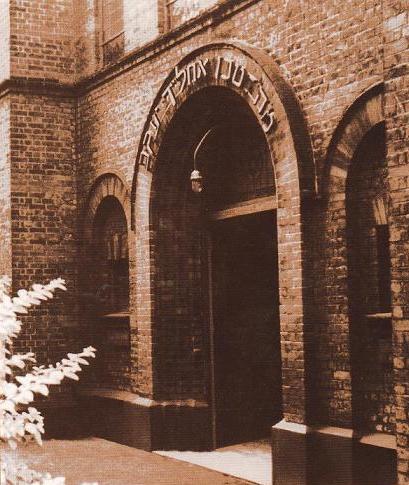
Entrance to the former Earlham Grove synagogue
|
Congregation Data |
|
Name: |
West Ham and Upton Park Synagogue,
from 1976(ii) |
|
Earlier Names:(iii) |
West Ham Hebrew Congregation,
from formation until 1906.
West Ham Associate Synagogue,
from 1906 until 1927.
West Ham District Synagogue,
from 1927 until 1972.
|
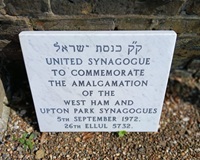
Plaque (now at Willesden Cemetery) commemorating the
merger of West Ham and Upton Park synagogues
|
|
West Ham and Upton Park District Synagogue
This was the name adopted on 3 July 1972,
following the merger on 1 July 1972 with
Upton Park District Synagogue.
Following some years of discussion, the proposed merger had been approved on
22 May 1972 at a meeting between the hon. officers of the congregation
and the board of management of the Upton Park congregation.
The new name was not formally approved by the United Synagogue until 13 November 1972.
A Service of Amalgamation was held on 5 September 1972, attended by Chief Rabbi
Immanuel Jakobovits.(iv) It remained the name until about 1976, when congregation ceased being a
district synagogue.(v) |
|
Address: |
93-95 Earlham Grove, Forest Gate, London E7 9AR.(viii)
Having outgrown its existing premises, on 2 December 1900 the
congregation resolved to purchase the house and plot of ground at
95 Earlham Grove for the sum £1,200,(ix) with the then main Great Eastern Railway line
running along the back.
On 28 February 1904, the adjoining premises at no. 97 was also acquired,
for the sum of £595(x)
and by 1906, no. 93 had also been
acquired.(xi)
The architect, Bertie Crewe,
drew up plans for the construction
of the synagogue.(xii) However it was not until 4 August 1910 that
building works commenced and on 27 October 1910, the foundation stone
was laid by Sir Herbert Cohen in a ceremony conducted by the Chief Rabbi Dr. Hermann
Adler.(xv) The synagogue was consecrated on 9 April
1911, also in the presence of Chief Rabbi.(xvi)
In 1928, a Communal Hall and classrooms, designed
as well by
Bertie Crewe,
were also erected on the site at the cost of £6,500
and these were consecrated by Chief Rabbi Dr. J. Hertz on 9 September
1928.(xvii)
In 1933, it was agreed to
build an extension to the main building and the architect,
Cecil Jacob Eprile,
was instructed to prepare the requisite plans. These would enable
seating for 112 men and 69 women and include a choir gallery. The
reconstructed synagogue was reconsecrated on 16 June 1935 by Chief Rabbi
Dr. J. Hertz.(xviii)
In the later stages of World War II, on 6 March 1945, a deadly German V2 rocket
fell in the vicinity of Earlham Grove, causing widespread devastation
and loss of life. Part of the minister's residence and the caretaker's
home were destroyed and synagogue and communal hall sustained considerable
damage.(xix) Temporary repairs were carried out
at the time but it took
several years for the synagogue, the communal hall (renamed the Abram
Emanuel Abrahams Hall) and the classrooms to be fully repaired and
redecorated. Following such repair, a ceremony was held on 16 July 1950 to mark the reopening and reconsecration of
the premises.(xx)
|
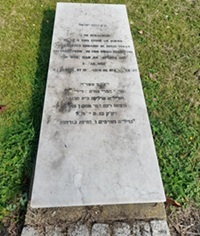
Burial Stone for the destroyed Sifrei Torah at Marlow Road Cemetery
|
|
A youth synagogue, designed by the architect, Edward Lyons, was
later added to the complex. Work commenced
on 1 March 1958 and the foundation stone
was laid on 13 July 1958 by Aaron Goldberg, the then Life President of
the synagogue, in a ceremony officiated by
Dayan Morris Swift.(xxi)
The building was consecrated 31 May 1959 by Dayan Swift.
Named The Alfred Collett Youth Synagogue, it was reputedly the first purpose built youth synagogue in London.
On the afternoon of Saturday, 11 August 1984,
a fire broke out at the synagogue, caused by an electrical fault,
destroying the synagogue and its contents. Thirteen of the synagogue's sifrei torah were
destroyed or severely
damaged and their remains were buried in a special plot at in the front
of the ohel at Marlow Road Cemetery, East Ham, on 9 September 1984,
preceded by a special service conducted by the Chief Rabbi, among others, in the congregation's
Youth Synagogue.(xxiii)
As a consequence of the fire the congregation moved to the Youth
Synagogue, which was undamaged by the blaze, as was
the Communal Hall.(xxiv)
On the closure of the East Ham, Manor Park & Ilford Synagogue in 1986,
the majority of that congregation's remaining members transferred to
West Ham and Upton Park Synagogue.(xxv)
|
|
Formation and Earlier Premises: |
The first organised Jewish services in West Ham can be traced back to
Ephraim Samson, who called a meeting on 18 August 1897 at his home at 43
Buckingham Road, Stratford, Forest Gate.
This resulted in services being held, at the Earlham Hall, Forest Gate, for the 1897, 1898 and 1899 high holy days only, where some 100
worshippers attended.(xxviii)
In about 1899 the congregation was operating from 3 Windsor Road, Forest
Gate,(xxix) and on 8 October 1899, it was agreed to rent a house at 129 Forest Lane, Forest Gate, for use as a synagogue,
the first Sabbath services being held there on 6 January
1900.(xxx)
However, it appears, almost from the outset,
that these premises were inadequate for the needs of the congregation,
as in December 1900 the congregation resolved to purchase the site at
Earlham Grove, although it would be over a decade before the
congregation was able to complete the construction of their new
synagogue at these premises.
|
|
Final Status: |
The congregation celebrated its Centenary in 1997.
In preparation for this event, the congregation requested the United
Synagogue to return to it the impressive collection of ritual silver
which it had sent to the United Synagogue for storage and safekeeping
following the 1984 fire. Unfortunately, most of this could not be found,
and the United Synagogue admitted that the items may have been distributed to other active communities
(possibly under the assumption they were no longer required by West Ham)
without recording the fact, or even sold off without permission. The local congregation only managed to recover a portion
of it.(xxxiii)
The Centenary commemorative service, attended by the Chief Rabbi, was held on 14
September 1997,(xxxiv)
by which time membership had dropped to only some 200 members, of whom
only 63 still resided locally.(xxxv)
Numbers continued to dwindle and ultimately rendered the congregation unsustainable,
prompting the United Synagogue to officially close the doors and dissolve the congregation in 2004.(xxxvi)
Following the 2004 closure, the entire site was sold,
the remaining structures demolished and replaced by a four-storey
block of social housing apartments, named
Adler Court (in honor of Chief Rabbi Dr.
Hermann Adler, who had consecrated the original synagogue many years
earlier). The site incorporates a
memorial plaque to the former
synagogue.(xxxvii)
The closure marks the demise of the last synagogue in Newham. |
|
Ritual: |
Ashkenazi Orthodox |
|
Affiliation: |
The congregation was unaffiliated until joining the
United Synagogue
as an associate synagogue in 1907 and was raised to district synagogue
status in 1927.(xxxviii)
In about 1976, it became a constituent synagogue, when the district
synagogue category was discontinued. |
|
Ministers:(xlii)
To view a short profile of a minister - hold the cursor over his name. |
Rev. (later Rabbi)
Louis Mendelsohn - from 1903 until 1914 and
thereafter, as "Dayan" Mendelsohn, he also held
the post of minister until
about 1931.(xliii)
Rev. Isaac Aarons
- first reader and effectively minister from 1914 until 1931.(xliii)
Rabbi Solomon Z. Mestel
- minister from 1931 until 1934.(xliv)
Rev. Benson Fertleman
- minister from 1937 until his death in 1942.(xlv)
Rabbi Ephraim Ferdinand Einhorn
- temporary war-time minister from 1942 until 1945.(xlvi)
Rev. (later Rabbi) Isaac Waller
- minister from 1946 until his death in 1956.(xlix)
Rev. Gerald Schneider
- minister from 1957 until 1973.(l)
Rev. (later Rabbi) Myer Levenstein
- minister from 1973 until his death in 1981.(li)
Rev. Saul Beck
- minister from 1981 until his death in 1983.(lii)
Rabbi Aryeh M. Sufrin
- part-time minister from 1983 until 1987.(liii)
Rev. Michael A. Atkins
- minister from 1989 until 1992.(lvi)
Rabbi Ronen Broder
- part-time minister from 1992 until about 1998.(lvii)
Rev. Shlomo Odze
- minister in about 1999/2000.(lviii)
Rabbi J. Butler
- minister in about 2001.(lix)
Rabbi Ephraim Levine
- minister from at least 2001 until 2003.(lx)
|
|
Readers:
To view a short profile of a Reader
whose name appears in blue - hold the cursor over his name. |
Rev. Isaacs Aarons - see
above
Rev. Gershon Rosenthal
- reader (later second reader) from about 1899 until 1930.(lxiii)
Rev. Herz Rachman
- reader from 1931 until 1947.(lxiv)
Rev. C.S. Rosenberg
- reader from 1947 until January 1953.(lxv)
Rev. L. Ben-Aryeh (previously Rev. L. Schechter)
- reader from 1954 until 1958.(lxvi)
Rev.
Isaac Myer Woolf
- reader from 1958 until 1959.(lxvii)
Rev. P. Krief
- reader from 1961 until 1962.(lxviii)
Rev. Harry Cosson
- reader from 1962 until 1972.(lxix)
|
|
Lay Officers:
|
Unless otherwise stated, all data on lay officers has been extracted from listings in
Jewish Year Books (although in many instances officers' given
names have come from other sources).(lxxiii) |
|
Wardens
1912-1913 - Symon Weber & Leon Harris
1913-1914 - Symon Weber & J. De Haas
1914-1915 - Symon Weber & A. Michaels
1915-1919 - Symon Weber & J. De Haas
1919-1923 - Symon Weber & S. Zucker
1923-1930 - Symon Weber & Aaron Goldberg
1930-1934 - Aaron Goldberg & L. Norden
1934-1935 - Aaron Goldberg & M.M. Harris
1935-1938 - Aaron Goldberg & T. Presky
1938-1940 - Aaron Goldberg & I. Abrahams
1940-1945 - no data
1945-1948 - Paul Lowi & Leon Spiro
1947-1952 - Alfred Collett & Leon Spiro
1948-1949 - Alfred Collett & A.H. Milgrom
1949-1951 - Alfred Collett & Victor Schaverien
1951-1952 - Alfred Collett & A. Vigon
1952-1953 - S. Freedman & H. Labovitch
1953-1954 - Alfred Collett & H. Labovitch
1954-1956 - A. Vigon & S.S. Waldman
from 1956 - no data
Treasurers
1897-1909 - E.H. Cohen(lxxiv)
1909-1927 - Abram Emanuel Abrahams
Financial Representatives
1927-1929 - L. Norden
1929-1940 - Henry Webber
1940-1945 - no data
1945-1946 - M. Blumenthal
1946-1956 - C. Molen
1956-1960 - no data
1960-1968 - Julius Mays(lxxv)
1968-1969 - Ronnie Finger(lxxv)
1969-1981 - Julius Mays(lxxv)
from 1981 - no data
|
Chairman
1897-1900 - Symon Webber(lxxvi)
President
1900-1912 - Symon Webber(lxxvii)
Hon. President
1930-1936 - Symon Webber
Life Presidents(lxxx)
1949-1974 - Aaron Goldberg
1986-1991 - Alf Weinberg
1994-1996 - Arthur C. Gilbert
1997-not known - Monty Black
Vice Presidents
1900-1902 - L. Joseph(lxxxi)
1902-190? - Ephraim Samson(lxxxii)
1906-1911 - N.H. Van Cleef
Secretaries & Hon Secretaries(lxxxiii)
1897-1902 - Ephraim Samson(lxxxiv)
1902-1903 - F. Lewis Cohen(lxxxv)
1903-1918 - Louis Norden(lxxxv)(lxxxvi)
1918-1935 - M.B Fidlan(lxxxvi)
1935-1960 - Maurice S. Barnett
1960-1972 - Harold H. Posner
1972-1994 - Arthur C. Gilbert
1994-1996 - Miss Jacqueline Burns
1996-2004 - Mrs Elizabeth Benjamin
Beadles / Collectors(lxxxvii)
1919-1925 - Bernard Ostroff
1926-1958 - Myer Woolf
1958-1969 - Shimon Bergman
|
|
Membership Data: |
Jewish Year Books (seat-holders)(xc)
|
1914 |
1915 |
1917 |
1918 |
1919 |
1920 |
1921 |
|
283 |
289 |
304 |
288 |
300 |
400 |
428 |
United Synagogue
(male seat-holders)(xci)
|
1940 |
1950 |
1960 |
1970 |
|
457 |
561 |
523 |
296 |
Other Sources
(Howard Bloch's Earlham Grove Shul, 1997)(xcii)
|
1933 |
1945 |
1946 |
1962 |
1969 |
1997 |
|
336 male & 160 female |
495 male & 47 female |
579 male & 53 female |
500 male & 178 female |
328 male & 142 female |
138 male & 162 female |
National Reports & Surveys(xciii)
1977 - 322 male (or household) members and 153 female members
1983 - 249 male (or household) members and 149 female members
1990 - 371 members (comprising
324 households, 2 individual male and 45 individual female members)
1996 - 294 members (comprising
256 households, 9 individual male and 29 individual female members)
2001 - 203 members (comprising
80 households, 29 individual male and 84 individual female members)
Also see below for 1911 seatholder records on All-UK
Database.
Harold Bloch's Earlham Grove Shul, 1997, contains a lists of
the synagogue's seatholders in 1911 (Appendix 2) and 1935 (Appendix 3). |
|
Local Government Districts: |
West Ham, a suburb in east London north of the river Thames, is now in the London Borough of Newham
(created on 1 April 1965), within the
administrative area of Greater London.(xciv)
It was previously the former
County Borough of West Ham (incorporated as a borough on 1 April 1899),
geographically within the County of Essex.
|
|
Cemetery
Information: |
For
United Synagogue cemeteries, see Cemeteries of the United Synagogue.
The Jewish cemetery at West Ham was opened in 1857, long before a congregation was established locally. It initially served two
City synagogues,
the New Synagogue and
the Great Synagogue.
(For additional information, see
JewishGen's Cemetery Discovery Project
- West Ham). |
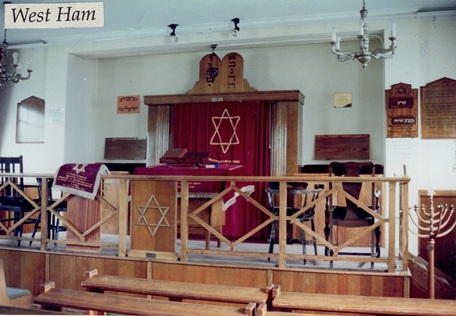
Interior of the former synagogue in Earlham Grove (post 1984 fire)
(courtesy Jeff Rosen)
|
Search the All-UK Database
The records in the database specifically associated with the Synagogue include:
Click here for a list of other London records in the Database that may also include records
associated with this congregation.
|
|
Online Articles, Bibliography and Other
Material
relating to this Congregation
on JCR-UK
on Third Party Websites
Notable Former Members of this Congregation
and
Other Notable Jewish Associations with West Ham
and the London Borough of Newham
-
Dr Louis Comyns (d.1962) was the Member
of Parliament for the West Ham constituency of Silvertown from 1945 until 1950 (when the constituency was abolished).
-
Victor Shaverein, one of London's best known kosher caterers,
was a member of West Ham synagogue.
-
Ronald Waldman (d.1978), a senior executive at the BBC, sung in the
West Ham synagogue choir.
-
Alf Weinberg (d.1991) was the commanding figure in synagogue affairs from the 1960s until his death in 1991.
He served as senior warden for much of that period
-
Jewish Mayors of the London Borough of Newham:
-
Abraham Wolffe, born in Glasgow, was the first Jewish mayor of the London Borough of Newham, 1968-1969;
-
Michael Davidson (d.1991) was Mayor of the London Borough of Newham in 1970-1971.
-
Notable burials at West Ham Jewish Cemetery:
-
Cadeluc Jacobson,
former native of Hanover, one of the Jewish
survivors of the 1815 Battle of Waterloo;
-
Baron Ferdinand de Rothschild
(1839-1898) and his wife Evelina
Rothschild (1839-1866), to whom he
built a magnificent mausoleum, and is buried
next to her.
-
Sir David Salomons (1797-1873),
a founder of the London and Westminster Bank and
the first Jewish sheriff of the City of London
(1855) and the first Jewish Lord Mayor of London
(1855-56).
-
Jewish connections with West Ham United Football
Club;
-
David Gold (1936-2023), born in Stepney,
London, of a Jewish father, played for the club at youth level,
and was joint chairman of the club from 2010 until his death in 2023;
-
Avram Grant, from Israel, was manager
of the club during the 2010-11 season;
-
Israeli football players who have played for the
club include:
-
Eyal Berkovic - 1997-1999;
-
Yaniv Katan - 2005-2006;
-
Yossi Benayoun - 2005-2007, 2012 (on loan);
-
Tal Ben Haim - 2010-2011.
-
In 1923, Hakoah Vienna, a Jewish Austrian sports club, became the first foreign football club
to win against an English club on English ground, when
it defeated West Ham United 5-0
at the Boleyn ground (also known as Upton Park).
|
|
Congregation Records |
|
Registration District (BDM): |
Newham from 1 January 1968(xcv) -
Link to Register Office website
|
|
Marriage Records: |
Marriage Registers (first entry 1911; last entry February 1994) deposited with Newham Register Office |
|
Other Organisations & Institutions
connected to this congregation
|
|
Educational
-
Talmud Torah & Hebrew and Religious Classes
- Proposed at a meeting on 28 September 1897, the
classes opened on 29 November 1897 with 25 pupils.(c)
Nearly eight decades later, due to dwindling numbers, it was decided to close the classes
(the last class taking place on 20 July 1975), and amalgamate with the
classes in Ilford.(ci)
Headmasters (other than the
congregation's minister or reader): Maurice Barnett (1923-1947);
Dr. B. Lorraine (1947-1975).(cii)
The following are details of the number of pupils
enrolled in the clases for the relevant years:(ciii)
|
1899
|
1901
|
1902
|
1906
|
1909
|
1912
|
1913
|
1914
|
|
55
|
75
|
80
|
100
|
110
|
113
|
182
|
110
|
|
1916
|
1920
|
1921
|
1923
|
1930
|
1932
|
1972
|
1975
|
|
98
|
120
|
140
|
148
|
146
|
189
|
20
|
12
|
|
|
Other Institutions
-
Ladies Guild - formed on
10 December 1899.(cvi)
-
Burial Society
- established on 4 November 1900.(cvii)
-
Ladies Benevolent Society
- active by 1924.(cviii)
-
The Forest Gate and District Jewish Social and Literary Society - established in
October 1928.(cix)
-
The West Ham company of the Jewish Lads' Brigade was the largest in
London in the 1930s.(cx)
-
Ivri Social and Literary Society
- in 1932 this also incorporated the local Habonim (founded 1931)
and The Earlham Club (a Jewish youth club founded during the interwar period).
Following wartime suspension, it was revived
in 1955.(cxiii)
-
A refugee hostel for 20 Jewish boys was opened at 51a Romford Road, Stratford,
on 23 April 1939.
It later moved to 16 Earlham Grove, supervised
by the West Ham and District Refugee
Children's Committee.(cxiv)
|
|
Notes & Sources
(↵
returns to text above)
|
|
The following notes rely, to a large extent, on
Earlham
Grove Shul - One Hundred Years of West Ham Synagogue and Community by Howard Bloch (1997),
which we refer to as "Bloch's History of the Shul". In
parallel, a
history of the congregation to 1911 (the "online 1911 History"),
written for The Order of Service for the Consecration of the Earlham Grove synagogue,
appears as chapter 2 (pp. 7-15) of Bloch's History of the Shul and is
also available online on JCR-UK, with a
link from this page.
|
List of United Synagogue Congregations
Jewish Congregations in the London Borough of Newham
Jewish Congregations in Greater London
Greater London home page
Page created: 23 July 2006
Data significantly expanded and notes first added: 9 June 2026
Page most recently amended: 26 June 2026
Research by David Shulman and Steven Jaffe
Formatting by David Shulman
Explanation of Terms |
About JCR-UK |
JCR-UK home page
Contact JCR-UK Webmaster:
jcr-ukwebmaster@jgsgb.org.uk
(Note: This is to contact JCR-UK, not the above Congregation)

Terms and Conditions, Licenses and Restrictions for the use of this website:
This website is
owned by JewishGen and the Jewish Genealogical Society of Great Britain. All
material found herein is owned by or licensed to us. You may view, download, and
print material from this site only for your own personal use. You may not post
material from this site on another website without our consent. You may not
transmit or distribute material from this website to others. You may not use
this website or information found at this site for any commercial purpose.
Copyright © 2002 - 2026 JCR-UK. All Rights Reserved
|
|