|
|
|
The Genealogical Research Division of

|
|
|
|
|
|
|
|
The Genealogical Research Division of
|
|
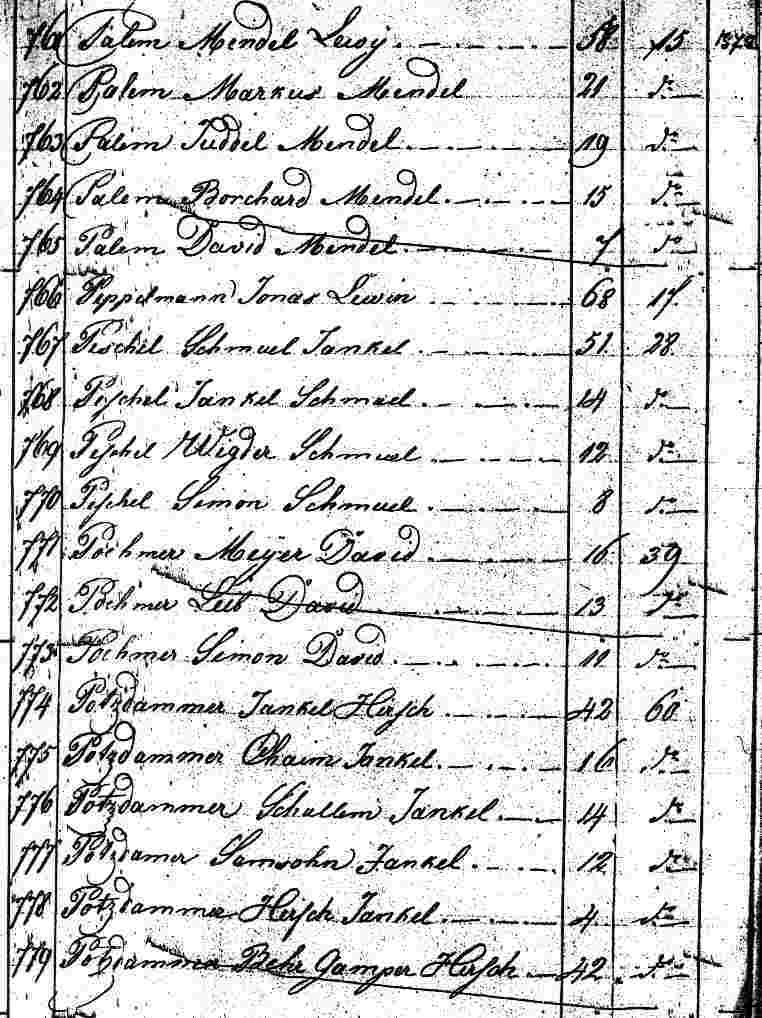
Jews in Hasenpoth / Aizpute 1834Developed and Donated by the Courland Research GroupThis database contains over 1,000 names of Jews lawfully entitled to reside in Hasenpoth (now Aizpute, Latvia) taken from the material microfilmed in the Riga Archives in 1941. 
Background and StatisticsThis database consists of over 1,000 Jewish males living in Hasenpoth in 1834 (now Aizpute, in Latvia). Jewish males of all ages are listed, including a four-day old infant not yet given his name. The names of women or female children were not recorded. A house number is given, making it possible to see how many people lived together in a household and to make reasonable inferences about family relationships. This is the earliest list in the JewishGen Latvia Database, and it represents the first fruits of the Courland Research Group's Herder/LDS microfilm project. The History of the MicrofilmsIn 1940/41, the Baltic Germans began a programme of microfilming parts of the Riga archives, prior to the repatriation of the German ruling caste to Germany. In addition, they took some original archive material with them as they withdrew. These microfilms eventually came to be lodged at the Herder Institute in Marburg, Germany, where they remain today. In 1986, the Church of the Latter-day Saints, the Mormons, successfully negotiated with the Herder Institute to make a copy of these microfilms. Consequently the microfilms are available on order through the global network of LDS Family History Centres. To date, Latvia has refused access to the LDS for microfilming, with the effect that the Herder/LDS microfilms are the only available microfilm source for those seeking to carry out research from primary sources. The Formation of the Courland Research GroupIn early 1999, three active members of JewishGen: Dr. Paul Berkay [USA], Dr. Martha Levinson Lev-Zion [Israel] and Dr. Abraham Lenhoff [USA] became convinced that these microfilms were more important to the study of Courland Jewry than had previously been appreciated. Together they formed the nucleus of the Courland Research Group, with a view to raising the to buy a set of the Herder microfilms. The goal was to create a database of Courland Jewish records using the Herder microfilms. It was known that seven of the 127 Herder microfilm rolls had material of Jewish interest. To see an Inventory of these rolls click here. The difficulty was justifying the purchase of the whole set with a view to seeing whether there was additional material, previously unidentified, relevant to the study of Jewish family history. Following considerable debate as to the value of the exercise, the Courland Research Group Steering Committee raised the funds and following a year of negotiation, a set of microfilms from the Herder Institute was delivered to Dr. Berkay in California. On receipt, he set to work on an the initial inventory of all 127 rolls, carrying out an image by image search to identify all pages of Jewish interest. What has emerged is a genealogical treasure chest, full of puzzles and conundrums but containing extensive original records relating to early Jewish families living in Courland and surrounding areas. To date, the Courland Group has completed an inventory of approximately 50 of the 127 films. Over 1,000 previously unrecorded pages of Jewish material have been identified. In addition, the Courland Group has made a commitment to the LDS to create a usable name index to the Jewish families recorded in these documents. What makes the microfilms difficult?The microfilms are beautiful but difficult. The microfilming exercise was clearly carried by the Baltic Germans in considerable haste. The pages are microfilmed out of order, and as often as not upside down or backwards. Frequently left-hand pages are filmed but not the right hand pages, or the left and right hand side of the pages are located on different rolls of film. It is rare for there to be a full run of pages relating to a single list. Having said this, once the ordering is understood, there are many lists where the handwriting is reasonably clear and readable and where it should be possible, with the help of volunteers, to create the index of names and the database of family entries. The task that the Courland Group set itself was:
The Hasenpoth List - What kind of List is it?The Baltic Germans labeled this list as an Oklad or tax list, and this name has been adopted by the LDS in its inventory. Further research suggests that the list is not, in fact, a true Oklad or tax list for the following reasons:
In genealogy it is important to differentiate between what we actually know and what we assume to be the case. Adopting fixed positions too early on can block research that eventually leads to a more complex and richer knowledge of the Jewish communities of the past. We do know that in time the ability to prove that a family's roots in Courland predated 1835 became important. By an Ukase [law], Jews who were enumerated in the census of that year or earlier were granted full rights of residence in the Province of Courland. Those who came after that date remained on sufferance and from time to time there were calls for expulsion. Being able to produce evidence of the legal right to reside was important and it is one of the many reasons why Jews were unwilling to give up their registrations in towns or areas of origin. Using the list of Hasenpoth Jews: The Entry Fields explainedCourland had become part of the Russian Empire in 1795, but the list is in handwritten German fraktur script rather than Cyrillic. This is because the language of culture and administration remained German as it had been for some 500 years since the conquest of the area by the German Teutonic knights.
What can this database tell me about my family history?
Helping Jewish Families to find roots
Acknowledgements:The Courland Research Group thanks Dr. Peter Wörster of the Herder Institute, Marburg Germany for his advice and assistance. Dr. Wörster is the author of a number of books and articles on the Herder Films including Die Kurlandischen Seelenlisten 1798-1834, Marburg 1997 [co-authored with the late Arthur Hoheisel]. The extraction and databasing of the Hasenpoth list was undertaken by Martha Lev Zion and Abraham Lenhoff. Paul Berkay continues with the task of inventorying all rolls. Further assistance was given by Stanislav Gorbulev. The Courland Research group expresses its gratitude to Michael Tobias our WebMaster and to Warren Blatt for additional web work.
Constance Whippman, Database Co-ordinator
|

|
Subscribe to our newsletter Edmond J. Safra Plaza | 36 Battery Place | 646.437.4202 | info@jewishgen.org | |
|