JCR-UK

The former

Hambro' Synagogue

City of London, London EC3

and Commercial Road, London E1


JCR-UK is a genealogical and historical website covering all Jewish communities
and congregations throughout the British Isles and Gibraltar, both past and present.

Hambro' Synagogue
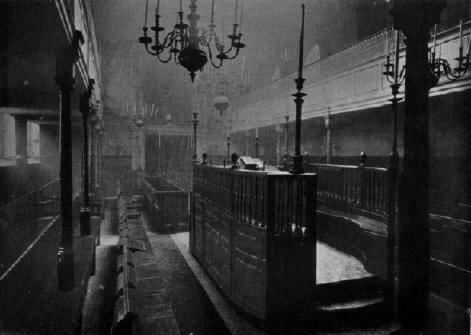
The Hambro' Synagogue, Fenchurch Street
(from Roth's' "History of the Great Synagogue"
part of JCR-UK's Susser Archives)

Congregation Data

Name:

The Hambro' Synagogue(ii)

The name "Hambro", a corruption of the word Hamburg, was presumably chosen as the congregation became the centre of the Hamburg Jewish colony in London, who naturally drifted to it.(ii) The congregation initially conformed to the Hamburg minhag (customs).

It was also known, at various times as "Mordecai Hamburger's Synagogue" (an alternative name for the founder, who was generally known as Marcus Moses), "Wolf Prager's Synagogue" (who laid the foundation stone for the second synagogue) and "Henry Isaac's Synagogue" (a prominent early patron of the congregation).(iii)

Formation and Addresses:

The Hambro' Synagogue was the second of the three historic Ashkenazi synagogues of the City of London, moving to London's East End in 1899.

It was a schismatic offshoot of the Great Synagogue, and was founded by a wealthy gem dealer, Marcus (or Mordecai) Moses, also widely known as Marcus Hamburger. Moses, together with Abraham Nathan, and Sampson Mears, wished to establish a small house of study and prayer (a beth hamedrash) at St. Mary Axe, in the City. The move was bitterly opposed by the Great Synagogue, who with the support of the Sephardi Bevis Marks Synagogue, had obtained an injunction from the Court of the Alderman of the City of London against the erection of such alternative place of worship.  A dispute subsequently developed regarding a divorce, in which Moses had publicly and scathingly criticised the ecclesiastical authorities, which lead to his being excommunicated by the then Chief Rabbi of the Great Synagogue (the decree subsequently being dissolved by the Hambro's first rabbi).(iv)

1707 to 1725 (or 1721)

In 1706/7, Marcus Moses, with some friends from Hamburg, nevertheless  established a congregation meeting in his home in Magpie Alley(v) (also called Church Row or Church Passage), a narrow passage, close to the present Fenchurch Street railway station, that ran south towards Crutched Friars (just to the east of present-day Fenchurch Place), London EC3. At the same time, a separate burial ground was acquired by the congregation in Hoxton.
However, the excommunication ruined Moses financially and he was forced to travel abroad for several years to recoup his losses. Religious services continued from his house in his absence.(viii) Although there are conflicting accounts as to where and when he went and when he returned,(ix) it appears that in about 1712 he went to Fort St. George (Madras) in India and was involved in the purchase for the governor of Madras, Thomas Pitt, of the famous Pitt diamond - reputedly "the largest diamond ever seen in Europe", later sold to the regent of France. In 1721 he returned to England with a large fortune, which he was able to utilize to built a new synagogue for his congregation.(x)

1725 (or 1721) to 1893

In 1725 (or 1721)(xv), in defiance of the injunction and against the objection of the Great Synagogue and Bevis Marks Synagogue, Marcus Moses built a regular synagogue in the garden adjacent to his house in Magpie Alley, Fenchurch Street,(xvi) having himself previously purchased the freehold to the plot.(xvii) The foundation stone for this structure, discovered in 1893, gives the Hebrew date of foundation as 3 Sivan 5485 (which corresponds to 15 May 1725), and states that it was laid by R. Zeeb Wolf, son of Isaac Bimas, of Bomsal, Prague (who became known as the Wolf Prager), Moses's son-in-law.(xviii) The synagogue had seating for 218 men and 55 women.(xix)

In 1805, the freehold of the site and building in Magpie Alley (by then known as Church Passage) was bequeathed to the congregation in 1803/5 by Eleazar Philip Salamons.(xxii)

In 1892/3, the synagogue closed and was demolished, as part of City of London improvements.(xxiii)

1893 to 1899

Services were held during this period in the vestry room (or hall) of the Great Synagogue, Dukes Street (now Dukes Place), London EC3.(xxiv) The congregation's books and property were stored in the basement of the Central Synagogue in Great Portland Street, but many of the valuable items were missing when later reclaimed.(xxv)

1899 to 1936

From well before the establishment of the United Synagogue, the Hambro' had serious financial problems and there had been numerous abortive schemes for either its closure or its amalgamation with the Great Synagogue, the most notable being in 1863. As part of the 1870 scheme on the establishment of the United Synagogue, the Council of the United Synagogue had resolved that in the event of the closure of the synagogue, its name would be transferred to first synagogue founded after such close.(xxvi)  This relocation policy was explicitly designed to handle the shifting Jewish demographics out of the City of London and into the East End.

Accordingly, a new Hambro' Synagogue was opened in 1899 in Union Street (renamed Adler Street in 1913 after the former Chief Rabbi, Dr. Hermann Adler, who had recently died), London E1, which runs south, some 700 feet from Whitechapel High Road to Commercial Road, about 1,000 east of Gardiners Corner, in the heart of London's East End. The building, designed by architect Lewis Solomons,(xxvii) with seating capacity for 400 congregants,(xxx) was consecrated by Chief Rabbi Dr. H. Adler on 27 August 1899.(xxxi)

Final Status:

After nearly 230 years of existance, the synagogue closed on 30 April 1936(xxxii) and amalgamated with the Great Synagogue, although the congregation initially retained a distinct administrative identity within the United Synagogue, to the extent of electing honorary officers and a board of management.(xxxiii)

Ritual:

Ashkenazi Orthodox

Affiliation:

One of the original five synagogues that formed the United Synagogue in 1870, of which it remained a constituent member until 1936.(xxxiv)

Related Institution:

The Hambro' Synagogue was one of the synagogues instrumental in setting up The Beth Hamedrash, sometime prior to 1782.(xxxv)

Ministers:
(To view a short profile of a minister or cantor - hold the cursor over his name.)

Rev. Jochanan Höllischau - Hambro's first rabbi, from 1707 until unknown date(xxxix) 

Rabbi Hart Lyon (Rabbi Hirsvh Lewin) - rabbi of both Hambro' and Great synagogues, from 1758 until 1764(xl) 

Rabbi Meshullam Solomon (Rabbi Israel Meshullam Zalman Emden) - rabbi from 1764 until 1780(xli)

Rev. Samuel Marcus Gollancz - minister and reader from 1854 until 1899(xlii)

Rev. Woolf Esterson - minister from 1899 until 1936(xliii)

Cantors (Chazanim) / Readers and Others:

Rev. Solomon Jacobs - reader during early 1840s (c.1843)(xlvi)

Rev. Herman Hoelzel - reader from 1845 until 1852(xlvii)

Rev. Philip Hyman Forlezer - temporary assistant reader, appointed 1876(xlviii)

Rev. Emanuel Spero - reader from 1880 until about 1883(xlix)

Rev. Israel Greenberg - reader by 1885(lii)

Rev. Joseph Hiller - reader from 1901 until 1928(liii)

Rev. Sidney Israel Lubin (temp) reader from 1925 until 1936(liv)

Principal Office Holders (1874):(lvii)

Wardens - Joseph M. Isaacs & Hyman Levy

Financial Representative - Henry A. Israel

Secretary - Jacob Salomons, CT

Shamas - Michael Hyams

Beadle - Nathaniel Solomons

Lay Officers from 1896:(lviii)

Wardens

1896-1900 - Joseph Jacobs & Emmanuel Salomon

1900-1903 - Joseph Jacobs & Louis Lubinski

1903-1905 - Louis Lubinski & Harris Wolf

1905-1909 - Harris Wolf & L. Joseph

1909-1910 - L. Joseph

1910-1912 - L. Joseph & S. Lesser

1912-1917 - L. Joseph & Dr. J. Klein

1917-1918 - I. Passoff & Dr. J. Klein

1918-1931 - I. Passoff & M. Newman

1931-1932 - S. Griller & M. Newman

1932-1936 - M. Newman & S. Moss

1936-1937 - M. Newman & A. Isaacs

Financial Representatives

1896-1898 - J.A.J. De Villiers

1898-1903 - I. Weinberg

1903-1912 - Dr. J. Klein

1912-1927 - Walter B. Styer, LLB

1927-1929 - Joseph Koski

1929-1931 - A. Wix

1931-1935 - B. Harris

1935-1936 - A. Isaacs

1936-1937 - N. Temple

Secretaries

1896-1899 - L.J. Salomons

1899-1936 - Rev. Woolf Esterson

Membership Data:

In 1845 there were 70 ba'alai batim and 150 seatholders (Chief Rabbi's Questionnaire).

United Synagogue (male seat-holders)(lix)

1870

1880

1890

1900

1910

1920

1930

161

162

102

199

212

211

207

Also see below for seatholder records on All-UK Database.

Local Government Districts:

City of London synagogue

The locality of Magpie Alley and Dukes Place are both in the Aldgate Ward of the City of London (within the administrative area of Greater London since 1 April 1965).
Until the abolition in 1908 of civil parishes in the City, Magpie Alley was in the parish of St. Katherine Coleman and Dukes Street was in the parish of St. James Dukes Place.

Adler (Union) Street

Adler Street is in the London Borough of Tower Hamlets, created on 1 April 1965, within the administrative area of Greater London.(lx)
Previously, Adler Street (formerly Union Street) was in the Metropolitan Borough of Stepney (established 1900) within the County of London (established 1889), both of which entities were abolished in 1965.
The southern 500 feet of Union (Adler) Street, which included the Hambro' Synagogue, was in the civil parish of Mile End Old Town, the northern 200 feet being in the civil parish of Whitechapel. Both civil parishes were abolished in 1927 by absorption into Stepney Borough parish (until that parish's abolition in 1965).

Cemetery
Information:

JewishGen’s Cemetery Discovery Project:

Hoxton Cemetery (exclusively for members of Hambro' Synagogue) purchased by Marcus Moses on 25 March 1707 on a 150 year lease at 10 shillings per annum.(lxiii)

Hackney Cemetery (exclusively for members of Hambro' Synagogue), Luriston Road, disused in 1872.(lxiv)

Burial Registers

For United Synagogue cemeteries generally, see Cemeteries of the United Synagogue.


Search the All-UK Database

The records in the database specifically associated with the St John's Wood Synagogue include:

  • Seatholders Lists:

    • 1885 (151 records);

    • 1899 (71 records);

    • 1910 (255 records); and

    • 1933 (289 records).

Click here for a list of other London records in the Database that may also include records associated with this congregation.


Online Articles, Bibliography and Other Material
relating to this Congregation

on JCR-UK


Congregation Records

Registration District (BDM):

City of London
City of London (since at least 1901) - Link to Register Office website

Adler Street

Tower Hamlets (since 1 January 1983)(lxv) - Link to Register Office website

Marriage Records:

Two Marriage Registers, completed following the move from the City (first entry 27 October 1897; last entry 31 March 1927) are deposited with Tower Hamlets Register Office (ref: s24).


Other Organisations & Institutions
connected to this congregation

Educational

  • Children's Services - in the 1910s, these were held for twenty, later thirty, weeks per year commencing in November of each year, with an average weekly attendance of 430. Officiated by a rota of preachers, arranged from the ministers of the United synagogue and students at Jews' College, London.(lxvi)


Notes & Sources
(↵ returns to text above)

  • (i) Reserved.

  • (ii) Cecil Roth's The History of the Great Synagogue, 1950, Chapter IV (online). ↵

  • (iii) Introduction in Jewish Year Books 1901/2 through 1911. ↵

  • (iv) Chapter IV ("Roth's Chapter IV") of Cecil Roth's The History of the Great Synagogue, 1950, ("Roth's History") provided a detailed history of the break with the Great Synagogue and the establishment of the congregation. ↵

  • (v) Roth's Chapter IV and Peter Renton's The Lost Synagogues of London, 2000 ("Renton's Lost Synagogues"), p.39. ↵

  • (vi) and (vii) Reserved.

  • (viii) Renton's Lost Synagogues, p.40. ↵

  • (ix) The account given here of his journey abroad generally follows his biography on encyclopedia.com. However Roth's Chapter IV gives his year of departure as 1717, whereas in a letter from Wilfred S. Samuel published in The Jewish Guardian ("Samuel") in 1925, the year is given as 1711. Although both Roth's Chapter IV and Elkan Adler's Jewish Communities Series: London, 1930, ("Adler") agree that India was his destination, Samuel states that he went to the West Indies and in Rev. W. Esterson's The History of the Hambro' Synagogue on the Occasion of its 200th Anniversary, 1925, the destination was given as the East Indies. ↵

  • (x) In 1731 Moses went back to India where he died. His eldest son, known as Moses Marcus (b. 1701), converted to Christianity and published in 1724 an autobiographical tract justifying his action. ↵

  • (xi) to (xiv) Reserved.

  • (xv) Most sources agree on 1725, although Adler gives the year as 1721. ↵

  • (xvi) Introduction in Jewish Year Books 1901/2 through 1911. ↵

  • (xvii) Renton's Lost Synagogues, p.40. ↵

  • (xviii) Introduction in Jewish Year Books 1901/2 through 1911. The foundation stone was discovered in 1893 by architect Delissa Joseph in the course of excavation works relating to the construction of the building to replace the then demolished synagogue. ↵

  • (xix) Paul Lindsay's The Synagogues of London, 1993 ("Lindsay's Synagogues"), p. 46. ↵

  • (xx) and (xxi) Reserved.

  • (xxii) Introduction in Jewish Year Books 1901/2 through 1911. However, according to Renton's Lost Synagogues, p.41, his name was E.J. Salomons, who in 1803 presented the property "to the Synagogue in perpetuity." ↵

  • (xxiii) Introduction in Jewish Year Books 1901/2 through 1911. ↵

  • (xxiv) Renton's Lost Synagogues, p.41. "The Hall of the Great Synagogue" was the address listed in Jewish Year Books from the first edition (1896/7) through 1898/9 ↵

  • (xxv) Renton's Lost Synagogues, p.41. ↵

  • (xxvi) The United Synagogue 1870-1970 by Aubrey Newman (1977), pp. 28/9. ↵

  • (xxvii) Lindsay's Synagogues p.47. To view a description of the Jewish architectural works by Lewis Solomons, hold your cursor over his name. ↵

  • (xxviii) and (xxix) Reserved.

  • (xxx) Lindsay's Synagogues p.47. ↵

  • (xxxi) Introduction in Jewish Year Books 1901/2 through 1911. ↵

  • (xxxii) Jewish Year Book 1937. ↵

  • (xxxiii) The United Synagogue 1870-1970 by Aubrey Newman (1977), p.167. ↵

  • (xxxiv) The United Synagogue 1870-1970 by Aubrey Newman (1977), p.221. ↵

  • (xxxv) Renton's Lost Synagogues, pp.58/9. ↵

  • (xxxvi) to (xxxviii) Reserved.

  • (xxxix) Roth's Chapter IV. ↵

  • (xl) Roth's Chapter X. ↵

  • (xli) Roth's Chapter X. ↵

  • (xlii) Palgrave Dictionary of Anglo-Jewish History, 2011, p.348. ↵

  • (xliii) Rev. W. Esterson was listed as minister of the congregation in Jewish Year Books 1899/1900 through 1937. ↵

  • (xliv) and (xlv) Reserved.

  • (xlvi) Encyclopaedia of British Jewish Cantors, Chazanim, Ministers and Synagogue Musicians by Michael Jolles ("Jolles's Encyclopaedia"). ↵

  • (xlvii) Biography of Herman Hoelzel on oztorah.com website. ↵

  • (xlviii) Jolles's Encyclopaedia. ↵

  • (xlix) Jewish Chronicle obituary 30 September 1927. ↵

  • (li) and (lii) Reserved.

  • (lii) Rev. Greenberg's position was confirmed by contemporary synagogal notices and his professional advertisements as a mohel in the Anglo-Jewish press. ↵

  • (liii) Rev. J. Hiller is listed as reader of the congregation in Jewish Year Books 1902/3 through 1927. ↵

  • (liv) Rev. I. Lubin is listed as reader (temporary) of the congregation in Jewish Year Books 1928 through 1936. ↵

  • (lv) and (lvi) Reserved.

  • (lvii) Jewish Directory for 1874, edited by Asher I. Myers. The Directory actually lists 15 different office holders for the congregation, all of whom are included in the Communal Leaders dataset within the All-UK Database. To search see Database above. ↵

  • (lviii) All data presented here on lay officers has been extracted from listings in Jewish Year Books, first published 1896/7. Where a person was first listed in a year book as holding a particular office, it has been assumed that his term of office commenced in the year of publication of the relevant year book and that he continued in office until the commencement of office of his successor, unless the office was shown as vacant. Initially year books corresponded to the Hebrew year, and thus ran roughly from autumn of one year - the year of publication - until autumn of the next year. From 1909, year books were published according to the Gregorian year, being published generally towards the end of the year prior to the year appearing in the title of the year book. For example, if an officer is listed in Jewish Year Books 1919 through 1924, it is assumed that he commenced office in 1918 and continued in office until 1924. However, it should be noted that this is only an assumption and, accordingly, his actual years of office may differ somewhat from those shown here. ↵

  • (lix) The United Synagogue 1870-1970 by Aubrey Newman (1977), pages 216/7. ↵

  • (lx) The London Borough of Tower Hamlets, an Inner London Borough within the Greater London administrative area, was created on 1 April 1965 upon the merger of the former Metropolitan Boroughs of Stepney, Bethnal Green and Poplar (all of which had been in the former County of London, established 1889). ↵

  • (lxi) and (lxii) Reserved.

  • (lxiii) Renton's Lost Synagogues, p.39 and Lindsay's Synagogues p.46. ↵

  • (lxiv) Renton's Lost Synagogues, p.39. ↵

  • (lxv) The former Registration Districts were: Mile End Old Town, from 1 October 1857 until 1 January 1926, and Stepney, from 1 January 1926 until 1 January 1983. All registers would now be held by the current register office. ↵

  • (lxvi) The Jewish Year Book 1915. ↵


List of United Synagogue Congregations

Street Directory of Synagogues in the London East End and City of London

Jewish Congregations in the City of London and the London East End

Jewish Congregations in Greater London

Greater London home page

Page created: 24 May 2006
Data significantly expanded and notes first added: 8 October 2026
Page most recently amended: 27 October 2026

Research and formatting by David Shulman


Explanation of Terms   |   About JCR-UK  |   JCR-UK home page

Contact JCR-UK Webmaster:
jcr-ukwebmaster@jgsgb.org.uk
(Note: This is to contact JCR-UK, not the above Congregation)

JGSGB  JewishGen


Terms and Conditions, Licenses and Restrictions for the use of this website:

This website is owned by JewishGen and the Jewish Genealogical Society of Great Britain. All material found herein is owned by or licensed to us. You may view, download, and print material from this site only for your own personal use. You may not post material from this site on another website without our consent. You may not transmit or distribute material from this website to others. You may not use this website or information found at this site for any commercial purpose.


Copyright © 2002 - 2026 JCR-UK. All Rights Reserved