
|
|
|
The Genealogical Research Division of

|
|
|
|
|
|
|
|
The Genealogical Research Division of
|
|
Lithuania 1897 Census DatabaseExtracts of the Jewish records in the
|
||||||||||||||||||||||||||||||||||||||||||||||||||||||||||||||||||||||||||||||||||||||||||||||||||||||||||
|
· Historical Background · About This Database · Data Fields · Obtaining Originals · Bibliography · Place Names in the Data · Search the Database |
Names of 13,465 Jewish individuals (2,475 families) residing in Kovna and Vilna Gubernya, extracted from the first official census of the Russian Empire. Information includes name, patronymic, age, relationship to head of household, place of birth, place of residence, place of registration and some occupations. This material was translated from the remaining fragments of the original 1897 census documents which are stored in the Lithuanian State Historical Archives in Vilnius, Lithuania.
In 1895, the Imperial Russian government began planning a census of the entire Russian Empire. The actual count of individuals took place on January 28, 1897. Previously, tax registrations and draft registrations had been collected, but this census was different — it was to be used only for statistical purposes.
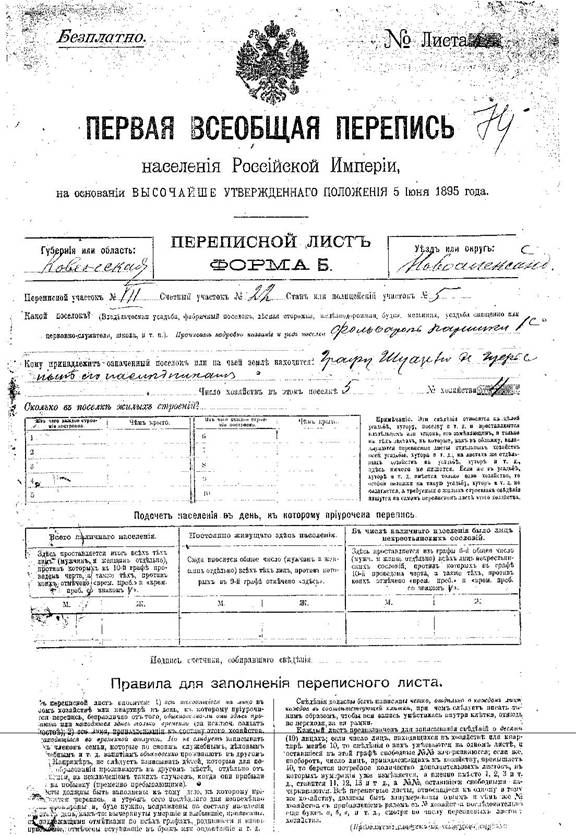
“The 1897 census had an ambitious intent: to document the entire population of the Empire and describe its associated characteristics on a single day. This [odnodnevnaya perepsis] would collect data on age, gender, literacy, nationality, place of birth, etc., for all residents irrespective of their social Estate or tax status. . . . Varying census forms were printed for what were considered the five principle groups of persons. Form [A] was for peasant households that resided on agricultural property; Form [B] was for landed Estates; Form [V] for urban populations; [another form] for the military population; and [the final form] for boarding students, clergy, wards of charitable organizations, etc.” (Thomas K. Edlund, “The 1st National Census of the Russian Empire,” FEEFHS Journal, volume VII, numbers 3-4, Fall/Winter 1999, Salt Lake City, Utah).
To see an example of these forms, click on the image at the right.
All individuals were listed together, but nationality (including "Jewish") was identified.
After the census was taken, a second copy of every return was made. Both copies were sent to the provincial census commission. The provincial census commission sent one of copy to the central commission in St. Petersburg. After the central commission tabulated statistical results, their copy of the information was destroyed. However, some of the original returns were saved in local and provincial archives.
This database is a translation of the remaining fragments of the 1897 Census records, extracting only Jewish persons, from Kovno and Vilna gubernias. Please note that there are many qualifications in this statement:
| Uezd / District | Gubernia | Total Population * | Total # of Jews * | Jews as a % of Population | # of Jews in Remaining Records | # of Jewish Families in Remaining Records | % of Jewish Records Remaining |
|---|---|---|---|---|---|---|---|
| Kovna (Kaunas) | Kovno | 227,431 | 45,353 | 20% | 0 | 0 | 0 |
| Vilkomir (Ukmergė) | Kovno | 229,118 | 30,153 | 13% | 4,291 | 834 | 14% |
| Novo-Alexandrovsk (Zarasai) | Kovno | 208,487 | 26,463 | 13% | 3,646 | 637 | 14% |
| Ponevezh (Panevėžys) | Kovno | 222,881 | 27,207 | 12% | 1,397 | 251 | 5% |
| Rossieny (Raseiniai) | Kovno | 235,362 | 26,447 | 11% | 1,083 | 194 | 4% |
| Telz (Telšiai) | Kovno | 183,351 | 22,695 | 12% | 607 | 82 | 3% |
| Shavl (Šiauliai) | Kovno | 237,934 | 34,348 | 14% | 713 | 161 | 2% |
| Kovno Gubernia Total | 1,544,564 | 212,666 | 13.7% | 11,737 | 2,159 | 5.5% | |
| Vilna (Vilnius) (not including city of Vilna) |
Vilna | 1,728 | 316 | ||||
* From the Statistical Summaries published by the Imperial Russian government in 1905, available on LDS microfilm.
In 1999, Howard Margol finalized an agreement with the Lithuanian State Historical Archives in Vilnius, for the Archives to translate the information from the 1897 census records into English, key the data into a computer, and send the data to him on diskettes. The entire project was completed in February 2000. Peggy Freedman helped co-ordinate the data collected for the project. The translated data was moved from Word documents into a database, and now, thanks to the JewishGen wizards, is searchable by name, place, soundex value and keyword.
Howard donated the Word documents for the entire translation of existing Jewish records from the 1897 census to the Family History Library in Salt Lake City, Utah. The FHL re-produced this document on microfiche. The title on the microfiche is "1897 census extracts from Lithuania". The Family History Library Catalogue (FHLC) description is: "Filming: 459 exposures on 10 microfiches (105 mm.), GS6001828". You can order in a copy of the microfiche through your local LDS Family History Center (FHC). The microfiche ordering number is 6,001,828.
| Town | If this entry is from Form [V], the name of the town is listed. |
| Volost / District / Gubernia |
Russian administrative designations on the Census forms. A volost (county) is a subdivision of an uyezd (district), which is a subdivision of a gubernia (province). In this database, the gubernia will be either Kovno (Kaunas) or Vilna (Vilnius). See list of districts, below. |
| Address |
|
| Landowner / House of |
The name of the person owning the property on which the family lived. On Estates this is usually the owner of the Estate. In Villages and Towns, it is often, but not always, the resident. It is used in place of a street number to identify an address. If two families lived at the same address, they will both be displayed if you search for one of them. They may or may not be related, but we felt that the information that they lived together was important. |
| Name | Surname and Given Name(s) of each individual. Transliterated from Cyrillic. |
| Age | Age on the day of the census taking, January 28, 1897. This census in particular has been criticized by demographers for "age heaping", the tendency to prefer or avoid certain ages when taking the reports. |
| Father | A patronymic — the father's given name — is part of the Russian naming convention. Patronymics are usually included with the individual’s given name and surname, for example "Peisakh Abramovich Katz" means "Peisakh, son of Abram, surname Katz". The fathers' given names have been extracted from the patronymic and put into their own column for this database. |
| Relationship | Population units were counted by Household, not by individual, in the Russian Empire in 1897. Usually (but not always), the Head of Household was the oldest man living in the household. This column identifies each individual’s relationship to the Head of Household. |
| Comments | Any notes made by the census taker. |
| Born / Registered / Living | Place of Birth, Place of Registration, and Place Living. These three location columns give some of the most interesting information in the Census. It was common that a person lived in one place, but was officially registered in another place. These columns give an idea of how our ancestors moved, and why we can’t find them in the places that we expect to find them! Because many of these locations are so small that they are not included on the commonly used genealogical lists of places, they are included in this database just as they were transliterated from the original. To facilitate research into place names, we have extracted a list of all place names appearing in this database, which appears at the bottom of this introduction. Some unusual terms can appear in these columns:
|
| Source | The archive, fond, series, and file number of the original record. All of these records are from the Lithuanian State Historical Archives in Vilnius ("LVIA" = Lietuvos Valstybės Istorijos Archyvas). For example, "LVIA / 768 / 1 / 54" indicates that this record is from the Lithuanian State Historical Archives (LVIA), fond (record group) number 768, series 1, file 54. |
If you do find your ancestors or relatives in this database, and you would like to receive a photocopy of the original census page that they are listed on, you can write to the Lithuanian State Historical Archives at:
Lietuvos Valstybės Istorijos Archyvas
Gerosios Vilties 16
2009 Vilnius
Lithuania
For a nominal fee, they will send you a copy. You must send them your ancestral information contained in this database, together with the Source (the fond, series, and file number), so that no research would be required. The original record is handwritten in Russian (Cyrillic alphabet).
There appear to be duplicates based on different transliterations of the same word. But just as there is a Rome, Georgia; a Rome, New York; and a Rome, Italy; there may be duplicate names of places in the Russian Empire. We have documented three towns called colloquially "Ponemon" in Lithuania: two in Novo-Aleksandrovsk district and one in Suwałki district. We have tried to err on the side of over-inclusion, instead of arbitrarily combining places when we are not certain if they are the same.
The Lithuania 1897 Census Database can be searched via the JewishGen Lithaunia Database.
| Search the JewishGen Lithuania Database |
| JewishGen Databases | JewishGen Home Page |
|
Subscribe to our newsletter Edmond J. Safra Plaza | 36 Battery Place | 646.437.4202 | info@jewishgen.org | |
|