The Courland 1907 Duma Voters Lists
3,310 RecordsIncluding the 1905 list of Windau voters · Courland gubernia · Latvia
Background
This database consists of the Jewish males who were eligible to vote in the elections to the Russian Duma (Parliament) of 1907. Each of the twenty principal cities and towns of Courland gubernia is included, except for Libau (now Liepāja, Latvia). In addition, the database includes the Jews registered as eligible to vote in Windau (now Ventspils) in the 1905 Duma elections. The original lists are in printed Cyrillic; they were purchased and donated by the Steering Committee of the Courland Research Group.
Eligible Jewish Voters, by Town
| Town Name | Total Number of Eligible Voters — Jewish | |
|---|---|---|
| Present Name | Name in 1907 | |
| Aizpute | Hasenpoth | 131 |
| Bauska | Bauske | 219 |
| Dobele | Doblen | 15 |
| Durbe | Durben | 4 |
| Griva | Griwa | 138 |
| Grobina | Grobin | 35 |
| Ilukste | Illuxt | 199 |
| Jaunjelgava | Friedrichstadt | 275 |
| Jekabpils | Jacobstadt | 231 |
| Jelgava | Mitau | 339 |
| Kandava | Kandau | 20 |
| Kuldiga | Goldingen | 160 |
| Palanga | Polhangen | 89 |
| Piltene | Pilten | 28 |
| Sabile | Sabeln | 66 |
| Saldus | Frauenberg | 132 |
| Subate | Subbat | 73 |
| Talsi | Talsen | 109 |
| Tukums | Tuckum | 392 |
| Valdemarpils | Sasmacken | 31 |
| Ventspils | Windau 1905 | 265 |
| Windau 1907 | 357 | |
| Total | 3,308 | |
What can I learn from the Voter’s Lists?
- You may find direct and identifiable family links. In most cases the name of the voter as well as the name of the voter’s father (the Patronymic) are included so that you may have information about two generations.
- You may be able to identify collateral family. Your direct ancestors may have emigrated abroad but aunts, uncles, cousins and older family members often stayed behind. Voters Lists may provide information about other family members formerly unknown to you.
- In order to vote a person had to be at least 25 years of age and male. You are safe to assume that anyone listed is at least that age. The Windau 1905 list gives the ages of voters in many cases.
- The lists will help you to identify possible geographical areas for further research since they show that persons of that surname were settled in a given locality.
- The lists were compiled in two sections. Individuals in the first list were the most prominent citizens and are likely to have owned significant real property or a larger scale business concern in the community. The voters in the first section of the list had weighted votes that counted for more than those in the second half of the list.
- Voters had to be “of good character”. You can assume that those on the list had never been convicted of any criminal offence and that they were in good standing in the community.
- The eligibility basis will give you information about the individual including whether he owned real property, ran a business, was entitled to a pension etc.
- The comments column sometimes gives additional detail.
BUT NOTE
- Just because your ancestor or family name isn’t listed as eligible to vote does not mean that he didn’t live in the locality. He may not have been eligible or simply failed to register for some reason.
- A listing in a given town or city does not necessarily mean that the person lived in that place. He may have originated from outlying areas or villages too small to enjoy separate registration.
Images
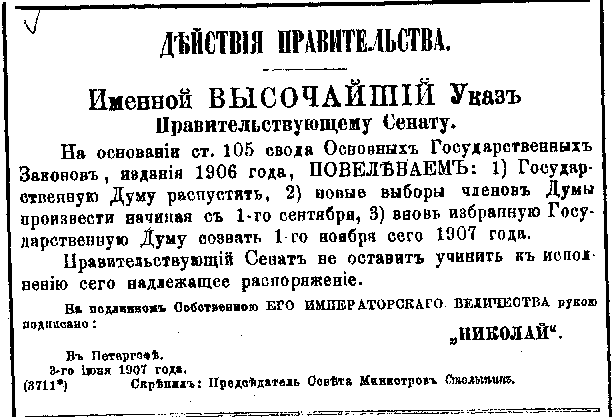
Announcement for the Duma election, which was published in the Vedomosti on 6th June 1907.
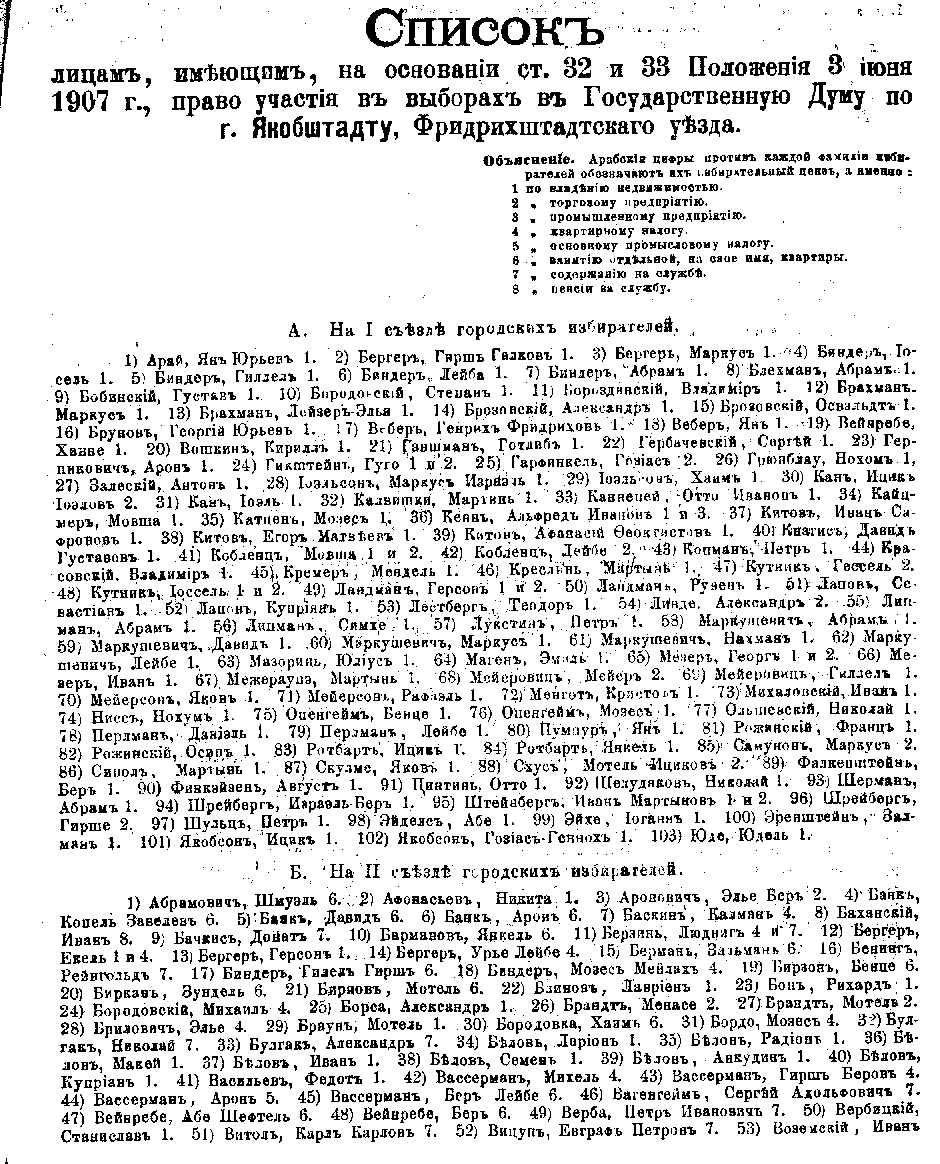
Section 1 of the Duma electoral roll for Jakobstadt (Jekabpils), 1907.
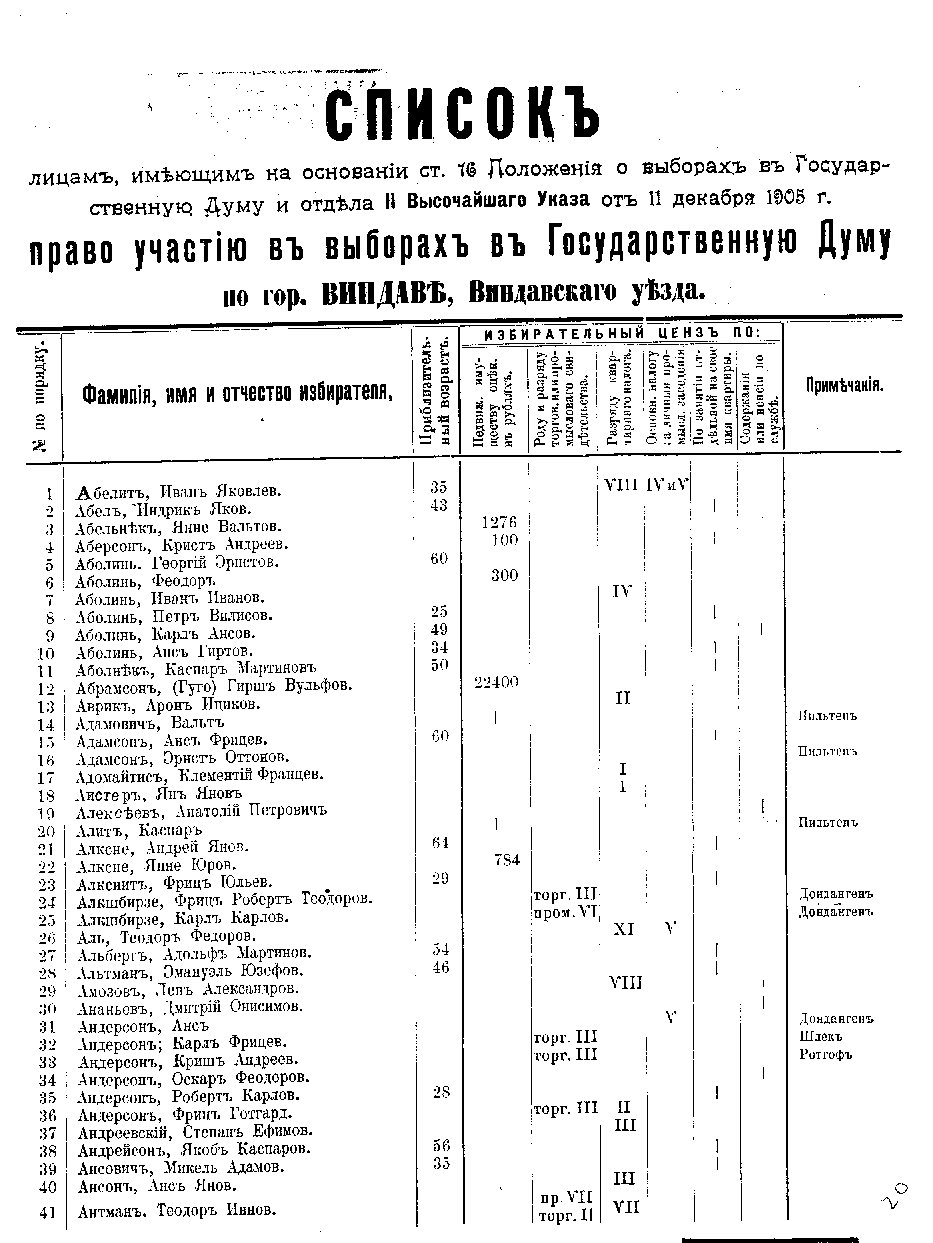
First page of Duma electoral roll for Windau (Ventspils), 1905.
How was the Database Created
The original lists are in printed Cyrillic form. They were purchased and donated by the Steering Committee of the Courland Research Group. The Courland Research Group is particularly grateful to Paul Berkay (USA), Stanislev Gorbulev (Germany), Abraham Lenhoff (USA), Martha Lev-Zion (Israel), Iris Sitkin (USA), Michael Whippman (United Kingdom) and Kathy Wolfson (USA) who together transliterated 8,000 entries in order to identify the Jewish entries for database inclusion. Particular thanks is due to Professor Ruven Furber, Director of the Centre for Judaic Studies, and Dr. Tatjana Aleksjeva for advice and support in the project and to our webmaster Michael Tobias.
The Entry Fields in the List — What do they tell Us?
The database entry columns are set out below with an explanation.
Explanation of Fields
- The Entry number is of potential interest. The 1907 Voters lists are organised in two parts. Voters in Section A (sometimes called Section 1) had substantial real estate or business interests. Those in section B (sometimes called Section 2) were fully entitled to vote but generally had less economic and social status than those in Section A. Those included in Section A were entitled to vote in the first stage of the election and controlled a large proportion of the vote despite the fact that they are numerically smaller in number than those voters in the second group. The importance of the Jewish community to the commercial life of the cities and towns of Courland is reflected in the high proportion of Jews listed in both sections.
- Family name: This refers to the person’s surname. The form of the name is transliterated from the Cyrillic original. In the late 1880s the Baltics had been subjected to an official policy of Russification by a succession of Czarist edicts. By 1907 the Jewish families of Courland would have been well used to the Russian form of their name for official purposes. There is substantial evidence however that the ordinary language of communication and culture remained German as it had been for over 700 years and that despite Russification at official levels the German form of the surnames remained in active use.
- Variant Surnames: This refers to the German form of the Surname where it is possible to make a link from other records relating to the family. It is clear from a wide variety of sources including address and commercial directories that Jewish families continued to use the German form of their names at least until 1918 when many names were “Latvianised” when the independent state of Latvia was established. For example the Russian form Vipman is the same family found in German sources from the period spelled Wippman. The transliterated form Vipman is the Family name entry while Wippman is recorded in the column for Variant Surnames.
- Given Names: This refers to a person’s first name or names. The spelling given is the Russian form although these are generally easy to recognise as variants of the German/Yiddish versions.
- Father’s Name: Most entries in the Voters’ Lists include the patronymic (the first name of the entrant’s father). The Patronymic has been stripped of its “-ov” or “-ovich” grammatical marker to give the ordinary form by which the person would have been addressed. It is not clear why some entries have no Patronymic given or what the significance of this would have been.
- Town: Each voter was registered in a town. It is clear from the Windau 1905 list, however, that Voters came to the town to register and were often from the surrounding areas. Forty of the Voters registered to vote in Windau are recorded as being from Pilten. Unfortunately information as to origin was not recorded when the 1907 list format was devised.
- Date: The date given is the official year of the Duma. This is either 1905 or 1907.
- Comment Including Eligibility Basis to Vote: In common with other European countries only males were allowed to vote at this time. Although the Jews were considered a nationality as opposed to a religion there was no restriction on their right to vote. In order to be eligible to vote an individual had to qualify under one of the following eight categories:
- Those with real property.
- Those carrying on a business (retail). This would include small shopkeepers and there are many Jewish entries.
- Those engaged in manufacturing business.
- Those paying house tax.
- Those paying industrial or business tax.
- Those living in separate flats (leases of property were not uncommon).
- Government employees.
- Those drawing a government pension (former government employees).
Deciding on Who Was Jewish for the Purposes of Extraction to the Database
It was not thought practical or a good use of resources to database all individuals eligible to vote in the whole of Courland. The focus of the project was to identify Jewish entries for inclusion and to exclude those entries of no potential Jewish interest. No distinctions are made on the Voters’ Lists as to nationality or religion of an entrant and therefore a method of deciding who to include as Jewish and who to exclude involved devising a methodology. No system can be perfect but this is how we approached the task.
Initially the first 5 or 6 lists that were undertaken were done in full so that all entries were entered into the working Excel file. The transliterator of the list indicated in each case whether the entrant was Jewish/NonJewish or “unsure” and did so on an “instinctive” or common sense basis. Each list was done independently by two people to see how much discrepancy there was in terms of this method of classification. The correlation was remarkably high, to such an extent that it was felt that the transliterator of the list could be relied upon to include obviously Jewish entries. Those entries which might be Jewish, but about which the transliterator was unsure, were listed separately for further consideration by the moderator and list checker.
The “markers” which were used are as follows:
- Obviously Jewish surnames such as Israelsohn, Itzigsohn, etc.
- Traditional Hebrew or Yiddish given names or Patronymics.
- Many lists exist where religion and nationality are clearly indicated. Any surname appearing on such a list and also appearing in the Voters list has been included in the database.
- Names which appear on the JewishGen Family Finder for a city or town are always included in the database.
- The percentage of Jewish entries was checked against general statistical information compiled at the time as to the Jewish population of the towns concerned.
No system is fool proof. However, the Latvia Research Division is confident that the Courland Voters’ list project will provide useful material for further research on the history of Jewish naming patterns and the social history of the Jewish communities of Courland generally.
Future Projects
The Latvia Research Division seeks to database all Duma and local election lists and the search continues to locate further lists for extraction. Libau 1907 is now in progress, although the original copies are in poor condition. We need volunteers to help with this ongoing work. Please contact the Latvia Research Division if you are interested in joining the volunteer team. You will receive a warm welcome.
The voters lists were purchased with funds from a much appreciated anonymous donor. In order to continue the project of databasing the further voters lists, including the important Libau 1907, we need further funding and sponsorship. Please contact the Latvia Research Division if you would like to help further the Duma Voter’s lists project or with any other aspect of the work of the Latvia Research Division.
Acknowledgements
Professor Ruvin Ferber and Professor Aivars Stranga, University of Latvia Centre for Judaic Studies, Riga, Latvia; Dr. Tatjana Aleksejeva, Riga.
Constance Whippman, Database Co-ordinator
Searching This Database
This database can be searched via the JewishGen Latvia Database or the JewishGen Unified Search.
Databases like this one are made possible entirely through volunteer effort and generous donors. Your contribution helps fund transcription, research, and preservation of Latvian Jewish records.
Support the Latvia Research Division