|
Reading Hebrew Tombstones
Jewish tombstones with Hebrew inscriptions have an added value to
genealogists, in that they not only show the date of death and sometimes
the age or date of birth, but they also include the given name of the
deceased's father.
This permits you to go back one more generation.
Here are a few helpful pointers if you cannot read Hebrew.
At the top of most Jewish tombstones is the abbreviation
פּ'נ,
which stands for po nikbar or po nitman, meaning
“here lies”.
At the end of many Hebrew tombstone inscriptions you will find
the abbreviation
ת נ צ ב ה,
which is an abbreviation of a verse from the Bible, the first book of
Samuel, 25:29, “May his soul be bound up in the bond of eternal life”.
If any Hebrew characters at all are written on a tombstone, they are
most likely to be the person's Hebrew name. A Hebrew name always
includes a patronymic, the person's father's given name.
This is a unique feature of Jewish tombstones, and a great boon to
Jewish genealogy.
The Hebrew word בן,
ben, means “son of”,
as in “Yaakov ben Yitzhak”, meaning
“Yaakov, the son of Yitzhak”.
The Hebrew word בת,
bat, means “daughter of”.
On tombstones, these words will often appear as
ב'ר, an abbreviation for
ben reb, meaning “son (or daughter) of the worthy”,
followed by the father's given name.
The word reb is a simple honorific, a title of respect,
akin to “Mr.” —
it does not mean Rabbi.
The Jewish Calendar

Dates are written in Hebrew according to the
Jewish calendar.
This calendar, which starts its “year one” with the Creation
of the World, was probably designed by the patriarch Hillel II in
the fourth century. He calculated the age of the world by
computing the literal ages of biblical characters and other events
in the Bible, and came up with a calendar that begins 3760 years
before the Christian calendar.
Years:
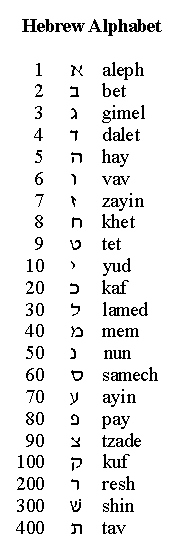
The letters of the Hebrew Alphabet each have a numerical value,
specified in the chart on the left.
When a Hebrew date is written, you must figure out the numerical value
of each letter and then add them up.
This is the date according to the
Jewish calendar, not the
calendar we use in every day life, known as the Gregorian calendar
(also referred to as the Common Era, civil or Christian calendar).
In September 2009, for example, the Jewish year was 5769.
Given a Hebrew date, you need to do only a little bit of math to
change the Hebrew year into a secular year.
Often a Hebrew date after the year 5000 on the Jewish calendar
will leave off five thousand. For example, the Hebrew year
5680 will be written as 680 rather than 5680.
To compute the civil (Gregorian) year, simply add the number 1240
to the shortened Hebrew year.
Here's one example: If the year is written as
תרפג,
the letter
ת is 400, the letter
ר is 200,
פ is 80, and
ג is 3.
400 + 200 + 80 + 3 = 683.
The 5000 is usually left off, so the actual year would be 5683.
By using our formula, 683 plus 1240 is 1923.
That is the civil year.
Months:
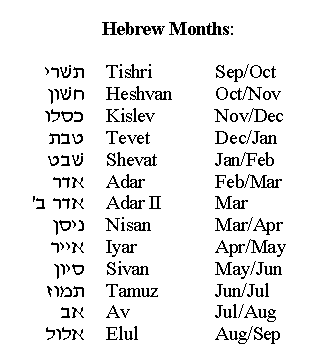
The Hebrew year begins on Rosh Hashanah, which occurs on the
Gregorian calendar in September or October.
Therefore, the dates listed for the months of Tishri, Heshvan,
Kislev and sometimes Tevet must be read as applying to the
preceding year of the civil (Gregorian) calendar.
Converting Calendar Dates:
The complete transposition of a Hebrew date to a Gregorian date
uses a very complex formula.
It is easiest to simply refer to one of the published or online
reference works, such as:
- The Comprehensive Hebrew Calendar, 5703-5860, 1943-2100,
by Arthur Spier (Jerusalem, New York: Feldheim Publishers, 1981); or
- 150 Year Calendar, by Rabbi Moses Greenfield (Brooklyn:
Hotsaat Ateret, 1987).
Most synagogues and Jewish libraries possess one of these works.
Another alternative is to use one of several computer programs:
JCAL,
Hebcal,
Tichnut;
Steve Morse's “
Jewish Calendar Conversions in One Step”;
or JewishGen's online JOS calculator
(https://www.jewishgen.org/jos).
These programs can convert Hebrew to Gregorian dates and vice versa,
as well as display calendars and Yahrzeit dates for any year.
For more information about the Jewish calendar,
see the JewishGen InfoFile
Introduction to the
Jewish Calendar.
Some Hebrew Phrases
In addition to names and dates, here are the common Hebrew words which
appear on tombstones:
|
| Here lies | po nikbar |
   |
|
| Son of | ben |
  |
| Daughter of | bat |
 |
| Title, i.e. "Mr." | reb, rav |

|
| Son/Daughter of the honored | ben reb |
|
|
| The Levite | ha-levi |
    |
| The Cohen | ha-kohen |
 |
| The Rabbi | ha-rav |
|
|
| Dear, Beloved (masc.) | ha-yakar |
 |
| Dear, Beloved (fem.) | ha-y'karah |
|
|
| Father | av |
 |
| My father | avi |
|
| Our father | avinu |
|
| Mother | eem |
 |
| My mother | eemi |
 |
| Our mother | emanu |
|
| My husband | baali |
 |
| My wife | ishti |
 |
| Brother | akh |
 |
| My brother | akhi |
|
| Our brother | akhinu |
|
| Sister | akhot |
|
| Aunt | dodah |
 |
| Uncle | dod |
|
|
| Man | ish |
|
| Woman | ishah |
|
| Woman (unmarried) | b'tulah |
|
| Woman (married) = "Mrs." | marat |
|
| Old (masc., fem.) | zakain, z'kaina |
 |
| Child (masc., fem.) | yeled, yaldah |
|
| Young man/woman | bakhur, bakhurah |
|
|
| Died (masc., fem.) | niftar, nifterah |
 |
| Born (masc., fem.) | nolad, noldah |
|
|
| Year, Years | shanah, shanim |
|
| Day, Days | yom, yamim |
|
| Month | khodesh |
|
| First of the month | rosh khodesh |
|
|
Hebrew Abbreviations on Tombstones:
There are many many different Hebrew abbreviations that are found
in tombstone inscriptions and Hebrew literature.
Abbreviations are usually indicated by a quote mark or an apostrophe.
Often, the apostrophe is used to abbreviate a single word, whereas the
quote mark indicates an abbreviated phrase.
For more information, see the following works:
- “Hebrew Abbreviations for Genealogists”,
by Edmund U. Cohler, Ph.D., in
Mass-Pocha
(Newsletter of the
Jewish Genealogical Society of Greater Boston).
- Part I: IV,1 (Winter 1994/95), pages 4-7.
- Part II: IV,2 (Spring 1995), pages 14-18.
- Part III: IV,3 (Summer 1995), pages 16-17.
- Hüttenmeister, Frowald Gil. Abkürzungsverzeichnis
hebräischer Grabinschriften. (Frankfurt am Main:
Gesellschaft zur Forderung Judaistischer Studien in Frankfurt am Main
[Society for Furthering Judaic Studies in Frankfurt am Main], 1996).
349 pages.
{Frankfurter judaistische Studien, Volume 11.
In Hebrew and German.
Hebrew title: Otsar rashe tevot ve-kitsurim be-matsvot bate ha-almin}.
ISBN #3-922056-08-3.
OCLC 925532369.
- “Reading Hebrew Matzevot Key Words, Abbreviations, & Acronyms”,
compiled by Dr. Ronald D. Doctor. (June 2008).
21 pages.
http://www.rootsweb.ancestry.com/~orjgs/Abrrev.pdf.
Symbols on Tombstones:
In addition to the inscription, symbols on the tombstone can be
clues.
- Two hands, with four fingers each divided into two sets of
two fingers, is the symbol of a priestly blessing —
this signifies a Kohen, a descendant of the biblical
high priest Aaron.
- A pitcher signifies a Levite —
in ancient days, members of the tribe of Levi were responsible
for cleaning the hands of the Temple priest.
- A candle or candelabra often is used on the tombstone of a woman;
and the six-pointed Star of David on that of a man.
- A broken branch or tree stump motif on a tombstone
often signifies someone who died young, whose life was cut short.
Bibliography:
- Kurzweil, Arthur.
From Generation to Generation: How to Trace Your Jewish Genealogy
and Personal History.
(New York: HarperCollins, 1994).
Chapter 9, pages 342-358.
OCLC 823528084.
- DOROT,
The Journal of the Jewish Genealogical Society
(New York):
- XI, 2 (Winter 1989-90), pp 2-3:
“Getting the Most Out of Your Cemetery Visit”.
- XI, 4 (Summer 1990), pg 16; and XII, 1 (Autumn 1990), pg 8:
“Tools of the Trade”.
- Krajewska, Monika.
A Tribe of Stones: Jewish Cemeteries in Poland.
(Warsaw: Polish Scientific Publishers, 1993).
242 pages. {Mostly illustrations}.
OCLC 925571139.
- Rath, Gideon.
“Hebrew Tombstone Inscriptions and Dates”,
in Chronicles
(Newsletter of the Jewish Genealogical
Society of Philadelphia),
Vol. 5, No. 1 (Spring 1986), pages 1-4.
- Schafer, Louis S.
Tombstones of Your Ancestors.
(Bowie, MD: Heritage Books, 1991, 2007). 160 pages, paperback.
{Doesn't deal specifically with Jewish tombstones}.
OCLC 233523010.
- Schwartzman, Arnold.
Graven images: Graphic Motifs of the Jewish Gravestone.
(New York: H.N. Abrams, 1993).
144 pages.
OCLC 891405959.
- Strangstad, Lynette.
A Graveyard Preservation Primer.
(Nashville, Tenn.: Association for Gravestone Studies, 1988, 1995, 2013).
126 pages.
OCLC 1007570142.
- Association for Gravestone Studies, 278 Main Street, Suite 207,
Greenfield, MA 01301. (413) 772-0836.
{Produces a quarterly newsletter, Markers, and access to a
lending library.}
https://www.gravestonestudies.org.
- Caplan, Judith Shulamit Langer-Surnamer.
“Tombstone Translation Topics: How to Decipher and Read a
Hebrew Tombstone”.
In: 19th Annual Conference on Jewish Genealogy: Syllabus.
(New York: Jewish Genealogical Society, 1999), pages 217-221.
Also In Jewish Genealogy Yearbook 2000 (20th International
Conference on Jewish Genealogy, Salt Lake City, IAJGS, 2000),
Section 1, pages 80-84.
Links:
|