 |
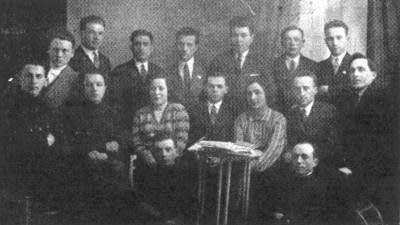
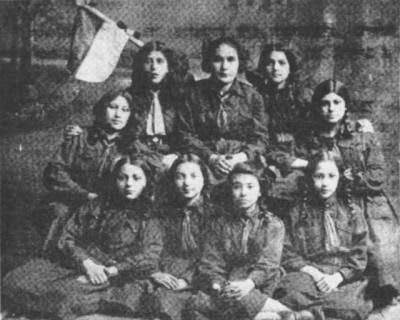
Second row: Esther Chatzkelevitz
Third row: Letzki, Yerozelmski, Slutzki, Kaplinski
|
|
[Page 239]
by Yonah Vallach, May His Memory Be for a Blessing
Translated by Rabbi Molly Karp
The Jewish youth in Lida suckled its spiritual nourishment from the roots of the tradition in the house of Father and Grandfather and was not in need of antisemitic motives to insert national awareness and Jewish consciousness into his heart.
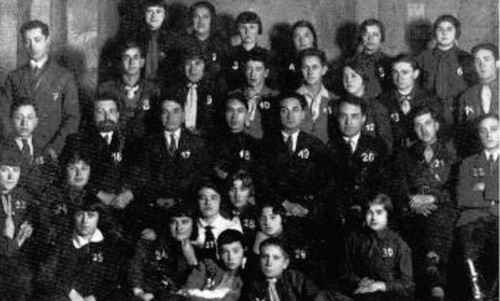
The national image of the Jewish youth was formed in the days of childhood in his parents' house, in the cheder, in the Talmud Torah, and in the Hebrew school “Tarbut.” With the rise of the youth movement in the city in all its streams and hues, the youth began to stream to their clubhouses. In the course of time the cell clubhouse became into the second home of the young men and women.
Between the walls of the clubhouse the conceptual recognition was formed, in accordance with the ideological shades of the movements; however at the end of the matter the road led in one direction – to Zion.
The longing for Zion over the passage of time turned into something more tangible, that is, into self-realization, into aliyah to the land of Israel. The aliyah of young people from Lida turned into a festive event in the city; in those days they talked in the city about who was traveling, and who was preparing to travel tomorrow.
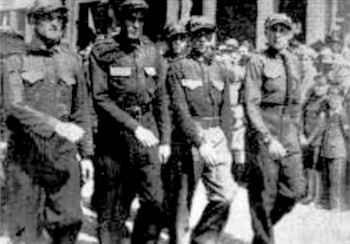
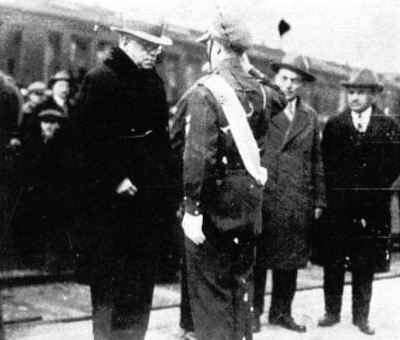
Deep, deep that festive parade, that holy stance, was etched in my mind, in which the members of “HaShomer HaTzair” parted from the first three of those to fulfill their dreams.
|
|
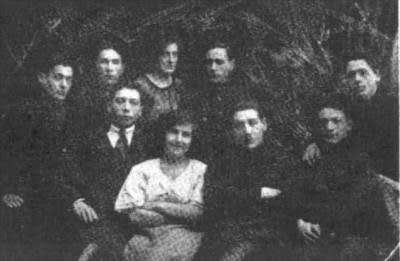
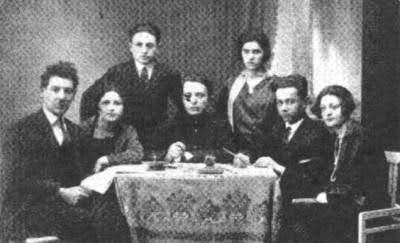
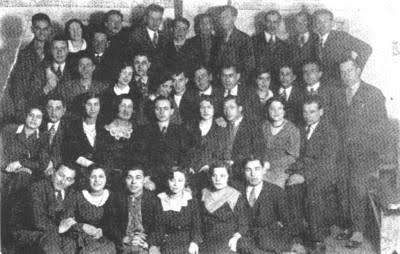
| From right to left, first row from above: Dovsha (Doris) Volpinski, Manya Kronik, Avigayil Boyarski Second row: Esther Chatzkelevitz Third row: Letzki, Yerozelmski, Slutzki, Kaplinski |
Joy and holy trembling surrounded us, and more than a little envy nestled in our hearts in those moments, in our seeing them appear in leather jackets, which for some reason symbolized in that period the fulfillment, the aliyah.
Of course, more than once it happened that the aliyah was in opposition to the desire of the parents, for whom it was not easy to come to peace with the idea that their sons and daughters would leave the warm nest of the family and wander to a distant land for which riots and incidents seemed to be its lot.
In Lida there existed a number of Zionist youth movements: “HaNoar HaTzioni,” “Beitar,” “Beitar,” and “Freiheit.”
All the movements mentioned above educated for self-realization, and their madrichim and leaders themselves served as fitting examples of this education.
Over the course of time the youth movements encompassed almost all of the Lida youth.
The movement of realization was well felt in the house of Mother and Father; it began much before the aliyah to the land. The parents' plans for the future of their sons and daughters were disrupted by the recent ones.
The good intentions of the devoted parents to bequeath a high education to their children were dashed, for suddenly the son would appear in the house and inform them that he had set his face towards training and aliyah to the land of Israel.
The Lida youth excelled in adherence to and fervor for the idea that they had chosen for their life's path, and dedicated to it most of the hours of the day and sometimes their last penny.
Indeed, the cell clubhouse became the second home of the Lida young person. The way of life that was formed in the clubhouses was of a unique kind. The continuous worry about the four walls, the cleanliness of the cell, its decoration, publication of a wall newspaper, were our lot each and every day, and we even dreamt about it in the nights.
On the outings, in the summer camps (settlements), and in the shared singing around the campfire we wove new webs of life; true and honest group life.
And already from the dawn of our childhood we took upon ourselves the sacred work of the Zionist movement with all its practical commandments, and in this area painstaking work was done by the youth really out of passion, devotion, and tirelessness.
The deeds of the young men and women of Lida served as an example to all the towns in the area.
by Avraham Gelman
Translated by Rabbi Molly Karp
The branch of the League in Lida counted a relatively large number of members and had weight in the elections to the Zionist Congress and likewise in the elections for the Community Council in the city. There were also members in it like those who did not belong to the parties in an active fashion and also part of the free professional men were concentrated in it.
The League used to arrange lectures and conferences on all kinds of topics that were connected to the problems of the land of Israel and the Jewish people, and at its initiative conferences were held in towns like Vasilevski, Lipnishki, Iviyah, and others. Its members acted in the distribution of the movement newspaper “Das Vort”[1] and in the distribution of shekels for the Zionist Congresses.
With the ascent of the Nazis to the government in Germany and the strengthening of antisemitism within the Polish population, the Zionist parties and movements began to organize themselves in a more tangible way. In this period branches of “HeChalutz” and “HaOved” were organized in Lida out of an organizational affiliation with the “HeChalutz” center in Warsaw.
From time to time members of the movement's center would come to Lida to visit and would hold meetings and lectures with the party activists in the residence of the training kibbutz. The house was in the courtyard of the “Nirvana” movie house (after the revolution the movie house was established again and its name was changed to “Ara.”) Among the members of the center who came to visit were Yitzchak Tzukerman (Antek), Moshe Mezibovski, Mendenitzki, Voshtzina, and also the composer Natan Bistritzki came to visit a number of times. The youth movements were also active in fundraising for the Keren Kayemet, and I remember meetings that we would hold in the building of the “Tarbut” school with the representative of the KKL in the city, Mr. Berl Dvoretzki. On behalf of “HaShomer HaTzair” Herzl Katz and Yitzchak Bozken, Reuven Bozgan and me from “HeChalutz,” Yocheved Rodnitzki and Rachel Kaplan from “Freiheit,” the teacher Moshe Nizvotzki from “Mizrachi,” and Yosef Kalmanovitz and Pesya Sobel from “Poalei Tzion Socialist Zionists,” participated in the discussions.
“HeChalutz” also established conferences and summer settlements, and I remember a summer settlement in which I participated. This was in the village of Tatishchevski next to Lipnishki. From the branch of “HeChalutz” and “Freiheit” in Lida about 30 members participated, and the rest were from the branches of the towns of Lipnishki, Iviyah, and more, and it lasted about two weeks. The members Plotek and Pundak participated in the summer settlement on behalf of the center.
The auditorium of the branch of the movements “Poalei Tzion,” “Freiheit,” and “Freiya Scouten”[2] in the year 1928-1929 was in the house of Rozenstein (Der Kanisha Na'ar) on the market street, in two rooms. The place was too narrow to contain the masses of the adults and youth who were coming to hear lectures and to participate in discussions and debates about issues of the hour and the nationalism of the Working Land of Israel movement. The Madrichim of the younger level were Volinski, Alter Dartzinski, Alter Vangiski. In the year 1931 Mose Novoprutzki arrived from the center. He breathed a breath of life into the movement, and organized various groups for public performances. From time to time lecturers would arrive from Vilna and among them I remember Burstein and Dovkirer.
In the year 1938, a year before the outbreak of the war, the centers of the “Freiheit” and “HeChalutz HaTzair” parties decided to unite, and then arose the united movement “Freiheit HeChalutz HaTzair.” The unification conference took place in Yosefov, which is next to Warsaw, and the writer of these lines participated in this conference on behalf of the “Freiheit” branch. Avraham Steinberg, may his memory be for a blessing, participated on behalf of “Poalei Tzion Socialist Zionists.” About two - three hundred delegates came to the conference from all throughout Poland, and there were also emissaries there from the land of Israel. In the words of the speakers, and in general in the atmosphere that prevailed over the conference, the worry and the fear about the disaster that was approaching Polish Jewry were felt, in the wake of the announcement of Nazi German militarism, the strengthening of antisemitism, and the persecution of Jews in Poland itself. It seems to me that already then the last chord of the Zionist youth movement was heard, the liveliness of Lida, and maybe of Jewish Europe in general.
Translator's footnotes:
by Tziporah Koplevitz (Bilig)
Translated by Rabbi Molly Karp
The idea to establish the “HaShomer HaDati” movement in Lida sprung up in me in at the beginning of the spring of 1934, a time of flowering and awakening. My first approach was to the teachers Moshe Nizbotzski and Moshe Portnoi, may their memories be for a blessing, who for me were fountains of knowledge. The two of them responded to my suggestion willingly. The first of their actions was to explain the importance of the matter to the parents of the Talmud Torah students, that in Lida there would also arise a youth movement for children of families who kept the traditions. With their help, the doors of the Talmud Torah were opened before us. It was there that we held meetings. The teacher Nizbotzski assigned two students to me, Yonah Sokolovski and Tzvi Kameneski, and placed it on us to serve as madrichim. We would spend long hours there in preparations.
Within a short time the number of members in the new movement, which continued to be organized and take shape, grew. Twice a week Moshe Portnoi would lecture before us on the essence of the Zionist movement, and its history. Moshe Nizbotzski engaged us in topics of Jewish literature, and would also transmit to us news from the land of Israel and what was being done within the groups. Shabbat was dedicated to a lesson on Pirke Avot, an explanation of the content of the festivals of Israel and the values and contents of the prayers. For our part we held group dancing and games. The members were divided into groups, each group by their flag. The attire also was in accordance with the custom of other youth movements, in keeping with the religious way.
We had time to arrange a few summer settlements, in Baronovitz, in Vilna, a place where we met with members from various branches and this broadened our horizon and awaken our energy.
In the year 1939 I prepared to go out to Zkofna, and afterwards – to the training kibbutz, despite my parents' opposition. Meanwhile the skies darkened, the war broke out. The bombs. Tohu va'vohu,[2] and suddenly on Shabbat the thing happened, and here is the echo of cries arriving from afar: “Live, Stalin!” I remained frozen in my place. What would be now? Tanks rolling noisily, red flags waving in the air. The Soviet conquest began.
The next day we buried our flags in the ground. All the papers, and all the newspapers that were dear to us, were thrown into the fire. We emptied the corners of the cell that we cherished with devotion over the course of years. We locked the door behind us and parted from the place. From here the activity in the underground began for me, and the purpose was how to achieve the difficult goal, how to get to Vilna, as a station to the land of Israel.
[Page 241]
|
|
|
|
|||
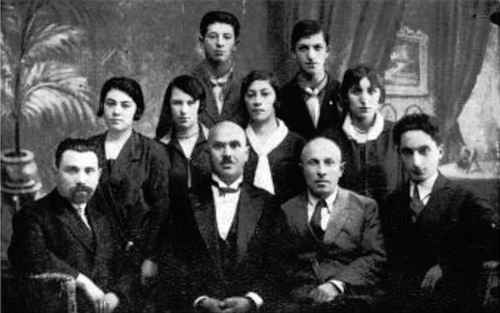
From right to left: 1. Tziglenitzki (Daughter of “Yashe Rushes”) 2. Eliyahu Shmulevitz 3. Fruma Kalmanovitz (Levin) 4. Leib 5. Unidentified 6. Tziporah Levin (Bleichbord) 7. Elchanan Yeshayahu Kamenetzki |
|
|
Translator's footnotes:
by Moshe Aharonovitz (Furman)
Translated by Rabbi Molly Karp
I don't come to dwell on the past of the dear city of my birth Lida, for it has gone by and is no longer. But it is my desire to dedicate a few words to the memory of the “Beitar” movement in the city.
“Beitar,” or as it was called at the beginning “The Youth Movement Named for Trumpeldor,” was one of many youth movements in Lida, which began with small numbers and quickly increased to large ones. In the year 1929 Dr. Lipman, may his memory be for a blessing, was sent to our city from the center in Warsaw to lay the cornerstone for this youth movement. At the founding gathering participated: the teacher Pesach Yeruzalemski, the pharmacist Mr. Shif, Mr. Gurvitz, the teacher Kushelevitz, and our first commander from Vilna Yaakov Shmarkovitz, a young man with pleasant ways. Among the few young people were my brother Aharon, may his memory be for a blessing, the future leader of “Beitar” Lida, Tamar Yeruzalemski, Pinchas Kaplan, Moshe Leibovitz, me, and a number of other young people.
The enthusiasm among the youth was great. Each and every day young men and young women of all the classes of the city streamed to the movement.
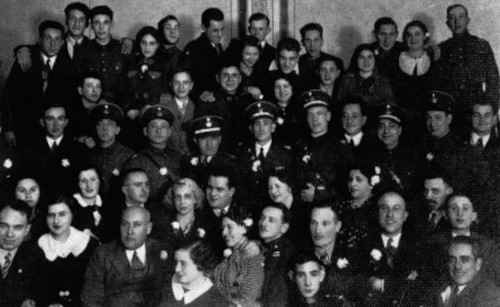
We rented two rooms by the teacher on Skolna Street for the afternoon hours. Quickly a uniform garb and the movement anthem appeared. Almost every evening cultural activities were conducted. Every week we would receive printed circulars from the center, and in them “the intention” for our work in the future. We, the heads of the groups, tried to impart love of the homeland to our students, sports exercises of various kinds, polite habits, proper relations between people, etc. We increased the sports exercises, outings outside of the city, and we frequently went out to wonderfully organized summer camps in which we would spend about a week.
How proud we were when we returned from the summer camps to the city, every group with its flag, in the uniform attire, in orderly lines, standing upright and “Beitar” songs on our lips.
I remember the coming of the head of “Beitar,” Jabotinsky, to our city in the year 1932. Feverish preparations were made in anticipation of his arrival. For a week “Beitar-niks” streamed to the city from all the surrounding towns. And when the wished-for day arrived we went out in wonderfully unified and organized lines by way of the streets of the city to the train station to receive the honored guest. A sea of blue and white flags and blue and white uniform attire filled the streets. The Gentiles crowded on the sides of the roads with looks of wonder on their faces, as if they were asking each other: “Are these the children of Israel that were humiliated by us?” Standing upright and full of pride we marched towards the train station.
by Shimon Mikolitzki
Translated by Rabbi Molly Karp
The saying of Sholom Aleichem is known, that “to write about living people – this is a pleasure; about the dead, that is a mitzvah.” I willingly accept upon myself the pleasure and also the mitzvah; to write about the Beitar movement, which I entered when it was still in diapers, and I was already an active member in it until the Soviets entered our city. Our movement was supposedly eliminated then in Lida, but only “supposedly.” Actually there was continuation, even within Soviet Russia, in the forests and in the taigas, even those who were in the Nazi concentration camps continued, and the chain continues until today.
The Beitar movement in Lida was founded by Yaakov Shmarkovitz, the first Beitar commander. A tall, lean young man, from a Chassidic family, his father was an ardent and God-fearing Chassid. Yaakov received a religious and traditional education, inherited his adherence and ardor from his father, and with that same adherence and ardor and faith he devoted himself to the organizing of the Beitar cell in Lida. M. Ilotovitz, A. Aharonovitz, Y. Kaplan, Leibovitz and others joined him. This was in effect the first nucleus of the Beitar cell in Lida. Over a short time the movement began to grow.
The first residence that served as a cell for Beitar was the house of Rabbi “Lazoiker” on Skolna Street across from the Beit HaMidrash Hagadol, in the place where “The Yeshiva” was. In the nights the voices of the yeshiva students, the melodies of the Gemara, sharp debates on the interpretations of the Tosafot or Rashi burst through the open windows of the Beit Midrash. And exactly across, with no less enthusiasm, the voices of the youth, who sang Hebrew songs about the liberation of the nation and the land, burst out.
With the growth of the movement it was possible to see Beitarniks marching in the streets of the city with their Beitar attire, which without a doubt left a strong impression on the residents of the city and especially on the youth. Likewise they began to organize a public gathering with the participation of the leaders of the movement of that time, such as Dr. Y. Shechtman, Y. Klarman, Lipman, Menachem Begin, and others.
Also within the walls of the movements itself the education and the propaganda held a very important place, thanks to the members Yaakov Tzifelevitz, Eliyahu Berger, and Shimon Mikolitzki. They organized literary trials and lectures on historical topics, and also published a weekly wall newspaper edited by Sh. Mikolitzki.
A special event that strengthened the Beitar movement was the visit of Z. Jabotinsky in Lida. Beitarniks came from all the surrounding towns
[Page 243]
in their full attire to receive the head of Beitar. The Polish government also paid him great honor. In the evening Jabotinsky spoke in the Nirvana movie house, which was full to capacity, on the topic “England, the Jews and the Arabs.” Jabotinsky's influence was great, and he drew many people to the ranks of the movement. “The Covenant of the Revisionist Zionists,” at the head of which stood Mr. Gurvitz and Mr. Shif, and “The Covenant of the Soldier,” at whose head stood Mr. Goldvasser, were organized.
In the year 1933, in the time of the division between Jabotinsky and Grossman, the movement was somewhat shaken, and there were doubts about which direction to turn, but almost all of them remained faithful to Jabotonsky's line.
When the founders of the movement ascended to the land, B. Kaplan (today in Israel) was appointed as the Beitar Commander, and after his aliyah to the land Y. Tzifelevitz, S. Rubinovitz, A. Berger, Sh. Furman (who was known afterwards by his nickname “Shaul the Galilean”), and Sh. Mikolitzki stood at the head of the movement. Great movement was felt in all the areas thanks to the activities of the member Tzifelevitz, a talented young man with great power of influence and rhetorical ability. Without a doubt, had he remained alive, he would have been among the supporting pillars of his movement. Every Shabbat night he held an “Oneg Shabbat.” The program included: a discussion on issues of the day, a live newspaper written by the hand of Yaakov Tzifelevitz, and the highlight of the evening was the appearance of the dynamic duo Moshe Tzifelevitz and Dov Rubinovitz. With their voices they turned the “Oneg Shabbat” into a unique experience of its own kind.
And here I would like to mention two of my friends, who were not only members of the movement but also close friends, the best and dearest friends, and they are Shmuel Rubinovitz and Shaul Furman. Shmuel Rubinovitz, short in stature and broad-shouldered, powerful and very strong, a Beitari in heart and soul, with true military discipline. The movement occupied the first place in his life, the command of the movement was for him the commandment of his life, and Shaul Furman was also the same type. They differed from each other only in their external appearance – Shaul was tall and thin. The two of them brought far-reaching changes in all of the way of life of the cell, in essence and in organization. Shaul was very beloved and had pleasant ways. Athletic, as if his whole body was full of “springs.” Anyone who wanted to hurt him out of mischief, immediately received in return what he had coming to him, and as he himself testified: “I have springs in the body, when they only touch me the body immediately reacts in return.” These “springs” always stood him well, and only at the time that the English shot at him, they did not work for some reason. Let these words serve as a modest symbolic monument to my two friends.
The movement grew and daily acquired new members. A group of members assembled from among the gymnasia students, and among them were: M. Vinitzki, Grau, Levit, Boyarsky, Zlatkovitz, Yehudit Nachmanovitz, Leah Pupka, and others.
Every day the members of the Beitar cell assembled for gatherings and discussions, which were accompanied by Hebrew songs and Hora dancing. After time they also began military training and the use of firearms. However outside, where people could see, they only used sticks. The meeting place was behind the bridge that was over the Lidzika River, or in the forest, far from people's eyes. And when the illegal aliyah began, aliyah without certificates, Aliyah Bet, Shaul Furman was among the first in that aliyah. The Jewish street awakened, the movement's reputation increased, and I remember that in a memorial to Slomo Ben-Yosef, the boy from Lutzk, Shlomo Tabatznik, who went up to the gallows in the year 1938, in the Great Synagogue, they eulogized the son-in-law of Rabbi Rubinovitz from Lida, and among the rest of his words he said: “Here I stand before you without Beitar attire, a person who all the time stood at a distance and sometimes I looked at you scornfully, but now I stand and bow my head before the Jewish hero Shlomo Ben-Yosef, heroism it seems possible to find in the heroism of the Maccabees.” After him the Beitar Commander from a town adjacent to Lida, the member A. Kalmanovitz ascended to the bima, and in his speech he explained the background of the system and the events in the land of Israel. Then a change began on the Jewish street. The attitude towards us changed for the better, and many understood our spirit and our vow, to dedicate our lives to the land and to the nation.
|
|
1) Rachel Katz [no #2] 3) Rivkah Boyarski 4) Luba Trotzki 5) Sarah Katz 6) Rachel Furman [no #7] 8) Moshe Leibovitz [no #9] 10) Pinchas Kaplan 11) Yishayahu Tevelson [no #s 12-13] 14) Feinshreiber 15) Kalfetz 16) The Teacher Yeruzalimski 17) Dan Horvitz 18) Betzalel Lichenstein (Vilna) 19) Yaakov Smarkovitz 20) Avraham Shif 21) Aharon Aharonovitz 22) Shlomo Grinspan [no #23] 24) Fridman 25) Etel Karplovski 26) Gite Volfovitz 27) Tamar Yeruzalimski 28) Moshe Aharonovitz 29) Batya Zablodovski 30) Shikortz 31) Yeruzalimski |
[Page 244]
|
|
|
|
|
|
[Page 245]
|
|
At center: Zev Jabotinsky From left to right: Beitar Commander Aharon Aharonovitz (back to the photographer); Chairman of the Revisionist Zionists Beitar Avraham Shif, Dan Gurvitz |
by Zvi Shif
Translated by Rabbi Molly Karp
A straight nose, thick eyebrows, and black hair streaked with white. A high forehead. This is the image of my father that is carved in my memory and accompanies me for these nearly 30 years.
I was twelve years old when my mother died, and I and my eight-year-old sister Shifra Malkah remained in the exclusive care of a devoted father who was full of understanding. Even though our small pharmacy and the worry for the children had enough in them to occupy him fully, he dedicated much of his time to communal work. He was one of the founders of the Revisionist movement and over the course of time he became the Chairman of the Revisionist Zionists Beitar in the city.
More than once this status required the abandonment of matters of livelihood, and especially at the time of hosting emissaries of the movement's center who would visit in our city. Zev Jabotinsky visited us twice. The organization of the visit and lecture of this distinguished leader was tied up with more than a few problems and my father was always the living spirit in this endeavor.
With the rise in our city of a broad Revisionist movement that wide echelons of the Jewish population from youth to old embraced, this to a great extent is thanks to my father. With exhausting organizational work, in countless assemblies, lectures, more than a little private means, he educated a generation of Jewish young people for Zionist vision and fulfillment.
I am reminded of my father in his free hours, when he would fill hundreds of notebooks with Hebrew, Yiddish, Polish and Russian, with prose and also poetry. And I would be excited then by the beauty of his style. These were hours of pleasant thoughts about him. He would even try his strength in Esperanto. He was one of the founders of the group for learning this language in our region. In sorrow and in pain I ponder again and again about my father who did not get to see the fulfillment of his aspirations and his dreams. May his memory be blessed.
|
|
Secretary of Beitar in Lida |
|
|
JewishGen, Inc. makes no representations regarding the accuracy of
the translation. The reader may wish to refer to the original material
for verification.
JewishGen is not responsible for inaccuracies or omissions in the original work and cannot rewrite or edit the text to correct inaccuracies and/or omissions.
Our mission is to produce a translation of the original work and we cannot verify the accuracy of statements or alter facts cited.
 Lida, Belarus
 Yizkor Book Project
 JewishGen Home Page
Copyright © 1999-2026 by JewishGen, Inc.
Updated 22 Dec 2025 by JH