 |
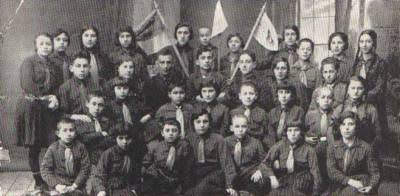
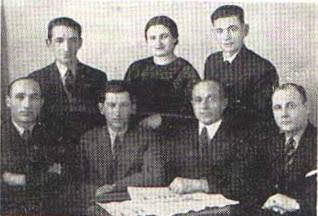
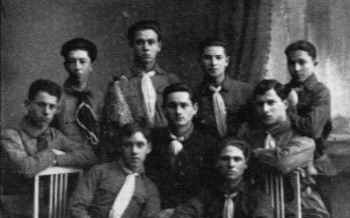
At center: Ola Zeitzik
|
|
[Page 229]
by Arieh Poltzik
Translated by Rabbi Molly Karp
The youth movement was an offshoot of the national and socialist liberation movements of the Jewish nation, and was a fermenting and creative cause for Jews in eastern and central Europe before the ascent of the destroyer. The youth movements arose as fruit of the rebellion of the youth against the ways of life of their fathers, and they took upon themselves roles of national renewal and pioneering work in the land of Israel.
The English scouting spread in all the lands of Europe and reached Poland as well. In the year 1921 an adaptation of Baden-Powell's[1] scouting book was published in Poland. In those days the first Polish Scout Battalions arose. The long stick, the scout shirt, and the broad-brimmed hat became a thing in the general style among the youth in Poland. The name “Scout” served as a means of attraction for the Jewish youth. And indeed in the year 1921 Jewish Scout battalions were founded in Poland on the Polish pattern.
Indeed, the purpose of the special exercises and training of the English Scout was to educate an English soldier, who would know how orient himself in the virgin forests of Africa and Asia; however, this did not suit the Jews very well. However, the romantic image of scouting, which acted on the imagination of youth, and the essential role of an exemplary all-around education, whose slogan “a healthy soul in a healthy body” filled part of the content of the new movement, while on the other hand, continuing education in Jewish studies was a completion of education of healthy youth who engaged in outings and physical exercises. This was the beginning of the road: to awaken dormant strengths among the youth, to move him towards many-faceted development, and to deeds and achievements with shared powers.
The heroic deeds of the Shomrim in the land of Israel influenced and brought the conclusion that it is not speech that determines, but only the everyday deed is able to bring the lofty national ideals to fulfillment. Since they were still young and the possibility was not given to them to live in the land, they decided to train themselves in exile for the important national roles, by means of systematic education, familiarity with the nation and its history, penetration into the cultural values and recognition of the land of the ancestors and in the conditions in which they would need to live.
HaShomer HaTzair
The first youth movement that cast educational and social patterns and that served as a model and example for the rest of the youth movements that arose in its wake, and learned from its ways and attempts, was “HaShomer HaTzair.”
HaShomer HaTzair was founded after the union of two Jewish national youth organizations: “HaShomer” and “Tzeirei Tzion,” which between them separated quite noticeable differences. The first was a Jewish interpretation of the Polish Scouting organization, while the second was a kind of European version of the “yeshiva,” whose essential goal was learning, disputation, and debate. In the first there was a point of honor about the continuing education in the technical professions, while in the second the emphasis was placed on the wisdom of Israel. The young people from the two organizations would meet frequently and the idea of the unification was born. At first the two parties existed side by side, and over the course of time they reached an amalgamation of all the human and Jewish fundamentals. Thus the archetype of the Jewish youth was created that was really young and really Jewish, in which the way of life and the deed served for him as a kind of two sides of the same coin.
In that same period, that is, in the 1920s, there was in the city of Lida a large Jewish concentration. Most of it was materially sound, which influenced it on the cultural level. Jews governed the economic life of the city, and they did not only work in commerce, but they also developed manufacturing, established factories in various industries, and not only that, most of them even gave Hebrew names to their enterprises, such as: Tachanot [mills], Erdel [overshoe], Ra'anan [refreshing], etc. The Jews lived on the main streets of the city and in its center, and thanks to their material situation they had the opportunity to acquire a good education for their children.
And indeed, there were a number of gymnasia in the city. .Apart from the government gymnasia, there was Dvoretzki's gymnasium, and later the “Tarbut” gymnasium was founded.
The Jews who were residents of Lida were educated people with initiative, and infused with the Zionist spirit. It is no wonder, therefore, that when news arrived about the existence of a youth organization by the name of “Scout,” the idea found fruitful ground in the city. A group of youth organized itself that began with an intensive activity under the guidance of Ola Zeitzik.
At its beginning the activity was mainly in the area of scouting, and the main goals were two: 1. A healthy soul in a healthy body; 2. The shaping and forging of the will, with the emphasis placed on the physical education.
Over a short time the framework was expanded, and from a limited group of maturing youth, they began to organize groups of all ages.
The youth was drawn to the movement, and began to pound on its doors. Nevertheless, they were accepted into its ranks only after selection, and therefore only choice material was concentrated in it. The activities were mostly in scouting, the meetings were dedicated to games, songs, and drilling exercises, while most of the songs were in Hebrew, and the anthem was “HaTikvah.”
As was said, the main thing in the activities of the movement was physical education. Until that time the Jewish children spent most of their time in “cheder,” bent over the books, so that they were far from nature and the concern for developing physical ability.
The scout in Lida instilled within the youth the need for the education of a Jew who was healthy in his body, proud and standing upright, who would be able to withstand all kinds of national challenges, who would be competent to perform all the kinds of tasks that would be placed upon him, and who would not fall in physical fitness from the Gentiles, whether in games of sport or in a challenges in a time of necessity.
“The Scout” strove for the achievement of the two goals mentioned above in a methodical way of education, and organization of enterprises and joint activities of the youth. Thus, for example, an orchestra of a group of students was organized that played on unique kinds of instruments. This was an original orchestra that united the youth group and served also for purposes of entertainment.
A second and more important group kind of activities were the outings in the lap of
[Page 230]
nature in a semi-military form. They would go out of the city together, to the forests or the villages, and devote themselves to studying scouting in practice. Life in the lap of nature and in the fresh air contributed to forging the character and shaping the will, and they also developed the physical ability of the students. Besides this, they used to dedicate a limited time in every activity for drills; in this way they became accustomed to discipline and teamwork.
These activities constituted a source of attraction for the youth learner, who before this was indifferent and did not show interest in the Scout organization. The framework of the movement began to expand and additional groups, were organized. In their beginning these groups were small but in time they grew and bound their members in bonds of friendship and true affection. The Scout shirt and the long stick became a thing that was in style in Lida.
Over the course of time the name of the “Scouts” movement was changed to “HaShomer,” and with the change of the name the content too was changed, which no longer limited itself to education in scouting alone, but began to instill Jewish studies, Zionist ideas, and educational activities on the cultural plane. In the activities they began to dedicate a significant amount of time to conversation in which the Director-Madrich lectured on a topic such as: the history of the nation of Israel, getting to know the land of the ancestors, and the love of work, and afterwards he would develop an argument. The students expressed their opinion, asked questions, and finally the Madrich would sum up the topic. He stayed principally on the important points on which it was possible to give an opinion, and likewise on the reading of additional material for deepening the information.
The expansion of the framework of the movement necessitated finding a place that would be a home and would enable regular activities, whereas the custom then was to carry out the activities under the open sky, or in the beer factory courtyard. Now they rented a room on Sovalska Street and they called the place an “office.”
The extensive activity of the movement, which meanwhile received the name “HaShomer HaTzair,” was a thorn in the side of the Polish authorities, who found a pretext and forbade the carrying out of the activities. The cell began to operate underground, and moved to Tzernova Street. This matter caused difficulties in the development of the movement. The activities were constricted and fraught with danger. The youth who desired to join the ranks of the movement was prevented from it due to the risk, and because of the intense opposition of the parents, who did not permit their children to belong to an illegal organization.
Upon receiving legalization the “HaShomer HaTzair” cell expanded its horizons. In that same period it moved to a new residence that had a number of rooms, which enabled activities at the same time for a number of groups. At the head of the cell at that time stood Avraham Poltzek, who was very devoted to the educational work. His work was not in vain, and his efforts bore fruit. The cell became established and grew in both its quantity and quality, so that even older youth, mostly from the gymnasia, joined the cell. The population of the city was conscious of the revival movement of the nation of Israel in general, and related to the youth movement with fondness. We can learn about the great influence of the cell on the city from the effort that people made, despite having passed the age, sought to be accepted in it.
The next stage of the development of the cell was the implementation. The elders of the group began to go out for training. The time arrived to fill the fundamental principal of personal realization with content, in which the unity of the way and the deed was reflected.
The idea of the training for the work was fundamentally productive and essential, while its purpose was to train the youth towards the future. Most of their numbers were from wealthy homes and lived comfortable lives, or they learned in the gymnasia, or they helped their parents with their commerce. Considering that it was desirable for the youth to receive preparation for aliyah to the land, a place where it would be necessary to do manual labor in difficult conditions that they were not accustomed to, the essence of the preparation needed to be expressed in the learning of agriculture.
However, in reality an entirely different thing was accepted. In Poland there were actually only a few farms in which agriculture training could be received. Most of the training centers were organized in the cities, and the economic conditions were quite difficult. It was hard work to obtain, the income was small, and therefore it was impossible to obtain suitable housing. In addition to that the amounts that could be spent for food were constricted, and therefore nutrition was also poor. But despite all these difficulties,
|
|
| “HaShomer HaTzair” in Lida at the Beginning of Its Organization At center: Ola Zeitzik |
[Page 231]
the movement's means of education proved themselves, and the methodical education was not in vain. The desire that grows and strengthens, the developing stamina, the preference for matters of the nation over private matters – all these helped to overcome the obstacles and to make a stand in the difficult conditions of the training until the longed-for certificate would be acquired. The crowning glory of the fulfillment was aliyah to the land. The first group from the cell that ascended was from kibbutz “HaSolel.”
After that, systematic aliyah began, and this was after the completion of very long periods of training in conditions that were not easy. In addition to the difficulty of acclimation to physical labor, to which they were not accustomed, it was also necessary to tighten the belt due to a lack of means for the purchase of food in sufficient measure. However, as was said, thanks to the education that they received in the movement, the members of the cell held on, after a long road that was not paved with roses, and despite the opposition of the parents, who despite their being Zionists themselves, did not view the proletarianization of their children favorably. There were those who saw disaster for the family in this. Despite this the students did not give up, and continued on their road towards the challenge.
In that same period, when aliyah to the land brought the emptying of the cell of the graduating class, a certain freeze and even a stoppage took place in the development of the movement. The cell then moved back to a smaller home. Members of “Breaker” began to go out for training, and when the need for self-realization became closer – departures also began, the numbers of learning youth began to fall. Quickly the composition of the human material in the cell changed, and most of the students were no longer students of the gymnasia.
In the year 1934 recovery began and the cell entered a period of prosperity and splendor. There was a need to find a large dwelling place that could contain all the youth that streamed to the movement. Then the house moved to Zevalna Street, where it took the place of the school, in a building with many rooms and a large auditorium. Every regiment received a separate room. This fact enabled organized activity that began with the decoration of each room in accordance with the purposes of the educational level. The activity entered fixed patterns. Thus, for example, they turned Lag Ba'Omer outings[2] into an event in the city. When they returned from the forest in the evening and together passed through the streets of the city, the community would welcome the returnees with celebrations. Likewise they made it a tradition that the camps and the summer settlements that were arranged by troops in the various villages became quite long periods in the heart of nature, in order to take advantage of the time for activities both in the area of scouting and in general continuing education. The expansion of the framework and the enlarging of the cell were felt in the city despite the fact that in the same period an additional number of youth movements that were able to be developed arose in the city.
The activity was not only reduced in activities between the walls of the movement itself. The heads of the cell were active in both “HeChalutz” and “The League for the Working Land of Israel;” they participated in the general Zionist activities in the city and their influence in the city was noticeable and strong. This elevated the national awareness of the entire population, and was reflected in elections to the congresses and the rest of the areas of activity of Constructive Zionism.[3]
The hard work and energy that was invested, the education for the challenges, and for the values and the training that the young people received – all these bore fruit. The students of the Lida cell did not disappoint upon their arrival to the land, and with the sweat of their brow they offered up their contribution to the building of the land. Those that emerged from the Lida cell who were concentrated in the “Kfar Menachem” farm are proof of that. The place that was abandoned by the previous settlers was changed by the joint powers of the students of the Lida cell and their friends from a wasteland to a flowering garden, which stands out not only in its exterior, but is also a developed farm that is based on an integration of agriculture and manufacturing. Also in other points we encounter students of the cell, such as in Kibbutz Aylon in the northern part of the land, a desolate and mountainous place on the border, far from the Jewish center, which was conquered by hard, exhausting work, and likewise in Beit Zera, in Beit Alpha, in Gal'on, and others.
The youth movements of the Jewish nation, which were pioneers of national renewal, fulfilled all the tasks that they took upon themselves, and that were placed upon them by the national of Israel for the sake of the establishment of the State of Israel. The Lida youth took its full share in this national undertaking.
|
|
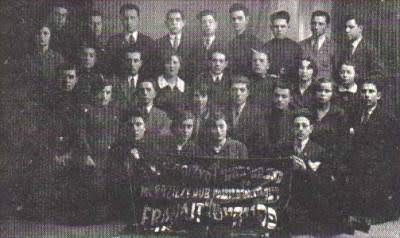
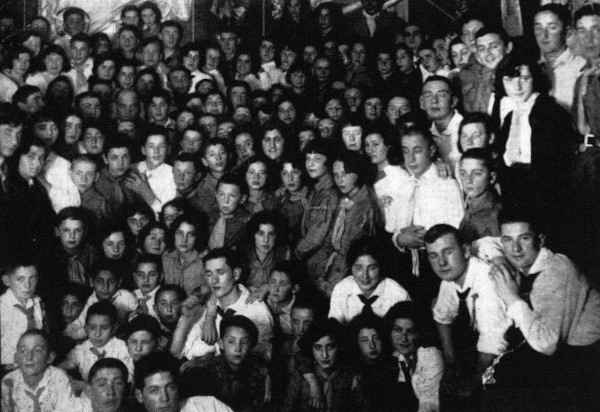
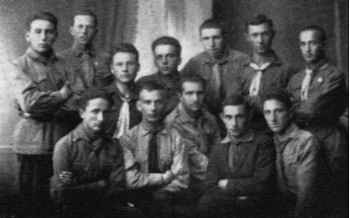
| The “HaShomer HaTzair” Cell, the Kinneret Troop (1928). The Emissary Micha Vardimon |
[Page 232]
“HaNoar HaTzioni”[4]
The “HaNoar HaTzioni” organization was organized in Lida in 1931. Before this the majority of its members were united in the “Herzliya” organization. On the heels of the unification with HaShomer HaLeumi[5] that arose in Poland at the initiative of the members of “Herzliya,” the cell of “HaNoar HaTzioni” was founded in Lida. The movement was mostly comprised of high school students, and after some time, working youth also joined its ranks.
The movement had all the characteristics of the youth movements that were accepted on the Jewish street in that period:
The organization was built from three classes, according to the age of the members. The emphasis was placed principally on three academic activities. Together with this, expeditions, outings and summer camps were held. The camps were organized jointly for members of the whole region. In addition to this, national camps for the leaders were held in the mountains. However, they always considered the cultural theoretical side more.
Members that afterwards filled primary roles in the head leadership in Warsaw emerged from the Lida cell and left their mark on the whole movement.
In the year 1933 a split occurred in the organization of the General Zionists. This event also influenced the “Noar HaTzion” organization in Lida, which defined itself as part of the General Zionists Aleph, that is, the Greenbaum group.
After one student from the government school was taken out of the gymnasia because of her membership in the “Noar HaTzion” organization, many of the students stopped visiting the cell, and the activities were weakened to a certain degree. Nevertheless, a number of members went out for training, and after they completed their training period (whose conditions were very difficult), they reached the land.
In the time of the Russian regime, the “Noar HaTzion” organization in Lida went underground. The members stayed in constant contact and worked together for aliyah. The people of the movement passed through Lida to Poland, and from there to the land. At the end of the Second World War, members of the cell in Lida engaged in help for the refugees and in guidance for their transfer to Vilna, so that from there they could ascend to the land of Israel.
“Freiheit” (Dror)[6]
The youth movement “Freiheit” was founded in Lida in about the year 1927 at the initiative of the “Poalei Tzion” party.
From the lack of a meeting place and a permit from the authorities, the activity began in secret. The gatherings were held in one of the classrooms of the “Talmud Torah,” secretly, by the light of a candle, while entering and leaving the building was done in total secrecy.
After about half a year, the party obtained a gathering place and also legalization by the authorities. At first the movement concentrated on working youth 16-18 years old, and the main part of its activity was expressed in discussions, political debates, and social parties.
After a number of years a young class by the name of “Freiye-Scoyten” (Free Scouts) was organized, which focused on children from the age of 10 and up. The activities of the young class were based in scouting. In order to ensure Madrichim, special courses were organized.
In the year 1931, an adult member was sent from the center for the administration of the scouts and also for the administration of the drama group. This coordinator – Moshe Novoprutzki – with his coming to Lida, breathed life into the movement, and brought its growth and development. The years 1932-1935 were years of flourishing for the movement: summer camps, outings, a drama group, a choir, public appearances. All of this outside of the regular daily activities in the groups and age levels.
The ideological education was based on Socialist Zionism, and from an organizational point of view this was a youth movement of the “Poalei Tzion” party. However over the course of the years the movement received a distinctly pioneering character: training and aliyah to the land of Israel was made a central educational branch of it. Despite the fact that the realization was not an obligation – for it was possible to join “Poalei Tzion” without the condition of aliyah – many of the movement's founders, from its Madrichim and its students, went out for training and ascended to the land.
The city of Lida excelled in the period mentioned above in the flourishing of the youth movements of all the ideological hues. It was pleasant to take a walk on the main street in the evening and see hundreds of youths, in the attire of the
|
|
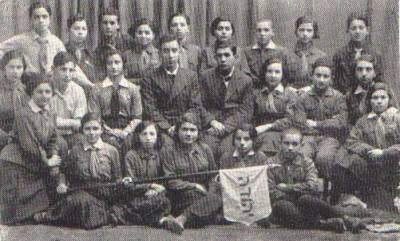
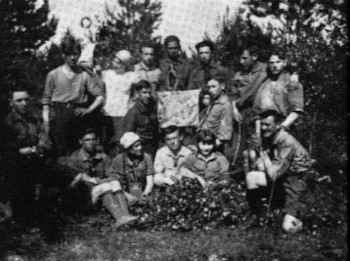
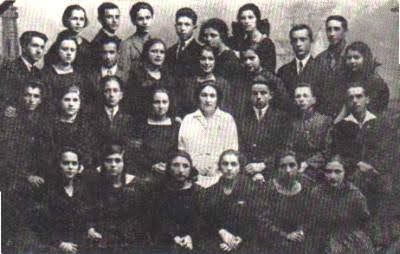
| The “Freiheit” Organization at the Beginning of the 1930s |
[Page 233]
various movements, emerging from their club houses full of the joy of life and youthful energy.
About a year before the Second World War, a closeness began between “Freiheit” and “HeChalutz HaTzair” to the degree that it was possible to unite the two movements, and indeed, before the outbreak of the war, the united movement “Freiheit”- “HeChalutz HaTzair” arose.
The Nazi ax that was lifted against the Jews of Europe also cut down this young branch, the youth movement in Lida, the city with a large, awake and active Jewish population.
The students of “Freiheit” in Lida were among the partisans, among those who made their way to the land of Israel, but most of them were destroyed with the members of their nation and the members of their city.
|
|
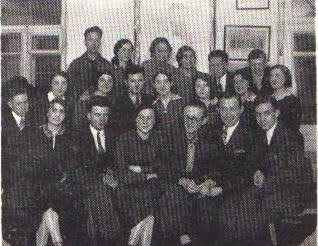
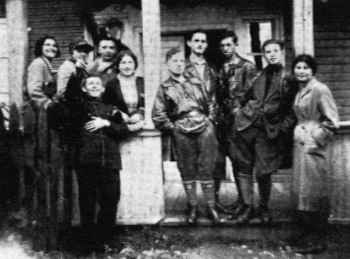
| “HaShomer HaTzair” The “Bnei Midbar” Group, the Tribe of “Judah” |
|
|
|||
Seated from right to left: Eliyahu Damesek, Shmuel Maslovti, Dvoritzki, Arieh Rubinovitz. Standing: Yosef Kalmanovitz, Gite Orzechobski, Yisrael Shvailach |
Translator's footnotes:
by Zalman S. Vinogradov
Translated by Rabbi Molly Karp
Frost Flowers
A winter night – a night of frost. The residents of the city are closed up in their houses. Silence in the streets and the courtyards.
Only from the yard of the old house that is on Sovalska Street are voices emerging and rising, young and invigorated voices. Girls and boys are sitting in a circle and giving their voices in song.
And in their songs they are sailing to the fields of the Emek washed in sun, to the lofty mountains of the Galilee. Here dreams are embroidered and stretch into longing.
The young people dream about the summer. Every word from the mouth of the Madrich – falls and is absorbed by the open hearts. He tells about the land, of its rocks and its wildernesses, its fields and its groves.
Erev Tu B'Shvat.[1] In our minds' eyes, we see almond trees flowering. Against the background of the windows the frost draws the shapes of imaginary trees, flowers of frost.
The conversations continue to flow until late. From the liberation of the nation and the redemption of the land the conversations move to the liberation of humankind. A new society will arise in the land of the ancestors.
Here they learn to love and have faith in humanity, to meet the tasks, to stand proudly against the hatred in the alienating Christian street, against the difficulties of life, against temptations and illusions. Towards the realization of dreams. In the old house a Shomrei generation grew up.
Beginning
The beginning of the “HaShomer HaTzair” cell in Lida – at about the end of the First World War.
New winds began to blow in that hour on the Jewish street. The youth seeking to go beyond the old framework of the educational and family regime, from the strict traditional way of life that freezes its keepers.
The echoes of the great events in the world arouse agitation and the young people seek an outlet for their desires. Information about the liberated youth movements, about youth values, the right of youth for self-definition, also reach here.
The Balfour Declaration and the rising wave of Zionism, echoes of the revolution across the border, stir up the youth and bring them to a search for new frameworks. Out of these searches the new cell is founded.
At the beginning the “HaShomer HaTzair” cell in Lida carried a scouting character, and was influenced by scouting. The main part of the activities were outings, singing, dancing, spending time together in single-age groups. Youthful joy, longing and searching.
There is preserved in my hands a certificate from those days, in the name of M.P., that testifies that the bearer is a member of the “HaShomer HaTzair” organization in Lida, the Trumpeldor troop, Yehuda group. Signed by the head of the troop – Zeitzik, and the year – 1923.
Years of Formation and Growth
Over the course of some time connections were made with the centers of the movement, and the cell underwent a period of formation and unification.
Into the framework new conceptual content was poured. The emotional connection to the land of Israel gave birth to the aspiration for self-realization, for aliyah, for working the soil, and for life in a kibbutz framework.
On the long road to realization of youthful dreams there now waits for every guard the stage of going out for training.
The educational group constituted the foundation of the Shomrei cell. The group is single-aged and in it were generally 15-20 teenage boys or girls. It had a Madrich, a director in the language of those days, older than his students by only a little.
I still remember the wonderful connections, the brotherhood and companionship that were woven among us, the youth of the group, the appreciation that we expressed for the Madrich, and our identification with him.
The number of groups, generally 3-4, were organized by troop. The troop that I belonged to, the “Maccabee” troop, numbered in the days of its flourishing nearly 100 youths. Extensive educational and cultural activity was done in the framework of the groups and the troops.
Lion Cubs – Scouts – Graduates
The level of the activities in the cell was suited to the age of the students. These were divided into three grades. The youngest constituted the “Lion Cub” level (later they were called “Wilderness Children”).
The “Lion Cubs” sported green ties and came mainly from among the students of grades 5-6 of the elementary schools. Most of the members of my class in the primary school “Tarbut” were “going” to “HaShomer HaTzair.”
While we were “Lion Cubs” we engaged mainly in games, scouting, knowledge of nature, the nation and the land. The emphasis at this level was placed on the emotional connection, on badges.
In a very impressive festival assembly our troop pledged allegiance to the values of the movement and was accepted to the second level – the Scout level. With joy and pride we sported the insignia of the level. From now on not only games and entertainment were the cell's occupations; rather, also serious conceptual activity, accompanied by explanations and discussions.
Alongside the scouting and knowledge of nature we were learning knowledge of the land in a methodical fashion – we called this Palestinography in those days, the history of the nation and the person.
Problems of the young man and woman at the beginning of their adolescence were resolved together. The open, simple and honest explanations of the madrichim lightened, more than a little, the discomfort of the youths at this age.
We ascribed great importance to the Shomer commandments, to the realization of them in life and to keeping them faithfully. They are still engraved in my memory:
The activities took on a deeper style, a scientific one. Problems of society
[Page 235]
and individual, the teachings of Borochov, some problems of the pioneering Zionism, the revolutionary socialism, the beginning of psychology.
From now on the members of the troop were accepting upon themselves the yoke of responsibility to the cell. My friends, and after some time myself as well, were joining the local administration, beginning with guiding.
That same hour discussions were held in the troop in which each one outlined his path in the future.
Values of self-actuation, going out for training and aliyah. Deliberations and decisions. Each one stationed at a crossroad. It was for him to determine which road he would choose.
Youthful dreams – world view – way of life.
In the spring of 1939 our troop, the “Maccabee” troop, parted from its member Natan, who was the first to go out to the training kibbutz in Slonim.
Many prepared to follow in his footsteps, but fate had other plans. The years of the Shoah destroyed the hopes while they were still on the vine.
In the Cell, In the Evenings
The cell was bustling with people. Almost every evening, even when there were no organized activities, meetings of the troop or the group, we would come to it, and even for only a few minutes, a quick encounter, to see, to hear.
It was pleasant there, and cozy.
There were always heard in it a joke and singing.
Noisy and lively lives of youth.
The older youths, who did not get to have organized lessons, found here an opportunity for the completion of education. At his disposal were continuing education groups, and also a rich library, named for my brother Eliyahu Vinogradov, may his memory be for a blessing, one of the activists of the cell, who was plucked while he was still at the beginning of his promising road.
The learning youth also completed here gaps in his education, but mainly he was drawn to the new horizons that were here revealed before him – horizons that were not opened for him in the Polish gymnasia and even not in his home, even if his home was wealthy and educated.
In the Field and In the Forest
We will still remember the outings of the cell – sailings in the language of those days – mainly those of Lag Ba'Omer.
Hundreds of Shomrim – dressed in full Shomrim attire, grey shirts, ties and insignia, arranged by groups and troops with their flags – marching in the streets of the city towards the nearby forest, with Hebrew song bursting from their mouths. And the youths standing erect and proud – indeed a spectacular sight. They reach the Czachowski Forest. Within a short time field table are set up, stoves are built, and other scouting facilities, and we are already feasting to our hearts' content.
Immediately the games and sports competitions begin, and towards evening campfires go up and around them singing and stormy Hora dances. The festive graduation parade. Anthems. A quiet descends. We are stationed all around with pounding hearts and holy trembling.
With a clear voice the head of the cell says: Shomrim strong!
And from our mouths, from the mouths of hundreds of Shomrim, erupts the answer: Chazak Ve'ematz![4]
|
|
| General Assembly of “HaShomer HaTzair” |
[Page 236]
In the heart of the Lida pine forest the echo reverberates the call: Chazak Ve'ematz, chazak, chazak, chazak…
Summer Camps
The summer camps (“settlements” in the language of those days) constituted one of the greatest and finest undertakings of the “HaShomer HaTzair” cell in Lida, and surpassed the scope and importance of the regular activities.
Those wonderful days that we spent in the villages and farms are engraved on our hearts as the most powerful youth experiences in our lives.
Already a long time before the fixed date the anticipation and preparation for the settlement began. With the beginning of spring we started the practical preparations: conversations with the parents, gathering equipment, raising money.
And finally the departure. Today it is hard to understand how we succeeded to organize – we, young men and women without the help of an adult - such a wonderfully extensive enterprise.
The days went by very quickly in the settlement, and it is entirely a kingdom of youth. Spending time in the lap of nature, bathing, outings, night trips, scouting games, competitions, discussions and parties.
And the difficult living conditions did not bother us: the crowding, the rough straw mattress on the floor. The simple food was more pleasing to our palates more than all delicacies.
For many youths this was the only opportunity to go out of the choking streets of the city to the lap of nature. Nevertheless, also for others, like me, who went out every year with their families to a summer camp, these were shining days of independent living among their own age group.
Cheerful laughter and the joy of youth reigned over all.
For the Sake of the Land of Israel
An essential part of the activity of the cell was dedicated to the land of Israel. First and foremost – for the sake of HaKeren HaKayemet. The Shomrim were among the first for every endeavor. I still remember how on cold winter evenings and rainy fall evenings we would pass from house to house through distant foggy alleys and empty the blue boxes[5] that were in them. And in every place we were received warmly. Even in the poorest house they donated, even if it was only a few pennies. We felt that with our own hands we were redeeming the land. One more dunam and one more tree.
And indeed the Jews of the city of Lida excelled in their donations for the sake of HaKeren HaKayemet, and our cell was among those marching at the head in fundraising, and even won a special distinction for it.
We likewise participated in other activities that were organized by the Zionist institutions, and I remember well the protest demonstrations against the White Paper.[6]
Our political activity was especially alert to the elections to the Zionist Congress, in the framework of the Working Land of Israel bloc.
The preparations for the elections of the 21st Zionist Congress that was held in 1939 in Switzerland are well remembered by me. The entire cell volunteered. We distributed
|
|
| Summer Settlement of “HaShomer HaTzair” in Lida |
|
|
| “HaShomer HaTzair” – Yehuda Group (1929) |
|
|
|||
[Page 237]
shekels,[7] we ran a campaign, and on the evening of the day of the elections we spent the entire night drawing slogans on the sidewalks of the city. How the Polish inhabitants of the city were amazed when they went out in the morning to the streets and found them decorated with tens of writings: Vote for list 5 – the list of the Working Land of Israel.
Brick by Brick
The most festive minutes in the life of the cell were at the hour of the parting from the Shomrim that were ascending to the land of Israel.
I was still a small boy in those days, but I remember well the feeling of the festival in the cell and in the entire city at the time that the first of those implementers from among the students of the Lida cell ascended to their kibbutz in the land.
Brick was added to brick, group to group, troop to troop, and the cell grew and flowered.
In the peak period the number of members of “HaShomer HaTzair” in Lida neared about 500, and relative to the numbers of Jews in the city this was among the most successful in Poland.
Most of the Jewish public, especially the Zionist public, related to our activities with sympathy, and more than one supported us with a generous hand.
For the success within this public they got the public banquets that we held. One of them that was held in the “Edison” theatre is well-remembered by me. The hall was completely full. Shomrim and their families, Zionist sympathizers and those who were just Jews. All of them enjoying the spectacular performances that were imbued with youthful spirit, of the people of the cell.
But difficulties were not lacking. In the last years before the outbreak of the Second World War we especially suffered from the Polish authorities that restrained our steps. In a certain period the cell was closed at their instruction, and only with great difficulty did we succeed in obtaining legalization while we were using borrowed names.
Amidst the Jewish Youth
The central part of the activism of the members of the “Maccabee” troop, and mine among them, occurred in the years 1938-1939, the eve of the outbreak of the Second World War.
That year opposing processes were felt among the youth on the Jewish street.
From one side a process of assimilation occurred. Part of the Jewish youth wanted to integrate into the Polish society and to obscure its uniqueness. They increased their speaking of Polish, and they tried in every way to resemble the Polish members of their age group.
However the events shook them violently. The antisemitism, the economic ban, the picketing, the discrimination, did not allow the assimilators to forget their Judaism or have it forgotten.
At that same time there were only a few students of the gymnasia in the Shomer cell. With the ascent of the wave of antisemitism the illusion of assimilation burst like a bubble, and this part of the youth began to seek the way back to its national identity.
In the wake of this process a group of learning youth was formed which afterwards, for the most part, joined the cell.
The people of “HaShomer HaTzair” knew how to stand proudly and bravely against the harassment of the hostile Polish street.
I still remember how it was precisely the members of “HaShomer HaTzair” who did not observe the mitzvot who were among the few Jewish students in the Polish gymnasia who refused to write on Shabbat despite the strong demand of the teachers.
When a “ghetto” for the Jews was introduced by the Polish students in one of the classes, and they were forced to sit on the left side of the classroom, these members of “HaShomer HaTzair” did not submit in any way to the humiliating demand, and in different and various ways they were isolated, and sometimes also beaten, they continued to sit precisely on the right-hand side.
September 1939
While we were still concluding the summer settlements and preparing for the coming season of activity, the horizons were darkened and the world's skies were clouded by the news of the Ribbentrop-Molotov Pact.[8]
We hurried to aid the first victims of the war that had not yet broken out, and rescued from neighbors in the cell a group of Jews who were expelled from Germany.
And here the bitter day of September 1st arrived. The war broke out. We see with our own eyes the destruction of the airbase next to Lida. We hear the fierce battles, the rapid invasion of the German forces and the collapse of the Polish front.
|
|
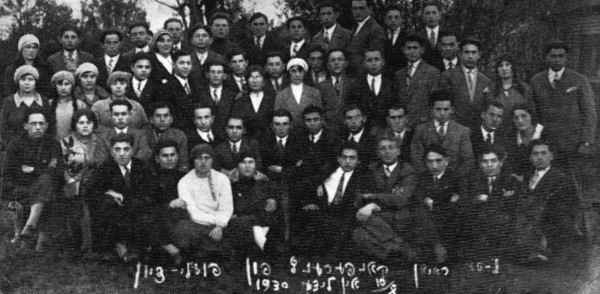
| Conference for Poalei Tzion in Lida 1930 |
[Page 238]
Our hearts were torn between hope and fear.
And already the Soviet tanks were thundering in the streets of the city. With sincere enthusiasm we welcomed the Red Army that redeemed us from the dangers of the Nazi conquest.
However, the disillusionment came quickly.
Would we really give up on our last hope, on the most precious thing of our lives, on aliyah? Had the end of our dream really been decreed – to build new lives in the land of the ancestors?
It was known to us about the possibility of crossing the border to Romania and we were leaving for Lvov in order to check this possibility. But our hopes were dashed. The border to Romania was firmly closed and our people who tried to cross it were caught and imprisoned.
With the consolidation of the Soviet regime we decided to dismantle the property of the cell – until the fury would pass. We divided the library of the cell among our trusted members. We secreted the cell's flags in tins and hid them in a secure place.
I hold quick meetings with my friends and wonder about the mood among them. I meet a few times with part of my students, a group of adult scouts, and we prepare for the future.
An Opening for Aliyah
On October 10, 1939, Vilna was transferred to the hands of the Lithuanians. A chance for aliyah was opened. Quickly emissaries of the main administration of “HaShomer HaTzair” and activists of the “HeChalutz” center in Poland appeared among us and begin to organize the mass transfer to Vilna. The movement calls to its faithful: “Get up and leave for Vilna. From here there is an opening for aliyah.” Hundreds of Shomrim, thousands of pioneers, and tens of thousands of Jews are streaming towards the border crossing – and Lida is a transfer station for them.
The houses of our members, activists of “HaShomer HaTzair” in the city, serve as centers for smuggling. The Shomrim are the contacts, help with organizing, host the border crossers in their homes. For some time the fund of the “Chalutz” center in Poland is kept in my house.
The city is entirely humming with people. Many Jews host people they know – and people they don't know – who are found on their way to Vilna. The synagogues opened their gates and those who did not get to be invited to homes found in them a warm corner to spend the night.
In every place there are wonderful revelations of Jewish comradeship.
From among those standing at the head of the transfer movement, from the directors of “HaShomer HaTzair” in Poland who spent that period in Lida, I particularly remember two figures:
Yosef Kaplan, serious and introverted, who afterwards was one of the heads of the Pioneer underground organization in Poland, and Adam Burks, lively and smiling, afterwards one of the leaders of the Bialystok ghetto revolt and the Jewish uprising in the Treblinka camp. Mordechai Anielewicz, who became famous over the course of about two years as the commander of the Warsaw ghetto, also passed through Lida.
The mass transfer that was directed at first in an almost free fashion became a thorn in the side of the Soviet authorities and the border became more and more closed. The guard became more and more strict. The authorities were investigating the organizers of the escape.
We turn to the men of the administration and inform them of our desire to cross to Vilna; however they require us to remain in place in order that we continue to serve as contact people – as long as pioneers are arriving who want to transfer to the border crossing. We remain.
The year 1939 most of the events come to their end.
In the Interrogation
On a clear morning at the beginning of January 1940 an unknown man appeared at my house, dressed in civilian clothing, and asked my name. I am still wondering about what is going on when I am asked to get dressed and to be escorted by him. We go down to the street and here it becomes clear to me that I am arrested, and two militiamen are leading me – with drawn bayonets – along the road.
On my long way downhill on Sovalska Street to the Secret Police center, across from the post office, I hear clearly the whispers, full of compassion, of those going back and forth “they are leading the son of the Vinogradovs.”
We arrived at the place. I was brought into a big room and across from me was a Soviet officer. In his hand was a revolver and he interrogated me meticulously and at length about “HaShomer HaTzair,” about the Zionist movement, and on smuggling across the border to Vilna.
I deny everything, and he pressures, demands, threatens.
The day lengthens towards evening. My mother, Miriam Vinagradov, may her memory be for a blessing, tries that same hour, with the help of acquaintances close to the authorities, to find out my location. When they don't succeed in this they begin already to weep for me.
In the evening, after a long day of threats, I manage to get out. Starting the next day I must present myself to the police twice a day.
To the Passage to the Border
The next day in the morning I present myself as demanded to the police, and I decide to go out to the border crossing, to Vilna. I discuss it with my friend Natan Zimeranski (today Kanmoni) and we immediately make the required preparations. I pack a few things and part quickly from the members of my family. I never saw them again.
Only my mother, Miriam, when it became known to her after a year that I was about to ascend to the land, endangered herself and came to Kovno to take leave of me. The image of her waving her hand goodbye when the plane in which I was flying to Moscow on my way to the land took off, is still engraved on my heart.
In order not to attract attention we, my friend Natan and I, wearing farmers' clothes, rented a fast sleigh, and raced across the border. While it was still evening we reached the house of a man who was connected to the smugglers. While we were still on the road it became known to us that search parties were raiding the roads in order to catch us.
The connections that we made previously with the smugglers stood by us. We find the man and immediately go out on the road. The cold is strong, the snow is deep. The borders guards are circulating on skis, but the expertise of the guide was great.
With dawn we are on the second crossing of the border, we are welcomed nicely by the Jews of Lithuania.
Quickly we reach Vilna and join a concentration of kibbutzim of “HaShomer HaTzair” together with another 700 Shomrim and Shomrot[9] from all over Poland.
In the Underground
Despite the many dangers the connections were not entirely cut off. Over a few months an emissary went out from Vilna – Y.Sh. – in order to confer with the trusted men of the movement in the area of the Soviet conquest. In Lida the emissary stayed in the house of the family of K. The emissary received the means for the establishment of the Shomer underground from the hands of my mother, Miriam Vinogradov, may her memory be for a blessing, who transmitted a large amount of money into his hands.
Translator's footnotes:
|
|
JewishGen, Inc. makes no representations regarding the accuracy of
the translation. The reader may wish to refer to the original material
for verification.
JewishGen is not responsible for inaccuracies or omissions in the original work and cannot rewrite or edit the text to correct inaccuracies and/or omissions.
Our mission is to produce a translation of the original work and we cannot verify the accuracy of statements or alter facts cited.
 Lida, Belarus
 Yizkor Book Project
 JewishGen Home Page
Copyright © 1999-2026 by JewishGen, Inc.
Updated 05 Dec 2025 by JH