 |
|
|
[Page 246]
by Yosef Bankover
Translated by Rabbi Molly Karp
The Year 1923-1924
A difficult crisis is passing through Israel. Part of the olim are leaving the land.
And in a time of lack of work in the cities, and particularly in the settlements, as a result of the alienation of the farmers and the inundation of the settlements with cheap Arab labor, the great need is felt for organized pioneer aliyah that knows the land's needs and its missions.
The “HeChalutz” movement in Poland was put to a difficult test. The rapid and unnatural growth (from 2,000 to 10,000 in Poland) of “HeChalutz” was likely to endanger the movement and bend it to new ways that were entirely undesirable to us, unless it came into our hands to control the situation and turn “HeChalutz” into a mass organization without giving up on its ideological principles. Together with the expansion of the movement there was a need for its deepening, for methodical and orderly guidance. In the presence of the difficult situation, special effort was required to fulfil the role that was placed on “HeChalutz” at that time: to stand in the breach, to organize and strengthen the organization in Poland, and to repair the situation in the land by means of unceasing aliyah of pioneers with knowledge and desire. But the pioneers too, according to the information that was received in the organization's institutions in the land, mostly did not withstand the test, and moved to the city.
All of the great effort in training the members was in vain. Our aliyah added numbers, but it did not change the situation. In the search for means to repair the situation, we came to a conclusion that the reason for the problem was in the disintegration of aliyah; that it was necessary to begin with the organization of aliyah itself. In place of the aliyah of individuals, group aliyah was needed. The members that stood at the head of the movement felt the need for organized and centralized aliyah, which was done to unite the olim, to ease the difficulty that was in the objective conditions.
The regional council in Vilna approached to fill one of the most pressing needs of the hour for “HeChalutz” in the Diaspora and decided to organize an aliyah kibbutz of pioneers of the Vilna regional by the name of “HaKovesh,” which would ascend in a tight-knit group,
and be available to the Land of Israel workers' organization for conquest and for labor. About 200 olim and olot were authorized by the center for the next aliyah. The regional council in Vilna turned to all these members with a special circular and offered to them the organizing of an aliyah kibbutz.
Among the hundreds of pioneers that were scattered throughout all the small and most distant towns, there was a great response throughout the Vilna region to the establishment of “HaKovesh.”
The pioneers of Lida and the surrounding area excelled in a unique way. In all these places branches of “HeChalutz” and a series of training kibbutzim arose which were at the beginning of their steps, with “Tel Chai” at their head.
Lida was a city with a longstanding Zionist tradition. In the city an awakened Zionist movement and the youth organizations held a place at the head. There are also “HaShomer HaTzair,” “Dror-Freiheit,” and Beitar. It conducts intensive activity for the KKL and much activity in the League for the Sake of the Working Land of Israel. In Lida there was also a Hebrew gymnasium that contained the best of the local youth, and the pride of the Zionists was upon it.
The members of “HeChalutz” in Lida participated in an active way in the training kibbutzim in the city and the surrounding area, and members of “HeChalutz” saw to sources of work for the training kibbutzim in the factories, in tree felling, and in services in private homes. The Lida pioneers went out for training in distant places – to Grochov, Klosova, Bendin, and Shachariah.
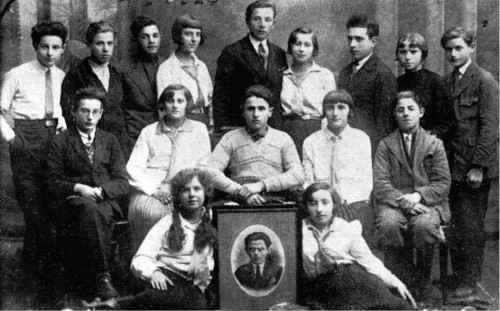
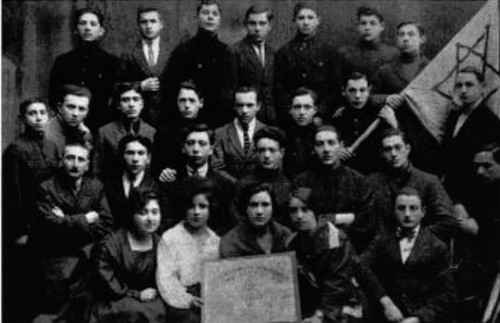
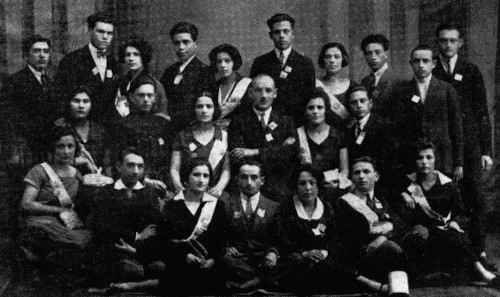
A special chapter in the lives of the pioneer youth movements was the branch of “HeChalutz HaTzair” in Lida, which was rightly able to see itself as a first branch in all of the Vilna region, and maybe in all of Poland.
Indeed, the branch of “HeChalutz HaTzair” in Lida, as the first, and as the initiator of this new movement, cast about in the dark at the beginning of its steps. But the composition of the branch and the blessed activities of the young boys,
|
|
[Page 247]
who were also helped by the experiences of the local “HeChalutz” rabbi, all helped the “HeChalutz HaTzair” branch in Lida to set out on the royal road of an organized branch and to serve as an example and a goading factor in the expansion of the “HeChalutz HaTzair” movement in the region and in all of Vilna.
And it was because of movement satisfaction and the great happiness to be found in pioneering Lida, to meet with the lively youth and to be a witness and a helper in the continuous expansion of the pioneer movement in the place, in all its branches. Members of “HeChalutz” from Lida were among the companies of aliyah of “HaKovesh” that ascended first to the land, and in significant numbers, and with their aliyah to the land they harnessed themselves to the burden, and to great movement responsibility. The activists among them continue in their lives in Ramat HaKovesh until our days.
And if we have reached this point, we are permitted to be proud of the pioneers of the Lida district, and the members are permitted to look with retrospective satisfaction and review the road that they crossed and the shared challenge in aliyah, and the conquest of the work, in settlement and in defense.
by Avraham Gelman
Translated by Rabbi Molly Karp
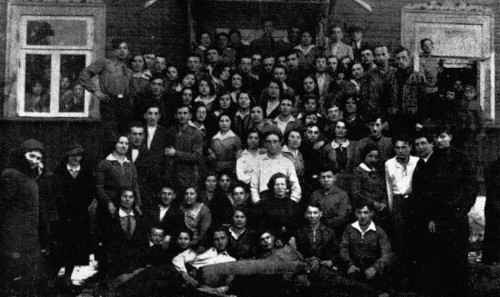
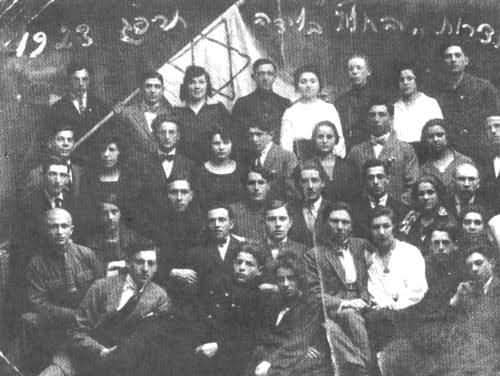
The training kibbutz of “HeChalutz” in Lida was at the beginning of May 3rd Street in the house of Ribatzki, the owner of large vegetable gardens. Afterwards they dwelt in the courtyard of Deluskin adjacent to the Nirvana movie house, and from there they moved to the area of the railroad, and finally they settled in the new quarter of the city, next to the new post office not too great a distance from the police station.
In the beginning the number of members was small, and in the situation of a lack of work that prevailed in Poland it was hard at that time to obtain work. Because of that a committee was established that saw to the kibbutz (“Pro-kibbutz Committee”) and helped it with the search for sources of work. The employers were of the opinion that a Jew is not capable of working in hard and exhausting jobs and this was “a matter for the Gentiles.”
The work situation was improved after a galoshes factory was opened: “Erdel.” Likewise owners of small businesses and middle-size restaurants had the practice of hiring male and female workers from the training kibbutz.
Things got to the point that the Poles working for Kronick, Gurvitz, and Melnik complained that “Palestinistics” were snatching the work from their hands, and what's more but that the members of the kibbutz were attempting to take the good jobs from the Poles.
In the training kibbutz, enthusiastic cultural activity was also conducted; parties and banquets were organized, and on every Shabbat night tens of male and female members would come there from the city to listen to singing and for gaiety.
From among the members that were in the training kibbutz in Lida we will point out in particular: Yitzchak Tzukerman (Antek), one of the commanders of the Warsaw ghetto revolt, Moshe Mendzitzki, Aharon Dodlzak, who was active in the League for the Sake of the Working Israel.
|
|
[Page 248]
|
|
|
|
|||
|
by Micha'el Orzichovski
Translated by Rabbi Molly Karp
“HeChalutz”
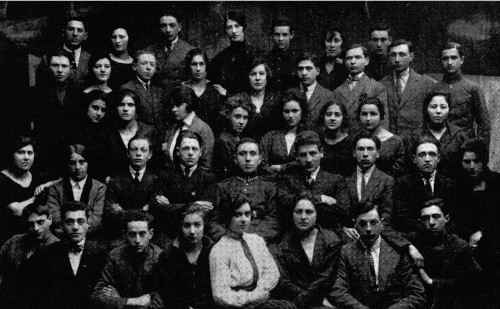
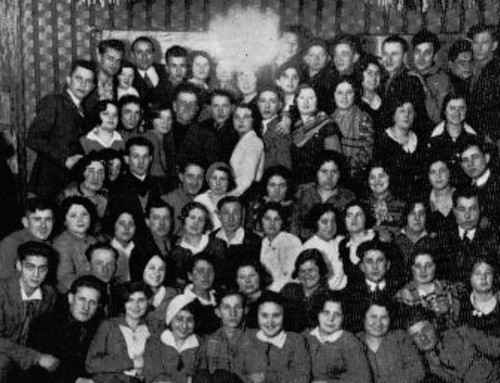
The branch of “HeChalutz” in Lida counted in the boom years about 500 male and female members. The closed gates, the difficulty in aliyah, did not prevent hundreds of youths from joining this organization, in which they saw a solution for their lives and their futures.
Here I am reminded of the branch on Mitzkovitza Street (the crooked street) in the courtyard of Bodin the bathhouse attendant. The branch clubhouse served the members every evening for discussion, learning, and entertainment. The member that stood out the most was Chinah Yishayahu Kamenetzki, who would run around from one to the other, to this one he would say something stinging, and to this one out of preaching, and all in hilarity.
When the place became too small the branch was moved to the Talmud Torah on Shulhoif Street, the place where most of the synagogues were, and in the center stood the magnificent Great Synagogue. After the youth movements joined “HeChalutz,” it was moved to the home of “HeChalutz HaTzair” in the cheder of Itshe the Melamed, and afterwards together with “HeChalutz HaTzair” to a rented home on Shulhoif Street.
In that house all of the youth movements that were connected to the Working Land of Israel movement (HeChalutz HaTzair, HaShomer HaTzair, Freiheit, Poalei Tzion Socialist Zionists, and the General Zionist Youth) assembled for general assemblies.
Whoever entered this house immediately breathed into himself some of the atmosphere of the land of Israel. From time to time an emissary or a lecturer from one of the movements mentioned above came, and then the large room in the branch was too small to contain all who came to the general assembly. The assembly would then take place in the house of “HaPoel” on Sovalska Street, across from the Edison cinema, the house of Levin “the Voranava stabler.”
In the 4 rooms of the branch each night a cultural and educational activity was held.
In 1933 the “HeChalutz” branch founded, according to the instructions of the “HeChalutz” center, “HaOved,” whose members were craftsmen, single and also married, and trained them for aliyah to the land of Israel.
To the praise of the youth who united in “HeChalutz,” one can say that it is distinguished favorably from the rest of the non-organized youth who revealed indifference to everything that was happening in the lives of the Jews.
The youth movements that participated in “HeChalutz” constituted a vibrant factor, active and alert, and every event in the lives of the Jews in Poland and in the land of Israel found an echo in their heart.
Thanks to the Pioneer movement they went out for training, went up to the land of Israel, and many of them joined the kibbutz movement.
“HeChalutz HaTzair”
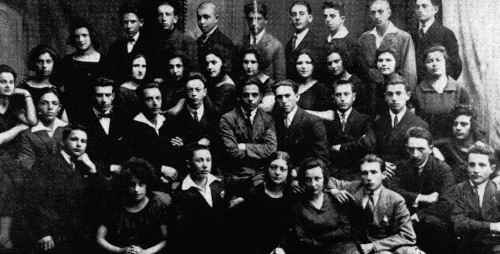
In the year 1926 I joined the branch of “HeChalutz HaTzair” in Lida. With the worsening of the economic situation in the 1920s and the depletion of the livelihoods of the Jews, the Jewish youth and the youth movements that saved them from degeneration and undesirable effects were badly hurt.
The “HeChalutz HaTzair” branch was located on Alexsandrovska Street, in the house of the Kaplan family, in two rooms that included a few long benches and a table.
The rooms were empty, but the warmth in them was great. Each evening tens of young men and women ages 15-18 gathered there, were warmed in the social atmosphere, and lent an ear to the words of the madrichim. One
|
|
[Page 250]
of these was Shlomo Visonsky, may his memory be for a blessing. He was a student of the gymnasium of Dvoretzky. Before he completed his studies he devoted himself with all his soul and might to the HeChalutz and the Hechalutz HaTzair movements. A smart young man, honest and beloved. He guided the young people, opened before them a whole world and all that was in it, and in the main excited them with his faith in the working land of Israel. A great disaster occurred to the branch when he became ill and passed away at a young age. We saw ourselves then as orphaned. His picture, which hung on the wall in the branch, accompanied us in every event of the branch. Those who were devoted and filled the empty void in the branch of “HeChalutz HaTzair” were: Roza Poltzek, Kaplan, the teacher Novoprutzki, and Chinah Yishayahu Kaminitzki, who was the living spirit in “HeChalutz.”
Among the important activities in the branch will be noted the publication of the booklet “HeChalutz HaTzair” that reflected what was happening in the movement. Its editor would write these lines and also the members Alter Vangiski and Eli Shmuelovitz. This work was done in secret, for “HeChalutz HaTzair” was illegal in the eyes of the authorities, it did not have a special permit and existed under the auspices of “HeChalutz.”
When the number of members grew we rented a new home for the branch on Sadova Street in the cheder of the Melamed Berdovski, who was known as “Itshe the Rebbe.” There the activity expanded. The auditorium was decorated with pictures and the number of members grew from day to day.
After this the members of “HeChalutz HaTzair” became madrichim of new groups that were called by the names of the heroes of Tel Chai and personalities from the land (“The Devora Drechler Group” “The Sarah Chizik Group,” “The Brenner Group,” etc.).
The cultural activity branched out. The teachers of the “Tarbut” school helped us with this. They dedicated some of their free time in the evenings for lectures and lessons. The activity “Twilight,” which was held on Shabbatot in the winter, and in the summer around the campfire, made a great impression.
Inside a pile of wood an electric light was hidden that shone a dim light. The members sat around the campfire, song burst out of tens of mouths and infused the hearts with the spirit of life and faith.
There were events that went beyond the scope of the branch alone, and became centralized activities in the city, such as: the memorial evening in memory of Dr. Binyamin Ze'ev [Theodore] Herzl, which was organized by the branch in the “House of the People” on Sadova Street, in the building of Chanan Ilitovitz. Youths of all the pioneer youth movements participated in it.
The appearance of the member Alta Rom in a long black dress, who with her pleasant voice sang the mourning song for the death of the leader, electrified all who were present. But the performance of the students of “HeChalutz HaTzair” from the lives of the Working Land of Israel excelled no less than this performance. People spoke of and took pleasure from this impressive performance for many days.
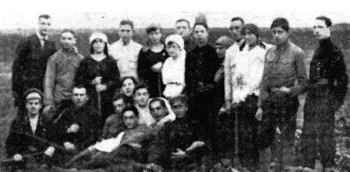
From time to time in the summer outings were held to the adjacent villages Chetna, Melo-Kovshtzizna, in which the Nivolski and Savoitizki families dwelled, likewise conferences and settlements were held at Nieman Station, in which was found the troop of kibbutz “Tel Chai.” In the lap of nature the stooped bodies stood up straight and breathing something of the spirit of the village and the atmosphere of the life of the kibbutz. On the outings the love of the land of Israel, friendly relationships between one person and the next, and the drawing near of hearts, were nurtured, and by means of this also bringing aliyah to the land near.
|
|
[Page 241]
|
|
|
by Aba Bassist
Translated by Rabbi Molly Karp
We were a group of friends who had completed school without having there being any goal before our eyes or a direction in which to go. We joined “HeChalutz HaTzair” which was established with the active help of “HeChalutz.”
The first general assembly was conducted by a Madrich on behalf of “HeChalutz.” As Chairperson the member Shlomo Vismonski, may his memory be for a blessing, was elected, and I was elected Secretary. It was possible to say truthfully that I didn't know with what to begin. They gave me a pencil and paper and told me to write down the words of the members. In that same meeting the committees were also elected: a culture committee, a technical committee, and more.
We would gather in a small room in an attic on Shkolna Street, boys and girls at a young age, and discuss the things that were standing at the top of the world, Zionism, and in the main the renewed land of Israel. All this was done in secret, quietly, because we knew that it was forbidden for our voices to be heard outside, for all of this blessed activity was done without official permission… We needed to be guarded and careful of the evil eye of the authority, and our boys circulated outside the clubhouse at the time of the activities and guarded it from anything bad.
Until today I remember the ardor that they instilled in us for the land of Israel. They explained the essence of Zionism to us, the history of the settlement in the land of Israel, the aliyot, etc.
“HeChalutz HaTzair” served for us as a school in which we learned that one must not live a life of idleness (and all of us were idlers then) and every one of us was obligated to learn and acquire a profession. A group of members left home and moved to work on a farm in an adjacent village. The Gentiles from the village were amazed to see how Jews were working in agriculture. In that same time a school for carpentry was also opened under the auspices of the “ORT” society, and a few of the members of “HeChalutz HaTzair” began to learn carpentry work. But the school did not last a long time, because the Polish government did not look kindly on this enterprise, and closed it. We then moved to work with private carpenters.
And thus we passed very slowly from lives of idleness to lives of work, and after a day of work, sometimes quite hard, we would gather again in our warm corner, hearing a lecture, participating in a discussion, and spending time together.
Frequently we would go through the city in pairs and empty the Keren Kayemet boxes. “HeChalutz HaTzair” granted us a great deal from the aspect of education, culture, and Zionism, and trained us for manual labor.
I remember that when the turn of a number of members came to move to the adult “HeChalutz” they were forced to be tested. A few of the “HeChalutz” veterans sat in a special room and tested each one of us, if we really absorbed the Torah that they taught us in “HeChalutz HaTzair,” and if he was permitted to pass into the adult “HeChalutz” in order to train himself for aliyah.
On the eve of the festival of Chanukah of the year 5685 [1924] I reached the land of Israel.
by Zelda Barsovska (Gluzman)
To the Memory of My Parents, and My Sisters Who Were Killed in the Holocaust
Translated by Rabbi Molly Karp
Before the war, a time when Lida still under Polish rule, I visited a national Jewish school at whose head stood the Principal Haber and his teaching staff, some of whom taught me: Lichtman, Fruchtman, Zartzin, Zach, Tziglenitzki, and the Hebrew teacher Yeruzalimski.
When I finished school the possibility was not given to me to continue with studies, the lack of which I felt. At that time I joined the ranks of “HeChalutz HaTzair” in Lida. I began to visit the movement and I found great interest since extensive and diverse social and cultural work were conducted in it.
I began to be active and received all kinds of roles, some of them more important and some of them less important. In Poland of those days antisemitism was already felt more and more. I understood that my place was in the land of Israel and not here – in exile. We opened with widespread activity in order to focus the youth in the pioneer movement and we established a stable branch in Lida.
The branch was divided into groups and we belonged to the “Adult” group. Likewise there were younger groups: the “Bachrut” group, the “Brenner” group, and the “Trumpeldor” group. Our branch was on Targova Street, in the cheder of Itshe the Melamed. In the daytime children learned there, and at night it served as the cell of “HeChalutz HaTzair” in Lida. There we would hold all kinds of cultural performances, parties, games, dancing, and we would organize various outings to Rushlaki. The cell on Targova Street served as a source of life for the youth in Lida. The singing and dancing the Hora continued until the wee hours of the night. More than once we were joking around until it was almost time for Rebbe Itshe the Melamed and his students to arrive.
And so passed for me a few years in “HeChalutz HaTzair” in Lida in which I was educated in the spirit of Zionism and the longing for the land. Afterwards I went out for training in the “Klosova” troop that was in Vohlin. Until today I carry in my memory many pleasant memories from those times.
Two years before the outbreak of the war I went up to the land. When I was about to ascend my mother, may her memory be for a blessing, wept very very much, and afterwards she said in Yiddish: “my child, better in land or in sand” which is to say, “my child, better to go in the sands of the land than on the soil of outside the land.” And from then I did not see my dear parents or my sisters again. And only thanks to the Zionist movement, to my aliyah, I preserved the stock of our family and I established a new generation in the land of Israel.
|
|
JewishGen, Inc. makes no representations regarding the accuracy of
the translation. The reader may wish to refer to the original material
for verification.
JewishGen is not responsible for inaccuracies or omissions in the original work and cannot rewrite or edit the text to correct inaccuracies and/or omissions.
Our mission is to produce a translation of the original work and we cannot verify the accuracy of statements or alter facts cited.
 Lida, Belarus
 Yizkor Book Project
 JewishGen Home Page
Copyright © 1999-2026 by JewishGen, Inc.
Updated 22 Dec 2025 by JH