 |
|
|
[Page 79]
[Page 80]
By Fishl Rauf
Translated by Janie Respitz
Our town was among the first to have a branch of the World Zionist Organization in 1898. The local “Hovevei Zion” (Lovers of Zion), the earliest supporters of Zionism, who were not connected to any organized society, connected themselves with the newly founded organizations in Warsaw. The Zionists in Koło showed great interest in the first Zionist congresses. They were not satisfied simply with the information in the newspapers and sent representatives to the congress.
The tone of the newly founded organization was set by a group who presented the slogan “Practical Zionism”. They said they did not have to wait for Dr. Binyamin Ze'ev Herzl to receive a charter from the Turkish government to create a home for the Jews in the Land of Israel. We must immediately buy land, where possible, and settle Jews. The more colonies set up, the stronger the chances of creating a Jewish state. The Zionist members Mikhalovitch, Gliksman, Berish and Noyman and others actually turned this slogan into reality.[a]
The three- four groups of Zionist in town (among them members of “Mizrachi” a religious nationalist movement in Russia and Poland in the framework of the World Zionist Organization) met almost daily in the newly founded small synagogue “Zion”. After prayers, particularly after the evening prayers, they discussed daily activities, distributed Shekels, collected for the Jewish National Fund's campaigns which were illegal in the first years of political Zionism.
At the same time another group began doing something to spread Hebrew. Reb Yoine Vilner, a son-in-law of Reb Shloyme Poyzner, organized evening classes teaching grammar to the boys in the House of Study according to the book “The Path”. Many Zionists chose to speak Hebrew on the Sabbath, just like Eliezer Ben-Yehuda who brought Hebrew to daily life in the Land of Israel.
[Page 81]
In those years the Jewish youth in town realized that pushing the wagon of the P.P.S (Polish Socialist Party) would not bring salvation for Polish Jews. For that reason, they left “Achdut” and the P.P.S and founded the “Poalei Zion” (the Labour Zionist Movement) and “Hatchiya” (The Revival). The founders of “Hatchiya” were young men from the House of Study: Getzl Valkovitch, Yekhezkl Meir Valter, Khaim Lifshitz, Hersh Valter, Yitzkhak Goldman (Moishe Goldman's brother), Rafael Pinkhas Kazminsky, Nekhemieh Yaffe and others.
The first steps taken by “Hatchiya” were;
The teachers in Heder did not know their pupils were already involved in an organization. They hid from their teachers like from the Police.
[Page 82]
They did not know about the meetings. To the contrary, they thought we were excited with the JNF stamps. While studying we would glance at them which disrupted their teaching.
The Hasidim, especially the fanatic among them, looked suspiciously at the Zionist activity of the Heder (school) boys. After a “Purim Campaign” they denounced them. The Police arrested Shmuel Trayber and the writer of these lines. During the interrogation they asked if the money was for “Achdut”?
Our parents moved heaven and earth. There was an uproar in town. Delegations went to the high official and mayor. The matter was handed over to the police commissioner in Lentshitz and there they succeeded to erase the “sin” for twenty rubles. After sitting for ten days, they released those who were arrested.
The epilogue of the denunciation: they revealed the denouncer. It was the Hasid Vishegrodsky from a suburb of Warsaw. He did not lack problems…
We learnt about conspiracies in Heder. On more than one occasion a pupil played a dirty trick and the Rebbe (teacher in Heder) went crazy. He would begin to investigate and try to reveal the sinners. No one betrayed anyone: “I will die before I will denounce!”
After our release, older boys from political parties were interested in in the process of our interrogation and were amazed by our discretion.
This is a chapter of its own in the Zionist work during the First World War. This was actually the beginning of the Zionist ascent.
Original Footnote
[Page 83]
By Henekh Hirshbein
Translated by Janie Respitz
Eight years after the founding of the “General Bund of Jewish Worker's in Lithuania, Poland and Russia”, the first political cells of the movement were founded in Koło. The rumors of a Russian revolution in 1905 and the fight against the Czarist authority reached our town. A large portion of Jewish youth yearend for action and joined the ranks of the Bund. Young and old knew of this new organization which they called “United People”.
The slogan “with common strength and unity” indicated its goal. The first task placed on its members was: to support the underprivileged and oppressed and to declare a fight against the Czarist leaders. The chairman of the organization was Stalinsky. Also active were: the Labozhinslky brothers, Loyfman, Skurky, Levin, Vakholder, Kaninsky, Bercovitch and Brukshteyn.
Meetings, strikes and demonstrations – with that began open public appearances. At a meeting under the open sky the chairman Stalinsky called on the masses to disrupt the Czarist leadership. He held his speech on the balcony of the court house.
When the news arrived that the Czar granted a constitution, the joy was endless. In the middle of the old marketplace the excited crowd lit barrels of tar and the enthusiasm was great.
Soon after the “Small Bund” was founded. It helped spread illegal proclamations, transported various “non-Kosher” items and carried out dangerous missions.
After the failure of the Russian Revolution, they began here as well to persecute socialists and “Achdut” members. Arrests and exiles were a daily occurrence. Some escaped abroad, some went to jail and out of those, some were saved. Among them: Labozhinsky, Khatzkl Beynish and others. The patrol did not leave Yakov Vakholder's sick bed until he died.
The police commander at the time was a certain Kogan (he was a converted Jew).
[Page 84]
He kept a close eye on the Bundists. He assisted moles, and one of them, on Simchat Torah received his punishment. Beside the synagogue he was stabbed with a knife. He also caused the organized workers great suffering: a young man from Sampol was stabbed by him during a fight. His friends healed his wounds in great secrecy: they rented a room in the Bayrakht Hotel and kept him there until he was healthy.
Helping one another – this was the main purpose of the Bundist program. A Bundist was not deterred by any hardship when it came to offering help, even if it meant risking his own life. They were called “Achdut Youth” (United Youth), and there was actually unity among the members of the Bund.
After the police chicanery and terror, the Bund organization actually ceased to exist in Koło. It was renewed around eleven years later in 1916, in the middle of the First World War.
The organizers of the renewed organization were: Roykhverger, Likhtnshteyn, Pakman, the Sapirshteyn brothers and Danilevitch. They placed a lot of effort in organizing political and literary discussions.[a]
A library and reading room were founded and named for Page N. Graser. They renovated an abandoned premises and transformed it into a beautiful hall – “Future Home”. The evenings provided a lot of pleasure accompanied by the artist Yakov Vayskitz. The activities were run by a group of devoted members: Bashe Gutman, Menakhem Shtar, Danilevitch, Hirshbein, Leyb Brener, Taptche, Rayzl Zielinska, Krayndl Khmielnik, the Arkovitch brothers and the Grinboym brothers.
The poorest of the Jewish population, among them transport workers[b] and the female managers, belonged to the Bund.
[Page 85]
The young porters and the servant girls learned through the organization how to hold their heads high, be equal citizens in society. The were uplifted and began to express their ideas about local Jewish life.
The Bund sent representatives to all communal institutions like city council and the Jewish community council. The councilmen and elected members of the Jewish council defended proletarian interests. There was not one political or economic group where the Bund did not take part. On the economic domain, everything was done to ease the life of the workers and common folk in Koło[c].
In the socialist handworker's union the following were active: Menakhem Shtar, Leybish Taptche, Avrom Danilevitch, and Henekh Hirshbein.
In the years 1919-1920, when the aprovisation question was difficult, a baker's cooperative was founded by the Bund which allowed the poor masses to acquire a few allocated products, good quality and on time. The founders of the cooperative were: Leyb Brener, and Henekh Hirshbein. They brought the first transport of goods for the cooperative from Warsaw.
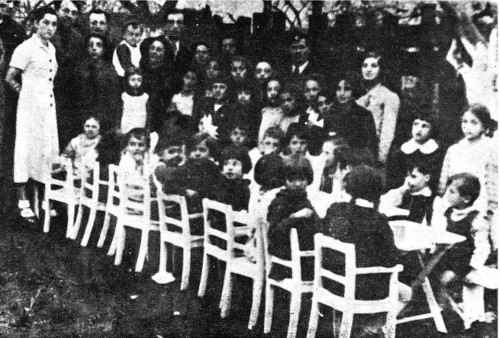
The activity in the cultural domain: a lot of energy and work was given for the benefit of small children and poor parents. Fathers and mothers, in many cases, had to work for others in order to earn a piece of bread. The children wandered in the filthy courtyards without supervision. In 1928 the “Medem Children's House” was founded. Fifty children from poor homes, between the ages of 4-7 received their first education there. The kindergarten teacher Rayzl Gutman was simply amazing. She magically evoked talents which enchanted the audience during their performances in the city theatre. Twice a year the Children's Home put on a show which was well attend and left a lasting impression.
In 1932 the institution moved to its own location. The house had a garden as well as a playground.
How did they arrive at this?
At a meeting of the Children's Home committee the question was asked about obtaining their own house. The committee member Bayle Yakubovitch responded: From my husband's transport salary I have saved 100 zlotys. We would like to use it to renovate our dwelling, however, given that the Children's Home needs a new location,
[Page 86]
we will postpone and give the amount as a donation to buy a new house.
|
|
The member Avrom Danilevitch announced that he too had saved one hundred zlotys to buy a winter coat. He will not buy this piece of clothing and will donate the amount for the children's home, to the house fund. Similar responses made it possible to buy a house from the Kahn brothers on Blankovo Street.
The organization of Jewish Women Workers “YAF” was also active in our town. They reached out to all the social and political movements to help with the Children's Home.
The daily Bundist newspaper “Folkstseitung” was read by dozens of Jewish worker's families, distributed by Itche Friedleyb.
In the “Press Days” when members and future members distributed newspapers, the number of sold copies was a few hundred.
The Koło “Bund” fought a hard ideological battle with the other Jewish parties. Koło was not a factory center,
[Page 87]
however, it had an aware and progressive proletarianized youth. Almost every young person belonged to a party. Every week they attended lectures and meetings. Lecturers came from Warsaw and they did not let them rest. Each party wanted to win over more members and when elections took place the town practically boiled over.
The regime made normal activity of the Bund difficult. The police harassed and tried to figure out how they could cause a pitfall. A policeman came to every lecture and more than once showered the participants with protocol and penalties. It even resulted in the arrest of some members. During the dedication of the red flag, the police forbid the march through the streets. Of course, we did not carry out the order.
During the destruction of the majority of Polish Jewry, our town faced great misfortune. They expelled and tortured, in the camps and on roads – this was the first chapter, the second – in the crematoria. Very few were saved and those who were are dispersed throughout the world.
|
|
Original Footnotes
[Page 88]
By Avrom Hartshik
Translated by Janie Respitz
Sixty years ago, when the party of the Jewish Working Class, “The Bund” was founded, “Young Bund” was also active; young Jewish child workers took part in the adult demonstrations.
A special place in the work of socialist education in our town was occupied by “Tsukunft”. Members of the organization recruited exclusively from the working youth.
In the 1920s, the “Tsukunft” together with the “League for Culture”, organized the so-called “evening courses” for young and older Jewish workers. They taught them to read and write Yiddish as well as other subjects.[a] The young workers, after a long work day in the workshops, studied diligently and never missed any lessons.
Organized “Culture-League”
The “Culture – League” was the legal name under which the public and cultural work of the Bund in Koło took place.
At the “Culture-League” the “Branislav- Groser” library existed, which had a few hundred books and many readers. Principally the readers were young Jewish workers, who through the library became familiar with the works of Jewish and general literature. The following members were active in the library: Leyb Gnatchik, Yakov Danilevitch, Henekh Gnatchik and Shaul Grinboym.
Outings and Gatherings
In the summer the “Tsukunft” youth organized outings outside of town,
[Page 89]
in the forest, in the fields, at the castle or by the river. Worker's songs would ring out all around. Often, the outings took place in partnership with the organization in Turek, or with the “Tsukunft” in Dombia or Grobov. They would meet half way and spend the whole day in the forest, playing games and listening to cultural discussions.
The Koło members of “Tsukunft” also participated in the gatherings which took place in Krushnievitz, Kutno, Kalisz, Vlotlavek and in the national gatherings in Warsaw.
Two “Tsufunft” gatherings took place in Koło: one in the summer of 1930 and the second in 1933. “Tsukunft” members who participated from other towns and cities came from: Kalisz, Kutno, Kurshnievitz, Kanin, Grobov, Dambia, Klodova, and Sampolne. The youth enjoyed a few days at these gatherings, organizing sporting events. At a closed meeting they reported on the educational work in the organization and the fight to improve working conditions.
The May 1st demonstration was impressive. The “Tsukunft” marched in the first rows and carried the red storm-flags. Everyone wore blue shirts and red ties. Their songs filled the streets. When the May Day demonstrations were forbidden, they celebrated the day in a closed environment. They never stopped celebrating this worker's holiday.
“Morning Star”
The “Tsukunft” also organized a sports club called “Morning Star”. The instructor was Elboym. Later we were visited by Kushmiersky from Lodz.
The Koło “Morning – Star” sports club had two good, trained teams for ping-pong and volleyball which excelled in competitions with other sport clubs. Those active in “Morning Star” were: Khaim Rafael Roykh, Shimon Grinboym, Avrom Hartchik, Khone Shiye, Shmuel Vays, Moishe Layzer Engel and Tankhum Danilevitch.
The Bundists continued to be active under the Nazi regime. A committee was formed, which helped
[Page 90]
|
|
other members, those deported to the Lublin region. They sent them packages of food and clothing. The committee also organized illegal First of May celebrations in 1940 and 1941. The May First gathering in 1940 took place at the home of Itche Fizitzky; in 1941, at the home of Pola and Arye Kigel. They watched through the window to ensure the Nazis were not coming. The speakers asked those gathered to endure the horrible times.
In the Poznan camps the Bundists gathered together. A meeting took place to commemorate the anniversary of the “Bund”. In the camp “Remo” on a Sunday afternoon, there was a gathering of 22 Bundists from the following towns and cities: Koło, Turek, Grobov and Unieyev. On the tables – 2 bowls of sauerkraut, a few rations of bread and a couple of bottles of soda water. These were the refreshments. Speakers at the meeting were: Shiye Tzites (Turek), Meir Arkovitch and Itche Fizitzky. Tankhum Danilevitch recited Eynhorn's poem “With the Oath of the Bund”.
The majority of the camp inmates were killed in various ways. I, one of the survivors, will not forget the path of the worker's struggle which guided the members of my hometown.
May their memory be a blessing.
|
|
|
|
Original Footnote
|
|
JewishGen, Inc. makes no representations regarding the accuracy of
the translation. The reader may wish to refer to the original material
for verification.
JewishGen is not responsible for inaccuracies or omissions in the original work and cannot rewrite or edit the text to correct inaccuracies and/or omissions.
Our mission is to produce a translation of the original work and we cannot verify the accuracy of statements or alter facts cited.
 Koło, Poland
 Yizkor Book Project
 JewishGen Home Page
Copyright © 1999-2026 by JewishGen, Inc.
Updated 31 Dec 2025 by LA