 |
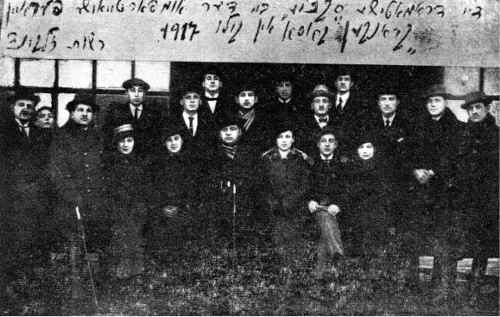
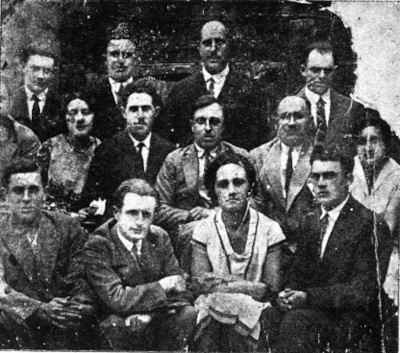
Standing (From right to left): Sh. Frushnavsky, Koyfman, A.B. Kurtz, Brand, M. Zalkind, Y. Barkovsky.
Seated: L. Markovitch, Rozental, Nokhem Rafalekes and Ezriel Pshedetsky.
|
|
[Page 92]
By Mordkhai Zalkind
Translated by Janie Respitz
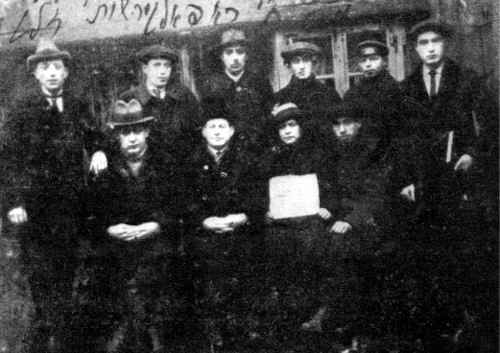
In 1916 the “Young Zionists” singled out a group of members who could not find justification in the program of the Zionist Socialist Party of the day. The group consisted of 10 men (almost all tailors) and organized the “Labour Zionist” organization in Koło.
Actually, this was not the beginning. The first cell of the “Labour Zionists” was founded in 1907-08. The first were Vrano and Volkovitch but they did not succeed in establishing roots of this new party in their community.
One Sabbath, a young man came to Koło and asked: “Who here is a Labour Zionist?”
They pointed to a group of young men. As they soon learned, he was a member of the Warsaw Labour Zionist organization. His family name was Samet.
He came to us from Sampolna, a neighbouring town, where he ran a Jewish school.
From time to time he visited Koło and led group meetings, explaining the ways and goals of the “Labour Zionists”. The meetings would take place in “Lasek” across from Goldberg's sawmill.
It is worthwhile mentioning that on the Sabbath there was no transportation between Sampolna and Koło. Our friend Samet would come by foot. He did not receive any compensation. His discussions would attract new members.
The party was illegal. One day Zalman Rubashov[2] came from the “Velt Farband” (International Association). We organized a secret meeting in a private home. Someone informed the German secret police. The speaker jumped out the window and a few friends followed. Luckily, no one was arrested.
The German occupiers did not want to legalize the “Poalei Zion” (Labour Zionists). We came up with an ingenious idea: we put forth a request to the authorities:
[Page 93]
we wanted to found a “General Worker's Sick Fund”. They agreed.
The wash house served as our first meeting place, the so-called “Banye” on Okulna Street. With joy, our members renovated the building making it appropriated for a social place of gathering.
Food products during the war were bad and limited and the result – epidemics and general physical weakness. The Sick Fund tried to give the sick all possible help. Although the initiators were members of the “Labour Zionists”, there were representatives from other parties on the committee, as well as unaffiliated.
|
|
Standing (From right to left): Sh. Frushnavsky, Koyfman, A.B. Kurtz, Brand, M. Zalkind, Y. Barkovsky. Seated: L. Markovitch, Rozental, Nokhem Rafalekes and Ezriel Pshedetsky. |
The deficits of the “Sick Fund” were covered by theatre performances, organized by the drama section of the society.
In 1918 The Sick Fund was closed down by the German secret authority. A German from Poznan carried out the denunciation.
[Page 94]
|
|
|
|
[Page 95]
After the emergence of independent Poland, the “Labour Zionists” began to work freely. They opened the “Worker's Home” and the number of members grew with a lot of support in town. Witness to this were the fist elections to city council: from six Jewish councilmen, four belonged to the “Labour Zionists”.
The party experienced difficult days in 1920 when Budyony's Cossacks crept into Poland and crossed the Vistula. They suspected the “Labour Zionists” of being connected to the Russians. Some of the activists were arrested. Thanks to the intervention of a Sejm deputy, Dr. Yitzkhak Shipper, they were freed.
|
|
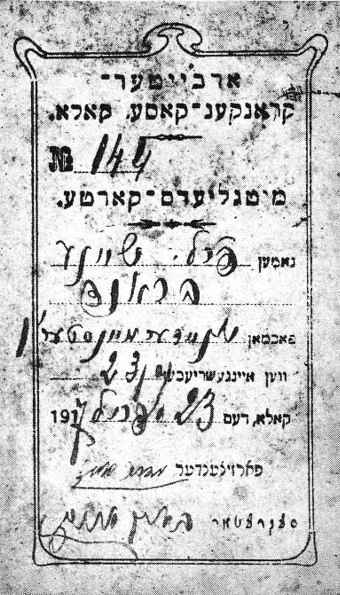
Name: Miss Sahyna Brand Occupation: Tailor master Date: April 23, 1917 |
[Page 96]
The split in the “Labour Zionist” party took place in the summer of 1920 due to disagreements about the membership in the World Zionist Movement and socialist orientation. The overwhelming majority moved to the left-wing, which after the split was called the “Left Labour Zionsts”. In our town the majority supported the left orientation.
After the split the following four created the core of the “Labour Zionists” (Right): Zalman Bornshteyn, Avrom Leybush Kaninsky, Ruven Modalisnky and the writer of these lines.
The greatest task was to attract students. The students in the Jewish high school were: Mikhal Bergman, Hersh Kurtztog and Y.L. Goldberg. They brought a lot of life into the small group. The students joined the “Labour Zionist” (right) and began intensive work for the Palestine Worker's Fund and for Zionist funds.
The locale of the “Labour Zionist” (right) was in Kreitzman's house, near the Warta River. This is where they organized Box Evenings (fundraisers) and lectures which were well attended. The main forces were Ruven Modalinsky and Mikhal Bergman. Their speeches were listened to with great attention. At hostile meetings the opponents were: Zalman Bornshteyn and Morkhai Zalkind. Y.L Goldberg proved to be a good administrator and organizer. He gets the credit for the successful activities and renting the new premises from the Levin family on Okulna Street, three large rooms. Day after day gatherings of the groups took place there. Saturday night entertainment, lectures three times a week and discussion evenings.
When the “Labour Zionist” (right) began to collect tools for the workers in the Land of Israel, the whole city gave them required support. When the party established the “Hechalutz” (Pioneer) Resort, hundreds of youth signed up.
In 1924 the “Labour Zionist (right) ran independently in the communal elections. The parties made fun of the new “boy's party”.[a]
[Page 97]
However, the masses showed trust. The results of the election: 1 representative on the Jewish communal administration and 1 representative on the Jewish communal council.
After the unification of the Zionist socialist “Young Zionists” party, the Labour Zionists” (right) began intensive work in all fields. In the city council elections, a new victory we reached. Two representatives were elected: Avrom Leybush Kaninsky and Leyb Brukshteyn.
|
|
A departure banquet for Dovid Fordonsky. |
Original Footnote
Translator's Footnotes
[Page 98]
By Avrom Kharap
Translated by Janie Respitz
An important part of the cultural work of the “Labour Zionist” (right) was the drama club.
In the winter of 1925, the club performed Fineman's “Holy Sabbath”. The director we Dovid-Itzik Levkovitch. The participants were: Dovid Fordonsky, Akiva Karo, Frania Levin (today Kaninska), Leybush Albert, Shmuel-Leyb Firsht, Yakov Zayd, the Reykhnshteyn sisters, the Levkovitch sisters, the Granas brothers and another 20 people from the “Freedom” youth. A year later, they performed Goldfaden's “Kol Nidrei”.
In 1930, the drama club, under the direction of Godl Katovsky, performed Osip Dimov's play “Who is he? A Jew!”. The participants were; Godl Katovsky, Akiva Karo, Dovid Fordonsky, Ruzhka Shultz. The prompter was A. Kharap.
In the performance of “Today's Girls” the following participated: Akiva Karo, Avrom Rozntal, Ruth Eyman, Sonia Polansky, Lyuba Prsost, Meir Hanftvurtzl, Kharap, Godl Katovsky, and the kindergarten teacher Deklboym from “Tel-Chay” children's home. Later the following plays were performed: “Itzikl Wants to Get Married” and “A Sacrifice of a Sister”.
In the years 1931-1932, the youth drama club under the direction of the kindergarten teacher Bluma Kornfield (today Vasser and lives in Tel Aviv), performed a series of reviews about the Land of Israel which were very well received.
The very popular songs were “Three Young Men” and “The Nights in Canaan”. (They were translated from the Hebrew by M.H.), and from the reviews entered Jewish homes.
A second performance was Osip Dimov's drama “The Singer of his Sorrows” (directed by Glavisnsky from Kutno). The participants were: Dovid Fordonsky, Kharap, Albert, Manya Stal, and the kindergarten teacher Khayke.
A little later, when the Kibbutz training was established in Koło, the kibbutzniks together with us reorganized the drama club and
[Page 99]
performed original reviews about the Land of Israel, as well as a play by Kalmanovitch “Our Rabbi”. Those who participated: Yehoshua Godlberg, Dovid Fordonsky, A.Kharap, Yudis Rotbard, Mendl Tzimerman, a member form the training kibbutz, Hersh Albert, Pinkhas Belkhotivsky, Yakov Shultz. Then we performed Goldfaden's historic operetta “Dr. Almasado” with: Yudis Rotbard, Avrom Kharap, Eva Bzhustovsky, Hersh Albert, Yakov Rotbard, Hartshik, Kibel and others. Besides these, our members performed programs for all the pioneering and Zionist events, like campaigns for the Jewish National Fund and the Jewish Agency which took place a few times a year.
Our members also participated in various performances to benefit charitable causes.
|
|
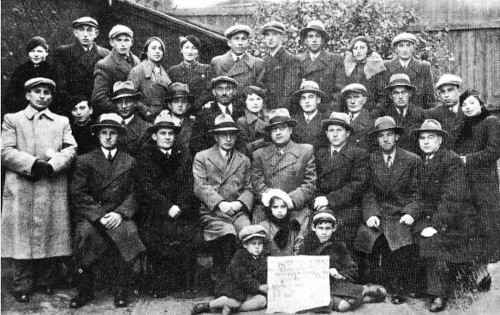
Seated (from right to left): Sh. Markovitch, Hendl Izralevitch, Moishe-Mendl Halter, Eliezer Levkovitch Second row: The kindergarten teacher, A.L. Kaninsky, Dr. Grosfeld, Leyb Luksnburg, Bine Vaynshtok Third row: Bayrak, Pinkhas Brener, Akiva Karo, Shmuel Lentzitzky |
|
|
JewishGen, Inc. makes no representations regarding the accuracy of
the translation. The reader may wish to refer to the original material
for verification.
JewishGen is not responsible for inaccuracies or omissions in the original work and cannot rewrite or edit the text to correct inaccuracies and/or omissions.
Our mission is to produce a translation of the original work and we cannot verify the accuracy of statements or alter facts cited.
 Koło, Poland
 Yizkor Book Project
 JewishGen Home Page
Copyright © 1999-2026 by JewishGen, Inc.
Updated 09 Feb 2026 by JH