 |
|
|
[Page 59]
By G. Volkowitz
Translated by Mira Eckhaus
| In memory of the soul of my father, my teacher, Avraham ben Yosef Ze'ev Volkowitz z”l, and in memory of the soul of my mother, Seldaka, the daughter of bat Itzhak Isaac Halevi Levin, z”l. |
If many of my city's residents will tell in their memoirs about Koło, which was distinguished by many virtues, and about its people who were diligent and upright, some of whom had good qualities and some of whom were educated, certainly there will be more things that should be added. This community was ancient and many traditions were handed down from generation to generation. I do not pretend to write its history, but to save from oblivion a few things that I heard from my mother, my teacher, may she rest in peace, and from the words of my father, may she rest in peace, and from my father and my teacher, whose burial place and date of death I do not know, because he perished with the saints of Ghetto Warsaw. At the outbreak of World War II, he sought refuge with my sister Bertha, who lived in this city.
I will begin my story with the old market, where my father's house was located. This market was the center of the city, and at its center was the council house and the tower built by the Swedes. This market was inhabited mostly by Jews, except for a Polish pharmacy. In recent years, a Christian hotel and restaurant have been added.
In both corners of the square yard of the old market were water wells with hand pumps. From them, the water carriers, carrying buckets and pails, provided drinking water to the residents of the market and the surrounding streets. This water was harder than the water of the Warta River, which surrounded the city, but they were careful to drink it for fear of filth. The river water was sweet, but they still preferred the water from the wells.
Forests - so it was passed down from generation to generation - surrounded the city on all sides until the 18th century, and remnants of them remain to this day. The grandmothers and grandfathers passed down this information, which they heard from their parents and elders about these forests. According to them, these forests served as the home for predators. In the winter months, when heavy snow covered the earth, groups of hungry wolves would enter the city streets, and the howls of the wolves would strike fear into the residents. To appease the predators, loaves of bread were prepared in the houses as a “gift” for the animals that would go out to hunt. In the morning, when the howls of the wolves were heard, food was thrown to them through the windows - a sacrifice.
There was no house of prayer in the old market area, and from this it must be concluded that the first Jewish residents were few and had little means.
[Page 60]
They were unable to purchase a plot of land on which they could build a small synagogue so that they could preserve the Jewish heritage that they carried with them on their wanderings.
As the Jewish settlement grew, a second market was added to the city - the New Market. Here, several plots of land were purchased on which houses of prayer, butcher shops, a mikveh, and a poultry slaughterhouse were built (a cattle slaughterhouse was built on the riverbank).
The community's most precious thing was not the synagogue but the Beit Midrash. Young men, eager for Torah, came here from far away. The gabbaim took care of their food and established an organization called the “Young Men's Society”, which included all the Beit Midrash scholars. The society's role was to raise funds from all the houseowners in order to purchase Torah books, to provide lodging for those coming from afar, and to arrange meals for the scholars in the houses of the city's residents. Every man, wealthy or poor, considered it his right to have a young man dine at his table. The women sometimes mended the clothes of the regular guests. The care and treatment of the young men of the Beit Midrash became a byword.
One of the gabbaim of the Beit Midrash, from whom I had the privilege of hearing a lesson in the Gemara-Rashi-Tosafot, was Reb Shmuel Leib Wasserman. His body was weak all his days; when he walked, he lowered his head before him, as if he suffered and accepted it with humility.
Rabbi Shmuel Leib was loved by all the young men and scholars studying in the Beit Midrash and respected by the houseowners. One look he sent through his glasses was as powerful as many words.
We eagerly listened to his lesson before noon. We listened to his words and explanations with great interest and saw that he was wise and witty, well-versed in all the quibbles of the Talmud, versed in all the commentaries, and there was no obstacle that could hinder him.
Between Mincha and Maariv, he would teach the householders a lesson from the book “Magen Avraham”. And they too listened to his words with admiration. If it were not for the worry of making a living, they would sit with him until midnight, because his words of Torah were interesting and wise and they learned quite a lot of practical sense from him.
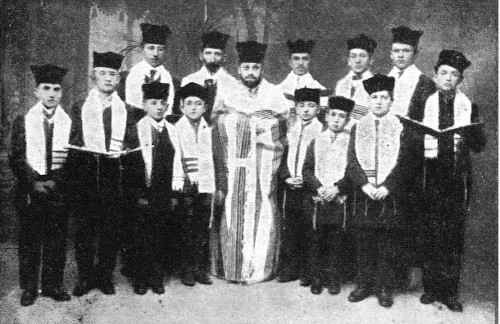
During the Days of Awe, Rabbi Shmuel Leib was the “Ba'al Tefila” in the Beit Midrash. He prepared the choir that helped him sing the prayer in advance: after Shavuot he began the rehearsals and concluded them on the eve of Rosh Hashanah. As he stood before the Ark, we realized that his stature was not stooped, as we were accustomed to seeing on weekdays. When his hands were holding the pillar, his strength and upright stature were revealed. His pleasant voice merged with the voices of the “poets” standing to his right and left. With his trills during his prayer, he would make every heart tremble. “Not even a tyrant and a cruel person would stand before him”, murmured the simple people among the worshippers.
Thanks to his concern for the supply of sacred books, the Beit Midrash never lacked either Babylonian Talmud or Yerushalmi Talmud books, or the books of Rishonim and Acharonim. He made sure that the books were complete and handed over torn ones to the bookbinder. If new editions of “Yoreh De'ah” and “Choshen Mishpat” or the books of the Rambam and books of “Questions and Answers” were published, he was among the first
[Page 61]
purchasers. Long shelves on the west wall were laden with books and could not hold them all; some of them always remained on the tables.
He wasn't satisfied with just that. He also took care to the benches and tables, so that they would not be “lame” because of the pranks of cheerful young men. During the winter, he ordered the shamash to turn on the ovens twice a day, so that they would warm the Torah students, who studied nights and days. He always noticed the diligent students, encouraged them, and stood by them.
The Great Synagogue
The synagogue was the pride of every religious person, but those who looked at its thick walls considered it as a fortress not only for the spirit of our people. Every trouble and every joy - they brought it to it.
When was the first synagogue built? - There is no answer to this question either. The last synagogue to be completely destroyed by the impure Nazis was built in 5620, ninety-eight years ago. Before it, a small house of prayer of earlier generations stood on this plot. The one who supervised the construction was Reb Yosef Reichert. He was the main benefactor and the other residents helped him.
As mentioned, the synagogue was modest on the outside, but inside - it was unparalleled in beauty. Of all the walls, the one that stood out in its beauty was the eastern wall: here stood the Holy Ark and staircases from the right and left lead to it. From this place the rabbi would deliver his annual sermon, and also rabbis, public emissaries, brought their words to the congregation. As the Zionist movement grew stronger, the rabbis of Jerusalem, who came on behalf of the Zionist foundations, spoke from this elevated place.
I will not prolong with the description of the holy place. I would like to add only one detail: When the Balfour Declaration was announced, people of all ages gathered here, and the ladies' section was also completely full of women. When the speakers read from the words of “Ezra”: Who among you of all his people, may God be with him, and may he go up to Jerusalem which is in Judah, and build the house of the Lord - - - And everything that is left of all the places where he has lived, let the people of his place carry him with silver and gold - - -”, the women took off their jewelry, wrapped them in handkerchiefs, and threw them into the stage, the first contribution to the establishment of the state.
Shabbat day in the city
The influence of the Jews in the city was most noticeable on Shabbat days. Starting at dusk on Friday onwards, all vehicular traffic was suspended. Before evening set, the shamash appeared on the streets of the city and with a large wooden hammer he knocked three times on the door mezuzah, announcing that the Shabbat was approaching and that all negotiations must stop immediately. The shopkeepers began to urge their customers, Jews and Poles, to hurry out of the shops, so as not to desecrate
[Page 62]
the day of rest. Silence reigned in the city streets shortly after the shamash's announcement, The businesses were closed and there was no one in the market.
The city took on a new form: children in Shabbat clothes, adults with wet beards and wigs, who had returned from the mikveh, girls dressed in colorful dresses. Soon, all the roads leading to the houses of prayer will come to life again: some to the synagogue, some to the Beit Midrash, and some to meet friends.
As darkness fell, the Shabbat candles shone through the windows. Anyone with a keen ear would hear the housewife's prayer, even though it was said in a whisper. The women blessed the candles, welcomed the Shabbat, and poured out their hearts before the Creator of the world, that He would provide sustenance for the home and preserve the health of the children.
The prayers are a chapter in themselves. A chazan alone could not be compared to a chazan with a choir. The melodies of the Hasidim's prayer houses did not sound like those of the Beit Midrash of the opponents. Each society and its own style, and there were quite a lot of societies, or “minyanim”. And these are the societies that also served as places of prayer: “Tehillim Society”, “Ein Yaakov Society”, “Shas Society”, and “Mishnayot Society”.
|
|
When the men returned from the houses of worship, they brought with them the light of Shabbat. With the song “Shalom Aleichem Mal'achei Hasharet” they welcomed Shabbat HaMalka. At the prepared table, not only
[Page 63]
the family members sat; most of the time, a guest was also present, or in simple terms: a poor person, a beggar, who came from a distant city. The gabbaim of the houses of worship gave each one a note with the host's name written on it.
|
|
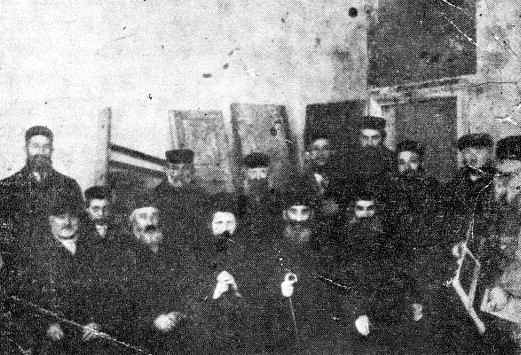
Seated (from right to left): Wolf Butzker, the shochet Erlich, Hirsch, the son of the rabbi, Shtechelberg, Zelig Sitner. Standing: - - Lipe, Avraham Frost |
The Shabbat meal, which was distinguished by special and good dishes - fish, noodle soup, meat and compote - was eaten slowly. Between each dish – they sang Shabbat songs. Sometimes the guest would sing a new tune or told a story and everyone listened carefully. And at the end of the meal, the husband would read to his wife from the big Friday newspaper: What was said about the countries, who would rise and who would fall? And the maid in the homes of the wealthy would take out from under the pillow the “novels” of the famous writer Shemer, who has no rivals in the way he knows how to keep readers intrigued…
The societies for social assistance
We have listed above several societies that were primarily concerned with Torah study; however, great and important was the activity of the societies who played a social role, such as: “Chevrat Malbush Eromim” (the society for the clothing of the needy), “Somech Noflim” (assistance to poor families in times of mourning), “Bikur Cholim” (assistance for patients), “Achnasat Kala” (Helping poor families marry off daughters), “Achnasat Orchim” (Hospitality for passersby and the poor), “Talmud Torah” (support for educational institutions and students in need), and more.
Every society had activists, men and women, and thanks to their dedicated work and the trust that the public felt in them, the poor of the people were saved. The help was small, but it had great effects: no one was left abandoned and hungry, and there was no poor child who was not educated in “Talmud Torah”.
[Page 64]
An interesting aspect was the celebrations held by the societies, which assisted in bringing people together, and congratulating the activists on a successful year of activity. It goes without saying that the expenses for the feasts were not covered by donations, but only by the participants' fees.
The “Bikur Cholim” society held its annual party during the days of Hanukkah. Its members included scholars of Torah, wealthy houseowners, and craftsmen who held a respected position in the community. Their feast was well-known. The table was set with a delicious food, and first and foremost, boiled, fried, and stuffed fish, in different flavors: sweet, peppered, pickled, and sour. All those invited chose the dishes according to their taste. The same was true of meat dishes: poultry (chicken and goose), veal, beef, and slices of “Beylak” from a turkey. And the soup – “golden soup” like the soup prepared for a bride and groom on their wedding night. Compote, drinks and fresh challahs - generously. Everything was in abundance. Between each course, those who know how to play entertain the guests with songs from the Shacharit and Musaf prayers. When they got a little drunk, they didn't delve into the singing and even sang songs from the “Day of Awe”: “Kol Nidrei”, “Netane Tokef”, and so on.
The “Chevra Kadisha”, “Chevrat HaBachurim”, and the other societies mentioned above held the celebration on Simchat Torah. The “refreshments” at the “Chevrat HaBachurim” celebration began immediately after the Shacharit prayer: a glass of schnapps and a cake, and continued with lunch at the house of the gabbai. I remember how the scholars of the Beit Midrash gathered in the apartment of Reb Shmuel Leib Wasserman to drink a toast together and to express their gratitude to their teacher and rabbi, who took care of all their needs. As they got a little drunk, they started singing and dancing while Reb Shmuel Leib in the middle of the circle. Everyone tried to hold on to their sash. Between dances, they sip toasts of schnapps and eat delicious dishes.
“Sisu Vesimchu Besimchat Torah!
Simchat Torah in the city was the happiest day; there is no other day that can be compared to it. On this day they did not notice that besides Jews there were also Christians. The drunk and the dancers “took over” the streets and did as they pleased. Folk songs, Chassidic songs and prayer songs did not stop from morning until evening. Couples and groups danced in the streets and the joy was endless. The climax of the joy was when the Torah scrolls were taken out of the synagogues of the societies into the streets of the city and they danced in a circle, as the poet Yitzhak Lamdan wrote:
| Our ancestors danced like this: | While our ancestors danced | |
| One hand rests on the shoulder of the friend | They closed their eyes tightly, | |
| The other hand holds a Torah scroll | And springs of joy opened, | |
| - Bearing with love the suffering of our people - | Their feet became light | |
| Our ancestors danced like this… | And with eyes closed - | |
| While our ancestors danced. | ||
[Page 65]
I would like to share some details from one afternoon Simchat Torah procession that I witnessed in my childhood:
The community's dignitaries, including the gabbai of the synagogue, gathered in the new market, in the square in front of the synagogue. With alertness and anticipation, they awaited the celebrating people who were in various corners of the city, near the houses of prayer. Then the chazan and the poets appeared and lined up near the entrance, but no one entered the synagogue. From all sides, women flocked and entered the ladies' section.
From afar came the echo of singing and dancing. And then, a group was approaching, the members of “Minyan”. The preacher who headed the group held a Torah scroll in his hands. To his right and left walked the chuppah bearers. Around them, people were dancing with their children and rejoicing in the joy of the holiday. They moved slowly and it seemed that they will never reach their destination, the gates of the synagogue, because the excitement was great and they were not making any progress at all.
As the procession approached, I noticed my father was among the Torah scroll bearers. I held onto his sash and danced with the entire congregation. When they arrived at the square of the synagogue, the chazan was given a signal to welcome the visitors with a singing that increased the enthusiasm.
With great honor and joy, the Torah scrolls were brought into the Holy Ark. As the bearers approached the stage, the women who were at the ladies' section showered them with sweets and dried fruits: raisins, almonds, figs, dates, and candies. The children pounced on the great spoils and filled their pockets, and there was no one happier than them.
In the evening, the public prayed the Maariv prayer, after which the “Hakafot” began: The gabbaim honored the worshipers by carrying the Torah scrolls in one circle around the stage. This circle was not done by walking, but by dancing and singing, and the enthusiasm of the dancers was immeasurable. Even during the Hakafot”, the women threw out the remaining sweets from the ladies' section, and the children rejoiced and were happy: singing, dancing, and also refreshments. What could be more sublime than that?
Purim - The most important holiday
There is a common saying among the people: “Purim is not a holiday, and fever is not a disease”. However, the young people turned this holiday into an experience beyond compare.
It began with the reading of the scroll and the sounds of the rattles. The “rattles industry” was very developed: everyone made their own “trick”, and anyone who succeeded in making a rattle that made a greater noise than their friend's rattle was considered excellent. And anyone who was jealous of his friend would add to the noise of the rattle by stamping his feet when the reader of the scroll mentioned the name “Haman ben Hamedta”.
After the rattles, there was the custom of “Mishloach manot” (the giving of fancy food gifts to friends on Purim). Each family would compete with the other, who would bring the most food. And the bustle was great, and the little ones in the family, boys and girls, were full of work and trouble, and of course there was a reward for the errands…
Purim was a long holiday, from the 14th of Adar to the 15th of it. Even on Shushan Purim, the special atmosphere of the holiday
[Page 66]
remained. Ostensibly, the holiday was celebrated by each family separately at their home, and yet its impact was noticeable in the city.
The disguises contributed greatly to the merriment of the holiday. The masks and the makeup and the acting of the disguised ones - a lot of thought was put into these. The first place in the disguises was taken by the groups that presented complete “plays” and their repertoire: “Megillat Achashverosh”, “The Sale of Yosef” and “David and Goliath”. Next came the individual disguisers or couples. Their level was not very high: they entered the house and sang a song and extended a hand… Sometimes there was nothing in the song to amuse the mind, or to entertain those around the table that was laid out with all the goodies.
The groups that presented the complete plays chose a wealthy and influential family, to which guests and neighbors were invited. First, the herald came in and announced: “Make room, receive the actors with great attention!”. While he was still speaking, the main actor appeared, and he began a solo song to please the ear. In the middle of his song - the second actor came in and this is where the plot began. If the first was a tragic character - the second came and made people laugh, to entertain and add a new color. One by one, the other actors came in and half the room became a stage for a play.
The audience, the family and their guests, more than once participated in the play by making intermission calls. They posed questions to the players, openly expressed criticism: they condemned one and praised another, and they praised those who were singing. More than once, they were served a glass of beer or wine in the middle of the play. And at the end of the show - refreshments and a reward: a few rubles.
The holiday in which everyone ate the bread of poverty
The holiday of Passover came with its joy along with a bundle of concerns for the good people of the city: “Can we provide for the known poor and those hiding their poverty the money required to prepare the Seder?
The “good people of the city”, the activists among the community leaders, were restless. In their meetings they compiled a list of all the needy who benefit from the charity fund and those who receive alms in secret, and on another sheet a list of the wealthy of the city: what special levy will be imposed on them? And on a third sheet - the amounts that will be collected from “Kamcha D'Pascha”.
The last levy was imposed when buying flour for matzahs (some people baked matzahs separately) or when buying matzahs. No one was exempt from “Kamcha D'Pascha”, which was dedicated completely to the poor, so on Passover they will not have to beg for favors or dine with others.
Even the Rabbi of the community was busy in the two weeks before Passover: he would go to the flour mills to kosher the machines, check if new spare parts had been introduced, and if they had removed the year-round flour, which is leavened flour, from the warehouses.
From the mills he went to the bakers. He preached a “dose” of morality to them too and warned them to be vigilant about kashrut, so as not to bring, God forbid, disaster upon the community. Making the barrels for water and the bowls for kneading kosher; cleaning the oven - all of these require supervision.
[Page 67]
When all the preparations were made, the rabbi appointed overseers to stand guard during the baking, to watch closely to ensure that not a crumb of leaven was transferred into the bakery area.
The work of the supervisors was not easy at all. Most of the work in the bakeries was done by Christian workers who were not careful about the commandments. They scolded them, the bakers and the roll workers, to wash their hands often, not to hold the slice of dough away from the large dough because it could leaven. They also urged the servers to hurry up and put the rolled matzah in the oven. They scolded one and complimented another. From morning to evening they were in constant motion.
Those who were careful with the commandments did not trust the Christians and “recruited” all the family members to come to the bakery to help prepare the matzahs. With their arrival, there was a different spirit in the bakery, a spirit of joy. During the kneading and rolling, they would sing “AzYashir” and “Hallel”, and when they finished with the prayers, they would sing Chassidic tunes.
After the holiday of Purim, the “burning season” of painters began. There was no house in which the rooms were not painted, or whitewashed. The whitewashing was done by the residents, but not everyone was skilled at painting. There were about ten painters in the city, and everyone wanted to be ahead. And the painting was not done by machine, but by hand. It goes without saying that the rich were the first, and only in the last days before Passover did come the turn of the shopkeepers who were bargaining. In order not to lose customers, the painters got smart and painted only the ceilings of dozens of houses, leaving the walls and the oil painting for after the holidays -after all, they needed a livelihood after Passover as well. They did not stop drinking schnaps, as they saw the drink as a means of increasing strength! And indeed, during the burning season they worked twelve hours a day or more.
The shopkeepers also looked forward for this season: Who doesn't want to buy new things for the holiday? And the redemption was, thank God, to their satisfaction. And the buyers were not only Jews. The Christian holiday of Easter falls, for the most part, close to the Jewish Passover. They too did a lot of shopping and had money in hand, because the Jews bought their own produce for the Passover: poultry, eggs, onions and potatoes and hay and beets. And the livelihood - they hoped to have a livelihood like this all year round….
There was a strange custom in the city: On the last day of Passover, the young men made a large doll and put it on a pole: “Chametzikda barchu” - that's what they called this scarecrow. They carried the scarecrow “Chametzikda barchu” in a playful procession around all the streets, and at dark they burned it with fire.
The joy of marriage
The holiday atmosphere remained even after Passover, from the 22th of Nisan until the end of Shavuot. Between the holidays was Lag BaOmer, which is the day of weddings. As is known, there is a certain mourning custom during the days of counting the Omer, it is customary not to get a haircut or hold weddings, but the 18th of Iyar, which is Lag BaOmer, deviates from this custom.
Many weddings were held on this day, and the musicians, not knowing where to go first,
[Page 68]
were those who determined the order of the weddings: which would be held first and which would be held last. When the bride and groom specifically requested the orchestra for a fixed time, they were forced to hire musicians from a nearby town.
There was great bustle in the homes of the in-laws. The wealthy would send carriages for the guests on the wedding day and bring them to the banquet venue. The invited guests did not come empty-handed and brought with them a gift for the bride and groom. Each guest tried to stand out, so that others to speak of his generosity.
The chuppah was arranged near the entrance of the synagogue in the New Market. The groom was brought from the banquet hall and an orchestra walked before him. The guests carried lighted candles in their hands. The groomsmen brought the bride to the chuppah accompanied by an orchestra. Here they circled the groom three times, while the chazan and choir sang delightfully.
After the chuppah, the new couple would be driven to the banquet hall. The bride and groom were now the center of attention, with the comedian reciting his rhymes in front of them. Here are some rhymes by the comedian Yaakov Yarmush, who would spice up his recitations with verses from the Bible and the words of Chazal:
“Tish zagen”
Hear thing, holy congregation / those who keep the Torah of Moses / who come with joy / to rejoice with the groom and bride / and I will also fill your joy with singing / with a song / also with an inquiry / to work mightily / to praise and commend / and to rejoice people / with mind and taste and smell / before important people / wise and generous / educated and understanding / and for the honor of the groom / to rejoice in joy / and for the honor of the people who came / beautiful and handsome people / who have come here to a place of joy and rejoicing / - - -
The “seven blessings” in honor of the young couple were considered as a long feast. The rich held them every day with an orchestra, a large crowd, and generous feasts, and the affluent also held feasts for several relatives.
There were two halls in the city: the Theater Hall and the Yazshvinsky Hall. Sometimes the weddings were also carried out in these halls.
“Green Thursday”
The Christian holidays revived the businesses of Jewish shopkeepers and also those of the stall owners at the fairs. Revenues increased greatly, because urban Christians, like rural ones,
[Page 69]
sought to embellish the days of joy with fine clothes, new shoes, sweets, and the like, and all of these things could be obtained from Jews. Only one holiday of the Christians cast a shadow over them, and that was “Green Thursday”, which for the most part fell after Shavuot.
This religious day stood in the shadow of the cross, and during this day the Jews were in danger: they feared that the zealous Christians would disrupt normal relations through incitement, and that life would not soon return to its normal course.
The preparations for the “Green Thursday” procession were extensive. In preparation for this holy day, various corners of the city streets were decorated, where ceremonies were held. The main place among them was the old market, near the pharmacy of the Christian Ruyevsky. There, a sukkah was erected from tree branches and greenery. The front wall of the building was covered with embroidered tablecloths on which were hung images of saints. On the stage inside the sukkah, statues were placed and the monogram of Jesus and holy vessels were placed. Carpets were spread on the sidewalk near the sukkah, as if before entering a temple.
As mentioned, there was excitement among the Jews that day, and some of them, who lived in Christian neighborhoods, were in fear. The shops were closed and children did not attend school that day and were careful not to approach the place of the ceremony, because it could lead to disaster. Until ten o'clock in the morning, some tension was noticeable.
The procession of believers, numbering several thousand people, left the church on Kalish Street. From there it marched to the old market, led by priests, monks and nuns, young people in white cloths, and followed by a large crowd. The procession carried icons and flags, and under a silk canopy - the statue of Jesus. The marchers sang prayers.
The ceremony began with the procession entering the Sukkah. The choir then began singing and the heavy crowd followed. The priests sprinkled holy water on the cakes that were prepared and the crowds fell to their knees.
After the ceremony, the procession continued to the Warsaw Bridge, where it stood again and sang hymns. At noon, its participants returned to the church, and the masses of peasants returned to their homes, some by car and some on foot. Only then did the Jews begin to go out of their apartments and the city became quiet, returning to its peace.
The fire department in its training and celebrations
A prolonged ringing of the large bell in the new market (near the theater building) heralded a fire or public disaster. Not a few minutes passed and volunteer firefighters from all corners of the city began to come running to their station. The copper helmet strapped to their heads, an axe stuck in their wide belt and a thick rope - that was all their personal equipment. About fifteen minutes after the ringing, squads of firefighters left in a vehicle carrying the firefighting equipment: pumps, hoses and ladders. The horn sounded a blast: Clear the way!
[Page 70]
The fire brigade also included several Jews, mostly tinsmiths, who excelled in courage and were experienced in walking on sloping roofs.
Once a week, on the first day of the week, towards evening, the firefighters trained in Kowalski's yard, where a tall wooden tower stood. The firefighters descended from it by crawling on a rope. While crawling, they did several rounds, and whoever did the most was considered the best. Orderly drills were conducted in the yard and the workers' ability to operate the pumps was tested.
The fire department's celebration, which was held in a square in the Warsaw suburbs, attracted a large crowd. A brass band entertained the young people who were dancing. Between dances, they enjoyed the food and drinks from the stalls around. The highlight of the party: the agility competition. On several wooden poles, up to five meters high, the organizers placed various valuable objects, which the most agile climber won.
We saw the effective help of the fire department during the heat waves, when fires broke out in the villages near the city.
|
|
By Abel Yarmush
Translated by Janie Respitz
May these lines from me, a fellow townsman, whom fate carried from Pintes Street to the highest corner of the world, in far away Bolivia, be a small stone on the memorial monument of our birth town Koło.
I often reflect, and like in a panorama, scenes run through my mind from four decades ago. I can see myself on Pintes Street, among the brick and wooden houses; I am back as a pupil of Anshl Bik, the teacher. I walk by Shatan's granary. The scenes end quickly. A gang of boys walk through the alleys, arrive at “Lasek” and from there walk to the memorial of the “Two Brothers” – at the end of town. They walk further, until the nearby village Kashteletz with the suspension bridge…
Another recollection: the Warta River which surround the city, invites us to take a walk. My friends and I rent a boat from the Pole Markovsky, and do a round trip from the “German teacher” until Pintes Street, passing Kovalsky's. On the water we see peasants on rafts. The scene changes: women are doing laundry on the river banks, and not far from them, children are catching fish. It was practically a custom, that on Tisha B'Av, we went fishing. On a Friday afternoon, the crowd is bathing in the river. Some are doing tricks and all sorts of stunts while swimming. They lay down on benches, swim on their backs, and step out. All clean and dressed up, they go to synagogue to welcome the Sabbath, and after, to the Friday evening supper…
The town is wrapped in greenery, a lot of greenery. Couples walk down the beautiful alleys, and as in the rest of the world, swear their “eternal love”. Also those who have come to their summer homes from Warsaw and Lodz are delighted by the summer landscape.
In those years, at the old marketplace, where the city hall stood, the town drummer would appear (we called him “Yakh with the drum”). He would come out of the city hall like a high ranking official, with his drum hanging on a leather strap. He stopped in all corners of the marketplace,
[Page 72]
banged his drum and called the “audience” to gather. Once there was a large crowd gathered around him, “Yakh” would stand stiff, become “official”, wipe his long mustache, and inform the public that the night before a pig had been stolen. Anyone who knew about the theft and would not report it would be punished.
During the winter the marketplace was cozy and lively, especially on market days -Tuesdays and Fridays. The marketplace was filled with wagons with grain. There were lady farmers with chickens, eggs, butter, fruit. They were besieged by Jewish shoppers. They chewed straw, bargained, cursed, then clapped their hands and a deal was made.
On some wagons there was peat, bundles of wood, sacks of potatoes. On Sukkot the farmers brought green branches to cover the Sukkah, and on Passover they brought beets to make borscht. Jews on their way to the House of Study, carrying their bags with their prayer shawls under their arms, would stop at the wagons, examine the peat to check if it was dry, take a potato out of a sack and examine it as if they were experts. Who is not an expert on leftover vegetables?
The teacher from town with the nickname old onion glutton, gives “private lessons”. He strides slowly and seriously, like…a teacher. His face is bordered by small black beard and his eyes are obstructed by glasses. He smokes a pipe, as it befits an intellectual. If you interrupt him, he offers you a sniff of tobacco, his use of tobacco was masterful from hand to nose. Filling his nostrils, inhaling and sneezing was like a concert performance of tobacco sniffing.
The Gabbai of the House of Prayer Reb Nakhman the Shrieker (he shrieked when he spoke), the teachers in the Heder (religious school): Anshel Bik, Vaterkhiye, Reb Efraim Zumershvartz, as well as the artisans: Mosihe the shoemaker, Avrom-Mendl “The Hammer”, Moishe Mliniker, Hertzke Parkh, Pukatch and others, were regular guests in the marketplace every morning.
Two brothers, who dealt in fruits, “the useful”, stand with a large covered wagon and a variety of fruits spread out on a table. Beside them, Ezriel Fisher, Moishe Yunivetcher, Soreh the fish woman with washtubs filled with all sorts of fish – tench, pike, gudgeon, and of course, carp for the rich. The fish swim around the barrels and splash. The small fish protrude, and Soreh the fish woman swears on all oaths to the poor customers that the fish had just been alive: “Let me live to see all good things!”.
[Page 73]
In a bustling corner of the marketplace there is “Slek's” stand with soda water. He adds a bit of syrup “for free”. Not far from him is Khemiye Brener with his halva, chocolate and other delicious things for the Sabbath. The herring merchant is across from him. All the barrels are the same except for one which had schmaltz herring. In the others there is marinated herring, and the last one, herring for the poor, herring with a smell…
The synagogue and the House of Study are in the new marketplace. In the vicinity, the slaughterhouse and the ritual bath. In the centre of the marketplace stand the municipal theatre and the fire department.
The impudent boys in town, who feared no one, would sit in Avrom-Yakov Band's tavern. There you could find: Itzil Tap, the blind Binem, Shaye Zhelozhnik, Volf Tantsmayster, Khaim Elye Makhak, Khaim-Isar Kuntzman, Shmuel Shad, Hersh Poyer, Yakov Smatshaz and others like them. The favourite food was gizzards drowned in beer. All the while they told stories about the Russo-Japanese war, Port Arthur and hummed a familiar military march.
If we are talking about music we must mention, at that time in Koło, there was the famous band of Reb Yekhiel Klezmer (musician). They were well-known in the whole region. Yekhiel was invited to the nobleman's court for balls and weddings. The fact he could not read notes did not bother him. He did not need them. He sent his son Zalman to study in a non-Jewish school where he learned music. This is how he became a great “scholar”. They came to him to write “petitions” and to review government “papers” sent by the authorities.
Yekhiel was an observant Jew, not pious, but never missed the evening prayers in the Prayer House. He dressed in German style: summer – in a light suit with a white cloth vest, upon which, with largesse, he wore a large twisted chain from a silver watch – a wedding gift. On the chain hung a medallion with the head of the Russian king and a horse. His face was outlined with a short-trimmed beard, he wore a round hat. On his middle finger of his right hand – a wide gold signet ring. Yekhiel often used this ring as collateral, depositing it with the parents of the bride ensuring his participation at the wedding, and as not to disrupt the celebration, his band would perform on time.
[Page 74]
Hi second son Yoineh was a tailor of ready to wear clothing. On market days he stood with a covered wagon and sold cloth suits for the peasant boys. Hew as also a bit of a musician, drumming a drum. His son-in-law Yosef Litvak, who came from Russia, played the bass. Litvak's son played the trumpet.
When there was a wedding in town, one educated in Torah, they had to use Yekhiel's band. The wedding canopy was set up near the synagogue. They led the bride and groom there accompanied by music. Half the town followed Reb Yekhiel's band, listening to the Russian march, his son-in-law's repertoire, and folk melodies. They brought a bit of joy to the quiet streets and alleys.
During the wedding meal, when the band played background music or pieces from the operettas “Bar Kokhba”, “Shulamis” or “David in the Desert”, the crowd was delighted. When Yekhiel got sleepy and could no longer rest the fiddle on his chin, he rested it on his stomach. Zalman, who played first fiddle (and played with his eyes closed), would wake him up: Father, Beh! Father, Eh! Tseh! Yekhiel would answer him: We will soon play “Beh” as well as Tseh”.
The high holidays hold a special place in my memory.
Passover eve. It is lively and joyful in the courtyard. The old straw which had a damp smell was removed from the mattresses. Leaning against the posts were bundles of fresh straw. People beat their bedding; feathers flew as if it was snowing. Our neighbour Henyieh, Reb Ezriel Fisher's wife, made her dishes Kosher for Passover: everyone wished each other a Kosher Passover, and to live another year in good health and in a good mood.
Reb Yosef-Volf the wagon driver, who twice a week drove Zvikelsky's omnibus to Kalisz, does one more trip during the week of Passover. He does not want to be ashamed on Passover up to the last minute.
The sun, also different, begins to warm mildly. What a pleasure. It already feels like spring. Young children jump on the straw in the courtyards and transform a barrel of water into a ship…Noisily they fill the Hallel with their trumpeting voices.
Reb Hersh “Kaizer” our neighbour, a tailor of ready-made clothes, on holidays becomes a hat maker, a painter, a presser. He takes old clothing and makes them look brand new, unrecognizable.
[Page 75]
He stands today from early in the morning on in the courtyard next to a crooked table whose boards do not live peacefully together. One board has lifted and the second deliberately and in spite of everything descended a few centimetres. There is no talk of “equality”, but Reb Hersh does not pay attention to such trivialities. The table, an inheritance from his father, of blessed memory, was always useful. Today it will also function well allowing him to display the holiday clothes.
Beside the table stood a bowl with blue water. Every once in a while, Reb Hersh dips in the brush, lets a few drops fall and then decorates the clothes for the wealthy men, who for various reasons do not like to buy new clothes from Pomp, the best tailor in town. Reb Hersh works until late at night. With his eyes red from fatigue, he consoles himself: “during the holiday I will get some rest”. His wife Gitl, thin as a stick, helps him by sewing buttons on the pants and delivering the goods to their customers.
One can smell the freshly baked Matzah everywhere, a scent of Passover. Even at our house we already had the “bread of affliction”. Delivery guys would bring the Matzahs from Reb Moti's bakery and they were packed in a white clean blanket. After receiving payment for delivery, he wished my father a Kosher Passover and father replied: The same to you!
In the streets everyone worked up steam: they polished, cleaned. Neighbours consulted on another on “important matters”: How many, for example, meals would they need, if they include the Sabbath? They offered Charoset which had thousands of flavours. One woman recounted, famous for finding bargains, that while shopping in the marketplace, heard some ill-natured gossip.
Father helps to bring Passover into the house, rushing not to be late in burning the Hametz. The Haggadot already on the table. Every few minutes another neighbour arrives and asks:
“Reb Yakov, when is it time to burn the Hametz?”
“In the Prayer House they said nine o'clock!” responded father with pride, as if fulfilling an important mission.
Passover eve, lunchtime. Frying potatoes in fat, cracklings tempt our nostrils. Even the gentiles enjoy the smells. The gentile shoemaker
[Page 76]
Meller, (who wore a beard like a Jew) relished a piece of Matzah which we gave him, washed down with red borsht. He wishes us to live another year and includes himself and wished us a Kosher Passover.
The head policeman Kagan, a convert from Judaism, also enjoys tasting Jewish foods and local Jews invite him to Reb Avrom-Yakov's tavern. There you can find lots of good things and drink a glass of Passover wine. On the interim days of Passover (as well as the interim days of Sukkot), a sea of guests would arrive: young men came from surrounding towns: Konin, Turek, Dambia, Izhvitz. With walking sticks in hand, they walked down the alleys inspecting potential brides. Teachers closed “transactions” and took in new students for a “term”, a half year.
Who doesn't remember the Days of Awe and the period of repentance?
It is already autumn and rainy. In the morning no one feels like getting up, but they must. Father says that on such a dreadful day fish tremble in the water…on dark mornings and often at night we must get up and go recite the prayers of repentance. A choir is organized in honour of Rosh Hashana (the Jewish New Year), which will help those leading prayers. The ritual slaughterer from Kladov is the director, he leads Musaf (the supplementary service). Rehearsals take place all week and the sweet melodies ring out in the streets. Tuvye the fruit dealer has a boy who sings in the choir and his voice is so sweet. He loses himself in his old voice: “One who passes a modest person under his staff” repeating a few times “under his staff”, and Mendl Ezra, the bass singer responds with “His staff! His staff!”.
On the eve of Rosh Hashana and on Rosh Hashana everyone wishes one another “A good year!” and “May you be inscribed for a good year. And on the eve of Yom Kippur (the Day of Atonement) – “May you be sealed for a good year” and “Have an easy fast!”.
The years pass quickly in the world and meanwhile deeds are being accomplished. Things are also changing for us in Koło.
During the years 1916-1918 the Jewish parties renewed activity, organizing and beginning a new era.
The youth gather in locked venues and outings. New songs are taught in forests and fields. National holidays are portends for celebrations. Of all the outings outside the city, the largest was
[Page 77]
in Dombia. As they walked the few kilometres one could hear the songs resounding on the road.
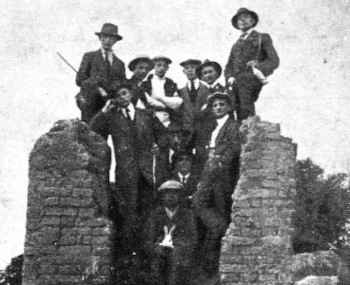
After marching a few more kilometres we arrive in Chelmno.
|
|
They rest for a while. They go examine the special features and take pictures as a memento. It did not occur to anyone that in approximately twenty years this village would be so sadly renowned…
When the San Remo Act was proclaimed, the excitement saw no boundaries. All the Zionist parties collected signatures, demanding the Land of Israel for the Jewish nation. The agitation in the schools and public locales reached its highpoint and led to heated discussions with its opposers, particularly the “Bund”.
Every Saturday representatives would come from headquarters, speakers and lecturers. Each one attracted an audience. Meetings were often held and those gathered would derive pleasure from the discussions between the presenters. One scolded the other, they conflicted and each one exposed the baggage with acuteness and knowledge.
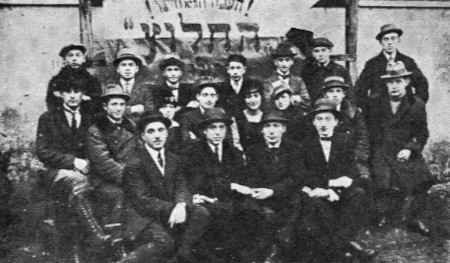
Last but not least – “Hechalutz” (“The Pioneer”). A Jewish land owner consented to
[Page 78]
help prepare Jewish youth for the Land of Israel, teaching them how to work the land and run a farming economy.
|
|
First row (From right to left): Efraim Vaynshtok, Sh.A. Shlezinger, Avigdor Shike, Fishl Rauf Second row: Yehuda Pshedetsky, Mashkovitch, Esther Feldman, Varmbroyn, Moiseh Guldman. The last one – Avigdor Rozental Third row: Koyfman Mikhalovitch - - - A. Yarrmush. |
Simple, sincere Jews from my hometown, how willingly we listened to your speeches. It the street, in the House of Study, between the afternoon and evening prayers, and where not? When the following gathered together, Ozer the butcher, Isar the porter, Moishe the shoemaker, Yitzkhak the Lemonade -Jew, Mordkhai from hospitality, Moishe Mliniker and Moishe Pikatch, they explained everything in detail, beginning with politics and ending, as usual with…the dead.
They did not only love to talk and expand, they also listened. When a Jewish preacher or orator came to town they swallowed every word, every example, every story.
And a word about the “Ein Yakov” readers.[1] After the evening prayers, my father, of blessed memory, would study with a cluster of Jews, the legends from “Ein Yakov”. They listened attentively and searched for the hidden meanings and subsequently forgot about their daily worries.
All is gone, but not forgotten.
La Paz, Bolivia.
Translator's Footnote
|
|
JewishGen, Inc. makes no representations regarding the accuracy of
the translation. The reader may wish to refer to the original material
for verification.
JewishGen is not responsible for inaccuracies or omissions in the original work and cannot rewrite or edit the text to correct inaccuracies and/or omissions.
Our mission is to produce a translation of the original work and we cannot verify the accuracy of statements or alter facts cited.
 Koło, Poland
 Yizkor Book Project
 JewishGen Home Page
Copyright © 1999-2026 by JewishGen, Inc.
Updated 15 Jan 2026 by JH