 |
|
|
[Page 35]
By Elyahu Duvdevani
Translated by Mira Eckhaus
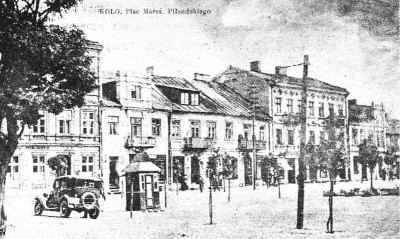
Koło, where I was born and where I reached adulthood, was also my pride in my youth, and not without reason: after all, it was once considered among the most exalted cities and was called “Vyelkopolska Miasto Koło”, that is, Koło - a city of Greater Poland.
About forty years have passed since I left the city, of which only remnants of Jews remain, and it is revealed before my eyes with all the beauty of its landscapes. First, I see the two arms of the mighty Warta River, between which the city is embraced; far from the river, in the city center, are the remains of the wall that was erected against the Knights of the Teutonic Order, where in the distant past a sublime castle stood, and only a part of its towers, its barns, and its storehouses remain as a memory. I recall the legend that I absorbed in my childhood and that activated my imagination: This castle - so we whispered a secret - is connected by a long, long cave to the basements of the Catholic church in the center of the city. What was the use of this cave? We have also found an answer to this: in times of emergency, when the enemy gained strength and reached the city limits, the Polish soldiers, who had been defeated, retreated to this cave, fortified themselves in the center, and gathered strength for an onslaught on the invaders.
At school, the vague picture of Koło's distant past was somewhat clarified. Here we learned about the great hero Henryk “the Woite”, who founded the city in the 14th century and placed its gates. Permission to build Koło was granted to him in 1362 by the enlightened king Casimir the Great by a special law. Until this enterprise of him, a miserable village with a serf settlement stood on its territory. It was Henryk who raised and elevated the place. The teacher revealed a hint of his reflections: it is assumed that Casimir was dependent on the money of the Jews. Therefore, he was inclined to the proposal of building another city that would serve as a place of living for Jews whose main occupation was trade. The Jews served the country and their taxes to the king strengthened his throne. A 16th-century Polish historian states that Casimir granted the Jews privileges thanks to his affair with Esterica, the daughter of a Jewish tailor from Opoczno.
The nearby villages of Brodzów, Powiercie and Kościełec, on whose hills the Swedish king welcomed the emissary of Jan Casimir in 1655, also added a touch of dignity to the city. Near the city is the village of Chelmno, where the Nazis built the extermination furnaces during World War II.
Every village and its reputation. When we learned about Mikolaj Copernicus, the great astronomer, the teacher mentioned the name of his teacher Wojciech, who lived in a village near our city, Brodzów. Copernicus learned his philosophy. According to the legend that goes around among the Polish people, the
[Page 36]
Archbishop Magnienzo is buried in Brodzów. When we visited the village of Kościełec on day trips and on our days of rest, we went to the magnificent palace that used to be a meeting place for ministers and kings.
From the distant past to the near future. When a foreigner came to Koło, the first things that meet his eyes are the crosses of the churches and the needle-like mast of the city hall. Afterwards, he will see the tops of the trees of the forests, protruding above the surface. As he approaches the outskirts of the suburbs, a white tower from the time of the Swedes, will welcome him, which will call: “Stop, an ancient city before you”. Those with good eyesight will also notice the wheel attached to the top of the mast, which is the symbol of the city: Koło - a wheel.
As one walks in the city, all the tall and lofty buildings, which are the prayer houses of religious, attracts you. Among them included also our synagogue. The Jewish builders got clever and erected another building on top of it, which is conical in shape and shows the two Tablets of the Covenant. They raised the Tablets with a tin flag in order to fulfill the words of Chazal: “…a city whose roofs are higher than the synagogue - in the end it will be destroyed”. (Yerushalmi, Tractate Shabbat). Yes. This was the appearance of the synagogue from the outside, a building that would not collapse or stand idly by, as if there was no control over it. Many events of the Jewish community in this city were integrated into it. Next to the synagogue building stood the Beit Midrash.
There were two entrances to the city, in the two suburbs that were added on both sides of it, since its center was too narrow to accommodate the growing population. Both were attached like strips to the central district, by wooden bridges leaning over the branches of the Warta River. From one suburb the road led towards the capital city of Warsaw and from the other, on the opposite side, towards the provincial city of Kalisz. Therefore, the suburbs were named after these cities. The boulevards were popular with the young men; the river served as a source of life and entertainment on summer evenings and winter days. We spent our time sailing and fishing in the summer, and on winter days - ice skating.
Every year, during the fast of Tisha B'Av, the young men would go sailing; and at the end of the fast, they would return home with a bounty of fish.
And here is the center of the town! First you encounter its markets, and from them – to the streets, which branch out in all directions. The feeling is that you are in a Jewish city, you have come among your people. Whether you are a stranger, a passerby, they will extend an inviting and heartwarming hand to you: “Peace be upon you, where are you from?” And you are sharing similar ideas with the people of the city - they will immediately offer you a business deal, or they will argue with you about the prayer of the “chazan”. You are not alone; you will always find someone to strike up a conversation with you.
If the glory of the old market was the city hall, then the glory of the new market was the great synagogue, which dates back to the 17th century, and the Beit Midrash. These two could be likened to two brothers. Although they were very old, old age was not noticeable in them. They watched over generations: they accompanied them to their final rest and also welcomed those who came; within them, people spoke about their sorrows, in times of disaster, and in times of joy, they celebrated in them.
[Page 37]
The structure of the synagogue blended different styles, the most prominent of which was the Gothic style, whose arched windows and ceiling attested to its antiquity. To the dark vestibule, which was slightly raised above the plain, they ascended by two steps, and from there they descended into the temple by two steps in order to fulfill the verse: “From the depths I have called you, O Lord”.
The vaulted ceiling was painted azure, like the color of the starry sky. The Eastern wall stood out from all the walls, and on it were two captivating oil paintings by the Jewish painter Opuchinski, a man from Kutna. On either side of the Holy Ark stood two lions in a leaping position, their eyes blazing with rage. In the spaces between the windows - the musical instruments of the Temple that were mentioned in the Bible: the trumpet and the violin, the harp and the flute, the organ and the shofar, the drum and cymbals, and more. In the center of the hall, in a place raised above the floor – was the lectern, on which the Torah was read. From there, public messengers and heralds delivered their words about Zion and urgent matters. Chandeliers which were illuminated by electric light, were hung from the ceiling.
In the Western wall there was a niche. From within it peeped the orphaned flame of the “Eternal Candle”, a wick placed in a glass of oil. This light shone day and night, and the shamash saw to it that it never went out. Compared to the chandeliers with their candle-shaped bulbs, the “Eternal Candle” was extremely poor; but it contained a hint of our status among the nations of the world…
The synagogue had two “ladies' sections”: one in the gallery, in the shape of the inverted 8th letter in the Hebrew alphabet, facing east. Whoever offered the most money for a “seating place” (they called it “a shtat”) would win it. In the second “ladies' section”, which was added to the synagogue building, the prices of the seats were cheaper. At the beginning of the year, before the “Days of Awe”, the gabbaim would be engaged in selling the seats in the synagogue. The closer the place was to the Holy Ark, the more honorable it was and the more expensive it was.
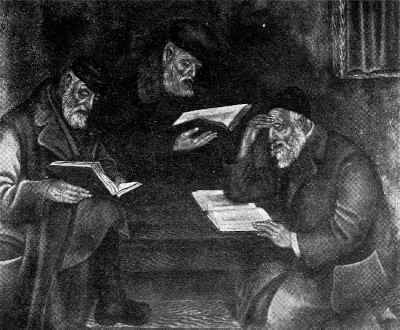
As mentioned, the Beit Midrash stood next to the synagogue. The Beit Midrash served as a place of public prayer in the morning and evening; but its main purpose was to study Torah. When you think of the Beit Midrash, you see before your eyes the groups of Torah scholars: young men from the city and surrounding towns, as well as from distant towns. Among those studying there was the young man Nahum Sokolov z”l, the great Zionist leader, who served in the years 5691-5695 as president of the Zionist Organization and the chairman of the Jewish Agency. The young Nahum Sokolov moved to our city from his grandfather's Beit Midrash in the city of Wyszogród, a journey of hundreds of kilometers, to meet the outstanding Torah scholars: Rabbi Binyamin of Taubenfligel (Kanfei Yona) and Reb Shlomo Halevi Posner, a scholar of Reb Akiva Eiger, who is well-known in Israel (see the book “Ishim” by N. Sokolov, Part 2, page 198).
Who doesn't remember the winter evenings in the Beit Midrash? Especially during this period, the Beit Midrash was bustling with life. Late at night, when the whole city had fallen asleep, the lights of the wax candles could be seen through the windows. The voices, the melancholy sounds, could be heard far away. This place of Torah attracted people: at twilight time, women gathered
[Page 38]
on the windows, so as to hear the voices of the students. Here a mother would come to see her son, a mother-in-law to see her son-in-law, and a wife to see her husband. Behind the two stoves that in winter were heated with wood, small talk would take place, and during the short breaks the students of the Beit Midrash would roast potatoes in them.
|
|
The Jews of Koło invested most of their energy in buying and selling. The grain trade and the shops selling various commodities were their main sources of livelihood. Everyone visited the market on the regular market days, Tuesday and Thursday. The shopkeepers and artisans also looked forward to these days. Their mood depended on the amount of the revenues.
On these days, the farmers from the surrounding areas would gather in the city markets. They would bring their produce on their carts. In exchange for their produce, they would buy in the shops everything they needed.
In the market squares, near the artisans' stalls, was the center of negotiation: in a certain corner stood the tailors with their ready-made clothes for every size of child, teenager, and adult, and next to them - the shoemakers. Next to them stood the hatters and belt makers.
[Page 39]
Potters, sellers of porcelain and tinsmiths occupied a large space. In a long row were sellers of colorful fabrics and notions.
The cattle trade was concentrated in a special market. The horse traders also gathered nearby. The young men came to watch this market: how a young foal is run, how a riding horse is jumped.
In the old market, next to the farmers' carts, merchants of eggs, vegetables and poultry were walking around. They would negotiate with the farmers' wives and buy notions the butter, eggs and poultry of all kinds. They negotiated loudly, checking the goods carefully, pretending to be deprived and in the end everything ended peacefully.
|
|
A prominent place was reserved for the wealthy persons, the owners of large businesses. The most important of them were the owners of large flour mills, which were driven by electricity, as well as exporters of unprocessed leathers abroad. Some of the merchants established trade relations with Germany and exported timber, grain, cattle, horses, and eggs, vegetables and poultry. There were also forest tenants and sawmill owners (sometimes rafts would transport the forest products across the Warta River, a magnificent sight, especially on moonlit nights). Some families made a living from inns and money changers.
Back in the middle of the 19th century, the porcelain industry was owned by the Rauch family, and this industry was inherited by the Rachlawski family. In recent years, it was owned by the M. Kirschbaum and Rothbard. Its products were sold throughout the surrounding area.
The main occupation of the tailors was selling cheap clothes to the
[Page 40]
poor people. Their livelihood was based on local fairs and market days in nearby cities. For most of the year, they moved from city to city, hiring a large freight cart, onto which they loaded their goods. However, they didn't always find customers for their goods, and sometimes the revenues only covered the travel expenses.
The Jews of Koło differed from their Polish neighbors in their manner of walking and clothing. On their heads they wore a round black cloth hat with a visor, a Yiddish hat, and on their upper body a long, Yiddish kapota. On weekdays they did not show off, in keeping with the simplicity of their living conditions. With the new winds blowing, their attire also changed: the progressive Jews, especially the young men, dressed according to the fashion of the Polish people.
The mother tongue was Yiddish, and the accent was different from all Yiddish accents in the rest of the country. The special accent of the people of Koło was influenced, apparently, by the German language. Its characteristic - the tendency to diminutive: “Ich”, “Ichie”; “Lefl”, “Leflichie”; “Taf”, “Tafcie” and so on.
About a dozen “assimilated” spoke Polish in their family circle; these were, so to speak, the elite of the Jewish population. There were few in the city, about two dozen, and they spoke fluent Polish. Out of a sense of inferiority, they admired everything that came from the Gentiles. They would kneel and bow to every “nobleman”, and tried to be more Polish than the Poles by nature. When they came among Poles, they declared “We are Poles in blood and bone” (Jestszy Poliacie z krwi i kości).
The commoners set the tone in the city. They were the majority of the community and the majority of the community, and even though there were no Torah scholars among them – “the whole nation would live by them”. They made a living from hard work and were proud of it. Their willingness to help anyone in their time of need should be noted. They were known as honest and straightforward.
In the evenings and on holidays, when they got together, they knew how to entertain each other with conversation and singing. Many of them were skilled musicians. They were delighted to hear the “Musaf” prayer of the chazan in the synagogue or to see a performance of a Jewish opera by Goldfaden and Lateiner. They knew how to conquer many desires, but they could not overcome the desire to play music: for it they were willing to pay any price.
Among the commoners of the city who gained a reputation as heroes, muscular, ready to come to someone's rescue in times of trouble and distress were the “Machliakes” (named after the head of the nursing home, Michal Podchlabnik). This was a very large family, who made a living from trading cattle. They were known as hospitable and charitable people. They were the first to stand up in the campaign against the gentile thugs who sought to mistreat the Jews.
The Hasidim constituted a thin but significant stratum. They treated with disdain those who were not sharing their ideas and did not enjoy the benevolence of the “Tzadik”.
[Page 41]
On Shabbat and on holidays they gathered in their prayer house, called the Shtibel. In their daily lives they were known for their devotion to religion. They were strict about both minor and major mitzvahs. They did not engage in polemics with those who disagreed, as if they were saying: “A Hasid man lives by his faith in the Tzadik”. They did not attack or seek to impose their rule because they were the “minority”. In one area they were very active - in the field of slaughterers. Most of the slaughterers were Gur Hasidim. The rabbi was also very careful about their honor, and did not harm them. Here we should mention the Hasid Gabriel Sitner, who was considered “the first Hasid” in the court of the Gur Rebbe, the Rebbe of Itche Meir Alter, zt”l, and after his passing - with his son, his successor.
Besides the Hasidim of Gur Calabria, there were also Hasidim of the Tzadik from Alexander.
The Jewish tradition and patriarchal way of life, with all its splendor and glory, were preserved in every Jewish home. From wedding feasts to the “Forschpil”, the tables were always full of all good things. At weddings, a group of Jewish musicians would play. At the head of this group stood Lishak, his violin in his hand, and he conducted the group. This Lishak was a music teacher and the lead player in a band of musicians that played at celebrations.
Jewish youth grew up and were educated in religious and secular educational institutions. There they learned Kodesh studies, as well as the preliminary studies of Russian, Polish, German, and arithmetic. The revised cheder of Ozer Zurndorf, a modern educator, should also be mentioned. He was a Jew of good and quiet character; he was able to win the hearts of his students with his moderation and the way he studied. He also paved the way for the public school, into which the spirit of Zionism penetrated. I also studied in the cheder of Katriel Szoldowski z”l. We listened attentively to Katriel's Bible lessons. His students knew chapters from the Trei Asar by heart. His Hebrew lessons and penmanship appealed to me. Katriel was an expert in writing congratulatory letters for Rosh Hashanah.
He lived in Haifa during the last part of his life. Katriel was one of the few educators who was privileged to immigrate to Israel.
What was the content of the boy's life in the “cheder”? What were his aspirations? The Torah of the “Melamed” did not give any direction. To be Jewish and to know a little Bible and a little Gemara, that was the goal. In their free time, during short breaks, they would play various games: “Kvittelach” - throwing a knife in the sand. On cold winter days, they would go ice skating. I remember a disaster that happened to my friend Bazeski, when he left the “cheder” at the end of a Gemara lesson. He went ice skating with his friends, the ice cracked, the water swallowed him and his body was not found. It was a severe shock to all the young men in the city.
When spring, which symbolizes the time of freedom for us, arrived, the longing for Passover, which brought a change in the atmosphere of the town, intensified.
[Page 42]
On summer nights, the youth spent their free time partly on a cruise on the river (from the Warsaw Bridge to the castle) and partly on walks in the forest or in the city park or in a cricket game in the field near the city power station.
After the famous Baylis trial, and before the outbreak of World War I, the youth began to realize that there was no future for them in exile. Although there were those who saw the fall of Tsarism as the salvation of the Jewish people, most of the youth embraced the idea of returning to Zion.
During the First World War
The war first gripped the border regions, and Koło was not far from them. The most famous is the rampage of the Prussian troops in the city of Kalisz, which they destroyed. Thousands of people were displaced from their homes, and many of the refugees arrived in our city naked and destitute (some say that all this was done in accordance with the will of Bismarck).
During the fighting in the area, we were cut off from our father. As the Germans approached, terror fell upon the city's elite. My father feared that the invaders would take him as a hostage, as he was one of the city's most respected men. When the Russian positions, which had been fortified to protect the area, were breached, my father did not have time to say goodbye to his closest family members. My father and two older brothers escaped at the last moment. They crossed the Warta River in a fishing boat while the retreating Russian army burned the bridges behind it. My father and my brothers were headed towards Warsaw, where lived the family of my sister Nechama z”l (she perished in the Warsaw ghetto).
My father, Eliezer Lipman Kirschbaum (HaCohen) z”l, was engaged in leasing forests. He reached the far north, as far as Vladivostok. He was a generous Jew, with a good spirit and good qualities, ready for any call for help. He generously donated to all the funds and all the Jewish charitable institutions in the city. When they were about to establish a municipal hospital, on the edge of the Kalisz suburb, he generously donated for its establishment. My late mother, who assisted him, had a gentle soul.
A sense of compassion and a desire to help each other was embedded in the entire Jewish population. Everyone was ready to assist the homeless, to restore their sense of dignity that had been taken from them, so that they would not become beggars.
The first act was to establish a soup kitchen, which provided hot meals to hundreds of people for only a nominal fee. Many dined in the soup kitchen and others took their portion home and never went hungry. A special committee handled housing for the homeless and finding jobs for the needy.
It wasn't long before a new wave of refugees flooded our city, victims of the war from Lodz. Like the people of Kalisz, they also sought temporary shelter. Once again, a financial effort was made to
[Page 43]
provide the latter with the maximum help, both rich and poor did not stand aside. The donations that flowed into the charity fund were a support and relief for the displaced and exiles who found themselves in our city and remained there until the wrath passed.
Many families immediately found a way of living: some engaged in crafts and others in trade.
There was also something positive in the arrival of the young people to our city, as they diversified the life of the provincial town. The athletes in them joined the existing teams and raised their level.
We withstood the distress of those days. We fought the typhus that wreaked havoc on the poor people and managed to stop the disease, we did not let depression take over us. People with initiative, who united the scattered and lonely refugees, were found - and we did not abandon them: the enlightened ones instilled in every person the present need. They cultivated in them the national consciousness and established nuclei of action. It's impossible to talk about all the small and large enterprises that were created. I would like to concentrate on the work of education, which was invested with the utmost energy - because we sought to strengthen the human spirit.
With the establishment of the occupation regime, they began to renew the school network. The Jewish public activists did not distract themselves from spiritual life either. Economic concerns did not slacken their efforts to educate boys. During the bad times, two secular Jewish schools and girls' schools were established. One was run by the teacher Gutman, and the other by the teachers Tchernozhil, he and his wife, both were among the Kalisz refugees.
|
|
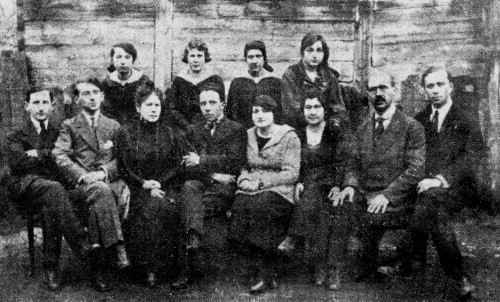
Standing (left to right): Students Z. Feldman, Kotzer, Feiner, Kleinerman Sitting: Teachers Hertz, principal Gutman, teachers A. Gutman, H. Levin, Mrs. Gutman, Glitzenstein, Arbuz |
[Page 44]
Jewish schools for girls were an innovation. Prejudices that viewed girls' education as frivolous were eliminated.
And to the credit of the aforementioned teachers, it must be said that they did not disappoint the hopes placed on them, they gathered around them good teaching forces, and their work was not in vain.
There was a limited consolation in the temporary change in the attitude of the Poles towards the Jews. The hatred that the Endecja had inspired also vanished. The Real School registered Jewish students. Wealthy families sent their children to this school, and Jews constituted about twenty percent of all students at the Polish school, which had hitherto adhered to the quota. The fear that they would multiply and put the gentile in the shade was gone.
It wasn't long before the “large-heartedness” of the Poles was revealed. They did not do what they did for the sake of Israel: their tendency was to assimilate Jewish youth, to cut them off from their roots. Of course, the reaction was not long in coming. And the Polish administration was forced to give in to the Jews' demand. A Jewish teacher was added to the teaching staff, whose lessons were devoted to Jewish history.
The Poles, who were preparing for liberation from the Russian yoke, did not succeed in weakening our national position and our Jewish pride. After school hours, I continued my Hebrew studies with my friend Mitek Frankel[a] with a yeshiva student from Kalisz, whose last name was Aft. He took it upon himself to “balance” the Torah studies of the younger generation. Against the secular Torah, the Bible, Hebrew grammar and literature. In those difficult years, 1916-1917, the foundation for the Hebrew Gymnasium was laid.
During the war years, the decrees the invading Germans imposed were more frequent. Prohibitions on movement by car and on foot limited free life. Intercity movement was allowed only to those who received special licenses (“Shein”), and not everyone was entitled to it. A series of prohibitions limited free life. But the Jews, as usual, showed great flexibility, accepting and not accepting the prohibitions. They invented new things all the time and deluded the “Yankees”. Bribery flourished, and with it came alarming revelations: thefts, smuggling, and informing.
Informants were found among the Jews who sold themselves to the police and revealed to them the Jews who supplied the city with food. At the entrances to the city, army and police posts were stationed, and they inspected all the supplies that were brought in and taken out.
After the informing, hunger in the city increased. The prices of essential commodities were expropriated. It goes without saying that the Germans confiscated everything in the stores that could be sent to starving Germany. They also showed a gesture of honest people, and to the shopkeepers from whom they expropriated their goods, they paid with “Banes”, notes whose repayment time would be at the end of the war.
[Page 45]
During the times of distress, there were long lines to the bakeries. A family that was lucky enough to receive a loaf of black bread considered itself happy. White bread was considered a luxury. Leather for shoe soles was something a rare thing. A new fashion came to the city - shoes with wooden soles. However, this was not the only substitute: instead of coffee and tea - a substitute: instead of kerosene lamps - oil glasses with a thin wick in them. Only one room in the apartment was lit.
After two years of war in our territory, with all its horrors - there was a slight relief. What caused this change? Was it the result of the front lines moving away from the Polish territories? Or was it the worsening of the situation of the German and Austrian armies in the campaign? In November 1916, Germany and Austria published a declaration (manifesto) on the establishment of an independent Polish kingdom as a constitutional monarchy. This immediately gave its signals, and even in our city, the attitude towards the Polish population changed.
In order to reconciliate the public, which suffered from the hard war, from the taking of hostages, from the enrichment of the city, and from deportations - the German occupation government renewed the civil institutions. As the head of the civil government in Koło was appointed the Pole Ostrovsky, owner of a factory for agricultural machines, Moshe Walter was appointed as the city treasurer and my brother-in-law, Itche Neumann[b], was appointed as secretary. A civil militia was also established, whose job was to maintain internal order in the city. In order to create the impression that there was no discrimination here - Jews were also allowed to participate in it. Two or three Jews were included in the auxiliary police and were armed with clubs and guns. It goes without saying that this was not a municipality like the previous municipalities, which were established on the basis of elections. It was under supervision and “guidance” and was limited within its framework. The scope of its operations was limited, because the days of the emergency had not yet passed. This is not the place to elaborate on the affair of relations in this “new” institution between the Jews and the Poles and on the hidden hatred on the part of the anti-Semites for the Jews. The Endecja did not manage to reduce the number of Jewish representatives in the city nor deny them equal rights. The Jewish representatives spoke out without hesitation and condemned every anti-Semitic phenomenon.
Another step was taken to cancel the emergency orders: the Jewish community was reactivated. For a while, my brother Munya (Moshe Yosef) Kirschbaum served as chairman.[c] This institution, which had been forced to cease operations and its rights were revoked, was recognized again by the occupation government. First, the cemetery department was activated and a trust was given to the “Chevra Kadisha”: they did not require a “Toit Shaynan” from it in the event of death. The head of the Chevra Kadisha was Reb Shlomo Wasserman, a modest Jew and a wise scholar, a textile merchant. He was also a great writer, and the book of memories of this institution was entrusted to him.
[Page 46]
The large-scale harms on the economic positions of the Jewish people ceased, and it seemed that soon all the previous privileges would be revoked. Certain circles hesitantly regarded the “good intentions” and suspected that there was a conspiracy here.
Those involved in the political and social action felt the change in the atmosphere. The spread of the national idea among the younger generation was done publicly. Much propaganda was done in the field of practical Zionism: the immigration of Jews to the Land of Israel in order to settle them there. It was known about a number of older and younger Zionists who intended to immigrate and fulfill their dreams. They were only waiting for the fighting to stop, among them were: Berish Neumann, the baker Treiber, Yehezkel Glicksman. They were in correspondence with the consul from Koło. The first who heralded the immigration of the Jews of Koło was Michaeli Michaelovich.[d]
The Jewish youth in Koło in the years 1916-1918
We will recount some of the unrest among Jewish youth during the war years and focus on the Zionist movement.
According to the instructions of the Zionist party centers, which were based in occupied Warsaw, the branches in the provincial towns also began, and Koło among them, to carry out various activities. The first successes proved that the situation had changed in all respects, the restraints had been removed, and whoever was more agile and active would reap the rewards.
The best efforts were devoted to two main areas: a) to cultural and social action; (b) to constructive social assistance. Both areas met the call of the hour. The youth in Koło was carried away with the flux typical of those days. Among the first actions in the cultural field was the establishment of a public library - an important factor in raising the level of education among the youth. The foundation of the library was the books collected as gifts from private individuals, which were in the languages: Polish, Hebrew and Yiddish. To this collection were added books purchased for cash and on credit in bookstores.
The new institution immediately left its mark on the youth's conversations, which from now on also revolved around literature and political questions. Anyone who observed travelers in the evenings saw that every young man and woman had a book under their armpits. Those who read a lot were considered more respected.
The Hanftwürzel family made a room in their apartment on Okulna Street available to the library, and this room immediately became a center of attraction. The success was above and beyond all expectations. The library was the most important institution among the youth. There were no experienced librarians, everything was done on a rotating basis and on a voluntary basis. The youth exchanged books three times a week because the thirst for every new book was great.
[Page 47]
After this action, it was time to act for Zionist education among the children and the elders. New paths were opened and propaganda also penetrated the school. In the month of Nisan 5677, the youth organization “Children of Zion” was founded, which later changed its name to “Zionist Shul-Jugant Organization – Herzliya”.
|
|
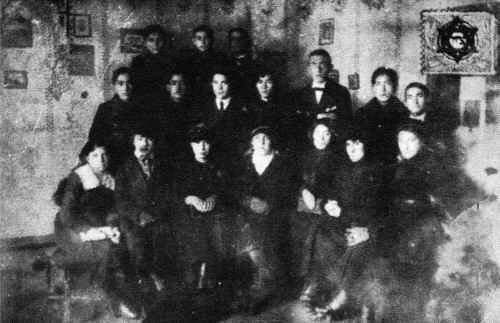
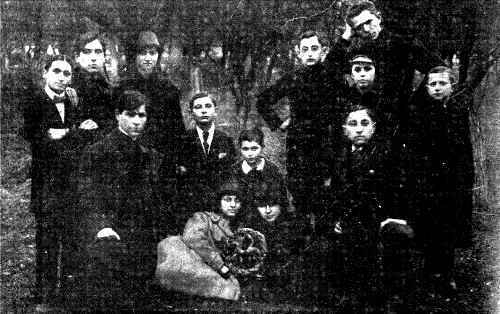
First row from right to left: T. Verona, T. Reichert, L. Feldman, Shika, Z. Feldman, S. Zilberberg, Toptch Standing: A. Yarmush, A. Duvdevani, K. Michlovitz, M. Hanftwürzel, M. Berkowitz, S. Koninsky, Davidovitz Standing in the third row: Pernkovsky (- -) (- -) |
The first committee of this organization included twelve boys and three girls. Among the activists:
Michael Hanftwürzel, Lisak, Greenberg, Zhenya Feldman, Ruth Bauman and Sarah Zilberberg. The writer of the lines served as secretary. Our guides were members of “Tze'irei Zion”[e]: Abba Yarmush and Kaufman Michalowicz. On behalf of the center in Warsaw, we were occasionally visited by: Avraham Gravitsky and Moshe Ishahayavich.[f]
We took advantage of the new conditions as much as possible. Meanwhile, the economic situation was in dire straits and general impoverishment was expected - we experienced a flourishing of cultural and social life. Zionist activism branched out greatly: in the evenings, on weekdays and on Saturdays, lectures and “Kastelawanten” were held that attracted crowds. The lack of a chance to get along in Poland after the
[Page 48]
war raised the question in everyone's heart “Where to”? The youth came to hear a reassuring answer. A great bustle was towards the anniversary of the death of the Zionist leader Dr. Binyamin Ze'ev Herzl. On the 20th of Tammuz, we discussed some of the ideas of the Zionist philosopher. No Hanukkah ball was intended solely for amusement and entertainment.
|
|
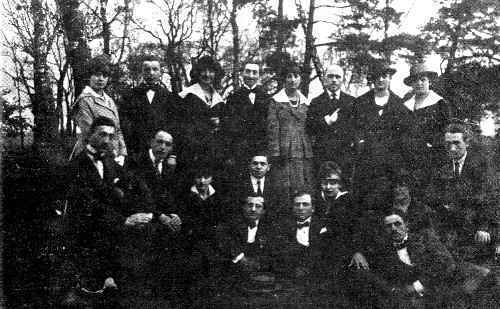
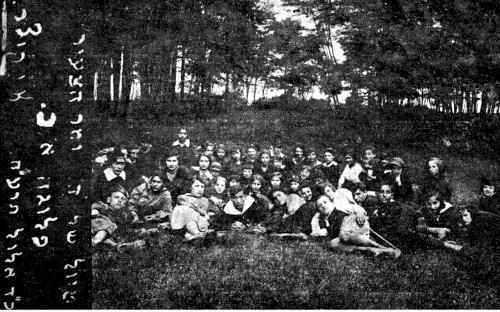
Among them: Rozshe Leschinska, Ester Feldman, Wambran, Aharon Kuninsky, Avraham Avital Teubenfliegel |
The ideological action also left its mark on the practical action: Representatives of youth organizations were added to the regional committee and the local committee of the Jewish National Fund. We also did our best for other public enterprises.
We brought the blue box to every house, and we engaged in collecting and emptying money for this fund. I can't forget one emptying. It was in 1917. When we came to the apartment of the dentist Shlomo Shlowichter z”l, he welcomed us warmly, as if we were his relatives. With warmth and fatherly gentleness, he turned to us and his mother said: “Well done, my young friends. May the blessing come upon you!”. When we opened the box and counted the coins, he took a sum of money out of his pocket and added it to the money that was is the box. This act was a strong encouragement to us. After all, this was not a mere donation, it was given with all his heart and the giver - a hardworking man, one of the elites of the city's intelligentsia. This expression of appreciation increased our strength for further actions.
[Page 49]
Let us recall some of the activities of “Tze'irei Zion”. This organization achieved much in its activities for the Land of Israel and for social assistance. “Flower Days” (Film Days) served as sources for several activities (the donations were tax-exempt and were dedicated only to the cause).
The opponents of “Tze'irei Zion” among the workers called it the “Silk yeshiva scholars' party”. Anyone who knew them closely realized that they were no different from all the workers. Both worked for their livelihood and earned their living by hard work. They had great power in organization and execution; sometimes they took upon themselves all the practical work of the Zionist movement, and they were always involved in the social action.
The speakers of this movement, the spiritual forces, were: Dr. Shturman and Avraham Teubenfliegel. Their lectures on various Zionist and general topics were treated with great interest. The evening Hebrew lessons were especially popular, under the guidance of Avraham Teubenfliegel. Of the activities of the “Tze'irei Zion”, I remember a public fest held in the municipal garden which gained fame. The lighting at night, the decoration, the varied program - everything satisfied the visitors. The drama circle organized by the “Tze'irei Zion” movement under the guidance of
|
|
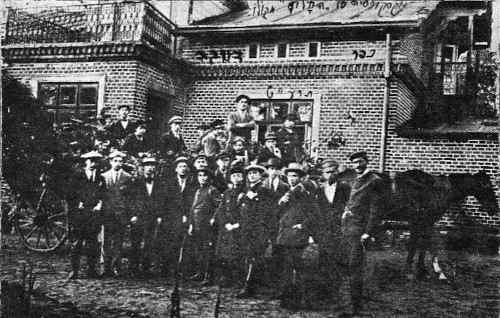
Sitting (from right to left): 4) Ruth Bauman 7) Krazinowska (Doumbia) Kneeling: 5) Klepper, Toptche (from Kalisz), Michael Hantwarzel Standing (from left to right): A. Yarmush. 3) A. Duvdevani, the other were from Doumbia |
[Page 50]
Yarmush - aroused interest in the youth. The drama circle started is a small scope, performing in a small hall that was used as a religious girls' High school in the Hantwurzel family's apartment. Promising talents were discovered and we continued to perform in the municipal theater, or as it was known, the “firefighters Hall”. The first big show was composed from sketches from “Agenten” by Shalom Aleichem and “Students” by Peretz Hirschbein. The languages of the sketches were Hebrew, Yiddish and Polish. Several of the actors who performed in the Hebrew sketch could not read this language, and the text they had to memorize was written for some of them in Latin letters.
In our city, which had theater enthusiasts, there was a dramatic studio under the guidance of the renowned actor Eyzikovitz from London who came to visit our city. Due to transportation difficulties during the First World War, he remained in our city and lived with his relatives, the Yelovsky family (a member of this family is in Israel). The repertoire of the band included: Darpas Ying, Shylock, Othello and more. Among the leading actresses, Sarah Shaldovsky (Borkovsky) stood out.
During the war, scouting - the organization that was founded by the Englishman Baden Paul - spread throughout the world. Scouting was nurtured in Poland and served as a camouflage for the patriotic action to train fighting youth for the future…
We, the children of the Jews, were attracted to scouting because of its educational tendencies: “to offer help to every person, to love and protect the animals and plants, to educate oneself and become a true man and useful to society, and to prepare oneself for the battle of life”.
|
|
In the front (from right to left) from left): Klepper, M. Hantwurzel, A. Wolkowitz, A. Hantwurzel, H. Wernbron, S. Meroz, Y. Neiman, H. Boymann, Lantzitzka |
[Page 51]
First, we joined the Polish Scouts. The atmosphere here was liberal in theory, however, in practice the imposed commandments were not observed. In the month of Av 5678, we separated from them and founded the Hebrew scout association “Hashomer Hatzair” named after Yehuda HaMaccabi. This movement found supporters among the youth in Koło. The leadership and command were in the hands of our guides Moshe Goldman z”l and, may they live long life, the following distinguished members: Isaac Hantwurzel, Shlomo Neumann, and others. R. Wormbruin, Bergman, L. Feldman (and, may she live long life, A. Wolkowitz) were active in organizing the girls' section. In 1918, during the shiv'ah for the death of the Zionist leader Yechiel Chelanov, “Herzliya” and “Hashomer Hatzair” held a memorial meeting. On that day, the youth movements appeared united on the streets of the city.
We were not satisfied with local Zionist action. From Koło came the call to the nearby towns – Doumbia, Kłodawa, Sompolno and Radziłów - come to us and see and do as we do!
|
|
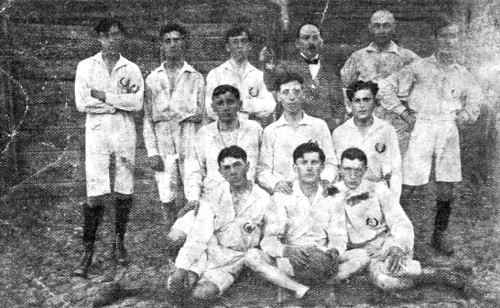
Standing (first row, from left to right): Cohen, I. Bizhinsky, Templehoff, A. Artsichovsky, Volkovitch, S. Neumann Second row: (kneeling): Yehoshua Meroz, Fox, M. Frankel, sitting: Pinchas Peshdetsky, L. Albert, Soika Avraham |
The “HaTikva” association for physical culture, led by the trainer Tauba from Lodz, was a great success. A soccer section was also held, with the participation of the players from the “Bar Kochba” club from Lodz who happened to be in Koło (one of them - my cousin, Itzhek Feitlowitz, and the other - the brother-in-law of the Pshadzki family - now live in Haifa).
[Page 52]
Early years in independent Poland
The revolution of November 9, 1918 in Berlin brought the end of the war that lasted 4 years closer. On the Western front, the German army lost its self-confidence, and in occupied Poland panic struck the garrison. In our city we witnessed the collapse: the soldiers and officers began to desert, which was accompanied by a flight of fear. The last soldiers would sell their weapons in exchange for clothes. The P.O.W., seeing that the strength of the Germans was decreasing, confiscated the weapons of the last soldiers.
With the arrival of Marshal Józef Piłsudski to Warsaw (he was released from his imprisonment in Magdeburg, Germany after the revolution), independent Poland was established. This country, which suffered from enslavement and oppression, did not know how to maintain the security of the minorities who lived in it. The first victims were the Jews. The Endecja, who sought to take power from Piłsudski, incited the masses to riot against the Jews.
A new wave of riots swept through the country with the arrival of General Josef Haller. In 1919, when his unit, which he had formed abroad, returned to the liberated homeland, the soldiers proved their “heroism” not on the battlefield but in acts of cruelty: they beat innocent Jews, cut the beards of the elderly and pious Jews.
The Jewish defense, which was organized in all Polish cities to protect lives and property, also operated in our city. The pioneers of the defense in Koło were members of the sports association. When the Endecja learned about the defense, they joined forces…
One winter night, an order was received from the HaHaganah headquarters to transport cold and hot weapons to a position in the suburbs of Warsaw. M. Toptche, one of the refugees from Kalisz, and I, were sent on this mission. A mobile guard of the New Polish Army stopped us near the bridge. That night, a thorough search was conducted in the gymnasium. When word spread throughout the city about our imprisonment, all the cold and hot weapons were hidden underground. Only our weapon was confiscated. My connections with the head of the Polish battalion, whom I knew personally from my days as a Polish scout, assisted us in times of trouble. The next day we were released.
One day, a guard of the P.O.W. patrolled that street in Warsaw. As he passed by the Hebrew Gymnasium building, he heard a conversation. In one of the classrooms, a meeting of the “Tzei'rei Zion” and the “HeChalutz” members was taking place. The guards suspected they were organizing an “assassination” and entered the building. Then the meeting turned into a “Geography lesson”. One of the members explained the map of Israel to those present.
The Poles did not believe in the staged action and conducted a search. In a bench compartment, they found two pistols, and the commander of the guard asked ironically: Are these “tools” necessary for studying Cartography? And again, thanks to the connections with the battalion chief, the matter was blurred.
[Page 53]
|
|
The “HeChalutz” group in our city, who had undergone agricultural and ideological training, decided to fulfill the mission and join the first members of the movement, who were about to pave the way for those who would come afterwards. At the end of 1918, one hundred and five young men gathered, whose goal was to reach the shores of the homeland. Among them were members of the “Tzei'rei Zion” and the “HeChalutz” from Koło: S. A. Schlesinger and R. Landsman.
I had the privilege of being among the immigrants of the third Aliyah. I immigrated to Israel in March 1921, afterwards, a few of our townspeople arrived.
Today, the number of the expats from Koło who live in Israel is about five hundred people, including survivors of the Holocaust.
The abundant spring has been stopped up. The voice of the Torah, that was heard from the Beit Midrash, has been silenced. Koło - which was a large and important city to the Jewish people - no longer exist.
Original Footnotes:
[Page 54]
By Fishl Rauf
Translated by Janie Respitz
This was at the time of the “Russian Spring” when new winds began to blow in the reactionary Russian Empire. The intelligentsia stretched out a hand to the enslaved impoverished social class and awoke a feeling of hope for better days. The reverberations of the socialist revolutionary movement reached all the way to Poland. Workers, Poles and Jews, began to transform their yearnings and deeds.
In Koło, as in other cities, things were changing. An organized group of workers emerged which began secret activities and educational work.
An important role was played by the drama club in organizing the illegal movement, which allowed the first phase of open gatherings. This had great significance in establishing familiarity, identifying people etc. The leader of the club was Meyer-Ber Bobiatzky, the son of a rich respected family. With his knowledge, or without, the club laid the foundations of the illegal revolutionary group which was called “Achdut”[1]
The drama club, which had for the most part a cultural task, also made it possible to create open contact between the unorganized workers with a portion of the intelligentsia.
The first step in the beginning of this work was fight against the 16–17-hour work day. Workers toiled in workshops from 7 in the morning until 12 at night. The lunch break was a half hour. The meal was eaten at the work station as to not waste any time…The demand for an 8-hour work day was presented as the first plan of the above-mentioned fight.
The beginning, understandably, was difficult. The Jewish artisans, the employers, did not, under any circumstances, want to concede to the demands and did not want to agree to any relief measures. In the negotiations with the journeymen, they appeared as
[Page 55]
avowed enemies of the workers. A few clenched their fists, while others held back… in order to realize, that a few journeymen stood on side with their masters, and opposed the fair demands. On the other hand, one could note the “curious” – the sons of the work providers helped the journeymen and apprentices in their fight against their parents, supported them in their demand for rights. In one workshop, for example, the master's son extinguished the kerosene lamp so the salaried worker could no longer work. When the lamps were relit, they did not give off light because he pulled a “prank” …
The workers led a difficult struggle against the bosses. Here and there they set up pickets at certain workshops and stopped the strike breakers, from others, they chased away, with force, journeymen and apprentices. This activity was obviously connected to beatings and quarrels, giving cause to incidents where employers informed the authorities. Regardless, the struggle did have some positive results. The work day was shortened from sixteen to twelve hours and after a while to ten hours. However, the worker's struggle did not end here. They continued to fight for an eight-hour work day.
Members of “Achdut” organized meetings of their clandestine groups. For this purpose, they used the woods outside of town, the so-called “Lasek”: other groups met further away in the Tumiday Forest. At these meetings they brought up questions which provoked discussion. Meetings were also arranged to discuss conflicts between workers and master craftsmen.
The victorious battles increased the interest in the illegal movement. It actually grew but could not obtain a premises. All matters were carried out under the open sky. In order to prevent clashes with the police, and prevent information reaching the authorities, they placed guards who protected the access to the clandestine places and did not allow unwelcome elements. I remember such a gathering. My cousin Khaim Leyb Rauf took me (I was still a young boy) to a meeting in the forest. He barely managed to convince the guards to let me in. The Czarist gendarmes looked poorly upon the working youth
[Page 56]
because they suspected other illegal activity would follow. However, they did not succeed in catching the workers during their meetings. They were also unable to find any illegal “literature”.
The drama club developed many activities and attracted a broad range of social classes, workers as well as intellectuals. Almost every three months a new play was performed written by well known playwrights like Goldfadn, Gordin, Pinsky, Lateiner and others. The well attended performances brought in nice profits. It is easy to guess where this money was designated. Bobiatsky himself did not benefit; he was removed from the clandestine movement.
We can see how strong the influence of the drama club was on the population by the following fact: A Jewish theatre troupe came to Koło at the same time as a Polish troupe, led by the big shot Zavodsky. They rented the stage for a long period of time. The Jewish troupe asked their Polish colleagues to leave the locale for one evening so they could perform and cover their travel expenses. The Polish actors refused. The intervention of “Achdut” did not help. Then a decision was made: No Jews would attend the Polish performances. For two weeks the theatre was lit to “empty seats”. The director Zavodsky asked forgiveness from the Jewish drama club. This example shows the strong influence and power of “Achdut”.
Until 1905 everything went smoothly. Heated days began after the proclamation of the constitution by Czar Nicholas II. The news about the big changes arrived in town and elicited excitement. In the days celebrating the constitution the revolutionaries came out of hiding, feeling free to say everything they had to say.
The day the constitution was proclaimed the members of “Achdut” gathered at fat Hersh Beynish's (he was living in Shaul Shurek's house), and sewed a red flag. They carried the flag to the demonstration in the old marketplace. From there the demonstration went down other streets culminating in the Polish procession.
[Page 57]
Barrels of tar were placed in front of the town hall which were transformed into burning torches. Polish and Jewish speakers spoke to the gathered masses. Their speeches were accompanied by slogans: “Long live freedom!”, “Long live Poland!”, “Long live the 8-hour work day!”.
The Jewish speaker, who was not a local, was called Stolarsky. Among other things he said: “Comrades, a door has opened through which light has begun to shine on the workers”.
The celebrations lasted a few days. Workers marched through the streets as well as priests and farmers from nearby villages and school children. They forgot about their hatred of the Jews – idyllic.
During the celebrations no one was seen from the Czarist authority. The members of “Achdut”, who had illegal weapons, shot out “Hurrah!”. Disguised gendarmes and secret police saw and noted everything. As soon as the freedom days ended, they began hunting down the freedom fighters, like hunting animals in the forest.
As usual, there was no shortage of provocateurs and informers, who served the “Okhrana” (Russian secret police). The “Achdut” activists faced difficult bitter times.
I remember when Jewish informers came to us looking for Simkha Mliniker. They wanted to enter the apartment of his cousin Khaim Leyb, but my father would not let them in, locking the entrance. When they left, they led out the hidden man through a secret exit. Only later did I learn that Simcha was hiding in our house. In the middle of the night, my father took him away in a milk wagon. Simkha was disguised as a female peasant. They took him out of town and he left for Germany. The following Koło residents fell into the hands of the gendarmerie: Khaim Leyb Rauf, Avrom Leybush Kaninsky, Leyb Bzhustovsky, Yakov-Volf Vakhalder, Kepek and others. Some of those arrested were taken immediately to Kalisz and imprisoned. The authorities prepared material for large open trials.
After 5 years in jail, Khaim-Leyb Rauf was sent to Siberia;
[Page 58]
A.L. Kaninsky sat in jail for ten months. Others received much lighter sentences.[a]
After the great “campaign” open political life in town was practically dead. The “Achdut” continued its clandestine activity. From time to time they discovered small cells of underground revolutionary work and the active members were arrested. Every time a high ranking Russian official or the governor-general would pass through town, some people would be arrested, especially workers, even though they never found materials to find them guilty.
This is how our town added a brick to the fight for social achievement.
Original Footnote
Translator's Footnote
|
|
JewishGen, Inc. makes no representations regarding the accuracy of
the translation. The reader may wish to refer to the original material
for verification.
JewishGen is not responsible for inaccuracies or omissions in the original work and cannot rewrite or edit the text to correct inaccuracies and/or omissions.
Our mission is to produce a translation of the original work and we cannot verify the accuracy of statements or alter facts cited.
 Koło, Poland
 Yizkor Book Project
 JewishGen Home Page
Copyright © 1999-2026 by JewishGen, Inc.
Updated 04 Jan 2026 by JH