 |
|
|
[Page 127]
Told by Sabina (Timan) Schmukle
Written by Chaim Batlan
Translated by Sara Mages
The fall of Kraków and the occupation of the entire district, took only a few hours. The arrival of the Germans in Briegel left the town's entire population in a state of bewilderment and profound shock. A great fear fell upon the town, and everyone shut themselves in their homes. However, the desire to live compelled people to start going out to fetch water and food. The population began to move about in the town again, and it seemed that life had returned to its normal course. However, the first order was issued very quickly, the prohibition on the gathering of people, which also applied to public halls and community centers. As uncertain as life was, this first decree signaled to the Jews that an even worse situation lay ahead, but the will to survive prevailed over their fears.
[Unnumbered page]
|
|
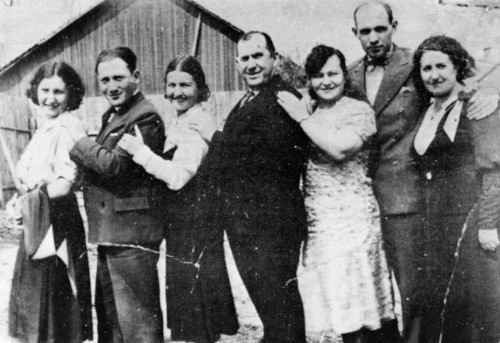
| Left to right: Leah (Lola) Mansdorf, Mondek Laufer, Chava Laufer (Brandstatter), Yakov Brandstatter, Netka Brandstatter (Tzor), Max Lamensdorf, Mirian (Mina) Strenger (Brandstatter) |
|
|
[Page 141]
Special activity
The courage of a group of young people should be noted. In the early days of the war, many fled eastward from the German occupied territory, some by car, some by wagon and others on foot. All those passing through the town were treated to cup of hot tea, cakes or bread with spread. This was organized by a group of members of “Akiva,” and as much as I remember they were: Sabina Timan, Lipka Peibusovich, Lola Bloch and Beno Burgnicht, many among the Jewish population assisted this operation to the best of their ability. And here, a surprise, the municipality secretary approached the tea and food table, which stood in the corner of the market, and addressed us with these words: “you have done a wonderful thing. Therefore, we too, on behalf of the municipality, feel it appropriate and wish to take part in their endeavor.” He gave us on the spot an official order to the town's bread bakers, and every day we received bread to distribute to those passing through the town. They noted this to the credit of the townspeople, saying that they had passed through many towns but in none of them was such an activity.
The Germans appointed a Judenrat
The Germans appointed the Judenrat. Initially, the Jewish population deluded itself, thinking and saying, “it's not so bad,” but disappointment soon set in. Initially, the Jews wanted to believe that the Judenrat would serve as a support framework for the population, but they soon realized, to their great sorrow and misfortune, that the Judenrat was not created for the sake of the Jews, but rather for the sake of the Germans. The Judenrat did not provide the Jews with advice or guidance, all its activities consisted solely of carrying out the orders received from the Germans. The Judenrat began recruiting men and women for labor demanded by the Germans, and reporting for work triggered all kinds of vile schemes on the part of the Germans. The most prominent scheme was the imposition of a “ransom,” meaning that those who wished to redeem themselves from the burden of labor camp were required to pay ransom in cash or its equivalent. The amount kept increasing day by day, even for the rich. At first, many had done so, but the Germans' greed for money grew day by day. Time and again they returned with a new decree, until the majority of the Jewish population could no longer bear it. And so life went on, with all the hardships and troubles that grew worse by the day. At the same time, there was the culture of looting and robbery by our Polish neighbors with the Germans' help.
I saved a baby
No one in town had ever imagined the first great Aktion, which was carried out by the Germans with such suddenness and on such a massive scale. Indeed, we have grown accustomed to men, women, and children being shot here and there, but these incidents were isolated and appeared random. This time, the Germans brought two trucks larger than usual and loaded about two hundred women and young women onto them.
Next to us lived Lola Brandstetter. She was a few months postpartum and swollen all over like a barrel. She could barely move her body to care for the baby and the house. On the day of the Aktion, two Germans burst into her house and ordered her to leave. She refused, snatched the baby and clasped him to her heart. She held him so tightly in both arms that it was impossible to take the baby from her
[Page 142]
despite all the curses and cruel blows. It is inconceivable that a man would behave this way toward a woman with a baby in her arms, or toward a woman at all. But she did not move from her place. Then, they dragged her by the hair, with the baby in her arms, through the corridor and down the stairs to the market center where two trucks packed with women were standing. I do not know what higher power or mad audacity took hold of me, but in a single tug, I pulled the baby from her arms. I held the baby and fainted. To this day, I do not know if it was because the butt of a German rifle struck my head, or from the sheer emotion of seeing my mother and sister on the deportation truck. To this day, I also don't know who took the baby from me.
Loneliness
I feel the need to write about a weakness that, in my opinion, worked against us in those days, namely, loneliness. This is the hardest and ugliest blow we have suffered during a time of trial, a time of disgrace and a decisive struggle over our very physical existence. There is a popular Yiddish saying that characterizes the nature of the Germans, that each of them is Yekke potz – absolute fool. Yet together they attained the pinnacle of wisdom, which, to our great misfortune, they used this time for diabolical inventions, murder and extermination and hellish torment such as humanity on earth had never known. In contrast, they singled out the Jews, who, collectively, are utter fools and blockheads, yet as individuals, each one is a man of great wisdom. Yet, to our shame, sorrow, and misfortune, whether the Jews were together or each on their own, they were powerless. Lacking any understanding of the perilous reality before it emerged, everyone was bewildered and confused; all resourcefulness and counsel had deserted them.
First, the global Jewish leadership failed, out of ignorance, a refusal to know, and a lack of foresight, to prepare the Jews in time for what lay in store for them. They did not sense the approaching disaster, and the lesser public activists, from all streams, followed in their footsteps and engaged with trivial daily matters. In our town, there were party members and their elected representatives, community leaders, and the municipal officials. Rabbis and sages who, for many years, claimed exclusive authority to speak on behalf of the Jewish population. So, when this terrible, dreadful disaster struck us, it was as if the earth had swallowed them, and this very loneliness led us, over time, to lose the moral, human, and spiritual qualities that distinguish a person as a human being. Then, as a result of the inhumane conditions created by the Germans, they turned us into the most persecuted dogs. And if we had indeed become such people, then each of us sought out, for himself, and for himself alone, the prey needed for his daily survival, and to each of us, all the methods and stratagems seemed the most appropriate, only to sustain his hunted dog life. We became like a beast from the vast European jungle of human beings. We have turned into the worst kind of jungle predators, creatures that sense the calamity about to befall them. They know how to band together in herds, which provides a primary defense for their survival. Only the stragglers get picked off; the herd remains a herd. But for us, the opposite happened. Jews were led in droves, by the tens of thousands, to total extermination, to the routine of suffocation and burning and only a few saved their bodies. This tragic truth must be told so that future generations may know what truly happened. Only when they know the genuine truth is there hope that they will learn the lesson, for the sake of the survival of future generations.
[Page 145]
Details written in Polish by Moshe Licht Braun
Written by the book coordinator
Translated by Sara Mages
As the sole survivor of the extended family that lived for generations in the town of Briegel, I feel compelled to put into writing what one of our neighbors, a Pole who still lives in Poland, told me during my visit to the town after the war ended.
[Page 146]
We lived about a kilometer from the town center, near the Kraków-Lwów main road and the bank of the Uszwica River, which crossed the border between the town of Briegel and the village of Jadownik, notorious for its acts of violence against the town's Jews. At this location, six Jewish families gathered at my grandfather's house, which had a designated room for communal prayer on Friday evening and on holiday eve. Boys, who over the age of Bar Mitzvah also participated in the prayer, and the number of worshipers exceeded twenty. My father hy”d also served as a cantor who led the prayers. On Saturday morning, everyone went to R' Wolf Loibes Beit Midrash. On Friday afternoon, my father hy”d returned from the bathhouse in his carriage and on the way, he hummed aloud the Kabbalat Shabbat psalms and the melody of Lecha Dodi [“Come My Beloved”]. He also urged his horse in Yiddish, “you foolish horse, can't you feel that the holiness of the Sabbath is drawing near? Well then, lift your legs with greater agility and joy, and he waved the whip over the horse's back. So it continued for decades until the outbreak of Hitler's war.
The Germans entered Briegel three days after the outbreak of the war. A few weeks later, an SS commander came to my father's house and demanded that he bring two of his grown daughters to his car, which was parked nearby. He gave him ten minutes, and emphasized that if he didn't bring them, he would shoot him on the spot. My father z”l, who was unable to conceive that it was actually permissible and possible to do such a wild thing, dawdled for a few minutes. The sisters hid in the attic, and my father, unwilling to hand his daughters over to the Germans, stood before the commander and told him that his daughters were not at home. The commander drew a pistol and shot him on the spot. I wish to emphasize that this murderer lives in Germany today.
At the School for Murder
Two months later, a Polish non-Jew came with a German, and they called for my brother, David. When he showed up, they asked him to accompany them, and they walked in the direction of the railroad bridge whose tracks led to the largest brewery in Poland, “Okocim.” As they approached the bridge, my brother Nathan (Maccabi's goalkeeper in Briegel), came towards them. The Pole directly asked him to join them, and when they crossed the German bridge, he pulled out a gun and shot the second. The Jews of the town brought them both to a Jewish grave, hy”d.
The murderers' game
A few months later, the Germans devised a unique and murderous game for them. My sister Berta, was seized while walking to the town center by Germans passing by in a car, heading toward the wooden bridge that led to Tarnow. They tied her hands behind her back, blindfolded her, and ordered her to walk in the middle of the road. As she was walking on the road, she was struck by the car and left critically injured on the road. Since no one at home knew what had happened to her, they only picked her up an hour later. For two days, she endured the agonizing torments of death, until she breathed her last and her pure soul departed, hy”d.
The Briegel Ghetto
After the murder of individuals, they moved on to the mass killing of dozens, and from that point forward, they proceeded to uproot hundreds of Jews from the town, seemingly to labor camps. But, in fact, these Jews were exterminated
[Page 147]
by all sorts of strange and bizarre deaths, the likes of which a normal person could not even conceive. At the end of 1941, they rounded up the town's remaining Jews and placed them in a ghetto. Into it, they also brought all the Jews from the Jewish settlements and villages that fell under the jurisdiction of Briegel. Also, my remaining family and relatives, were put into the ghetto, which had a single purpose: starving the people, causing their physical and mental deterioration. A year later, the ghetto was completely liquidated. The Jews were removed from it and loaded onto freight cars bound for the Bełzec extermination camp, and only a few individuals survived from the ghetto. My sister, Gusta, who managed to escape the ghetto, found a hiding place with a Polish woman in Kraków and remained there until the day the German army retreated from the city. Then, she allowed herself to step out into the hallway of her hiding place, a place where a Polish neighbor saw her. He summoned the German “executioner” police, and during the retreat, a German came and shot her.
In this way, my entire family perished in the destruction of the town at the hands of the German people, may eternal disgrace be upon them, lasting until the end of days. May their names become an abomination, and their memory a source of horror and mortal dread.
May their memory be cherished alongside the entire community of Briegel! Amongst the holy and pure who shine as brightly as the sky, and may their names endure forever and ever.
|
|
JewishGen, Inc. makes no representations regarding the accuracy of
the translation. The reader may wish to refer to the original material
for verification.
JewishGen is not responsible for inaccuracies or omissions in the original work and cannot rewrite or edit the text to correct inaccuracies and/or omissions.
Our mission is to produce a translation of the original work and we cannot verify the accuracy of statements or alter facts cited.
 Brzesko, Poland
 Yizkor Book Project
 JewishGen Home Page
Copyright © 1999-2026 by JewishGen, Inc.
Updated 22 Oct 2026 by JH