 |
 |
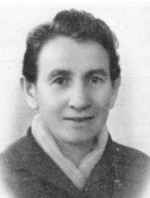 |
See article on page 113
See article on page 86
See article on page 123
|
by Mina Treiber (Teller)
Edited and written by Chaim Batlan
Translated by Sara Mages
When I look back from the perspective of that time, the experiences of the town's younger generation unfold before me.
The younger generation mostly follows the trend of the time. They lived in the spirit of the Haskalah [Enlightenment] era and classical Yiddish writers, most of whom adhered to socialism. The first logical step they took was to destroy the Hasidic framework of Beit HaMidrash with everything it contained. Indeed, the Zionist movement as a whole was not socialist, but the Zionist youth movements were swept up in the flood of the Marxist spirit. In its literature, they saw themselves as the vanguard bearing the challenge of destroying Jewish tradition. “Hashomer Hazair,” which was the best-known youth organization, was drawn into this Marxist turmoil. As a result, “Hashomer Hatzair” underwent a severe crisis, and reached the point of disintegration in Western Galicia. Some turned to Communism, others to “Akiva,” a General Zionist youth organization, and the majority turned to private life.
In our town
In our town, as in most towns in Galicia, “Hashomer Hazair” gradually disintegrated, and the Jewish Youth Association “Akiva” was formed from its remnants. I don't know its early stages since I joined when it was at the peak of its development and attracted dozens of youths to it. It created a unique, unprecedented model, which she imbued with the spirit of Hasidic fervor, total Jewish devotion and love for Eretz Yisrael. Suffice it to mention, by way of illustration, the Kabbalat Shabbat at the same time, other youth movements set out to undermine the Jewish concepts and way of life that Judaism had created for itself. In our ken, Kabbalat Shabbat was an evening of joy and the holiness of Shabbat. It was an evening of singing and learning new songs.
Most members of the ken sang prayers and Sabbath songs together, as well as the songs of Jewish national poets that were popular among the youth in those days, songs that expressed the longings for Eretz Yisrael.
This evening instilled in us a sense of traditional Jewish joy. According to the concept of “Akiva,” and from Kabbalat Shabbat to Oneg Shabbat which came the next day. On Saturday afternoon, at three o'clock, discussions began in all the groups. The younger age group engages in discussions on the theory of Scouting, while the older age group discuss Zionism, the movement, Eretz Yisrael and other current topics. There were also joint readings, such as those in Beit HaMidrash, according to the “Akiva” version, and then the Oneg Shabbat party started with the participation of all the members.
This Oneg Shabbat took on a completely different character than Kabbalat Shabbat. At the conclusion of the reading, my brother, Chaim Teller, began to sing a passage from the Shabbat Mincha prayer: Atah echad v'shimcha echad [You are One and Your Name is One]. What a sense of sorrow washed over us, and an atmosphere of holiness enveloped us all! This special singing evoked a romantic spirit in the style of “Akiva,” and the closing song was Shir Ha'Avoda VeHamlakha [“The Song of Work and Labor”]
[Page 114]
by Hayim Nahman Bialik. And then, a mighty hora singing erupted, and circles began to dance. What a sense of uplift, delight, and happiness it instilled in us all. It seems to me that these two evenings spoke for themselves, highlighting Akiva's uniqueness in the town. I admit that when I recall those evenings, my soul yearns for those days; I might also add that the Akiva branch in the town was very well organized, and everything operated according to the schedule set out in the activity plans.
Discipline and morale were exceptionally high. I would describe it as an inner obedience rooted in upbringing, self-sacrifice, and the unique Jewish fervor that distinguished its members. It is with great regret that I must emphasize that, despite the positive attitude of “Akiva” toward ancestral tradition, it encountered vigorous opposition from Hasidic circles.
I also find it necessary to emphasize that the “Akiva” group in our town was composed of ninety percent of working-class youth, in the full sense of the word, whose daily existence was a constant, grueling struggle. Yet despite everything, this wonderful youth knew how to face their hardships with love; to rise above and live for that one cherished aspiration: to reach their ultimate goal, Eretz Yisrael. It is simply a tragedy that so few succeeded in getting there.
| Beit Yehoshua Monday, 3 Av 5737 – 18 July 1977 |
by David, son of R' Pinchas Plank
Kiryat Ata, 2 April 1978
Translated by Sara Mages
First, I must express my appreciation and admiration for the initiators of this book. In their devotion to the mitzvah, they managed to overcome all the difficulties and obstacles that stood in their way, and to bring the Yizkor Book, the only memorial for the town's martyrs. And now, they are nearing the publication of a book.
Although I surmise that this book may lack literary merit, as a means of commemoration it will certainly serve as a beacon, illuminating and reminding, ensuring that what must not be forgotten, the fate that befell the Briegel community, is not lost to memory. May this book serve as an unimpeachable source for us, our children and grandchildren. To read it and understand the meaning of our lives, and the lives of our parents hy”d,[1]in a small town in Western Galicia before this terrible destruction. I have not the slightest pretension to being a writer. My only wish is to contribute a tiny element to the Yizkor Book of the town, a town that once was, but is no more! A town vibrant with its Jews, Torah scholars, seekers of knowledge and the common folk.
What should I write about?
In fact, I had intended to write only about the movement “Po'alei Agudat Yisrael,” a movement founded by a handful of students of our holy and genius rabbi, R' Moshe Lipschitz hy”d, the Rabbi of Briegel. However, I would be doing a disservice to us all, and especially to myself, having had the privilege of being his devoted student, if I didn't mention first the lineage of rabbis who served this distinguished position from the Lipschitz family. It began with HaGaon, Rabbi Aryeh Leibish Lipschitz, who was named, Aryeh D'Bei llah “[The Lion of the Heavenly Household”], after his book. He came to the town from Vishnitza [Vyzhnytsia] where he served as a rabbi. When he was appointed Rabbi of Briegel, he settled there. He also passed away there and was buried in an ohel[2] at the new cemetery. Many Hasidim used to come to this place to pray at his grave site for the salvation of all and the individual.
[Unnumbered page]
|
|
|
|||||
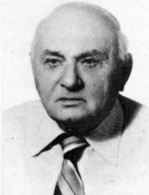
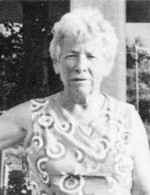
| Mina Treiber (Teller)
See article on page 113 |
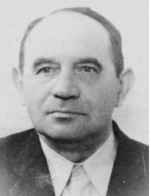
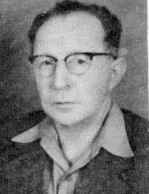
Yosef Hoenig
See article on page 86 |
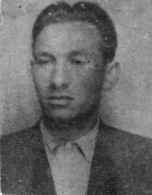
Rachel Hamer
See article on page 123 |
|
|
|||
| Shimon Einhorn
See article on page 120 |
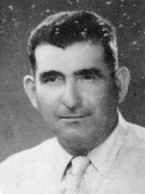
David Plank
See article on page 115 |
|
|
|||
| Daniel Keiner
See article on page 100 |
Elisha Sternlicht
See article on page 102 |
[Page 115]
I would also point out that R' Aryeh D'Bei llah was one of the most prominent and closest followers of Gaon Olam, the Chozeh[3] of Lublin. R' Aryeh D'Bei llah had two sons, R' Aharon Lipschitz, who was appointed Rabbi of Vilipoll [Wielopole], and after him his son, R' Natan Nata Lipschitz, who succeeded his father in this town. His eldest son, R' Shlomo Zalman Lipschitz, probably (without certainty) came in place of his father, R' Aryeh D'Bei llah, as Rabbi of our town Briegel. His son, R' Tuvie, came in place of his father, R' Shlomo Zalman Lipschitz, as Rabbi in our Town, and was known as the old rabbi. In his time, in 1904, a fire broke out that consumed most of the town. It has been told that the flames reached the neighborhood of the “Old Rabbi,” stopped there and all those who lived in the rabbi's neighborhood were saved from the fire.
The dynasty of R' Tuvie
R' Tuvie had three daughters. I knew one of them personally, Tzirel, wife of Noah Schiff. He was a wealthy owner of a large ironware business in the town. He was also the supplier of these products to the owner of “Okocim,” the well-known brewery in Poland. R' Noah was a prominent Hasid and had two sons: Chaim Schiff and Berish Schiff. Both held the highest rank among the town's Hasidim yet harbored no rabbinic aspirations.
The son of the second daughter, Freida, (if I'm not mistaken) was appointed judge in the town. After the death of R' Tuvie, the old rabbi, this judge was called R' Chaiml'a Dayn [the Judge] in the town. The son of the third daughter, Rachel, became the Rabbi of Voynitch [Wojnicz], and also her second son, R' Chaim Dechner, one of the prominent Hasidim in the town of Briegel. From this, it can be inferred that the town and its surroundings became filled with members of the dynasty. They also gained many friends and admirers according to the customary style: the old rabbi, R' Tuvie Lipschitz, passed away on 8 Adar 5674, 1912. He was a distinguished student of Chaim of Sanz [Nowy Sącz] who also served as the Admor of Briegel. After his death, the position of town rabbi remained vacant for about eleven years. In 1920-21, the Vilipoller Hasidim, whose largest concentration was in Kraków, moved their rabbi to our town. They bought a plot of land and built him a house and Beit Midrash. Their intention was to bring their rabbi close to Kraków. Moreover, he was the son of Ahrel'e, grandson of Aryeh D'Bei llah, and his Hasidim may have thought that he would be appointed the town's rabbi. And so the Vilipoller Hasidim court was created in the town. Indeed, many of the town's Hasidim joined his Hasidim, but they didn't succeed in appointing their rabbi to the Rabbi of Briegel. It should be noted that the prominent spiritual figures in the town, such as R' Efraim'l and the two judges, R' Menashe Kepler and R' Chaiml'a Teitelbaum z”l, and also the Hasidic personalities, R' Noah Schiff and R' Neftaly Teitelbaum, held the primary authority in the community. The two families who held the reins of power were the family of R' Noah Schiff and his two sons, Chaim and Bercha Schiff, and R' Naftali Teitelbaum and his two sons, Menashe and Binyamin Teitelbaum. R' Noah Schiff considered himself R' Tuvie's son-in-law and therefore believed he was entitled to the inheritance of the rabbinate of the old rabbi, and if not that, at least a role in determining community affairs. And also R' Naftali Teitelbaum, who felt himself as the last of the Teitelbaum rabbinic dynasty in Briegel. These two families were together. R' Noah Schiff and his sons continued to pray at Beit HaMidrash of R' Chaiml'a Dayn, which had been inherited from the late R' Tuvie. R' Naftali Teitelbaum conducted himself like a rabbi when he presided over the Seudah Shlishit in the presence of dozens of Hasidim. At that time, the community affairs were conducted under the leadership of the two aforementioned families. Legal matters were handled by the town's two judges: Menashe Kepler and R' Chaiml'a Dayn. It should be added that in terms of knowledge, R' Menashe was incomparably superior to R' Chaiml'a Dayn. But in terms of their lineage, R' Menashe had no linage at all, and in those days, lineage was the most decisive factor.
[Page 116]
R' Moshe Lipschitz hy”d
In 1923, Bercha Schiff Binyamin, R' Menashe Teitelbaum, R' Arye Landau, R' Berish Zilberman, R' Itamar Goldblum and others, whose names I don't remember, conspired to appoint the town's rabbi. They decided not to appoint as town rabbi either of the two distinguished figures residing in the town: the Vilipoller Rebbe and R' Chaiml'a Dayn, who always pretended to be the town rabbi. The group of conspirators found the son of the third daughter of R' Tuvie, Rachel, who was widowed by her first husband and had a son and a daughter. She married for the second time to R' Shlomo Halberstam, the Rabbi of Bobov [Bobowa]. Rachel's son was R' Moshe Lipschitz, in the future the last Rabbi of Briegel. He, and his sister Freida, remained in Carlsbad [Karlovy Vary], a city in the Austrian part of Czechoslovakia during the First World War, when many Galician Jews fled the area during the retreat of the Austrian army to Krakow. In Carlsbad, R' Moshe Lipschitz served as the rabbi of Beit HaMidrash, in which several dozen devout Jews prayed. It was a marginal rabbinical position, commanding little respect. He complied with the request of the town's dignitaries and came to Briegel. From that moment on, a fierce dispute erupted with great intensity in our town, which has been notorious ever since the Apter Rav[4] affair. The matter escalated into a public Jewish scandal in Western Galicia. Once again, the town was divided into two rival camps. The town notables, the undisputed leaders, in favor of R' Moshe Lipschitz, while those from the other camp for R' Chaiml'a Dayn. Ha! Ribono Shel Olam! [Master of the Universe], what a turbulent state of quarrels, verbal abuse, banishment, expressions of contempt, and even physical blows among rivals. This brought the town back to the period of “unity” associated with the Apter Rav and R' Tuvie, the old rabbi, who, as aforementioned, passed away. I need only add that the situation played out right up to the election between the two candidates, R' Moshe Lipschitz and R' Chaiml'a Dayn, and the election was inconclusive because the votes were evenly balanced. What's more, the Vilipoller Rebbe and his associates didn't participate in the elections, despite the fact that he and his fellow townsmen were among those who expressed doubts about R' Moshe Lipschitz. Here I must add that, in all likelihood, they would never have reached a decision on the matter at all. However, those in control of the community knew how to maneuver the situation. They conspired with the provincial authorities in Krakow, where the matter was formally settled, and R' Moshe Lipschitz became the rabbi of the community. This left a bitter residue in the community, the bitterness of which was felt for many years. Here I must mention a figure who was most prominently during the days of that quarrel, and he is, Naftali, son of Chaiml'a Dayn. He was a learned man, but the quarrel caused him to lose his self-control, may the same thing not happen to us. If anyone spoke to him, even about biblical discourse, he always directed the conversation to the town rabbi, R' Moshe Lipschitz, whom he referred to as “Fat Moshe” out of hatred for many years. This remained a constant theme in his speech for many years, because hatred consumes the hater and turns him into a victim, a victim of bitter conflicts. It is also worth mentioning another unfortunate event that took place during those days. After the rabbi's appointment, the community leaders decided to revoke R' Chaiml'a Dayn's right to sell slaughtering vouchers (kvitlekh in Yiddish). This was additional, side income, separate from the town judge's salary, and forcefully transferred the sale of the vouchers to R' Efraim. Everything told here took place when I was ten or eleven, when I was still studying at the cheder of R' Yisrael Menes. When I grew older, around the age of fourteen or fifteen, I moved to study at R' Moshe Lipschitz's Beit Midrash. The house that the community built for the rabbi on part of the plot that was designated for the community's “Talmud Torah” school. The rabbi's living quarters were on the second floor, and Beit HaMidrash and a room for Torah study were on the ground floor. I continued to study at this Beit Midrash until Hitler's war. This period accompanies all those who survived to the present day, and for a long life. Our rabbi, R' Moshe Lipschitz, proved himself to be a great Torah genius, and none of those who aspired to be the town rabbi came close to his level. This was demonstrated throughout his years of his tenure, right up to the terrible end of our holy community, hy”d. I will try to write down some of the impressions I still remember of his virtues and qualities. Our rabbi was
[Page 117]
a genius in the theoretical, practical, and revealed aspects of the Torah. He was an excellent preacher and his sermons on Shabbat HaGadol before Passover and Shabbat Shuvah before Yom Kippur, were a work of art. The worshipers at the “Hasidim Shtiebel” stood open-mouthed as they listened to his beautiful sermon. It was impossible to hear such sermons from R' Chaiml'a Dayn, not from the Vilipoller Rebbe. Many of the elders said that such sermons had not been heard in the town for decades. He was a cantor of the highest and finest quality. To this day, the Musaf prayer on Rosh Hashanah at the “Hasidim Shtiebel,” and on Yom Kippur at the Municipal Beit Midrash (Great Beit Midrash), remain in the memory of all those who heard them. He wrote liturgical poems. In short, a man of broad education and deep knowledge across many diverse fields! The celebrations in his Beit Midrash, the meals in his sukkah, and the feast during Simchat Beit Hashoevah. The second hakafot at his Beit Midrash in the Sanz version uplifted the spirit. He also founded a yeshiva named “Yeshivat Lomdei Torah” and gave a lesson there every morning. He appointed R' Avraham Loewenstein hy”d, who was one of the greatest scholars in the town, head of the yeshiva. At their rabbi's encouragement, his students founded a “food society” that provided two meals a day to every needy person passing through the town. I remember the two young activists who worked hard for this cause: my friend Yosef Hartman, son of Zalman Reuven Hartman, and Eli Melter hy”d. Two young prominent scholars also deserve a special mention, and they are: Zalman Gestman sone of R' Yisrael Menes from whom the students moved on to study independently in Beit HaMidrash. This Zalman was a genius unlike any others in the town, By the age of eighteen, he had mastered every topic from the Six Orders of the Mishnah and the Talmud. The second, Chaim Tzimt, son of Yakov Tzimt hy”d. Mutual competition existed between our yeshiva students and the large concentration of young Hasidic men in the town, They concentrated at the Bobover Hasidim Beit Midrash of Chaiml'a Dayn with Mendel Schiff, son of R' Chaim Schiff, who was known for his singing. Two additional study halls should also be mentioned: Beit HaMidrash of Vilipoller Rebbe and Beit HaMidrash of R' Efraim.
The disappointment of our rabbi zt”l
In 1935, a spirit of renewed organization emerged among the town's youth, after several years of stagnation in the town's youth organizations. The “Akiva” movement, which continued to exist, also gradually shrank after several of its first members made aliyah to Israel. That same year, “Hashomer Hatzair” and “Hashomer HaDati” of the “Mizrachi” movement were also revived. Ken “Beitar” and the branch of “Po'alei Zion Left” were also organized. This spirit also didn't bypass the students of the town's rabbi yeshiva, and they, too, embarked on a path of organization. Since all these organizations were too liberal for them, they decided to found an organization that would suit them and their lifestyle. The solution was the “Tzeirei Agudath Yisrael” organization, but for that we wanted to obtain our rabbi's approval. However, we didn't dare ask him for this, because we knew in advance that he wouldn't give his consent. In those days, Mrs. Sarah Schenirer, the founder of the girls' school “Beit Ya'akov,” came to town for an interview with our rabbi regarding the establishment of “Beit Ya'akov” in the place. The discussion lasted over two hours, during which she endeavored to secure his consent for “Beit Ya'akov” school in the town. But she failed to achieve her goal. After the rabbi refused the establishment of Beit Yaakov school in the town, it was clear to us that he would oppose the organization “Tzeirei Agudath Yisrael.”
[Page 118]
Po'alei Agudat Yisrael in Briegel
Despite all the hesitations, we finally decided to establish Po'alei Agudat Yisrael. And if it concerns Po'alei Agudat Yisrael in the town, I feel obliged to mention that in 1926, this organization was founded in our town at the initiative of Yosha Libel and one of the Sanditzer brothers hy”d. At the head of the organization stood R' Shmuel Foust z”l (he passed away in Israel). He was a man of vast knowledge and rare intelligence, and at that time he edited the first newspaper of Po'alei Agudat Yisrael in Krakow. The organization folded after a few months. This time, as I noted above, all the main founders were students of our rabbi, R' Moshe Lipschitz. I think it is fitting to mention the names of those who remined in my memory, and they are: Ahron Sanditzer, Nisan Hartman, Yehoshua Apel, Eli Melter hy”d, Tzvi Schneider z”l (passed away in Tel Aviv), and may live long: Shimon Kleinberg and the writer of these lines. We rented a room across from the “Hasidim Shtiebel,” which several years earlier had been emptied of its young students, and we started with organizational activities. We conducted an activity for Keren HaYishuv [the “Settlement Fund”], as well as informational activities conducted by a member of the movement's headquarters. When our revered rabbi learned of this, he was stricken with grief and mourning: “surely, it is inconceivable that his students would commit such a terrible act!?” He summoned some of his closest students and demanded that we abandon this despicable path. He also threatened to publicly denounce us in his sermon on Shabbat Shuvah, and in this manner a rift developed between us and the rabbi. I openly admit that I suffered greatly from this rift, as I had personally formed a special bond with him. Several weeks later, we approached him with a request for an interview, and he agreed to our request. We explained to him clearly that we had no intention, God forbid, of straying from the path he had charted for us, and that we wished to maintain our loyalty and connection with him as in the past. Then, he reconciled with us, and we returned to being under his care and protection.
Over time
The common saying, “What time will not do, intellect will do,” has a great meaning in life. As aforementioned, we returned to the rabbi and left the club, but the gathering of friends continued. This time we used the shop of Malka Mozes hy”d, mother of my friend Tzvi Mozes hy”d and Mendel Mozes, may he live long, who lives with us in Israel. The shop stocked all the Yiddish newspapers, and the place became a gathering place for the town's young people for an exchange of views. It was here that we debated the problems facing the Jewish people in general, and those in Poland in particular. And there was plenty to debate! It was on the eve of the outbreak of Hitler's war. Then Ze'ev Jabotinsky z”l[5] appeared with his evacuation and petition plan. At that time, a very close relationship developed between the rabbi and me, and I even took the liberty of telling him that I was not entirely at ease with the Po'alei Agudat Yisrael movement. I also used to read him Ze'ev Jabotinsky's article that appeared in the Yiddish newspaper Der Moment ['The moment']. He listened to my reading with great attentiveness and nodded his head in deep concern. I, and most of my friends from that same circle, became more supporters of the Ze'ev Jabotinsky movement than Po'alei Agudat Yisrael. I recall how, back then, when Ze'ev Jabotinsky came to Poland and issued a special call to Polish Jewry, his words still echo in my ears to this day: “Jews, have mercy on yourselves! It is the last hour! Heavy, black clouds are covering the face of Europe, you still have time to save your lives and your
[Page 119]
shirts (meaning property). Please lend an ear to these bitter and hasty words of truth, for your very lives are at stake.” However, to our misfortune and shame, people from every stream and persuasion, as numerous as the colors of the rainbow in the sky, arose and formed a very strong bond, ranging from rabbis and their Hasidim to Jewish communists. Agudat Yisrael and the Bund, Mizrachi and the assimilationists, the General Zionists and the various socialist Zionists, all alike constituted the vanguard in this battle against Ze'ev Jabotinsky. He was like a loyal house dog to the Jewish home, yet his warnings fell on deaf ears. In this way, the Jewish world sank deep into a negative state and futile arguments, from which it was difficult to emerge, and worst of all, this became the very substance and essence of Jewish life. This acted as a sleeping potion for the Jewish people on the eve of the outbreak of the Second World War or, more accurately, before the terrible destruction.
I hope that with this brief article I am contributing a tiny fraction to the prevailing mood in the town of Briegel when the world's future was determined, and this will give us, and our children and grandchildren, some food for thought regarding the tragic truth that befell the Jewish people: a) due to the fact that we have sunk into the deep mire of fruitless bickering. b) due to the fact that thousands and tens of thousands failed to listen to the prophet of destruction, Ze'ev Jabotinsky.
Translator's footnotes
Details were provided by Shimon Einhorn
Written by Chaim Batlan
12 December 1977
Translated by Sara Mages
To understand the thought and the desire that led us to this firm decision to build the house, come what may! I must go back a few years and recount the events, factors, and reasons that preceded this decision:
Around 1920, a youth organization operating outside the confines of Beit HaMidrash was organized for the first time in the town of Briegel. The first obstacle facing the initiators was securing a room to serve as a club. Securing such a room from the town's Jewish homeowners was extremely difficult, almost impossible, for no one wanted to be singled out as someone who was helping with “apostasy,” Heaven forbid! Such was the general atmosphere, and when they finally secured a room, it was so small that no one was interested in it. Moreover, the place could not meet the club's needs, since the young people had set themselves goals such as establishing a library, learning Hebrew, forming a drama group, organizing activities for the Jewish National Fund, and holding lectures and general meetings. It should be noted that there was no hall in the town that could be secured, even at full price. It was impossible to secure the hall at the “Sokol” since its people were the most anti-Semitic. Furthermore, it was impossible to secure the municipal hall, which was less suitable for performances or meetings, because the rabbi's people controlled all Jewish affairs in the town. They didn't allow the Poles in the municipality to grant the hall to “Jewish criminals,” as they saw them. And so, they continued for several years under unsuitable conditions. They rented rooms for a club from the Poles on the outskirts of the town, and for shows they rented “Hocher Shmil's” tavern, which was ill-suited for a play. Since there was no other option, the performances were held at his place,
[Page 120]
as it was the largest hall available for this purpose at the time. Hashomer Hatzair emerged from the first youth organization and succeeded in rallying the town's finest young people around it. But time took its toll. The young people grew up, and there was no longer a place for them in the youth movements or in sports organizations. Furthermore, the number of books and book readers increased, and this required a larger place. The number of attendees of the drama club's performances and various public lectures also increased. Special mention should be made of a number of adolescents who, in due course, emerged as public activists seeking a field of action. In 1927, a group of initiators was formed, and I recall their names: Yakov Paust, Mendel Zelngut, Avraham Teichtel, Moshe Shnur hy”d, Perdek Spielman z”l and Yehoshua Shnur, who lives with us in Israel. I was then the youngest in the group. Over time, I was appointed treasurer, and within a year we started to collect donations for Beit Ha'am - Dom Lubovy [community center], and we obtained a plot of land on which it was built. Once it was secured, activity regarding the construction of the building intensified. Knowing that we had a plot of land gave us a huge boost and instilled in us the confidence that we were capable of achieving the goal of building this house. From then on, the establishment of Beit Ha'am became our cherished goal. It would be no exaggeration to say that only the sons of a Hasidic town were capable of such self-sacrifice to accomplish a mission.
In 1928, we went from success to success in our work. One of them was when the adults among us established contact with the town's Polish intelligentsia, headed by the principal of the Polish Gymnasium. With their assistance, the city council decided to rent the hall in the municipal building to us for performances, balls, and dances, despite the vigorous opposition of the Jewish representatives from the rabbi's people. Six months later, the city council acceded to our request and even allocated a donation for the building, albeit a very small sum. They also added at the meeting that once we actually begin construction, they will revisit our request and, once again, the decision will rest solely on the Poles' vote. Needless to add, this made us a source of irritation to the rabbi's people. This was the first blow we dealt to the rabbi's men, who for decades had dominated the Jewish public without restraint and respect. From that time on, the drama significantly stepped up its pace of activity. A play, or a dance ball, was held roughly every two months, and all proceeds were dedicated to the building of Beit Ha'am in the town. From then on, our circle steadily expanded and won public support. In 1929, the building plan was prepared, submitted to the city council, and was immediately approved. Two months later, in 1929, construction of the building began and a year later the building stood in its place. Admittedly, it wasn't perfect, because we were mired in debt, but it stood firm. Then, the committee members and also activists signed personal promissory notes so that we could continue the construction. Even in that condition, it allowed us to use it for all the necessary activities, and over time all the debts were paid off. Thanks to this, we finished it inside with plaster, a stage, and flooring, but the exterior work was not completed. In its condition at the time, the building enabled us to carry out all the necessary activities, and over the course of time, all the debts were paid off to the delight of the activists. To the delight of the activists, and to the dismay of Jewish members of the city council.
It must be noted that the task of the construction of Beit Ha'am was largely undertaken by the young people who had left Beit HaMidrash and the graduates of all the Zionist youth movements. They became the guiding forces behind the town's social and cultural life. At the same time, I must admit that the Zionist activity was sidelined, and to a significant extent even impaired, since all mental and financial resources were directed toward the construction goal. Yet from a Jewish public perspective, when I look back at those days, it was a matter of compulsion imposed by the times and the circumstances,
[Page 121]
and I do not question the necessity of the action taken. A major initiative that led to the construction of Beit Ha'am in our town, Briegel. It is simply heartbreaking and agonizing that all our hard work has been lost to us forever, and that the least deserving, the town's Poles, won it. Yet it seems that the vicious cycle of Jewish history in the Diaspora is a recurring process: “The Jews are exterminated, and their property is inherited.”
I would only add that, as I look back on those days, I realize it was solely thanks to that pure, wholehearted devotion, boundless devotion, devoid of even the slightest desire to derive any personal benefit or pleasure from it. Only in this way could we rise to the task and accomplish it! Yet, it is a pity that so few remain of those who poured the very fire of their souls into the mission's success.
May the memory of the entire holy community endure forever and ever.
And may their name endure forever - Amen.
by Mendel Moses - Kiryat Sprinzak, Haifa
Translated by Sara Mages
The buds of the Hasidut, which were sown by R' Yisrael Baal Shem Tov[1] (the BeShT), grew at a later period also in our town, Briegel. In this brief article, I want to draw a line from the BeShT, the founder of the Hasidut, up to the Hasidic movement in our town in the period before the destruction.
From the BeShT, the Hasidut movement was passed to the greatest of his disciples, R' Dov Ber of Mezeritch (the Great Maggid). From him, it was given to R' Elimelech of Lizhensk, and from R' Elimelech it was passed to R' Yaakov Yiztchak, the Chozeh of Lublin[2]. From him, the Hasidut branched out to almost all Poland and Galicia. Most of the prominent sages and spiritual leaders, who founded various dynasties, were students of the Chozeh of Lublin. Among them was HaTzadik HaGaon[3], R' Aryeh Leibish Lipschitz, president of the court of the holy community of Vishnitza. Later, at the end of his life, he was the president of the court of the holy community of Briegel, and there is the burial place of the author of the book, Aryeh D'Bei llah [“The Lion of the Heavenly Household”]. I have already written at length in another article in this memorial book about this tzadik. His son was R' Aharon. R' Aharon's son was R' Natan Nete Lipschitz, the Admor[4] of Vilipoll [Wielopole]. R' Natan Nete son was R' Yiztchak Lipschitz, may HaShem avenge his blood, the Admor of Vilipoll, who established a place of Torah and Hasidut in Briegel. His many supporters and Hasidim in this area agreed that this Admor should settle in our town, the town where his great tzadik grandfather, the author of Aryeh D'Bei llah, was active. The Hasidim of the Admor R' Yiztchak, numbered in the hundreds, and they established an institution for Torah and worship in our town, in addition to Beit HaMidrash of the judge, R' Chaim Teitelbaum z”l, where the Bobover Hasidism gathered. Hundreds of Hasidim came to the aforementioned Admor for the holidays. He was also renowned as a miracle worker. Our town also had a few Hasidim from other dynasties, such as the Hasidim of Koloshitz [Kołaczyce], Belz, etc. However, the two main factors
[Page 122]
in our town were the Vilipoller Hasidim and the Bobover Hasidim. The sound of the Torah emerged day and by night from the two shtibelekh[5], as well as from the Great Kloyz[6], called the “Hasidim Shtiebe,” where the town's rabbi, R' Moshe Lipschitz, officiated. The Hasidic movement was one of the major movements in our town and encompassed hundreds of yeshiva students. The Hasidim stood out especially when they traveled in droves to their Admorim to spend the holidays with them. Many others came from near and far to Briegel to stay in the company of the Admor of Vilipoll zt”l. When the war broke out and the Nazis drew near our town and a mass flight from the German soldiers began, there were those who tried to persuade the students of Beit HaMidrash to flee from the oppressor's wrath. However, most of them claimed they could not leave, because they feared that during their wanderings, they would not have the opportunity to put on tefillin. They also feared the neglect of Torah study, etc. Woe! Those holy, guileless young men did not fear the dangers lurking along the way, especially during wartime, and their primary concern was the possibility that they might fail to fulfill God's will. Most of them were consumed as the perpetual burnt offering upon the altar of sanctifying God's name. When I visited Briegel in 1946, I passed by the Batei Midrash that existed in the place until the outbreak of the war. When I saw the desolation that prevailed in these sacred places that had been turned into barns, my heart sank. I was particularly shaken when I approached the spot where the house and Beit HaMidrash of the Admor of Vilipoll once stood. Not a trace remains here of what once stood in this place. For a short while, I stood rooted to the spot, unable to move a hand or a leg. Here, in this very place, where just a few years ago I used to set aside time for Torah study and hurry twice a day to pray, morning and evening, this place has been turned into a pasture for the horses of the gentiles who came on market days. Woe to the eyes that see such things! Woe to the ears that hear such things! I have no choice but to lament the aspects found in the verse from Lamentations (1:22): “May all their wickedness come before You, and deal with them as You have dealt with me. For my sighs are many and my heart is faint…”
Translator's footnotes
by Rachel Hammer - Kibbutz Mizra
Translated by Sara Mages
I don't remember the first period of the ken[1] in Briegel because I was young back then. However, I retained memories of the scandals that erupted in our home when my sister, Dvora, four years older than me, returned home late from the ken. I tend to think that this was the first period of the organization of the ken. In those days, the organization was headed by Chaika Schneider, the eldest sister of Dvora Schneider who lives in Israel, in Tel-Aviv.
The same Chaika Schneider pulled me, too, to the ken. She was a charismatic figure by today's standards, and, for us, a sublime, messianic figure. Her powers of persuasion and influence were so great that they overcame all my hesitations, so I decided to join the ken, come what may!
I must emphasize that it was not a ken in the sense of the ken in our days. In other words, an organized and well-equipped club. It was a meadow at the edge of a small grove, outside the town limits, and it served as a venue for our social gatherings, friendly conversations, and practical, educational scouting activities.
[Page 123]
The ken
Over time, the ken gradually grew larger, and we also had a club. It was a tiny room, three square meters, and in it, we housed the library. Bookshelves covered all walls of the room, and in the center stood a table with two benches. They were used by groups studying Hebrew, the Bible, knowledge of Israel, Jewish history, and more.
In those days, a spirit of unrest stirred among the youth. The town's young people, including many students from Beit HaMidrash, who had grown weary of studying the Gemara and of a life detached from reality, rose up and left. Dozens of young men of various ages, along with some amcha[2], joined the ken. Since the ken was composed primarily of girls, there was a palpable shortage of male leaders for the boys' groups.
At one of the meetings of the ken's leadership, it was decided, given the lack of any other option, that I should take on the role of counselor of a group of young men who were slightly older than me. I remember well the night I agonized over whether I could handle the task. I should note that the group was composed of two subgroups, high school students and, as previously mentioned, older students of Beit HaMidrash. In addition, I was confronted with a burning issue, the problem of “sex.” I was slightly younger than my students, and I had to grapple with a problem that was not entirely clear to me either.
Admittedly, I had received sex education at the ken two years earlier from one of the books that was popular at the time, “The Life of the Bees” by Maurice Maeterlinck. With its help, we gradually reached from the culture of the plant world to the culture of the animal world. However, the studies and knowledge acquired prior to facing the trials of life led to quite a few mishaps. Matters escalated to the point of outbursts directed at the girls of the ken, as it was called back then, under the streetlamp.
Mixed blessing
As dozens of boys and girls joined the ken, hostility toward Zionism in general, and toward our ken in particular, intensified because it was the only address for young people to meet in those days. The Hasidim called it “the impure,” based on the derogatory term they used for the Christian Church. They waged a ceaseless war against the entire Zionist youth organization in the town, but this time with even greater fury and rage, for they felt we had penetrated deep, deep into their ranks, and that this breach in the walls of their stronghold threatened to topple their absolute rule over the town's Jews.
Indeed, it was not long before they launched an all-out war against our organization, and all methods or means seemed suitable to them, including informing the police. The informer was in the image of a short, limping Jew, father of one of the members. This member was exceptionally gifted, and his father thought, and hoped, to make him a rabbi and a great scholar. But his son didn't think so. He secretly joined his group of friends in Hashomer Hazair, and in doing so, found himself engaged in a constant and extremely difficult struggle. The poor young man showed up for activities covered in bruises and with black eyes, testimony and proof of the father's treatment of his rebellious son, but the son did not give up and stood firm, determined to continue. His teammates decided to teach this snitch a lesson. One dark night, they lay in wait for him in a dark alley, threw a blanket over him, and beat him severely. I deemed it appropriate to condemn the actions of my trainees, on the grounds that we were opposed to the use of force, yet deep down I was pleased with their commendable initiative. And indeed, since then, the young man has appeared at the nest freely and without black bruises around his eyes.
[Page 124]
An image flashes through my mind, one of many I experienced personally, when we were sitting in a Bible class, which was usually held with closed doors. A guard was stationed at the door outside, because the parents often came to take their sons, and especially their daughters, from the ken. Suddenly, a coded knock was heard at the door, a note slipped through the crack informing the instructor that my father was waiting outside. I was immediately strapped to a belt and was lowered through the window, a height of four meters. After that, they opened the door; my father z”l politely said Shalom and asked, “what are you doing here?” (specifically in Hebrew). The instructor, Reuven Loichter z”l (two years later he made aliyah to Israel and became a member of Kibbutz Merhavia), answered my father, “We are studying the Bible,” and pointed to the books. Nice, my father said, and left. A few days later, my father repeated the previous maneuver, but this time I refused to climb out of the window and stayed put. My father entered. I turned pale as lime and was ready to be slapped in the face. This time, it was a geography lesson on Israel (then it was called Palestinography). My father was invited to sit down. A few moments later, he stood up and told me to come home immediately, and I replied yes, father. When I came home, there was a great deal of anger, though this time I wasn't beaten, but the atmosphere in the house was tense. This manifested in various forms of harassment, as I was considered a wayward daughter, even though I was deeply attached and devoted to my family and I adored my father.
My parents' home
I see it my duty to describe my parents' home in order to clarify the nature of Jewish life in the town in those days.
My father z”l, was a highly respected homeowner and the owner of a fabric (textile) shop. A religious Jew with deep-rooted knowledge of Judaism, who held an unwavering belief in the God of Israel. Despite all this, he was not affiliated with any of the Hasidic circles in the town. My mother z”l, was a beautiful woman with noble qualities, as befits a Jewish woman by the standards of that generation. In the full sense, a Jewish mother, as is written in the song “A woman of Valor,” which is sung by Jews when they return from the synagogue on Shabbat eve. I admit that my mother's beauty affected my sense of self-worth over the years, because I resemble my father z”l not only in character but also in appearance. Ah, the jealousy, the female jealousy. My eldest brother already belonged to those who had turned their backs on the study of the Talmud and sacred texts, and even allowed himself to delve into Spinoza, Kant, and Laplace. He also didn't hesitate to secretly peek at the phonography booklets and spent most of his time with his friends endlessly arguing about every topic of great importance. He leaned towards the General Zionist movement but did not belong to any organized group in the town. At the same time, he knew not to cross certain boundaries, such as changing his clothes or going out with his head uncovered. He never stopped going to the synagogue, nor did he create any conflict with the customary practices in our father's home. Thanks to this, hardly any problems arose regarding the course of his life. His younger brother joined the ken and also left for an agricultural training company. Despite this, no one was angry at him. This may have been due to the fact that our father z”l already had two brothers in Israel, the Hammer brothers in Haifa, who made aliyah from Germany. Well, that was the treatment of the boys compared to the treatment of the girls… Ah! Here, the routine of small-town life had reigned supreme since time immemorial, and without any hesitation…
The hakhshara[3] company
The great practical test, for all those who did not only speak eloquently or preach to others, was the desire to realize the ideal in the spirit
[Page 125]
of which they had been educated. In other words, to acquire a trade and become a manual laborer. For this, our distinguished member, Reuven Loichter z”l, served as example. He had done it in a very simple way. In 1926, the community built a house for the town's rabbi, and the construction was carried out by a gentile contractor from the village of Jadowniki. Reuven contacted the contractor and asked him to hire him for half-days' work without pay. The gentile agreed, and Reuven did all the simple tasks, such as handing mortar and bricks, and this served as a marvel and an inspiration in the town. Many, even the staunchest opponents among the Hasidim, went to watch the halutz [pioneer] performing work that, according to the town's conventions, was considered unbecoming for a Jew. A short time later, he left for agricultural training and in 1927 made aliyah to Israel. He was followed by Yosef Hoenig, who lives with us in Israel, in Ness Ziona. He was forced to leave his father's home, who was among the prominent Hasidim who opposed our organization, moved into our small ken and slept on the benches. His entire kitchen equipment consisted of an alcohol burner on which he cooked cocoa, ate a slice of dry bread, and that was the beginning of his vegetarian period. He decided to study a very non-Jewish trade, a wagon maker, and later underwent agricultural training, as was customary in those days, prior to making aliyah to Israel. In 1927, if memory serves, I was supposed to leave for agricultural training, but my parents found out, and I was placed under house arrest. As the days of detention went by, I formulated a plan of action. First, I established contact with my friends from the ken by lowering notes from the window and planned an escape from the house to the hakhshara. I waited for the opportunity to come and not be late. And indeed, it came. My father, as usual, traveled to Łódź, the textile industry city, to bring fabrics from there. He traveled and stayed there for several days.
He entrusted my older brother with the responsibility for me and made him a guarantor that I would not run away from home. My father also added that if he didn't find me at home upon his return, he would suffer a bitter fate. The day after my father left home, I was given two hours of free time, and I took advantage of them as I had planned with my friends. They prepared provisions for the journey for me, half a kilo of smoked pork and a loaf of bread, and, accompanied by two friends, I walked to the nearby train station in Bochnia.
I traveled on the first train to Lwow [Lviv], and from there to the hakhshara point. My brother, who was responsible for my presence at home, fled to Tarnów. Later on, he married a beautiful and wealthy young woman, and everything turned out for the best. He always pointed out that, thanks to me, he had found his way in life, and his good fortune in the image of the beautiful and wealthy wife he had found.
The lawsuit against the ken in the town
Yes, we were even put on trial. Admittedly, I don't remember a single quiet year during the five years I was a member of the ken. The police frequently conducted searches and even shut down the club. Thanks to the intervention of the town's senior Zionists, led by the lawyer Kritenstein, who constituted the local committee of the Zionist Organization, the doors of the ken were opened for the continuation of the activities in it. All this was done, of course, in response to the constant denunciations by Hasidic circles, even though a number of young women from Hasidic households had left their homes and traveled to hakhshara. They stepped up their informing to the authorities and even took the law into their own hands. One night, they broke down the doors of the ken, tore up many books, and vandalized photographs. They also defaced the picture dedicated to the four victims who fell during the 1918 pogrom, when Poland liberated itself from Austro-Hungarian rule. Of course, they allowed all this because of the way the police treated them, and we were forced to overlook all of this. However, the height of audacity was reached after the town rabbi convened an extraordinary meeting of local Jews and openly challenged and denounced us. He hurled insults and
[Page 126]
abuse, and even publicly accused us, claiming that our entire ken was a place of incest. And that was not all. They even filed a lawsuit against Yosef Hoenig, the ken's leader. He was charged with soliciting underage girls for prostitution and sending them to unknown locations. Yosef was arrested and claimed to the police that he did not know where they had gone or where they were and this actually worked to his detriment. At that time, a copy of a telegram addressed to Yosef was already at the town post office. It contains a message that the girls should stand in the offices of the main leadership in Lwow, and on this basis he was sued by the police. The trial took place a few days later. Yosef appeared standing tall and, in fluent Polish, explained the movement's goals at length, and also about the agricultural training for the Jewish youth and their ultimate goal to make aliyah to Eretz Yisrael. The judge was impressed by his remarks, complementing our organization and acquitted Yosef. However, the rabbi's associates did not relent and filed an appeal with the District Court in Kraków. We also filed a lawsuit against the rabbi for libel and defamation. The lawyer representing the Rabbi's associates felt uncomfortable with our lawsuit and proposed a settlement agreement under which both sides would drop their claims and cease mutual attacks, and then the turbulent passions subsided.
Over time, Yosef made aliyah to Israel, and I had to wait another year and a half for aliyah.
It is a pity that so many were deterred by the arduous journey and so few reached Israel- a pity.
[Unnumbered page]
|
|
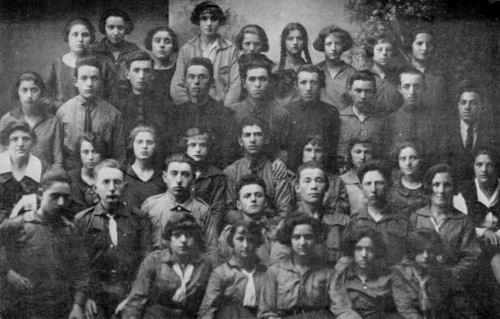
| Ken “Hashomer Hazair” in the town, 13 May 1926 |
|
|
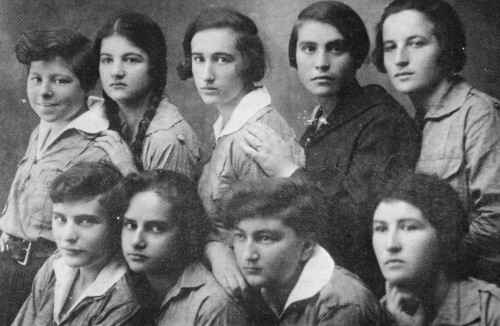
| A group of girls from “Hashomer Hazair” in the town |
Translator's footnotes
|
JewishGen, Inc. makes no representations regarding the accuracy of
the translation. The reader may wish to refer to the original material
for verification.
JewishGen is not responsible for inaccuracies or omissions in the original work and cannot rewrite or edit the text to correct inaccuracies and/or omissions.
Our mission is to produce a translation of the original work and we cannot verify the accuracy of statements or alter facts cited.
 Brzesko, Poland
 Yizkor Book Project
 JewishGen Home Page
Copyright © 1999-2026 by JewishGen, Inc.
Updated 22 Oct 2026 by JH