 |
during his visit to Briegel in early 1935
|
|
[Page 86]
by Yosef Hoenig - Ness Ziona, March 1977
Translated by Sara Mages
On a summer day in 1923, about a dozen teenagers gathered at the “Jewish Library” to discuss ways to promote culture. It was agreed to establish a self-study circle. This circle was the first beginning of the renewal of Zionist activity in our town.
We knew, that several years ago there was a Zionist youth organization named “Tikvat Zion” that founded the “Jewish Library.” However, with the outbreak of the Russo-Polish War in 1919-1920, military-age youth left our town never to return, and with them all the Zionist activity stopped. Only the library remained with several hundred books in Yiddish, Polish and German, and a few dozen readers who exchanged books once a week.
The self-study circle has grown and developed. We studied the history of the Jewish people, Jewish literature and the history of Zionism. From here we came to the need to learn the Hebrew language. We contacted the “Tarbut” association in Krakow and asked them to send us a Hebrew teacher.
When the teacher, the member, Yoel Dreiblet, arrived, he began to sort out the students. It became clear to us that we had to divide the circle into several classes, depending on their knowledge of Hebrew. The main difficulty was with the girls because their knowledge was almost nil.
We also had to overcome financial difficulties, because there was no chance of financial help from anywhere. We had to pay the teacher and also all other expenses. With great difficulty, we organized about seventy students. The teacher came to us twice a week, we progressed in our studies and that also created a Zionist atmosphere. When all this went well, the Hasidic circles began to incite the parents of the boys and girls to forbid their children from gathering at the “impurity” (as they called the library), because it could lead, God forbid, to conversion. Of course, this activity made it very difficult for us, and more than once parents came during our activities to pick up their children, shouting and cursing.
In one of the winter days of 1924, the shamash of the Rabbi of Wielopole, who lived in our town, came to the home of the writer of these lines to invite him for questioning by the rabbi. I answered him negatively. Soon the news spread in the town that I had refused to appear before the rabbi for questioning regarding my activity at the library. “Friends” approached me from all sides to convince me to go to the rabbi. After consulting with friends, and under the influence of my father, I went to him.
When I arrived at the rabbi's apartment, I was taken to his room. He received me with a stern expression and lashed out at me, saying: “I can't walk down the street, because the smell of “impurity” wafts from the house across from me where boys and girls gather together, and who knows what you're doing there.” I explained to him the purpose of our visit to the library and the nature of our activities there, as well as our aim to organize the youth for making aliyah[1] to Eretz Yisrael. When he heard these words, he started screaming and cursing. I slammed the door and left. The next day, the rabbi invited my father to him, told him about the conversation he had with me, and said: “it wasn't enough that I couldn't convince him from going to impurity, but he wanted to prove the righteousness of his path and make me a Zionist…”
Meanwhile, our cultural activities expanded, and a drama circle was founded under the guidance
[Page 87]
of David Vastrich (one of the few veteran Zionists in the place). When we were ready for the performance, we couldn't get a hall because we were interrupted by all sides. After much effort, and with the help of Yehoshua Schnur, who was close to the town's circles, we received the council hall, and the performance was a success.
Unfortunately for us, at that time a new rabbi was elected in our town and, wanting to prove himself, he began to fight us by all means. In one of the Melaveh Malka[2] meals, which he held for his Hassidim, he incited them against us. As a result, at the end of the meal, they broke into the library, tore up many books, broke and tore pictures on the walls, and also destroyed the memorial plaque to the victims of the pogrom in our town in 1918.
When we learned about the incident the next day, we notified the police, and then new problems began. We went from accusers to defendants. The police chief began checking his lists of associations registered and approved by the authorities, but he couldn't find our library. Therefore, he threatened to file a lawsuit against us on the grounds that we were “minors!” On that occasion, he also paid a “visit” to the library and searched among the books to find illegal literature. With great difficulty, and through “lobbyists,” we were rescued from this predicament…
Our circle expanded, the longing to change the image of youth (most of whom were from the middle class) intensified. We were tired of the wars with our parents and the environment and saw no way out of the situation. Some of our members began to accept and get used to the existing conditions, but for others, their longing and yearning for Eretz Yisrael intensified. But the problem was that we had to leave for hakhshara[3] and to do that we had to contact a group, or a kibbutz, but we were not affiliated with any center.
At the same time, Reuven Loichter, a member of “Hashomer Hatzair” in Bochnia was visiting us, and with his help a ken of “Hashomer Hatzair” was organized in our town. Within a relatively short time, several youth groups were formed from the previous group, “Tikvat Zion”, as well as young men and women who had only just joined. The members were divided into groups and companies according to age, an action plan was developed, and we contacted the main leadership in Lwow [Lviv]. We held meetings with kens of “Hashomer Hatzair” in nearby cities, Bochnia and Tarnow. Slowly the library room became small, we began looking for another room for our activities, but we encountered difficulties because no Jew wanted to rent us an apartment. We had to wander out of town and found a room at the home of a Polish family. The activity there was only for the older members because the place was quite far from town.
In the spring of 1925, two graduates of the ken[4] left for agricultural training, the first to realize the intense yearning to arrive in Eretz Yisrael.
That summer, Zionist activity in the area expanded and deepened. Members of the “circle,” mostly the older in it, established an association named “Tikvat Zion.” The youth movement, “Akiva”, was also organized. We needed to coordinate the actions of these associations without interfering with each other. A joint committee of all Zionist organizations was established to coordinate all activities, such as: Keren Kayemet, selling shekels[5], Hebrew courses, etc.
As a result of the comfortable atmosphere created, we also began to process the approval of the bylaws of “Hashomer Hatzair” with the district authorities. A youth “guardianship” committee was established, in which several members of “Hashomer Hatzair” who had reached adulthood participated. With the help of the lawyer, Kritenshtein, who lived in our town, we obtained the permit and, in this manner, became “legal” in the eyes of the authorities.
Ken “Hashomer Hatzair” developed. On Saturdays and holidays, we left for the surrounding fields and forests because only there the members of the ken were able to gather together.
[Page 88]
In the spring of 1927, several female members of “Hashomer Hatzair” left for agricultural training. Of course, without their parents' knowledge. A commotion erupted in the town, and parents didn't know where their daughters ran off to. They turned to the ken, and we explained to them that the girls had gone to hakhshara and would return safely in a few months. However, the parents were not satisfied with our explanations and turned to the police with a complaint. The local police chief, who was a “friend” of ours from earlier times, invited one of the ken s instructors to him and demanded to know the girls' whereabouts. We claimed that we didn't send them, they left of their own free will, and their whereabouts is unknown to us. The next day, the police discovered at the local post office a copy of a telegram sent from the main leadership of “Hashomer Hatzair” to the address of one of the instructors, containing an order to send the members to hakhshara.
The police submitted their findings, along with a copy of the telegram, to the District Attorney's Office, in order to file a legal claim against the recipient of the telegram, who was responsible for sending “minors” against the will of their parents. The parents of the ken's members began to fear for their children's safety. They started to chase the ken's instructors and even threatened to beat them. Almost every evening, they came to the ken and forcibly took their children home. Thanks to the beautiful summer weather, we have moved a large part of our activities to the fields and forests outside the town.
The incitement against us reached its peak on Shabbat Shuvah[6] of that year, when the Town's Rabbi gathered the townspeople at the Great Synagogue. In a speech that moved the gathering, he said, among other things: the impure transgress three “thou shalt not” from the Torah: a) idol worship, b) bloodshed, c) incest…
We consulted with our lawyer, and it was decided to contact the rabbi, Dr. Yehoshua Thon in Krakow, to give us a qualified opinion on this matter. We turned to the Zionist General Council in Krakow and requested an interview with Dr. Thon. In a meeting with the esteemed rabbi, he explained to us why he, as a rabbi, cannot elaborate on our rabbi's words, because he has enough trouble with rabbis. Therefore, we must only turn to the court. We returned to the Zionist General Council and left the matter to Dr. Warhaftig, who was their lawyer at the time, and through him the lawsuit was filed against the rabbi. The lawsuit rolled through the courts, until towards the end of the year both lawsuits, the police against us and ours against the rabbi, returned to the local court. And one fine day we were told that the judge and the lawyers for both sides had agreed among themselves to dismiss both lawsuits…
At the end of that year ,it was the turn of Reuven Loichter to make aliyah. It was an important event for us, as he was the first immigrant from our movement during those four or five years. In this we saw the beginning of the fulfillment of the longings for Eretz Yisrael.
After these events, the activity proceeded smoothly. Members left for hakhshara, and the parents probably came to terms with the situation. The chances of making aliyah to Israel were slim because the country's borders were closed. Here, the movement's graduates began to think about a different temporary outlet. Meanwhile, the idea arose to establish a “Jewish community center,” where young people could gather freely without the need of apartments that were impossible to obtain. Indeed, during the time of Yakov Paust, an action committee was established to help the former residents of our town everywhere. The committee requested financial support and within a few months raised enough money to purchase a suitable plot of land. A few years later, when I was already
[Page 89]
in Israel, I learned that the building had been built. It's just a shame it didn't serve its intended purpose for long…
In 1930, with the renewal of immigration that was discontinued due to the events of 1929, a few members of “Hashomer Hatzair” and “Akiva” made aliyah and joined kibbutzim, cities and settlements in Israel.
In retrospect, after all these years, one can only regret that we were unable to influence the many hundreds of young people in our town to leave everything behind and make aliyah to Israel. Only at the memorial ceremonies for the victims of our town do we meet a few people who, in those days, were among those who opposed our path, and today they also admit it, and it's a shame…
Translator's footnotes:
by Chaim Teller
Translated by Sara Mages
“Akiva,” the one I am attempting to write about, is the second “Akiva.” My knowledge regarding the first “Akiva” is very limited, and I don't allow myself to express an authorized opinion as the information that has reached me is extremely limited. Therefore, it should be noted that it was organized in 1926 by young people who, for some reason, didn't find their place within the framework of “Hashomer Hatzair,” which was then at the peak of its development in the town.
In those days, most of the intelligent youth and children of homeowners, whose situation was good and were well-dressed, gathered at “Hashomer Hatzair.” Membership in “Hashomer Hatzair” was enough to grant a young man or woman a position of importance by the standards of the time, and many were drawn to this youth organization also from the circle of Beit HaMidrash. For the youth, thirteen and older, it was an opportunity to break free from the ideological stagnation of the Hasidut that dominated the town at that time.
There was also a part that embraced the Zionist-national idea but didn't emphasize the Palestinocentrism[1], as it was called at that time. Namely: self-fulfillment or a kibbutz and its commune. They felt the need to organize, and the initiators went along with the general trend of that period. From 1924-1928, there was a steady surge in the establishment of youth organizations in all cities and towns across Poland. Also, in our town, “Akiva” was organized under the influence of the people of Krakow and Bochnia. The driving force in this organization were Shprintze Fishelberg Kleinberg's eldest daughter and Zalengut's young daughter. I allow myself to characterize this “Akiva” as a meeting place for friends, but it held a significant advantage because it had a cultural character. However, the organizational and ideological glue was too weak, and therefore, this “Akiva” fell apart over time.
The second “Akiva”
I take the liberty of writing about this “Akiva” because I was present at its inception, and I will endeavor to recount its development in detail, as I experienced it. First, it should be noted that it wasn't established as “Akiva,” unique transitions preceded it. Just as the first youth organization in the town was called “Tikavt Zion,” and over the years” Hashomer Hatzair” was created from it, so, in only a difference of time, “Akiva” was founded. It was in 1929, following a severe split within the ranks of “Hashomer Hatzair,” which had long been eroded by Marxism, making the outcome
[Page 90]
inevitable. Some of its senior leadership in Lwow [Lviv], as well as a large and important portion of its graduates, turned at that time directly to the communist movement…
In Briegel, the situation within “Hashomer Hatzair” had reached a standstill. Only four young women who hoped to make aliyahto Israel, and two groups of young boys and girls, remained in the ken[2]. Organizational activity gradually dwindled, and eventually, all the older groups disbanded, each one went his own way. Those looking for activity found it within the framework of the graduates who gathered at the “Dom Ludowy” [community center] and its organizations, such as the drama circle, the sports organization “Maccabi,” the library etc. From the groups that left “Hashomer Hatzair,” a trio of initiators founded an undefined youth club. However, the trio knew the direction in which the club was heading, and this became clear over time. They started looking for young people to join the club. However, the problem was that, at that time, there was a sharp decline in the ranks of the youth connected to the Zionist idea in general, and in our town in particular. The trio: Beno Borgenicht who lives with us in Israel and one of the first residents of Be'er Sheva. Mendek Eisen who lives in Haifa and also Hershel Lebel hy”d[3]. This trio took on the task of establishing a youth organization.
The main factor that brought me to this organization was my childhood friend, Sheik Sternlicht, who lives in Haifa. He left “Hashomer Hatzair” together with his teammates. He was practical and purposeful and apparently knew that by joining this organization he might achieve his goal, making aliyahto Eretz Yisrael. From my conversations with him, he knew that I often read the Books of the Prophets, Micha, Amos, Shmuel and Yeshayahu. He also knew that I leaned towards leftist views, but not those of the Communist Party! Indeed, my entire affiliation with Pp'alei Zion Left youth was one big camouflage and nothing else. A few years earlier, I was caught up in the anarchistic idea when I was in Nowy Sącz as a young boy who was sent there by the Bobover Hasidism. I was ten and a half years old at the time, but this is not the place to prolong this part of my life. Although, for me, this story is rich, varied and precious, we will return to Shiek Sternlicht. He knew that despite my leftist views, great is my will to make aliyahto Eretz Yisrael, and that's simply because I didn't see a future for myself in Poland. One evening he came to look for me at the restaurant of Yoshe Shnur hy”d. This was the place for all the townspeople, especially for the wealthy gentiles. A separate wing was reserved for them and for ordinary Poles and Jews. Those were divided into two groups, the Poles mostly drank together until they got drunk, the older Jews “killed” their spare time in the evening playing dominoes and the younger ones in a billiard game. Obviously, I was outside this realm, since I was desperately in need of money. I purchased the right to sit in the place by buying a round bun with a piece of herring for ten groschen. Every evening I spent my free time in this tavern, it was warm there, and it was lit by electric lights. And there, Shiek Sternlicht turned to me directly and said: “Chaim, come with me.” I got up and left with him. On the way, he said to me, “we're going to a club, and you'll find that you won't be any less comfortable sitting in a club than in the tavern. The club has electricity, and there are also newspapers and some books in Yiddish. You can sit and read without any interruption, and here you also have an organization through which you can make aliyahto Eretz Yisrael. We entered the club, which was located behind the newspaper stationery store of the brothers Tzvi Mozes hy”d and Mendel Mozes who lives with us in Israel. It was a large, handsome room lit by electric light, and it had two tables and four benches like in Beit HaMidrash. In the corner stood a small cupboard with two
[Page 91]
doors and in it about thirty scattered books. There were three teenage boys in the club: Mendel Buchman, Baruch Vashibeki hy”d, and Mendel Shie Stollers who now lives in Sweden. I befriended these boys, who came from poor; wretched homes, not less than mine. We talked about this and that, and it was quite pleasant. I rummaged through the bookcase and found a book of S. Ansky's letters. I glanced at the book and found it interesting. Within the hour, the trio appeared, Beno Borgenicht, Mendek Eisen who live with us in Israel, and Hershel Lebel hy”d, and they were followed by Yosel Sara Beiles who lives with us in Israel. And so we were about ten boys. The next day, in the evening, I went alone to the club and was the first to arrive. I continued reading S. Ansky's book. Slowly the group gathered and another candidate, Tzvi Metzendorf z”l, arrived. Several days later, the trio announced that we would have to move from this place. I should note that there was no group activity in those days. And now they informed us that they had found a place for the club, at the house of Schmilchel, the egg merchant. It was a room, three-quarters of a cellar without a floor and electricity. The group took its first real activity. We moved the tables and benches to the new place as well as the bookcase. That evening, the trio didn't come. We sat down for a group conversation about the situation we were in. From what everyone said, it was clear that the fate of the club depended on us, and only us. And so, we decided with a firm resolve to hold on no matter what! The decision obliged us more than anything, and we carried it out to the best of our ability, and successfully.
The Jewish Youth
And so, we, the amcha[4] group, the first in the club apart from the elite trio, felt the need to exist. For that, it was necessary to increase the number of members, so that we could get out of the state of mental unrest that we were in those days. It must be admitted that at that time we had no coherent conceptual framework, and we didn't even know the name of the organization. In contrast, the group's prime directive was to develop and for that, of course, there was a need to improve the club. The first thing, the floor, and since we didn't have money for that, we filled the hole in the room. Not far from the club was a hill, we dug clay from it, brought it to the club and leveled the floor a few centimeters lower than the height of the threshold. Next to the hill we also found logs and then the idea came up to make the floor slabs out of them. And, once again, the question of money for the boards. We started collecting boards from all sorts of boxes and pieces of planks. We did the floor in about three weeks, a new section every day. What self-fulfillment that was! We built ourselves with our own hands! In those days of creation the first herald arrived, Zoshka Metzendorf hy”d, sister of Tzvi Metzendorf z”l. She was accompanied by her sister, Zasia who is living in Israel. Efraim Buchman, the first of the group that was created overtime, also came. The next day came Hadasa Pedgerin and Tuvia “Tiste,” all live with us in Israel. How great the joy was in our house, even though we moved the club to the cellar. The number of members grew day by day, and together with this the trio began to crumble. The first to stop coming was Hershel Lebel, and after him Mendek Eisen. After their departure, the treasury was transferred to Baruch Vashibeki. The only one who stayed with us was Beno Borgenicht. Several days later, we assigned the secretariat to Hadasa Pedgerin since she was a typist by profession, and the role of librarian to Zoshka Metzendorf. We made every effort to make the time enjoyable for these two girls, and they really enjoyed it. Hadasa wrote a letter to the secretariat in Krakow secretariat announcing our existence, the secretariat immediately replied to us and that's how we received the name “The Jewish Youth.”
[Page 92]
The entire initiative in the hands of the amcha group
We realized that we were capable of doing everything for our existence, and the fact that our numbers grew within a few days encouraged and united us even further. In those days the existence of our organization passed into the hands of the group. We established a course of activities. Twice a week' Beno Borgenicht taught a Hebrew course and a geography course on Eretz Yisrael. In our time it was called Palestinography. Hadasa Pedgerin undertook the reading of the “Auto-Emancipation” by Leon Pinsker and a conversation on this topic. My part was the teaching of the history of the Jewish people, so cultural activities took place every evening of the week. However, I must emphasize that in our club the emphasis wasn't on acquiring knowledge but on intention and action, and it must be admitted that we lacked cultural resources. The only one that could be called “cultured” was Beno Borgenicht, who knew more than all of us. He walked among us as a school principal, and that fascinated him greatly. The group was very comfortable with him because, apart from his teaching, he didn't interfere in any organizational matters. I can add that he wasn't involved in the social life of our organization at all. He never left on a trip with us and never participated in a social evening. He also didn't participate in any general performance, on Oneg Shabbat[5] or in our parties. But we, the group, were comfortable with him. It is also worth noting that this occurred during the first period of our club, about two months after its establishment.
We became missionaries
And so, the amcha group felt that the entire burden of our existence was placed on our shoulders, and then we “attacked” the remaining members of “Hashomer Hatzair.” From the boys' group we only “snatched” two boys: Metzendorf z”l and Tuvia Mingelgreen. In contrast, four of the girls' group: Beila Blaugrund, Machka Grinberger, Sophie Berkelhamer hy”d and Shushka Appelrot who lives in America. We pursued them until they finally agreed to come to. And so it was: the four of them came shortly before sunset, we immediately arranged the benches in a square and sat around. I, who was the initiator of Oneg Shabbat, also served as moderator. In the introduction to the text I said something like this: who, like us, natives of the town, knows the value of our Shabbat, a national asset that any nation would be blessed with. Therefore, as a youth organization, we are duty-bound to nurture this wonderful tradition. I read an excerpt from “Sabbath in Kasrilevke” by Sholem Aleichem. After the reading, I began with the song “You are one and your name is one,” and we continued with Shabbat songs. Tuvia Tiste sang us with his pleasant voice songs in Yiddish like Mayko-Mashmelon and songs by Avrom Reyzena, and Avraham Gebirtig that were very popular at the time. When he finished singing, we burst into the song “Offer the sacrifices of righteousness and put your trust in God.” With the singing we started to dance. The dance was supposed to be a rondo [circle dance], but none of us knew how to dance it, so we danced a kind of Hasidic rondo. Not a rondo or a Hasidic, but we danced until late in the evening. On that evening, we parted from Sheik Sternlicht who was leaving for hakhshara[6] company in Bielsko. Also, this fact added a special atmosphere to that evening. We just started and one of us is already leaving for hakhshara. The next day, the whole group came, but only for a short time, and they continued to come every day. They
[Page 93]
also joined our Palestinography and history group. The group of “four” surprised us greatly, they brought a group of girls younger than them. This group initially consisted of eight girls. I remember the names of some of them. Tauba Sternlicht and Zasia Metzendorf, who are in Israel, Reizel Blaugrund, Mary Berkelhammer, Toshka Appelrot and Fruma hy”d. On that Sabbath there was great joy in our home, because we realized that the group that we acquired a week ago was staying with us.
The next Oneg Shabbat, repeated itself with greater intensity and a sense of holiness enveloped our hearts. It seemed as though a cry of victory burst forth from the dancing and singing that only innocent youths from our town were capable of doing so. How good it was for us back then, great joy in our hearts! However, the late hour prevented us from continuing to enjoy ourselves, because even the sixteen-year-old boys and fifteen-year-old girls had to be at home between nine and ten in the evening. And then I was left alone in the club. It was my habit to come first and leave last. During those hours I read Feierberg's book Le'an. This was the first book I read in Hebrew, and I tell the truth: more than I read I prayed this book because I didn't know Hebrew. What I learned at the cheder wasn't enough to read a book. Only with the help of a textbook and the Yiddish-Hebrew dictionary of Szewach Walkowski from Krakow I continued the reading of the book Le'an. His character, Nachman, the rabbi's son, captured my heart until I completely identified with him. In this manner, many evenings went by. Fun, uplifting, and soul-warming evenings.
The momentum in our organization
With the acquisition of both groups of girls, our ken entered a self-development phase. Not a month went by without a group being added. A group and also individuals. We grew and expanded. Life at the club became lively and, above all, practical. Mendel Buchman taught a course on binding the books in our library that were mostly separated into pages. Everyone who came to the club participated in bookbinding before starting cultural activities in groups. We set an important principle for ourselves: time at the club should not be wasted and there is always something to do for it. Zoshka Metzendorf, for example, discovered a long list of books owing to the library, and took the trouble of returning them to the club. She also initiated a book donation project and dozens of books were added to the library. It is worth mentioning Perdek Shpielman z”l, the only one in the local Zionist committee who was interested in our organization. He donated many books and even a bookcase. It was natural that most of the books were torn and worn, but the workers in the binding department knew how to repair and bind them in a very nice way. Mendel Pastovsky made two presses for us from wooden boards and screws, and the books remained pressed while they were still damp from the binding.
The library gradually developed. For borrowing a book, the library collected five groschen from members, and ten groschen from nonmembers. With this money we bought binding materials and volumes that were missing. Many members joined this work with full dedication and acquired the knowledge of bookbinding. Indeed, in a primitive way, but quite effective. As our organization grew, the number of members reached over sixty in a short time. This was an achievement for us above and beyond anything that we dreamed of or wanted. And I wouldn't exaggerate if I said that there was no organization like ours in all the surrounding cities and towns.
[Page 94]
Decorating the club
Mendel Buchman continued with the bindings, and I moved to decorating the club's walls. Each wall expressed itself with its own pictures and sayings. Those were taken from Pirkei Avot [Ethics of the Fathers] and the Bible, as also catchphrases from the leaders and founders of Zionism. Three members participated in this work: Hadasa Pedgerin, who wrote a rare and beautiful calligraphic script, and Mendel Buchman, who knew to write block letters in a beautiful graphic manner. I did the technical work of cutting, slicing, gluing and decorating with all kinds of paper chains or ornaments. To help me, I enlisted Beila Blaugrund hy”d, the most intelligent and wise girl of all the girls. Unfortunately for me, this girl hated hearing Yiddish, and I wasn't fluent in Polish. In those days, I read Tolstoy's Anna Karenina in Polish while I was working on the new binding for the book, but it was very difficult for me to speak Polish. For that reason, I suffered a bitter disappointment which accompanied me at the club until I left for hakhshara. And this is how it happened: at the club's eastern door was a rough-paneled door that led to two rooms in the cellar. We covered the door with cardboard and glued green wrapping paper to it. In the center of the door, we hung a board with the ken's action plan, the names of the groups and their leaders, the name of the conversation and it's time. On both sides of the board were various sayings written on decorated paper in Hadasa's amazing handwriting. I only had to decorate the door frame. In the middle, above the door frame, I made a kind of crown and from it two sleeves to the corners of the frame. Here, I wanted to make two loops from which two curtains would descend to the middle of the door height. All of this was made of crêpe paper in two colors, blue and white. I had trouble making the loops and then Beila Blaugrund appeared. I turned to her: “you see, I've almost finished everything, I'm having trouble and I can't make the masha (loop in Polish). As soon as I said the word masha, she burst into hysterical laughter, and repeated it again and again, specifically in Yiddish, vas machten mit di masha [what are you doing with Masha], laughing and repeating it again and again like a broken record. I tried to explain to her that I took the word masha from Yiddish, as we used to say in Yiddish (zi hot gebindn di hor ofn kop mit a masha) her hair is tied in a loop. Then she increased her laughter. At that time, more members arrived at the club. She continued with vas machten mit di masha with mockery, contempt and wild laughter, and everyone laughed hi… hi…. She mocked me until I had to leave the club. An hour later, I came back and said shalom, but she answered with a vicious scream vas machten mit di masha, and again everyone burst out laughing after her. It reminded me of the chanting of Tzon Kedoshim [“Holy Sheep”] on Simchat Torah and the little ones answering meh… meh… What can I say, and what will I say? I have suffered for too long from the word masha. It seems to me that Topele Tutaritu of Sholem Aleichem suffered less from his bullying than I did from my masha. She made me look ridiculous in the eyes of the members, despite the fact that we were on friendly terms and even had mutual respect. But, at the same time, she took every opportunity to hit me with vas machten mit di masha, and why? To this day, I do not know.
[Page 95]
The Zionist Youth
After the incident with Beila Blaugrund, I included Sophie Berkelhamer in the decorating activity. She was reserved in her nature and didn't want to cooperate with the ken. At the same time, Beila Blaugrund became the leader of the girls' group in the second battalion, and Machka Grinberg organized the girls' group in the third battalion on her own initiative. Sophie was left without a role, so I forced the decoration work on her, and when she took on the role, she proved herself to the full extent of her talent. She had a highly developed sense of architecture and was also skilled at drawing, carving, and sculpting. She completed the decorations very successfully and this fact motivated her to further activities in the ken. She took upon herself the leadership of a group of girls who organized themselves into the third battalion. After strenuous, diligent, and industrious work carried out in the bindery, the volume of work there diminished. A group from the second battalion, with Mendel Buchman as its leader, continued this work. I remember a few of them: Efraim Buchman, Monik Maginoinik, Pawel Labewers and Tuvia Tiste's brother. They all live with us in Israel. Shlomo Shturkha and Yehezkel Leherpeld hy”d. Mendel Buchman began a new practical activity, a small sawmill. Young and old entered the sawmill work. Out of plywood made all kinds of frames, baskets, etc. The highlight of the sawmill was the creation of a large menorah made of plywood. All of this was planned and prepared for the Hanukkah ball. Mendel Buchman's group of boys was in the second battalion against Beila Blaugrund girls' group. I hung out with the older members, but I didn't manage a group. I initiated, planned, and was an uncrowned coordinator, and remained that way until I left for a hakhshara company and aliyahto Israel. I initiated something new: dramatizing of songs in Hebrew and Yiddish, and for this I enlisted Sophie Berkelhamer and Tuvia Tiste. They both knew a chapter in singing. Sophie Berkelhamer prepared the setting, painted the Jerusalem landscape from a photo in Kern Kayemet Leisrael booklet. Mendel, Shie Stallers and Efraim Buchman built the stage. The song we performed was Me'al Pisgat Har Hatzofim [“From The Summit Of Mount Scopus”] by Avigdor Hameiri z”l. On Thursday afternoon, as we were in the midst of final preparations for the performance on Saturday night, a blond high school student suddenly entered. He introduced himself as Tzvi Zeichner, a messenger from the Tarnów district, and explained to us that we had been annexed to their district. After the establishment of the central leadership of all Zionist youth organizations in Krakow and Lwow, we are now called the Zionist Youth. Previously, we were the Jewish Youth Association, according to the accepted version of the people of Krakow at that time. The truth must be told that during the entire time we were connected with Krakow they never came to visit us. He promised us, in the name of the Tarnow District, to visit the ken at least twice a month, and to monitor the activities at the ken. At that time, our ken improved and became more successful. Baruch Vashibeki organized a group of boys for the third battalion, and his rival, Tzvi Metzendorf, followed suit. Our main means of attracting young men and women to join us, were the balls we held for each holiday and festival. We drew the material from the informative booklets of Kern Kayemet Leisrael, which in those days presented various plays to the youth. In addition, we performed various songs. Three goals stood before us at these balls: A) this was a very important cultural-social action for the members of the ken. Through this they learned all kinds of songs and their content. B) we opened the gates of the ken to all the youth, and this method has proven to be the best for attracting members to the ken. C) each member paid an entrance fee of five Polish groschen, and non-members paid ten groschen. These revenues were used to balance the budget for rent, taxes for the Tarnów district, and the purchase of instructional books.
[Page 96]
The background of the split in the movement
During school holidays, all the youth movements held summer camps. No one from our ken left for such a summer camp, because none of us could pay the required fee to attend the camp. It should be emphasized that the people of Krakow organized a separate summer camp for the kens in their district, and groups in Galician towns that were connected with them. Although we received news of arguments between the people of Krakow and the people of Lwow, they were very weak. Since we belonged to the Tarnow district, we were loyal to the people of Tarnow, who followed the people of Lwow. The summer camp for the first battalion, which was organized by the people of Tarnow, was held in Bańska Wyżna. A conference for the first battalion and the senior class was also held there. I walked to the conference because I didn't have the money for the train fare. From Brzesko to Nowy Sącz and from there to Bańska Wyżna, about seventeen hours of walking. I arrived at a stream that flowed through a hill. With great difficulty, I took off my shoes and soaked my feet in the water, then I felt how swollen my feet were and how tired I was. I remained lying on the grass for about an hour with my feet soaking in the cool stream water and recovered after the short rest. I continued to walk barefoot because I couldn't put on my shoes and reached the building that stood on the top of the hill. A blue and white flag was flying over the building, along with a large banner in Hebrew and Polish, announcing the existence of the camp there. I surrounded the building and realized that the place was empty, but I felt a rustling in the kitchen which indicated that someone was there. I entered and found two girls cooking in huge pots, but when I asked for something to eat and drink, I only received a cup of tea. The girls said that two young men traveled to bring food and unfortunately, they had no food. The dinner planned after the food was brought will be served when the people return from the trip. When I asked where I could stay, they told me that I had to go up to the attic where the boys were staying. I went up to the attic and here I encountered a high school student who didn't go on the trip with everyone else. We introduced ourselves, Chaim from Brzesko and Zipzto Zilberman from Przemyśl, and he gave me a place next to him. The entire attic was lined with soft straw. I lay down and told him about my walk from Brzesko to Bańska Wyżna, about a hundred kilometers. He looked at me in amazement and asked, “how did you do that?” I answered him, “what will you do in Eretz Yisrael when you don't have money and transportation? He admitted on the spot that we really should prepare for this. He moved on to explain what is happening in the movement, adding that we were on the verge of a split. The right to create the movement belongs to the people of Krakow. They chart the path the movement should take and know what they want. Not so the people of Lwow. Apart from the fact that they belong to the general Zionist movement, they don't know and don't want anything different or special than the existing youth movements. And as such, it is completely unnecessary. I fell asleep from exhaustion and remained sleeping until the next afternoon. On Friday, at dinner time, they woke me up. I was already the last one, but I still managed to get grits and bean soup and bread. I ate two bowls of soup with bread, and then I got a portion of potatoes with a kind of goulash. Everything was very tasty and the portion was large, but I added to myself another bowl of soup with bread and that's how I was full. Let's not forget that I hardly ate for a day and a half.
[Page 97]
The last negotiations before the split
When I left the dining room, I came across several groups standing in the area in front of the building. Most of the people arrived at the conference that was going to take place on Saturday. Everyone's eyes were turned toward the ravine. They pointed at the hill in front of us and said: here is Idek Orenstein, the head of the movement who was summoned from Kibbutz Petach Tikva in Israel regarding the friction between the people of Krakow and people of Lwow. He had to decide and rule, a split or no split. I deliberately emphasized the words, “the people of Krakow and the people of Lwow,” because in those days there was no fundamental difference between these two factions. Both belonged to the General Zionists, and both opposed the Marxism that had permeated and taken hold of most Zionist Jewish youth movements. Immediately upon his arrival, Idek Orenstein locked himself in with Yitzhak Steiger z”l and Menio Gottlieb from the Lwow leadership, and they began making inquiries. It should be emphasized that Orenstein was a native of Krakow and also the founder of the movement. At the same time, he sided with the position of the people of Krakow, as he was connected to the movement's spiritual leader, Yoel Dreiblatt z”l. He understood the movement's distinctiveness, even though at that time this distinctiveness had not yet found explicit expression in the life of the movement. The number of people gathering outside the building grew, as did the arguments for and against the split. I turned back to the attic and there encountered a group arguing enthusiastically with the same Zipzto Zilberman. He called to the people of Lwow: “they are not Jews at all.” Then I burst out screaming: “You have no permission to use such names.” After all, Judaism excludes no one from its fold, and its consistency is the guiding principle. “God waits for a Jew's repentance until the day of his death.” Therefore, you, at any rate, are forbidden to issue a ruling on the matter. At the same time, in my humble opinion, it must be acknowledged that the primary credit for initiating the movement belongs to the people of Krakow, and there is not one person who denies this. My outburst affected the entire group, and after it dispersed, I returned to reading Feierberg's book Le'an that I had with me.
“Akiva” evening at the summer camp in Bańska Wyżna where the split took place
As night fell, everyone was summoned to the dining room by the ringing of a bell. Each one received a roll the size of half a challah and a cup of cocoa. At the end of the meal, it was announced that a reception would be held for the kibbutz emissary from Eretz Yisrael, Idek Orenstein. Dozens of conference participants immediately flocked in from all sides and filled the dining room to capacity. It was so crowded that no one could move around in the room, which measured twenty square meters. About two hundred people entered. In the room there were benches along the walls, as well as a small narrow table for the leadership. Idek sat in the center and on his side sat Yiztchak Shtiger z”l, Monia Gotlib and four other people unknown to me. Yiztchak Shtiger rose and welcomed Idek with warm greetings and words of praise, as befitted an emissary from a kibbutz in Israel. Idek remained comfortably seated and gave a brief overview of the kibbutz and his special activity. In other words, for the first time, an independent General Zionist list appeared for the election of the Petah Tikva Workers' Council. He also noted the difficulties the Jewish worker encountered with his Arab competitor, and the viewpoint of the Jewish citrus growers on the question of Jewish labor… And suddenly, he stopped talking… and after a two-minute pause he began to hum the melody: Hoy…tidri…hoy… hoy. Tidri… hoy… hoy. Tra ll la hoy ha! Hoy…tidri… and so on and so forth (unfortunately, I don't know
[Page 98]
how to read sheet music and that's the reason why I trill so much). And so everyone began to hum, and from humming moved to singing in hushed tones. Slowly, slowly they raised their voices and the enthusiasm kept growing. The people, packed together, danced and moved to the rhythm of the singing. Each in his place. The dance resembled the leaps of Kadosh! Kadosh! Kadosh[7]! And so the dancing and singing continued… This electrified and elevated atmosphere enchanted me more than anything, even though I hadn't heard a word from Idek before, nor did I know him. After witnessing the spiritual elevation he bestowed upon us in this situation, I decided in my heart: I will follow him without any hesitation, come what may! The entire camp went to sleep with a sense of relief, given the oppressive feeling of division that prevailed at the beginning of the evening. We also believed that the split would not occur after this evening. That was indeed the prevailing view, and many had hoped otherwise, but to everyone's dismay, the split became a reality. On Shabbat morning, Idek left the camp. Alone, without any escort, and that was the sign that there was indeed a split. The next day, Sunday morning, I left the camp together with a young man from the hakhshara kibbutz “Zionist Youth” near Gorlice. When we arrived, I asked the hakhshara group if I could stay with them for a few days, and they agreed. On Monday, I went out to work with everyone. The work was in the granary because, at that time, the threshing had already begun after the harvest. At five-thirty in the morning, we went to the granary. A gentile, one of the farm managers who had arranged the work, was waiting for us there. Luckily for me, the young gentile, who worked feeding the sheaves into the threshing machine, didn't come to work that day, and the two gentile girls, who usually replaced him at work, refused to do so on that day. The manager asked, who volunteers to feed the sheaves into the machine? I jumped first and said: me! The gentile and the two gentile girls burst into wild laughter, probably because I was the youngest, smallest, and scrawniest of them all. To their laughter I replied: please try me for one hour! If I don't do my role properly then, and only then, will you fire me! I said these words with such arrogant confidence that they surprised everyone. To that, the manager replied, “remember what you said, I'll fire you.” I answered jokingly: we will see it later. With obvious anger, the manager turned on the threshing machine and even increased its speed, intending to fail me. I asked for a large headscarf and received it from one of the girls of the hakhshara company. I pulled it over my face, up to my eyes, and started working. Two gentile girls handed me sheaves that had been brought to them, and I fed them to the threshing machine. To everyone's surprise, I carried out my work quickly and successfully. Before long, the manager added another young woman to hand me the sheaves, because the two of them couldn't keep up. At breakfast, the manager brought me a bottle of milk as a token of recognition, and also at noon. That day, the manager let us off work an hour and a half early. This was as a reward for having managed to squeeze in almost double the quota that day, by the number of sacks we counted. I continued on Tuesday and Wednesday, and in the evening, I informed the kibbutz work coordinator that I had to return home the following day, but the members of the company absolutely refused to let me go on foot and insisted that I travel by train. I agreed on the condition that on the next day, Thursday, I would continue working until two o'clock. After I finished working as agreed, I walked to the nearest train station and traveled to Tarnow and from there to Briegel. I went straight to the club and met my group and the girls there. I told them about the split and persuaded them to go together with the people of Krakow, with Idek Ornstein as the leader. That evening, Hadasa Pedgerin wrote to Krakow and informed them that our ken was joining them. The truth is, at that time no one cared where we belonged. They simply
[Page 99]
had no intention of doing so, didn't care about the split. In our ken, as aforementioned, the main thing was that we exist and that we will exist! All other considerations were marginal and not important at all.
If so “Akiva”
Well, the ken was presented with a fact. Just as we had been transferred to the “Zionist Youth” by the Tarnow district emissary, Tzvi Zeichner, this time we moved to “Akiva” and the contact with Krakow was also facilitated by an emissary. Of course, this time I was the emissary. Things at the ken were proceeding as usual, without any sign of an upheaval. For in the early days, there was nothing that could point to the difference between “Zionist Youth” and “Akiva,” and what transpired in this matter manifested itself in the leadership in Krakow. It centered around Yoel Dreiblatt, Yakov Prand, Moshe Zinger z”l and Idek Orenstein may he live long. The control was in the hands of Yoel Dreiblatt, he knew exactly what the character of this movement ought to be. But in the kens and within the leadership, even in Krakow there was great confusion. For the most part, they were imbued with the spirit of “Hashomer Hatzair,” the veteran youth movement in Galicia which shaped the image of the youth. Almost all Jewish youth movements were swept into the vortex of Marxism, and only minor differences distinguished them from one another. In general, during that period, socialism was the fashionable craze within the youth movements. However, Jewish youth gradually began to turn away from socialism and shifted toward Zionism. Only to Zionism without a layer of socialism. And so, “General Zionist” youth movements were established, for whom Marxism was “impure,” and this was the important point that distinguished them from other youth movements. However, “Akiva” didn't settle for “just without socialism.” It wrestled with the dilemma and sought a “unique” path for itself. It took upon itself an immensely difficult challenge: to bring the youth back to the values of Judaism and Jewish tradition, specifically to the Hasidic way of life. To do so, it incorporated Hasidic melodies and dances as an important part of the lifestyle of its kens. This was a spirit that emanated from sources entirely new to those that had existed in youth movements until then.
“Akiva” invested enormous efforts in advancing its youth, including the earliest Jewish sources, and began with the Bible and its commentaries on the Talmud and Poskim[8]. It set to itself the goal of providing knowledge of Judaism and thereby returning the youth to the fold of Judaism. It was the first to see that without Jewish consciousness, the younger generation would distance themselves from Judaism and the uniqueness of Judaism. A generation that won't even want to ask the wicked son's question from the Passover Haggadah: “What is this service to you?” “To you, not to him! And to prevent the phenomenon of the type “To you, not to him! “Akiva” instituted a process of deepening knowledge of Judaism based on its original sources. In doing so, it sought to achieve two goals: a) to eradicate the growing lack of knowledge about Judaism among Jewish youth worldwide, which distanced them from Judaism altogether. b) it wanted to create a framework of Jewish identity with old spiritual content adapted to the new times, and here it found itself entangled in a web of inner indecision. As an example, I will bring the evening of Kabbalat Shabbat[9] at the first hakhshara company in Bielsko. After the split from the Zionist Youth, it was understood that in Kibbutz Akiva this evening should be expressed through the traditional Kabbalat
[Page 100]
Shabbat prayer, and also the new songs written by Jewish poets in the unique spirit of the Shabbat. And so it was, they prayed, sang Shabbat songs, all in accordance with the Jewish tradition of Galicia. Unfortunately, at the end of the meal, the first company commander saw fit to treat us to a reading from the book, “Days and Nights” by Nathan Bistritzky (Agmon), which wasn't in the spirit of “Akiva” and the times. The passage was very romantic and dealt with the question of “free love” that invites the man. In my humble opinion, this reading damaged the spirit of Kabbalat Shabbat, despite the recitation of the Song of Songs that the Jew repeated before Kabbalat Shabbat.
There were many inconsistencies, as “Akiva” lacked legal consistency. “Akiva” never mentioned the fulfillment of the commandments according to law, it only emphasized the preservation of tradition, its values, and their cultivation within its ranks. In our town, Akiva's role was merely to act as a brake on the youth's rebellion against centuries-old customs that distorted the image of the Jew and Judaism. In 1932-3, after the ken had taken on a clear form, it was possible to examine its unique approach to tradition. If “Hashomer Hazair” had left behind traces of an avant-garde fighting against tradition, “Akiva” would have been the opposite. “Akiva” sought a way to endear tradition to the youth and to respect religious Jews. While they were indeed a formidable rival to the Zionist youth, we viewed them as the potential reservoir for the national revival movement. Therefore, it is necessary to respect them to avoid confrontation with them.
To the reader: In conclusion, I ask the forgiveness of the patient reader, who will exert himself reading the long and detailed, and perhaps even tiring, lines. But please understand that a reason that is especially important to me, caused me to immerse an important part of my youthful life, which I dedicated to our organization. It became my first home in the ranks of priorities, for all the other obligations I have in life. And with the tired and bored reader, forgiveness.
Well done to the members of “Akiva”
Translator's footnotes:
Told by Elisha Sternlicht z”l
Written by Chaim Batlan
Translated by Sara Mages
The trend towards leftism has reached Briegel too. How did that happen? The first to do so were members of “Hashomer Hatzair,” who were increasingly gravitating toward leftist views, though this took place discreetly rather than publicly. “Hashomer Hatzair” only appeared as a pioneering Zionist youth organization, especially in a Hasidic place such as Briegel.
However, when the Wiesenfeld family arrived in our town from nearby Bochnia, they purchased a small, neglected soda water factory. After turning it into a thriving business, the family began extensive communist propaganda activities and even established an underground communist cell.
[Page 103]
However, it was not this leftism that led to the establishment of Po'alei Zion Left in Briegel, but rather the conduct of the Zionist Organization in the town. They didn't even think it was necessary to organize that segment of the youth considered to be workers. On the contrary, they secluded themselves within the framework of being more important, more knowledgeable, and more understanding. It was not fitting for them to be found together with the amcha[1], who were considered their inferiors. Lo and behold, most of them were former members of “Hashomer Hatzair, ” yet it was precisely they who isolated this segment, a group that so deeply yearned for organization and social nurturing. Indeed, it was “Akiva” that embraced the youth from the town's impoverished families. However, they were too young, ranging from ten to eighteen, and that didn't suit our age group. And so, many of my age, twenty-five and older, as well as younger ones, wandered through a void, without any substance or meaning. Indeed, some of us tried, in one way or another, to integrate into the general society that gathered at “Dom Lubovy” (“community center”) but, to our regret, we could not be accepted into this society because it rejected the amcha.
As for me, I experienced this firsthand. Indeed, I was fortunate enough to only land a role in the play “Hophni and Phinehas,” as a military officer, along with Mechil Tzauber (Eisen) and Pinchas Lash. It was an exceptionally successful comedy, so much so that our drama group performed it again in the nearby town, Bochnia. Despite the success of the play, and even though each of us excelled, it didn't earn us the right to perform in any other production. As previously noted, we were considered amcha, and this fact drove some of us to seek out an organization. I say openly, among those Zionists, we felt like stepsons in every respect. There were those among us who saw no future for themselves, neither in the town nor in Poland, and therefore, we wanted to make aliyah to Eretz Yisrael. Most of us were skilled tradesmen, we were not afraid of hard work or harsh conditions, since our living conditions in Briegel were not better. We all thought that through this organization, we would achieve the ultimate goal, to make aliyah to Israel. And so, we organized ourselves as a workers' party within the framework of Fraye Iugnt [Free Youth], an integral part of Po'alei Zion Left. In all honesty, we felt that in this organization, there was no one above us who considered us inferior to him. In a short time, this organization became cohesive, and we reached a membership of fifty-four, and received all the organizational and ideological help from the party in Tarnow. In this way, we were drawn into the anti-Zionist-bourgeois spirit and instructed to fight in the Hebrew language. Therefore, the Po'alei Zion Left oath in Yiddish or “The Internationale, ” are without a shadow of a doubt more important than the Zionist “Hatikvah. ” In this manner, they instilled in us the spirit of the socialist revolution, but it was impossible to put it into practice. However, it was possible to channel the revolutionary spirit within the Jewish street in Brigel, and at one of the public appearances performances at the “Dom Lubovy” we refused to sing “Hatikvah.” This led to a brawl, and people on both sides were beaten, since our members were more prepared for blows than the sons of wealthy homeowners, or the masters, as they called themselves. I will only mention one of us, Pinchas Yatzik z”l, who lifted a table on Shimon Einhorn's head, and miraculously, someone stopped the table while it was still in midair, otherwise, who knows what might have happened that evening. In any case, despite our small numbers, we didn't lose; and it was a small measure of revenge for being viewed as lowly people.
And so, we became a force to be reckoned with in the town. However, an unexpected event occurred during that time. The police began making arrests within the underground communist cell, and one man was arrested, Adolf Berkelhammer,
[Page 104]
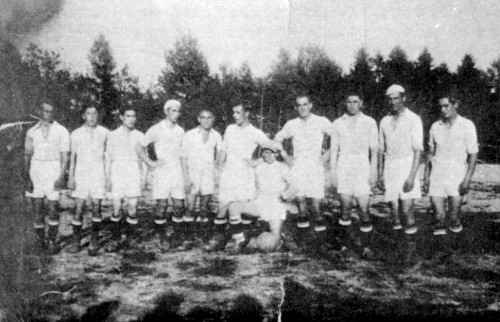
a member of Po'alei Zion Left. After he was released, I demanded that he draw the necessary conclusion and leave the party. His response was truly “revolutionary”: he grabbed a board and smashed it over his head! Poale Zion completely disbanded following this incident and the atmosphere of arrests in the town, and only a few remained in contact with the party in Tarnow. A year later, after I made aliyah to Israel, I was told that they formed a soccer team, but also this time it lasted only for about a year.
Interesting incidents that have remained vivid in my memory
I would like to bring up a few interesting incidents that have remained vivid in my memory, and they are:
In one of the social balls that took place at the “Dom Lubovy,” one of the participants bought a portion of a carp fish head. While eating, a bone got stuck in his throat, causing great panic among those present. Fortunately, Dr. Shatil z”l was in the place, and with the help of two knives managed to extract the bone from the man's throat. Thanks to this, the public was able to continue enjoying the ball, in addition to saving a human life.
I was startled by an unusual figure
In my neighborhood, which was called “Trzcianka,” it was dark even after electric lighting was installed in 1930-1931. The distance between one streetlamp and the next was about a hundred meters. The streetlamps were small, so darkness swallowed the faint glow, and there were also short streets with no lighting at all. The house where we lived was situated directly opposite the intersection of “Drobni” R' Lishes,” which started from R' Chaim'l Din Mark, as it was called in the town back then in the town. As I approached the last building of “Drobni,” in which lived the teacher Leibish Strom and his wife Yachtzshe, who sold rolls and bagels at the homes of the wealthy, I encountered an exceptionally tall figure at the far end of the building that served as the grain warehouse for that Drobni. I was startled but immediately recovered. I walked over to the fence by the shed, tore off a plank, and started hitting left and right. And then, screams and pleas for me to stop hitting erupted. Then, one climbed down from his friend's shoulders. I can't recall today who those two jokers were who managed to pull such a stunt on me, but the strong blows solved the problem.
A story about a sukkah
In our house was a large yard, and facing the street was a building containing four apartments. Two large apartments were divided by a partition of thin planks at the height of two meters, meaning that they didn't reach the ceiling, and two smaller, one-room apartments. Behind this building, about ten meters away, stood a second building also of four apartments and eight tenants.
Naturally, a special structure was needed for a sukkah, and such was one of the sheds owned by us. It had a roof that opened to both sides which was called the “Schlock.” Over the years, this “Schlock” broke down, and it was impossible to open it, and once opened, it could not be closed. And here, the days of the Sukkot holiday were drawing near. The children prepared the decorations, but the “Schlock” didn't open because it was rotten. Therefore, the tenants decided that, since time didn't
[Unnumbered page]
|
|
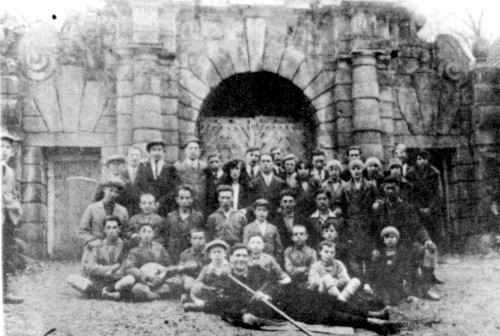
| The older group of ken “Akiva” on a trip with Gad Buchman
during his visit to Briegel in early 1935 |
|
|
| “Maccabi” soccer team in Briegel |
[Page 105]
permit repairing the “Schlock”, they would turn to Avromka Laub, borrow the crates he used for packing eggs, and will assemble a sukkah out of them, and so it was. The neighbor, Betzalel Yakel David's, demanded that the entrance be moved to the other end of the sukkah and not by his front door. To this, Mendel Lieberman, one of the neighbors who always believed his decision was the sole deciding factor, ruled that under no circumstances should this be allowed to be done. And, as a man who stands his ground, he warned everyone not to dare do such a thing. However, Bezalel didn't accept Mendel Lieberman's verdict. After they finished covering the sukkah with branches, and the children began the decorating, Bezalel started taking a crate out from the far end to move it to the opening they had made next to the entrance of his house. At that very moment, Mendel Lieberman and his family attacked Bezalel and beat him severely, and Bezalel was saved from severe injuries only thanks to the neighbors' intervention. From that day on, Bezalel decided he didn't belong in our sukkah and moved to Menashe Shohat's sukkah. However, the next day, once tempers had cooled and the neighbors came out to inspect the quality and layout of the sukkah, they realized that anyone stepping out of the sukkah risked bumping his nose against the door as it swung open. After an in-depth discussion, they managed to convince Mendel Lieberman that the opening should indeed be moved to the other end, and, what's more, that doing so would not entail much trouble.
They talked and talked, and the men of action carried out the task of moving the sukkah's entrance to the other end. Yet, their pride didn't allow them to go so far as to ask for forgiveness from Bezalel. That year, everyone who came to the sukkah felt Bezalel's absence, because he knew better than anyone how to sing the traditional holiday songs in a beautiful voice that everyone enjoyed. In addition, the verses he used to write and cut out from colored paper to decorate the Sukkah were missing. He truly knew the meaning of the secret of a “beautiful sukkah, ” and in that year he decorated Menashe Shohat's sukkah. And so he continued, and in the third year, Menashe Shohat's sukkah was the most beautiful sukkah in the town. Many townspeople came to visit it and looked at her spectacular decorations, something that we, the young ones, deeply regretted.
The roof covering of the town's synagogue
With special pride I wish to mention this work for which I served as team leader. This synagogue was rebuilt after the great fire in 1904, when the fire consumed about ninety percent of the town, including the synagogue. Since my childhood, I remember a period of twenty-five-years when this building stood unfinished with only brick walls. Several Batei Midrash were also built: the Hasidim Shtiebel, the town's Beit Midrash and R' Wolf Laubis minyan. Moreover, after the town had been without a city for over fifteen years, the community leaders appointed a town rabbi. I believe R' Moshe Lipschitz, one of the descendants of Aryeh D'Bei llah [R'Aryeh Leibush Lipschitz]. They knew how to build a new house for the town rabbi, and only the synagogue remained with its desolate walls. It was only in 1933 that work began on completing the building. Since I was the primary and regular worker for Motel Blecher, who provided the roofing work, I performed the roof covering work, and I remain proud of it to this day. To our great sorrow and misfortune, according to the testimonies of the survivors of the destruction, it was the first building the Germans burned down with its equipment and Torah scrolls immediately upon entering the town.
[Page 106]
I made aliyah to Israel through “ Stam Halutz” of “Akiva”
As I have already mentioned, my sole desire was to immigrate to Israel, and to that end, I initiated the creation of Po'alei Zion Left, but it dispersed. In mid-1934, Mendek Eisen and Tzvi Lehebil, who were among the initiators of the youth organization from which “Akiva” grew, organized the “Stam Halutz”[2] of “Akiva.” Together with some of my friends, who were previously with me in Poale Zion, I joined this “Stam Halutz.” A few months later, I joined the hakhshara[3] company in Rzeszów under the management of Lola Tefet. To this day, I do not understand why manual laborers and tradespeople needed such training, or what value it added. For many, this was a stumbling block for aliyah. And besides, why was all that organizing for aliyah to Israel necessary? I venture to say that tens of thousands were ready at any moment to make aliyah to Israel, and no less were ready to travel to America.
It is with great satisfaction that I note that a large number of HeHalutz members are in Israel, and that none of those who arrived in Israel have left.
May this article of mine serve as an eternal monument to the martyrs of my hometown, a town that is no more, for the German hand of destruction decreed the annihilation of its Jews.
Translator's footnotes
|
|
JewishGen, Inc. makes no representations regarding the accuracy of
the translation. The reader may wish to refer to the original material
for verification.
JewishGen is not responsible for inaccuracies or omissions in the original work and cannot rewrite or edit the text to correct inaccuracies and/or omissions.
Our mission is to produce a translation of the original work and we cannot verify the accuracy of statements or alter facts cited.
 Brzesko, Poland
 Yizkor Book Project
 JewishGen Home Page
Copyright © 1999-2026 by JewishGen, Inc.
Updated 30 Sep 2026 by OR