 |
|
|
[Page 274]
by B. Kupitski
Translation from Yiddish by Beate Schützmann-Krebs
Our train, on its way from Russia through Baranovitsh [today Baranavichy] to the new Polish-Soviet border at the Bug River, draws closer to our region, and a deep, persistent longing takes hold of me – the desire to cast one last glance at the town where I was born and raised, at its familiar streets and houses that once felt so familiar and so much like home.
From our Soviet escort, the commandant in charge of the repatriation train, I learn that before we cross the border we will have to wait several days near Brisk. I immediately decide to take advantage of this fortunate opportunity and visit Kobryn.
My acquaintances, who hear of my plan, try to dissuade me. Some of them have already managed to visit their own shtetls – and they regret it. The visit cost them too much strength. And now they cannot free themselves from the impressions that accompany them like shadows; extraordinary nightmarish feelings weigh on them without relief. I nevertheless remain firm in my decision, and when the train approaches the small station Teveli at three in the pre-dawn hours – fifteen kilometers from Kobryn – I get off, wait somewhere in a corner until daylight breaks, and then quickly set out on foot toward Kobryn.
It is still a gray early morning. The fields, like wondrous green carpets in the morning dew, are adorned with a multitude of colorful flowers and blossoms of every kind. The air is fresh and invigorating, filled with various spring fragrances. Nature has awakened in all its magnificent beauty. In truth, nothing has changed with time, and there is no sign of the overwhelming storm that swept through our world. From the nearby villages, entirely intact and untouched, the herdsmen have already driven out the cows. Lost in my thoughts, I walk ahead with quick steps.
I recall that today is Lag Ba-Omer, and my thoughts carry me for a moment back to those happy times when our beautiful, high-spirited youth would, on this day, march proudly, glowing with joy, into the fields, adorned with flowers and greenery, rejoicing and dancing the hora across the green meadows and fields. For a moment, it seems to me that, through a distant echo, I hear fragments of those lovely Lag Ba-Omer songs; and for a brief instant, incomprehensible, self-deceptive thoughts begin to steal into my mind – thoughts that make me forget the terrible reality and lull me into an illusory, inexplicable mood, in which one wants to believe and imagine that the dreadful reality was nothing more than a bad, evil dream, and that nothing at all had happened.
Lost in my thoughts, I cast an involuntary glance into the distance, and my heart begins to beat hastily. From afar, the blurred contours of the town already become visible. The long-dreamed-of moment approaches – the moment for which I yearned throughout the five years of my wanderings. I am already close to the town, but how grim and gray the harsh reality appears.
I recall those happy times when, after a longer absence, I would return home. How joyful I felt then at the thought that I would soon be welcomed back into my friendly home surroundings. But now – to whom am I coming, and who is waiting for me there? No longer do the joyful glances of my loved ones await me: not a mother, not a sister, not a brother, not a father. None of my good acquaintances will
[Page 275]
extend a friendly hand to me anymore. To whom am I coming, and from whom can I expect anything now? How dreadful the reality looks – this moment so long yearned for and so long dreamed of.
Without noticing it myself, I enter the town. The first signs of the Jewish destruction begin to appear. Here is the place where Hurvits' sawmill[2] once stood. Black, smoke-charred skeletons of shattered walls and ovens; rusted, twisted pieces of machinery lie scattered about. A few minutes later, the Japanese Bes-Medresh [study house] comes into view before my eyes, the first symbol of the Jewish destruction. Its roof torn off, without windows or doors; its walls riddled like a sieve by shrapnel fragments. All the buildings around it half demolished and torn apart.
Crossing the Muchaviec bridge, a terrifying sight opens before my eyes: the entire row of houses on the right side, from the bridge up to the lane of Dr. Pribulski, of blessed memory, has almost entirely disappeared. Dr. Pribulski's house, including Palevski's brick house, and the Jewish banks – all gone. The large bes-medresh, half demolished and shattered. A dead cemetery silence. From every direction – deep sorrow and desolation.
All the yards and the areas around the houses are overgrown and neglected, filled with all kinds of thorns and wild grasses, like an abandoned grave. Not a living soul can be seen in the street. And here, before my eyes, stands the circular row of market shops – from which generations of Jews drew their poor, pitiful livelihood. Like orphaned mourners, they stand there, with their lowered, partly broken, twisted shutters. The red-tiled roof, partly shattered. All the houses and shops opposite the ring of shops are half destroyed, without doors, without windows, or boarded up with planks.
I observe everything around me attentively. It strikes me that so many of these house skeletons show no signs of fire damage. As I later learned, the surrounding peasants had, on a large scale, taken apart many houses and used the material to build homes in their villages.
I enter Ratner Street, the street where the Jewish ghetto had been concentrated. The entire row of brick houses on the left side – the side of the Ratner Bes-Medresh – has almost entirely disappeared. From the market up to the fields, except for the wooden houses closer to the fields, everything is gone. The right side of the street as well – most of the houses are mere skeletons or half destroyed.
From afar, the Chasidic shtiblekh come into view: the Kobryner, the Slonimer. Outside, a military field-kitchen. Soviet soldiers sit on the little bridges and on the grass around them. All the remaining bote-medroshim and municipal institutions are occupied by the military, because the barracks were burned down.
Before me stands the red-brick building of Margolis' Barracks, where, throughout the last twenty years, the entire cultural life of our town had been concentrated – where all the schools, youth organizations, and parties had their meeting place. Who among our Kobryner, scattered across the whole world, does not feel a deep sentiment for this corner of our youth's education? A school of Zionism for the last twenty years, where an entire generation of Chalutzim and pioneers was forged and shaped, and from where hundreds of us found our path and our life's meaning
Slowly I walk on, observing with full attention the image of Jewish destruction. I pass through the Jewish Street, which is, comparatively speaking, not badly damaged. And here before me stands the Great Synagogue. Somehow it seems to me that it has changed beyond recognition. Like an old mother who has outlived her own children and remains lonely and abandoned in her old age, it stands orphaned and sorrowful.
The courtyard where Jewish children once played on Shabbats and festival days is neglected and overgrown with all kinds of thorns and wild grasses, like an abandoned grave. By the half-round doors lie scattered kernels of grain. The synagogue now serves as a grain warehouse for the Soviet intendatur [the local supply and provisioning authority]
A step further on lies the old Jewish cemetery, transformed into a marketplace where peasant women sell poultry and dairy products on the designated market days. The new Jewish cemetery, according to the information received, has been turned into a military airfield.
Completely shaken and in a very heavy mood, I begin to seek contact with
[Page 276]
Christian townspeople who might possibly inform me about the circumstances of the Jewish annihilation. The streets are, unfortunately, empty. Literally, not a living soul can be seen anywhere, except for the Soviet military patrol at a street crossing. Most of the Jewish houses that are still relatively intact stand deserted, or are occupied by newly arrived families of officials from the Soviet civil and military administration.
At the corner of the market square and Brisker Street, where there had once been a barbershop, I notice a sign in Belarusian: “ Shoemakers' artel” [state-run craft workshop]. Inside I find several Christian shoemaker-journeymen from among the town's pre-war residents. It turns out that the business manager of the artel is Michael Blumberg (the porter), who, at the time of my visit, had gone on business to Brisk.
I try to learn something from them. To all my questions I receive one and the same stereotyped answer: “All your people were killed.”
In the concrete details they give me, they contradict one another, so that none of it can serve as reliable material. The most important thing I learn from them is that in town there are still a few Jews – a handful who returned from the forests – such as: Binyomin Mazurski's son (from Patrike), Efraim Topolski's daughter from Kobryner Street, Goldfarb the tinsmith's daughter from Brisker Street, and a few others.
I am received with the greatest friendliness. They are already sitting on their packed bundles, ready to cross the border into Poland.
What follows is a long series of accounts that make the blood freeze in one's veins. All the martyrological stages our unfortunate people endured during their long, bloody path seem like a pale shadow compared with what our unfortunate brothers, sisters, and good parents went through. All the tormentors of our people in every age – Torquemada, Ignatius Loyola, and all the other malakhe-khabole [angels of destruction] of the Spanish Inquisition – seem rehabilitated compared with the Ukrainian Hitlerist murderers and sadists.
I learn details about the first and second liquidation Aktionen, which shake my entire being. About the tragic role of the peasants, who served as hunting dogs, not allowing a Jew to hide anywhere and save himself; about peasants who would bring hidden Jews they had found, tied to a wagon like a cow, into town to the Gestapo – for the price of two liters of vodka and twenty kilos of salt; about Jewish children who wandered about, swollen from hunger, begging in the villages for a piece of bread; about young Jewish women and girls who had hidden during the liquidation Aktion, whom the Ukrainian gendarmerie dragged across the bridge by their hair and then murdered by shooting them.
As it turns out, the two tragically notorious liquidation Aktionen took place as follows: the first, during the twelve days of Av 1942, on Shabes-Nakhmu, in which those belonging to the so-called Category “B” – consisting of people without productive professions, as well as children, women, and the elderly – were taken out to Brona Góra near Kartuz-Bereze and there, all of them, about three thousand souls, were murdered. (At Brona Góra lie approximately seventy to eighty thousand Jews from all the towns around Pinsk and Baranovitsh.)
The second Aktion took place on 12 October 1942, in which the remaining entire Jewish population – several thousand souls – were murdered one kilometer outside the town, on the fields of Ratner Street. After this, Kobryn had become completely judenrein [free of Jews]. It was nothing more than the tragic finale of the long, murderous and systematically prepared destruction campaign that the Gestapo had undertaken against the unfortunate, defenseless Jewish population from the very first day of its arrival in the town.
Already in the first weeks after occupying Kobryn, a broad, wide-ranging oblave [police raid] was carried out against the Jewish population. Hundreds of people were seized in the streets and dragged out of their houses, especially younger ones, supposedly for forced labor. They were assigned shovels, which in fact were intended
[Page 277]
for digging their own mass grave. Then about three hundred people were caught and sent off in trucks in an unknown direction, from which they never returned.
And when the then temporary representative of the Jewish population – before the establishment of the Judenrat – Maks [Maksim] Sanina, of blessed memory, under pressure from the distressed families of the disappeared, went to the Gestapo to inquire about their fate, he was, for his excessive eagerness or perhaps his insistence on receiving a concrete answer, arrested and immediately shot.
Because this manner of destruction had aroused the greatest panic among the Jewish population, and the youth had begun to flee into the forests – thereby increasing the partisan groups, which had already begun to form and make their presence felt against the Hitlerist occupation power – the Gestapo, after creating the Jewish ghetto in October 1941 and establishing the Judenrat, shifted to a second, more refined tactic: the Judenrat itself was charged, besides the tax in gold, dollars, and jewelry that had been systematically pumped out of the Jewish population until the final taking of even the last thing – the soul – with providing the required number of victims, officially “for labor.”
The Judenrat was thus placed before the alternative: either let the Germans carry out their frequent oblaves in the ghetto, or each time, upon a demand, hand over a list with the required number of victims. And of two evils, one chooses the lesser.
By having to draw up the list of victims themselves, the Judenrat was placed in a position where it could designate people whose disappearance would leave the least pain among those who remained behind. Various mentally ill individuals and solitary people without families were selected.
Thus the Judenrat, which incidentally consisted of some of the town's most respected householders, found itself, contrary to its own will and despite its best intentions to mitigate and reduce as much as possible the scope of the Jewish catastrophe, transformed by German perfidious tactics into an instrument directed against its own brothers. The same may be said of the Jewish Ordnungspolizei [order police], which stood at its disposal.
It is a fact that many young people did not sit passively in the ghetto awaiting death. They escaped to the forests, and concerning their fate it is difficult to say when and how they perished. Most likely, however, there is truth to the report that a Jew from Ratne who came to visit his hometown learned from local peasants that sixty to seventy young people from Kobryn were surrounded during an oblave against partisans in the region of Dyvin and Ratne by a Gestapo detachment and were murdered in the most brutal manner.
Some Kobryn youth who had been working approximately twelve kilometers from Kobryn, along the highway in the direction of Brest, were likewise killed shortly after the second liquidation Aktion.
According to the testimony given by Gedalyahu Bil, Rabbi Michael perished during the final liquidation Aktion. Nevertheless, there can be no doubt that Rabbi Michael Shmoysh and Noach Alkon, of blessed memory, were killed during the first liquidation Aktion.
It is known that before those assigned to Category B were sent to Brona Góra, all the women, children, and elderly people who had been condemned to death were held for an entire night under the open sky, surrounded by armed Gestapo men and Ukrainians, on the site of the shtiblekh [small prayer houses] of the Kobryner and Slonimer Chasidim. There, Rabbi Michael and Noach Alkon addressed the assembled crowd, speaking of kidesh-hashem [martyrdom for the sanctification of God's name] and khevle-meshiekh [the birth pangs of the Messiah's coming], which had befallen our generation.
In a deeply troubled state of mind, I left the few surviving Kobryner Jews, no longer knowing where to go. I decided to visit the house where my friends had once lived. As I approached, I saw the doors thrown wide open.
All the interior walls had been dismantled. The whole house had been turned into a single large open space, in which rows of folding cots stood, with military blankets and woolen overcoats hanging down from them.
On the walls, where portraits of renowned rabbis and Chasidic masters had once hung, there now hung Soviet state emblems.
[Page 278]
I explained to the man on duty where I had come from and asked permission to search the nearby stalls, perhaps somewhere there might still be a photograph of my friends. I groped about in the darkness among old, broken pieces of furniture.
Disappointed, I left the place. I went to visit the house of a cousin of mine, who for many years had kept a food store on Brisker Street near Moyshe, the baker (Bilsker). At the entrance to the house, a few children clustered together on the cobblestones; an astonished Gentile woman appeared in the doorway, and from the windows I could feel the curious stares of Gentile children upon me.
A storm of emotions such as I had never before experienced shook my entire being to the deepest recesses of my soul. Hastily I moved away, not even knowing where I was going. Within moments I found myself leaning against a wall in one of the side alleys, unable to remember when or how I had wandered there.
I gradually began to understand and feel the earnest warnings of my acquaintances, who had tried so hard to dissuade me from making this visit. Little by little, I regained my composure and looked around at all the houses and small attic dwellings surrounding me. In every corner Jewish families had once lived; everywhere there was emptiness and desolation, not a living soul to be found anywhere. All were gone, all cut down…
A cry burst forth from the depths of my being:
Jewish Kobryn! How I had longed for you in foreign lands, beneath the distant and alien skies of Siberia, to see you once more in my lifetime. And how cruel and tragic is the realization of that dream.
Where have all your people gone, the old and the young? Our devoted and self-sacrificing fathers and mothers, our brothers and sisters, our cheerful, life-loving youth? All were cut off from the world before their time by cruel murderers; whole families were annihilated, perishing without a trace, with no one left even to say Kaddish for them, no one remaining of them at all…
Tired, completely broken and despairing under the weight of the terrible nightmarish feelings pressing upon me like infinitely heavy stones, I stand at the crossroads of the Brisker and Vladover Highways, waiting for a chance truck heading in the direction of Brisk.
It is already late in the evening. In the good, happy times, one would by now have seen the little flames of the kindled Shabbat candles glowing in the windows of Jewish homes, and in the Jewish Street one could already feel the preparations for welcoming the Shabbat. The sun is sinking somewhere far off in the west. Eerily, like black banners of mourning, the long shadows of houses and trees stretch across the road, and everything appears shrouded in profound grief.
The old holy Jewish community of Kobryn is no more, the town of so much authentic Jewish tradition, original Jewish folk life, and the wellsprings of Jewish culture.
Bereaved, orphaned, abandoned, and enveloped in the profound silence of a cemetery, its many half-destroyed bote-medroshim, synagogues, and youth clubs now doze in the shadow of loneliness and oblivion.
No longer does one hear from them the sound of Torah learning of diligent yeshiva students bent over the Gemara. No longer do the soulful, heart-pouring melodies of the Chasidic shtiblekh resound from within. No longer is the bright, joyful, boisterous laughter of our splendid, vibrant, life-loving youth heard.
Half-destroyed and forsaken, the houses and shops stand empty where our parents once lived out their lives in beautiful Jewish traditional ways and earned their modest livelihoods. Extinguished is the ner tomid, that great, eternal light which had shone so brightly through so many generations.
Vanished forever, erased from the face of the earth by a horrifying cataclysm, together with many thousands of other larger and smaller Jewish communities, in the flood of blood and fire that swept down upon our unfortunate martyr people…
My thoughts are suddenly broken off. A truck arrives. I am allowed to climb aboard. Soon the last houses and the last traces of the town vanish from sight. I cast one final farewell glance behind me. Tears stream from my eyes. One last farewell tear falls upon the lonely grave of our dearest ones, of our brothers, sisters, and parents, who were so innocent, and were murdered with savage cruelty for no reason other than that they belonged to the Jewish people…
Translator's Notes:
by G. Plotsker
Translation from Yiddish by Beate Schützmann-Krebs
The following journalistic article by G. Plotsker originally appeared in the Paris Naye Prese [“New Press”].
The usually quiet Rue Jarry begins to come alive in the darkness of night. The little coffeehouses, found here at every step, fill up in the evening with people of the night. On the walls of the cafés are painted various female figures in suggestive forms.
It is difficult these days to obtain a hotel room in Paris. Many newly arrived immigrants and people in transit have had to settle in the small hotels on Rue Jarry. Many of them came to Paris from the German camps. There are also two families here from the ship Exodus, who disembarked in Marseille. Most of them have papers for relatives in Australia and Paraguay; among them are women and children.
“We are already among the fortunate ones,” they say, “because we have reached Paris.” They had lived through difficult days, and they also found it difficult to leave and meet those closest to them.
Mrs. Solovski of Kobryn (known in Kobryn as Sore Daytsh), who occupies a room in a hotel on Rue Jarry, lived in Kobryn until it came under Soviet rule.
When the Germans entered, she and her husband fled to the forests near Pinsk and joined a Soviet partisan unit. Their group numbered thirty-five people. She served as a nurse. Their partisan unit struck fear into the Germans. The partisans' attacks invariably ended in success.
In 1943, the Germans threw enormous military forces against them. This was in response to a daring raid the partisans had carried out against a German guard post. The partisans shot the fifteen-man guard and seized its weapons. Using flares and aircraft, the Germans searched for them and tracked their movements. At that same time, a child was born to Mrs. Solovski in the forest.
“But my husband,” the woman says through tears, “no longer had the privilege of seeing his only daughter.”
Her husband had been sent on a reconnaissance mission. The Germans captured him and, after severe suffering and torture, shot him.
Mrs. Solovski wrings her hands, glances at the little girl, suddenly breaks into loud sobbing, and says:
“Can you imagine what it meant to have a newborn child with you in the forest? We had to march dozens of kilometers on foot, loaded down with medicines and weapons, constantly living in fear of being captured by the Germans, and in addition to all that, there was the baby.”
She took a sheet, placed the child inside it, wrapped it around herself, and carried her on her shoulder. But then came the tragic moment when she had to part from her child.
The partisans were being pursued by the Germans the entire time. We had to remain under the strictest secrecy. Every movement of every person had to be carefully calculated. The crying of her little child could have endangered them all. Therefore, the commander of the unit decided that Mrs. Solovski's child had to be secretly entrusted to villagers.
The partisans learned that an Eastern Orthodox priest lived in a nearby village. Two partisans and the mother went to him and entrusted the child to his care, on the condition that he would return her to her mother after the war.
The priest gave them a note bearing his signature. The mother concealed and carefully safeguarded that piece of paper as though it were the most precious treasure in the world.
After the war, Mrs. Solovski took her child back. Today the child is already six years old.
[Page 280]
She knows that she was born in the forest and that her father was killed by the Germans. The mother is now waiting to depart with her daughter and join her relatives.
This is one of the Jewish residents of Rue Jarry. And when she, or others like her, tell of their lives, the carefree, shabby little picture of the street disappears. Her room seems to rise up and drift away somewhere far, far away, miles above this Parisian side street.
by A. Kobryniets
Translation from Yiddish by Beate Schützmann-Krebs
|
|
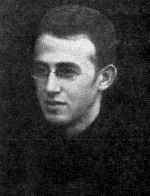
Born in Kobryn in 1908, he followed the educational path taken by most children of that era: kheyder, folks-shul [public elementary school], and gymnasium, completing his studies with the highest distinction. Unable to continue his university studies in Poland, he went to France, where he earned the degree of Doctor of Medicine.
Y. L. Khabovetski was one of the co-founders of Hashomer Hatzair in Kobryn. Together with Khayim Goldberg, he devoted an immeasurable amount of energy and effort to the Hashomer Hatzair movement.
A few years before the Second World War, Dr. Y. L. Khabovetski settled in the nearby town of Pruzhany, where he pursued his medical practice with great success, while at the same time remaining deeply active in educational and communal affairs.
The murderous German destruction of the Pruzhany ghetto swept our beloved Dr. Khabovetski into the death camp of Treblinka, where he struggled on with his last reserves of strength, living to see his liberation by the Soviet Army[2].
Cruel fate, however, tore him away from us one day after his liberation.
May his memory be honored.
Translator's Notes:
by Noach Priluk
Translation from Yiddish by Beate Schützmann-Krebs
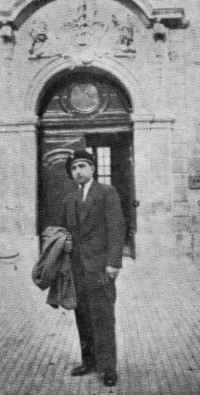
Sheyme Faynshteyn, a son of Kopl the shames [sexton] of the Great Synagogue, was born in Kobryn to poor parents. When he was five years old, his mother died, and he was left an orphan.
|
|
At the age of eleven, his father also died, leaving him a complete orphan. By the age of twelve, he was already working as an apprentice for a tailor in Dyvin. When he turned sixteen, he became involved in underground activity. He became an active member of the Tailors' Syndicate and joined the Communist Party. For a certain period, he served as secretary of the tailors' organization.
He was arrested and sentenced to three years' imprisonment. After his release, he remained active in the labor movement until the Polish authorities sent him to the concentration camp at Kartuz-Bereza. When the German-Soviet war broke out and the Germans occupied Kobryn, he went into the forests as a partisan and was killed in battle with the Nazis.
Honor to his memory!
by Noach Priluk
Translation from Yiddish by Beate Schützmann-Krebs
Time and again, when reading accounts of the Warsaw Ghetto Uprising, I come across the name Menashe Motivyetski.
And each time I pause in thought and reflect: This is, after all, our own Menashe Motivyetski, the fearless fighter of the Warsaw Ghetto.
Who was Menashe Motivyetski?
His mother was named Malke Peshe Goldin; his grandfather was Pinkhas Berezener, and his grandmother Bobl. They lived in Kobryn on Ratner Street. In 1922 the family moved to Warsaw.
Menashe was raised in a religious home. He completed secondary school and became a lawyer. During his years of study, he was drawn into leftist circles. During the time of the Warsaw Ghetto, he was one of its most resolute fighters. Thanks to his fluent Polish, he was able to leave the ghetto with Aryan papers, and together with a Polish Communist group he fought against Hitlerism until he fell in battle in the summer of 1944, during the Warsaw Uprising.
He left behind a wife and child in mourning.
Comrade Menashe! For your comrades in arms, you will always remain an example!
Honor to your memory!
Translator's Note:
[Page 282]
|
|
JewishGen, Inc. makes no representations regarding the accuracy of
the translation. The reader may wish to refer to the original material
for verification.
JewishGen is not responsible for inaccuracies or omissions in the original work and cannot rewrite or edit the text to correct inaccuracies and/or omissions.
Our mission is to produce a translation of the original work and we cannot verify the accuracy of statements or alter facts cited.
 Kobryn, Belarus
 Yizkor Book Project
 JewishGen Home Page
Copyright © 1999-2026 by JewishGen, Inc.
Updated 13 Oct 2026 by JH