|
|
[Page 241]
[Page 242]
[Page 243]
|
|
by Sam Glas (Bebl Glotzer, New York)
Translation from Yiddish by Beate Schützmann-Krebs
|
1. The murderous barbarians arrived, wanting to claim mastery over the world. With their wild Nazi fury, they brought a blizzard upon humanity and life.
2.
3.
4.
5.
6.
7.
8.
9.
10.
11.
12. |
by B. Kupitski (Grenoble, France)
Translation from Yiddish by Beate Schützmann-Krebs
Jewish Kobryn in a slice of time: 1 September 1939 – 22 June 1941
The last summer days of August 1939 were wondrously beautiful. Out in the fields the harvest had already been gathered in, and the broad, thick, long rows of sheaves seemed to mirror themselves in the golden rays of the sun, against the backdrop of richly colored natural carpets adorned with every kind of blooming flower. Everything lay as if dreaming in the stillness of Creation's first six days. In nature there was no sign whatsoever of the dreadful cataclysm drawing near.
It was as though a malevolent fate wished deliberately to grant humanity a few more quiet, lovely days, to lull it into slumber before opening the sluice-gates of a bloody flood. But in the town, a panicked, agitated mood could already be sensed.
With inner trembling and feverish nervousness, neighbors would gather in the houses where there were radio sets to listen to the latest broadcasts about the Polish-German conflict, which sharpened from day to day and was taking on an increasingly threatening form. And outwardly, in the streets, a panicked atmosphere was likewise evident.
The women, who possess a particularly sharpened instinct, dragged sacks of salt from every direction and prepared kerosene and matches. The communal authorities began instructing the population on how to conduct themselves in the event of an air raid. Trenches were dug in all open municipal spaces, and commanders for the civilian population were appointed for the various quarters and streets.
In fearful dread and in the highest nervous tension, the days flowed by, and at moments one even allowed oneself, quite consciously, to drift into the illusory hope that perhaps an extraordinary miracle might occur and that the misfortune, which seemed almost unavoidable, would be averted at thelast possible moment.
The town was still dreaming in its broad, early-morning quiet. Everything was still wrapped in a dead, pre-dawn stillness when suddenly a mighty, thunderous roar from a squadron of bomber planes broke over the town. And before anyone had even managed to grasp what was happening, the entire town began to shake under the impact of the heavy thunderous explosions, which now came one after another.
Minutes of fearful, deathly terror followed. A powerful crashing of windowpanes shattering outward followed. The strips of paper pasted in the shape of a cross on the windows helped little. With a wailing voice, the siren of the municipal electric works cried out, sounding the alarm for an air attack. The roar began to grow weaker. The planes took a course northward and disappeared in the direction of East Prussia.
The market square and Post Street were enveloped in black clouds of smoke. There were human casualties. Among them the elderly [Reb] Lipschitz of Brisker Street. Yudelevski's brick house on Post Street had been reduced to a ruin.
Posters from the administrative authorities appeared in the streets, announcing to the population that the eternal enemy of the Polish people had begun his war of aggression against Poland. At the same time, notices were issued about the mobilization of all age groups subject to military service.
People rushed to the pharmacies to buy gauze bandages, iodoform, iodine, and other antiseptic items, “so that one should not, God forbid, have to do without.” Every few hours, the municipal siren again let out its terrifying, mournful wail, announcing the approach of
[Page 246]
a new air attack, which, fortunately, avoided the town and instead targeted military formations and military installations outside the city. The alarm signals grew ever more frequent, and although the bombardments took place far beyond the town, they completely shattered already strained and frayed nerves.
The appearance of the town at night was frighteningly uncanny. Everything was wrapped in dense darkness; everything was masked so that not a single ray of light could escape through any crack or opening. Couriers ran about distributing the mobilization cards. A large part of the Jewish population scattered into the surrounding villages to familiar peasants, out of fear of air bombardment. With dreadful anxiety, people listened to foreign radio broadcasts about the disorganization and demoralization of the Polish army after the first three to four days of battles.
The highways were enveloped in clouds of dust from vehicles rushing with the greatest haste toward the Russian border, carrying the empty-headed, proud, pampered high Polish state officials with their families, drunken, demoralized Polish officers, and Polish nobility from the western regions – people who, in the good, fat years, had had no other concern than to refine and humiliate the Jewish population.
On Monday, the 11th of September, the entire town was shaken by the unexpected news that Hitler's murderous army was no more than fifty kilometers from Kobryn, breaking through in a wedge formation from the direction of Bialystok. The entire Jewish population was seized by the most terrible panic. The greater part of the youth ran from the town, wherever their eyes led them. One said farewell to elderly parents, packed a few pieces of clothing and other absolutely necessary items, and set off toward Pinsk or Kovel, in order to reach the eastern border.
All the refugees continued on their wandering path, remaining stuck in Dyvin, Ratne, or in the small towns near Pinsk, waiting for news from Kobryn.
On the 16th–17th of September, the shattered remnants of the Polish army, making use of the favorable strategic conditions around Kobryn, put up heavy resistance, and after a bloody battle of ten to fifteen hours, the town was taken by the Germans. They did not advance further, waiting for the Russians, who on the 17th of September crossed their former border in order to reach the Bug River.
The Germans remained in the town for three days. Fortunately, the mournfully notorious Gestapo did not arrive, and the Jewish population came through with mere fright.
On the 20th of September, the Soviet military arrived and flooded the town with its enormous army from all formations, which for two to three weeks marched day and night in the direction of Brisk.
The Soviet administration began to introduce its regulations in the town. Kobryn was incorporated into Western White Russia, with Minsk as its capital. In all communal institutions, as well as in the schools, the White Russian language was introduced in place of the former Polish. All craftsmen were called upon to organize themselves into so-called arteln, meaning that craftsmen of each trade would work together in a single common workshop, together with their former workers, all of them employed by the government.
All income was deposited each day into the state bank, and the former workers – who were now, in the social sense, placed on an equal footing with their former employers, the craftsmen – all worked together for a wage corresponding to the Soviet standard of living, yet far inferior to the earnings of Central European workers before the war and scarcely sufficient to satisfy the most primitive necessities of life.
The shopkeepers were ordered to open their stores and sell their merchandise at pre-war prices, accepting one ruble as equivalent to one zloty.
The shops were besieged by interminably long lines of people, chiefly Soviet officers, soldiers, and civilians, who bought up everything that came to hand,
[Page 247]
especially manufactured goods and leather.
The shops emptied quickly. No new merchandise could be obtained, since the industrial centers – Łódź, Warsaw – were in the German-occupied part of Poland. All shops were gradually closed and liquidated.
Cases of inspections increased, both in shops and in private homes, in order to uncover concealed goods. The guilty were brought before the court, whose sessions were held publicly with the participation of a large audience, so that the hated speculators could be publicly branded.
Among the Jewish population there prevailed a general depression, dejection, and a restless mood about the future. The declassed middle class, losing the ground beneath its feet, losing its shops and workshops, had nothing to turn to in order to make a living. Here and there, some still managed to hide a bit of merchandise, which they sold behind the counter, giving them the possibility of holding out for a short time. But this was bound up with great danger, for it was regarded as speculation and prosecuted in court.
Among the Jewish population the urge grew to tear themselves out into the open, free world. Smuggling of people to Vilna began, which at that time was in Lithuanian hands. Some people succeeded in tearing themselves away from the eymek-habokhe [“valley of tears”], but the greater part, caught in family constraints, could not do so and remained stuck in place, waiting passively for whatever blind fate would bring.
A mixed Soviet-German commission for the exchange of population began its work. Jews originating from the German-occupied part of Poland, who had streamed en masse into the Soviet zone during the first months after the Polish capitulation, when the border was still open, now registered en masse to return to Poland. People stood in line through entire nights in order to be among the first in the early morning, when the commission would begin admitting applicants. They paid the German officials hundreds of dollars in bribes so that they would permit them to re-enter Hitler's “paradise.” The greater part were refused, and they remained with the stigma of having wished to leave the Soviet fatherland – and the consequences of this did not take long to appear.
A plebiscite was held in which the population had to declare itself for or against the incorporation of Western White Russia into the Soviet Union, which naturally produced positive results. The passportization campaign began. All were required to accept Soviet citizenship. It became noticeable that the greater part of the middle class and those originating from the German-occupied part of Poland received a certain new mark in their passports, which seemed not to be accidental and therefore disturbed all who had received this designation.
On the 20th of June, a so-called tshistke [“purge”] took place. In the middle of the night the entire town was sealed off by the N.K.V.D. (the Soviet military police). All those originating from the German-occupied part of Poland who had submitted their applications to the Soviet–German commission to leave the country were arrested by the hundreds and sent to the northern taiga regions of Komi for [forced] labor.
The Jewish population became ever more impoverished. Through various means, the Soviet administration – which already had long experience in liquidating the bourgeois classes – strove to draw back the small amount of money that the shopkeepers had managed to accumulate, or, as it was called in Soviet terminology, to “razkulatshen” them. The Soviet administration correctly assessed that as long as there still existed layers of the population who had saved a bit of money, they would not hurry to work for the government for the low wages it paid. And in order to force someone to become productive for the state, to transform him into a true proletarian, one first had to take away his material resources so that he would be compelled to live solely from his wages.
Following this principle, one bright early morning the Polish zlotys that had been in circulation – large sums of which had previously been forcibly
[Page 248]
accepted by the Soviet administration at parity with the ruble – were declared invalid. Among all shopkeepers and layers of the Jewish population, considerable amounts of Polish money had been collected for the redeemed merchandise, which now became worthless. At the same time, the so-called fin atdel (tax office) sent demands to the former shopkeepers for tax sums that often far exceeded the small amount of money they had received when liquidating their shops, and these demands were imposed with complete ruthlessness under various threats.
Thus the Jewish middle class was driven down to the level of complete impoverishment. The awareness grew of the countless mistakes committed – of not making use of all the possibilities for emigration to certain overseas countries, where emigration had not yet been forbidden before the war, and of not understanding then to take advantage of what had still been possible. Feelings of despair and depression bore down relentlessly, and people asked themselves every day: Me'ayin yavo ezri? – “From where will my help come?”
Parallel to the collapse of the economic situation of the Jewish population, the entire spiritual and cultural life was extinguished. The Yiddish and Hebrew schools were liquidated immediately after the occupation of Kobryn. In their place arose schools in the White Russian language. All Zionist youth organizations, as well as the Zionist organization itself, were liquidated and closed on the very first day of the takeover of power in Kobryn. All philanthropic municipal institutions were likewise liquidated because of the extreme impoverishment of the Jewish population.
Even ominous outgrowths began to appear in the main fortress of ours that had guarded and sheltered the Jewish people in all generations. Our resistance to racial assimilation, the entire Jewish economic, spiritual, cultural, and religious life was being destroyed and laid waste at a galloping pace. Nowhere was there any sign of hope, from where a ray of light might come to scatter even a little of the dense darkness.
With anxious fear and deep unrest people listened to the foreign radio broadcasts about the tense situation. They understood that there was no reason for anything but the worst.
On the 20th of June, two days before the outbreak of the Soviet-German war, another tshistke took place, during which individual families from various towns and townlets were arrested in the middle of the night by the N.K.V.D. and sent into the depths of Siberia.
On the 22nd of June, Kobryn was again awakened by a thundering cannonade from an air attack. The last Soviet-German war began, and with it the final phase of our destruction – the brutal, murderous, physical annihilation of the holy Jewish community.

by Gedalyahu Bil[2]
Translation from Yiddish by Beate Schützmann-Krebs
Having had the good fortune to meet a larger circle of Kobryner, my landsleit, I consider it my painful obligation – may it not be too heavy for me – to acquaint them with the history and the martyrology of the Kobryner Ghetto. And it is an obligation for me, because I would often hear from those tormented and afflicted in the ghetto their worry and sorrow that their experiences would fall silent and remain without a trace, lost to forgetfulness.
Having only one single wish – that all their suffering and afflictions, the entire kidesh-hashem [sanctification of God's name] epic, be remembered and reach their distant and their near ones: children, brothers, and sisters across the whole world – that they may be able to tell their children and grandchildren what the cruel enemy, the brown spawn, did to their fathers and mothers, and that it may remain as a memorial for generations to come, above all the moments of heroism and kidesh-hashem that the Jews of Kobryn inscribed into their scroll of destruction.
|
|
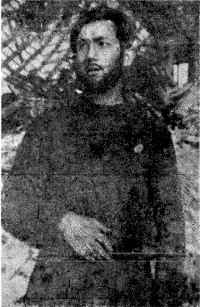
Coming out of a bunker in the Kobryner Ghetto |
Let the world learn – through the mouths of the few who managed to survive the annihilation – that the enemy, in carrying out his plan, sought not only to torture and crush physically and then deliver the final death blow. His aim was also to degrade his victims spiritually and morally, to arouse the lowest instincts, believing that some of them would not refrain even from killing their closest brothers to save their own lives. But this the accursed enemy did not succeed in achieving. This is what our holy martyrs wished to convey to you. In doing so, I fulfill their last will.
Dear friends! Allow me to divide the history of the ghetto in Kobryn into three periods:
(1) the beginning, (2) the long chain of suffering and torments, and (3) the destruction. These are indeed short spans of time, but in terms of the number and scope of the persecutions, degradations, and annihilations, they constitute the most tragic chapter of our Jewish martyrology. Certainly, what is described here will be no more than a small fragment of what truly occurred. But I do it according to my modest abilities.
The entry of the Germans into Kobryn took place on June 24, 1941. On the day before, the 22nd, the town had been awakened by terrifying explosions of bombs, similar to those of September 1939. The astonishment was beyond measure. No one wanted to believe that the bombardment came from German airplanes. Many thought these were Soviet maneuvers. But the illusion did not last long,
[Page 250]
because already at seven o'clock in the morning the first packed cars and trucks began arriving from the Brisker Highway, carrying Russian families evacuated from the bombed city.
It soon became clear what was happening. In a brief conversation with one of the arrivals – whose car had suffered a serious accident while turning hastily off Brisker Street, causing several deaths and severe injuries – he related that every day freight cars loaded with coal from German-occupied Poland used to arrive in Brisk and then depart again loaded with grain. But on that day, instead of coal, the sealed freight cars arrived carrying German soldiers, who immediately leapt out in full combat gear, taking up positions along the length of the railway line.
From that moment on – with the first victims of the bombardment and those killed in the automobile accident – the dark history of the Jews of Kobryn begins. That same day, that is, Sunday, many Russians were evacuated: the Party, the N.K.V.D., and many other institutions. It was impossible to escape by train, and very few managed to flee in cars.
Many believed that within a few weeks the Russians would return. Engineer Levinzon, the son-in-law of Parikl from Shkolne [School] Street, had said: “I know the Germans well. If I were not certain that the Russians would come back quickly, I would have committed suicide immediately.”
During the night a defensive line was again set up around Kobryn, and toward morning, at eleven o'clock, the German military marched into the town. People crawled out of their hiding places and, with a chain of curiosity and fear, looked on at the gigantic stream moving eastward.
The entry of the Germans passed without any incidents involving Jews. For the time being, they settled themselves into Jewish homes. The population broke into the large Russian stores and emptied them. The Germans kept their distance. And everyone took – Jews as well as non-Jews – dragging away from the cooperatives leather, clothing, linen, sheet metal, glassware, soap, tobacco, and from the food warehouses flour, sugar, coffee, oil, and so on.
On the third day a group of Germans began to show what they were capable of. Very early they set fire to the Khaye-Odem Bes-Medresh on Kobryner Street, as well as other houses. One could have extinguished the fire, but the Germans did not allow it. A tremendous blaze broke out, spreading to the neighboring houses. Thus the entire left side of Kobryner Street burned down, along with the surrounding lanes – from Eli Ber's house to the deaf locksmith, and on the right side from Freydke's house to Otshe Slon. Also the nearby lanes and the entire quarter of Ratner Street, Oleyne, up to the Ratner Bes-Medresh, burned down.
Many families were left without a roof over their heads. Little by little they found temporary shelter with friends and acquaintances. These were the first days of the German occupation – the “distinctions” with which Hitler's robber band chose to honor us.
The offensive continued to push ever deeper into Russia. Every day one could see enormous trucks passing through the town, carrying hundreds and thousands of captured Red Army soldiers – torn, starving – who were being sent off to Germany as slaves.
It did not take long before Jews began to be conscripted for forced labor. In the early mornings hundreds of Jews would gather at the magistrate – the city council – and from there they were sent out in groups to work. They worked cleaning the town and the railway lines. At first one received payment for such a day's work: half a kilo of bread. With time the labor became harder. They began dragging people out to work on the highway, where one worked ten hours a day without rest and also received beatings. Naturally, the number of workers diminished.
After several weeks a new measure appeared. I no longer remember exactly how it happened. Garber, who used to assign people to labor, received the names of all males between the ages of sixteen and fifty-five, and it was arranged that everyone would work in turn.
[Page 251]
The German Kommandantur [military command headquarters] was established in Kobryn. The Jewish representative there was Sanine (who, after several weeks, was shot). Through him the order was given to form the Judenrat, which was to serve as the intermediary between the Jews and the Germans.
The Judenrat was not elected by the Jewish population; it was appointed according to directives. The Judenrat was presided over by the elder Angelavitsh[3], together with his two close associates: Abrasha Herman and Moyshe Fuksman.
The Judenrat consisted of twenty-four council members, who wore white armbands with the inscription “Judenrat.” Among the council members one remembers: Angelavitsh's sons, Meir Savitski, Engineer Levinzon, Engineer Yaroshevitsh, Yankele “the Pole,” Tenenboym from the hardware shop, Dovid Heyman, Ruven Margolis, Yidl Goldin, Dr. Milner, Ayzik Kupitski, Tenenboym the dispatcher, Mrs. Pribulska, the teacher Nitskin, and others.
In its later development, the Judenrat of twenty-four council members, together with the militia and its employees, came to number about four hundred persons. The council had a labor office, which handled the assignment of workers for the Germans in the forced-labor camps and also the registration of skilled workers. It was likewise the task of the Judenrat to comply with all German demands – and their demands became ever more pressing.
All Germans stationed in the town had to be lodged and supplied with beds, clothing, and kitchenware. For this purpose the Judenrat, together with the militia, confiscated everything it considered necessary. Thus the Jews were robbed of everything that had any value whatsoever. Three monetary contributions were imposed, as well as levies of silver and gold. Later they added fur coats for the winter, sewing machines, bicycles, and other items.
It was bad. People were distressed. But no one imagined what lay ahead – that it could become even worse.
Around the month of September the civil administration arrived in Kobryn – or, as it was called, the Gebiets-Kommissariat. People then comforted themselves, thinking that perhaps now, with the change of authority, things might become somewhat easier. No one imagined that with the arrival of the civil administration the cold-blooded Hitler plan would begin – to annihilate slowly and deliberately, to break and crush morally and physically, before delivering the final death-blow.
Power in Kobryn was held by several young thugs, about twenty-four to thirty years old. The Gebiets-Kommissar was a bandit of twenty-four, named Panzer; his assistant, the murderer Kabalnik; and the official responsible for Jewish affairs, Hofmann.
A registration of all Jews was carried out at the “Manke's” brick building. At the corner of the marketplace and Shkolne [School] Streets, Jews stood for long hours in lines in order to register. The only ones permitted, for the time being, to continue working in their shops were the skilled tradesmen. They received permits and were thereby exempted from forced labor.
One early morning they began seizing Jews; many were taken directly from the registration line. Since it was a rainy day and the murderers did not want to get wet, they did not search much. About 150–180 people were locked into sealed trucks and taken away to the Brisker Highway.
My uncle Moyshke was working then on the Brisker Highway, about four kilometers from town, together with a group of sixty men. When they learned what had happened, they hid themselves in a nearby grove. From there they heard two hundred shots. No one wanted to believe that it was his child, father, or husband who had been shot. People tried to convince themselves that such a thing was impossible – even though Christians would come and report that not far from the village of “Patrike,” human limbs were protruding from the earth.
This was the first mass murder of the Jews of Kobryn.
It was terrible to see how Yokhe, the butcher's wife, walked up and down Shkolne Street, tearing her hair, weeping for her son Binyominke, who had been dragged away
[Page 252]
together with the 180 men. Among them was also my uncle Yomtov Bil; Polyak the shopkeeper's son; Tenenboym, the hardware dealer's son; Palevski, the teacher and a member of the Judenrat; and children of fifteen and sixteen years old.
The murderers ordered the Judenrat to point out two of the wealthiest Jews. They indicated Antopolski and Vayngarten [Weingarten], the owners of the dry-goods store. The murderers drove to both places with trucks and robbed the people of everything they possessed.
The same murderous authority decreed that Jews had to wear yellow patches in the shape of a Star of David , or a circular patch ten centimeters across. With a Jewish population of seven to eight thousand, it is no wonder that our town, Kobryn, turned yellow with Jewish patches. All Jews from the age of ten and up had to wear the yellow patch. It became clear that a ghetto was unavoidable – and within two weeks a ghetto was indeed created.
|
|
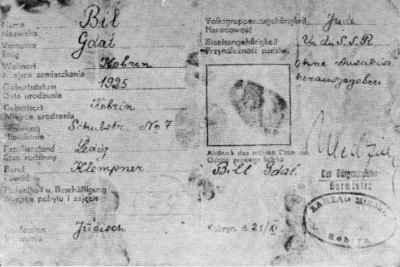
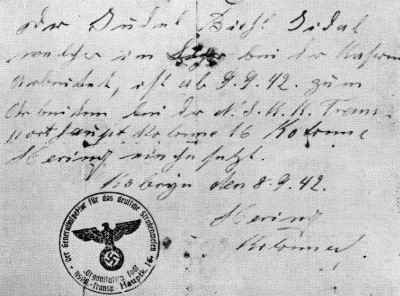
[We learn that the author – here listed under the name Gdal Bil (Bill) – was born in 1925, lived at “School Street 7” in Kobryn, and worked as a plumber. The document also shows the imprint of his right thumb.] |
People ran about seeking a roof over their heads, a room, a corner where they could lie down. The study houses filled up. The area of the ghetto was designated by the civil authority together with the magistrate, whose mayor was Min_zinski[4] – formerly a teacher at the gymnasium.
The ghetto encompassed[5] the left side of Potshter [Post] Street; all of Ratner and Kobryner Streets; the right side of Kindler Street; the right side of Pinsker Street – from the post office to Kindler Street; the left side of Pinsker Street – from “Avrom's” cinema to the old sacred site [cemetery]; further, Brisker Street from Shrednye [Sredni] to Rastovski; Shkolne [School] Street; the marketplace from Shkolne to Klashtorne [Monastery] Street. For a certain time a part of Pilsudski Street was also included in the ghetto – from Klashtorne to the river – as well as the quarter on the right side of Klashtorne, including Pribulski's house. But later the Jews were ordered to move out of that area.
It was heartbreaking to see elderly people dragging along their few poor belongings on wagons or handcarts. One saw pieces of furniture being carried – items that for generations had never been moved from their place. At the Judenrat a commission was formed that took upon itself the task of finding housing for those who had been driven out. In particular, all those whose houses now lay inside the ghetto took in friends and acquaintances – naturally, the overcrowding was unbearable: five or six persons in a single room. The furniture had to be left in the sheds or out
[Page 253]
on the street. In the rooms, beds dominated – five or six in one room.
Most Jews were then living off the sale of their last few belongings. By that time it had already been forbidden for Christians to enter a Jew's home or to trade with him. The murderous gendarmerie together with the Ukrainian police kept strict watch, and if they noticed that a Jew was speaking with a Christian, or that a Christian had gone into a Jew's house, they immediately carried out a severe search, emptying the home and leaving only the bare four walls. Such a search was carried out at the home of Moyshke Moroz, the maker of gaiters, from whom they even took the bedding.
On the nights that were still warm, neighbors would gather in the courtyards and alleyways and talk late into the night, recounting the latest events and comparing the Germans of 1914 with those of today. Our situation worsened greatly with the arrival of winter; it became impossible to get warm, and whenever someone tried to obtain a bit of wood, the house was immediately cleared out by the gendarmerie .
One day I went out with Yudl Zaltsman to a nearby village on the Brisker Highway. We took off our yellow patches and went out to the village. Toward evening we returned. As we approached the hospital, we saw a group of people walking in the middle of the street. We noticed the yellow patches on their chests. Later we learned that these exhausted, elderly people, women and children with koyshlekh [small bags] in their hands, had been driven out of Bialovezh [Białowieża] and Yanevke [Janówka] – Jews whom the Germans had expelled from their little towns, some of whom dragged themselves to Kobryn and the rest to Pruzhene [Pruzhany], where they had created a Yidnshtat [“Jewish settlement,” forced concentration area].
The unfortunate people were driven into the building of the gymnasium, and from there the Judenrat distributed them among the Kobryner Jews in the ghetto.
One day a new decree came out from the commissar: to gather all the elderly and the disabled and send them to Pruzhany. The Judenrat collected about two hundred persons – the sick, the old, and the homeless – in the building of the Povshekhne shul [public school], from where they were then taken out in closed trucks, guarded by Ukrainian police.
Naturally, such a decree did not pass without heartbreaking scenes. For example, when they took the disabled Ben-Zion Kozhukh's son – he worked at the bus station – his young wife, unwilling to part from him, went along with him. Many of the homeless people from Białowieża also went voluntarily; they wanted to get to Pruzhany.
A few days later it became known that all these unfortunate people had been shot near the village of Imenin[6], five kilometers from town. Among them were Khaye Rivke, the balebatishe [respectable housewife]; Epelboym's two children, the photographer; Mazurski (from the soap works), a daughter; and many others. This was the second mass killing of the Kobryner Jews.
The decrees and afflictions did not come to an end. Every day brought new death sentences; “contributions” and mockery continued. They simply did not allow us to lift our heads. We had not yet managed to absorb one decree when a new calamity was already being conceived – it is impossible to enumerate all the misfortunes. I wish only to mention one particular case: a group of twenty to thirty men was sent out together with a herd of sheep and horses to Kovel. There were even volunteers for this work. Several weeks passed, and nothing more was heard from these men. Once again – they had been shot. At the same time, rumors reached us of large mass-slaughters of Jews in Kovel and in Slonim.
At that time the plan ripened for a supposedly independent Ukrainian government under German protection; posters began to appear in the streets inciting the murder of Jews, claiming that Jews were guilty of everything: Jews were communists; Jews were the incendiaries of the world.
Then a prohibition was issued forbidding anyone to leave the ghetto. It was also forbidden to cross from the ghetto on Shkolne Street to the second ghetto on Ratner Street. Only the Jewish militia was permitted to transfer a few people from one ghetto to the other.
A bitter winter set in, and with it our sufferings increased even more. People froze to death from the cold on the highways and near the barracks
[Page 254]
while digging the canal. For the canal work one had to get up at five o'clock in the morning and walk some fifteen kilometers on foot, in the dark and in the cold. Thus dragged on the dark days of sorrow and misfortune, without a single ray of hope. From time to time a faint report would reach us from the distant Eastern Front, where two gigantic forces were locked in a struggle of life and death. Then a pale spark would flicker in the hearts of those tormented to the brink of death, and their extinguished eyes would turn eastward with a holy tremor – perhaps deliverance would yet come…
Let us now take a look at life in Kobryn outside the ghetto. After all, Kobryn was not only Jewish; there were also Russians and Poles. In contrast to Soviet times, when state cooperatives had existed, many shops or little stores owned by Christians sprang up. The entire Rynek-Gas [Market Street] filled with all kinds of businesses: food, haberdashery, hardware, and so on. Goods were smuggled in from Poland. The Christian trade did not last long; by New Year the Germans ordered all these shops to be closed.
Many Jews lived in good relations with their Christian acquaintances. This is explained by the fact that they needed one another. Because of the frequent house searches carried out among the Jews by the German gendarmerie , and because of the law requiring the surrender of items such as furs, machines, bicycles, and other valuable things, many Jews hid their belongings with Christian acquaintances. The Christians took these things with open hands, and in this way the wealthier Jews entrusted a large part of their property to their Christian friends for safekeeping.
No particular help for the Jews on the part of the Christians was noticeable. The Christians – perhaps out of fear – submitted to the separation that the Germans had imposed. There were isolated cases of a more humane attitude, but these must be regarded as exceptions.
New Year was approaching, and with it many changes entered the life of the ghetto. Jewish craftsmen were no longer permitted to work in their workshops. This was a very heavy blow, for it took from us the last direct contact with the peasant, who had been the only supplier of food for the town.
The Germans decided to create a large artel [state-run craft workshop], where, under Christian administration, the Jewish craftsmen were to work.
For this purpose they chose the large buildings of the Jewish schools at the end of Potshter Street, which bordered the ghetto. The Judenrat was ordered to provide workers, and the undertaking began. All trades that could be found in Kobryn were gathered there: locksmiths, tinsmiths, shoemakers, tailors – men's and women's – knitters and brush-makers, carpenters, makers of gaiters, watchmakers, fur-repairer, photographers, and in general every trade from which they could make use.
From the beginning the Judenrat had to send workers there by force. Because, when the artel was created, private work outside the ghetto had not yet been forbidden, it was understandable that everyone preferred to work freely rather than be locked inside the artel.
The head of the artel was the Pole Mikhta, formerly a drawing teacher at the gymnasium. As Jewish supervisor, Fishman (from the Singer machines) was appointed. At the same time the Germans established vocational courses for the Christian youth, and they were required to do their practical training in the Jewish artel – each craftsman was assigned a pupil, and he had to sign that over the course of two years he would be obliged to teach him the trade.
Because of the strict regulation that all workers had to be registered, and because rumors were circulating that two ghettos – “A” and “B” – would be created, meaning one for skilled workers and one for the unskilled, people understood that with certain employment they might be able to buy their lives. Therefore everyone was thinking only of how to register as a skilled worker, or how to get himself into the artel. For this purpose people would bribe the director of the labor office, the newly made Volksdeutsche [local non-Jewish resident granted German ethnic status] Opnalski, and the head of the artel, Mikhta. The Gebiets-Kommissar,
[Page 255]
however, issued a certain limitation on Jewish workers, so that not every craftsman could obtain a permit.
The men from many wealthy families became “craftsmen” through the mediation of the Judenrat, or directly by bribing officials with money. Long-time merchants thus suddenly turned into workers, and the rights of the old, genuine craftsmen were taken away. In the Jewish homes one heard no other conversations or comments than about obtaining a worker's permit; those who had no possibility of getting one went about dejected and worried. The ones who suffered most from this were the former small-scale traders and store owners.
Another kind of artel was created in Kobryn: a German woman named Andzeyevska from Kobryn established a hand-knitting factory, where sweaters and gloves were produced for the Germans. The Jewish division of Andzeyevska's artel was set up in the small Brisker Bes-Medresh, opposite Mazurski the soap-maker. More than a hundred women worked there.
The wages were negligible, but in return they were fortunate to have the skilled-worker certificate.
The blacksmiths' artel had its place in the Brisker Bes-Medresh. The photography division worked in the home of Epelboym “Rembrandt” on Priest's Square. Epelboym was privileged and had permission to live in his own house because he headed the photographic division, for which he was directly responsible. Among the most privileged craftsmen were the tailor Epelboym and his sons, Zivik the shoemaker, and Moyshke Goldberg (Moroz), who worked exclusively for the German Gebiets-Kommissar and his men.
To characterize the conditions under which people worked in the artel on Potshter [Post] Street, I will give a few characteristic strokes. For example, a peasant comes to order a lock. He enters from outside the ghetto into the office, which was divided by a barrier into two parts. He is dealt with by a Polish clerk; the guard calls in the Jewish locksmith. The peasant states what he wants to order – then the Polish calculator consults with the Jewish locksmith about how much should be charged for the job, and sends the Jew back to the workshop. The price is determined by the Polish clerk alone, who negotiates directly with the peasant. When a tailor was needed for taking measurements, the client would be allowed into the tailoring section.
In the early period, when things were not yet so strict, the Christian or the peasant would bring some food for the Jew – for money or in exchange for something – so that he would work better and faster. One can estimate that about 500 Jewish craftsmen worked in this enormous artel, but the majority of Jews still worked outside the ghetto at that time.
For example, with the Germans in the provisioning office, in the barracks, in the straw depot, and in many other places.
A workplace of this kind was called a platsvuke. One went out to the platzvuke at seven o'clock. By oneself one was not permitted to leave the ghetto. There was a regulation that only a Christian was allowed to lead Jews; there were cases, for example, where a ten-year-old Christian boy would lead a platsvuke of thirty or forty Jews – grown men. The Jews had to walk four or six abreast on the cobblestones, and at the head of the line marched the little rascal, as the leader.
From six o'clock in the morning the inside of the ghetto gate would be crowded with people. When the leader appeared, the group he was responsible for would step out into the middle of the road and set off for work. Every few minutes another group would march out of the ghetto. By around eight o'clock all the men had already marched off. Left behind were only the children, a few women, and the militia. A mute emptiness would then descend.
One of the prominent figures in the ghetto was Yosl Yedvab, the miller. Together with his administrator, a Christian, he would steal flour and sell it inside the ghetto – and because of this, the Judenrat relied on him greatly. The flour was brought into the ghetto as follows: Jews, as well as Christians, received ration cards; the Jews received 70 grams of bread. The flour allotted for this bread was taken from Yedvab's mill, according to the distribution instructions of the Gebiet-Sekretariat. No one ever checked how much flour was actually brought
[Page 256]
into the ghetto. The main thing was simply the permit to bring it in. Having a trusted man in the mill, they would issue ten loads instead of one; in this way Yedvab's mill became the most important supplier providing the ghetto with bread.
Among the fifty platsvukes that were scattered outside the ghetto, there were about ten that were considered the worst, because they were directed straight by the German murderers. At that time I worked in the kosharn – the barracks. There was a bandit there, a raging murderer, who would not rest until he had beaten a few holes on Jewish heads. For every little thing he would beat with whatever came to hand: a rifle, a piece of iron, a stick, or even with his fist.
One winter day my turn came. He called me in together with another boy, a certain Shvarts, lined us up next to each other, and announced that if we screamed or tried to run, he would shoot us – taking out his revolver as he said it. His sadistic eyes stared wildly at his victims. A death-glimmer showed in our wide, terror-stricken eyes, shining out of our pale faces. We were lucky, because he merely grabbed both our heads and smashed one into the other; seeing blood, he felt satisfied and let us go.
Worse was when he struck someone across the shoulders with a rifle; then the one he hit could no longer make it home on his own strength, always collapsing in weakness.
Thus passed the wintertime, with its short, bitterly cold days and long, dark, frozen nights. Dark and harsh were the nights. Sleep would not come, despite the exhaustion of a day of hard labor and torment. Everyone would probe and search with thought and gaze the situation in which we found ourselves; and if someone happened to drift off a little and imagine that perhaps this was nothing more than an evil nightmare, reality would lash out with death-frightening blows.
In those winter nights one would lie there, pondering and thinking – thinking about tomorrow, reflecting on the latest events. The mind would often run across the sea to our closest relatives, who now lived in Erets Yisroel, America, or Argentina, imagining how they would react if they knew what was happening to us. Waking up with a pillow wet from tears was an everyday occurrence for most of us – weeping for the lost, for those whom we would never see again.
In the winter nights one would very often hear the rifle shots of freshly murdered Kobryner Jews.
At first, they would shoot people at the newly built bridge on Pinsker Street; later, when that place had been fully used, they chose a site for executions near the new Jewish cemetery on the Tevelier Way.
Much can be said about that dreadful winter, and all of it only about misfortune, about tsores [troubles]. There were no joyful things then; no weddings, no circumcisions, certainly not. A horrifying nightmare surrounds those epochs. In the light of the events that were to come, these experiences appeared almost like a gan-eydn [paradise]. Troubles began to chase after us, each time sharper and more repulsive.
The newly created camps emerged, where they locked up our youth – our beautiful girls and boys – the quiet, innocent ones, over whom they would jeer and mock, making them perish from suffering.
Later, new camps appeared, into which they already dragged older women. In summertime, they had to sit, poor souls, on the highway on a stone, with a heavy hammer in hand, under a burning sun, and strike – split large stones into pieces with their weak, worn-out strength from not having enough to eat.
Even before the snow began to melt, under the spring's sun-rays, a new decree moved toward us. Two camps had to be created: one in Khodosy [Chodasy] on the Brisker Highway, and the second near Zafrud on the Pruzhener [Pruzhany] Highway. It seems the Germans did not consider it enough to have the large groups of Jewish workers who labored on both highways from seven in the morning until six in the evening without rest. They decided to establish permanent groups, locked in under wire – incidentally isolating the youth from the ghetto, so that it would not occur to them to create any kind of underground organization, an organization that might
[Page 257]
want to analyze our situation and draw conclusions from it.
Perhaps the Germans feared that with the coming of spring – when everything strains toward life, when every living thing wants to throw off the yoke of the heavy winter – the Jewish youth, too, might long for a bit of freedom; therefore, already in the first days of March, an order appeared concerning the camps, and once again the Judenrat set to work. This time it was the labor office, where among others Gershon Avrom and Aharon Vigodsky worked as supervisors.
It was certainly no easy task to pull out of Kobryn several hundred young people – almost all of them were already working. Therefore the Judenrat took everyone, without exception.
Until then there had been in the ghetto a certain number of Jews who had managed to keep their children from forced labor; they would simply give valuable things to the Judenrat, which was in need of such items, and therefore their children were not touched. All this lasted until the end of winter; afterward there was no longer any way out, and even the privileged ones could not avoid going to the camp – for example Moyshe Zbar's two girls, aged sixteen and thirteen; Ayzik Guzhanski's two daughters; and many, many others.
Young children, who in their lives had never held anything heavy in their hands – now they had to be torn away from their parents and taken far away, like prisoners behind wire, under the supervision of a German.
Sad and lamentable problems confronted the Judenrat, which was located on Pinsker Street in the former Jewish hospital. Mothers would come weeping, complaining, crying out why they were taking her only daughter; another would ask why they were dragging off her child. They were right in their own way – who could take their weeping as something bad? It was their hearts that were crying, their maternal feelings. But the officials of the Judenrat carried out their function, dictated by the Germans' brutal power. It happened not once that such a mother was thrown out, sent home.
Meanwhile, those destined for the camp were getting ready to set out, sewing shoulder-bags, fixing their shoes, and putting on something – it was still cold then. There was no possibility that someone would refuse or run away. Where could one, poor soul, run to or hide?
On one particular day many freight trucks drove into the market. The youths began to appear. The painful and heart-rending scenes that took place in the ghetto cannot be described. The farewells, the weeping; the children would wipe their mothers' eyes: “Don't cry, Mama, it won't be terrible,” they would comfort their parents. The families would accompany the children to the boundary of the ghetto and there they had to stop. They were not allowed to step beyond it. The mother, poor soul, had to watch how her child moved farther and farther away – and in silence she wept.
The doubts bored and gnawed at us regarding the labor camps; one would hear that they were taking people for work and, once they led them out of town, they shot them. And even if they did not do it right away – who could believe them? That they would not do it later, when one was already with them behind wire, and they might feel like killing you at any moment. With such thoughts and feelings we understood and empathized with the unfortunate mothers in those moments. Besides the youth, among those destined for the camp there were also older people with gray hair.
The bloody history of the ghetto dragged on. Again came a time of sorrow and exhaustion, of longing and pondering – what would be – about the dearest ones in the camps. Life went on; one had to think about further matters. From time to time a letter would arrive from the camp – sometimes the Germans would permit someone to come into town on a Sunday. There were a few fortunate ones who, through German intervention via the artel, paying good money beforehand, managed to get their children released from the camp, with the pretext that their trade was needed in town.
Life ran on, and spring did not stand still either. It became ever warmer; the registration of Jewish skilled workers came to an end. In the arteln
[Page 258]
new-born craftsmen appeared – for example, Unterman's boy became a locksmith, Stavski the teacher a carpenter, and many other respected Kobryn householders took tools into their hands. Naturally, one had to pay enough beforehand for this. In the Jewish craftsmen's section only those people were permitted to live who had special passes identifying them as belonging to the registered craftsmen.
The Germans stepped up to their devilish, cynical work: to divide the Jews, to create a kind of wall between one part and the other, in order to be able to annihilate all Kobryner Jews bit by bit. To achieve this aim, they divided the Jews into two ghettos, A and B.
In Ghetto A only skilled workers with their families had the right to live. Again there was shouting and lamenting in the Judenrat; most loudly cried the craftsmen who had not been registered. A real bitterness. Rumors went around that the non-craftsmen would be sent out to be shot. But, as usual, in this case no amount of shouting helped. The power of the Judenrat was absolute. There was no other civic body that could oversee their work. The decree had fallen, and our people began once more to pack up, to break themselves anew.
|
|
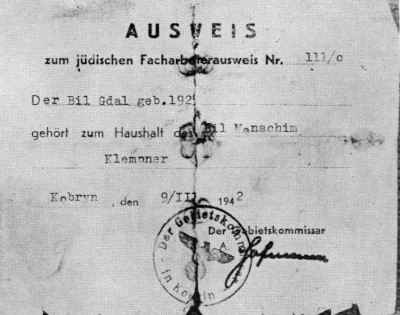
[“Supplementary identification to the Jewish skilled-worker certificate No. 111/c; Bil Gdal, born 1925, belongs to the household of Bil Menachim; Plumber. Kobryn, 9 March 1942. The District Commissar in Kobryn, Hofmann.”] |
A whole series of searches for apartments began, people exchanging places. Whoever could not find an apartment would be placed somewhere with the help of the militia, wherever the Judenrat's commission had determined. On the streets of Kobryn one saw wagons and little carts full of cupboards, beds, mattresses, and other bedding. At the side of the wagons walked a Jewish militiaman. Behind them trudged the owner, exhausted – pale and broken – stumbling in the mud in the middle of the road. In this way people dragged themselves along for several weeks, from Ratner Street to Shkolne Street and from Shkolne back to Ratner. Our family, belonging to Ghetto A, had to pack up and move, because that part of Shkolne Street belonged to Ghetto B – as did two streets and part of Ratner Street, namely
[Page 259]
Oleyne Street and the lane leading to the Kobryner rabbi.
At the same time, the Gebiets-Kommissar ordered that the Jews be removed from the Povshekhne Shul [the public elementary school] on Shkolne Street, because he felt like moving in there – and nothing would have come of his settling himself in the middle of the ghetto had it not been for his later decrees. He ordered that in the vicinity of his residence, that is, from Sredni [Shrednye] Street to Kzhyve [Krzywa] Street, no Jews were allowed to walk, and during the hours when he came home, no Jew was allowed to be seen in the street. If he happened to meet someone, he would beat that person terribly and also impose a fine on the Judenrat. The militia therefore guarded that area strictly, so that no one should, God forbid, violate the law of the scoundrel.
I would like to characterize somewhat the Kobryn Jewish militia. From what I have heard, in many towns a part of the Jewish militia behaved like traitors to their own people. For the price of their lives, and the lives of their families, they would help the Gestapo in its murderous plans. In Kobryn, on the contrary, such cases cannot be recorded. The Jewish militia in no case helped the murderers in shedding Jewish blood, nor did they hand over any Jewish hiding places.
The militia would concern itself with calling people to work, standing at the gates of the ghetto, and keeping order in the ghetto. When Jews were transferred from one apartment to another, they would intervene with force whenever the previous owner did not want to leave his dwelling. This happened especially when it involved residents of Ghetto A. The militia would also, on the order of the Judenrat, carry out inspections, searches, confiscations – as I have already mentioned, one constantly had to give the Germans all kinds of things, and ever more and more – through bribery.
The Judenrat had to resort to confiscations in order to meet all the contributions that the Germans kept imposing. It simply came to the point that people, out of good will, no longer wanted to give so much. For example, when the Germans demanded leather goods or manufactured goods, the Judenrat would go searching among former leather-shop owners or manufactured-goods shopkeepers. More than once they would find goods buried in the ground by these shopkeepers – and, of course, take everything. In such cases the militia would create pronounced hostility. Among the strict militiamen who would dig and search thoroughly were counted Shepsl Goldin, Yankl Aynbinder, and others.
The militia consisted of 50 young men. Among the leaders were Khontshe Berviginkin and a certain Shats [Schatz] from Brisk. The others were Kalmen Zivik, Shamay Blumenkrants, Gurvits, Pavl Broytbort, Shepsl Goldin, Shloyme Heyman, Moyshe Ken-Tsiper, Yankl and his cousin Kilinski, Yankl Aynbinder, Meir Ger, Khayim Boym, Moyshe Kupitski, Hershl Heyman, Arke Daytsh, Permut from Polne, Mendl Vernik, Siletski (the expediter's son), Motye (Yudel the shames'), Ize Kalibelski, Shloyme Vinograd, Shanyeva, Dubetski[7].
The militia, like all employees of the Judenrat, was registered – and had the right, together with their families, to live in Ghetto A. Therefore people would give a lot of money or apply protektsye [influence] in order to be taken into its ranks.
With the beginning of the work in the gardens of the surrounding aprovizatsye [provision depot], many Jewish girls tried to get themselves drawn into this field work. The work outside the ghetto was very worthwhile, mainly because under the things one could smuggle in a carrot, a beet, a potato, a bit of flour. This little bit of food was a treasure.
In the early period they still left the gates of the ghetto open, so that the peasants who traveled from the Dyviner side into town, because of the lack of another road, would pass through Margolis' Lane – and in this way a center of trade arose. Children would occupy themselves with this trade; they were already trained and practiced in it. One had to be very careful that no German or Ukrainian policeman would notice it. Seeing a peasant wagon, they would run after it, and along the length of the lane the trade would take place: they would shove the money to the peasant, or a valuable item in exchange, and take the chicken, the piece of butter, or the bit of beans – and immediately disappear into the little lanes of the ghetto.
In such a manner the trade would occur, and thereby a little bit of food would be brought into the ghetto.
[Page 260]
Once a commission of Germans came to inspect the Jewish houses. A panic broke out. One had to hide the chickens that some people had, because how could there be chickens in the ghetto? Obviously they had been bought recently, and in such a case there would again be an inspection, and everything would be robbed out of the house and the last bite taken from one's mouth. Under such circumstances the ghetto managed to provide itself with food. One can say that there was no hunger as in other places. There were no particular cases of people dying of hunger. The truth is that in very many houses one had long not seen any butter, oil, meat, or sugar; but a few potatoes and a little piece of bread everyone still had.
In Kobryn things were still good in this sense, because no Germans stood at the gate of the ghetto, only the Jewish militia, and they did not hinder smuggling in a little food. When they closed the ghetto and getting food became ever harder, there were several families who, because of their specific work, could occupy themselves with a bit of trade. For example, Roytkop the balegole [wagon-driver], who would take out of the ghetto the dirt and refuse; he had a special permit to drive in and out of the ghetto with a wagon. He would make use of the opportunity and bring into the ghetto a bit of butter, a chicken, milk, and other food.
For Passover the Judenrat obtained from the Gebiets-Kommissar permission to bake matzah at Feygl the baker-woman on Sredni Street and at Gitl Eynshteyn [Einstein] on Ratner Street. They heated the ovens as before the war. Naturally the baking was not proportional – that is, not on a proper scale – because everyone had to bring his own flour, and the matter of flour was difficult.
Passover in the ghetto was desolate – the most desolate since Kobryn has existed as a Jewish settlement. One could no longer see our girls and boys going out, each in his group, strolling along Nyevski, laughing, rejoicing. One also no longer saw the masses of small children in their new outfits, with polished shoes and on their heads the new little hats – each from his school, Tvune or Tarbut – playing in the courtyards of the schools and the bote-medroshim [study houses] with nuts, or in other games.
Everything had disappeared, without a trace. Passover passed like all other days. One had to get up early as always, dragging the sack with the sukhares [dry bread rations] on one's shoulder and going out to the gate for the forced labor.
At that time they had already begun to build high fences around the ghetto. Until then it had not yet been fenced in. Earlier they had fenced in Ghetto B. Bitter it was for those residents, seeing how they were being enclosed, how they were being cut off from the other Kobryn Jews. A despair seized them all.
I would often come into Ghetto B as a worker of the Judenrat. At Yudelevski, in the brick house on Potshter Street, the municipal dairy had been set up already in Soviet times. The peasants from the surroundings would bring their milk there, from which they would skim off the cream and work out butter for the Germans. Since they had nothing to do with the skimmed milk, they would give it to the ghetto. Every day around twelve o'clock a line would form on Ratner Street at Kostshuki's house, where Mindl Herman would manage the distribution of the milk.
When they created two ghettos and did not permit any contact between them, a certain portion of the milk was carried into Ghetto B. I actually worked at carrying the cans of milk. The desolation and sorrow grew and intensified in Ghetto B.
It was hard for me to hear such words from people as “They will kill us, and they will let you live.” Carrying within oneself such a feeling – that they will kill me and let another live – is very painful; it pursues you and bites like a poison.
With the closing of the ghetto they also took away the electricity from the Jews. Jews do not need light. One must go to sleep earlier, because one must get up early. Thus the time passed.
The blooming month of May came, full of fragrant scent and flowers – but not for the Jews. In this spring the Jews had, instead of flowers, sorrow.
Like a falling bomb, a desolate piece of news: again ten Jews shot. In the camp on
[Page 261]
Pruzhener Highway several Jews had complained about their state of health. The chief of the camp, on one of the nights, ordered that those who felt sick should step out; he would send them into town. Ten people stepped out. Early the next morning a truck came to take the people. The guard, presumably knowing what would happen to them – that they were not being taken into the ghetto – pushed Litman Fadaravski [in the Hebrew Version of Sefer Kobryn, p. 319, the name appears as Litman Podorovski] out from among the ten. But he, not understanding the guard's intention, cried and begged that they should take him along as well.
The people were taken out into a nearby forest and, as usual, ordered first to dig pits and then shot. The German who carried out the execution received for it his reward – a two-week leave to go home. Among the ten who were shot was Leyzer Kagan, a haberdashery shopkeeper.
During that time several more Jews were shot in executions. Great agitation was stirred up in the ghetto by the case of Shepsl Shulyer. Despite the prohibition of the Judenrat, he would go out beyond the ghetto. Once Angilovitsh caught him and ordered him arrested. He was arrested at the request of the Judenrat.
The next morning a punitive expedition from the S.S. came to Kobryn to make “oblaves” [manhunts] in the forests. They wanted to clear out the entire prison, shooting the detainees. Among them was also Shepsl Shulyer. Thus he fell, unwittingly, a victim of the Judenrat.
At the beginning of June a new camp was created near the barracks, two kilometers from town – specifically for the people of Ghetto B. Many people went off to the camp with their families, afraid to remain in the ghetto. Ari Shevelyavitsh went with a daughter; Meir Kamenetski (Yudel the shames' son-in-law) with two children aged sixteen and thirteen; Kravyets, Faneytelekhe [in the Hebrew Version of Sefer Kobryn, p. 319, the name appears as Mrs. Pnaitel] with the daughters; Avigdor Vayner's girls, Asne and Khane; Yankl Melnik the butcher with his family, the Kashtshuks' two girls; Yudl Shnal, Meir Britve, and many others.
At the end of June, early one morning, things again became unsettled in the ghetto. In general, the last days had been extremely turbulent. A special expedition had arrived in Kobryn to fight the partisans. The expedition would not enter the forests; instead, it used the following procedure: in the places where the partisans were known to stay, they would gather the peasants from the surrounding villages, drive them into a stable, and burn them alive. Lately one heard of many such cases. Because of this, many peasants left their villages and moved into town.
The last German expedition went out along the Dyviner Road, killed the Jews there and the peasants in the nearby villages, and came to Kobryn. Usually, in such times, the Judenrat had plenty of work. It would receive many orders from the leaders of the murderers, and everything had to be supplied. Under such conditions the turmoil in the ghetto grew sharply. I do not remember exactly the reason why so many people fled to the camp near the barracks. The Germans then ordered that a small number of Jewish militia be sent out to the camp, saying that there were too many in town.
It was dark in the ghetto. I will never forget the scene: once, on my way to the Judenrat, a young woman met the young Angilovitsh on the street, fell at his feet, and with bitter tears asked him what she should do – go to the camp or not. But she had a small child; what advice could he give her? Her lament and pain expressed the grief and anguish of the entire ghetto. People ran about in despair like wounded animals.
The sudden flight to the camp of Ayzik Kupitski with his family – his son-in-law, who at that time worked in the Jewish labor office and was a brother-in-law of Moyshe Fuksman (Abrasha Gvirtsman), went with them as well – shook everyone. That Kupitski, who lived in Ghetto A, so close to the Judenrat, should flee to the camp was simply beyond comprehension.
The transfer of a group of Jewish militiamen to the camp near the barracks weighed heavily on everyone at that time. We were all unsettled and torn by circling, tormenting thoughts and despair. During the day we had to go to work, and there was no time to think; but upon returning, already at the very entrance to the gate, people would immediately sniff around, ask, and inquire whether anything new had happened that day. The situation
[Page 262]
remained tense until the disastrous Shabbat of June 2, 1942.
It was a hot summer day. At twelve o'clock I went to Dr. Hershl Feldman on Pinsker Street to call him to my mother, who was feeling unwell at the time. Walking back from the doctor and entering Ratner Street, I noticed great movement and agitation. It did not take long to find out what had happened. Ghetto B on Shkolne Street had been surrounded, and all the Jews working on the platsvukes were sent home. The tension grew more serious from hour to hour.
Various rumors were circulating, but the one that dominated said that a German general was supposed to pass through Brisker Street, and therefore the ghetto had been surrounded with guards.
People were naïve then. Naturally, we cannot judge those unfortunate people. I want to emphasize once again that when people find themselves face to face with death, they summon every illusion to help them convince themselves that the danger is not meant for them, that it will not happen, that it simply cannot happen. I noticed the same mood later in Warsaw. People kept hoping: maybe… maybe… Meanwhile, the hours passed quickly.
At six o'clock, Ghetto A was also surrounded. As I understand it, a conversation must have taken place in the meantime between the Judenrat and the Gebiets-Kommissar [district commissioner], because immediately the Jewish militia ordered everyone to gather at the beginning of Ratner Street – those from Ghetto B who lived on Oleyne Street, at the corner of Oleyne and Ratner.
Many people from both Ghetto A and Ghetto B hid themselves. We, too, had such a kind of hiding place. We decided that our father, Sheyne, and Shloyme should go out, because they had certificates as skilled workers. Our grandmother, mother, and I would hide. And that is what we did. We went into the hiding place, taking with us a little water and food, shutting ourselves in the darkness, with heavy, dark thoughts.
Our hearts and minds found no rest – thinking what they were now going to do with us and with all the people of Ghetto B. Meanwhile, wild German shouting – searching to see whether anyone had remained in the houses – came toward us. After about twenty minutes my father and my brother ran in and told us to come out as well. As it later turned out, our father had consulted with Abrasha Herman about whether he had done right by hiding us, and he had advised him that we should go out.
On Ratner Street all the people were already standing gathered on the road. On a balcony of Moshe Abramtshik's brick house stood Moyshe Fuksman and Meir Savitski, calling out names from a list – they were to step aside – what that was supposed to mean, I did not know. But none of the people paid any attention to the call, and no one separated himself from the rest.
The Gebiets-Kommissar, seeing that his plan produced no results – that he did not see the number of victims he had reckoned with – began to carry out another selection. Tables were set up in the middle of the street, and everyone from Ghetto A was ordered to take out their certificates. The group from Ghetto B, which stood on Oleyne Street, surrounded by S.S. men, looked on in sorrow.
The selection took place as follows: the Germans sent all the older people from Ghetto A, as well as families with many small children, over to the B group on Oleyne Street. They spared no one – they tore out by force whomever happened to please them. Those whom they let pass had to lie down on the cobblestones fifty meters farther on. From our family they tore away my grandmother.
The scream of Tanye Kroman, from whom they tore away her mother, still rings in my ears – and the last look of the mother, with which she tried to calm her daughter.
When the teacher Alkon passed through with his wife and daughter, the daughter was holding the skilled-worker certificate. The German asked them who the main worker was. The daughter answered that she was – and then the parents were sent over to the Ghetto B group. But had the father been holding the certificate, they all would have been let through. In that moment, a human life depended on such a detail.
[Page 263]
Every act of resistance was punished with death. A family from Zhelikhov – whose father was a tailor – was to be sent from the A group over to the B group on Aline Street. The father resisted, refusing to go. Then a murderer, a German, hurled him to the ground and, with a stick, beat him brutally and cold-bloodedly on the head until he killed him – and the poor children tore themselves loose, screaming, trying to shield their father.
Meanwhile it grew darker and darker. They brought in trucks, and in the light of the projectors carried out the next selection. All night we lay like shadows on the ground. Thus the Jews of Kobryn spent the night from Shabbat to Sunday, hanging on the scale between life and death.
It was a night like no other. I lay there thinking about the Red Army, about those closest to us abroad. Do they feel what is being done to us now? I looked up at the sky, at the trees and leaves, and begged that everything they saw they should remember and someday tell the world. Somewhere a cat ran past. It had freedom – it was allowed to run. Of course, it was not a Jew.
Toward morning the B group had to form into rows, into a column. The Kobryner Rabbi walked in the middle with his hands raised, praying to God…
Toward Sunday morning the onslaught began. They smashed doors and windows, searched, beat people, and at the slightest resistance shot them.
A group of Germans with Ukrainians spread through the ghetto, looking for people in hiding. They found several – mostly sick people who had been unable to leave their houses. In the hospital of the ghetto, located on Kobryner Street, they shot all the patients. On Ratner Street they discovered several people in a hiding place. Osher Vaynshteyn [Weinstein] coughed there, and with that gave away the hiding place.
From there they dragged out Malke Levin with her mother, Minke Tserkovnik, and many others. They led Khazan's daughter past us, who was holding by the hand two children – Shmayuk's grandchildren. Twenty minutes later they forced the mother past us without the children, her hair disheveled, her chest exposed, and with her hands wrung in despair she cried bitterly: “Where are my children?” All these unfortunate people were loaded onto trucks and taken away to Ghetto B.
That same day, around two o'clock, we were ordered to disperse. At the same time they told us that the left side of Pinsker Street would no longer belong to the ghetto, and that the people who lived there must not return. Those who were hiding there remained trapped, as if in a snare.
Rabbi Michael, the religious judge, dared to cross the street without being noticed. Shnal, however, together with his wife, was spotted as they tried to cross. They were taken to the community courtyard – the former Jewish hospital – and shot there.
Life hung by a hair. Once someone fell into their hands, there was no investigation, no trial – they simply grabbed a person by the hair and shot a bullet into the head.
On the second day they removed the guard around Ghetto A, but Ghetto B remained guarded for about two more weeks, during which they continued to search and rummage through everything, looking for people in hiding. Some of them managed to tear themselves out of there and make their way over to us in the ghetto. Vayner [Weiner] – a man from Zafrud – living on Shkolne Street, hid with two small children, five and seven years old. On the fifth day after the slaughter, unable to endure the hiding place any longer, he sent the children out, hoping they might slip through unnoticed.
The children began to move forward slowly, looking around to see whether anyone had spotted them; but unfortunately a Ukrainian militiaman noticed them. The children tried to retreat, but it was already too late. The younger one managed to run back to his father in the hiding place; the older one, seven years old, was struck by the enemy's bullet. Thus the child fell, staining with his innocent blood the earth where he had once played and made mischief.
In Ghetto A the broken and tormented Jews returned to their homes –
[Page 264]
in every family someone was missing; other families had been wiped out entirely, not even a trace remaining. Next to us lived the teacher Reznik. They wanted to spare him but take away his mother. He went off together with her – to death. Such cases were many.
In Ghetto B several hundred people were shot, either in their houses or in the street. The dead had to be covered, so the community was ordered to provide wagons and collect the slain. They were buried in the cemetery in a single mass grave.
The Jews who had been caught in Ghetto B after the slaughter were gathered in the prison courtyard, and on the fifth day they were taken out and shot. Yankl “Selo,” the blacksmith, who at that time worked in the prison smithy, saw several of them there – among them Shepsl Shulyer's wife with her children, and many others.
Yudl Saltsman, who worked for the Germans in the courthouse building, where the Ukrainian militia was stationed, told me that thirty Jews were brought there and shot by the Ukrainians. They also took Aharon Sherevski[8], who had lived in Ghetto A. Already in Ghetto B, he told the German who was leading him that he had a gold watch at home on Pinsker Street; if the German would free him, he would give him the watch. The German did not hesitate – he took him to Pinsker Street, took the watch, and shot Shereshevski in his house.
Thus half of the Jewish population of Kobryn was killed, among them also several who had worked for the Judenrat, as well as members of the Judenrat itself – such as Meir Savitski and Ayzik Yarashavitsh[9]. Many families connected with the militia were also taken. The property of the Jews from Ghetto B and from the left side of Pinsker Street passed to the Germans. Poles too seized much Jewish property. Only in a few cases did the possessions of families who had been taken pass to the Judenrat, and no next of kin remained.
In the labor camps around Kobryn the Jews were not touched. They were merely kept shut in during the time of the Aktion [the German term for a planned roundup, deportation, or killing operation] and were not called out to work. Later, already in the camp, Britve the barber told me that when the slaughter took place, they were tightly encircled. He went about like a madman – he had left behind his wife with four children. But he was fortunate: his wife and the children had been in hiding and were not found.
No elderly people were seen in the ghetto at that time. Even the few who had managed to hide and thus save themselves were afraid to show themselves in the street. Toybe Berestitski was the one elderly woman who moved about freely. Her son-in-law worked as a chauffeur in the Gebiets-Kommissariat. During the selection he asked the commissar to let her pass through, and so she remained alive.
After the slaughter the Judenrat established a children's home for the great number of orphans, as well as for the children whose parents had been taken away to the camps. On Monday morning, as never before, everyone again had to present themselves for work. No one even dared to complain. Children were taken to work in Ghetto B to pick up the belongings, sort them, and pack them.
Several days later the belongings of the murdered from Brona Góra were brought to the Kobryner synagogue. Jewish children were also taken there to work – to sort the items and to empty the pockets, taking out money and valuables. Among the martyrs were people who, in the very minutes before death, recorded what was happening.
Thus, in the belongings of Itshe Schraybman [Schreibman] they found a letter written at the moment when the wagons arrived at Brona Góra. He writes that everyone is ordered to strip naked. The Germans rage, beat, shoot. Alkon, the teacher, delivers a speech in which he says that the murderers should remember that their own children will one day be treated the same way they are now treating these unfortunate people. At those very words they shot him.
[Page 265]
What happened afterward to the three thousand victims we can no longer do more than imagine: children with their mothers, parents and siblings walking together on their final path – the path toward death. The day was summery, yet without life; murderous fate hovered over them with despair. Who among them did not think, in that moment, of those who remained alive – their own, their dearest ones – who might never learn where their bones lie, nor in what coarse and cynical manner they were led to their death…
Who among the Kobryner Jews – women and children – who were driven to their death ever expected such a mise-meshune [unnatural, violent death], a mass grave in a common lime pit at Brona Góra, some of them buried alive or suffocated because the bestial German bullet failed to strike.
Who can fully grasp the holy spirit of their final sacred whisper, the confessional prayer of an innocent congregation of Jews being led to death as a decree for their Jewishness?
The heavens trembled and fell silent. The miracle did not occur. May their name be sanctified for all eternity. May the thirst for vengeance after their murderers never be forgotten…
At Brona Góra there was also a camp of Kobryn youth, which I had earlier forgotten to mention. They worked there gathering the abandoned weapons left behind by the Soviets. Later, the children from the Kobryn ghetto were summoned to bury and cover over their fathers, mothers, and sisters. After completing this inhuman labor – and in order to erase every trace of the German murderers' work – they also shot those one hundred Kobryn youngsters. Some of them managed to escape and return to Kobryn. This was told to me by one who escaped from there – a sixteen-year-old girl named Morgenshtern, a niece of Virtser.
About two weeks after the Aktion, a new registration of the surviving Jews was ordered. On a Sunday all Jews had to gather near the artel, and there we were registered and had our fingerprints taken. At the table sat the German head of the labor office, Boks-Kantsler[10], with his assistants: Feyvl Shmayuk's daughter, the only Jewish employee in the labor office, and Gvirtsman and Fuksman from the Judenrat. Two days later, toward evening, the Jewish militia delivered notices to several hundred people who were summoned to the camp. Many workers from the artel were already taken there.
From our house they summoned my sister, my mother, Khinke, and me. The next morning we all had to present ourselves at the gate. Germans arrived and took away the several hundred people. The newly taken camp-inmates were, at first, granted the small privilege that – because of lack of space – they were allowed to return to the ghetto every evening to sleep there, and early in the morning they had to report again. Many people tried, by means of bribes or through German connections at the places where their relatives and friends worked, to get themselves released from the camp.
I began to grow accustomed to camp life, where one had to walk every day, barefoot, 20–30 kilometers in the heat, picking stones from the highway. During this work they would beat and drive us. Others were transported to the Brisker Highway to pour asphalt. There the work was even harder. People were burned, scalded, and beaten still more. They came back from there bloodied, exhausted, and early in the morning had to return to work again. Others sat along the highway near the barracks and broke stones. I worked there too, together with elderly women, men, and children. In this way I worked there for a month and a half, until they pulled me out of that place and transferred me to other work for the Germans, where my sister had earlier gone to work as a laundry seamstress.
At the new platsvuke I worked together with Fashel “from the buses,” the Yudelevski brothers, Ayzik and Mulik Gloyberman. They worked as mechanics, and I as a wood-cutter. It was a small piece of luck that we were allowed to return to the ghetto at night. The ghetto again resumed its wretched, sorrowful life. After the first slaughter, the youth of Kobryn began thinking more and more about joining the partisans. Among the first partisans were a Soviet boy (Berl, the oil-miller's son-in-law), Avrome (a boy from the Rozenbergs), Getsl Verkhalevski (the chimney-sweeper's son),
[Page 266]
Sholem Kornblum, Itsik Daytsh, Solovski (Shloyme Daytsh's son-in-law), Berel Yapontshik, and others.
A great deal in forming the partisan group and in the conspiratorial underground work was done by a certain Gershon Tenenboym (a grandson of Mordkhe Noach), from Kindler Street, a young man of twenty-one. He knew all the paths to the forests. He would travel to Brisk, establish contacts, procure weapons, and so on.
Much was also accomplished in the underground work by the Jewish militia, with its leader Shats [Schatz].
|
|
[The inscription, with the name written incorrectly, reads: “The Jew Bichl Gidal, who works in the camp near the barracks, is, as of 9 September 1942, assigned to work with the M.S.K.K. Transport Main Column 16, Column Mering (…).” |
The partisan activity did not develop, first of all because of the lack of weapons. Partisans would obtain weapons when they attacked Germans. But in order to attack, one also needed to have something with which to do it – and that was lacking. Many times, through various efforts and hardships, it was possible to obtain a little bit of weaponry. Some took advantage of this stroke of luck and went off to the forest.
A larger partisan group even formed around the Boloter forests [possibly Lasy Błota, the swamp-and-marsh forests east of Kobryn, a typical partisan refuge], but not all were supplied with weapons. In addition, responsible military discipline was lacking – the readiness to endure hunger, to be exposed to terrible danger that lurked from all sides, partly from the peasants. Above all, the worry about what was happening with their own people who remained behind weighed heavily, and many returned to the ghetto. All this had an effect and hindered the growth of the pull toward the ranks of the partisans.
A greater development of the partisan movement began only much later, at the beginning of 1943, when the Soviets dropped parachutists with weapons in order to help establish contact and coordination with the wandering partisans under disciplined military leadership. In such a group our few partisans joined – who, sadly, were by then only remaining fragments, perhaps twenty percent of those who had originally gone out to the forest.
Returning to our Kobryn front that summer, we found all our townspeople hopeless. The Germans kept advancing and did not retreat.
At that time people began to build bunkers under the ground. Margolis' Lane,
[Page 267]
which had not been paved, suddenly rose higher and higher; people would carry there the earth from their excavations.
Most of the bunkers were primitive – a pit with a concealed entrance, covered over with earth from above. Some bunkers, though, were good ones. People said that at the Goldins they had built a bunker that had cost a great deal of money. In this way the Jews of Kobryn quietly prepared themselves for another disaster; no one spoke about it, but everyone felt that the end was coming. The murderer would not let anyone escape from his hands.
When the atmosphere became a little more strained, people would give their children over to familiar Christian acquaintances – only to regret it afterward and take them back again. Mints the doctor and his mother then fled from Kobryn; Khinke Goldfarb and her mother also disappeared from the ghetto – off to a village. But these were exceptions; most of the time the Christians were not willing to offer hiding places. They were afraid of the Germans.
So the months passed until the dark night from Wednesday to Thursday, October 14, 1942. Then the ghetto was once again surrounded in order to carry out to the end the Hitler plan: to annihilate and eradicate the remaining Jews, so that no trace of them would remain.
At that time they also shot all the young men from the surrounding labor camps. They were encircled and taken out in groups by truck to the outskirts of town and shot. Group by group, so that no resistance could form. In this way, within a single week, all the Jews of Kobryn were murdered. Kobryn was cleared of Jews entirely – the Jewish creation and building of generations upon generations was finished and cut off.
The seven-hundred-year-old Jewish life, together with its cultural treasures, was torn out by its roots by the German band of murderers. The bloodthirsty beast – which boasted of being able to tear Jewish infants to pieces, flinging them against stones – set itself to exterminating our people, going from town to town.
In those days Jewish blood flowed along the roads and streets of Brisk, Pinsk, Drohiczyn, Antopol, Bereze, and so on. The events that followed I will not describe, but only translate what was written down in Polish – the last Aktion up to my escape from the ghetto.
It was on a hot, summer-like evening, October 13, 1942. Exhausted, our platsvuke [the members of our work detail] dragged itself along Brisker Street after the day's labor in the ghetto. Ahead of us walked a tall German. As always, I walked in the third row, terribly worn out, and my tired eyes fell on the surroundings – on the abandoned, empty street, on the houses which only a short time before had been filled with their inhabitants, steadily alive and full of the joy of Jewish youth, surrounded by the little Rokhel'ekh, Sore'lekh, and Moyshe'lekh.
Everything was abandoned and desolate. My eyes grew moist with tears; I looked at the sacks hanging from our shoulders – sacks that were, for each one of us, a source of sustenance, because in those sacks we would smuggle in that little bit of food for which a hungry child, an elderly mother, a father, or a frail little brother or sister was waiting.
Dragging ourselves along like that, we approached the gate of the ghetto, which at every moment swallowed up the returning work groups. On the other side of the gate our own people would stand – with great impatience, with despair, with pounding hearts – waiting for their loved ones. For very often it happened that someone did not return to the ghetto; it was perfectly clear that the person had been murdered by the bandits, for no reason at all.
That evening, more exhausted than usual, I lay down early to sleep. But I could not fall asleep. I was tormented by thoughts of despair, of hopelessness. Who could sleep and not see the images of the last ghetto months? Here before me I see the wild faces of the SS men, who had come from a hunt for the partisans. In my ears rang their cynical talk among themselves about brutally torturing the young partisans.
One of them – with the appearance of a typical sadist – boasted to his comrades how he had caught a young Jewish girl.
[Page 268]
Wild little flames lit up in his eyes as he told, with how much brutality and animal ferocity he had tormented the young girl, so that she would give herself over to his beastly lust – and how she resisted…
For two days already, a tense and oppressive atmosphere had reigned in the Judenrat. The SS men who had arrived in our town demanded more and more things. One had to provide a hundred beds together with bedding, several dozen men's suits, and many other items – all under the condition that everything had to be in new condition.
People had not yet forgotten the incident with Abrasha Herman, when he returned with a swollen face because, among the last socks that had been carried out, they had found a pair with visible runs in them [literally: “with the little ‘eyes’ of the fabric let down”].
And they still remembered the beating of Angelovitsh, because he had not delivered, at the exact minute demanded, a certain amount of gold they had ordered. It is almost unimaginable what the representatives of the Judenrat had to endure each time the SS men issued new demands and requirements.
Despite everything – perhaps because of the terrible exhaustion – I dozed off, but I did not sleep long. When I came to, I still felt a sharp pain in my limbs and a roaring in my head. I had been awakened by the noise outside and the commotion in the room. I realized that something was happening.
Father was already dressed and speaking with Mother, who must also have just awakened. Sheyne, meanwhile, was sitting on the edge of the bed and crying. Father told me to get dressed immediately, because the ghetto was surrounded by a camp of German murderers.
Still half-sleepy, I had not yet grasped Father's words; but my sister's crying pushed me to orient myself – to understand what was happening here, in what situation we found ourselves. The clock showed three-thirty in the morning. Complete darkness outside. Shadows of human figures floated past the windows.
I jumped out of bed quickly, pulled on a pair of boots, thinking that perhaps it might still be possible to escape into the forest.
I went out into the street and found a whirl of a desperate crowd, running from one place to another in chaotic trembling. My first step was to find out what the new situation was. I ran to the place where the forest people usually gathered, to find out whether the ghetto was heavily guarded by the Germans, and whether the way into the woods was guarded as well.
On the way I met Miriam Goldin, who had been carrying sukhares [zwieback] into the bunker; she urged me to turn back home, so that we could decide what to do. The house was dark. Aunt Henye, with her little boy Benek, and Blyumke Antopolski were discussing with us what should be done. We decided, first of all, that the women and children should go down into the bunker. And meanwhile, dawn began to break outside.
Suddenly the ghetto gate opened. Gendarmes – murderers – with death's heads on their caps, armed with rifles and automatics, appeared on the street. Oh! If only the ghetto had been organized then, if only we had had weapons, so that we could give some sign of organized resistance – not fall like shmates [rags], but lay vengeance upon the ghetto street, take down a few murderers; let their blood sink into the ground. Let their damned blood soak into the cursed earth…
But that did not happen. The few people who were still in the street scattered as soon as the Germans entered, and meanwhile the murderers spread out through the ghetto. From afar, in my ears, there rang their inhuman, bestial shouting: “Heraus!!! – Out! Out!”
Oh God! Can a human heart, human feelings, recount such murderous executions? The blood freezes in one's veins at the very thought of the terrible scenes that unfolded.
Here – a woman runs, disheveled, with her blouse torn open, holding in her hand a tiny, crying child. Her terrified eyes, half-mad, express unspeakable horror. Behind her walks an SS man, driving her on with his rifle toward a quicker march to death. In the scene, other gendarmes look on, laughing and swelling with pride over their victim. It seems to me that the prehistoric cannibals were not as unworthy as these German murderers.
My own situation was becoming ever more serious. I had to decide whether to go into the bunker with the women or look for another hiding place.
[Page 269]
Meanwhile the Germans had already begun rounding up many people at the end of Ratner Street; they beat them with rubber truncheons, with iron rifle-butts, and they shot. They were looking for axes to break open the fence that led to the Dyviner Road, in order to drive out the assembled crowd.
What thoughts ruled the minds of our Kobryner Jews? Did they understand that they were being led to slaughter? That these were their last minutes, that soon they would lie dead, suffocating one another?
No – their thoughts were numbed; their final moments were filled with terror. People were as if bewitched by the confusion, deafened; their will was broken by inhuman blows and by the muzzles of the automatics stretched out toward them. They had become weak like sheep, their hands raised high, without resistance – like hypnotized beings.
With eyes frozen in disbelief I looked at everything happening around me. The entire crowd had gathered together like one mass, at the top of which two hands rose up, crying out to heaven; at the same time my eyes noticed the Germans – their wild faces, children torn from the hands of their mothers, and the muzzles of machine guns ready to fire.
Suddenly I noticed my father and brother among the crowd. A feeling shook me: the women were left alone in the bunker. I abandoned my hiding place – dangerous anyway – and ran through the gardens to be with them in the bunker.
There, besides our own, I found Sore Tsherne Tenenboym, her sister Faytshe, Avroml Blezhovski, and Khone's young son.
Later my father and brother also managed to escape from the mass of people and came to us in the bunker. Only Uncle Moyshke was still missing.
We closed the flap and, lying cramped together on the ground, we did not speak – each of us sunk into dark, brooding thoughts. So we lay there for two days. We could hear how outside cars drove back and forth, and all night long the vehicles roared. What could it mean? Did it truly signify the final annihilation of Kobryn's Jewry? These were the worries that gnawed at all of us without cease.
On Friday, in the middle of the night, several of us crawled out of the bunker to see what was happening in the ghetto. The street was quiet and dark. From afar one could hear only German shouting. Inside the house everything was thrown about, the cupboards ransacked. We gathered food and water for the bunker and closed ourselves in again.
On Saturday at nine in the morning, German voices reached our ears, coming ever closer. Our hearts were dying from fear; Mother begged the one God, and Aunt, with trembling hands, held the mouth of little three-year-old Binyominke so he would not, God forbid, begin to cry. The expectation of what would have to happen once they reached our hiding place was terrible. I pressed myself tightly against my sister.
The footsteps came nearer and nearer, and it seemed they had stopped right next to our bunker. Yes! We are finished, I thought. But it would not settle into belief; another thought came – perhaps they will go away and not notice that people are hiding below. But no, they were already moving around, searching for the entrance. Unable to find it, they shouted that we should come out, and if not, they would throw grenades to blow it open.
How horrifying – to see and feel the destruction drawing near, and yet thoughts of miracles, of life, mixed in: so little lived. I am still young – and for what reason must we lie down in a pit and receive a volley of death-bullets? For what sins must I watch them shoot Mother, Father, Sister – or one of my own? Oh, Heaven! You make us suffer too much, without taking from us the thoughts that perhaps it would be better to be numbed – not to think, not to feel before dying.
The pounding of an iron crowbar tore through my thoughts. The Germans, unable to find the entrance, were trying to hack a hole through the roof. Every blow into the earth struck us in the heart. I looked around at my loved ones for the last time. I pressed myself into their sorrowful spirits.
There sat Sheyne, completely resigned – perhaps thinking that a month
[Page 270]
earlier she could have escaped the ghetto and had put it off; Mother sat in the corner and wept; Aunt still held her hand over little Binyominke's mouth, but it was already too late – his crying could no longer bury us again.
Meanwhile the pounding had done its work: after breaking through the upper layer of earth, the crowbar smashed through the boards, and a faint beam of light broke in toward us.
After making a larger opening, the Germans ordered everyone to come out. The light stung. Our eyes, after three days lying in the bunker, had grown unused to brightness. All around lay a dead silence. I looked around: we were surrounded by Germans with loaded rifles in their hands, pointed at us. Encircling a group of people – women and little children – broken, terrified. They, the victors, ordered us to walk forward, and they led us out to the end of Ratner Street.
All along the way we stepped on trampled earth. The streets were empty and desolate, doors and windows smashed. Shreds of belongings lay strewn about; torn feather-beds lay scattered and tangled. At the end of Ratner Street a piece of fence had been hacked away, through which one could see the Dyviner Road – the last road. Beside the fence lay, tossed and scattered, the belongings of men, women, and children.
As we were led in the direction of the marketplace, I cast a look around. Oh – how fearfully sorrowful. Everything was muted. The houses, in a ruined appearance; no movement; everything was dead! God – where are they? All the Jews of Kobryn?
The sun was already warming strongly. The coat weighed down even more under the burden. We were exhausted from three days lying in the cramped space without food or drink. Near Birman's brick house they stopped us. Here I noticed more brown murderers with skulls on their caps and wild, bestial faces. From below, from the cellar, people looked out through the cracks; likewise from the height of the windows. They wanted to lead us down into the cellar, but it was impossible because of the great narrowness.
So they led us up to the top floor.
The four rooms were packed with people. At the door stood two Germans with automatic rifles. In the first minutes, when they locked us inside, I was completely depressed, thinking of nothing – only pressing myself into the mass of people. We had lived through too much these last days for the mind to be able to think easily. Little by little I came back to myself and began to look around. A conversation even started up with those nearby. The crying of children was suffocating; in the rooms it was hard to breathe. No wonder – many had already been sitting here for over twenty hours, and no one was allowed to go out.
I reckon that not everyone had grasped what awaited them, had not imagined that they were packed into a death-stall and were only waiting until the death-pits would be finished for them. Every minute new Germans came in, sweeping their eyes over their victims and leaving with an ironic smile. What they were thinking – I do not know. In their faces there was only cynicism. One of them even brought a little sugar for the children.
|
|
Drawn by Fanny Glotzer |
I sat down in a corner near Mother; Sheyne and Shloyme went into another room. Mother's nerves were too strained, and unable to control herself she broke out in tears – weeping over the fate of her children. Around us stood Ayzik Gazhanski, his wife and son; the Ashkenazi sisters; Bashe Kamyonke with her children; Brokhe Yablonski with two grandchildren, Mane and Muni;
[Page 271]
Khone, the son of Ayzik the smith, with his wife and children; Meier Vaynerman [Weinerman][11] and his family; a girl named Polyak, and others whom it is impossible for me to list.
A German came in, looking for Epelboym the tailor. His son-in-law, Yisroelke Lev, called out – but the German must have known the man he wanted, and struck Lev across the face with a stick for calling out. Sheyne Vaynerman and my sister begged him to let them go to the artel. They were good workers and they wanted to live.
Hearing this, he ordered Sheyne Vaynerman into another room. Within seconds there came from there terrible screams and crying – and the swishing of a whip. The mother of the unfortunate girl, and the younger sister as well, raised a cry and a wail, but the beating lasted a very long time. Afterwards the murderer led his victim back in with a terribly bloodied face – simply unrecognizable. The mother fainted when she saw her daughter in such a state, but the bestial German was still not satisfied. He dragged the battered girl and ordered her to look for the second one – my sister – who had also begged to be let out. My heart pounded with terror.
Unable to find his second victim, he finally let her go.
The unfortunate girl sat down on the ground, poor thing, and moaned from pain. Then I heard that my sister and her friend, Sore Tsherne Tenenboym, had escaped.
The thought that one could escape strongly excited me. I went over into another room, which was also full. The windows were barred; several boys were in the process of breaking a bar in order to be able to escape. So that the sound of breaking the bars would not be heard, the people deliberately raised crying and shouting.
A young girl, unknown to me, crawled through first, through the broken window bars. But misfortune happened – in the yard they caught her, and with sticks beat her to death. Her screams were terrible, splitting the heavens.
Strongly unnerved, I left that place and went into another room. Here too there was a window, but without bars, only covered with a board from a door. The fate that befell the girl upset me so much that what I did afterwards was, for me, without thinking. Near the window stood several youths. I spoke to them about escaping. I pulled off the board, opened the window, and in a second I was already outside. Behind me ran Litman, Segal, Melnik's boy, and several others. Immediately we heard shooting and whistling bullets over and around us. The Germans were shooting from the yard. I jumped over some fence and fled without direction. My head worked quickly – I wanted to find somewhere a closet to jump into.
During the slaughter in Ghetto B, several people saved themselves by lying for days in pits filled with filth. I found such a place. Looking inside, it was full. But my human feeling did not allow me to jump in. With disgust I ran further. I ran into an open shed and hid myself among rags. German voices were heard; surely they were searching for the escapees. I lay there for twenty minutes, and could no longer remain lying. It carried me onward. The stubborn thirst for life ordered me to run. I went quietly out of my hiding place, ran into another courtyard, jumped out – all this took seconds. Only instinct was driving me.
I came into a house; my glance met torn feather-beds, scattered things, down and feathers mixed together. From this house a hole led into an empty shop in Kagan's brick house. The door of the shop led outside the ghetto. In the shop I hid under a closed table and waited until night. When it became dark, I went out through a hole in the window – someone had surely made it earlier – to the Aryan side and reached Brisker Street. Whether by chance, or because it was destined that I live, I encountered a Christian woman named Shtshygiale[12], who hid me for a certain time.
On the day of the slaughter, about 200 people were in the artel [workshop]. The brown murderers carried out searches to see whether among them there were people without workshop papers. Thus they found
[Page 272]
among them Berviginkin[13]; they wanted to take her away from her husband, Itshe Stavski. But she resisted being separated from him. The Germans found a way for that too: they took out a revolver and shot her near her husband's feet. Thus dozens of men and women were killed.
The people in the artel, seeing that a large part of their families had already been killed, made a silent uprising. They broke the installations and cut up all the merchandise. As an answer to this sabotage, the Germans shot 150 of them. Thus 150 heroes perished, who, having no weapons, fought in this way. The remaining 50 were transferred to the prison, and there they worked exclusively for the Germans. Among them were Zivek the shoemaker, Epelboym the tailor, Khayet with his wife and child (from Brisk), Polye Zbar (Shameshl Moyshe's) with a grandchild, and others[14]. Half a year later, Khayim Boym was caught in the forests and placed among the 50.
In 1943, when the attempt of the people to escape was discovered, they were all shot. Many heroes also fell in the ghetto, offering resistance to the brown beasts. One cannot forget the sacred figure of the young partisan Tenenboym. Exactly at the time of the slaughter, he found himself in the ghetto. He fought on Kindler Street with a group of Germans. When he fired his last bullet, a murderous shot reached him.
The teacher Mrs. Vidatski later buried him on Polne Street, in her garden. Inspired by his heroism, Vidatski buried him while seated, believing that this was in accordance with Jewish law.
Goldin's daughter fought the Germans with grenades. As a poisonous act of revenge, the murderers did not want to shoot her, but tortured her with blows from sticks until her pure soul departed.
Two grandchildren of Abe the butcher – Khanine's two children, who lived on Podritse Street, and who were on their way to the river – set fire to their houses in the ghetto and fell together in battle with the murderers.
Dr. Khayim Goldberg fired all the bullets he had at the Germans, and with the last one he shot himself. Dr. Milner and Dr. Liberman, not wanting to deliver their families into the hands of the murderers, poisoned their own families.
Thus separate Kobryn heroes fought without weapons, falling with honor in the unequal battle with the impure devils. Heroes of such stature – whose testimony is known only to God alone. In the stormy, horrifying moments of destruction, individual heroes fought with stubbornness and with whatever they could, until their final death-throes.
Many people saved themselves, as I did. More than 500 people escaped, scattering across roads, fields, and forests; others sought shelter in town with acquaintances. Christians – and indeed almost all of them – later fell into German hands, betrayed by peasants, Poles, and Ukrainians.
Epelboym the tailor's daughter, Zelde Adler, hid near the monastery for several weeks. Neighbors would give her food, but they did not want to hide her. So she wandered about until Christian children noticed her and handed her over to the Germans. When Christian children saw a Jew roaming about, they would run after him, shouting: “Zhid… Zhid…”
My aunt Henye and her children, the Antopolsky family, also escaped from the ghetto, but within several days they were caught on Polne Street. Moyshe Zbar and his family escaped and hid with a Christian family, Blotski, but they were later caught by the Germans.
On the roads and in the forests Jews were scattered – barefoot, hungry. They wanted to save themselves. But many of them found death. Entire expeditions of Ukrainian police were sent out to search for Jews along the roads. I heard how young girls threw themselves into wells, not wanting to fall into Ukrainian hands.
Sheyke Gvirtsman was caught about a month later on Tevelyer Road. So too Mordkhe Yurazditski's son – and so many, many others. Peasants would bring Jews into town, tied to
[Page 273]
the ladders of their wagons, leading them like cattle, to hand them over to the Germans.
No one then stretched out a hand to a Jew; all not only pushed us away, but betrayed us and delivered us into the hands of the enemy. I went into several Polish and Russian houses, asking whether they might know of someone – of Jews – who had been saved. All of them looked at me with astonishment and drove me out.
Oh! If only I could convey to someone my feelings during those times when I wandered about in the dark city of Kobryn – without a home, without a bed, hungry, pursued at every step, by every evil force, afraid of every rustle of a leaf.
More than a hundred Kobryn Jews did manage to reach the forests. There some of them met the earlier partisans, but disorder and chaos still reigned, as well as a lack of weapons. Within several weeks the Germans, like tracking dogs, set themselves loose on the nores [earth bunkers] of the partisans, and many of them were killed in that Aktion.
Among the individuals whom fate granted another five months of life were Vayngartn [Weingarten], the manufactory merchant; Khame Sender's son-in-law, and Shmuel Mazurski, the son of Alter Mazurski. They lay hidden in a certain ruin, but unfortunately, while cooking something for themselves, the smoke betrayed them, and the Germans dragged them out of their hiding place and shot them.
Nisl Goldfarb, an orphan, had in fact been hidden by a Christian family, Dabrovalski, for more than half a year, but unable to continue enduring the bandits' hands, she too was eventually discovered.
Thus, during the year and a half of the vandalesque rule of the murderous Germans, all the Jews of Kobryn were destroyed.
The first group of Kobryn Jews was killed in the murderous Aktion of Brona Góra near Bereze. They were shot and thrown into lime pits. The great majority of Kobryn's Jewish souls perished with kidesh-hashem [martyrdom], in the Aktion of October 14, four kilometers from Kobryn on the Dyviner Road.
Even their dead bodies were not left in peace. In 1944 a group of Hungarian Jews was brought down to Kobryn, ordered to exhume the shot victims and burn them. For two weeks, near Kobryn, the bodies of the shot Kobryn Jews burned. Today, on that place, not even a trace remains; one can only find scattered human bones in a field on which, most likely, crops were later sown…
Blessed be the holy memory of our hometown martyrs!
Revered be their name!
Accursed may you remain, murderous German nation! May your name be erased from the family of nations! To shame and disgrace may you remain for all eternity!
Translator's Notes:
|
|
JewishGen, Inc. makes no representations regarding the accuracy of
the translation. The reader may wish to refer to the original material
for verification.
JewishGen is not responsible for inaccuracies or omissions in the original work and cannot rewrite or edit the text to correct inaccuracies and/or omissions.
Our mission is to produce a translation of the original work and we cannot verify the accuracy of statements or alter facts cited.
 Kobryn, Belarus
 Yizkor Book Project
 JewishGen Home Page
Copyright © 1999-2026 by JewishGen, Inc.
Updated 13 Oct 2026 by JH