|
|
[Page 223]
[Page 224]
[Page 225]
by M. Glotzer
Translation from Yiddish by Beate Schützmann-Krebs
|
I Central Zamd Square – Polish military marches, Polish pomp. Cheerful! A gathering point – steeped in sport and play and romp.
II
III
IV
V
VI
VII
VIII
IX
X
XI
XII
XIII |
Translator's Notes:
by Noach Priluk
Translation from Yiddish by Beate Schützmann-Krebs
Notwithstanding that the annual priziv [military draft] usually fell around Hanukkah, people already began to feel, during the Days of Awe, whose son would have to present himself for the priziv. The intense swaying during “Let us proclaim the mighty sanctity,” [a High Holiday prayer], the hard beating of the chest during al-khet [confession of sins], the heavy crying in the vayber-shtibl [women's prayer room] – people would already be talking about the sons of worshippers who would have to appear for the coming priziv.
A few weeks before the beginning of the pristutstvo (examination commission), the priziv would already begin to stir. The town would fill with novobrantses (military-age young men). Since Kobryn was a district town, the prizivnikes [draftees] came from the surrounding smaller towns: Horodets, Antipolye, Drohitshin, Motele, Dyvin, Tshernyan, Teveli, and all the other places around the region.
The Kobryner Jews would immediately recognize the novobrantses by the food baskets they carried – the large loaves of gentile bread (unsalted), the pork, and the hard cheese. Even though the state liquor monopoly was closed (as the law required), the novobrantses still wandered around drunk and frightened the Jewish shopkeepers and the market-women. More than once, fights broke out with the novobrantses – when they harassed a Jew, when they grabbed a loaf of bread from the market-women, or when they overturned the wooden tubs of apples, pears, or other fruits.
Our wagon drivers, coachmen, and porters would then give the shkotsim [non-Jewish ruffians] a proper “honoring.” For “such a bit of work,” with whips and wagon-irons, they would lay into them so hard that they put real fear into them.
A special method was devised by the blond tinsmith from Brisker Street near the market. Whenever he heard about a robbery committed by the novobrantses, he would rush out holding two heated irons in his hands (because of the cold, the irons looked black and cold on the surface).
The shkotsim, seeing the blond tinsmith, would let themselves loose at him with the shout: “Davay, virvat zhelyaza!” [“Come on, let's grab the iron!”].
Then a strange scene would unfold. Each one who ran up and grabbed at the irons with his hands would leap back instantly, leaving behind bits of skin from his palms.
Particularly painful was the experience for some Jews with long beards, when the shkotsim managed to throw into such a beard small little wooden piece wrapped with thin, sharp wire. In unlucky cases, the wire would get so entangled that one had to shear off entire sections of the beard.
Toward nightfall, the novobrantses had to gather in Pintshuk's brick house on Pinsker Street. There they had their makeshift night-camp on two-tier wooden bunks with straw-sack bedding. Their wild shouting and their white-Russian songs could be heard from far away.
For us kheyder boys, this was a delight – the teachers would send us home several hours earlier than usual. We made good use of that time for mischief, and sometimes to watch the beatings and drunkenness of the novobrantses.
For the Jewish prizivnikes [draft candidates], it meant trouble. If the non-Jews had no desire to go serve, the Jewish boys certainly had no desire to serve four years under the Russian Tsar – to be sent off to the Kavkazer [Caucasian] or Siberian regions, to have to eat non-kosher food – and for what? For the provozhitelstvo [residence permit] that the Tsar granted Jews? Or for the name zhid farkhati?[1]
The Jewish prizivnikes did everything in the world to avoid serving under the Russian Tsar. Wealthy parents would arrange first-class legotes – for example, if a father had two sons, he would register them under two separate family names. In that way, having “only one son,” he would be exempt. Or they would send the Jewish prizivnik off to America, paying a fine of 300 rubles for it (a very large sum in those days).
Poor prizivnikes, on the other hand, would torment themselves by starving (growing thin) so as not to have the
[Page 227]
required weight. They would live on nothing but potato latkes without salt (so they wouldn't have to drink), drink strong tea (without sugar), and smoke fifty cigarettes a day.
Some would take real risks and inflict injuries on themselves – for example, cutting through the pereponke [the thin ear membrane] of the ear (so that discharge would run), dislocating the toes, or making themselves appear as if they had a kile [rupture]. Others would drink such mixtures that their hearts would beat violently. Some would have all their teeth pulled; others would swallow leeches. On the day of reporting for the draft, they would come to the priziv so they could spit blood. And on top of all that, one had to bribe – that is, give khabar [a payoff], because without khabar they would even take cripples into the military.
Endlessly, all sorts of fixers and bribe-takers would mill around near the prisutstve. The prisutstve was located at Bendit's brick house in the middle of the market. When examining the prizivnik, two military doctors would sit there: Doctor Malzhave, the voyenskher natshalnik [military commander], the marshalek [district marshal], the ispravnik [police chief], the Rabbi Shafit, and the town golova [mayor].
The prizivnikes had to strip completely naked, and if they missed the weight and the measurements – and had greased the right palms – they were exempted.
Rich children, except in rare cases, did not go to serve. With 500 kerblekh [rubles], the matter was settled.[2]
At the priziv, people would often mock the Jewish young men, saying they could not hold a rifle, could not sit on a horse, and so on. Reality, however, proved otherwise. These same young men fought like lions in the ghettos, on the battlefields, and in the forests against the Nazis. They also showed heroic bravery in the Israeli fighting against the Arab armies and the British.
Blessed be the Jewish heroes who, through their heroism, demonstrated that they are outstanding soldiers when they know what they are fighting for.
Honor to their memory.
Translator's Notes:
by Ester Bil
Translation from Yiddish by Beate Schützmann-Krebs
This happened in our Kobryn at the end of the past century. I remember it as if it had happened just now.
We had many Jewish tavern-keepers who made their living by selling bronfn [schnapps] by the glass. One was actually not allowed to sell by the glass – it was forbidden. According to the law, one could sell only sealed bottles. So the Jewish tavern-keepers found a solution, and every time a new aktsiznik [tax collector] came down to conduct inspections, the tavern-keepers would gather for a meeting and each would contribute something, bringing the gentleman a gift – a sugar loaf and a few bottles of wine. The gift worked like a golden remedy: the tax collector would become full of good cheer and would not bother the tavern-keepers for the entire year.
The same thing happened with the cigarette and tobacco sellers, who sold papirosn without banderoles. In any case, they too would bring the aktsiznik a handsome gift, and everything would be kosher veyosher [perfectly in order].
A story unfolded: the aktsiznik was replaced. Down came a new aktsiznik, a real scoundrel, who did not want to take any gift and wanted nothing to do with bribe. This new tax collector caused trouble, constantly writing up protocols and imposing fines. Whenever he noticed someone drinking from a glass, he would immediately take action.
Things became bad – simply unbearable. In short, Jews still had to make a living, so they went to the rebbe, Reb Noach'ke, the Chasidic master, to ask for advice: what should they do, how could they free themselves from the troubles this cursed fellow was causing?
The rebbe, Reb Noach'ke, grew thoughtful for a moment. Then he asked on which street this persecutor of the Jews lived, and when they told him that he lived on Jewish Street, at a Polish noble landowner's house, not far from the old Jewish cemetery, he said: “It will be good, im yirtse Hashem [G-d willing]. Go and take two strong men from among the porters, pay them well. Tell them in my name that they should have no fear.
[Page 228]
I instruct you to do it this way. They should wrap themselves in white linen cloths and wait by the cemetery until nightfall. When the aktsiznik passes by, they should seize him and tell him: ‘Come with us to the cemetery, because you are causing Jews great troubles; they have no way to make a living.ଁ”
And so it was. They dragged him to the cemetery and frightened him so badly that a terrible fear fell upon him. He began to beg, saying that he would leave Kobryn if only they would let him live.
And that is exactly what happened. Early the next morning he left Kobryn at once. The Jews breathed freely again, thanked God, His beloved Name, lived in peace, and looked with reverent awe toward Reb Noach'ke.

by Avroml Lev
Translation from Yiddish by Beate Schützmann-Krebs
1.
In the days of the Malvin, of blessed memory, while he held the Kobryner rabbinic seat, it happened once – during the Days of Awe – that a meshulakh came to collect money for a yeshiva and began making his rounds through the town. A suspicion arose about him – and rightly so: who would send a meshulakh during the Ten Days of Repentance to collect funds for yeshivas?
In short, since there was already suspicion, they went to the Malvin and told him the matter. The Malvin did not think long and instructed the Jews to take the meshulakh into the bathhouse.
And so it was: that very day the Jews led the meshulakh into the bathhouse, and to their great astonishment they saw that he was not circumcised – he was a non-Jew.
They managed to take from him the seventy or eighty rubles he had collected, and drove him out of town almost naked.
2.
Rabbi Marim would always pray in the Brisker Bes-Medresh. He had the habit of remaining there until the very last Jew had gone home.
Once, walking home from the bes-medresh after Mayriv [evening prayer], lantern in hand, Rabbi Marim saw – poor thing – a wagoner struggling on Yudevitshe's brewery with his little horse, unable to pull the wagon out of the mud. The rabbi did not hesitate; he immediately set out to fulfill the commandment of azoyv-tazoyv [you shall surely help] – even if the person in need might be a non-Jew.
How great was his joy when, by the light of his lantern, he saw that the wagoner was in fact one of Kobryn's own residents.
by Melech Glotzer
Translation from Yiddish by Beate Schützmann-Krebs
Quite often, Reb Motye, the brickmaker from Garber Street, would tell – there in the Gas Bes-Medresh – the story about the old resident of Kobryn, Reb Yankl the Horodetser (Glotzer).
According to Reb Motye, this was a mayse-shehoye [an actual occurrence], which he had heard from his own grandfather. The incident took place in the 1860s.
Reb Yankl Horodetser (presumably originally from Horodets) used to trade with the surrounding pritsim [Polish noble landowners], serving as a kind of contractor, supplying various town goods to the estates – and at the same time buying up the grain produce from the pritsim.
One afternoon, Reb Yankl Horodetser set out in his bitke (a small two-wheeled cart drawn by a single horse) toward a landowner's estate on the Zatisher Road. After traveling some seven or eight verst (the road was forested), he heard a growling from behind. He immediately turned around – and froze. At a distance of nearly a verst, a large khaye [beast] was running after the cart.
Terrified to death, Reb Yankl began whipping the horse. The growling repeated every few moments. After turning around again a minute later, he saw that the distance had shrunk – and the khaye looked like a bear.
Reb Yankl felt the danger of death. A thought raced through him: surely this had been sealed from Above on the last Yom Kippur. And he began reciting vidoy [the confession prayer] with full intention.
The growling drew nearer with every moment. Reb Yankl's teeth chattered one against the other, and with a whispered Sh'ma Yisroel he closed his eyes, feeling – from the sound of the bear – that it was now only a few steps from the cart. After a few seconds passed, the growling suddenly stopped.
Reb Yankl felt an animal's breath close to his face. “Life is already lost anyway,” he thought to himself – and opened his eyes. How astonished he was, confused and nearly fainting. A huge bear, as large as a calf, was holding one paw on the footboard of the bitke, springing with its other paws on the ground.
Reb Yankl opened and closed his eyes, unable to grasp whether this was a dream or reality. But looking at the pleading expression in the animal's eyes, Reb Yankl began to sense that something was not right – and glancing toward the bear's paw, he saw, to his great surprise, a a pointed stick of wood driven deep through the bear's paw.
Only now did Reb Yankl understand the situation – and the bear's desperate look.
It took Reb Yankl considerable effort before he managed to pull the piece of wood out of the bear's paw, for it was rough and knotty in shape. As soon as the wood was dragged out of the bear's paw, the bear jumped down and ran off toward the rear.
Reb Yankl recited goyml [the thanksgiving blessing], thanked His Holy Name, and sang fragments of the Psalms of praise. After traveling for about half an hour, slowly drawing out a nigun, he suddenly heard the animal's growl again. His blood froze. A terror of death seized him when he saw, from behind, the bear once more running after him with great speed.
Reb Yankl, certain that death was now approaching, began again to recite vidoy with great intention. One thing puzzled him: the growling did not sound as frequent as it had the first time.
It took less than a minute before he felt the bear's snorting running alongside the bitke. With fear and wide-opened, staring eyes he saw the bear lift a paw – and at the same moment a sizable lump of honey, roughly two pounds, fell from the bear's mouth. It seemed to Reb Yankl that the bear's expression was cheerful and mischievous.
According to the old Reb Motye's conjecture, the family name of the Glotzers[1] must have originated from that incident with the bear – the one that made Reb Yankl's eyes bulge in astonishment.
Translator's Note:
by B. Adler
(Ddedicated to my father)
Translation from Yiddish by Beate Schützmann-Krebs
|
1. A brickyard stands in Kobryn. It makes bricks for sale. How to begin to build? Reb Shmuel! When there's no money – the answer is: borrow and lend, as long as the house is provided.
2.
3. |
Translator's Notes:
by Yitskhok Lerner
Translation from Yiddish by Beate Schützmann-Krebs
Springtime. The market – around and between the kromen [shops] – is empty; the peasant from the village does not come. He is busy working his fields, sowing and planting.
The brokers and dealers wander about with nothing to do. They have no one from whom they can buy, and no one to whom they can sell.
“Guys, what do we do?” asks one of the group.
“You know what,” calls out Ari Stavski, “we ought to make ourselves cheerful.”
And seeing a young non-Jewish peasant boy, he starts calling him over. Turning to us, he says that we'll amuse ourselves a little.
There is nothing to do anyway. Everyone looks at him in surprise.
The boy comes over and asks why he was called. Ari answers him: “Tell me – can you shout?”
“Yes, I can! What do you need a shouter for?”
Ari tells him the following: he has rented a small orchard with fruit trees, and to keep anyone from coming and picking the fruit, there has to be a struzh [watchman] there – someone who can shout well.
The non-Jewish peasant boy is very pleased with the important position. He truly has nothing to do and just wanders about. Ari turns to him again and says:
“We need to test whether you can shout well.”
And without thinking too much, they take the boy over to Podrovski's yard and tell him to show what he can do.
However much the boy shouted – trying hard to make a good impression – it was still too soft for the group of jokers. He strained with all his strength, shouting so loudly that one could hear it all the way down Brisker Street and even in the Lepesyer Barracks. The shouting drew many curious onlookers, who stopped to find out the reason for all the noise.
After shouting for about a quarter of an hour, Ari wrote down the boy's address and told him that very soon he would call him for the job. The group had enjoyed themselves, laughed, and for a while forgot the hardships of earning a livelihood.
by Elimelekh Lebenshul
Translation from Yiddish by Beate Schützmann-Krebs
The Brisker Bes-Medresh had the good fortune to be served by Motye the shames [sexton], who, with heart and soul, took care of its honor and made sure that the entire religious and traditional manner of conduct was carried out with full ceremonial precision.
Motye was “head and shoulders above everyone.“ Tall and thin, a towering figure. One theory was that from too much height or thinness – or perhaps from both together – he bent sharply forward. From his face there grew a black-brownish, rounded beard, silvered with white hairs. His brown, sparkling eyes seemed to burn. His forehead was always furrowed above his brown eyes, framed by heavy brows that gleamed with a pious ecstasy. His longish face gave him an ascetic appearance. His two long, bony hands dangled at his sides like two guards, a right one and a left one.
The kheyder boys used to argue: some called him Og-meylekh ha-Bashan[1], others claimed that he was one of the ancient Bney-Anak[2]. In any case, however the matter might be decided at the end of days, they reached an agreement that for now they would call him “Motye Poyf,” and so he remained with the nickname “Poyf” all his life.
Motye the shames, or – as people actually used to call him – Motye Poyf, had become so deeply absorbed in his role as attendant of the Brisker mokem-koydesh [holy place] that he himself felt like a piece of the bes-medresh, carrying in his memory all the religious ceremonies, remembering by heart all those called up to the Torah who, year in and year out, were summoned for Akdomes [the liturgical poem recited on Shavuot], Maftir Yoyne [the reading of the Book of Jonah on Yom Kippur], Atoh-hor'eyso [“You have been shown,” a special Torah-reading introduction].
He knew who said Kol Nidre each year, who recited the blessing for rain, who counted the first sfire [the first day in the traditional forty-nine-day count after Passover] and who said the first slikhes [penitential prayers].
Reb Motye's memory was extraordinary. He remembered all the yortsaytn [memorial anniversaries] by heart, knew the family names of the balebatim [householders] when making mi-shebeyrekhs [blessings for individuals]. Though he was no scholar and had never studied loshn-koydesh [Hebrew] with grammar and cantillation, he nevertheless understood most of the perush ha-milos [explanation of the words].
He even served as a Torah reader during the week on Monday and Thursday, pointing with the taytl [pointer] to the lines he read – mostly according to a memory system, repeating to himself where to stand and where to place the cantillation marks. He knew entire weekly Torah portions by heart. And needless to say, he knew how to pray and recite Psalms. Even for the Days of Awe prayers, Motye never used a holiday prayer book.
He would walk around constantly, reviewing from memory passages of Shulkhn-Orekh [Code of Jewish Law]. It was a ziveg min ha-shomayim [a match made in heaven] between the Brisker Bes-Medresh and Motye Poyf. They loved each other, each one satisfying the other, living together in the greatest harmony.
The bes-medresh lacked nothing. It had someone to look after it. Motye the shames treated it with great love and respect. He cleaned and swept the floor every day, made sure there was water in the ritual washstand, and changed the hand-towel every Friday evening. He scrubbed the candlesticks, cleaned the dust from the shelves with the Shas [the six orders of the Mishnah and Talmud] volumes, the religious books and the rabbinic notebooks. He heated the stove every winter morning, repaired the tables, benches, and reading stands, and lit the kerosene lamps cheerfully each evening.
The bes-medresh, for its part, repaid Reb Motye many times over, giving him satisfaction in full measure – entrusting him with the omed [prayer leader's stand] during the weekday dawn services, the mi-shebeyrekhs, and the El-Moley-Rakhamim [memorial prayer]. Radiant with delight, he would call the balebatim up to the Torah with the melodic Ya'amod Reb Ploni ben Ploni.
Today, who even speaks anymore of such important ceremonies as waking the balebatim for slikhes, knocking with a stick on the shutters, or administering malkes [ritual lashes] on the eve of Yom Kippur before the fast? It is impossible to measure the joy Motye felt when carrying the lulav and esrog [palm branch and citron used on Sukkot] from one balebos to another – especially to the women who had recently given birth, for whom
[Page 232]
one had to bring the lulav home so they could recite the blessing.
His joy overflowed entirely on the Friday evenings, when he would begin changing the mentelekh [mantles] of the Torah scrolls. With the quiet devotion of a kohen during the Temple service, he busied himself removing the weekday mantles and putting on the Shabbat ones.
On Simkhes-Toyre [Simchat Torah] he would shine in all his tall, lanky height. Radiant with joy, he would distribute the verses of Atoh-hor'eyso. His usually bloodless face would take on a rosy charm as his long, bony hands passed out the hakofes [processional circuits with the Torah] to the right and to the left.
Motye Poyf's piety was beyond measure. Besides his daily praying with all the sections of Shulkhn-Orekh [Code of Jewish Law] and Eyn-Yakev [anthology of Talmudic aggadic teachings], he constantly recited Psalms, murmuring them from memory wherever he stood or walked. He observed every detail of Shulkhn-Orekh; even the smallest transgressions were, for him, matters of sakones-nefoshes [danger to life].
And so it happened one day: on the night of Yom Kippur, after Kol Nidre, when all the prayers had already been said and people had wished each other leshone-toyve tikoseyvu [“May you be inscribed and sealed for a good year”], the few pious Jews who used to stay in the bes-medresh reciting Psalms through the night had already gone home. It was after midnight. Motye the shames, not wanting to leave the bes-medresh alone with so many burning memorial candles, stayed there through the night.
Sitting there, leaning on the table, he fell asleep while softly murmuring Psalms. According to what he later told, he dreamed of radiant mountains and glittering palaces. Not being accustomed to such brightness, he became frightened. When he awoke, he saw many burning lights. Seemingly forgetting that it was the night of Yom Kippur, he began running from table to table, blowing with his mouth and extinguishing all the memorial candles, then leaned on the table again and fell back asleep.
When Motye awoke at dawn and saw the khilel ha-koydesh [the desecration of the sacred], the great sin he had committed in his sleep, he nearly attempted to take his own life. He was tearing himself apart with bitter remorse; who knows what he might have done had the first dawn worshippers not quieted him, telling him that, after all, he was not guilty – he had not been in his sober mind, and it was plainly evident that this was a matter of the Satan, and whoever is led astray by the Satan in a state of sleep is not held liable.
In short, nothing helped. Motye sat there tormented, crying out that he was khayev-mise [deserving of death], and like a condemned man he waited for his punishment.
The worshippers could not bear to see Motye's anguish, so after Neilah prayer they advised him to fast one day, and with that he would perform tshuve [repentance]. So it was. Motye took upon himself a vow to fast on the second day after Sukkot, and year after year he would fast and do tshuve for his misdeed on that Yom Kippur night.
The second fast was something Motye himself decreed upon himself, obligating himself to fast all his life because of another transgression in which he had been led astray.
And the story happened exactly so:
During the First World War, when Kobryn was occupied by the Germans, may their name be erased, in the year 1915, they imposed various decrees – forced labor, sudden roundups, and other troubles.
Once, they carried out a roundup in the Brisker Bes-Medresh, and for some reason these wicked ones, may their name be erased, did not like the way the bes-medresh was arranged. In short, they took Motye the shames to the police station and put him under arrest. Arrest is arrest – what can one do? One still has to eat, so his wife would bring him a little pot of cooked food every day.
There were other people arrested along with Motye, but none of them were Jews. The non-Jews also had food brought to them. The food would be taken away by the German policemen and then handed out to the prisoners.
One day, at midday, each prisoner was given the pot of food that had been sent for him. Motye took his pot, sat down in the half-darkness, made a blessing, and ate.
The next morning he was released. Coming home, he asked his wife where she had learned to cook such a rich stew – the one she had brought him the day before – with little bony bits and some strange kind of meat.
Hearing Motye's question, Leye-Gitl
[Page 233]
wrung her hands and cried out that she was in great distress, that she was heartbroken. She had brought him a milkhikn krupnik – a dairy barley stew – and the Germans had switched it and given him non-Jewish meat instead. Motye fainted. When they revived him, he voluntarily punished himself for having stumbled, through the Satan, into innocently eating non-kosher food, and he took upon himself a vow to fast every year on the second day after Shavuot.
Translator's Notes:
by Avraham Lev
Translation from Yiddish by Beate Schützmann-Krebs
In Japanese Captivity
Being sent as a messenger by Rabbi Pesach Pruskin, may the memory of the righteous be a blessing, I happened to go in to Reb Shloyme Stelmakh, peace be upon him, whose son Naftali had been a friend of mine back in Krasnitski's kheyder. As soon as I came in, he asked me:
“What's doing, Avroml? Do you remember how we used to sit squeezed together on one bench in Krasnitski's kheyder, and how he, peace be upon him, would walk around with the big whip, and whenever he felt like it, he'd lay a boy across the whipping-bench?”
I told him, “I remember it as if it were happening right now.”
As usual, we asked each other how life was going. He told me that he had been a prisoner in Japan when Japan captured Port Arthur together with [General Anatoly] Stessel's army of 135,000 men – generals, colonels, officers, non-commissioned officers, and ordinary soldiers. He said that he, too, had ended up there for a hard four years, and that the master of the house where he was kept had been a very kind person, who loved to talk with him. The man had even shown him the script of Hoshea ben Elah[1], whom Sanherev had exiled[2].
I told him, “It seems they must still be descended from the Ten Lost Tribes[3].”
He answered, “It could be, because those tribes were very strong idolaters and lovers of sensuality.”
A Prophecy from a Madman
Three years before the First World War, a madman named Leyzer Mendl used to wander around.
One day, a few of us were out for a walk along Brisker Street. Behind Brisker Street there was a large pine forest, very pleasant. As we were walking, as usual, we enjoyed talking. In the middle of our stroll, we saw a large group of Christians going into the monastery complex – lehavdil, to draw the proper distinction. We said to one another: “Ay! What a pleasant life they have, and we have to be scattered in exile.”
Just as we were saying these words, Leyzer Mendl, the madman, came up to us and said: “You see, people! In that monastery, German horses will be standing.”
As usual, at the time we laughed at his words.
In the end, when the Germans were already in Kobryn, I went out to the marketplace, and I saw the Germans leading horses out of the monastery complex. I saw it myself with my own eyes.
And I thought to myself that this was exactly right, just as the Gemara says: miyom she-khorav beys ha-mikdosh nitnah ha-nevuah le-ketanim, le-khayes, u-le-shotim – that is, since the destruction of the Temple, prophecy has been given over to small children, to animals, and to madmen.
A Tithe from Teaching
Years ago, before the First World War, I was a teacher in Kobryn. In my school, I established the rule that every tenth boy should study with me free of charge – good, bad, it didn't matter. That was my practice.
Being the bal-krie [Torah-reader] in the Ratner Bes-Medresh, I also taught young men to become bale-krie, not for the sake of receiving a reward.
Between Minkhe and Mayriv prayers, I would go from one bes-medresh to another and study Mishnayes [Mishnah texts] and Eyn-Yakev with the people. And so the question naturally arises: why teach this specifically before Mayriv? I'll explain it to you according to a single rabbinic teaching.
In the morning prayers, before the recitation of the Shema prayer, we say two blessings, and after the Shema we say one blessing.
[Page 234]
But in the evening prayer, we say two blessings before the recitation of the Shema and two blessings after it. This is explained as follows: since a poor man begins his day with Mayriv, everything is spoken of in terms of Mayriv until one arrives at the morning prayers.[4]
Once one has already reached the point of davenen [praying], one speaks about the matters that belong to the prayer itself, and afterwards one speaks about the matters that belong to Mayriv [evening prayer]. The conclusion is ve-ha-mevin yavin [whoever understands will understand][5]. And if someone were to ask me why I somehow got myself tangled up with Mayriv and with the Kohanim [priests], I will tell you a parable.
Once there was a maggid [itinerant preacher] who knew only one sermon – the sermon on the Torah portion Korach[6]. So he begins with the proper introduction, that one must deliver the sermon according to the weekly portion. And imagining himself traveling, he arrives in Buenos Aires or La Plata, and the weekly portion there happens to be Matos [“Tribes,” the weekly Torah portion] or Matos-Masei [“Tribes–Journeys,” the combined weekly Torah portions]. So he begins to chant, with a pleasant melody: “And Moses spoke to the heads of the tribes, if a person makes a vow…”
And on this there is an entire tractate, Gemara Nedarim.
The maggid gives a quick word to the shames [sexton]: “Be so kind and bring me a pinch of tobacco.” The shames brings him a little tin of tobacco. He takes the tin in his hand and shakes it, until it falls to the ground. He bends down to pick it up, and as usual he shifts it a bit, and then he exclaims: “Feh! Let it be so – it has sunk in just like Korach!”
Translator's Notes:
by E. Lebnshul
Translation from Yiddish by Beate Schützmann-Krebs
|
-1-
Kobryner pious Jewish women, -2-
Had one not seen the wigs -3-
It meant the women had to shudder -4-
Even more shuddering and shame -5-
Instead of smoothing their own hair, |
[Page 235]
|
-6-
With hair-offerings – tradition was served. -7-
It looked like a contest – -8-
More than mere prejudice, -9-
Great was the traditional spirit |
by B. Adler
Translation from Yiddish by Beate Schützmann-Krebs
After the First World War – when Poland occupied the Kresy region – a rumor began to circulate about a blacksmith from Kholozhin[1] who was said to be a true wonder-worker, healing the sick and giving blessings that were fulfilled. People kept talking about the Kholozhiner's miracles; they even began calling him “Rebbe.”
The miracles of the Kholozhiner Rebbe spread and widened throughout all of Polesie. Everyone added to the stories and passed the wonders along. The legend wove itself ever larger and ever denser. Wherever one went or stood, people kept speaking about the Kholozhiner. They told that even Christians came to seek advice from the Rebbe, the blacksmith, and to receive blessings from him.
Here I will recount a true episode involving the Kholozhiner Rebbe and my father, of blessed memory. I assure you that this is not an invented tale.
My father, of blessed memory, was a very pious Jew, but not a believer in gute yidn [here: miracle workers] with special powers. He used to say that only the One who lives forever can help, and that one must turn only to Him and ask. When we would ask, “Father, do you think you could ever become wealthy?” he would answer: “Why not? It says clearly: My help comes from the Lord, Maker of heaven and earth.”
Always he believed that the Almighty would help him. He always had trust in the Master of the Universe.
My mother, on the other hand, was a pious woman, a Chasid's daughter, and she believed in gute yidn. She clung to my father and said:
“Shmuel! Why don't you go to the Kholozhiner? You see – everyone goes, and he helps everyone. Go too!”
My father, wanting to free himself from her insistence, would offer all kinds of excuses, but it didn't help. She kept pressing him:
“Go! Go! You'll see – he will help us. Look, Shmuel, you walk around without a livelihood. We need so much. What will be the end of it?”
That's how she kept pleading with my father.
Until one fine day my father said: “Good. I'll go to the Rebbe.”
It was in the year 1924 when my father set out and went to the Kholozhiner, of blessed memory. He came to him, and the Kholozhiner asked my father: “What do you want?”
My father answered: “Rebbe, I want a livelihood. I have a wife and little children – one must have something, Rebbe.”
“Well then, what do you do?”
“Rebbe, I do nothing. I wander around and live from brokering, or whatever else comes my way.”
“Well, and what do you plan to do from now on?” asked the Kholozhiner.
“I would like to bake bread to sell.”
The Kholozhiner opened a small book and asked my father: “What is your name?”
“Shmuel Shimshon, Rebbe,” my father answered.
[Page 236]
The Rebbe looked into his little book and thought for a while. Then he lifted his eyes again toward my father and said: “Good, good. Bake bread – you will have bread for yourself and for your whole household.”
My father handed over the pidyen [gift] and departed.
When he came home, my mother asked: “Well, what did the Rebbe say?”
My father told her the Rebbe's answer – that the Rebbe had told him to bake bread, and there would be bread.
And so it was: Early the next morning my father went out into the street. There was not a single złoty in his pocket, but one must go out – perhaps the Almighty will send something.
He came to the marketplace and stopped near Shepsl Leye-Rishl's flour shop. Out came Shepsl Leye-Rishl's.
“Good morning, Reb Shmuel.”
“Good morning, Reb Shepsl. What's new? And what are you doing, Shmuel?” asked Shepsl.
“Nothing,” my father answered, and then said: “I wanted to bake a few loaves of black bread to sell, but I have no money for flour.”
“Go on, don't be foolish, Reb Shmuel. Take a sack of flour without money. When you sell the bread, you'll pay me.”
My father didn't think twice. He called over a porter with a little cart and told him to bring the sack of flour home.
When he came home, he felt a bit ashamed before my mother. After all, she had been the cause – she had been the one who sent him to the Kholozhiner.
In short, the flour was mixed and the dough was left to rise, and the first loaf of bread was baked. The result: people snatched it out of his hands. My father at once paid Shepsl for the flour, and there were even a few złotys left over as profit.
Next morning my father went to Shepsl and said to him: “Reb Shepsl, I want to bake rye bread.”
Shepsl didn't think twice and gave him a sack of white flour. The sack of flour was brought home. The dough was left to rise, and the rye bread was baked.
And here the Rebbe's blessing was fulfilled – entirely so. For rye bread, one must know how to bake it. It is baked completely differently from the coarse black bread. One must be a professional baker; otherwise it comes out badly.
Since my father did not know the procedure for baking it, the bread turned out poorly. No one wanted to buy it.
The whole batch from the sack of flour remained in the house. We put the bread wherever there was a shelf or a drawer. We had bread for many weeks. We ourselves had to eat all of it.
My father, of blessed memory, would always say:
“See – the Rebbe knew what he was saying: Bake bread, and you will have bread for yourself and for your whole household.”
Translator's Note:
by B. Adler
Translation from Yiddish by Beate Schützmann-Krebs
When one writes a zamlbukh [anthology] of a town, it is worthwhile to include everything the town possessed. I will try to give a few characteristic strokes of the types who lived in our little town of Kobryn; they were a natural outgrowth of small-town life.
I. Isser Yudel[1] the “Madman.”
In truth, he wasn't actually mad – only, unfortunately, a bit twisted in his ways. He never hit anyone and never teased anyone. He had once been a bit of a tailor, but he had no desire to work. He would wander through the streets, ragged, grimy, and always had his fixed expression: “Kenst mir kratsn.” – “You can scratch me.”
If someone stopped to speak with him, he would ask: “Do you know me? Then scratch me. Don't know me? Then scratch me as a stranger.”
II. Khayim Nisn [Nissan]
A lowly, reddish-blond fellow, also rather neglected, certainly no professional. He would haul on a little cart a balloon of soda water from Markuz into the small shops, or some other item. He never bothered anyone, but when people provoked him, he would become angry and strike.
When one spoke with him, he would say:
[Page 237]
“Ah! If I had a złoty right now, I'd buy one long one with two round ones.”
This meant a roll with two cutlets – an expression of the constant hunger of Kobryn's poor types.
III. Moyshe Koterine
A tall, dark, heavy fellow. Always barefoot, with torn trousers and a broken, devastated heart. He would always stand at the corner of Brisker Street. By nature a quiet man, driven mad by the war.
IV. Naum
A Gentile, also a quiet one, a victim of the war. He knew everyone by name. His place was likewise the corner of Brisker Street.
Translator's Note:
by Elimelekh Lebnshul
Translation from Yiddish by Beate Schützmann-Krebs
Finding ourselves at the chapter on folklore, we come to the very heartwarming, life-giving essence of Jewish shtetl existence – the whole complex of customs, practices, ways of speaking, tales, sgules [folk protective practices], sayings, and cures.
Of course, this folklore is not an exclusively Kobryner phenomenon, but a constant part of the general Jewish folk in all its towns and townlets. Nevertheless, for us it is something that was especially cultivated and developed in Kobryn, and therefore important to record – the distinctive Jewish conduct, customs, sayings, and parables.
The Kobryner way of speaking was purely Lithuanian, only without the foundational “s.”
For example, the Kobryners would not say: “Sabes nokh di fis iz gut tsu slofn” – [on Shabbat, after the fish, it feels good to sleep] but rather: “Shabes nokh di fish iz gut tsu shlofn.”
In contrast to the Polish Jews, the Kobryners did not sing out their speech, but spoke their language dryly, without any sing-song.
The Shabbat fish – a privileged Jewish Shabbat dish – was not cooked with a sweet, mild taste as among the Polish Jews, but rather with plenty of pepper. And since we are already speaking of food, we must mention that in this area Kobryn hardly distinguished itself, for aside from Shabbat, people ate almost the same thing all week long: krupnik (the name “Kobryner krupnik” was in many cases the characteristic nickname for a Kobryner) – a porridge of barley groats with potatoes – together with bread. Potatoes, buckwheat porridge with milk, groats, rice, and bebelekh [small beans, sometimes cooked with tiny dumplings] were also common.
On Shabbat, besides challah and fish, there was also a olive-sized portion of meat, carrot tsimes [sweet carrot stew] or potato tsimes [sweet potato stew] with plums. The festival days were already more privileged.
|
|
Drawn by Fanni Glotzer |
They had already developed certain “distinctive concessions” in matters of food, giving each holiday its own particular stamp of uniqueness. That is: Passover was marked by eggs and nuts. People would chop eggs into practically everything – into the kneydlekh (matzah balls), the latkes [potato pancake], and the rosl [beet brine]. Shavuot was, by contrast, celebrated with dairy dishes – all kinds of bobkes [broad beans], blintzes [crépe], green borscht with sour cream, and cucumbers with sour cream.
On Rosh Hashanah people would allow themselves to a kezayis [the size of an olive]
[Page 238]
of watermelon and a few grapes for shehekhyonu [the blessing recited on new occasions]. And during Hanukkah they would feed themselves with gribenes [crispy rendered poultry cracklings] and latkes, just as on Purim they enjoyed hamantashen [filled pastry] and shalekhmones [Purim gift packages].
All the various holiday ceremonies were accompanied by vertlekh [folk sayings; humorous rhymed quips] and tselokhes-vertlekh [folk sayings; humorous rhymed quips], just as a good number of Kobryner Jews had their own nicknames. Many were called by their parents' names or by their trades. For example:
Khayim Shmuel Zavl's; Shamesil Moshe's; Khane Volfshtshikhe's; Yonah the Geler (Blond]; Fishl the Royter [Redhead]; Leyzer Pondyes; Gershon Mindl Hene's; Berl the Olinik; Nakhum the Shloser [Locksmith]; Moyshe Leyb the Boyer [Builder]; Moyshe Moroz; Khayim Zokhtsher, etc.
Curious and original were the Kobryner vertlekh and nicknames, such as:
Kolbebe mit lakritz – not a specific dish; [said jokingly].Kobryner krupnik – a porridge of oat groats with potatoes.
S'felt a klyepke – meaning: half-crazy.
Boi babi – a capable woman.
Dai bazhe shchashchi – [a Slavic folk saying]: As long as we're healthy – troubles won't be lacking anyway.
Yeder shtertsl tsu zayn top – said about matchmaking; [literally: Every lid has its pot ].
Meylekh Khavyetskis (Sobieskis) tsaytn – meaning: very old times; [literally: in the days of King Khavyetski (Sobieski)].
|
|
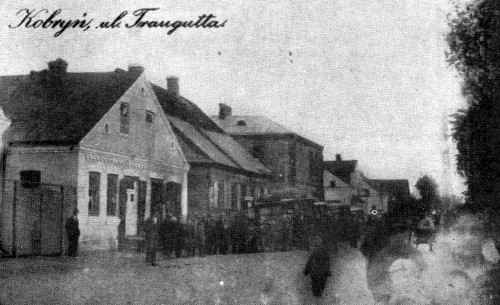
| [No external caption; the photo shows Traugutta Street around 1930, named after Romuald Traugutt. A better version of this photo and more information about this street can be found here: https://ikobrin.ru/de/kobrin-istrom.php |
Mit vos der top filt zikh on – mit dem vert er tsebrokhn – said about stubborn, tight-fisted natures; [literally: What fills the pot is what breaks it.]Purim iz nisht keyn yontef un kadokhes iz nisht keyn krenk – a dismissive, ironic saying; [literally: Purim is no holiday, and fever is no illness.]
Er shoklt zikh vi a lulav – said of someone rocking intensely while davening; [literally: He sways like a lulav.]
Poznatsh pana po kholyevi – [Polish saying]: one already knows who you are; [literally: You recognize the gentleman by his boot-shaft.]
Arayngefaln vi a yon in suke – meaning: arrived unexpectedly, unprepared; [literally: Dropped in like a soldier into a sukkah.]
Ale yonim hobn eyn ponem – meaning: everyone looks alike; [literally: All soldiers have the same face.]
Lebn zol men tsvishn goyim, shtarbn – tsvishn yidn – meaning: Live among non-Jews, die among Jews.
A patsh fargeyt, a vort bashteyt – meaning: the superiority of the spiritual over the physical; [literally: A slap fades, a word remains.]
A kapore mayne sonim – said upon hearing bad news; [literally: A kapore on my enemies.]
Tey mit eyngemakhts – meaning: tea served with stewed or preserved fruits.
A finfter rod tsum vogn – meaning: an unnecessary person; [literally: A fifth wheel to the wagon.]
Hak nisht keyn tshaynik – meaning: don't talk in a disorderly way; don't ramble.
Drey nisht keyn spodik – meaning: stop making up stories; stop with the tall tales.
Nishto keyn tolk – meaning: there's no order.
Nisht geshtoygn, nisht gefloygn – meaning: completely fabricated; a made-up story; [literally: Neither climbed nor flown.]
Loy dubim veloy yaar – meaning: nonsense, something that has neither beginning nor end; [literally: No bears and no forests.]
[Page 239]
R'hot a geshlifene tsung – meaning: a refined, polished manner of speaking; [literally: He has a sharpened tongue.]Loyf stramalevau, “strama galova” – Russian: aimed straight with the head; [literally: Run straight-headed.]
Oyf'n boydem a yorid – meaning: neither climbed nor flown; nothing has happened; [literally: A fair on the attic.]
A nekhtiker tog mit a fuler vokh – meaning: it doesn't even begin; sheer impossibility; [literally: A yesterday's day with a full week.]
An alter terekh – an unpleasant old man.
R'hot a kop fun a minister – meaning: a clever, capable mind; [literally: He has the head of a minister.]
Kofel-shmoynedike reyd – meaning: overly elaborate, veiled speech; [literally: Double eight-fold speech.]
S'hot mayn bobes tam – meaning: not tasty; lacking quality; [literally: It has my grandmother's flavor.]
Zise lakrits-reyd – meaning: overly sweetened, ingratiating speech; [literally: Sweet licorice words.]
R'hot a moyl malkhes – meaning: an eloquent, fine speaker; [literally: He has a royal mouth.]
R'hot a kheylek in bod – meaning: he has pretensions; [literally: He has a share in the bathhouse.]
A moyl pekh un shvebl – meaning: he can scold sharply; [literally: A mouth of pitch and sulfur.]
Az di moyz iz zat iz di mel biter – meaning: he has already eaten; now he criticizes; [literally: When the mouse is full, the flour is bitter.]
Az s'iz nisht keyn meydlekh tantst men mit shikses – meaning: when no Jewish girls are present, one dances with non-Jewish ones.]
Arum a fetn top iz zikh gut tsu raybn – meaning: good to stay in contact with the wealthy; [literally: Around a fat pot it's good to rub.]
Zay mir nisht keyn feter un ney mir nisht keyn shikh – meaning: keep your distance; don't get too close; [literally: Don't be an uncle to me and don't sew me shoes.]
Far a geshlogenem tor man keyn shtekn nisht vayzn –meaning: do not admonish someone who has already suffered enough; [literally: One does not show a stick to someone who has already been beaten.]
Az men paret zikh op af heysn, blozt men af kaltn – meaning: to be cautious; [literally: If one has been scalded by hot things, one blows on cold ones.]
|
|
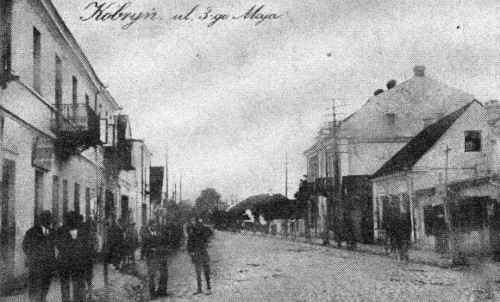
| [No external caption; the photo shows the street (ul.) 3-go Maja (named in honor of the Polish Constitution of May 3, 1791). A better version of this photo can be found here: https://ikobrin.ru/de/starfotokobrin5.php#!prettyPhoto[gallery1]/4/ ] |
Opgelebt di zibetsik un geshtorbn vi a nar – meaning: to live in pleasure; [literally: lived to seventy and died like a fool.]Mit eygene iz gut kugl tsu esn – meaning: do not make any business deals; [literally: with one's own, it is good to eat kugl.]
Genosn, a simen, az s'iz emes – meaning: a proof of correctness; [literally: enjoyment – a sign that it is true.]
Der goy iz treyf, ober zayn groshn iz kosher – meaning: recognition of commercial dealings with the non-Jew; [literally: the non-Jew is treyf, but his groschen is kosher.]
Afile zayn mit toyznt kep – meaning: something very hard to find; [literally: even if it has a thousand heads.]
Curses and maledictions:
A nikhpe dir in di zaytn – [literally: an epileptic fit to your ribs.]Lekher in leyb vi Katerines tsener – [literally: holes in the torso like Catherine's teeth.]
Gey tsu aldi shvarts yor – [literally: go to all the devils.]
A kholyere in di beyner – [literally: a cholera in your bones.]
A brokh tsu zayne yorn – [literally: a calamity to his years.]
A shtroy dir in oyg – [literally: a straw to your eye.]
Geshvoln vi a fas – [literally: swollen like a barrel.]
Az nisht gedakht zolstu vern – [literally: may you not even be thought of.]
Az nisht geharget zolstu vern – [literally: may you not be killed.]
Ze nor dem bok – [literally: just look at that buck.]
Zolst geyn vu fefer vakst – [literally: you should go where pepper grows.]
A yid a khazer – meaning: a miser; [literally: a Jew, a pig.]
Krats mir – [literally: scratch me.]
Ikh vel im hern vi dem koter – [literally: I will hear him like the tomcat.]
Es art im vi dem farayorikn frost – [literally: it bothers him like last year's frost.]
Men zol fun dir nisht hern keyn pips – [literally: one should not hear a peep from you.]
[Page 240]
Customs and Remedies
According to the traits and practices passed down orally from generation to generation, the people of Kobryn in very old times practiced the following folk customs:
|
|
JewishGen, Inc. makes no representations regarding the accuracy of
the translation. The reader may wish to refer to the original material
for verification.
JewishGen is not responsible for inaccuracies or omissions in the original work and cannot rewrite or edit the text to correct inaccuracies and/or omissions.
Our mission is to produce a translation of the original work and we cannot verify the accuracy of statements or alter facts cited.
 Kobryn, Belarus
 Yizkor Book Project
 JewishGen Home Page
Copyright © 1999-2026 by JewishGen, Inc.
Updated 05 Oct 2026 by JH