 |
|
|
[Page 200]
by Sh. Kelmenzon (Montevideo)
Translation from Yiddish by Beate Schützmann-Krebs
Various jokes and anecdotes used to circulate about the teacher Alkan[1].
A frosty evening rises in my memory. We were standing in a small group on Nyevsker Street. I was still, one might say, a green youngster in town – only a few months since we had come from Russia, from “Samara.” So we were standing there, and Itshe Shraybman told:
When the Germans left the town and the Reds took it over, and money began to be worth absolutely nothing, people advised Alkan that, with the little money he still had, he should buy some pelts. And since word was going around that houses were being searched, it was suggested that Alkan wrap the pelts around himself – and that's what he did: he wound them all around his body.
When Alkan went outside, one person passed the story on to another. And wherever he turned, people asked: “Mr. Alkan, how come you've recovered so quickly? You've grown so stout overnight – no evil eye.”
Mr. Alkan became furious. “Such a disgrace! They saw right through me.”
To Alkan, Yiddish was a lowly thing. “It sounds coarse,” he used to say. Hebrew he sanctified and defended at every opportunity.
When Peretz Markish[2] came to Kobryn, excitement boiled up in every corner – such a thing! Peretz Markish!
I remember how we were sitting in Freydkes' Hall, with Alkan in the middle of us.
“How will Peretz Markish affect you?” we teased him. “Will you keep quiet and not interrupt?”
Alkan warned us that he would not tolerate anything. He would do this and that to him…
We waited with impatience. Peretz Markish spoke – and Alkan kept silent. We all kept muttering: “Well, well… and he's still quiet.” He sat there, his eyes fixed in a hard stare and his whole body clenched, until the end – saying nothing at all.
When Peretz Markish finished, our teacher Alkan said to us: “Children, Markish has enchanted me and inspired me – he has won the battle.”
Every time I think of Alkan, various memories float before me, filled with sweetness and richness.
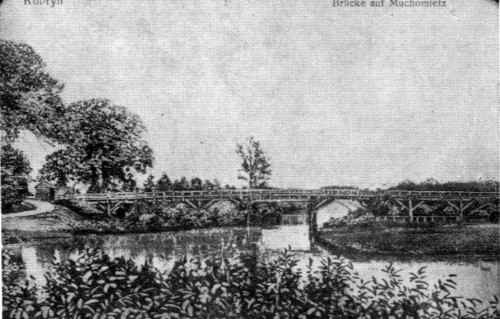
I see the shtetl, the wooden bridge, the market, the poverty, the fair. Jews and Jewesses bustle about with their trading, and peasants – drunk – rattle back to the villages on their wagons, singing. And here are those naïve, unpolished faces of the youth – a fervent youth, searching for a tikn [moral repair] in the world, wanting to know everything, whether in literature or in politics. One would have thought that people from hard, bitter labor – apprentices working for others – wouldn't seek knowledge. Yet they did.
How many times did I go to Mitsrayim Street to teach alef-beys to the porter's son. He wanted to know everything, and in the end he came to understand and carried in his heart an ideal of liberation – a social, worldly liberation.
These were the Kobryn evenings. The meeting halls looked packed with youth. And Ben-Zion Fantal spoke and taught the young people to go to the sands of Erets Yisroel and many indeed went to build the land. And Itshe Pintshuk, small but dynamic, helped blow the ideal of Chalutzim into them.
I can never forget the comic-tragic picture of Shmerele Ash with his goats – and also his craft, pressing the wine.
My thoughts turn to another original Kobryn type, Shimshele Moshes, as he runs and shouts with a hoarse, muffled voice at the youngsters who are paddling around in his little boats, telling them not to overstep the limits of their time.
A truly original type was
[Page 201]
Yudele the Sexton, with his shouting, “A bath, Jews, a bath!” – so primitive and so touching.
Here I see my uncle Yosl, with his stubborn face; he insisted on being the king of oil.
The Kobryn girls were especially attractive.
The strolls through the streets – the Zamuchaviec, the Botshevnik, the Kosharn, or down Pinsker Street. Arguing about all sorts of problems – that's what we did. The desire for knowledge was enormous, impossible to measure.
I clearly see the figure of Rabbi Peysekh'ken, with a fiery voice, delivering sermons – and the prayer halls with young fellows who came from afar with leaden faces.
Is it true that all this should no longer exist? That all of this should pass away like the sun sets? It's hard to believe – can an entire life simply vanish like that? Be uprooted entirely?
Truly a life of poverty – yet a life so deeply loved.
I remember, when I used to travel to Warsaw for work – that great city with its entertainments, with good Jewish theaters, with cinemas, with dozens of places for diversion – and yet I felt drawn back to Kobryn, to our town, where everything was baked deep into the heart: the friends, the innocence, the simplicity that never let me go. I could hardly wait for Peysekh or Sukes, for the moment when I would rush back to my little town, to my own, to my people.
I write these lines and feel that no one is there anymore. The whole shtetl, all the people, are gone. It weighs on me – heavy, so heavy and sorrowful on the heart – because all of mine have disappeared in a bloody sea.
Translator's Notes:
by Melech Glotzer
Translation from Yiddish by Beate Schützmann-Krebs
In my earliest youth I remained an orphan. I was not yet a full seven years old when my father, of blessed memory, died. I hardly grasped the full extent of the tragedy of what had happened. Raised in a strictly religious home, with notions of oylem-habe [the world to come], I believed that this was only a temporary disappearance – in order to appear again in a more beautiful world – and that the path led downward beneath the earth toward Erets Yisroel.
The continuing piety, the intensity of study, swallowed up my young being. I had not yet finished the year of kaddish when the First World War began.
As the front drew closer to our Kobryn, the effects of the worthlessness of human life and spirit drew closer as well. Entire camps of homeless and wandering (bezhentse) Jews strayed around Kobryn, with wagons loaded with household goods, bundles, and suitcases. Aside from the Zamd [sand] Square, many homeless people also settled in the synagogue courtyard and in the bote-medroshim [study houses].
The shattered surroundings had their effect on my young being. Boys, rough and unruly, began to befriend me and pull me into their rough-and-tumble, disorderly circles. Shmuel Hersh tried hard to draw me into his gang during the battles he used to wage with Britve's gang across the river by Narodnikes Street every Shabbat, using whole piles of stones, sticks, and mud – which, by all accounts, was a transgression from heaven. I, so as not to desecrate Shabbat publicly, would help Shmuel Hersh with advice from an observation point. Naturally, such things were noticed by side-eyes and reported to my mother, of blessed memory, earning me a proper scolding.
The influence of the khevruse [group] went its own way. So I also took part in the tshort [devil] games – throwing sticks from a twelve-meter distance into a tin can, and whoever knocked over the can with the first stick became “the emperor.” There followed a whole series of games of “thieves” and simple running contests on the Zamd [district].
[Page 202]
When fonye ganef (that's what people used to call the Russian military) withdrew from Kobryn, a great commotion broke out. It was the eve of Shabbat. People were frightened and didn't know what to do. The soldiers used to rob.
I remember how, a day before the Germans entered, a tsherkes [Circassian] on a horse rode up to our house, shouting zdes yest vodka (“Is there vodka here?”). My mother begged him, crying out that, so help him God, we had no vodka. He became angry and said he would bring gaze [kerosene] to set our house on fire, and immediately rode off. A few minutes later he returned with a small can of naphtha. We all fell at his feet, begging him to have rakhmones [mercy], and when he was given a hundred rubles he softened and rode away.
The last night before the German entry, all the neighbors spent the night at Khaye-Sore's, in her walled cellar. Early in the morning I went with my mother through the garden toward the synagogue, and before we had gone even twenty meters, a tremor struck us – an airplane bomb had fallen near the synagogue and torn off a corner of the cantor's dwelling. Aside from several horses that were killed, there were no human casualties.
The synagogue courtyard was filled with bezhentses [refugees], who sprawled about with their bedding and rags and their handcarts; the density and the stench were beyond description. It was simply the danger of an epidemic. Cholera was going around then. I remember how one of our neighbors, Moyshe the Boyer's [builder's] mother – a widow – lay swollen from cholera. That Sunday at midday, the first Germans appeared, with the points on their helmets.
With the German entry, a forced atmosphere began. First came the compulsory bath on Pinsker Gas; in the Jewish hospital the bathhouse was operating, where one had to stand in line and go in groups under the cold shower. A very large number had their heads shaved.
A few weeks after the Germans marched into Kobryn, forced labor began. Men from seventeen to fifty-five were sent out in groups to cut trees in the forests and to lay out the roads with logs. They also took people for fieldwork. I cannot forget how, as an eight- or nine-year-old boy, I signed up for fieldwork, going every free morning seven verst to Zalisye to dig potatoes, earning one mark fifty a day.
Economically, those years were shattered and uncertain, full of speculation. Most Kobryner Jews smuggled. People turned to whatever was possible. The question of food was chaotic and insecure. A large number of Kobryn householders kept their own livestock in order to have a little milk and butter. Gardeners were hired, and greens were sown. I remember how we rented about three morgen of land near the mogilkes [graves] and planted potatoes year in, year out, until after the Bolsheviks. We buried the potatoes every Kheshven [October-November] in pits near the house, covered with straw and earth from above so they would not freeze.
I mostly loved driving the cattle out into the fields in summer, onto the pasture at daybreak, meeting up with the livestock of the other householders, the neighbors, whose animals were let out of the stalls to go with the herd to pasture. The mooing of the cattle was a daily, primitive early-morning concert. The bovine tones repeated themselves again toward evening, when they returned from the pasture, sated, with their “milk stores” loaded. A distinct pleasure and delight could be felt among the drinkers of the warm milk, freshly drawn from the cows' “deposit.”
The only thing for which I had no desire – or better said, no patience – was churning the cream from the settled milk in the boyanke. It always took too long. The thrusting with the stick, which had a little wheel with holes at the bottom (similar to a ski pole, only shorter), without stopping, was too monotonous for me. So I would gulp down the warm whey together with hot potatoes, so hot that steam rose from them.
After the butter came a series of cheeses, made by pouring sour milk into small pointed bags (yozheklekh), letting the whey drain off for a day,
[Page 203]
and then pressing the cheese with a stone on a small board to give it a flattened shape.
A happy satisfaction came to me in 1917, when I began attending the compulsory school. I liked the compulsory school (the future Jewish elementary school). I remember that school with pleasure – the one where the teachers Miss Zalkind and Mr. Yomtov Bil taught us.
The German retreat from Kobryn at the beginning of 1918 found us children in an excited mood. We would hurry out and take delight in seeing how the Germans ran with lowered heads, beaten, their fine clothing and boots torn off them, as well as their weapons, by Polish shkotsim – Polish louts.
A restless time then unfolded for the Jewish population. Until the Polish military occupied Kobryn, we lived through days of trembling. Every day it was said that the Belakhovitses, Makhnovtses, and Petlyurovtses[1] might come in. I remember people saying in our house that our wagon drivers and porters –together with the fire brigade – were ready to resist any robbery attempt or any random attack. We youngsters also prepared ourselves, with pointed stones and iron tools. Luckily, we never had to use any of it.
The economic situation, in that chaotic period, became even more shaken. Money, in and of itself, acquired only a relative value. The German mark collapsed completely. The Russian ruble assignments turned feverish – their value changed every day. The assignments with holes in them suffered a total downfall. Nafol tipol – they kept falling without end. The Kerensky assignments [Kerensky-era paper ruble notes] dominated for only a very short time.
People were looking only for golden imperials.
With the arrival of the Polish army for the first time, the situation of the Jews of Kobryn began to improve. American aid from HIAS [Hebrew Immigrant Aid Society] and the Joint [American Jewish Joint Distribution Committee] began to appear. They began distributing cans of condensed milk, little cakes, and also clothing and shoes. Visitors from America began to arrive, wearing large straw hats. People called them the American delegates. One of the first was Yosele the American, whom we boys would run after whenever he came to bathe in the canal wearing a bathing suit – something we had never seen before and therefore did not understand.
A few days before the Bolsheviks entered Kobryn, my uncle – my mother's brother – Yakov Sokolov, came to us. He barely managed to get back to Brisk, traveling by drozhke [three wheel horsedrawn carriage]. It was no longer possible to get a train. During the entire time the Bolsheviks were with us, my uncle and my mother, of blessed memory, were in Warsaw, and I, together with the rest of the family, remained under the Bolsheviks.
After the return of the Polish forces, I traveled with my mother to Volkovisk [Vawkavysk] and Ruzhenoy [Ruzhany] to distribute the two thousand dollars that my uncle had brought as a delegate for those towns. I remember our trip – by sleigh – first to Prushane [Pruzhany]. We spent the night there and in the morning went on to Ruzhenoy. It was a rare sight: calling together a large assembly in the local bes-medresh, choosing three persons to make the proper distribution. We sat for two days in the bes-medresh and divided the money, having each recipient write a receipt.
The social and economic situation of that time was, for the most part, a trading economy – everyone traded. Men, women, and even fifteen-year-old boys traded. For example, our own trade. Even without an open shop, we still carried on a full trade in manufactured goods and leather. Almost every two weeks my mother would travel to Warsaw to buy manufactured goods. Sometimes she would get off in Mezritsh [Międzyrzec Podlaski] to buy leather – especially leather tongues for boots – and then sell them to the Kobryner shteper (maker of gaiters/ low-boot uppers). We continued with this occupation until the beginning of 1925, when my mother, of blessed memory, fell ill, and despite the intervention of the Warsaw doctors, she died there.
The Hechalutz organization, which I joined together with Yakov Novik and Leybl Sirote, took up one of the most beautiful pages of my life story. In 1927 I went on hakhshore [agricultural-training program for preparing young pioneers] to Visoke [Wysokie Litewskie], and afterwards to
[Page 204]
Orle [Orla] near Slonim. It was one of the finest periods of my youth. The communal, comradely life together – without any prejudices, without any special privileges, with everyone together, united as one – was an organization of truly ideal achievements. Everyone worked together and rejoiced together; there was no distinction between field work, sawmill work, or loading wagons. What mattered most was the spiritual elevation, the idealistic ecstasy.
Returning from the kibbutz, I continued with great enthusiasm the activities of Hechalutz, taking at the same time an active part in the Poalei-Zion party… For a longer period I also held the position of librarian of the Brener Library, and carried out other technical functions as well.
Being influenced by the work in the kibbutz, and feeling in particular a strong urge toward physical labor, I went off to Gurvits on Zamuchaviec to work in the sawmill – cutting planks – and at times also doing mill work, until my departure for Argentina.
Translator's Note:
by Mordekhay Priluk
Translation from Yiddish by Beate Schützmann-Krebs
January 1940. Friday night, at two o'clock, an officer came into my house with three armed soldiers from the N.K.V.D. (the Soviet secret police). The officer turned to me with the question: “Are you Mordekhay Priluk?” “Yes,” I answered. At that, I received the announcement that everyone who was in the house had one hour to pack – we had to leave the town.
Naturally, in one hour it was impossible to pack even the most necessary things. We took whatever came to hand, without choosing whether the things were good or bad. After the appointed time, we were put onto a truck and taken to the train.
When we reached the train, we already found many Kobryner Jews in the wagon: Pakter with his daughter-in-law Rashe and grandchild; Khayenka the Katsev [butcher] with his whole family; Shloyme Nadritshne (the blacksmith) with his family; Leybke Dalinski with his family; Mrs. Gingold with her son; the old Shimantshekhe; Leybl the Katsev from Dyvin; and a large number of Kobryner Poles.
In Kobryn we were locked in the wagons for two days, because they kept bringing more people from the surrounding villages. From Kobryn we were taken to Zhabinke [Żabinka]; there we stood for three days.
When the Jews of Zhabinke found out that there were Kobryner Jews in the wagons, they kept asking us: “Where are they taking you?”
I answered them: “We know where we're coming from, but where they're taking us – that we don't know.”
During the three days that we stood in Zhabinke, the Jews of Zhabinke provided us several times a day with food and drink. They also gave us food for the road, and even shared money with us. With the Jewish farewell blessing – may hashem-yisborekh [the Blessed Name] grant you success – we departed, not knowing where they were taking us.
In sealed wagons, without air and without light, we traveled for several days.
After traveling for three days, we came to a stop at a station, where the wagons were opened in order to lock more people in with us. We turned to the eldest of the guard with the following appeal: “If we don't receive food and light, we're not going back into the wagons for the night. They can even shoot us here on the spot.”
The eldest agreed to our request, and every day, when we stopped at a station, they provided us with bread and cooked warm food. After twenty-six days of travel, we arrived at the station in Kazakhstan. There we were ordered to get out of the wagons, and with
[Page 205]
trucks we were taken through the villages.
The Kobryner Jews were divided into two parts: one part to one village, the second to another village. We received living quarters in former granaries. We appealed to them to give us boards and bricks. The request was granted. From the boards we made poln – simple plank floors – and beds, and from the bricks an oven. In this way we arranged ourselves little by little in the new home.
In order to receive food, everyone had to work, without distinction of age. Even I, who was then seventy-five years old, had to work in order to receive the food portion that was distributed.
Over the course of the time until the outbreak of the Russian-German war, I received parcels from my daughter Henye in Brisk. Rabbi Michael the rabbinical judge also sent us matzah for Passover; and Reb Sender-Borekh the Katsev [butcher], who is a relative of mine, sent me poultry fat with a piece of chicken for Passover.
During that time, my family members who had remained in Kobryn worked out papers for me and for several other Kobryner Jews, so that we could return home. But before all the formalities in Kazakhstan were completed, the German-Russian war began.
At that time, both groups of Kobryner Jews united in one village. Seeing that we would have to remain here for a longer period, we did what Jews customarily do: we organized a mokem-kodesh [a prayer space]. All the more so because the High Holy Days were approaching. It is noteworthy that there was no interference from the authorities – we were allowed to carry out our religious needs.
The minyen [prayer quorum] was arranged in Leybl Dalinski's house. There we had a Jew from Petersburg who had brought along a Torah scroll. In the town there were many Jews who had been deported and who were not from Kobryn.
After the first death of a Jew, who was buried in the Christian cemetery, we turned to the elder of the rayon [district], asking him to give us a piece of land to establish a Jewish cemetery. The piece of land that we received turned out to be from a former Jewish cemetery, because we found old gravestones there with Hebrew inscriptions. Apparently, a Jewish settlement had once existed there.
Then Pakter died, and two more Jews from Kiev, who were also buried in the Jewish cemetery. Before our departure back to Poland, a gravestone was erected for Pakter by his daughter-in-law Rashe, made by Shloyme Nadritshne.
When the Hitlerite bands were driven out by the Russians and all of Russia was liberated, we – all the deported Jews – were transferred to Ukraine. There we were settled and registered, and our situation improved. A Polish delegation appeared and began distributing goods to us. Thus we remained in Ukraine until the end of the war.
A manifesto was issued by the Russian government stating that all Polish citizens could depart for Poland. Knowing that there was no longer a Jewish settlement in Kobryn, I left together with other Kobryner Jews for Poland. We arrived in Lower Silesia, in the town of Rikhenband [Reichenbach, today Dzierżoniów].
The Jewish committee in Rikhenband provided us with housing, food, and other necessities. Knowing that I had two sons in Argentina, and unable to emigrate directly from Poland to Argentina, I continued on my wandering path to Austria. After spending two months in Austria, in the camp Lintsh [Linz], I arrived in Germany, where I stayed for six months.
During that time I received papers from my son so that I could travel to Paraguay. Since there was no Paraguayan consul in Germany, I had to travel to France for the visa. In France, the Paraguayan consul did not want to give me the visa because of my advanced age, seeing that my papers were made out for an agricultural worker. I was then forced to travel to Belgium.
By good fortune, the Paraguayan consul in Belgium died, and after spending three weeks in Belgium, I returned to Paris. From Paris I traveled to Italy, where I finally received the visa, and traveled on to Paraguay, with a transit through Montevideo.
In Montevideo my son awaited me together with my granddaughter, whom I had not seen for twenty-five years. After spending two weeks in Montevideo, I was transferred by the Joint with an airplane to Paraguay.
At that time it was very difficult to enter Buenos Aires. After spending three months in Paraguay, I arrived – after long and difficult wanderings – in Buenos Aires, to my son Noach.
by Leybe Avrukh
Translation from Yiddish by Beate Schützmann-Krebs
|
Remark from the book editor:
Because of the insistence of Mr. Leybe Avrukh – that certain parts of his article “My Home-Town” should not be edited – I remove from myself the responsibility for this article with regard to form, style, and correction. |
| Book editor: Melech Glotzer |
When one begins to unfold the past of one's childhood years, various images of events and experiences pass by like a strip of film. It carries one back to those abandoned places where one took one's first steps – where one drew one's first inspiration and wove one's first dreams. One remembers every little path and foot-trail one walked, every corner that one warmed with hot breath and feeling.
Driven by the circumstances of that time, one tore oneself away from the branched-out family – like a fruit from a tree whose roots stretch back through many generations. One set out on unknown roads in distant lands to create a new home. And with that very first movement on the wandering road, one already carried along the warm longing that had fastened itself deep in the soul – something one can never tear out again, even though one no longer has anyone there except graves.
|
|
The Zamuchaviec District
What comes first to my mind is my street and my beloved home, where I was born and grew up. A street perhaps similar to many other streets, yet I felt something different toward this one. To me it looked broader and more majestic.
Its actual name was Bobruisker Street, but people called it Shoseyne, because of the well-known
[Page 207]
shosey – the highway that stretched from Warsaw to Brisk, passed through Kobryn, cut through various small towns, through Smolensk, and ended at Moscow.
Besides the breadth and beauty of that mentioned shosey, our street distinguished itself by its cleanliness and its spacious houses. Quite separated from one another, with orchards and gardens; behind the gardens, in summertime, a wide-meadow flat grew green with a glistening stretch of water. In winter the water there froze and served as a slide, where the youngsters would glide, make mischief, and spend their time.
Beyond the meadow stretched broad fields with various vegetables and grains, whose colors shimmered and enchanted with natural brilliance. There the railroad line cut through like a cord, with its high iron bridge that looked as if it reached far into the distance. The drawn-out whistle of the passing trains reminded one of faraway places from which greetings seemed to be heard.
It was a wonderful, colorful frame for the splendid picture that was called Zamuchaviec.
In the summer evenings the youngsters would fill the street with bicycles, and in the nights the loving couples would dream out their longing hearts. The Shabbat evenings were marked by the large number of Jewish strollers. The beautiful panorama and the good, clean air drew everyone in.
Another factor also added a certain liveliness and movement to our street: the large government barracks that were located down along the shosey, about a verst from town, where the 150th Atamansky Regiment was stationed (the entire movement of the soldiers with their officers passed right along our street).
Besides its natural beauty and attraction, our street had another advantage. All the peasant wagons from the surrounding villages, bringing their products to the town market, would pass through it. Many Jewish residents of our street were occupied with buying up the produce from the peasants. In our house this trade went on at a fairly substantial scale.
In our street lived several Jewish agrodnikes [outdoor laborers], who worked the gardens around the Lepesyer barracks, being gardeners of vegetables. These were the balebatim [householders] Khantshe, Manish Kagan, and Velvl Lepesyer.
There was also a considerable number of Jewish craftsmen and enterprises in our street, where, incidentally, most of the workers were Jews.
I remember the large tannery of the Pintshuks, whose son Itshe I studied together with under the esteemed Hebrew teacher Paltiel Polanski, of blessed memory, whose remembrance is always dear to me. Incidentally, it is worth noting that this teacher was a highly intelligent and ardent Zionist, to whom the Kobryn intelligentsia would come to discuss and debate topics of political and intellectual character.
Across the railroad line stood our house with the large garden, neighboring Shtilerman's steam mill. Opposite us were the houses and gardens of Sender Borekh Biletski, and the Vinodskis and Pekers. Besides the considerable number of Jewish craftsmen, there were also several taverns and wagon-entry houses. A notable number of Jewish food shops and bakeries sprinkled the Zamuchaviec side with homely Jewish color and gave it the characteristic Zamuchaviec stamp.
The name Zamuchaviec comes from the Russian expression “over the Muchaviec.” This is the river that draws itself from the Dnieper and, through the Bug, flows into the Vistola[1]. In the summer months, timber rafts would move along this river toward Rantsik (that timber trade was mostly in Jewish hands). From time to time motor-boats would come along the water (they were called parakhodn [steam boats]). The entire town would then go to look at the boats.
A source of joy and pleasure for the youngsters was the Muchaviec, on whose back lodkes (little boats) would float in the summer evenings, with singing youth and romantic couples. The high bank on the Zamuchaviec side, which had been built up
[Page 208]
to hold back the water during Passover time so it would not flood the fields, had its own distinctive name – the Botshevnik. With its alley of trees on one side and the water on the other, it drew the longing, romantic couples as if by magic, and absorbed into itself all their melodies and love poetry.
Besides the romantic moments, the Botshevnik was also a place for discussions among various groups, as well as for the studying youth, who would make use of the beautiful walking path for their thoughts and plans.
|
|
At the same time, the river was also a source of livelihood. In the winter months people would cut ice and store it in the ice cellars (lyedovnyes). Many Jewish water carriers also drew their sustenance from the river – they would deliver water in barrels to the balebatim, replacing the former hand-water carriers who used to carry the buckets on yokes. This orderly, hardworking Jewish life gave color and brought charm to the little townscape of Kobryn.
Before I cross over the wooden bridge, I want to pause for a few more strokes about the Zamuchaviec side, which formed a kind of little town of its own, with all its characteristics and peculiarities – like, for example, khadorim [cheders], minyonim [minyans], two dayonim [religious judges]: Borekh the dayen and Yitskhok-Osher the dayen, and religious functionaries.
Zamuchaviec also had a modern Jewish elementary school, where I myself studied. It stood on the Tevelier Road toward the train station. The school was run by the teacher Yisroel. He himself left for North America before the First World War, and because of that the school was closed – something that was sorely missed at the time. The parents regretted the loss.
Zamuchaviec possessed, besides its minyonim, also two large bote-medroshim [houses of study]: the old one, called the “Russian,” and the new one – the “Japanese.” There is a story behind these names, which I will try to bring out here.
Originally, Zamuchaviec had for a time only one large bes-medresh. And as things stood in those days, the takifim [strong and influential persons] would seize all the power and honor and rule and dominate in the manner of the bale-takses [community tax-farmers].
This forceful behavior of theirs led to quarrels and disputes during the praying and the reading, so that some balebatim [householders] left the study house and created a separate minyen [prayer quorum]
[Page 209]
and a separate group for Mishnah study and Tehillim [Psalms], led by the balebatim Khayim Shteynberg (Khayim Peyke), Velvl the Lepesyer, Moyshe Mordekhay the tombstone engraver, Zelig Lusher, Tenenboym, and my father.
The revolutionary group decided (to spite the rulers of the old bes-medresh) to build a new bes-medresh. This was approximately in the time of the Russo-Japanese War. The revolutionaries achieved their goal and gave the new bes-medresh the name “Japanese,” probably as a symbol of the Japanese victory. The old bes-medresh received the nickname “Russian,” as a symbol of the Russian defeat.
In the Japanese Bes-Medresh a democratic spirit took hold. Equality and respect for everyone prevailed, without any autocrats. The starostes (wardens) were not appointed but elected, and not a few craftsmen were chosen for this office – for example Yankl the Blacksmith, and others. This democratic spirit also influenced other bote-medroshim [houses of study], which followed the example of the “Japanese.”
Mentioning my father, of blessed memory, I must pause to note his energetic cooperation in the building of the Japanese Bes-Medresh. As one of the five, he devoted himself with heart and soul to the Japanese Bes-Medresh. Besides money, he provided woodwork – doors, windows, and cupboards – for the new bes-medresh. Serving as gabe [warden] for many years, he was also, year after year, the bal-shakhres [leader of the morning service] on the Days of Awe.
When my father, of blessed memory, was on a visit to Argentina in the year 1936, I remember that he used to receive many letters from the bes-medresh [house of study] balebatim, in which they wrote to him about how much they missed him, saying that the bes-medresh lacked its proper caretaker. When he returned to Kobryn, the joy among the “Japanese” group was beyond measure – they practically carried him on their hands. This shows the appreciation our parents had for their historical values.
Speaking of my father, I must also mention my late mother, may her memory be a blessing, who earned a name for herself through her good heart and her secret charitable giving to those in need and distress. Even before the groans of the needy were heard, my mother, of blessed memory, was already prepared with help and counsel. She would not sit down to eat until she had first provided for the impoverished families. Until her holy soul departed on the 14th of Ov [Av] 1918, she never ceased to support and care for the needy. Her passing was deeply mourned by many acquaintances and neighbors, whom she had won over through her good qualities and her generous heart.
The Traffic Movement Toward the Train
The traffic toward the train was very significant from the Zamuchaviec side. The streets leading to the station quivered whenever a train came in or pulled out. The three or four daily passenger trains filled the streets with an unending stream of carriages, wagons, and pedestrians going to and from the station. A source of livelihood for many Zamuchaviec families was the railroad, as they worked loading and unloading various goods, cereals, and timber. Wagon drivers, porters, carters, and coachmen drew their sustenance from it. True, they lived a hard, toilsome life, but one full of charm, as worthy breadwinners.
With a particular curiosity, the youth would gather at the station to meet the arriving passenger trains; some accompanied those departing, others awaited arriving guests or friends. Besides those mentioned, the largest part of the station's visitors were simply curious onlookers, catching a glimpse of the station, the passengers, and – incidentally – seeing the steam-huffing locomotive and hearing its whistle.
During Khalemoyd Peysekh [the intermediate days of Passover], the movement toward the station took on a festive character. Boys in new clothes and neatly dressed girls filled the streets leading to the station. Older couples also strolled toward the train. The young people enlivened the streets with their singing and playful teasing; the young men eagerly awaited the arriving guests, hoping perhaps to meet girls traveling to visit family – the so-called fryedzhe meydlekh. Likewise, the girls awaited, with no less excitement, the newly arrived young men. And not a few matches came out of these chance encounters.
Recalling the Khalemoyd periods, I am reminded
[Page 210]
of the melamdim [religious teachers], who used to come to the fathers to negotiate about pupils for the coming zman [term] in the kheyder [traditional elementary school]. We boys were afraid of falling, God forbid, into the hands of a harsh melamed, where the kantshik [strap] was the main pedagogical argument. Khalemoyd was also the time when craftsmen took on new apprentices for the zman.
Crossing the wooden bridge from Muchaviec, which separates the Zamuchaviec side, one suddenly encountered an entirely different panorama. Here there was no longer the spaciousness of Zamuchaviec with its wooden buildings. Instead, the houses of Nyevski were brick-built and stood almost one against the other, in a big-city fashion. The closer one came to the market, the taller the houses were, with several stories rising one above the next. Here were found all the government institutions: the zemsker-natshalnik [zemstvo district chief], the court, the state bank, the prison, monasteries, the pro-gimnazye [pre-gymnasium, lower secondary school], and so on.
The ring of shops in the middle of the market, as well as the surrounding densely packed stores, were all Jewish. The streets – Brisker, Ratner, Narodnikes, and Potshtover – were almost exclusively Jewish streets. The Jewish Street was especially distinguished by its large and splendid shul [synagogue], which Christians often visited, especially on Yom Kippur for Kol Nidre.
There were Jewish craftsmen, who ran Jewish workshops, and Jewish stores and shops of every class. In a word, a town with a pulsating Jewish life in every sphere. Matches were made, celebrations were held, families grew, new little Jewish children were born – future generations already with new songs, songs that said: “Vos klingt ir kirkhn-glokn shoyn genug dershrokn…”[2] and songs that said: “Shoyn nisht vayt, vet zayn di tsayt, fun libe un fun sholem…”[3] A youth that had already looked beyond the narrow, tight borders of the small town, with a wider gaze toward the broad, great world.
Like an eagle with outstretched wings cutting through the air and rising into the heavens, so too did Jewish children already pull and strive toward a brighter morning and a freer world – away from the cramped kheyder rooms, from the Talmud-Torahs [religious elementary schools] with their old-style teachers, and from the entire old-fashioned way of life.
Jewish children put on uniformed student clothes with shiny buttons; many found success and went far away, others remained only with the uniform; still others – alas – had already been carried by that same uniform far from Jewish life. But these were perhaps isolated cases, and thus life began to take on a different appearance.
There was also another kind of uniform – one might call it a formless one – in gray colors or in striped patterns, behind the thick prison walls, or in the distant, Siberian, frost-bitten steppes, from where a warm greeting would be carried back to one's hometown, to the little room where a mother would rock her child with the song:
“Dortn shteyt dayn tate, mit der lopete in hant, un grobt kvorim oys far der beyzer makht…”[4] [“There stands your father, with the shovel in his hand, digging graves for the cruel authority…”]
Kobryn also contributed its share to the great political struggle against the tyrannical, Black Hundreds–backed despotic rule of the Russian tsar [the Black Hundreds were a reactionary, monarchist, and violently antisemitic movement in late Tsarist-Russia], with his entire hooliganish ecclesiastical retinue. Kobryn, too, gave of its own: devoted torch-bearers who carried their sparks to the great underground revolutionary bonfire that flared along the entire length and breadth of the vast Russian land, until it reached its point of culmination and burst forth like a mighty powder fuse, toppling from its firmly embedded pedestal the tyrannical autocrat together with his entire decayed, corrupt, and pogrom-filled order. The echo at the time was so great that the whole world trembled.
Kobryn also writes its own page of history within the vast, multiethnic Russian territory, in the just and great struggle for liberation – from oppression and darkness toward a free and brighter morning.
And so life wound its way in our Kobryn in those days, amid the perpetual struggles that life itself had thrust forward in every sphere – social, cultural, economic, religious, and educational – where the old did not wish to step aside and the new
[Page 211]
sought to impress itself with all its means and achievements, until the world broke apart and the great bloody flood burst forth with the outbreak of the First World War.
The First World War
The First World War fell like thunder from the sky in the middle of a bright day; a simple terror descended upon the Jewish population, and people were left helpless and discouraged. People walked about with a single question: what will happen, and how long will this last? Others tried to console themselves that it would not go on for long – three or four months. Meanwhile, greetings from the fronts had already begun to arrive, and the first wounded started to appear, including familiar faces from Kobryn and from the regiment, for the Otomansker [Atamansky] Regiment of our town was among the first to be sent to the front.
The town breathed a little more freely when the fronts initially moved farther away from Russian territory, but this brought no real comfort, for every family thought of its own loved ones who were in the fire – besides the sorrowful news from the Jewish population in the places where the fronts passed through. And so people lived in fear until the wheel turned again and the fronts began to draw nearer.
Just as blood flows through the veins, so there stretched across all the railway lines leading to the fronts, from the wide and far-flung Russia, long trains with tightly packed wagons of soldiers of every kind and rank, fully armed. And because one of those railway lines cut past our town – like a vein of the great Russian body – this affected the inhabitants even more, for every packed train that passed by appeared like the blood draining from a great slaughtered ox.
Still more sorrowful was the sight when the same trains that returned from the fronts were also packed – but now with broken men, shattered, bandaged – and at every station they would carry down on a stretcher some already covered over, for whom the hope of rebirth had ended, extinguished. And the only trace that remained after them was the wooden cross with its little metal plate stating his origin on his fresh grave. And somewhere, in a small room, a mother with tear-filled eyes and a clenched heart would light a candle for his soul, after receiving the imperial report with its great praise for having fallen for the fatherland.
In the early days, the Jewish population would wait at the train station for those sorrowful trains that stretched deep into Russia, handing out various foods and cigarettes to all those unfortunate, shattered men. But with time, people grew accustomed to it, and they began to look to their own troubles, for as the fronts drew nearer, the first Jewish homeless began to appear – torn from and driven out of their homes, for such was the order of the enemy of Israel, the supreme commander Nikolai Nikolaevich, may his name be erased. And all these roofless people had to be provided with everything necessary.
In that great nightmare – between terror and hope, between sorrow and the thunder of the cannon fire – where young lives soaked the Polish fields with their blood, and where soldiers in their death-throes held on their lips the names of their dearest ones, even in those days Shakhne mit der Zhipitse[5] was still in his usual place.
The events of the war brought division into our Jewish society; “Germanophiles” and “Russophiles” emerged. In the bote-medroshim people would grow heated and argue over the situation at the front. Countless comic scenes played out when the bes-medresh Jews grew heated and began to argue fiercely, trying to demonstrate – with “signs-and-wonders” gestures – the positions at the front, depicting on their hands the positions of Fonye ganef [Russian military] on one side and Yeki ganef [‘Yekke’, the familiar Yiddish nickname for the German side] on the other.
And if the bal-moshl – the man illustrating the positions – lacked enough space on his own hand, he would simply take the hand of his conversational partner and continue laying out the positions of the battles.
[Page 212]
Thanks to the disputes just mentioned, people would at times forget their own troubles. As the front drew nearer to our region, everyone assumed that at the Brisker fortress the Germans would be held back. But the very opposite proved true. The commandant of the Brisker fortress turned out to be a German spy and surrendered the Brisker line to the Germans without resistance. And this, at that time, was by no means the only such case. Near Kobryn itself a small battle did indeed take place, but it could no longer change the situation, for in several areas the German wedge had already pushed far deeper into Russia.
I want to recall here one episode of the wild, murderous brutality shown by the Russian military men toward the Jewish population on the night before. It was a Shabbat night, just before the power changed hands, when a Russian Cossack shot two Jews – a father and son, Motl Kraman and his son – because they refused to let themselves be robbed. This is only one small blossom from the whole evil growth of how the Russian Tsarist army behaved toward Jews wherever they marched through.
The Battle Over Kobryn
On that Sunday early morning, a clear and bright dawn rose from its nightly sleep. The first rays of the sun that appeared lit up the horizon. Over the course of the night, the long lines of wagons – the masses of homeless people that had simply clogged the streets so completely that it had been impossible to pass through – had disappeared.
An extraordinary stillness prevailed, like the hush before a storm. The air was entirely filled with powder, as though at any moment it might burst open. Here and there one could see the disheveled beard and the shattered face of a neighbor, with the single question on his lips: “Any news?” And of course, no one could give any precise answer.
Meanwhile, housewives had lit fires in their homes to revive the tired spirits of their families. With frightened souls, people crept about in the shuttered houses like shadows.
Suddenly we heard voices. We ran outside, and this scene unfolded before us: two soldiers were walking along with a tin can of kerosene in their hands, and behind them ran a Jew – a neighbor – shouting: “Jews, save your houses, because they're going to burn them! This is part of the Russian wartime tactic.” And in the middle of the street stood an armored car, with a Russian officer at its side giving orders: “Set it on fire! Set it on fire!”
The Jews, in any case, had nothing left to lose. And knowing the Russian system – that a ruble speaks, and a ruble holds its tongue – they quietly settled the order with a handful of Russian rubles and saved the entire corner of Jewish homes.
In the meantime, groups of soldiers from the shattered Russian army began to appear, retreating into the hinterland and bringing along many wounded from the front. With each passing hour, they came in ever greater numbers.
And here, before our eyes, the broken Russian army revealed itself in its retreat. Now that the soldiers had come out of the trenches, and on the advice of several soldiers marching past, we were told not to expose ourselves but to look instead for a safer shelter, because a battle would break out here – and so it was.
Within a matter of minutes, the first shell had already fallen in the town as a warning, with very tragic consequences, striking a group of Jews who had sought refuge between the river and beneath the old Jewish cemetery. Among the first victims were several members of the Mezdritsh family.
A shell also struck the home of my rebbe, Reb Mordekhay – known as the Zapruder Rebbe. There, too, there were victims, in addition to a large number of casualties in the shulhoyf [synagogue courtyard] among the homeless. In this way, Kobryn contributed its share of blood to the sorrowful nightmare of the Great World War.
It is hard to describe the fearful moments that we ourselves lived through on that terrible, blood-soaked day of the battle over Kobryn. We were no great strategists, for the “war tactics” taught to us as children came only from the ancient Tanakh,
[Page 213]
and they did not prepare us for modern strategy. In such moments one simply follows instinct – looking for a safer shelter – and not knowing where it would be better to go, our feet carried us almost out into the open fields.
There stood a high stone wall, overgrown thick with trees, and a long trench that was not very deep. All of it belonged to the Christian cemetery on the far side of the railway line, near the iron bridge. In that strategic spot several Jewish families sought refuge, ours among them. We settled ourselves in the long trench and waited ‘ad ya‘avor za‘am [Isaiah 26:20] – until the line of fire would pass.
And so it was destined for us to become witnesses, watching at close range with our own eyes the titanic struggle between two hostile armies.
When we wanted to leave that place, we could no longer do so, for we found ourselves surrounded by the Russian battle army with all its divisions and all kinds of weaponry, holding its defensive position against the pressure of the attacking enemy. Anyone can imagine our situation at that moment: caught between an army in the very thick of the fire, our fear was doubled. Besides the bullets and shells that fell around us like hail, there was also the danger from the Russian battle army itself, which looked anything but friendly upon the Jewish population – all the more so in such a moment, when there is no control and everything is lawless.
But, as it turned out – according to the convictions of the religious Jews – the verses of Tehillim and the Sh'ma Yisroel, which the Jews kept repeating without pause in that moment, protected us from all evil, and we came out alive.
It is impossible to convey what we felt in that moment. I was still a child then, but certain impressions that engraved themselves upon my childish memory I will try to bring out.
To the whole war scene that unfolded before us – with the full orchestra of explosions from every kind of weapon, and with the bursts of countless shells of various calibers – we noticed the arrival of an armored train that was firing on the enemy lines. Crossing the great iron bridge, it came to a halt. Several soldiers disembarked from the train; they approached both iron bridges, and within a few minutes two terrifying detonations were heard.
Turning our gaze toward the place from which the explosions came, we saw how the tall, proud iron bridge, after giving off a powerful groan, bent to one side – like a person who feels a sharp pain from a severe wound. The second iron bridge, which looked like a dwarf compared to the first, did the same. This made a dreadful impression on all of us.
A second experience we felt in our own bodies. Among all the shells that fell around us, it seems that one of them wanted to play a trick on us and throw everyone into mortal terror: it fell not far from us with such force and with such a terrible explosion that we were all left covered with a thick layer of earth.
After the whole struggle against the unwelcome mass that had smothered our breath, helping one another to free ourselves from the pressure and get out into the open, we began to count and call out to see whether anyone was missing. It turned out that a child was missing. A cry of alarm went up, and everyone, of course, began searching for the child among the heaps of earth. They found him alive, sleeping in the arms of nature.
That child is a member of my family who now lives in Buenos Aires, and at that moment he slept through the experience whose bitter taste so many of our brothers later endured – feeling the dreadful pain of being buried alive, without any hope of rescue, in the terrible Nazi years. And perhaps this was a warning from divine providence, that one should leave that accursed land, where hatred and destruction are always seething.
[Page 214]
Another image engraved itself in my memory: when one army had withdrawn and the second, the hostile one, approached. From a distance, across the fields, we noticed masses of people advancing in gray-colored coats. The Russian armies had already positioned themselves on the other side of the river, on the Pinsker Road, and around the barracks. And, as it seems, according to the rules of battle, they do not hesitate to greet one another in such moments – so a reception came from the Russian side for the uninvited guests that made the earth tremble.
Naturally, the guests did not remain without an answer. Well, had I been Dante, I might have tried to describe that hellish fire. And we poor creatures found ourselves in the middle of it.
And so we hovered between life and death, with fear and hope, under inferno-like fires, amid the dangerous clashes of two mighty powers struggling over the course of world domination. And with the passing of day after sunset, finding ourselves already in the company of the new rulers, we left our place of refuge and made our way to our homes – discovering, as usual, in the abandoned trenches of the departing power the new protectors who had taken their place.
And protected, it seems, by the wings of good malokhim [angels], we reached our homes under a hail of rifle bullets that came from the Russian side toward the positions of the new masters.
Kobryn Under German Rule
A considerable destruction was caused by the retreating Russian power. The prognosis of the supreme commander of the Russian army, Nikolai Nikolaevich – may his name be erased – to destroy and burn down primarily Jewish property and possessions was carried out with great zeal by the frenzied, Black-Hundred Russian officers. Many blocks of houses went up in smoke, as did the ring of shops. In our Zamuchaviec area, a large part of the houses burned down – including the Russian Bes-Medresh.
The Japanese Bes-Medresh, however, although it remained entirely intact, could nevertheless not be used by the Jewish population, because the Germans had turned it into a camp for captured Russian soldiers.
For the Jewish population, the first period of the German occupation was extremely critical. One was cut off from the world. Trade had come to a standstill. The peasant population around Kobryn had scattered together with the retreating Russian military; people wandered about anxiously; no one knew what to do. Added to this was the harsh German military regime (although those Germans were righteous men compared with the Germans of the Second World War). The state of emergency, being seized for forced labor, weighed heavily upon the Jewish population.
The depression was felt especially in the evenings. One did not dare leave the houses after eight o'clock. Doors and windows had to be closed and shuttered so that no light should be seen outside. The echo of the booted Germans with the iron fittings on their soles brought uncanny impressions into the nights and deepened our sense of dejection.
The town began to hunger. The Jewish population, enlarged by the newly arrived Jewish homeless, found itself in a desperate situation. There was a shortage of foodstuffs, and who knows what catastrophe might have occurred had it not been for the harvest season, which fell precisely at that time. The potato and grain fields ripened then; the Jewish population made use of this resource and saved itself from the bad situation – and thus began, little by little, to prepare for the coming winter.
By the following spring, the Jewish population had already taken up agricultural work with greater zeal. Considerable tracts were sown with grain, potatoes, and various summer vegetables, becoming in this way full-fledged agricultural specialists. At the same time, the circles of trade began to show a bit of movement. True, not entirely on a legal footing, but people traded; the craftsmen and workshops also moved from their dead point and began to resume their roles. The situation
[Page 215]
had changed. There appeared oylim v'yordim – those rising and those falling. Many former wealthy men became yordim, while new wartime men of means arose in their place.
The situation during those years was especially critical for Jewish youth. Because of wartime regulations and the state of emergency, young people were unable to engage in cultural development and therefore could not carry out any activities at all. In general, social activity was almost completely paralyzed. In matters of education, however, the situation was somewhat better.
In addition to the regular kheyder [cheder], Talmetoyre [Talmud-Torah], and gimnazye (with Yiddish and Hebrew as subjects), the tsvangs-shul [compulsory school organized by the Germans] was added. It became the true nucleus of the future, multifaceted Jewish school system, which filled our Jewish Kobryn with pride.
The tsvangs-shul progressed so much that, over time, it was transformed into a folks-shul [public elementary school]. The building of the former Talmud-Torah on Potshter Street became too small, and as soon as the opportunity arose to purchase Margolis' Barracks at the corner of Potshter Street, the folks-shul immediately moved there.
Some time later, a Tvune school and a Tarbut school were organized, and they also established themselves in that same building.
Toward the end of the German occupation, a vocational school was organized by the local ORT society for training in carpentry for boys, and in needlework for girls. These schools also settled into the aforementioned barracks. Various youth organizations, libraries, and general social circles likewise established themselves in that same building.
A large cultural center developed, encompassing all branches of social, political, and intellectual life. The barracks were alive with activity and with the struggle for Jewish continuity; a radiant youth shone forth from that place and became the pride of the Jewish community of Kobryn. Hundreds of that splendid youth dispersed throughout the world and continue to carry forward the golden chain of Jewish existence.
Today we find many Kobryners in leading positions and in the leadership of movements fighting for the State of Israel, as well as in the American countries, engaged in the struggle for dignified Jewish positions and rights.
1917 – 1918
The year 1917 was the most decisive year for world events. The continual defeats of the Russian armies, the relentless pressure of the German forces, and the disintegration of Russian power brought down the Tsarist regime.
The sparks of the fiery Russian Revolution reached the German rulers as well, and together with the Russian Tsar, the German Emperor was swept away. Nations awakened; people rose up against despotic tyranny, cast off the yoke of enslavement, and a current of freedom swept across cities and countries, carrying the masses into the struggle for a better today and a brighter tomorrow.
Kobryn did not remain outside that passionate fight for freedom. The Jewish community of Kobryn – especially the youth – threw itself into this current of ideas, participating fully and passionately in the struggle for freedom.
Various factions and movements suddenly sprang up on the Jewish streets of Kobryn; especially when, in that same year, the Balfour Declaration was issued, calling for a Jewish national home in Erets Yisroel. The Jewish national movement then flared up with all its shades, igniting Jewish hearts with messianic fervor. The town pulsed with ecstasy, and the youth with a fervent pioneering spirit to defend Jewish self-determination.
At that time, hooligan bands and marauding peasants were running wild, craving Jewish property and goods, sharpening their teeth to rob and to carry out pogroms. Not a few Jewish towns went through tragedies at the hands of the Belakhovtsy and the Makhnovtsy army bands. The idea of self-defense became urgent. To that end, a voluntary police force was formed, led by Epelboym the Photographer and other Jewish soldiers from Kobryn. They purchased rifles and ammunition from the departing Germans and stood guard
[Page 216]
ready to resist any attack.
Fortunately, they did not often have to use their weapons. The fire brigade, composed entirely of Jews, took part in this self-defense militia. When the surrounding marauding peasants (who had gathered more than once to begin a robbery action) saw the organized Jewish force, they became frightened and abandoned their predatory ambitions.
This organized self-defense did much to curb and restrain the town's underworld gangs, who sought to fish in the muddy waters of unrest.
The Polish Oppressors
When Kobryn was occupied by the Polish military, we all believed that a brighter time was coming for the tormented Jewish people. And why shouldn't it have? The Poles themselves had suffered enough from servitude and subjugation, dragging along the fate of being an oppressed nation; they might well have shown humane feeling and treated the Jews as equal citizens.
But the result was the opposite. The Polish hooligan-soldiers committed excesses and began to mock and harass the innocent Jewish population, which had no possibility of defending itself. The self-defense organization was liquidated, and Jewish beards and peyes [sidelocks] were exposed to shame and mockery; throwing Jews off trains and driving them out of their economic positions became a daily occurrence. Depression grew; there was nothing one could do, and for everything one needed concessions. Often even khabar [bribe] did not help.
The numerus clausus for Jewish students and later the cech [guild] law for Jewish craftsmen led to an increase in Jewish emigration. In those years, large numbers of young Jews indeed scattered: some to Erets Yisroel, others to the United States, Argentina, Canada, Cuba, Uruguay, and Brazil. We may perhaps be the first part of what later became the she'erit ha-pleyta [the surviving remnant].
The greater part of Jewish Kobryn – the overwhelming majority – could not tear itself away from generations of rooted life, and groaned and sighed under the heavy Polish feudal yoke, bearing the entire burden of the special tax screw, was harassed, and very often tormented in prisons.
But the Jewish youth did not give in so easily. Despite all the troubles and torments, the Jewish youth fought, steeled themselves, honed themselves, and strove bravely toward struggle and revenge. They forged themselves with heroism and strength to withstand the final battle of slaughter and destruction – the “ghetto epos” – and demonstrated, in countless cases, the martyr-like tamot nafshi im Pelishtim [“let me die with the Philistines,” Shoftim / Judges 16:30]
May these lines serve as a written gravestone for our heroic brothers and sisters who perished in sanctification of the Divine Name and the people.
The Martyr-Like Destruction
The plague of fire and annihilation spread across the world, and the brown murderer unleashed himself upon the Jews. The German loathsome creature trapped the Jewish people in a snare. Worse than a wild predator, which tears its prey apart at once, this repugnant German force tormented and drained the life from the Jews, subjected them to every harsh affliction, and in the end suffocated and burned them alive.
Our Kobryner brothers and sisters shared the same horrifying fate as all the other communities of Europe, endured the infernal ghetto process, and were then murdered al kiddush ha-shem [in sanctification of the Divine Name] in Brona Góra and along the Dyviner Road.
I honor, with deepest grief, the sacred memory of my father, brother, sister, with their families and children. I bow my head as a sign of profound mourning and recite the traditional Yisgadal ve-yiskadash shemey rabo…[6]
[Page 217]
My First Visit to a Chasidic Rebbe
Amid all the struggle and striving, the stumbling and rising within Jewish life, the religious Jewish sphere also shimmered with its own distinctiveness. When the war ended, the world opened up, and guests began to travel and arrive, our Kobryn too took its place on the map of places visited by guests of various ranks. Among these different visitors I want to pause and record one distinguished guest – a Chasidic rebbe.
Why I stop precisely at such a guest has a personal motive: as the child of a father who was a misnaged [opponent of Chasidism], my childhood imagination was always stirred by Chasidim and Chasidism. Above all, I was drawn to their joy and their beautiful nigunim [melodies]. But to enjoy the full cup – to be able to observe Chasidism up close – was for me only a childish dream. As a child, of course, I could not make it happen. To slip away on Shabbat from my father's bes-medresh [study house] and go pray in a Chasidic shtibl was a matter of sakones-nefoshes [danger to life]. It smelled of scandal, and with beatings I had to remain with my dreams.
But just as the years do not stand still and children grow up, so in that period when our Kobryn was visited by a Chasidic rebbe, I was already a young fellow. I then permitted myself to go visit the Chasidic rebbe, in order to satisfy my curiosity.
It goes without saying that misnagdim [opponents of Chasidism] pray earlier and eat earlier[7]. It was already Shabbat, after the meal, when – with a tremor in my soul – I let myself slip into the Chasidic shtibl, to see a rebbe in all his splendor, surrounded by his Chasidim. Entering the kloyz, I found the rebbe already reciting the Askinu se'udasa [opening formula for the Shabbat meal], for the praying had already finished, and a few shamosim [sextons] were preparing the table.
My first encounter with a Chasidic rebbe shattered my entire childhood fantasy, for I had always imagined that a rebbe looked somehow different from all other people. In my childish thoughts, I always pictured a rebbe with a long white beard down to his belt, with the face of a moyshe-rabeyne [Moses, our teacher] and above all, that his entire bearing and conduct were superhuman, suffused with godliness–according to all the stories I had heard about Chasidic rebbes, with their wonders and miracles.
And here, at my first encounter with a Chasidic Rebbe, I saw before me a young man, between thirty and forty years old, with a beautiful pitch-black beard – not very large, but a handsome one – with a pair of black, flame-like eyes that could pierce and momentarily unsettle anyone, with a fine, rounded face. In a word: a handsome, sympathetic man in every respect. If I had met this same person in the street, not knowing, of course, that he was a rebbe, I would sooner and more surely have taken him for a clever merchant than for a Chasidic Rebbe. But a Rebbe he was, after all. So I remained waiting to see what would happen next.
Meanwhile, householders – Chasidim – began returning from their meal [with their families], in order to celebrate the tish[8] with the Rebbe.
And, as it turns out, even among Chasidim things are divided into classes, although unity reigns among them. The very distinguished householders seated themselves closest around the Rebbe; naturally, the middle-class ones a bit farther out, and so on, farther and farther, until finally the very last group – so to speak, the “punished class,” those who had not had the merit to be born wealthy, so that a poor man should not be born at all. For them there was no place at the table; they had to content themselves with sitting wherever they happened to be standing.
The Rebbe made kiddush, first lifting from the table various little decanters with mashke [liquor], and, after examining them carefully, he conferred the honor on one of them – whichever mashke he chose – to be used for the kiddush. And the shamosim began bringing to the table the finest and best of what the Chasidic women had prepared. On such an occasion every Chasidic woman wanted to display her talent, and in the women's shtibl they had set out an exhibition of stuffed intestines, the best kugels, all kinds of cholents, and the most beautiful challah, so that the aroma filled the kloyz and stirred the appetite.
And at the tish the Rebbe began distributing shirayim [portions of food distributed by the rebbe, regarded by Chasidim as carrying spiritual merit]. Naturally, those seated closest
[Page 218]
around the Rebbe – the more fortunate ones – had little plates and spoons, so the shirayim reached them quite properly. But the ones farther out, who could not push themselves close to the table, would have their portion sent from the Rebbe “by post,” that is, from hand to hand. And since each hand slipped a little piece into “its own mouth,” by the time it reached the intended recipient, he too would put his hand to his mouth – but whether anything was still left there was a matter of great doubt.
But the Rebbe, with his sharp eye, apparently noticed that there were some who had been squeezed out. So he called out from above to a Chasid sitting far down below: “Nokhem, come here, take shirayim.” Well, when the Rebbe calls, there is no question – one must somehow grow wings and get there, even if it seems impossible. So they allowed him to climb up onto the bench that stood by the wall, and under the shoulders of all the distinguished householders who let him pass, he made his way toward the Rebbe and received the shirayim directly from the Rebbe's hand. And the Rebbe told him to stay there, so he settled himself comfortably on the windowsill and was now close to the Rebbe.
In my heart I thanked the Rebbe for gladdening the soul of such a Jew. And afterward several more men made themselves comfortable on the windowsills, in order to be close to the Rebbe and enjoy the shirayim. But as for me, the small one, who had not come for shirayim at all, but to observe a Chasidic Rebbe and to enjoy divrey-toyre [words of Torah; teachings or discourse on sacred texts] – which has been my weakness from childhood until this very day – I saw only strange movements from the Rebbe every few minutes.
Suddenly he would throw his head backward and remain in a pose with his face toward the ceiling and his eyes closed, for a few seconds; then he would let his head drop forward abruptly, remaining in an inverted pose, murmuring something unintelligible to himself. These odd movements he kept repeating constantly. And as for divrey-toyre, I must admit that not a single word was heard, and the crowd of Chasidim received all this with open mouths and eyes strained toward the Rebbe. What they were thinking during all this – only they knew. What I was thinking, I cannot understand to this very day. But one thing I did understand: what the Rebbe was thinking.
But from all these things I nevertheless took away something good. First of all, the faith – which for that Chasid was sacred – and above all, the joy; that stood highest for me. Watching how an entire community of Jews was inflamed with a joy that overflowed its banks, and the beautiful singing with the lively dancing, which swept up everything and everyone – this made an extraordinary impression on me, and it engraved itself in my memory for my whole life. I found it necessary to recount this as a remembrance of the vanished Jewish life of the former Kobryn.
Translator's Notes:
by Yisroel Blezhovski
Translation from Yiddish by Beate Schützmann-Krebs
In connection with the Zamlbukh Kobryn, feelings and thoughts about my unforgettable hometown rise to the surface within me.
Before my eyes the center of the town unfolds – the ring of shops – with all the movement and bustle of our familiar local trade: the colorful, warm-hearted hometown merchants, shopkeepers, market women, craftsmen, balegoles [wagon drivers], and porters, mingled with a pious manner and a sacred, devotional atmosphere that gave color and warmth to our lives.
I see before my eyes the Karliner Shtibl in the narrow little lane next to Mome Balagole[1] – the shtibl that breathed piety and Chasidic fervor.
The faces of the worshipers of the Karliner Shtibl float before my eyes – the respected Chasidim and balebatim, such as Menakhem Margolyes[2], Berl Liverant, Osher Tenenboym, Aharon Sukenik, Khontshe and Monish Kagan, Pinkhas Leyzer Lev, Moyshe Gelpman, Osher Volinyets, Yehuda Goldin, Elye Ber Yurazditski, Berish Unterman, and others.
Among those same worshipers belonged also my father, Yehuda Blezhovski, of blessed memory.
The names mentioned here are, for us Kobryner, something more than ordinary names. Who in Kobryn did not know the Jew with the large white beard, Reb Menakhem Margolis, the owner of the barracks on Potshter Street, which during the last twenty years had become the central point of our Jewish culture – the nest of schools, vocational schools, organizations, and libraries.
I now recall another respected balebos [householder] and merchant, Osher Tenenboym, who had his candle factory on the Narodnikes. I remember his good-naturedness and his love of spending time with young people. He had a habit of touching each child lightly on the nose and, at that same moment, handing out a piece of chocolate or nuts. He was always surrounded by children. The youngsters would push and jostle; everyone wanted that little pull on the nose, just to get a gift. It was a mixture of joy and pain.
A truly original Jew was the shames [sexton] of the Karliner Shtibl. His name was Yekl. Poor man – he was a somewhat too quiet (a bit simple, naïve) shames. Very often we boys would pick on him and throw towels at him. We made our fun at his expense.
Simkhes Toyre [Rejoicing of the Torah] was always lively. The shtibl would fill up with young people, boys and girls. People truly celebrated – kissing the Torah scrolls and flirting with the girls.
The Karliner Shtibl was destined to play a special double role in Chasidic life. As long as the old Stoliner Rebbe lived, there was peace and harmony. All the Chasidim felt themselves under one guidance. With the death of the old Stoliner Rebbe, two factions arose. One side supported his son, R. Moyshele, who remained in Stolin; the other supported the second son, R. Arele, who settled in Karlin.
Most of the time, R. Moyshele would come from Karlin to Kobryn. Since my father had been born in Stolin, he felt a deep connection to him, and more than once the Rebbe would take my father under his arm.
Whenever the Rebbe came to Kobryn, things would become lively in the little Chasidic world of the town. The Chasidim would vie for the Rebbe; everyone wanted him to stay with them.
The joy would increase on Shabbat afternoon when they celebrated the tish. No one ever refused the shirayim [the Rebbe's leftover food, considered spiritually charged]. I remember how my father, of blessed memory, would take care of the Melave-Malke [the post-Shabbat meal honoring the departure of the Shabbat Queen] with herring and fish. They would sing Chasidic melodies until half the night.
I can still see them before my eyes – the bale-menagnim [master singers]: Reb Menakhem Margolis, the regular bal-shakhres [the prayer leader for the morning service], and Berl Liverant, the regular bal-musef [the prayer leader for the additional service].
[Page 220]
I remember the visits the Rebbe would sometimes make to our store. We considered it a great privilege. Although my father did not believe in owning houses of one's own – he would say, “It's better to be a wealthy neighbor than a poor homeowner” – my mother would nevertheless ask the Rebbe to bless us that we might have a house of our own.
And so it was. After some time, my father actually became wealthy and bought two houses.
By 1930, I was already a grown young man. In those years, a great wave of emigration began from Poland, including from Kobryn. Jewish youth were leaving for the wider world. I also began thinking about going, although my father was against it. I kept insisting so much that my father took advantage of the opportunity when the Rebbe was in Kobryn and brought me to him.
Of course, the Rebbe sided with my father at first. But when he saw that I was determined and truly wanted to leave, he said to my father, “Let him go. He will not be lost.” I thanked the Rebbe and left for Argentina.
To my great regret, my family did not want to leave Kobryn. My sister Sonye contented herself with going to the University of Warsaw, and my younger sister Manye attended the high school. My brother Avroml took care of my father's business, and so they remained until the bloody murderer Hitler fell upon Poland.
With the Russian march into Kobryn, everything changed. The businesses were liquidated, and my father became a bes-medresh zitzer [a man who spent his days sitting in the study house]. It seems that the sorrow and anguish weighed heavily on him. He became ill and died. These events affected my mother very badly; during that time she aged terribly.
It seems that the cup of pain and suffering had still not been filled. Then came the brown invasion of June 22, 1941. Kobryn fell into a murderous grip and, to our great regret, was never liberated again.
Our community shared the dreadful fate of thousands of other Jewish settlements. We were thrown into the ghetto and tormented fearfully until the death blow came – October 15, 1942.
About my brother, the following case is known to me: While hiding in a cellar with very little drinking water, he refused to drink, saying, “I will not drink. Let this water be for the more deserving ones.” How much heart and sacrifice lie in those words. It is likely that my brother gave up his life in the torment of thirst.
Let us remember them all forever and recall them with trembling and reverence.
Translator's Notes:
by Shmuel Ber Priluk
Translation from Yiddish by Beate Schützmann-Krebs
I remember my first dardeke melamed [a teacher of very young children], Reb Avroml – or, as he was called, “the Horbater melamed.” A Jew with a large hump – and his poverty was even greater. He taught the children the alef-beys. Since he did not earn enough from his teaching, he would raffle off a korbn-minkhe [a women's prayerbook] every Friday. Each ticket cost a kopeke. It goes without saying that he himself would win the drawing each time, for then he could raffle off the prayerbook again the following Friday.
With great effort (holding the pointer in one hand and the whip in the other), he managed to pound the alef-beys into our heads, and also to teach us how to pray from the sider [prayerbook], along with everything an absolute beginner needed to know.
After finishing the course with the Horbater melamed, I went to Reb Shmerl Kiselov's kheyder. His kheyder was in the Libesheyer Shtibl. He was a Jew of medium height, with a black komets-berdl [a beard shaped like the Hebrew vowel sign komets], which had already begun to turn silver at the sides. Neatly dressed, he taught us Khumesh with Rashi [Pentateuch with Rashi's commentary], and also the beginnings of Gemara [Talmud text]. Being something of
[Page 221]
a maskil [a follower of the Jewish Enlightenment], he would explain the svarbe [the twenty-four books of the Hebrew Bible] to us in a more modern way.
Not being sufficiently well-off, his wife Khaye-Itke had to help out with the livelihood by selling milk and vegetables – and she took care that nothing would, God forbid, be lacking for Shabbat. Reb Shmerl was a very good melamed. He truly did not spare us slaps with his straight, stiff fingers (which had remained unbendable because of some operation). We would see fire before our eyes when they touched our cheeks – yet the slaps were considered proper.
I remember a characteristic incident from the time when I was already learning Gemara. One Shabbat evening, my father was testing me on the lesson. Coming to the sentence that says mi sheyesh loy mone rotse mosayim [one who has one hundred desires two hundred], I translated: “Whoever has fifty wants a hundred.” My father asked me who had taught me such a translation. Being in a tight spot and wanting to save myself, I said that my teacher had. After havdalah, Reb Shmerl came to my father's house for the review. With simonim [prompting cues] he tried to rescue my situation, but I was already frightened and did not notice my teacher's signs – and therefore received from my father the punishment that children used to get in those days.
After learning several zmanim [traditional study semesters] with Shmerl, they placed me with a more advanced melamed, by the name of Reb Shmuel Yeshaye. He lived on Ratner Street. I admit that his teaching never really entered my head. I was more interested in the calves that his industrious wife Dvoyre would buy at the market and slaughter in secret (to help her husband a bit with the livelihood). I endured the course – one zman – and afterward they transferred me to Reb Shloyme Levin.
He was a learned scholar. His dignified countenance made an impression on me. He headed a yeshiva in the kohel-shtibl [small communal room or house for prayer] near the Great Synagogue.
He would learn Gemara with us, and often assigned us a passage to read aloud. We had a mashgiekh [supervisor] over us by the name of Reb Moyshe Shmuel. I remember an incident: while learning Mesekhte Kedushin [Talmud tractate dealing with the laws of betrothal and marriage] or Gittin [Talmud tractate dealing with the laws of divorce documents], we came upon a rather delicate passage – “Abaye said: I found an open entrance.” We asked him to explain it to us; otherwise, we could not continue.
The mashgiekh, not wanting to clarify such matters for eleven- and twelve-year-old children, searched for all kinds of excuses just to get around it. We did not let him off, knowing that he was very fond of kandl-tsuker [rock candy]. We promised to buy him some, but for our mashgiekh, moral integrity stood above everything.
From my teacher Reb Shloyme I remember the following incident. As children tend to do, I once got into a scuffle with my sister Henye, of blessed memory. Since Reb Shloyme lived next door to us, in the home of Khane Gran, she went over and reported me to my teacher.
Reb Shloyme called me in and explained the nature of the relationship between a brother and a sister, the harmony that ought to prevail. His plain, straightforward explanations and clear reasoning affected me so deeply that my sister no longer had anything to complain about.
I also remember how, on Simkhes-Toyre [festival celebrating the completion of the annual Torah-reading cycle], Reb Shloyme would tuck the front panels of his kapote [long caftan] into his belt and dance with the Torah – it was pure vitality. He would rejoice without measure. And rightly so: who else had devoted himself to Torah study the entire year as he had? Who else had shed so many tears during the piyut [liturgical poem] of “Ten Martyrs of the Roman persecutions”? It is a great sorrow that such a pure Jew, who was a mushlem bekhol [a person complete in every respect], should have been murdered by those filthy Nazi hands.
Here in Argentina I often recall my madrikhim [teachers, guides], who gave me my first education and planted in me that little bit of knowledge.
May these few lines serve as a memorial for all my madrikhim, whose teaching has remained engraved in my memory to this very day. May their remembrance be honored – Yisgadal ve-yiskadash shemey rabo [“May His great Name be exalted and sanctified”].
by Dovid Yurazditski
Translation from Yiddish by Beate Schützmann-Krebs
Kobryn! I sing of you with my most tender feelings. You live on in my thoughts with the holiest remembrance, without end!
I remember you, my beloved family; I remember you with those boundless heartfelt moments, the emotion of our parting – I, in my early youth, full of dreams; you, in your finest blossoming. Where are you now, Jewish youth of Kobryn! Your days and nights once resounded with life; who does not remember your beautiful promenades, where Yiddish rang and sang – without distinction of faction, right or left, all of them sang your praises.
Kobryn, truly a Jewish town of many generations! Woven through and surrounded by culture and tradition. To think of you, of your splendor, of what you once were – that is the loveliest part of my present. But when my thoughts reach your sorrowful end, I tremble and begin to whisper the profound Kaddish.
Dedicated to my dear cousin Rokhl Davidson.
|
|
|
|
JewishGen, Inc. makes no representations regarding the accuracy of
the translation. The reader may wish to refer to the original material
for verification.
JewishGen is not responsible for inaccuracies or omissions in the original work and cannot rewrite or edit the text to correct inaccuracies and/or omissions.
Our mission is to produce a translation of the original work and we cannot verify the accuracy of statements or alter facts cited.
 Kobryn, Belarus
 Yizkor Book Project
 JewishGen Home Page
Copyright © 1999-2026 by JewishGen, Inc.
Updated 10 Oct 2026 by LA