|
|
[Page 175]
[Page 176]
[Page 177]
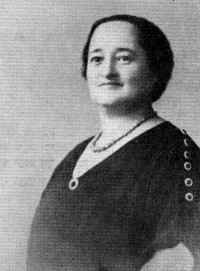
by Dr. Rivke Shterman-Ginzburg
(Montreal, Canada)
My Little Town Kobryn (A Bundle of Memories from Former Student Years)
Translation from Yiddish by Beate Schützmann-Krebs
It is painful to write memories of a bygone youth – vanished, carefree years, sweet dreams, hopes that have been swept away, and all kinds of other youthful experiences. Still more sorrowful is to recall the lost home, where the little cradle once stood; the hometown that was torn out by the root and dragged with it into a dark abyss, the entire Jewish community, which perished through all manner of mises meshunes [unnatural deaths], suffering, and pain!!!
|
|
I am grateful to the friends in Buenos Aires who are engaged in publishing the Memorial Book of Kobryn – my hometown, my unforgettable “Belz”[1] – for encouraging me to write a chapter of memories from that past which, although not very distant, nevertheless appears today entirely dead and vanished. For the last thirty or forty years have clothed the world in a mantle of age and have placed humanity before such bitter and unexpected problems that one could not have foreseen them for generations and generations…
I will at once apologize to the dear readers for the perhaps too personal tone that I strike in these lines. But whose pain is as great as the pain over an entire family, over an entire town – which, incidentally, was a prominent mother-city of Jewish life, an ir ve-em beYisroel – a pain over an entire vanished world, which has forever wounded the soul and left behind an endless sea of tears and blood?!…
I search and probe my own soul now, and I see the torn threads that once bound me to every little house and every little alley in my hometown, Kobryn.
Here I see, through my imagination, our own small but clean little house, with my parents, sisters, neighbors, children, and the whole surrounding world. Here rise up in memory the youthful years – the best, more mature years – when one had already been privileged to study abroad and would come home only in the hot summer months, for a few sweet, counted weeks.
One would come to warm oneself spiritually beside the mother, eternally worn down by toil, who – although she was a simple, old-fashioned Jewish woman – was nevertheless endowed with a rare grace and beauty, with a wisdom that many men would have been happy to call their own, with a mind full of constant worry and concerns for livelihood, and with a book of debts: how much each porets – the Polish estate-owner – owed her for his purchased goods, such as shot hares, dairy products, and other provisions, which were also supplied to the grazhdanski klub [civic club] or to the military…
Already with the early-morning clatter, my mother would get up, for people would constantly come calling and asking after her – after the frail Ester Miriam, may she rest in peace! She was the life-spirit of the entire family: the provider, the caretaker, the one who had to marry off children and see to it that they were supplied with every good thing.
[Page 178]
And just as our little home was filled with sweetness and charm, so too was the entire surroundings: the green meadows and fields dipping themselves into blossoms; the woods around the shtetl; the dear little river – the Muchaviec – the enchanting moonlit nights when we would stroll until bright dawn along the so-familiar Vlodaver Highway [the road to Włodawa]…
Back then it seemed that the shtetl's idyll would last forever, that one would always be able to come and refresh oneself a bit, to recall those tender, quiet childhood years… Who would ever have imagined that from all of this – from the entire birthplace – everything would run out like a stream, or turn into one great beys-oylem [Jewish cemetery], leaving forever in one's heart and soul an empty pit, a desolation for which there is absolutely no name…
Surely one dreamed, not once and not twice, that in later years one would still hold fast to the sentiment for the old home, that one would return there to refresh old memories, to recall forgotten friends – at the very least, that one would be able to visit the precious graves where the bones of the unforgettable parents, relatives, acquaintances rest… But everything was torn away in an instant! Over the entire past hovers one great abyss! No one remains! Nothing remains!
And so I carry within myself my own beys-oylem in my heart, and I drag along in memory the names of the nearest and dearest – friends and companions, neighbors and good acquaintances. The murderer devoured them all! All were cut down so prematurely…
Kobryn was never a large city. The stamp of “province” lay poured out over it through all its years. Yet it had something specific within itself, something of a kind that cannot be expressed in words. The simple and honest Jews, their hard struggle for parnose [livelihood]; the constant running around seeking gmiles-khesed [acts of practical kindness] from one person to another; the caring for a sick Jew or a woman in childbirth; the old hekdesh [communal shelter] that was supposed to serve as a home for the aged; and dozens of other memories that now come to mind – all of this awakens a great wound and carries me back to those old, far-vanished childhood years…
There was no stiffness, no tension such as one sees in the big city. Every Jew – even a completely “proper” balebos, a wealthy man, even a balguf [a stout, heavy-set fellow], as Mendele would have called him – was nevertheless always regarded as a simple human being of flesh and blood.
On Shabbat and holidays people would go to one another for kiddush, or simply to spend time together. Jews from the study house would gather and talk and learn, or speak about the rabbi, the khazn, the town shames, and just about communal matters…
I recall once a Shabes Bereyshes [the first Shabbat after Simchas Torah, when the Torah reading begins anew] in our large house. It was something of such a kind that does not leave my memory. My father, Avraham Yitskhok – an old Karliner Chasidic Jew – would invite his Chasidim to us on Shabes Bereyshes for a kiddush. Naturally, the entire Chasidic shtibl would come to us, and my mother already knew how to prepare for them kol-tuv [every good thing]. There would be fish, cholent, kugl, stuffed chicken necks, cakes and pastries of every sort, and certainly the proper bit of mashke [liquor], of which a Chasidic Jew never refuses…
Right after the prayer, they would crowd into the house with a cheerful “Gut Shabes,” with a little tune, lightly hopping along to it. Right away one would make the brokhe [blessing], and Jews who knew the shvartse pintelekh (the printed letters) would let themselves into a conversation – often into a sharp Talmudic argumentation – and in this way they would constantly speak divre-toyre [words of Torah].
A little later they would draw out, slowly and at length, a Karliner or Stoliner nign [melody], and they would enter into religious fervor. Then the mood reached its apogee – or, as one says in plain Yiddish, its kulminatsye punkt [culmination point]. They would begin finishing off all the foods – the cholent, the kugl, and then let themselves go dancing. A long line of Chasidim, with one man's hand on the next one's shoulder, would hop and dance, rhythmically and to the beat, with the melody of an old Chasidic nigun, their eyes closed, truly in religious ecstasy, which one could only notice among the great Chasidim.
The hisloyves [religious fervor] had no limit, and from dancing in the narrow rooms they moved on to dancing on the tables. Light as feathers their feet lifted,
[Page 179]
and singing zmires [Shabbat hymns] and all kinds of nigunim, they danced their way in like this until far past midday.
Even today the lingering sounds of those sweet melodies ring in my ears – melodies that engraved themselves forever into my heart and mind… Quite often a melody rises up in memory, one that I haven't heard for four decades… And what was actually in those melodies? They weren't a Tchaikovsky or a Bach “symphony” [i.e., high classical music]; they were even often monotonous. But it seems to me that the most capable and gifted musician or composer could never have reached the depths and sweetness of those Karliner nigunim…
And who wasn't among that dancing Chasidic crowd on Shabes Bereyshes? There was Eli the Blond – the clever, sharp mind with his red beard; Reb Osher Volinyets; the good-natured, tall fellow with the broad shoulders; and Reb Moyshe Goldin, the aristocrat among the Chasidim, whose garments sparkled with elegance and splendor. His tall, slender figure and his whole majestic appearance fit wonderfully with his graceful dancing, during which he looked like a prince among the Chasidim.
Incidentally, his house, his family, the upbringing he gave his children – all were well known to everyone. I can in no way forget that remarkable episode when his granddaughter Miriam threw a hand-grenade at her attacker, when she realized what lay before her – and she was, of course, torn to pieces!…
The fate of Reb Moyshe Goldin has also remained forever concealed, for during the First World War he was torn away, carried off to Russia, and to this day no one has ever heard from him again. And so I recall Menakhem Margolis, a Jew, a bal-tsedoke [a charitable man], a wealthy man – whose house was the very embodiment of charity, of secret giving, from which a poor man never went away hungry or naked.
Yes, these were Jews whom we will never see again, for they were the last Mohicans of generations that will never return! It seems to me today that one Shabes Bereyshes in the old home of long ago, in my little town of Kobryn, was filled with so much Jewishness, with so much beauty and love from one person to another, that today no college can demonstrate it, no society, organization, or even a beys-medresh [study house] in the new American world, which has been emptied of everything that was once so enchantingly beautiful, truly Jewish, and poured through with grace and loveliness …
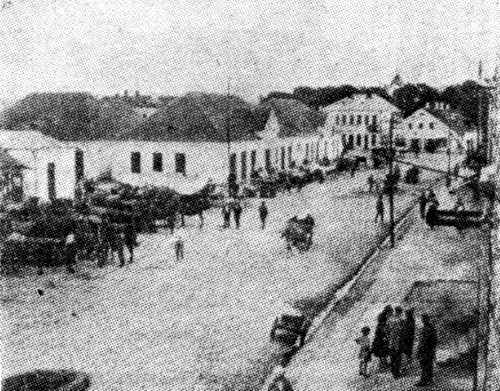
But let us return to the town. The little river Muchaviec divided the town into two parts, joined by a wooden bridge that, whenever a heavy freight wagon with flour, or heavy logs, or even a drozhke [three-wheel horse-drawn carriage] drove over it, made you feel certain it would break apart…Yet people strolled across the bridge, arranged rendezvous, and from there set off onto the Bitshevaya[2], which stretched out on both sides of it.
It is hardly necessary to add that this was a remarkable combination created by nature itself, where trees and greenery were reflected in the still waters of the Muchaviec, and young, warm hearts beat in rhythm with the gentle waves – waves that at times gathered themselves when a little wind blew stronger, or when a boat passed and disturbed the menukhe [calm] of the surface…
Let it therefore be recorded here that the bridge served as a strolling-place, where people most often met or formed new acquaintances, and from there one would go off wherever the heart pulled. In this way both the bridge and the Bitshevaya became the “property” of the Kobryn youth.
There one could hear quiet declamations of Pushkin's or Lermontov's poems; simple folk would hum hemerl, hemerl klap![3] [“Little hammer, little hammer, bang!”]; or one might hear broken chords from Di Shvue [The Oath, the Bundist hymn], and the like. More than once, on the Bitshevaya, one could hear sighs and sobs from disappointed souls, and even see tear-stained faces trying to hide their heavy moods…
So it buzzed there like in an anthill – both on the bridge and on the Bitshevaya – and footsteps could often be heard late into the night…
[Page 180]
Kobryn was also not spared from major fires. It was as if some fate pursued it, and every few years the flames would consume either half the town or a large part of it, so that by the time one section had been rebuilt, people already had to think about how to rebuild the other.
Naturally, after each pozhar [fire] one would see new construction – finer and larger – but not everyone was able to manage that. Still, after every fire the town emerged more beautiful and more modern, and when Kobryners wanted to recall a certain event, they would say: “Dovid left for America exactly a year before the first fire, and Etl left two years after that pozhar…”
All major or minor events were remembered and referred to according to the size and the date of the fires, which tended to break out periodically every few years.
A separate chapter should be devoted to describing the Kobryner fire brigade – or, as they called themselves then, the volne pozharne komande [volunteer fire command] – but I will leave that to others who have a better memory than I do, or perhaps took part themselves in the work of extinguishing the fires. In any case, it is a very interesting chapter in Kobryn's Jewish life.
Every time I left Kobryn for my studies, I would take leave of my parents and sister with a silent prayer that at least no fire should break out during the season.
Recalling my student years, I think of the friends and companions who studied together with me – though not all in the same city and not all in the same course. In Kobryn, people looked at us students as “the chosen ones,” for each of us wore a particular uniform: one wore the dress uniform of the Kommercheski Institut [Commercial Institute] in Kiev, which looked practically like that of a general with its epaulets; another wore a blue shoulder strap – the insignia of Moscow University – where he studied medicine; another wore the uniform of the real-shule [state technical secondary school] with its yellow buttons and shoulder straps; and yet another came from the commercial school [a business-oriented secondary school]. All together we formed a kind of distinct “intelligent caste” during the summer months, and it was lively and cheerful among the ranks of the student youth.
While the parents sweated in their shops, burdened with worries – that a bill was coming due and there was no money, or that a parcel of merchandise had to be picked up at the post office, or a shipment from the railway, and there was no cash – the young people would take off in little boats or wander into the dense thickets and amuse themselves, often until late at night.
During the day, when one wanted to rest a little after a sleepless – or not-quite-slept-through – night, people would go out to the Vlodaver Highway, and from there wander off somewhere into the deep grass, onto a meadow, and lie down to read a book. Kobryn's streets also did not remain empty on those beautiful summer evenings – especially Ratner Street, Suvarovske, and the others – which would listen to the various romances and old songs.
And what could be more delightful than bathing on those hot summer days? Every summer morning we were pulled out of bed and drawn to the river to bathe, then to stretch out on the beautiful bank and refresh ourselves with the crisp, fragrant air. My childhood friend, Fanya Fyalkova (today a dentist in Moscow), shared most of these pleasures with me. But other friends of my age also took their place in my young life – among them the very gifted Dora Kartsinel, who, besides being highly educated, was also strongly musical and had a weakness for playing dramatic roles… Dr. Mordekhay Milner, Dr. Velvl Pribulski, and others formed a kind of amateur art group in Freydkes' hall, and we often put on performances – naturally, as amateurs.
Of the entire Kartsinel family, sadly, only the sisters Ida Rozen and Polya Rip remain – both in Montreal; one sister, Sheva, in Moscow; Roze in Haifa; and Yakov in a kibbutz near Haifa.
Our kruzhok [circle] later gained even more importance because, during the German occupation in the First World War, almost all of us worked as teachers in Alkhovitsh's
[Page 181]
Pro-Gimnazye [pre-gymnasium], where Engineer Levitos also worked as an excellent pedagogue. I must also mention the daughters of Khane Zaritski – both dentists – who were part of our circle, and in later years Dr. Liberman, Dr. Yoshke Pribulski, of blessed memory, and many others who gave Kobryn a special brilliance during those beautiful summer vacations.
Love was always at the top of the daily agenda for Kobryn's youth. This “weakness” spared neither Jews nor Christians, neither the young nor the older. Every now and then one would hear about a suicide because of an unsuccessful love affair, and when one looks today at American Jewish – and even non-Jewish – youth, one sees the enormous difference between the small town of long ago and our great cities – New York, Montreal, and surely also Buenos Aires, and so on.
Today there is no love in the literal sense, as there once was. That great, sacred institution called “love” has weakened; no one sacrifices himself, God forbid, today for a girl, nor a girl for a boy… Everything is ordinary, cheap, evaporated, and it seems that the sacred trembling of love that once fluttered in young souls has disappeared forever… Today's youth also wants love, but everything is so cheap, so banal, so superficial that it reveals a simple “bankruptcy” of the once-sacred love, for which one was ready to give up one's life…
A heaviness would settle on the heart when summer began to slip away and the new school year approached. One had to take up once again the packing and the road – some to Warsaw, some to Lodz, some to Kiev, and some to Moscow. One felt that everything has its time: a time to spend pleasantly, and a time to study. And yet one did not want to leave the sisters and Mother alone, and more than once my mother's words still echo in my ears: “Got fun Avraham, fun Yitskhok un fun Yakov, der liber Shabes-koydesh geyt avek [God of Abraham, Isaac, and Jacob, the beloved, holy Shabbat is going away]…”
Remembering the Kobryner Shabbat in our home tears my heart apart. Even now the four brass candlesticks still flicker before my eyes – the ones in which my mother, Ester Miriam, blessed the lights her entire life, and which are never missing from my own Shabbat-holiday table whenever I must recite the candle-blessing…
These brass candlesticks are, for me, a wellspring of memories – of good and of difficult recollections. The lights do not let me forget the many experiences of our Kobryn, and especially that these four brass candlesticks, after they had served their role at various simkhes [celebrations], tnoim [betrothal agreements], khasenes [weddings], and other joyful moments, also served as the final companions of my mother's precious soul when she breathed her last…
And just as Shabbat refuses, in any way, to be removed from memory, so too does Eve of Shabbat, when the Kobryner Jewish women would busy themselves with shining their pots and pans – specifically at the Muchaviec. The whole Eve of Shabbat would be reflected in the river; there they would also wash and rinse the little children's heads in honor of Shabbat.
That is why, already on Friday night, people would sit on the frizbes [wooden benches], near the freshly spruced-up, cheerful houses, and remain there until late in the evening – until they practically fell asleep. From some of the Chasidic windows the sound of kiddush or of zmires [Shabbat hymns] would still carry, while others were already half asleep.
In the early mornings my father, of blessed memory – the Karliner Chasid – would rise very early every Shabbat and sit down to review the weekly Torah portion aloud, and his voice would mingle with the birdsong that drifted from the nearby tree beside our house.
The magic of the summer evenings, especially on the Shabbat, had no equal. The sky was red, like purple; the sun would send its last rays as a greeting, sinking lower and lower. The little river would “ignite” in the last fading rays of the sun. From the other side of the Muchaviec there would drift torn-off sounds of a clarinet, or a shepherd's pipe, as he hurried back into town with the herd of animals…
Even making havdole [the ritual marking the end of Shabbat] was no simple matter… For example, when Shmuel Mordekhay Pyalkov (Terkel) would make havdole, his hoarse voice would tear through doors and windows,
[Page 182]
and his singing of zareinu vekhaspeinu [“our seed and our money”] all the way to the end would carry far beyond the borders of Klashtorner Alley… And he truly had something to sing about, for he had a house full of children, and a large drawer full of money – not only for himself, but also to lend out on interest, from which he earned a very fine livelihood…
All these memories would usually come up whenever one had to leave Kobryn and travel off into the wider world. One would immediately begin thinking about when one would return home, to that small, beloved town of Kobryn. Usually one would come back for Peysekh [Passover], and that holiday was truly the greatest source of joy and profound experience.
Whoever has not lived through a seder in our home, has not soaked himself in the splendid melodies of Ekhad mi yodea [“Who knows one?”], or Adir Hu [“He is mighty”], or Khad-Gadya [“One little goat”] – he knows nothing of a seder's beauty. Those Karliner melodies should have been immortalized on record, for they nourished the soul for almost an entire year… To this very day, those sweet, heartfelt seder melodies accompany me – melodies that I would not trade for the finest classical compositions.
I also want, in passing, to give a characterization of the Karliner Chasidim. My father was by no means, God forbid, a fanatic, although he was entirely absorbed in Chasidus. He would, for example, enjoy having a long conversation with the young fellows who would come into our house, where there were three daughters, young girls. But instead of encouraging a young man to come in, my father would actually show a certain indifference…
For example, I remember how he once spent time with Yakov Yitskhok Yafe, the former great Hebrew teacher and Talmudist, who used to come into our house. And after they had gone through a certain Talmudic matter together, my father said to him: “Well, the other young fellows come because of the girls – so what do they understand? But you, who know the the shvartse pinetelekh [printed letters], why do you bother with girls?”…
Nevertheless, Yafe did not let himself be deterred and continued to come into our room… My father did not feel ashamed and simply showed admiration for the young men – those who were “candidates” to become bridegrooms for our sisters…
Yes, all of that was beautiful and dear, and as I recall it now while writing this chapter of memories, a deep sadness settles over my soul. Where has my hometown Kobryn gone, with its Jews? Where have the fine Kobryner balebatim [respected heads of Jewish families] gone, the Chasidic Jews who were renowned for their heartfelt warmth and hospitality toward guests? What has become of all the Kobryner rabbis and rebbes, who held the upper hand in our community? And where are my youthful friends – all those mentioned earlier: the refined and gentle Dr. Mordekhay Milner, Dr. Pribulski, the nurse Dora Kartsinel, my colleague Dr. Blumke Antopolski, who kept gathering dollar upon dollar and had managed to save a considerable sum, until she was, alas, murdered with a cruel death by the Nazis, may their name be erased!…
Also the image of the young dentist Ana Irger and Moyshe Gibgot, and the many good friends of our home – of my sister Asne, may peace be upon her, and of my parents, of blessed memory … A piece of life went away with them and with the entire vanished, exterminated Kobryn!
I remember my last visit to Kobryn, already very shortly before my departure for Canada; the house was full of friends and relatives.
Here sits Moyshke Palyer, my cousin from Pinsk – a clever Jew, a man of real intellect, though a truly miserable pauper, poor in the worst way. And before my eyes now flickers the image of the beautiful Kravetski family (from my mother's side): Aba, Yente, their daughters Gitl, Esther, and Soreke, and their only son Berl, who brightened the house. We sat and recalled our cousin Yisroelke Furmanovitsh (today in Buenos Aires), and other relatives of the family… There was not the slightest doubt that we would see them all again – alas, misfortune struck.
A piece of history lies behind me, an entire eternity, and still my soul cannot make peace with the thought that everything is lost and gone forever!!! One cannot believe that such a thing could have happened – that everything could perish at once and leave behind one vast desert, or a cemetery in the heart!!!
But alas, so it is, and may history judge what justice means, and why such
[Page 183]
beautiful old Jewish communities of a thousand years had to be wiped out, leaving behind only a lamentation for generations!!!
Yet those who, thanks to their fortunate destiny, did escape the tragic decree will never forget Kobryn, and may my few lines serve as a kadish [memorial prayer] for my shattered hometown, which has found its expression of sorrow in this Pinkas [communal memorial volume] that the Kobryner Jews in Argentina are now publishing.
Translator's Notes:
by Sonya Avram (Tshako)
Translation from Yiddish by Beate Schützmann-Krebs
|
I
Ah, how I am drawn back II
I long – III
I recall – our honored friend IV
Ah, how I am drawn to that place – V
Everything stands before my eyes – VI
And how delightful it was – in all its reaches – VII
There! Running to the river to bathe – in fullest measure – VIII
Ah, where is Margolis' Barracks – that array IX
I long for Mitsrayim Lane – that place X
God, You great One – XI
Where is my home? Where is my friend? |
by Khane Shtilerman
Translation from Yiddish by Beate Schützmann-Krebs
Memories written with tears about my beloved, unforgettable home-town Kobryn.
As a child I once heard a very good word from the old Kobryner rebbe, the sage Reb Pinyele, of blessed memory. He said that in the name of the town “Kobryn” there is a meaning for each letter – for example, kol be-ramah nishma [“a voice is heard on high”]: the voice of those who sat day and night and learned; the voice of the children learning Torah; the voice of the prayers of the worshippers in all the synagogues – all expressing kol be-ramah nishma[1].
Now, to our great sorrow, every letter of the word “Kobryn” carries a mournful meaning: keyver neshomes – a grave of souls. All the dearest and most beloved ones we had there have been turned into a keyver neshomes.
The old cemetery, with its little Ohels, told us about the famous tsadikim and sages – the authors of various religious books who lived in Kobryn. And the gute yidn of our own time – the Chasidic masters: Reb Dovidl the rebbe, Reb Noachke the rabbinic judge – pure tsadikim. The Kobryner rabbi, of blessed memory, and all the people of Torah gave us honor and pride.
I remember the old synagogue on Pinsker Street, which had a reputation as one of the oldest synagogues in Poland and even in Russia. It drew the attention of historians, researchers, and artists. Priests and writers used to visit it, photographing the antique objects – the wonderful holy ark, with its two great lions, which were made so artistically.
I remember that during the First World War, when the Tsarist army was leaving our town, one of the departing Cossacks – a great tsoyrer ha-Yehudim [enemy of the Jews] – poured kerosene over the old historic synagogue and wanted to set it on fire.
The sexton of that time, a very pious Jew, placed his hands against the synagogue, bracing himself in front of the wild Cossack, and said:
“Harge mikh beser un farbren nisht di shul [kill me instead, and do not burn the synagogue].”
The words, it seems, had an effect. The Cossack struck the sexton several hard blows with his whip, and then ran off by himself.
Even the shrapnel that struck the walls of the synagogue did not damage it, and the people who hid in the synagogue while the battle was in full blaze were not harmed at all.
Our town Kobryn was a prominent Jewish center. It made its voice heard – its distinctive Jewish tone – in the general concert of national Jewish culture. It sent its youth, its sons and daughters, to all the larger Jewish communities of the world to build and to struggle for our new national-Jewish life and for our rights.
None of the Kobryners ever forgot our beloved home – where we spent our childhood years, where we lived out our youth in song and dance – there on Potshter Street, in the Guberniya district, on that beautiful promenade, or by the broad Muchaviec River, bordered on one side by the so-called Botshvenik[2], where young and old strolled on Shabbat afternoons and in the evenings, when the moon was reflected in the water.
The youth, standing on the Muchaviec Bridge, spun their dreams and thought about their sweet future. The river – with its barges of timber floating toward Danzig, and with the peasants' song Ey, Dubinotchka, hatsma – filled everyone's hearts with hope and joy. The running water, always flowing on its way toward the Bug, refreshed them, and so did the taste of its fish – the koresn (crucian carp) and shleyen (tench) – which the young people would catch with simple fishing lines and proudly bring home for their mothers to fry or cook.
Before my eyes floats the image of the whole town. The bridge separated the town from Zamuchaviec, the street leading to the barracks and to our steam mill, and the second street leading to the train station – the Bobruisker Street, the marketplace with its shops, from which all the Jews made their modest but ample living. I remember that not far from my father's house, may he rest in peace, stood
[Page 185]
the great sobor [Russian Orthodox cathedral], and beneath the sobor the boulevard, the duma [town hall], the post office, and other municipal buildings.
|
|
All this was annihilated by the wicked Hitler and his murderers.
God's wrath poured itself out upon everyone; all were killed – no one was spared, not the elderly, not the nursing infants; all were shot. Many of those shot were buried while still alive. The wind carried to us the stench of that blood-soaked mizbeyekh [sacrificial altar]. Who can possibly convey, and who possesses the language to express, the impressions each person
|
|
[Page 186]
felt when the news reached us.
I see before my eyes our beloved town; I see its streets, destroyed and laid waste. A few buildings that remained standing rise among the ruins. Around them reigns a deathly silence. Where once there was a Jewish home, there is now a heap of collapsed walls.
I have read letters from landsleit about the murdered and tormented lives of our own people. We must give our oath – swear by their radiant figures, which hover before our minds and bleed within our hearts – that we will continue the struggle.
Wherever we may be, we will fight for those great ideals for which they lived and for which they died as holy martyrs. We will fight for those great human ideals that make the Jewish people ever-enduring; we will fight for Jewish life throughout the entire world, for the eternal struggle for justice and for freedom, for only in this do we see the national meaning of our existence as Jews in the world.
Blessed be the name of our holy martyrs.
Translator's Notes:
by Tevl Goldshal
Translation from Yiddish by Beate Schützmann-Krebs
My memory leads me into the labyrinth of my youthful years. I walk up, with pride, onto our Kobryner bridge and feel stirred by our Jewish boldness, which managed to erase the old Jewish timidity, radically changed the Jewish approach to problems, and – instead of fearfulness toward non-Jews – brought forth courage and valor.
I remember with precision; I was an eyewitness to Jewish daring and success.
I was still a young boy then; it was on a fair day. The market was filled with peasants' wagons and traders from the surrounding area, and people were pushing, forcing their way through the crowd. In this tumult, Boyner's son – a young kosher-slaughterer apprentice – took a bit of hay from under a peasant's wagon for his own horse's cart. When the peasant saw this, he raised a loud outcry and threw himself upon the boy to beat him.
Other peasants ran over to help the non-Jew.
My heart clenched. I was trembling, certain that they would trample him. But I was immediately astonished, for the boy apparently never even thought of running away; instead, he stood up boldly against them, and whichever peasant came near him was sent off at once, bloodied, shouting a stream of curses and a loud bozhe-moy! [“my God!”]. Only then did Boyner's son take flight, when the whistle of the Russian gorodovoy (policeman) was heard nearby – he had come running at the report that peasants were being beaten.
It then became clear that the Jew had no fear of matching himself against the goy, holding himself back from such boldness only – and exclusively – in the presence of the government's authority.
More than once I had occasion to see how our so-called “weak Jews” would band together in the priziv-teg – the days of military conscription – when the Christian youth who had been given over for army service wanted to let themselves go once more and would attack the poor market women in order to rob them. At such times our wagon drivers, porters, and ordinary Jews would let loose and really lay into those lawless youths, giving them a brutal beating. The shkotsim [rough non-Jewish youths] would scatter like mice.
When I grew older and began taking part in the Kobryn football club HaKoakh[1], I more than once found myself in fistfights with shkotsim, especially when our club found itself in a dominant role in a match against the Polish club Stshelets [Strzelec] or another one.
Rarely did a match end normally, and to tell the truth, I must say that we Jewish youth never left the field in disgrace, but always stood our ground and paid back in the same coin – and sometimes even harder.
Translator's Note:
by Yakov Zaltsman
(Montevideo)
Translation from Yiddish by Beate Schützmann-Krebs
I spent my childhood years in the religious Hebrew Tvune school. When we finished Tvune, some of us went off to study at Takhkemoyne [Tachkemoni] in Warsaw; others, the more religious ones, went to the yeshiva. I was among the religious boys and entered the yeshiva ketanah – the small yeshiva in Kobryn – under the leadership of Rabbi Pesach Pruskin, of blessed memory.
After studying a year in the yeshiva, a group of us went off to the Kletsker yeshiva under the leadership of Rabbi Yitzchak Elchanan. Among us were young fellows who later received rabbinic ordination, such as Meir Pantol from Brisker Street, a tailor's son, and Markl the Soyfer's from the Narodnikes[1].
I studied in the yeshiva only one year. Because of my mother's death, I had to break off my studies and come home. Then a new chapter in my life began. I started looking for a purpose and entered the ORT vocational school to learn carpentry, which was run by Kiselyov. My physical strength wasn't up to it, and I had to stop my studies.
Around that time, the work of electrifying the town began. I started working on that project. At first I worked with the electrician Gedalya Bil from Brisker Street, and also with the local outdoor laborers from Brisker Street. Later I worked for the engineer Zaritski, and that's how I began to earn my bread.
Socially, I joined the emerging Hechalutz Hatzair [The Young Pioneer] group and became one of its first founders. We established the movement at the home of the Loyfer family on Narodnikes Street.
Among the elder chalutzim were: Ben-Zion Pantol, Pintshuk, Isser Zbar, the Loyfers, and others.
The Chalutz movement grew, and in the locale on Klashtorne, at Shmerl's near Terkel's, the party Poalei Zion–Tze'irei Zion [labor-Zionist party and its youth movement] was established, along with the youth group of the party.
The spiritual leaders were the comrades Pantol, Pintshuk, and Zbar. Among the youth were Moyshe Vaynshteyn [Weinstein] the printer, the Kalikhovskis, and myself. I was always among the left-leaning ones, supporting the Yiddish language at the youth gatherings. In Brisk I supported the left wing of Berl Locker in the matter of Yiddish and Hebrew in Erets Yisroel.
Being left-leaning, I became a member of the professional union. As an electrician I belonged to the construction union. The union included the furniture and finish carpenters, the locksmiths, the electricians, and the mill workers from the brick factories.
As a sympathizer of the left I was chosen as the technical secretary of the union. I also carried out the technical work for the Nutrition Union, which included the bakers, the millers, the meat workers at the slaughterhouse, the porters, and the carters. This was in 1926. I remember that among the youth in the Poalei Zion party, people suspected me of being a communist. The suspicion rested on the fact that the left had elected me as a technical functionary. They began distancing me from the leadership, and in the end I was expelled from the youth committee – and that, naturally, distanced me entirely from the work.
After the mass arrests of the Communist Party in 1926–1927, I was drawn into Komyung [local Jewish communist youth organization]. I became a member of the professional council of the red factions within the unions – first on Pinsker Street, across from the synagogue, and later on Brisker Mitsrayim Lane, near the Tsigelekh [family] from the matzah bakery.
There I became acquainted with political activists such as Meir Sondak the Shnayder [Tailor], Meir Likov the Tailor, and Shmerl Meysel the Tailor, and together with them we founded the city committee of Komyung. The meetings were held at Lukov's house, on Brisker Street,
[Page 188]
behind closed doors and shutters, with guards posted outside.
I remember that it was on January 1, 1928, before the major trial of the political prisoners in Kobryn. The trial took place on January 10, 1928. On the night of the 9th, we decided to hang up three red flags with the slogans: “Long live the Ratnfarband [Soviet Union],” “Long live the White-Russian Communist Party,” and “We demand the release of our political comrades.”
The flags were supposed to be hung as follows: one on Ratner Street, across from the police commissariat, at Birman's house; one across from the prison; and one across from the courthouse on Klastorne Street. On that same January 10, a demonstration was supposed to take place at the prison. On that day, the peasants from the surrounding villages gathered – it was the day of the Kobryn fair. But the plan failed: the comrade who was carrying the flags from Bolater village was caught, arrested, and beaten. More arrests began; several comrades were taken in, but they were released shortly afterward.
In 1928, elections to the city council were held. We – the Workers-and-Peasants Bloc, List No. 5 – put forward the candidacy of Grinberg from Pinsker Street and, if I recall correctly, a Christian, Sashke Karpuk from Zamuchaviec. List No. 5 won and succeeded in electing both candidates.
I remember the meetings of the city council near the boulevard, behind the monastery, where Menakhem Birman of the Agudah [here: Agudas Yisroel Orthodox movement] sat with his broad beard and presided over the sessions. As far as I recall, he was the chairman of the city council. Berl Palyer of the General Zionists, Dr. Pribulski of the Folks-Party, and Pantol of the Poalei Zion Party – all of them defended Jewish interests in Kobryn.
These are a few glimpses of the Jewish town of Kobryn, with a population of ten thousand Jews – Chasidic, Misnagdic, Zionist, and progressive Jews. The Jewish youth front shone especially brightly through its organizations, such as Hashomer Hatzair. When Lag Ba-Omer came, they would march out with Berviguken riding ahead on horseback, singing, proudly carrying their flags in front.
Our sports clubs – Maccabi, HaKoakh, and the heroic workers' youth – all of this together formed a magnificent, vibrant community, which was so brutally destroyed by the murderous German barbarity, may their name and memory be erased.
May the Jewish name of Kobryn be remembered for generations; may our children know their origins.
Translator's Note:
by Binyomin Bil
Translation from Yiddish by Beate Schützmann-Krebs
One feels compelled to record the episodes that have remained in a boy's memory.
Besides the youthful summer joys of swimming, going out in little boats, taking vitshetshkes [outings], or in winter walking around with lanterns and sliding on the frozen Muchaviec, I also remember the vicious, thuggish Polish security patrols, who begrudged the cooperation and camaraderie among the clubs and associations, showing their hooligan's mug at every opportunity for a freedom action. These so-called “visits” usually ended with brutal “honors” in the evenings, letting us feel the taste of their rubber truncheons.
The hatred-tendency of the military and reactionary clique was directed especially against the Jewish population, in order to divert the masses' anger from their own miserable economic conditions. The antisemitism of the elders carried over to the younger ones and even to the school youth. The hatred often found expression in stone-throwing by the Christian youth. Naturally, the Jewish youth did not run away; they would only do so in cases
[Page 189]
when it was a sheygetsl – a vicious brat who would beat someone so badly he could cripple him.
The same thing happened in winter, when the Jewish youth had to walk along Potshter Street on their way to school. They were pelted with snowballs by the Christian school youth who studied in the gymnasium across the way. Here, too, the Jewish sense of self-defense did not leave the reaction without an answer.
I also cannot forget the good side – the side of shared consolidation, of common interests among the oppressed and exploited, both Jews and Christians, who found a common language, understood one another, and formed friendships, grouping themselves together in a single union-association with universal human ideals, in order to struggle jointly against the enemy of freedom – against fascism, whether open or disguised – achieving considerable success in this sphere.
by Sam Glas (Bebl Glotzer),
New York
Translation from Yiddish by Beate Schützmann-Krebs
On Ratner Street, next to the market, there was a building. Below, there was a billiard hall, and above it a hall for simkhes [celebrations], and from time to time actor troupes would tour there and give performances.
Once it was announced that they were going to show “moving pictures” there. I was a small boy then, and I had a quiet longing to see such a performance for the first time. On a beautiful day I slipped away quietly to that hall, and with my saved-up money I bought myself a ticket and went inside.
The hall was filled mostly with children, and for the most part Jewish ones, who were just as curious as I was. On the screen they showed a picture – I don't remember the name – but we all enjoyed ourselves immensely.
Suddenly the screen fell down, and in the darkness I noticed a kerosene lamp burning on the stage. But the audience thought there was a fire and began shouting “pozhar!” [“fire!”]. A tumult broke out, and people started pushing toward the exit. The panic grew; they ran, stepped on one another. I remember how I stood up on my bench and tried to calm the crowd, telling them that there was no fire, only a lamp burning naturally. But it didn't help at all – everyone was frightened, confused, and ran down the stairs. Many children were trampled there; several were injured.
A boy, Binyomin Zorekh's son – the tailor's child – was killed. I was the last one to leave, and for a long time afterward I avoided, and was afraid to go anywhere where masses of people were gathered.
Translator's Note:
by Yakov Begun
Translation from Yiddish by Beate Schützmann-Krebs
It is now twenty-seven years since I parted from you, with the hope of seeing you again together with all those near and dear. A dreadful catastrophe shattered my striving. My hopes were destroyed. The brown beast murdered our Jewish Kobryn and wiped out our expectation of ever seeing you again.
Beloved hometown Kobryn, how magnificently you are engraved within me, within my innermost life. Like colorful spring blossoms you appear in my memories. Kobryn, you are the most beautiful chapter in the book of my life.
You nurtured a compact Jewish population of ten thousand souls. Generations upon generations were formed in your splendid embrace – developing, struggling, striving, suffering, and rejoicing under your great, warm, cozy shade. Even more beautiful and more splendid you appear to me in the kidesh-hashem [martyrdom] radiance of your dreadful destruction.
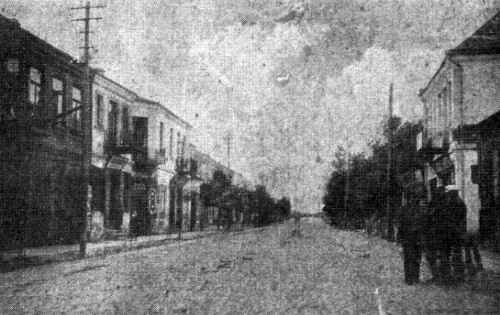
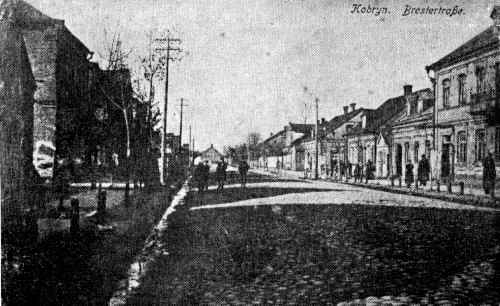
Brilliant little leaves of memory mingle within my recollection. Here I see the homelike, lyrical panorama of our Brisker Street, the main entryway from the west, from the Brisker Highway. Through that very route moved the currents that wrote history and united the strivings and struggles of Berlin, Moscow, and Warsaw.
Tatar and Swedish armies tore their way westward, and along Brisker Street marched likewise Napoleon's invading armies on their way to Moscow, and their retreat – shattered – by the Tsarist forces.
The back-and-forth march of the armies in our own century – German, Polish, and Bolshevik – passed along the Brisker Highway, and this stamped Brisker Street with importance, from which later branched off the roads leading to Pinsk, Dyvin, and Kartuz-Bereze [today: Byaroza].
I cannot forget the dear and original, typically Jewish residents of Brisker Street. Here was Reb Ayzik the Red, or Ayzik the Blacksmith, almost the first Jewish resident at the entrance to Brisker Street, arriving from Brisk. A Jew tall and solidly built, afraid of nothing in the world. Many still remember and admire his strength. He settled in the very house on Brisker Street where a peasant, with an axe, had murdered an entire Jewish family.
That tragedy plunged the whole town into mourning. A special impression was made on us children, who remained constantly frightened and avoided passing that house and that area – until one fine day Ayzik the Red came and moved into that very house. That act of Ayzik's calmed us children. And just as we children felt, so too did the whole town feel proud of that Reb Ayzik. It strengthened the sense that we Jews are not afraid of anyone.
A cozy lane stretched from Ayzik the Blacksmith's house toward the town, passing the municipal hospital, the large gymnasium, and the very large barracks named for the Gibgot family, who lived next to the barracks. And despite the fact that Gibgot was one of Kobryn's wealthiest Jewish householders, he also occupied himself with agriculture, and this did not diminish his honor in the least.
Walking past Gibgot's house toward town, we come upon two lovely rows of houses, wooden and brick, headed by the white brick house, in which the post office had once been located. Next comes the cozy house of Itsikl the Milkman, who supplied dairy products to a good number of the residents of our Brisker Street.
Entering from the Vladover Highway – one of Kobryn's most beautiful strolling places, and the best route for learning to ride a bicycle – we encounter the well-known merchant's house of Shepsl Leah Rishel's (Shuler), facing
[Page 191]
the house of Shmuel “fun di breter” [the Lumberman].
A cozy path led a bit farther on to the Kobryn ostrog (the large stone prison), then to the wheelwrights and the shmayukes [local small craftsmen]. A little closer to town, facing us, stood the large steam mill of Pinkhas-Leyzer Lev, which was later called Breytbard's mill. As its neighbor the mill had the house of the uspravnik [police prefect].
Farther toward town the houses grew denser: the blacksmith's house, the house of Moyshe the Baker, the house of Doctor Malezhave, Shraybman's lumber yard, and the brick house of Maletski. It was a delight for us boys to stand under Maletski's window and listen to his daughters playing the piano.
Right after Maletski's house were the houses of the “Ketselekh” and of Lipshits the Baker.
And here we came to our well-known Mitsrayim[1] Lane, which had a distinctive, characteristic air of age and poverty. A legend circulated that explained the origin of its name. It happened during the first great fire that struck Kobryn. The fire had seized almost the entire town, and when it approached that lane, a woman ran about crying that her daughter was about to give birth there. In that same lane there was then the yeshiva of a great rebbe. When the rebbe heard this, he went out with his Gemore in hand and said to the woman: “Go home, deliver the child, and have no fear – this lane will not burn. It will stand as long as the exile of Egypt stood.”
The fire had already surrounded the lane from all sides when suddenly a heavy rain began to fall; the flames died out, and the lane emerged unharmed.
|
|
Years later another fire broke out, and again the lane remained intact. Even the fires set by the Russian army during its retreat in 1915, when they doused many houses with kerosene, did not damage Mitsrayim Lane. It remained whole.
People calculated and said that Mitsrayim Lane had already stood for some four hundred years. This was truly not an exaggeration. The windows of some houses were almost level with the ground, and the walls were warped and crumbling.
One had to admit that the name Mitsrayim Lane was perfectly suited to the lane's very look and character.
By Mitsrayim Lane stood the houses of the Orler – the bagel baker –
[Page 192]
the Goldfarbs, the Beguns, and the “Tsigelekh” family. They were the first to introduce machine-made matsah, and later Yakhe the Bakerwoman followed their example.
Next came the neighbors of the Brisker bakery: the Polip brothers, the Kamenetskis, the Bilsker baker, Epshteyn [Epstein] the pharmacist, and the blond tinsmith, with whom an incident occurred that was later printed in the newspapers. Namely, the blond tinsmith predicted years before the First World War that Poland would become an independent state. When his prophecy was fulfilled, he was rewarded with a medal and a lifelong pension.
The next neighbors, stretching toward the marketplace, were the Bils, the Moroz family, the “Kaiser,” and the tombstone engraver.
Of the two bote-medroshim [houses of study] that stood on Brisker Street, one was called the Brisker Bes-Medresh. The second was the Talmud-Torah Bes-Medresh, where the Kobryner Talmud-Torah[2] was located until it moved into its new building on Potshter Street, which offered far greater conveniences than the bes-medresh had in those days.
The new Talmud-Torah stood opposite the priest's garden, with Volfke Soloveytshik as its neighbor on one side and the Bezpaltshik family on the other.
|
|
As a pupil of the Talmud-Torah, I remember certain features of that learning institution. The Talmud-Torah was made up of five divisions (kites). In the first one the rebbe, Reb Yisroel the Maltsher taught – a small, slight Jew with a black beard. There we spent an entire year learning the alef-beys [Hebrew alphabet].
To reach the second division one had to go up the stairs to the first floor. There, the rebbe, Reb Shmuel the Grober, taught – a sturdily built Jew with a rough voice. He taught with great discipline, pounding the Torah into our heads. Whether out of fear or embarrassment – in short, one had to repeat the lesson until it stuck.
The third division was also on the first floor. Here taught the Berezer rebbe, who was somewhat sly and had a weakness for taking our toys, so that at the end of the year he could bring them to his own town and distribute them there as gifts to his children and friends. Many times we managed to get the toys back, quietly opening his box and carrying out the little theft.
The fourth division was also upstairs. It was led by the Shershever rebbe, a very capable teacher, who nevertheless had the weakness of pounding the Torah into us with a leather strap.
The fifth division was already almost like a small yeshiva. There the
[Page 193]
mashgiekh [Rabbinic supervisor] himself taught – a man who considered himself a rosh-yeshiva [head of a yeshiva]. I did not get to study with the mashgiekh, because the Talmud-Torah was closed in 1915.
With the entry of the Germans, the Talmud-Torah was transformed into a folks-shul [public elementary school].
In general, the Talmud-Torah had been a significant advance in those days. The comfortable rooms with fresh air all around were a great improvement over the former dark and stifling kheyder rooms. The Talmud-Torah also had a cellar downstairs, where on the Eve of Passover the utensils were made kosher. When the Talmud-Torah building burned down, the folks-shul moved over to Margolis' Barracks.
There are hundreds of features to recall and to preserve about our Kobryn. But sorrow presses in and makes the heart ache. It is hard to write with such pained feelings – yet the fact remains that Kobryn lives within us, and will remain in our memory forever, with a feeling of sanctity.
Translator's Notes:
by Henye Avrukh
Translation from Yiddish by Beate Schützmann-Krebs
With pain and with anguish I write a small page of history about my hometown, Kobryn. Pain for our dear ones who are no longer among the living, and anguish toward the robbers (may their name be erased) who murdered precious lives in a brutal manner. More than once I fall into deep thought, and before me there rises, alive, our beloved hometown with its paths and footpaths, its streets and little alleyways.
|
|
Fourteen years have passed since I left my town – my father and mother, sisters, brothers, aunts and uncles. A whole fabric of memories surrounds me. Every street, every little alley stands before my eyes with its gentle and romantic charm.
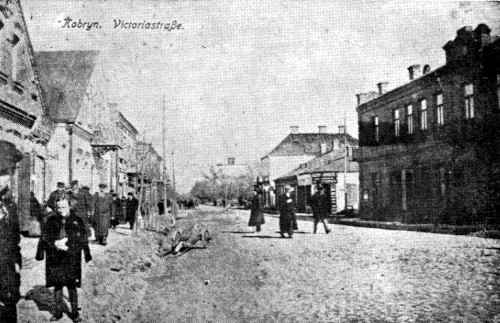
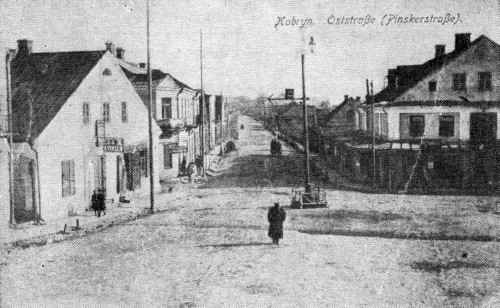
Here is the marketplace, the center point from which the streets stretched out: Brisker, Potshter, Ratner, Narodnikes, and Pinsker Street. The side across the river Muchaviec, to the south, was called Zamuchaviec and stretched all the way to the train station.
One reached Zamuchaviec by way of the Nyevsker trotuar [paved walkway], the main trotuar for the Kobryner strollers. Besides these larger streets, every street had little alleyways around it. I recall some of them, for not all of them had names:
[Page 194]
the Bath Alley, the Cloister Alley, the Talmud-Torah Alley, the Mitzrayim Alley, and so on. They stand before my eyes and remind me of the loveliest parts of my youth.
My memories lead me to Kantsiper's house, where I was born and raised. I remember how we children spent our time there; every season had its own games, some of which have remained deeply engraved in my memory, even though several decades have passed since then. In summer we would play Meti [a local children's throwing game], Tsaykhn [most likely a children's drawing game played on the ground], and Di Dame fun Linsberg [“The Lady from Linsberg,” probably a local children's dramatic role-playing game] and in the open air we played with chestnuts. Whole mountains of chestnuts we would bury in little pits in our yard.
We lived close to the town's two boulevards: the New Boulevard and the Old Boulevard. In the Old Boulevard, which was nearer to us, we used to play hide-and-seek. On the hot summer days we were constantly in the boulevard, under the thick branches of the trees, or by the little stream, splashing in the water the whole day long, until the mothers would come running to call us home to eat something.
In winter all the girls from the yard would gather in our house. Sometimes the boy Pinye Kantsiper (today in Erets-Yisroel) would appear at the window and frighten us with various tricks. We, the little crowd, would squeal – not knowing whether from joy or from fear.
Most of all, I remember the holidays in our Kobryn. Take Peysekh [Passover], for example – with such purity and beauty it was welcomed. Everything was made kosher, and the dishes for Peysekh were taken down from the attic. The house was scrubbed and washed. Weeks beforehand, the matses [matzah] were purchased. A sense of holiness filled the home during the sederim [Passover ritual meals], when everyone ate and recited the Hagode [Passover Haggadah]. My father and my grandfather, may their memory be a blessing, sat on the raised, cushioned Seder beds. I feel that I will never forget that holiday atmosphere in our home. My mother, may her memory be a blessing, with her delicious dishes, shone with deep parental joy.
After Peysekh came Lag ba-Omer, when the group of schoolchildren would go with the teachers into the forest. I remember very well those walks in the Patriker Forest. On Shvues [Shavuot] we children would tear off fresh greenery from the meadow and decorate the houses. Even on Tishe-b'Av, when everything was in mourning, we, the little crowd, still had a good time – throwing little burrs at one another, making ourselves merry, watching how one plucks the tiny burrs from the clothing and shakes them loose from the hair.
During the Days of Awe a sense of reverence hovered in the air: whole groups of women and men would gather, some in the bes-medresh, others in the shul [synagogue]. People went to pray that it should be a good year.
Simkhes-Toyre [Rejoicing of the Torah] was very joyful, when we, the little crowd of youngsters, would go to watch the yeshiva students dance with the Torah in the Khaye-Odem Bes-Medresh, the chasidim in the Karliner Shtibl [small prayer house], or in Reb Dovidl's Shtibl. It was joy that warmed the heart – even though the next morning everyone had his worries about earning a livelihood.
Khanuke [Hanukkah] was wonderfully beautiful, when father and mother, grandfather and grandmother gave Hanukkah-coins. Children waited for this the whole year.
A special spectacle was Purim, when Shimshen with his horn, together with Tevl the Blind and other poor fellows, would dress up as Purim players and go from house to house performing little plays.
These wonderful holidays surrounded us like a wreath of flowers – a chain of honest Friday nights and holy Shabbats that gave emotion and delight to our youth.
One cannot forget the Potshter Street, where in Margolis' Barracks stood the folks-shul [public elementary school], the vocational schools – the tailoring school and the carpentry school – where my father, Dovid Kiselyev, may his memory be a blessing, was an instructor in the carpentry school, and Khanele was an instructor in the tailoring school.
Like a beautiful dream, the time of the folks-shul passes before me. In that house I spent my years until I was eleven. What a life, what joy we children experienced there. How dearly we loved our teachers. I remember the vetsherinkes – little evening meals at school – the kestl-ovntn[1], and also the literary evenings arranged by the children and teachers.
Like a boiling kettle, everything bubbled in Margolis' Barracks during the day: the schools, the vocational schools, the orphanage, the Tarbut school [Hebrew-language Zionist school], and the Beit Yaakov school [religious girls' school]. In the evenings, Hashomer Hatzair [Zionist youth movement] with its dances and songs. People were merry,
[Page 195]
even though coming home one often found only a piece of dry black bread – yet we lived with delight and hoped for better times…
“Kinderlekh, es vet aykh nokh gut zayn [Children, things will still be good for you],” my mother, may her memory be a blessing, used to say – but sadly, she did not live to see it.
|
|
A joyful feeling surrounds me when I recall the lively quarrels between the Yiddishists and the Zionists, and the constant discussions about political and social problems. Speakers would come from Warsaw – Bundists, leftists, and Zionists. Almost every Shabbat there was a lecture.
I mentioned the carpentry vocational school, where my father was an instructor. After the First World War, the ORT organization spread a system of schools throughout all of Poland, including our Kobryn. There were orphaned boys who had no possibility of studying; they entered the vocational school.
Besides those already mentioned, wealthier boys also enrolled – those who wanted to emigrate and therefore learned carpentry.
I remember with what love and selfless devotion my father dedicated himself to teaching. Besides instructing his students in the trade, he also educated them as human beings. My father had only the schooling of a kheyder [traditional elementary religious school], nothing more – but he possessed remarkable abilities.
The vocational school, like all schools, had a six-week vacation. During that time he would travel to Warsaw for drawing courses. He traveled once to Warsaw and once to Vilna in order to perfect himself. He was, after all, not a fully trained instructor. Together with him, instructors from other towns would travel to take examinations in drawing; he always surpassed other instructors who had completed industrial schools.
My father would always come back with words of praise. I remember that once he was given a golden compass as a gift. As everywhere, our Kobryn also had its flaws. As soon as one person distinguished himself in some way, there were always those who begrudged him. My father had many enemies.
In every era there are people who love to be involved in communal affairs. Some do it for honor; others do it with a clear conscience, simply to help the community in whatever way is possible. My father was one who wanted to do everything for the community. Since his material situation was not good (I must admit that there was never enough for Shabbat), he
[Page 196]
understood the worries of the townspeople, and wherever he could help with advice or action, he did so wholeheartedly.
I will mention a few facts here: After the First World War, food and meat began to arrive from America for Rabbi Michael the dayen [religious judge]. My father was one of those who distributed these supplies. Now, years later, when our dear ones are no longer with us, I must admit that my father never sent any of these things to our home. There was not a scrap of meat in the house, nor any clothing. My uncle, Note Kiselyov (today in Philadelphia), went to Rabbi Michael and asked that something be sent to his brother as well.
Such was my father, although in Kobryn people imagined who knows what he received from all this. My father's income from the vocational school was much smaller than what he would have earned had he run a workshop of his own. But since it was a communal matter – teaching boys, mostly poor ones, a trade – he loved it with all his heart.
The vocational schools were founded in 1920. I was still a child then. But I remember well how dearly people loved my father. A small example: Every Purim, his students would gather, each bringing what he could, and present him with a shalakhmones [Purim gift]. Many of his students are here in Buenos Aires today. They surely remember it.
When the vocational school was founded, it was non-partisan. Later, the Bund took over control. My father, may his memory be a blessing, was a passionate Zionist his entire life, although he never propagated any party affiliation among his students. The Bund brought in another instructor from Vilne, and quarrels began, until the carpentry school went under in 1928.
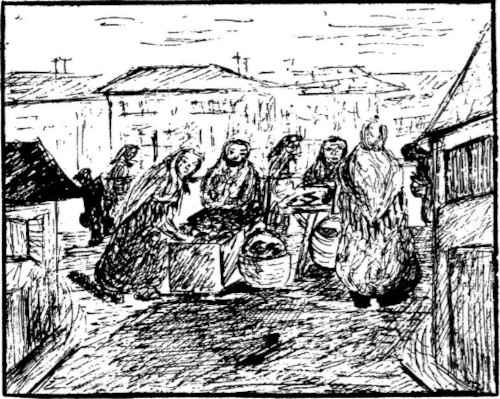
Let us return to our Kobryn streets. I mentioned the market. Like a dream, I see before my eyes the ring of kromen [shops] with the zitserkes, as they were called, who would sit around little tables selling fish, fruit, vegetables. I remember some of their names. Khane Reyzl the zitserke – her oaths and her scolding I recall well.
She was not to blame. Her poor material situation had brought her to it. A woman who had to raise children, do all the housework, and be the breadwinner.
The shleyferke [a woman who sharpened knives and tools], also a good Jewish woman, had to be both mother and breadwinner.
The Kobryn market day had a reputation. On market day it boiled and roared like in a very large city. Kobryn was a trading town. Peasants from the surrounding villages would come driving in with their wagons and set themselves up all across the market. At times one could hardly get through.
Our Jews made their living through trade. One managed to get by – abi gezunt! [The main thing was to be healthy]. And farther down Pinsker Street, on the Zamd, the market for horses and livestock would set itself up. Merchants from the large cities would come there.
Speaking of Pinsker Street, I recall my youth – how I lived and spent my days. I remember very well the Jewish Street, the ornament of our town Kobryn, where the old shul [synagogue] stood – renowned for the beauty of its holy ark and, in general, for the architecture of the shul. Whoever was in that shul saw and confirmed its beauty. The paintings of the shul could be compared to great works of art of today. It was the adornment of Jewish Kobryn. On Shabbat or on a holiday, packed groups of Jewish men and women would come to pray. A holiness hovered over our shtetl.
I recall the walks along Brisker Street on the Vlodaver Highway. The summer evenings on the Vlodaver Highway I will never forget – when groups of young people would let themselves loose, singing and dancing amid the beautiful nature.
Zamuchaviec, the second half of Kobryn, which was separated by the bridge, offered its own competition. Who among us does not remember the beauty of the Botshevnik, the path to the sluice at the river? How splendid, how romantic it all was.
I recall episodes from Klyaster [Cloister] Lane. Before Peysekh, when the snow would melt and the river would overflow its banks, it happened more than once that the lane was flooded
[Page 197]
and people had to travel by boats. For us youngsters, that was a holiday. We would not leave the place. Whole days we stood there, watching the evil wonder.
The river comes back to me – the beauty of our Kobryn summertime, when many people, after a hot summer day, would throw themselves into our Muchaviec to cool off a bit. In the evenings, groups of young people would let themselves drift in the boats and sing the most beautiful songs. Will it ever be forgotten? Never, never.
In 1934, Kobryn had a population of 10,000 inhabitants, Jews and Christians together.
When Hitler – may his name be erased – began his rampage in Germany, it also began to be felt among us in Kobryn. The economic situation started to grow worse and worse. Aside from a few wealthy men whom Kobryn had (Shnal, Fuksman, Mordekhay the Tailor, Yedvab from the mill, Yosl Kats from Alinitse, Gurvits from the sawmill, Yisroel Leyb Epstein), the great majority of Kobryn's Jews were in a pressed and difficult position.
|
|
Drawn by Fanny Glotzer |
A great many people began looking for ways to emigrate. The antisemitism kept growing. The majority of the Kobryn emigrants still hoped to come home again. One was drawn back to the birthplace, where – besides family – everyone felt bound to the place where one had spent one's childhood years, with its beautiful paths, gardens, lanes, and meadows.
Who could have dreamed then that my beloved parents, sisters, and brothers would perish so murderously? A death that I could not even mourn up close; a death that dried out my tears, so that I can no longer cry… even when I must. Great honor to their memory!
Let me recall my grandfather Shmerl, may he rest in peace, who was killed by murderous hands. A Jewish melamed [teacher], who lived in a period of strict piety. More than once, speaking with him, I would marvel at how much worldly knowledge he possessed. He would always tell me that he and a young man from the Gvirtsman family
[Page 198]
were the first to discover socialism. He would read Karl Marx's books on political economy and understand them like a modern young man.
There was one thing he held fast to – yikhes [lineage]. Hardly would he see me walking once with the child of a simple Jew, and he would not tolerate it. What a child had learned was not important to him; the main thing was that the father was an ordinary man, and therefore I was not allowed to walk with the boy.
My second grandfather: people called him Arke “fun di breter” [the Lumberman]. He used to buy the boards, and my grandmother Khaye, may she rest in peace, would take care of selling them. A Jewish woman, small, but clever. She had thirteen children. I remember that every Friday she would heat the oven and prepare a cholent for all the neighbors on the street. She considered that a great mitsve [commandment].
|
|
My grandfather Arke would provide the old rabbi with wood for heating. My grandmother Khaye, may she rest in peace, always used to say that Arke had built the Great Bes-Medresh.
Every Shabbat people would gather in our home, shelling nuts and sunflower seeds, tasting my mother's cakes, and with that Shabbat one could live through an entire week. In our house it was never noticeable that we had barely scraped together the few groschen needed to buy flour and bake challah in honor of the Shabbat.
I recall certain figures from Kobryn that stand vividly before my eyes. Yudele the shames [sexton], a little Jew – lively, small, cheerful – and a great pauper. A man who, besides being the shames, also served as a kind of charm-maker against the evil eye. On Fridays he would call the Jews into the synagogue with his sharp little voice, crying out: “Shabes, Yidelekh!”
Another figure: Shamesl “fun di lodkes” [the Boatman], also a man with a sharp voice, who lived near the bridge by the river. In summertime he would rent out the boats; he would sell the ice from the ice-cellars. He was the king of our river.
I also remember Bertshe the Mute, a neighbor of ours. A man who came from fine parents. But because he was mute, he became a water-carrier. He would argue with people in his own tongue.
I also remember the town madmen, who never struck anyone but simply wandered about the streets. There was a Russian gentile named Naum. He would always stand at the corner of Nyevski, at the very spot where people strolled. Everyone would make fun of him.
The Jewish madman, Isser Yidl, had a saying: “Krats mir! [Scratch me]!” – the whole town used it. He was always inventing such little phrases, and the sane ones made use of them.
The madman Katarine looked like a bear – hairy, big, and rough.
Blyume Itke, the madwoman, was an old girl who had gone mad because of a love affair. She would go from house to house singing little love songs. One song I still remember:
The flower grows in the garden,
the rain pours down on her.
The rain stops pouring –
she loses her color.
Our town has been laid waste. We mourn the beautiful Jewish life, all the customs, a life of generations upon generations that has been wiped away forever.
Blessed be their memory!
Translator's Note:
by Yitskhok Lerner
Translation from Yiddish by Beate Schützmann-Krebs
Every morning Khantshe, the daughter of Reb Ari the Royfe, would prepare for her father a list of addresses of the patients he needed to visit. After returning from davenen, Reb Ari would have his breakfast – a cookie or a bagel with chicory – then take the list and calculate each street and each patient so that he would not have to walk back and forth on the same street twice. He would say “vilekh” [let's go] and set out. Ari's gait was light and quick – he almost seemed to float.
It was worse at night, when someone began knocking at the door while he was in his deepest sleep. The longer it took him to wake up, the harder the knocking became. Until Ari said to his daughter: “Go ask who it is.” The daughter obeyed and asked, then passed the name of the patient on to her father. When Reb Ari heard who the patient was, he would leave the warm bed, get dressed, and go save a person.
Sad it was when, upon hearing the name of the patient, he would answer that they should say he was not at home. Then – okh un vey [woe] – the patient's chances were slim indeed.
Once it happened that his daughter Libe fell ill with typhus. Since the custom was not to treat one's own family members, Dr. Pribulski and Dr. Kendel took care of his daughter. Reb Ari would stand at a distance and watch.
One evening the doctors in question came to examine his sick daughter. They began shaking their heads, and with worried faces they said that the situation was critical – very bad. When Ari asked, “Why?” they answered that the seriousness of the condition could be seen in the symptoms: the body was blue.
Reb Ari immediately rushed over to his sick daughter, took her pulse, and remained astonished. He noticed nothing that pointed to any danger. He began searching for the cause, and looking closely at the body of the sick girl, he noticed that his daughter was wearing a blue blouse. He quickly realized that, most likely, the color of the blouse – as the patient had been sweating – had run and stained the body of the sick girl.
Reb Ari turned to the doctors and said: “Honored colleagues, you were frightened for no reason – and in doing so caused me great pain. The body is blue because the dye from the blouse has run.” The doctors examined the patient anew and, fortunately, confirmed the correctness of Ari's assertion. They then pressed Ari's hand and congratulated him.
From that time on, the doctors of Kobryn held Reb Ari in high regard. When visiting a patient, they would ask whether Ari the Royfe had been there. And if so, what prescription he had written – and in most cases they would proceed according to Ari's prescription.
With very poor patients he would not take any fee, and at times he even laid out money for the prescriptions he ordered from Vaysnberg [Weisenberg], the pharmacist. “It's all right,” he would say, “God will help so that you will have enough to pay when the time comes.”
A rare type of royfe.
Peace to his dust.
Translator's Note:
|
|
JewishGen, Inc. makes no representations regarding the accuracy of
the translation. The reader may wish to refer to the original material
for verification.
JewishGen is not responsible for inaccuracies or omissions in the original work and cannot rewrite or edit the text to correct inaccuracies and/or omissions.
Our mission is to produce a translation of the original work and we cannot verify the accuracy of statements or alter facts cited.
 Kobryn, Belarus
 Yizkor Book Project
 JewishGen Home Page
Copyright © 1999-2026 by JewishGen, Inc.
Updated 3 Oct 2026 by LA