|
|
[Page 159]
[Page 160]
[Page 161]
|
|
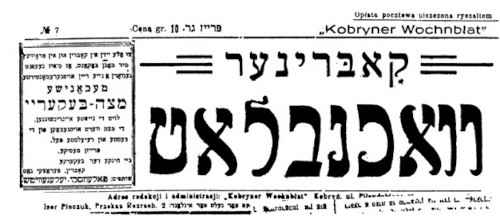
The Yiddish reads: “To all Jews in Kobryn and the surrounding province we announce that a new, thoroughly renovated mechanical matzah bakery has been opened, equipped with the newest installations. The matzah is baked from the finest and purest flour. Prices are moderate. At Khinke the Bakerwoman, Kobryn, Peratski Street. Partners: Palevski, Yelenevitsh.”] |
by Noach Markuze
Translation from Yiddish by Beate Schützmann-Krebs
As a modest expert in the halokhes [rules] of theater, I would like to give a brief overview of the film performance of The Dybbuk[1], which caused such a worldwide sensation.
The first point of my critique is directed at the fifth act, which the “great master” of the film The Dybbuk found it necessary to add – after roughly fifteen years of performances of The Dybbuk on various stages – and without the author's permission, who, incidentally, can no longer express any opinion about this “fifth wheel” that has been fastened onto the Dybbuk wagon.
I would ask the brand-new Dybbuk director (after David Herman) what the point would have been, after all, had he not added this fifth act. I mean the first act – the so-called prologue. Would the cinema audience, heaven forbid, have formed a different impression of Leah if she had not been heard whimpering as a tiny infant on the theater stage? And would the audience have missed anything in its impression of the Miropoler tsadik [righteous man] if he had not strolled through the prologue with his Chasidim [followers], in landscapes filled with various vegetation (apparently wanting to imitate a model from “laytishe” films[2])? And if the meshulakh [emissary] and Khonen, the yeshiva student, had not wandered through these landscapes – would that have been a great loss for the play, which in reality presents an entirely different sphere than the one the new Dybbuk director wants to impose upon it by force?
And what is the point of watching, with one's own eyes, how the tsadik of Miropol first appears with a blond beard and a healthy stride, and later becomes gray and weak (as in his older years)?
I would ask the talented director of The Dybbuk: what does this add to Dybbuk? And is it not unnecessary to show how the tsadik grows and changes – from young to old? A tsadik should be shown as a fully formed figure, a complete vessel, no matter at what age he is placed on the stage (of course, unless the content of the play absolutely requires it).
It was for nothing – sadly – that the truly talented artist Avrom Morewski was made to wander through the tall grass with that bundle of Chasidim, all for nothing and to no purpose.
And what is the point of having the meshulakh appear so often, and of showing his explicitly miraculous kfitses-haderekh [instantaneous travel]? Well, granted – if the rabbi's stick can summon a storm wind over the cemetery, and if the white sheet can produce a sharp, eerie whistling during the dintoyre [rabbinic court proceeding] with the dead, then such miracles as a kfitses-haderekh might also occur. But what is the purpose of all this squealing and these hysterical attractions imposed on Leah – who, according to the Dybbuk, is meant to be modest and deeply feeling?
And from what, exactly,
[Page 162]
is the audience supposed to form a deep impression of Khonen the bal-mekubl [Kabbalist]? Merely from his two long sidelocks? For when you tear off those two long sidelocks, he remains a modern, fashionable Lubavitsher who carries Leah in his arms with no less “heroism” than Itsik carries Mayte out of the burning tavern[3].
And since when has Khonen become such a ben-bayis [a familiar of the household] at Sender Brinitzer's, and since when has he been making himself so familiar with Leah – when, according to the play, she asks him at night in the bes-medresh: “Khonen, where have you been all this time?”– – –
And if the meshulakh really tried to present the image of a hidden mystic, it is in fact much more the image of a Bedouin spiritual figure – or of a Yemenite “sage.”
The meshulekh from the Vilna group presented himself as a very specific kind of Jewish itinerant, and his voice sounded softer and more broken, while at the same time he appeared to be a man of integrity and fairness. And what is the whole crowd of Chasidim and little Chasidimlekh, with all their various little theatrical mannerisms, doing here, when in the period in which the real Vilna ensemble used to perform the play, the play itself calls for only four mekubolim [Kabbalists]–the so-called batlonim [pious idlers, bes-medresh regulars] –who would stir up the audience by recounting their little Chasidic legends? – – –
And where, in all of this, is Khonen the Kabbalist – the man who fasts from Shabbat to Shabbat, whose body has become so broken that he no longer has any control over his inner being?
And when Khonen, after falling into a quiet faint during his intimate conversation with his friend – whom he wants to initiate into the secrets of Kabbalah – holds on to the two pillars of the old bes-hamedresh, singing almost to himself a few biblical verses from Shir Ha-Shirim [Song of Songs] as an expression of longing for his Leah – then the Khonen of the new edition of The Dybbuk steps out as a conductor with a whole choir of singers. And since we are already speaking of singers, one has to ask how it is that the Warsaw cantor Gershon Sirota suddenly makes his appearance here with a coloratura of the kind sung on Hoyshayne-Rabe, the seventh day of Sukkot.
Did all the celebrated figures of the Jewish people really have to be represented in this film? And what have you done here, esteemed director, with Sender Brinitzer – who, according to the play The Dybbuk, is neither a cruel man nor an unusually greedy one, but merely represents the type of a certain number of his grade of Chasidim, wealthy men with forceful manners? Yet in this film The Dybbuk, Sender Brinitzer appears even more money-hungry and brutal than Shakespeare's Shylock, for out of sheer greed he never allows his only daughter Leah to speak her mind, and only because another five years of kest [financial support provided by the groom's father] had been promised does he marry her off to a half-idiot.
And from which Zohar did you learn, dear director, that segufim and tseyrufim – ascetic practices and purifications – are performed with such bizarre grimaces? Such “exercises” would sooner befit an athlete who is losing consciousness than the young Kabbalist Khonen, who strives toward the pardes [the mystical orchard; the fourfold levels of Torah interpretation].
It seems that the literary advisor of the film The Dybbuk, Professor Balaban, has no greater knowledge of Kabbalah and mysticism than the Dybbuk-director himself.
And from which Yoyre-Deye [the halakhic code governing ritual law] did you derive the notion, dear director, that a ruling of a dintoyre [rabbinical arbitration] can be issued by a Chasidic rebbe without the local rabbinical court?
And if An-ski summoned to the dintoyre the rabbi, Reb Shimshon, together with his two rabbinical judges, and only with their permission does the rebbe conduct the dintoyre, and only when excommunicating the dybbuk does he ask permission from the holy congregation, then why did the esteemed director wish to throw out of the dintoyre the principal mekhutn [in-law], the more-dosre [local rabbinic authority]? Perhaps out of sheer stinginess in staging the scene?
Then why did he not scrimp on staging such a “rich” funeral, in order to tickle the nerves of the audience?
And why did he shorten the blowing of the shofar so drastically when driving out the dybbuk? Why is he so frightened of the dybbuk that right after the first tekie [a sustained shofar blast] he already makes his escape, when according to the play (and so it was also with the Vilna troupe), the dybbuk is extremely stubborn and refuses to leave his “destined one” even when one also blows a shvorim [three broken shofar blasts], and only after the terue [a rapid series of staccato shofar blasts], when the dybbuk is completely broken, does he draw away from her – carrying her off with him. – – –
Now a remark on the matter at hand: When the meshulekh [emissary] says, “I will tell you a parable from your rebbe: the Miropoler once led one of his Chasidim to the window and asked him
[Page 163]
whom he saw there. The man answered that he saw people. Then he led him over to a mirror and asked, ‘Whom do you see now?’ The Chasid answered: ‘I see myself.’”
The meshulekh says explicitly: “I will tell you a parable of your rebbe.” So why, then, does the film show Sender Brinitzer being led by the hand to the window – and when he already says that he sees people, he is told once again to look into the same window, and suddenly the window has become silvered like a mirror, and now he sees only himself?
And finally:
Money is certainly no small matter. But to take the finest and most delicate play in the Yiddish dramatic repertoire and turn it into a mockery – for that one must possess chutzpah of the very highest order.
Translator's Notes:
by Y. Sh.[1]
Translation from Yiddish by Beate Schützmann-Krebs
It happened last week. Once again there were waves of terror attacks here and there. The heart tightens with an approaching worry, and painful thoughts press in. At such moments it is good to step away from the boiling whirl of daily life and withdraw into solitude.
I was strolling on an ordinary Wednesday along the Kobryner highways when suddenly, from somewhere in a corner, my ear caught quiet sobbing… It intrigued me. In that very moment I thought: perhaps a dreadful family tragedy is unfolding before my eyes, and immediate help might be needed. I approached – and before my eyes an idyllic scene revealed itself: a Jewish family with the elderly grandmother at the head, all gathered around the father, who was reading aloud with great intensity scenes from Sabine.
I observe the surroundings: sharpened ears, faces lit with excitement, eyes clouded with emotion, gazing intently into the dream-palace of Sabine. On the table lies a rich spread of literature – a display of the most modern popular editions: Yoldishe neshomes, Tsebrokhene hertser, Nokh halber nakht, and so on.
The family is quite well known to me. The father had been a loyal party man, and the children – members of youth organizations.
“Forgive me, my distinguished friend,” I begin the conversation, “I unintentionally overheard deep expressions of sorrow over the tragic fate of the heroes. But tell me – since you are a man of heart and feeling – what is the reason that you are so indifferent to the tragedy of our world, to our own fate? I mean: what is happening on both shores of the Mediterranean, in Erets Yisroel as well as in Spain, contains far more dramatic substance and is of far greater importance than the ‘wondrous life-tragedy of that orphan girl’…
I consider you a serious man. How is it possible that you would poison young souls with pornographic shund-literature and turn them into spiritual invalids? Perhaps you will accept a friendly piece of advice: tell your children a chronicle from a newspaper – about us… That is far more instructive.”
“Father, read on!” – interrupts the younger daughter. “I'm terribly eager to know whether he, the Marquis, came out of the duel unharmed…”
“And besides,” adds the third, “don't get drawn, Father, into long talks with him. He's not a modern fellow and doesn't go in our ways…”
The father replies: “No, children, I will not read to you any further today… Go to your work or your amusements. He touched a painful point in me… It's true – once I was different, I had an ideal and strove for its realization. But today – these are different times. And other songs… I am completely broken –
[Page 164]
crushed under the weight of decrees and troubles that we are living through… Too many shadows and evil forces have run wild over our heads… Then I want to forget everything – everything and everyone…”
“But you know,” I interrupt him, “by doing so you are doing the greatest favor to your life's enemy… You want to forget, to numb yourself. Yet in these times what is required is precisely clear vision, sharp awareness, and clarity of truth. That is exactly what the poisoner intends: to offer easy nourishment in order to dull the mind, to deafen the voice of conscience, to cloud thought, to serve up portions of eroticism – so that afterwards he can completely destroy us and the work of our lives. Sabine and similar kinds of shund are opium for the people, poison for its soul, and turn attention away from what truly matters…”
“Brother, in wartime one must not forget oneself, must not lose oneself, and our life is after all a hard struggle for bread, for existence. Now I understand many things that until now were unclear to me… I never used to see you and your children at our gatherings; I searched for you in vain among the subscribers to our press and libraries; in your card index for the Keren Kayemet and other funds I have lately found only emptiness… You have become enslaved – unconsciously and systematically – by fascism. From a man you have become a servant…”
My companion fell silent. His eyes lowered, ashamed before me. “Yes, you are right – brother! And not merely right – more than right. Meanwhile the shund spreads relentlessly… Against street-literature let us offer a classical work; against boulevard sensations, let us teach, let us educate; let us put an end to this ‘modern' plague…”
Translator's Note:
by Yosef Shvarts [Schwartz]
Translation from Yiddish by Beate Schützmann-Krebs
Autumn days. Evil winds blow, bringing the message of the coming winter. You flow out of your loneliness into the world; around you, you see fogged horizons, leaden skies, and a darkened expanse. And as nature is – so is its child: the human being. Troubled moods take hold of you, and heavy thoughts settle into your mind. Indeed, autumn is a fitting moment to withdraw into your “four cubits” and make an accounting of yourself – for yourself and for others…
Hard – very hard – it is to read the daily press in these days. The mountain of Job-tidings weighs down upon one, arriving from different continents, from the fronts of war. Already one part of the world stands in the stage of a bloody battle, of annihilating war, and in other parts the sacrifices are meanwhile being prepared for the bloody Moloch. Short communiqués tell of defeats or victories, but between these lines cries out the tragedy – the tragedies – of our time; one hears the wailing of millions of seduced, violated, unfortunate people who have been turned into non-humans by fascism…
Wild, unleashed hordes run riot across all the paths of human life, and in the name of His Majesty, the sole ruler who wishes to cover his own nothingness, they reduce to ruins everything that bears a cultural imprint. Reaction grows and spreads its black wings over lands and continents; the triumphant fist of naked, physical force celebrates its victory, governed by the “interests of the pocket.”
In a demon-dance the brown, black, and yellow fascisms join hands – together with smaller fascisms still in the making – and press forward in their march of destruction, sowing wasteland and annihilation.
Raging, raging, evil winds…– – – – – –
But your time will soon pass… New rebellious forces are growing, gathering strength.
[Page 165]
Like a fire-spewing volcano they will hurl the executioners into the faces of human beings, and with burning lava they will flood and drown the nests of evil and the centers of inquisitorial orders.
In the endless sea of loneliness and pain, in the catacombs of the modern great inquisitors, upon the fires of fraternal hatred, strength will be forged, the will will ripen– and then the human being will become a mentsh. His life will be guarded as the greatest sanctity, and on all the ways and paths of the earthly globe will resound the song of human happiness – the song of liberation.
It has become a historical truth: with the rise of reactionary forces, its sister-limb – antisemitism – blossoms. This is the natural aftergrowth of fascism. For this reason, it is no surprise that in all fascist or perhaps ultra-chauvinistic countries, antisemitism becomes part of the program of order. The Eykhe laments [the biblical Book of Lamentations] of our time already sound like banalities to our ears … Pogroms and other accompanying phenomena of this kind have become our daily bread.
At the sight of the ghetto-decree[1] in the “temples of science”, everything we have lived through until now becomes pale and overshadowed. As time goes on, the iron ring around the Jewish community grows ever tighter; ever more forcefully they want to push us into a cursed ghetto – a sodom-betl [Procrustean[2] bed] of brutality – where the remaining few years of the persecuted people are supposed to be lived out. The yellow patch – the symbol of our deepest tragedy in the Middle Ages – will also mark the twentieth century, the era of humanitarizm and fascist “morality.”
But we are a resilient people – a nation with a flexible yet unbreakable backbone. We do not live only in the present, passing moment. Before us stands the history of martyrdom; with us stands the far-off vision, the golden dream of a liberated Jew. We, too, will survive the modern sanballitit[3] [the fashionable cynicism of the age]…
Therefore, brothers, the first commandment is: no despair. Do not let yourselves be destroyed by the germs of apathy and helplessness. Rather, close yourselves inward, armor yourselves against what surrounds you, and wait out the storm ad ya'avor za'am [until the fury passes].
This will be the best tshuve – the best answer – to the enemies within: to guard faithfully the idea of redemption, and to gather all our strength toward that goal.
Let the winds rage around us; we will nevertheless raise high the banner of a proud, liberated Jew, and around that lifted banner call for mobilization, for action – for the awakened land and for the liberated people.
Awaken, you forces of the people!
This is the conclusion of our days. Let the springs of deep faith well up anew, and netzakh Yisroel lo yeshaker – the Eternity of Israel will not deceive [1 Samuel 15:29]. The Zionist Kobryn, too, will awaken and be poised for its essential tasks.
At the sight of annihilating decrees, in the face of a new Middle Ages, we are concerned for our fate: not to fall into hysterical fear, not to react like a pariah tribe to our national suffering, but – as a people conscious of its life-path – to close ranks into a mighty front, in struggle for our very being.
Let evil winds rage around us; we will nevertheless press forward on our path – the path from ghetto to redemption.
Translator's Notes:
by A. Kobryner
Translation from Yiddish by Beate Schützmann-Krebs
As we turn to the question of the rabbinate, we have no intention, God forbid, of criticizing the rabbis themselves. We merely wish to draw an analogy and to state the difference between the condition of Jewish religious life in earlier times, during the formation of the kehile [community], and today.
The older generation is a witness, and the younger one knows from history, how the rabbi conducted himself with his own people. The expression is entirely fitting: mara d'asra, balebos – the master of the place, the head of the house.[2] He was, in fact, the actual authority in the community. He led the struggle against the powerful figures in Jewish communal life. There existed a very fine relationship between every Jew and his rabbi. The needs of daily life were brought to him directly by each individual. In material matters and, all the more, in spiritual ones, the rabbi was bound to his congregation.
Therefore the rabbi devoted all his strength, his full energy, and his authority to the people. He was in constant contact with them – teaching the community, addressing them almost every Shabbat with sermons, with moral instruction, strengthening Jewish unity, fortifying faith, and, as far as possible, fighting against gossip, informing, and similar evils.
But all this has changed since the memshole [governing authority] of the kehile. There is no voice and no answer. One no longer hears the rabbi's voice from Shabbat to Shabbat, no sermons. The lasciviousness in the street is great; may the Merciful protect us, it multiplies from day to day. There is no end to feeding people treyfes [non-kosher food], and one hears not a word about it from the mara d'asra. No one comes to strengthen faith, to fortify unity.
Do you know why this is?
Quite simple: the kehile, with its poor leadership, has broken the contact between the congregation and the mara d'asra. There are hardly any truly honest men today …
The rabbi no longer waits for the Jew to come to him with a pidyon [donation]. The rabbi's authority depends on livelihoods granted out of favor… like clay in the hands of the potter[3].
Empty bote-medroshim [houses of study], such great chaos in the Jewish religious street – a barrier has arisen between the Jew and his rabbi. The local power-holder rides on his horse and does whatever he pleases. There is no religious domestic order in town.
So if the cedars fall, what will the moss on the wall do?
Translator's Notes:
by A. Holtsman
Translation from Yiddish by Beate Schützmann-Krebs
Seventeen years have passed since the local chapter of Hashomer Hatzair was established in Kobryn. In the perspective of history, such a short span of time occupies hardly a noticeable place – often, almost nothing at all. Especially in today's storm-tossed times, when history has had to serve as a teacher of life and a guide toward the future, it has been forgotten and pushed into the category of superfluous things that burden humanity, which is ready at any moment to cast them off. Therefore, one might think that it is hardly worth reflecting on such a brief period.
But it looks entirely different for those who lived their whole youth within the framework of the local chapter – the ken, the local branch of the movement – and experienced every stage of the movement's development. For those mentioned above, the local chapter is bound up with the most beautiful and exalted moments of their early youth – campfire gatherings, hikes and excursions, settlement-style youth camps, and so on.
Later comes the period of maturity,
[Page 167]
filled with responsibility and devotion, when the young person wrestles with searching and probing in order to find answers to the various eternally complicated problems of life – social, national, and societal. Along with this, new experiences are created, and one takes upon oneself, with a sense of happiness, the entire burden of the matter.
In the next period, when the time of dreaming and play has passed and a decisive step of personal realization is demanded of every individual, the most revolutionary turning point in the life of a member of Hashomer Hatzair occurs: to burn the bridges behind oneself and to build new ones for the future. One must uproot – or at least dull – the negative, atavistic feelings that humanity has planted in one's blood, our inherited outlook.
In the collective chamber, the ideals that had already begun to weave themselves into youthful dreams gradually crystallize and now acquire a concrete content and form. Here the eternally sought synthesis between word and deed, individual and collective, human being and cosmos is brought into being – a synthesis that gives the feeling of being connected with everything and everyone.
It is not by chance that we have been carried onto the waves of life. And it is also not by chance that we still exist today and occupy first place in relation to the other youth organizations. The deeper meaning of our existence lies in the so-called “transvaluation of values.” We came to the youth and said: the Jewish people will be able to liberate itself only when we not merely bring the Jewish people to Erets Yisroel in a geographical sense, but when we bring Erets Yisroel to the Jew. That is, we must already here cast off the psychology of the Diaspora in all its crippling forms, straighten our backs, and look reality directly in the face, without shrinking from its far-reaching consequences.
The conclusion drawn from this was hagshama atzmit – self-realization. Not phrases, but deeds – thanks to which we have succeeded, up to the present day, in establishing in the land more than thirty Hashomer Hatzair kibbutzim, which are rooted and firmly planted in the most important and difficult positions, defending the honor of Jews against senseless Arab terror. This gives us strength in the Diaspora to carry out educational work, even in difficult days, with hope for better times in the aliyah and the ascent in the land.
As an example of life and activity in the local chapter, one may take the evening that surpassed the expectations not only of the pessimists but even of the optimists regarding the work and accomplishments of our chapter. It became clear that there exists a youth set apart from the noisy street-clamor, living modestly and preparing itself for the life ahead – a free life in its own land. These are the ones who carry forward the work of the pioneers, not looking at all the difficulties and moods that rage through the Jewish street.
No one looks at us without cynicism and disdain, asking:
“What do these idlers want?”
Our answer to all of this is: after the winter must come spring and a sunny summer. This strengthens our endurance, our steadfast faith in our ultimate victory, with the feeling that our tomorrow is not far away!
by A. Kobryner
Translation from Yiddish by Beate Schützmann-Krebs
It seems that Haman has already paid in advance for all the Hamans of all times. He has become the scapegoat for all the enemies of Israel.
Precisely in the month of Adar – the month of his downfall – all the decrees and misfortunes have lately come upon us. Hitler comes to power; the Jewish boycott in Germany; the Nazi seizure of Austria – all this happens in Adar. And when Madame Pristorova [Janina Prystorowa, a Polish politician who in 1936 sought to ban kosher ritual slaughter] feels the urge to deprive Jews of their livelihoods and throw them onto the meat-block, that too must occur exactly in the month of Adar. And you know why: the minister
[Page 168]
specifically demanded that people be forced to torment the Jews, because this year we have two Adars[1], and therefore it is a mitzvah to set the Jews' blood in motion.
But the greatest trouble, I think, is that Adar falls before Passover, and the old question arises: Jews, where will we get what we need for Passover? And yet – Jews! Do not worry. After all, it is still Adar, and “when Adar enters, joy increases.”
Once, two litigants came before a rabbi with a dispute over a piece of land. One claimed that the land belonged to him, and the second claimed the opposite. After hearing both sides, the rabbi said: “Now let us hear what the third party has to say.” And with that, he bent down, put his ear to the ground, and called out to the litigants: “Do you know what the land says? It says that it does not belong to either of you – but that both of you belong to it.”
The same thing happens with the enemies of Israel. The Nazis shout at the Jews: “Out of the country! The land belongs to us.” The Narovetses [Polish far-right nationalists of the Endecja movement] and their hangers-on shout the same: “Jews! You must leave this land. There is no place for you here among us. You are strangers. The land belongs to us.”
But if all these enemies of Israel, of every kind, would put their ear to the ground, they would surely hear the same answer the rabbi heard: that the land does not belong to them – but that they all belong to it. And let us truly hope that this will be fulfilled very soon.
Translator's Note:
by A. Kobryner
Translation from Yiddish by Beate Schützmann-Krebs
An old couple lives from whatever their two sons manage to earn on market days – a few złotys now and then. Their home is run-down, though here and there one can still see traces of former prosperity… Yet poverty already peers out with ten eyes from every corner. But no matter how poor they may be – Purim must be celebrated as it ought to be! For weeks they prepare for that day. Every bite is pinched from their own mouths, just so the celebration will turn out as splendid and as impressive as possible.
The children of the street, who go about in costume, already know that in this house a tasty haman-tash [a traditional Purim pastry] awaits them, a few groschen, and above all the smiling face of the old grandmother.
Most eagerly of all, the “Tarbut Troupe” is received; the old couple waits for them with pounding hearts.
They will bring a greeting from Erets Yisroel – after all, their youngest son Yisroel lives in the Galilee, in Tel-Hai!
And when the children sing – singing softly into the stillness – the old grandfather and grandmother see before them the bright image of their son, and they themselves grow young again; the wrinkles on their faces smooth out, and they become livelier and fresher.
The children feel the friendly, heartfelt atmosphere and thank the old couple with more songs and dances. And when the children already stand at the threshold and a gentle “Shalom Chag Sameach” slips from their lips, they hear a quiet wish from the old grandmother:
“When you grow older, and when you are in Erets Yisroel, give my son in the Galilee a greeting!!!”
by A. Kobryner
Translation from Yiddish by Beate Schützmann-Krebs
In life, in everyday use, people think of them simply as “small things.”
But these seemingly insignificant, fleeting, minor details often reveal the whole person. In the shine of the spotlight that flashes out from a simple, everyday action, the character, the soul, and its most intimate chambers show themselves before our eyes.
Let me illustrate a few such “small things” from a single day – in this case, Purim.
In praise of the Tarbut teachers, let the beautiful Purim custom be shared with our public: when the Tarbut pupils go about dressed in special costumes and masks and bring into every Jewish home the tidings of Erets Yisroel.
We all know with what kind of spirit Jews celebrated Purim in 5698. The newly bloody Haman-like persecutions in Austria, which broke out during the week of Purim, and the fresh edicts against us here in this country, drove away every bit of joy – joy so characteristic of the traditional Purim celebrations of earlier times. And in a heavy, almost Tisha-B'Av-like mood, Jews observed Purim.
So it was truly a genuine, sunlit joy when the children came in with their cheerful Erets Yisroel songs and brought greetings from that land about which everyone dreams:
the grandfather, the father, the grandchild.
All the proceeds were designated for the Keren Kayemet L'Yisrael [the Jewish National Fund, responsible for land purchase and development in Erets Yisroel]
A very instructive episode is the reception that the Jews of Kobryn arranged for the children. The facts are told not, God forbid, to preach to anyone or to make propaganda for the KKL – which certainly has no need of that – but they are stated simply for the sake of truth, conscientiously.
by A. Kobryner
Translation from Yiddish by Beate Schützmann-Krebs
Already from afar the brightly burning candles shone in the home of a well-known Kobryner gvir – a wealthy man, a gabe [charity overseer], and an active communal figure. For Purim he had prepared a little box with two Groschen. After all, he was a philanthropist!
For 364 days of the year he distributed charity to the poor in single Groschen, but today was Purim, and since – thank God – his good situation was said to have been promised to all of us, he gave with a broad hand: two Groschen…
And when a ragged, poor boy stumbled in, terrified, into the holiday kitchen, they handed him a two-Groschen coin and the maid told him to run along at once…
And the same two Groschen he gave to the Tarbut pupils, for the Keren Kayemet L'Yisrael.
Symbolic two Groschen from a rich Jew – for the people, for the building of the land, to whose gates he himself will cling when the time comes…
Two Groschen – a sign of poverty, of hearts turned to stone, which are opened not by the power of free will toward liberation, but by the hammer of expulsion.
Two Groschen…
by A.R.
Translation from Yiddish by Beate Schützmann-Krebs
The wooden bowls tell the story…
Kobryn – a town like all towns. The first and best proof is the marketplace. Strolling on a market day among the kromen [shops], you immediately notice a scene you wouldn't have seen half a year ago.
A row of bowls was set out – old ones like soldiers already mustered out – and among them, brand-new bowls like fresh recruits, the so-called “Ovshem-bowls[1].” The Jewish merchants stand there, unfortunately, bent over and shifting about near their bowls, waiting impatiently for a peasant to come with pakule [raw hemp], wool, and the like.
By contrast, the new “Ovshem” merchants move about arrogantly and proudly, preparing to push the old ones out of their selling spots. And looking at the bowls, you get the impression that they're telling you their rich past – of many successes, never having tasted the flavor of failure, but on the contrary always having felt the peasant's good regard.
And shaking themselves, they lament the situation, which grows worse from day to day. Feeling clearly the process of being pushed out, both kinds of bowls stand there like two hostile armies.
With contempt and mockery, the new ones look at the old bowls, as if at broken, useless objects. They look with chutzpah, from above, as if saying: “Today is our time.”
Translator's Note:
by A. Kobryner
Translation from Yiddish by Beate Schützmann-Krebs
The Kobryner Bris ha-Tsohar [“Covenant of the Dawn,” a Revisionist youth group] is living through hard days – just as in all of Poland, so too in Kobryn.The situation of the Jewish masses is far too serious for them to lull themselves with Zionist youth songs.
Their youth organization has been almost completely liquidated. The Jewish youth has already sobered up from the glittering, stage-managed performance that goes by the name of Beitár[1] education. From time to time they air out the clubhouse with a bit of dancing…
Recently, however, they have begun to take up some activity. The few leaders of the local Bris ha-Tsohar and Beitár, unable to bear watching how their neighboring organization, Hashomer Hatzair [“The Young Guard,” socialist-Zionist youth movement], grows and develops – its clubhouse full of young people, full of life – while in their own clubhouse cobwebs and dust gather, have now begun to reorganize the Beitár nest.
The first step was: to gather six-year-old children, hand out little calendars to them, and promise that at every meeting they attend, they will receive gifts.
Incidentally, in their organ Di Velt [“The World,” the movement's newspaper], you will most likely soon read a report of this sort from Kobryn:
“Our organizations – Beitár, Bris ha-Khayil [“Covenant of the Soldier,” a Revisionist youth group], Bris ha-Tsohar, etc. – are developing very nicely and already encompass the greater part of today's youth.”
In order to raise money for the Keren Tel-Hai [Tel-Hai Fund] and to gather the masses around themselves, a special delegate from the Keren Tel-Hai directorate came last Shabbat. And as you know, the organizational work is not accidentally tied to Keren Tel-Hai money…
Jews need a livelihood; one must maintain an apparatus that works in the air – and more besides…
And I must admit, speaking objectively: the speaker left an impression as… a brilliant performer. With his fine “khokhmes” [here: clever turns of phrase],
[Page 171]
his rich facial expression, his elegant gesticulation, he captivated the audience.
Especially striking was the issue in which he portrays Jabotinsky as the eagle of Israel, Moses – and Weizmann as the “traitor” to whom one gives khalitse[2]: one pulls off his shoes and throws sand into his eyes…
About the Keren Tel-Hai he said nothing at all – a sign of Revisionist “modesty,” that one does not speak about one's own matters… And when the speaker finished his wonderful improvisation, his camp applauded him.
His speech was in the spirit of Revisionism: phrases, phrases – which adorn their own insignificance and poverty in the practical work of redeeming the land.
Translator's Notes:
by Yusifun[1]
Translation from Yiddish by Beate Schützmann-Krebs
…War – that dreadful word – flashed like lightning across the black wings of the Angel of Death. And from bloody Mars there was driven a restlessness into the hearts of men.
This message of destruction crept into every forsaken settlement and summoned forth, into the bright sunlight, the bloody specters of the not-so-distant World War…
The shadows of that bloody past penetrated everywhere: into luxurious palaces and into the collapsed little hut; into the capitals of Europe and into the remotest, swamp-Parsinsoaked distances; and they drove into the background the deep complacency of carelessness that marks the character of modern man, provoking tension – a trembling before fate, fear of tomorrow, and unrest, a twitching unrest for our present, our immediate future.
In a single instant the sun of war rose, and eyes were opened, splitting the fog of the cruel night that is called: our time. And they saw: vast seas drawn with boiling blood, fresh blood of slaughtered people; and on the shores, mighty, scattered fires burning from one end of the world to the other. And in those fires – the skeletons of human beasts, mocking and laughing at us and at our fate with Mephistophelean laughter…
Over our heads hangs the sword of Damocles, which will soon be lowered upon us by a dark hand; and an arrow – a terrible, bloody arrow – will burn its way through our bodies, and beautiful Europe, that brilliant, shining civilization, will become a heap of ashes, a valley of destruction…
In thousands of variants, in all human dialects, the time writes in bloody script:
Mene, Mene, Tekel u-Parsin. Your days, man, are numbered…
“So it was, so it is, and so it will be for generations upon generations. With this formula the old, gray grandfather begins to tell the young grandchild a terrible, horrifying tale spun from bloody threads – a legend among many legends about our life in the first half of the twentieth century.
The earth was fertile; it possessed the resources of life. Man upon the earth marched along his triumphant route to harness the primal forces of nature and bend them to his use. But it was the reign of the iron-fisted rule.
The steel of the plowshare was melted down and shaped into a tank.
And when hunger prowled through the streets of Europe and millions of people clung desperately to the edges of the
[Page 172]
locked, overfilled grain storehouses of the magnates – they were shown a sharp, gleaming sword, a long, gleaming spear.
Then the world became like one single concentration camp.
The weak have no right to live – this became the ruling slogan – and the wild hunt of the ravenous wolves after the weak began. Peaceful peoples, who had drawn the sap of the earth and nourished themselves with it, were attacked and swallowed up in the great, gaping jaws of Leviathan…
All nations wanted to be strong, and in those days “strong” was understood not as a firm, economically grounded, prosperous country, but as heavily armed – more instruments of death, doubled murder-battalions, arsenals of weapons…
Already then the great misfortune began, for the shattered fire-serpent started to create wastelands in various corners of the earth…
The fate of gray, innocent people was already sealed: Death, covering the dust of the earth with human corpses.
A storm broke loose, a whirlwind burst forth, howling wildly, flinging the peoples like chaff, and with the black plague it spread everywhere… The most terrible war of all wars began…
Here the grandchild will interrupt him with a simple, innocent question: “Are you not mistaken, dear Grandfather, in giving the exact time? For such events – I learn about them in ancient history, in the Middle Ages – but in modern times?”
“No,” the grandfather answers him, “no – unfortunately, I am not mistaken. I still remember that year exactly, for it was such a dreadful time, engraved in me with fiery letters. The time when the world was set ablaze with robber-greed and murder-madness.
It is the year of the wildest inquisitorial trials in the land, where terror reaps its fruits and the revolution devours its children. The year when Hitlerism makes its blood-stained triumphal march into Austria, which dies with a kiss-of-death upon its lips; the year of tangled, complicated political constellations; the year of the wild dance upon the graves of human culture and the auto-da-fés of great prophetic ideas – …1938, that year.
We already live under the shadow of the eve of war; in the dark glances of the people the fear of war has already begun to ignite. With tremendous greed and tension one reads the newspapers. Masses gather around the radio sets and swallow every scrap of news from the front…”
And the front is vast and wide, stretching across all the European states, with its nests in every center… The nerves are terribly strained… One wants to conjure up some word of comfort… But the stereotyped formula is always one and the same.
Yesterday, as today, and tomorrow as well – so it is…
Therefore the fateful question hangs in the air, on everyone's lips:
What will happen tomorrow? What will happen?
In the stillness of the night your ear catches a distant murmur from afar – the march of millions of boots, somewhere, toward destruction.
Translator's Note:
to the Administration and Council of the Jewish Religious Community of Kobryn
Translation from Yiddish by Beate Schützmann-Krebs
Honored Gentlemen,You have drawn up the budget and allocated the appropriations for the year 1938.
On the expenditure side – a series of fictive items that are never actually paid out; and on the income side – a guaranteed increase in appropriations amounting to 54,000 złoty (in 1937: 36,000 złoty; and in 1936: 10,000 złoty).
Is this not a major public scandal?
And everyone asks: With what does the kehile actually concern itself, apart from kley-koydesh [sacred ritual objects], etc.?
Do you perhaps take any responsibility for opening a Jewish hospital, a vocational school, supplementary courses for boys and girls?
Do you perhaps support the last remaining Jewish institutions?
Do you perhaps give subsidies to schools and educational establishments?
Isn't money still being collected for them door-to-door?
Have you dealt with the painful issue of kosher meat?
This is not the work of our community “caretakers.”
Your work consists of personal accounting – party-biased as well as business-related.
Do you grant exemptions or not? Are you close to, or on good terms with, the gentlemen of the administration and council, and if someone has sinned against you, do you take revenge and bear grudges or not?
Here is an example! You assessed me at 50 złoty. My means and earnings are well known to you. In 1935 I was assessed at 10 złoty. In 1937 at 15 złoty. And today? –
Was this, from the outset, a personal act of revenge by my former employer, Mr. Sholem Rimland? Must one still prove the injustice – the 75 złoty – in the assessment? Mr. Sholem Rimland, of blessed memory, and me at 50 złoty – his former employee.
And the appropriations for the other gentlemen of the community and their friends, who were not assessed at all, or at laughably small sums! And since I am not the only one in this matter, it is unnecessary to prove it further.
I therefore ask you, the administration and council, especially the presidents: Do you feel that your conscience is clean, and that the burdens of your inflated, unrealistic budget should be borne by those who are already oppressed and terrorized? Do you think that leit din ve-leit dayan [“there is no law and no judge”]…?
You know that the local Jewish community has no trust in you and does not want communal activists who use their positions for personal interests.
With respect,
Leybl Sirote
from the Kobryner Vokhnblat (“Kobryn Weekly”)
24 March 1938
|
|
the ritual slaughterer and circumciser |
by Noach Timyanker
Translation from Yiddish by Beate Schützmann-Krebs
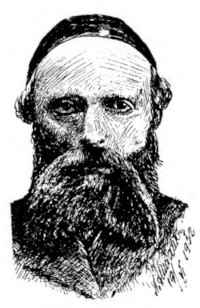
I believe I will not be sinning against the good trait of modesty if, among the gallery of personalities of our Kobryn, I portray the figure of the well-known Reb Moyshe Khayim, the shoykhet [kosher butcher]. His popularity among the Kobryners is widely spread, for I want to state openly that there is not a single Kobryner who has not been circumcised by him over the past fifty years.
In connection with this, a fact comes to mind. After the First World War, when the Poles took power in our town and one needed personal documents, metrikes [birth certificates] were required. The starostwo [district office] accepted as valid the metrikes issued by my father, may peace be upon him, on the basis of which even foreign passports were issued.
Now, being myself of mature age, when one views people and events with a critical eye, and moreover when there is distance in time that allows one to reflect ever more objectively, I recall acts and matters of my late father that are worth highlighting.
In truth, I see in Reb Moyshe Khayim, the shoykhet, a revolutionary spirit–inasmuch as such a spirit fits within the framework of that epoch.
Some fifty years ago, when the Jewish world in general – and the kler [religious leadership] in particular – still held fast to the old-fashioned kheyder system and to ancient, truly ancient traditions, of which we today have no real notion and which one finds only in old Jewish literature, traditions that in our understanding have become confused with the Middle Ages – even then, my father sent my older sister to a Russian gymnasium [secondary school], something that at the time stirred no small storm among the fanatically religious element. And later, when I myself left the bes-medresh bench and devoted myself to secular education, he encouraged me in this with various means.
Although my father was religious by nature, he nevertheless held to the principle that “Torah is good together with worldly conduct” [Pirkei Avot 2:2] – one must integrate religious life with the demands of the secular world
In his learning, he also moved beyond the circle of those who immersed themselves in mysticism and Kabbalah. He, however, was more of a realist and studied a page of gemore [Talmud] with the community, which for the rabonim and the Chasidic circles was far too much realism. Just imagine the atmosphere of fanaticism in which our grandfathers and grandmothers lived, when even Talmud study struck them as altogether too worldly.
Also in his work as a Jewish circumciser, he introduced a new system of hygiene. The wood-powder that had been used in such cases was replaced by him with other antiseptic methods. Likewise, the procedure of metsitse [suction of blood], which was unhygienic and in many cases led to infection, was replaced by him with a glass fitted with a rubber tube.
One must mentally transport oneself back into that epoch in order to grasp the scope of such a breach of established boundaries.
Yet my father was deeply religious to the extent that, being a shoykhet, he would not – as others did – have any dealings with the meat sellers in trading hides and similar items. He feared that such business could, Heaven forbid, lead to a kind of favoritism toward a butcher and to declaring kosher something that ought to be treyf [non-kosher].
He was always cheerful and carefree, firmly believing in Divine Providence, and that no one can alter his destiny, and therefore one need not worry.
These are, in broad strokes, the features of the portrait of Reb Moyshe Khayim, the shoykhet – a person who was an institution unto himself, and who lived and worked in Kobryn for more than half a century.
Peace to his dust.
|
|
JewishGen, Inc. makes no representations regarding the accuracy of
the translation. The reader may wish to refer to the original material
for verification.
JewishGen is not responsible for inaccuracies or omissions in the original work and cannot rewrite or edit the text to correct inaccuracies and/or omissions.
Our mission is to produce a translation of the original work and we cannot verify the accuracy of statements or alter facts cited.
 Kobryn, Belarus
 Yizkor Book Project
 JewishGen Home Page
Copyright © 1999-2026 by JewishGen, Inc.
Updated 6 Dec 2026 by LA