|
|
[Page 147]
[Page 148]
[Page 149]
by E. Lebnshul
Translation from Yiddish by Beate Schützmann-Krebs
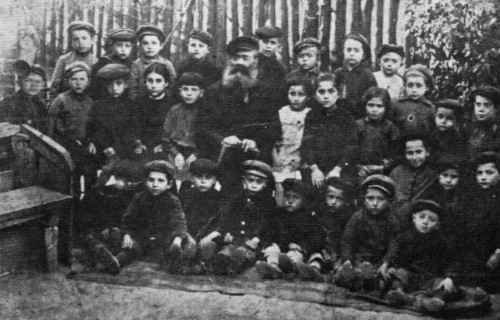
Kobryn possessed a considerable network of educational institutions which, until the First World War, consisted mainly of khadorim – several on almost every street – and, in addition, the talmetoyre [Talmud Torah].
The khadorim varied. Some had two classes, others only one. There were also khadorim for absolute beginners, whose teachers were called dardeke melamdim [teachers of very young pupils]. Each class, or each one-class kheyder, had about twelve pupils, who sat around a rectangular table roughly two and a half meters long.
The rebbe[2], at the head of the table, would sit with a leather whip made of many cut strips, and a vire or palke [long stick], so that he could reach a pupil who tended to make mischief rather than study.
The curriculum followed a fixed order. The khadorim that taught khumesh [Pentateuch] with Rashi [classic medieval Jewish commentator] remained exclusively with khumesh and Rashi – beginning in the month of Khesvan [eighth month of the Jewish calendar] with Bereyshis [Genesis], and reviewing each week's parshe [weekly Torah portion]. There were khadorim that accepted only pupils who had already studied several years of khumesh with Rashi and Tanakh [Bible], and who now needed to advance to gemore [Talmud].
The larger khadorim could be considered small yeshivas, taking only gemore pupils. There the study consisted solely of gemore with Toysfes [classic medieval Talmudic commentaries]. From these latter khadorim, pupils would go on to the yeshivas of Slabodke, Mir, or Keltz, in order to deepen themselves in the sea of Talmud and to receive rabbinic ordination.
|
|
At the same time, there were Russian state schools – institutions such as the gorodskoye utshilishtshe and the gimnazye for Christian children. About five years before the First World War, some Jewish pupils (children of free-thinking parents) began entering the Russian gimnazyes.
With the German occupation, a change entered the entire system of khadorim and melamdim [teachers]. The compulsory school
[Page 150]
established by the Germans became the accidental beginning of a new Jewish school system.
In later years, this system was organized as the folk school under the TSYSHO [Tsentrale Yidishe Shul-Organizatsye, Central Yiddish School Organization].
With modern methods and under a proper pedagogical direction, the leadership of the school lay in the hands of the teachers: Rubin, Antpolski, Yomtov Bil, Reznik, Platnik, and others.
|
|
Toward the end of the German occupation, the Tvune [reason] school was also organized, with a rich Hebrew program – under Zionist influence and with the supervision of R. Michael. The Tvune was led by its well-trained teachers: Rozenboym, Moyshe Khayes, Noach Alkon, Novik, and others.
A few years later, the Tarbut was formed – a completely Hebrew six-grade school in which the instruction was in Ivrit. The Tarbut was directed with great care by its founder, Levitos. The teachers Noach Alkon and Borekh Nitski worked there with particular dedication.
Close to the 1930s, the girls' Beit Yaakov school was established – a religious school under the influence of the Agudah [Orthodox movement].
A short time after the First World War, almost all the educational institutions moved into and were established in the Margolis' Barracks: the folk school, the Tvune, the Tarbut, and the Beit Yaakov school.
|
|
[Page 151]
In the same building, the Kobryner Jewish vocational school, organized by ORT, was also established – under the supervision of Dovid Kiselyov, Shmerl the Melamed's son, who directed the carpentry workshop; and Khanele, the seamstress, who headed the women's tailoring department.
During the years of Polish rule, the attendance of Jewish pupils in the Polish powszechne schools [state elementary schools] and in the gymnasium also increased. Many of the Kobryner Jewish pupils completed the gymnasium, and because they could not enter the Polish universities (due to the numerus clausus), they dispersed to Italy, Germany, and especially France in order to continue their studies.
Despite the modernized and secular Jewish school system, Kobryn still had a considerable number of khadorim with melamdim. This was not surprising: in the final decade of the Kobryner Jewish community, a yeshiva was opened in the Khaye-Odem Bes-Medresh, and together with the small yeshiva, they managed to renew and strengthen strict religious education.
|
|
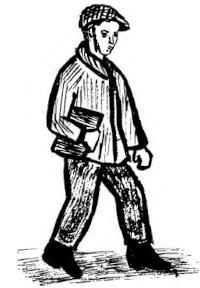
Drawn by Fanny Glotzer |
Translator's Notes:
by Yakov Novik
Translation from Yiddish by Beate Schützmann-Krebs
Todres' Kheyder was well known to two generations of Kobryn's Jews. Although it was called a kheyder, it was of an entirely different type. In its arrangements and in its curriculum, it possessed a distinctly new style.
There were none of those long tables with benches, in the same room where, besides the kheyder, the rebbe's bedroom, dining room, and kitchen were also located. Here there were two large, bright rooms, furnished with school benches in two rows, with inkwells set between them, facing the doske (a board for writing with chalk).
There was a special room where the children ate, and a large, spacious yard for playing, with benches to sit on, a special enclosed basin of water with a spigot for drinking, and other conveniences for children.
Boys and girls studied together. All the children were of the same age – between five and six. Reb Todres did not go from house to house to recruit pupils, nor did he go every Shabbat to examine them, as the old-time melamdim used to do.
The course of study consisted of two terms – that is, a summer term and a winter term. Officially, children were registered for the new school year after Khalemoyd Peysekh [the intermediate days of Passover], but already a short time before Peysekh all the seats were usually filled.
[Page 152]
There were two classes: a younger one – the beginners – which was conducted by Reb Todres himself, and an older one, taught by his son Yitskhok (when the Tvune was founded, Yitskhok and his kheyder transferred to the Tvune).
The method of instruction was also entirely different. Besides learning Ivre – that is, davening and beginning khumesh – they also studied zhargon [Yiddish]. At that time, this was something of a revolution in the field of education: reading and writing zhargon without nekudes [vowel signs], using the spelling rules of the contemporary orthography, as well as writing azbuke [the Russian alphabet] and arithmetic. A Hebrew primer was a novelty in Kobryn in those days.
|
|
The very fact that Reb Todres called himself “the teacher” and not “the rebbe” already showed the special character of his kheyder. Even after his death, the kheyder continued for some time under the supervision of his wife, of blessed memory, with a hired teacher – but always under the same sign: “Todres' Kheyder.”
by Yakov Novik
Translation from Yiddish by Beate Schützmann-Krebs
In 1915, during the First World War, when the Tsarist authorities fled and Kobryn was occupied by the Germans – may their name be erased – a new type of school was founded: a Jewish-Russian Pro-Gymnasium, with Russian as the language of instruction.
For the Jews of Kobryn, this was something entirely new. Until then, Kobryn had not known such a type of school. Besides the Talmud Torahs and the khadorim, traditional and semi-modern, there had been a Russian gorodskoye utshilishtshe, where the pupils sat without caps. The teaching staff there had been entirely Christian, and the pupils, for the most part, as well. The “Holy Jesus” and the “Holy Mary” hung on all the walls; antisemitism was felt in every corner.
At that time, the percentage of Jewish pupils in the Russian government schools was negligible. Kobryn was then,
[Page 153]
in its great majority, religiously minded, and it could not permit itself to send its children to a school where one sat bareheaded, facing the “Holy One,” and where classes were held on Shabbat. And if one studied on Shabbat, one had to write as well – even though officially it was said that no one was forced to do so.
The small percentage of pupils who attended these schools came from somewhat assimilated parents – for example, the Maletski family – or from people with careerist tendencies, who were willing to give themselves up on their Jewishness, lower themselves, and endure the hardships of the teachers' antisemitism as well as that of their classmates, all in order to achieve a bit of career advancement.
It is therefore no wonder that the Kobryn youth were simply captivated by this new type of Pro-Gymnasium.
It was curious, unusual, and interesting – a thoroughly modern Pro-Gymnasium with all the little details. The same curriculum as before, with Russian as the language of instruction. The ringing of the bell, the peremenes (breaks), the examinations, the discipline was perfect; every subject had its own teacher.
Classes lasted until midday, just as in the earlier Russian gymnasiums, with one single exception: the teaching staff was Jewish, recruited from the Russian-Jewish intelligentsia. People spoke Russian among themselves, and with the pupils as well. The main thing was that there were no antisemites. The “Holy One” was no longer present, and in addition, there was the privilege of having a Hebrew teacher to teach Hebrew. True, it was precarious – balanced on the edge of a knife – but Hebrew nevertheless found its way into the curriculum.
|
|
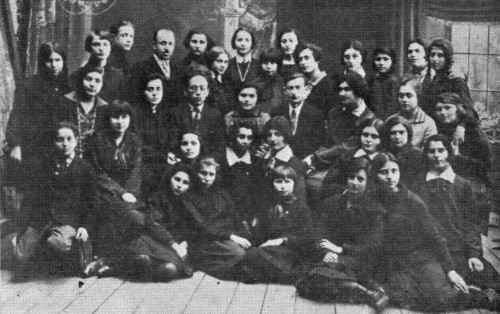
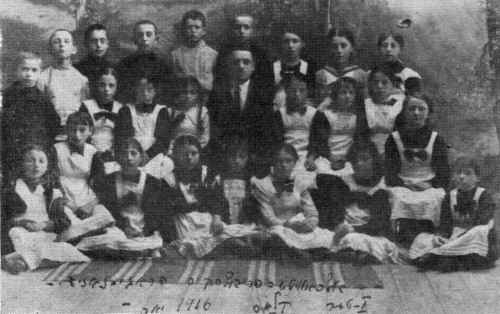
“Alkhovitsh–Pribulski Pro-Gymnasium, First Class, 1916.”] |
The new Pro-Gymnasium quickly became very popular. As its founding it had two preparatory divisions (prigotovitelnye) and four classes. Later, a fifth and sixth class were added.
The subjects were taught on a genuinely high pedagogical level. The school was located on Shkolne Street, in the Christian priest's house – a splendid, spacious building with every convenience: a beautiful garden, large rooms, bright and filled with sun and air – it was invigorating!
A choir was created in the Pro-Gymnasium, along with an orchestra of mandolins and balalaikas, under the direction of the teacher Khomutinski (now in North America).
The directors were Alkhovitsh and Pribulski (the younger brother of Dr. Pribulski). At the end of the year, the examinations would take place.
The same fear and dread of failing existed as in the earlier
[Page 154]
Russian government schools. The examinations concluded with a public spectacle in Kobryn's Freydkes Hall, performed by the pupils and the school orchestra. There was such an overflow of pupils that, within a short time, another Pro-Gymnasium of the same type was created under the name “Garber–Alkon Pro-Gymnasium.”
Unfortunately, however, there was not enough room for two schools of the same type, and they merged into a single school, namely: “Garber, Alkon, and Pribulski.”
This school was housed on Potshter [Post] Street, in the former gymnasium building, where they continued with success until the occupation by the Kresn [Kresy Wschodnie region] authorities – the Poles – who opposed this Pro-Gymnasium because Russian was the language of instruction, and forced them to transfer to Polish gymnasiums.
Translator's Note:
by E. Lebnshul
Translation from Yiddish by Beate Schützmann-Krebs
Dvoyre's Library, which was named after its founder Dvoyre [Deborah] of Tshitalnye, was the foundation – the base – for the larger libraries that would come later, for example Brener's Library, the Hashomer Hatzair Library, and the Professional Association's Library. It was located on Pinsker Street, not far from the little bridge over the Kobryn stream.
Dvoyre's Library had another significance: it served as a kind of gathering place where girls and boys could meet – a sort of unofficial club. In the years before the First World War, a strict religious atmosphere still prevailed in Kobryn, and meetings between girls and boys were looked upon very unfavorably. So what could one do? The youth, after all, did not want to submit to strict traditions, and they found a solution. They began striving for culture, and since Dvoyre's Library was, before the First World War, the only library in Kobryn, the boys and girls went to Dvoyre to exchange a book.
If a particular volume was out, one would wait to see whether someone returned this or that book. And in the meantime, one would strike up an acquaintance and talk a bit. Dvoyre's Library truly played a cultural role in Jewish life at that time – and not a few real romances began, thanks to Dvoyre's Library.
by E. Lebnshul
Translation from Yiddish by Beate Schützmann-Krebs
Brener's Library was founded after the German occupation during the First World War. It operated under the wings and influence of the Poalei Zion. Its location was the premises of Shmerele Ash.
Thanks to its various benefit events – such as bliml-teg [Flower Days], conferences, and “kestl-ovntn” [question-box evenings] – Brener's Library continually expanded its holdings, purchasing almost every month new editions of Yiddish works and translations.
By its tenth anniversary, Brener's Library already counted more than 5,000 volumes, with about 700 readers and dedicated librarians who served the members daily and exchanged the books for them. There was also a reading room in the library itself, where many readers would sit and read the works.
Through Brener's Library, the broader Kobryn reading public became acquainted with the classic works of Mendele, Sholem Asch, Sholem Aleichem, Peretz, Smolyanski, Segalovitsh – and, among the non-Jewish classics, Tolstoy, Dostoyevsky, Artsybashev, Mickiewicz, Victor Hugo, Anatole France, Romain Rolland, Thomas Mann, and others.
Brener's Library was a shining star in Kobryn's reading sphere, bringing illumination into the minds of the great majority of Kobryn's youth.
by Melech Glotzer
Translation from Yiddish by Beate Schützmann-Krebs
It was Khalemoyd Peysekh [the intermediate days of Passover]. I was five years old when they showed me a Jew of medium height with a handsome, chestnut-colored beard – somewhat reddish, with strands of sive (white) hair at the temples. The beard greatly reduced the appearance of Reb Nokhem's [Nachum's] face. Only his greenish eyes were visible, tear-filled behind his shpakuln (spectacles). His hat cast a deep shadow over his forehead.
This Reb Nokhem was my first melamed [teacher]. Since I had already been taught the first Hebrew texts at home, the rebbe began to teach me Khumesh [Pentateuch].
We were fifteen boys. It did not take long before we all became friends. The rebbe would sit up front and call on us one by one to recite a portion of the weekly parshe in Khumesh, while keeping beside him a kantshik with lokshn (a whip with narrow leather straps) to react in case the pupils made mischief instead of listening to the words of the Khumesh.
Every so often the rebbe would nod off, sitting there, his head dropping about five centimeters lower – and then, catching himself, he would suddenly jerk upright and, in his hoarse voice, shout: “Shtil zol zayn shkotsim!” [Quiet, you louts!].
I don't remember whether this happened before Lag ba-Omer or after Shvues [Shavuot]. Among the boys in our class was the son of Shayas[1] the wagon-driver – a boy named Bentsi, I think. He was a very unruly child, and together with a few helpers he devised a plan to take revenge on the rebbe, because the rebbe had struck him a few times with the kantshik. They prepared glue in a little tin can, mixing it with a bit of resin.
One time, when the rebbe had braced his head in his hands and his face was close to the table, the pupil who was reciting Khumesh lowered his voice, and everyone stayed quiet so the rebbe would fall more deeply asleep. And so it was – after a few minutes the rebbe was snoring contentedly. Then Shaya's rascal took a small stick, smeared the glue mixed with resin along the edge of the table, right under the rebbe's beard, and quietly guided the beard-hair toward the sticky patch.
Once the deed was done, we all ran off. Each of us imagined the pitiful sight of our rebbe when he woke up – and the pain and annoyance of seeing a good number of beard hairs stuck fast to the table.
The next morning the rebbe went straight for Shaya's boy, holding him to be the chief culprit and giving him, perhaps, a good dozen lashes with the kantshik. None of the pupils wanted to confirm Shaya's guilt; everyone was afraid of him.
After the portion of blows that Shaya's benokl (boy) received, he swore he would take even greater revenge on the rebbe and wanted all of us to help him and swear loyalty. I was one of those who did not lose heart and did not want to take part in such an adventure. This angered him, and he began to harass me, jostling and shoving me. My warning him did no good. He only wanted a wrestling match to see who could throw the other to the ground.
Seeing that I didn't want to accept the fight, he began hitting me. I couldn't stand it any longer and gave him a hard blow under the nose. It seems the blow landed well – blood began to run from his nose. The boys around us started shouting: “Blood, blood!” That had some effect. Everyone got frightened, Shaya's boy became flustered, and they all scattered.
I remember lying for three days up in our attic, hiding, afraid of Shaya's boy and his brothers taking revenge. From then on, I stopped going to Reb Nokhem's kheyder.
Translator's Note:
by Melech Glotzer
Translation from Yiddish by Beate Schützmann-Krebs
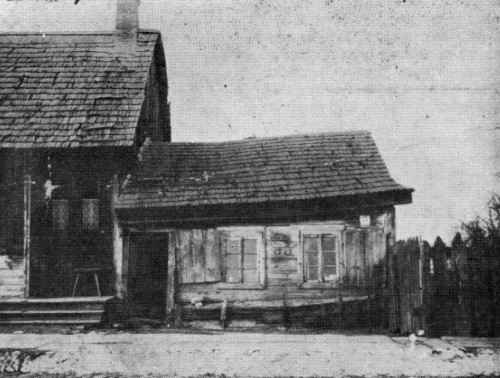
On Pinsker Street, on the side opposite the synagogue, farther toward the Zamd [sand] district, stood a low wooden house with a broad prizbe – a kind of earthen bench – and two low windows looking out onto the street. To enter the house, one had to step down two small steps. This was Shmerl the Melamed's kheyder.
Inside the kheyder there were two long tables, around which twelve to fifteen pupils would sit and study.
Shmerl the Melamed, a bit taller than average height and not too heavy, with good, responsive eyes, was about fifty-five years old. He had a black beard – almost without any white hairs.
|
|
Shmerl the Melamed's kheyder system was Khumesh [Pentateuch], Rashi [classic medieval Jewish commentator], and beginning Gemore [Talmud].
|
|
[Page 157]
Every Shabbat, after cholent, Reb Shmerl would be invited to a pupil's home in order to examine him on the weekly parshe of Khumesh in the presence of the parents.
He was a very decent melamed. People used to say that he kept the kantshik [whip] only to frighten the boys, and that he almost never used it. In the summertime, Shmerl would walk around the kheyder and along the street near the kheyder wearing a thick kamezelke [vest], which didn't fully cover his tales-kotn [ritual undershirt with four corners and fringes], leaving part of the black-striped garment showing, with the fringes hanging from the corners. He was a typical Jewish melamed, who carried out his role with integrity and honesty.
May he rest in peace.
by Melech Glotzer
Translation from Yiddish by Beate Schützmann-Krebs
|
-1-
Reb Michael made the purchase. -2-
Hashomer Hatzair blossomed there. -3-
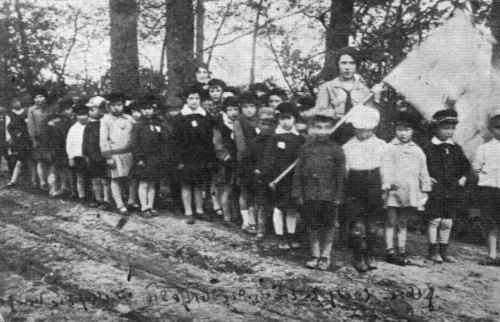
Every morning, a sea of little children. -4-
In the afternoon, the panorama changed. -5-
Speaking a mixture of Yiddish, Polish, and Hebrew – -6-
Joy! Delight in the barracks. -7-
With sports and life, the barracks pulsed; -8-
All values wiped away, -9-
May the curse coil back upon itself |
Translator's Note:
|
|
JewishGen, Inc. makes no representations regarding the accuracy of
the translation. The reader may wish to refer to the original material
for verification.
JewishGen is not responsible for inaccuracies or omissions in the original work and cannot rewrite or edit the text to correct inaccuracies and/or omissions.
Our mission is to produce a translation of the original work and we cannot verify the accuracy of statements or alter facts cited.
 Kobryn, Belarus
 Yizkor Book Project
 JewishGen Home Page
Copyright © 1999-2026 by JewishGen, Inc.
Updated 22 Sep 2026 by LA