 |
|
|
[Page 109]
by Leybl Sirote[1] (Haifa)
(Translated from Hebrew by Aharon Khludnyevitsh [Chłodniewicz])
Translation from Yiddish by Beate Schützmann-Krebs
|
|
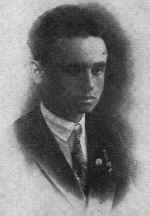
| Leybl Sirota [sic] |
In Kobryn the Poalei Zion party existed already before the First World War, but it began to develop only after the October Revolution of 1917, and especially in the years 1918–19. It occupied a large premises – the entire upper floor of Faynfeld's house in the center of town – with many comrades and sympathizers. Among the founders and activists were Bartenboym, Ragaznitski, and others.
The transfer of Kobryn to the newly created Poland; the Russo-Polish War; and especially the split within the Poalei Zion movement in 1920 caused the party to fall apart. A few counted sympathizers of the Left Poalei Zion remained, but no organized branch of the Left Poalei Zion existed. In this transitional period only Hechalutz was active, which continued to grow and expand its activity with the following circles: Tze'irei Zion, the Zionist-Socialist circle, and non-party group. Among the active workers were Levin and B. Khari (both now in Israel), and others. From the younger generation: Bentsi Pantol [Ben-Zion Pantal] and Itshe Pintshuk.
The Kobryn branch (division) of the Right Poalei Zion was founded in the summer of 1925 by two groups: Bentsi and Itshe on one side, and Y. Kh. Vigodski (now in Israel, Givat), Sh. Stavski, and additional comrades from the Zionist-Socialist circle on the other – accompanied by youth divisions such as Y.S.A.Y.
Among the activists of Y.S.A.Y. were Yosl Kalikhovski (Israel) and Moyshe Vaynshteyn [Weinstein]; among those from the Zionist-Socialist circle were Tsherkes and others.
In July 1925, some 20–30 comrades gathered in the premises of Hechalutz, in the house of Mr. Freger. Among them were several who were not members of Hechalutz. It was decided to sign the party declaration.
A temporary committee was elected to organize and convene a founding assembly, from which a leadership was subsequently chosen in the following composition: Bentsi Pantol, Itshe Pintshuk, G. Dalinski (now in Israel), Yankl Novik (now in Argentina), and Tshernyetski. The secretary was Yankl Novik.
Closer ties were established with the party center (Merkaz) in Warsaw, and thus the path was opened for further party work. In a relatively short time a party emerged that was truly worthy of bearing the name in full measure. The number of members continued to grow from year to year, until it reached 200 – active and ready to respond to every call of the movement (aside from a circle of friends and sympathizers numbering about 1,000.)
The youth organization Freiheit counted about 300 members.
Membership continued to grow steadily, despite the fact that many comrades had
[Page 110]
gone to Erets Yisroel or emigrated to other countries.
Periodic visits were carried out by comrades from the party center, as well as from Erets Yisroel [Land of Israel]. The Arbeter Shtime was distributed, and after the affiliation with the Zionist-Socialist circle, the Bafrayung Arbeter Shtime was circulated, and later Dos Vort.
The party took part in all joint gatherings and actions, carried out self-mobilization, and conducted broad educational work in all party matters. Special attention was given to the professional associations. Thus branches were created in the following trades: leather workers, tailors, construction workers, tinsmiths, employees, and others.
The frictions between the Bundist center of the professional associations and the others (who were under the influence of the Left), together with the constant persecutions directed at the associations' activists by the Polish authorities, led to the decline of the organized professional movement. The party then began to carry out organizational work within those trades that stood close to it – especially among the porters.
|
|
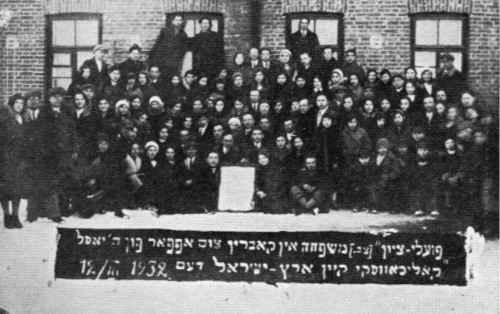
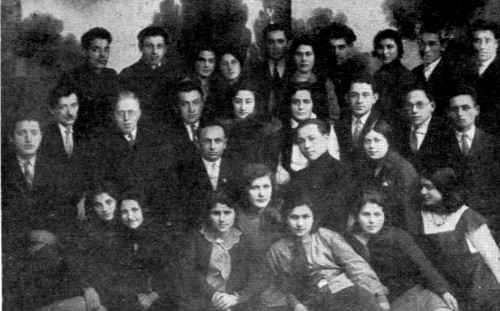
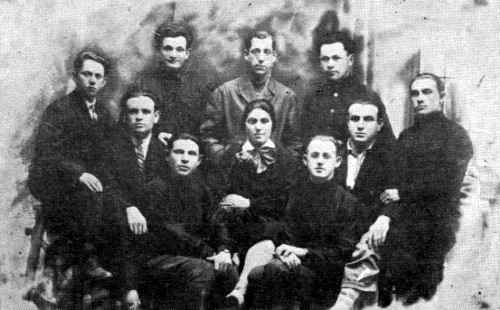
“Poalei Zion (Zionist-Socialist) family in Kobryn, on the departure of Mr. Yosl Kalikhovski to Erets Yisroel, March 12, 1932. ”] |
Hechalutz
For many years the party was the only one that provided the training and education of the Hechalutz comrades, until the affiliation of Hashomer Hatzair with Hechalutz. Even then, the party remained active and energetic in its educational and hachshore [training] work. When the Haoved movement arose within Hechalutz, an impulsive branch developed that included a considerable number of small craftsmen in the town and enabled many of them to make aliyah [immigration to Erets Yisroel].
Keren Kayemet LeYisroel (K.K.L.)
The party devoted its best energies to the work of Keren Kayemet, educating the youth for the Keren Kayemet undertakings – money collections, emptying the pushkes [charity boxes], and making contributions themselves.
Keren Hayesod
The party took part in the actions of Keren Hayesod. The majority of the more prosperous comrades would regularly contribute to the same fund.
Shekalim – A Campaign[2]
The party took part in the Keren HaShekel campaign. At the conferences of the “Bloc for a working Erets Yisroel” – which was formed during the Congress elections – the participants were mostly Poalei Zion comrades. Of the approximately 1,500 shekalim sold, “Bloc for a working Erets Yisroel” received about 1,300 votes,
[Page 111]
and the remainder went to the other parties and groupings. For the 19th Zionist Congress in Zurich, the delegate was comrade Bentsi Pantol [Ben-Zion Pantal], and for the 20th – the comrade Tsalke Shvarts (now in Israel).
K.P.A.I. – Keren Poalei Erets Yisroel
The party regularly took part in raising funds for this keren [fund].
Within the “League for a Working Erets Yisroel”, the number of comrades contributing to the K.P.A.I. reached 400. The secretary of the “League” for many years was the comrade Leyzer Goldberg, and the treasurer was Tekhla Feldman (both now in Israel). The party was represented on the committee that confirmed candidates for aliyah to Erets Yisroel, and it greatly assisted the kibbutz-hakhshore [training commune] that existed in the town. In this way it accompanied hundreds of comrades in their aliyah to Erets Yisroel.
|
|
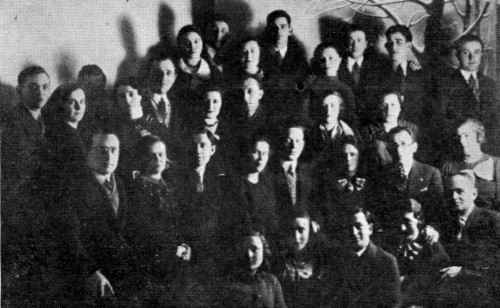
| Kobryner Hit'achdut group [The “Union” faction within the Tze'irei Zion movement] |
Social Work
The party was represented in the local ORT [Jewish vocational-training] society and in its administration. Alongside the activity of the vocational school, the party demanded of ORT that it provide greater support for the youth who were preparing in the hakhshore [training] centers to go to Erets Yisroel.
In the town there was a carpentry school for boys and a sewing workshop for girls. During the elections for the World ORT Congress in Berlin, the party received a telegraphic notice to delegate a representative to participate in the Congress. On the same day an urgent meeting of the ORT members was convened, and the comrade Itshe Pintshuk was chosen. The mandate, unfortunately, was not used because of technical reasons. (This was the second mandate that the Hechalutz movement in Poland received.)
The party was represented in the department and in the curatorium of the Y.S.A. school[3] that existed in Kobryn. It arranged for teachers from among its own comrades or sympathizers. Among the teachers were the following party members and supporters: Grosfeld, director; D. Marin, Zak, Malka Rubin (now in Israel), and Liza Gibgot.
After the closing of the school, the party reopened the school that operated under the shul-kult [school-culture] association, and it existed for two years, until it too was closed because of material reasons.
For the municipal-council elections in 1927, the party came forward for the first time with its own platform. Prior to this, secret meetings had taken place with representatives of the Kompartey [Communist Party] and of the Ukrainian group
[Page 112]
“Selrob,” with the aim of creating a united workers' list for the upcoming elections.
|
|
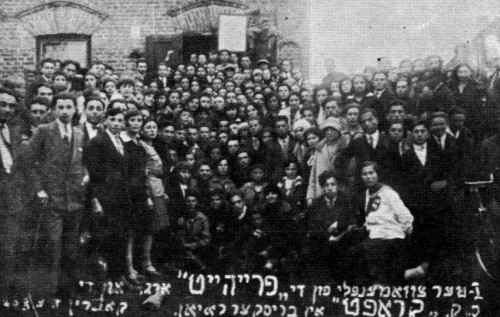
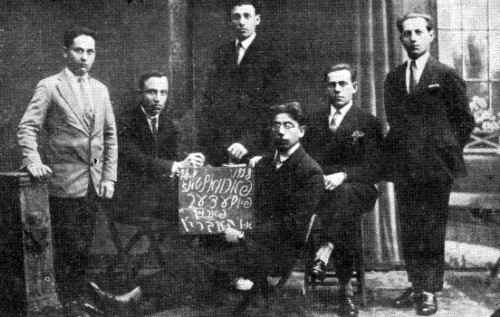
“First gathering of the Freiheit organization and the S.K. Kraft in the Brisk district. Kobryn, (date illegible)”] |
The following took part on behalf of the party: Itshe Pintshuk, Grosfeld, Leybl Sirote (now in Israel); on behalf of the Ukrainians: Perikhotik, Rafalovitsh, Dimantshuk; and on behalf of the Communists: Maslovitsh, Kamenetski, and Moyshe (?).
Since the party could not give up the Zionist positions with a proper proportional representation, it went independently to the elections. The party then received one mandate: Pintshe Lifshits; the Communists received two: Maslovitsh and Grinberg; and the Ukrainians none.
When the Russian and Polish councilmen withdrew in protest against the Jewish majority in the municipal council, additional elections were held, and the following were elected: Bentsi Pontal [Ben-Zion Pantal] and Yitskhok Tenenboym. In the later elections we received three mandates: Bentsi, Yitskhok Tenenboym, and Leybl Sirote; the Communists one mandate, Kaplan; and the Bund none. The Ukrainians did not take part in these elections.
The activity of the party's representatives in the municipal council was accompanied by success and brought the party considerable recognition – especially through the public appearances and work of Bentsi Pontal. A workers' quarter was established near the municipal slaughterhouse, and certain social reforms were introduced.
In the last years before the outbreak of the war, the Polish authorities banned our party and its activity. Only one list continued to exist – the well-known B.B. list[4]. Jewish representation in the municipal council was reduced to a minimum, and our list was disqualified. The party convened special meetings to deal with certain issues that were connected with the municipal council, and for this purpose made use of the weekly newspaper Kobryner Shtime.
The Jewish Community
In 1928, at the first community elections, the party's representative chosen was the comrade D. Marin, a teacher in the Y.S.A. folks-shul [Jewish elementary school]. In the later elections, abuses were committed by the B.B. Jews Hershl Tsukerman (now in America) and Sholem Rimland.
The party received only one mandate (Bentsi Pontal), instead of four, according to the number of votes that had been cast. The falsified election result was denounced by the party together with the General Zionists, and as a protest we did not take part in the activity of the Jewish community.
[Page 113]
The Poalei Zion party always responded to every call that came from the organized Jewish society fighting for its rights – whether it was a strike-protest or some other action. The same was true of the specific workers' mobilizations, such as the May Day celebration, gatherings, and youth congresses.
After the Brisk “excesses” (the tragically well-known pogrom), the party was placed on alert. Thus, on a certain market day, when the hooligans were preparing to carry out “a bit of work” on the Jews, the porters and carters were organized, the authorities were warned, and measures were taken to prevent the disturbances.
|
|
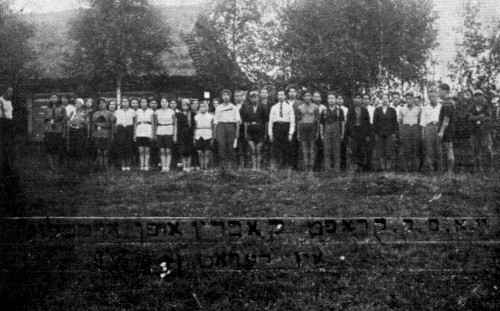
“Sport Club Kraft, Kobryn, on an outing in… (location illegible).”] |
Cultural Work
Evening courses were held, as well as a folk-university, assemblies, and conferences, all of which were always well attended. Special mention must be made of the large Brener Library, with its thousands of books in Yiddish, Hebrew, and Polish, which counted a hundred readers. The Hapoel sports club, with its modern facilities – whose founder was the teacher Zak and later M. Zubatski – and the youth choir under the direction of Yitskhok Vinograd (now in the United States).
More than once a request would arrive from Warsaw, from the Merkaz (central office), to send comrades to take part in the center, especially the comrades Pantal and Pintshuk. Thus, in order to cooperate in the central office of Ha'oved and Hechalutz in Warsaw, the comrade Tsalke Shvarts – one of the finest cultural and educational forces, who trained a generation of youth from Hashomer Hatzair in Kobryn – was sent.
From the small rooms at Fregers' house, which had become too cramped for its activity, the party moved to Shteynbergs (Shmerl Ash) – a larger house with several rooms. After the closing of the Y.S.A. school (covering the deficit of the school itself, amounting to 200 dollars, in which twenty comrades took part, who signed fifty notes of four dollars each, which were transferred to the Folks-bank), the party received the premises of the school in the large building at the corner of Traugutta Street (Post).
This was the building where all the Zionist youth movements were concentrated, and where the party reached its highest point of growth and development, until the Polish authorities – at the instigation of certain Jews who disliked the activity – forced it in 1938 to leave the building on Traugutta. It then moved to Fialkov's house, and from there to the house of Ken Tsipor [name faded in the original] in the center of town.
[Page 114]
The composition of the party's leadership in 1939, just before the outbreak of the war, was as follows: Bentsi Pantal, Itshe Pintshuk, Leybl Sirote, Abrasha Herman, Itshe Stavski, Avraham Fridman, and Khane Podrovski.
The Polish authorities persecuted, harassed, and imposed various difficulties. They snooped around in the library, confiscated books, and required a monthly report on the financial condition of the affiliated institutions: Hechalutz, the Kh. Brener Society, Hapoel, and Frayhayt [Freiheit].
They also demanded that certain employers dismiss Poalei Zion comrades who worked for them as employees. They pressured Mr. Gurvits to dismiss the comrade Bentsi Pantal; they also obstructed Abrasha Herman from appearing in court as an attorney and created all sorts of difficulties for him because of his party activity, and likewise for others. Nevertheless, the party's activity did not cease for even a minute until the outbreak of the war on September 1, 1939.
On September 17, when the Russians entered Kobryn after the Nazis had left, Zionist work was forbidden. The party became illegal. The comrades Bentsi, Itshe, Abrasha, and others were placed under the supervision of the Soviet authorities. The only remaining path was to flee to Vilna, the only way to be able to leave for Erets Yisroel.
Yet the Zionist spark did not go out – a small measure of hope still flickered in the hearts of the Kobryn Jews, until the Nazi invasion broke out on June 22, 1941. Thus began the torment-filled agony of the Jewish community in Kobryn, leading to its complete annihilation on October 15, 1942.
|
|
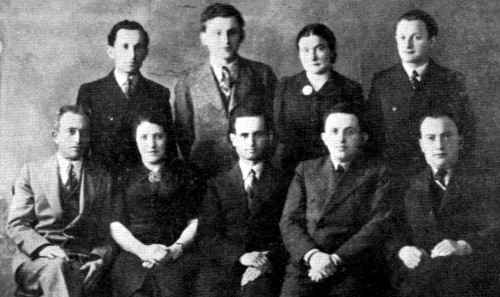
Seated, from right to left: B. Pantol, A. Herman, L. Sirota, Kh. Faynfeld, A. Virtser Standing, from right to left: Kushnir, Kh. Podrovski, Stavski, and Fridman |
Kobryn – one of the hundreds of towns and townlets scattered across White Russia and Poland, where the majority of the Jewish population, living a hard and burdened life, embodied in miniature the entire national-Jewish life, in all its shades and nuances, from extreme right to ultra-left; on one side tradition and deep Jewish piety, and on the other a free, secular self-expression.
Nevertheless, there was something especially “Kobrynish” – if one may put it that way – a kind of familial quality in the mutual respect and distinction among the various tendencies, parties, and circles, each one striving in its own way
[Page 115]
toward a better and more beautiful tomorrow, toward the uplifting of the Jewish people and of the working masses.
|
|
Kobryn, beloved town!
Where we first saw the light of day, where we were raised and brought up! There, where we left behind our dearest and most precious ones – parents, brothers and sisters, comrades and youth, thousands of friends and sympathizers who proudly carried the idea of our national-social renaissance.
Some of them fought with their last strength against the cruel enemy. There were houses for which the Nazis had to use tanks in order to destroy them. Among them was the house of Ber Vikunkin; there were Abrasha and Khantshe Herman, Itshe and Rokhl Stavski. There was the house of Zubatski: Mordekhay and Mirke Zubatski and his brother Hershl with his wife Lize; likewise the house of Note Goldfarb and others who threw grenades and fired at the Nazis until the last moment and fell with honor. They sanctified the people and the movement in which they had been raised.
Kobryn – your streets and houses remained intact; what are you today for us? A place of pain and destruction, death and annihilation, an Emek Ha-Bokha [Valley of Tears] of our holy martyrs.
Who walks today through your streets that once swarmed with Jewish children – why were you not destroyed together with your Jews?
We will not forget you! Through all eternity you will remain in our memory.
30 September 1950
Haifa, Israel
Translator's Notes:
by Zalman Lipshits
(Translated from Hebrew by Aharon Khludnyevitsh [Chłodniewicz],
from the book Sefer Kobryn)[1]
Translation from Yiddish by Beate Schützmann-Krebs
I lived in Kobryn as a stranger and at the same time as a resident from 1915 – when the people of Brisk became homeless – until I emigrated to the Land of Israel in 1921.
In that town I took my first steps in the youth movement, and for the first time took part in social life.
The town is especially dear to me, where a mother, brothers, friends, and comrades remained – in suffering and in joy.
Kobryn – from the mountain of destruction I gather fragments of memories, a memorial light for all the dear and beloved ones…
If one were to ask me to which youth movement I belonged in my earliest youth in Kobryn, I would without doubt answer: Tze'irei Zion. And to the question: what was the gateway to the movement, my answer would be: the Literary Society.
For many of you it is surely unknown, and perhaps you have already forgotten about such a society; it would be an injustice not to mention it with a few words.
The society, or circle, was founded in 1916. Its driving spirit was Rogoznitski (a brother of Gedalya Alon Rogosnitski, of blessed memory). Every Saturday afternoon we would gather on the upper floor at Palevski's. There I heard my first readings about Hebrew and Yiddish literature and received my first notions of social life in the community. For a young fellow who had until then lived within the narrow circle of tradition and dry halakhah, a new world opened up.
Our group was non-partisan, although most of the speakers belonged to particular parties. Naturally, each person would speak according to his own political outlook. The readings almost always led to heated discussions. And although on the one hand this sharpened our minds, it also, at the same time, caused a widening of differences – until our club eventually closed.
Around that time the General Zionists organized a circle, or club, with the official name Beit Am [House of the People] – if I am not mistaken, there was even a sign with that name – and we, the young people, were its regular guests.
In the evenings the club was full of young people, boys and girls. There were often “kestl-ovntn”[2] – questions and answers – “flying mail,” and other entertainments. Our Zionist work consisted of collecting money for the Keren Kayemet LeYisroel [Jewish National Fund] at weddings and at other events.
Some of the young people – the more active ones – were not satisfied with the situation as it was; they criticized and called for more practical action. Eventually the Tze'irei Zion party was founded. In the meantime we would gather on Brisker Street in an upper room, and there the idea was also raised of creating a library. In those days the first reports about the Russian Revolution reached us.
Although the impression was a strong one, it did not sweep people along. Even the youth, who are generally alert and inclined toward revolutionary moods, remained – aside from a few exceptions – indifferent. The reason for this may have been the weakly developed class consciousness or the petty-bourgeois attitude of the more conservative masses. Still, people were curious to know what was happening over there on the other side of the border. But everything was somehow veiled and unclear.
I remember that at that time we lived on Garber Street. The German military patrol that used to control the traffic between Kobryn and Antopol knew me. They also knew my friend Yonah Bener (Ben-Ner),
[Page 117]
who lived on the same street.
Once, our comrade N. M. came to us and introduced us to a certain person – not a Jew – and asked us to help him get through the military post because he had no permit (sheyn).
We did not think about it for long and carried out that little piece of work. And until the German Revolution broke out[3], we did almost the same thing every evening. Although by then we already knew that our “passengers” [the strangers we were escorting] were Russian soldiers who were being smuggled out of the prisoner-of-war camps around Kobryn, we were well aware of what awaited us if we were, God forbid, caught. But the danger excited us and drew us on.
And when I think today about those extraordinary days, I myself do not know what to call it: foolish youthful madness, or, on the contrary, taking upon ourselves these heroic deeds. Whatever it may have been, at the time it seemed to us that we were doing very important work.
Someone raised the question: why, and for whom? What would the comrades say, the party? I remember my comrade Yonah's answer: “After all, it's a purely humanitarian act – or even pidyen-shvuim [redeeming captives].”
And since the party still had no clear line, each person would resolve his doubts according to his own understanding and inspiration.
Even the left-wing elements (a rather insignificant number in our town) were then in a state of inner ferment. True, in later years their group grew, and many of their activists were persecuted in the prisons of Brisk and Bialystok. But in those days their entire activity consisted of endless discussions and conversations in Bartenboym's shop.
Later they founded the first folks-shul [Jewish elementary school] in Kobryn, with the teachers Portnovski and Holtsman.
People still remember the songs of Khayim Khomatinski [Chaim Chomatinsky] and the children's operetta he composed. There was also a children's choir (if I am not mistaken, it was called Hazamir). The repertoire, created without any particular pretensions, consisted of liberation songs and workers' songs. In one of the more advanced classes of the folks-shul, a dramatic circle was formed, in which teachers, students, young people, and adults all took part. Plays by Sholem Aleichem, Hirshbeyn, and Peretz were performed.
The first Hebrew evening courses were also introduced here. I have recorded all this in order to show that joint undertakings were carried out, regardless of political differences.
After the German occupation forces left the town and the Poles took it over, the “club,” that is, the Tze'irei Zion group, was closed for several months. The evening courses continued.
A circle for Hebrew literature was also established. Here the teachers Noyekh [Noach] Alkon and Yafe [Yaffe] should be mentioned. We, their students, will always remember them with affection.
The latter – an outstanding master of the language – clarified for us all the difficult rules of dikduk [Hebrew grammar]. But what has remained especially vivid in our memory is Mr. Alkon's pathos during his lectures on the Hebrew writers and poets and their creations.
Only once did the Polish authorities close the courses for a few days, but thanks to the intervention of A. Levitos they were reopened. After our club was finally legalized, the number of visitors increased, and the library also developed. Unfortunately, we did not have any intellectual leaders who stood at the proper height. The central departments in Warsaw and Brisk, it seems, did not devote much attention to the smaller towns.
I do not remember, for example, that anyone from the center ever visited us. Our meager ideological knowledge we acquired from the yearbooks of Ha-Poel Hatzair – Moyshe Holtsman's private property – and from Dr. A. Galperin's lectures on Jewish history.
Those were times of great national awakening.
We lived through many sorrowful moments then: the Pinsker shkhite [slaughter], the Lemberg pogrom, and the mournful hazkarah [memorial service] in the Great Synagogue. Those were the days of the march of the sorrowfully famous Halertshikes (General Haller's legions).
We also had bright moments:
[Page 118]
the day of Keren Ha-Ge'ulah [the Redemption Fund], after the proclamation of the Balfour Declaration, when the “entire town” gathered in the synagogue and contributed with great enthusiasm to the collection – women donated their jewelry – for the redemption of our people.
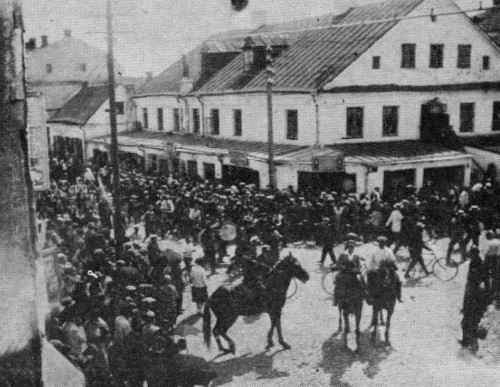
Another day is remembered: Lag Ba-Omer. The courtyard of the Great Synagogue and the Pinsker Street were filled with people. The students with their banners – Zion banners. Jewish speakers addressed the crowd about liberation and deliverance. Several high officials of the Polish authorities – among them military officers – spoke about equality and equal rights for all the peoples living on Polish soil. A general joy prevailed. People kissed one another in the streets. The students with their teachers, the young people, and our party marched, accompanied by an orchestra (from Pribulski's school), to the forest beyond the town. Until evening we spent the time singing and dancing. It was the first public celebration in liberated Poland.
It was then that the first group began preparing to make aliyah to Erets Yisroel. Needless to say, not all of these efforts were purely national-Zionist in character. A kind of emigration psychosis seized the youth. Many went off to America, and others joined the party in order to make aliyah. No official Hechalutz branch yet existed in Kobryn. We had only heard about it. Consequently, we did not undergo any pioneering training.
There was even an attempt by comrade Yisroel ben Khayim (Goldshteyn) to rent a piece of land and create an agricultural training program, but for material reasons it did not succeed. And yet the first two groups that reached the Land (Erets Yisroel) went as a kvutza group and engaged in kibush avodah [labor conquest]: working on draining the swamps in Nahalal, planting tobacco in the Galil [Galilee], and some of them belonged to the founders of Kfar Yehoshua.
|
|
The first group consisted of only five young people. They left quietly[4]. Even the companions who came to see them off at the corner of Brisker Street hurried away, because from a distance one already
[Page 119]
heard the echo of the cannons – the Bolsheviks were approaching. It was the summer of 1920. The short period during which the Bolsheviks were in our town left a strong impression on the youth. The club was closed. The group wandered around the streets and marveled at these plain soldiers, among whom it was hard to tell who was an officer and who was an ordinary soldier.
Meanwhile the “apparatus” began to work. A wall newspaper was issued under the name Royte Kobryn [Red Kobryn]. Literary tribunals[5] were organized. Meetings were held in the middle of the marketplace. The students were invited to participate. But they did not dare.
The main activists in the propaganda office were our Jewish brethren from Homel and Minsk. We became acquainted with them more closely. They did not even mock our plans to go to Erets Yisroel. Access to official posts became open – this attracted the youth. And so I myself received a position in the Office for Popular Education, working on counting and sorting the thousands of books that the Poles had left behind as abandoned property when they fled the town.
The new authorities mobilized all young men from the age of eighteen. But this did not last long, because by morning the Bolsheviks had already left the town.
The first letters from the kvutsa [group] began to arrive. We read them once and again. Not everything is clear. Not everything can be written. But one thing becomes clear to us: the land is desolate, yet at the same time beautiful, and it is waiting for hands that will work it and make it fruitful.
The necessary preparations were made. And on May 3, 1921, the second kvutza left Kobryn, and the “entire town” accompanied them with the traditional farewell, “until we meet again.” Unfortunately, the blessing was not fulfilled.
They never saw one another again.
|
|
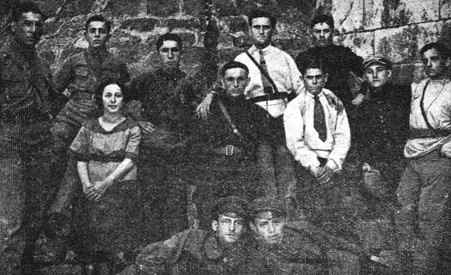
[Since this photograph also appears on page 113 of the Hebrew original version of the chapter – and is reproduced there in much sharper quality – I have chosen to use the photo and its caption from that source.] |
Translator's Notes:
by Borekh Glazman[1]
(printed in Shpigl (Mirror))
Translation from Yiddish by Beate Schützmann-Krebs
The shtetele I am about to describe is called Kobryn. It lies somewhere between Brisk and Pinsk. Once it belonged to the Grodno province; now it is a forsaken, God-forsaken – and people want to leave it too, oh, how they want to – place set out on the kresn, that is, on the borderlands of Poland.
It was an early winter Shabes [Shabbat] eve. It was actually only November, but here the low houses already stood hunched under heavy blankets of snow, and a sharp blizzard swept across the bare fields near the train station. The neglected little patches of ice on the trees chimed like polished glass pendants on huge hanging chandeliers.
At the station I was met by a delegation of young comrades who already knew that an American Jewish writer was arriving. Their faces showed the greatest curiosity, and their mouths were open one after another, despite the frost that hung in the pre-dawn air outside. Their many questions had been piling up inside them and were practically bursting out of their mouths…
But they saw that I was dead tired after the long journey from Warsaw, and they let me rest. After all, they knew: their “victim” would not slip out of their hands. Besides, they knew I had come for several days.
At the inn where they had brought me with great pomp, the number of escorts had already grown smaller – because not everyone had the courage to follow along behind on drozhky on Shabes. But in any case, I couldn't fall asleep. A man waited on me; he made up the bed. Only the room was so cold, and the bedding wasn't much warmer. They explained to me that the room hadn't been heated for an entire week, since no guests had stayed in it. Why waste wood for nothing? Now, of course, they would heat the hrube [oven] soon. But it was Shabes today, so they sent for the shikse [non-Jewish girl] instead.
Well then – I saw that I wouldn't fall asleep no matter what. So I got dressed again, even put on my overcoat and galoshes, and paced around the room, trying to warm myself up…
When that grew tiresome, I stopped by the window. Across the snow-covered streets, girls and women were carrying little parcels and pots, wrapped tightly in rags. I understood at once that they were surely bringing home the scalded pots of shabesdike milk with chicory from the baker – and my lips began to water.
Across from the window of my inn stood a monument from the time of the Napoleonic wars. Here, they say, he suffered one of his last defeats. On the top of the monument there was supposed to be – so the hotel attendant explained to me, trying to warm me with words, since he clearly couldn't do it with the oven – on the top of the monument there once stood an eagle holding a snake in its beak, a symbol of Russia, which had defeated France. But the Poles have now chopped down the Russian eagle.
Four cannons stood at the four corners of the monument, their black, yawning muzzles gaping straight toward my window – straight toward me… I don't like it somehow…
I stepped away from the window and moved toward the door. Maybe the corridor would at least be a bit warmer.
But when I opened the door, I almost knocked over several people who, it seems, had been standing right behind it the entire time.
Ah – so this is my “delegation” that came to meet me at the station! Just look at that. And they had told me that they would all go straight home as soon as I lay down to sleep… But I see that not only has none of them gone home –
[Page 121]
as if they were afraid that this “rare bird,” the “American,” might slip away in the meantime – but on the contrary: their number has, by itself, grown even larger…
A few more young men have joined them, who, it seems, wouldn't let the delegation have the whole excitement to itself … They were all standing there, whispering among themselves in a kind of secretive hush, when I suddenly opened the door.
“Listen,” I called out to them, “why are you standing here in the cold corridor? Come inside – at least you'll warm up a bit…”
And at the same time I made a quick calculation: with so many young fellows, no evil eye, my room would surely get warmer soon… My invitation, of course, was accepted at once.
Some of them sat down on the windowsill, others leaned against the tiles of the cold oven, and still others were jostling around the room like lost sheep… There was nothing more in the room than a single creaking Viennese chair to sit on.
“So – who do you work for?” I tossed a question into their little huddle. And again I did it with a calculation: otherwise they'd soon begin to interview me… on account of America, of course.
“We work for unemployment…” answered a young fellow with a strongly reddened nose, apparently singed by the bitter frost outside, not letting himself be asked twice. “Myself, I'm a maker of trousers and vests, but I'd work at anything… just give me work!”
“And how much do you earn a week, when you do have work?”
“Fifteen zlotys a week… that is, less than two dollars,” the young man with the red, frost-bitten nose explained again. And when he noticed the look of astonishment on my face, he quickly added, cheerfully:
“That's because I haven't been in the trade very long… A good master can even earn as much as thirty guldens a week!”
From my further conversations with my visitors, I learned that even good craftsmen – tailors, leather-workers, gaiter-stitchers, and so on – would feel fortunate if they earned thirty złoty a week. Men with families! And what wonder is it, then, that even the town's balebatim, shopkeepers, and small traders also earn no more than thirty guldens a week…
“One time thirty and one time three,” remarked another young man with a very wide mouth and broad facial features. And I do not know whether he was joking, or whether he said it with regret.
“For how should the shopkeepers and small traders earn more? The surrounding White-Russian peasants are also terribly impoverished; they have nothing with which to buy. Village products in Poland are cheap, city products expensive: a peasant must sell an unimaginable hundred pud of grain in order to be able to buy even a single pair of boots…”
“The local peasants,” called out a red-haired young man, “have never lived as poor as in these last few years… What should they buy from the Jews in town? Nothing at all… They don't even buy kerosene anymore… On winter nights they burn only pine-chips.”
From this young man's words it was clear that he felt great sympathy for the impoverished peasants in the surrounding area – no less, if not more, than for the Jewish poverty in town. It did not take long before I truly found out: this young man was not only “red” on the outside – red hair, red eyes, a red jacket made of some kind of red-dyed sheep's wool, and even the trousers he wore already had a reddish look from being smeared and worn down… but he was “red” on the inside as well, so to speak – he was a Communist.
For a certain period he had occupied himself with smuggling across the nearby Soviet border a Communist newspaper, which he then distributed himself throughout the villages. The newspaper had a name in all three languages – Borba, Baratika, Volka – and was printed in Russian, White-Russian, and Polish. The Polish gendarmes – for a handsome coin, of course – would even help him steal across the border… until the matter was discovered here, and the Polish gendarmes were then kept there.
[Page 122]
My attention was drawn the whole time to a young man with a somewhat boyish appearance. Several times already he had opened his mouth as if to ask me something. But the older, stronger young men shouted him down, pushed him back, and did not let him get a word in…
And the poor boy opened his mouth again and again and closed it again and again, like a fish out of water, until I finally asked him myself what he wanted to tell me, and he told me:
“A few years ago my father, together with my little four-year-old brother, left for America… I couldn't go along – they didn't let me leave Poland; some paper was missing… At home only I remained – my mother had died a few years earlier.
Well, in the goldenem land [America] my father went through the usual ‘immigrant blessings,’ long and wide, until he finally got work in the Philadelphia Navy Yard, and there he fell from a high pier and was killed…
So my father surely left an inheritance… But how does one find out about it?
As for the address of my little brother, who is now surely a grown young man – I don't know it at all. Should I perhaps place an announcement in an American newspaper?”
“After all, you have the greatest Yiddish newspapers in the world over there…” he boasted, proud of America's greatness. He knew it, this fellow…
In general, I noticed everywhere in Poland that the local Jewish youth now knew a great deal about America – America, the promised land, toward which all their eyes were turned…
“But will my brother even read the announcement?” the young man pressed on, voicing his further doubts with pain. “He left when he was such a little child… Most likely he doesn't read any Yiddish newspapers at all… In America your Jewish youth assimilates…”
“Yes, all of them, all of them yearn to get away from here – some toward Russia, some toward America… Of course it would be more fitting to go to America; but what can one do – America doesn't let you in… In Russia –”
“From there they simply throw you back across the border, if you've already stolen across…”
“Unless you go there with some kind of shlikhes [mission]…” – the red-haired young man called out .
“Well – you have to prove yourself worthy of it!” complained the boyish-looking young man.
“And when you prove yourself worthy of it,” remarked the young man with the wide mouth and broad facial features, “they put you in prison here first…”
And again I did not know whether he was joking or not. After all, he himself had already been in Moscow – back in 1919 – and had fled from there because of hunger. People then received only one pound of bread a day to eat! Now, when he hears that in Moscow there is once again food to be had, he truly regrets it…
“Soviet land is a wonderful country… as soon as there is bread there again…”
And the red-haired young man began telling me about the terrible persecutions that the leftists had to endure at the hands of the Polish authorities.
Here, in the border districts, where poverty is overwhelming and the Russian border is not far, Communism is indeed much more widespread than anywhere else in all of Poland. The Jewish youth here sees only ruin and hopelessness – they cannot study, they have nowhere to work. There is absolutely nothing they can take up…
And “over there,” one hears, life is truly open to young people – they can do everything there; the doors and gates are open to them… That “over there” truly exerts a powerful pull on the starved young imagination – and perhaps also on the starved stomachs…
Therefore, when they are arrested here – and I soon hear from them a story about the dreadful torments that the Polish authorities inflict on political prisoners – torments and tortures that make one's hair stand on end: they drive heated needles into the soles of the feet… they hang the arrested on such inquisitorial wheels that spin the prisoner in the air like a mill… they pour water in through the nostrils – because the mouth can
[Page 123]
be clamped shut, and the water would simply flow back out – but through the nostrils it goes inside, into the stomach; and when the stomach becomes swollen with water, several gendarmes then sit on him, because that produces terrible suffering…
I ran out of the room to catch my breath for a moment.
We walked through the streets. It was already after the prayers. Jews were already making the Shabes blessing in their homes, most likely over a humble pear-and-apple compote, the Shabes fruit stew …
Girls bundled up in huge headscarves, with only their bright little faces peeking out, were already carrying the cholent from the big baker's oven across the marketplace.
The ortodoksye [orthodox Judaism], as they say, is still strong in the shtetl…
The local “leftists,” when they want to hold a lecture with a Jewish writer or even just a speaker, cannot possibly do it on Friday night – the respectable householders' children simply would not have the courage to come.
Nevertheless, a few of my companions were now smoking cigarettes. Perhaps because they felt protected by me, the American – who would dare stand up against me? A mere trifle… and perhaps they simply wanted to show me, the man of the world, their free spirit…
The language you hear in the street is clearly Lithuanian Yiddish: “We have many Skhidim [Chasidim] here…” A Yiddish newspaper from America is seen “often,” they said. By that they meant – rarely. In local Yiddish, when one wants to express the idea of “rarely,” one says gants oft [very often].
Here on the kresn [borderlands] the youth hardly speaks Polish at all – they speak Yiddish; the girls speak a little Russian, left over from earlier times. But the girls – oy, the weaker sex! – they assimilate more quickly, especially linguistically; they've already begun to speak Polish as well… Yet the Jewish boys here in the border districts boycott such girls who have begun to speak Polish…
For Kobryn is a purely Jewish town, an old Jewish community, with an old Jewish pinkas [community record]. Ninety percent of the population are Jews. It doesn't matter that the magistrate, the town administration, is Polish – with only one Jewish lavnik [member of the town council]…
And precisely for that reason the one Jewish lavnik, Mr. G., also dislikes Jews… When Jewish workers turn to him to be exempted from the magistrate's fee for registering lessons, he refuses them – because, he says, the Jewish workers are “economically privileged”…
As people in the street were already beginning to point at me too insistently with their fingers – “There he goes… that's him… there he goes…” – I decided to take refuge in a nearby café.
Incidentally, it really is the only café in all of Kobryn! Inside I soon discovered that I could not get a glass of coffee – because only last week their entire supply of coffee had run out…
What choice did I have? Again I went out into the street, strolling in the frost. On an empty lot opposite me boys and young men were drilling in scout uniforms. How astonished I was when the commands of the scout officer reached my ears – in loshn-koydesh [Hebrew]: khad, shtayim… yeminah! smolah! (one, two… right! left!).
My companions explained to me – with a touch of contempt and quite a bit of dismissal (“for they are, after all, Yiddishists”) – that these were the respectable householders' children from the local Hebrew gymnasium, who had their own scout organization – the Polish scouts won't take them, so they've set up their own. And truly – what else is on their minds? Playing soldier!… and in Hebrew, of all things!…
With enthusiasm and excitement they were now performing their athletic exercises on the lot – some of the athletes wearing glasses, all of them with frost-reddened noses… Akharei lehitpazer! (“after me – disperse!”) their officer shouted – a young man with a red neck, who gave his commands in Sephardic pronunciation. And the scout group gradually dispersed… The frost burned…
Through the frost-covered little windows of the low, huddled, crooked houses, under their heavy winter drifts, one sees: at tables where the shabesdike candlesticks still stand; on tablecloths where crumbs of khale lie scattered and which are speckled with little stains of fat and milk, bearded fathers sit and recite: Borkhi nafshi… utsidkoskho tsedek; and young girls, still “blood and milk,” melting small round patches on the frosted
[Page 124]
panes with their warm breath, peering out through them into the Sabbath dusk with wistful, yearning eyes…
It was growing dark. A frosty evening, a heavy Shabes-night mood. Although it had long been night outside, one saw no lights in the surrounding windows; in the synagogues and bote-medroshim Jews were still swaying in prayer over Ato khonantonu [the Havdalah insertion in the Amidah] and the wakeful Shmone-Esre [the Eighteen Benedictions, the Amidah].
The shops were still closed. The shops here, incidentally, are closed two days a week: Shabes and Sunday – Shabes because one wants to, Sunday because one must… Croaking crows hung thickly on the winter trees like heavy winter fruit; on a corner of a street a pack of stray dogs was celebrating a dog's wedding…
From the Misnagdic synagogues the worshippers were already coming out, yet no one hurried to open the shops – why should they? Would the customers break down the doors?
From the Orthodox church in the middle of town one heard a poor, orphaned ringing – not like church bells, but like the little bells on the necks of goats.
The Orthodox bells, poor things, were also in exile now.
But in the Chasidic shtiblekh it was still dense and dark; in the shtetl there were rebbes – Misnagdic[2] rebbes, if one may put it that way; the Kobryner rebbe lived here, the Slonimer rebbe came here once in a while to visit. In the shtiblekh, dark as the night, shadow-figures hung about; old men – and their fur hats – sat in the cold shtibl, sat at empty tables and sang:
Ay, ay, ay… bosor vedogim… ay, ay, ay! vekhol mat'amim…
And then they began to draw out a black-bile, melancholy melody… At first only one man sang – no one helped him until he finally gathered strength and began to scold the oylem [the whole crowd]:
“Well, what's the matter with you, Jews… why aren't you singing? One must sing, Jews…”
Soon all the Jews at the table began to draw out such a monotonous, sorrowful tune, like people before slaughter… They pulled the children into the melody as well, and the children tore at their throats too, like small calves before they are led to the knife.
All around it was so dark – even the windows of the shtibl could not be seen from outside; and soon there came over you a certain impression as well, an impression that before you was not the underworld, not the real world, but a shadow-world, an oylem-hatoye. And you were so startled that you hurried out of there.
At night you no longer saw any youth at all in the streets. Everyone sat at home; strolling about was too cold; there was no club to go to. No clubs of any kind were permitted here.
By a few open shops I heard people whispering – but whispering quite loud:
“Here he goes, the American…”
America, the fortunate land! They told me: not far from Kobryn there is another small shtetl, Antipolye [Antopol], it's called – “they're well off there,” people say, speaking of that shtetl with envy…
There they do not live through any crisis at all, a wealthy shtetl! Why? Quite simple. It is a shtetl entirely without young people. The youth have scattered across the faraway lands: to America, South Africa, Argentina… In Antipolye almost only old people, children, and women have remained, and their only livelihood is the money they receive from America and all the other distant lands.
Tomorrow is Sunday. The market is completely dead. Everything is shut. In the middle of the market stands a painted post with little placards pasted on it: to Brisk – so many miles; to Kartuz-Bereza – so many miles. Nothing more. You don't see even a single wagon passing through in any of those directions…
Around the market, by the shuttered shops, a few human shadows were loitering about. I shuffle over to them. They are kosher butchers, meat-dealers; they are talking about how the tax is being raised.
“How many zodiks [the hind-quarter pieces] of meat do you need for tomorrow?” one butcher asks another.
“Zodiks?” the other says, almost astonished. “He's slaughtering my geese… one zodik will be enough. If I sell at eighty groschen a kilo, he sells at seventy! All just to undercut my prices.”
“Foolish one, what do you think? In every person there's a bit of spite… and whenever he can, he smothers the next fellow.”
At midday I eat lunch in the richest restaurant in town – naturally a Polish one. On the walls: hunting pictures, pictures from Polish history, the Wawel [cathedral complex]… At the tables
[Page 125]
sit the most elegant, high-born pritsim [Polish landed gentry] – real pritsim. When a lady comes in, the Polish gentlemen jump up from their seats at once, as if on springs, bowing, bending, turning on their heels…
From my place at a restaurant table I notice something: several times now, as the door opens halfway, a frightened head without a cap – a Jewish head – pushes itself inside. He looks in, gives a smile, a sniff, another charming smile, and disappears. Several times already, like a dog that isn't sure how his master will treat him. Whether he'll give him something to eat if he edges up to the table, or whether he'll get a kick in the belly from a booted foot.
This man is actually dressed in a rather fine fur coat and gives the impression of a merchant who surely does some big business with the local pritsim. But the beaten, wary, dog-like expression in the runny eyes, the fear on the sunken cheeks, the whole submissive look tells a completely different story…
I look around the dining room. None of the surrounding Polish pritsim pays the slightest attention to this man, who keeps pushing his head so dog-like through the half-opened door every so often.
Only outside the restaurant did I realize: this is actually a well-known local merchant – a former one, a ruined merchant…
He has no business whatsoever now to conduct with the pritsim. So what then? The Polish pritsim use him for errands. They send him to buy various small items. They expect him to deliver different bits of information and gossip about one another, and so on.
True, all of this could easily be handled by a Pole, or even by a simple street boy. But the high-born Polish gentry take a special pleasure in being able to occupy a Jew with such trifles – an older Jew… and moreover a formerly respected balebos [householder, master]. It is, apparently, especially delightful for them that they have, for these little tasks, their own “Moshke“.
Just as I am standing there, a young Polish lord comes out of the restaurant, turns to the old Jew in the dignified fur coat – addressing him with “du” [the familiar, informal “you”] – and sends him to buy a packet of cigarettes.
Toward evening the shames [beadle] goes around the marketplace and calls out in an uneasy voice, as if he were making a public announcement – “Tonight, the rabbi speaks in the shul [synagogue], Jews, the rabbi speaks tonight in the shul.”
One of the wagon drivers, who loiter idly around the marketplace, steps up to me angrily, the whip raised in his hand as if he meant to threaten me.
“Panie [mister], when are you leaving here today?”
“How do you know that I'm leaving today?”
“A fine story, indeed… can't one tell from looking at you that you're a stranger? And besides, even if you're not rushing… it's fine. A Jew needs to earn something! What are you going to sit around here for, eh? Leave today on the ten-o'clock… let a Jew earn a few guldns!”
Toward nightfall I sit again in my hotel room. Through the walls I hear the wind howling outside. From somewhere a humming reaches me – those cheerful Polesian melodies. It must be the servant singing somewhere. The unease of that peasant tune tears at the heart, and then it becomes quiet again.
A child suddenly begins crying somewhere behind the wall. A young mother, or perhaps a sister, quiets it with a little song, whose melody now comes out far more plaintive and drawn-out than usual – a tune to the rhythm of a creaking little wagon and a creaking heart.
Un efsher geyt es dir in na-a-dn…
Di mame vet farkoyfn di shtu-u-ub…[3]
I really do leave that same evening with the wagon-driver's sleigh, which takes me to the “ten-o'clock.”
All the while my sleigh is accompanied by the ringing of the sleigh bells, as if in some enchanted winter tale – an evil winter tale from an evil sorcerer…
A mill appears by the side of the road, turning its wings one after another in the frosty, thick silence of the night. But one can hardly believe that it is truly grinding flour… One is more inclined to believe that it turns its wings idly on empty millstones, grinding only desolation, poverty, and sorrow for the abandoned, hopeless Jewish inhabitants of the shtetl – that forsaken Jewish shtetl among the snow-covered forests of Polesia.
Translator's Notes:
by Mates Kamyenietski [Kamieniecki]
Translation from Yiddish by Beate Schützmann-Krebs
So that future generations of Kobryn's living descendants may understand the lives of their parents, grandparents, great-grandparents, and friends from the town of Kobryn – their sufferings and their joys – I will describe the professional [workers'] movement, its beginnings, its development, and also its partial decline.
First of all, I want to say a few words about the causes and factors that brought about the organization of a professional movement in Kobryn as well.
Toward the end of the 19th century and the beginning of the 20th, industrial capitalism developed rapidly. This had a major impact on Tsarist Russia, which also began, at least in part, to move onto the path of industrial development – and naturally this made itself felt in the small shtetl, which likewise began to change the forms of life and labor.
Before the war of 1914, Kobryn already had a number of workshops – shoemakers, tailors, and other trades. The shoemakers' workshops in those years were already working on a broader scale for the Tsarist government, which was preparing for war.
During the war years all these trades found themselves in a dead state. The reason was that the population had become terribly impoverished and no longer had the strength or means to obtain even the barest necessities.
Life, however, did not want to remain frozen, and it forced its way through to new horizons – and also to new hardships that arose in those years. The post-war period was strongly influenced by the great victorious October Revolution. The presence of the Red Army in Kobryn in 1920 left behind a spark for the formation of the workers' movement.
By 1921 there already existed in Kobryn a revolutionary movement, which consisted mainly of petty-bourgeois elements. Among the workers who were then in the movement were Bartenboym, a watchmaker; Moshke Goldberg; and Moyshe Kemlmakher, a tailor (he is now in America). Among the intellectuals, one remained loyal to the teachings of Marx and Engels – Hershl Pantol – who, in 1921, was tortured in the Białystoker jail in the struggle for a better tomorrow. The others scattered when the real struggle began with the Polish capitalists and pritsim [Polish landed gentry].
The real revolutionary movement arose with the organization of the professional unions in 1921 – at first illegal, and a little later legal. In March 1921 the first assembly of the shoemaker-workers was called. The first person who took an interest in the question of organization was Moyshe Zbar, a farm-laborer from the village of Kamyen [Kamień].
The first assembly took place on Pinsker Street, in the old Russian-Polish besoylem [cemetery], and more than seventy workers took part. Moyshe Zbar then spoke and explained to the workers the meaning of being organized. From the leather-workers, Meir Epelboym, Artshik Kraman, and Shloyme Kamieniecki spoke, explaining the significance of the working class and its struggle for a better tomorrow. Other workers also spoke and proposed electing a committee of five people to establish contact with all the Kobryn workers, regardless of trade, and to organize them.
The committee that was elected consisted of: Meir Epelboym, Artshik Kraman, Yeshaye Vigutov, Piotr Yarashevski, Shloyme Kamieniecki, and a representative of the youth.
On that day it was decided that the committee would meet twice a week – Sunday and Thursday. Assemblies would be held once a week, on Saturday. All gatherings were illegal.
At the first meeting, the committee decided to call a general assembly, making use of the days of khalemoyd Peysekh [the intermediate days of Passover] in 1921,
[Page 127]
in the gubernye building on Potshtshe [Post] Street. At that assembly it was decided to call a general strike of the entire trade – for better wages, for recognition of the elected representative of the leather-workers, and for a weekly stipend for the apprentice boys, who at that time worked a set period for the balebatim [employers] without pay. A strike committee was appointed, consisting of the five persons already mentioned. They were given the authority to determine the day on which the strike would begin.
After the first meeting of the strike committee, held on Kobryner Street at the home of Yitskhok Kominyar, together with delegates from the workers employed in the larger workshops, it was decided that after working the first day following Passover, every worker should inform his balebos – and if it was a large workshop, the delegate should inform the employer on behalf of all the workers – of the following demands: a forty-percent wage increase for all workers; a weekly stipend of fifty marks for the apprentice boys; and a nine-and-a-half-hour workday.
Seeing that the balebatim laughed it off, the workers did not come to work, declaring a strike. The strike lasted nine days. The balebatim employed every provocative means to break the strike – with police, strikebreakers, and other methods – but they did not succeed, because of the strong will of the leather-workers, led by the left-wing elements of the trade.
|
|
The outcome was that the stubborn balebatim [employers] were forced to recognize the just demands of the organized shoemaker-workers. They saw that this was a force that could not be broken with provocative or police methods, and they even had to pay for the nine days of the strike, as well as a fine of fifteen thousand marks for the provocative measures they had used against the workers.
Such a defeat was something they had not expected – that for not working they would have to pay, and on top of that a fine. Nothing like this had ever happened in the history of the little town of Kobryn.
After the victory of 1921, the leaders of the leather-workers – who numbered 170 members – established contact with the Warsaw central office of the leather-workers, so that they might help organize a legal union. The help came immediately. A representative arrived, and a
[Page 128]
general assembly was called at once. The assembly took place on Pinsker Street, in Gavrushkin's house.
A commission was elected, consisting of five persons:
Chairman: Meir Epelboym; Treasurer: Artshik Kraman; Secretary: Piotr Yarashevski; Cultural Representative: Yosl Vigutov; Youth Representative: Shloyme Kamieniecki.
|
|
“The administration of the leather-workers' trade in Kobryn.”] |
The tailor-workers also did not remain backward in their desire to organize themselves into a professional union in order to fight for better living conditions.
In 1922 a tailor-worker came to Kobryn, by the name of Sem [Sam]. According to the information given at the time, he had been exiled by the Tsarist government for his revolutionary activities. The October Revolution freed him. He returned to Poland and came to Kobryn. Being a conscious worker with left-wing ideas, he could not look on indifferently at the harsh conditions of the tailor-workers – the ten-hour workday and the small wages. Together with another group of tailors from town, he set about organizing a professional union.
The first gathering took place in the home of the tailor-worker Esther Dubin. The assembly had an illegal character. The agenda was as follows: (1) to establish a legal union; (2) to fight for an eight-hour workday; (3) to fight for immediate economic improvements.
At this gathering a temporary commission was elected, consisting of the following persons: Sem [Sam]; Elye Slomyanski; Avroml Kushnyer; Rive Leyke; and Leybe Pertshik.
The temporary commission, with the help of active leather-workers and political fighters, threw itself into the work with the full fire of youth, in order to carry out the above-mentioned resolutions.
The tailor-workers quickly became aware of the situation that had arisen, which was bound up with their desire to improve their living conditions. They began gathering in small groups, on the streets and boulevards, speaking among themselves about the coming struggles with the tailor balebatim [employers] that would have to be waged. In 1922 the tailor-workers' union was legally established, with a membership of 130. With the organization of the legal branch, the tailor-workers entered a new phase of social and communal life.
The first legal assembly took place with a representative of the Needle-Workers' Central Office. The representative's name was Sonye. The assembly was held on Ratner Street,
[Page 129]
in Abramtshik's brick house. The demands for which the workers were prepared to fight were the following: an eight-hour workday; achieving this at any cost; recognition by the balebatim of the professional union and its representative; recognition of the workshop delegates; and a wage increase.
The postwar years created great hardships for the workers. The formation of the Polish reactionary government, which was not capable of stabilizing the economic life of the country, brought difficulties. The country went through a constant process of inflation. This made it necessary for the workers to remain continually on guard, fighting to raise wages in proportion to the rising cost of living.
The struggles of the tailor-workers occupy a rich chapter in the general fight of the Polish working class. The first strike, which took place for the above-mentioned demands, ended in victory for the workers.
The union entered a new phase of expanding its activity within the framework of organization. A larger locale was rented, into which both unions – the Needle-Workers' Union and the Leather-Workers' Union – moved. The locale was at the Kempers' home, on Sadove Street. This made it possible for the members of the union to express themselves in many areas of social life.
In that period, the Kobryn worker awakened to the struggle for a better tomorrow. The achievements of the workers in the above-mentioned trades inspired all the others to organize themselves with the same aims.
The woodworkers' union, which was founded at that time, counted 70 members – mostly Christian workers from town who worked for Gurvits in the sawmill, among them a small number of Jews. The activists of the union were: a White-Russian named Lyovke Grisha, Korpuk Fyodor, Moyshe, Verkholevski, and Koshtshuk, and others.
Their struggles were bound up with great difficulties. Because of the weak consciousness of the Christian workers and the pressure from the balebatim [employers], the scope of the struggle was reduced. The organizational process among the woodworkers went forward with difficulty, and the union's existence was very short-lived.
A food-workers' union was organized, with a membership of sixty – among them mill workers and bakery workers – led by Yankl Lifshits.
The transport workers also organized themselves into a union. Their number consisted of thirty members. The backbone of the union were the Kobryner porters. If I am not mistaken, the technical work of the union at that time was carried out by Yankl Lifshits.
In 1922, when the elections to the first Polish Sejm took place, the professional unions in Kobryn took an active part, together with the peasants from the villages, who were also fighting for land and freedom. The left-wing list received 10,000 votes, with four deputies in the Polish Sejm.
A phase now began of strengthening the positions that had been won, because the balebatim, together with the authorities, continually lay in wait for the workers' organization, which they regarded as their chief enemy. Active workers were needed in order to forge a class-conscious worker who would thoroughly understand the importance of a class union and prepare a strong army for the coming economic and political battles that the Kobryner workers would have to undergo.
This required a cultural preparation of the workers, and it was not one of the easy tasks. The element in the unions consisted of children of poor parents, who had begun working in their early youth and had not had the opportunity to attend school.
This task was taken up by the left-wing elements, who had the initiative in the professional unions. The Red Fraction had the responsibility to supervise and lead all the activity. A cultural commission was created, which worked out a plan of activity for the unions.
Much effort was required.
[Page 130]
The work had to be carried out in the following manner: frequent conferences, in the locales of the unions and outside them – that is, in salons with conference speakers specially invited from Warsaw. The frequent kestl-ovntn[1] brought liveliness among the members. Questions were posed, written or oral, and whoever among the workers was known for his knowledge was asked to speak and answer. This brought heated discussions among the workers, leaving deep traces of knowledge in the minds of workers who were in a meager state of cultural development.
It required the effort of intelligent forces who could lend their hand to this important work. Unfortunately, in the town there were very few who were inclined toward the left-wing workers' movement. Most were petty-bourgeois, strangers to the collective spirit, enemies of progressive ideas. The only help the professional unions had in the cultural sphere came from a few prepared individuals who, at that time, had been swept along by the revolutionary current.
These were Yosl Kasherovski, who at that time was secretary of the Needle-Workers' Union, and Moshke Flamenboym, secretary of the Leather-Workers' Union.
Moshke Flamenboym was the leading force among the workers in the unions, and until his departure for Russia he remained loyal to Marxist theory, fighting against the enemies of the working class.
Yosl Kasherovski was cut from a different dough. As a party member and union secretary, he did not show a strong Marxist way of thinking; this became evident when it came to cultural work in the unions. He wanted to invite the teacher Krul to the kestl-ovntn, who was a member of the Bundist party.
The Red Fraction in the professional unions at that time were the ones who controlled all activity, and they were principled in their opposition, for real and compelling reasons. For an audience that was unprepared in all social problems, it would have been counterproductive to allow in a prepared, intelligent opponent who, with his strength, could dominate and undermine their positions. The dispute led to Yosl's removal as union secretary and later also from the party.
The cultural work continued through the cultural commission, which came to the conclusion that the kestl-ovntn were too meager, and that the worker also needed a book to read, and like a thirsty person he had to drink from the spring of knowledge. And since such a thing did not exist in Kobryn, unfortunately, a commission was created under the initiative of the youth committee, consisting of the following persons: the small Meylekh and Moshke Koshtshuk, who undertook to create a library.
In its beginnings it was illegal and small in number. The librarian was Meylekh; the library was his parka with two large pockets. The locale was simply the two boulevards. There were designated days on which the members would come to exchange books. Great caution was required in the work.
With time, the number of members and books increased, and Meylekh, with his “wandering” library, could no longer satisfy the needs of the moment. They were forced to look for a way out. For a short period it was kept in Meylekh's home, under the same conditions – that is, illegally.
Under such circumstances it was impossible for the worker to benefit from the cultural treasures that the library offered at that time. It was therefore decided to organize it in a legal form, within the professional unions. This must have been toward the end of 1924 or the beginning of 1925. These years were years of lively cultural activity. The kestl-ovntn, the conferences, and the book forged in the young Kobryner worker a strong proletarian consciousness. They gave him greater courage in the continuing struggles for economic and political improvements.
In 1925 an illegal May Day demonstration took place in Kobryn, organized by peasants together with the town's workers.
[Page 131]
It began in the marketplace with red banners and song. They marched as far as the jail on Brisker Street. There the police arrived and dispersed them. It ended with arrests – mostly peasants from the villages and a few townspeople. The workers were not frightened by the events and continued to stay close around their organization, carrying on their activity as usual.
In April 1926 the professional unions began preparing for the May Day celebrations. The commissions of the unions then decided that on May 1 a legal demonstration should be held. A request was submitted to the starostve [district administration] for permission to march legally.
The Kobryner workers prepared for the great holiday, but the fascist police also prepared – to prevent our plans. On April 28, 1926, at two o'clock in the morning, the police raided the homes of the most active union members, and all were arrested – as well as a large number of peasants. This was the first defeat suffered by the professional unions.
With a brief interruption, the professional unions were shut down. At that time Naftali Kaplan was also arrested. But there was no evidence against him, and he was released. Together with Shmerl Ayzenshteyn [Eisenstein], Hinde Lukov, Khane Kogan, and others, they set about rebuilding the Tailors' Union. The remaining unions carried out no activity at all.
In 1928–29 almost all of those arrested were released. They again devoted themselves to the service of the professional movement and to the library, which had grown into one of the largest in Kobryn.
A reading room was also created at the library, where one could obtain all the newspapers: Yiddish, Russian, Polish, and Ukrainian. In 1930 the library conducted a fundraising campaign in the form of a ring [a circulating subscription list]. A large sum of money was collected, which was spent on books. Even the Kobryners in Argentina, Uruguay, and America took part in this ring.
This was more or less the activity of the professional unions up to 1932. The remaining years, until the outbreak of the Second World War, were years of police harassment against the workers' movement throughout the entire country. In this period they had almost completely choked off all activity of the professional unions.
|
|
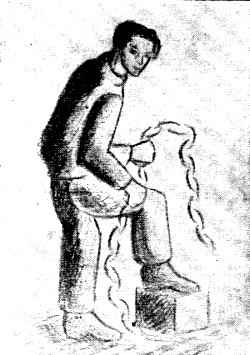
drawing by Fanny Glotzer |
In 1940, when the Red Army liberated Kobryn from the Polish fascists, the Kobryner workers again set about organizing themselves into unions. But the unions no longer had the character they once had. The workers themselves were already the masters of their own fate. Yet time did not permit the Kobryner workers to see with their own eyes the fruits of their long struggle for a better life under the rule of the workers. And bestial capitalism destroyed all of it – the best and the most beautiful of our native town, Kobryn.
On July 20, 1944, the Red Army liberated Kobryn once more – but regrettably, without our best people, who did not live to see the liberation.
In my opinion, the peoples of the Soviet Union,
[Page 132]
through their exertion and rivers of blood, made it possible for us to write this Pinkas Kobryn, in order to eternalize everything we once had there. May this be a warning to the enemies of truth, who help to spread today's filthy anti-Soviet propaganda.
Active members whom I forgot to mention:
From the Tailors: Shmerl Eynshteyn [Einstein], Sondak, Khane Bil, Dovid Lipshits, Malke Kornblum, Khane Amalinski.
From Food-Workers: Zalman Vigutov, Mikhael Blomerg, Avroml Grinberg.
From Leather-Workers: Shloyme Fuks, Dovid Vigutov, Yakov Begun, Yisroelke Bil. The immigrant from Grodno named Motl Goldberg; Moyshe the Keyser's; the young Moyshe Kagan, who was commonly called “Moyshe the Blind.”
Translator's Note:
by B. Adler
Translation from Yiddish by Beate Schützmann-Krebs
Despite the fact that at the time when the Craftsmen's Union was organized I myself was a wage-laborer, I shall try to give an overview of the union's existence and of the individuals who stood at the head of the organization.
The Craftsmen's Union was founded in the years 1920–21, with a broad membership of approximately 150 members – among them masters of various trades, with or without journeymen. By that time workers' unions had already been organized. And perhaps it was precisely for that reason that the Craftsmen's Union was founded: in order to oppose the demands of the workers.
In the period when strikes were proclaimed, consultations would take place between the workers and the balebatim in the locale of the craftsmen. Their locale had been rented in the wheel-shops, in the building of Fishel the ogrodnik [gardener], on the first floor.
The first chairman was Khayim Vaynerman, the belt-maker. Later it was Shimon Schwarts (Soldat). In 1927 the chairman was Khayim-Leyb Lagunovski, the tailor – a young man with much energy, who was deeply devoted to the union. During his presidency a craftsmen's bank was organized, which issued loans to poor tradesmen.
The union did not carry out any special charitable work. It took no particular part in political, Jewish, or Zionist matters – except when city-council elections took place, in which it would participate and put through certain candidates in order to defend their interests.
At that time the Polish government issued the well-known severe cech[1] law, which required every craftsman to obtain an official license (after passing a special examination). This cech law worsened the situation of many tradesmen who knew that, if they went to take the examination, they would not receive permission.
Being represented in the city council, the councilmen would, whenever possible, try to ease this painful problem for their members. Aside from the cech law, the craftsmen suffered from heavy taxes that the government imposed on them in order to oppress them.
On Friday evenings and on the Shabbat the union's locale was closed, because most of its members were religious and spent their Shabbats and holidays in the bote-medroshim. By contrast, the other unions carried out all their work only on Shabbats and holidays.
When the kehile [Jewish community] was created, several members of the Craftsmen's Union were represented in its administration.
The Craftsmen's Union had a sick-benefit fund, from which all members received medical assistance. Much was accomplished in this area by Dr. Pribulski, of blessed memory, who was indeed the chief doctor of the craftsmen's sick-benefit fund. Thus the Craftsmen's Union existed with all its characteristics and customs until Nazism came and wiped out our beloved town of Kobryn – its Jewish inhabitants, its Jewish institutions, and the Craftsmen's Union among them.
Honor their memory!
Translator's Note:
|
|
JewishGen, Inc. makes no representations regarding the accuracy of
the translation. The reader may wish to refer to the original material
for verification.
JewishGen is not responsible for inaccuracies or omissions in the original work and cannot rewrite or edit the text to correct inaccuracies and/or omissions.
Our mission is to produce a translation of the original work and we cannot verify the accuracy of statements or alter facts cited.
 Kobryn, Belarus
 Yizkor Book Project
 JewishGen Home Page
Copyright © 1999-2026 by JewishGen, Inc.
Updated 10 Oct 2026 by LA