|
|
[Page 101]
[Page 102]
[Page 103]
by E. Lebnshul
Translation from Yiddish by Beate Schützmann-Krebs
Political parties may be defined as those groups that have a legal association or that have a common program of action for struggle – and in this sense, the Jewish political parties of Kobryn may be counted among them. These parties blossomed during the First World War and grew stronger under Polish rule.
Already under the Tsarist regime, the activities of several political parties had begun to sprout. The suppressed freedom movement of 1905 did not fail to leave its mark on Kobryn as well – in the Kobryn prison, not a few freedom-fighters (Buntovtshikes) were locked behind its bars.[a]
Calls and proclamations of the Social Democrats (Plekhanov's study circle) began to appear on the streets. Thanks to the brochures and propaganda materials of the newly emerging parties, the Jewish street became acquainted with the real situation. And thus, alongside the old Chovevei Zion [Lovers of Zion], who later transformed themselves into the General Zionists, there appeared the Bundists (opponents of Zionism), the S.R.s (Social Revolutionaries), Poalei Zion (Borokhovtses), and Communists.
The development of the above-mentioned parties proceeded with countless obstacles and difficulties. Aside from the passive activity of the old Chovevei Zion, every other political party activity was forbidden. More precisely, according to the gendarmerie (police) instructions, there was not allowed to exist any Bund, any S.R.s, or any Poalei Zion. Naturally, under such conditions an underground activity had to develop, which – aside from a few failures – made great progress in attracting new forces and in propagating the ideals and programs.
Shortly before the First World War, Kobryn already possessed – although not legally – a fully formed General Zionist organization under the leadership of Engineer Levitos (Mordekhay the timber dealer's son-in-law from Pinsker Street). Not a few helped in forming the Zionist organization: the Polonski brothers (especially Platiel Polonsky from near the pametnik [monument]). The sympathies of the Tenenboym, Fuksman, and Antopolski families were clearly evident.
With the proclamation of the Balfour Declaration, after the collapse of the German occupation regime, a surge swept through the Kobryner street, and the multicolored spectrum of political parties blossomed. Meetings, gatherings, discussions, and resolutions flooded the Jewish street. There was not a single evening without a speaker, without a gathering. People debated and argued.
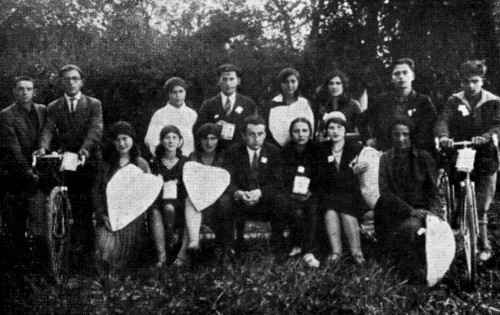
Most strongly of all, the Poalei Zion party distinguished itself, and the matter of Erets Yisroel [Land of Israel] inspired the youth most deeply. The Chalutz [pioneer] movement was immediately created, along with the group Frayhayt [Freiheit, Freedom], which concentrated within itself a large part of Kobryn's youth. They threw themselves, body and soul, into the campaigns for Zionist collections, organizing for this purpose the Bliml-Teg [flower days].
At the beginning of the 1920s, a large part of Kobryn's first Chalutzim left for Erets Yisroel by way of Austria, remaining in Vienna for an extended period. Kobryn also distinguished itself in the Second Aliyah, sending a large percentage of Chalutzim.
Communist ideology also had its popularizers – Hershl Pantal [Pantol], Bartenboym the watchmaker, and others. When the Bolsheviks came to Kobryn, they became major figures in the revkos [revolutionary committees]. An incident from that period tells of a Jewish militiaman named
[Page 104]
Meshl, from Brisker Street, who went into the small bes-medresh near Khane Zaritski's sewing shop on Shabbat to read, and then took the younger people out to work – to dig trenches – shouting as he did so:“Palazhit seyfer-toyre, davolno baltyat i idam robot!” (Put down the Torah scroll! Enough with your loafing – let's get to work!).
Several Kobryn young men left together with the retreating Red Army.
After the establishment of Polish rule, political party life unfolded in both length and breadth. The party struggle flared up most intensely during the Sejm elections; countless parties rose to the surface. By then there were already Mizrachi, Agudah, right-wing and left-wing Poalei Zion, Tze'irei Zion Hit'achdut [Young Zionists, the Union faction], Folksists, Artisans, Bundists, Communists, General Zionists A [Alef], and General Zionists B [Beys].
Speakers and meeting activists came and went; there were opponents; meetings were sometimes broken up, and at times there were even beatings.
For the Jewish community elections, matters proceeded more quietly, because at that time the Communists – and also the left-wing Poalei Zion – did not want to participate in community elections, holding it to be incompatible with Leninist doctrine to sit together with Jews “in shtreimlekh” (symbol of the “moldy bourgeoisie”).
By contrast, the city-council elections were already much more lively. The election propaganda was conducted heatedly and with great intensity. It was understandable: since the Jews formed the majority of Kobryn's population, they had the right to a dozen councilmen and a deputy mayor.
|
|
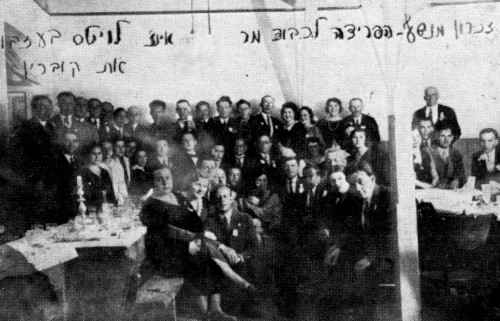
“In memory of the farewell celebration in honor of Mr. Levitos, the engineer, in Badowo (?), from Kobryn.”] |
In some of the city-council elections, the right-wing Poalei Zion succeeded in securing the largest number of councilmen. Those who served as Jewish vice-mayors were Birman, Dr. Pribulski (of blessed memory), and Hershel Tsukerman. The Artisans, who had been strongly invigorated thanks to the Folksist party of Noach Prilutski, were led in Kobryn by Khayim Leyb the tailor, Vaynerman the belt-maker, Shimon Soldat, and others.
The Bund, which had surged with great momentum in Kobryn during the years of the Russian Revolution, shrank in the years that followed. The Mizrachi had its defined circle and developed energetic activity; its principal instructors were the teacher Rozenboym, Kelmenzon, and others.
The left-wing Poalei Zion party did not manage to strike deep roots and remained a smaller group – possibly due to a lack of capable leadership.
The Tze'irei Zion Hit'achdut had somewhat more success, up until their merger with the right-wing
[Page 105]
Poalei Zion. They developed a considerable amount of cultural activity. Their leaders were Pintshuk, Khari, and Vigodski.
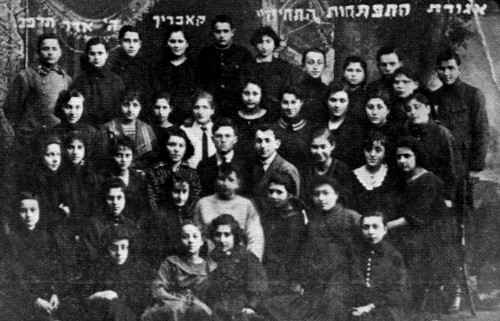
Great liveliness and joy were felt in the group Hatkhaya (“Revival”), which carried out a wide-ranging program of activities.
The most numerous party in Kobryn was the right-wing Poalei Zion. Year after year it expanded its ranks and developed the strongest activity through its capable leadership. Under the Poalei Zionist influence stood the Hechalutz (Pioneer Movement), and it was from their ranks that it took shape. The youth party led by Poalei Zion, as well as Hechalutz HaTza'ir [Young Hechalutz], bore fruit over time and produced mature members for the party.
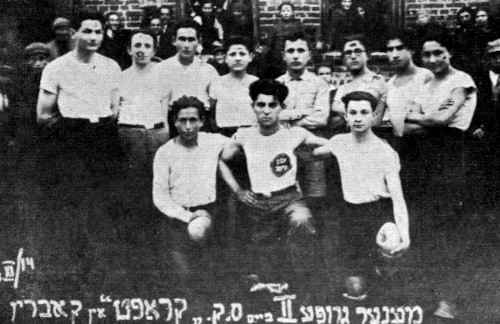
The sports club Kraft [Power] within the youth organization Freiheit (Freedom) demonstrated with vivid visibility the joy of the youth and their healthy development.
The Poalei Zion party had a great influence on Hashomer Hatzair, and not a few members of Hashomer Hatzair later entered the party. One of its outstanding leaders was Ben-Zion Pantal [Pantol], an indefatigable and energetic figure who contributed decisively to the party's success on the Kobryn front (not for nothing was he regarded as the “Kobryner Ben-Gurion”).
Alongside Pantal, Itshe Pintshuk acted with great success, advancing strongly the theoretical and literary side. They were assisted by Leybl Sirote, whose oratorical abilities drew large crowds to the gatherings. In later years, Tsalke Shvarts, Abrasha Herman, Itsl Vinograd, and others came to the fore.
|
|
| A Flower Day for the Jewish National Fund |
Having mentioned Hashomer Hatzair, it is only logical to give the movement the necessary attention and to describe it. True, one might not call Hashomer Hatzair a political party in the full sense, yet in those years Hashomer Hatzair contributed greatly to the enlightenment of the Jewish youth, bringing in idealism, aspiration, and–last but not least–offering its own example of self-sacrificing dedication to the community, educating truly courageous young fighters for a just and ideal better tomorrow.
Large groups of Kobryner Hashomer members demonstrated through deeds their conviction, realizing their journey to Erets Yisroel and contributing with their own persons to the fulfillment of the ideal. Let it not be forgotten to mention their
[Page 106]
loyal and dedicated leaders: Khayim Goldberg, one of the principal builders of Hashomer; Katkes, Zaritski, Tsalke Shvarts, Polonski, Iser Pintshuk, and others.
A great martyr's path was endured by the extreme-left Jewish movement (the Communists). With the consolidation of Polish power, the persecutions and arrests began; the first victims fell, with Pantal at their head (tormented in the Bialystoker prison) during the period of the great hunger strike.
Yet the underground work continued with even greater fire. And during the arrests of a considerable number of Kobryn youth – men and women – counteractions flared up, with red flags hung every morning on the telephone wires.
|
|
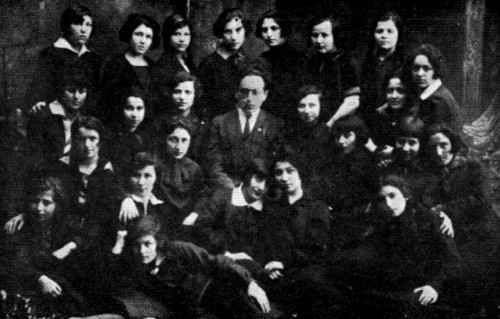
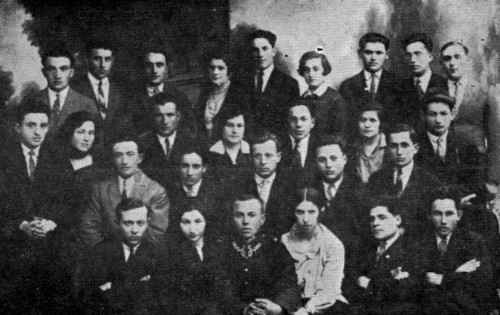
| A group of YIVO activists in Kobryn |
|
|
“Hatkhaya Development Association, Kobryn, 5 Adar 5682 (?).”] |
[Page 107]
During the trial there were attempts at intimidation and attempts to drag the accused out by force.
The left developed strong activity in the professional associations, which for the most part lay under Communist influence. As for the professional associations, we will leave that for another place – and one of their most active members, Mates Kaminetski, provides that account.
The picture of the parties active on the Jewish street would not be complete if we were to pass over the Agudah [Agudas Yisroel]. In Kobryn the Agudah possessed a firmly established and loyal membership under the leadership of Birman and Kobryniets, with Rabbi Pesach at its head, who with his oratorical talent demonstrated great success; thanks to him the Agudah would draw many votes in given elections.
|
|
| A Hechalutz group in Kobryn |
|
|
“Men's Group II of the Sport Club Kraft, Kobryn – 8 November 1914.”] |
[Page 108]
|
|
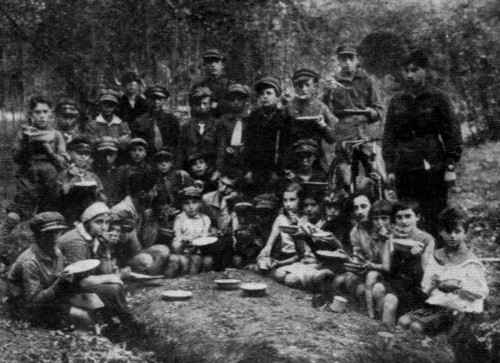
| Outing of Hashomer Hatzair |
|
|
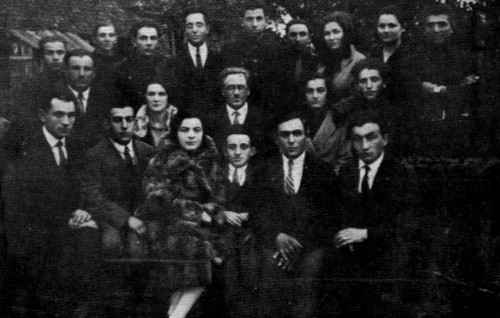
| Kobryner Poalei Zion group with Comrade Hartsfeld |
Author's Note:
|
|
JewishGen, Inc. makes no representations regarding the accuracy of
the translation. The reader may wish to refer to the original material
for verification.
JewishGen is not responsible for inaccuracies or omissions in the original work and cannot rewrite or edit the text to correct inaccuracies and/or omissions.
Our mission is to produce a translation of the original work and we cannot verify the accuracy of statements or alter facts cited.
 Kobryn, Belarus
 Yizkor Book Project
 JewishGen Home Page
Copyright © 1999-2026 by JewishGen, Inc.
Updated 10 Oct 2026 by LA