|
|
[Page 85]
[Page 86]
[Page 87]
by Melech Glotzer
Translation from Yiddish by Beate Schützmann-Krebs
Not having precise data about Jewish occupations in the earliest period of Jewish settlement in Kobryn, we must rely on conjecture, mobilize our powers of imagination, and – together with the information recorded in various writings and pinkasim [communal record books] of other towns – offer a reflection of the Jewish economy of Kobryn.
Beyond any doubt, the earliest Jewish professions in Kobryn were of a trading character. Jews would bring in or purchase from traveling merchants coming from distant towns a variety of goods – such as salt, spirits, household items, tools, knives, saws, as well as linens and underwear – and resell them to the surrounding pritsim [landed gentry] and peasants, while at the same time buying from them their grain and livestock products.
|
|
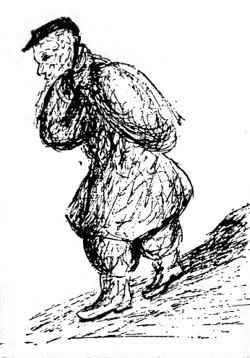
| Old-Time Jewish Trader Drawn by Fanny Glotzer |
The wealthier Jewish peddlers would travel around in bitkes – small two-wheeled carts drawn by a single horse. The poorer peddlers would drag themselves along on foot…
Quite a number of Jews would lease from the pritzim [landed gentry] various taverns and fruit orchards. Others would take on the leasing of livestock breeding, dairies, and forest trade.
With the passage of time, the Jewish population increased and grew, reaching probably about 1,200 souls toward the end of the seventeenth century.
In the first quarter of the eighteenth century, new livelihoods were already emerging. Jewish tailors, shoemakers, builders, and others began to establish their trades.
Jewish shopkeepers and inns also emerged, where peasants would come together with merchants from distant towns to sell and buy goods. Jewish podryatshikes [contracting middlemen] would come down to purchase livestock, horses, and grain. There were also Jewish forest merchants who would trade timber, sending it down the Muchaviec River toward Danzig.
Jews began to build mills, oil presses, brickyards, breweries, and tanneries. And, as is often the case among Jews – when one person starts a business, others become envious and start the same one – these industries multiplied and expanded over time.
A few generations later, the Jewish population of Kobryn increased even more. By then, the town had already become a center for the surrounding small towns, villages, and estates, thanks to its location directly on the main road between Brisk–Pinsk and Brisk–Pruzhany–Baranovichi.
Around that time, after Napoleon's wars, the rural population began to be freed from panshtshine [serf labor] and started to cultivate the land on their own account. This gave rise to an expansion of Jewish commercial horizons. Jewish shops multiplied – provision shops, haberdasheries, hardware shops, herring dealers, grease dealers, oil shops, rope dealers, bakeries, hat makers – so much so that the idea arose to set up a ring of shops
[Page 88]
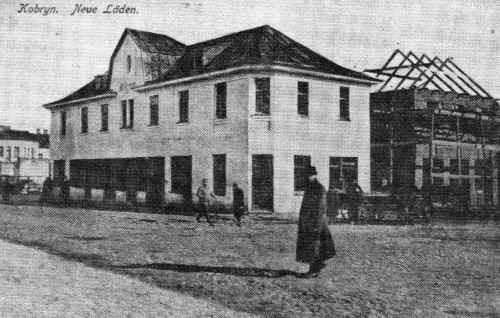
in the middle of the marketplace, where the weekly fairs could be held. And so it was. A ring of shops was erected on an area of two town blocks – a square, four-sided structure filled with shops both on the inside and the outside.
From then on, Jewish commerce became ever more firmly established. Jewish transport work expanded through the Jewish balegoles [wagon drivers], who would haul goods and make journeys to Pinsk, Volhynia, and Ukraine on the one side, and to the West – to Brisk, Warsaw, and Danzig – on the other.
After the time of Nicholas I, Kobryn blossomed particularly, thanks mainly to the railroad line Brisk–Pinsk–Minsk, which was built in those years and ran directly through Kobryn. The Kobryn station was established, and from that point on the town grew with tremendous momentum.
With the railroad, countless merchants from deep inside Russia and Poland would arrive for the large fairs, loading onto the trains the goods and grain they had purchased. Peddlers from Warsaw, Odessa, and Petersburg would also come, acquiring various wares.
During that period, new industries began to form in Kobryn, employing paid labor. Jewish craftsmen likewise organized themselves in the new trades: blacksmithing, coppersmithing, tinsmithing, painting, paper-gluing, shearing, carpentry, gaiter-making, and wood-turning. At the same time, new professions appeared – watchmaking (whose practitioners would also repair parasols), bookbinding, petition-writing, cigarette-making, and others. Many of these artisans advanced to such a degree that they needed to employ several paid apprentices.
Not a small amount of commercial value was added by the permanent regiment stationed in the Kobryn barracks. This brought employment and income to many Kobryner Jews. Jewish podryatshikes [contracting middlemen] would supply provisions and take care of all necessities for good pay.
|
|
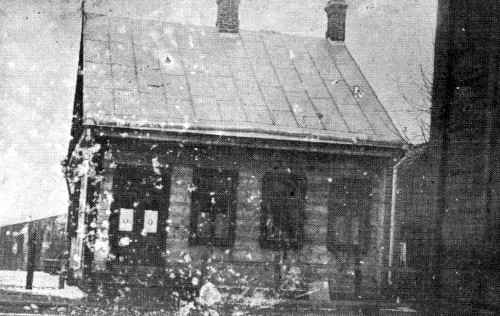
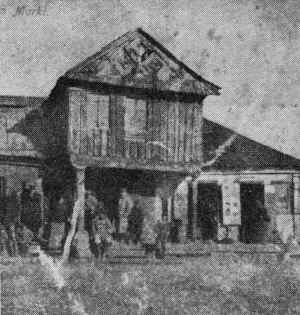
| Exterior view of a Kobryn wooden house |
Kobryn was regarded as a principal district town (kreiz-shtot) in relation to the surrounding small towns – such as Dyvin, Zhabinka, Horodets, and Antopol. None of these towns had such central institutions as Kobryn: the district court (gosudarstvone sudya), the prison, the tax center with excise-collectors, the barracks, the police prefect's office, and the railroad station.
For that reason, one would encounter daily arrivals of many people
[Page 89]
from the neighboring towns, coming to take care of various legal matters and, in the process, to buy goods and various articles to take home. There was always bustling activity from horse-drawn carriages, wagons, covered carts, sleighs (in winter), and porters at the inns, whose numbers steadily grew.
By that time – namely, toward the end of the nineteenth century – Kobryn already had about 280 shops of every kind. The number of craftsmen and artisans was roughly 500, not including apprentices and young trainees.
|
|
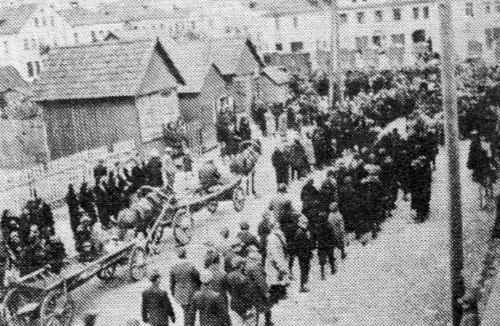
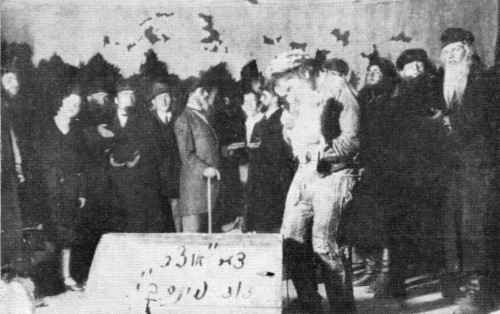
| A demonstration in Kobryn |
At the beginning of the twentieth century, the Jewish population increased even further; it already numbered about 5,500 souls. The number of shops had become rather excessive, and so had the number of craftsmen. Competition developed, and there was simply nothing to be done. People no longer knew where to turn. Livelihoods were meager, and incomes grew weaker. The poor became more numerous. Meat was then a rare food for the great majority of residents. Except for Shabbat, most people lived on black bread, baked from Friday to Friday, accompanied by the well-known Kobryn krupnik made of boiled groats, pearl barley with beans, or buckwheat porridge.
As a consequence of such conditions, and hearing about the new America, many Kobryners began to leave for that land. Some returned after earning a few dollars, worn out from the strenuous work in peddling or in the shops.
In the meantime, Kobryn continued to grow – sighing, groaning, yet still growing – living, trading, and progressing. Some people became quite wealthy, and others even wealthier. (There was a saying that went around: “Riches go to riches,” each to his own lot.)
The overall volume of trade increased, the professions multiplied, and thus we arrive at the First World War with a Kobryn of about 2,000 families, roughly 400 shopkeepers, a modest 100 industrial manufacturers, 600 craftsmen, and 1,200 laborers and journeymen.
The First World War gave Kobryn only a slight jol. Aside from a small number of better-off householders and merchants who left for Russia along with the departing Russian military, Kobryn remained almost unchanged economically. The entire commercial apparatus continued to function, with all the professions – plus one new one: the smuggling trade, which took hold of a large part of Kobryn. A smuggling and black market developed. People smuggled from town to town: sugar, saccharin, flour, leather, hides, spirits – anything that could be moved, and there was always something that could be moved with a khabar [bribe].
Kaykl's transport wagons – the large covered wagons that traveled day after day to Brisk – worked at full capacity, and this was only a small part of the smuggling, the greater portion of which was carried out by rail.
|
|
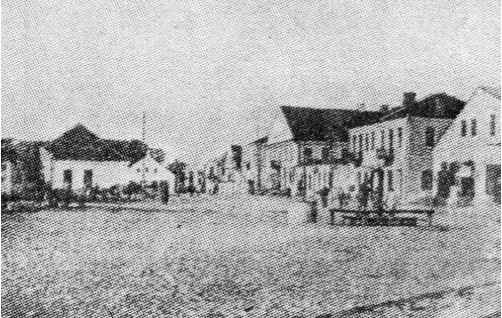
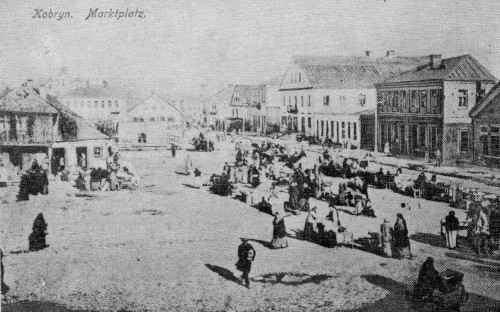
| The Market from the south side |
Many Jews then turned to gardening and took on orchard leases. Dozens of families made their living as gardeners or became yishuvnikes – taking on orchards for Shavuot
[Page 90]
and selling the fruit during the Elul season was one of the more common livelihoods.
Fortunately, Kobryn did not share the tragic fate of other towns in White Russia during the period between the German withdrawal and the establishment of Polish authority, and therefore its economic structure was not shaken.
With the arrival of Polish rule, an entirely new profession appeared – the broker's trade. Dozens of people walked the streets working as brokers, brokering whatever could be brokered. Russian tsarist money (asignatsyes) without holes, Kerensky notes, dollars, five-ruble imperials. Besides money, the brokers also brokered or arranged grain purchases and small lots.
The severity of Polish rule and the heavy taxes, borne chiefly by the Jewish population, pushed many young men of Kobryn to take up the wanderer's staff and set out into the wide world.
|
|
| The new ring of shops in Kobryn |
Aside from the ideal emigration to Erets Yisroel, an emigration fever toward America took hold. The 1920s and 1930s of this century can indeed be counted, with full justification, among the strongest years of emigration, and from those years emerged the emigration centers of Argentina, Uruguay, Cuba, Mexico, Canada, and others.
The Jewish crafts sector was gravely harmed in the years before the Second World War by the guild question. The difficulty for Jewish craftsmen in obtaining a guild certificate led to bitterness and to clandestine activity among a large portion of artisans and tradesmen.
Christian shops and cooperatives began, in those years, to make life difficult for the Jewish merchants. But the Jews of Kobryn found ways to manage.
Every shopkeeper had, besides his Jewish customers, his regular non-Jewish clientele, and he knew how to keep them – and, at times, how to win new customers, thanks to the significant increase in the peasant population around Kobryn. Incidentally, it is worth noting – speaking here about Kobryn's commercial development – that the ring of shops, which had burned down when the Russian army withdrew in 1915, was rebuilt in the early years of the Polish occupation. This added considerable commercial importance to Kobryn's Jewish trade.
In the last decade before
[Page 91]
the Second World War, a considerable number of Jews had become active in the free professions and among the intellectuals. We find them by the dozens in the medical, legal, and educational fields: doctors, midwives, pharmacists, feldshers, lawyers, bookkeepers, and teachers – the so-called “intellectual proletariat.”
The other proletariat, the physical one, also expanded strongly in those same years. The great majority of the trades represented in the Kobryn professional association were in Jewish hands. To name a few: tailors, shoemakers, quilters, carpenters, builders, wheelwrights, bricklayers, house painters, paper-hangers, printers, bookbinders, watchmakers, hat-makers, barbers, porters, and izvoshtshikes [carriage drivers]. Jews were represented even in the mills and lumberyards.
In the 1930s, the number of workers – together with those in the intellectual professions and the artisans who worked independently – can be estimated at about 3,000, more or less. Shops and craft enterprises, as well as industrial undertakings, may be estimated at roughly 1,000 (always using approximate rounded figures).
The development of trade in the last years between the two world wars prompted activity among the Jewish banks and loan-funds, which greatly assisted in organizing credit commerce. These were Reb Michael's Bank, the Merchants' Bank, and the Craftsmen's Bank.
As for the wealth of Kobryn's Jewry – its total value – it is difficult to give a precise estimate. Still, if one is not making a major error, one could estimate, in dollar terms, about 750 dollars per family, calculating roughly 2,000 Jewish families. This brings us to a total of 1,500,000 dollars as the approximate value of Kobryn's Jewish property.
All of this became ofer-voeyfer – dust and ashes. Together with the annihilation of Kobryn's Jewry, the entire Jewish property and livelihood was destroyed. Was it all worth it? A historical Jewish question…
by E. Lebnshul
Translation from Yiddish by Beate Schützmann-Krebs
Kobryn, situated on the Belarusian lowland belt, took shape along both banks of the Muchaviec River, some 55 kilometers before its confluence with the Bug.
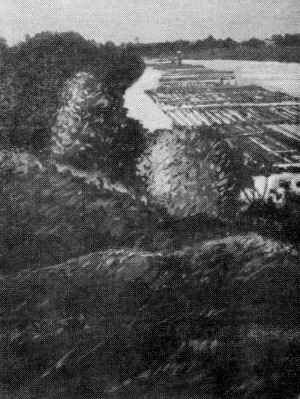
The Muchaviec, which joins the Dnieper with the Bug, played a special role as a means of transport in the months between Passover and Sukkot, serving the timber rafts (barkes) that made their way toward Danzig on the Baltic Sea.
The logs came from the Belarusian forests, were lashed together into rafts, and the peasants steered them with long ten-meter poles (borsakes). The huts on the rafts, made of straw for the raft-men to sleep in and to shelter from the rains during the several months such a journey could last, made a very striking impression and became a favorite target for many Kobryn boys who threw pebbles at them. There were strong swimmers who could even perform the trick of swimming the canal underneath the rafts.
In earlier times, before the Pinsk–Warsaw railway line was built, berlines (cargo boats) used to ply the river, transporting various goods, grain, and even people from one town to another along the length of the Muchaviec. In more recent years, modern river traffic – including a steamship (parokhod) – operated during the summer months, adding a lively color to Kobryn and serving as an important means of transport.
In the 1890s of the previous century, Kobryn was fortunate to receive a railway line. The Pinsk–Brisk–Warsaw line placed its station on the Muchaviec side, about a half-hour's walk from the town center. With the establishment of the railway, Kobryn began to grow at a faster pace;
[Page 92]
the railroad became a source of livelihood for many Jews.
|
|
| Timber rafts on the Kobryner Muchaviec |
Merchants came from far away to the famous Kobryn fairs, as did voyazhorn [peddlers], podryatshikes [contracting middlemen] – in short, it meant income for cabmen, coachmen, porters, freight agents, inns, and guesthouses.
In the middle of the eighteenth century, Kobryn was also endowed with a highway that stretched from Brisk through Kobryn to Pruzhany, continuing further toward Baranovichi, Smolensk, and Moscow. This highway greatly contributed to making Kobryn an important commercial center for the dozens of villages surrounding it.
The weekly market days, and especially the monthly fairs, made Kobryn known for hundreds of versts around. On the market square one could find every kind of merchandise: livestock, horses, pigs, poultry, eggs, cheese, butter, potatoes, barley, grain, radishes, and seeds.
The custom among the traders was to slap their right hand into the non-Jewish peasant's right hand when striking a bargain. Each time the trader improved his offer, he would ask the goy for another slap of the hand; this was meant to signify that the deal was closed. And as long as the non-Jewish peasant did not agree with a slap of his right hand into the trader's right hand, the transaction was not considered concluded.
The fairs were excellent places for all sorts of sleight-of-hand entertainers, who performed acrobatic feats – walking on nails, or lying with their shoulders on the nails while another man stood on the belly of the one lying down – afterward collecting coins in a hat from the surrounding spectators.
Kobryn, one might say, was filled with shops. Besides the ring of shops, which had been rebuilt after being burned down in the First World War and numbered about two hundred shops, Kobryn possessed three or four times as many shops spread around the ring on the market square, in the streets and alleys.
|
|
| Leybe Lev's (“the Black”) house |
Everyone managed to make a living. True, many only barely, on a knife-edge, but it was nothing to complain about. There were also quite a few shopkeepers in the same line of business who were envious and constantly needled and nagged one another, begrudging every bit of each other's earnings; and not infrequently this led to quarrels – especially among the zitserkes [market women].
[Page 93]
The zitserkes were the poorest class of women traders, their entire stock laid out on a small table. In winter they especially suffered in the freezing cold. Their only bit of relief came from the little fire-pot.
The men, by contrast, were privileged. Aside from those who spent day and night studying in the bote-medroshim, the others – almost without exception – would go every evening for an hour or more to the bes-medresh: first for Minkhe and Mayriv prayers, and in winter to warm themselves at the stove, standing with their hands behind them, warming them and casually exchanging stories, or listening to a page of Gemara or Mishnayos. Very often preachers and emissaries from the yeshivas would arrive, and between Minkhe and Mayriv they would let loose with the famous preacher's nigunim [melodies] about Jewishness and faith.
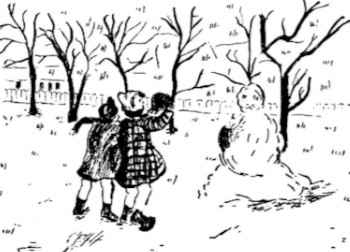
For the youth, winter was a source of mischief. First of all, there was the making of snowmen: rolling together great balls of snow, sticking in two black coals for eyes, and sometimes finishing it with a hat on top to give the impression of a person.
|
|
| Kobryner Market Place |
The greatest pleasure was skating on the river. The more well-to-do skated on real skates, while the poor skated on shpores – simple pieces of wood with a wire underneath. And the little sleds for sliding downhill from a small hill were among the finest delights; and not to mention grabbing on with a clenched fist to a horse-drawn sleigh with its jingling bells.
In summer, there was nothing that could be considered a sin. The cold, transparent canal refreshed even the most parched soul. The bathhouse was divided into a men's section and a women's section. Naturally, no one knew anything about bathing costumes, so there were no difficulties.
And if once in a while some mischievous fellow, a good swimmer, stayed under water long enough to get close to the women's section, screams could be heard up to the seventh heaven.
After the First World War, Kobryn saw a bathing costume for the first time. It happened when Yosele the American came. People looked at him as at an evil wonder. Children ran after him laughing.
The batshevnik, the footpath running parallel to the river on the Zamuchaviec side, was one of the most pleasant strolling places for the youth. That was where romances were spun; young people discussed practical matters and debated
[Page 94]
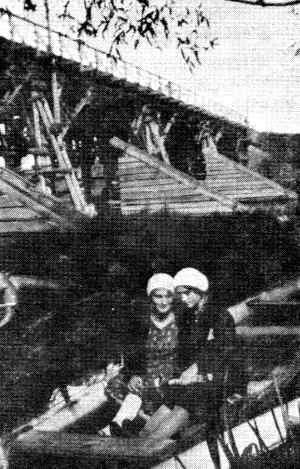
worldly and social questions. The batshevnik was especially lively on summer Shabbats. Going out on the river in little boats in the evenings, in groups with the girls, singing as they went, was one of the loveliest pastimes.
This should not diminish the importance of other strolling places, such as the Nyevski Sidewalk, the Vladover Highway, the Fatshter Promenade in the governorate, and the shady mogilkes [grave fields].
|
|
| Snowmen Drawing by Fanny Glotzer |
A highly regarded place for strolling was the bulvar [boulevard] in the very center of town. The monument with its three cannons, commemorating Napoleon's war, made a most impressive sight.
That same boulevard would fill up on Sundays with a Gentile crowd coming to the monastery that stood nearby. The shkotsim and shikses [rough non-Jewish boys and girls] would blacken the surrounding sidewalks with sunflower-seed shells.
At the beginning of spring, the kries – the chunks of ice floating down the river, knocking against and splitting one another – presented a rarely seen beautiful spectacle. People would stand for hours on the bridge, watching the play of the drifting ice.
The old bridge had burned down when the Russians retreated during the First World War. In its place, toward the end of the 1920s, a new, broad bridge was built, which added greatly to the town's appearance. In those years, Kobryn began its electric lighting, for until then the town had used kerosene lamps and lanterns.
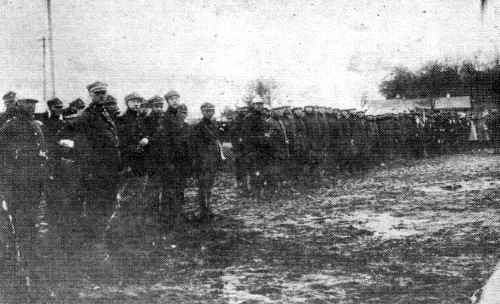
For many years, Kobryn had a military garrison with soldiers. In the Tsarist period, the Tshornomorski Regiment and the Otomansker Regiment were stationed in Kobryn. This is confirmed by the (Lepesyer) Barracks built in Zamuchaviec, as well as the Gibgot's and Margolises' Barracks. On Polish holidays, the 83rd Regiment would come to hold parades on the Zamd opposite the old Jewish cemetery. The schoolchildren were required to take part in the marches on the Third of May and on other holidays.
Besides the civil authority, which in the Polish period was headed by a starostvo with a town council, there was a police district under a commandant, with assistants and a few dozen policemen. Kobryn also had its courts on Brisker Street, not far from the prison.
The municipal hospital at the beginning of Brisker Street did not diminish the value of the Jewish hospital on Pinsker Street.
|
|
| Kobryn's new bridge |
Most Jewish women wore wigs. In earlier times, pious Jewish parents would have the bride's hair shaved off before the wedding canopy.
Kobryn had its own Jewish klezmer musicians, who played at Jewish weddings. Well-known
[Page 95]
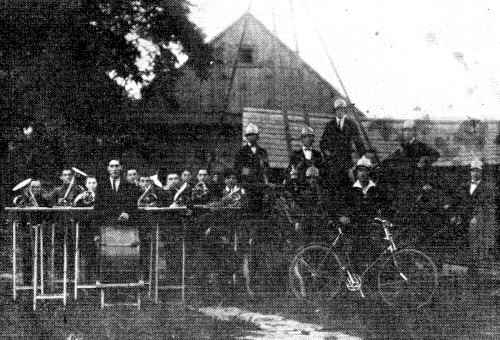
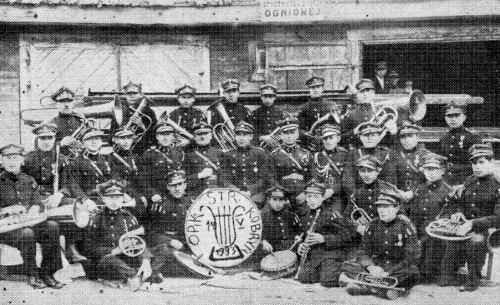
were Shimshen the klezmer with his band, the Britves, and others. The fire brigade had its own orchestra as well; the majority of its members were Jews. In times when political powers were shifting, the fire brigade would turn itself into a zelbstshuts [self-defense unit], in order to resist bandits and pogromtshikes and to prevent bloodshed. The Kobryn porters also helped in defending Jews and Jewish property, especially during the periods of the prizivn [Russian conscription period] and the prizivn [newly drafted Russian conscripts].
|
|
| Kobryner fire brigade in full equipment |
In the last years under Polish rule, the sanitary conditions of the population improved. It was ordered that the mist-kastns – the refuse pits where garbage and waste had been thrown together – be removed from the courtyards, thereby preventing plagues and illnesses. And not only that: even a simple cigarette butt or scrap of paper dropped on the sidewalk would be punished with a złoty fine.
The Friday-afternoon call of the shames to close the shops and go to welcome the Shabbat was one of the special Jewish customs. One remembers especially Yudl the Shames, who, besides calling out in the synagogue, would also announce in the bote-medroshim all notices and messages, including which sermons could be heard after resting from the cholent. In the last years, the sermons of Rabbi Pesach Pruskin in the Great Synagogue took precedence and overshadowed all other preachers in the religious sphere.
Kobryn had twenty bote-medroshim, Chasidim shtiblekh, and synagogues of various tendencies.
The orphanage, the home for the aged, Linas-Hatsedek, and Hakhnoses-Kale [help for poor brides] were genuine relief institutions, run by tireless activists.
In the socio-political sphere, very intense struggles were reflected. Meetings, conferences, lectures, and presentations were arranged. During election times, one practically had to rush from place to place in order to hear all the speakers and their opponents.
The establishment of a kibbutz in Kobryn, under the pioneering leadership of the khalutsim, brought great idealistic significance.
There were three main libraries in Kobryn: one, the Brener Library of Poale-Tsion at Shmerele Ash's; the second, of Hashomer Hatzair at the Margolises'; and the third, of the professional associations on Tsigelekh Street.
Kobryn also did not lack cinematographic halls. One was at the Freydeks',
[Page 96]
and the other was the Avrom Hall. From time to time, Jewish troupes from Vilna and Warsaw would tour with the well-known repertoires of that period.
Kobryn also had its own dramatic circle under the leadership of Peysekh Boym, the Markuze brothers, Kalkar, and others, periodically giving good performances for the benefit of social-philanthropic institutions. Productions such as The Dybbuk, The Oytser, Motke Ganev, and others were staged. These were amateur actors with whom no Jewish theater troupe would have been ashamed to appear.
The omnibuses that circulated in the later years strongly outcompeted the former boydn [large covered wagons] of the Kaykl brothers, which had been important transport systems between Brisk and Kobryn. The boydn would be loaded with merchandise and people, sometimes leaving keyn plats far a shpilke [no room even for a needle] – a Kobryn expression.
The deliberate self-starvation (to fall below the required weight) practiced by Jewish youth, who had to present themselves for the physical examination, was an annual phenomenon. And not infrequently, there were cases of inserting defects into the ears or nose in order to avoid serving in the military.
The spread of newspaper culture in the years between the First and Second World Wars was in Berele's hands, later passing to Goltsman. The Haynt and Moment were among the most widely read papers. Out of frugality, many would jointly borrow a single newspaper. The serialized novels were retold from mouth to mouth. Goltsman also distributed the Kobryner Vokhnblat.
|
|
| Kobryn dramatic studio under the direction of Peysekh Boym [Image inscription: “The Oytser,” Dovid Pinski] |
Kobryn, in its later years, counted a considerable number of Jewish professionals who, despite all the difficulties of the numerus clausus[1], broke through the closed doors of the universities with youthful determination and achieved their intended goals. To great sorrow, all that effort was in vain, for the vast majority of these Jewish professionals perished together with the entire Jewish population, murdered by the murderous German hand.
May everyone's memory be sanctified.
Translator's Note:
[Page 97]
|
|
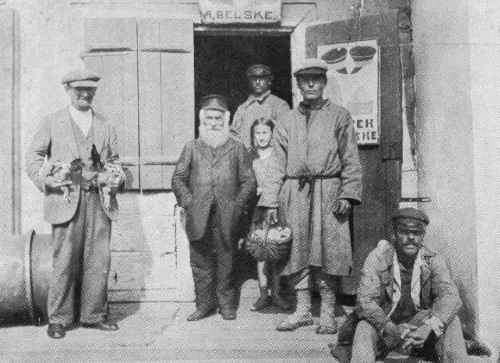
| Original photo next to Belske's hat shop |
[Page 98]
by M. Glotzer
Translation from Yiddish by Beate Schützmann-Krebs
During the early-morning hashkome service in the Gas Bes-Medresh, one could already sense the smell of a yarid [fair].
This was felt most strongly among the householders from the Zamd district – men like Khayim Zelig with his heavy boots (which he never lifted when walking but dragged, scraping and clattering along the ground, waking the neighbors as he passed). Included among them were Shmuel-Hersh, the blacksmith from Zamd; the fiery Soloveytshik; Yoel the shoemaker; Nadritshne, the second blacksmith from beside the canal; Motye the brickmaker; Meir-Leyb the farmer; Yonah the Blond.
And all of them would support the bal-tfile, the prayer leader, clearing the way for him. While he recited the long Shmone-Esre [the Eighteen Benedictions], by the time Aleynu [closing prayer] came, they were already slipping their prayer shawls and phylacteries into their bags, thinking about the good potshatkes [little gains] from the fair.
Among some of the hashkome worshippers returning from the bes-medresh, a certain annoyance would arise: seeing how many capable, industrious women were already standing at their shops, calling out to the approaching goyim [non-Jews]: “Tshoy shtsho prodayesh?” [What are you selling?].
A touch of envy would stir toward Bobke the shopkeeper, Mindl Henye, Khayke the widow, Beyle-Dvoshe, Khaye-Sore the caller – who had already made their purchases of poultry, grain, and dairy.
Beyle-Dvoshe stood out particularly because of her privileged location: living far below, downstream from the Zamd district, opposite the kloyster [monastery], right near the burial grounds, she was usually among the first to intercept the non-Jews coming from the Kamyener side. She would probe the contents of the wagons with the familiar, hackneyed refrain – “Tshoy shtsho mayesh?” [“So, what do you have?”] and “How much for the chickens, the butter, the eggs?” – while at the same time blowing aside the feathers at the poultry's hindquarters in the back of the wagon and, in passing, with expert knowledge, determining which hens were layers and which were not.
Naturally, the entire purchasing power of our Beyle-Dvoshe was quite small and limited. To put it plainly, all she owned was a half-empty little shop, three by three meters. So when she bought a few earthen pots of butter, half a dozen chickens, and a few shok (five dozen) eggs, she was already out of money. Her neighbors knew this well, all the way up into town – people like the Montakes, the Priluks, Leyzer Pandyes from across Bobke, and the Ostromitshers, who sometimes even bore a bit of resentment toward Beyle-Dvoshe. But they had patience.
Nadritshne, the Zamd blacksmith, would brighten up on market day. Coming into the smithy after his early-morning hashkome bite, he would already find a whole commotion and bustle of non-Jewish peasants and horses. All around stood wagons stuffed with straw, sacks of grain, and trussed-up calves. The holyobles [wagon poles] stood raised, jutting high into the air, the horses tied by their reins to the hitching posts or to the fence near the smithy.
The apprentices were already bustling about, pumping the bellows with their feet, reddening the horseshoes so they could then flatten them out on the anvil. They worked to the monotonous sound of the big apprentice's hammer and the smaller master's hammer, while holding the glowing iron with the tongs. Reb Nadritshne the blacksmith's cheeks would shine with black soot, mixed with sweat and the reflections of the flaring coal.
By eight o'clock the entire Zamd district would already be in full bustle with wagons, horses, livestock, and people. A hand-slapping haggle would begin between the horse and small-good dealers and the non-Jewish peasants. They would start from the midpoint – the price the goy asked – and then slap hands each time the dealer raised the price and the goy lowered it, until they reached an agreement. After that, in many cases, the dealer would pull out a bottle of vodka from Kholyeve and offer a “Nasdrov!”
By midday, most of the goyim had already sold off their small wares, their grain, and their other vegetables. Then the buying would begin. All the shops – the dry-goods stores, the ironmongers, the bakeries, the groceries, and the haberdasheries – would be packed with non-Jewish men and women. Everywhere there was bustling activity. As for the taverns, needless to say, the brandy was being knocked back to the right and to the left. A special color
[Page 99]
was added by the street-criers with their “complexes,” who for a single złoty would sell not only a little knife with a comb, but would even throw in a piece of soap for free.
Toward evening, the wagons – loaded with shikses and shkotsim [rough young country folk] – would begin to set off. The peasants would start driving home, singing their White Russian songs at the top of their lungs. Jewish pranksters would hang on to the backs of the wagons, or to the sleighs in winter, catching a ride underneath – and many times, a smack from a whip.
Late into the night, the Kobryn shopkeepers would talk over the fair and rejoice over their hefty takings.
by Yoske Bervigunkin[1] (Asunción, Paraguay)
Translation from Yiddish by Beate Schützmann-Krebs
Kobryn no longer fell into the category of a shtetl; by then it was regarded as a shtot, a town. Its population consisted of roughly ten thousand inhabitants, about nine thousand of whom were Jews, who had lived in Kobryn for generations. The remaining ten percent were made up of White Russians, Poles, and Russians.
Most of the trades – tailoring, carpentry, shoemaking, blacksmithing, locksmithing, and similar ones – were in Jewish hands. Retail and wholesale trade was likewise predominantly Jewish. A small number were engaged in agricultural work.
Kobryn had a large number of khadorim [traditional elementary schools]. It had a small and a large yeshiva, a Hebrew-language Tarbut school, a Yiddish secular school, an ORT vocational school, and an eight-grade gymnasium with mostly Jewish pupils.
|
|
| Kobryner fire brigade |
The sizable number of Jewish students, most of whom could not continue
[Page 100]
their studies in Poland, spread out to various European universities, and it did not take long before new Jewish doctors, lawyers, engineers, dentists, teachers, akusherkes [midwives], and others began to appear in Kobryn.
|
|
| Orchestra of the Kobryner fire brigade |
Kobryn was also active in the social and political sphere. All political parties were represented, the largest of which was the General Zionist party.
The workers were organized into various professional associations that showed vitality and a spirit of struggle.
As for religious life, Kobryn had sixteen bote-medroshim [study houses], one shul [synagogue], and several Chasidic shtiblekh [prayer rooms], a Khevre Shomr-Shabes [Sabbath-observing society], and so on.
Kobryn had a theater hall and two cinemas, a Polish bank, a Jewish cooperative bank and a loan society, a home for the aged, and an orphanage.
Kobryn also had a volunteer fire brigade – or, as it was called, the pozharne komande – which counted about one hundred and twenty members, almost all of them young Jewish men, equipped with all the necessary apparatus, along with its own orchestra. The pozharne komande protected and saved Jewish property and goods, as well as lives, from fire.
At the end of the First World War, when various bands and robbers were roaming about, the pozharne komande transformed itself into a zelbstshuts [self-defense] militia (samooborone), with three hundred men and a significant number of weapons. Thanks to this, the Jews of Kobryn almost did not share the fate of other Jewish towns and shtetlekh, where robberies and murders took place.
A similar situation arose again in the 1920s. During the Polish-Russian war, the zelbstshuts with its organized discipline, prevented and restrained the predatory appetites of the Halertshikes[2], Bulakh-Balakhovitshes[3], and other marauding bands.
To our great sorrow, all of this is gone. Honor the memory of our holy martyrs!
Kobryn is now on the Russian side, and only two or three of its old Jewish residents still live there. A portion of the Kobryners is scattered across the entire world – the largest Kobryner kibbutz or landsmanshaft is in North America; the second in Argentina; the third in Erets-Yisroel [Land of Israel].
Translator's Notes:
|
|
JewishGen, Inc. makes no representations regarding the accuracy of
the translation. The reader may wish to refer to the original material
for verification.
JewishGen is not responsible for inaccuracies or omissions in the original work and cannot rewrite or edit the text to correct inaccuracies and/or omissions.
Our mission is to produce a translation of the original work and we cannot verify the accuracy of statements or alter facts cited.
 Kobryn, Belarus
 Yizkor Book Project
 JewishGen Home Page
Copyright © 1999-2026 by JewishGen, Inc.
Updated 22 Aug 2026 by LA