 |
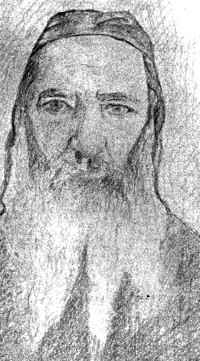
Drawing by Fanny Glotzer
|
|
[Page 62]
by A. Kobryniets[2]
Translation from Yiddish by Beate Schützmann-Krebs
The source – or, better said, the nest of Chasidism, as is well known to all of us, arose on the borderlands between Poland, Ukraine, and Hungary. It was there that the creator, R. Yisroel ben R. Eliezer, the Besht [Baal Shem Tov], was born.
To begin describing the entire movement of Chasidism would lead us far afield. I wish only to dwell on a few brief strokes about this movement in general, and about its influence on our little town of Kobryn.
It has rightly been pointed out that the origins of Chasidism grew out of the Jewish masses, and that the movement always defended the simple folk. And we truly see this in the Chasidic legend, which did not overlook the Jewish artisan – who represented a significant class within the Jewish population of the eighteenth century.
According to a Chasidic tale, a tailor, before his death, instructed in his will that from his worktable – the table at which he had labored honestly his entire life – they should make him a coffin, and in that coffin bury him (Sifrei Tsadikim [Books of the Righteous]).
The Chasidic legend teaches that when an artisan comes to the World to Come and the angel begins to question him about what he occupied himself with in this world – whether he sat and studied – it will be enough for him to point to his worktable and say: “Look, at this table I toiled my whole life. I sat here day and night and worked, just to scrape together a bare living for my wife and children.” And that will be sufficient for him to be granted Gan-Eyden [Paradise].
The Chasidic legend knew how to value the honest labor of the Jewish artisan: not only will he himself merit the World to Come, but at times the entire shtetl is sustained solely in his merit.
It is pointed out in Shivkhei ha-Besht [Praises of the Baal Shem Tov], where he once expressed himself about an artisan who “benefits from the honest labor of his own hands”: that one who supports himself solely through his own upright work sustains, in his merit, the entire Jewish community…
Chasidus also sought to invest great kavones [spiritual intention] in the prayers of poor, simple working people – so that even when they do not always know what they are praying, and perhaps have only money in mind, their prayers nevertheless carry a meaning entirely different from what we might imagine.
It is told that Rebbe[3] Meirl Premishlyaner [from Peremyshliany] once said to his Chasidim [followers] who had complaints about the simple Jews – those who did not pray leshem-shomayim [for the sake of Heaven] but had material concerns in mind while praying. R. Meirl of Premishlan cried out:
“Riboyne-shel-oylem [Master of the Universe]! I know very well that if one were to take all the prayers that Jews offer up to You and squeeze them out thoroughly, their essence would be – money, only money… But I also know that if one were then to take that money which Jews ask of You and squeeze that out, its essence would be Torah and good deeds. For why does a Jew need money? To pay school fees for his children, to marry off his daughters, to be able to invite a guest for Shabbat, to help a poor relative, and so on. Therefore it is no misfortune that they also ask for money in their prayers.”
We very often encounter statements and expressions from the rebbes who sought to find merit in the simple Jew. We find many such defenses in the words of R. Levi Yitzchak of Barditshev [Berditchev]. For example, the Chasidic legend tells that R. Levi Yitzchak of Berditchev once came upon a Jewish wagon-driver standing in the middle of the marketplace, wrapped in his tallis and tefillin, praying while at the same time greasing the wheels of his wagon. R. Levi Yitzchak lifted his eyes toward Heaven and said:
“See, Master of the Universe, what a precious people You have. Here is a simple Jew, a wagon-driver – and even as he greases the wheels, he is praying to You!”
The central foundation of Jewish ethics has always been the commandment of tsedoke [charity], for
[Page 63]
“tsedoke is equal to all the commandments of the Torah” [Bava Basra 9b] – the commandment of charity outweighs all the other commandments of the Torah.
It is possible that, because Jews were constantly exposed to danger – always living under the domination of other peoples – a natural sense of mutual help developed among them, a readiness to support one another. When Chasidism arose, this old Jewish trait of giving tsedoke and helping the poor immediately came to the fore. Since the entire essence of Chasidus was a movement of the oppressed and downtrodden Jewish masses, it is understandable that the commandment of mutual aid played an especially significant role among the Chasidim.
In the earliest period, at the very emergence of Chasidus, some Chasidim even maintained joint funds, ate together, lived in a communal fellowship, and in a certain sense broke down the great barrier that had existed between rich and poor – between the “fine Jews of the eastern wall” and the craftsmen and simple Jews “behind the stove.”
When one leafs through the Chasidic tales about the first Rebbes, the disciples of the Baal Shem Tov, one sees that almost all Chasidic legends speak of the greatness of giving tsedoke, of redeeming captives, and of supporting the fallen. On this occasion I will present a few such legends.
It is told about R. Nachumke Tshernobyler, the grandfather of the Trisker Rebbe, that he was once imprisoned because of an informer. He pleaded with the jailer to allow him to go free for two hours, for he needed to collect money in town for a poor man. The jailer did not agree at all, but R. Wolf of Zhitomir persuaded him by agreeing to enter the prison himself as a guarantor for the specified time. The jailer then permitted R. Nachum Tshernobyler to leave the prison for two hours in order to gather funds for the needy man.
It is also told of the Sanzer Rebbe, R. Chaim Halberstam, who – although he presided over a large and wealthy court – nevertheless distributed almost his entire fortune among the poor. More than once it happened that a destitute woman came to him, weeping that she had no money to marry off her daughter. The Rebbe would take out all the money he had and give it to her. The reputation of the Sanzer Rebbe as one who gave abundant tsedoke spread so far that hundreds of poor people from the most distant places – even from Hungary – would make their way to Sanz, knowing that they would not leave empty-handed.
At times the gaboim [charity overseers, synagogue wardens] could not manage the crowds of poor people who besieged the Rebbe's door. It is even told of this same Rebbe that before going to sleep he would call in the gabe and ask him to shake out the pockets of his garments and check whether any coins remained in them, so that if a poor man arrived, they could be given to him. Among the hundreds of such accounts one could continue to enumerate the stories and customs that characterize the path of Chasidus.
A special place within Chasidism was occupied by music. One can say that with the rise of Chasidus, the Jewish people acquired a new sensibility – a new feeling for sacred melody.
We find in Likutei Moharan of R. Nachman Braslaver [of Breslov/Bratslav] the teaching that “the voice of melody clothes the Shekhinah[4].” Melody is the garment of the Shekhinah; one must possess an understanding of music. And indeed, R. Nosn [Nathan], the disciple of R. Nachman of Braslaver, relates that when R. Nachman sang a nign, he would let himself go into a dance with such fervor that anyone who had not seen him dance had never in his life seen a true dance.
R. Nachman Braslaver always carried within his heart the sorrow of the entire world. He taught his disciples that “a person must serve Hashem with joy;” one must always worship G'd with gladness.
Chasidus went so far in its emphasis on melody that a saying arose: whoever cannot sing cannot be a Chasid. First of all, one had to know the skarbove melodies [traditional, stereotyped] that the old Chasidim once sang.
People recall the Rebbe, and this itself brings about tshuve [repentance]. For that reason, in Chasidic circles various skarbove melodies are sung that are regarded as ancient and handed down in tradition – and attributed to well-known menagnim [traditional Jewish singers], who transmitted them across
[Page 64]
generations. They were sung while recalling their lineage: that this or that Rebbe used to sing this particular nign.
Many Breslov and Chabad melodies became very popular, alongside the nigunim of R. Elimelech of Lizhensk, the Lubliner Rebbe, the Kozhnitser Maggid, the Kotzker Rebbe, the Ropshitzer Rebbe, and the Zlotchever Rebbe [of Zlotshov], R. Mekhele, as well as R. Pinchas'l of Koretz, and so on.
One of the greatest menagnim – and also a composer – was the old Mozhitzer Rebbe, Reb Yisroel Taub. His singing had a sweetness all its own.
A composer of Chasidic melodies was R. Asher'l of Rimanov. Most Chasidic nigunim, however, were created by various prayer leaders and gaboim of the different rebbes' courts. Melody was used constantly: at the tish [the rebbe's table gathering] on Friday night, at the Shabbat meals, at shaleshudes [the third Shabbat meal], and especially at the melave-malkes [the post-Shabbat farewell meals] – in addition to the special nigunim sung during the prayers of Shabbat and the Yomim-Neroim [Days of Awe].
It is therefore no wonder that Chasidim who did not have a rebbe in their own towns would, from time to time, travel to visit a rebbe elsewhere and return home filled with a renewed spiritual “baggage” they had absorbed while being in the presence of the rebbe.
Through this influence, ever-larger circles of followers became inspired, and Chasidus spread throughout Poland, Galicia, and Volhynia – including our own town of Kobryn, which possessed no fewer than seven Chasidic shtiblekh [small prayer house], each belonging to a different dynasty: the Kobryner, with its own rebbe, R. Moshele Kobryner, of blessed memory (one of the earliest founders); the Slonimer, Libeshever [Lubieszówer], Karliner, Trisker, Bialystoker, and Stoliner.
The custom was that several times a year the rebbe, at the request of the Chasidim [followers], would come down to visit them, to rouse them a bit spiritually. Whenever this happened, it was a special joy for the Chasidim, whose rebbe had come to them. A large delegation of Chasidim would go out to meet him, dressed in their Shabbat clothes, and at the train station they would welcome the rebbe with honor. And as they traveled back from the station into town, a caravan of droshkes would form – on one of them the rebbe, with his gabe or shames at his side, and a Chasid with whom the rebbe would stay during his visit. And all around them: Jews with neatly combed beards, dressed in holiday clothing, their faces shining. Such a distinguished guest for this Shabes!
To welcome the Shabbat at the omed [the prayer leader's place], the rebbe himself would lead. Needless to say, since the rebbe had a sweet voice, many additional Jews – not Chasidim – would come to hear him.
After kaboles-shabes [the welcoming of the Shabbat] there would be a rush to greet the rebbe. What awe and deep feeling would show on every Chasid's face when he could reach out and take the rebbe's hand in greeting.
After the prayer service, the rebbe would leave, accompanied by his Chasidim, and go to the Chasid near the train station where he would stay in order to conduct the tish [the rebbe's table gathering]. Some rebbes would conduct the tish in the shtibl itself.
The rebbe's tish would begin quite late – when in all the Jewish homes people had already finished the Friday-night meal, only then would the rebbe begin preparing for kiddush. Perhaps he did this to give everyone the opportunity to be present when he conducted the tish. The tish would continue late into the night.
When the tish was held, many Jews – Chasidim who belonged to other rebbes – would come to hear Torah and to receive a portion of shirayim [the rebbe's leftover food, considered spiritually meaningful]. It was, after all, a spiritual delight. Even Misnagdim, out of curiosity, would come to see. The shtibl would be packed with Jews.
During the weekdays, the rebbe would sit in his private room and study, and Chasidim would come with kvitlekh [written petitions] to seek his advice on various matters. The usual procedure was to approach the gabe to ask whether one could be received by the rebbe. The gabe would then inquire of the rebbe whether a certain person wished to speak with him. And after receiving the gabe's permission, the Chasid would enter the rebbe's room, speak with him privately, and leave a pidyen [a monetary offering] in the process.
I recall an incident that was talked about at that time in the Trisker Shtibl. During a certain visit to Kobryn by the Trisker rebbe, R. Velvele, of blessed memory, one of his followers brought him a large pidyen [a monetary offering]. The rebbe refused it and handed the money back to him.
[Page 65]
|
|
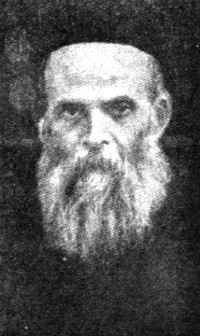
| Impressionistic Depiction of the Kobryner Rebbe Drawing by Fanny Glotzer |
[Page 66]
He had heard that the man publicly desecrated Shabbat, and the rebbe did not want to touch money that came from such a person. Instead, after admonishing him for a while, the rebbe asked him to give his word that he would do tshuve [repentance], and said that if he would hear that the man was keeping Shabbat, that would be the greatest pidyen [monetary offering] he could bring. One thing I know: the man was ashamed to come to the shtibl for quite some time – and indeed, the rebbe had not been mistaken.
The stay during such a visit usually lasted about a week. By contrast, Chasidim would travel to the rebbe on certain occasions such as Yom-Toyvim [festivals] or the Yomim-Neroim [Days of Awe].
We Jews of today can hardly imagine what a spiritual delight it was for such a Jew to travel to the rebbe for yontef. One example of such a journey can illustrate the following story:
Reb Yosl the baker from Zamuchaviec, a Slonimer Chasid, far from being a wealthy man, would leave his bakery – from which he perhaps lived the entire week on the bread baked for Friday – and on Thursday night he would set out for the train to spend Shabes with the rebbe. His wife would cry out: “Gevald, Yosl, s'vet dokh kalye vern di roshtsinete broyt!” [Yosel, for heaven's sake, the sourdough bread will be ruined!]
And when her protests and pleas did not help, she hid his Shabbat kapote. Perhaps, she thought, this would be a sgule [a remedy] – he would have nothing to wear. But Reb Yosl paid no attention. He took his talis [prayer shawl] and tefilin [phylacteries], and in his weekday clothes, just as he was, he tore himself loose in one quick motion and ran to catch the train.
I remember my father, of blessed memory, telling about my grandfather, Reb Yosl Moyshe Shprintses, of blessed memory – how he would tuck both sides of his kapote into his belt, make a bundle of his talis and tefillin, take a walking stick in his hand, and walk those 120 kilometers on foot to Trisk to visit the rebbe.
I cannot help but recall many such deeply sincere and innocent Jews, like Reb Nachum the melamed. I remember him from my childhood: whenever he was called up to the Torah, his voice would choke with tears as he made the blessing. Surely Reb Nachum stood before the liturgical reading book, trembling, with yires-hakoved [awe and reverence], as though he were standing before a reckoning in the presence of the heavenly court.
Or such Jews as Reb Yonah the shoykhet [ritual slaughterer], a Trisker Chasid, who would pour out his heart with his sweet voice and, in a tone of lament, enter a state of dveykes – a deep, religious ecstasy – while reciting the Asore-Haruge-Malkhes [the Ten Martyrs]. R. Aharon Dovid the shoykhet, Reb Khayim the baker, Reb Aharon Fuksman, Reb Aharon Khayim Shvarts [Chaim Schwarz] – and dozens and hundreds more Kobryner Jews: living by the labor of their hands, poor but pure-hearted, and at every free moment sitting over a sefer or the Mishnayos.
This was the beauty of that old generation, which preserved – and absorbed into its very veins – the spiritual treasures. One may call it “small-town provincialism” or “ a soft-hearted petty-bourgeois simplicity,” but at its core it was a longing for genuine Jewish life, for national and social elevation – a striving toward one's true self, from which one could no longer break free.
Our fathers in the Old Home could not live without a minyan, without a Mishnayos society, without a Tehillim society, without a sermon from a maggid, a chant from a khazn [cantor], or a good bal-tfile. We, their children, inheriting the beauty of that bygone generation, added our own will, longing, and yearning of our own time. We stylized their nigunim, and through the years we sang them with the same fire and Chasidic fervor. Our modern poems – we quote writers and artists just as our fathers used to quote rebbes and rabbis.
We possess so many descriptions of the Yom Kippur atmosphere of the past, or portrayals of the shtetl on the night of Kol Nidre: the congregation dressed in taleysim, in white kittels, shoes removed, standing in white socks. The rebbe is not yet present – and surely one heard there, on the way to Kol Nidre, the cry of a woman in childbirth. The old rebbe had to rush there; in such moments, one must hasten to help a Jewish soul.
We could, of course, write at great length about the heritage we received from our fathers, and mention the eternal Jewish creations, Torah students, the Chasidim, and the Gaons. But I am not speaking about individuals; rather, about the spiritual beauty that dwelled in the splendid souls of simple Jews, pious Jews – craftsmen, laborers, unskilled workers. Jewish mothers, Jewish homes that have been
[Page 67]
immortalized in Jewish literature for all eternity – and around them there is so much beauty, warmth, and idealism that it uplifts us as well.
Can we even imagine, in our mind's eye, that a filthy Nazi beast tore out all these spiritual values with every kind of bestial cruelty, and through inhuman, murderous methods tormented and destroyed such precious and refined souls?
May the beastly German-Nazi gang be cursed forever. Holy and dear to us will remain the memory of our beloved and precious Jewish martyrs who sanctified God's name.
Translator's Notes:

by Melech Glotzer
Translation from Yiddish by Beate Schützmann-Krebs
If Kobryn was not considered an explicitly Chasidic town, it nevertheless possessed a sizable number of Chasidim, divided into various groups – each with its own independent shtibl, where they would pray according to the manner of their rebbe, and receive him in the same way whenever he came to Kobryn for Shabbat.
Everything was in a stir when the rebbe held the tish – the Torah teaching he delivered carried an unmistakably mystical character. Many could barely hear what the rebbe was saying and therefore could not understand it; yet people would still find themselves spiritually refreshed by the rebbe's Torah teaching. It was hispayles [ecstatic arousal] and genuine inspiration.
Very important and meaningful was the dynasty of the Kobryner Chasidim. Blessed with their own rebbe, the Kobryner Chasidim grew ever more numerous and impressive. The Kobryner rebbes did not draw their spiritual inspiration from the great rebbes, but traced their lineage to the Mezritcher Maggid, walking in his ways. They did not care for wealth, knew nothing of carriages, suites, parades, luxury, or splendor like the other rebbes of Poland and Galicia – but were instead modest, living in ordinary houses and traveling in ordinary wagons to visit the Chasidim in the surrounding towns. The dynasty of the Kobryner rebbes continued into its fourth generation.
At the beginning of the present century, the Kobryner Shtibl was established, adding a distinct success to the leadership of Reb Dovidl, the son of the rebbe Reb Moyshke, of blessed memory. In Reb Dovidl's time, the influence of the Kobryner Chasidim truly spread to its greatest extent.
According to the testimony of the old Chasidim, Reb Dovidl enjoyed great popularity – a special quality, his quiet inward cleaving to God, gave him a deeply mystical character. Especially on Shabbat, when he would appear dressed all in white, with white socks; the restless look in his sharp brown eyes, set in a pale face and framed by a long black-reddish beard with silver strands at the tips, aroused the greatest respect and boundless inspiration.
|
|
| The Slonimer rebbe on a Visit to Kobryn |
[Page 68]
His state of rapture during the recitation of the Shmone-Esre [the Eighteen Benedictions, the Amidah] and likewise on Shabbat early in the morning during Nishmas [the hymn Nishmat Kol Chai, a poetic praise of God] were among the most characteristic and deeply affecting moments – the crowd would listen and observe with held breath. Apart from this mystical cleaving to God and his quiet inward giving over of himself, the davening of the Kobryner Chasidim generally differed from that of other rebbes through its rapid pace.
The praven dem tish [the gathering of the Chasidim around their rebbe at the long, set table] had great dramatic significance – it was packed to the brim – hundreds of people would sit and stand around the table, becoming swept up in the ceremony.
At the beginning of the kiddush [sanctification over wine], the tension in the room would be taut and drawn tight. Every smallest movement or even the softest rustle from the rebbe carried – and was felt to carry – meaning. His gestures and the emphatic exclamations when he delivered Torah would bring the crowd into a state of great ecstasy. Even those who could not hear or understand him would still find themselves enjoying it. There was pervasive hislayves [fervor] among the assembled, absolutely no sober or detached thought.
The crowd would become even more enflamed during the singing of the zmires [Shabbat hymns], which musically gifted Chasidim with good voices would open. The sharing of the shirayim [leftovers from the rebbe's table], the grabbing of the almost completely shredded pieces of fish, passed from hand to hand, and likewise the bits of lokshn-kugl [noodle pudding] – all of it was so picturesque that it practically begged to be painted by skilled artistic hands.
Even more impressive were the Chasidic dances. The Chasidim who danced would set off in a rikudl [a small, circling dance], arms linked shoulder-to-shoulder, their eyes transfixed, throwing their heads back again and again and then forward once more – repeating this without pause many times. A special impulse would take hold of the Chasidic dancing on Simkhes-Toyre [Simchas Torah, the festival celebrating the completion of the annual Torah reading], accompanied by the singing of various festive religious songs. Not infrequently, little Yiddish songs would be woven into it.
The rebbe's income came from the pidyoynes [monetary offerings traditionally given to a rebbe], which Chasidim would bring. The revenues would come in through the gabe [charity overseer, synagogue warden] or through the shames [sexton]. The rebbe himself did not involve or busy himself with financial matters.
On a smaller scale, though with most of the same Chasidic characteristics, the Karliner, Trisker, Lubavitcher, and Libesheer Chasidi appeared as they conducted their own manner of worship in their respective shtiblekh.
During the First World War, when the town was destroyed and the Jews of Libeshe [Lubieszów/ Liubešava] had to disperse, a large number of the Libesheer – together with their rebbe, Yitzchak Aharon – came and settled in Kobryn.
A whole series of Chasidichispayles [fervent spiritual arousal] arose among the Libesheer, who wished to demonstrate the greatness of their rebbe through heightened joy and more elaborate tishn [festive Chasidic gatherings around the rebbe's table]. The Libesheer achieved considerable success, creating festive effects at the weddings of their rebbe's children.
The weddings were splendid and richly adorned with all the customary pomp. Rebbes, in-laws, and Chasidim from towns and townlets gathered with the full tumult and fanfare. It was wintertime. The rebbes arrived dressed in coats of sable fur and high fur shtreimels. Chasidim, kapotes, peyes, and shtreimels milled about and bustled through the crowd.
A day before the wedding there was great activity in the Kobryner bathhouse. The mikves – both the men's and the women's – worked at full steam. Poor people whetted their appetites for the wedding's vetshere [evening meal]. Geese and ducks were roasting. The ovens were filled with challah, cakes, tsimes [a baked sweet root-vegetable dish], and fried preserves.
For the khupe [wedding canopy], preparations were made – besides the bride, groom, and in-laws – also by the badkhonim [wedding jesters] and the klezmer musicians. Because the khupe was delayed on account of the rebbe's dignities, the impatience of the older women grew; they longed to hear the words of the badkhonim and, incidentally, to learn about the droshe-geshank [gift accompanying the wedding sermon] and the other gifts.
The evening meal after the khupe was conducted majestically. Each rebbe was accorded honor and delivered Torah. At the golden broth, the groom displayed his mastery of Torah. All the guests seated around took deep nakhes [satisfaction]. The calling out of the droshe-geshank brought the evening meal to its end – sometimes even until daybreak.
Most of the in-laws remained
[Page 69]
until after the sheve-brokhes [the seven wedding blessings], which were celebrated with the greatest ceremonial fervor, leaving a splendid impression and a sympathetic effect on the Libesheer Chasidim.
To all the above-mentioned traits and characteristics, one must not forget to add the great interest the Chasidim had in recounting stories about these or those gute-yidn or rebbes. Naturally, the stories about their own rebbes were the finest. From time to time the stories would grow in scope – and needless to say, the miracles and wondrous deeds, the true triumph of Chasidism. Here, no opponent was permitted to question the possibility of a moyfes [miracle]. Woe to anyone who dared to be so hard-headed. Chasidim would call such a person a “dried-up heart.”
by B. Adler
Translation from Yiddish by Beate Schützmann-Krebs
Around the year 1855 (approximately), the dynasty of Kobryner Chasidism was founded by Reb Moshe, of blessed memory. Reb Moshele was rebbe for twenty-six years. After his passing, his grandson Reb Noach Naftali became rebbe. After Reb Noach Naftali's passing, the leadership was taken over by Reb Dovid Shloyme, or, as he was called, Reb Dovidl. Reb Dovidl passed away on the 11th of Kheshvan, 5679 (1918).
After Reb Dovidl's passing, a dispute arose among the Kobryner Chasidim over who should occupy the rebbe's seat. One side supported Reb Moshe Aharon; the other side supported Reb Zeydl. The first side prevailed, and Reb Moshe Aharon became rebbe in the year 1919.
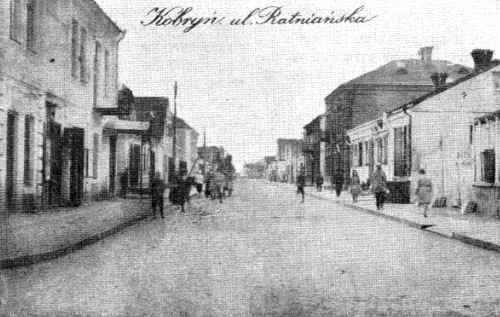
On Ratner Street, on the right side, going into a little alley, stood a two-story building that was the rebbe's house. The entire rabbinic family lived there. Next to the building stood a one-story structure that had, on its eastern side, a large garden. This was the Kobryner Shtibl.
Although my father was a misnaged, I would always go to pray with my grandfather (who was a Kobryner Chasid) in the Kobryner Shtibl. I remember the praven di tishn [the gathering of the Chasidim around their rebbe at the long, set table]. Most deeply engraved in my memory is the celebrating of the hakofes [Torah circumambulation], and Simkhes-Toyre. The entire shtibl would be filled with men, women, and children. Everyone would want to kiss the Torah scroll that the rebbe carried. During all seven hakofes, the rebbe would walk in front, and when he came back toward the Orn-Koydesh [ark], all the Jews would remain standing, and the rebbe would dance alone with the scroll until he became tired. Afterwards all the Jews would dance together. For us youngsters it was very interesting to watch – and also to catch a little dance ourselves.
On the Yomim-Neroim [Days of Awe] a fear would fall upon us, a trembling dread when we entered the shtibl on Yom Kippur for Kol-Nidre and saw the rebbe, together with all the Jews in their kitlen, reciting the prayer Tfile-Zake.
The rebbe would say: “Nu! Moyshe Elkona, gey zog Kol-Nidre” [go say Kol-Nidre].
Moyshe Elkona was a Jew who suffered from rheumatism. Barely able to drag himself with his twisted feet to the omed [podium], he would begin Kol-Nidre with such a weeping voice that I would think God would, without any doubt, forgive all sins.
After Kol-Nidre, the Jews would sit around the rebbe to rest, and they would sing. I still remember how Reb Shmuel Khayim Grinberg would sing Ezre hasoyfer [Ezra ha-Sofer], and we would join in softly. Whether one wants to or not, one must acknowledge the powerful impact of the Kobryner rebbes – Chasidim felt protected and cared for.
Until Hitler, may his name be erased, came and murdered all the Jews of Kobryn – and with them the last rebbe, Reb Moshe Aharon, of blessed memory.
ת.נ.צ.ב.ה.May his soul be bound in the bond of life.
by E. Lebnshul[1]
Translation from Yiddish by Beate Schützmann-Krebs
Kobryn was always under a significant religious influence. In earlier times, piety – or, as the common folk would say, “the Yidishkeyt” – exercised complete authority over the Jewish inhabitants of the town, and this was clearly visible in every respect. A proof of this is the fact that there was no exception: everyone had a place to pray, whether in a bes-medresh or a shtibl. It was rare for Jews to miss the Shabbat prayers, and needless to say, never the religious festivals or the Days of Awe. It is therefore understandable that Kobryn had such a large number of bote-medroshim and Chasidic shtiblekh.
The residents of each street or alley wanted to adorn themselves and take pride in having their own bes-medresh or shtibl. In this way an entire network of religious gathering places arose. People would point to the bes-medresh on Pinsker Street, and so that it would not feel like an only child, they built the Great Synagogue right next to it. In the same way, many other followed:
|
|
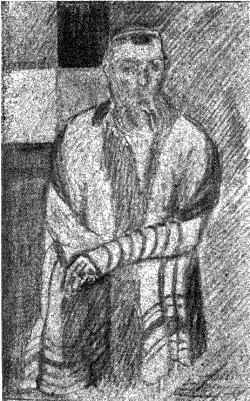
| A Jew in a talis [prayer shawl] and tefillin [phylacteries] Drawing by Fanny Glotzer |
The religious appearance of the town was filled with traditional style. There was an unending number of religious functionaries, what people lately had begun to call the “religious proletariat.” A whole colorful circle of gaboim [synagogue wardens], prayer leaders, Torah readers, beadles, ritual slaughterers, judges, and scribes gave the town a distinctly pious stamp, and everything moved in rhythm with the religious order.
There were organized early-morning minyans [prayer groups] that would begin their ceremonial davenen at daybreak in winter, when it was still dark. Most often these were craftsmen or peddlers. They were usually the first to tread the narrow paths through the freshly fallen nighttime snow. The later prayer groups were formed of merchants or men who did not have to worry about earning a livelihood, because their wives were eyshes-khailtes [hardworking women], tending to the little shops.
Aside from the rabbinical judges, who served as the rabbi's assistants in lesser matters – such as deciding questions of kosher and treyf [permitted and forbidden foods] and minor arbitrations – the rabbi was the town's central religious figure. He would deliver the two most significant sermons of the year, on Jewish faith and strengthening religious observance, on Shabes-Hagodel [the Great Shabbat before Passover] and Shabes-Tshuve [the Shabbat of Repentance before Yom Kippur]. The rabbi was also the central figure at assemblies dealing with important communal matters.
Besides the rabbi, the Rosh HaKehile [head of the Jewish community] was a major authority in Jewish communal life and exercised his governance over various institutions – such as the korobke (the concession for the kosher slaughter
[Page 71]
of meat in the slaughterhouse), the Talmetoyres [Talmud Torah schools], the hospital, the bogodelnye [home for the elderly], the cemetery, and the public bath.
The bote-medroshim [houses of study] were served by shamosim [sextons], who cleaned, made sure there was water in the hand-basin, changed the towel every Friday afternoon, collected discarded sacred texts, heated the stove in winter, lit the lamps, polished the candlesticks, woke people for slikhes [penitential prayers] by tapping with a stick on the shutters during the month of Elul, and maintained the memorial register for the yortsaytn [anniversaries of deaths].
Oversight of the shames's duties rested with the gaboim, who also served as the treasurers for the honors during the Torah reading, collecting the fees, selling shtet [seats in the house of study], setting the prices for mizrekh-shtet [front-row seats on the eastern wall], tapping the charity box for small coins after the Torah reading, deciding who would serve as bal-krie [Torah reader], bal-tekeye [shofar blower], and who would act as the one who recites the mishebeyrekh[2] blessings.
They negotiated with the bal-tfile [prayer leader] for the Yomim-Neroim [Days of Awe], purchased kerosene, candles, and other necessary items. They arranged small pieces of kindling wood for the bes-medresh [house of study] in winter and assigned the Shabbat guests every Friday afternoon – deciding who would go to whom as a guest at the tish [the Chasidic rabbi's Shabbat table].
Incidentally, there was a kindly custom – practically a khok-veloy-yaver [an inviolable rule] – never to leave a poor man without a host on Friday afternoon; he had to be assigned as a guest to a balebos [householder] for kiddush. The gaboim were the ones who determined when the prayers should begin and who tapped on the shtender [lectern] as a signal to the bal-tfile.
The prayer leaders were mostly bale-khazoke [those with established rights]. That is, each one had his own established role – for example, a Shabbat-only prayer leader would not go to the omed [podium] on weekdays, and the weekday prayer leader would not usher in the Shabbat; the same held for the Yomim-Neroim prayer leaders, who were already designated for their full musical abilities. Each had his own nign [melody], his own kneytsh [here: distinctive musical twist].
A special distinction was held by the shul-khazn [synagogue cantor], who was a true cantor – one who would pour out his heart in Ahavas Olam [“Eternal Love,” a prayer in the evening service] during Mayriv [evening prayer] and recite kiddush on Friday night. The same was true for Av Harakhamim [“Father of Mercies,” a memorial prayer] in the Musef [additional] service.
The congregation would draw deep joy and satisfaction from him, and it was no coincidence that on the Yomim-Toyvim [festivals] and Yomim-Neroim [Days of Awe] the synagogue filled with Jews who wanted to hear even a small part of the cantor's voice. The same cantor would, for the most part, also serve as the one who conducted the wedding blessings at the ceremonies held in the synagogue courtyard.
Together with the effects created by the Jewish klezmer (the band) and the badkhn [wedding jester], who would let himself go with a melancholy tone, a special atmosphere with a distinctly Jewish color was formed.
Especially impressive was the mood between Minkhe [afternoon prayer] and Mayriv in the houses of study, when the tones would resound– the melancholy Gemara melodies of the diligent students, the young capable learners. Their voices would mingle with those of the teachers, engaged in teaching Talmud or Ein Yaakov. More simple Jews would enter a quiet state of religious ecstasy as they recited Psalms, and the very simple ones would tell stories of gute-Yidn [chasidic masters].
From time to time, magidim [itinerant preachers] and meshulokhim [emissaries] from other towns would come down and deliver sermons between Minkhe and Mayriv, telling parables in a special Gemara-nign [Talmud-chant] – often moving the congregation so deeply that tears would come to their eyes, not to mention the vayber-shtibl [women's section], where one could hear the broken, quivering tones.
The payment for the sermon was whatever the gabe [synagogue warden] allowed the preacher to collect by placing a plate on a lectern near the exit – and any Jew who wished could throw in a coin. The gabe would also arrange for a householder to host the magid for the evening meal and overnight lodging. These same magidim or meshulokhim were the bearers of news for the town (in modern language, “informative agents”), telling what was happening in other towns and regions. Naturally, they would sometimes recount things that were neither “risen nor flown” – in other words, not entirely accurate – or simply distort the details when telling of wonders (the miracles performed by this or that gute-yidn).
The majestic Shabbat revealed itself from the very beginning, with its lively and imposing Friday-afternoon bustle, when all the peddlers who traded in the surrounding villages began to arrive. The fish market played its classic Erev-Shabbat role – packed with Jewish women buying even the smallest little nothing, ”fish for Shabes.” After all, what woman didn't buy fish for Shabes?
Most of the craftsmen and shopkeepers would, on Friday morning, put aside their tools and business dealings and turn toward the Malke Shabes [the Shabbat Queen][3]. A flurry of washing and rushing would begin – everything was cleaned and scrubbed – and Jews
[Page 72]
hurried to the bathhouse, which had been heated since early morning. It was a fortunate day for the broom sellers, who provided the pleasure of being able to give oneself a good beating in the hot steam, which grew hotter and hotter on the upper bench, thanks to the repeated pouring of small ladles of water onto the glowing stones, accompanied by the cries: “Gist, yidn! Zhalevet nisht!” [Pour, Jews! Don't hold back!]
The ceremony would end at the cold mikve [ritual bath] of daled-oyf-daled [four-by-four cubits], which was needed to cool the overheated bodies. For the women, who had to make themselves ready for Shabes, there was another mikve, with a tukern [bath attendant], whose supervision contributed to Jewish hygiene with a particular kind of fanaticism.
Half an hour before sunset, the shames was already running through the streets of the town, calling everyone into the shul [synagogue]. The last shops and wine stores then closed. New people began to appear in the streets – freshly washed, boys with carefully combed heads under their little caps, their curled peyes [sidelocks] hanging down; girls with newly braided tseplekh [braids] – all in Shabes clothing, with polished shoes.
The houses – a true taste of Gan-Eydn [Paradise] – were all orderly, clean, and thoroughly spruced up. After blessing the lit candles, the women would walk around with their combed parukn [wigs], waiting with emotional holiday-like anticipation for the men's “Gut-Shabes.” Very often the last to return from the bes-medresh [house of study] brought guests home for the festive Shabbat table.
The kiddush, as well as the zmires [Sabbath hymns], had great ceremonial value, and anyone who had a pleasant voice would sing them at full volume. The Friday-night meal had much festivity and often lasted an hour and a half or even two hours.
The early-morning Shabbat prayer service had a ceremonial character and did not end before one o'clock. Before the Torah reading, all announcements and proclamations of religious and civic importance were made, and the selling of Torah honors, according to a higher bidding system, added a special value to the Torah reading and brought real interest into it. The Musef service heightened the mood and was of a very festive character.
The midday meal was almost the same for everyone: the tsholntn [Shabbat stews] and kuglen [puddings], placed in the ovens on Friday afternoon, were the only dishes and had been traditional for generations.
The Shabes sermons, the shaleshudes [third meal], and the melave-malke [post-Shabbat meal] completed the traditional religious picture.
Coming to havdole [the ceremony marking the end of Shabbat], one already felt a melancholy, a regret that the holy Shabbat was departing and the gray week was arriving.
The Yom-Toyvim [festival days] differed from Shabbat with their own distinctive character. For example, Rosh Hashanah was considered, besides being the New Year yontef, a “sum-total holiday” in terms of mitsves and aveyres [commandments and transgressions], both active and passive.
The davenen was led by special High Holiday prayer leaders, who brought a unique color with their melodies. A special effect was made by the bale-tkies with their shofar blowing.
Especially impressive was the Tashlekh ceremony, which led to the river, where each person had to turn out his pockets, letting the crumbs fall into the water as a symbol of the transgressions that were to sink into the water just like the crumbs. It was a scene of faith and of great artistic value. Baked khales [challahs] in the shape of birds were among the integral customs of Rosh Hashanah.
The ceremonial character of Yom Kippur was of a very special nature and gave the day its own distinctive stamp. The Aseres-Imey-Tshuve [Ten Days of Repentance], with the early-morning penitential prayers, made even the most indifferent tremble.
The eve of Yom Kippur began with shlogn kapores[4] and slaughtering fowl. Before the fast, Jews would allow themselves to be given malkes [symbolic lashes] in the bes-medresh and would throw tsedoke [charity] into the bowls at the doors of the bote-medroshim.
After the pre-fast meal (usually noodle soup, chicken, and compote), the New-Year wishes began – the tears and the blessing of one another. The surrounding stillness during Tfiles-Zake [the personal confession] and the special Kol Nidre melody
[Page 73]
engraved themselves in memory. It made one tremble. Not for nothing was it said that on Yom Kippur even a fish in the water trembles.
The fasting (with only rare exceptions) was a complete fact and was carried out with admirable discipline – a mass scene framed within a harmonious prayer-process. The men, clad in their white kitlen[5], their taleysim pulled over their heads, swaying to the rhythm of the prayers, opened by the cantors, held everything tightly together and made a deep impression on young and old. The Malkhiyos [verses proclaiming God's kingship] and the Avoyde [sections of the liturgy] intensified the effect of the solemnity.
During Minkhe, at the moment of Maftir Yonah, the pale faces began to look tormented and melancholy.
As Neilah [the concluding prayer] approached, a nagging uncertainty would take hold – had the passing Yom Kippur truly succeeded in achieving atonement?
|
|
From right to left: Kh. Lukin, Y. Gazhanski, Sh. Varhaftik |
When the congregation repeated three times “L'shana Haba'ah B'Yerushalayim!” [Next Year in Jerusalem!], the mood was already lifted, and with genuine ecstasy they would cry it out. A surge of confidence and hope was contained in that outcry.
Pious Jews would still that same evening, after Mayriv prayer, hammer in the first pegs, thus
[Page 74]
beginning the building of a suke [festival booth]. The movement of building sukes was in full swing during the three days that separated Sukkot from Yom Kippur. The non-Jews in the area already knew the special character of Sukkot and would bring skhakh [branches and straw] for the roof covering to sell, as well as yellow sand to spread on the floor inside. Many questions and answers would unfold about the gentle radiance that filtered in through the skhakh roof.
By Hoyshayne Rabe [the seventh day of Sukkot], the suke [festival booth] would be considerably brightened by the hoyshaynes [willow branches], lulovim [palm branches], and esrogim [citrons]. The careful choosing of the hoyshaynes, with the proper leaves and of generous size, the uniformity of the lulovim, and above all the esrogim, created rare decorative effects for the holiday spectacle – such as the scene of carrying the esrogim to women or to the sick so they could recite the blessing, together with the baked leyters [small braided holiday loaves] to take the kvitl [petitionary note].
The joyful Shminatseres [the Eighth Day of Assembly], or the eve of Simkhes Toyre [the Festival of Rejoicing with the Torah], would march in with a whole wave of festivity – a foretaste of Simkhes Toyre, the most exuberant holiday of joy. The hakafos [processions with the Torah scrolls], the circling and kissing of the Torah scrolls, were colossal celebrations. Seeing women in the men's section was a matter of extraordinary significance – a small concession, allowing the women to look inside from the strict separation of an entire year, which otherwise barred them from entering the men's area.
Everything rejoiced, from the smallest to the greatest. The Ato Horeyso [opening verses of Simkhes Toyre] awakened pure joy. In the morning, the prayer service would at times last until three o'clock in the afternoon – especially the reading, repeating countless times the Siem ha-Toyre [completion of the Torah]. A special charm lay in calling up Kol ha-Ne'orim [All the Children], followed by the lekekh [honey cake] and brandy. It was, [in the words of Esther 8:16], “joy and gladness for the Jews”.
A few months after Sukkot, with no holiday in between, we would encounter the warm Chanukah spectacle, which spread through the brightness of the great miracle. The singing of “These lights we kindle” could be heard in every home. The holiday was celebrated with latkes [potato pancakes] and gribenes [crispy rendered chicken cracklings], and the cheder-boys would amuse themselves with dreydlekh [spinning tops] and playing kvitlekh [cards]. There were those who said that even pious Jews would play kvitlekh on Chanukah.
Without making much of the Fifteenth of Shevat, a day of carobs and figs, we come to the renowned Purim and Shushn-Purim [the day after Purim] – a truly fine historical holiday. The special melody that accompanied the reading of the Megile [Scroll of Esther], the portrayal of the Jews in the time of Ahashverosh, when the murderous plans of Haman-Haroshe [Haman the Wicked] failed thanks to the stirring beauty of Queen Esther and were turned into peaceful delight – becoming the beginning of the establishment of their own independence – raised Purim to a magnificent holiday.
As the Megile was read, the gragers [Purim ratchets] and clappers would rattle at the mention of the word “Haman,” accompanied by a stamping of feet.
The holiday was accompanied by festive meals of Hamantashn – a remembrance of Haman's downfall – by shalakhmones [Purim gift-portions] and all good things. Bands of Purim players would go around, disguised and made up, performing scenes and singing cheerful couplets.
Purim was even more joyful because one already stood on the threshold of the great holiday of liberation, Peysekh [Passover] – only four weeks away. The coming of spring also gave wings to the long-awaited Passover.
Cooking would begin in town with moes-khitn [charity funds for wheat] and matses [matzahs, unleavened bread] for the poor. The town would go into an uproar – everything wanted to be renewed: the people, their clothing, their dwellings. One kept washing, lime-whitening, repairing, and renewing. Jews would carry the fine sifted flour to the bakeries to bake matses. The very pious Jews insisted on shmure-matse [supervised matzah], which was baked with special care.
The women had the work of soaking rozhinkes [raisins] in tubs, and after soaking for several weeks, straining them through pointed sacks in order to obtain kosher Passover wine.
In the last days before Peysekh, the kashering of the utensils would begin. Fires were lit under large copper kettles, and in this boiling water all utensils were kashered – except earthenware.
The festive ceremony of burning the khomets [leaven] – the bits of bread gathered into a wooden spoon and swept together with feathers taken especially from the window frames –
[Page 75]
and the mekhires-khomets [sale of leaven] on a town-wide scale to a non-Jew under the supervision of the rabbi or the dayen [religious judge] were extraordinarily decorative scenes under a traditional Jewish banner. The new Peysekh utensils, which were taken down from the attics, made an impressive sight.
One can say with full confidence that the most beautiful Jewish ceremonies took place on Peysekh at the Seder. Every head of household, dressed in a kitl [white ritual robe] and surrounded by cushions to support himself, truly looked like a king – and accordingly his wife counted herself a queen. The table shone with whiteness, filled with matses, arbe-koyses [the four cups of wine], kharoyses [charoset], morer [bitter herbs], onion, and salt water.
Seated around the table for the Seder, the asking of the kashes [Four Questions] would begin. According to the Hagode [Passover Haggadah], the acts were carried out one after another, up to the kneydlekh [matzah balls].
Afterwards came the scene of opening the door for the kos shel Eliyahu Ha-Novi [cup set out in expectation of the Prophet Elijah], and likewise the scene with the hidden afikoymen [a little piece of matse eaten after the meal], ending with the Khad Gadye song, when it was already far past midnight.
On the second day the same ceremonial Seder was repeated. The following days, Khol Ha-moyed [intermediate festival days], as well as the final days of Peysekh, passed with great festivity. One felt lifted in spirit.
Guests for Khol Ha-moyed would arrive from neighboring towns. New acquaintances were formed, and often matches were made. While the adults enjoyed mead and latkes [pancakes], the children occupied themselves with playing with nuts.
|
|
After Passover there followed the period of counting the Sfire[6], when one was not permitted to bathe and no weddings were celebrated. On Lag-BaOmer Jews would refresh themselves and rejoice – especially the youth, who would march in rows with white-and-blue banners on an outing to the Potriker Forest, and thus, in a spirit of freshness, march into the green festival of Shvues [Shavuot], which breathed with greenness in the fields. The houses would be decorated with plasnik [greenery], creating natural effects.
The festival of Shvues was characterized by its foods, especially the special cheese bobkes[7].
To pass over the fast of Tishebov [Tisha b'Av, the principal summer fast day mourning the destruction of the First and Second Temples] –
[Page 76]
which little boys would “celebrate” by throwing berries at one another – would mean to pass over a fragment, a stroke of color, of traditional Jewish Kobryner life. The same was true of the “Three Weeks and the Nine Days” [the traditional mourning period from the Fast of 17 Tammuz until Tisha b'Av] during which no weddings were held and no meat was eaten.
A persistent longing surrounds us and draws us back to our birthplace, Kobryn – to the town that gave us so much joy and uplift, with its heartfelt customs and holidays. May these lines serve as a bright remembrance of Kobryn.
|
|
Translator's Notes:
by Melech Glotzer
Translation from Yiddish by Beate Schützmann-Krebs
According to the testimony of Khayke the shopkeeper's father, the Nikolayev soldier, and other elders, the Kobryner Shul [Synagogue] began to be built in the middle of the nineteenth century.
After the harsh policy of persecution toward Jews under the Russian Tsar Nicholas I – with the seizure of young boys and their dispatch for twenty-five years of military service in Siberia – there came the milder policy of Alexander II, who generally allowed the peasants of the land to breathe more freely.
For the Jews as well, changes came that were somewhat for the better – and they made use of them and became better integrated.
In that period the Jews of Kobryn undertook to build the Shul. It was a project of very great significance for that time.
The construction lasted a good number of years (it is assumed more than five). The financial means were supplied mostly by the town's wealthy men – the podryatshikes [contractors] from the surrounding estates, and merchants dealing in grain and timber. A municipal tax was also imposed on salt, yeast,
[Page 77]
and candles. Income from the koropke (slaughterhouse) also came in, and in this way the financial obligations were met.
The interior appointments – the painted decoration with its special character of the Jewish months, the rounded, vaulted high ceiling, and above all the fantastic carvings of the tall Orn Koydesh [holy ark], divided into three stories, each higher and narrower than the one below – were of aesthetic and artistic value. The lions, cherubs, Tablets of the Law, and the hands in the form of the priestly blessing were artistic achievements of the highest order.
The Orn Koydesh was painted in a beautifully executed, colorful array of impressive tones that blended into a splendid combination with the shining gold. The steps leading up to the Orn Koydesh [holy ark] heightened it and added to its dignity.
The large balemer [central reading platform] for reading the Torah in the center of the Shul gave the impression of a decorative stage on which solemn religious acts were performed. Each time, a different householder would be called up onto the bime to read. The one who was called up had to wrap himself in a talis, recite a blessing at the beginning and a blessing at the conclusion of reading the passage, and wait to step down until the next man had finished his blessing – a fantastically brilliant spectacle.
The pol [inner floor] was made of red brick and stood seven steps lower than the floor of the polish [ante-chamber], which was also paved with brick. The polish served not only to provide protection from rain, snow, and cold, but also as a place for worshippers and visitors who wanted to take a breath of air during the Torah reading – to smell tobacco and smoke on the holidays, when it was permitted.
In summer, it was very cool in the synagogue – a real delight – and in winter it was so cold that most of the worshippers would wear felt boots.
On the Days of Awe, the synagogue would overflow – on Rosh Hashanah and Yom Kippur [Day of Atonement], especially on Yom Kippur, it was packed with worshippers and visitors who came to hear the cantor (the only occasion on which the prayers were sung by him, accompanied by cantorial assistants). The cantor's chanting of Kol Nidre left an impression on everyone.
On Friday evenings, the cantor would welcome the Shabbat and let his voice pour out over all the melodies of Lekho Dodi and Kiddush.
The cantor had his dwelling on the side of the Shul facing the Kobryner stream, near the temporary women's mikve [ritual bath].
The Shul occupied approximately 5,000 square ells and was built in a square form. It bordered Pinsker Street on the south and the Kobryner stream on the north; on the east side, Rufas Lane, and on the west, Pinsker Bes-Medresh Street. On the side toward Pinsker Street the Shul possessed a garden, whose cherries belonged to the shames [sexton] – provided the boys did not get to them too early and tear them off, climbing over the fence.
During the First World War, a German bomb struck a corner of the Shul and broke off a piece of the cornice.
According to the sworn testimony of our Kobryner landsman [townsman] B. Kupitski, who stopped in Kobryn while returning from his deportation in Russia after the Hitler war, the Russian military occupied the Kobryner Shul and transformed it into a grain storehouse. This act, committed against Kobryn's highest Jewish cultural temple, is painful and altogether distressing.
The Great Kobryner Shul ceased to serve the purpose for which it had been built.
by Melech Glotzer
Translation from Yiddish by Beate Schützmann-Krebs
R. Michael the dayen [religious judge] did not have much luck regarding the Kobryner rabbinical seat. After the passing of Rabbi Dovid Grinberg, of blessed memory, at the beginning of the First World War, Kobryn found itself in an uncertain and unsettled situation, unable to decide whether to appoint a new rabbi – and whom.
|
|
Two dayonim [religious judges] remained: R. Michael and R. Noach. R. Michael had the advantage of being of a more modern bent, an adherent of Zionism, and he regarded himself as a rabbi. In that capacity he handled the legal records of the metrikes [civil registry], residency certificates, emigration documents, and similar papers.
Through these functions, Dayan R. Michael began to strengthen his position more and more, gradually gaining supporters for his plan not to fill the rabbinical seat with a new rabbi – that he alone would suffice. Naturally, not everyone agreed with such a plan, and at the first opportunity, when R. Peysekh [Pesach] Pruskin appeared, the great majority aligned themselves with him.
R. Michael was the purchaser, and in his name the Margolis Barracks was acquired, where all Jewish schools and institutions found a home. He had considerable influence in the bank next to the Great Bes-Medresh [study hall].
After the German occupation ended in 1918, when HIAS [Hebrew Immigrant Aid Society] provided food (a communal kitchen) and clothing to the needy Jewish population, R. Michael became the trusted representative and directed this relief effort. Rabbi R. Michael was killed in the final liquidation Aktion of the ghetto in October 1942.
May his memory be a blessing.
by B. Adler
Translation from Yiddish by Beate Schützmann-Krebs
The Righteous Man, Reb Pininke Shik, of blessed memory
At the end of the nineteenth century, there lived in Kobryn a great tsadik, R. Pininke Shik. People called him by the nickname Pininke, because he was a small, slender man. His son, R. Avraham, would recount the following incidents and say that they were entirely true.
|
|
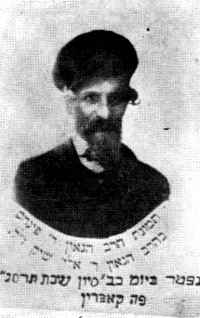
| [No external caption; the photo bears the inscription: “Portrait of the esteemed Rabbi Pinkhas, son of the esteemed Rabbi Arye Shik. He passed away on Shabbat, the 22nd of Sivan, 5663 (1903), in Kobryn.”] |
Every day, R. Pininke would pray in the Ratner Bes-Medresh. It had become a firmly established custom to wait for the tsadik in order to welcome Shabbat with him. His custom was that, before beginning the prayers, he would first call the poor people to him – those who usually sat under the balemer [platform with a reading desk from which the Torah is read] – so that he could give them a place for Shabbat.
When many guests happened to arrive for Shabbat, the kaboles-shabes would take longer. R. Pininke had to make sure that every last guest was taken care of.
A story is told: A butcher who prayed in the same bes-medresh became impatient – whether because he was too hungry or eager for the fish. In short, without waiting for the tsadik, he went up to the omed [podium] and began, “L'chu neranena la-Hashem.” Naturally, a great uproar broke out, and people wanted to trample the butcher. But R. Pininke said that they should continue with the prayers.
On Shabbat morning, the butcher did not come to pray. People assumed that he had stayed away because of the insult he had caused. But it turned out differently: On Sunday morning, the butcher's wife came to the rabbi to ask him to forgive her husband. The rabbi told her that he forgave him.
The woman began to weep and cried out: “Rebbe! Save my husband – he is ill.” The rabbi promised her that he would pray to the Master of the Universe to forgive him. When the woman left, he stood and said a prayer. Afterwards, he called out to his righteous wife and asked her whether the butcher had many children – such a pity for them, poor things.
Exactly on Friday night, at eight o'clock – at the very hour of kaboles-shabes – the butcher passed away. The tsadik could not annul the decree from Above. This story is related by the tsadik's grandson, Pinye Shik, who lives today in Buenos Aires.
R. Dovidl, the Rebbe of the Kobryner Chasidim
My grandfather, of blessed memory, was a Kobryner Chasid, and from the time we were small, he would always take us along to the shtibl for the prayers. I would look at the Rebbe with awe and reverence. He was a tall, proud Jew with a dignified beard. When he entered the shtibl, everyone would rise from their places.
When he led the tish or delivered Torah teachings, he would read it with a slight stutter – but not when he prayed. We children could not understand it. People said that it was because of the awe and reverence he felt before the Master of the Universe.
[Page 80]
R. Dovidl was a very great tsadik, and when he became ill and realized that his last days had come, he summoned a minyan of Jews and instructed them that after his passing they should perform the four mises beysdin for him [the four traditional rabbinic death penalties, performed here only in symbolic form]. They promised him they would do so, and they fulfilled his final request.
I remember this. As a small boy I stood in the bes-medresh and watched as they carried it out, and I thought to myself, “What terrible people these must be.” They take a dead man and throw little stones at him, and burn his body, and strike, and choke. Later it became clear to me what the Rebbe had meant by this – to come to the World to Come as a completely righteous man.
|
|
the ritual slaughterer and circumciser |
by Melech Glotzer
Translation from Yiddish by Beate Schützmann-Krebs
Reb Moyshe – or, as he was commonly called, Moyshe the shames [sexton] – was the very nerve center of the Kobryner Gas [Street] Bes-Medresh. It was, so to speak, a “match made in Heaven,” tied and bound together. The bes-medresh truly needed someone to care for it: an old, wooden structure built of planks, held together in its weakness by outside supports, with patched-on boards inside, and with the shingles on the roof constantly repaired so that the rain would not seep in – yet it maintained its dignity, standing there like a strong, imposing figure on Pinsker Street.
The Gas Bes-Medresh was a central point where three Shacharis minyanim [early morning prayer groups] were held every day – a sacred place where the yeshiva students would chant, swaying back and forth in the traditional manner, where Gemara shiurim [rabbinical lessons in Talmud study] were taught between Minkhe and Mayriv, where chapters of Mishnayos were studied, and where simple Jews sat reciting Psalms.
The Gas Bes-Medresh was the best place to slip into during the winter: one would fold one's hands behind one's back and stand near the long, hot stove, enjoying its warmth – and even more, the heartfelt, melancholy tones of the Gemara learners, or listening to the news from Fishel the Blond (the “Prophet”), who fancied himself a great politician and would read aloud newspapers, interpreting what lay between the lines. During the First World War he would draw the military positions by hand – those of the Germans, may their name be erased, and of oppressive Russia with its partners, the French.
The Gas Bes-Medresh gained special prestige from standing with its mizrekh side [eastern, sacred side] facing the entrance to the Great Shul – it looked like a second king standing before His Majesty. Among the little cheder boys it was commonly believed that the Gas Bes-Medresh had stood there since the Six Days of Creation – that is, from after the Flood and the generation of the Dispersion. But the knowledgeable ones – people like Motye the brickmaker, Meier Leyb the peasant, and Leybe from the tannery –
[Page 81]
would demonstrate with signs and proofs that the Gas Bes-Medresh was merely a centenarian elder of a building, and that it had been built roughly in the days of Napoleon.
In general, whatever the situation may have been, and despite all its importance, the Bes-Medresh was very much in need of a practiced hand – someone who would look after it properly. Someone who would make sure there were bundles of firewood in the winter; who would put in the little additional windowpanes during the week of the Torah portion Lekhlecho, when the first frosts usually appeared; who would see to it that there was water in the hand-basin; who would make sure that the shmoys [discarded sacred texts] didn't lie about like neglected scraps, but rested respectfully on the shelves of the Shas [full Talmud] and the poskim [halakhic authorities]; who would sprinkle the floor so the dust wouldn't rise too much when sweeping after davening; who would keep order among the various volumes of Shas with their leather bindings – the Ein Yaakovs, the commentaries of Chazal [Our Sages of Blessed Memory], the commentaries of the Geonim [early medieval rabbinic authorities], and all the other works.
All this was well understood by Paltiel Palonski, and when he served as gabe [warden], the decision was made to hire a proper shames [sexton]– someone who would look after the whole ensemble of Bes-Medresh customs, the Days of Awe ceremonies, who would study a page of Gemara with the people between the afternoon and evening prayers, who would sell Torah honors on Shabbats and festivals, serve as the Torah reader, make the blessings, and perform all the other ritual announcements.
The choice fell on Reb Moyshe, the rabbi from the Pinsker Street, who lived next to Sender the glazier, behind the Lubeshvever Chasidim's shtibl. He was a man somewhat above middle height, broad-shouldered, with a light blond beard grown into two long points, drawn smooth along his cheeks, and with bright, mournful eyes that carried a quiet, grieving shine.
When misfortune struck Reb Moyshe and he had to take his wife to the Vilayke[1], hoping her madness might be cured, he was not yet forty. Gripped by a deep melancholy, he devoted himself to running a small cheder with two classes – a Khumesh [Pentateuch] class and a Gemara class for the older boys. With no one to look after him or provide him with food, and fulfilling the commandment not to let himself go hungry, he took to cooking for himself.
While testing a student on the weekly Khumesh portion, he would take a small piece of meat from the ritual soaking water, set it on the salt board, and–scraping coarse salt from the wooden salt box with his thick fingers to season the meat–he would casually ask the student: “ Well then, my fine young man! What happened when Laban the Aramean confronted Ishmael, the son of Hagar?” As he peeled the potatoes, he would quiz him further, drawing on the sacrifices described in the portion of Leviticus.
After the hour of salting had passed, he would throw the meat together with the potatoes or the barley groats into a pot of hot water that stood on the stove or the little iron heater.
Then he would go to the Gemara students and discuss with them the laws of damages–how an ox might stray into another man's field and cause harm.
Sensing that the barley soup (krupnik) was nearly ready–judging by the spoon he always dipped in to test it–he would send the students home. That was called dinnertime – the warm-meal hour.
After eating his single daily meal – which three times a week he would replace with barley grits stew or with lentils – he would sit down to drink tea. A whole ritual would begin: setting up the samovar, lighting the coals in the narrow iron tube, and pouring in a little kerosene. He never blew on the fire with his mouth. Instead, he would pull off the boot from his left foot, turn the boot shaft so that its opening faced downward, place it over the tube, and–pressing with the sole–pump it up and down until the fire caught.
When the samovar had come to a boil and the tea in the little pot was already boiled up, dinnertime was over, and the students would begin to return, to review once more the weekly portion or the Gemara lesson. Rabbi Moyshe's tea-drinking ritual never ended until he had drawn out the very last bit of water from the spout. That was always his “little last bit.”
When Paltiel the gabe offered him the position of senior sexton, Rabbi Moyshe recoiled: “Really? Me? What – am I already starving? God forbid.”
After thinking it over for several days, he agreed to take the post – especially since they were preparing the cheder-shtibl for him behind the Bes-Medresh, which had a large room with a stove that could serve him both as a cheder and as living quarters.
Thanks to the senior sexton's duties, Rabbi Moyshe
[Page 82]
changed a great deal. He became more active, began studying a page of Gemara with the townsmen between Minkhe and Mayriv prayers, taking the place of Reb Hillel the Brisker. Rabbi Moyshe became a Torah-reader, and indeed with careful, precise trop – the exact traditional accents.
He chanted the haftoyres [prophetic reading] with the traditional melody. He began welcoming the Shabbat at the omed, became the Shabbat and Yom-Toyvim Shacharis prayer leader, and took it upon himself to be the shofar-blower. He tickled himself with the music and wanted to convince himself and others that he possessed a sweet voice and could also serve as the Musef cantor. But he could not manage it; he did not have the necessary voice. His hoarse, short-winded voice did not help him, and he, poor man, had to leave the Musef service and the Days of Awe to Reb Yonah the Blond.
Rabbi Moyshe had a weakness for telling great stories – wonders of the Vilna Gaon. He was a strong Misnaged [opponent of Chasidism] and held firmly to the teachings of Reb Chaimke the Brisker Gaon. A rare and singular type.
Peace to his dust.
Translator's Note:
by B. Adler
Translation from Yiddish by Beate Schützmann-Krebs
It is difficult to give the exact date of the founding of the Kobryner Home for the Aged. A supposition – at least, as some say – is that it came into being in the 1880s.
Naturally, the development of the Kobryner Home for the Aged took place under the sign of constant hardship and very modest conveniences. The lack of material means did not allow for proper care of Kobryn's elderly – with comfortable rooms, good beds, and clean, hygienic facilities.
They had to make do with an old, abandoned house on the corner of Ratner Street and subsist on the meager board payments from the Kobryner community and on the scant, unpredictable donations that Kobryn's Jews would give during the keres [charity collection] on the eve of Yom Kippur.
|
|
It may also be that the members of the administration – those who managed the Kobryner Home for the Aged – did not sufficiently or properly make use
[Page 83]
of Kobryn's resources to support the elderly and the lonely. For it is hardly believable that the interpretation of “Do not cast us off in our old age” [Psalm 71:9] would leave Kobryn's well-established Jews cold and unmoved.
However the matter may have been, the Home for the Aged fulfilled an important charitable function in the Jewish life of Kobryn. And one must not forget that in the last decade of Kobryn's Jewish existence, the sense of support and concern for the elderly broadened greatly and came to encompass major plans – for proper care of the lonely aged, whose situation had begun to grow more comfortable and more orderly.
With the destruction of Kobryn's Jewry by the barbaric German murderers, the Kobryner Home for the Aged was likewise brought to an end.
May these words serve as an everlasting tribute.
[Page 84]
|
|
|
|
|
|
JewishGen, Inc. makes no representations regarding the accuracy of
the translation. The reader may wish to refer to the original material
for verification.
JewishGen is not responsible for inaccuracies or omissions in the original work and cannot rewrite or edit the text to correct inaccuracies and/or omissions.
Our mission is to produce a translation of the original work and we cannot verify the accuracy of statements or alter facts cited.
 Kobryn, Belarus
 Yizkor Book Project
 JewishGen Home Page
Copyright © 1999-2026 by JewishGen, Inc.
Updated 10 Oct 2026 by LA