|
|
[Page 47]
[Page 48]
[Page 49]
by Berl Kupitski (France)
Translation from Yiddish by Beate Schützmann-Krebs
It is hard to find many towns in Lithuania or Poland where the original Jewish folk character and all the old, beautiful Jewish traditions, in all their forms, found such a richly colored expression as in our town of Kobryn.
Kobryn is an old Jewish community, already in existence for more than 700 years. This is attested to by the ancient gravestones in the old Jewish cemetery. Jewish life was concentrated in the area known as Yidishe Gas [Jewish Street], where the first synagogue was built, as well as the cemetery.
It is difficult to provide precise figures for the various stages of its development, since it has not been possible to obtain the necessary historical and statistical material. It is known, however, that during the so-called Gzeyres Tach ve-Tat – 302 years ago, during the Cossack uprisings, when the heydamakes [marauding bands] of Bohdan Khmelnytsky carried out pogroms and plundered hundreds of Jewish communities in Poland and Lithuania – Kobryn, too, was destroyed. It is also known that in the year 1873, nearly eighty years ago, during the cholera epidemic, great devastation also occurred among the Jewish population.
Judging by the well-organized religious and social-philanthropic institutions that had been handed down by earlier generations, it seems undeniable that Kobryn was once widely known. To convince oneself of this, it is enough to point to the splendidly built Great Synagogue with its original orn-koydesh [holy ark] (the likes of which were hard to find anywhere in Poland), to the numerous solidly constructed bote-medroshim [study houses] – fifteen or sixteen in number – and to the Jewish hospital.
The Jewish community of Kobryn was led by the greatest authorities, such as Rabbi Meirim, of blessed memory, Rabbi Berlin, of blessed memory, and other renowned rabbinic figures in the Talmudic world.
Jewish religious life in Kobryn was reflected in its full richness of color. Its spiritual life pulsed with Fit is enoughrhythm and strength. The beautiful Jewish customs and traditions were highly developed and carefully preserved. All the philanthropic societies – such as Linas-Hatsedek, Bikur Cholim, and many others – were constantly active in Kobryn.
The Chasidic movement of Israel Baal Shem Tov, which arose as a reaction to German Mendelsonyzm (the movement of Moses Dessauer)[1] and struck deep roots in Poland, did not bypass Kobryn either. The sadly well-known religious disputes that later flared up between Chasidim and Misnagdim found some of their fiercest expression in Kobryn.
There was hardly a single religious stream – whether Chasidic or Misnagdic – that did not find expression in Kobryn. It is enough to point to the many and varied Chasidic shtiblekh that existed in the town: Slonimer, Lubavitcher, Trisker, Karliner, and Lyubeshever [Lubieszówer] – who, unfortunately, never lived in peace with one another. Only God knows what divided them and for what reasons their quarrels arose.
Kobryn was known for its strong Chasidic tendency, dominated by the dynasty of the “Kobryner,” famous for their modest and popular tishn [communal Chasidic gatherings around the Rebbe]. On the yomim-neroim [Ten Days of Awe] and the festivals, Chasidic followers from the surrounding towns would gather there.
Kobryn possessed its own yeshivas, led by gdoyley-ha-Toyre [great Torah scholars]. The advanced yeshiva students were supported by local householders who provided them with meals.
The rise of the Chovevei Zion [Lovers of Zion] movement, as well as the later appearance of political Zionism, aroused enthusiasm among the enlightened Kobryner youth. At the same time, a second socio-political party – the Bund – also made its impact felt, bringing new vitality and color into Jewish Kobryn.
After the proclamation of the Balfour Declaration,
[Page 50]
when Zionism emerged from its theoretical stage and entered its phase of practical realization, a period of great national awakening began in Kobryn. The entire Jewish youth, almost without exception, was systematically drawn into the many national youth organizations that were founded immediately after the end of the World War. It was then that Ha-Chalutz, Hashomer Hatzair, and all the other youth organizations of the Zionist-bourgeois parties were established in Kobryn.
In the years 1921–22, when the yishuv [here: the Jewish community in pre-state Palestine] in Erets Yisroel was still in its infancy – weak both economically and in numbers – and when the country lived under the constant threat of organized murderous Arab attacks, a pioneering aliye [aliyah] began from Kobryn.
During the twenty years of their existence, up until the outbreak of the last great war, the above-mentioned organizations carried out extensive national work in every sphere of the wide-ranging Zionist enterprise, as well as significant cultural-educational activity. Hundreds of Jewish young people received their education and intellectual formation within these organizations. Pioneer cadres were continually trained; they received their professional preparation in the various hakhshore centers and, after completing the necessary practical training, were sent to Erets Yisroel to the different agricultural settlements and kibbutzim, where they now take an active part in building the yishuv.
A great deal was also accomplished in the cultural and educational sphere. There was not a single Jewish youth in Kobryn who belonged to these organizations who did not know – or at least understand – the Hebrew language.
Especially outstanding in the Hebraization of its members was Hashomer Hatzair, where all discussions were conducted in Hebrew.
Kobryn also had a Tarbut school, a Tushiya school, a TSYSHO school, and a Beis Yaakov school for religious Jewish girls, run by Agudas Yisroel, as well as various Hebrew evening courses organized by the Zionist organizations.
The center of all Zionist cultural and educational work was located in Margolis's barracks. All the schools and all the parties had their premises there. It was there that the laboratory stood in which the soul of the young generation was forged and shaped.
The Jewish national youth of Kobryn distinguished itself by its extraordinary dynamism, often sweeping along the frequently apathetic older Zionists into active Zionist work. Through its efforts, a wide-ranging and vigorous activity was carried out in every sphere of Zionist life. The entire Jewish youth of Kobryn was drawn in and mobilized for the national cause. Without exaggeration, there was not a single young person who did not belong to one or another Zionist youth organization. And there was not a single home in which the blue Keren Kayemet [Jewish National Fund] box did not hang.
The entire broad spectrum of Zionist parties was represented in little Kobryn, ranging from the left-wing Poalei Zion to Betar [Revisionist Zionist youth movement founded by Jabotinsky] and Bris HaChayil [religious-nationalist youth movement with a paramilitary character]. As is usually the case, conflicts and frictions were by no means rare.
In the local weekly paper, people often exchanged sharp words, and quite often in terms that were difficult to classify as suitable for print.
At that time, our party activists and our naïve, good-hearted youth had not yet understood that national interests stand far above petty, narrow party distinctions, and that a shared destiny binds us all together as Jews.
No one sensed the terrible, creeping cataclysm that was approaching with giant steps; our party activists did not understand the brutal and simple truth that when the Ukrainian and SS bands would come, breaking with axes and crowbars into the Jewish homes in the ghetto during the liquidation Aktion, they would not ask whether a left-wing Poalei Zion member or a Betarnik lived there, a Mizrachi follower or someone from Agudas Yisroel.
Our old Jewish community of Kobryn, so close to our hearts,
[Page 51]
exists no longer. It has vanished and been wiped out in the great flood of blood and tears that swept over our unfortunate people, together with the many thousands of other Jewish communities, larger and smaller, that were destroyed and laid waste. On this occasion, the names of our meritorious communal activists, who met a martyr's death, must be mentioned here:
– The rabbi, Reb Michael Shmoysh, of blessed memory, the guide of our community for the past twenty-five years, a dedicated communal activist, who contributed greatly to social-philanthropic work and to religious education. He was killed in the liquidation Aktion.
– Noach Alkon, of blessed memory, a pioneer of Hebrew education in Kobryn. For more than thirty years he worked tirelessly in the field of educating and Hebraizing our youth. He was killed in the first Aktion.
– Ben-Tsion Pantal, of blessed memory – educator of our pioneering youth for the past twenty years. He devoted his entire life and energy to the Zionist cause. He was killed in the ghetto.
– Hela Pribulska, of blessed memory – a meritorious Zionist and active communal worker. She was killed separately in the Kobryner ghetto.
– Dr. Khayim Goldberg, of blessed memory – one of the first founders of Hashomer Hatzair in Kobryn. He was killed in the Kobryner ghetto after a heroic act of resistance.
Welcoming the initiative and cooperation to perpetuate the memory of our old Jewish community of Kobryn, I would like to express the hope that this book, which will be distributed to every Jewish home of our landsleit, will also contribute to closer cooperation and stronger ties among the Kobryner Relief Committees in the various countries where they exist, for the benefit of our shared cause.
Translator's Note:
by M. Tsinovitsh
Translation[2] by Aharon Khludnyevitsh [Chłodniewicz]
Printed in Sefer Kobryn
Translation from Yiddish by Beate Schützmann-Krebs
The history of the rabbinate in Kobryn can be divided into two periods: the first Kobryner rabbis, from the founding of the community until the time of Reb Meir Marim [Meirim][3], the author of Nir al ha-Yerushalmi (1857)[4]; and the period from Reb Meir Marim until the tragic destruction of the Kobryner community by the Nazi murderers, may their name be erased.
In contrast to the second period, about which we possess precise information, the history of the first Kobryner rabbis is very poor in reliable and firmly established data. No documents or pinkasim [communal record books] from those early times have survived. Nevertheless, we have succeeded in identifying the names of several Kobryner rabbis and respected scholars who were either born in our town or served there. And even if the list of the earliest Kobryner rabbis is not complete, it still casts a certain light on the spiritual life of this distinguished community in past centuries.
The rabbi, Reb (Yaakov) Kopel Kahana[5], served as Av Beis Din [chief judge of the rabbinical court] and head of the yeshiva in Kobryn. After Gzeyres Tach ve-Tat, [the massacres in 1648–49], we find Reb (Yaakov) Kopel Kahana serving as rabbi and as head of the yeshiva in Kobryn. According to the testimony of authors from that period (the 17th century), Reb Yaakov Kopel was a great scholar, and his yeshiva in Kobryn enjoyed high esteem.
From the work Kitvei ha-Geonim [Writings of the Geonim] by Rabbi Zvi Horowitz, rabbi in Dresden, we learn of a Kobryner rabbi by the name of Reb Shlomo. Although few details about this rabbi have survived, it is known that he was an odem khoshev [a respected and distinguished figure]. His son-in-law was Rabbi Chaim ha-Kohen Rapoport of Zilkov [Żółkiew]. It appears that he (Rabbi Shlomo) served as rabbi in Kobryn after the aforementioned Rabbi Kopel.
At that time – that is, roughly three
[Page 52]
hundred years ago – Kobryn became renowned through one of its native sons, the well-known darshn [preacher] Rabbi[6] Betzalel ben Shlomo, the Kobryner, who traveled throughout Poland and Lithuania delivering his sermons.
Besides his sermons, Rabbi Betzalel gained popularity through his three books: Pelekh ha-Rimon [The Segment of the Pomegranate], Amudeha Shiv'ah [Her Seven Pillars], and Korban Shabbat [The Shabbat Offering]. A large number of rabbis of that period gave their approbations to the works of the Kobryner preacher. In his last book, Korban Shabbat, we find a detailed description of the terrible destruction wrought by the bands of Khmelnytsky in the years 1648–49, of which he was an eyewitness. In this work, the preacher sharply reproaches the Jews for their sins of Shabbat and festival desecration, especially the innkeepers and leaseholders.
The three mentioned books of the Kobryner Maggid achieved wide circulation not only during his lifetime; many years later new editions of these instructive works continued to appear.
At the time when the darshn R. Betzalel was traveling throughout the region with his sermons, Kobryn itself had a maggid muflag ve-chasid [“an outstanding and pious maggid”], R. Aryeh Leyb Kobryner of the Binkovitser [Binkowicz] family. We learn of him from a work authored by his son, R. Eliyahu, Mikhtav Eliyahu [The Treatise of Eliyahu] (Hamburg, 1715).
Around that same period – the seventeenth century – we encounter another author from Kobryn, R. Yosef ben Uri Shraga. He composed a book entitled Ma'arakha Chadasha, which contains lamentations and penitential prayers concerning the expulsion from Tsoyzmir (Sandomierz) in the year 1698; it was published in Frankfurt an der Oder in 1699.
One of the Kobryn natives who enjoyed a reputation as a learned man and a man of Torah was the aforementioned R. Eliyahu, the son of R. Aryeh Leyb. Owing to the unsettled conditions of the time, he was driven as far as Plingyan [Plungyán/Plungė] (in the Zamuter/Samogitian region of Lithuania). He is the author of Mikhtav Eliyahu (Hamburg, 1715), a commentary on Pirkei Avot. In this work he records several new insights that he is said to have heard from his father, of blessed memory.
Some two hundred and thirty-five years ago, the rabbi of Kobryn was R. Akiva ben R. Moshe ha-Kohen of Brisk. We find his approbation to the book Kerem Chemed [“Vineyard of Delight”] (published in Dirnfurt, 1720) by R. Eliyahu ben Yitzchak Ayzik of Vysokaye-Litovsk.
About two hundred and ten years ago, the Kobryn rabbinical seat was occupied by the rabbi, Reb Nachum, according to what is recorded in the biography of R. Yaakov Kranz, known as the Dubner Maggid, a grandson of the Kobryner Rabbi Nachum. No further details about this rabbi are known.
According to the book Avot Ateret Le-Banim [The Fathers, a Crown to the Children] (Warsaw, 1927) by A. L. Lifshitz, we learn of another Kobryner rabbi named R. Eliyahu, a son-in-law of the Brisker Rabbi Nachman, who came from the Sirkin family.
In the year 1809, the rabbi in Kobryn was R. Shlomo, the son of R. Avraham Mintz. His approbation appears in the book Chidushei Maharam Shif [The Novellae of the Maharam Shiff] (published in 1804), together with the approbations of many other rabbis from Poland, Galicia, Volhynia, and Lithuania.
Afterwards he became the rabbi in Slonim, where he gave his approbation to the book Milchamot ha-Levi'im[7] in the year 1818. There he is mentioned as the Av Beis Din of three communities: Pruzhene [Pruzhany], Kobryn, and Zelvi [Zelva]. Another approbation by this Kobryner rabbi is found in the book Brit Olam by Rabbi Yitzchak Ashkenazi.
Concerning a later Kobryner rabbi, “the great Gaon Rabbi Moshe,” we find information in the book Beis Moshe (a commentary on the Shulchan Arukh) by his great-great-grandson, R. Moshe Epstein of Zamość.
From the book Ohaley Shem by Sh. N. Gottlieb (Pinsk, 1910) we learn of a Kobryner rabbi named R. Shemaria Weingarten, formerly rabbi in Lyubeshov, who was descended from R. Yekhiel Mikhel of Zloczow. His son was R. Avraham Aba Yosef, rabbi in Yanov and Lyubeshov. His son, in turn, was R. Yitzchak of Lyubeshov, the father of the later tzadik, R. Yaakov Leyb, whose successor was R. Yitzchak Aharon Weingarten, known as the Libeshever Rebbe. He was so called because, after the First World War, he moved from Lyubeshov to Kobryn, as the latter had been destroyed.
The Rebbe Nachumke Kobryner
The Rebbe, Reb Menachem Nachum ben R. Yehuda Leyb Epstein was born at Passover of the year 1846 in Visoki-Litovsk [Vysokie-Litewsk] (in the Brisk region) and passed away on the 1st of Menachem Av 5678 [1918] in Bialystok. Like his father, he was a Kotzker Chasid, and later on he began to travel to the Slonimer Rebbe, Reb Avraham, author of
[Page 53]
Yesod ha-Avodah [The Foundation of Divine Service].
After the passing of R. Avraham in 1884, a large part of the Slonimer Chasidim chose him as their Rebbe and even built him a shtibl (the Slonimer Chasidim's shtibl), which existed until the destruction of Kobryn.
In 1895, after the great fire in Kobryn, the Rebbe, Reb Nachumke, left for Bialystok. There, too, a large community of Chasidim devoted to their Rebbe formed around him. Even the Misnagdim of Bialystok held him in high regard and showed him great respect.
His daughter Miriam was the wife of R. Yitzchak Aharon Weingarten (the Libeshever Rebbe).
Reb Nachumke first lived in a small house on Zamukhavyets [Zamuchaviec], where he devoted himself to Torah study. Among his earliest followers were the distinguished householders Reb Alter Palyevski and Reb Shmuel Zavel Averbukh.
R. Nachumke's Chasidim maintained shtiblekh not only in Kobryn but also in Brisk, Bialystok, Horodok, Warsaw, and Łódź.
The Kamenitzer Maggid, Reb Chaim Zundel, was born in a village near Kobryn in 1856. In the book Imrei Chaim (Tel Aviv, 1929), the story of the Kamenitzer Maggid is recorded. Already in his youth he distinguished himself through his knowledge of Tanakh and Gemara [Talmud]. From an early age he was drawn especially to the sermons delivered by the Maggidim. Later he went to Brisk, where he studied in the yeshiva there. In his later years he became renowned as a Matif Leumi [“national preacher”], as well as a capable activist in the movement of the early Chovevei Zion [Lovers of Zion] among the Jews of Russia.
The Gaon Rabbi Meir Marim ben Rabbi Moshe Shafit (a grandson of the Maharshal and the Rema [Rabbi Moshe Isserles])
At the age of fifteen he was already serving as rabbi in Maytitsh (in the Slonim region), and later in Vishnyove. In 1849 he became the rabbi of Shventsyan (in Lithuania), then of Jakobstadt (in Courland, Latvia), and from 1857 onward he served as rabbi in Kobryn. He passed away in Kobryn in 1874. His ohel [a small structure built over a revered rabbi's grave] is located in the old cemetery, next to the ohel of the Kobryner Rebbe, R. Mosheke, with whom he had been closely befriended.
Among the Jews of Kobryn, the name of Rabbi Meir Marim was revered as that of a great scholar, a tzadik, and a baal-mofes [a wonder-worker believed to perform miracles] – also because of his sympathy for the Chasidism of the Baal Shem Tov, whose founder and disseminator in the region had indeed been the aforementioned R. Mosheke'le Kobryner.
In the book Or Yesharim by Moshe Chaim Kleinman of Brisk (which contains the biographies of R. Mordechai and R. Noach of Lekhevitch [Lyakhovichi], Rabbi Moshe Kobryner, and R. Avraham Slonimer), many accounts are recorded describing the noble character traits and great acts of charity of Rabbi Meir Marim.
The Rabbi Shuv, one of the elder Kobryner in Jerusalem, passed down interesting details about the virtues of Rabbi Meir Marim. When he arrived in Kobryn as rabbi, he lived on Ratner Street, in a poor dwelling consisting of just a couple of small rooms. His quality of mistapek b'me'at [being content with very little] was demonstrated by the story that he had proposed to the Kobryner householders that all of them – rich and poor alike – should contribute a single kopeck a week toward his salary. In this way he would not stumble into improper favoritism.
R. Eizel Charif of Slonim said about R. Meir Marim's work Nir al ha-Yerushalmi: “Such a book I, too, would be capable of producing – but to be such a tzadik as he was, that is beyond my powers.”
After the passing of Rabbi Meir Marim, the rabbinic seat in Kobryn did not remain vacant for long. His successor was R. Eliyahu Shik, known as R. Elinke[8], formerly rabbi in Nayzager [New Žagarė][9].
As the official rabbi, however, the son of R. Meir Marim, R. Aharon Yehoshua Shafit, was appointed; he later emigrated to Erets Yisroel and settled in Safed. His successor in the rabbinate was his son-in-law, the attorney Panovka, who held the position until the outbreak of the First World War.
The second son of R. Meir Marim, Rabbi Betzalel Chaim Shafit of Vyozin, published his father's work Nir al ha-Yerushalmi. It should also be mentioned that a nephew of R. Meir Marim – the well-known Rabbi Avraham Aharon Yudelevitch, born in Novrodok [Novogrudok] and later rabbi in Selub [Selyub], Kozhenitse, Konstantinov, Manchester (England), and afterwards in the United States – studied Torah in his youth with his uncle in Kobryn.
Rabbi Elinke Shik (an acronym formed from the name Shmuel Yehuda Katzenellenbogen) came from a distinguished family that traced its
[Page 54]
lineage back to R. Shaul Wahl of Brisk (according to legend: the “one-night king” of Poland). On his father's side he was a great-grandson of the Rabbi Yomtov Lipmann, the author of Tosafot Yomtov [Mishnah-commentary].
In Ha-Maggid of 1863 (no.45), there is a correspondence concerning the arrival of R. Eliyahu Shik in New Žagarė as rabbi. A delegation had been sent to Dvynsk to present him with the K'sav ha-Rabbonus [rabbinic appointment document]. Among the prominent householders were the great Talmud scholar R. Shimon Horowitz and the wealthy man Moshe Elyashev (the great-grandfather of the later famous critic, the author of Machshavot [Thoughts]).
One of R. Elinke's most striking character traits was his humility. He was also known for his hospitality and, above all, for being a great masmid [one who studies Torah with tireless diligence]. He is the author of Sefer Ein Eliyahu [The Fountain of Eliyahu], a commentary on Ein Yaakov [The Fountain of Yakov]. He distinguished himself especially through his interventions on behalf of the khapers-cantonistn[10].
The following incident is told about him: While he was in Grodno, he heard that in the community house Jewish children were being held–“captured” to be sent off as soldiers. He grabbed an axe, ran out into the street, and shouted:
“Brider Yidn, vos shvaygt ir? Lomir rateven yidishe nefoshes!” (“Jewish brothers, why are you silent? Let us save Jewish souls!”). When the Jews saw the rabbi with an axe in his hand, each one seized whatever he could find – one a piece of iron, another a spade–and followed him. They surrounded the community house, broke down the door, and freed the Jewish children.
Afterwards, R. Elinke gathered the entire community in the synagogue and adjured them never again to allow Jewish children to be seized. (From Sefer Medor Dor [From Generation to Generation], by M. Lifson, 1937).
It had not been destined, however, for the town of Kobryn to have the righteous R. Elinke as its rabbi for long. His rabbinate lasted only half a year, and he passed away unexpectedly while delivering a sermon, leaving the Kobryner community in deep mourning.
His son, R. Pinchas (better known as R. Pininke), did not wish to assume the rabbinic seat after his great father and remained, all his life – for a period of twenty-eight years – a dayan [rabbinical judge] and moreh tsedek [halakhic decisor for practical questions].
R. Pininke published his father's work, Derekh Avot, a commentary on Tractate Avot (Warsaw, 1884).
R. Pininke did not involve himself in the civic affairs of the town. He sat only in his permanent place in the Ratner Bes-Medresh [Beis-Midrash] and studied Torah. His simplicity and uprightness reached far beyond Kobryn and made him known throughout all of Lithuania.
The well-known writer Shmuel Yakov Yatskan wrote about him after his passing:
“…He did not turn his learning into a spade with which to dig [Pirkei Avot 4:5], but fulfilled the commandment of studying Torah for its own sake, as it is written: ‘And you shall meditate upon it day and night.’ He did not even wish to become the town's rabbi, so that he could devote himself entirely to Torah and fear of Heaven. Therefore one may say of him that in our generation, when everyone seeks only material pleasures, R. Pininke may be counted as echad bedora – one of a kind in his generation – with his simplicity, humility, and fine character traits.”
One of the Kobryner bney-Toyre [traditional Jewish scholars] who achieved great esteem in the rabbinic world was R. Noach Chaim, son of R. Moshe ha-Levi Levin, born in Kobryn in the year 1838. He served as a dayan and moreh tsedek during the rabbinate of R. Meir Marim.
He published the following works: Binyan Yerushalmi (Warsaw, 1894); Megillat Esther (Warsaw, 1865); Megillat Yochasin [Scroll of Genealogy] (same place); Asarah Ma'amarot [Ten Discourses]; and Masekhet Avot [Tractate Avot] (Wilna, 1866).
His books received approbations from the greatest rabbis of that time, among them R. Yosef Shaul Natanzon of Lemberg, R. Hirsh Orenstein of Brisk, R. Dovid'l of Kotzk, R. Menachem Mendel of Vorki, R. Leyb Eiger of Lublin, R. Asher of Stolin, and R. Avraham of Slonim. Included among them was also the approbation of the rabbi of Kobryn, Reb Meir Marim, in the year 1866.
Rabbi Shaul Katzenellenbogen (Epstein)
R. Shaul was born in Vilna in 1828, the son of Rabbi Meir ha-Levi Epstein, known among the people as “Rabbi Meir Shnipishker.” Already as a boy, R. Shaul displayed remarkable mastery in learning. In 1858 he became rabbi of Kasove (in the Slonim region). He gained renown as a great preacher and Jewish sage, and was invited to serve as rabbi in the towns of Lekhevitch [Lyakhovichi], Krynki, and New Žagarė (after R. Elinke Shik left there for Kobryn).
In 1882, while residing in the nearby city of Brisk, he was offered the rabbinic seat of Kobryn. Both the Chasidim and the Misnagdim united in choosing him as their rabbi.
Here he quickly won the affection of all the householders, and throughout the ten years
[Page 55]
that R. Shaul served as av bet din, he was shown the greatest respect. He distinguished himself not only as a great scholar, but also by taking a genuine interest in everything that happened in the town. He knew exactly who needed help in a time of distress. Thanks to him, the gmiles-khesed fund [Gemilut Chasadim, a charitable loan society] was established, which helped more than one fallen person regain his footing.
The rabbi's residence was located on Ratner Street, where he would deliver a sermon every Shabbat. During the Days of Awe he prayed in the Great Synagogue and there delivered his traditional sermons.
In his final years, R. Shaul was ill and traveled to Warsaw for treatment. There he lay bedridden for several weeks and passed away on Khol ha-Moed Sukkot of 5652 (1891). He was then sixty-four years old.
The greatest rabbis of the time sent the Kobryner community their heartfelt condolences, among them the Gaon R. Yitzchak Elchanan Spektor of Kovno.
R. Shaul left no authored book of his own. Only a few of his teachings are preserved in Imrei Noam, which was published by his son R. Avraham Meir ha-Levi.
R. Shaul's eldest son, R. Binyamin Isser ha-Levi Katzenellenbogen, served as rabbi in Svirzine [Svierzhyn], near Stolptsy (Shtoyfts]. It is worth mentioning the two sons of R. Binyamin Isser:
R. Avraham Chaim, who later assumed the rabbinate in Svirzne [sic] and afterwards in Saratov, where he served as rabbi even during the Soviet period; and the second son, Shalom Yaakov Katzenellenbogen – or, in short, יש”ק [Y.Sh.K.] – who collaborated with Dovid Frishman on Ha-Dor [“The Generation,” a Hebrew literary journal].
About him, Zalman Shazar, the first Minister of Education of the State of Israel, relates interesting details in his autobiographical work Kokhvei Boker [Morning Stars] (Am Oved Publishing House, 1950): “His prose poems under the pseudonym יש”ק [Y.Sh.K]., and his short stories in the London journal Ha-Yehudi [The Jew], rightly earn him a place as one of the first pioneers of the modern Hebrew novella (short literary fiction).”
After the passing of R. Shaul, his son-in-law R. Shemaria Yosef Karelitz, together with his son Mordechai Yehonatan, published a booklet entitled Giv'at Shaul [“Shaul's Hill”] (Warsaw, 1892), which contains the biography of their father-in-law and father.
Among the distinguished descendants of R. Shaul are the rabbis: R. Aharon Yeshayah Karelitz of Vilna (now in Bnei Brak, Israel); R. Meir Karelitz, rabbi in Vilna and now the spiritual leader of Poalei Agudat Yisrael [Workers of Agudat Israel] in Israel; and R. Moshe Karelitz, moreh tsedek [halakhic decisor for practical questions] in Vilna and editor of Knesset Yisrael [“Assembly of Israel”], a publication of the Agudat ha-Rabbanim [Union of Orthodox Rabbis in Poland] in Poland, who was murdered by the Nazis [may their name be blotted out] in the Vilna ghetto – and others.
The Gemilut Chasadim society [charitable loan society] that had been founded in Kobryn by R. Shaul continued to be administered after his passing by the respected householders Reb Shmuel Soloveichik, Aharon-Leyb Vlodovski, and Leyb Zelaznik.
About Reb Aharon-Leyb Vlodovski we find the following praise in Ha-Melitz (1903): “A maskil [enlightened intellectual], a man of Torah, founder of the Home for the Aged, and a contributor to the progress of the Kobryner community.”
The Rabbinate Question in Kobryn after the Passing of R. Shaul
Despite the discreet remark of the Gaon R. Yitzchak Elchanan Spektor of Kovno, suggesting that one of R. Shaul's sons should assume their father's position, two factions nevertheless formed in Kobryn regarding the question of who should inherit the rabbinic seat.
Some of the balebatim [householders] supported one of R. Shaul's sons; the other side put forward different candidates: R. Mordkhe'le of Karelitsh (later rabbi in Slonim) and R. Itzele Rabinovich. In the end, R. Chaim Berlin was chosen as rabbi. He was the son of the renowned Gaon and director of the Volozhiner Yeshiva, R. Naftali Zvi Yehuda Berlin (the Netziv).
At the age of thirty, R. Chaim received an offer to assume the rabbinate in Moscow in the year 1865. He became the first rabbi of that young community. In 1884 he left Moscow and moved to Volozhin to assist his father in directing the famous yeshiva. When it was closed in 1896 by order of the authorities, R. Chaim was invited to Kobryn.
Although R. Chaim came from a family of Misnagdim, he nevertheless, through his tact and balanced leadership, won the sympathy of the Kobryner Chasidim as well. He was also a talented speaker. In the year 1897 a gathering of rabbis was held in Petersburg. From the Grodno
[Page 56]
Governorate two representatives were chosen for this assembly: the Białystoker rabbi, Reb Shmuel Mohilever and the Kobryner rabbi, Reb Chaim Berlin.
Especially during the great fire of 1895 (תרנ”ה), R. Chaim distinguished himself through his energy and assistance. According to a correspondence in Ha-Tzefirah, “never before had Kobryn suffered from a fire as it did this time.” About three hundred houses burned down, together with all their property and belongings. One person was killed and several were injured – that was the tragic total.
The first aid arrived from the surrounding towns: Dyvin, Yanove [Janava], Maltsh [Malč], Pruzhene [Pruzhany], Antopolye [Antopol], and Shershev [Šeršava]. But more substantial assistance for rebuilding the town was expected from Russian Jewry at large. Indeed, a relief committee for the fire victims was soon established, headed by the spiritual leader R. Chaim Berlin. The governor himself came to the town and ordered that five hundred rubles be allocated from the meat tax, and he personally contributed twenty-five rubles.
The well-to-do Jews who had not suffered losses in the fire also contributed: Reb Shmuel Soloveichik gave 100 rubles, and Ayzik Bierman 90 rubles. But the main assistance came from other communities and from abroad. Much was accomplished thanks to the energetic efforts of Aharon Leib Vlodovski and R. Dovid Yafe. The Białystoker community sent a sum of 3,000 rubles. Four hundred marks were also received from the “Prince of the Righteous,” Baron Rothschild.
The Jews of Kobryn knew how to express their gratitude to their loyal and energetic leader. Thus we find letters of thanks published in Ha-Tzefirah and Ha-Melitz, written by the Kobryner Jews Borekh Garber and Shmuel Dovid Andrinovski.
When the rabbi, Reb Chaim Berlin was taking a rest cure in Druzgenik [Druskininkai], he was offered the rabbinate of Shedletz [Siedlce]. The Jews of Kobryn tried to dissuade their rabbi, urging him not to leave them. After completing the relief campaign for the fire victims, and shortly thereafter, R. Chaim accepted the rabbinate of the city of Yelisavetgrad [today Kropyvnytskyi] in southern Russia. It seems, however, that he longed for Lithuania and its people. He then made aliyah to Erets Yisroel and settled in Jerusalem.
After the passing of R. Shmuel Salanter (in 1909, תרט”ט), he assumed the leadership of the Ashkenazic community in Jerusalem and became the chief director of the Torah institutions in the Holy City. There he passed away 1917 (תרע”ג) [sic][11].
After R. Chaim Berlin left Kobryn, the question of the town's rabbinate once again became pressing. Another attempt was made to invite R. Mordkhe'le of Slonim to serve as rabbi, but this, too, was unsuccessful. In the meantime, a great fire broke out in the town in the summer of 1896. According to the correspondence of Borekh Garber in Ha-Melitz, four hundred houses went up in smoke, and more than a thousand families were left without a roof over their heads. As always, several communities responded to the call for help, among them the Białystoker community with a generous contribution. Kobryn was rebuilt and beautified after the fire.
In 1897 the dispute over the rabbinic seat intensified. Two years passed amid quarrels, assemblies, and pirud levavot [divisions of heart] over choosing a suitable rabbi who would satisfy all factions. According to the reports of R. Yisroel-Dovid Andrinovski in Ha-Melitz from 1897 (issues 163, 147, and 175), one faction – that is, the more prominent and affluent householders – wished to bring in the Chaslavitcher rabbi, who was known as a great scholar. Opposing them was the second faction, consisting mostly of the common townspeople, who favored the rabbi of Krakinova in Zamut [Samogitia], whose strength lay in his oratorical talent, which had a powerful effect on the masses.
There was no shortage of insults, letters to the newspapers, and mutual accusations, with each faction demonstrating “proofs and signs” that only its own candidate was worthy of occupying the honorable rabbinic seat in the city of Kobryn.
In the end, both factions had to yield and give up their stubborn insistence on their respective candidates. Prominent personalities of the time mediated in the matter, among them the rabbi Reb Zalman Sender of Malč. R. Meir Atlas was chosen as rabbi.
From that period (1901) we find in Ha-Tzefirah a necrology following the death of the well-known Kobryner townsman R. Shimon Pribulski, who passed away at the flourishing age of forty-three (the father of Dr. Yosef Pribulski, of blessed memory).
[Page 57]
Among other things, it is said about the deceased: “He distinguished himself as a communal activist and benefactor. Thanks to his initiative, the society T'mikhas Chaverim [Support of Friends] was founded, and he also generously supported the volunteer fire brigade. In general, he was beloved and esteemed by the entire town.” (correspondence by A. Bartenboym)
Reb Meir Atlas – Rabbi of Kobryn until 1905
R. Meir Atlas, the son of R. Dovid of Meishagola (Kovno Governorate), was regarded as one of the great rabbis of his time. Together with his colleague R. Zvi Yaakov Oppenheim, he founded the renowned Telz Yeshiva. He came to Kobryn from Salant (in Samogitia), where he had previously served as rabbi. His name was widely known for his distinctive method of study.
During R. Meir Atlas's tenure as rabbi in Kobryn, his son-in-law – the later Gaon and rosh yeshiva of Brisk, R. Elchanan Wasserman – lived and studied there. Another of his sons-in-law was R. Yehuda Kahana-Shapiro, a son of the aforementioned Gaon R. Zalman Sender.
In 1905 (תרט”ה), R. Meir left Kobryn to assume the rabbinate of Shavel (Šiauliai), following the passing of R. Yosef Zecharia Stern.
R. Shmuel, son of R. Shlomo Grinberg (Rubinstein)
R. Shmuel was born in the shtetl Orla near Białystok in the year 1825. He studied in several yeshivas and later served as a Talmud teacher in Kobryn for forty years. Besides teaching, he also delivered classes in several study circles. He especially devoted himself to clarifying the commentary of the Alshikh on Tanakh [R. Moshe Alshikh, classical biblical commentator].
R. Shmuel was among the first communal activists who concerned themselves with collecting support for the Old Yishuv in Erets Yisroel. He would travel around as a preacher and exhorter when the movement of Chovevei Zion began. In order to realize his aspiration and make aliyah to Erets Yisroel, he published (Lublin, 1853) a work consisting of a synthetic abridgment of the Alshikh's commentary on Tanakh. With the proceeds from this book he was able to cover the expenses of the journey.
Among those who gave their approbation to the work were such great Torah scholars as R. Yoshe Ber Soloveichik of Brisk, R. Shaul Katzenellenbogen of Kobryn, R. Pininke Shik, and R. Noach Naftali, a grandson of R. Mosheke'le Kobryner.
After many wanderings, R. Shmuel finally fulfilled his long-held wish to make aliyah to Erets Yisroel. He settled in Jerusalem, where he would give classes in the Beis-Yaakov synagogue. He was also active as a communal worker and served as gabbai of the Grodno support association (Kobryn belonged to the Grodno Governorate). He passed away in 1902.
The Gaon Malbim in Kobryn
In the year 1879, the Gaon Malbim (acronym for Moshe Leyb ben Yechiel Mikhel) stayed in Kobryn on his journey to Krementshuk [Kremenchug], where he was to assume the rabbinate. He had departed from Königsberg, where he had served as rabbi until then.
On the way he fell ill and had to remain in Kobryn for several weeks. The presence of the great Gaon in the town made a deep impression on the Jews of Kobryn. According to the account of Yudel the sexton of the Chaye-Adam Beis-Midrash, the Malbim lodged in the house of Yoshe Minkes. The Jews of Kobryn then proposed to the Malbim that he remain with them as rabbi (this was after the passing of R. Elinke Shik). The Gaon even wished to agree, but at the same time he could not refuse the invitation from Kremenchug. He therefore departed from Kobryn.
However, upon arriving in Kiev his condition worsened, and there he passed away on the first day of Rosh Hashanah, 1879.
Translator's Notes:
by B. Adler
(dedicated to the Tsadik Rabbi Pininke)
Translation[2] from Yiddish by Beate Schützmann-Krebs
|
I
Sitting over the Gemara, II
He lifts his eyes, III
His wife has gone out of the house – IV
Searching here and searching there – V
The woman came back from the market. VI
The tsadik calls the shames Ezra, |
Translator's Notes:
[Page 59]
|
|
| A characteristic Gemara student Drawing by Fanny Glotzer |
by E. Lebnshul
Translation[1] from Yiddish by Beate Schützmann-Krebs
From very old times, and thanks to the steady, disciplined religious leadership, the rabbi has always been the greatest authority among Jews and has been held in honor. He was respected by everyone – even by non-Jews – and was often mentioned in conversation as a model of goodness, and, as many used to say, the adornment of the town.
The rabbi always exercised the strongest influence over his community. And even though he did not involve himself in certain social matters, his opinion nevertheless played a decisive role in all affairs.
With great reverence people would greet the rabbi when he walked through the street on his way to the bes-medresh [study house] or the shul [synagogue].
Upon entering the bes-medresh or the shul, all the Jews who were sitting would rise and would not sit down again until the rabbi reached his designated place beside the orn-koydesh [ark]. The respect shown to the rabbi was beyond measure. In the rabbi's presence no one dared to speak in the middle of davening. It was considered an honor to wish the rabbi Gut-Shabes or Gut-Yontef[2].
The greater part of his time the rabbi devoted to learning Torah. Day and night he would sit and study Shas [the full Talmud] and Poskim [halakhic decisors], while at the same time composing treatises with explanations on Gemara and Tosafot [medieval Talmudic commentaries].
To uphold the rulings, the rabbi would, through the shames [sexton], with the help of public announcements and proclamations, have the hasroes [warnings] or mishpotim [judgments] made known before they were read aloud. In rare cases the rabbi would come to a prohibition – that is, forbidding the meat or wine of a Jewish shopkeeper. Only very rarely would the rabbi reach the most severe penalty: kheyrem [excommunication]. This happened only in exceptional cases involving apostates or oykher-Yisroelnikes [those who harm the Jewish community].
With the growth of Kobryn's Jewish population, the rabbi's burden of deciding halakhic questions became lighter.
The dayonim [rabbinic judges] had now come into function, and they would concern themselves with paskenen [deciding] the questions of treyf [non-kosher], kosher [fit for consumption], and posl [invalid for ritual use]. Major din-toyres [legal disputes], arbitrations, inheritance cases, or matters of the laws of divorce were conducted in a bes-din form [rabbinical court], where the rabbi would sit together with one dayen or two dayonim and issue rulings jointly.
The rabbi and the dayonim lived on a small yearly salary, which barely sufficed for their livelihood. The problem of sustenance was eased by the concession the kehile [community] granted the rabbi and the dayonim: the right to sell every first heyvn [yeast] and every second likht [Sabbath candle]. Besides these mentioned sources of income, a few gildn would come in from weddings, circumcisions, and the mekhires-khomets [Passover sale of leaven] on Passover evening.
Great authorities sat upon the Kobryner kise-harabones [rabbinical seat]: such as the Gaon R. Shaul, the Malbin [sic]; R. Meir Berlin; R. Marim; the Rabbi Meir Atlas; R. Dovid Grinberg; R. Michael; and, last but dearest, R. Peysekh [Pesach] Pruskin.
Lacking precise information about the important rabbis of blessed memory who sat upon the kise-harabones [rabbinical seat] until the end of the nineteenth century, we turn now to the personality of Rabbi Meir Atlas, who sat with great dignity upon the kise-harabones [rabbinical seat] at the beginning of the twentieth century. Together with Rabbi Meir, there served as rabbinic judge R. Pininke Shik (a son of R. Eliyahu Shik), about whom stories circulated of wonders he performed as a guter yid – a tsadik.
After the passing of the Kobryner Rabbi Meir Atlas, of blessed memory, the kise-harabones was taken over by Rabbi Dovid Grinberg, who remained in office almost until the Germans entered Kobryn in 1915.
After the passing of R. Dovid Grinberg, the kise-harabones of Kobryn remained without a successor. The two dayonim [rabbinic judges], R. Michael and R. Noach, conducted the religious affairs of the town.
Besides the religious matters, R. Michael also managed the birth registers, issued various certificates for weddings, certificates for emigration – in short, he held the entire legal Jewish registry of Kobryn in his hands.
[Page 61]
With the establishment of the Polish state after the First World War, the Rabbi Peysekh [Pesach] Pruskin came to Kobryn. A Jew of noble countenance – tall, with a handsome reddish beard, large blue eyes, and a rather stout figure. From the very first sermons he delivered in the synagogue, one felt how he was winning over the Kobryner Jewish community.
R. Pesach's sermons were of great religious value. With his clear language, his melodious voice, and his special nigun [melody], he inspired the greater part of Kobryn's Jews.
Even the non-observant would come to hear the rabbi with pleasure. And despite the fact that he was an opponent of Zionism (a prominent figure of the Agudah), he enjoyed the sympathy of the great majority of Kobryn's Jews – even of some Zionists.
The balebatim [householders] were so inspired by R. Pesach Pruskin that, despite the opposition of R. Michael and his faction, they proclaimed him the rabbi of Kobryn.
Within a short time, a new house was built for the rabbi near the Khaye-Odem Bes-Medresh [Chaye-Adam Beis-Midrash]. R. Pesach Pruskin took religious observance very seriously and succeeded in establishing a yeshiva in the Khaye-Odem Bes-Medresh. His son-in-law, Rabbi Shloyme [Shlomo] Mates, would give the shiurim [rabbinical lessons].
|
|
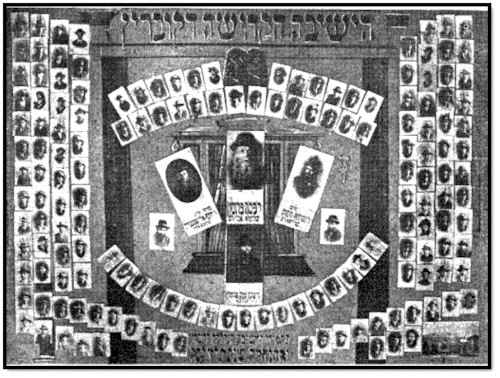
| [No external caption; the photo bears the inscription “The Holy Yeshiva of Kobryn.”] |
The popularity of R. Pesach Pruskin continued to rise steadily. Only the legal registry books were lacking – those were in the hands of R. Michael, who under no circumstances wished to release them, being supported by a group known as Michaels tsad [Michael's faction].
At the beginning of 1941, an untimely death tore away the magnificent figure of Rabbi Pesach Pruskin.
In light of the later tragedy that befell the Jews of Kobryn, the passing of the inspired R. Pesach Pruskin may be regarded as a merit – sparing him the brutal murder at the hands of the accursed German barbarians.
Rabbi Michael, however, did not escape the tragedy. Together with the entire Jewish community, R. Michael was shot during the second and final extermination action in October 1942.
Along with all the Jews of Kobryn, the esteemed and leading figure of Rabbi Michael, of blessed memory, was cut down.
May his dust rest in peace.
Translator's Notes:
|
|
JewishGen, Inc. makes no representations regarding the accuracy of
the translation. The reader may wish to refer to the original material
for verification.
JewishGen is not responsible for inaccuracies or omissions in the original work and cannot rewrite or edit the text to correct inaccuracies and/or omissions.
Our mission is to produce a translation of the original work and we cannot verify the accuracy of statements or alter facts cited.
 Kobryn, Belarus
 Yizkor Book Project
 JewishGen Home Page
Copyright © 1999-2026 by JewishGen, Inc.
Updated 10 Oct 2026 by LA