 |
|
[Pages 28-34]
by Itshe Pintshuk
Translation[1] by Aharon Khludnyevitsh [Chlodniewicz]
Printed in Sefer Kobryn
Translated from Yiddish by Beate Schützmann-Krebs
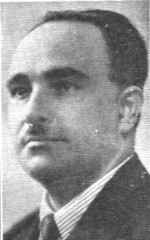
Itshe Pintshuk [Pinchuk], one of the most devoted and energetic Jewish activists of Kobryn, dedicated himself to gathering materials and data about the history of our town. In the Kobryner Vokhnblat, he began publishing a series of articles on this subject. We present them here without any abridgment – may they serve as a contribution to preserving his name and as a modest memorial to the Kobryn community.
The history of every town and its development, its monuments and historical sites, the legends and memories surrounding the prominent personalities and leaders who remained there, lived there, and left their mark – all of this awakens distinctive feelings and a particular interest in every native son. This is especially true of a Jewish settlement that, over the course of several generations, grew from a tiny point into an important Jewish community. Despite all the misfortunes, hardships, and persecutions, this town nevertheless revealed significant creative forces that stood by it in times of distress and contributed to its growth and flourishing.
It is not among the easiest tasks to retrieve from deep oblivion long-past events and to refresh images that have long since faded. Many important episodes have been lost to memory simply because no reliable sources exist regarding the formation and development of our town, Kobryn, and its Jewish community. Not even a pinkas [town register] or any other document from those earlier times has survived. And needless to say, it is impossible to research and locate in the archives the necessary material that could shed light on those distant, long-past centuries.
One must therefore regard the present work as an attempt to gather facts, records, and data concerning the history of our town, and especially of its Jewish settlement. It must be emphasized once again that a pinkas is lacking – which, aside from its local character, would also have served as a cultural-historical contribution to the study of general Jewish life.
Regarding the origins of Kobryn in the earliest period of its development, no precise information exists. It is only known that the town was founded around the 11th century by the heirs of the Rus' Grand Prince Izyaslav[2] (1054–1078). After his death, the Rus' realm broke apart into separate principalities because of the continual conflicts among the various princes (knyazn).
Kobryn is regarded as an old Rus' town – a gorod (in Polish: gród)[3] – situated at the rivers Muchavyets [Muchaviec] and Kobrynka. Traces of a medieval fortress can still be found today at the confluence of the two rivers, which was intended to serve as a defensive wall against potential enemies.
At the end of the 17th [sic] century, Kobryn passed to the Principality of Vladymyr-Volynsk. (To which of the Vladymyr-Volynsk princes – Roman Mstislavich (1172–1205) or his sons Daniel and Vasylko – it belonged is not known).
In the year 1286, Kobryn was granted by Prince Vladimir Vasilkovich to his wife Olga Romanovna, together with its inhabitants, the Monastery of the Holy Apostles, Horodets, and a number of villages. The inhabitants were instructed to be as obedient and loyal to their new ruler as they had been to their previous one.
The population of the princely estates could be divided into free people and laybeygene [serfs]. Among the free were the soldiers and the leaseholders. Both the townspeople and the peasants leased the land that belonged to the prince, paying very high taxes, which consisted of heavy labor obligations as well as monetary payments. The peasants were regarded as serfs belonging to the prince.
At the beginning of the 14th century (around 1321), when the Lithuanian ruler Gediminas (1315–1341)
[Page 29]
took possession of Polesie, Kobryn came under Lithuanian rule and was transferred to the heirs of Algirdas [the son of Gediminas]. After the Polish-Lithuanian Union of 1385, Kobryn once again passed to the Polish Crown, although in practice it continued to belong to the Grand Duchy of Lithuania.
In the year 1392, the Lithuanian Grand Duke Vitold [Vytautas] (1392–1440) transferred Kobryn to Andrei Vladimirovich, the heir of Vladimir Vasilkovich, who ruled there until Vytautas's death in 1440. Afterwards, the town passed to the princes of Pinsk. By the end of the 15th century, Kobryn belonged to Ivan Semyanitsh [Semyonovich] Kobrynski, who descended from Daniel Romanovich and from Gediminas. At that time, a separate Kobryn principality was established, dependent on the Lithuanian Grand Duke. The Kobryn dynastie, which also included Dabutshin (Pruzhany) and Horodets (and, according to other sources, Pinsk as well), did not exist for long.
The Russian-Jewish Brockhaus–Efron Encyclopedia mentions the hypothesis that Horodets may also have been part of Kobryn, and that it was almost completely destroyed during the Swedish siege in the 17th century. (It appears, however, that this hypothesis is only partially supported – namely, insofar as Horodets may indeed have been connected to Kobryn).
In 1497, the Kobryn prince Ivan Semyonovich had the Monastery of the Heyliker Spas [Holy Savior][4] built on the banks of the Kobrynka, surrounded by many fields and a mill. (This is the so-called Klyashtor [kloyster, monastery] on Klyashtorne Street – Kleyn Zamuchaviec[5] – where the court was later located.) The Kobrynka, which begins in the Dyvin marshes, was in earlier times a rather wide river, flowing between two tree-lined avenues through Mostove and Kl[y]ashtorne[6] toward the Muchaviec.
The last Kobryn prince was Theodor Ivanovich, whose grave is located in the aforementioned monastery. After the prince's death at the beginning of the 16th century, Kobryn passed into the possession of the Polish king Sigismund I. (the Old) (1506–1548).
The history of the Jews in the Polish-Lithuanian provincial towns – both in the Middle Ages and in later periods – is rich in countless attempts by the Catholic Church and the local magistrates (town councils) to introduce separate streets for the Jewish population, thereby impeding their development.
Jewish property and possessions were frequently exposed to arson attacks and to assaults carried out by incited neighbors. The Jews, who tended to settle in their own separate streets – both for psychological reasons and for reasons of safety (just as Armenians and Germans in other towns had their own distinct streets, such as Armenian Street, German Street, or streets named after particular trades (guilds), like Shoemakers' Street, etc.) – had to struggle against such decrees, whose sole purpose was to diminish and restrict the Jewish population.
Kobryn likewise had a Jewish street. It is difficult to determine precisely when such a “ghetto” came into existence and how long it lasted. Regarding the Jewish population of Kobryn in the year 1563, we have the following picture:
On Pinsker Street (right side) lived the following Jewish householders: Yoske Yoskovitsh, Moyshe Yatskovitsh, Avraham Shmulevitsh, the synagogue, Shmuel Abramovitsh, Yitskhok Kanilitshitsh, Dovid Shlimits, Shabtai Yoskovitsh, and Yakov Yoskovitsh.
Pinsker Street (left side): Shloyme Davidovitsh, Leyzer Ulilovitsh, Khlavne Levkovitsh, Khayim Yoskowitsh, Yoske Yatskevitsh (two houses), Peysekh Tlumitsh, Feyvish Klavnovitsh, Nisan Yatskovitsh.
Ostrametska Street (Bobruisk side): Feyvish Yoskovitsh.
Brisker Street: Khlavne Levkovitsh, Shmuel Abramovitsh (three houses). Altogether – 25 houses belonging to Jewish householders. (The number of Jewish families was certainly larger.)
Christian houses: 223.
It is difficult to determine the exact number of Jewish inhabitants. According to some data, the number of Jewish householders reached 19; according to Bershadski, 17; and according to the Russian Jewish Encyclopedia, 22. In general, these figures refer only to Jewish homeowners (balebatim).
According to this “revision” list, we find the following situation: not all Jews lived exclusively on the Jewish street; Jews also appear on other streets. This, therefore, undermines the assumption that there was an exclusively Jewish street.
However, it is also possible that the
[Page 30]
Jews listed on Brisker Street and Ostrametska Street were arendarn (leaseholders). One of them – Feyvish Yoskovitsh – is indeed mentioned on Ostrametska Street specifically as an arendar. He also enjoyed certain privileges that other Jews did not have.
As for the others: either they, too, were arendarn, or they lived in their own houses on Pinsker Street (the Jewish street). It is also possible that they held certain [communal or administrative] functions that granted them the right to live outside the Jewish street.
For example, there is the case of a certain Michael Itskovitsh, who received the privilege of living on the market square and was also granted the right to produce and sell wine there.
This case occurred much later – at the beginning of the 18th century – yet it nevertheless demonstrates that a Jewish street did exist. The fact that there were also Christian houses on Pinsker Street, and even the Polish (Catholic) church, does not change this, because in many other towns we find the same phenomenon: Christians living on the Jewish streets, even though this was prohibited by law.
It is therefore quite possible that, at that time, Kobryn already had a Judengasse [Jewish street] – namely Pinsker Street – and that the most important Jewish institutions were located there, such as the synagogue, the bathhouse, the cemetery, and others.
The Jewish population was forbidden to wear golden belts (which were fashionable at the time). Women were not permitted to use gold or silver jewelry. A yellow hat for the men and yellow clothing for the women were the distinguishing marks that were supposed to set them apart from the rest of the population. It was also forbidden for Jews to keep Christian servants.
However, it appears that all these laws and restrictions, taken from the Lithuanian Statute of 1566, were enforced only to a limited extent in practice.
In the final years of the reign of Sigismund August, the Polish-Lithuanian Union was completed. Kobryn was then, as before, incorporated into the Lithuanian principality. The king became increasingly dependent on the shlyakhte (the nobility), and this, to a great extent, worsened the situation of the Jews.
After the death of Sigismund August (1572), Prince Valois ascended the Polish throne. He maintained very close ties with the clergy, and therefore his attitude toward the Jews was unfavorable. His reign, however, did not last long.
Stefan Batory came to the Polish throne in 1576, and during his rule the situation of the Jews improved considerably. He confirmed the earlier Jewish rights and vigorously opposed blood libels and other anti-Jewish accusations. After his death (1586), Kobryn passed into the possession of Stefan Batory's widow, Anna Jagiellonka.
From the collection Regesty i nadpisi, St. Petersburg 1899, no. 21, March 1511:
The Jews of Trok [Trakai], Grodno, Brisk, Lutsk, Vladimir, Pinsk, Kobryn, and others living in the Grand Duchy of Lithuania submitted a petition to King Zygmunt [Sigismund] requesting confirmation of the edict issued by his brother Alexander. According to this edict, the Jews were required to supply one thousand horses for the service of the ziemstwo [local administration]. But the Jews, pointing out “ that until then they had never taken part in war,” asked that matters remain as they had been, without changes.
Alexander granted their request and decreed that the Jews were not to be called up for war (military service). However, with regard to paying taxes, providing wagons, and fulfilling other obligations, they were to do so equally with the rest of the population among whom they lived. King Zygmunt confirmed the privileges of his brother.
January 21, 1529:
…All Jews living in the Grand Duchy of Lithuania on royal land (including the Jews of Kobryn) were required to pay into the royal treasury the sum of 60,000 Polish groschen. This amount they were to assess among themselves, according to the means of each individual, and pay no later than the holiday of Passover.
1563:
From the revision of the Kobryn economic-administrative district. According to the data of the census
[Page 31]
carried out in 1563 by order of King Sapyega [Sapieha], the following Jews were then living in Kobryn:
On Pinsker Street, on one side:
Name Owner
of HousesOwner
of GardensYoske Yoskovitsh 3 3 Moshke Itskowitsh 3 3 Avraham Shmuelevitsh 3½ 3 Shmuel Abramovitsh 3½ 3 Yitskhok Kehelitsits [Kanilitshitsh?][7] 2½ 3 Dovid Shleymovitsh 2½ 3 Shabtai Yoskovitsh 2½ 2 Yakov Itskovitsh 4 2
On the other side of the street:
Name Owner of Houses Shloyme Davidovitsh 3½ Leyzer Ulilovitsh 4 Khlavne Levkovitsh 3 Fishl Yoskovitsh 2 Yoska [Yosko] Itskovitsh 3 (the same Yoska) (i.e., the same person as above)[8] 3 Yakov Yoskovitsh 3 Zakhar Yakubovitsh 2½ Yoska Peskovitsh 2½ Peysekh Shleymovitsh 3½ Feyvish Khlavnovitsh 3 Nisn Itskovitsh 4½ Zelik Yoskovitsh 2½ Leyzer Meyshovitsh 2½
On Bolotskaya Street:
Name Owner of Houses Owner of Gardens Itska Yatskovitsh 3 2 (the same Itska) (i.e., the same person as above) 3 2
Gardens belonging to Jewish owners:
Name Owner
of GardensItska Yatskovitsh 2 morg Shmuel Abramovitsh 2 morg Khlavne Levkovitsh 2 morg Peysekh Shleymovitsh 1 morg Itska Yakubovitsh 2 morg Shloyme Davidovitsh 1 morg Feyvish Yatskovitsh 1 morg
The gardens belonging to the listed Jews were located at the end of Pinsker Street and extended along the Bolotskaya Street.
Gardens on the other side of Bolotskaya:
Name Owner
of GardensShmuel Abramovitsh 2 morg Shloyme Davidovitsh 1 morg
Behind these plots were located:
Name Owner
of GardensShmuel Abramovitsh 8 morg (the same Shmuel) 7 morg
The land of the Bishop of Kobryn near the Kobrynka and Muchaviec rivers was leased by the Jew Itska Yatskovitsh.
On Ostrometska Street (behind Muchaviec, on the right):
Name Owner
of ParcelsOwner
of GardensIskovitsh 3 2½
On one side of Brisker Street:
Name Owner
of ParcelsOwner
of GardensKhlavne Abramovitsh 5½ 17 Shmuel Abramovitsh 5½ 17 (the same Shmuel) 5½ 17 (the same Shmuel) 5½ 17
February 8, 1578:
Royal decree to the Jews of Lithuania concerning the payment of taxes in gold coins (rendlekh).
King Stefan announces to all Jews living in Pinsk and in the surrounding towns, townlets, and villages of the Pinsk district that, since until now the Jews have not paid their taxes in gold coins, and since they still owe from earlier years the sum of 77 gold rendlekh to the royal treasury, Mr. Nikolai Kirdia is therefore empowered to demand the aforementioned amount.
In the Lithuanian register (“list”) from which this act is cited, the following note appears: “A letter sent to the Jews of Pinsk concerning gold coins.” Further, the following remark is added: “Such letters were sent to the districts and towns of Novogrudek, Minsk, Grodno, Kobryn, Vilna, Trakai, Brisk, Mstibogubsk, and Kovno.”
Year 1583:
The number of taxes levied on goods, transported through Brisk in 1583 …….Yakov Yoskovitsh, a Jew from Kobryn, to Lublin ……[ The sentence is only a fragment].
November 15, 1642:
(From the report of the commissioner concerning the complaint of the Kobryn priest of the Church of the Holy Apostles Peter and Paul about the use of church land).
…The priest Vasili Payevski lodged a complaint with the royal commissioner against the Jews of Kobryn –
[Page 32]
Mikhna, Dudtsina, and Itskhok Salomonovitsh – accusing them of having seized a piece of land belonging to the church.
The commissioner investigated the matter in the presence of witnesses and ordered the Kobryner zemlyamer (land surveyor) to measure the disputed plot.
Regarding the accusation that the Jews were damaging the water sluice that brought water to the church by pouring dirty water from the beer-brewery into it, the commissioner ordered that both the Jews and the priest must set it right.
April 4, 1667
The king commissions Mr. Fyodor Savitski to demand the toll for crossing the bridge that is located on his estate on the road from Brisk to Kobryn. The toll is to be levied on merchants, Jews, and carters, but not on clergy or nobles.
Since some merchants – Jews – wishing to avoid paying the tax, transport their goods in small boats across the Muchaviec, it is permitted to demand 2 Polish groschen for each boat.
May 10, 1670:
(Decree (ukaz) to the Jews of Kobryn to pay the debt to the Pinsk monastery, in the amount of 1,246 gold rendlekh and 15 Polish groschen, as debt and interest.)
The Pinsk monastery lodged a complaint concerning debts in the amount of 1,246 gold rendlekh and 15 Polish groschen against the Jews of Kobryn: Leyb Itskovitsh, Leyzer Shmulovitsh, Khayim and Yisroel Moshkovitsh, Yosef Ulinovitsh, Yosef Khayimovitsh, Dovid Itskovitsh, Avraham Feybushevitsh, Yosef Zavelovitsh, Yehuda Moshkovitsh, Shmuel Miralovitsh, Getsl Ulinovitsh, Zelik Abramovitsh, and Shloyme Osherovitsh.
The accused did not appear before the court; no information was received concerning the reason for their failure to present themselves.
The representative of the complainant showed, with a copy from the Brisk registers dated March 10, 1670, that the summons to appear before the court had indeed been delivered to the Jews of Kobryn.
At the same time, the complainant pointed out that, according to an agreement dated February 6, 1657 between the monastery and the Jews, the Jews had obligated themselves to pay 1,246 rendlekh and 15 Polish groschen in annual installments of 96 rendlekh. In the event that one installment would not be paid, the Jews had undertaken to pay the entire sum at once.
But the Jews did not fulfill their obligation; therefore the monastery demands to exact the entire sum together with the expenses. The court ruled that the Jews must pay the aforementioned sum – 300 rendlekh as compensation.
1676:
King Jan III orders all military commaders – both Polish and foreign – as well as the Cossacks of Zaporozhe [Zaporizhzhia], who must pass through the Kobryn region or through the town of Brisk, that they are not to do any harm to the townspeople or to the Jews of Brisk in the suburbs.
1714:
The community elders of the town of Kobryn – Shmuel ben Yosef and Yosef ben Meir – issued, on March 3, 1714, in their own name and in the name of the entire Kobryn community, a letter of surety (akhtav eroves, a guarantee) for the Kobryn Jews Michael ben Yitskhok and his wife Sara bas Asher, and their children and heirs…
1744:
A judicial complaint in the matter of Count Fleming against the Rudnitskis concerning stolen goods by Gypsies.
In the name of Count Fleming, a complaint was entered in the Brisk municipal court against Rudnitski, the administrator of his estate Rudzki, and also against Kontsevitsh, Artsishevski, the brothers Kotsikav, and eight Gypsies, who were accused of having stolen from the following Kobryn residents: Meir Katsushevitsh, Shmuel Notovitsh, and the rabbi Reb Meir Nokhumovitsh.
According to the complaint, the aforementioned Gypsies stole from a storehouse (sklad) valuable items which the three mentioned Jews had kept hidden there, to a value of 5,000 rendlekh. The stolen objects were handed over by the thieves to the other accused persons…
[Page 33]
March 27, 1748:
Pavel and Adam Bukhovetski submitted a document to be entered into the Magdeburg municipal registers in Kobryn, in which they donated to the “Monastery of the Holy Savior” three debts owed to them by the Jews of Kobryn. The first debt, dated July 23, 1702, amounts to 2,558 tynfim [low-grade silver coins]; the second debt – 550 tynfim; and the third debt – 600 Polish rendlekh.
In 1514, the towns of Pinsk and Kobryn were united with the Lithuanian communities.
At the beginning of the 16th century, Kobryn belonged to Prince Ivan Semyonovich. Together with his wife Fyodora, he founded an Orthodox church in Kobryn.
(According to the book by S. Bershadski, Litvishe Yidn, St. Petersburg 1883.)
Kobryn in the years of the Gzeyres Tach Vetat massacres of 1648–1649 [the Khmelnytsky massacres]
…From there he went to the holy community of Slonim. There were 200 balebatim [householders] there; almost all of them were massacred.
From there he went to the city of Minsk, “a mother-city in Israel.” There were 500 Jewish balebatim; almost all of them were annihilated.
From there he went to the city of Pinsk. There were about 300 balebatim; almost all of them were killed.
From there he went to Slutsk – 300 Jewish householders were slaughtered there.
From there he went to the town of Kobryn. There were about 200 balebatim there; they, too, were almost all slaughtered. And from there he went to the great city of Horodna [Grodno], “a mother-city in Israel,” and there were about 1,000 balebatim, great and wealthy men – all of them were slaughtered.
(From the book Tit HaYayin[9] by Reb Shmuel Feybish ben Reb Natan Feitel of Vienna, as quoted in Sefer HaDema'ot by Shimon Berenfeld, Eschkol Press, Berlin, 5683 [1923], vol. 3.)
From the Takkanot of the Va'ad [communal ordinances issued by the regional Jewish council] of the year 5383 [1623]
These are the borders and surroundings of the holy community of Brisk:
…Kobryn, Horodets, Prushana…
From the Takkanot of the Va'ad of the year 5388 [1628]
Concerning the man from Lekhevitsh who is known to the head of the community of the holy community of Pinsk: the Pinsk community must hasten and expel him from the borders of the lands of Lithuania and Rus'. And if he does not obey, they shall warn him with hatarat dam [declaring him liable to violent sanction], and he shall be judged as a roydef (a pursuer).
The same shall be done to the man from Kobryn, who is known to the leaders of the holy community of Brisk: he, too, shall be expelled – together with his wife and children – beyond the borders of Lithuania and Rus'. And if they do not obey, the leaders of Kobryn shall warn them – hatarat dam – and if, after being warned, they persist in their rebellion, they shall be judged as rodfim.
Kobryn
(extracted from “Pinkas Medinat Lita,” ed. Simon Dubnow, Einot Press, Berlin 5686/1926). (According to the Yiddish Encyclopedia.)
A Jewish community existed in Kobryn from the beginning of the sixteenth century. The name “Kobryn” is mentioned among the Lithuanian communities that received five privileges in the year 1514 from King Alexander.
The town, together with the suburban districts in which Jews were permitted to reside, extended over a large area in the fifteenth and sixteenth centuries. The small town of Horodets, located about five miles from Kobryn, was once part of Kobryn, but it was almost entirely destroyed in 1653 during the Swedish siege. The Jews suffered most from the Polish soldiers who, when they mutinied after not receiving their pay, would help themselves freely to Jewish property.
In 1766, Kobryn was reduced to the status of a village, but by 1795 it once again became a district town. The town suffered greatly from the French army during Napoleon's march in 1812.
On the old Kobryn Jewish cemetery one finds gravestones dating from the sixteenth[10] century. The first (known) rabbi of Kobryn was Reb Betsalel ben Shlomo Darshan, who died in 1678. His successors were: Yakov ben David Shapira (or Spira, d. 1718), author of Ohel Yaakov, and founder of the yeshiva in Kobryn, where more than one hundred bokherim [young men] studied; Rabbi Mintz (d. 1819); Rabbi Shemariah, who also served as the Rebbe
[Page 34]
of the Rubeshover [Hrubieszów] Chasidim (d. 1835); Rabbi Moyshe (“Moshkele”), the Rebbe of the Kobryn Chasidim (d. 1858); Rabbi Meir Meirim Shafit (d. 1878), author of Nir al Yerushalayim [“A Foundational Treatise on Jerusalem”]; Rabbi Eliyahu, known as “Rabbi Elinke Lider” (d. 1876); Rabbi Shaul Epshteyn [Epstein] (d. 1891); and Rabbi Meir Atlas.
Kobryn possessed many khevres [societies] and benevolent institutions, a beautiful shul [synagogue], a large number of bote-medroshim [study houses] and Chasidic shtiblekh.
In earlier times, the Jews of Kobryn were engaged mostly in agricultural work and in brewing beer. But in 1882, Tsar Alexander III prohibited Jews from leasing estates and from living outside the town.
In 1897, the government assumed the monopoly on beer production. This greatly worsened the situation of the Jews, and many of them began to emigrate.
(According to the Jewish Encyclopedia [English], vol. 3.)
(According to the Russian Encyclopedia, St. Petersburg, 1895.)[11]
At the beginning of the 18th century, the population of Kobryn was severely reduced because of an epidemic that broke out there. In 1766, Kobryn was downgraded to a village. During the time of the Third Partition of Poland, Kobryn was given as a gift to General Suvorov, who ordered all major walls (fortifications) to be demolished.
In 1795, Kobryn once again became a district town.
Translator's Notes:
by Melech Glotzer
Translation from Yiddish by Beate Schützmann-Krebs
| I
Memories run — a fast machine — II
I remember your Shabbats, your festivals. III
The warm-spirited Chasidim, the austere Misnagdim[1]. IV
Militant slogans in the working world. |
[Page 35]
|
V
Fair-day traders — myriads of shops. VI
A delight was the summer heat. VII
It all stands before my eyes, facing me still. VIII
The rabbis' quarrel — the town split into factions. IX
Who does not remember our rabbi — the last we'd known, X
No more organizations within Margolis' hall. XI
How my birthplace frightens me now. XII
Great is the memory of your holy name. |
Translator's Notes:
by M. Ginzburg (Montreal, Canada)
Translation from Yiddish by Beate Schützmann-Krebs
Kobryn as a typical Jewish town, with rabbis and rebbes, institutions, organizations, and charitable foundations. The finest period in Kobryn's Jewish life, which lasted about twenty years. Jewish leaders and spokesmen. Educational institutions and teachers. The spiritual profile of Kobryn as it took shape after the First World War. Socialism and Zionism, each seeking to dominate the Jewish street. American relief for Kobryn, strengthening the Jewish settlement both morally and economically. Kobryn's distinguished contribution to the broader Jewish-Polish life in the years between the two world wars.
|
The finest chapter in the history of Kobryn falls within the counted twenty years between the First and Second World Wars — more precisely, between 1919 and 1939 — when Kobryn succeeded in reaching maturity in the sense of a Jewish social and national renaissance, and played a very fine role that made it worthy and deserving of being recorded in the book of remembrance of the Jewish people.
Kobryn was, in essence, the synthesis of a Jew shaped by three distinct types, if one may put it that way. It was one of the three elements that together formed the cultural structure of Vilna, Volhynia, and Poland — for these three centers shaped a kind of specific Jewish type who possessed within himself the intellectual qualities of the Litvak [Jewish Lithuanian], the softness of the Polish Jew, and the heartfelt warmth of the Volhynian Jew.
And although sparks of assimilation had already begun to flicker over Kobryn since the rise of the Haskalah, Kobryn nevertheless possessed such an inner strength that it did not allow itself to melt down into a single crucible of foreign accretions, foreign ideas, and foreign attitudes…
Naturally, it did not escape the illness of parties and quarrels, like all other Jewish towns, and it was not spared even disputes “for the sake of Heaven” between the Chasidim and the Misnagdim[1], between rabbis and rebbes. Yet it managed to maintain a constant balance, and after every ideological storm the sky would clear again, and Kobryn would survive these “ailments,” emerging strengthened and refined, ready to continue that mission in life which fate had destined for it…
Kobryn, however, drew its main influence from its close neighbor, which had always been a major Jewish center — Brisk-de-Lita [Brest-Litovsk]. And although it had significant cultural and even commercial connections with Warsaw and Vilna, it was nevertheless shaped more strongly by the nearer Brisk, toward which it always looked up with a certain hidden envy…
Thus the saying “better a close neighbor than a distant brother” was indirectly fulfilled.
The number of inhabitants in Kobryn did not change much over the last fifty years. In 1897, Russian statistics recorded a population of 10,408 souls in Kobryn, and in 1928 Polish statistics recorded a population of 10,068 — which means that over a span of thirty years
[Page 37]
the number of people remained almost unchanged. And on the eve of the great storm of the Second World War, Kobryn counted roughly the same number of inhabitants, because the increase of the population almost always balanced out the number of those who died or emigrated. Thus, over the last fifty years, Kobryn had remained almost unchanged in size; but Jewish life, on the other hand, continually shifted and took on different forms, according to the “winds” and new tendencies that prevailed among the Jews in the various periods.
As for the composition of the population: it was eighty percent Jewish and twenty percent Christian. The character of the town was therefore Jewish, and its outward face was Jewish as well. The Christians were not very visible, because the center of the town — its commercial life, its artisans, and its intelligentsia — belonged ninety percent to the Jewish sector.
There was even a time when Kobryn had a yeshiva with 400 students who sat day and night learning Torah. Under the changing circumstances, the spiritual level shifted as well, each time taking on a different character, according to what the times demanded.
A characteristic trait of Kobryn was the warmth of its people, who consistently fulfilled the mitzvah of welcoming guests, of ve'ahavtem et ha-ger [“and you shall love the stranger”], and other beautiful Jewish commandments. During and shortly after the First World War, Kobryn was surrounded by refugees, because the great retreating Russian army had passed through the town. The period of German occupation and the German decrees caused many people to remain in Kobryn, unable to leave the town.
The Jews of Kobryn literally shared their last piece of bread with the homeless, with the so-called bezhentses [refugees], and showed them such heartfelt kindness that those people never forgot it for as long as they lived.
This can only be explained by the fact that Kobryn possessed that deep Jewish warmth, that fraternal sentiment that had taken shape within it thanks to its geographic position between Brisk, Pinsk, and other large Jewish towns that had always been distinguished by their Jewishness — great Jewish personalities, great rabbis and rebbes who influenced Kobryn.
There were Jews who would not get out of bed before pouring negel vasser [the ritual washing of the hands upon waking], and there were also Jews who were not especially pious but who always stood facing the Land of Israel, looking across generations and epochs toward the distant future, when the Jewish people would once again merit to dwell in their own land, in Erets Yisroel.
Kobryn had witnessed much suffering, much pain, many human afflictions — not to mention its own bitter end, which we do not even wish to mention here, leaving that to others, for the very thought alone is horrifying and makes it impossible simply to continue writing…
Therefore we will keep ourselves as close as possible to our goal, to our subject, hoping that others will contribute to this same Pinkas their own memories and facts, which will, at least in broad strokes, bring out the history of that beautiful Jewish community that bore the name Kobryn.
Jewish Social Life in Kobryn
Looking today through the prism of time, with the eye of an observer, one cannot help but marvel at how Jewish social life in Kobryn adapted itself to the new framework of Jewish circumstances, hopes, and struggles, and followed the same path that Jews in all the lands of the Diaspora experienced.
The new dawn of the Jewish renaissance, the Balfour Declaration, and the revived hopes for a true Shivat Tzion [the collective return of the Jewish people to the Land of Israel] electrified the Jews of Kobryn — especially the Misnagdic element — and with the end of the First World War, a great, lively, almost feverish activity began. The idea of a renewed Jewish life in the Land of Israel filled the majority of Kobryn's Jews with passionate longing and new hopes: perhaps this would indeed lead to redemption; perhaps they were already standing at the threshold of a new era that would change the
[Page 38]
physiognomy of Jewish life in exile — first under the Russians, and later under the Poles.
Small Zionist circles of every kind were created, and each, according to its own outlook and aspirations, devoted itself within its own dalet ames [one's own small personal sphere; literally “four cubits”] to the work that would help build the Land of Israel and revive the Jewish homeland. The British Mandate brought new inspiration in its early years, especially when Lord Samuel was appointed as the Jewish High Commissioner for the Land of Israel. This ignited young hearts with new dreams — that soon, very soon, they would have their own leader, a king, a president, who would govern a Jewish state.
Naturally, the youth threw themselves with fire and fervor into Zionist work. Hashomer Hatzair captured the hearts of the young people, and a ken [a local branch of the movement] of “Hashomer Hatzair in Kobryn” emerged, which, with great enthusiasm, devoted itself to preparing young people to go to Israel — and it achieved its goal. A number of members of Hashomer Hatzair indeed left for Erets Yisroel during the interwar years and became among the builders of the new state. A Hekhalutz organization [the Zionist pioneer movement] was also established.
This, of course, does not include the organization of the General Zionists, who had already been quite active in Kobryn, for a strong apparatus of Keren Hayesod was already functioning, as well as a large apparatus of the Jewish National Fund, whose administrator was the young and energetic Yitskhok Faygenboym [Yitzchak Feigenbaum] — about whom we will have more to say later. There was also a group of Orthodox Zionists, although the word “Mizrachi” was scarcely heard in Kobryn, for the Chasidic Jews still stood somewhat outside the camp, and the Chasidic rebbes did nothing to rouse the masses in favor of the Zionist ideal.
Here we will present a very characteristic case:
In Poland, after the terrible events in Hebron, it was decided to conduct a Yizkor appeal on Shminatseres [Shemini Atzeret, the eighth day of Sukkot] in all the synagogues of the country. Naturally, Kobryn did not lag behind and resolved to hold a Yizkor appeal in the synagogues on Shemini Atzeret and Simkhes-Toyre [Simchat Torah].
At the special meeting convened for this appeal, the following participated: the chairman of Keren Hayesod and president of the Zionist Organization in Kobryn, Berl Poler; Sh. Koloditski; A. Polonski; Fyalkov; B. Israel; Reshes; M. Vinograd; and others, under the chairmanship of Y. Feigenbaum. All the synagogues showed the proper attention, and the appeal was carried out with great success.
Only the Kobryner Shtibl experienced a failure, and here is what happened: the Rebbe's grandson suddenly ran to the Rebbe and reported something to him, and immediately afterward the Rebbe himself ran to the bal-krie [the Torah reader] and snatched the sefer [the liturgical reading book] from him in the middle of the reading. This caused great displeasure among all the Chasidim, for the community activists had already come to an understanding with the synagogue wardens — especially with Moyshe Khayim Shoykhet — that of the collected funds, 20 zlotys would go to the bes-medresh, and the remainder to the Jewish National Fund. The result was that in the Kobryner shtibl the appeal was no longer a success.
A similar incident occurred in the Brisker Bes-Hamedresh, where the activists of the Jewish National Fund had to “fight for permission” to make an appeal against the well-known donor Yosef Kaplanski (the matzo-bakery owner). Nevertheless, the general appeal proceeded peacefully, and a sum of 600 zlotys was raised — quite a respectable amount for Kobryn.
But the incident did not end so easily…
The devoted Zionist, Engineer Levitas, came out the following week with an accusation against the Kobryner Rebbe in the Brisk –Kobryn weekly A.K.
“We demand an answer!”
Engineer Levitas wrote:
“We cannot remain silent about the extremely characteristic incident that took place in the Kobryner Shtibl, and specifically involving the Kobryner Rebbe himself, in person — that the Rebbe should run up to the sefer during the reading and tear it out of the hands of the bal-krie, simply because mishebeyrekh [traditional synagogue blessing formulas, often used for fundraising] were being recited for the benefit of the Jewish National Fund?
We know that the Kobryner Rebbe is a righteous and upright man, a true God-fearing Jew, and we
[Page 39]
are simply astonished: how could such a spontaneous outburst of anger come from him, such a disgrace to the Torah and to the worshippers?… And one more question suggests itself: Honored Rebbe, do you truly hold that the Zionist is treyf, but his money is kosher?
We know that you have many Kobryner Chasidim [in the sense of followers], in Poland as well as in America, who donate to Zionist funds; and we also know, Honored Rebbe, that you maintain contact with the Chasidim who are Zionists — especially the American ones — you send them letters, blessings…
So how does it come to pass that the Jewish National Fund becomes so treyf in your eyes that it is worth tearing a sefer out of a Jew's hands? What is the meaning of this, Honored Rebbe? Answer us! We demand a reply!” (1 November 1929).
This shows us that the strongly Orthodox Jews were far from doing anything for the Jewish national funds — without which one could never even have dreamed of building up the Land of Israel.
Zionism, however, did have a solid foothold in Kobryn, thanks to the truly devoted activists who, incidentally, were also engaged in vigorous work in all other areas of communal life. Through their efforts, Zionism was able to advance openly and freely, bringing ever new cadres into the Zionist “army.” <[> The old dispute that had raged in Kobryn many years earlier — which Rebbe was greater, the Kobryner Rebbe or the Slonimer Rebbe — was part of the reason why Zionism did not win the hearts of the Chasidic Jews. Their entire being was absorbed in the existential question of “Which Rebbe is greater and more distinguished? Which Rebbe has more Chasidim [followers]?” and similar such questions that, for them, stood at the very summit of the world…
We will therefore mention here the first sincere Zionists in Kobryn, who paved the way for those who came later. These were Borekh [Borekh] Garber, Berl Chaves, Dovid Moyshe (Volftshikhe's son-in-law, today a rabbi in New York). They, together with others, were the actual pioneers of Zionism — the successors of the Haskalah movement. Later, additional devoted Zionists joined them, such as Dov Paler, Engineer Levitas (who, until 1934, held the foremost place of Jewish life in Kobryn), the later city-council president Bervikunkin, Yehuda Goldin, Osher Tenenboym, Moyshe Bregman, and others whom we will have occasion to mention later.
Of all those mentioned, Dov Paler was the most active. And because he had no children, he devoted his entire life to Zionism — that is, to the Keren Hayesod, the principal instrument for raising funds for the Land of Israel. He was also very active as a councilman in the municipal council, and everywhere his influence worked in favor of Zionism.
Even in the Kobryn community, whose leadership was headed by Nakhman Dovid Birman, it often happened that one had to fight for the Zionist principle. For Mr. Birman belonged to the Orthodox camp; he had enough sense not to obstruct any Zionist undertaking publicly, but as for helping of his own accord — that was entirely out of the question.
As for Engineer Levitas: during the fifteen years in which he was highly active — between 1919 and 1934, until he left for Rovno to take a position as director of the Tarbut Gymnasium — he demonstrated extraordinary communal achievements in almost every sphere of Jewish life at that time. He served for a short period as the mayor of Kobryn; later, when the Polish authorities consolidated their power, he became vice-mayor, and still later a lavnik [member of the town council] of the municipal magistrate. But throughout all fifteen years he kept his hand on the pulse of Jewish life in Kobryn. He would stand up to the authorities and consistently defended Jewish honor and Jewish prestige.
He was also active as editor of the Kobryner Vokhnblat, which was, in fact, the very same Brisker Vokhnblat, only with a changed heading on the front page, and was of course printed in Brisk, where the writer of these lines was its publisher and editor. Kobryn, however, had its own “autonomy” within the Brisker Vokhnblat, because Kobryn itself did not have the means to publish a newspaper of its own every week. After an initial attempt —
[Page 40]
undertaken by the first editor, Moyshe Zaritski — it was later agreed between the writer of these lines and our friend Avraham Levitas that every Thursday Mr. Yitskhok Faygenboym [Feigenbaum], the authorized representative of the Jewish National Fund, would come to Brisk, spend the night there, and early Friday morning set off with the bundle of Kobryner Vokhnbleter for Kobryn.
This was certainly a major accomplishment on the part of the leadership of the Kobryner Vokhnblat, because the very same editorial articles, feuilletons, and other important pieces that the Brisker Vokhnblat printed were absolutely suitable and useful for the Kobryner Vokhnblat as well. For that reason, a separate section called “From the Life of Kobryn” was introduced, which each week reflected the communal activities in Kobryn. In addition to this, every week the editor, Engineer Levitas, would write an article about Kobryn's municipal politics or about Jewish affairs, and Mr. Faygenboym would supply the social section with the various news items.
A third and very distinguished force — both in Zionism and in the newspaper — was the renowned teacher and mentor Noakh Alkon, who was an institution unto himself and had a large circle of followers and admirers. Noakh Alkon was one of the finest characters that Kobryn possessed, and his heroic act toward the German executioner-power during the last World War, when the Jews of Kobryn were driven out of their ghetto to be murdered, will never be forgotten.
Alkon and the entire community already knew where they were being taken, and clearly the wails could have split the heavens, and even the Nazi murderers felt somewhat shaken. Then Noakh Alkon stepped out from the ranks and approached the Nazi commandant with a request: that he be allowed to calm the crowd. The commandant permitted him to address the Jews and quiet them — but instead of turning to the Jews, Alkon turned to the Nazi dogs and said to the commandant, looking him straight in the eyes: “You murderers have already lost the war, because you have set yourselves against the Jews!” He cursed and denounced them with the harshest words, and a few bullets put an end, on the spot, to his noble Jewish life!!!
He always taught heroism and the struggle for Jewishness; he preached the principles of our Tanakh, and he himself was ready to pay with his life in the fight for justice and righteousness, just as he had preached it all his days.
Alkon's essays in the Kobryner–Brisker Vokhnblat were of a high literary level, and even today, when we open an old bound volume of the weekly and read one of Alkon's essays, one sees how much spirit and courage this man possessed, and how worthy he was of that exalted position — to be a madrikh u-more be-Yisroel [guide and teacher in Israel].
Speaking of the Kobryner Vokhnblat, we must once again emphasize that there was a great ambition among the people of Kobryn to have a tribune of their own. And because the Brisker Vokhnblat, which I published and edited, so generously took in the “sub-tenant” — the Kobryner Vokhnblat — it became possible for them to bring into print everything they wished, especially since the editorial line of the Brisker Vokhnblat was also one hundred percent Zionist and profoundly national.
When the first issue of the Kobryner Vokhnblat appeared, the Jews of Kobryn recited the Shehecheyanu [the traditional blessing of gratitude for reaching a joyous moment], and many people came to the home of the first editor, Moyshe Zaritski, to offer their mazl-tov. Mr. Alkon was immediately drawn into the literary section of the paper. Later a witty writer, Noakh Markuze, joined as well; he had a weakness for humor and often delighted the readers with humorous stories and all sorts of jokes. A series of articles about “left-wing” monographs on the distinguished figures of Kobryn was written by someone under the name A. Nestor, who lampooned everyone in a humorous manner and provided portraits of all the Kobryn communal activists — among them the already-mentioned ones, as well as Dov Paler, Shmuel Yakov Bervikunkin, who was president of the city council, president of the Patronat of Ha-Shomer ha-Tsa'ir,
[Page 41]
a member of the World Zionist Executive for Kobryn, and held other positions.
This same Bervikunkin had originally been the publisher of the Kobryner Shtime, and he always had a strong inclination toward literature and scholarship; incidentally, he was also a learned man and clear-minded in worldly matters. Thanks to having an organ of their own, the Jewish social fabric of Kobryn was able to stretch out its hands freely and respond to every development in Jewish life. And it should be said, to the credit of the Kobryn communal workers, that they fulfilled their mission with pride and dignity and brought honor to the entire Jewish settlement in Poland.
The Jewish and Hebrew School System in Kobryn
In general, the Jewish school system in Kobryn between the two world wars did not have an easy task. The Jewish masses had not yet reached a clear, unified sense of what kind of education they wished to give their children. Earlier, a Bundist school of the TSYSHO school system [Central Yiddish School Organization] had taken root in Kobryn, but with the new Zionist winds, people increasingly shook themselves free of the Bundist school and turned more and more toward the Hebrew-national Jewish schools.
In this way the Midrasha Tushiyah [a Hebrew “School of Wisdom”] was established, whose leadership was entrusted to Engineer Avraham Levitas, who became its director. The school then had 185 children, and naturally the financial burden was far too heavy for it to operate properly.
One of the main teachers was, naturally, Noakh Alkon, who together with Levitas had to carry the heavy financial yoke of the school.
This same Midrasha Tushiyah was also the home of Ha-Shomer ha-Tsa'ir, which had struggled in vain to obtain a place of its own and had been unable to achieve this for a long time.
In 1929 the Jewish folk school of TSYSHO (the Central Jewish School Organization), a Bundist institution, was closed. This school had fought hard for its existence, but in the end had to cease operating, because — as Mr. Faygenboym reported in his annual survey in the Rosh Hashanah issue of the Brisker-Kobryner Vokhnblat—TSYSHO had not succeeded in planting “Bundishe Torah” [the Bundist ideological line] in Kobryn, even though its closing meant the loss of a Jewish cultural institution.
By contrast, the T'vunah School [lit. “Insight,” “Understanding”] and the Beis Yaakov School managed to survive the severe crisis and continued to exist. And as mentioned, the strongest of all was Tushiyah, thanks to its high pedagogical and organizational level.
Tushiyah, which already possessed half of the building, now wanted to take over the entire premises, because the number of pupils had grown and it had truly become impossible to accommodate them all. The classes in the Midrasha Tushiyah often continued until eight o'clock in the evening, something to which the parents strongly objected. Matters went so far that the authorities intervened, and in the end the starosta [the town's administrative head] also expelled the Brener Society from the premises — and Kobryn had more than enough to talk and argue about…
Focusing on Jewish education in general, it must be said that every Jewish child — boy or girl — received a solid Yiddish or Jewish-Hebrew education, grounded in the Tanakh [Bible] and in Jewish-Hebrew literature. The teachers were of the highest caliber, and it was truly a pleasure, time and again, to visit the Tushiyah school and listen to the little children speaking a rich, lively Hebrew and discussing subjects of genuinely serious content.
In addition to the regular schools, the Tarbut Secretariat in Kobryn organized special Hebrew courses for children who had been left without schooling after the closing of the folk school and who could not be admitted to Tushiyah because their knowledge of Hebrew and the Bible was still too limited. This was an important and very beneficial initiative
[Page 42]
on the part of the Tarbut organization, which, incidentally, rendered great service to all of Polish Jewry by helping to spread the Hebrew language and culture and by instilling a new national spirit in the hearts of the youth.
Beyond all this, there were also melamdim [teachers] who taught Gemara, and two yeshivas where young men — already close to their twenties — studied and possessed substantial knowledge of both the Babylonian and Jerusalem Talmuds.
In addition to the schools already mentioned, there were of course various cheders, and — as in every Jewish community — a Talmud Torah. And in those places where the old custom still survived, a yeshiva student would receive esn-teg — [designated “meal days” provided by local families]. Naturally, this institution of teg had disappeared in the later years, although Jewish women would not at all have objected to keeping this beautiful Jewish tradition alive — thanks to which generations of Talmud scholars, great figures of Israel, and the like had been nurtured and brought up.
Nor was Kobryn in those interwar years lacking the familiar type of partey-meshulekh — the party emissary or institutional fundraiser — whether from the Land of Israel or from Poland itself. Hardly a week went by without Kobryn receiving a representative of some Erets Yisroel institution, most often from a yeshiva, or an old-age home, or an orphanage, or any other [traditional] charitable organization.
Some would come and deliver sermons in the synagogues; others would speak to their party circles; still others came on behalf of general Jewish causes — for example, Keren Kayemet, Keren Hayesod, Hekhalutz, for the building and development of the Land of Israel and on behalf of the various colonies or kibbutzim that had already been established there.
Indeed, some of these meshulokhim found hospitality with the leaders of the parties they represented. For instance, nearly all Zionist guests arriving in Kobryn would go straight to Dov Paler, who was the president of the Zionist Organization and, in general, a generous host. On the other hand, guests from other parties would go to their own followers, and Yitskhok Faygenboym [Feigenbaum], the local representative of Keren Kayemet L'Yisroel, would take care of them as well…
Thus, once, the vice-president of Brisk — the well-known leader of the Hitachdut [a labor-Zionist federation], Avraham Levinson (today in Israel's Ministry of Education) — was invited to Kobryn to give a lecture for Tarbut. His topic was “Hebrew Culture and Our Youth.” The lecture took place in the large hall of Avrom, and the chairman of Tarbut, Engineer Levitas, opened the gathering — in Hebrew, of course — and introduced the distinguished guest, the vice-president of the city of Brisk, as one of the leading figures of Hebrew culture and language.
After the lecture, a larger group gathered for tea at the home of their friend Levitas, and there one found the mesilta u-mishmana [the community's elite] of Jewish Kobryn — and naturally also Noakh Alkon, Palevski, Paler, Koloditski, Kotkes[2], and others.
In general, the work on behalf of the Hebrew national schools was connected with various lectures and educational programs. From time to time, the Tarbut organization would arrange lectures and even small study-circle gatherings, in order to give full expression to the movement that had developed parallel to the entire Zionist effort during the two decades between the two world wars. Kobryn was one link in the chain of this educational activity and did not lag behind the great cultural program of the Zionist Organization, which advanced slowly but surely toward the victory of Zionism and toward the establishment of the Jewish national home in the Land of Israel.
It should be understood that this was an era of renaissance, of revival and hope — and if only Zionism today still possessed that same momentum and freshness that it had at the beginning of the serious Jewish [ideological] contest after the First World War, not only in the great Jewish centers but even in towns such as Kobryn, Brisk, Slonim, Baranovitsh [Baranowicze], and others.
The Political Situation of the Jews in Kobryn
The principal activity of the Jewish collective in Kobryn found its expression in the magistrate
[Page 43]
and the city council, where the Jews waged a genuine struggle for their rights — in accordance with the literal meaning of the Polish constitution and with the regulations of the magistrate and the city council.
Above all, the Jewish vice-mayor, Dr. Yoshke Pribulski, was not someone who would let anyone spit into his porridge, and he would react instantly whenever his honor — which meant the honor of Jewish Kobryn — was touched. Thus, for example, there was an incident when a councilman of the Kobryn city council made an unworthy remark about Dr. Pribulski, saying that “his hands were not clean.”
Dr. Pribulski immediately drew the consequences and brought a lawsuit against Councilman Valensevitsh [Walencewicz] for insulting him during a session of the Revision Commission of the city council.
Councilmen Bervikunkin, Birman, Tsukerman, Berman, Khaykin, Paler, Kaplan, and others formed a small, select committee — consisting of Birman, Khaykin, and Councilman Rafalovitsh — and prepared the necessary information for the city council on the basis of the complaint.
In response, the Polish-Russian councilmen resigned their mandates in order to support the accusations against Dr. Pribulski. They submitted a declaration stating that, since their number was a minority compared to the Jewish councilmen, and since “things were not being run properly” and there was a deficit of 100,000 z³oty, they were therefore renouncing their mandates in the city council. This declaration was signed by all the Polish-Russian councilmen. They also left the session immediately, and Mayor Olshamovski closed the meeting at once.
This showed that the Jews of Kobryn did not let themselves be swayed by a slanderous accusation, and that they were prepared to stand guard and expose the complete falseness of the Christian accusation. The united Jewish bloc in the city council decided to pick up the thrown gauntlet and fight for the truth, for the Jewish majority had never abused either its rights or its opportunities.
On September 9, 1929, the Jewish councilmen submitted their response to the declaration of the Christian delegation, categorically rejecting all accusations and emphasizing further that the Christian councilmen had often sabotaged the sessions and the municipal work. Because of this, the city had been delayed in securing government loans for paving the streets, installing artesian wells, and similar projects.
All the Jewish councilmen — Dr. Pribulski, Bervikunkin, Khaykin, Paler, Tsukerman, Berman, Lagunovski, Zbar, Gurvitsh, Rimland, Birman, Kilinski, Margolis, and Lipshits — signed this dignified reply to the Christian councilmen (Engineer Levitas was not in Kobryn at the time).
Rumors began circulating that the city council would be dissolved. In the end, the mayor himself resigned; new elections were held, and a new mayor — the one the Jews had wanted — was elected. At that point, the vice-starosta delivered a speech and practically begged the Jewish councilmen to allow the previously dismissed Christian councilmen to return, although he added that the city council could have functioned even with only the Jewish members. Still, since Kobryn had a mixed population, it was “better” to have them as well…
In the end, Councilman Valansevitsh [sic] received two weeks of arrest for insulting Dr. Pribulski. Later he personally apologized to Pribulski, and the latter forgave him the penalty…
This is only one example of how the Jews of Kobryn safeguarded their honor and stood up against every accusation — and thanks to this, the Jews felt secure and proud, knowing that they always had such honest representatives.
Jewish Institutions and Charitable Organizations
In Kobryn there existed, in miniature form, almost all the Jewish institutions and charitable organizations that could be found in many larger cities. And they were run with great responsibility and care.
A very distinguished place was occupied by the orphanage, which housed sixty Jewish
[Page 44]
orphaned children. At first the Communist authorities, and later the Polish authorities, opposed the idea of having a separate Jewish orphanage, arguing that there was already a Christian orphanage and that the Jewish children should be combined with the non-Jewish ones. But the Jews of Kobryn did not allow this, and they succeeded in establishing a Jewish orphanage.
However, when it came to maintaining the orphanage with their own resources, the situation became difficult. The budget could not be kept in balance, and it was constantly necessary to appeal to the Jewish sense of compassion in order to support the orphanage.
The principal director of the institution was Mrs. Toybe Kustov, who threw herself into this sacred work with all her heart and soul. Thanks to her, the orphanage earned the recognition of the entire Jewish community, as well as of the American Joint representatives. Mrs. Kustov truly sacrificed herself for the institution of these innocent children and regarded them as her own. She was the chief administrator, the teacher, and the mother; she no longer knew where she ended and the orphanage began. It was truly a blessing for all the orphaned children that they had such a luminous presence as their protector, and Mrs. Kustov carried out her work with great pride and a deep sense of responsibility until the very last day, when she left Kobryn.
Before her departure, a farewell evening was naturally arranged, and the children wept bitter tears at her leaving. With her departure they lost a mother, a nurse, an administrator, and a friend who had served them faithfully for so many years and with such deep self-sacrifice.
Another important institution was the Kobryner Home for the Aged, which likewise did not swim in an abundance of surplus funds… There, too, it was necessary from time to time to carry out renovations, fix the building, and, of course, support the elderly men and women — all of which cost a great deal of money. One of the active workers was Mrs. Osna Stravitsh, who did an enormous amount for the Home for the Aged and was, incidentally, greatly beloved there. She never let a week go by without visiting the home, and before her departure she even gave a farewell meal for all the elderly residents, carrying the pots of food to the home herself.
The Linas Hatsedek and the Women's Association also had their sphere of work, and as everywhere, they too suffered from a shortage of funds… They had to live on monthly contributions, and one can easily imagine how difficult that was.
The TOZ [Jewish health-organization; public health & medical aid] clinic, which had developed beautifully from its beginnings, later had to close for lack of money. Even the ORT school [vocational training school; Jewish technical education], which had earned an honorable place in Kobryn, had to work very hard in order to balance its budget. Seventy children studied in the ORT school, and it could have become much larger and more useful had it only possessed greater means of support.
The Brener Library and the Hashomer Hatzair Library were in no much better condition. Together they already held some three thousand books and had to support themselves mostly from their subscribers. The Workers' Library, too, faced a difficult struggle for its existence, although its subscribers were far more loyal to the library than those of the others.
In general, it was too heavy a burden for little Kobryn to maintain three separate libraries, yet they did exist and played a fine role.
The Traditional Religious Life in Kobryn
Kobryn counted eighteen bote-medroshim [study-houses], in addition to the smaller minyanim [prayer quorums]. The Great Synagogue was a true splendor, adorned with drawings that every visitor admired. The Ark was a work of art. Besides the synagogues, there were also many small shtiblekh, usually named after the towns the worshippers came from or after the Chasidic rebbes they followed. Naturally, there was no shortage of pekhotni maggidim— ordinary, foot-travelling itinerant preachers — who never failed to pass through Kobryn.
The two yeshivas — the smaller one,
[Page 45]
the Yeshiva Ketana, and the other, Khaye Odem — stood under the supervision of the Rabbi Peysekh Pruskin. When the larger yeshiva was founded, a dispute arose between Rabbi Michael and Rabbi Pruskin. The intelligentsia sided with Michael, while the craftsmen and the common folk stood with Pruskin, for he was a magnificent speaker and knew how to reach the masses…
The Mizrachi, the Ha-Chalutz Ha-Mizrachi [religious Zionist pioneering movement], and also Agudes-Yisroel [Agudath Israel, the worldwide Orthodox Jewish communal and political movement], under the leadership of Menakhem Birman, all took part in a beautiful custom: Jewish women, when baking challah for Shabbat and holidays, would bake an extra loaf — or several — for the poor, who would come by, or to whom the loaves would be brought. But all of this was done quietly, in secret, so that no one would know.[3]
A major shift occurred in the national-religious atmosphere in 1937. Zionism lost favor with the Polish authorities. The large building at 33 Traugutta Street, which housed the center of the Zionist movement, was threatened with closure. This reflected the general mood in prewar Poland, where Zionists and Socialists were increasingly viewed with suspicion. The center was indeed shut down, and even the new location on Shkolne [Szkólna] Street was kept under police surveillance. The Kobryner Weekly, Kobryner Vokhnblat, was closed on June 18, 1938.
Panic seized the Jews of Kobryn, and people began searching for a refuge — somewhere to flee, or somewhere to go.
America now became the only anchor of salvation, and everyone turned their eyes to relatives on the other side of the Atlantic. Shipments of money and aid began to arrive. The air in Poland grew ever more stifling, and thus Kobryn was drawn, into the Second World War, when its fate was, tragically, sealed!!!
Kobryn was a sparkling jewel in the crown of Polish-Lithuanian Jewry, but it never had the chance to become what it aspired to be. Generation after generation endured devastating fires and antisemitic persecutions; two terrible world wars, ghettos, and annihilation — this is the sum of the history of that beautiful Jewish community, which had among its members many outstanding and luminous personalities: Rabbi Meir Berlin, of blessed memory; Dr. Y. M. Zalkind; the Rabbis Michael Shmoysh and Pruskin; Reb Moshke Kobryner; and many others.
Translator's Notes:
[Page 46]
|
JewishGen, Inc. makes no representations regarding the accuracy of
the translation. The reader may wish to refer to the original material
for verification.
JewishGen is not responsible for inaccuracies or omissions in the original work and cannot rewrite or edit the text to correct inaccuracies and/or omissions.
Our mission is to produce a translation of the original work and we cannot verify the accuracy of statements or alter facts cited.
 Kobryn, Belarus
 Yizkor Book Project
 JewishGen Home Page
Copyright © 1999-2026 by JewishGen, Inc.
Updated 10 Oct 2026 by LA