|
[Page 13]
[Page 14]
[Page 17] [sic]
by Melech Glotzer
Translated from Yiddish by Beate Schützmann-Krebs
Kobryn is recorded by historians as a town in the Belarusian territory, located along the Polesie railway line, about forty kilometers from Brisk on the Bug River.
In very early times it was under the rule of various Lithuanian princes and Polish counts. According to the saying “Go to the Swedes,” Kobryn played a certain role during the Swedish occupation, when Swedish troops landed there. The Tatar and Turkish invasions caused great destruction and left deep devastation in that Kobryn.
During the attacks of [Bohdan] Khmelnytsky's bands in the years 1645–46 [sic], our town of Kobryn suffered severely. According to historians, nearly a quarter of the Jewish population — then numbering about 1,200 souls — was killed.
After the Polish partition carried out by the Russian general Suvorov in 1793, Kobryn remained under Russian rule until the First World War.
The Polish uprisings of 1830 and 1863 did not spare our town. The Polish nobles who ruled Kobryn in that era drew the local population into the struggle, both for and against the uprising. Naturally, there were many Jews who were more inclined to support the Polish insurgents, hoping for better treatment, and not a few Poles found refuge in Jewish homes.
Under the Tsarist regime, Kobryn was under the authority of an ispravnik, a nadzoratel, a kolodishnik, and gorodovyes — officials who, for a few rubles and a bottle of vodka, would sell out almost anyone short of the Tsar himself.
As a district town, Kobryn had its own court, a prison, and two military regiments (the Chernomorsk and the Ataman regiments), complete with all their equipment and barracks.
In the twenty years between the First and Second World Wars, Kobryn was under Polish rule, as part of the Brisker Voivodeship.
According to records in various archives, as well as inscriptions on gravestones in the old cemetery, we find the origins of Jewish Kobryn in the twelfth century. According to the oral tradition passed down from parents to children and grandchildren, the Jewish settlement originated with communities that had emigrated from Germany.
Unable to endure the persecutions and oppressive decrees, many Jewish families moved eastward and spread out across the Polish and Lithuanian provinces. Some of these families settled in Kobryn, which at that time was still a small shtetl and may not have had more than a hundred inhabitants.
Situated at the edge of the great marshy expanse of Belarus, a region thick with forests stretching all the way to Ukraine, Kobryn — thanks to the Muchavets River, which carried most of the area's waters toward the Bug and the Vistula —promised its inhabitants a flourishing future.
Kobryn began to take shape in the bend formed by the little Kobrynka River where it flows into the Mukhavyets [Muchaviec], that is, in the area of the klyaster (the former monastery), and further east, across the Kobrynka, on the road leading to the old cemetery.
According to various accounts and legends, the name Kobryn derives from the small stream called the Kobrynka, which flowed past the Narodnikes[1], crossed Pinsker Street, and emptied into the Muchawiec River. Naturally, it is difficult to verify the accuracy of such information. There are also other sources that derive the name Kobryn from a certain count or prince named Kobrynski. The second explanation appears more likely.
According to legend, Kobryn in ancient times stretched from the Pinsk side all the way to Horodets. Needless to say, all such information must be treated
[Page 18]
with great caution, not least because, according to these claims, the old cemetery would have been located in the middle of the town — an improbable fact, since a cemetery is always established outside a town. Except that, if that were so, Kobryn would have had to have a population in the hundreds of thousands.
What is more certain is the likelihood that in earlier times, up until the seventeenth century, the town was concentrated on the left bank of the Muchawiec, near the old klyaster [monastery], and gradually spread over time toward the cemetery and the burial grounds.
According to the same accounts handed down through the generations, the occupation of some of the earliest Jewish families consisted of trading with the surrounding noble estates — buying up grain, dairy products, hides, and timber, and at the same time selling them finished goods brought from the larger cities. Other Jewish settlers leased breweries and taverns from the landowners, paying them an annual tax.
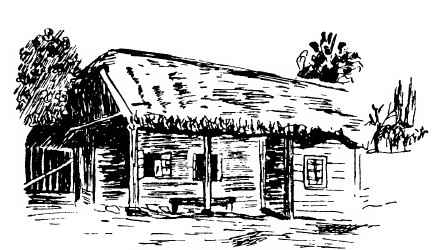
The typical house in Kobryn was built of timber—thick, rough-hewn planks with moss packed in between — and roofed with shingles or straw.
|
|
| A typical wooden house (Drawn by Fanny Glotzer) |
Kobryn suffered greatly from two major floods at the end of the nineteenth century and the beginning of the twentieth. Our town also did not escape several major fires that destroyed large sections of it. This led to the creation of the Kobryner Fire Brigade, which voluntarily took upon itself the task of protecting the town and fighting fires, and more than once turned into a form of self-defense against attacks by marauding peasants or wandering ruffians.
To Kobryn's Muchaviec River — which in its time had been an important transport route connecting the smaller towns of the eastern region with the major centers of Brisk, Warsaw, and Danzig, thanks to its link between the Dnieper and the Bug — there was added, in the middle of the eighteenth century, the Brisk–Pruzhane [Pruzhany]–Baranovitsh [Baranovichi] highway. Passing directly through Kobryn, it brought with it a great deal of vitality and progress to our town.
The Sunday market days, and especially the monthly fairs, grew in scope thanks to the highway. The market teemed and bustled with the peasants who had arrived, and with the various kinds of merchants who came along the highway to buy the peasants' produce while selling their own finished goods. This created work for porters and wagon-drivers, who would load entire wagons with grain, wax, hides, and fruit; and with people packed under the wagon covers, the wagons would set off along the highway toward the large cities.
Kobryn's reach and importance expanded even further, and its trade broadened, when in the 1890s the Brisk–Pinsk railway line was established, with the Kobryn station situated on the right bank of the Muchaviec.
The railway line became a source of livelihood for many Jewish families. New inns, taverns, and shops opened, bringing lively activity to the economic life of the town.
It is fair to say that by the end of the nineteenth century Kobryn already counted more than 4,000 inhabitants, who engaged in a wide range of social and economic activities and, in addition to their involvement in trade, held important positions outside the sphere of commerce.
During this period, the crafts developed considerably in all their branches, with the number of artisans increasing both in the traditional trades and in the newer ones. Hundreds of Kobryn's Jews worked as builders, carpenters, wheelwrights, blacksmiths, locksmiths, roofers, woodworkers, coopers, wagon-drivers, furriers, tailors, shoemakers, bakers, rope-makers, millers, glaziers, and many others.
To tell the truth, it must be said that
[Page 19]
despite the growth of the Jewish crafts, the majority — indeed the great majority in both number and substance — of Kobryn's Jews were shopkeepers and traders.
During that period, the religious spirit clearly and exclusively dominated communal life, with the rabbi serving as the principal authority in all spiritual matters. The Kobryn rabbinate was held by some of the great figures of the generation, among them the Malvin, Rabbi Marim, and Rabbi Shaul A”A [likely Rabbi Shaul Epstein, who served as Av Beit Din in the Brisk–Kobryn region].
|
|
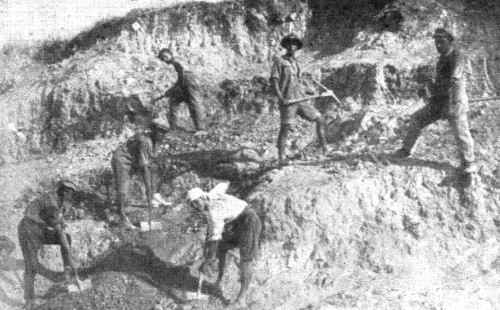
| The first group of Kobryn khalutzim (pioneers) in Erets Yisroel |
In the time of the Vilna Gaon, our town became especially noted for its Misnagdic stance. In later years, however, Kobryn also came under Chasidic influence, and various Chasidic groups arose, each with its own shtibl. Distinguished in particular by his special grace was the Kobryner Rebbe, Reb Moshke, who led his dynasty among the Kobryner Jews of Chasidic bent.
Kobryn was also privileged to have its own guter Yid [chasidic master], Reb Pininke, of blessed memory, who inspired the community with his radiant presence, his simplicity, and his fine character traits, and who was an ornament to the surrounding settlements as well. Countless legends and wonders circulated about the righteous Reb Pininke, which he was said to have performed.
The extent to which religious life was widespread and dominant is evident from the fact that in Kobryn no fewer than eighteen (the number of life!) bote-medroshim [study houses], shtiblekh, and yeshivas were built.
Kobryn felt particular pride in its Great Synagogue, distinguished by its magnificent interior — built in the mid-nineteenth century — whose architectural carvings were admired by all, Jews and non-Jews alike, especially the artistic design of the orn-koydesh [holy ark], which truly captivated the eye.
With the outbreak of the First World War, the situation of many Kobryn Jews was shaken. Besides the many young Jewish men who had to go to the front (for by that time Jews were already required to serve in the military), many Jews lost their livelihood because the Russian army retreated — and with it most of the peasants, who scattered deep into Russia (not a few Jewish families went with them).
With the arrival of the Germans in 1915, a system of compulsion began, accompanied by ration cards, forced labor, forced schooling, and forced bathing. Smuggling flourished, and the clandestine trade helped people get through the situation.
The Brisk peace brought no peace.
[Page 20]
The Russian Revolution and the constant shifting of powers until the final occupation by Poland were the most chaotic and lawless of times; everyone dealt in whatever he could.
A clearer picture of Kobryn's Jewish life emerges after the First World War, when our region passed to the new Poland. The equal rights granted to the Jewish population — to vote and to be elected to parliament and to the city council — brought forth the colorful party landscape characteristic of our Jewish distinctiveness.
The Zionist movement grew, with all its factions and shades.
|
|
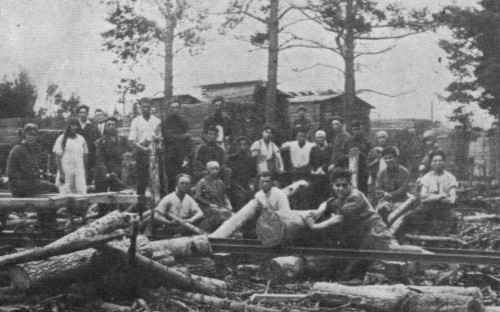
| A group of khalutzim at lumber-mill work |
The General Zionists, under the leadership of Levitas, the Palonski brothers, Palyer, and others, popularized the Zionist idea in Kobryn, organizing fundraising campaigns for the Keren Hayesod [the United Israel Appeal, the central Zionist fundraising foundation established in 1920] and the Keren Kayemet [the Jewish National Fund, responsible for land purchase and development in EretsYisroel].
The influential Poalei Zion party, with its vanguard sections Hekhalutz and Borokhov Youth, under the energetic leadership of Ben-Zion Pantal, Itshe Pintshuk [Pinchuk], and Leybl Sirote, developed a wide-ranging political and social activity, taking a very active part in various actions of both national scale and local character — especially after the unification with the Tzeirei Zion [“Young Zionists,” a socialist Zionist youth movement active in Eastern Europe] party, led by Itshe Pintshuk, Khary [Chari], and Vigodski.
The significant Poalei Zion faction of city-council members — such as Pantal, Sirote, and Lipshits — demonstrated the scope and the impact of the aforementioned party.
The outstanding pioneers of the Kobryn khalutz movement, both from the First Aliyah and from the later ones, inscribed truly important pages in the history of Kobryn's idealistic youth. Most of them fought in the struggle for the proclamation of the State of Israel.
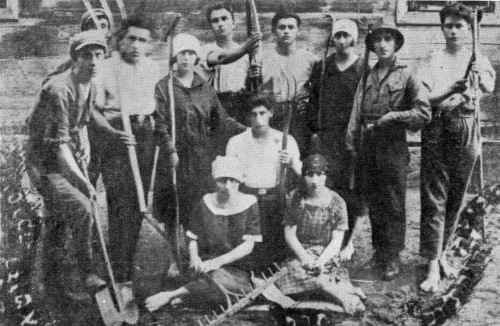
The hakhshore [hachshara] farms of Hekhalutz occupied a respected place. They were the pride of the movement. Every summer, dozens of groups would form and be sent out to various kibbutzim in order to receive the proper preparation for life in Erets Yisroel, in a Zionist-socialist spirit. In Kobryn itself, a kibbutz had recently been active with great success. The great majority of the young people who left for Erets Yisroel had gone through these kibbutzim.
An important cultural factor was the Brener Library, founded by Shmerele Ash on his premises. Under the Poalei Zion banner it developed a wide-ranging activity, organizing various cultural undertakings such as classes, lectures, kestl-ovntn [a youth discussion evening where participants submitted anonymous questions into a “kestl” (box), which were then drawn at random and debated], and similar events.
The influence of the Bund, which had been particularly
[Page 21]
noticeable at the beginning of the First World War under the leadership of Sam, diminished in the later years. The majority turned further to the left, under the influence of Yosl Pantal, Moyshe Zbar, Shloyme and Mates Kamenyetski, and others. They succeeded in reaching certain strata of Kobryn's working youth, developing intensive political and professional activity.
The Communist faction was very active during the various election campaigns in the town as well as in the surrounding villages, at times acting with great self-sacrifice in distributing election propaganda, posters, and banners. Many young people paid for this activity with many years in prison — among them, for example, the aforementioned Pantal (who was murdered in the Białystok prison while leading a hunger strike in 1926), Moyshe Yekhiel, a youth from the Kayser family, Khayim Man, Kamenyetski, and many others.
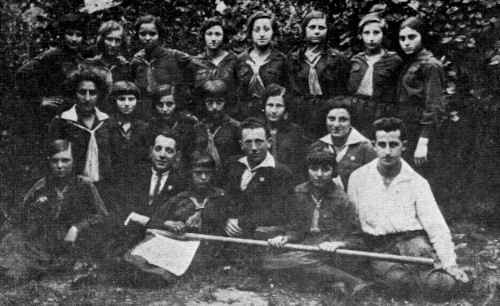
Among the youth organizations that most strongly influenced the young people was Hashomer Hatzair, which impressed everyone with its dynamic rhythm. Beginning as a scouting group, Hashomer branched out and, in time, became an independent force; it also served as the reservoir for many later khalutzim and Poalei Zion activists.
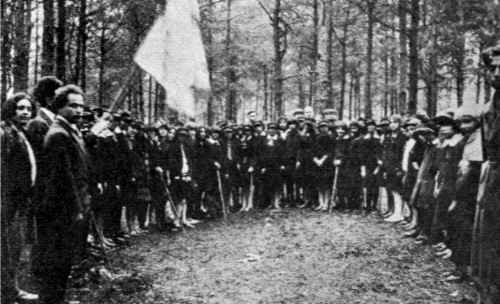
Standing out in particular as leading shomrim [members of Hashomer Hatzair] were: Moyshe Mints, Khayim Goldberg, Itshe Faygnboym, Moyshe Katkes, Yitskhok Fuksman, Tsalke Shvarts, Berl Zaritski, Pintshe Goldshmid, Iser Pintshuk [Pinchuk], Yisroel Khayim Biletski, and others. The Lag Ba-Omer marches and the summer outings brought festive, colorful moods into the everyday life of Kobryn.
|
|
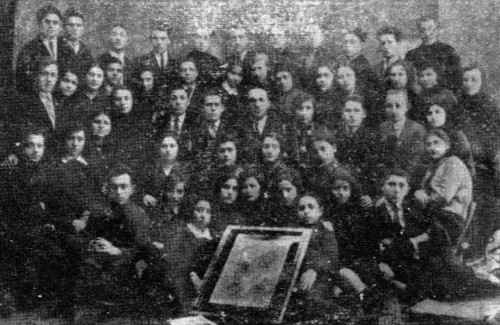
| Kobryn group of khalutzim |
The political party movement began to take shape in earnest in 1922, after the elections to the first Polish Sejm, when all political parties were granted the right to conduct educational work among the masses. It seemed that Poland would become a truly democratic state with a democratic parliament that would, in fact, carry out what was written in the constitution. Envoys from various political parties arrived with their election platforms, promising to fight for the well-being of the working class. At that time the Folkists (the party of Noach Pryłucki) also came and organized the artisans' association.
The Bundists had the needleworkers' union under their control. In contrast, they did not manage to organize the leatherworkers' union,
[Page 22]
because the majority of its members were left-leaning and therefore already under the influence of the Communists.
A few years later they succeeded in organizing a construction workers' union and a food producers' union. These, too, were under the influence of the left and therefore had much to endure from the persecutions carried out by the authorities.
The professional unions maintained a rich library, regularly organized meetings, brought in lecturers from other towns, and considered themselves to be an important force among the workers.
The left organized several strikes, most of which ended successfully.
The artisans were organized in their own association, which was located on the premises of Fishel the ogrodnik [market-gardener], across from the shops. They conducted intensive activity, had their own loan fund under the leadership of Reb Noakh the din [rabbinical judge], and even succeeded in getting their own councilman, Khayim Leyb Lagunovski, elected.
|
|
| Kobryn Group of the Bund |
A very visible and useful activity was carried out by a Kobryn financial institution, the Merchants' Bank, located upstairs at Fuksman's, with its director Reb Aharon Shmuel Antopolski.
Particularly popular was the so-called “Reb Michael's Bank” (People's Bank), which gathered around itself nearly the largest part of Kobryn's merchants and which, at the same time, constituted Reb Mikhl's camp in the major dispute surrounding the rabbinic controversy of that period. Reb Michael was in a privileged position because he was the legally recognized owner of the metrike [vital records] books and the issuer of certificates for other legal matters, thereby forming his followers into a significant faction.
On the other side stood the Amkho front, which strongly revered the personal qualities of the second rabbi, Reb Peysekh [Pesach] Pruskin, the renowned preacher whose powerful sermons won over the public. The Great Synagogue would be packed on Shabbat afternoons with people coming to hear Reb Pesakh's sermons.
He was a major pillar of the Agudah and was supported by the head of the community, Reb Nakhman Birman, of blessed memory, as well as by Khayim Kobryniets, Hershl Tsukerman, and other respected householders.
This group fought against
[Page 23]
the Tarbut school and, more generally, against the new Zionist spirit. In those years, this group developed considerable activity in the political sphere, having their own Ratmener [councilmen] in the Kobryn city council and in the communal administration. These were N. Birman and Hershl Tsukerman [Zuckermann].
|
|
| A group of Kobryn shomrim [Hashomer members] |
At the beginning of the fourth decade of the present century, the Revisionist movement appeared on the Kobryn scene under the leadership of Khayim Gloyberman, Arontshik Herman, the Mazurski brothers, Likhtinger, and others.
Among the personalities without a clearly defined political orientation who [nevertheless] managed to obtain the office of deputy mayor were Dr. Yosef Pribulski and Hershl Tsukerman.
In the field of journalism, Kobryn did not lag far behind the larger centers — on the contrary, it maintained a certain prestige. Its weekly publication, the Kobryner Vokhnblat (a reproduction of which, together with several articles, we include in this book), edited by Itshe Faygenboym, Itshe Pintshuk, and Iser Pintshuk, served as the platform on which most of the social and political issues of the period between the two world wars were discussed. With only minor interruptions, it continued to appear until Hitler's attack on Kobryn. The newspaper was printed at Abramovitsh's press.
At that time, Kobryn already counted close to ten thousand Jewish inhabitants, representing about 80–85% of the town's total population.
The school system had expanded considerably. The kheders and yeshivas, which before the First World War had been the foundation and principal source of education, now had to give way, under the new circumstances, to modern educational institutions.
Secular education and pedagogical systems also made their way into Kobryn. It began with Pribulski's pro-gymnasium; later, during the German occupation, a compulsory school was established, which was subsequently transformed into the well-run public school under the auspices of Tsisho [the Central Yiddish School Organization]. Its teachers included Yomtov Bil, Reznik, Kroyl, Yitskhok Plotnik; and among the women teachers were Antopolski, Rubin, and others.
It did not take long before the Tevunah school [modern Orthodox school], with its Mizrachi [religious-Zionist movement] tendencies, was established under the leadership of the teachers Rozenboym, Moyshe Zuberman, Yitskhok Novik, Moyshe Khayes, Reb Zundl, Zelik, Stavski, Reb Shloyme, and others.
Particularly impressive was the heavily attended Tarbut school, with Hebrew as the language of instruction, founded by Eng. Levitos and later headed by the teacher Alkan. In the last years, the religious girls' school Beis Yaakov [Orthodox girls' school system] came into being, under the influence of Agudas Yisroel. Not a small number of Jewish youngsters also attended the Polish public school (powszechna) and the middle school (gymnasium).
In the field of sports, the sports club Kraft, affiliated with the Freiheit youth of the right-wing Poalei Zion, distinguished itself organizationally, offering sports courses, competitions, and competitive matches. The Jewish football team HaKoakh often competed boldly against the non-Jewish teams, never discouraged by failures or, at times, even attacks, carrying the Jewish name with pride.
Kobryn also had its own amateur theater troupe, which performed fine plays under the direction of Peysekh Boym and the Markuze brothers; the proceeds were devoted to philanthropic purposes.
Of great value was the establishment of the Kobryn Jewish fakhshul [vocational school], organized by the Ort society, under the instruction of Mr. Kiselyov and Khanele di Kleine [the Small]. Many competent craftsmen in carpentry and metalwork —today prominent manufacturers— received their training in this vocational school. This is confirmed by the well-known Argentine furniture manufacturers: the Avruchs, Vaynerman [Weinerman], Shreybman, and others.
|
|
| Lag ba-Omer excursion in Patrike |
Kobryn enjoyed a fine reputation for its social and philanthropic institutions. It maintained its own Jewish hospital, served primarily by Jewish professionals such as Dr. Pribulski, Milner, and Liberman.
A particularly respected place was occupied by the orphanage, which was established shortly after the First World War and was carefully run by a group of kind-hearted women who spared no effort to provide the lonely orphans with everything they needed. Nor was the poor and solitary sick person forgotten: the Linas Hatsedek society took care to look after them.
Lonely elderly people were likewise assisted by the moyshev-skeynim (old-age home, bogodelnye). The Hakhnoses Kale [Hakhneses Kallah] institution contributed greatly to solving the marriage problem of poor young women.
In contrast to the years before the First World War, when there were only two Jewish feldshers — Ari the Royfe [the Healer] and Veysman the Feldsher — the later years saw Jewish professionals who had become very well-known: Dr. Pribulski,
[Page 25]
Dr. Milner, Dr. Liberman, and, among the younger professionals, Feldman, Mints, Khayim Goldberg, Khabovetski, Angilovitsh, Schwarts, Abrasha Herman, Khayim Pantal, Vaysenberg, and others.
|
|
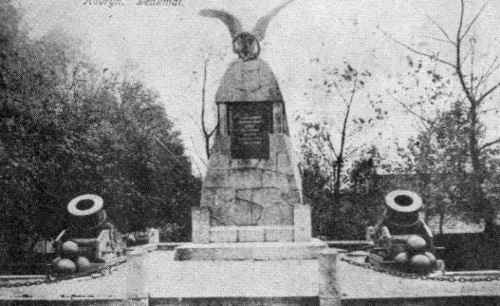
| Kobryn Monument |
In the economic sphere there was no single branch in which Jewish initiative was not active. This is demonstrated by the large number of Jewish enterprises — for example, the brick factories of Motye Vaynshteyn [Weinstein], Sholem Pintshuk [Pinchuk], and Sholem Rimlyand; the lumber mills of Gorvits; the steam mills of Broytbard and Yedvab; the oil factories of Kats, Berl the “Alinik,”[2] and Leyzer the “Alinik”; the knitting factories of Kobryniets and Kraman; and the cigarette factories of Leyzer Tenenboym and Averbukh.
There were also furniture workshops run by Mezritsh and Slomyanski; bakeries owned by Gozhanski; tanneries of Alter Pintshuk; soap factories of Alter Mazurski and Kraman; soda-water plants of Palevski and Vezenshteyn; and candle factories of the Tenenboym brothers.
Nor were Jewish agriculturalists lacking — market-gardeners, orchard-keepers, transport workers, and freight forwarders, among others.
In the years between the two world wars, the economic situation of many Jews in Kobryn deteriorated. The ever-tightening tax screw on the one hand, and the increasing difficulties of practicing handicrafts in the final years before Poland's collapse on the other, drove masses of Jews — especially young people — to seek places for emigration.
The steadily increasing emigration in those years revealed the insecure situation of the Jewish youth. Emigration had initially been directed toward North America. When the gates of North America were closed and no certificates for the Land of Israel could be obtained (except in special cases), the younger generation dispersed to Argentina, Brazil, Cuba, Mexico, Colombia, and other places. Most of them managed, to varying degrees, to settle successfully — and in this way saved themselves from destruction.
After the outbreak of the Second World War in 1939, Kobryn was taken over by the Soviets. This was the second time the Soviets entered Kobryn (the first time was in 1920). Although the entry of the Soviets was not to the liking of some Kobryn Jews, they nevertheless had reason to consider themselves fortunate when compared with the annihilating German occupation. Regrettably, we know little about the lives of the Jews of Kobryn under Soviet rule.
Terrible was the end of our beautiful, once-flourishing
[Page 26]
Kobryn. The creation of the ghetto and, finally, the mass shootings in Brona Góra and along the Dyviner Road, carried out by the German murder-gang, left us orphaned and surrounded by grief. May these lines serve as a memorial to our beloved hometown.
Khaval al d'avdin v'lo mishtakḥin — woe for those who are gone and will not be found again[3].
|
|
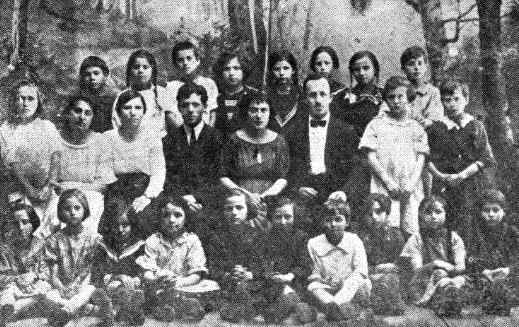
| A group from the Kobryn Folk School with the teachers Yomtov Bil and Antopolski |
|
|
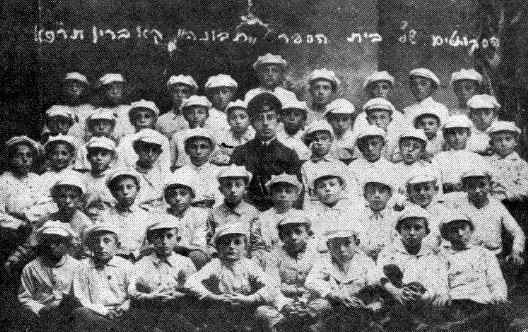
| A group of Tevunah scouts led by teacher Vaynshteyn [Weinstein] |
[Page 27]
|
|
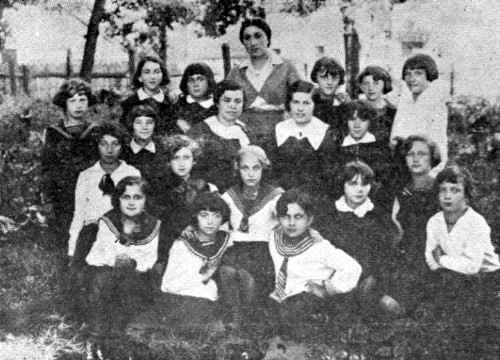
| The Beit Yaakov School in Kobryn |
|
|
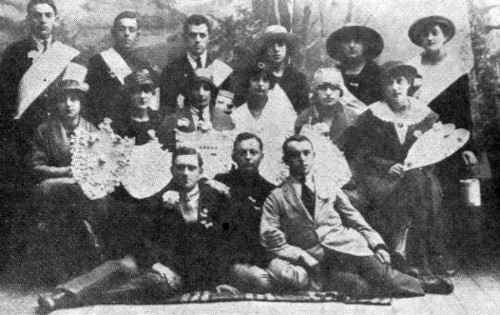
| A “Flower Day” [fundraising event] in Kobryn |
Translator's Notes:
On page 187, however, we learn that “Narodnikes” refers to a specific street name in Kobryn, the Narodnikes Gas. Return
|
JewishGen, Inc. makes no representations regarding the accuracy of
the translation. The reader may wish to refer to the original material
for verification.
JewishGen is not responsible for inaccuracies or omissions in the original work and cannot rewrite or edit the text to correct inaccuracies and/or omissions.
Our mission is to produce a translation of the original work and we cannot verify the accuracy of statements or alter facts cited.
 Kobryn, Belarus
 Yizkor Book Project
 JewishGen Home Page
Copyright © 1999-2026 by JewishGen, Inc.
Updated 10 Oct 2026 by LA