 |
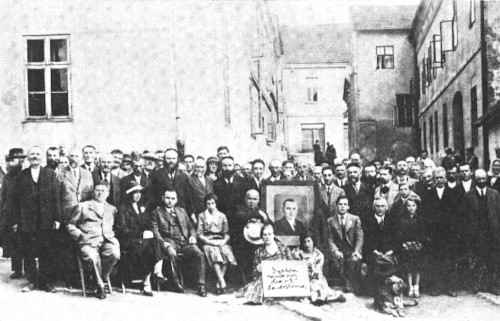
Sitting from right: Sydonia Sauerstrom, Dr. Wilhelm Kluger, Shimon Sauerstrom, Niec, manager of the Finance Office, Martha Sauerstrom, /-/, /-/, /-/
|
|
[Page 128]
Sixth Chapter
Community Institutions
Translated by Mira Eckhaus
1. People's Bank
Before World War I, the “Mutual Credit Fund for Trade and Crafts” was founded in Wadowice by Dr. Isidor Daniel. The director was Leopold Landau, Moshe Baruch's son; Eliyahu Fishgrund, who also served as the community's secretary, was appointed bookkeeper.
With the outbreak of war, the bank was liquidated. For this reason, a noticeable void was created in the field of Jewish banking after the war ended. Although a Savings Bank of the district operated, its operations did not include small trade and crafts. Due to the shortage of money and the pressure of taxes, the settlement was in dire need of a banking institution. Cooperative credit came to its aid. The government at that time supported the cooperative movement (the president of the country at that time, Wojciechowski, was one of its pioneers) and made various concessions in establishing cooperatives and even granted them tax and credit discounts generously.
American Jewry, which at that time tried to rehabilitate Polish Jewry not by giving donations but rather through constructive help, it established a central cooperative association in Warsaw and, through the pages of the Jewish newspapers, appealed to all settlements to establish credit cooperatives for small trade and crafts.
In Wadowice, activists Ben-Zion Ber and Kalman Proffer were engaged in this action. It is worth emphasizing their initiative, because usually political parties or local authorities laid the foundation for the establishment of cooperatives, and they provided the necessary office and the initial capital. Ben-Zion Ber and Kalman Proffer did not have all of these conditions at their disposal. They came into contact with this cooperative center, drew up regulations according to the instructions they received from it, and managed to attract other citizens from the city's activists to the action, such as Dr. Bernard Schor, Yechiel Belmut, Slo Nesselroth, and Chaim Shlomo Ciesner, and in a short time they acquired the sympathy of the entire population. They also obtained credit for commercial bills at the center, were accepted as members of the Association for the Inspection of Jewish Cooperatives in Warsaw, and under the name “People's Cooperative Bank Ltd.” they opened this banking institution, which was a blessing in our city.
At its beginning, the bank was housed in Ben-Zion Ber's apartment on Kosciuszko Square, and later moved to a special residence rented for it on “Third of May” Street. The bookkeeper was Ben-Zion Ber and the treasurer was Kalman Proffer. The management was elected from among the shareholders and operated
[Page 129]
on a voluntary basis. Dr. Bernard Schor served as chairman and legal advisor, and the deputies at various times were Shmuel Abel, Sammy Brunner, Chaim Shlomo Ciesner, and others. The members of the board were Yechiel Kalmot, Hirsch Gleitzman, Israel Gross, Simcha Wurzel, Emanuel and Berish Wolf, Reuven Schreffer, and others.
It is worth emphasizing here the extent of their volunteerism. These people would devote entire hours of their time to management meetings. The audit committee also worked with great dedication, which led to the acquisition of trust from the population. Every year, membership and deposits fees were increased until the bank became a public institution, whose scope of credit for trade and industry did not fall in any way from the operations of the aforementioned Polish Savings Bank. The only difference between them was that the Polish Bank received financial assistance from the regional authority, under whose guarantee all operations were carried out. The Jewish Bank, on the other hand, grew only under its own power.
In recent years, the bank served not only the local trade and craft industries, but also the merchants and small industrialists in the nearby towns of Andrychów, Zator, Kalwaria, and Suka. Poles also submitted credit applications to the bank.
At the People's Bank, Hella Einhorn, the daughter of Tuviahu Einhorn, worked as a secretary. She was distinguished by her high intelligence, exceptional cultural education, and good character. Although her health was poor due to heart disease, she was always in a good mood and clear mind, and she loved every person and every child with a sincere heart. She perished in the Nazi Holocaust.
On this occasion, we should also mention Tonka Rotter, the secretary to attorney Dr. Schor, who worked diligently on the bank's legal activities. She participated extensively in the city's social life, in the “HaShomer” movement, the General Zionist Organization, in “Maccabi”, in “WIZO”, in the management of the Jewish People's House, and did much for the public good. She also perished in the Nazi Holocaust. Her father, Shmuel Rotter, an industrialist, was active in the “HaMizrahi” movement and helped the poor a lot. He died before the war. His wife Lina was active in a society for the care of orphans. His daughter Ida was also active in the “Young WIZO” movement. They perished during the Holocaust.
From this family survived only the daughters Mila Glass (now lives in Paris) and Olga Breitbart (now lives in Switzerland).
2. War Invalids Association
The Jewish war invalids were disadvantaged within the General Association of War Invalids, and were always in the minority. Therefore, they were forced to establish their own organization called the “Jewish Organization of War Invalids of the Wadowice District”, whose headquarters was in our city.
Dr. Wilhelm Kluger, Yechiel Belmut, Yehoshua (Ozias) Gretel, Victor Hess, and others were elected as members of the board. The founder and chairman of the organization, Shimon Sauerstrom, was himself a war invalid (he was blind). The association's office was located in his apartment, on Kościuszko Square, and later moved to the People's Bank building, on “Third of May” Street.
The scope of the organization's functions was very broad. Taking care of the daily affairs of the invalids meant obtaining the rights and discounts granted to them by the government's Invalid Persons' Constitution and its various regulations, and a fair distribution of franchises (concessions for the sale of tobacco and schnapps). There were cases
[Page 130]
in which the authorities canceled old franchises, which for many years had been held by Jews. This happened, for example, with the franchise of the wholesale liquor store on the main square, which for about 50 years had been held by the Fishgrund family. Then the organization fought very fiercely to continue this livelihood in the hands of Jews by handing over the franchise to a disabled Jew.
Chairman Shimon Sauerstrom's rights in this area were especially great. He was led by a trained Red Cross dog. He did not surrender to the dictates of fate and his spirit was not broken. He was full of energy in this public work, which he continued without ceasing. He himself managed the office, participated in national conferences of the disabled, and during the meetings he took the lead in the debates and demonstrated great knowledge of the complicated laws of the disabled. His daughter, Syda Schlesinger, lives in New York.
The disabled organization owned a wholesale tobacco trading house at the Hess Hotel. This trading house was run voluntarily by Victor Hess, who also devoted himself to other public works as described in this book. Hess perished in the Holocaust with most of his family. His daughter Helena Czesnower lives in Ramat Gan.
3. Merchants Union
For the purposes of protecting the interests of Jewish commerce during the interwar period, there was an association of Jewish merchants in our city. The initiator and founder was Yechiel Belmot, who was the first chairman, and in recent years Sammy Brunner, Slo Nesselroth, and Chaim Shlomo Ciesner. The secretary was Henrik Oster, the director of the Criminal District Court Chamber.
The union maintained a mutual aid fund for poor merchants. For a long time, the union's fund was in Yechiel Belmot's office on the main square and later at Sammy Brunner's on the “Third of May” Street.
The scope of the union's activities was broad, especially in the recent period, which was marked by complicated tax laws, by providing assistance to small merchants in completing income tax returns and declarations for the purchase of commercial certificates, in preparing appeals against taxation and protecting trade from false accusations of expropriation of currency rates.
All these types of offenses, such as failure to display the price list, failure to indicate the price on the goods, lack of accurate account books and, worst of all, adjusting the price of the goods, when the currency rate was falling dramatically from day to day, to the new values. All this caused persecution and severe oppression. In this struggle to protect trade, the union and the chairman have achieved notable achievements and have been highly regarded.
[Page 131]
|
|
Sitting from right: Sydonia Sauerstrom, Dr. Wilhelm Kluger, Shimon Sauerstrom, Niec, manager of the Finance Office, Martha Sauerstrom, /-/, /-/, /-/ |
Translated by Mira Eckhaus
1. Women's Society (“Froyen Fariyan”)
A women's society existed from the earliest days of the Jewish settlement. The society's role was to provide relief to pregnant women and poor women with many children. In those days, the Wadowice General Hospital did not yet have a maternity ward, so the society was a source of salvation and blessing for poor families. The society paid for the midwife, sent one of its members to supervise the birth, and if a pregnant woman fell ill, the society hired a special caregiver to watch over her at night.
For many years until 1919, Anna Huppert, wife of Israel Huppert, served as the society's chairman; Chaya Rivka (Helena) Jacubowitz, the wife of Matityahu Jacubowitz and mother of the writer of this article, served as secretary; the treasurer was Salomea Kluger, the wife of Zechariah Kluger.
Great were the efforts of this handful of women to maintain the organization and provide the necessary relief. The effort was especially great in the years 1914-18, when the city was plagued by hunger, hardship, and infectious diseases, and because of the war, many families were left without a livelihood.
True, at that time there was a very small general health maintenance organization in Wadowice, but it was for manual workers only, which means, therefore, Christians. In those days, there were no pension funds or retirement benefits. Therefore, it is appropriate, within the framework of this book, to emphasize the great deeds of these women and to extol their many rights.
Anna Huppert, whose generosity is already mentioned above in the article about the “HaShomer HaDati”, was 90 years old when she was deported with the transport that was transferred by the Nazis to Belzitz in 1942. Chaya Rivka Jacubowitz, a noble and kind woman, who was an example to others in her wonderful way of life and known for her generous donations, passed away in 1923. All the people of the city shared in the family's heavy mourning.
In the early interwar years, Regina Thieberger served as the organization's chairwoman, and then Franciszka Bendec held this position until 1936.
Regina Thieberger always excelled in helping the poor. For many years, various poor people lived in her house, and she did not demand rent from them. During World War I, when the city was terribly overcrowded and there was a terrible shortage of apartments, and refugees and soldiers were pouring in from the front, exhausted, Thieberger's house was wide open to the unfortunate. She died shortly before the outbreak of World War II. It was as if heaven wished to spare her the suffering of the Holocaust, as a reward for her rights. Her husband, Adolf Thieberger, one of the respected men in the city, raised his children in the spirit of tradition and love of humanity. He died around 1920.
Their sons, Beno and Dr. Maurice Thieberger, well-known philanthropists, survived the Holocaust and now live in New York. They are connected with the people of our city by cordial ties.
Franciszka Bendec gained general recognition among the Wadowice Jews due to her tirelessly work
[Page 133]
for many years for the women's society. When she moved to Bilitz, the residents of the city said goodbye to her at a festive ball held at the Jewish Intelligentsia Club. The heartfelt gratitude on behalf of the population was expressed in the wonderful speech of Dr. A. Zimmerspitz. She perished in the Holocaust in Lviv in 1941.
Her son Henryk Bendec, who is mentioned in this book for his extensive public activities, lives in Israel (Bat Yam), her other son, Karol, is in Poland.
|
|
|||
|
|
|||
[Page 134]
The Women's Society Committee included, among others, Leonora Goldberger, the wife of the dentist Max Goldberger, Frida Ferster, Yeti Schreffer, the wife of Reuven Schreffer. The members Rivka Goldberg and Liba Rapaport particularly excelled in their great work for the society.
Leonora Goldberger died in the Russian exile. Yeti Schreffer and Liba Rapaport perished in the Auschwitz extermination camp. We all remember Liba Rapaport's many activities in collecting funds for the “Hachnasat Kallah”, to cover the hospitalization expenses of poor patients, and so on. Her daughter Lipka survived, she lives in Saarbrücken.
2. “Bikur Holim” Society
The “Bikur Holim” society treated poor patients, who received free medical treatment from city doctors at its expense, and the society also paid for the cost of the medications. In recent years, the society's chairman was Eliezer Binnenstock, and the board members were Anshil Burger, Liba Rapaport, Isaac Rosenfeld, and Aharon Shengot.
For many years, the unforgettable Dr. Shmuel Taub served as the society's physician. He answered every call and provided help to every sufferer.
3. “Talmud Torah” Society
This society cared for poor students whose parents could not afford the expenses of their religious education. The society gave them a stipend for study and household expenses, clothed them, and bought them textbooks and supplies.
For many years, the chairman of the society was Reb Josef Broner, a scholar and wise man who devoted his whole heart and energy to the society's activities and for this reason earned the deep gratitude of the parents and students. The role was not easy. At first, he had to raise funds from a population that was largely progressive and looked unfavorably on the influx of religious youth who came from other cities to study in Wadowice. It was necessary to arrange a place for free lunches with families, and there were many other worries. Reb Josef Broner died before the war.
|
|
His wife, Breindel (Bronislava) Broner, was known as a woman of valor for her volunteerism and her help to people in need. Her efforts during the days of fury not to go to the massacre and to save her family and neighbors from the clutches of the Nazis are recounted below in the chapter on the Holocaust. Their memory will live on forever.
Their sons Leopold and Yaakov, and their daughters Paula (Einhorn) and Pella (Hershteil), survived and now live in Israel.
[Page 135]
The board members of the “Talmud Torah” society were Tuviahu Einhorn, Yehoshua (Ozias) Gretel, Shmuel Greizman, Isaac Rosenfeld, and Aharon Shengot.
4. “Gemilut Hasidim” Society
The Wadowice Gemilut Hasidim fund gave small loans to artisans and small merchants. It was their credit institution, ready to lend in any hour of need, without having to pay any interest for the loans. It was a continuation of the glorious Jewish tradition of Gemilut Hasidim in which the members of the Jewish nation excelled.
In recent times, committee members Ben Zion Bar, Emmanuel Wolf, Slo Nesselroth, Kalman Propper, and others have taken part in its development.
5. Orphan Care Society
The first item on the agenda of this society was to arrange a guardian on behalf of the society for orphaned families. It also took care of the orphans' clothing and other needs and organized summer camps for them under the guidance of teacher Chaim Reiter.
During the summer, about 40 orphans would gather every day, at 8 a.m., in the yard of teacher Reiter's house and, under his supervision, would go out to the suburb of Groble, where they would spend a pleasant time until evening in the garden of the “Walner” restaurant, engaging in conversations and games. Sometimes they would also take a trip to the nearby “Dzbonk” mountain. The organization would take care of their food during the trip.
Dr. Apollineri Zimmerspitz was appointed chairman of the society, and recently his place was taken by Dr. Malgozetta Daniel. The members of the board were Sammy Broner's wife, Leonora Goldberger, Ella Wasserteil, Paula Zimmerspitz and Lina Rutter.
6. “Supporters of the Poor” Society
In the interwar years, the economic situation of Polish Jewry declined, and a significant portion of the population needed support. Indeed, among the members of the Wadowice congregation there were only few poor begging for food, because the Wadowice residents were accustomed to living on a budget and working productively, so as not to become a burden on the shoulders of the congregation. However, poor people came here from various parts of Great Poland and eastern Galicia, from settlements that lived in poverty.
To support the poor who came from outside the city, the Jewish population would provide them with one-time support, through the “Supporters of the Poor” society that was founded for this purpose. This saved the poor the trouble of going from house to house and causing disruptions to people's work.
Every week, every citizen would give his share of donations for the society generously. The chairman of the society was Moshe Schlein. The treasurer was Avraham Kay. The society's board seat was in the treasurer's apartment on Kosciuszko Square.
Translated by Mira Eckhaus
1. General comments
Until World War I, there were no Jewish social or sports organizations in our city. The religious found their satisfaction with the rabbi and the like. The progressives considered themselves as Poles, or as German Jews, and without hesitation visited the “Casino” of the Polish officials or officers, or the “Jagiellonka” club on the main square. A small part of the Jews even participated in the national extremist organization “Sokol” and enjoyed the sports field of this organization.
The relations between them and the Poles were so ideal that one could often meet the Jewish intelligentsia playing tennis there with high-ranking Polish officers and their wives.
Some Jews in Wadowice believed that if they organized themselves, they might be suspected of initiating nationalist and Jewish separatist activities, while cooperation in Polish organizations would strengthen ties with the Polish population and protect them from anti-Semitic propaganda.
The Poles were very pleased with this situation, because in their efforts to increase their power against the Austrians, they succeeded in this way to distance the Jews from their aspirations for Germanization, and during the parliamentary elections even to acquire a large number of Jewish votes.
This idyll ended with the rebirth of the Polish state, whose territorial composition included the eastern Fringe areas, where the Jews had always considered themselves as an ethnographic sect and did not identify with other peoples. Their structure left its mark on the whole of Polish Jewry. Separatism was also caused by the Zionist movement, which, starting in 1919, gained great strength in our city, and had a strong tendency to establish national organizations and independent cultural life.
Social separatism was also caused by the views of some Poles, who thought that the cause for every crisis and economic failure was the excessive number of Jews involved in trade and liberal professions and therefore called for an anti-Jewish economic boycott. Of course, the distance from an economic boycott to anti-Semitic incitement in the newspapers about a social boycott was quite short.
When Hitler's propaganda began, social relations between Poles and Jews cooled completely to the point of becoming an open boycott. There were cases in the Polish “Casino” where Poles who had only recently been considered good acquaintances and friends of various Jews began to distance themselves from them and were even careful not to shake their hands or greet them.
All these reasons led the Jews to start organizing and developing independent, social and sporting organizations, not necessarily national ones, that were completely independent of the Poles.
Thus, the Jewish Community Center, the Jewish Library, and the Sports and Gymnastics Association were founded. Let us tell you about them in detail.
[Page 137]
2. The Jewish Community Center
The Jewish Community Center was founded around 1926, in the Hoffman House on “Third of May” Street. The founders were Henrik Oster, Henrik Bendec, Stefan Hoffman, Dr. Leon Wedler, Beno Thieberger, Dr. Wilhelm Kluger, Dr. A. Zimmerspitz, and others.
In the first period, only professionals and university students visited it. Later, in light of the events of the aforementioned period, when it became clear that this cultural institution was essential for all residents of the city, and especially for the younger generation, it was decided to establish a special building that would be designated for Jewish culture and entertainment. For this purpose, a public committee was elected, headed by Beno Thieberger, who was a well-known philanthropist and always devoted to public activities. However, since the construction plan failed due to financial difficulties, the Community Center was moved to the city center to a rented hall in the Tafet House on the main square. A new committee was then elected, on which the youth were also represented. Thus, this cultural residence became a public center for Jews of Wadowice, where almost all the cultural activities of the city were concentrated. Except for the Hasidic circles, almost the entire Jewish population participated, without any barriers of political character or party views.
The Jewish Community Center's committee emphasized that the institution would not have any political character in its activities and lectures. This fact resulted in a large turnout of the audience. Various writers and publicists often came from Krakow as lecturers, including Dr. Moshe Kanfer, editor of the newspaper “Nowy Dzieńnik”. Evenings dedicated to music and readings were also held.
During the meetings in the Jewish Community Center, there were no noticeable differences in age or status. The youth sat at one table together with the older generation, engaged in conversations and debates with them or played various games, such as chess, dominoes, etc. Others read newspapers and literary magazines.
The members of the Jewish Community Center committee at various times included Dr. Ryszard and Malgozetta Daniel, Leon Wedler, Eliezer and Shlomo Jacubowitz, Matzik Neselrot, Dr. Shevach Fishgrund, Tonka Rutter, Dr. Bernard Schor, and others.
On Purim, Hanukkah, and other national holidays, almost the entire city flocked to the Jewish Community Center. The celebrations and balls were then held by the Jewish Community Center itself, or the hall was given over to other performers.
The atmosphere there was always lively and full of movement, also because the Maccabi Association club was located nearby, and in their free time from gymnastics activities, Maccabi members would often go to the Jewish Community Center and enjoy its services. The lawyers who were members of the Jewish Community Center had a great influence on the formation of the youth's character, on the broadening of their horizons, and on their social behavior.
This idyll of shared social life between youth and adults began to falter when, about three years before the war, the youth acquired the majority of votes on the Jewish Community Center committee and attempted to introduce radical changes in the character of the center, in the spirit of the youth. The adults, who could not agree to these changes, decided to open a new club called the “Jewish Intelligentsia Club”. However, it was agreed that in the future, balls and festive performances would be held only in the Jewish Community Center, with the full cooperation of the intelligentsia.
[Page 138]
The Jewish Community Center, with its atmosphere, is one of the great chapters in the history of Wadowice Judaism.
The management of the cafeteria at the Jewish Community Center was in the hands of Pepi Zimmerspitz, who, with her diligence and gentle behavior towards the guests, played a large part in the development of the Jewish Community Center. This institution and the education of her children were at the center of her life. It is therefore worth noting her aspirations to achieve these goals. She perished in the Holocaust. Her daughters Genya Shikman and Hella Natovitz, survived the Holocaust and now live in Australia, as well as her son Shmuel Feder, who lives in Paris.
|
|
3. Jewish Intelligentsia Club
As mentioned, this club existed since 1936. It was located in the house of Dr. Zimmerspitz on “Third of May” Street. Henrik Bendec, Dr. Moritz Huppert, Dr. Leon Wedler, Dr. Bernard Schor, and others were elected to the club committee. The chairman was Dr. Ryszard Daniel.
Lectures were often held in this club. In another room, which was intended for reading, were always literary and scientific newspapers and monthlies from all over the country.
4. The Jewish Library
In previous years, the Polish General Library “T.S.L.” (Public School Society) met the needs of the modern Jewish reader. It was located in the “Sokol” building, and the Jews had no choice but to make do with this library.
With the renewal of the national movement, this library could no longer meet the demands of Jewish youth, and then arose the idea to establish a Jewish national library.
The operation was carried out partly by donating books and partly by collecting funds to purchase books. This plan was realized thanks to the enthusiastic support of Itke Plesner, then chairwoman of the Zionist Movement, who agreed to place part of the Zionist Club at the disposal of the library. When, over time, the library grew and the space became too small, the People's Bank agreed to give the library one room in its office.
Initially, Sarah Neihart devoted herself to the work of the library, taking special care of purchasing new books from the continuous income.
In recent times, Leon Thieberg served as librarian and was assisted in his work, alternately, by Joseph Zimmerspitz, David Broner, Herman Rik, Dolek Neselrot (he lived on Zatorska Street), Nathan Groner and Anda Goldberg (Broner). This practice became a tradition and over time the younger
[Page 139]
generation took over the work from the older generation who had left their shifts at the library. These people dedicated their time to working shifts at the library and managing the registers, not in order to receive a reward.
The library grew by a constant purchase of new books, and in addition to Jewish books, it also contained world literature and science books.
During the transitional period, when the Zionist movement weakened, the library was the only spiritual center for the youth. Leon Tyberg, a true friend of the youth, greatly helped in this. He and Joseph Tyberg were the sons of Baruch Tyberg, the first Jewish resident of Wadowice who broke the ban on Jewish settlement in the city.
Details of Leon Tyberg's tragic death will follow in the Holocaust chapter. Itke Plesner, whose rights for the Zionist movement in the city have already been discussed, died at a young age before the war. Joseph Zimmerspitz died at a young age from tuberculosis.
Herman Rik was, according to our hypothesis, the only Jew in the city to be convicted of communism. He was suspected of being a communist. When he once went to the park on a rainy day, a detective from the government followed him. Upon entering the park, Herman Rik went to a hidden spot, lifted a stone and took out propaganda material from under it, which was hidden there, and was immediately arrested by the detective. It is doubtful whether he was a self-confessed communist, but it is known that after completing his high school studies, he was unable to make ends meet in life and was discouraged.
He bore the 8-month prison sentence imposed on him with courage. The entire city was shocked by this trial, because Hermann Rik was a very friendly man and a member of a respectable family. He perished in the Holocaust.
Nathan Gruner and Dolek Neselrot currently live in the United States.
5. Sports Association – “HaGibor”
As described above, after the collapse of the Austrian Empire, national sentiment among the youth was growing, until the need to establish an independent sports organization for it emerged. And indeed, such an organization was founded in our city in 1922. The founder was Henrik Bendec, who throughout the organization's existence took care of the budget, equipment, team members and its training. He himself was just a sports enthusiast. He was assisted by a young man named Kahane.
Because of the organization's leaning towards Zionism, its equipment was stored in the Zionist Organization club. Training and games were held on the sports fields near the Skawa River. There was a team consisting of 11 members and 4 substitute members. The main game was soccer. The team sometimes traveled to nearby cities to participate in games with Jewish and Polish teams.
Some of the members, such as Avraham Neihart and others, immigrated to Israel in 1926. Others, such as Shlomo Arnhalt and others, went into pioneer training, and the association disintegrated. In 1930, a new sports association, the “Maccabi” Association, revived.
6. “Maccabi” Sports and Gymnastics Association
Even before it was founded, there were sports exercise classes for girls at the club
[Page 140]
of the “Hess” Hotel on Shenkevitz Street. For this purpose, special instructors were brought from Bilitz who trained them in athletics. The number of female students increased over time, and boys also wanted to participate in the training. Therefore, the initiative was taken to organize a permanent sports association called “Maccabi” and after renting a place in the Tafet House on the main square, by the Jewish Community Center, lessons in sports exercises began for the entire youth.
In recent years, Dr. Jacob Tafet served as the association's chairman. The committee included Chaim Belmot, Dr. Ryszard Daniel, Leopold Goldberger, Dr. Leon Wedler, Friedrich Wissick, the brothers Dr. Eliezer and Shlomo Jacubowitz, Matzig Neselrot, Jan Forster, Joseph Korengut, Dr. Bernard Schor, and more.
|
|
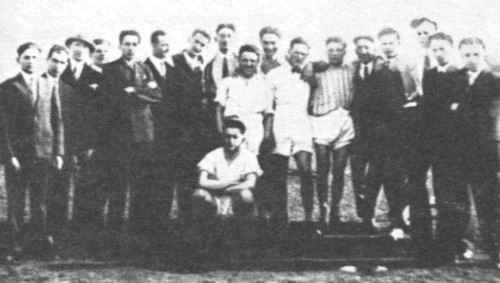
From right: /-/, O. Neselrot, M. Jacubowicz, /-/, D. Broner, S. Ehrenhalt, H. Rik, R. Neselrot, W. Petzenbaum, M. Neselrot, Dr. J. Tafet, /-/, J. Zimmerspitz, H. Melman, H. Friediger J. Kluger, M. Kriszer Weinlez Sitting: Ch. Balamut |
The association held various sections: gymnastics, rhythmic, athletics, ping pong, basketball, tennis and soccer. The lessons were held in the club, except for the last three sections, whose training was held on the empty area in front of the barracks on Third of May Street and then by the “Venice” restaurant.
The instructors were Shimon Ehrenhalt, Idek Eagle, Paul Forster and Olek Korengut.
[Page 141]
Great achievements were achieved by the basketball, tennis, and ping pong teams, who won games against Polish sports teams in Wadowice and nearby cities and the teams moved up to a higher league. The basketball team played against excellent teams, such as “Beskid Andrychów” (a Polish team) and “Maccabi” Andrychów. In the competition, it achieved the first place and thanks to that it was included in the First League of the Krakow region.
The football team played against the Polish team “Skawa” in Wadowice in the presence of crowds of the Polish population.
The association included about 100 athletes. In addition to them, it also had amateur members who paid monthly membership fees. The congregation wholeheartedly supported this organization, which was completely non-partisan and covered its budget solely from membership fees without needing financial help from any political parties.
The only goal that this organization set for itself in its actions was the slogan, which was so neglected in diaspora life, “A healthy mind - in a healthy body!”
|
|
JewishGen, Inc. makes no representations regarding the accuracy of
the translation. The reader may wish to refer to the original material
for verification.
JewishGen is not responsible for inaccuracies or omissions in the original work and cannot rewrite or edit the text to correct inaccuracies and/or omissions.
Our mission is to produce a translation of the original work and we cannot verify the accuracy of statements or alter facts cited.
 Wadowice, Poland
 Yizkor Book Project
 JewishGen Home Page
Copyright © 1999-2026 by JewishGen, Inc.
Updated 28 Aug 2026 by JH