According to the situation from 1938
 |
 |
|
|
[Page 198]
Ninth Chapter
In the ghetto
Translated by Mira Eckhaus
The establishment of the ghetto
Ghetto Wadowice existed from July 3, 1942 to August 10, 1943. Wadowice was for many years a blessed city, a center for the cities and towns in its vicinity, because it had a concentration of many district offices. And yet this status of a central city, instead of being a positive advantage, became a negative one when the central ghetto was established there for all the Jews of the area, the same ghetto that was their last stop before Auschwitz.
Here in Wadowice, the Jews of the area were concentrated, because it was not worthwhile for the Nazis to open separate ghettos in each city. As we described above, shortly before the Aktsia of July 2, 1942, some of the Jews from the towns of Kenti, Sucha and Zator were transferred to Wadowice, together with some of the residents of Cieszyn Silesia. Those who were considered capable of work were transferred to the “shop” and remained there until July 5th, together with the remaining people from Wadowice, those who had successfully passed the Gestapo screening. After that, they were all transferred under police escort to the ghetto that was established at that time. The ghetto population numbered approximately 1400 people.
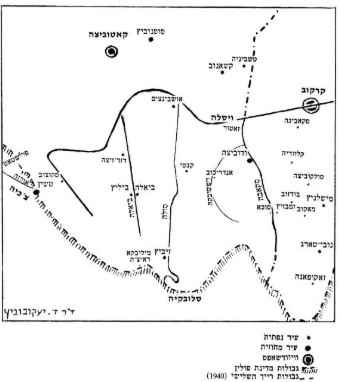
The towns of Kalwaria and Myślenice were not included in the ghetto. They were located across the Skawa River and belonged to the General Government of Poland.
In order to provide a true picture of the ghetto, it should be added that after three weeks after it was established, almost all of the remaining people of Andrychów were transferred there. Shortly thereafter, a large number of them returned to Andrychów, and a small group of foreigners from other towns joined them.
Apart from this, other small changes occurred when the Nazis deported the remaining Jews of the village into the ghetto, as well as the ones who hid there.
The image of the city and its inhabitants had changed greatly. Before the war, almost everyone knew each other. Now at least half of the people were strangers to each other.
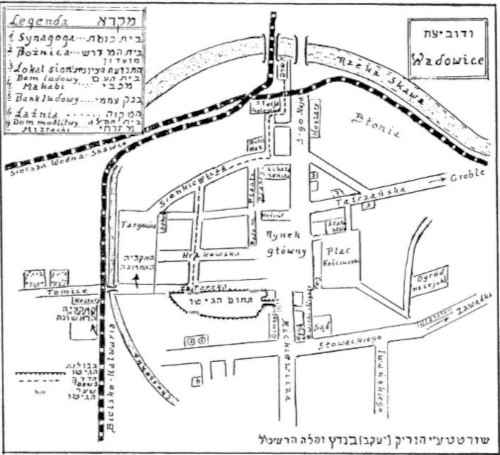
The ghetto area included Midlarska, Karante, Piaskova Streets, including the old Mikveh (formerly owned by the Mark family) and from Zatorska Street on the left side towards Tomica to the Shichter Bakery. In addition, the corner house on the main square, where the Binnenstock family lived, among others, belonged to the ghetto, since the gate of this house led out into the ghetto area on Midlarska Street. The shops in front of this house, whose doors were
[Page 199]
opened into the square, were not included in the ghetto and were annexed to the Aryan side. However, the shop windows were opened into the courtyard of the house, that is the ghetto, so that here was created the opening to the free world, a place to smuggle valuables and letters to the Aryan side. The Jews used these windows as described below for various purposes.
With the exception of Zatorska Street, the ghetto was established in the poorest part of the city, on meager streets reminiscent of the city's oldest days. There were small wooden houses and shacks inhabited by the poorest residents. Most of the houses had long been slated for demolition.
With the establishment of the ghetto, the front gates of the houses on Zatorska Street were completely closed. Every Jew was forced to enter the house through a back gate that led to Piaskova Street. The entire ghetto area was surrounded by a barbed wire fence. In this way, the ghetto was completely separated from the outside world, no one could leave or come in.
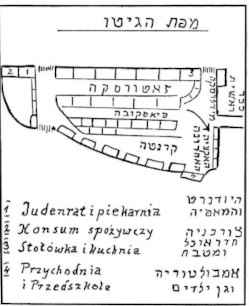
The main gate was arranged on Zatorska Street, next to Shichter's bakery, at the corner of the road leading to the synagogue. A guard of the Jewish militia was posted there, who checked people's entry permits day and night. According to the attached map, there were three more gates on other corners, but they were not always open.
On July 2, when the Germans gathered all the Jews in the barracks area, the Poles quickly left their meager apartments in the area of the ghetto that was to be built, to move into better apartments that the Jews had been evacuated that morning. The Jews entered the meager apartments of the Poles three days later, on July 5.
The ghetto was terribly overcrowded. Approximately 1,400 people could not manage in such a small space. It happened that twenty or more people had to live in one room, so it was impossible for all the ghetto residents to sleep at the same time. When one shift of the “shop” was working, the other took advantage of the opportunity to sleep.
When the Jews entered the ghetto, they were given one-time permission to go to their old apartments under police escort and take certain items from there.
In Adolf Abel's restaurant, a kitchen and dining room were established on behalf of the Judenrat for all Jews under the leadership of Victor Hess, a former hotel owner, and David Scharffer, a former restaurant owner. The kitchen was established out of necessity, as it was impossible to cook in the crowded apartments. A kindergarten was also established on Karante Street, and an ambulatory with a small hospital was arranged under the direction of Dr. Better.
Dr. Bronisław Huppert invested a lot of work and effort in running the kindergarten. His wife Marta and their daughter Anda did the same, with their valuable help in running the communal dining room. With Dr. Huppert's help, elementary school courses were organized on Karante Street for the children of the ghetto, which were run by Maya Vaksberg from Andrychów. The Bronisław Huppert family, as well as its ancestors, had long been famous for their philanthropy and dedication to public work. Even in those terrible times, they did not abandon this family tradition and did much to alleviate the situation of the dying population.
[Page 200]
According to the situation from 1938 |
||||
|
|
[Page 201]
|
|
| City map |
[Page 202]
2. Ghetto life
After days of astonishment that enveloped the city following the train's departure in an unknown direction, life slowly returned to its normal course. Work in the “shop” was difficult and worries about maintaining a miserable life abounded. It was necessary to hide the pain of losing loved ones deep within the heart and adapt to the discipline and orders of the ghetto and the “shop”. There were even people who continued to send packages to the camps, while still living under illusions regarding the fate of the deportees and the future that awaited them.
On the second floor of the Shichter house was the office of the Judenrat. Downstairs, under its supervision, operated the bakery that supplied bread for the ghetto. The community did an important and valuable job in those days; it handed out the apartments and settled disputes. It also took care of sanitary arrangements, unlike ghettos in other places where this vital matter was greatly neglected and many people died even before the deportation, swollen from hunger or infected with contagious diseases.
On holidays, Piaskova Street was as crowded with people as it was in spring. People strolled along the street for their own pleasure, just as they had strolled along “May Third” Street before, taking advantage of every opportunity for entertainment.
On Passover, a joint “Seder” was held in the ghetto for all the lonely girls. The survivors will never forget this “Seder”. Thanks to the efforts of the community, each one received a portion of meat and an egg. Matzahs were also not lacking for the “Seder” table.
The son of the Shochet from Zator was invited to lead the “Seder”. He read the Haggadah with special emphasis and even added explanations and commentary. For each verse of the Haggadah, he found associations appropriate to the present situation. When he listed the plagues that the Holy One, blessed be He, inflicted on the Egyptians in Egypt, all the participants made a comparison in their hearts with today's Pharaoh, in the form of Hitler.
In April 1943, news began to arrive that the Germans had been defeated at Stalingrad by the Russians, that Rommel's army had suffered severe blows in North Africa, until it was forced to retreat, and that the British Air Force was also bombing German cities. This news hinted at the beginning of Hitler's defeat and should have encouraged the Jews, had they not already been at the stage of exhausting their strength and losing their last drop of blood.
Tears like water were shed that night of the “Seder”. Each of the girls who participated in that event was lonely and her loved ones, if they had not fled east, were lost forever. They remembered in this emotional hour the former times, when the whole family sat down to the Seder...
It is worth noting with appreciation the volunteerism and heroism of Anna, the wife of Hirsch Gleitzman, when it was necessary to renew the connection between the ghetto inhabitants and the outside world. Disguised as a peasant, Anna sneaked out of the ghetto and crossed the “Skawa” river barefoot (the bridge was guarded by the Nazis and their assistants) and reached Kłocza Gorna, where the family had previously lived, at great risk. On her return, she brought with her food, medicine, and other items.
A sad incident shook the ghetto: the death of a senior court official, Slovishik
[Page 203]
In previous years he had served faithfully as an officer for the Austrian Empire and the Polish government, and later as treasurer of the district court and director of land registration. He served the Polish state with all his heart and soul. Now he could not bear the humiliation and oppression that was the lot of Judaism, and he committed suicide. His disappointment was even greater, because when the war broke out, he fled with his family to Lviv. In 1940 he crossed the Soviet border, like many others, back to Poland, to fall into Hitler's hell. He refused to put up with the hooligan atrocities and preferred to end his life. Committing suicide, which in normal times was considered a shameful act and was generally forbidden by the Torah (“and you took very good care of yourselves”), was seen this time in a different light. Instead, it was seen as heroism and transcendence above this murky life.
The sorrow and grief were shared by all due to the incident, because the entire population knew him as a very quiet man who helped many people without expecting a reward and who rewarded them with many favors.
It is said that this is how Leon Tyberg, whose deeds for the city were already mentioned in our book, ended his life. When he was transferred in one of the transports to “Dulag”, he swallowed poison pills and died.
3. The Fourth Aktsia – May 10, 1943
On this date, the order to deport one hundred girls to Germany arrived. It came as a surprise because for ten months after the deportation of July 2, 1942, there had supposedly been relative peace. Everyone rebelled against this order and tried to defend themselves against it. It never occurred to the people that it would be easier to survive in a labor camp in Germany until the end of the war, and here in the ghetto death awaited everyone. Families with only one daughter were especially reluctant to obey and comply with the demand. They turned to the “Judenrat” and under public pressure its leaders withdrew and families with only one daughter were released from this decree.
Among the girls taken to Germany were, among others, Pessia Brunner, Mania and Sarah Bader, Ada Becker, Luschka Bleiberg, Hanke Binnenstock, Hela Haas, Schindel Hirschsprung, Erna and Sabia Lefleholz, Bronia Matzner, Leah Neihart, Minda Fierstein, Hanke Kaufmann, Rivka Rosenfeld, Genia and Guscia Reich, and Hela Strauss.
Fate was on the side of these one hundred girls. Almost all of them saved their lives. Since it was an unusual event in the annals of the Holocaust for the entire shipment to be saved, it is therefore appropriate to describe and commemorate what happened to these girls after their separation from the ghetto.
The girls were taken in cars to a Jewish police station in Sosnowiec and remained there for eight days. Among them were several girls, such as Hanke Binnenstock, Sarah Bader, Genia and Guscia Reich, whose parents or relatives succeeded in bringing them back to Wadowice from Sosnowiec with the help of the “Judenrat”. Three months later, a worse fate befell these girls in Auschwitz.
So fatal were these times that if vigorous efforts were made to supposedly save someone and the efforts were successful, it eventually turned out that the success was disastrous. Such a case also happened to the Reuven Scharffer family: the son Romek was weak. When he was selected for shipment to a labor camp in Germany, his father, who was supporting the family of his widowed sister-in-law Bader, agreed with
[Page 204]
the widow that she would send her son Monique to Germany in exchange for his son. The “Judenrat” also gave its consent to this action. After a few months, Romek Scharffer was sent to Auschwitz, while Bader, who was transferred to a labor camp in Germany, saved his life and lived. He now lives in São Paulo, Brazil.
After eight days, the girls were transferred to a dirty “Dulag” barracks in Sosnowiec, where they slept on bunks and received poor food. They were also forced to wait in line for hours to get food. From here, some of them were transferred to the “Dulag” in Annaberg. In this camp, most of the prisoners were hungry and weak Jews from the Netherlands. There they would run around like hungry wolves after potato peelings. Many of them dropped helplessly like flies, from lack of food and terrible sanitary conditions. The girls from Wadowice were more capable to manage with the hard life in the camp, as they had experienced three years in a pseudo-ghetto and almost a full year in a closed ghetto.
The Annaberg camp left the most somber memories in the hearts of those who survived - screams and brutal beatings.
From there, the girls were sent to the aviation weapons workshops in Kaltendorf, to work as seamstresses. Some time later, the group was divided. Twenty girls were sent to the Reichenbach camp and from there to Langebielau, and the rest to other camps. Life in Langebielau was unbearably difficult. Transports of prisoners from Auschwitz arrived there, mainly Hungarian Jewish women, who were dressed in gray robes and had their heads shaved. Whenever such a transport arrived, all the prisoners were forced to appear naked before the Gestapo committee.
The “Lagerfuhrerin” Märzchik treated the prisoners in this camp with boundless cruelty. Armed with a whip, she used to inflict at least twenty lashes with great cruelty for petty sins or minor disciplinary infractions, even when she heard conversations between the prisoners on the other side of the wall before going to bed. Punishment for such a “criminal offense” affected one prisoner from the Wadowice ghetto, who returned from Märzchik's office with blue marks on her body.
Another part of the girls was sent from the “Dulag” in Sosnowiec to a thread factory in Gabersdorf. The living conditions there were the best of all the camps.
At the end of the war, almost all of these girls were liberated by the Soviet army and for a short time they moved to the nearby town of Reichenbach, where they lived in the apartments of Germans who had fled the Russians. Then the girls set off for their hometown.
4. The last Aktsia on August 10, 1943 - Tisha B'Av
After the deportation of the hundred girls, sad news came from other ghettos. The Warsaw Ghetto Uprising was suppressed in April. Fifty thousand Jews preferred to die heroic deaths in the ruins of the ghetto rather than go to Treblinka. The angel of death raged in the Polish ghettos.
It was clear to the Jew of Wadowice that the same fate awaited them, and that its execution was postponed by the Nazis only for technical reasons. After the United States entered the war, the pace of the extermination of Jews increased and progressed at an enormous speed.
However, good news also began to arrive from the fronts. After the defeat of General Rommel's army on the African front, Polish Jews tended to console themselves that the Allied countries were certainly planning an invasion of the Balkans through Yugoslavia. From the German press it was
[Page 205]
clear that the partisans control entire areas there. The Jews therefore expected the Allies to reach Hungary through Yugoslavia and from there to the Polish borders, thus the Jews in the last ghettos in southern Poland - including the Wadowice ghetto, will be saved.
In May, the Allied armies did indeed launch the offensive, but not through the Balkans, as hoped, but rather in Sicily. After the conquest of Sicily, they encountered fierce resistance from the Nazis and the Italians, and progress was halted. The salvation that the Jews of Poland had hoped would arise from the victories of the Allied powers did not arrive in time. In the meantime, the Nazis accelerated and sped up the wheels of extermination, and the fate of the three and a half million Polish Jews was sealed along with the fate of the remaining Jews in all the Nazi-occupied countries.
There was also a major change on the Eastern Front. At Stalingrad, the Germans suffered a crushing defeat. This news was confirmed in both the German newspapers and radio. The Russians recaptured the territories they had lost and trapped the Germans. But the Russian front stretched thousands of kilometers from southern Poland, and it was almost certain that rescue would be late in coming.
In view of the approaching death, the pace of work in the “shop” slowed down and slackened. The people realized that with their diligence and dedication to work they would not be able to please the executioners. The foremen saw the desperate atmosphere and shut their eyes without reacting.
At the beginning of August, Wadowice remained the only ghetto in the entire region. The liquidation of the other ghettos came to an end, as follows:
Only now did the eyes of the leaders of the “Judenrat” in Wadowice open, who until now had been living under the constant illusion that the Nazis would leave at least them and a few other people alive. Now, at the last moment, these, headed by Meirchik, tried feverishly to seek ways of salvation by escaping to the Slovak border. For this purpose, they sent loyal Polish emissaries to Zuardon, which is near the Slovak border, but it was already too late.
Even in the ghetto itself, they were looking for ways to escape at the last minute. There was information from Wieliczka that it was possible to cross the border from there through muszyna. But unfortunately, it was impossible to sneak with elderly parents via the “Skawa” river, which was well guarded by the Nazis.
Paula Klein did a heroic deed. She sneaked with her child to the Aryan side, approached Father Prokhovnik and begged him to save her daughter from death. He advised her to enter a monastery. When this plan failed, she turned to the family of the widow of Orish Goldberg, who had previously owned a restaurant in Świnna Poręba. One of her daughters married
[Page 206]
with a sergeant major of the Austrian gendarmerie. According to Ms. Klein's hypothesis, the deportation order did not apply to a converted Jew if his partner was of Aryan race. And indeed, the girl found a hiding place in this family, but only for a short time, because they too had troubles. It turned out that the widow belonged to the Aktsia deportees. Ms. Klein was therefore forced to take her daughter out and look for a new place of refuge for her.
A group of people tried to dig a tunnel in the basement of the Brunner House, near Zatorska Street. On the other side of the street, which belonged to the Aryan part, lived Polish citizens who previously had good relationship with the Jews. The said street was a central and wide street. Therefore, a lot of digging work was needed and countless buckets of soil were secretly moved to another place, so that the secret would not be revealed to the neighbors. At the last moment, new people joined the work. However, when the shovels advanced to the Aryan side of the street, they were forced to stop the work, because Zatorska Street had meanwhile been filled with Gestapo men and the noise of the shovels digging could have revealed the plot to them.
On the eve of the liquidation of the ghetto, on August 9, 1943, S.S. man Jakubek entered the shoe shop of Heshko Neiman at night and took back his shoes that he had previously given for repair, while they were still unfinished. Neiman told his neighbors about this and so the matter was passed on by word of mouth and the news reached all corners of the ghetto. Many considered this as a hint that the “Aktsia” would take place the next day.
The Jews packed their belongings all night, sewed backpacks and prepared themselves for the final journey. It was the night of Tisha B'Av, the day of national mourning, a day that has been a disaster for our people for ages.
And indeed, the next morning, Gestapo soldiers burst into the ghetto armed with rifles, posted guards at every entrance, making any resistance or escape impossible. The Jews were ordered to leave their apartments and go out onto Zatorska Street.
At the concentration area, the names of the people were read out according to a list prepared in advance. The Gestapo man announced that the “shop” was moving to Auschwitz, where the people of our city would continue their work and were even allowed to take any belongings they had with them. This was a deliberate lie intended primarily to deceive the victims, so that they would cultivate a false illusion in their hearts that they would continue to live a “shop” life there, and also to encourage them to take the rest of their property, so that it would be easier for the Gestapo men to inherit the victims' property after they had murdered them with their unclean hands.
For this “Aktsia” they specifically chose Tisha B'Av. This method was common among the Nazis - to begin extermination operations on a Jewish holiday or a National Day of Mourning for the Jews - in order to satisfy their sadistic instincts and more cruelly suppress the emotions of the victims. This time they chose the National Day of Mourning, the day of the destruction of the Temple.
Words cannot describe the crying and grief of that day, when everyone knew what awaited them and saw before them only a barbed wire fence all around, rifle butts and machine guns on every side, which denied them any possibility of escape.
The deported Jews were lined up in rows. The old, weak, and disabled were taken out on stretchers. The image of the sick old woman Shusterman Maskotsov, Adolf Abel's mother-in-law, being taken out on a stretcher from his house on Zatorska Street was shocking. Her daughter begged
[Page 207]
the people to help her carry the stretcher. This was the funeral of a living human being, who had not yet been redeemed by the redeeming angel, the angel of death.
The Nazis marched this parade of the unfortunates to Targowice Square, to the place that had been prepared beforehand for the “Aktsia” and surrounded by a high fence. The S.S. people ordered Meirchik, head of the “Judenrat”, to collect all the money and jewelry in the possession of the victims and hand it over to the Gestapo. Meirchik approached each and every one of the Jews and convinced them to hand over the money and jewelry in their possession, and then no harm would come to them.
Tszka Arnhalt Yakubovich took out bills from her pocket and tore them into pieces in front of Meirchik, declaring loudly: “We should also give them our money?”
Among the victims was a violinist from Bilitz, who, at the request of the Gestapo, began playing cheerful tunes. The Jews begged him to stop playing, because it reminded them of the worst version of “Ma Yafit”.
Around noon, after Meirchik's pleas to hand over money no longer worked, the victims were ordered to continue on their way to the train station. There they were all loaded onto carriages. The overcrowding in the carriages was terrible. In the train service compartments, police officers armed with firearms sat, ready to shoot if anyone tried to jump out of the carriage during the journey.
The above details are described according to information provided by Hanke Binnenstock Gross, who was present at this shipment and survived.
The further fate of this death train is described below in the article: The Fate of the Jews from the Wadowice ghetto in Auschwitz.
5. The fate of the people who hid in the bunkers
Panic and chaos reigned in the ghetto at the time of its liquidation. Only the two ladies, Laza Rumlet, the daughter of Rabbi Asher Anshil Yitzhak Zeltenreich, and Breindel (Bronislava) Brunner, the widow of Joseph Brunner, did not lose their temper. The latter was not deterred by anything and at that very moment, when life in the Wadowice ghetto died down, she led a group of people to the attic of her house, which was suitable for a hiding place. There she, her daughters Pella and Paula with her family, the Shmuel and Israel Schreffer families, Geminder, Anna Gleitzman with her two children, a relative named Hania Katz, who had come from Makow, and two other Jews from Zator hid.
Although the Nazis searched for escapees in all the places and basements of the ghetto, they miraculously did not enter this hiding place. These people hid there all day without food or drink. The next day, Pella Brunner and the people from Zator left this hiding place and went to the nearby abandoned apartments and brought food and water to all the people.
Of course, twenty-three people could not stay in a small hiding place for long during the hot summer days. Therefore, it was decided that each day, before dawn, they would quietly leave the hiding place one by one. The first step was taken by the three people who managed to bring the first food.
And so they did: they crossed the ghetto's borders and approached a Polish woman in the city who hid them in the basement and also promised to send a guide to the ghetto who would also take out the people who remained in the hiding place and take them to a safe place. From the secret information that had reached the ghetto even before that
[Page 208]
they learned that at one point in the nearby mountains there was a chance to cross the border and reach Slovakia. They tried their luck desperately and thus managed to cross the Polish border and reach the town of Tsatsa. From there they sent the Polish woman a postcard with instructions in initials on how and where to cross the border. The postcard also included the address of the guide who would take them across the border.
The Polish woman kept her promise and sent a guide to the ghetto, who at night helped everyone get out of the hiding place. First to leave was Breindel Brunner with her daughter Paula and her 3-year-old son. Paula approached the Oris Goldberg family, where her daughter was hidden. Then she wandered for a while with the children in Wadowice and finally managed to cross the Slovak border. When the war ended, she returned to Poland.
A tragic fate befell her mother. She hid in the city after coming out of hiding, but after a few days she was found by the Nazis and all traces of her were lost. Her image remains etched in our memory as a noble, active woman who helped the poor.
The same fate befell the rest of the people. After they left the hiding place, they hid outside the city in the house of a farmer named Vasil, who faithfully strove to save them. Anna Gleitzman, a woman of extraordinary courage, visited loyal farmers in the area and brought food and news from the Polish woman mentioned above. From her, she received the postcard sent to her by Pella Brunner from Tsatsa.
The people in hiding began the preparations to leave for the Slovak border, when suddenly the Gestapo appeared nearby. Vasil hastily harnessed horses to a cart and the entire group, numbering about twenty people, was loaded onto the cart and set off. But in the middle of their journey, in an unknown place, the cart was stopped by the Gestapo and all the passengers in the cart were shot on the spot, along with the farmer Vasil.
It is believed that the Gestapo sent telephone messages to all points on the way to Slovakia, with instructions to investigate and search for a wagon with fleeing Jews, and that is how they were discovered.
The families of Laza Rumlet and the pharmacist Spiegel tried to escape in a different way that same Tisha B'Av. They managed to sneak to the Aryan side through the barbed wire and through Karante Street, from where, through the back gate of a cake bakery (Herlik) whose front faced Mickiewicz Street, they secretly entered the attic of the house.
Here was already the wife of Lustgarten (a former printing house owner) who was deported with his children last year to Belzitz. This woman, despite being so damaged by the horrors of the Holocaust, still tried to save her life. But, as she was saying, rescue was impossible without money. As she knew where in the ghetto were hidden dollars, she left her hiding place to get them. After she left, she never returned.
The next day, hunger began to plague Mrs. Rumlet's children and she was forced to leave the hiding place. At night, she went with them to her apartment in Kosciuszko Square, where they had lived before the ghetto was established. The landlady agreed that they would hide in the attic. When hunger again plagued them, the son Yona dared to go out into the street, in order to look for potatoes. But as soon as he went out, several Polish boys approached him and, shouting “Zydek is going”, dragged him towards the police.
All this happened in front of the mother, who looked out of the attic window and saw
[Page 209]
her son struggling with the angel of death, who was lurking for him and was getting closer to him with every step he took. Leaving the house to save her son from the Polish boys or going to the police and begging for her son's release would have put her daughter's life and her own at risk. In order to save at least her daughter's life, the unfortunate mother had to suppress the pain in her heart.
As it turned out later, the boy Yona Rumelt was tortured cruelly, so that he will reveal his family's hiding place. However, he did not reveal the location.
Due to the lack of food and the constant fear that they would eventually be discovered, it was impossible to remain in this attic. After a few days, Mrs. Rumlet and her daughter left the place and walked towards the Slovak border. Their outward appearance was Aryan and they spoke fluent Polish. At that time, the Poles were being deported from Trzebinia to the districts on the Slovak border as punishment for acts of sabotage in train transport, and they therefore had an excuse to justify their migration towards the Slovak border. But none of this helped. On the way, the encountered Israel-haters Poles who recognized their origin and refused to give them a place to stay, and they could not obtain food for this reason. Even when they begged them, the Poles hardened their hearts and threatened to hand them over to the Gestapo. Due to the fear of being discovered, and lack of food, the two were forced to return to the city and go to the aforementioned landlady, where they found hiding place once again.
Here they came into contact with a local acquaintance, who helped them leave the city and reach the Slovak border again. While she was still in the ghetto, Laza Rumlet received letters from her brother Rabbi Shmuel Avraham Zeltenreich (now in Brooklyn), who wrote to her in a coded language, stating that there was a possibility of sneaking into Slovakia through the border at Muszyna.
This acquaintance volunteered to act as their guide, accompanying them by train to Kalwaria and from there via Krakow to Wieliczka. There they managed to contact a new guide, who helped them and another small boy, who was disguised as a girl, travel by train to Muszyna. From there they crossed the border via mountain paths.
David Yakubovich, the son of Yehoshua, was this child. He was given to them when they stopped briefly in Krakow on the way. His mother, who was exhausted and felt the end approaching, dressed him in child's clothes and thus he traveled all the way from Krakow to Slovakia.
Thus, Mrs. Rumlet managed to save her life, the life of her daughter, and the life of David Yakubovich. Of course, their wanderings did not end there. After the bitter experience of the Jews of Poland, they knew in advance what awaited the Jews of Slovakia. That is why they hurried and left for Hungary. When the ground began to burn under the feet of the Jews here too, they sneaked across the border to Romania.
Meanwhile, the war had come to an end and Mrs. Rumlet traveled with her daughter to Antwerpen. David Yakubovich moved around in all sorts of places until he finally arrived in Israel.
Fate was cruel to the pharmacist Spiegel family, who also hid in a hiding place on Mickiewicz Street. They left the hiding place before the Rumlet family. At night, they went to the gardener on Zatorska Street, who had promised them while they were still in the ghetto, that they would be able to find shelter with him in times of need.
A few days later, the Gestapo discovered the place. Apparently, someone had tipped on them to the Gestapo. They immediately came and killed everyone.
One of the violinist Goldberger's daughters also hid in the ghetto, but she was also found
[Page 210]
By the Gestapo. Friedrich Wiszczyk, Slo's son, one of the only young men to survive the deportations to Germany. He managed to escape the ghetto and hide with a Pole when the Aktsia began, however because someone tipped on him, the Nazis came to the hiding place. He tried to escape by going down the house's rainwater gutter, but dogs unexpectedly attacked him and so he fell into the hands of the Gestapo and was sent to Auschwitz.
The summary of this chapter, which describes the last attempts of those who somehow managed to evade the executioners and hide in bunkers and other hiding places, is: Of the approximately forty people who were in hiding places, only eight saved their lives (five adults and three children). Approximately thirty-two precious souls perished.
This article proves that the desire of the Jews of Wadowice to stay alive was strong, and their courageous struggle against the Nazi beast will testify to this. This struggle with superhuman powers was hopeless. The small remnant of the eight was miraculously saved, as they saw death dancing before their eyes at every turn.
6. The fate of the Jews from the Wadowice ghetto in Auschwitz
On August 10, 1943, after the train from Wadowice was unloaded in Brzezinka, an order was given to leave the cargo in place and enter the semicircle surrounded by S.S. men. In the middle of the circle stood the camp doctor, Dr. Mengele. In one of his white-gloved hands, he held a small stick, with which he sorted the victims. If he pointed the stick to the right, it was a sign of life, that is, to a labor camp. If to the left, it was a sign of the gas chambers, for extermination.
Those who were selected for death were loaded onto trucks and immediately taken to the gas chambers. Among them were young girls who were still able to work, such as Sela Langer, Tseshka Arnhalt (Yakubovich), Frida Arnhalt, and Hania Scharffer, Reuven's daughter. They were taken to death because their selection was carried out after the quota of 195 women who were sentenced to remain alive was already full.
In the trucks were, among others, the chairman of the “Judenrat” Barish Wolf, the previous chairman Reuven Scharffer with their family, and Baruch Meirchik. The Nazis did not spare their lives either. One can imagine the despair and disappointment of Wolf and Meirchik when they realized that this was the payment and reward for the loyal service they had rendered to the Nazis.
This Meirczyk, as described above, only a few hours before his death, during the roundup of Jews in Targowice Square, obediently carried out the Nazi order by taking the last penny from the pockets of the victims. He served the Gestapo diligently not only in Wadowice, but also in Andrychów, as described below in our book in the chapter on the Holocaust of this community.
In those days, the Nazis were already aware that they had lost the war, and in order to cover up the traces of their murder, they would remove hundreds of thousands of corpses from the mass graves and burn them. How could they afford to leave alive the members of the “Judenrat”, who in the future could potentially be the most powerful prosecution witnesses who would tell the judges of justice about the Nazis' deeds?
The most shocking event was the image of the boy Dudek Binnenstock, who on the last day in the ghetto and later on the train was instructed to join the young people and, in this way, save the
[Page 211]
his life. When he stood in the semicircle and the young man standing by him was taken, he ran and cried out: “To whom do I belong?” and again he clung to one of the young men. When this happened several times and he again sought a guardian, a shot was fired at him and the unfortunate boy fell dead on the ground and died in front of his family.
The group, which included 195 women, and some of the aforementioned men, were sent to the nearby labor camp. There, the women's hair was cut, their heads shaved, and they were dressed in prisoner clothing.
Among them were Mrs. Blitz with her daughter Rosia, Sela, Hanke and Ella Binnenstock, Lotka and Etka Einhorn, Rivka Scharffer, Sabina Fierstein, Marta Huppert, Dr. Bronislaw's wife with her daughter Wanda, Rosalia and Antonina Hass, Mela and Dove Kaufmann, Yenta Littner, Rivka Frischer, Zosia Grobner, Rosia Lieberfreind, Erna Schantzer, Zilla Schwabel, Guscia and Rennia Reich, Gusta Torton, Bosca Tyberg, Elvira Wissik, Genia Zimmerschitz and more.
Initially, they were sent to the quarantine block No. 20, where they were held for a certain period of time. This block housed many cases of contagious diseases, and in this way the Nazis thought they could finish off the victims. As a result, most of them contracted these diseases, mainly typhus. They either fell ill from exhaustion and died on the spot or in the gas chambers, to which they were sent at the last moment before their death.
This is how Marta Huppert and her daughter, Sabina Fierstein, Rivka Frischer, Zosia Grobner, Mela and Dove Kaufmann, Erna Schantzer, Gusta Torton, and Elvira Wissik perished in this terrible block.
It was very easy to contract typhus. At that time, shipments arrived from Greece with people who, due to the long journey and terrible sanitary conditions, became ill and weakened and masses died from this disease in the quarantine block. In addition, the Nazis deliberately poisoned the drinking water with various bacteria. Unlike the Greek women, the women of Wadowice were used to the Polish climate and already adapted to life in the camp. They would have had a chance of passing the quarantine test, too, if it had not been for the Nazis' poisoning of the water.
Those who survived this terrible quarantine block were sent to a work block. According to the information we received, only Erna and Lucia Glicksmann, Genia Zimmerschitz, Zilla Schwabel, Berta Wurzel, Karola Horowitz, and Hanke Binnenstock were ultimately saved and remained alive. The latter was sent to block no. 6 and once met by chance near block no. 20 with the former teacher of “Beit Yaakov” in Wadowice, Zilla Naigerschel, who served as a registered nurse in the Auschwitz camp. Hanke Binnenstock was desperately searching for drinking water there. Zilla Naigerschel, who recognized her former student, warned her of the danger of drinking the water and wrote down her number.
A few days later, another nurse, a Polish woman, appeared in Block No. 6 with blankets. Using that number, she found Binnenstock and wrapped her and the neighbor who was lying next to her, Bosca Tyberg, in these blankets, and brought them to another block that was populated only by Polish prisoners, who were not expected to be exterminated. In this way, they were saved. One day after this, all the women from block No. 6 were sent to the gas chambers. The noble Zilla Naigerschel now lives in Jerusalem.
[Page 212]
However, the end of Bosca Tyberg, for whom fate had seemingly played in her favor, was cruel. One day, the S.S. people appeared in her block, called out several names of women and ordered them to enter the gas chambers after 3 days. Her name was among the names. Usually, the intended victims were sent to the gas chambers immediately after the selection, so that until the last moment of their lives, the prisoner clung to the illusion that he would be saved from death and sent to work. But this time, things were different.
It is impossible to describe Tyberg's mental state during the three days she waited for her execution. She burst into tears and said that she could already feel the suffocation in her throat. She lived with the clear knowledge that after three days she would be suffocated and envied those who had already been exterminated, who until the last moment were hopeful that their lives would be saved. This is how Yosef Tyberg's wife perished.
Zilla Schwabel was miraculously saved. Her father Shimshon, her mother Chaya, and her brothers Alek and Yitzhak perished in Auschwitz. Although the first initially managed to escape to the city of Lviv, unfortunately he was not sent to exile in Russia. He returned from Lviv to Tokhov. In Tokhov, the murderous hand of the Nazis overtook him.
Thus, most of the Schwabel family, who were loved by all the people of our city for their kindness, integrity, and help to those in need, perished in this terrible camp.
Among the young men who, like the 195 women, were not immediately sent to the gas chambers but to work, were Shimon Blitz, Yaakov Binnenstock, Yanek Glicksmann, Yitzhak Hornung, Dolek Tieberger, the son of Heinrich, Roman and Sigmund Levenberg, and Monique Klein. They did not survive in quarantine block No. 20 and died there from exhaustion or typhus, or were sent to their deaths in the gas chambers.
They were young people, and this fact influenced their deportation to labor. But other Nazi criminals tried to eliminate them in a short time in the quarantine camp.
As described above, Friedrich Wiszczyk was deported to Auschwitz separately and because of his escape from the ghetto he was considered a political criminal. He did not go to the gas chambers, but was included in the list of political prisoners sentenced to hard labor. For this reason, he had a chance of being saved, but he contracted a serious illness – “furunculosis” due to vitamin deficiency. When he was released, he died of exhaustion.
Sigmund Levenberg managed to escape, through the sewer pipes, to the sawmill Barber in Yarosowice, where he hid. When he was not careful once and went outside, he was caught and handed over to the Gestapo.
7. Saving the Children of Aharon Krischer (Weinlez)
Aharon Krischer, the son-in-law of David Gelbwax, who was the son of the Dayan Rabbi Shimon Gelbwax, stayed in the ghetto with his wife and their two children, Alinka, who was born in 1939, and Rosia, who was born in 1940. When the “final solution” approached, Krischer took the two girls, one in his hand and the other on his shoulder, sneaked out of the ghetto and managed to enter with the girls into the village of Butzkowice, near Biala. There he left them with a housewife who had been his long-time acquaintance. His wife refused to leave behind her parents.
[Page 213]
Krischer never returned to Wadowice again, because in the meantime the ghetto had been liquidated and his wife and her parents had been taken to Auschwitz. He told loyal Poles in Bilitz about the bitter fate of his family and the hiding of the children in Butzkowice. After that, he wandered to various places and perished. It is believed that he was shot by the Nazis while trying to cross the border.
The girls Alinka and Rosia were kept in the village and herded geese. When, at the end of the war, a Jewish committee was established in Bilitz, the aforementioned housewife appeared before the committee and gave the girls' place of residence and took food packages for them.
When the news reached the Committee for the Rescue of Jewish Children in Lodz, whose job it was to search for children who had survived the Holocaust, it sent a suitable person to Butzkowice who managed to take the girls and transport them to Lodz. From there they were transferred to a children's camp in Marseille.
Here their traces were lost, because the camp was liquidated over time. The Krischer girls were particularly difficult to find, since they did not know their last name, after being separated from their parents at the age of 3-4, and knew nothing of their past. Relatives who had heard of their rescue from the aforementioned Poles searched for them.
After extensive searches in archives and various lists, including with Rabbi Schoenfeld in London, who treated many of these children, it became clear that in 1947 a wealthy American woman named Barker appeared in the Marseille camp, adopted the two girls as her daughters and transported them to the United States. There they were raised in this family in the city of Sunset. The granddaughters of the Dayan Rabbi Shimon Legbewax were lucky; they grew up in a traditional atmosphere and a wealthy family. One of them is now married and her last name is Schwartz and she lives in New Jersey. She has two children. The other, Ruth, graduated the University. When they learned about their real family in Israel, they quickly contacted it.
[Picture – Feiwel Weinlez]
It is appropriate to also commemorate the memory of their grandfather in this place, Feiwel Weinlez. He fled to Grodek Jagłonski. During a Nazi Aktsia, he was ordered to dig his own grave with his hands and then he was shot. Weinlez was a milkman in our city for many years, a faithful and devoted observant man. Every day before dawn he would go out with his children to the nearby estates to supervise the kashrut during milking. He had a kind heart and was devoted to the poor, and although he was poor himself, he provided them with milk on credit and waited a long time for payment. He remained a widower with eleven children, and despite this he took in three more orphaned children from the Weiss family. There was a Zionist atmosphere in his home and his children were active in the Zionist movement. In the review of the Zionist movement (see above) it is described how his two daughters, Hava and Naomi, immigrated to the Land of Israel after the end of the “training” period, before the war. Today his remaining children also live in Israel: his daughters Rosa Zilberman and Matilda Schmelzbach and his sons Meir, Chaim and Avraham.
[Page 214]
8. Causes of the total Holocaust of Wadowice Ghetto
People who were never in the ghettos sometimes make comments about Polish Jewry and ask: Why did they go like sheep to the slaughter, why didn't they defend themselves? Why didn't they flee?
The Eichmann trial in Jerusalem revealed the reasons that made the uprising against the Nazis and the escape to the Aryan side almost impossible. These were:
First of all, Wadowice was a small town and the Jews and Poles there usually knew each other well. The Poles also knew the Jews from the nearby towns who had been exiled to Wadowice, since before the war they would come and visit in Wadowice, either to participate in trade fairs or to arrange their affairs at the district offices.
Therefore, compared to other ghettos established in large settlements, it is understandable that leaving the Wadowice Ghetto was associated with exceptional danger. Even the first or at most the second Pole who met a fleeing Jew had no doubts about his origin. It is no wonder, then, that among the few families who sneaked out of the ghetto, victims fell immediately after the escape, such as the Rumlet, Spiegel, Brunner, Frydek, and Vishik families.
The fatal structure of the ghetto made the means of rescue even more difficult, and terrible difficulties arose because of it. In other places[1], lives were often saved in this way: when the sentry at the ghetto gate was at the other end of the gate, the escapee jumped through the wire surrounding the ghetto, or climbed a ladder, and passed to the Aryan side and was immediately swallowed up by the crowd of people going to work, and thus managed to reach a train station and continue his escape.
This was not the situation in the Wadowice Ghetto. As can be seen by the map provided in the book, the gate next to which the Nazi sentry or the Jewish militiamen stood was so narrow that any attempt to escape was doomed to failure and was impossible. The streets of Wadowice were quiet and there were very few passers-by on the Aryan side, so that it was impossible to mix among them without being recognized and without attracting any attention.
[Page 215]
In other ghettos, it often happened that a car equipped with forged documents, or whose people were disguised as S.S. officers, entered the ghetto, loaded with people, and took them out to the Aryan side.
An operation like this was also considered impossible in a small town such as Wadowice, where everyone knew each other.
Unlike other ghettos, there were no friends on the Aryan side of Wadowice who would supply forged papers. And, by the way, what use could such papers be when everyone knew each other and were also collaborators among the Poles?
In a small town such as Wadowice, there was no uprising movement, no partisans, and no underground organizations were formed like in other areas (e.g., Vilnius), which would have encouraged people to flee and provided aid to the fugitives. There was no “hinterland” that could have secretly contacted the ghetto and secured shelter and the weapons needed during the escape.
A significant obstacle was the location of the ghetto, near the border of the “Third Reich” which ran along the “Skawa” river. To leave the city, it was necessary to pass through passport control over the “Skawa” bridge. There was no green border (a forest border, etc.).
In addition, the nearby towns of Kalwaria, Myślenice and Suka were completely empty of Jews at the time of the final liquidation of the Wadowice Ghetto, and because of this, it was impossible at the final stage to establish even informative connections with the outside world, in order to learn what was happening in the surrounding area.
There was an escape point in Muszyna, by the Slovak border, whose executions began in Wieliczka.
In the last months before the final liquidation, Rabbi Shmuel Avraham Zeltenreich wrote letters to his sister Letzka Rumlet, in which he called in coded language to secretly leave the ghetto and reach Wieliczka. Mrs. Rumlet showed the letters to her neighbors Dr. Bronislaw Huppert and Rosa Kluger (the wife of the last community chairman), they replied and told her in despair that in the local conditions of the Wadowice Ghetto, it was impossible to think about it. Because death lurked at every step.
As our townspeople remember, the above-mentioned families excelled in energy and special initiative, and until 1939, luck always favored them, but in the Wadowice Ghetto, all intelligence and initiative were stifled. Everyone knew that at the train station in Kalwaria, when transferring from a Wadowice train to a second train heading towards Krakow, there was a railway official who would follow each passenger and, if he was Jewish, hand him over to the Nazis.
In light of the above, it is now clear in its entirety the terrible tragedy that befell the Jews of Wadowice and the reasons why, out of 1,400 people in the ghetto, only eleven survived in the end, and they are four people from the Brunner family, two from the Rumlet family, two children from the Krischer family, Ziga Arnhalt, and two people from Zator.
It is possible that a few more were saved. It can therefore be stated with certainty that not even one in a hundred Jews of the Wadowice Ghetto survived the clutches of the executioners. Approximately 1,390 people were trapped in the Nazi inferno and were exterminated. If after the war it would turn out that, apart from these eleven people, a number of other Jews from Wadowice, who were in Nazi captivity, remained alive, it would be only because in the years 1940-43, there were four
[Page 216]
shipments to labor camps in Germany, where the death machine did not work at such a fast pace and with such diligence as in Poland.
It is impossible to make an exact calculation of how many people escaped from these shipments. A rough estimate can be made as follows:
Sent to work:
In the first shipment, on Sukkot 1940, to Gleiwitz and from there to Utmot, - about 100 people In the second shipment, in April 1941, to Gogolin - about 50 people In the third shipment, on July 2, 1942, to Skrau and Gross Rosen - about 50 people From the fourth shipment, on May 10, 1943, of 100 girls to the Sudetenland, the city of Wadowice, which contained half of the ghetto's population - about 50 people Total 250 people
It is assumed that about a hundred and fifty of them survived. Some came to Israel and some were scattered all over the world.
It is also worth taking into account the seven women who survived the last transport to Auschwitz and 2two girls who escaped from a group suspected of communism, as described above. Perhaps a few more people were saved in Auschwitz. In summary, it can be determined that in total about a hundred and seventy residents of Wadowice were saved from the ghetto. This picture is very sad and shocking, if we take into account that before the war there were about two thousand Jewish residents in our city.
Many people from Wadowice, who managed to escape to the east, also perished in the Holocaust, after the outbreak of war against the Soviet Union in June 1941 and the occupation of eastern Poland by the Nazis.
Original footnote:
|
|
JewishGen, Inc. makes no representations regarding the accuracy of
the translation. The reader may wish to refer to the original material
for verification.
JewishGen is not responsible for inaccuracies or omissions in the original work and cannot rewrite or edit the text to correct inaccuracies and/or omissions.
Our mission is to produce a translation of the original work and we cannot verify the accuracy of statements or alter facts cited.
 Wadowice, Poland
 Yizkor Book Project
 JewishGen Home Page
Copyright © 1999-2026 by JewishGen, Inc.
Updated 26 Jul 2026 by JH