 |
|
|
[Page 30]
Public Life
(Public and Religious Institutions)
Translated by Mira Eckhaus
The field of activity of the Wadowice community was quite extensive, according to its founding regulations. Its authority extended to the Jews of the city and the Jews of the villages that were subject to the jurisdiction of the Wadowice Magistrates' Courts, such as Brewald Dolny and Szardny, Gożyn Dolny, Chocznia Fridźrichowice, Kłacz Dolny and Gorna, Skawca, Tomica, Tarnów, Woznicki and Zambęsz.
According to the above, the number of village Jews in this area decreased dramatically at the end of the 19th century, and by the outbreak of World War I there were only a few families in all these villages, except for the village of Zambęsz, which was famous for its developed leather industry, where 25-30 Jewish families remained until the Holocaust.
The roles of the community were:
We will discuss the important roles played by the rabbinate, the synagogue, the houses of prayer, and the cemetery in detail later in the book.
The slaughtering franchise and the cantorship (hazanut) position were inherited in the Avraham Miller family, namely to him, his son-in-law Tuvia Einhorn, and his son Ozer Miller.
A special paragraph in the seventh chapter: Personalities and Figures, is dedicated to the memory of Avraham Miller, who was one of the community's oldest and most respected elders, and his son-in-law Tuvia Einhorn.
Ozer Miller, who was meticulous in observing the mitzvahs, served as a shochet and bodek for several years. Despite his excellent training and expertise over time, he began to fear that he was not fulfilling his role as a shochet and bodek with sufficient diligence according to all the laws of the Shulchan Aruch. Therefore, of his own free will, he gave up this work. He remained in his position as chazan only and performed this role with holiness and purity. He was content with little and lived solely on the cantorship, and he supported his large family with great difficulty.
This is how Polish Jews lived during that period. Religion and faith were above everything else. His end and the end of his family are told below in the chapters on the Holocaust.
In the first period, the Wadowice Mikveh, near Zatorska Street, was privately owned by
[Page 31]
the contractor Yitzhak Mark, unlike in other places where the community carried the mikveh operational results. The reason for this was simple: older communities developed their institutions over generations, while the Wadowice community was young in years and, after having invested heavily in the construction of the synagogue, the Beit Midrash and the purchase of the cemetery, the community hesitated to continue with new investments in a mikveh and more institutions, which could have resulted in a heavy tax burden on the population. The supervision on the mikveh was in the hands of the rabbinate. At the end of the First World War, the Mark family sold the mikveh to a Christian and the rabbinate continued its supervision, but the Christian caused various difficulties for the Jewish residents, such as raising the price, limiting opening hours, setting inappropriate times, etc., and the protests of the community, which stood idly by in the face of this serious problem, were of no avail. Finally, vigorous steps were taken by the benefactor Yechiel Belmot. On his initiative, a bank loan was obtained and a mikveh was built near the synagogue, owned and managed by the community.
Baking matzahs was a monopoly of the community and was leased by public tender to a private individual. He was given a hall, flour and baking equipment (recently, 5,000 kg of matzahs were baked for Passover). Baking under lease was cheaper than if it had been done by the community itself. The Rabbinate prohibited bringing matzahs from outside the city. The intention was to ensure kashrut under the supervision of the Rabbinate and also to maintain the community's budgetary balance, since its budget was based, among other things, on income from the bakery. Prices varied, and there were times in which the wealthy and middle-class people set the price of the matzahs themselves, according to their financial ability, and they did so with complete loyalty. Those who were very strict were allowed to bake reserved matzahs, but only on the last night before Passover Eve, when the baking of regular matzahs had already been completed. These matzahs were baked by the Hasidim themselves, without outside help. The work was done to the accompaniment of encomium songs and with great enthusiasm. The picture was breathtaking, as the Hasidim dressed in long silk coats walked around the tables, preparing the matzahs and placing them in the oven. The supervisor of the work was Liebel Orbach, one of the Hasidim and people of action (a special article is dedicated to his memory in the section dedicated to the city's figures).
The community would represent the Jews towards the Christians by sending a representative to state rallies, by appearing and presenting best wishes to the authorities during the Gnostic era, by attending the swearing-in ceremony for soldiers, by submitting general requests to the city authorities, for example regarding the postponement of fairs to other dates because of Jewish holidays, the release of Jewish soldiers from military service on holidays, etc.
Its annual budget, which amounted to several tens of thousands of crowns or zlotys, was used to pay the community's employees' salaries and mortgage payments, to maintain the community's houses, for welfare purposes, etc. The main revenues were: community tax, slaughter (“Krupka”) and, as mentioned, also the baking of matzahs. During the period of Austrian rule, the maximum amount of tax collected from an individual was two hundred crowns per year. The amount of payment depended on the payer's income and property. Recently, approximately four hundred residents paid the community tax. The payment order had the effect of an execution order on behalf of the government. The residents fully understood the community's needs, and there was no need to use an execution order. Incidentally, according to the first regulations, any delay in payment resulted in the cancellation of the right to vote.
[Page 32]
Supporting the poor population was one of the important roles of the community. The destitute poor were given a monthly support. In preparation for Passover, matzahs were distributed to all the poor without exception. For this purpose, the “Kimcha DePischa” (charity given before Passover to help needy families) operation was organized. It is worth noting an interesting phenomenon from the beginning of the community's existence: the community was still small and its residents were few and their financial situation was solid, and when Passover Eve arrived and they looked for the poor in order to fulfill the commandment “Kol dichfin yetei veyachol” (let all who are hungry come and eat) not a single needy person was found. This golden age ended quickly as the community continued to expand.
The community made every effort to provide kosher food for Passover and on the Days of Awe for Jewish soldiers who were serving in the army in Wadowice. They were invited to private homes for holiday meals according to a distribution made by the community. And when the number of Jewish soldiers increased to two hundred and it was not possible to divide them among families, the community organized a special restaurant for them. For this purpose, it rented a hall, first at the Hotel Haas on Szenkowice Street and later at Rosner's, on Krakowska Street.
The organization of the “Seder” and the provision of kosher food every Passover during the years 1915-1918 for hundreds of Jews soldiers of the Russian army, who were in the Wadowice prisoner-of-war camp, is described below, in Malka Ram's article. See below a photograph that remains from that period, from which the verse from the monthly blessing “All Israel are brothers” (Kol Israel Chaverim) stands out, all Israel are friends even when their fate is to be in the enemy's army.
As the city's guard force grew steadily, the effort to provide kosher food for Jewish soldiers on Jewish holidays was too much for this small community, which did not have sufficient resources. It is appropriate to mention here the last community leaders, Matityahu Jakubowicz, Yechiel Belmut, Avraham Yaakov Reifer and Dr. Wilhelm Kluger, who did their best to extend help to the soldiers. Today it is difficult for us to remember all those who lent a hand in this action. We mention only those who remain in our memory from the recent period, namely the members of the community council Hirsch Gleitzmann, Victor Hess, Ferdinand Zweig and the community secretary Eliyahu Fishgrund.
When troubles and disasters struck the Jews of Poland, such as the influx of refugees from eastern Galicia in 1914-18 or the deportation of Polish Jews from Germany across the border in Zbąszyń in 1938, the community lent them its own help by organizing a fund-raising campaign among the people of the city. At that time, there were no emissaries or fundraising campaigns, and each community had to bear the burden of supporting the refugees on its own, without any support from other communities in Galicia or overseas. Indeed, the city's generosity was great, and thanks to this generosity, these activities could be carried out.
Community life was lively and intense. The numerous debates revolved around the issues of how to manage the community, how to improve its financial situation, and so on. We used to joke that every Jew was the head of the community by force, but not everyone should be forced into this one position. We were used to comparing ourselves with the municipality. There was complete silence in the municipality. The population would leave the mayor and his members of the executive committee a free hand in their activities and would not be interested in knowing how they were carried out. In contrast, among the Jews, the head of the community and the members of the council were always under close criticism. It should be emphasized that all the positions of
[Page 33]
the members of the community, including the head of the community, were not in order to receive any reward or any material benefit, and the work was done voluntarily.
What, then, caused the race for the community positions to be so fierce that during the elections the entire city was a mess? Apart from the pursuit of the honor – the position of the head of the community was undoubtedly a great honor - the main reason for this was the interest that people showed in public life, an interest that especially characterized the Polish Jews. Moreover, since their participation in the political life of the state and of local and regional authorities was minimal, due to factors beyond their control, the Jews were driven to seek a substitute and outlet for themselves in community life.
In those days, there was not yet the complete indifference to public life, as is the case today when the world has become materialistic and egotistic. The public at that time believed that it was not wise to place their whole trust solely in a few members of the community, who may have been chosen by mere chance, and that it was the duty of every citizen to cooperate with those who were chosen, since they have joint responsibility to take care of the affairs of the community.
We should not consider this approach as cynicism and small-mindedness. This is what democracy looked like in its early days (see the chronicles of ancient Athens); the ordinary citizen not only paid municipal taxes and from time to time voted in the municipal elections, he was also present at the meetings of the city council and influenced the decisions made as an advisor. This was also the case in Wadowice during periods when community life was vibrant and usually also turbulent.
We have recently become accustomed to the pseudo-democratic regime that prevails in various countries, that is, in which only a small number of certain people hold the reins of power and the public is indifferent and passive to their actions and omissions. For this reason, the situation that formerly prevailed in the Jewish communities in the Diaspora seems to us so strange. In reality, this public interest was for the common good. Being under constant public criticism, it was impossible for the community leaders to take any drastic, dictatorial steps.
If it ever happened that a certain error was made in this or that community, spontaneous action was immediately organized against it by the public, and under pressure from the public, the community leadership surrendered and changed its mind.
Here is an example: After the First World War, a poor tenant and his family were thrown out onto the street because of arrears in rent. The community members were willing to volunteer and pay the rent for him in advance for a certain period, but no landlord wanted to rent him an apartment. Under public pressure, the community gave in and handed over its office to this poor man, even though the members of the board opposed this on the grounds that the community was prohibited from handing over public immovable property for private needs. It is worth describing the circumstances that prompted the community board to back down from its stated position and opposition. Winter was in full swing and all the family members were literally under the open sky and their lives were in danger. Then the right man intervened, Shmuel Griezman, who will be described below, who, together with the head of the community, planned how to carry out this daring operation. He opened the community office in the dead of night and brought the unfortunate family inside, and the community was forced to endure this in silence and did not take legal action.
Another example: when in 1920 the value of the Polish currency fell dramatically and
[Page 34]
the new budgets could not improve the poor economic situation of the community workers, because of the rampant inflation for several years, the community, under public pressure, gave its employees the proceeds from the slaughter as a compensation for the loss caused by the devaluation of the currency. Hence it is easy to understand the special interest of the Zionist youth in the affairs of the community and their vigorous participation in the elections according to Dr. Herzl's[1] theory. The youth believed that to the extent that the Zionists, or at least their supporters, took positions in the community, they would pave the way for a Zionist movement among the adult circles more quickly.
The community's functions were carried out by:
A. During Austrian rule:
B. At the end of the days of Austrian rule and during the Polish government:
Members of the community council from recent times, whose names are etched in our memory, were:
Brush Goldberg Aaron Shengott Avraham Wiener Victor Hess
[Page 35]
Ferdinand Zweig Chaim Shlomo Cizner Hirsch Gleitzman Shmuel Sherper Kalman Proper David Galbwax
And from the previous periods:
Shmuel Offner, Berish Barber, Yosef Brunner, Mordechai Groshov, Simcha Wurzel, Chaim Levi Taft, David Mark, Ferdinand Mintz, Slo Nesselroth, Michael Petzenbaum, Wilhelm Reich, Dr. Bernard Schur.
All of them fulfilled their roles with great loyalty and dedication. In particular, we should mention Hirsch Gleitzman and Victor Hess, who were advisors and assistants to the head of the community and handled the community's financial affairs.
The community secretary, Eliyahu Fishgrund, was the right man in the right place thanks to his broad education and gentleness. He always worked hard for the community, always responded to requests, and for this reason was loved by all strata of the society. All his life he served as the community secretary. He perished in the Holocaust.
In its early days, there was only one dayan in Wadowice. Presumably, due to the small size of the community. This dayan was Rabbi Zvi Elimelech Greizman. Over time, regulations were established that imposed on the community council the duty to appoint a rabbi for the city.
At the beginning of Rabbi Zvi Elimelech Greizman's tenure, the Beit Midrash had not yet been established, and the ultra-Orthodox used to gather in his house. There they created the Hasidic atmosphere, which was attributed a significant value in our city, as the vast majority of the Jews in our city at that time consisted of progressive Jews. Reb Zvi Elimelech Greizman died around 5660 and was buried in Wadowice.
After the passing of Rabbi Zvi Elimelech Greizman, Rabbi Mordechai Rotenberg replaced him as the head of the Wadowice rabbinate in 1904. He was born in Krakow in 5632 (1872), studied in western Hungary at the famous Tzelim Yeshiva, and there he married the daughter of the Tzelim's Rabbi. There he also acquired his proficiency in the German language and Western European culture. In addition to his knowledge of the Talmud and teaching, he also had a perfect general knowledge. He distinguished himself as an exceptional preacher. He often preached at state rallies, in the presence of government guests, and his speeches were wonderful. He knew how to represent Judaism before those in power with all the pride and glory.
We still remember a magnificent reception held in 1912 by the city council in honor of the heir to the throne, Archduke Charles, when he passed through the village of Chotzenia, accompanied by members of the royal court, to our city. The Jewish community was represented by the head of the community, Israel Huppert, and Rabbi Rotenberg, who appeared then dressed in a tailcoat and top hat, and his speech in German made a great impression.
From that period, we also remember the visit to our city of the father-in-law of the Rabbi of Tzelim. Everyone was impressed by his personality and his speech in the Beit Midrash.
In 5672 (1912), Rabbi Rotenberg moved to Antwerp and served as rabbi there in the “Machazikey Dat” synagogue.
[Page 36]
During Hitler's occupation, Rabbi Rotenberg was arrested several times by the Nazis, who mistreated him and even cut off his beard. During the general deportation in 1943, he had the opportunity to escape, but when he saw that his wife and some of his family had also been arrested, he refused to leave them. He joined them and shared their fate. He was deported to a camp for foreign citizens in Vittel (France). Here too, steps were taken to save him, and the rabbi, who knew that his escape would endanger the lives of other Jews, who would not be able to be saved, refused to flee. Finally, he was exiled with the pious rebbetzin and his family to Auschwitz and burned at the stake a few days before the Allied army invaded France.
His daughter, Mrs. Sternbuch, who was educated in our city, has a great deal of merit in saving children during the Holocaust. She was sent to Poland immediately after the liberation by the committee for the rescue of the remnants of Jewish children who survived the Holocaust by being kept with the Christians. Thanks to her actions, in cooperation with Rabbi Schönfeld of London and others, thousands of children were transferred to Jewish orphanages in Western Europe, from where most of them continued to Israel. This enterprise was associated with many complications, since their Christian benefactors refused to release them and hid their identities under false names.
The community without a rabbi in 1913
The first chapter of our book mentions the struggle for the rabbinate between the progressives and the Hasidim, which took place when Rabbi Rotenberg moved to Antwerp. It is appropriate to briefly describe the background and course of this struggle here, since at that time, and especially in the small towns, the rabbis had a great influence on general education and on the cultivation of the character of the youth in the direction of traditional Judaism.
The progressives demanded that the new rabbi have a general education, wear European clothing, and be fluent in Polish and German so that he could give speeches at rallies before government guests and represent the community before the authorities during the Gnostic era; they did not consider his knowledge of Torah to be of great importance. The Hasidim, on the other hand, demanded that the rabbi be great in Torah and opposed European clothing and the lifestyle of the modern world, claiming that such a rabbi was, according to their concepts, non-religious. They were also willing to waive knowledge of languages, saying that the rabbi was not obligated to represent the community before the authorities. Heated debates ensued at the time, and the parties refused to compromise. And since the number of progressives and ultra-Orthodox was almost equal in the community council, it was not possible to obtain the majority necessary to elect the rabbi. Incidentally, the Hasidim claimed that they and only they were authorized to decide on this matter, while the progressives had no right at all regarding the choice of the rabbi, since they had no contact with the rabbi except on official occasions, because they preferred to spend their free time in cafes, at the cinema or playing other games. On the other hand, the Hasidim are in constant contact with the rabbi in every free moment, listening to his words not only on holidays but also on ordinary days. According to their claims, an unsuccessful choice could prevent them from receiving spiritual food from the rabbi.
Thus, the split caused the role of the head of the rabbinate of Wadowice to remain vacant for over a year. The progressives believed that eventually the ultra-Orthodox would withdraw from their position, since in the meantime they were suffering because of their attachment to the rabbi's functions, and in any case, having no choice, would agree to a modern candidate. This struggle ended when a group of Hasidim initiated a bold plan and brought to the city
[Page 37]
Rabbi Asher Anshel Yitzhak Zeltenreich of Oświęcim and, according to their advice, he began to serve without receiving any reward. Since he was a talented man and also successful in arbitration cases, he quickly gained popularity in broad circles of the public. His wisdom and fair approach also earned him deep appreciation from the progressive population. In the end, some of the members of the community council belonging to the progressive circles came to the conclusion that Rabbi Zeltenreich, who temporarily filled the place of the Wadowice Rabbi to the satisfaction of the entire public, was worthy of support and when the issue of electing a rabbi came up again at the council meeting, they also voted in his favor, and thus the situation that already existed in practice came into effect.
Rabbi Asher Anshil Yitzchak Zeltenreich was born around 5640 in the city of Zborov in Slovakia. He was appointed as the head of the rabbinate in Wadowice in 5673 (1913) and remained in this position until World War II. He was a wise scholar and a great writer, he wrote Torah novellae. As mentioned, he was very successful in his work in the rabbinical court. Even the judges of the state court, when they encountered difficulties in issuing a verdict in a trial between Jews, were accustomed to sending them to Rabbi Zeltenreich, and he usually found a way of compromise to the satisfaction of both parties. His home was open to the poor population, who found help and relief from him. He always had time and patience to listen to anyone who needed good advice. He was respected and admired by the entire population.
In the chapter “The Period of Rabbinate” by his son Rabbi Shmuel Avraham Zeltenreich (see below), there is a detailed description of his noble character and the fate of his entire family. In this chapter there is also a detailed description of his escape at the outbreak of war, his stay in Krakow, and his death for Kiddush Hashem during the selection that took place in 1943 in Zaguda Square in Podgórze.
The elderly scholar Rabbi Shimon Gelbwax served as the community's dayan and also served as an educator and Talmud teacher among the older youth. On Shabbat afternoons, he would teach Mishnayot and Pirkei Avot in the synagogue before a large audience.
He was about ninety years old when, on that fateful night, the morning of September 3, 1939, he left the city on foot. In one of the Aktsias in Krakow, he was taken to a concentration camp in Plaszow. According to the story told about him, when the Nazis approached his barrack to end his life, he wrapped himself in a tallit, made a confession, and immediately died. We have no authoritative confirmation of the accuracy of this story. However, the patriarchal image of the elderly dayan Rabbi Shimon Gelbwax remained etched in the people's memory, to the point that it's impossible to imagine his death any other way. Thus, this legend was born.
The second dayan was Rabbi Moshe Miller, a cousin of the chazan, shochet and bodek Avraham Miller, who was already mentioned in previous chapters. Rabbi Moshe Miller was a wise scholar and ran a yeshiva in his home. He died in 5682 (1924) and was buried in Wadowice.
As the community grew, the son-in-law of Rabbi Zeltreich, Rabbi Avraham Zvi Rumelt, was appointed as his deputy. He also served as his deputy in the rabbinical court and was heavily involved in writing rabbinical questions and answers, which were later printed in his book “Eretz Zvi”. He was killed by the Nazis in Lviv. His widow, Laza Rumelt, and daughter Rachel Reiss, who currently live in Antwerp, survived.
During the Nazi occupation, his brother, Rabbi Mordechai Rumelt, who was deported with his family to Auschwitz in 1943, served as acting rabbi.
[Page 38]
The affair about Rabbi Mordechai Rotenberg, z”l
In the book “I will remember these people”, a collection of the histories of the saints of the period 5700-5705, volume two (published by the Institute for the Study of ultra-Orthodox Judaism, New York 5716), a list was published, in which the author accuses our community of supposedly filing a lawsuit to the government and the criminal court against Rabbi Mordechai Rotenberg, Av Beit Din of Wadowice, with the harsh accusation that he was a traitor to the monarchy because he defiled the honor of the Imperial Majesty by refusing to appear in the synagogue on the Jubilee of the reign of Emperor Franz Joseph I and deliver a speech in his honor, as a protest that the community had introduced an organ into the synagogue and moved the bimah (stage) from the middle of the hall to near the Ark of the Covenant, as is the custom of the Reformers. The aforementioned author is referring to the celebration of the sixtieth anniversary of the reign of the emperor.
This celebration occurred in 1908 and the author claims that the trial was still ongoing in 1912. At that time, my late father was one of the leaders of the community and would always tell me about everything that was happening in it. He especially told me a lot about Rabbi Rotenberg, because of his prominent and interesting personality. Even when the rabbi left our city, the conversations between my father and our guests about the rabbi's actions and the reasons for his leaving the city continued in our house in my presence. And it is a wonder to me that neither during his tenure in our city nor after Rabbi Rotenberg left the city, did I ever hear even the slightest rumor about a criminal trial against him and about him being accused of something.
In writing about this matter, I did not rely solely on my own knowledge, but rather inquired about it with former residents of Wadowice, who are older than me, such as Mr. Shlomo Barber (Ramat Gan), Mr. Yaakov Bendetz (Bat Yam), Mr. Aharon Shengot (Tel Aviv), and also with Mr. Israel Einhorn (Givatayim), from the family of the shochets and bodeks of our city, who, due to their occupation, certainly knew all the affairs of the community and the rabbinate. They all told me that such a trial would never take place. It must be taken into account that our city was the seat of the District Court, and if such a thing were to happen, there is no doubt that the entire population, including us Jews, would have vigilantly followed the course of the trial, in the way they followed all kinds of famous trials, such as the trial: “Crimen laesae maiestatis”. If such a trial had really taken place and the rabbi of the community had sat on the bench of the accused, it is impossible that people would have not discussed it continuously.
Based on this, I consider myself entitled to strongly deny the claim that the Wadowice community filed a criminal complaint against Rabbi Rotenberg. Such a matter never occurred. This list is unjust and severely offends the honor of the community members who were active at that time, and we who are still alive have a duty of honor to reject this terrible slander with all our might and to protect the honor of the community.
At that time, some members of the Wadowice community considered themselves Polish or German “of the Mosaic persuasion”, but they treated the tradition of their ancestors with respect and appreciation and cherished the Jewish religion. They were faithful Jews and far from assimilation. The word “assimilated”, as the author called them, refers to Jews who distance themselves from the Jewish religion, who are ashamed of their origins, and whose descendants are not connected to Judaism. But such a thing cannot be said about the members of our community at that time, despite their being “progressive”.
It is also not true that they aspired to be community leaders just because they couldn't find a place
[Page 39]
to define themselves in it, or that their activity was just a pretext to take care of other goals. In fact, they took on this role to take care of the religious needs of the population and help the poor.
There are several things on this list that stand out for their untruthfulness:
I would like to add a few more words about the meaning of filing a criminal complaint at that time. Let us not forget the atmosphere that prevailed in the Diaspora at that time, especially in the small towns. A Jew who informed and handed over another Jew, regardless of whether the other person was innocent or guilty, to a Christian prosecutor, was considered in those days to be someone with a miserable and despicable character. Every Jew would treat him with great disgust and boycott him. Even if it happened that the criminal act was prominent and the amount of embezzlement was large, the needy person did not file a complaint with the prosecutor against a Jew. He sought various ways to settle the matter with the defendant through the local rabbi, through friends of the defendant and through a rabbinical court, but refrained from filing a criminal complaint. It is worth mentioning this Jewish trait in the memorial book of our city.
Therefore, it is impossible to believe that this was done by the chairman of the community, Dr. Isidor Daniel, a man who served as an example to the entire congregation in his way of life. He was a lawyer whose constant role was to protect Jews from the prosecutor and not to provide it with victims. How is it possible to imagine that he
[Page 40]
did this in the name of the holy community and against whom? Against the community rabbi! And on what background? Not because of a considerable financial damage caused to the community, but because of the rabbi's failure to appear at the ceremony... a minor detail that could certainly have been corrected by replacing him with another speaker, such as Teacher Reiter, a thing which was actually done more than once, although it was done only de facto.
What further highlights the untruthfulness of this story is the fact that the crime of “Crimen laesae maiestatis” requires active action on the part of the accused and not just a passive stance (such as “refusal to appear in a ceremony”). The Austrian government was liberal and human freedom was one of the principles of the constitution. The courts placed strong emphasis on this when discussing the rights of the individual. How is it possible, then, that a distinguished lawyer like Dr. Daniel would not conclude on his own that there was no desecration of the emperor's honor in the rabbi's passive stance? There is also no doubt that he knew that determining the order of the synagogue was the exclusive right of the rabbi, and that secular people were forbidden to interfere in this area, and that ultimately, if the matter were brought to court, it would bring shame not only to the rabbi but to the chairman of the community and to the entire community.
Rabbi Rotenberg's departure from the city was not due to alleged persecution by the “progressive” members of the community. In fact, they were particularly pleased with him because of his modern clothing, his clear and eloquent German, and his wonderful appearance (see below in Malka Ram's article). In my opinion, he left Wadowice because of radical changes that occurred at the end of his tenure in the city's appearance, which took on a new look as a typical Galician city, with an overwhelming majority of zealous Hasidic Jews. This situation is what caused the rabbi to prefer to move to Western Europe and accept the position of the head of the Antwerp rabbinate. We regret that Rabbi Rotenberg, a famous rabbi and a great man, found it necessary to leave the city. However, the attitude of the community leaders towards him was not the reason for his living[2].
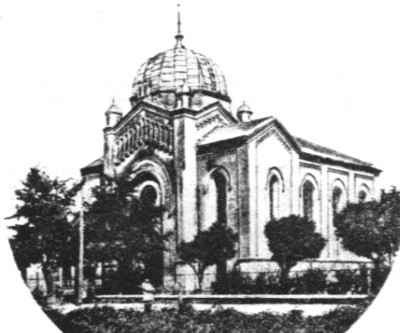
The municipal and central synagogue of Wadowice was built in 1885-89[3]. The public's participation in financing the project was quite large, considering its small size, which did not exceed about seventy-five families at the time. However, the community did not manage to raise all the necessary funds and a long-term mortgage was obtained from a bank in Bilitz, which was repaid in installments until the end of the First World War.
Until the Holocaust, there were many synagogues in Poland which were built in the Renaissance or Baroque style. These synagogues were distinguished by their polygonal columns connected by arches and curves. They also had magnificent grand entrances and mosaic paintings with symbols and quotations from the Bible.
Despite the oppression, there were no deportations to other countries in the history of Polish Jewry, unlike that of Western European Jewry, so synagogues from previous periods
[Page 41]
with Renaissance or Baroque style remained firm until the Holocaust, serving as living proof that this or that community was founded in previous centuries.
The construction of the synagogue in our city occurred at a time when construction in the Renaissance and Baroque styles had ceased, and the German style of construction from the 19th century served as a model for us: the interior structure was simple without the aforementioned lines, the walls were without paintings and quotations, and art was expressed only in a magnificent starry ceiling. Quotations from the Bible were also only on the Ark of the Covenant. Despite this, our city's synagogue was a magnificent building and its appearance was wonderful.
The bimah was also built in the style of progressive German synagogues, meaning not in the middle of the hall but near the Ark of the Covenant, but it was only used for reading the Torah and for sermons; the chazan prayed by the “Amud” (lectern), near the rabbi's seat. The simple style was also prominent in the construction of the bimah, although it was built of ebony and expensive marble. It had no paintings or decorations.
There was indeed a plan to build a gallery above the Ark of the Covenant for a women's choir and an organ. However, at the last minute it became clear that the ultra-Orthodox, who planned to settle in the city, would not agree to this under any circumstances. The place designated for this purpose was therefore closed off by building side walls. Nevertheless, the place was reminiscent of the previous plan. The spire above the dome of the synagogue's roof, which had towered over it for many years, was also a reminder of the “progressive” construction plan. As the population grew, this spire was also removed at the request of the ultra-Orthodox, who claimed that this shape was not suitable for a holy place.
The synagogue was built by architect Koren from Bilitz in a similar form of the synagogue in Bilitz, which was also built by him, but its area was smaller. The city's residents were rightly proud that the city followed in the footsteps of the city of Bilitz, which was famous throughout Austria for its developed textile industry.
The synagogue had several hundred seats and, together with the standing space, had room for approximately 700 worshipers. By building a large synagogue, the community leaders ensured that there was also room for the population that would move to live in the city.
During the Gnostic era, prayers and public rallies were held there, and the population would show up in masse to express their love for the homeland and their appreciation for the government. Delegations on behalf of the government, the courts, schools, the Ministry of Finance, municipal authorities, and a guard from the army stationed there would appear.
We still remember the solemn rallies of the Jewish soldiers' oath to remain loyal to the Polish state. The soldiers marched in a procession accompanied by a military band that would stop in front of the synagogue. They would enter the synagogue to take the oath in the presence of the rabbi, the head of the community, and the secretary. Speeches were also given and the chazan prayed Psalms. Despite the anti-Semitism that had also penetrated government and military circles, the Jews strove to give these rallies a festive atmosphere, in order to prove their faith in the Polish state.
The synagogue was a sacred and precious place in the eyes of all, as a place designated solely for the worship of the Creator. It was forbidden to give speeches on political and propaganda issues before elections and the like in the synagogue. Even preachers, who came to preach Torah and Musar, were not allowed to give their speeches there and were directed to the Beit Midrash. Nor were general assemblies of the city's Jews held there.
[Page 42]
Only on Simchat Torah, when the reading of the Torah lasted a long time, would the gabbaim distribute sweet delicacies and “kiddush” among those who were called up to the reading of the Torah, and even then, it was done only in the upper chamber above the synagogue. In this way, the city preserved the dignity of this house of prayer.
|
|
In recent times, Hirsch Gleitzman, Salo Nesselroth, Fischel (Ferdinand) Zweig, Shmuel Schreffer and others have served as gabbaim. For many years, Azriel Bargofen, who excelled in phenomenal memory, served as the Shamash. Thousands of people passed by him and he remembered them all by name. He knew how to called everyone up to the reading of the Torah by their name and by their father's name and to mention in the “Mi Sheberach” the names of their family members, relatives and friends. He died before the war. His successor was Yehoshua Feierstein, who faithfully fulfilled his role. Feierstein perished in the Holocaust.
We have dedicated memorials to some of the worshipers in the synagogue in various places in our book. Here we will try to complete the list:
Pesach Yaakov Bendetz, a veteran of the city. A wise, honest and charitable man. His wife Franziska and son Henryk are mentioned below in the book in connection with their many activities for the benefit of the community.
Yaakov Borta. A kind-hearted man, he always helped and supported those in need with advice and action.
Max Goldberger. Beloved by people, philanthropist. He was a doctor with many years of experience. He would provide free medical help to the poor.
Nathan Richtman-Goldberg. A religious Jew. With his honesty and fairness in running his business, he served as an example to others. He died in Israel in 1965.
[Page 43]
Marcus Goldberger. Violinist and an orchestra conductor. A kind-hearted man. He played at weddings of the poor without asking for any compensation.
Chaim Leib Haberman-Niehoff. A God-fearing, meticulous man of the commandments, an honest merchant.
Chaim Hess. An innocent and honest man, a philanthropist and supporter of the poor.
Yaakov Wasserteil. A wealthy merchant, famous throughout the area for his commercial talent, a charitable man.
Shimon Yosef Zelinger. A loyal merchant, dealing with public needs.
Yaakov Levenberg. A charitable man, helping the needy with acts of kindness.
Shlomo Leibler. A religious Jew, imbued with a spirit of love for humanity.
Moshe Baruch Landau (moved to Krakow in 1917). One of the city veterans and its aristocracy. His sons Isidor, Shmuel and Yaakov Zvi, all born in Wadowice, were famous wood manufacturers in Poland, his daughter Dorota Tamari lives in Paris.
David Mark. Philanthropist. Beloved by the youth. He generously supported the organizations of the younger generation.
Avraham Yaakov Navel. A kind and charitable man.
Pesach Fridiger. A man who always had a sense of humor, had a wonderful temperament and rare composure.
Avraham Strauss. An innocent and honest man, a man of charity.
Those who passed away, those who perished in the Holocaust - may their memory be blessed.
The Gabbaim took care to renovate and decorate the synagogue, especially before Shavuot. Indeed, the synagogue in its glory will forever remain etched in our memories. The atmosphere that prevailed at the entrance to the synagogue on the eve of Yom Kippur will never be erased from our memories. Everyone expressed their highest feelings for each other by handshake and wishes from the bottom of their hearts. This was not only because of the sanctity of the day but also thanks to the strong ties in business, society, or family. There was a feeling as if everyone was part of one big family.
Where is the vast majority of these people now? Not a single mass grave left behind them! Most of them perished in extermination camps, under terrible torture, or did not return from exile in Siberia and other places. All of them are pure and holy people.
Only a small portion of them survived and are now in Israel or scattered throughout the world.
The synagogue in Wadowice, like most synagogues in Poland, was burned down in 1939 and its walls were demolished with explosives. The Jews were also forced to evacuate its ruins. Details of the destruction will follow below is the chapter about the Holocaust.
The survivors who arrived in Wadowice after the war saw only the empty lot of the destroyed synagogue, already covered in grass. Our hearts ached at the sight of this desolation and the Nazi vandalism. At that moment, the verse from the “Thirteen Measures” prayer came to our minds:
“The Holy City and its districts have become a reproach and a disgrace, and all its treasures are captive and concealed”. - -
[Page 44]
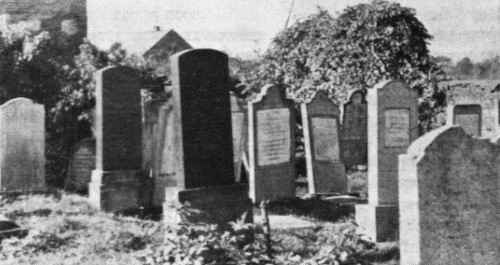
The destruction of Wadowice Judaism was carried out by the Nazis with the methodical approach known to the Germans: even the registration books, the community's archives, and the documents in the Starosty archive and the municipality were destroyed. Only the cemetery, which will be discussed in one of the following chapters, was saved.
When the number of “progressive” Jews decreased and many ultra-Orthodox from Galicia, most of them ardent Hasidim, came to the city, the municipal synagogue, which was intended only for prayer, did not suit their needs. The Hasidim were accustomed to social life within the walls of the Beit Midrash in addition to prayer. For them, the Beit Midrash was also essential for studying the Mishnah and Talmud with Poskim.
The Beit Midrash was built by the community at the end of the 19th century, on the grounds of the synagogue. Next to it was established the community office. The Beit Midrash already had a completely different character. It was open all day and prayers would continue there for hours and according to the Sephardic style. The Hasidic youth and a few of the adults would stay there all day and study Gemara. Often, preachers would also preach there.
On Saturday evenings, Melaveh Malkah celebrations were held there. Often, even on weekday evenings after the Maariv prayer, the Hasidim would gather around the tables to hear “Torah” and participate in Hasidic discussions. At the end of a tiring day of pursuing a livelihood and all that it entails, many of the visitors of the Beit Midrash would find complete satisfaction here in the evenings, listening to debates that were usually of a high standard and based on Kabbalah, Halacha and Agada.
The organizers of the celebrations were usually Liebel Auerbach and Yitzhak Turner, and recently the operation was carried out by Elisha Auerbach, Shlomo Brunner and Avraham Wiener.
The most recent Beit Midrash gabbaim who remain in our memory are Hirsch Nirenberger and Reuven Schreffer. Nirenberger, who was beloved by the people, also devoted himself to other public activities. He made sure to give his children a religious education. His son David (in Bondi, Australia) survived.
The character sketch of Reuven Schreffer will follow later in the story of the Holocaust.
The Baal Tefilla (leaders of the prayer) in the Beit Midrash were the dayanim Shimon Gelbwax, Moshe Miller, Liebel Auerbach, Ben-Zion Geminder, Isaac Rosenfeld, and others. The right to read from the Torah was reserved for Isaac Rosenfeld, who was an exceptional reader.
We have dedicated words of remembrance here and there in the book to some of the worshipers at the Beit Midrash. Here we attempt to complete the list:
Moshe Auerbach, a scholar and philanthropist. His son-in-law, Chaim Blitz, a scholar and a man of broad general education.
Yaakov Bedar and his son Shlomo. They were respected merchants. They were meticulous in their observance of the commandments and prayed with deep sincerity.
Berish Barber. One of the veterans of the city, an ultra-Orthodox Jew and a charitable man. His son-in-law was Israel Arnhalt, a kind-hearted man. His open house was a model for the whole city.
Shmuel Brunner and his sons Chaim and Leibel were successful merchants. People in need of help, a kind and comforting word, would visit their home.
Berish Goldberg. A wealthy merchant, imbued with a religious spirit, his lifestyle served as an example to others.
[Page 45]
Shimon Goldberg. A veteran of the city. Originally from Ksanow. Thanks to his influence, a number of Jews from this city settled in Wadowice.
Mordechai Grushov. A veteran of the city. While the ban on Jewish settlement in Wadowice was in effect, he lived in Grubela and there he took care of a prayer house and kosher food. When prohibition was repealed, he was one of the initiators of the establishment of the Beit Midrash. He was elected several times to the community council.
Israel Gross and his son-in-law Berish Wolf. They were public activists and philanthropists.
Zvi Gruner. A religious Jew with a good heart.
Avraham David Hirschsprung. God-fearing and a man of Torah.
Chaim Wiener. A wealthy merchant and doer of charity. He would help the needy with acts of charity. More than once, the lenders were not able to pay their debt on time, however, he did not refuse to grant additional loans.
Yaakov Wiener. A wealthy merchant. A man with a sensitive heart. On Shabbat, he would invite for a dinner at his house all the poor visitors who came to the city and were unable to find another place to dine.
Shlomo Wiener and his son Eliyahu. Honest merchants and charitable men.
Yrut. A man who was God-fearing, good-hearted and honest in his business. He died at a young age before the war.
Yehuda Leib Litner. A God-fearing and honest Jew.
Shmuel Isaiah Loftglass. A devout Jew who devoted most of his time to prayer and Torah study. He died at a young age before the war.
The brothers Yosef, Moshe and Yaakov Lefholz. Among the best and most diligent merchants in our city, who excelled in honest negotiating.
Avraham Nebenzel, a wealthy merchant. His honesty in trade was an example to others.
Moshe Niernberger and his son David Selig. Faithful Hasidim and honest merchants.
Avraham Samet, the son-in-law of the shochet and bodek Avraham Miller. A scholar, a wonderful Baal tefilla. On the Days of Awe, he would volunteer to pass in front of the Ark and would win hearts with his voice.
Chaim Peltzman. A God-fearing man. His participation in the Torah lessons of the fayan Gelbwax in the synagogue was prominent. He gave charity to the needy.
Michael Petzenbaum. An innocent and honest man, having a religious lifestyle, who educated his children with both religious and national education.
Haim Shlomo Tzisner. One of the most prominent public activists in our city, during the First World War, he was lucky and with his income he purchased part of the “Lagota” estate. Since then, he has gained a reputation as a philanthropist all over the area.
Shmuel Kaufman. An Orthodox Jew, who engaged with the needs of the community in faith.
Chaim Kalfos. A God-fearing man with a good heart.
Berish Kurtz. A wealthy merchant. He served as an example in his honesty and righteousness.
David Kluger. A God-fearing, honest and loyal man, he was beloved by everyone.
Yehoshua Klein. A good-hearted man, he also served as an example to others in his honesty and righteousness.
Moshe Rivner. A Hasid, he was engaged with the needs of the community and beloved by all.
The brothers Israel and Reuven Schreffer. Respected merchants, public activists, quick to fulfill the commandments and always prioritizing helping others.
Shalom Shmaya. A passionate Hasid and a man of great virtues, who passed away in his prime. His sons were also members of the Beit Midrash and continued in his footsteps.
[Page 46]
Shimshon Shoval. An innocent and honest man, kind and polite, who was loved and respected by all who knew him for his pleasant manners and generosity.
Nathan Schichter. A wise, God-fearing, and righteous man.
Those who passed away and those who perished - may their souls be bound in the bundle of life.
In addition to the Beit Midrash, there were private houses of prayer in various parts of the city:
On Tatshainska Street, a) in the apartment of Yaakov Langer; b) in the Gottlieb House (of the Mizrahi movement).
On Zatorska Street (of the Radomsk Hasidim) at the Jungoirt family.
On Spadzista Street (of the Zaloszitz Hasidim), at the Lewiber and Lefelholz families.
It is worth noting the volunteerism of Yaakov Langer, who held the minyan in his home for several decades, to make it easier for worshipers who lived on the edge of the city.
Yaakov Langer ensured that the prayer house was clean and warm voluntarily, without any compensation. During the Days of Awe, the minyan at his home was closed so as not to harm the revenues of public prayer houses from the sale of seats.
Upon his death in 1929, his wife Rachel continued his actions. After the destruction of the synagogue and the Beit Midrash in 1939, the Yaakov Langer prayer house remained the only one in our city where the congregation prayed.
His widow and their son Moshe perished in the Holocaust. Their second son Nehemiah died in 1932.
The gabbai of the aforementioned prayer house, throughout its existence, was Ephraim Lipmanowitz, an honest and decent man who fulfilled his duty with great devotion. He and almost his entire family perished in the Holocaust. His daughter Teresa and her husband Yehuda Eliezer Bedner live in Ramat Gan (see the book of Kalwaria).
Upon completion of the construction of the synagogue, the community purchased a special plot of land for a cemetery. The land was registered in the estate books of Wadowice as plot no. 983 based on a deed of sale dated October 4, 1892. Until then, the dead were buried in the cemetery in Zator. We know of at least one such case from around 1880. At that time, the wife of Yitzhak Aharon Shenkar from Zembrzyce was buried in the cemetery in Zator, even though the distance from Zembrzyce to this town was about fifteen kilometers longer than from Wadowice. Indeed, the Wadowice community did not yet have its own cemetery in 1880, even though the settlement had already existed for about fifteen years and, together with the Jewish population in the villages, numbered about one thousand and five hundred people. The cemetery was founded on a small plot on the border of the village of Tomica. A few years later, it was expanded by purchasing a neighboring plot. Eliezer Czachanowski, who is well remembered by all those who lived in our city, already participated in the second celebration held by the of the Chevra Kadisha. Throughout his years of residence in Wadowice, he served as the head of the Chevra Kadisha and fulfilled this difficult role with great volunteerism and dedication. He immigrated to our city from Russia and was the only Jew in Wadowice who was born in another country. Although according to the concepts of that time, especially in small towns, such a Jew was considered a stranger, he immediately found warm friends and was also elected as a member of the community council. He died and was buried in Wadowice. His son-in-law Shimon Yam was a gabbai at the synagogue for several years, until he moved to Krakow. He also fulfilled his role with great dedication
[Page 47]
to the satisfaction of the entire congregation. After the war, he was active in the Krakow community, where he died with his wife in 1964.
In the last years before the war, the permanent members of the Chevra Kadisha were Tuvia Einhorn, Liebel Auerbach, Anshil Burger, Yaakov Borta, Yehoshua Gretel, Yehuda Gottlieb, Berish Waxman, Michael Petzenbaum, Chaim Shlomo Zisner, Shmuel Koifman, David Kluger, Moshe Rivner, Moshe Sturm, Menachem Mendel Shengot, and more; as well as the women Beila Einhorn, Roisa Belmut, Dranger, Liebel Auerbach's mother-in-law, Lampel, Yeti Neihart, Liba Rapaport, and more. All of them fulfilled their roles voluntarily, with dedication and great patience, even in the winter when there was snow and severe cold.
There was a district military hospital in the city where Jewish soldiers occasionally died, especially during World War I. Many Jewish soldiers who were transferred there from the Russian front died of their wounds and infectious diseases. The army was required to notify the Chevra Kadisha of any such case, and its members immediately appeared at the hospital to grant the deceased a final grace and bury him in a Jewish burial. Even in winter and in the cold, when the cart would sink in the snow and mud on the narrow path leading to the cemetery, they would transport the dead body with terrible difficulty and bury it in a Jewish burial, because there was a danger that if they delayed, the military service personnel would bury the soldier in the general cemetery.
To this day, it is possible to see in the Wadowice general cemetery many tombstones of Jewish soldiers from all over Austria. There are also tombstones from the Polish War of Independence, such as the one on the grave of Officer Taub, the son of the doctor Shmuel Taub, who was a passionate patriot of the Polish homeland. When the Czechs attacked Cieszyn Silesia in 1920, he volunteered for the Polish army and a few days later fell in the first battle. Several years later, his remains were buried in a magnificent military ceremony at the Wadowice cemetery.
In the last years before the war, when a wave of anti-Semitism swept through Poland and rumors were already spreading that laws would be passed denying the civil rights of Jews, we would look at these graves with sorrow and tears. With pain we would read the words engraved on the tombstones, telling of a fall on the battlefield at a young age for the homeland - first the Austrian and then the Polish. In the silence of the cemetery, we would reflect on the number of Jewish victims during the Polish war for independence, which did not fell from the number of Polish victims, and on the civil discrimination against Jews that already existed and that extreme nationalist circles, whose influence is growing, were striving to turn into a by law discrimination, like the infamous Nuremberg Laws.
Recently, according to an agreement between the Chevra Kadisha of Wadowice and Kalwaria, the dead of the Kalwaria community were buried in the Wadowice cemetery instead of to Zator.
The cemetery was not ruin during the Holocaust, but many tombstones were destroyed and damaged by the local population. After the war, Meir Jakubowicz, the head of the Krakow community, donated a considerable sum to repair the cemetery. The remainder of the amount was collected from former residents of Wadowice, who lived in Krakow. The scattered tombstones that had been displaced were returned to their places, the fence and the house were restored, and the house in the cemetery was returned to the caretaker for permanent residence.
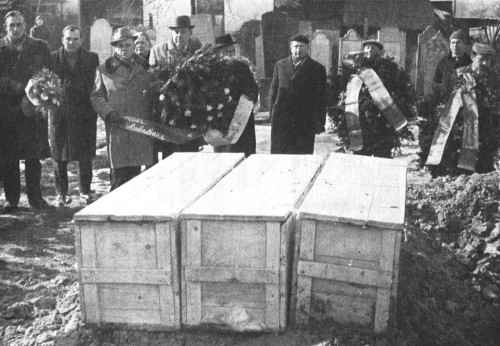
In 1964, the community in Krakow exhumed ninety-two bodies from Makow-
[Page 48]
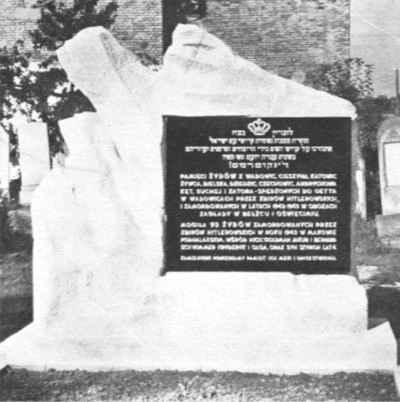
Podhalanski Jews, who were killed by the Nazis in 1942, and the bones of the martyrs were buried in a mass grave in the Wadowice cemetery. In 1942, during the deportation of the Jews of Makow to Belzec, they fled to the nearby forests, but since they did not receive help from the Poles, they could not hide for long and were eventually discovered by the Nazis and imprisoned in the “Marisia” hotel in Makow, a place where the Gestapo headquarters and a school for S.S. officers were located. They were detained in the basement of the hotel for 2-3 weeks in terrible and inhumane conditions. Then the Germans took them out one by one into the hotel courtyard and shot them for fun until they killed them all and buried them on the spot. After the war, the chairman of the Krakow community, Meir Jakubowicz, made every effort to bury the bones of the unfortunates in a Jewish burial. The Polish authorities agreed to the exhumation of the bodies from the hotel grounds, which had meanwhile become a sanatorium for chemical plant workers in Oświęcim.
The funeral, which was held on February 26, 1964, with the participation of the Polish army, school children, government representatives, and the masses of the people, turned into a major demonstration against Nazi barbarism.
A memorial was erected on this mass grave to these victims and to the saints who were deported from the Wadowice ghetto in 1942-43 to the extermination camps in Belzec and Auschwitz.
|
|
The Wadowice cemetery is the only remnant left as a memorial after the liquidation of the community, which had flourished for three generations. In the shade of the trees growing there, the tombstones will tell the story of the settlement's history, a history that was short in time but glorious and full of prosperity.
[Page 49]
|
|
they were buried on February 26, 1964 Chairman of the Krakow Community Meir Jakubowicz, from right: Mgr Leon Gwirtz, legal advisor to the community, from left: members of the community committee David Horowitz and Isaiah Taft. Without hats – representatives of the national council of Wadowice. |
[Page 50]
|
|
Original footnotes:
|
|
JewishGen, Inc. makes no representations regarding the accuracy of
the translation. The reader may wish to refer to the original material
for verification.
JewishGen is not responsible for inaccuracies or omissions in the original work and cannot rewrite or edit the text to correct inaccuracies and/or omissions.
Our mission is to produce a translation of the original work and we cannot verify the accuracy of statements or alter facts cited.
 Wadowice, Poland
 Yizkor Book Project
 JewishGen Home Page
Copyright © 1999-2026 by JewishGen, Inc.
Updated 28 Aug 2026 by JH