 |
|
|
[Page 168]
Chapter 32
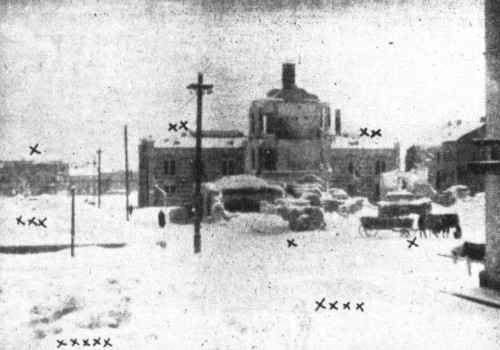
After the end of the war, a small number of Jews who survived the Hitlerite hell returned to Tarnów from the camps and hiding places. The majority of Jews who returned were through the Council with the repatriation. But all they found were ruins. All the houses in the area of the ghetto, which was formed during the Hitlerite occupation, were destroyed, not so much by the Germans, as by the local residents, who were looking for Jews' “hidden treasures.” Jewish houses, which were in the center of the city, on Walowa Street, Krakowska Street, Zydowska Street, and the Rynek market, as well as in the side streets: Seminarska Street, Agradova Street, and so on, were occupied by Polacks, brought there from Eastern Galicia. All the shops in the market, all the businesses that once belonged to Jews, were now owned by Poles. The Poles now rushed into commerce, even developing a “black market” where they sold “hard,” “soft,” and gold stuff. A bazaar was set up on Schenkevich Square, where looted Jewish property, such as bedding, furniture, clothing, candle-sticks, and other household items, was set out for sale. The new storekeepers, who before the war used to make fun of Jewish employment, now carried them out with extraordinary diligence and knowledge, showing an unusual storekeeper's talent. The Polish population had
|
|
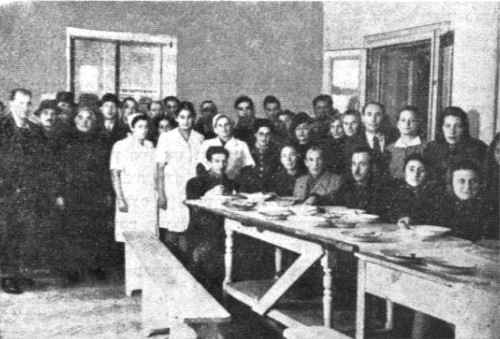
| The public kitchen at the Jewish committee in Tarnów, in 1946 |
[Page 169]
welcomed the returning Jews returning to their homes in Tarnów with certain reluctance. With the exception of the Polacks who belonged to PPS (Polish Socialist Party) and PPR (Polish Workers' Party), as well as the surviving Polish intelligentsia, whom the Hitlerite occupier did not spare and killed many of them in the concentration camps, the Polish populace openly expressed its surprise that there were still a few Tarnów Jews left alive. The then city president Schit (until the war, he was secretary of PPS in Tarnów), tried to help the repatriates in settling in, allocating them apartments, mainly on Goldhammer and Walowa Streets. Several Tarnów Jews; Bleiweiss, Sparn, Chaim Eliezer Schedlisker, Pinchas Glatzner, Dr. Kahn, Miss Terkel, Miss Mgr. Simche, formed a Jewish committee, whose office was located in Aberdam's former home on Goldhammer Street. At the same time, a Jewish committee was formed, which took over some functions of the former Jewish community. At the head of the congregation was Avraham Shpilman, then Chaim Eliezer
|
|
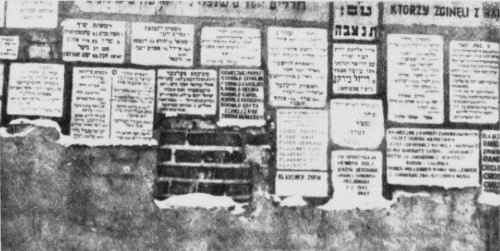
x The ruins of Jewish houses on Palvartshne {פאלווארטשנע} Street (which led to the New Synagogue). xx The mikvah was not damaged. xxx The snow-covered place where the New Synagogue once stood. xxxx The place where the Jewish Community Center building once stood. xxxxx The place where Deborah Menkes synagogue once stood. |
[Page 170]
Schedlisker, with the help of Pinchas Glatzner and several other observant Tarnów Jews. A synagogue was set up in the former Soldinger Hotel, and even a rabbi and a mohel {ritual circumcizer} were hired. The Jewish committee conducted extensive activities thanks to the funds it received from the Jewish Central Committee, and funds from the “Joint Distribution Committee.” An orphanage (foster home, day-nursery) was opened in Aberdam's house for the surviving Jewish children, led by Miss Birken, who herself survived the Hitlerite hell. There was also an ambulatory clinic run by Dr. Emil Dintenfass (now in Israel). At the Jewish committee offices, there was also a public kitchen, where most rescued Jews ate.
But as soon as the new Jewish life began to awaken, Polish gangs began to go mad. Under the guise of fighting the new regime in Poland, they robbed and murdered Jews. The first victims of such a murder in Tarnów were the Roth sisters and brothers. They fled the city during the first Hitlerite evacuation action, hid in the nearby forests, and when the Red Army marched in, they returned to Tarnów.
M. Tsanin, who visited Poland in 1947, described his impressions of post-war Tarnów in his book Iber shṭeyn un shṭoḳ (Tel Aviv, 1952):
|
|
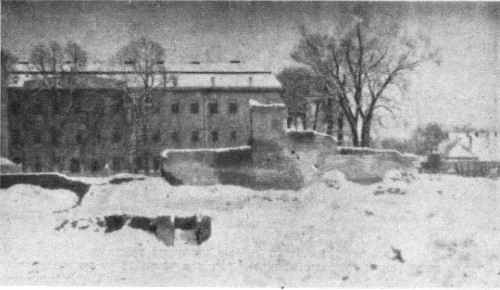
| The ruins of the Tarnów ghetto during the Hitlerite occupation. (Kascharova Street with the barracks building, which was not damaged) |
[Page 171]
|
|
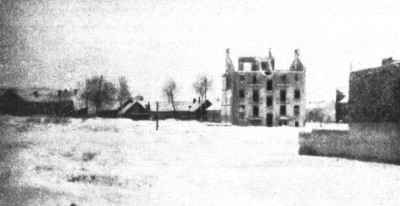
| The ruins, as seen from Volnoshtchi Square (the so-called Pig Square) |
|
|
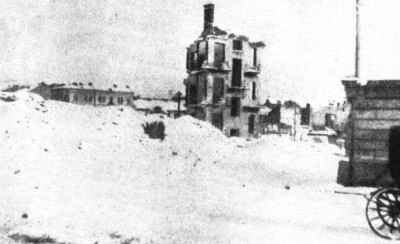
| The ruins, as seen from Pod Debem Square |
[Page 172]
“The Polacks started sending letters to the returned Jews demanding them to pay large sums of money for allowing them to live in the city. Later, the newly formed Jewish committee received a letter stating that if the Jews did not deposit one hundred thousand złoty under a certain stone in the city forest, all of Tarnów's Jews would be murdered.
“And there were already by that time three thousand Jews from Tarnów itself and from the neighboring towns.
“The Jewish committee delivered the threatening letter to the local militia. At the appointed time, the forest was guarded. Jews placed a packet of paper under a stone. At the hour stated in the letter, a Polish woman came and took the package from under the stone, believing that the Jews had deposited the demanded hundred thousand złoty. The woman was arrested, but later she was released without even a trial.
“The leader of the militia at that time was a well-known antisemitic outcast, who viewed the remnants of the Jews as excessive.”
|
|
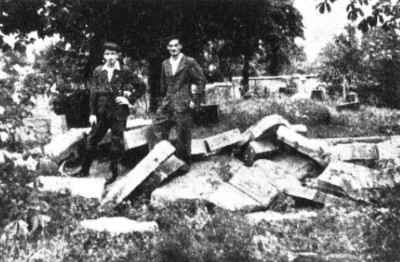
| Tombstones, which the German killers dragged from the cemetery to the streets in Tarnów. The Jewish committee collected them after the war and brought them back to the cemetery. |
[Page 173]
|
|
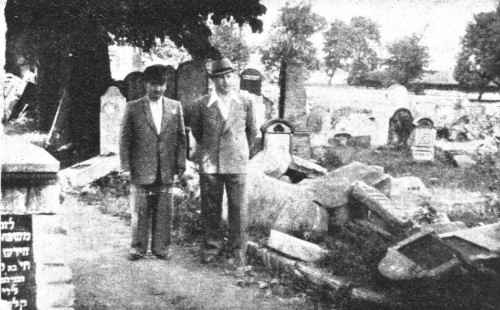
| The first members of the Jewish committee after the liberation of Tarnów at the cemetery (in the picture: Right: Asher Bleiweiss, now in Tarnów; Left: Pasternak, now in New York) |
[Page 174]
“After the Sejm elections in Poland, Polacks stopped Jews in the street and asked if they had voted for the government. Whichever Jew answered, ‘Yes,’ was murderously beaten.
“Jews once again lived in fear and panic. One by one, people began to flee from Tarnów. But when the Kielce Pogrom erupted, the flight took on a panicked character.”
“The cup of suffering of the Tarnów Jews was not yet overflowing. Two months after the Kielce Pogrom, the Polacks pasted up placards in the city, calling out to take revenge on the Jews, because they murdered a Christian child. A mad woman ran around the streets and shouted that the Jews had kidnapped her child and slaughtered it to make matzot. Panic broke out among the Jews. People hid in attics and cellars. People started packing bags to escape. But in the meantime, the militia found the missing child. It was playing in the sand somewhere among the ghetto ruins. The militia arrested the child's mother. Later, the Polacks came to the Jews and demanded that they forgive the sins of this ‘unfortunate mother.’ And the Jews ran to the militia and worked to have the woman be released from prison
“After all these horrible experiences in ‘liberated’ Tarnów, of the three thousand Jews who returned, only three hundred and fifty Jews determined to stay chose to remain there.
“But this handful of Jews ‘sat on their valises.’ There was only one brave Jew in all of Tarnów, H. M. Schedlisker, a skilled wholesale merchant from the colonial branch even before the war, who
|
|
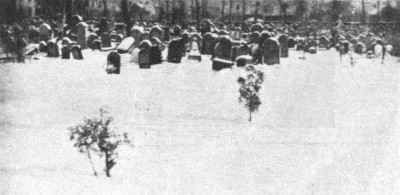
| The cemetery in Tarnów after the war, in 1946 (In the picture one can see two trees, which are standing over two mass graves) |
[Page 175]
first ran a trade in colonial goods {exported from colonies, tropics} in his private residence, and then in a business on Lwowska Street. However, he immediately liquidated his business and moved to Israel, where he is now. The well-known and respected Jewish industrialist Avraham Shpilman opened a small candle factory, and one of the largest textile manufacturers of Tarnów, Mr. Ketz, set up a workshop for laundry service. But very soon he moved to Wroclaw, then to
|
|
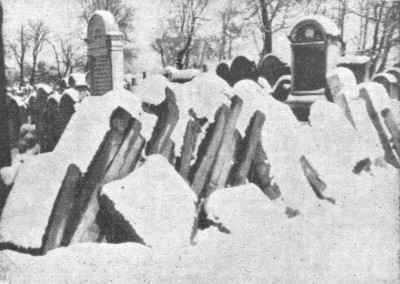
| Overturned tombstones in the Tarnów cemetery |
|
|
| Memorial plaques in honor of the murdered Tarnów martyrs, embedded in the back wall of the cemetery by their surviving relatives |
[Page 176]
Paris, where he ran a large clothing factory, and where he died in 1953.
“Thanks to funds from the Jewish Central Committee, a group of Tarnów Jewish tailors set up a tailoring cooperative, where several Jewish men and women workers were employed. Three Jewish lawyers, two doctors, a rabbi, a butcher; that is a picture of Jewish life in post-war Tarnów. Then two lawyers, a doctor, and the rabbi left Tarnów.
|
|
|
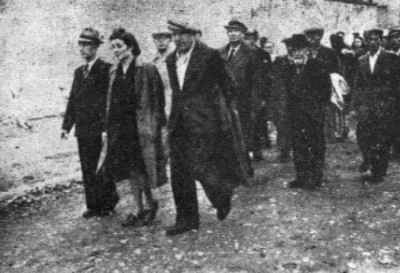
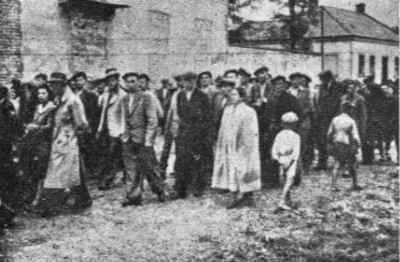
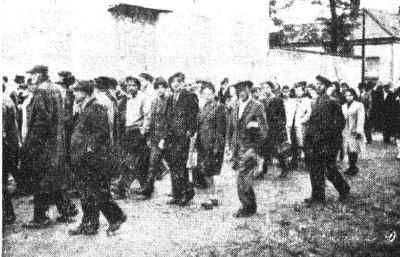
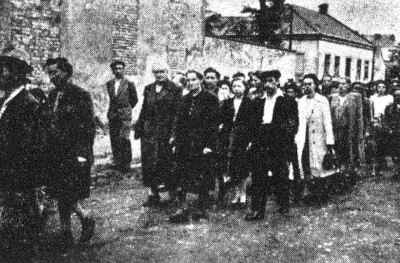
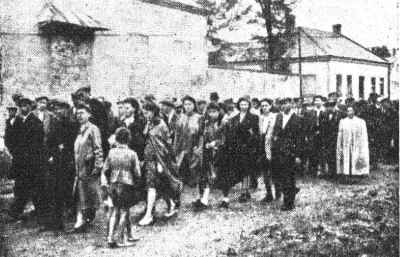
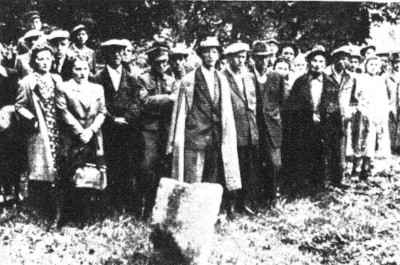
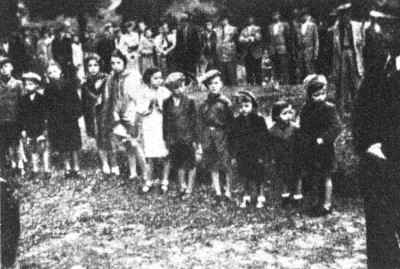
| The mourning procession of the remnants of Tarnów's Jewry walking through the streets of the former Tarnów ghetto to the memorial service at the cemetery on June 11, 1946, and to attend the unveiling of the monument over the mass grave of 25,000 murdered Jews. |
[Page 177]
|
|
|
|
| The procession at the first memorial service |
[Page 178]
“During the first years after the liberation of Tarnów, the Jews fled first to the western regions. Cities like Wroclaw {Breslau}, Wałbrzych, Dzershoniv had larger Tarnów former Jewish residents, most of whom were preparing to emigrate and leave Poland. A small number of Jews who remained in Tarnów, tried to keep up the prewar traditions, joining almost all of the political parties, each of which had a few members. Nevertheless, each party had its buildings, a reading room, a library, and lectures were often arranged. The General Zionists (Ichud), left and right Poalei-Zion, Hashomer Hatzair, Bund, Jewish Communists, and Orthodox were in Tarnów. The Bund
|
|
|
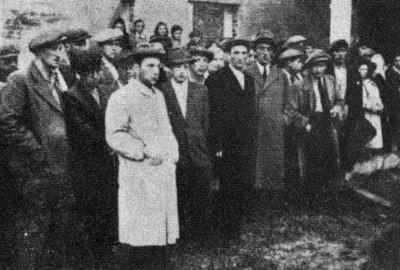
| At the cemetery in Tarnów, during the first memorial service in 1946 in memory of Tarnów's martyrs |
[Page 179]
set up a sports club and a choir; the left-wing Poalei-Zion formed a drama club. There were two synagogues, supported by the religious congregations.
|
|
|
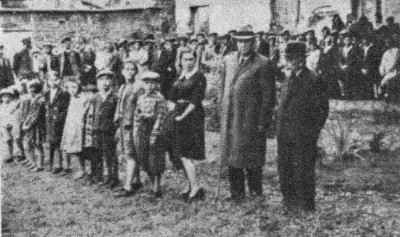
| At the cemetery during the first memorial service |
|
|
JewishGen, Inc. makes no representations regarding the accuracy of
the translation. The reader may wish to refer to the original material
for verification.
JewishGen is not responsible for inaccuracies or omissions in the original work and cannot rewrite or edit the text to correct inaccuracies and/or omissions.
Our mission is to produce a translation of the original work and we cannot verify the accuracy of statements or alter facts cited.
 Tarnów, Poland
 Yizkor Book Project
 JewishGen Home Page
Copyright © 1999-2026 by JewishGen, Inc.
Updated 05 Apr 2026 by JH