 |
|
|
[Page 125]
Chapter 25
These were the destructive results of the assimilationist-orthodox faction: Dissolving of the city self-administration; dissolving the Jewish community administration, and dissolving of an old and practical organization of Jewish merchants (which we will write about in another place). Jewish cultural institutions were also destroyed, the subsidies for the national funds, Hebrew schools, and beneficial social institutions were taken away. During the commissar rule in the community, slogans about burning Jewish libraries were allowed to be displayed. In one sentence: a true crusade had been proclaimed against Zionism and against all manifestations of national Jewry. All the current efforts and achievements of the community administration have gone to waste. The community institutions, such as the Jewish hospital, the old age home, and so on, were neglected.
By a decree from the Provincial Office in February 1932, Dr. Klein, supported by the Agudah party, was appointed the chairman of the temporary (commissary) community administration in Tarnów. He took over this office on February 21, 1932, and named as his representatives: Arthur Margolies, Chaim Aberdam, and Eliyahu Gevertz. In a few days, Arthur Margolies was released from office.
No one had any illusions that the new community administrator would be any better than his predecessor. The community has transformed into a real jungle. A few of the Orthodox were also dissatisfied with Dr. Klein's rule, who did not engage with the advisory council at all and ruled the community as if it was his own court. Although this was a time of increasing need along with the pauperization of the Jewish population, this strict administration did nothing to help Jewish poverty in Tarnów. At the same time, the subsidies were decided in favor of the supporters of the community chairman.
At a conference of industrialists in Tarnów, held on April 30, 1932, the unemployment problem in the city was discussed. As reported by the Tigodnik Żydowskie (June 5, 1932, № 18), the number of unemployed at that time reached 4,000, which together with family members was 12,000 people. About 20% of them were Jews. The Jewish professional associations did everything they could
[Page 126]
in order to make the difficult situation of the Jewish workers easier, but in the city council, as in the community, government temporary officials who cared little about what was happening in the Jewish community ruled. While on the Polish neighborhoods, the temporary city administration employed some of the unemployed Poles on public works, 10 days a month (twice for 5 days). Yet only one Jewish unemployed worker was hired there, even though hundreds were desperately seeking work. It goes without saying that the Jewish nominees at the time did not make any efforts at the city commissioner's office to correct the wrong done to the Jewish unemployed. The Jews have now lost even the slightest influence on city affairs, because the dissolution of the city council was the least of what happened to the Jews. The broadest Jewish masses had lost the possibility of influencing the city's affairs. Tarnów's Jews have now experienced one bad situation after another. The city budget, largely funded by Jewish taxpayers, did not address Jewish interests at all. People from the political orthodoxy, who had no influence on the developments in the city, were placed at the top of Tarnów's Jewry. The Jewish vice-mayor, Dr. Mitz, who at the time helped to dissolve the city council, now as vice-commissar lost some authority over the population; both Jewish and Polish, because they attributed the efforts to dissolve the city council as well as the Community Council to him.
As a result, Dr. Mitz was immediately released from his office as vice commissioner and his place was taken by Dr. Edvard Schalit. Dr. Henrik Ehrenfreund was co-opted as a member of the commissioner's self-management instead of Arthur Margolies who had been removed.
At the very first meeting of the temporary advisory council, Dr. Schalit explained in his address the reasons for dissolving the previous city council.
“The city council,” explained Dr. Schalit, “was attacked from the inside; it was attacked by people who were members in it. Too many strong personalities had entered the new council, both Catholics and Jews, who pushed them to the sidelines, so that they began to lose their previous influence and visibility. It could not go any further. It was necessary to put an end to it once and for all, and the best solution was to disperse the city council. And that is what happened. The council was dissolved. A temporary official was named in place of the mayor. A young inexperienced man, who had never worked in self-government. So now the golden times have come. Such young people can easily be wrapped around a finger. But the
[Page 127]
young official, it turns out, is not a greenhorn; he learned everything quickly; he did not want to be a subject or a blind tool in the hands of the clique, whose plans he saw through clearly. This is the source of the disappointment, this is the source of the anger, this is the source of the intrigues, this is the source of the attempts to tear down the commissioner or appoint another commissioner. This is not in the name of increased salaries, or of bringing back autonomy at all, but in order to seize power again. This was not to be allowed; the clique did not dare triumph again. It was necessary to resist; it was a necessity, and therefore, ‘I have put myself in a predicament.’ The gentlemen who were removed from the council,” continued Dr. Schalit, “raised a cry and began beating the drums, even threatening the government with a revolt; i.e., with the resignation of the commissioner's community administration and of all the Jewish members of the advisory council, immediately in a few minutes their government would not have any representation by anyone. And why the cry, why the commotion? What do you mean? Don't you see that appointing Ehrenfreund and Schalit to the advisory council is a ‘favor for the Zionists?’ If it were like that, it would be good; I would wish that for Poland and the Poles with all my heart. But it is not like that. Calling us to the council is not a favor to the Zionists, but a turning away from their lies and hypocrisy, which has penetrated these old, somber church walls. A legend has already formed around my person. ‘Schalit, is no longer an ordinary person, but an extreme Zionist.’ Such was the information, relations, and denunciations sent to Kraków and Warsaw. I am not a Zionist; I have always openly acknowledged my Polish nationality. A Zionist can only be the one who acknowledges himself belonging to the Jewish people. But even if I were a Zionist, I would not be ashamed of it and would not hide it. Zionism is a great ideological movement, built on the highest and noblest foundation. I sympathize with the Zionists. I dislike it, but is it not a ridiculous accusation, which is put to me, that I am a Zionist sympathizer? I openly admit to this; I will even go further and say that every good-thinking Pole who loves his fatherland should sympathize with them. None other than they knocked down the walls of the ghetto and fought the darkness that reigned over the Jewish street. However, I am not an enemy or an opponent of Orthodoxy. The Orthodoxy is a way of thinking, a world view to which one must approach with care. However, I am an opponent of the apparently orthodox leaders, who literally have nothing in common with this point of view, and consider themselves
[Page 128]
Orthodox in order to speculate on it. I despise these leaders, who have disorganized and demoralized a part of the Jewish community. And on this point I again agree with the Zionists, and also with a large part of the Orthodox. That is my relationship with the Zionists, and that is what I wanted to say today. Sincere patriotism, purity of spirit, and with clean hands, sincerity and honesty will guide me in my new public work.”
However, these changes could not influence the health of the city's economy. Because the source of evil was the entire system and the commissar (ed. strict official) regime. Therefore, most city residents, Poles as well as Jews, demanded the reinstatement of the city council, which would enjoy the trust of the broadest masses, because a magistrate detached from such a city council would be able to manage the communal economy in healthy, rational ways.
An even worse and sadder role was played by the temporary Community Administration at that time. A few months of commissar management in the community brought with it a terrible decline and confusion in the community institutions, and this happened precisely at a time when there was general distress in Jewish neighborhoods. A good example of this need was brought up in an interview that Chaim Friedman, editor of Tigodnik Żydowskie, conducted with the vice president of the craftsmen's association Yad Haruzim in Tarnów, Mr. Sigmund Haber. This is how Mr. Haber describes the situation in Tigodnik Żydowskie of August 5, 1932, № 5:
“The Jewish craftsmen find themselves on the edge of the abyss. Hunger and distress are now visible and entered even into the homes of well-educated artisans, whose women and children struggle for a piece of bread. The situation of the craftsmen is much worse than the situation of the workers. Because a worker still has some kind of unemployment support {insurance}, while the craftsman does not receive any support.”
In addition to all the troubles, the poor economy of the community has caused the Jewish hospital to be closed for several weeks because of the lack of money; no subsidies have been paid to the Jewish institutions, philanthropic or cultural; even the orphanage has not been paid the specified subsidies. In the old age home, there was no lay supervision and the old lay people were used to walking all day around the city begging.
The church budget for the year 1933, agreed upon by the commissioner's administration headed by Dr. Klein, caused great bitterness among the broadest strata of the Jewish population. While for the Talmud-Torah, they allocated the sum of
[Page 129]
7,000 złoty, but for any of the listed Jewish social and cultural institutions in Tarnów that were under Zionist influence, not even a penny was determined. Even the orphanage, only the negligible amount of 350 złoty a month was preliminarily allocated.
But the constant betrayals and mutual accusations among the commissary board members, as well as the poor economy, finally forced the administrative power to order new elections for the Tarnów community.
The election campaign, started by the commissar rule, first appeared to remove the Zionist voters from the voter list. The famous decree of the Culture Ministry of October 24, 1930 (Journal of Laws [Polish] № 75), contains among others, the famous Paragraph 20, according to which the election commission could take away the right to vote from any Jew, under the pretext that he is not religious enough. This order had the goal of shrinking the community's activities to the most necessary religious needs, as “compensation” for Agudah, which supported the Sanacja during the elections to the Sejm {parliament}. The commissioner rule, completely disregarding public opinion, appointed an election commission where Dr. Klein's close associates were included. Soon, the first orders of the election commission provoked great anger among the Jewish population in Tarnów. While in the last community elections in 1928, the voter list consisted of 4,400 voters, the current community administration gave the right to vote to only 2,940 Jews. Over 2,000 voters, included in the lists, submitted advertisements {i.e. notices}. While some orthodox members of the commissary administration resigned their mandates, the administrative power released Dr. Klein from his office, and Dr. Anselm Basler was appointed in his place as chairman of the commissioner's board, who was supposed to lead the elections to the Community Administration.
Dr. Anselm Basler, a son of one of the first Chovevei-Zion, who did not belong to any political party and had a lot of understanding for the Zionist movement, accepted the mandate under the condition that elections would be held immediately. The newly nominated Community Administration consisted of the following persons: Shimon Aberdam, Eliyahu Gevertz, Shlomo Mehr, Aharon Rosenzweig, (Agudah), Chaim Aberdam, Chaim Englander, Pinchas Templer, David Zwiebel, Mechel Schneider (Klauz), Israel Wind and Shmuel Tzenvirt (Bobover), Lippe Schmidt (Kolisets {Ukrainian} / Kolatschitz), Jacob Ehrenberg (Stutchin), as well as Dr. Goldstern, Dr. Edward Schalit, Eng.[ineer] Maximilian Eichhorn, Zelig Brav, Ezekiel Postrong, and Wilhelm Rubin.
Regarding the state of the community economy, led by the previous commissioner's administration, the facts testify that when taking over the
[Page 130]
community by the new community commissioner, only found 84 złoty in cash were in the community's treasury. Already on the second day of the rule of the new authority, enforced administration was instituted upon the community buildings in order to forcefully collect the debt for water in the amount of 2,000 złoty. And on the fourth day of the new regime, the executor waited for the community commissioner in his office to conduct the auction of the community furniture taken for non-payment of the immovable property tax {realty property tax} (a sum of 1,750 złoty). At the same time, a reminder letter from the savings bank arrived at the community office with a threat to take the matter to court in case the four installments of the mortgage loan were not paid.
This was a difficult time for Tarnów's Jewry. Distress and hunger literally took desperate forms and engulfed ever wider strata of the Jewish population. The situation at that time is described in the Tigodnik Żydowskie (December 16, 1932, № 50):
“The situation of the unemployed has worsened significantly this year, because of the brief season in seasonal jobs, especially in the garment industry, the unemployed cannot show such working hours, as is necessary to receive help from state funds for the unemployed. Therefore, few of the Jewish unemployed registered with the city's committee to help the unemployed. Irrespective of the fact that the help that the committee provides is very modest and is associated with working a certain number of days on public works, the unemployed encounter various difficulties of a formal-bureaucratic nature when registering. Particularly vulnerable in this area are the Jewish unemployed, who are challenged in various ways before receiving help designated for the unemployed. Home based manufacturers, who make up most Jewish workers in Tarnów, cannot turn to the city committee for help at all, which excluded them from the category of people who need such assistance. Although such a home based manufacturer who worked alone for years, not hiring any help, the committee nevertheless denies him the right to benefit from the unemployment fund. The home based manufacturers are wronged in every respect; they pay relatively high taxes, do not enjoy social security, and in case of unemployment, they cannot claim the few days' pay for employment in public works, which are designated for the unemployed. They live in the greatest need, and their situation is simply a desperate one.
[Page 131]
About 20 Jews were employed out of the 550 unemployed people in the public works department in December. More than 100 Jewish unemployed were deleted from the list. Even those who had met the conditions required by the committee were struck off. And the craftsmen, cart peddlers and retailers? They simply die of hunger, and no one cares about them, no one deals with them.”
It is no wonder that on December 15, 1932, a demonstration of the Jewish unemployed took place in front of the Community Administration Offices. Over 200 people demanded support.
In the meantime, news has arrived from Germany about alleged terror against Jews. Jews around the world rose up, raising a powerful voice of protest against Hitlerite barbarism. In order to give voice to this outcry, to awaken the conscience of the world, and to manifest solidarity with our unfortunate brothers in Germany, March 27, 1933, was designated as a protest day for all of world Jewry. Tarnów Jews also, sincerely and with no hesitation, joined the protest action. On that day, almost all Tarnów Jews gathered at the site in front of the New Synagogue, where a protest meeting was held, called at the initiative of the Zionist organization in Tarnów. Over 4,000 Jews filled the large synagogue, and over 2,000 (as the Tigodnik Żydowskie wrote) filled all the passageways, corridors, and the area around the synagogue because of lack of space. All the Jewish businesses were closed during the protest meeting. In that serious moment, people forgot about their struggles and disagreements. The joint presidium comprised Chaim Aberdam and Dr. Klein, then representatives of the Jewish community; Wolf Getzler, president of Mizrahi, and Dr. Avraham Chomet, president of the Zionist organization. All those present at the meeting, overwhelmed by the threat of death that hung over the heads of German Jewry, listened attentively to the powerful speeches by Chaim Naiger and Shlomo Mehr (Agudah). In a unanimously accepted resolution, their outrage against the criminal acts carried out by the Hitlerite gangs against the German Jews was expressed.
At the same time, Jewish merchants began to boycott German goods. Jewish librarians and subscribers to German periodicals, both political and professional, canceled the subscription. German companies flooded Jewish merchants and industrialists with letters, reassuring them with perfidious assurances, but soon after came anti-Jewish decrees and orders by the unrestrained Hitlerite pogrom organizers. The anti-German boycott embraced everything that came from Germany.
[Page 132]
Even medications that came from there. The struggle with Hitler's bestiality gradually assumed coordinated forms. The political leadership with the boycott action was included in the leadership of the Jewish Koło {club, caucus} in the Sejm. Along with the boycott action itself, a united Jewish committee led the fight against the persecution of Jews in Germany.
Tarnów Jewry joined the activity of the entire Polish Jewry. At the initiative of the youth committee of Bnei Zion, an organizing committee was established in Tarnów. On April 22, 1933, at a meeting of representatives from various organizations, a Boycott Committee was elected, which included the following persons: Dr. Shmuel Szpan, Dr. Isaiah Feig, Shimon Leiner, Hanna Pessel, Dr. Avraham Chomet, Hugo Schpieler, Mgr. {Magister} Taubeles, Streim, Moshe Schpilmann, Chaim Naiger, Wolf Getzler, Henrik Hollander, Eng. {Engineer}, Karol Szancer, Dr. Edward Schalit, Dr. Henrik Ehrenfreund, Dr. M. Blach, Dr. Wolff Schenkel, Ginger, Chaim Ehrlich, Yechiel Kurtz, Mgr. Henrik Schpilmann, Hersh Eder, M. Shapiro, Shimon Friss, Sigmund Fenichel, Madam Dr. Weiss, Israel Reich, Dr. Edward Klein. On April 29, the Boycott Committee held its first meeting, where Chaim Naiger was elected as president; as vice presidents, Dr. Edward Schalit and Joseph Heimann: Secretary: Mgr. Henrik Schpilmann; Treasurer: Dir. Yitzchak Schoenwetter. The Boycott Committee included all strata of the Jewish population in Tarnów, which was expressed in the composition of the various committees, elected at the first meeting. The following committees were appointed: Finance Committee: Dr. Klein as chairman; as members: Wolf Getzler, Henrik Hollander, Dr. Henrik Ehrenfreund, Mgr. Taubeles, Hugo Schpieler, Chaim Aberdam, Eliyahu Gevertz, Israel Glatzner.
Economics Committee: Eng. Karol Szancer as chairman; as co-members: Dr. Martin Bloch, Abraham Schpilmann, Yechiel Kurtz, Chaim Ehrlich, Israel Reich, Hana Pessel, Shimon Leiner, Hersch Eder, Wolf Shapiro, Dr. Feig, Maurycy Shapiro, Shimon Friss, Ignatz Ginger, Shmuel Zins, Yitzchak Engelberg, Wilhelm Rubin, Bernard Leib, Aharon Rosenzweig, David Boem, Dr. Wolf Mandel, Maurycy Hutter.
Propaganda Committee: Dr. Avraham Chomet as chairman; as members: Dr. Shmuel Szpan, Dr. Wolf Schenkel, Madam Dr. Weiss, Sigmund Fenichel, M. Streim, Shlomo Mehr, Dr. Borgenicht.
On the control board, Moshe Schpilmann was elected as chairman, and as members: delegates from individual Jewish youth organizations.
The United Boycott Committee had developed an intensive activity
[Page 133]
with the aim of popularizing the boycott resolutions and giving them an organizational framework. On the initiative of the committee, a conference of Jewish doctors and pharmacists was held, where it was decided not to prescribe any prescriptions that are processed in Germany. A special committee comprising eight doctors: Dr. Mandel, Dr. Feig, Dr. Faivel, Dr. Goldman, Dr. Hulles, Dr. Schoenfeld, as well as three pharmacists: Mgr. Taubeles, Mgr. Reich and Mgr. Remer had to set up a list of medicines produced in Germany and a list of replacements. At public meetings, in the press and through calls, the committee popularized the boycott resolution, getting them to be actually implemented.
The Catholic society in Tarnów also joined the boycott action. This was at a time when a bloc of anti-Hitlerist states was assembled in Europe, and the politics of Marshal Piłsudski in that period still followed the line of a necessity to start a preventive war with Hitler's Germany. At that time people were still writing in the Polish press, and in political circles, they were still talking about the hostile attitude of Hitler's Germany toward the Polish state, about the revisionist demands of the Germans, about not allowing any Polish developments into the German market and about the barbaric persecution of the national minorities in Germany. People even wrote about attempts at a Polish-Soviet rapprochement. On July 16, 1933, Karol Rodek came from Moscow as an official guest of Polish government circles (the high Soviet dignitary also visited his hometown of Tarnów, where his mother, Zacza Sobelzohn, lived at the time).
It is no wonder that, on the initiative of the union of reservists, a committee was formed in Tarnów to fight against German imports. All the Polish economic organizations belonged to this committee.
During May 1933, a joint meeting of the Polish and Jewish committees took place, where a joint executive was chosen: Eng. Hempfel as president, Chaim Naiger and Alexi as vice presidents, Mgr. Henrik Schpilmann as secretary, and as executive members: Eng. Szancer and Szadziński.
At that time, the first refugees from Germany arrived in Tarnów. They received the best possible help from the Boycott Committee. To cover this relief work, a collection campaign was carried out among the population of Tarnów.
[Page 134]
Meanwhile, there was no lack of trouble on the Jewish neighborhoods. Jewish merchants and industrialists broke under the tax burden. Unemployment continued to grow. The situation of the Jewish craftsmen was especially tragic. Many of the Jewish handicraft workshops were liquidated. Craftsmen was not able to buy the industrial certificates {licenses}. On the one hand, the craftsman was pushed out of his position by large-scale industry and as an “entrepreneur” could not benefit from unemployment support. And on the other hand, because of the general fall in consumption, he was economically bankrupt, since he did not have any reserves that would enable him to survive the bad times.
The then president of the handicrafts association Yad Haruzim, Mr. Maurycy Hutter, wrote in the columns of Tigodnik Żydowskie (February 24, 1933, № 8, and from March 17, 1933, № 11) on the background of the general decline of Tarnów handicrafts, stressed the particularly difficult situation of Jewish craftsmen in certain branches of industry. We present a summary of Hutter's conclusions.
There had been years when there were large workshops in Tarnów, where hundreds of workers were employed. Over time, all branches of industry in Tarnów have completely disappeared. According to the information from the presidents of Yad Haruzim in 1933, about 2,000 craft-workers worked in Tarnów, half of whom were Jews. In the same manner, the cattle breeding business, which a few years before was one of the most important production branches in the city, exposed to foreign export on a large scale, was completely liquidated. About 600 people were employed in that branch along with assistants. In the year 1933, only a few small hat workshops were left, and the most skilled craftsmen of this profession either moved to another profession or lived in great hardship.
At one time, there were three large woodworking factories (Meicher, Sangushka and Leder) in Tarnów, which employed many workers. Little by little, the factories were liquidated, turning into small workshops with barely a few workers. In addition, there were 40 carpentry workshops in Tarnów, half of which belonged to Jews. There was not a single carpentry shop in the city left that employed over 3-4 workers.
Shoe-making in Tarnów was completely under the sign of decline. The master cobblers, not having any work, tried to get employment at public works, where the daily wage was half a
[Page 135]
złoty, and they only got 2-3 working days a week, depending on the number of people in the family.
It was not any worse at the gaiter and spat shoe cover manufacturers. A few years ago, about 100 Jewish workers were employed in this profession, as this branch was entirely in Jewish hands. In 1933, several small workshops could be counted, where there was hardly any work for their owners.
A crisis was also felt by the tin sheet metal workers, whose number in the above-mentioned year reached thirty. Because of the general crisis in the construction industry, the sheet metal workers did not have any business either.
A similar situation was with the Jewish painters and glaziers, whose number was 25. Their work was only seasonal, but because of the decline in the construction industry, there was also a complete economic crisis among the tradesmen.
Luxury trades such as gold-smithing and watchmaking have been completely bankrupted because of the rising crisis and the great competition. At one time there were 25 goldsmiths, gold-platers, and watchmakers in Tarnów, almost all of them Jews. In the year 1933, there were 60 workers in 50 Jewish workshops.
Just like shoemakers and spat makers, tannery was developed in Tarnów, and one factory of this branch once employed 60 workers and operated for export. After World War I, the well-known industrialist Brach, in partnership with the Jew Werinfeld, set up a large tannery, where fifty (mostly non-Jewish) workers worked. Very soon, this factory was also closed. In the year 1933, there were barely a few Jewish tanners left in Tarnów. Only one of the oldest tanneries (Perlberg) operated at 8 Slovatskiego Street, employing a single worker.
Because of the development of the factory made clothing industry, the tailoring profession had almost completely disappeared. The situation of Jewish printers, binders, hairdressers, and photographers was also difficult. The Jewish locksmith profession really died out. The health regulations, in fact, were applied with all their sharpness, first against the Jewish bakers, who could not set up their bakeries, as the regulations demanded. Once upon a time, the bakeries in Tarnów each employed more than 10 workers, but in the year 1933, there was not a single bakery in the city that employed more than one worker.
This is just a general picture of the impoverishment of the Jewish population in Tarnów. We should also not forget about the large number of Jewish cart pushers/peddlers, shopkeepers, poultry dealers, pastry chefs and others, who practically lived on the help that various philanthropic societies provided them, or mainly on the support of the Jewish community.
[Page 136]
But in 1933, it was not really this Jewish Community Administration that should stand at the height of its tasks. The clique that was removed from the community feed trough did not surrender. At that time, a political monster appeared on the Jewish street, the so-called Jewish non-partisan bloc for cooperation with the government, as well as on the Polish street, the BBWR (Sanacja). The politicizing orthodox circles together with Agudah belonged to this bloc (but in a very small number, because the true religious Jewry was far removed from all the political machinations). This monster was necessarily the Sanacja, because at the end of 1933, after a longer commissioner rule of city hall, elections were held for the city council. The Sanacja strove to take over the city's self-administration at any cost.
On the Jewish street the Sanacja succeeded and supported the darkness, in order to remove from the Jewish masses, the possibility to make demands and defend themselves against the first symptoms of the infamous Auvshem policy (according to the statement of the then Sanacja Prime Minister Gen. [Felicjan] Sławoj Składkowski: an economic campaign (against the Jews): Auvshem [On the Contrary]). At the same time, the governing circles utilized the assimilationist remnants and certain orthodox circles, which blindly carried out the orders of the state administration, although they happened to be against the vital interests of the Jewish population.
Only the Jewish labor parties and the leadership of the Zionist organization did not submit to the pressure of the local administrative power, at the head of which was the superintendent, Dr. Dellinger, who made every effort to involve the Zionists in the Sanacja Bloc. Although on the one hand, the concern for a proper representation of the Jewish population in the city council demanded peace to the general civic bloc, especially after the fact that the Socialist Bloc (PPS or Bund) had for class reasons ruled out the possibility of cooperation with the Zionists; on the other hand, the latter distanced themselves from those who have until now both in city council, and in the community, harmed the interests of the Jewish population in Tarnów. The Zionists emphasized the independence of Jewish politics, put forward demands to secure qualitative and quantitative representation for the Tarnów Jewish population, proudly and dignified put forward demands for national Jewish resolutions, guarding against the Sanacja's Auvshem politics. One had to have a lot of political courage in order not to succumb to the pressure by the local administrative
[Page 137]
power. This courage was shown by the representatives of Tarnów's nationalistic Jewry, whose political leadership was in the hands of such good and honest Zionist workers such as Chaim Naiger, Dr. Shmuel Szpan, and Wolf Getzler.
The Jewish population, badgered by taxes and extermination orders; open and masked, was not prepared for an election campaign that divided the Jewish street at a time when unity was the order of the day. For this reason, the Zionists and a group of local independent Jewish political activists (sympathizers of Zionism) such as Dr. Edvard Schalit and Dr. Anselm Basler, strove to create first of all a unified Jewish bloc, but with the condition that on the list of candidates only those Jews who would be included, who would give a guarantee that they would be dignified and honestly represent the Jewish population. And when this did not go through, the Zionists, wanting to avoid the election campaign at the given moment, which was unfavorable and even harmful at that time, withdrew from the battlefield, not presenting their own list of candidates.
In an appeal to the Jewish population in Tarnów, the Zionist organization and Mizrahi [expressed] this fundamental point of view. In the appeal, we read:
“For three years we waited for elections to the city's self-administration. Thanks to the intrigues by various political shopkeepers {cliques}, three years ago the city council was dissolved, where representatives of the Zionist organization honorably represented the interests of the city and the Jews. Also during the current elections, our resolution was to create a strong, united front of all creative forces, regardless of belief and nationality. But as a condition, we decided not to admit into the city council people for whom the mandate is not a means and legitimacy to defend the interests of the community, but a source of personal influence and self-interest. As Jews, our primary concern was to preserve our deserved estate, and to carry out the postulate of outstanding Jewish representation both in number and in quality. We strove for a united front. We were ready to make concessions. With all our strength, we wanted to realize this resolution: ‘The best and most capable people on the health front take on the indebted city economy, develop it, and lift it out of debt.’ All our efforts that strove to realize the above goal have failed. The ‘spiritual leaders of Orthodoxy,’ the heroes of the ‘N.N. Items’ made it impossible to set up such a united front.”
At the end of the appeal it stated: “Jewish Citizens! We wanted
{[Page 138]
to be able to lead you to the battle against a group of demoralized political shopkeepers, who managed to win the protection and support of powerful factors, who are still not properly oriented to the moods that prevail on the Jewish street. They did not want to give us a free hand to settle the account with this group of “spiritual leaders of the Orthodoxy.” We hope that even without this fight, the powerful factors will persuade themselves that they have committed a grave mistake, giving their authority and support to destructive and harmful forces to city and the state. Therefore, the Zionist organizations did not present their own list of candidates for the city council.” (Tigodnik Żydowskie from December 8, 1933, № 47).
Because of that, the politicized group of Orthodox from Dr. Zilbiger's “cheder” {i.e. clique} ran for the city council; the Jews therefore received just barely 7 mandates, when there had been 17 Jewish councillors on the previous city council. Tarnów Jews en masse abstained from voting, or voted for the socialist list, which won a significant victory in this election. On the socialist list, several candidates from the Bund were elected as councillors, with David Batiste at its head.
It goes without saying that the elections to the Tarnów city council were closely related to the preparations for the community elections. The Tigodnik Żydowskie (January 5, 1934) gives the following assessment of the situation at that time, as a result of the elections held for the city council:
“This is our situation in view of the new city council, which no doubt will soon be constituted. Without representation, without protection, left to the kindness or unkindness of the factors, who while they do not assault us, but in truth, they cut under the foundations of our existence. And even worse is happening in our community courtyard. Darkness, obscurantism, and social decay are now winning; led by national traitors. In the Jewish neighborhoods, all the dark forces were allowed to roam freely and with impunity. What is happening in the Jewish areas in Tarnów, rises above the most disgusting and bizarre ruin of the former small town communal cliques.”
These communal cliques started storming the community again, in order not to allow elections to be held, which would have ended with a victory for the Zionists.
These cliques also lost their trust in Dr. Basler, the chairman of the commissary-run Community Administration, who did not want to accept a mandate in the city council from their hands, in solidarity with the position that the Tarnów Zionists had regarding the city council
[Page 139]
election. Soon, Dr. Basler had to step down and give up his position as chairman of the commissary administration.
In the above-cited Tigodnik Żydowskie we read, among others, about Dr. Basler's resignation:
Dr. Basler, as chairman of the Community Administration, had the best motivation and seriously considered the mission entrusted to him to carry out community elections. And the most important thing, he wanted to carry out clean and honest elections. But the elections to the city council showed how insignificant were the influences of this clique that negotiated Jewish votes. That is why they declared holy war on Dr. Basler, both openly, above and below ground. They boycotted the meetings of the administration, making it impossible to vote on the budget, in order to force the supervisory authority to accept the resignation of Dr. Basler, which he submitted on November 27, 1933, to Superintendent Dr. Dellinger.
When Dr. Basler stepped down, a new commissary-run administration was appointed with Chaim Aberdam as chairman, and Engineer Maximilian Eichhorn and Eliyahu Gevertz as his representatives. The new administration received an order from the new supervisory authority to conduct elections for the Jewish Community Council and Community Administration no later than two months.
The community's economy found itself on the eve of a complete disaster. It has already been characteristic of every commissary-run administration to deal only with ongoing issues, the most urgent, and leaving the recuperation of the situation to the next incoming administration. The temporariness and the awareness that very soon one will have to leave the office, caused the debts of the community to increase, the community taxes were not properly collected, and the community institutions were neglected (e.g. the Jewish hospital, old age home, etc.) There was no support given to the poor, even if it was a Jewish social institution, and there was no mention of any other activity that would be appropriate for contemporary progressive Jewish life. A reflection of this situation was the annual budget of the Jewish community. So, for example, the budget of the Jewish community administration in the aforementioned year 1933-34, did not differ at all from the previous commissary budgets. This was a reactionary, dead-end budget in the amount of 274,439 złoty, of which barely 3,000 złoty was allocated to the orphanage; the
[Page 140]
library and Safa Berura school: 500 złoty each. But for the Talmud-Torah, 7,000 złoty were allocated; and for the Beis Ya'akov religious girls' school, 1,500 złoty.
Then the commissary-run administration [i.e. temporarily managed by appointed officials (“commissars”) instead of elected representatives] immediately stepped in to conduct elections, as the supervisory authority had ordered. In the Jewish neighborhoods, an election campaign dispersed again. This time the Bund did not take part in the elections. There were two forces fighting each other: The Zionist bloc and the assimilationist-Orthodox bloc, which appeared under different signs, as well as a craftsman bloc, Yad Haruzim. The Zionists used the election campaign to propagandize Zionism and expose the politicking hypocrites, who were led by bankrupt assimilationists who had nothing to do with Judaism. The election took place on June 24, 1934. There were 4012 eligible voters, but only 2808 voted. The votes were cast for the following lists:
List № 1 (Chasidic Orthodox of Klaus and Belzer sects) received 270 votes and three seats: Chaim Aberdam, Mechel Schneider, and Reuven Strauss.
List № 3 (Yad Haruzim) received 443 votes and three seats: Maurycy Hutter, Ignatz Ginger and Sigmund Haber.
List № 4 (Private, unorganized Orthodoxy) received 197 votes and one seat: Shimon Weg.
List № 5 (National Jewish Bloc) received 1059 votes and eight seats: Chaim Naiger, Wolf Getzler, Dr. Shmuel Szpan, Heimann, Yechiel Kurtz, Dr. M. Menderer, Isaac Schoenwetter, and Henrik Hollander.
List № 6 (Bobover Chassidim); 203 votes and two seats: Schachna Anisfeld, and Mordechai J. Sander.
List № 7 (Agudah) received 413 votes and three seats: Eliyahu Gevertz, Aharon Rosenzweig, and Shlomo Mehr.
List № 10 (non-partisan Jewish bloc in cooperation with the government) received 110 votes, no seats.
The Zionist bloc emerged victorious from these elections, although it had a sufficiently strong negative feelings against it on the Jewish street. This was exploited by assimilationist elements, supported by government circles. The anti-Zionist lists received a crushing defeat. This time Tarnów Jewry also condemned the system of commissar rule and trusted the experienced national Jewish leaders, who during the election campaign openly propagated Zionist slogans. The circles that supported the Sanacja especially suffered a defeat; a party that no longer hid its antisemitism, and more and more boldly followed a line of economic extermination policy regarding the Jewish population.
[Page 141]
Therefore, the new members did not get to be constituted, but rather only the elected Community Administration. The supervisory authority annulled the elections to the Jewish community because the Zionists, together with Yad Haruzim (craftsmen), who represented a progressive element, not hostile to Zionism, had a majority in the community council. They did not want to allow the Zionists to take over governing the community. The supervisory authority again resorted to its tried and tested means: A temporarily controlled Community Administration.
At that time, there appeared on the political arena in Poland, the so-called “Jewish Veterans.” These were Jews who took part in the armed struggle for Poland's independence. Having only a very weak national Jewish program, they strove to gain influence on the Jewish community by collaborating with the Sanacja government. Although they emphasized in their program the necessity to defend Jewish interests, they did not see how they had become a tool in the hands of the Sanacja to break the Zionist influence among the Jewish masses in Poland. These Jewish combatants were a progressive element, at the very least, from intelligentsia circles. They were people with sincere concerns, but without social experience, politically naive. They believed that thanks to their services on the battlefield for Poland's independence, they would succeed in fending off the attacks against the Jewish population in Poland.
The leadership of the Jewish community in Tarnów was handed over to this group. Dr. Joseph Aupfner, Nestor of the Palestra in Galicia, a legalist, a man with a straightforward character, was confirmed as chairman of the commissary Community Administration. As his representative, the representative of the non-partisan orthodox faction, Chaim Aberdam, who was already familiar with the community economy, was appointed. Assigned as board members: Director of “Bank Pawshechni,” Leon Kapfler (now in Poland), Leon Holtzer (awarded with the order Virtuti Militari), Dr. Alexander Oberlender, Dr. Bezalel Speizer, Dr. Emil Wieder; all former Jewish combatants. To them were co-opted: Eliyahu Gevertz, president of Agudah, Bernard Leib, Moshe-Leib Lepfel, Shimon Osterweil, Marcus Rosenberg, Israel Wind, and Israel Wolff; the latter was not involved politically. The new commissary Community Administration worked honestly and with a lot of effort to save the Jewish community's economy from complete destruction. However, this administration clearly lacked a program of actions that would address the needs of national Jewry. It was an administration with a purely bureaucratic character, and it could not win the trust of
[Page 142]
the Jewish population in Tarnów. That's why its activity was limited, especially after the community was transformed into a battle-ground to get the so-called Krubke; the right to slaughter poultry and kosher meat. Behind the scenes of this battle, various groups and cliques operated, for whom the community was only a source of income.
Having therefore no support among the Jewish masses, this commissar administration could not oppose the cliques. So, in about two years, which was also a long period of rule for a commissar led community administration, it had to resign. The Jewish population in Tarnów demanded elections to the Jewish Community Administration, especially after the annulment of the last election was a clear calamity in light of the will of the Jewish voters.
At the government level, the policy of pushing the Jews out of the economic positions they occupied, was going on even stronger level at the time, and the fight for the right to work and the right to life demanded greater consolidation to counter the rising wave of antisemitism, which was sustained by the clerics {bureaucrats} and the Endecja. Only the Bund and the Zionist organizations evaluated the situation, calling on Polish Jewry to join ranks in the fight for a better tomorrow and to save their threatened existence. All over Poland, mass meetings were held under the resolution of defending the rights and honor of Jewry. On the initiative of the Zionist organization in Tarnów, such a mass meeting took place in March 1936, where the following resolution was adopted (cited in Tigodnik Żydowskie): “Dignified and firm, we will stand watch for our interests, full in our belief that we will overcome the current difficulties. The moment for the Renaissance of the Jewish People on its own land and to obtain their rights in the lands of the Diaspora is not far away.”
Related to the anti-Jewish excesses that broke out in various places in Poland at the time, on March 17, 1936, a protest strike by Jewish workers took place in Tarnów was proclaimed by the Jewish professional unions. On the day of the strike, three large protest meetings were held on the premises of the Professional Unions, where the local union leaders, Zeller, Batiste and Kohlffus, and the leader of the Left Poalei-Zion in Tarnów, Isaac Bittner (now in Israel), spoke. A second meeting was held on the premises of the Cultural League. Grinstein, Schiff, and Szpan (now in Canada) also spoke there. The third meeting was held on the premises of the Bund's sports club,
[Page 143]
Morgenstern {The Morning Star}. Sukmann, Kalb, and Gottloeb (now in Tarnów) spoke. The Jewish citizenry also joined the protest action of the workers, demonstrating against the attempts to violate religious freedom and against antisemitic agitation. As a sign of protest, all Jewish businesses in the city were closed for two hours.
In April 1936, Dr. Aupfner, along with him the entire commissary-led Jewish Community Administration resigned from their positions. The mission of putting together a new administration was again undertaken by Dr. Anselm Basler, but with the condition that he would receive an order to immediately conduct new elections, and that the Zionists would come into the administration. The Jewish population in Tarnów already had enough of commissioner rule over the community. Even the more serious Orthodox activists looked around and saw that the current commissar administration, with its socially ill-prepared and often irresponsible people, ignored or did not show the necessary understanding of the religious affiliations of the Jews. The Zionists also decided to support Dr. Basler, who with all his determination, declared he wanted to immediately hold elections. Therefore, they delegated their representatives in the Community Administration, which now included all political parties in the city, except the Bund. The aspiration of all was to liquidate commissioner rule and make the community economy healthy. This time, an administration proposed by Dr. Basler, who was elected chairman, was confirmed. The following persons were included in the administration: Chaim Aberdam, Eliyahu Baran, Eliyahu Gevertz, Aharon Rosenzweig, Lippe Schmidt (Orthodox circles), Wolff Getzler, Hana Pessel, Herman Flor, Chaim Naiger, Dr. Wolff Schenkel, Dr. Avraham Chomet (Zionists), Maurycy Hutter, Bernard Leib, Shmuel Dintenfass, Reuven Kaufman, Mgr. Pharmacist Taubeles (now in Poland): non-partisan.
This administration immediately stepped in to carry out the election mandate. At that time, the Bund and Poalei-Zion Left also announced their participation in the elections. A vicious election campaign had begun. The Zionists had to fight on two fronts. On the one hand, against the still strong influence of the Bund. And on the other hand, against the united Orthodox-assimilationist groups. At the same time, the Zionist party was weakened by the loss of two significant forces, who had in the meantime emigrated to the Land of Israel: Chaim Naiger and Dr. Shmuel Szpan. The Jewish national bloc, which embraced the General Zionists, Mizrahi and the merchants' union, therefore mobilized its followers with even more zeal. The mass election assemblies were transformed into beautiful manifestations for the Zionist ideals.
[Page 144]
|
|
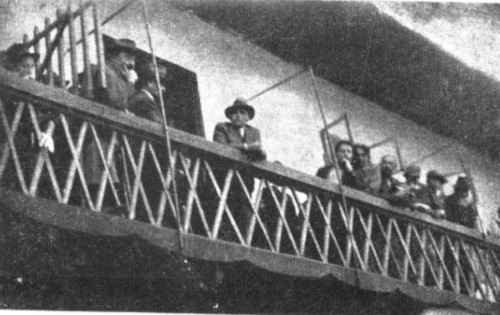
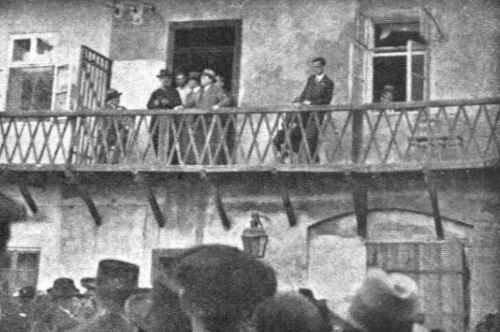
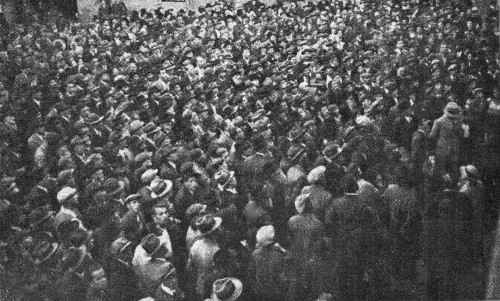
| A public meeting for the elections to the Community Council for Abandoned and Forgotten Cemeteries, in Tarnów in 1936 |
[Page 145]
The success of the Zionists was a no-brainer, considering that they managed to capture the same number of seats as before (eight), when the Bund and Poalei-Zion did not participate in the elections. The following were elected to the Community Council:
Zionists: Wolf Getzler, Joseph Heimann, Kohn, Dr. Wolf Schenkel, Yechiel Kurtz, Henrik Hollander, Dir. Leopold Schinagel, Dr. Avraham Chomet.
Bund: David Batiste, Zeller, Isaac Greenbaum, Moshe Feireisen.
Agudah and Bobover: Eliyahu Gevertz, Aharon Rosenzweig, and Shlomo Mehr.
Yad Haruzim (artisans): Maurycy Hutter, Joseph Ginger
Orthodox: Chaim Aberdam.
Poalei-Zion: Mgr. David Lenkovitch
Non-partisan Orthodox List: M. Schneider.
None of the parties had an absolute majority that could take over the government of the community. However, no one wanted to be the cause of re-introducing rule by commissioner over the community, which would have to happen if one of the community factions did not have a majority in the elections to the administration. Public opinion demanded that the Zionists take over the responsibility for the fate of the community. Even other groups have quietly hinted that they were considering that the Zionists take over the leadership of the community.
The community council chose an administration with the following composition: Dr. M. Menderer, Kahn, Wolf Getzler and Dr. A. Chomet (Zionists and Mizrahi bloc), who worked in cooperation with Chaim Aberdam
|
|
| Before the elections to the community in Tarnów in 1936. Above the community's courtyard, speaking to the assembled crowd, Dr. Chomet. To his left are the representatives from the Bund. |
[Page 146]
(who was also included in the administration). Apart from them, Aharon Rosenzweig (Agudah) and Yehezkel Neimann (Bobover Chassidim), David Batiste and Feireisen (Bund) and Maurycy Hutter (Craftsmen association]) were also elected. Thanks to the situation created, the Zionist representative Dr. M. Menderer was elected as chairman of the administration, and as chairman of the council, Eliyahu Gevertz (Agudah). The following were elected as vice-chairmen of the administration: Wolf Getzler and Chaim Aberdam.
The newly elected administration worked under the sign of mutual understanding with all the Jewish groups, which were serious about the role and the tasks of the Jewish community.
The administration had a difficult task for itself. The fatal commissioner rule left serious consequences in all Jewish institutions. We read about the activity of the newly elected administration in Tigodnik Żydowskie (January 22, 1937, № 4):
“Hardly a few weeks have passed since the new community administration was stepped in to work. It must be confirmed that during this short period, the administration's activity covered almost all areas of Jewish social life, showing initiative and a rare organizational and social sense. In the first period of its activity, the administration had to put in order the legacy of the previous commissary administrations, which was in all areas
|
|
| The Zionist organization in the election campaign for the congregation [council] in 1936. Next to the speaker Dr. Chomet - the chairman of the assembly, Wolf Getzler RIP; and the members of the presidium: |
[Page 147]
a negative one. Open and exchange debts in the amount of several thousand złoty; a large number of unpaid subsidies; a neglected Mikva ( ritual bath house); the Jewish hospital had weaknesses and defects; the social security department ran chaotically and without any plan; the constant intrusions in the community offices caused by the poor and needy, which hindered its normal work. The new administration has stepped in to sort out all the ongoing issues in order to pave the way for further initiative and expanded activity.”
Very quickly there were those who strongly wanted a commissioner appointed by the supervisory authority to again sit over the community.
In Tigodnik Żydowskie (№ 6 of February 5, 1937) we read that an indictment/accusation was filed against the community administration in the provincial office in Kraków. The accusation was anonymous, supported by a pamphlet that was previously been read in the synagogues and study halls. In this regard, the newspaper notes: “The attack on the current community administration came from those who do not refrain from using the name of belief and religion for the sake of personal influence and material gain. In the synagogues these days, a disgusting leaflet was pasted, signed by ‘Machzikei Hadath,’ which mostly includes Belzer Chassidim. In this leaflet, the hypocrites, no more and no less, call ‘to battle with the heretics,’ and they also admit that ‘a group of people who rose to power by force, organized a memorial gathering after the death of a known heretic, which upset us greatly, because according to the law, every Jew must rejoice if a heretic dies.’
“Probably, people here mean,” continues the newspaper, “the memorial gathering that the administration of the Jewish community in Tarnów arranged over the death of the leader of Polish Jewry, Rabbi Dr. Yehoshua Thon. It should be emphasized, however, that the official leadership of the ‘Machzikei Hadath’ society is limited to this page, explaining that someone is hiding under the name of ‘Machzikei Hadath.’
“These were actions of irresponsible individuals, without any consequence. The Jewish population in Tarnów, the Orthodox as well as the worker circles, gave the community administration its full confidence, which was led by a Zionist presidium responsible for its activity before the administration and the community council.”
After six years of commissioner rule, in February 1937, the first budget meeting of the community council took place, which was voted in by the Jewish population. The Tigodnik Żydowskie (February 26, 1937, № 9) tells us about the course of this meeting:
[Page 148]
“One must admit that the council passed the exam in a classic manner. With its seriousness, matter-of-factness, reasonable approach, loyalty toward the opponent, and with a sense of responsibility, the council has shown itself to be a picture of political maturity. At the presidium table sat Eliyahu Gevertz, chairman of the council, whose patriarchal appearance called for attention; and the energetic, devoted and caring representative of the Jewish population, who enjoyed the trust of everyone, president of the community administration, Dr. M. Menderer. There were the council members, representatives of all strata of the Jewish population in our city, well-known social workers. Almost all of them have earned their place of work, endowed with the trust of their followers, but also burdened with responsibility and concern for their fate, as well as for the fate of the entire Jewish community. Because all the groups sent their best people to the Jewish Community Council. Everyone oriented themselves quickly, so that the meeting was conducted smoothly, with full parliamentary form, without resorting to tricks with the rule book {regulations}. There prevailed complete freedom of speech, which was not abused by anyone. Everyone stood at the height of their task. The president of the Zionist faction, Dr. Chomet, an incomparable polemicist, who thoroughly knows the Jewish problematic, now appears as a seasoned and experienced politician, realizing the tactic of smoothing the partisan differences and creating a platform for cooperation between the Zionists and the Agudah, with a factual and objective relationship to work in the community administration on behalf of other groups in the community.
This objectivity was also characteristic of the actions of the representatives of the Bund, the skilled, responsible worker David Batiste, as well as Zeller, who showed great skill in setting and establishing demonstrative proposals. The Mizrahi activist, Yechiel Kurtz, who emerged, and having an ability to deeply penetrate the religious problem with seriousness. A good positive impression was left by the actions and the attitude of the councillors of Agudah. Because Mr. Shlomo Mehr, who showed to have a brilliant orientation in party-political matters and boldly opposes the rejection of the extreme orthodox in the address of the Agudah, has given proof that at least one section of the community can cooperate with the Agudah. The budget was reviewed {evaluated} by Dr. Wolf Schenkel. He described a sad picture of Jewish reality. He sketched a way out. He called to consolidate all Jewish creative forces, rebuild economic self-help, analyzes the most important items in the budget. He underlines the positive sides and points out the flaws and shortcomings, which, unfortunately, cannot be removed. He appealed for a factual
[Page 149]
discussion and to keep to the original level, worthy of representatives of the large politically mature Jewish community in Tarnów. The discussion, beautiful in terms of form and content, was carried out with responsibility and concern for the fate of the Jewish population in Tarnów. Dr. Shenkel emphasized in his speech how Jewish life was sad, depressing. The attacks are increasing from all sides. The hopelessness literally screams out from every corner. The expulsion of Jews from their economic positions continues systematically. The Jewish academic youth is beaten and bullied. But we do not have to fall into despair. We need to straighten our backs and work on the construction of our national home in the Land of Israel, as well as activate our national politics. We need to create a united Jewish front.”
Here is a picture of the budget meeting of the Jewish community in Tarnów, delivered by Chaim Friedman, brilliant reporter of Tigodnik Żydowskie.
The actual budget preliminary, we read in the Tigodnik Żydowskie, was presented as follows: “The list of community [tax] payers in 1936 included 1829 people, while in 1935 there were only 1562 tax payers. Nevertheless, the global amount was increased for the previous year only to 2040 złoty. In 1935, the global amount of tax assessment reached 61,395 złoty, and now, 63,435 złoty. However, the global amount on the side of revenue and expenditure was 269,420 złoty. On the income side, the following items were included in the budget: Community payment: 44,900 złoty; From the community buildings: 9,000 złoty; from kosher slaughter: 116,000 złoty; from the cemetery (tombstones, graves): 27,600 złoty; from the mikvah: 13,000 złoty; from the hospital and outpatient clinics: 20,000 złoty; subsidies: 4040 złoty; taxes and other revenues: 5,950 złoty.
“The expenses (according to specific items): Pay off debts: 12,200 złoty; religious administration: 20,232 złoty; office administration: 24,144 złoty; administration of the community buildings and the synagogue: 21,350 złoty; administration of the slaughterhouse: 30,933 złoty; administration of the mikvah: 12,600 złoty (including a renovation in the amount of 12,000 złoty); administration of the hospital: 48,978 złoty; old age home: 11,956 złoty; welfare and holiday activities: 30,060 złoty; subsidies: 24,800 złoty; insurances, taxes and mortgage interest: 8,960 złoty; employee insurance: 7,500 złoty; unforeseeable expenses: 3,300 złoty.”
The budget debate always revolved around the “subsidies” item, where various amounts were foreseen for the benefit of almost all active
[Page 150]
socio-philanthropic and cultural institutions. In addition, certain sums for the Land of Israel Funds, Hebrew schools, and Zionist societies of a cultural and sports nature figured in the items. The Bund representatives and the extreme orthodox (“Belzer”) came out particularly strongly against these budget lines. In the background of the tragedy of European Jewry during the last world war {WW II}, as well as the actual realization of the Zionist ideal, it is worthwhile to convey a fragment of the above-mentioned budget debate which is so characteristic of the political relations on the Jewish street in Poland at that time.
“After the anti-Zionist statements on the part of the Bund representative,” said the Tigodnik Żydowskie, “Dr. Chomet gave a comprehensive and effective response to the statements by Mr. Batiste, who emphasized at the beginning that the Bund considers it necessary to come out against Zionism at every opportunity and show its negative relationship with Palestine, although the Land of Israel has long since ceased to be a dream of a group of dreamers and has become an important factor in the lives of the broadest Jewish teachers, which was recognized by important socialist leaders such as Niejalkowsky, Leon Blum, and others. The proposed budget is a reflection of the powers of the current community, as well as an expression of the aspirations for a cooperation of these powers. The removal of these subsidies will transform the budget into a cemetery {limited} budget, while our aspiration is for the community to embrace the whole of Jewish life: religious, cultural, and social. If the financial means do not allow us to satisfy all the needs, then we should at least manifest our aspirations with small amounts. The Bund's point of view is strange. It fights for national-cultural autonomy. The organ of autonomy must be the community, but now the Bund wants to reduce the role of the community to be a manager of the cemetery and the mikvah. We are in favor of giving subsidies,” explained Dr. Chomet, “also to those institutions, which do not speak to us ideologically, because we reckon with the real power relationships, and we want to enable cooperation within the community, and cooperation is only possible when everyone's opinions are fully respected. Only such cooperation can be a guarantee for fruitful, healthy activity for the benefit of the entire Jewry, which needs to create a broader national front, as other nations that are in danger do. And if we talk about the need to set up unity in the Jewish community, this unity must be realized. Unity does not mean dictating, ruling. If we want to create unity, we must understand all circles of Jewry, which come into consideration in the work for the benefit of Jews. The present budget,
[Page 151]
especially so are the several subsidies, which are indeed an example of such an understanding. We also agree to give subsidies to institutions that are under the ideological influence of our opponents, indeed in the name of cooperation and mutual tolerance. The Bund also opposes the subsidies for JNF and Keren Hayesod. Thanks to the funds, we produced a powerful work in the Land of Israel, which caused wonder/astonishment throughout the world. And what did the Bund create? What has it produced that is eternal and permanent for Jewry, although it has been active in the public arena as long as Zionism? The Bund still maintains its stubbornness and negation of Zionism. In contrast, socialists of such stature as Andrzej Strug, Du Bois, Vandervelde; the leader of Jewish workers in America: Vladeck; Prime Minister of France, Leon Blum, have only words of praise for these deeds in the Land of Israel.”
The above-mentioned budget was accepted with the votes of the General Zionists, Mizrahi, Agudah, and representatives of the Jewish artisans, while the Bund and the councillors of the Belzer Chassidim voted against the budget. The efforts of the community administration, that the community should encompass all areas of Jewish life with its activity, and that apart from purely religious matters it should demonstrate its participation in the process of rebuilding the Land of Israel, but encountered difficulties also by the administrative power, which patronized darkness and obscurantism on the Jewish street.
That time was a very difficult one for Tarnów Jewry, just as it was for the entire Polish Jewry. The community was only a segment of Zionist activity, which encompassed all areas of Jewish life. In the year 1937, this life was greatly threatened by ever more aggressive activity. In newly independent Poland, antisemitism intensified, especially thanks to incitement by Endecja [Party] forces, such as by the official extermination policy in the economic field, led by the state Sanacja factors. The [article from] Tigodnik Żydowskie (November 10, 1937, № 37) best illustrates this situation in Tarnów: “On October 3rd, several Jewish stationery stores were under the control of pickets, who even forced Polish customers who wanted to buy from Jews out of the stores. The fact of picketing Jewish businesses caused a depressed mood in the Jewish circles, especially since this was the first case of anti-Jewish [activity] of this kind. It is characteristic, however, that the pickets were stopped by a group of Polish workers from the PPS, who drove the picketers away. The dignified and courageous behavior of Polish workers caused a lively response in Jewish society. Mr. Schit, secretary of the PPS, arrested during these events, was released.”
[Page 152]
From the above-mentioned aid budget for the year 1937, the supervisory authority immediately struck off almost all the budget lines for the institutions that were led and maintained by the Zionists. And not only that, the administrative power limited and hindered the Zionist efforts to lead the community on the wide path on which Polish Jewry was progressing. As the Zionists did not have a majority in the community administration, it was difficult to lead the community, while not backing away from some Zionist demands.
A crisis in the community administration also broke out against this background. On November 28, 1937, a Land of Israel conference was called in Kraków, which was to demonstrate the solidarity of the Jews in Galicia and Silesia with the struggling settlements in the Land of Israel. The executive committee of the conference had, among others, also invited the Jewish community in Tarnów. When the presidium of the community administration (Dr. Menderer and Wolf Getzler) demanded a decision from the administration to select a delegation to this conference, the majority in the administration (Bund and Orthodox) decided to remove the question from the agenda. Dr. Menderer, chairman of the administration, felt humiliated by this and resigned from his office. The crisis was averted, however, because the administration, at its meeting on November 24, 1937, declared that the above vote was not meant to express no confidence in the chairman, and thanks to this, the presidium was enabled to continue its work.
At the beginning of 1938, the presidium again resigned. This time, new elections for a chairman and his deputy was quickly arranged. The elections took place on January 23, 1938, during which Dr. Menderer was elected for the second time as chairman, and Wolff Getzler as vice-chairman. Both candidates (out of 10 votes in the administration) received only four Zionist votes, David Batiste's {sic Atist; probable typo} candidacy received two votes, on the other hand, the representatives of Agudah, Orthodox, and Yad Haruzim entered blank slips and thus enabled the election of a Zionist presidium. On the background of the latest incident in the Tarnów community, Tigodnik Żydowskie (January 28, 1938) wrote:
“As long as the majority of the Community Administration will cooperate loyally and objectively with the Zionist minority on the territory of the community, as long as the current administrative presidium will boldly and faithfully carry the burden imposed on it. The balance of the one-year activity of the administration turned out to be positive. In addition, it should be emphasized that the Community Administration, which consists of representatives of political parties, had shared the moments that divided and those that
[Page 153]
united them in harmonious cooperation in the community economy, with all the forces that could bring some benefit to the Jewish community in Tarnów.
“Even the control {review} that was carried out by the superintendent in December 1937, had to confirm that the community economy was being managed rationally and purposefully, that it was improving the situation in the community, which was in a difficult situation because of the commissioner's rule over several years. In addition, the review established that since the community's property was taken over by the current administration, it has grown by over 42,000 złoty by December 1937. After arranging the relations in the Jewish hospital and the old age home, already in 1938, the new administration set upon itself the task of carrying out a renovation of the New and Old Synagogues, community buildings, and the mikvah. And in the next program, it foresaw building covered rooms/stalls in the halls, to equip and manage an x-ray unit, and to set up a pavilion {sanatorium} for tuberculosis patients.”
The Jewish Community Administration thus became the sole representative of the entire Tarnów Jewry, because the group of councillors in the city council was not at all concerned with defending the threatened' Jewish positions, obediently subordinating to all the actions of the Sanacja people, who did not hide their Auvshem attitudes concerning the Jewish question.
The Tigodnik Żydowskie writes (March 5, 1937, № 10) about the tactics of the then Jewish councilors in the Tarnów city council:
“This tactic is bad, harmful, and irresponsible to vital Jewish interests. The Jewish councillors, in their best belief, of course, become a tool in the hands of people who are unfriendly to Jews.”
Only the Bund councillors, who were led by the able and energetic activist. David Batiste, boldly exposed the antisemitic Sanacja who benefited from Orthodox support. At the meeting of the city council, held on March 23, 1937, the situation of the Jews in Tarnów's Ambultsten was characterized by David Batiste in a speech during that meeting (as cited in the Tigodnik Żydowskie):
“In the communal offices, Jewish interests are treated unwillingly, with exactness. Jews are not allowed to work in city [positions]. For several years now, not a single Jewish official has been hired, and among 65 city employees who recently received an advance, there is not a single Jew. And although the Jews in Tarnów comprise 45% of the total population in the city; have lived here for 600 years; bear all the financial burdens for the community; in the entire administrative budget, which is about 2 million złoty, there are barely
[Page 154]
3 Jewish budget lines with a total sum of 9,800 złoty (of which for the Jewish hospital 2,000 złoty, old age home 1,800 złoty, orphanage 6,000 złoty), besides them, no Jewish cultural or social institution received any funding.”
In the city council itself at this time, the struggle between a larger group of socialist councillors (PPS and Bund) with the Sanacja majority, to which the Jewish councillors also belonged, intensified. The socialists attacked the city president, Dr. Brodzinski, particularly strongly. The Tigodnik Żydowskie describes the situation in the city council as follows:
“The last meeting of the city council, held on Tuesday, February 11, proved once again that the current city council is not viable and that our communal self-governance is going into the ground. It {the meeting} was about liquidating the conflict between the club of socialist councillors and Dr. Brodzinski, the city president. The meeting was very stormy. The socialist councillors left the meeting hall singing Chervani Standar (Red Flag). On the sidelines of the above meeting, we must return to our Jewish councillors. We already know them. They are not capable of any energetic steps, nor of any courageous attitude or having a shred of independence.”
This conflict ended with the resignation of Dr. Brodzinski. When the administrative power took notice of this resignation, the question of electing a new mayor became relevant. In this manner, as in such cases, much depended on the attitude of the Jewish councillors. Unfortunately, the then group of Sanacjan-Orthodox Jewish councilors blindly carried out the orders of the antisemitic Sanacja councillors, and not at all trying to influence the election of a new city president from the point of view of Jewish interests. On this point, the Tigodnik Żydowskie actually writes:
“The issue of electing a new city president {mayor} is not only a matter for the Jewish councillors. They have so far shown little determination and courage that the Tarnów Jewish community should leave the decision in the hands of the Jewish councillors, who so far have not been up to the task. The question of electing a new city president is vital for all of Tarnów's Jews. It cannot even be imagined that only the Jewish councillors, who represent at best a handful of Tarnów's Jews, should decide together with other Sanacja councillors. Unfortunately, the consolidation of the entire Jewish community only occurs under the pressure of failures and pressure from the outside. First, the sad reality cements the struggling Jewish groups. We put forth a resolution to the Jewish street
[Page 155]
in Tarnów to set up a joint body for the entire Tarnów Jewry for issues that concern us all, regardless of political beliefs. Consolidation from below is where our solution is. Such a body, which would represent the entire Tarnów Jewry, could also decide on the direction and tactics of the Jewish councillors when electing a new city president.”
These words, however, did not affect the politicized Orthodox councillors. Meanwhile, heavy dark clouds gathered on the horizon of Polish Jewry. It began with the campaign to abolish kosher slaughter. The famous Mrs. Pristor, supported by Father Chechak, did not stop with her antisemitic propaganda, but promoted the abolition of ritual slaughter as a central problem; as a remedy to overcome the severe economic crisis in Poland. The anti-Jewish resolutions found fertile ground in the then Polish Sejm, in which the Jewish deputies, led by Dr. Emil Sammerstein, led a tireless struggle to defend the threatened Jewish existence. For a long time, the battle over the issue continued. At the same time, the Polish Jews showed a lot of determination and stubbornness, not even refraining from proclaiming a meat fast for an entire month, which had the result that the antisemitic Sejm was forced to postpone until 1940 the implementation of the law prohibiting ritual slaughter. But the anti-Jewish agitation found a favorable response among the Polish people. In Brisk, the Jewish population suffered a lot because of anti-Jewish excesses. Both city residents and rural peasants attacked Jewish businesses and shops, killing the Jewish population and robbing them of their possessions and goods. Polish Jewry actively responded to the events, which had the character of an organized pogrom. Along with the entire Polish Jewry, the Tarnów Jewish population expressed its solidarity protest on May 24, 1937. At the call of the central bodies of all Jewish political organizations, Tarnów Jews shut down work for 2 hours. Exactly at 12 noon, all Jewish businesses and workshops were closed. Jewish social and economic institutions suspended work. Everyone protested against the events in Brisk with a silent demonstration. At the meeting of the Tarnów community administration, it was decided to protest against the events in Brisk and to express sincere and heartfelt sympathy to the Jewish community in Brisk. It was also decided to distribute an appropriate amount as urgent aid to victims of the pogrom. On the initiative of the Jewish community, on May 27, 1937
[Page 156]
a conference was held with the participation of the Rabbinate, where a committee was elected to help the suffering in Brisk. The committee included:
Dr. Menderer, Eliyahu Gevertz, Shmuel Zins, Wolf Getzler, and Joseph Heimann. Secretary: Edward Sauerstrom, Treasurer: Chaim Aberdam.
Dr. Menderer, chairman of the Community Administration in Tarnów, had dedicated himself to the work in the community. The frequent misunderstandings with the non-Zionist majority, however, discouraged the desire by this intense social activist to such an extent that in August 1938, he resigned from his office not only as chairman but also as a member of the community administration. The community administration decided unanimously to thank him for his hard work. At the same time, it was decided on how to conduct elections quickly for a new chairman. In place of Dr. Menderer, Mr. Henrik Flor joined the administration.
Also at this time, all the parties represented in the community administration gave themselves an accounting of the responsibility that lies upon them, especially at the time, when in the area of social security, the community's activities encompassed wider circles of Jewish poverty. The poverty in the Jewish neighborhoods increased with each day. The tax hike destroyed hundreds of Jewish livelihoods, which also found themselves between the hammer of the antisemitic administrative power, which used all the means to remove Jews from economic positions, and the anvil of the anti-Jewish Endecja, which really fought the Sanacja government, but was united with the Sanacja in their campaign against Jews. Under the resolution to develop Polish trade, the destruction of Jewish commerce was understood, and the administrative power assisted to this end. Even in the year 1938, a “Week for Making Trade More Polish” was proclaimed in Tarnów, which meant strengthening the boycott action against Jewish merchants, because the Polish population, especially from the working circles, gladly bought from Jewish merchants, receiving better and cheaper goods. As reported by Tigodnik Żydowskie (April 15, 1938, № 15), “The Endecja demonstration in connection with the ‘Week for Making Trade [More] Polish’ ended in failure, and on Saturday, April 9, 1938, a final demonstration of several dozen people was controlled by the PPS. When the train arrived at the memorial for the unknown soldier, it already consisted exclusively of socialists, who sang socialist songs. On Sunday, April 10, a meeting was held in the ‘Sokol’ Hall under the chairmanship of Engineer Drevnovsky from Maschtshitze {מאשטשיצע Mościce}. Deputy Dudjinsky from Łódź gave a speech, then a series of anti-Jewish resolutions were passed. The first public appearance
[Page 157]
of the Endecja in Tarnów ended in complete failure thanks to the bold stance by the local socialists.”
The election for a new chairman of the Jewish community administration took place on November 11, 1938. During the voting, Zionist candidate Wolf Getzler received 5 votes (4 Zionists and 1 Orthodox: Chaim Aberdam), the Bund received 2 votes, one vote was a white slip. The representatives of Agudah and Bobover Chassidim (Aharon Rosenzweig and Yechezkel Neumann) abstained from voting. Wolf Getzler was elected chairman. When the governor's office did not confirm the election of Wolf Getzler as chairman, the threat of commissioner rule once again hovered over the Tarnów Jewish community. According to the regulations for the religious communities (ordinance of the Culture Ministry of October 24, 1930), a person who does not belong to the administration could not be elected as chairman, and if an elected chairman was not confirmed for the third time by the supervisory authority, it had the right to nominate a chairman.
In such a situation, the Zionists had to resign from presenting for the second time the candidacy of Wolf Getzler for the office of chairman of the Jewish community administration, although of all the board members he had the most necessary qualifications to take over this office. At another meeting of the community administration, held on October 12, 1938, only the candidate of Dr. A. Chomet, who received 4 votes (out of 9 present at the meeting) while three ballots (from Bund and Yad Haruzim) were blank, and the representatives of Agudah and Bobover Chassidim abstained from voting. So, thus, around that time, Dr. Chomet was elected as the chairman of the administration. After the election, the Agudah representative, Aharon Rosenzweig, read a declaration that although he and his colleague did not participate in the vote, they express their full readiness to cooperate loyally with the newly elected chairman.
After the supervisory authority confirmed the selection of Dr. Chomet, he took over the office of the Tarnów community administration on September 23, 1938. Dr. Chomet described the tasks of the Zionist representation in the community in an article published in Tigodnik Żydowskie (November 25, 1938, № 47):
“The socioeconomic difficulties emerge from the fact that every third Jew in Tarnów enjoys public welfare activities, whether once or periodically, sometimes also permanently. Our aid campaigns on Passover eve, and the coal campaign in winter are the best proof of this. In the first place, therefore, community activity
[Page 158]
is concerned with solving social needs. We must give this activity a constructive character. Less begging, more help to speed up the productivity process of approved impoverished Jews. The appropriate satisfaction in fully taking into account and fulfilling the religious needs of the population depends on suitable community management. Such management, in order for it to fulfill its tasks, must be rational and planned.”
The community administration, although at that time it was burdened with maintaining and helping over 1,000 Jews exiled from Hitler's Germany, took on with all its energy the responsibility to fulfill the tasks that stood before the Jewish community. The new chairman, Dr. Chomet, proposed a broad work plan to the administration, which included the following points (quoted from the Tigodnik Żydowskie newspaper): 1) Improve the financial economy in the community by reducing its debts; 2) Properly collect the community tax and distribute it fairly; 3) Make the budget realistic, and; 4) Expand social assistance activities, rebuild the Jewish hospital, provide ambulatory health services, improve the old age home, build housing for the homeless and for the terminally ill, increase protection for the mother and child, create a work exchange for craftsmen, carry out the project of opening a pavilion {sanatorium} for tuberculosis patients. “We are living through a difficult time,” writes Dr. Chomet. “The Jewish community must contribute help and encouragement to the impoverished Jewish masses, and must also fulfill its obligations regarding the building and struggling of the settlement in the Land of Israel.”
The best witness as to how difficult Tarnów Jewry found itself at that time, is the fact, according to the report of the Passover campaign, carried out in 1938 by the Jewish community, that more than 1,700 Jewish families benefited from the Passover aid; i.e., about a quarter of the entire Jewish population of Tarnów. The cash amount of 4,953 złoty and 60 groschen [pennies] was distributed to 534 families. About 1,100 families, as well as Jewish institutions and organizations, received 5,571 kilos of matzot. Apart from this, Seder nights were organized for 178 soldiers who were on military service in Tarnów at the time, and the sum of 4,500 złoty was spent for 50 Jewish prisoners. In general, the community administration spent a total of 15,200 złoty on Passover aid. These funds were covered entirely by community funds (Tigodnik Żydowskie № 18, 1938).
[Page 159]
Even during this difficult period, Tarnów Jews did not let themselves fall down. In order to defend themselves against the Sanacja's Auvshem policy and against the Endecja's anti-Jewish agitation, Jewish economic and professional organizations, as well as political parties, had developed a lively enlightenment activity, not neglecting the struggle for Jewish rights in the city and the general state arena.
In the second half of 1938, all of Poland was preparing for the elections to the Sejm. The Sanacja was opposed by the entire socialist camp, the powerful peasant party of Wincenty Witos, and the entire Endecja. This anti-Sanacja bloc declared a boycott of these elections, because of the anti-democratic electoral regulations. Jews in Poland faced a dilemma: Either boycott the elections and remain without a representative, or lead the Jewish masses into an election campaign in order to gain a presence in the parliamentary forum to fight for Jewish rights. The Zionist organization in Western and Eastern Galicia and in Silesia took the view that the Jews were in a special situation, they should not give up on the limited, yet the only possible opportunity to expose how antisemitic the agitation by the Sanacja-Endecja was in the parliamentary forum. Therefore, these organizations decided to participate in the elections, especially since in the bloc that boycotted the elections, there were both Endecja and Wincenty Witos's People's Party, both of which did not hide their anti-Jewish slogans.
The decision by the Jewish organizations to participate in the Sejm elections had provoked quite sharp criticism among Polish socialist circles. Also, a lively discussion about this question was going on in the columns of the Jewish press. The point of view of the Jewish bloc, which encompassed the Zionist organizations, and among merchant and craftsmen circles, was defended by Dr. Chomet in the columns of Tigodnik Żydowskie. He wrote as follows (August 26, 1938):
“Only we ourselves can decide whether we should direct ourselves to Polish democracy. Based on the experiences of the last few years, we know that the success of an advanced democracy in Poland depends on the extent to which the Polish progressive elements will oppose the antisemitic wave. In a time of widespread antisemitism, our natural ally is a democratic front, and the existence of Polish democracy depends on whether it succeeds in clearing the air polluted by antisemitic agitation. Polish socialism must fight antisemitism and
[Page 160]
that is why in this struggle it must support all the democratic forces of the urban and rural population. In Poland, the struggle between the proletariat and the bourgeoisie in its social ideals is current, because the basis of the friction is now based on the sectoral struggle for the simplest rights of people and citizens. And there, where antisemitism prevails, there is a favorable environment for all kinds of liberalism and social reaction; there the various backwardness and reaction must triumph. That is why Polish socialism is so bloody interested in fighting antisemitism, because in our country the Endecja wants to come to power on the antisemitic hobby-horse and suffocate all signs of progress that are represented by the socialists and by certain liberal circles of the citizenry. Discarding the Zionists, they then went along with X, and then they voted for Epsilon, reminding us of a dispute about last night's snow. Now it is not about rejecting the past. The same PPS in independent Poland had committed a series of mistakes, which partially led to the current situation. We should not be rejected for supporting the Sanatzia, as it is in general, not healthy to make mutual recriminations. Everything must be done quickly, so as not to repeat the mistakes of the past. Fate has united the three million Polish Jewry with the efforts of Polish democracy, which fights against any kind of oppression, political as well as national, religious as well as social. Therefore, this dividing line is in bold one for us. We are natural allies of those who watch out that Tarnów should not become black {benighted}.”
A few weeks later, when the election campaign was in full swing, we read in Tigodnik Żydowskie (October 21, 1938, № 42) an article by the same author, A.N., “Are we going to the elections?”:
“We want to emphasize at the outset that life's commandment for the Jewish population in Poland is to support Polish democracy. No one in the Jewish community can orient themselves otherwise. This orientation toward democracy, however, does not mean the simultaneous resignation from separate, independent Jewish politics, dictated by the necessity to adapt to the subjective possibilities and objective conditions in which the Jews have to live and fight. Orientation toward democracy does not mean uncritically reacting to all the actions and decisions of this democracy, even only from the point of view that our specific economic structure and the national-social situation call us to remain faithful to an independent Jewish politic. The question of participating or abstaining in the Sejm elections enters the area of ordinary party-tactical calculations,
[Page 161]
which often have nothing in common with democratic viewpoints. The current tactics of the Endecja regarding the elections would be difficult to consider as an expression of its aspirations as a victory of democracy, although its point of view in the current final elections is the same as the point of view, whether of the People's Party or whether the PPS. Therefore, we repeat: We are going to the elections, aligned with Polish democracy, which considered it inappropriate to leave the parliamentary forum to someone else. We are not allowed to do this. Because our struggle is much more difficult than the struggle of Polish democracy. For us, the victory of Polish democracy will first mean the creation of an atmosphere where it will be easier to fight for the right to life and work. But we have to fight for this right to life and work today and tomorrow, independently of the political constellation in the country.”
The situation of Jews in Poland became more difficult every day. From the west came a storm whose first message was the wave of Polish refugee Jews living in Germany, whom the Hitlerite government had deported to the border city of Zbąszyń (German: Bentschen). Jews in Poland welcomed their expelled and persecuted brothers. In all of Poland, activity began in support of the Polish Jews expelled from Germany. This activity is one of the most beautiful pages in the history of the Jews in prewar Poland. Tarnów was not left behind either. This activity, in which the city's best citizens, all political parties, and organizations participated, was led by the community administration. For a time, the normal activity of the community was halted. The administration, the council and the officials were busy helping their homeless brethren. It is necessary to describe the willingness, and effort of Tarnów's Jews during this activity, in order to also honor the memory of those who at that time showed so much courage and effort, material and physical, for those who lost the roof over their heads in a matter of minutes. One also needs to tell about this activity, because it was not a self-serving one. At that time, Jewish social workers in Poland did not take get paid for their social activities.
The first transport of refugees arrived at night in Tarnów, on October 20, 1938. The local committee of the Zionist organization immediately stepped in, organizing aid. The refugees were immediately accommodated in the premises of the Tarnów Zionist Club, located on 4 Mickiewicza Street, and in the schools. Just as every train arriving from Kraków would drop off several dozen refugees at the station (many of whom immediately departed for various cities and towns..
[Page 162]
in western and eastern Galicia), that same night a food serving post was organized at the station, which was constantly busy, continuously providing the refugees with warm meals on the spot and with preparations for the journey ahead.
A temporary aid committee was organized by the Zionists in the city. The committee operated at the Community Center, where the refugees were taken directly from the station. In the Community Center, they received information about securing a roof over their heads and they were given food, money, and any needed medical help. An employment agency and a women's section were also set up, which dealt with collecting clothes.
The Jewish population in Tarnów lived with the tragedy of their displaced brethren. Dr. A. Chomet relates in an article in the Tigodnik Żydowskie (December 4, 1938, № 44), A.N., “Our Tragedy,” about the feeling of solidarity by Tarnów's Jews with the refugees.
“What do they look like? Exiled? Expelled? Refugees? How to describe their tragedy? Homelessness? Wandering about? They don't talk, they don't complain, they are like crazed ones. Torn out of their houses, their homes, from their beds, from their workshops, with only one shirt, without a penny. Mothers were separated from their children, women from their men. They don't talk, they don't complain, they only weep. They cry when you take pity on them. Old people wet their cheeks with tears, when you give them a bit of warm cooked food. They are silent when you give them help. Take a look at the pale, shocked faces of the boys and girls, who still have not freed themselves from fear and dread. You look at the expression of hopelessness of these people, and you weep with them. You cry over their misfortune and ours, cry over the tragedy and suffering of a homeless people. Because homelessness is our tragedy. Only when seeing the tears and distress is it clear and obvious. When, 50 years ago, the first pioneers returned to the Land of Israel, to put an end to wandering and start building their own home in their own fatherland, when they came across swamps and wasteland, sand dunes, and drought. When, despite the malaria and famine, they conquered the fatherland, the people still did not believe, not yet. Imbued with the awareness of the truth that our greatest tragedy is our homelessness. And today, when we grant aid to our unfortunate Jewish brethren expelled from Germany, when the nightmarish picture of exile again hovers before our eyes, when the entire Jewish society takes part in the rescue operation, healing the pain and the suffering, when we are surrounded by hopelessness and despair, we look with faith at the fighting heroic settlement, which
[Page 163]
with their blood fights for every piece of its own land, building the homeland for us and for those who shed tears today over their fate. This disaster united all the strata of the Jewish population. In these grim days, we have forgotten what had divided us. I hope that the tragedy we are living through now will be the last warning for us, that with joint forces we must fight for a better tomorrow for the entire nation, both in the Diaspora and in the Land of Israel.”
The Jewish refugee problem was not a simple matter. Dealing with about a thousand people, providing them with housing, food, work, and money for the most necessary expenses, demanded significant funds and man-power that would need to continue working for a longer period.
On November 5, 1938, the then chairman of the community administration in Tarnów, Dr. Chomet, convened a public meeting of representatives from all strata of the Jewish population, where he first reported on the current activity regarding urgent long-term help for the exiled Jews, including giving them financial support, sufficient nutrition, housing, and medical care. In addition, clothes, laundry, and shoes were distributed. After presenting the tragic situation of the refugees, the speaker appealed to the Jewish population for further financial relief and cooperation in the community's activity. At this meeting, a permanent committee was elected to support the Jewish refugees from Germany. The following persons were included in the committee:
Dr. A. Chomet: Chairman; Sigmund Fleischer, Wolf Getzler, Eliyahu Gevertz: Vice-Chairmen; Presidium members: Israel Kahn, Aaron Rosenzweig, Maurycy Hutter, Henrik Flor, Yehezkel Neimann, David Batiste, Moshe Feiereisen, Mrs. Dr. Ehrenfreund, Anna Flor, Dr. Wolf Mandel, District Court Judge Dr. Merz, Henrik Hollender, Dr. M. Menderer, Mgr. Schpielmann, Dr. Ignatz Seidenwerg Ignaz, Wilhelm Lichtblau, and Leon Birenbaum. The following were elected in the secretariat: Toshka Laufer, Miss Dora Ziegeltuch, Miriam Wildstein, Mangel {typo: Mandel} Wolff, Eduard Zauerstrom, Rosa Straum (officials of the community who volunteered to work without payment. They used to stay in the office until the late evening hours in order to resolve the current situation of the refugees). In addition, the secretariat also included Dora Goldstein (daughter of Aharon Rosenzweig) and Mgr. Primes. In the Finance Section: Sigmund Fleischer: Chairman; Hermann Flor, Dir. Oscar Kopfler, Abraham Jortner, Henrik Hollender, Mgr. Schpilmann, Joseph Ketz, Reuven Strauss, Jacob Fabian, Nachman Rennert, Eng. Karol Szancer, Maurycy Schwanenfeld, Dir. Isaac Schoenwetter, Dr. Sigmund Zilbiger, Eliyahu Gevertz, Wolf Getzler, Yitzchak Rotkes, Israel Hoenig, Yechiel Kurtz, Hollender Hersh-
[Page 164]
Leib, Wilhelm Lichtblau, Pessel Channah, Israel Glatzner, Bernard Leib, and members of the Rabbinate.In the Legal Section: Dr. Aupfner: Chairman; Dr. Ehrenfreund, Dr. Anselm Basler, Dr. Wolf Schenkel, Dr. Shlomo Goldberg, Dr. Bezalel Speiser, Dr. Ignatz Seidenwerg, Dr. Leon Maschler, Mag. David Lenkowich, Mgr. Miss Simche, Mgr. Wechsler, Dr. S. Rein, Dr. Edward Klein, Max Dintenfass, and Maurycy Hutter.
In the Housing Section: Henrik Flor; Chairman; Yechezkel Neimann, Julius Margolies, Chaim Ehrlich, Shmuel Keller, Mendel Pottaschmacher, David Kleinhandler.
In the Women's Clothing Section: Mrs. Dir. Kopfler: Chairwoman, with Mrs. Ehrenfreund, Goldberg, Fleischer, Gelb, Aupfner, Getzler, Funarska, Weiss, Holzer, Oeberlender, Raskes, Zins, Chechenovska, Merz, Muschkatblim, Fenichel, Schwanenfeld, Kets and Zatler.
In the Men's Clothing Section: Shimon Zeiden: Chairman; Chaim Keller, Emile Gans, Theodor Rath David Heinberg, Theodor Samson, Joseph Weinstock, Chaim Shalom Karn, S. Bland, Eliezer Zelinger, Pinchas Templer.
In the Provisions Section: Sala Gelb and Aharon Rosenzweig: Chairmen; Mrs. Esther Chomet, Mrs. Dir. Epstein-Friss, Eng. Merz, Miss Starkmann, Mrs. Leon, Mrs. Menderer, Mrs. Pessel, Mrs. Gevertz, Flougeizen, and Mrs. Kluger.
In the Employment-Agency Section: Lieber Gottlob: Chairman; Chaim Friedmann, Leon Quadratstein, Yitzchak-David Unger, Sigmund Fenichel, Moshe Schpilmann, Dir. Ignatz Lieblich.
In the Patient Care Section: Dr. Wolf Mandel: Chairman; Dir. Eugenius Schiffer, Dr. Emil Dintenfass, Pharmacist Taubeles, Dr. Chaim Haber, Dr. Klausner-Miller, Dr. Shimon Bloch, Dr. Rubin, Dr. Schoenfeld, Dr. Fenichel, Dr. Chaim Weiss.
In the Leather-work Section: Israel Blazer: Chairman; Mendel Pottaschmacher, Leon Friss, Laufer Marcus, Mechel Ferber, Feibusch Katz, Leib Rosenthal, Israel Halpern.
In the Station Rotation Duty Section: Hermann Kluger and Arthur Brig, with the help of permanent youth missions, whose chairman was Nachum Blumenkrantz, along with all the leaders of the Zionist youth organizations.
In the Control Commission: Dir. Leopold Schinagel, Yitzchak Schoenwetter, Braunislav Nebentzal, Oscar Kopfler, Bernard Czech. Thanks to the expanded committee, which included people who actively took part in the aid campaign, for until now, relieved the Community Council, which until then had to bear alone the entire
[Page 165]
burden of helping the refugees. This committee had completely fulfilled its task.
We listed the names of all the committee members, in order to honor the memory of these faithful, honest social workers who did not spare any effort or money to help their brethren.
Feeding the refugees took place at two places: Midday and evening meals were served in the kitchen that was arranged by the community in the economic school of Mrs. Dr. Epstein-Friss, and the General Zionists' Hanoar Hatzioni youth organization, gave its premises, which was located near the kitchen, to the disposal of the refugees. The refugees received breakfast on the premises of the handicraft association, Yad Haruzim, on Nove Street. At the same time, the premises served as a reading room and club, where the refugees spent their free time, having a specially arranged reading room and tea room. The housing issue was resolved as follows: Shlomo Wurzel gave the committee a place in his large clothing factory on Narotovich Street, which was renovated by Jewish craftsmen for free. Thanks to this, it was turned into a collective dwelling for several dozens of people. All the refugees received clothes, laundry, and shoes from the committee. Many of them were sent away post-haste. Tailors were assigned new machines that the “Art” provided.
In connection with the aid campaign for the refugees, it is still worth mentioning about the memorial prayer that was held in memory of the German Jews. The Yizkor commemoration, organized by the community, was also required to carry out a protest against the Hitlerite terrorist acts. Tigodnik Żydowskie (December 1938, № 49) reports on the memorial service as follows:
“Tarnów has not seen such a large gathering in a long time. Thousands of Jews from every class filled the New Synagogue. Cantor Rosenblatt began the prayer with the accompaniment of the choir under the leadership of the conducting artist. Dr. A. Chomet, chairman of the community administration, then spoke. He described the tragedy of German Jewry, and then emphasized that the cause of the tragedy of the Jewish people is its homelessness, the lack of territorial-state foundations for its existence and national development. Zionism foresaw such a development of events and provided the correct answer to solving the Jewish problem. The understanding of the necessity to build one's own national home in the Land of Israel has, unfortunately, penetrated very slowly into the consciousness of certain levels of the Jewish
[Page 166]
population and any potential benefit in this realm were ignored. Until now, Zionism, however, has achieved little. All efforts must be made to speed up the development of the Land of Israel, in order to lay the foundations for the establishment of a Jewish state.” Finally, Dr. Chomet called for assisting the refugees. Also speaking were vice president of the Community Administration, Wolf Getzler, Shlomo Mehr and a refugee named Rosenberg, who thanked the rescue committee for their help and care.
“The expulsion of the Polish Jews from Germany was only one of the extermination acts concerning the Jewish population of the ‘Third Reich.’ This happened at a time when the Sanatzia government in Poland had the illusion that a partnership with Hitlerite Germany had real foundations and could be a guarantee for Poland's independence. The Polish foreign minister Beck not only negotiated with Germany, but other Polish ministers traveled to Hitler's Germany to learn for themselves how to radically resolve the Jewish question.”
The second half of 1939 was already under the sign of uncertainty and war psychosis. The Hitlerite beast has no longer hidden its plans regarding Poland. The issue of Danzig and the Polish Corridor had become complicated. Dust spurted up into the air. In Poland, activity began for equipping the army, and for this purpose the government appealed to the population to donate money. In Tarnów, as in other cities, citizens' committees were set up to lead the campaign. During the year 1938, the Polish authority, reluctantly hardly tolerated the boycott campaign against Germany which was proclaimed by the Polish Jewry. In view of the looming danger from Hitler's Germany, they also included representatives of the Jewish population in the city committees for provisioning the army. Thanks to them, the campaign was conducted at its truest scope. Anti-Hitlerist proclamations appeared on the streets of Tarnów, signed by the mayor of Tarnów, the city superintendent, and the chairman of the Jewish community. n July 1939, there was a big celebration of the handing over of war material purchased by the Tarnów population. Tarnów Jews were not missing in the street parade, they had bought two machine guns for the army. At the head of the Jewish group at the demonstration was a banner they carried with the inscription: “Tarnów Jews – The Polish Army.”
[Page 167]
Nevertheless, they were just illusions. No one believed that war would break out so quickly. Already in July 1939, elections were held for the city council. The Jewish United Bloc received a large number of votes and mandates. But the newly elected city council did not to come together. The war made itself felt in Tarnów a few days before its official outbreak. A band of German spies and saboteurs, who were active throughout Poland, blew up the railway station in Tarnów on August 28, 1939. There were many killed and wounded.
Even before September 1, 1939, work began in Tarnów on protective measures like digging anti-aircraft bomb shelters. Tarnów Jews took part en masse in this work. Jewish officers and mobilized soldiers lined up in large numbers at the assembly points because it was a life and death war against the Hitlerite beast.
Who could have imagined that the day of September 1, 1939, when the Second World War broke out, would be the beginning of the end of Polish Jewry, of the Jewish communities in Poland and that the tragic chapter of Jewish martyrdom and Kiddush-Hashem {Hebrew: sanctifying the Name} would begin and end with a horrible annihilation. That tragic fate did not spare Tarnów Jewry, which had undergone such major development in recent years.
According to the Moli Rochnik Statistichni (Little Statistical Almanac) of 1939, in 1921, Tarnów had 35,300 inhabitants, including 15,608 Jews; i.e., 45% of the population. Irrespective of the antisemitism and Auvshem politics, the development trend of Tarnów Jewry was on an upward course. In the span of 20 years, the number of Jews in Tarnów increased, and in 1939 it reached 25,000, out of a total population of 44,900; i.e., Jews made up 55% of Tarnów's general population.
Through pain and suffering, Tarnów Jewry ended in the mass graves at the Jewish cemetery, in the Buczyna forest in Zbylitowska Góra near Tarnów, in the gas ovens in Auschwitz, Belzec, and in other death factories.
The chapter of the ascension of the Jews in Tarnów has ended, and the chapter of the descent destruction of one of the oldest Jewish communities in Poland has begun. We will recount the martyrdom of Tarnów Jewry in a special chapter in this book.
|
|
JewishGen, Inc. makes no representations regarding the accuracy of
the translation. The reader may wish to refer to the original material
for verification.
JewishGen is not responsible for inaccuracies or omissions in the original work and cannot rewrite or edit the text to correct inaccuracies and/or omissions.
Our mission is to produce a translation of the original work and we cannot verify the accuracy of statements or alter facts cited.
 Tarnów, Poland
 Yizkor Book Project
 JewishGen Home Page
Copyright © 1999-2026 by JewishGen, Inc.
Updated 05 Apr 2026 by JH