 |
|
|
[Page 72]
Chapter 18
“When the bloody World War concluded at the end of 1918,” Dr. Szpan further relates, “and a large number of our Zionists had returned home from the army, we resumed normal Zionist activity. Our efforts have primarily gone toward taking in hand not only the defense of Jewish heritage but also to defend the rights and honor of Tarnów Jewry. To carry out these designated tasks, we formed a Jewish National Council in Tarnów, which we declared as representatives of the Tarnów Jews, which did not actually protect them from any danger, which threatened during the first days of the formation of Poland's independence. The leadership of the National Council is in the hands of our colleagues: Naiger, Heimann, Dr. Schenkel, Getzler, and Schinagel.”
Gradually, the political parties revived themselves. At the time, there appeared a work by the Poalei-Zion leader Dr. M. Rosenfeld, The Polish Jewish Question, where he sets out the demand for national autonomy for Jews in Poland. On August 5, 1917, representatives of Poalei-Zion handed over a memorandum to the Dutch-Scandinavian Committee, which was formed by the Socialist International, where the national postulates of Polish Jewry are promoted. Along with the demand to establish a united and independent Poland, demands were raised for international guarantees to secure national autonomy for Jews in Poland. In the memorandum, the fact was also brought out that some Polish socialists were preoccupied, regrettably, with an attitude of extermination toward Jews, similar to the Polish princes. In addition, the Poalei-Zion movement in Galicia called a gathering of its activists to Kraków, with the participation of delegates from Tarnów: Pinchas Glick and the author of these lines. The meeting took place conspiratorially; the chairmanship was led by Dr. Yitzchak Schiffer. Among others, a resolution about Poland's independence was adopted there,
[Page 73]
as well as a protest against the ripping away of the Chełm District from Poland. Because of a provocative [informant], the Austrian government found out about the gathering. An investigation was conducted against his supporters, but it was not completed because of the fall of the Austro-Hungarian monarchy.
The Zionists quickly understood that the major attack must now be directed at the fading community boards, whose administrations were elected based on the old anti-democratic electoral ordinance, which from the start excluded the broadest masses of Jews from participating in the elections. At the time, the leadership of the Tarnów Jewish Community consisted of Berisch Maschler and his representative Eliyahu Baran, who ruled the community together with Secretary Lerhaupt. The Tarnów Zionists launched a struggle against this community administration. They led an energetic enlightenment campaign among the Jewish population about the role and tasks of the communities. Chaim Naiger, who had just returned from military service where he had distinguished himself with exceptional bravery, captivated audiences with his powerful presence at the mass gatherings.
The community rulers at the time picked up on the echoes of this mass action, heard the warning that came from the depths of the people. They proposed a National Council of 21 [of their] men for the community administration. According to their proposal, the administration was supposed to consist of 42 members: 21 from the previous community leaders, 11 Zionists, 6 Socialists (JSP), and 4 from Poalei-Zion. When the negotiations about this ended, especially after the old community administration had dragged out the entire issue, a meeting of nationalist Jews, held on November 31, 1918, decided to immediately initiate activities aimed at taking power over the community. At a meeting in the community building, a delegation was chosen, which entered the community and demanded ultimately from the administration to accept the representatives appointed by the political parties, who in this case acted in solidarity. The old administration gave in under this mass pressure, and the following persons were appointed: Edward Schwager, Chaim Naiger, Eng. Leuchter, Leopold Schinagel, Daniel Laibel (Poalei-Zion), David Batiste (Bund), Henoch Tisch (Poalei-Zion), Dr. Feig, and Dr. Léon.
The newly formed board immediately held its first meeting, at which a new leadership was elected with the following composition: Chaim Naiger and Edward Schwager. At the suggestion of [Chaim] Naiger
[Page 74]
and Daniel Laibel, a statute commission was appointed to work on a proposal toward a new election ordinance for the community.
In the aforementioned Jubilee Book on Tarnów Zionism, by Dr. Shmuel Szpan, we read about the Jewish Community being taken over by Jewish political parties in Tarnów:
“The Jewish Society of Tarnów will not erase from its memory that cold autumn evening of 1918, when a Zionist delegation, led by comrades Naiger, Szpan, and Getzler, which was welcomed at the mass meeting in Tarnów with the participation of thousands of Jews. The old community leaders, who were hated by the Jewish population, were forced to resign thanks to their proud and arrogant attitude, and handed over the administration of the community to the Zionists, led by Naiger and his colleagues, and held it for a long time. The proposals and memoranda about introducing universal suffrage to the Tarnów community, prepared by our colleagues, have been forwarded to the supervisory authority. The referent of the law proposal was Dr. Emil Merz. These proposals and memoranda helped a great deal in introducing universal suffrage to the communities in Poland.”
In addition to the community [council], an inter-party economic council was formed, headed by the young Zionist activist Dr. Léon. It was also decided to immediately set up an outpatient clinic under the leadership of Dr. Mannheimer (by the way; he worked there with no recompense). An ambulatory clinic for eye diseases was also opened, headed by Dr. Feig, who worked there with no personal benefit.
During the month of November 1918, when the new Polish state arose on the ruins of the occupying states, the Jewish population in Galicia suffered greatly. A deep disappointment has now been experienced by all those who spent the war years in the trenches, on the battlefields and believed that a free and fair Poland would be born. Instead of the guaranteed freedom and rights for Jews, an era of extremism and pogroms began; the physical and economic existence of the Jewish population was threatened. The situation of the Jews in the villages and small towns was especially tragic. Only thanks to the fact that the Jewish National Council in Kraków organized self-defense [groups] with former Jewish soldiers and officers throughout Galicia, prevented more victims from among the Jewish population. In the newly independent Poland, antisemitism intensified, especially thanks to incitement by the Endecja Party. Jews were forced to leave the villages and small towns, and move to larger cities. It goes without saying that because of this the Jewish population in the larger
[Page 75]
cities grew, which did not remain without an effect on the economic situation of Jews in general. During this era, Tarnów went through major upheavals. The Polish-Jewish coexistence in the city was not disturbed by excesses, although there was no lack of attempts by village elements and the local underworld to provoke riots, rob Jewish businesses and carry out other attacks. But these attempts were suppressed at the root, thanks to the outstanding attitude of the Jewish self-defense group under the leadership of Officer Jacob Solomon (ret.); thanks to self-defense by the Jewish Labor parties, as well as thanks to the interventions by the Jewish National Council with the local military and administrative authorities in Tarnów, who stood on top of their tasks, and did not allow anti-Jewish threats to appear. Helping no less in the situation was the Polish Socialist Party (PPS), which was strong in Tarnów, and opposed the anti-Jewish excesses.
The migration from the neighboring towns for security reasons had completely changed the population structure of Tarnów. According to the statistics compiled by Prof. Zdchislaw Simche (a converted Jew, murdered by the Nazis) based on the census carried out during 1921, he stated in the book Tarnów and Its Surroundings (published by the Tarnów magistrate and appeared in 1930 in for the city's 600th anniversary). This was the population in the Tarnów area as described, according to nationalities:
Poles Jews Ruthenians Germans Others Total Tarnów Judicial District 70,641 10,338 469 33 86 81,567 Rural communes of Tarnów Judicial District 46,052 115 29 6 18 46,220 In Tarnów city 24,589 10,223 440 27 68 35,347
From this table, it can be seen that the population in the villages was almost entirely Polish (99.6%), while the Jews there were only a small fraction (0.2%). In the entire district, this change was noticeable, where together with the city of Tarnów, the number of Jewish residents reached 12.6 percent, and the Poles; 86 percent. In Tarnów proper, the proportions were: 69.5 percent Poles; 28.9 percent Jews.
[Page 76]
Apart from the two national groups, the differences in the population were very small: 27 Germans and 440 Ruthenians (Ukrainians). These two national groups formed a total of 2% of the entire population of Tarnów. The increased number of Ukrainians in the city is explained by the fact that at that time [Symon] Petliura and his staff were staying in Tarnów.
According to the population listing of 1921, for the whole Tarnów Judicial District (i.e., along with villages) were 79.4% {md: typo in source} of Roman Catholic belief; 19.8% of Mosaic belief {ed: Jewish}, 0.7% of other religions. But in Tarnów itself, the situation looked like this: Mosaic belief, 44.1%; Roman Catholic, 54.4%; other religions, 1.5%. The increased percentage of the Jewish population is explained both by natural growth, and by the move from the village to the city.
According to the 1921 census, the population situation (by religion) in Tarnów District and in Tarnów itself looked as follows:
Roman
CatholicMosaic
beliefGreek
CatholicEvangelist Other
Christian
[sects]Others Total Tarnów Judicial District 64,810 16,197 102 31 413 14 81,567 Village communes 45,593 589 5 – 33 – 46,220 In Tarnów city 19,217 15,608 97 31 380 14 35,347
Comparing the table according to nationality with the table according to religion, it appears that a high percentage of the Jewish population (36%) registered as belonging to the Polish nationality. The Jewish population in the Tarnów District was mainly concentrated in the city itself, because according to the 1921 census, 98.6% Roman Catholics lived in the village communities of the judicial district, and only 1.3% were of the Mosaic belief. Larger Jewish settlements were found in the following villages of the Tarnów District: [Górki] Zadzimskie: 79 Jews (at that time, only 20 Jews applied there as having Jewish nationality); Pleśna: 45; Koszyce: 32. There were on average just 10 Jews in each of the 56 village communities belonging to the Tarnów district in 1921.
During the elections to the Polish Sejm in 1922, the Jewish population decided to put out its own united front in order to gain proper representation in the Parliament. In solidarity, Tarnów Jews also gave
[Page 77]
their votes to the Jewish National Bloc. In electoral District № 45, to which the following counties (Powiat) belonged: Tarnów, Pilsen, Brzesko, Dombrowa, Grybów, and Görlitz; of the seven mandates to the Sejm, it received: The Peasant Party, “Fiast:” 81,768 votes, and 5 deputies; The Catholic People's Party: 28,627 votes and 2 deputies; the National Jewish Bloc received 11,343 votes. Since the votes needed for a mandate were 14,133 votes, the Jewish List was missing 2,790 votes to [obtain] a mandate. These electoral districts were especially carved out so that Jewish votes would be drowned in the flood of Polish votes. The Bund also came out with a separate list, which at the time received 869 votes.
Thanks to the Jewish population, during the first years of Poland's independence, Tarnów achieved a high level of development. Engineer Rifushinski, then government commissioner, undertook a series of works to organize and repair the city, which was ruined by the events of the war. Jewish trade and industry went through an uphill climb. The number of Jewish workers in Tarnów also increased. But, at the same time, the wave of antisemitism intensified. The struggle for the right to work, the building of self-defense against agitation and boycott by the clerical and Endecja elements, provided a push to organize the Jewish economic circles on national foundations.
The continuous impoverishment of small Jewish merchants and artisans imposed important tasks and duties upon the community. Since that day (November 31, 1918), when the old community rulers had to relinquish their rule over the Tarnów community, this struggle underwent various phases. As we have already written, a beginning was made with the co-option of Zionist representatives into the administration, which was initially concerned with the issue of the state of the new community and introducing general elections. However, the Polish supervising authority did not confirm the proposals. Later, the reorganized administration proposed to reduce the tax to 2 złoty, which gave the right to vote in the community [election], so that [even] the poor classes of the population could also take part in these elections.
The administrative power responded to all these proposals by… dissolving the temporary community administration and putting in its place
[Page 78]
a government commissioner, who soon conducted the first elections for the Tarnów community, which ended with a victory for the Zionists. The old community administration could not forgive itself for its defeat, and began intrigues to undermine the new administration. As a result, the community administration was also dismissed, and a commissioner was appointed in its place, who again conducted elections. This time too, the Zionists won and took over the community government, but not for long. The administration (with Isaiah Zilberpfenig as chairman) was dismissed. At the beginning of 1922, elections were held for the third time in the community, and again a victory was gained by the Zionist bloc. At the time, there was a vicious struggle to constitute the administration, until the Minister of Education and Religion intervened. But the successive intrigues and zealousness once again led to dissolving the administration. This decision resulted in a complaint to the highest administrative authority, which annulled the decision of the first instance, and the administration was finally constituted in the following manner: Dr. Henrik Ehrenfreund; chairman; Dr. Shmuel Szpan: vice-chairman; Chaim Naiger: chairman of the community council. Some of them belonged to the community leadership: Wolf Getzler, Dr. Isaiah Feig, Yehiel Kurtz, Leopold Schinagel, Edward Schwager, Eliyahu Baran and Chaim Aberdam (the last one was from the Orthodox List), Maurycy Hutter (craftsman) and Abush Faust (Agudah).
Work by the administration was difficult, because it was conducted during a period of constant dismissals, in an atmosphere of insecurity and harassment on the part of the administrative power, intrigues and zealousness by the community's assimilation clique. For the two and a half years of its existence, the newly elected community administration kept to a course of slow but continuous development and normalization of the community's economy, but at the same time, fought for its full democratization. The Tarnów community attended not only to the religious needs of the Jewish population, but also played a leading role in cultural and social life. All the Jewish cultural institutions in Tarnów, regardless of their party or political affiliation, received subsidies from community funds. At the time, the community administration allocated subsidies for Safa Berura, Talmud-Torah, Beit Ya'akov {religious girls school}, Maḥzikei Limmud, supplementary courses at the Bund organization, Mizrahi “Yavne” Synagogue, Culture League, Jewish Library, Reading Room, and others. But before everything else, the community at the time was busy with the Jewish hospital and old-age home, which [until then] used to survive only on contributions and donations from
[Page 79]
private individuals. All the philanthropic associations that existed in Tarnów at the time also began to benefit from communal subsidies: Bikkur Ḥolim {ed: visiting the sick}, Anshei Ḥesed {ed: lit, Men of Kindness}, the “Yoldot” Society (looking after women on bedrest), Nadshieya (to help poor students have the benefit of a sanatorium), all Zionist youth organizations, the Bund Society “Our Children,” the society “Charity” (founded by Wolf Getzler and Dr. Feig). The orphanage began to benefit from a steady monthly subsidy. Also not excluded were: The Invalids' Association, Yad Haruzim Handicrafts Organization, Society to Support the Hebrew University in Jerusalem, Keren Hayesod, and the Jewish National Fund.
The all-encompassing activity of the Tarnów community will be best illustrated by the community budget for 1928, which we bring below, as well as the budget speech of the then chairman of the community council, Chaim Naiger:
Tarnów Community Budget for 1928
(Reprinted from the Tarnów Yiddish Weekly)Expenses: 1. Personnel Expenses: 1) Rabbi (if one is appointed)
2) [Religious court] Judges
3) [Ritual] Slaughterers
4) Trustees
5) Administration, personnel
6) Hospital, Ambulatory
7) Old-age home, personnel
8) Cemetery personnel
9) Attendants and housekeepers
10) Retired and widows
7,500
18,112.50
21,188
7,670
14,950
32,007
5,825
1,820
16,852.332. Practical Expenses: 1) Office expenses, printing, announcements, sick fund {ed: health clinic}, taxes, lighting, water, hospital, old-age home, etc.
2) Maintenance and renovation of community buildings (under 20,000 zł. For synagogues and study halls, and 20,000 zł. for the bath [house])
3) Cemetery
4) Hospital (provisions, medicines, etc.)
5) Hospital, Ambulatory [services]
6) Old-age home30,300
55,000
12,500
81,000
2,000
1,500
[Page 80]
3. Permanent subsidies: Talmud Torah
Orphanage
Safa Berura
Jew[ish] Lib[rary] “Public Library”
Achronke {ed: a publication?}
Bikkur Ḥolim {ed: visiting/caring for the sick}
Beth Jacob {ed: girls school}
Anshei Ḥessed {ed: charity}
Maternity Care Association
Bet Leḥem {ed: soup kitchen}
Self-help for students
Jewish invalids
Profess. Synagogue
“Yavne” Synagogue
“Ogniska”
Pall-bearers Association
Jewish Reading Room
“Nadzyeiya”
Assorted individual subsidies4000
2520
1800
600
900
800
800
600
800
360
360
480
360
600
600
240
480
400
7,7404. One-time Subsidies 1) Fire and flood victims
2) Kimḥe Depas'ḥa {md: Passover charity}
3) Nourishing of soldiers and prisoners during the holidays
4) Rescue Committee (further participation in the charity fund)
5) Charity Fund (Individuals)
6) Small grants
(at the disposition of the Presidium)
7) Debt repayment
8) Eiruv [Ritual Halakhic] Enclosures
9) Unforeseen expenses
10) Housing allowance for officials
Total:4,100
15,000
4,000
10,000
500
15,000
3,000
3,000
6,000
3,000
396,264.83Revenues: 1) Krifke
2) Advanced [payment]
3) Bath house
4) 10) Rentals
5) Payment for Passover flour
6) Weddings
7) Permanent Cultus Tax
8) Burial services
9) Hospital (taxes)
10) Small revenues (documents, etc.)
11) Magistrate (subsidy)
Total:135,530
9,500
10,000
7,600
10,000
5,000
20,000
20,000
48,000
1,000
5,440
271,890Extract: Expenses
Revenues
Deficit396,264.83
271,890
124,374.83
[Page 81]
The deficit is to be covered by direct taxes.
Budget Speech by Chaim Naiger
We have now decided on a budget of approximately 400 thousand zł. This budget is not fully covered by normal revenues and ends up with a deficit for the amount of 125 thousand zł., which will need to be covered by direct taxes.
From years of experience, we know that direct taxes really do not bring more than a maximum of 20 thousand zł. So, the entire budget is not realistic, and we are operating with numbers that have no real value. This state of affairs is unhealthy and is not suitable for such a serious and important institution as the Tarnów Community, which has a congregation of 20,000 Jews.
I said that an unrealistic budget is in an unhealthy state, and I will prove it soon. If we could reduce all expenses to meet the expected revenues, then development would be normal. For example, with a budget of 400 thousand zł. for which we can bring in a revenue of no more than 300 thousand zł., we could reduce every expense item up to 75 percent; it would not hurt at all. But development would be slow, and it would take longer before the administration's plans could be realized. But we cannot do that. The major part of our budget cannot be reduced by even 1 percent. All the expenses on salaries to the community's functionaries and employees
[Page 82]
must be paid one hundred percent with no reduction! The same also applies to the maintenance of the hospital and old-age home, for Kimcha Depascha, along with urgent donations, and for all the subsidies for the associations and individuals, for taxes, sick funds, and other necessary [budget] lines. These must all be paid in full. Therefore, it turns out that a whole series of budget items must be entirely removed because the revenues do not meet the expenses. For example, repair of the buildings owned by the community must be eliminated, no matter how necessary the renovations should be, and many other expenses must also be eliminated, although they were even decided upon unanimously.
If we continue to operate in such a manner with fictitious budget figures, we will always find ourselves in a state of crisis, and our administration will never be healthy.
We must also strive that when the expenses are decided on, we should be sure that they can really be spent, or in other words, that the preliminary income should have some real value.
What it means for us is that if we decide to work with a deficit of 125 thousand złoty, we must also keep in mind that this sum must be covered. Since the Jewish population is burdened enough with indirect taxes, the efforts by a democratic administration must be primarily to reduce the indirect taxes, not to increase them. So, there is no other way out other than to cover the deficit through direct taxes. We should not be afraid in taking this approach. The Jewish People are very happy to give for necessary purposes, if the necessity of that purpose is clarified, and one must not forcefully put them into effect.
It is necessary to have systematic information in operation, as well as systematic direct taxation, which should cover the deficit in its entirety. The speaker put forward a whole series of proposals for this purpose, which councillors Dr. Feig, Hutter, Dr. Szpan, and Baran addressed. The proposals put forward by Councillor Naiger were unanimously accepted.
After a year-long struggle, the Polish Sejm finally accepted the law concerning religious communities. In Dzennik Ustaw (Journal of Laws [Polish]) № 6, Article 38, of the 18th of January, 1928. The election regulations for the Jewish communities were published, according to which equal, secret, proportional, and direct elections were introduced. Every Jew from 25 years of age received active voting rights, regardless of whether or not he paid the community tax (etat).
All over Poland, people were preparing for the community elections. At the time
[Page 83]
commissioners governed the main Jewish communities in Poland, whom the administrative authority appointed to manage Jewish public and religious life. That was also the situation in Tarnów. That's why Tarnów was also preparing now for the elections. All the Jewish parties had joined in the struggle to take over the community. Not only political parties had now readied themselves for the election battlefield. The [Orthodox] Society, which under the guise of religion, fought Zionism most sharply, also entered the election campaign. The Zionists, however, came out with a clear program: transform the communities into national bodies; introduce changes in the community economy and place it on rational foundations; lead the community in line with the interest and realization of Zionism.
This happened at a time when liberalism and assimilation came out sharply against Zionism, when the state organs actively supported ignorance on the Jewish street.
During the current community elections, the campaign was drawn between three main forces: Zionists, Orthodox, and Bundists. While the Bund fought for the complete separation of religious matters from the community's activities, the Orthodox religious circles tried to fit the community into the framework of religious needs alone. The attitude of the Zionists to the problem and their election program to the community was set out in an article that was printed in the Tigodnik Żydowskie (№ 3, 1928). The author of the article, Dr. Shmuel Szpan, then vice president of the community administration and the actual leader of the community's economy, writes in the article, “Why Are We Fighting?”:
“The Zionists are fighting for the Jewish Community to lead and fully maintain the Jewish school system and the Talmud Torah, as well as the general school system, as well as the middle schools, not excluding the professional school system. The Zionists demand that the Jewish Community organize and support: hospitals, old-age homes, places for the terminally ill, public baths, night shelters for the homeless, educational homes for poor children, orphanages, boarding schools for young students, and [work] exchanges for craftsmen. In the Jewish Community, the Zionists will be a representative that will remind the Jews about their civil and national rights; a representative that will be able to stand up and defend the Jews when they are wronged.
“The assimilationist-reactionary spheres want to realize their community program by blackening the Zionists in the eyes of the Jewish masses because of their anti-religious, and in the eyes of the authorities, because of their anti-state positions.
[Page 84]
We Zionists, however, are fighting to democratize the earlier communities and transform them into Jewish communes by enlightening the Jewish society and by energetically reminding them of the rights entitled to the Jews.”
|
|
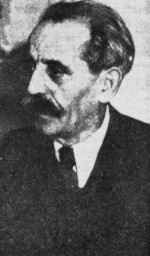
| Chaim Naiger z”l |
There used to be mass election meetings with the participation of 2,000-3,000 Tarnów Jews in the synagogue or in the community courtyard (on Lwowska Street). The most popular people's tribune {md: platform speaker}, who used to tear down the simple religious Jew, was Chaim Naiger. He exposed the bankrupt assimilationists without pity, and proclaimed the Zionist truth.
[Page 85]
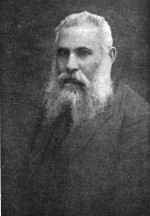
The popular social activist, Dr. Shmuel Szpan, who in his election [campaign] speeches made a name for himself by mercilessly exposing the political opponents of Zionism.
The other parties did not lack talented speakers either. Talmudists such as Shlomo Mehr and Nachman Renert appeared on the tribunes {ed: speaker platforms} at Orthodox meetings. They called on the faithful to remain true to the Torah, and pointed out that allegiance to Zionism cannot be reconciled with Torah ideals. Even among Zionists there was no lack of pious Jews, who enlightened the voters about the national mission of Orthodoxy at election meetings. This type of speaker included: the deeply religious Jew and loyal Zionist Wolf Getzler, and the son of the Szydłów Rebbe, Rabbi Yechiel Kurtz, an ardent and zealous Zionist, leader of the Tarnów Mizrahi.
|
|
| Dr. Shmuel Szpan |
At the time, the rather strong Bund also participated in the election campaign. This election campaign was led by David Batiste, an excellent organizer, meritorious and experienced Bund worker, who, despite all his devotion and love for the Bundist ideal, never forgot that he was a son of the Jewish People and fought with the
[Page 86]
best intentions for the victory of his party, which was strongly rooted among the Jewish workforce in Tarnów.
The Left Poalei-Zion also led their own election campaign in the community. At the head of this party stood the faithful and devoted Poalei-Zionist leader Henoch Tisch, the sacrifice-ready Pinchas Glick and Nachum Einspruch.
Also to be found in the Zionist camp was the Hitachdut {ed: Union} party, led by Dr. Berkelhammer, a well-known Zionist personality throughout Poland, as well as a skilled journalist. Among the Hitachdut activists were: Dr. Isaiah Feig, a dedicated Zionist politician.
The election contest for the Tarnów community was not only a struggle for mandates, but a struggle for national and social ideals, a serious and bitter one. Indeed, therefore, the groups that appeared during the elections in the name of impartiality, or with lists of private individuals, could not count on votes and influence among the voters.
The preparations for the campaign began smoothly after the superintendent announced elections would be held in the Tarnów community. On May 3, 1928, the community administration, under the chairmanship of Dr. Ehrenfreund, appointed an election commission of 16 persons: David Batiste, Isaac Bree, Dr. Henrik Ehrenfreund, Ignatius Ginger, Elias Gevertz, Wolf Getzler, Samson Lieber, Dr. M. Menderer, Wilhelm Rubin, Dr. Naftali Schwartz, Dr. Edward Schalit, Dr. Wolf Schenkel, Dr. Shmuel Szpan, Pinchas Templer, Isaac Wallach, Wolf Wechsler. As representatives: Dr. Jacob Hollander, Dr. Shlomo Goldberg, Haim-Leib Klugmann, Marcus Kellner, and Dr. Avraham Chomet. Dr. Henrik Ehrenfreund was chosen as president of the commission, and Dr. Shmuel Szpan as vice president.
The commission released a notification to the population, and called for every Tarnów Jew to fill out a declaration, which would serve as a basis for suffrage for the community [administration]. According to the statute of the communities, every Jew of 25 years or more had the right to vote if he had lived in the electoral district for at least one year. Jews who enjoyed public charity did not have the right to vote. The chairman of the election commission, Dr. Henrik Ehrenfreund, absolutely objectively and honestly observed the provisions of the election ordinance. Every doctrine and group had a chance to participate in the elections. The election campaign was sharp and vicious. From the articles related to the elections, published in the Tigodnik Żydowskie, we get a certain idea about the election atmosphere and tension, which then prevailed on the Jewish street in Tarnów. We continued with an article “Finally,” by Chaim Naiger (Yiddish Weekly, № 5, 1928):
[Page 87]
Motto: The slothful man does not roast his catch… (Proverbs 12:27)
“For two and a half years, the third elected Jewish Community Council in Tarnów has been in the midst of controversy. In the thirty months of its existence, it was always shrouded in black clouds, with new flashes [of lightning] flaring up all the time in the surrounding blackened darkness. But the community, which derives its life force from the fresh source of the people's will, the chosen people's community has overcome all crises and now stands young, strong and victorious, and is preparing for the first democratic election; at least semi-democratic, by the Tarnów Jewish Community. Indeed, this chosen Jewish Community; and not any government commissioner, who does not consider the will of the people, will have the right to spread and carry out the first act of democratic elections in our community and this is the result of the educational work, which the Zionist politics has been doing for decades on the Jewish street. If Tarnów Jews have been spared in the current historic moment from the disgrace of a government commissioner, from the shame of a curate, from becoming mature; this is the reward of Zionist policy, which is a policy of Jewish pride, of standing with a straight back, of a sovereign Jewish will.
The battle over the Tarnów community was not a duel between these or those individuals who wanted to hold on to the helm of power in the Jewish commune; this was a battle between the will of the Jewish People on the one hand, and violence and intrigue on the other hand.
On one side stood the majority of the Jewish voters, who have given their trust to the Zionist leaders, and on the other side stood a dark clique, which had no hold on the will of the people and therefore strives to break this will of the people. On the one hand, a party that sees the only instance and the only source of political power in the ballot itself, and on the other hand, a group that is actually afraid of the ballot and wants to rule with violence against the will of the voters.
It is both remarkable and utterly incomprehensible to any reasonable person that, despite having four representatives on the community council from their own slate, the opposition never once–throughout the entire thirty months–publicly challenged the serious transgressions of the majority at the open meetings. Instead, while fully aware of these matters, they chose to address them quietly through denunciations to the appropriate authorities rather than confronting them openly before the community. And it is again remarkable, and for an intellectual simply does not to understand, that the opposition never brought the grave sins of the majority and the community council to public meetings, as if it would have been the best opportunity to meet the Zionists who they hated in their hearts, to destroy them before
[Page 88]
Jewish public opinion, the only source of their political vitality. Or can someone perhaps understand the strange fact that the representatives of the authority never tried to convince themselves whether the majority in the community council is really guilty of the frightful sins, which have been thrown at them in all the clique's pronouncements?
And yet it is a fact that not once has the dissolution of the Tarnów community [administration] been determined and even signed, although the accused and condemned administration has not even been given an indictment; not to mention a closer examination, which would clearly give the lie to the clique's statements.
If, despite this, high-ranking officials have finally realized that the current community administration should not be dissolved, if the authorities have finally convinced themselves that the Tarnów Jewish population, which has chosen its community three times, did not deserve to be treated as a “nightmare,” and taking away the right to have an opinion about itself and having a custodian placed over it. This success is not to be thanked by anyone but the Zionist leadership, which raised the people to an independent way of thinking, to a proud and courageous performance, to the upholding of political freedom, of protected constitutional rights.
Now we are already in the very [heart of the] election campaign. The wheels of the electoral apparatus are already in motion, and in a few weeks the Jewish voter will once again; this time in a larger number than before, have to decide to whom he places his trust and to whom he authorizes to lead the community. The Zionist Party will, as always, present itself to its voters, it will tell them what it has achieved so far and what its program for the future is. The Zionist Party will call on its hidden opponents, who are afraid of the light of day, to come with wholeheartedness to the only competent court: to the voter assembly, and there, if they have courage, they should recount the sins, which were so well known independently, when they stood before a judge.
The Zionist Party calls on the darkly moral clique: Come now, and let us reason together {ed: from Isaiah 1:18}. Come here and meet with the Jewish voter; here we will argue. We will not owe you an answer, whether it is pleasant for you or not!
On October 21, 1928, the community elections finally took place. The Zionists seized a significant victory. Of the 4448 eligible voters, 3475 voted (approximately 80%). The individual parties received the following number of votes:
[Page 90]
Margolies, and Chaim Aberdam. The Zionists together with Meir Lev's Orthodox group, had 9 votes. They selected for the administration: Dr. Shmuel Szpan, Wolf Getzler, Dr. Henrik Ehrenfreund, Joseph Heimann, and Isaac Kaufmann. The Bund had only one representative in the administration: David Batiste.
At the meeting of the new community administration, which took place on December 22, 1928, a presidium was elected with the following composition: Dr. Henrik Ehrenfreund, chairman; Dr. Shmuel Szpan, vice-chairman; Chaim Naiger: vice-chairman. The community council Presidium consisted of two people: Chaim Naiger, chairman; Meir Lev, vice-chairman.
The newly elected presidium of the administration had very important tasks to carry out. The restoration of the neglected community economy required a lot of hard work, which was once again hindered by the old community leaders, who still dreamed of regaining power over the community. The new community chairman, Dr. Henrik Ehrenfreund, an impartial and honest businessman, with known sympathies for Zionism, went to work energetically. He correctly estimated and recognized the sincere intentions of the Zionists to base the community economy on sound and honest foundations, and to satisfy the national-religious needs of the broad masses, especially in raising social welfare to such a high level so it could address the growing need and impoverishment of the Jewish street. Dr. Ehrenfreund left the primary task of managing community affairs in the hands of tireless Zionist activist, Dr. Shmuel Szpan, vice-chairman of the community administration, who enjoyed the broadest confidence, without exception, of all strata of the Jewish population. With his impartiality, honesty, sincerity and deep understanding of the situation of Jewish poverty, he raised the status and image of the Jewish Community in Tarnów. Dr. Szpan did not even hold back from admonishing his own party members when he recognized that their approach to a social issue was incorrect. His resolution was: All for the benefit of the entire Jewish society! And he placed this rule above any misunderstood party interest.
The new community administration's first concern was to try to establish such an arrangement in the Jewish Hospital, so that it should be accessible to all Jews in need of medical help. The old-age home also needed to be transformed into a proper home for people who in their old-age were left without means of livelihood and supervision. The religious issues, which were in the competence of the Jewish Community, were from now on considered from the point of view of the real needs of the Jewish population. Wolf Getzler, board member and leader of Mizrahi,
[Page 91]
himself a deeply religious person, took great care to ensure that the religious tasks of the community administration should not be exploited for political purposes or for the private interests of individuals and cliques.
In order for the community budget to be placed on a sound foundation, the administration had to ensure that the income for the church would be stable, and that the community tax (etat) would be fairly distributed among the broadest masses of the Jewish population. Larger amounts of these funds have now been spent on social welfare because of the increasing neediness of the Jewish community. The Zionist institutions also benefited from community subsidies, but at the moment in a limited form. This subsidy was given, regardless of the fact that the supervisory authority was very careful that no Zionist positions should creep into the community budget. The religious institutions now enjoyed community support. A thorough renovation was carried out at the mikvah {ed: ritual bath}, and the cemetery was also put in order. The hospital and old-age home were now maintained by the community, and ceased to depend on contributions and donations from individuals.
The entire administration spared no effort and endeavor to raise the image and authority of the community as a serious representative of the Jewish population. Regretfully, there were still those for whom the honesty of the church administration was like salt on their wounds. In particular, the national Jewish spirit that was dominant in the community irritated these people. Informing and intrigue in the “high windows” made the work difficult. In official
[Page 92]
circles, people were favorably disposed toward underdevelopment on the Jewish street.
|
|
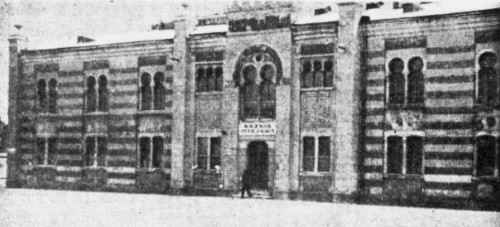
| The Tarnów mikvah building |
All subsidies for Zionist purposes were systematically suppressed by the Tarnów superintendent or by the county office in Kraków. Orthodox politicians, who considered the campaign against Zionism as a religious problem, united with the rest of the assimilationists against the community administration.
On April 28-30, 1929, the Tarnów community council dealt with the 1929/30-year budget. During this debate, a front of Bundists, Dr. Zilbiger's Orthodox, and Dr. Mitz's Folkists was formed against the Zionists. This strange allegiance had 11 votes out of the total number of 20 councilors, and with that majority the proposed budget proposal was rejected. This absurd front, however, had no substance. In order to get a picture of the vibrant Jewish life in Tarnów at the time; in order to understand the aspirations of the twenty-five-thousand strong Jewish mass in the city, we will present the full report of this meeting (according to Tigodnik Żydowskie, № 14, 1929):
During April 28-30, the newly elected community council met to discuss and decide on the budget proposal, which was proposed by the community management. The meeting was opened by the chairman Chaim Naiger. He began his speech in Hebrew and later switched to Yiddish. He warmly welcomed the councilors and emphasized the significance and importance of the community, which is supported by the new electoral law, and thanked the government for expanding the mandatory to cover Galicia, so-called [Józef] Piłsudski Decree on Jewish Communities, which provides partial satisfaction to Jewish demands in the area of autonomy. He then went on to explain:
“The Piłsudski decree, which regulates Jewish autonomy, has in truth certain limits, but it creates the foundation on which the further development of the autonomy can be supported. Such a development can take place if the Jewish communities in Galicia will understand each other on this question and act together. The tasks facing the communities are very big. First of all, it is important that proper order should be introduced in the Tarnów Rabbinate. The office of rabbi should be filled by a cultured person who should possess such authoritativeness toward the authorities and toward the Jewish population, as is appropriate for such an office. The Rabbinate must introduce order in religious and cultural institutions that belong to the community and lead them in accordance with the religious prescriptions and with an understanding of the democratic spirit of our time. Next, the community needs to take steps
[Page 93]
to rebuild the social institutions: the hospital and old-age home.”
“The orphanage, which receives small subsidies from the community, must be transformed into a community institution; The community is obliged to satisfy all the material and spiritual needs of the orphans who are in the facility. All cultural institutions, such as libraries, reading rooms and schools must be maintained by the community and supported by it. The community's capabilities need to be significantly expanded. In this manner, an agreement must be reached with the rest of the communities in Galicia.”
“The speaker further explains that as chairman he speaks on behalf of all the groups and streams, and appeals to them about creating a broad platform that will enable cooperation for the good of the community. We are not rulers here, but servants of our voters who sent us to the community to carry out necessary and serious tasks for the welfare of the community. Let us respect and value the autonomy we have received, and work in agreement with the will of our voters for the benefit of the community, population, and state. As the chairman, I ignore I am a member of a certain movement. I want the consultations to be conducted objectively, and I also ask for your help.”
After the chairman's speech, the representatives of the different movements gave their program statements.
Dr. Szpan firmly states that the Zionist program is known to everyone, and only in order to reject the various rumors spread by false dispositions, he specifies the principal postulates toward which the Zionists strive, and by what means they want to achieve this. The Jewish community is the representative of all social strata in the Jewish community without exception, and it must satisfy the needs of all of them.
The historical development of the Jewish People and the specific conditions of the Jews in exile led to the fact that religion and nationality have become a unitary concept for Jews, and it is difficult for us to separate one from the other. The great majority of the Jewish People are deeply religious; therefore, the Jewish community must create and support the institutions that are determined to satisfy the religious needs of the Jewish masses.
But religiosity is one thing, and dark clericalism is something else, which has nothing to do with religion and only strives, under the cloak of religion, to keep the Jewish masses unenlightened and deceived. The representatives of the combative Jewish clericalism are often people who have nothing in common with religion. The Jewish
[Page 94]
belief is not known to them; they have no respect for it, and speculate on political goals.
Rightly, Jews have been described as the “People of the Book.” Scarcely 4,000 years ago, after the birth of the Jewish nation and its country, Jews developed their legislation, the principles of monotheism, created social institutions based on justice, knowledge, and love for the neighbor. The cult of these principles and teachers {ed: learning} was spread by the Jews with the help of books. The school is the foundation of knowledge, and therefore the community must support, or as appropriate, support all, without exception, schools, kindergartens, libraries, and reading rooms. The community is not and cannot be a religious institution in the full sense of the word, but it must ease and satisfy all the needs of Jews in the area of religion, culture, social and physical education. We must keep in mind the principle: “a healthy mind in a healthy body!” And that's why we must also support the institutions that deal with the physical development of the population, especially the Jewish youth.
Social welfare must encompass all areas. There is still a lot to do in this direction: develop existing institutions and build new ones, such as an old-age home, shelters for the homeless, a hospice for the terminally ill, and housing for craft-workers. These tasks must be carried out in the near future. We need to abolish the system of indirect taxes, and [financially] support the budget through direct taxes. The Land of Israel is the central Jewish problem; therefore, the Jewish People must help Zionism in its colonization work in the Land of Israel. It is therefore the duty of the community to support all institutions that have the goal of rebuilding the Land of Israel.
Finally, the Zionists also demand to expand the autonomy of the community, to democratize it by granting suffrage to all women and men over the age of 21.
In the name of the Bund, David Batont {ed: should be Batiste} submitted a declaration, in which he says, among others:
The “Piłsudski Decree” only partially took into account our demands toward democratizing the community and made it possible for the working class to gain representation there. The statute, which provides that the community should satisfy religious needs, was issued as a result of efforts by the Orthodox-Assimilationist circles. We Bundists are against the clerics and the Zionists: We demand a secular community that excludes religious matters.
Our language is Yiddish, and we demand that this language be taught in the schools. The social and cultural needs of the
[Page 95]
Jewish population must be fulfilled by the community [administration]. Also, the budget must be covered by direct taxes. All the bourgeois parties want to keep the people in the dark, and the best method to accomplish this is the proposed budget proposal. But we are undertaking a campaign against the bourgeoisie, and we will lead it to a victory of democracy and socialism.
Mr. Mehr gave a statement on behalf of the Agudah. He says that Agudah strives to cooperate with other groups in the community, but the community must be religious. It can also embrace social and philanthropic institutions, but they must be conducted according to religious prescriptions. However, we demand: the reorganization of the Rabbinate, schools for boys and girls, evening courses for working youth, financial and produce {md: food}, and support for the poor population. Removing religion from the community is the same as promoting assimilation.
On behalf of the Hitachdut, Dr. Feig made the following declaration:
[Page 96]
“According to the Torah, the Jewish national religion and the Jewish nation is underpinned by religion. Introducing a division between these two common factors will take away from them some of their original content. It is therefore beyond any doubt that our community [administration], which is a religious institution, is also a national institution. We, Mizrahists, strive with all our strength and energy to ensure that the Tarnów community [administration] is placed on a proper level, and concentrates within it all matters; religious and national. We are not satisfied with maintaining the existing institutions or even setting up new ones, we also strive that the national-religious spirit should prevail in the various cultural and philanthropic associations. When considering the community [administration] as a religious-national institution, we recognize the Hebrew language as the official language of the community [administration]. Bearing in mind that the community [administration] is a basis for Jewish autonomy, we decided to work for the growth of this institution that is dear to every Jew.”
After giving all the explanations listed above, Dr. Mitz takes the floor, and says, among others:
“It is a parliamentary custom that when adopting a budget, not only the dry numbers are discussed but also the programs of the various groups that are represented in the Council, as well as the attitude of one group to the other. We are now a democratic community, and our task is not to limit ourselves to solving only religious issues, but also social ones. The proposed budget is similar to the budget of 30 years ago, and at this time, while I was also sitting on the Community Council, nothing has changed.
“I ask the Zionists: is the budget a reflection of their program? There are, of course, subsidies for Zionist, Orthodox and even Labor institutions, but the income for these expenses must be covered by consumption taxes and not by direct taxes.
“True, the budget also foresees income from direct taxes in the amount of 167 thousand złoty, but these revenues are not realistic, since during the past year only 20 thousand złoty came in from this type of tax. Because of this, people will have to increase the payment on the so-called Krubke{?}. If so, with what will the Zionists actually do to realize their program, while the budget is a fiction and legally unacceptable?
“If the community [administration] wants to fulfill its task in the social field, it must impose a 20% tax contribution to the state income tax, which must be included by the financial authority.
“And what does harmony look like between the various social groups? During the elections, the Zionists did not get an absolute majority.
[Page 97]
Therefore, they attracted only one [more] councilor to themselves for a vain purpose; so that they could gain [control] of the presidium of the council and the administration for themselves. Is this what is called harmony? There was a moment when a majority could have been created, but this moment was neglected by the Zionists.
“Because the budget is not real, I suggest it should be rejected and the proposal, as a formality, should be put to the vote.”
The chairman explains that the proposal by Dr. Mitz is a meritorious one and not a formal one; therefore, the vote on it can only take place after the presentation and discussion on the budget, and gives the floor for discussion.
Dr. Szpan, speaking to the budget, talks about specific parts of the budget, points out the growth of the expenses, especially the increase in the salaries of community [administration] employees, and the need to increase direct taxes.
After Dr. Szpan's lecture, board member Mr. Arthur Margolies, is given the floor. He accuses the council chairman, C. {Chaim} Naiger of not keeping his word to conduct the meeting objectively. Margolies thinks that the proposal by Dr. Mitz on rejecting the budget, is a formal one, and needs to be voted on before the start of the debate. He comes out against the chairman, who violates the rights of the council, and appeals to the community council to vote on the question.
D. Batiste, a board member, declares that the proposal by Dr. Mitz is a meritorious one. Despite the fact that Batiste and his friends will vote against the budget, he still thinks that the budget should be considered, so that everyone can express their point of view and clarify the reasons for which the Bundists are rejecting the budget.
After Mr. Batiste's explanation that the proposal to reject the budget is not formal one, Dr. Mitz agreed that there should be a discussion about the budget and his proposal. The council chairman declares that after the general debate is closed, and after moving on to detailed discussion, the proposal by Dr. Mitz will be put to the vote. After that, the chairman gives the floor to Mr. Mehr.
Mr. Mehr, a representative of Agudah, critically assesses the proposed budget, and explains that, first of all, one must strive to maintain and support the community's social and religious institutions already in existence. The speaker criticizes that the mikvah and the hospital do not provide the appropriate income. He compares the situation to similar facilities in Kraków and Pryzemsyl. For example, the mikvah in Kraków provides an annual income of 100,000 złoty.
[Page 98]
The income from treating the sick at the Pryzemsyl hospital covers 80% of the hospital budget, while by us it is only 20%. The speaker firmly states that disorder reigns at the mikvah and the hospital; no investments are being made. The mikvah is not arranged properly and is not kept in a sufficiently hygienic condition. Mr. Mehr also accuses the hospital administration of being bureaucratic, and the raising of the salary of the hospital staff is unjustified. The speaker proposes that the patients from high and middle-income classes who benefit from the hospital should be obliged to pay a certain amount so that the hospital does not have a deficit. In the end, Mr. Mehr declares that he and the opposition on the council, in whose name he speaks, will vote against the budget because the opposition has no representative on the Presidium.
Mr. Batiste speaks on behalf of the Bund. Among others, he said the following:
“The projected budget proposal confirms that it was compiled under the influence of the ruling party and the clerical groups. The Zionists form the strongest stream in Jewish society. They want to solve the Jewish question on a territorial basis. We Bundists are fighting to stop this movement because we think that life is decided by economic moments and not by romantic resolutions.
The bankrupt Zionist idea harms the interests of the Jewish masses, because energy and capital are being wasted on far-off and unrealistic goals. Zionism splits the Jewish masses off from the struggle here on the ground, from the struggle for democracy and socialism. The aspiration of the Zionists is also in contradiction with the principle of the right of the Arab people in Palestine to self-determination. The entire Balfour Declaration and England's mandate over Palestine are nothing more than an imperialist instrument of English politics.”
Moving on to the language question, Mr. Batiste asks: “Does actual life confirm the Zionist program? Almost 90% of the Jewish population speaks Yiddish. There is an extensive network of Jewish schools that are maintained by the workers, while the Zionists now want, against the historical development, that the Hebrew language should become the language of the Jewish People. The language struggle among Jews will end with the result that the Polish government does not want to support either the Yiddish or the Hebrew schools.”
“The Zionists are a strong party, but what if there is a struggle between rich and poor, between landowners and peasants, on whose side are the Zionists? In the best case, the Zionists seem indifferent to this struggle, but later they will benefit from the rights that the people fought for. Here in this country, the Zionists are conducting the same policy as the
[Page 99]
assimilationists once conducted. This is evidenced by such cases as the compromise agreement between ‘Jewish Koło’ {md: club of deputies} and [Władysław] Grabski, as well as the attitude of the Zionists in Romania regarding the peasant government there. The Zionists believe that through protectzia {protection} they can obtain rights, because they do not believe in their own capabilities, and do not want to take part in the struggles that the Polish people's democracy is leading.”
“The democracies of all nations are fighting with the current government, while the Zionists have declared in the Senate that for the price of minor concessions they are ready to vote for the budget. Did the Zionists do anything to hold back the Tenant Protection Law?”
Turning to the Orthodox, the speaker firmly states that they would like to limit modern life by preserving religious formulas. What is the point of view of the Orthodox in the matter of professional retraining and career change by the Jewish population? The Orthodox, being owners of large factories, solve the question in a simple manner: Jews are not allowed to work on Shabbat, and as the factory must be active on this day, they therefore do not hire any Jewish workers, so that they should not, Heaven forbid, have to violate the Shabbat. As a result, Jewish workers cannot get any work or employment. The Zionists bow to the Orthodox, whom anyone can buy off. The Orthodox support any government. At first, they worshipped [Wincenty] Witos. That is for today, for the current government. But when in the future there will be a change in power, and when there will come people who are hostile to the current regime, they will also support them. This clericalism must be gotten rid of. We do not come out against religion as such, but we condemn the clerical conduct, which uses religion in a hypocritical manner.
In the end, the speaker turns to the “Last of the Mohicans” for assimilation who are in Dr. Mitz's People's Party: You painted over the sign for National Yiddish, but that's not enough. The Jewish People's Party together with Yad Haruzim declared during the community elections that they fight against partisanship. These are the people that every government uses to suppress the Jewish movement. It was not long ago that they were aligned with Witos. No amount of feathering {md: covering up} will help these gentlemen anymore; we will immediately remove them from political life. These “Last of the Mohicans” of assimilationists themselves compiled a budget proposal in agreement with other bourgeois and clerical parties in the administration. They themselves confirmed all the budget items. Now, on the council, they are playing a comedy, asserting that they reject the same budget that they had accepted when they were in the administration. All this is done with the intention of extorting concessions from the Presidium.
[Page 100]
At the board meeting, explained the speaker: “When I abstained from voting on the question of sending the budget to the council, Dr. Zilbiger demonstratively proposed to protocolize it. Since when does Dr. Zilbiger control the activities and tactics of the Bund? Dr. Zilbiger and his colleagues deny me the right to interfere in our own affairs. We deny this right to all caffeine {md: coffee-drinking} politicians as well.”
The speaker sharply criticizes that part of the budget proposal that proposes to raise the salaries of the rabbi and the assistants in the Rabbinate, the so-called Religious Judges. These people do not work but take money from the community and from interested [parties]. The population must be defended against exploitation by the Rabbinate, and a tariff established for the rabbis for the assigned activities to be carried out by them. At the end of his speech, Mr. Batiste stamps the budget as black, clerical, and whose expenses are definitely aimed at non-productive purposes. And he declares that for the reasons mentioned above, the Bund faction will vote against the budget.
Wolf Getzler spoke on behalf of Mizrahi, who clashes with the conclusions of the Bund-Orthodox opposition. “It is impossible to imagine such a thing,” says Mr. Getzler, “as removing religious matters from the community [administration]. For Jews, religion and nationality are unified concepts. Whoever steps out of our religious society, falls away from their roots and from the Jewish People.”
“The opposition accuses us of devoting our energy and capital to other goals and neglecting the institutions in countries of the Diaspora. This denial is completely incorrect, because the Zionists are active in every area here in the country. Only the institutions that were formed by Zionists and are led by them, and developed for the benefit of the Jewish People. We are ready to help. We give our work and our money, while you, who call themselves Orthodox, turn away from any work and contribution. The institutions that are run by you are neglected and dirty. The richest of you have no understanding of general social issues, and shut your pockets when you have to give alms. The Jewish population rightly does not hold any trust in you, because they know you are incapable of managing social institutions and have no sense of organizational work.”
“The neglect of the Talmud-Torah, which sinks into obscurity and abandonment, best illustrates your organizational skills and your willingness to make sacrifices. You raise children in such a way that they become physically and mentally crippled. Make order there, then you will earn the right to criticize our institutions, which in every perspective are
[Page 101]
on a high level, and are the pride of Jewish society. We ourselves are not happy with the proposed budget proposal, but we know that step by step there will be an improvement, and that the realization of our community program can come along in a short time.”
Dr. Feig, a representative of the Hitachdut, disputes the conclusions of Mr. Batiste concerning his criticism of the Zionist program. “Not the class struggle,” says Dr. Feig, “but the leveling of the difference between the classes, can put an end to social struggles.”
“The language question was answered incorrectly by the Bund. Life in the Land of Israel has shown that the Hebrew language is a living, creative language, and in this manner, we connect with our old culture and create new cultural values. Our program, which strives to solve the Jewish question on the territorial principle, is the only correct one. The Russian socialists, after achieving state power, also came to read the Jewish question as based on the territorial principle, and from that came the efforts of the Bolsheviks to create Jewish colonies in Birobidzhan.”
Mr. Mehr of Agudah responds to the accusations of his political opponents and asks the Bundists: “Why do they live in the community, since this is an institution to relieve religious issues and needs, after all, they only want an exclusively secular community. Agudah therefore fights the Zionists, because in our opinion, they are not very religious. Besides that, we fight against their aspirations and cultural laws as they are such that can weaken the religious spirit of Jews. We consider the Zionists to be assimilationists. We think that the proposed budget is a good one and we agree on all its points. But we will vote against accepting the budget because we are concerned about a place on the Presidium.”
Dr. Zilbiger explains that his group wanted to cooperate with the Zionists, who want to govern the community by themselves, and that's why they communicated with Lev's [party]. “You must break off from Lev's [party], and then cooperation will be possible. In the administration, we voted for each budget item, but since it turned out that there are certain exceptions, we wanted to separately revise each item in the budget.”
In a brilliantly constructed speech, Dr. Szpan responds on behalf of the Zionist organization to the specific objections raised by the opposition. Turning to Dr. Zilbiger, Dr. Szpan says that just as in private life you can demand from people that they tell the truth and agree only with the truth, in the same manner, in the political activity we must fight with the aid of the truth. Therefore, the speaker demands that here too the truth should be spoken.
[Page 102]
“I firmly state,” Dr. Szpan sets out, “that it is true that Dr. Zilbiger participated in the consultations by the Community Administration, and agreed on all the items in the budget proposal. It is also true that before the budget proposal was formally forwarded to the Community Council, the gentlemen from the Orthodox-Folkist stream demanded to interrupt the meeting, called for a confidential consultation, invited Dr. Ehrenfreund and his colleagues to a conference, and demanded a place on the Presidium as recompense for accepting the budget.”
“On this, dear gentlemen, you received an answer that this demand, at least at this time, such barter for seats on the Presidium, is unacceptable, and even more so, because there is no possibility now to force elected officials to resign. This answer, and not the apparent unreality of the budget, moved you to vote against sending the budget to the Community Council.”
Addressing the Orthodox Agudah councilor, Mr. Mehr, Dr. Szpan characterizes his speech as completely non-religious, “because according to religious principles one must tell the truth, and [Mr.] Mehr uses it in his battle using untruth. Because it is not true that there is a protection system in the Jewish hospital, or that abuses and waste should occur there. You have to be careful with your words. If someone accuses the hospital management of committing abuse. It is not enough, then, to just retract the expression ‘abused,’ which he used in his speech. Mr. Mehr had rejected us at a meeting, that we did little for the hospital, we only whitewashed it. It is true that we allowed the building to be whitewashed; but we are whitewashing it as is required. We exterminate vermin of every kind. The hospital and its organization work without a stop. This institution is the pride of the community and of the Jewish population in Tarnów.”
“It is true that the hospital's income is minimal, the community spends large sums to support it. This is because it is a religious commandment that every poor sick person should be healed without charge. We really strive for the hospital not to have any income and we resigned from obtaining an income from poor Jews who need to be under medical supervision. Wealthy people do not come to the hospital, and when there is such a case, we collect the appropriate fee.”
“You, politicians of the Orthodoxy, do not like the cleanliness and orderliness that prevails in the hospital. For political purposes, you want to take advantage of the dissatisfaction of small groups of Orthodoxy who do not feel good in a hygienic and clean building. Instead of convincing these Jews that in a hospital there must be cleanliness and order
[Page 103]
and that it is not possible to visit the sick at all times, day and night, you want to exploit this dissatisfaction for political purposes.”
“If it was about established postulates, such as the acceptance of male nurses in the hospital, the current administration is ready to comply with this demand, if the Rabbinate recognizes it as necessary, in accordance with religious prescriptions.”
Dr. Szpan describes Mr. Batiste's speech as demagogic, and having nothing in common with the actual situation. “We take the most active part in the struggle for Jewish equality. No Jewish party can match our activity in this area. As for the method of this activity, it already belongs to us.”
“We believe Jews cannot rely on physical force and therefore cannot demand rights through violence. We have nothing to be ashamed of concerning the compromise that was made between Jewish Koło in the Sejm and Grabski. The acquisition of elementary rights through parliamentary struggle and the understanding the Jews have with the Polish government is in line with our program. We appeal to the principles of justice, and if the Polish government wants to recognize our just postulates, we are not ashamed of it, but on the contrary, we think that the understanding between Jews and the Polish people is a necessity. The expression of the opinion of the Polish people can only be by the Polish government, and not by any individual party, such as the PPS, whose protection the Bund seeks.”
Responding to Mr. Batiste's conclusions regarding the construction of the Land of Israel, Dr. Szpan expressed his surprise that in the realm of struggle by the Jewish community, Mr. Batiste thinks the Arabs are being deceived by the Jews. “We are not going to the Land of Israel with fire and sword. We are not going to remove anyone there, as had happened to us 2,000 years ago. We bring culture, our capital and labor energy to the Land of Israel. The construction of the Land of Israel by the Jews also brings happiness and prosperity to the Arabs. The professional retraining and career change of the Jewish population is necessary. There are too many merchants and people of uncertain professions among us. This surplus was removed before the war by emigration. Mr. Batiste certainly recognizes the necessity of emigration, but he is against emigration to the Land of Israel. The point of view of the Bund causes even more amazement considering the fact that the leaders of Western European socialists, such as Blum, MacDonald, Vandervelde, and others, admire the construction work of the Zionists in the Land of Israel and work with us in the Pro-Land of Israel committees.”
“The leader of the French socialists, [André] Léon Blum; the former
[Page 104]
and certainly also the future prime minister of the huge English empire, MacDonald; the leader of the Belgian socialists, and many others, all see in the construction of the Land of Israel a colossal progress and historical justice, but only Mr. Batiste fights us. We wholeheartedly reject the accusation that we are seemingly clerical. Our current work on the Jewish street shows the opposite of that. However, we recognize that religion and Jewish nationality are so closely related that one cannot separate one concept from the other. Based on this point of view, we are of the opinion that the Jewish community is called upon to regulate and maintain the religious institutions.”
In the end, Dr. Szpan turns to the Orthodox and clarifies that the Zionists wanted to allow Orthodox onto the Presidium, but the true Orthodox and not any politician who has nothing in common with religion, but they only want to gain power and influence at the expense of the Orthodox. “Your offer was rejected by us, because you do not have your own will, your own perception. Someone is leading you. He is not aware that an atmosphere of peace and cooperation should prevail in the community. We wanted to give you more than you need now, but you played the ‘whole-bank’ {the whole pot} and lost everything. Today, you are demanding concessions from us that can no longer be realized because of the previous elections, which were confirmed by the supervisory authority.”
After Dr. Szpan's speech, the chairman closed the meeting.
At this meeting, Greenbaum, the Bundist councilor introduced a proposal that the minutes of the council meetings should be kept in the Yiddish language.
At the meeting of the community council, held on March 30, 1929, the first speaker was Mr. Mehr, representative for Agudah. He tried to reject the objections that the Zionist speakers made regarding the speech made by the Orthodox. He rejected the Zionists [position]: “They are not religious, because they consider religion to be a private matter, so the Zionist Sejm deputies do not fulfill their duties and only take a pension; The nurses at the Tarnów Hospital are antisemitic.” Mr. Mehr defended uncleanliness in the Talmud Torah. He claimed that the Talmud Torah cannot be kept clean, because the Orthodox do not have funds. Finally, the speaker demands a place on the Presidium, “because with your nine votes out of the total of twenty, you will not be able to lead the community.”
After the chairmanship is taken over by Mr. Lev, Chaim Naiger takes the floor. He expresses his satisfaction that the discussion, with small exceptions, was on a high level. Answering the Bund representative,
[Page 105]
the speaker stresses that the Zionists cannot and do not want to conduct any class politics, but for a national policy in the name of all the Jewish classes in Tarnów, especially for worker welfare. “The Jewish People does not consist only of workers, because workers like us are a small minority. It is therefore simply incomprehensible that the Bund usurps the right to represent the entire Jewish population. Your relationship to the language question is strange. You fight hard against the Hebrew language, and at meetings you even try to disturb those who speak Hebrew. You do not fight against any language, but only do this in relation to Hebrew, in which the masterpieces of our literature are written, and which is spoken by a significant part of our people in the Diaspora, and by all the Jews in the Land of Israel. If you don't understand the Hebrew language, feel ashamed and sit quietly when someone speaks in that language. We also recognize the importance of the Yiddish language and use it. We think both languages should be equal, and the future will show which will win and remain the national language. We want the Hebrew language to connect with the old great Hebrew culture, and the revival of this language in the Land of Israel justifies our attitude.
The gentlemen from the Orthodox-Folkist List only want a stool {seat} and for that they are ready to destroy the autonomy they have received. These fine gentlemen feel that by rejecting the budget, the community council will be dissolved and a commissioner from their ranks will take over the community government. These hopefuls could have once misled them, but you will bear the responsibility before the Jewish People because of this destructive work.”
Mr. H. Hollander, Dr. Szpan, Dr. Feig, and Wolf Getzler spoke afterward.
Mr. Batiste polemicizes {engages in polemics} with the previous speakers, whom he describes as bourgeois. He expresses his astonishment that the Orthodox are in conflict with the Zionists, while there is not much not shared between them, and a reconciliation would be very possible. The speaker repeats his previous conclusions and firmly states that the Zionists do not take part in the struggle for democracy. When, in the near future, a struggle led by the workers of all nationalities breaks out against the current government system and for democracy, the Zionists will certainly not find themselves on the side of the struggling workers.
Mr. Mehr had a few more words to say, and the debate is closed with a speech by Chaim Geiger, who addresses Dr. Mitz in particular. Geiger {md: typo should be Naiger} is of the opinion that Dr. Mitz should not be counted among the assimilationists, because his perfect self-restraint so far, in private as in political life, does not allow for such a qualification. But the mentality of Dr. Mitz regarding
[Page 106]
the Jewish Community, is without a doubt assimilationist: when a few years ago the City Council in Tarnów was dissolved and a government commissariat with an advisory council was installed, he did not wish to accept an appointment to the advisory council; explaining that accepting the mandate would be seen as making peace with the fact of dissolving the council and putting in its place a commissioner. What was not in agreement with Dr. Mitz's convictions regarding the City Council, he now considers acceptable concerning the Jewish Community. Mr. Naiger appeals to Dr. Mitz's conscience, that he should not allow Jewish autonomy to be destroyed.
The proposal by Dr. Mitz to reject the budget was accepted with 11 votes by the Orthodox-Folkist-Bund majority against the 9 votes of the Zionist bloc. After the decision, Dr. Mitz proposed to send the budget proposal to the [Community] Administration, so that it could be worked on immediately and returned to the [next] meetings of the Community Council. Dr. Szpan, and also Dr. Ehrenfreund came out against this proposal, who confirmed that such a proposal would have been acceptable before rejecting the entire budget. After [Mr.] Feireizen, the Bund representative, declared that his faction would vote against Dr. Mitz's proposal, whose purpose is only to facilitate trading about with the presidium seats, Dr. Mitz withdrew his proposal.
The large crowd that had gathered received the vote with expressions of dissatisfaction, excitement, whistles, and shouting. The youth sang “Hatikvah.”
When at the same time the elections for the Tarnów City Council were held, the Zionists began activity to create a unified Jewish electoral bloc (it is worth noting that the City Council was elected 17 years ago). It was not so easy to comprehend the idea of a united front, which would encompass all the Jewish parties in Tarnów, on the Jewish street. The idea of a Jewish bloc was put forward by the Zionists, although it would have also included such parties, with which for years struggled against shaping Jewish life according to the Zionist approach. The Zionist organization consequently strived for a cease-fire and a peace pact on the Jewish street,
[Page 107]
…based on the assumption that the subject of elections to the City Council is a general Jewish matter, and not the [exclusive] matter of this or that party.
As a result of this clearing up work, the resolution for [achieving] a unified Jewish front site has results. In this domain, a complete victory was achieved, and a unified election committee was formed, whose goal was to introduce honest and dignified people into the City Council, prepared to carry out social activities. At the same time, the main goal of the unified Jewish bloc was to establish a suitable [number of] Jewish representatives, which would certainly have been smaller if each party had run in the elections separately. This bloc actually encompassed all Jewish groups, except for the Bund, which formed a bloc with the Polish Socialist Party (PPS) for the elections.
The basic assumption of the Zionist election tactics in setting up the united Jewish bloc, was the concern for the well-being of the city, and the aspiration to ensure the Tarnów Jewish population a representation that would reflect its number and weight in the city. In view of the outdated, reactionary election ordinance, according to which 550 voters of the first district or 550 voters of the second district needed to vote into the City Council as many councilors as the 16,000 voters from the fourth district, and in addition there were majority elections; the order of the hour was first of all, to create a general Jewish front uniting the fighting Jewish groups into a single bloc. At a decisive moment, when it came to defending the vital interests of the Jewish masses, the Zionists had to forget the current struggles, because only with joint forces could the Jews in the current situation fight for representation on the City Council, where very important questions for the Jewish population were often resolved. Of course, this was only a technical bloc, and this was emphasized by the Zionists during the election campaign. Dr. Schenkel, who appeared at an election meeting (under the chairmanship of Dr. Sh[muel] Szpan, June 2, 1929), explained among others: “We Zionists, while forming this bloc, have not resigned from our program. We will not for one minute stop our ideological struggle with the program lessness of the Folkists. We have not resigned from our struggle with militant clericalism, with a group of people who strive to use religion for political purposes, and to satisfy personal ambitions. We will continue this struggle with the same commitment as until now, in accordance with our program.”
But the then election ordinance for the City Council, which was to elect councilors in four districts according to the tax census, created such a situation,
[Page 108]
that the Jews, even those who were in a bloc, could not have an adequate representation in the City Council and therefore they had to strive to unite or [join in a] bloc with another group or even a non-Jewish bloc, in order to get the necessary number of votes. The representatives of the United Jewish Front have clearly emphasized that the bloc is not directed against the Polish population, and by pushing out bold and courageous national Jewish slogans, demanding political and economic equality, and not hiding under a mentality of assimilation, or to obscurantist masochism, it strives to create a foundation for a permanent lasting coexistence between the Jewish and Polish population. Therefore, the leadership of the united Jewish front decided (on May 6, 1929) to inform the president of BBWR, Dr. Skowroński, about the creation of a Jewish bloc.
Here is the content of that letter (according to Tigodnik Żydowskie of May 17, 1929, № 19):
“We politely share with you that the united Jewish groups, with the exception of Bund, have unanimously decided that these groups should participate as a unified Jewish bloc in the election campaign for the City Council in Tarnów. At the same time, we politely announce that the same Jewish block has expressed its conviction that in the vital interest of the city as well as in the interest of an independent and normal functioning of the City Council, it is important that all parties should be represented in it, including the socialist parties. Finally, we express our readiness to consult with the parties that belong to the Christian bloc, we ask for a meeting to be called for this purpose, to discuss the issues related for the implementation of this action.”
In accordance with the request expressed in the above-mentioned letter, on May 13, 1929, a joint meeting of the Jewish and Christian blocs was held in the hall of the Savings Bank. The Chairmen were Dr. Skowroński and Chaim Naiger. At this meeting, the following decisions were unanimously adopted:
“The representatives of the BBWR party and the representatives of the Jewish parties unanimously decide: The assembled commit themselves in the name of the parties they represent, to create a united front during the election campaign for the City Council and to cast their votes in solidarity on the joint list of candidates for councilors and their representatives. The gathered express their wish that the PPS Party will also have its representatives in the future council, and Father Dr. Lubelski, Dr. Kargul, Dr. Mitz, and Dr. Schenkel will be delegated to reach an understanding with the leadership of this party.”
[Page 109]
Negotiations with PPS did not provide any positive result, because the PPS demanded a large number of mandates. Therefore, this party formed a separate electoral bloc with the Bund. The bloc of the united Jewish-Polish parties elected a presidium in the persons of Dr. Skowroński and Chaim Naiger as presidents, Marshall-Kovich and Dr. Goldberg as secretaries. According to the understanding, the number of mandates for each party was determined in advance. Thus, the Jews should have received five mandates in the fourth and third districts, and twelve mandates in the second district. In the city administration, the Christian bloc was to receive the office of mayor and three clerks/jurors {Lavniks}, the Jewish bloc: one vice-mayor and three clerks/jurors {Lavniks}.
After a bitter election campaign, the united Polish-Jewish bloc achieved a complete victory. The morning after the elections in the fourth district, the secretary of the Jewish-Polish bloc, Dr. Goldberg, wrote in Tigodnik Żydowskie (No. 24, June 21, 1929):-
“In the City Council, there will not be any majority among the civic parties, whose rule should be judged as against the interests of the working classes. The Workers, both in the municipality and in the state, are our brothers, who through their work give their contribution to the general well-being. None of us even dreamed that a campaign against the workers would start in the City Council. The Polish-Jewish bloc made as its main task the peaceful cooperation of all strata of the population, regardless of class, religion or nationality. We do not lead or propagate any struggle, but a peaceful cooperation of all, for the welfare of the state and self-government. These basic premises of our program will be realized. Therefore, we can boldly tell the population that we do not consider ourselves victors over the working class.”
In the fourth district, only the candidates from the Polish-Jewish bloc were elected, with the following councillors:
Votes 1. Dr. Mitz, Hermann 4898 2. Dr. Szpan, Shmuel 4871 3. Dr. Ehrenfreund 4863 4. Naiger, Chaim 4859 5. Turac, Władysław 4858 6. Englender, Chaim 4852 7. Havaraski, Maximillian 4845 8. Father Dr. Lubelski, Josef 4820 9. Smallets, Stanislaw 4801 10. Gzebieluch, Jan 4727
[Page 110]
Votes 11. Haidukevich, Josef 4727 12. Vyshinsky, Eugeniusz 4723
The following were elected as representatives of the councilors:
Votes 1. Dr. Chomet, Abraham 4866 2. Wittek, Josef 4858 3. Blaser, Faivel 4850 4. Yuczhitsa, Augustine 4847 5. Hamel, Karol 4845 6. Rosenberg, Maria 4841
The following councilors were elected in the third district:
Glatzner Israel, Dr. Goldberg Shlomo, Kamushinsky Stanislaw, Margolies Arthur, Mikash Michael, Niedczelsky Michael, Pazdro Jan, Pikoul Jan, Dr. Schenkel Wolf, Dr. Skowroński Michael, Shadczinsky Ludvik, Wechsler Israel. As representatives: Banek Jan, Dychek Henrik, Frisch Joseph, Kargul Stefan, Kleinhandler Hermann, Rot Theodore.
In the second district:
Heimann Joseph, Dr. Rappaport Edward, Hollander Henrik, Rubin Wilhelm, Schinagel Leopold, Dr. Schalit Edward, Gevertz Eliyahu, Dr. Zilbiger Sigmund, Getzler Wolf, Schpilmann Avraham, Dr. Menderer M., Lieber Samson. As representatives: Feldbaum Gustav, Dr. Fink Adolf.
In the first district, representatives were elected only from the Polish population, according to the agreement, which foresaw that the election in the second district was exclusively from the Jewish population.
A protest was filed against the elections by PPS, which is why the constitution of the City Council was postponed until the protest was resolved by the administrative power.
The common Jewish front (besides the Bund, the Hitachdut and Poalei-Zion), had its lively echo also at the meeting of the Community Council, held on July 11, 1929, where the budget for the year 1929-30 had to be decided. It should be emphasized that since the community budget was rejected in April 1929, the community has conducted its financial affairs according to the old budget of 1928, but without the possibility of collecting direct taxes because of the lack of the budget vote. This time, however, at the above-mentioned meeting, the budget proposal was accepted with the votes of all the councilors except those from the Bund. The expenses of the budget were preliminary for the amount of 402,928 złoty; income from the community enterprises reached 271,000 złoty; the remaining amount of expenses of 131,928 złoty had to be covered by direct taxes. In addition, the council authorized the
[Page 111]
administration to take an investment loan for a maximum sum of 100,000 złoty.
The year 1930 was marked by an economic crisis in Poland, whose symptoms were already noticeable in 1929. Neediness and unemployment increased among broad strata of the Jewish population in Poland. Although the crisis was a general state-wide phenomenon, it first of all embraced the trade and industry, which literally collapsed under the fatal tax burden and economic policy. The consequences of this dreadful tax burden were felt most strongly and amply by the middle-class merchants and small traders, who never had a firm economic foundation, and in view of the growing economic depression were placed before the specter of hardship and hunger. The entire Polish Jewry found itself in a desperate situation. The government circles were deaf to the appeals for help, to the demands to loosen the tax loophole a little, to stop the statist politics, and to allow Jews into government offices.
In the Tarnów weekly Tigodnik Żydowskie (July 4, 1930, № 27), in an article by Dr. A. Chomet, “What will tomorrow bring?”, we read:
“The removal of Jews from the positions already occupied by them, the non-admission of Jews to any new economic positions, the numerus nullus, both in the state and in municipal bureaus, all the factors are the same in this area; both the ‘democratic’ and the ‘dictatorial.’ Tarnów Jewry is no exception either. Unemployment has increased because of the crisis in the garment industry. On January 19, 1930, about 100 tailors gathered on the community premises, demanding help. At the time, the Jewish community was the only institution where the poor sought help. Therefore, the extraordinary expenses have increased in relation to the catastrophic situation of the poor strata of the Jewish population in Poland.”
A reflection of this economic situation was also [seen] in the community budget for the year 1930-1931, adopted at the meeting of April 17, 1930, which can be seen by the following numbers:
Expenses: Rabbinate 32,196.53 zł.; Community bureaus 20,039.50 zł.; Pensioned 18,634.83 zł.; Hospital, Old-age home, Ambulatory [services] 92,568.50
[Page 112]
zł.; Slaughterhouse 35,627.56 zł.; Community buildings 48,520 zł.; Permanent subsidies 21,110 zł.; Subsidies and one-time donations 28,500 zł.; Cemetery 16,513.75 zł.; Miscellaneous 29,700 zł.; Domestic tax expenditures 1,800 zł.
On the revenue side, the following lines were appeared:
Hospital and Ambulatory [services] 39,880 złoty; Slaughterhouse 145,700 zł.; Community buildings 19,000 zł.; Cemetery 40,000 zł.; Miscellaneous 8,000 zł.; Domestic tax 92,900 zł. The expenses also were about 345,210 złoty and 61 groschen {pennies}. The income: 345,480 złoty; i.e., an excess in the budget in the amount of 269 złoty and 39 groschen {pennies}.
A very energetic and productive activity was conducted by the Jewish councilors in the City Council. Dr. Michael Skowroński was unanimously elected as mayor; as vice-mayor: Dr. Hermann Mitz; as clerks/jurors: Court Councilor Dutkiewicz, Colonel Habarski, Joseph Heimann, Engineer Reitsa, Dr. Schenkel, Dr. Schalit, and Architect Mikosch.
The Jewish-Polish coalition has passed its test-by-fire in the practical work in the magistrate and in the City Council. In particular, this came to the fore when presenting the city budget for the year 1930-1931. All legitimate demands made by the Jews were taken into account. It could be that this was the only city in the Polish Republic, where in the City Council, there were citizens from different nationalities and religions who worked in peace and harmony for the common good. Suffice it to mention that the preliminary budget for the above-mentioned year was reviewed {md: evaluated} by Councilor Dr. Shlomo Goldberg. In this budget, subsidies were determined for various cultural and social institutions in the amount of 80,000 złoty, of which 56% were for Catholic institutions, and 44% for Jewish ones. At the same time, each national group was left with the right to divide up those subsidies [as they saw fit].
But the joint Polish-Jewish cooperation and the positive attitude of the Zionist movement at the time was like a thorn in the side of some Jewish city politicians, who were not aware of the Zionist's influence, both in the community and in the City Council. A behind-the-scenes game began, led by the deputy mayor, who succeeded to his office with the help of the Zionists. In relation to the allocation of the Hebrew school Safa Berura by a city subsidy, a veritable orgy of intrigues and lies began. On the one hand, the Hebrew school was described as a “bourgeois” institution, and on the other hand, it was dismissed as being an forthright partisan position of the Zionists. The city budget, however, was confirmed by the provincial
[Page 113]
office, while the mayor, Dr. Skowroński, boldly defended the subsidies for the Jewish institutions as approved by the City Council. At the City Council meeting on May 28, 1930, Dr. Skowroński said that because of the incidents and attacks being organized in the City Council by one of the opposition parties that have no representation in the City Council, he should have resigned from his office, but a statement came from the Jewish side that encouraged him: D. Szpan confirmed at this meeting that the mayor enjoys the trust of the entire City Council and therefore he does not need to resign, even though he is facing difficulties because of the senseless shenanigans.
The Community Administration tried to alleviate the need on the Jewish community. The financial situation of the community was extremely difficult at the time. The income of the Jewish community covered the ongoing expenses, such as official pensions, hospital, etc. However, they did not insist on carrying out various urgent investments, especially after, when the community administration had put them aside because of the need to restore its own community buildings, which had not been repaired since World War I, and were literally in danger of collapsing. For this purpose, the community decided to take a loan of 8,000 dollars. Part of the money was to buy an x-ray machine for the hospital and pay for the land purchased for the new Jewish cemetery.
On the Jewish street [community], impoverishment had intensified. This is evidenced by the fact that during the budget year of 1930, the community administration had preliminaries for direct taxes for the amount of close to 70 thousand złoty. Additionally, the basis for measuring the basic rate for the [tax] payer was increased to the maximum amount of 1,000 złoty. The highest rate, however, was only met by barely three or four people, because there were no more Jews in Tarnów who could be assessed for such an amount of tax. The Jews simply broke under the tax burden.
With such a difficult situation of Tarnów's Jewry, it was a good thing that it had able and dedicated representatives both in the community and in the City Council. They tried, according to their possibilities and powers, to relieve the constantly worsening need among the broadest strata of the Jewish population. But a difficult time also came upon the two bodies in the city,
[Page 114]
when the fate of both the community and the City Council changed. There were areas in Poland, Jewish as well as Polish, which did not raise their hands either for the benefit of the city or for the benefit of the Tarnów Jews. Some of them felt bad in a community where people of good still tried to bring order and develop the community's economy, while others, in adhering to favoritism or because of narrow party interests, strove to collapse the Polish-Jewish front and disband the City Council.
The election campaign for the Sejm and the Senate, which were supposed to be held on November 30, 1930, came in aid of these groups. These elections were of great importance for the Polish state and its regime, because the future Sejm had to adopt a whole series of laws of an exceptionally important meaning for Polish Jewry: To amend the constitution and establish a new election ordinance. Throughout the country, a sharp struggle broke out between the pro-government bloc, which preached the necessity of constitutional changes in order to consolidate the power of the government, including the parliamentary form, and the situation, which almost all the people's streams were in; they demanded to maintain the democratic parliamentary principles.
The Jews in Western Galicia formed a unified electoral bloc, which encompassed all the national Jewish groups, the Zionists, and the merchant and artisan circles, stepping out for the election campaign with their own list, at the head of which stood Dr. Joshua Thon. This expressed the principles of Jewish autonomous and independent national politics in the state arena. A list of the National Jewish Bloc, № 14, was presented in Tarnów District with the following candidates: Dr. Yehoshua Thon, Dr. David Bulva from Kraków, Inacz' Bernard Zimmermann from Kraków, Joseph Heimann from Tarnów, Dr. Shmuel Szpan from Tarnów, Wolf Getzler from Tarnów, Dr. Jacob Blech from Görlitz (now lives in Israel).
In this election campaign, not so much went into winning a mandate in the Tarnów District, because the electoral geography in the area dividing the separate electoral districts, which were cut up with the explicit intention to gradually reduce Jewish numerical representation. It involved collecting all the Jewish votes in Tarnów District (as in all other districts) on the National Jewish List, because in this manner the Jewish deputies in the Sejm could claim that they represented the entire Jewish population of the entire country, and that the Jewish community {sic! Kibbutz} in Poland stands behind them. The main thing, however, is to maintain the principle of an independent national Jewish policy, to drag the Jews
[Page 115]
out of permanent mortgage to the factors {md: powerful}, who had the power, and using the old arrogant method, tried to win Jewish votes, through requests or threats.
In the election appeal to the Jews of Western Galicia, Dr. Thon clearly and precisely stated this point of view:
“No! We will not step down from our liberating activities. Our principle was, is and will be: During the elections, the Jews are a separate and closed group. The Jewish voter casts his vote for a Jew and [then to] another Jew. A ‘Jew’ only means someone who is running as a Jew, and not under a foreign company.”
Jewish merchants, retailers, and almost the entire Jewish intelligentsia spoke out for the National Jewish List in Tarnów. In the city, however, there were “fixers,” who were a tool in non-Jewish hands and tried to win Jewish votes. Among the Tarnów Orthodoxy, there were even a number of individuals who called to vote for the government list, the so-called “One” (Sanacja). The struggle of these pro-government groups took on a sharp character, because they were joined by the Agudah of Tarnów, which organized an election meeting in the Klaus, while in the community, together with Bund, it pushed through a decision that forbids organizing election meetings in the new school, in order to hinder the election campaign for the National Jewish List.
Nevertheless, the National Jewish List snatched a complete victory on November 16, 1930. The Tarnów District encompassed Tarnów-Görlitz, Dąbrowa, Grybów, and Briegel (Brzesko). There were 23,271 voters in Tarnów, only 16,743 voted. Of this, the government list № 1 received 7,189 votes; and List № 14, the National Jewish [List] 3,108 votes; Bund (united with right-wing Poalei-Zion) received 1,027 votes; Left Poalei-Zion ([List] № 6) received 307 votes. The “Zentralev” List (PPS, Fiest, Endecja), received 4,871 votes. In the entire Tarnów electoral district, the election result was as follows: Of the 250,185 voters, 198,975 valid votes were cast. Of these, the separate electoral lists received:
[List] № Votes 1 80,092 (Government List) 5 1,110 (Bund and Right Poalei-Zion) 6 355 (Left Poalei-Zion) 7 112,261 (“Zentralev”) 14 5,157 (National Jewish Bloc)
According to the estimate, published in Tigodnik Żydowskie (November 21, 1930, № 43), 739 Jewish votes were cast on the non-Jewish lists
[Page 116]
in total, while on the Jewish electoral list – [№] 14, Bund and Left Poalei-Zion in Tarnów itself were given altogether 4,442 Jewish votes.
Joseph Heimann, president of merchants and industrial unions in Tarnów, in the article “The Election Cut” (Tigodnik Żydowskie, № 43 from November 11, 1930), assessed the results of the election in Tarnów as follows:
“We are still just after the Sejm elections. The national Jewish camp came out of the campaign all right, regardless of the general apathy, although it almost did not conduct any election campaign in view of the disgusting, revolting and passionate counter-action from the assimilationist-Orthodox clique, which openly and with complete commitment campaigned for the non-Jewish list. We repeat and emphasize that with almost no agitation on our part, the local Jewish population, consciously in its Renaissance spirit, went to the ballot box and cast 3,108 votes for List № 14. Most of those who voted for the list had no illusions. They knew the difficulties were almost insurmountable to succeed in winning a Jewish mandate in the current Tarnów District. But the voters had the full conviction that this is a categorical imperative, a dictate of political reason and personal opinion, that in fulfilling their civic duty of going to the ballot box, they must cast their vote solely and only for List № 14.”
“In this manner, the general elections proved that the Jewish society in Tarnów demonstrated its high political maturity to a significant extent. From the start, it turned out that these elections would not have any impact on the City Council, that the Polish-Jewish cooperation in the City Council did not lose anything because of the Sejm elections.”
For the Zionists, these elections to the legislative bodies were only an episode in their work of enlightenment among the Jewish population. Steadfast to the point of view of independent Jewish politics, they did not allow themselves to be pushed off this path, although it was connected with certain sacrifices and difficulties in the area of the community [administration] and the City Council. Immediately after the elections, rumors began to circulate about leaving the City Council. Those who served the Sanacja during the general elections, demanded their reward, their dream about seats on the community and in the City Council had to be realized.
Unfortunately, their dream came true very quickly. The City Council was dismissed. The last meeting of the Tarnów City Council took place on December 16, 1930. The weekly, Tigodnik Żydowskie
[Page 117]
(December 19, 1930), in an article, tries to answer the question of whether Jews should regret the last City Council:
“We have always held the point of view of self-government and were opponents of rule by a commissioner. We regret the City Council, because it was a platform for Polish-Jewish understanding, a very important experiment, perhaps the only one in all of Poland. For 14 months, the City Council worked smoothly and harmoniously. There was not a single disharmony, not a single antisemitic outburst. The understanding between us Jews and the Christian councilors was complete and one hundred percent. Who knows if Tarnów will ever have such a City Council again. We are only ashamed that among the leaders of the self-government were to be found Jews, our “dear Orthodox,” with the Jewish deputy mayor at their head.”
At the last meeting of the City Council, the supporters of city self-government were sharply exposed by councilors Chaim Naiger, Dr. Schenkel, and Dr. Szpan, and Father Dr. Lubelsky. They clearly denied the rumors that the Zionists apparently captured City Hall to the detriment of Christian affairs. “I firmly state here,” declared Dr. Lubelski, president of the Christian People's Party in Western Galicia, “that neither Catholic nor Polish matters have been neglected.”
The government commissioner, Mr. Marshall-Kovich and his representative, Dr. Mitz, settled in the magistrate's office. Among others, the Jews Arthur Margolies, Dr. Opfner, Dr. Sigmund Zilbiger, Israel Wechsler, Chaim Aberdam, Wilhelm Rubin, and Dr. Klein were appointed as advisors. With the exception of Dr. Opfner, all Jewish advisory council members were those who supported the government's list during the last general election. The Jewish representation in the town hall had decreased and the Jewish influence there has shrunk significantly.
But this was not the end of the punishment of Tarnów Jews for their massive vote for the National Jewish list. Agudah demanded another payment. They wanted to control the community [administration] The Zionists, although they did not have a majority in the community, helped to introduce changes in the social and cultural field. The repeated attacks by the Orthodoxy against the community administration have recently ended in failure. But after the hurricane [force] fire against the Zionists in the City Council, the attack on the community [now] had greater chances for success.
The last meeting of the community administration held under the chairmanship of President Chaim Naiger was on January 29, 1931. At this meeting, which
[Page 118]
according to the ruling mood, exactly resembled the divisive City Council meeting. Dr. Fish, on behalf of the Zionist faction, filed a protest against the intention to dissolve the community council and community administration. “We are witnesses,” declared Dr. Fisch, “of an incitement that will probably lead to the dissolution of the community and the appointment of a commissioner over it. This agitation does not surprise us. It does not frighten us. It does not surprise us, because we are already used to the illegal dissolution of autonomous bodies. This does not scare us. We do not want to be afraid of losing our authority in the community, especially in such conditions when the work is very difficult and thankless. We will also not shed any tears because of the dissolution of the community, but we must guard against this kind of treatment. The struggle to expand the foundations of our autonomy also led to the fact that the community ceased to be a place for family privileges for certain families. In the Jewish community, the widest strata of the Jewish population had a voice. Chosen on the basis of an extended electoral procedure, the community is the expression of the will of the people and deserves greater attention and should not be thrown and abandoned every [other] day.”
“People are now undermining,” Chaim Naiger, chairman of the community council declared in his speech, “one autonomy after another. The same people who intrigued against the City Council are now trying to undermine the community; the last autonomous position remaining in Tarnów. Some dark forces are now lurking on the Jewish street and destroying everything that is useful and necessary for impoverished Jewry. Let our protest be a dignified response and expression of contempt for the underground forces, which are purposefully striving to destroy the Jewish community and demolishing the foundations of Jewish autonomy.”
On behalf of the Bund faction in the community, David Batiste declared: “The very fact of disbanding the community [administration] does not make any impression today, but we must stamp [out] such methods, the known denunciations on the part of those who are hiding today. The fact of dissolving the community [administration], the destruction of our autonomy, is not an isolated phenomenon. This is only a link in the chain of significant events that have taken place recently. Why was the hegemony in Jewish life handed over to Orthodoxy and the assimilated intelligentsia? Because that is how you can get rid of the opposition in a humanitarian manner. During the elections to the Sejm, the Orthodox gave the Prince {md: lit. Poritz; ‘gave to Caesar’) what they had to give him. They were promised a tax reduction and other golden sanctions, and were given a decree that novelizes community law. The Jewish masses have been handed over to those who
[Page 119]
could not come to power in the normal, honest manner; they are not trustworthy by us; only through the power of the Prince will they be able to rule.”
Dr. Szpan, vice president of the Jewish Community, explained: “The Jews came out of the last political action with a victory, which brought a Jewish representative into the City Council, who worthily defended Jewish interests, and stood on guard for the well-being of the city. What is true is that some Jewish councilors betrayed us and, by undermining the city's self-governance, caused untold damage, first of all, to Tarnów Jewry. During the time of the existence of this City Council, Tarnów Jewry was well represented. Since Tarnów existed, our cultural needs were not met with such understanding and loyalty by the Catholic portion of the Councilors, as was the case recently, and for the first time, Jewish philanthropic institutions were treated with proper care. What we achieved for Jewish purposes, we received in a dignified manner and not through begging. Our relationship with the Catholic members of the Council was based on mutual understanding, trust, and tolerance. No one will shed a tear for the dissolving the community [administration], but we must protest against the means and methods that our opponents used.”
At this meeting, the opposition councilors Chaim Aberdam, Zelig Brav, Eliyahu Durmszt, Shlomo Mehr, Dr. Mitz, Dr. Klein, M. Reinhold, and Wolf Wechsler, were absent. The chairman of the community [administration], Dr. Henrik Ehrenfreund, an apolitical person who worked in the community without selfish or ulterior motives, could not bear these intrigues. Driven by the frequent denouncements and contradictions, at the end of February 1931 he stepped down from his office as chairman of the community administration. The vice-chairman, Dr. Szpan, who, together with Wolf Getzler and the president of the administration, Chaim Naiger, struggled with various difficulties, so as not to allow a commissar to rule over the commune. However, because of the pressure from those who joined the commissioner's benches, the administrative power ordered control over the community, looking for motives to dissolve the Jewish Community and thereby justify the removal of a commissioner. The motives were found: because the community administration paid 890 złoty to the Jewish National Fund in order to perpetuate the date of Poland's [first] decade of independence, which was then celebrated throughout the country. In addition, it was “discovered” that the community paid out 900 złoty for matzah for Jews in Russia. And finally, the community allocated, with the consent of all the councilors, of course, the sum of 9,863 złoty and 50
[Page 120]
groschen to the Rescue Committee (Gmilat Hessed: Benevolence Committee), from which the poorest Jews were given interest-free loans of 100 złoty on longer and smaller installments. This amount was only borrowed from the Rescue Committee, and the following were personally responsible for repaying the money: Dr. Szpan, Wolf Getzler, and Gabriel Dorst.
And so it happened, on March 10, 1931, that Vice President Dr. Szpan was presented with the decree for dissolving the community administration in Tarnów. Instead of the disbanded community [administration], the superintendent appointed a temporary administration headed by Dr. Zilbiger, based on Par. 30 of the Law of March 21, 1890, (as an urgent case). In addition, the following were included in the administration: Chaim Aberdam, Zelig Brav, Eng. Eichhorn, Eliyahu Gevertz, Dr. Goldstern, Chaim Goldberg, Dr. Klein, Bernard Leib, Aaron Rosenzweig, Arthur Margolies, Shlomo Mehr, Wolf Wechsler, Eliyahu Weinberger, and Zwiebel.
Discussing the fact of dissolving the Jewish Community in Tarnów, the [weekly] Tigodnik Żydowskie writes (on March 13, 1991 {sic! should be 1931} № 11):
“A Commissioner in The Community. This is a long-planned goal by Agudah and its followers, a bunch of assimilationists that hides it under its coat [tails]. The appetites and ambitions of various ‘significant Jewish politicians’ have now been appeased, and the exchange that the Agudah presented during the Sejm elections has been cashed in.”
“With what began its rule in the community, the temporary community administration in the community office, had, among other pictures hung on the wall, a portrait of Dr. Z. P. Chajes, chief rabbi of Vienna, the most famous in the Jewish world, a great scholar, [one who was] esteemed and respected by Christian scholars. The temporary administration began its hostilities in the community with an order to take down the picture of Dr. Chajes and put it in a corner, and that was only because he was a Zionist…”
“In the same office, there were two other pictures hanging on the wall. These were diplomas from the Jewish National Fund {JNF or KKL}, sent from Jerusalem to the Jewish Community in Tarnów regarding including the Polish Republic on the tenth anniversary of its independence in the ‘Golden Book.’ These two pictures also fell victim to the temporary administration. In addition, the commissary administration forbade the singing of the “Hatikvah” in the new Synagogue and forbade the collection of donations for the Jewish National Fund, which people used to pledge when called up to the Torah. When, in mid-May 1931, the issue of subsidies for various cultural institutions was considered by the temporary administration, the subsidies
[Page 121]
were allocated to the synagogues and prayer houses such as: Klaus, Bobover, Belzer, and others. On the contrary, not even a single groschen was allocated to the Safa Berura Hebrew schools, the reading room, and the public library. To justify such an action, the representative from Agudah explained with the following [statement] (quoted from the Tigodnik Żydowskie of May 15, 1931, № 19): “He would be in favor of setting aside a certain amount, but only for burning down the public library.”
During this time, increasingly heavy clouds darkened the Jewish horizon. Need and hunger settled into Jewish homes, which not long ago had led a comfortable life. The Jewish citizenry found itself in a truly hopeless situation. The merchant and the worker, the craftsman and the Jewish intellectual looked to the future with concern and fear. Tarnów Jewry also found itself in such a situation, and precisely at a time when it did not have its own representation in the City Council, while the community [administration], the only institution that could come to the aid of the Jewish population by expanding its social activity, found itself in the hands of irresponsible people who did not care at all for the well-being of the Jewish population.
Irrespective of the economic crisis, general need and catastrophic situation of the entire trade and industry, the tax authority in Tarnów, assessing the industry tax (Podatek Przemyslawi) for 1930, placed upon the Jewish taxpayer a double and triple assessment as for 1929. It came to the point that because of the excessive tax assessments, such clothing companies as: J. Katz, Brown Brothers, J. Feigenbaum, Sauder and Weinstock, D. Landmann, Reizel Rubin, Stone and Roth, Greenberg, stopped operations. 400 Jewish workers, formerly employed in the above enterprises, were now unemployed.
It should not be forgotten that the garment industry in Tarnów occupied an important position not only in the industrial sector in Poland, but also found itself in a very respectable place in the Polish export. The development of the clothing industry in Tarnów dates back to around the year 1850. Then in Austria-Hungary, the garment industry in prewar Poland occupied a dominant position in terms of quality and quantity. But during the Austrian era, the developments of the Tarnów garment industry had a great impact on all the countries of the
[Page 122]
Hapsburg Monarchy. In the Balkan countries, including Turkey, where a lot of goods were exported, during the Sanacja regime, because of its irrational policy in the area of taxes, passports, payment and credit, the arrangement of the Tarnów garment industry could not stand up to foreign competition, especially the Czechoslovakian (Prościejów) and Austrian (Vienna) products, so that regaining the previous record encountered many difficulties. Therefore, just before the World War II, the sales were limited only to the domestic market, although there was no lack of efforts to take over foreign markets as well. In September 1931, a special delegation went to London to make contact with receivers {buyers} there. The Tarnów garment products, have not remained behind the foreign products at all, even surpassing them, thanks to the diligent work and efforts by the producers {manufacturers}, with the help of the workers, employed in the branch. It also succeeded in expanding the industry with other articles; such as women's clothing, [women's] exercise clothing, and rubber articles. Given its scope, only the garment industry in Budziczno (south of Łódź) could be compared to the Tarnów garment industry, although in terms of quality, Budziczno was lagging behind.
After the World War I, the demand for goods for the clothing industry in Tarnów was completely covered by the Łódź factories. The spinning mills in Bialystok, Bielsko and Częstochowa had little significance for Tarnów. Goods were also brought from Andrychów, Reiche and Ciechanów. They were the basis for the textile production in Tarnów, which to a large extent were in Jewish hands.
Prof. Zdchislav Simche, in his book, Tarnów and Its Surroundings, which we have already mentioned, describes various branches of industry in Tarnów and gives the scope of a number of branches in [great] detail. In addition, it must be emphasized that the entire garment industry in Tarnów, without exception, was in Jewish hands.
As Prof. Simche reports, according to the figures he received from the local health fund, in the first half of 1929, 1,200 workers worked in 61 clothing companies. This number is not exact, because actually a much larger number of workers was employed there; e.g., home manufacturers, who inhabited entire streets in Grabowka, and these were mostly Jewish workers. It should be emphasized that for various reasons, a large number of the home manufacturers were not registered in the health insurance funds.
[Page 123]
In the year 1929, the following enterprises of the garment industry in Tarnów employed more than 4 workers (the information is according to Prof. Simche):
In 32 tailor workshops: 303 workers
In 5 workshops for women's clothing: 457 workers and 313 home manufacturers
In 10 workshops for hats and caps: 82 workers
(exclusively Jewish) In 7 laundry shops: 127 workers
(less than 70% Jews)
In 3 workshops for quilts and corsets: 30 workers
In the following years, a larger number of confectionery [ed: clothes manufacturing] companies were added. The number of Jewish workers employed in the branch before the outbreak of the World War II reached 3000.
The statism, the tax hike, the extermination policy, the non-allowance of Jews to state bureaus; everything taken together led to the fact that the general economic crisis hit Jewish existence hard.
The antisemitism nurtured by the Endecja, which rose to power, made itself felt more strongly. In such a situation in Tarnów, where the Polish-Jewish coexistence was generally harmonious, the Endecja raised its head and influenced a large part of the Polish school youth. When at the end of the year 1931, the graduates of the Tarnów middle schools prepared a joint photo shoot with the professors. All three gymnasiums became a scandalous arena with a pronounced antisemitic character. In the first gymnasium, the Polish students did not want to be photographed together with the religion teacher [Professor] Wachtel. In the second high school, the Catholic students did not want to be in the same picture with Professor Zwecher. A similar story was repeated in the third gymnasium. It also happened that as a sign of solidarity with Professors Wachtel and Zwecher, the Jewish graduates did not want to be photographed with the Polish graduates, and seven Catholic students from Department B of the second high school joined in solidarity with this stance. At the same time, the Jewish graduates of all three high schools made a joint picture and hung it in one of the shops on Krakowska Street.
Enterprises and institutions were built from funds that were wrung out with blood and sweat from the Jewish population in Poland, while at the same time Jewish workers, artisans, intelligentsia, technicians, and merchants were completely kept away.
When the area between Dunajec and Son on one side and the Wisła [River] {Vistula River} on the
[Page 124]
other side, which also encompassed the city of Tarnów, according to a decree by the state president on March 22, 1928, was recognized as a privileged one for newly established enterprises that were of significance to the military industry. When smelters, foundries, chemical and ceramic factories actually began to emerge in this area, and not far from Tarnów, the huge state nitrogen factory was built, which employed over 5,000 workers and 100 engineers; but literally not a single Jewish worker, nor a single Jewish engineer, was employed in any one of the state enterprises. The entire region was hermetically sealed off for Jewish merchants.
These were still weak smears of the great antisemitic action in the country that was led by the Endecja. Its representative in Sejm, Deputy [Roman Franciszek] Rybarski, openly threatened that “Polish public opinion will clearly turn against Jews, because the Jews are the ones to blame for the current situation in Poland.”
Unfortunately, Tarnów now lacks the power it had with the previous Jewish representatives on the City Council. It lacked the previous community administration and council that would come to the aid of the poor Jewish population to repel the attacks against Tarnów's Jewry. The commissary administration, with Dr. Zilbiger at its head, devoted all its work to avoid making the important decisions of the last elected community administration. Thanks to the dead rule of some bankrupted assimilationist politicians, supported by remnants of darkness and superstition, and with the help of the authorities, the Jewish Community in Tarnów was moved back a few hundred years.
Only when the battles for the offices of Religious Court judges, slaughterers, and rabbis, intrigues started among the politicizing Orthodox, when the community commissioner stopped counting on the will of its own followers, when there were cases of manipulations with communal funds, the so-called “N.N. Positions,” an open riot broke out in the commune against Dr. Zilbiger. It also happened that Dr. Zilbiger allocated significant amounts of community funds to the election fund of the governing party, the Sanacja, which was preparing for the [general] Sejm elections. These funds were listed in the books as “N.N. Positions.” The only weapon that Tarnów Jewry had, which in its overwhelming majority condemned the commissar rule over the community, was to expose the communal clique. The Tigodnik Żydowskie gave the tone and the guidelines for that campaign.
The story of the “N.N. Positions” forced the supervisory power to carry out an audit of the Community Bureau and release Dr. Zilbiger from
[Page 125]
his office as chairman of the commissary administration of the community (January 15, 1932).
|
|
JewishGen, Inc. makes no representations regarding the accuracy of
the translation. The reader may wish to refer to the original material
for verification.
JewishGen is not responsible for inaccuracies or omissions in the original work and cannot rewrite or edit the text to correct inaccuracies and/or omissions.
Our mission is to produce a translation of the original work and we cannot verify the accuracy of statements or alter facts cited.
 Tarnów, Poland
 Yizkor Book Project
 JewishGen Home Page
Copyright © 1999-2026 by JewishGen, Inc.
Updated 05 Apr 2026 by JH