 |
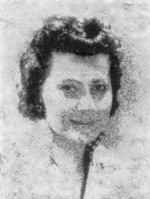
Tovah (Gitele) Steinberg-Reuveni
|
|
[Page 196]
by Shmuel Klipatz
Translated by Pamela Russ
A few months before the outbreak of the German-Soviet war, I was mobilized in the Red Army. From Ostroh, I was sent to a military unit that was on maneuvers at the border. We felt a great tension at the border, but no one even imagined that a war would break out.
At dawn on Sunday, June 22, 1941, the Germans opened a powerful firing upon us, accompanied by heavy bombardment. We received an order to yield. The Germans pushed forward and there was a great panic among us. There was great chaos on our front line, and the army fell apart.
I saw that I would be able to fall into captivity with the Germans, so I left on foot from Volodymyr-Volynskyi to home in Ostroh. When I arrived in the city, this was exactly before the first aktzia. I arrived in the evening, and at dawn, all the inhabitants of the city were driven out and everyone was gathered in a place behind the forest. Machineguns were placed all around and the Germans began to segregate the Jews: The able-bodied workers were placed separately from the non-able workers. One group was taken back into the city and the other group remained in position, in the “place.” There were already graves dug out, and 2,000 Jews were shot on the spot.
After the aktzia, the remaining Jews were divided into places where each one had to work. I was sent to work in the municipal power plant company. The director of the power plant company was a Pole named Szczawinski. He was a very decent person, a liberal Christian, and we had very good relations with one another. He lived behind the city. Since I was a carpenter by profession, he asked me to do some work for him.
I wore a yellow patch, as all the Jews did. At that time, the Jews could still move around in the city, since this was still before the existence of the ghetto in Ostroh.
When I came to Szczawinski's house, his wife received me very well. She herself was a Russian, a kind-hearted person, not an anti-Semite. We talked to each other, and she said she was very sorry that we were suffering so much from the Germans. She told me that the times for the Jews were now very difficult and one could know what tomorrow would bring. So that if a difficult situation for the Jews would arise, I should come to their home and she would save us.
I told my wife Sima about this, and we hoped that the Szczawinski family would perhaps
[Page 197]
help us during a time of great difficulty. The whole time I was working in the power plant factory as a carpenter. We suffered from hunger, but no matter how bad, we figured it all out. The Gentiles stood behind the fences and secretly sold food items.
Later, all the Jews were herded into a ghetto. The Christian residents were driven out of their district, and the Jews were driven into their bad houses. The ghetto all around was fenced off, and the ghetto was guarded by policemen from outside.
Everyone was driven to work. Everyone had to work, men and women. Every morning people were driven to work in the city. The Jews worked at the most difficult physical jobs, they put stones together [masonry], repaired destroyed houses, and always worked under a watch.
I used to go to work every day in the power plant, and worked at my profession as a carpenter. None of us had any illusions about what the Germans could do to the Jews. We knew that after one aktzia, another would follow, and the end would be complete destruction. But what could be done? There was no rescue. We lived with the present day and waited for miracles.
But Jews did not sit with folded hands. Some young people fled into the forest, some started preparing hiding places in houses to hide in an emergency, when there would be an aktzia.
The Ukrainian policemen who guarded the ghetto were waiting for the opportunity, when they would receive the signal to start killing the Jews. But in the meantime, they robbed, beat, and jeered with each other over the fate of the unfortunate Jews. They took whatever they wanted, and searched for valuables and gold at the same time, thinking that the Jews hid these things. So, they found hidden things as well. The Ukrainians also destroyed the hiding places and then beat the Jews to death.
The one who was most destructive was the sadist Petrov. He could not rest if he did not kill a Jew. He was a bloodthirsty murderer. Before the Polish era, he was the foreman of the magistrate, he used to direct the mayor. On his conscience, he did not have a single murdered Jew. After the war, he escaped together with Tkachenko, the commandant of the police in Ostroh.
This is how we lived until the third aktzia, which took place in October 1942.
The aktzia started by suddenly not allowing anyone to leave the ghetto. Those who needed to go out to work were not taken to work. All of them remained in the ghetto. The heart said that something was going to happen, had to happen, but no one knew what that was going to be.
On all sides of the ghetto there was a reinforced guard of Germans and Ukrainian police, ready to give a death blow to the Jews in the ghetto. Jews who had prepared a place to hide, began to hide. The Germans suddenly ordered that all the Jews must gather in one place, but by the time that all the Jews had gathered, the Germans and Ukrainians had already started shooting. Some tried to run away but they were shot while running.
When the third aktzia took place, I was no longer in the ghetto. I hid myself in a hiding place under the ground. At night I took my wife and we went to Szczawinski. There,
[Page 198]
in the stall, there was hay, and we crawled right into it. After some time in the hay, I left my wife and went into the Szczawinski home and I told the wife that they were killing all the Jews in the ghetto, and I begged her to save us. I reminded her of her promise that she would be prepared to save us if the Germans would begin to murder all the Jews of Ostroh.
Frau Szczawinski was very moved by my terrible news, and I noticed tears in her eyes. I immediately saw that she would keep to her promise. She immediately prepared some food and decided in the spot that we should build a hiding place. The best place would be behind the oven where they baked bread. The entrance to the hiding place would have to be in the place where the animals ate, because in that place there was a lot of hay and straw.
We immediately took to the task. I dug and Frau Szczawinski carried out the earth and spread it around so that no one would figure out that we were building a bunker. She carried the earth out all night until the hiding place was ready. She gave us some boards so that we could have a “bed” to lie on. But the board was too short for me, so I took some rocks from out on top of us, and added that to the board, and then I was able to lie down. But lying like that caused my blood to gel in my feet from not being able to move.
Frau Szczawinski brought us food every day at the same time that she went to feed the animals. The hiding place was well camouflaged, and a random person could not recognize it. But meanwhile, I was not happy that the homeowner Szczawinski himself did not know about our hiding place. His wife took this entire responsibility upon herself. Also, her young children did not know about us. Only her older sons knew and did not tell anyone. When Frau Szczawinski got sick, one of her older sons brought us food. They always took an interest in how we were doing in our hideout, see if anything was missing, and see if we needed any help.
We would wash ourselves twice a year: for the new year and for Pesach [Passover]. She would bring us warm water and we would wash ourselves.
There was a servant in her house, a Ukrainian, a terrible anti-Semite, and she was connected to the Banderites, and we all had to protect ourselves strongly from her. When Frau Szczawinski would bring us the warm water so that we could wash ourselves, she would send away the servant for their holiday, and only then were we able to wash without any fear.
We received food three times a day. We ate whatever the Szczawinski family ate, without any exception. She did all this with great love, knowing that she was risking her life and putting her family in danger, but she was prepared for all of it so that we would be saved from destruction.
Germans and Ukrainians would come into her house more than once. Szczawinski himself was a good mechanic, so Germans would come to him to fix their typewriter. But no one even thought that there were two Jews hiding in his place.
We remained in the hiding place until the Banderites came. At that time, the Banderites also killed the Poles, and in order to save themselves, they too had to flee from their homes into the forests. At that time, we remained without food for an entire week.
At night,
[Page 199]
I went out of the hiding place unnoticed to gather up some corn that was completely dried out by then. Nonetheless, we would keep the kernels in our mouth and this satisfied us. Otherwise, we would have died of hunger.
I suffered a lot with my feet. From not having space, I was not able to move my feet. The entire time, we lay without any movement.
When the liberation happened, and the Soviets entered Ostroh in February 1944, we could not remain in the city for a long time. I was immediately drafted into the Soviet military. And because I had already served in the military before, they did not keep me long in the exercises, and they sent me to the third White Russian front in eastern Prussia. I was wounded in one of the battles. I served in the artillery until I was released from the army at the end of 1945. Before that, I was sent to the border of Japan. That's where we stayed until the war with Japan ended.
After being released from the army, I returned to Ostroh. That was in December 1945. I did not stay in the city for long, and my wife Sima and I left for Lemberg. But we were afraid to remain in Lemberg because the NKVD had arrested my wife's brother for anti-Soviet activities. There was a danger that we too would be arrested. So, her brother, who was active in the Breicha [underground movement that helped Holocaust survivors escape and settle in Israel], became very active in helping us escape Russia as quickly as possible. We were in Poland for a short time, in Gliwice, and in the year 1956, we arrived in “the land.”
Since we were in now in Poland, we decided to try to find the Szczawinski family – our saviors. But we were not successful. We looked for them in many different places in Poland, but we could not find even a trace of them.
Our human obligation was to find them and thank them for risking their lives and saving us from destruction. These people were the real “righteous among the nations” who demonstrated humanitarian behavior at a time when everything around was black and rotten, and Jewish life was chaotic. We have them to thank for our lives.
Finally, we found out that one of the older Szczawinski sons is in Germany. We hope to find him and connect with him. Our Jewish and proper obligation is to make sure that Yad Vashem recognizes them as “righteous among the nations,” and our hope and dream is to be able to thank them for everything good that this noble family did for us as they extended a human hand, saved us from death, and in exchange did not receive any material satisfaction.
by Betty Eisenstein-Keshev
Translated by Pamela Russ
Introduction:
This piece is almost entirely based on the statements by the witnesses, Jews who themselves experienced all the 49 units of the German-Ukrainian hell in Volhyn. And now, it must be said: Also, the statements of our own witnesses do not give a complete picture of the life and destruction of the Jews during the Hitler period. The more that time passes, the more important details become forgotten, as they fly out of memory. But, even in the actual times themselves, not all the Jews of the ghetto knew or were able to know about all the happenings.
Some examples:
I myself saw how the Germans burned the Torah scrolls of the shuls on Tatarska Street in Ostroh. Later, after some time had passed, I questioned the Jewish Ostroh residents themselves, or other people who were there at that time. Of the six people whom I questioned, only three knew of this incident, and the other three had no clue of this event. It is completely possible that they never knew anything about this, even when it actually happened. But it is also possible that they knew before, but now completely forgot.
In Dubno, during the aktzia of “Judenrein,” they left 35 specialists behind. Soon after, during the next two weeks, they killed off 25 of them. Of the leftover 10, three escaped and the remaining seven died the day after the escapees disappeared. Of the three that escaped, two survived. And only these two knew everything that was related to the specialists. The rest of the Jews who survived, because they fled Dubno at the beginning of the aktzia, could not know anything about this, that at the beginning 35 specialists were left aside, and that later the majority were killed and only 10 remained.
In Koval, an incident took place at the killing site, that became an act of resistance. But in the Koval killing site, only one person survived as a witness. This event would have remained completely unknown if not for Shia Potchar, who sewed clothes for the regional commissioner – Montal.
Since Montal still had some clothes at the Jewish tailor Potchar, he himself took Shia Potchar out of his place after the aforementioned incident took place.
[Page 201]
Potchar sat at the commissioner's place in a locked room, and did the sewing there for the commissioner until February of 1943. Then, when he knew that the work was ending, he also knew that his own end was near. So, he nervously, and at the right moment, escaped…
There were rumors from Rowno that came during the time of the aktzia, in August 1942, and they also came to a line of towns and cities in the area, that on the first day of the aktzia grenades were thrown from a high ledge in the ghetto onto the Germans and Ukrainians and they were killed.
These rumors came from the Rovno Christians, and according to these rumors one German and two Ukrainian militiamen were killed by Jewish hands. Several Germans and Ukrainians were wounded. There were no remaining Jews who witnessed this act of resistance. No Jew from Rovno who survived is able to know about this scene that took place.
If a Jew managed to get out of the ghetto, he could think only of his own escape, of his own survival. He had absolutely no possibility – not psychologically nor technically – to observe his surroundings. Yet, since there are no witnesses to this act, no one can understand anything about the preparations for it, which were carried out under strict conspiratorial secrecy.
Who, then, can know about all the preparations, difficulties, and acts of minor resistance that took place, yet left behind no trace of evidence?
I, just like every Jew who survived this last destruction, at the beginning, after my survival, bound my life to the duty of fulfilling the mission of telling the story. I began by writing the history of my town of Ostroh.
In 1945-1946, at the request of the Jewish Central Historical Commission in Poland, I began collecting materials and testimonies regarding acts of resistance by Jews during the time of the German occupation. This material was later described in a book in the Polish language, titled “The Underground Movement in the Ghettos and Camps.” I began collecting material for this book, which is now in the reader's hands, in 1946 in Poland. I continued the project in Germany in the years 1947-1948 and completed it in the State of Israel during 1949, and then submitted the manuscript for publication.
When I began processing the material, and that was at a time when for the majority of survivors of that horrible storm, their economic existence during the catastrophe was already a half-forgotten, fading thing, I relived those experiences all over again. Against my own will, I was transported back to those times. I united with those who were no longer here. I united with that cruel pain, in that immense grief for which no words have yet been born.
Often, while writing and working on the material, I was overcome with trembling. It was very difficult to delve into those memories, to describe – using simple, everyday human words – things that were anything but simple, anything but ordinary.
At times, it felt like a profanation for me to weigh, measure, calmly contemplate, critique, and write about the deep suffering of hundreds and thousands of worlds that had been destroyed in such a manner. More than once, I asked myself the question: Is it not chutzpa for an ordinary person to
[Page 202]
try to paint and describe the nightmares, the pain, the person's trembling, that was experienced while being destroyed, of hearts that pierced the eyes that screamed with fear as they watched their own destruction. Do the heavens not have to send down a powerful person, a prophet, a comforter, with the power to express the profound pain, the inexpressible agony?
More often than once, I was deep and long in thought, and had doubts. But when I weighed the fear against my own chutzpa, and on the other scale, the absolute, real possibility of distorting or changing, falsifying the last destruction, distorting the human faces of our loved ones – something that is even worse than their murder – I nonetheless decided to see this work through to the end. In my eyes, this decision grew into an absolute necessity, a moral obligation, after my conversation with the Ukrainians in a railway carriage in Germany.
I regard this work, and I ask every reader to view it likewise, as a modest partner of this monumental work describing our great twentieth century tragedy, a work that will, and must, sooner or later, come into being.
The Outbreak of the Russo-German War
On June 22, 1941, the Russo-German War broke out. Right from the first days of the war, a mass evacuation began of Soviet officials, the militia, and all people from the east who held various administrative posts. In Vohlhyn, unlike in other areas newly occupied by the Soviets, there were also possibilities to evacuate the civilian population. Anyone who presented themselves was taken aboard the trains heading east. Borders were thrown wide open to everyone. People could travel using any means of transport.
Who evacuated, besides the Soviet personnel? Naturally, the Ukrainians and Poles did not budge from their places. The long-awaited hour had arrived for them. And what about the Jews? Among the first to flee were people who had engaged in political work for the Soviets, served in the militia, and managed to make personal enemies among the non-Jewish population. They also had ample reason to fear retribution. A certain percentage of young people of military age also fled, driven by a wide variety of motives, sometimes contradictory to one another. Refugees from the German occupied side also fled, people who remembered the Germans from the parts of Poland they had settled in, who had already fled from them once before. Yet, the majority of Jews remained where they were, for a variety of reasons.
After everything, Jews did not fully understand what Hitler meant for them. True, really, that two years earlier, refugees from the left bank of the Bug River had recounted the most horrific stories about the Germans, their terrible actions against the Jews. But people had convinced themselves that the worst was over. So, indeed, many refugees had even returned to their old homes, back to the Germans. This meant that, despite knowing what life was like under German rule, they preferred to remain under the Germans rather than endure hardships under Bolshevik rule.
[Page 203]
During the short two years that the friendship between the Bolsheviks and the Hitlerites prevailed, Soviet newspapers did not utter a single negative word about the Germans; they wrote nothing regarding the atrocities that the Germans committed in Poland and Czechoslovakia, in terms of the general population, and against the Jews in particular. Evacuation meant a life of wandering as a refugee; it meant hunger and cold, and misery. In a normal place of residence, everyone, regardless of where they were, at least had a small roof over their head.
Added to all this was the realization that the war would not last forever. One reasoned that, as a Soviet citizen, he would remain isolated after the war, just as he had been before it; he would have no contact with the outside world, and would never have the chance to break free from this hell and enter the wider world. He would have only two options: to remain a lifelong prisoner, both spiritually and physically; or to commit suicide. However, regarding the Germans, the prevailing belief was that, once the war ended, however that would be, there would be some possibility of escaping from their clutches and venturing out into the wider world.
All these considerations caused the majority of Jews in Volhyn not to move from their places.
The Ukrainians and the Jews
It is impossible to separate the Banderovtzes [Ukrainian nationalist] from the Ukrainian population. It is possible, and also likely, that among the Ukrainians there were actually no Banderovtzes, but their numbers were very small, and they were not significant enough to alter the general picture.
You can say, with total objectivity, that the Ukrainian nation comprised of Banderovtzes and their sympathizers. In any case, there were no active opponents to the Banderovtzes. The Banderovtzes set the tone for all Ukrainian life, and understandably, that they – in the manner that was required among the traditional anti-Semitic Ukrainian masses – formed their respect for the Jews, and for the first time, the Jews met the Bandertovtzas, who were active earlier only in the underground, only after the liquidation aktzias. Until this time, Jews in the ghettos saw the Ukrainians only in the administration in the militia, or among the general civilian population. Therefore, we can apply the term Banderovtzes in relation to the Jews only after the aktzias of the Judenrein operations.
The scant two years of Soviet rule added fuel to the traditional hatred that Ukrainians had towards Jews for hundreds of years; the identification of Jews with Communists contained nothing new.
For quite some time, Jews–especially those whose work brought them into contact with the general population–sensed a terrifying lava, a volcanic force, that was waiting for the chance to erupt and sow death and destruction all around. The Jews who held separate positions in Soviet agencies that dealt with the public–such as, for example, the finance office, the department for the procurement of grain and livestock, and similar institutions–evacuated immediately alongside the Soviet administration.
Had they not done that, then they were
[Page 204]
forced to move to places where they were unknown people, or otherwise they became the first victims. On the first days, they were removed from their homes, and since then, there was no trace of them. But the rage of the Ukrainians did not lessen against these Jews, and in the first days of the German occupation, a wave of pogroms took place in Volhyn.
The Ukrainian nation was overly filled with hatred toward the Jews and with a desire to exact revenge on them. The ordinary Ukrainian person, the neighbor, the former co-worker, the customer, had changed beyond recognition. No one would admit to knowing a Jew, let alone acknowledging any friendship. Even the friendly relations that had existed with Jews just the day before came to a sharp end.
They showed great contempt for Jews, openly asserting their superiority by refusing even to acknowledge the Jews' presence, and often beat up Jews on the street. During the first few weeks, before Jews were banned from the market, the local population refused to sell the Jews any of life's needs or products. In their naivete, Jews appealed to the Ukrainian clergy and Ukrainian authorities, pleading for help. Appeals were made to the sentiments of influential Ukrainian figures, urging them to convince their acquaintances, members of religious circles, the faithful, and those in official and church positions, to show compassion toward the Jews, otherwise the consequences would be bad. The Jewish representatives made this plea by appealing to the consciences of Ukrainian leaders. Otherwise, the Jews faced death by starvation.
After the period of the first intoxication with the demonstrations, the tide of hatred and attention to the Jews subsided externally. But this did not happen because of discussions and because of the Ukrainian administration, who simply laughed at the naivete of the Jews who came to them with such complaints and demands for help, but with the pressure of the events of the evolving German politique.
The Ukrainian felt less and less like a nobleman, like the boss of the situation, but on the contrary, as the power and intentions of the real leaders of the situation, the Germans, the dimming Ukrainian began to be ashamed and feel foolish, and then he himself began to drop his head that was held high.
The Ukrainians self-secure and self-rule feelings were beginning to get lost already in the first few days, when they saw how the Germans punished the Russian war prisoners, as they were treated like animals, starved, mercilessly and without conscience being killed without any thought. Not providing any form of security to the independent Ukrainian, and the arrest of many gangs, completed the process that began earlier. But these changes that occurred in the sidelines of the conflict between the Ukrainians and Germans only slightly changed in the main question and attitude between the Ukrainians and the Jews. They only stopped openly to demonstrate their hate towards the Jews, as they had done in the beginning, when they had wanted with all means to copy the Germans, and show how far they had gone with them, how strongly they appreciated the German route, and how great was their solidarity with their liberators.
[Page 205]
The Relationship of the People to the Jewish Goods and Products
The main interest of the population was centered in the enthusiasm to become rich from the Jews. Already in the first days of taking over the land from the Germans, the population, some openly and some only halfway, disguised and embarrassed, stole the possessions from the Jews, even outdoing one from another as they stole things.
Individual thefts happened everywhere and had no connection with the organized populace thievery. Those organized, secret robberies carried the mark of a plan, while the individual incidents simply bore only a personal characteristic. Ukrainians openly walked into a Jewish home, opened the cabinets, cupboards, commodes, and took whatever they wanted and liked. Individual Ukrainian militiamen did exactly the same thing. As they came into a Jewish home, they immediately demanded watches, clothing, linen, and more. Jewish representatives went to the officials to inform about these robberies and invasions. These representatives brought positive results. The Germans were as interested in robbing Jewish belongings no less than the Ukrainians were, and they sharply forbade the population and the Ukrainian militiamen to “visit” Jewish homes and take things from them. They even said that the Jews should report any incident. The thievery, actually, in general, stopped.
As long as the robberies continued without punishment, as long as things could be taken openly, as long as the only concern was that the neighbor should not be more skilled and be first to snatch the Jewish possessions, as long as that which belonged to the Jew also belonged to the non-Jew, that is how long it was almost impossible for the Jew to purchase daily needs from the non-Jew, or to exchange things for daily needs.
Only when robbing Jewish goods became impossible, only when the population became convinced that the Germans were the true masters and the sole “heirs” of the Jewish possessions, only then did the Ukrainians come to realize that they were not the only ones in charge, and only then did they begin to trade and conduct transactions with the Jews.
People began buying goods from Jews, bartering with them and swindling them. As a result of this new situation, the population became more and more interested in maintaining contact and relations and business connections with the Jews. And thanks to the changes, the German ban on looting and their desire to seize everything for themselves, the Jews, restricted to the absolute limit, and condemned to death by the Germans, were in a position to avoid the death by starvation, which the Germans would gladly have inflicted upon them.
The Ukrainian peasant was in contact with the Jew for one of the following four reasons:
[Page 206]
their possessions, mainly clothing. The Ukrainians brought their products. With all the transactions, the items were given away for almost nothing, practically for free, for a quantity of items that in no way was close to the real value of the sold items.
It also happened frequently that the buyer rarely paid even the insignificant price that he promised to pay for the purchased product. In most cases, particularly when the product had value, both sides agreed that the Jew would be paid by instalments.
Many times, the buyer did not have all the products that he had to give over, but even more so, in almost all cases, the seller was not able to take all the things at the same time. You could not bring in many products all at the same time. It was always dangerous at the ghetto gate, where the guard could actually take all the items, and let alone that if a larger number of products was found, that would cause the penalty of death. The Ukrainians, not maintaining their word, or fooling them, or not providing the promised items, became a mass phenomenon, so the Jews began to sell their products for money, then bring the money into the ghetto, and then buy products there, even for higher prices.
This made a difference on the black market in the actual ghetto itself. The Ukrainians stopped meeting the Jews at work, and smuggling of daily products increased in the ghetto between the Jews and the Ukrainians. It was primarily meat, flour, sugar, oils, etc., that were smuggled in.
There was a special trick that went on between the Ukrainians: to trick the Jews out of products. This trick took place with all kinds of talks. In the early period, Jews wanted to ensure their better belongings. In the ghetto, they argued, the items were not safe.
If they had to flee from the ghetto, or to hide, they had to leave all the things behind in the ghetto. Otherwise, they thought that regarding the things that were outside of the ghetto, they would leave things with the Christians who had agreed to take in these items. They believed that they would be able to use these things as desired. They also believed that anything found outside the ghetto would be easier to sell, other than an item that would have to be smuggled out of the ghetto.
In order to place the better items somewhere, the Jews came to an agreement with Christians, former neighbors, good friends, acquaintances. In particular, there were former housekeepers, wetnurses, and customers. Understandably, the Jews searched for the Christians, but in the end, the Jews actually looked to contact other Jews. In an equal measure with the Ukrainians, other Christians who lived in Volhyn also showed an attraction to Jewish items.
Just as Jews wanted to give away their items with the hope of getting them back later on, the same way, the Christians hoped to be able to get the items and keep them to themselves. Jews gave away expensive items, better furniture, pianos, other music instruments, better clothing, furs, and sometimes expensive linen. Doctors gave away their tools and remedies. The first incidents of giving away these things, particularly the furniture, began as soon as it was clear that ghettos would be created and exchange began with the municipal administration regarding the ghetto areas. Other things
[Page 207]
were given to the Christians during the entire time of the existence of the ghetto, almost until the liquidation.
During the time of the ghettos, it often happened that the Jew did not receive back the item he had given to “his” Christian to hide. When the Jew asked that it be given back, most of the time the response was a diplomatic, evasive reply. For example, the item could not be returned at this time because of the neighbours who would see the transaction; or that the neighbors had to be prepared for this; the item had to be first removed from hiding, and this had to take a day or two or three.
Giving things to the Christians happened for other reasons as well. Jews gave away expensive items and money, and that way ensured an eventual hiding place during a dark time. Jews decided, with the consent of the Christians who had to create hiding places in their own homes, that they would be able to hide there in times of need.
The cost of an eventual hiding place, a so-called bunker, had no limit. For these hiding places, the Jews always paid and paid, gave over possessions, and simply paid with money as well. Only a small percent of the Christians, who took part in these agreements, meant this honestly. The majority fooled the Jews.
There was another, very original method of cheating the Jews out of their things. During the time of interim liquidations, or of the final liquidations, when rumors circulated about forthcoming aktzias, when Jews, understandably, found themselves in the greatest unnerving situations, often, many unfamiliar Christians stole into Jewish homes, looked around, searched for things with their eyes, and forced the Jew to sell or even give over the items.
In order to be successful, these Christians motivated the Jews with logical arguments: “You will be slaughtered anyway, so is it not better that we get your things rather than they fall into the hands of the Germans?”
In general, the Jews reacted to these propositions with intense rage. It also happened that the item which the uninvited guest, the Christian, had demanded, had disappeared in the interim. Others, with great discretion, rejected the offers, and sometimes gave the item in exchange for some food.
Every action of the Christian people, and in particular of the Ukrainians, was a good opportunity to demonstrate their power and stubbornness and trickery and prediction for the script of the German officials, as they would act towards the Jewish possessions.
As known, there were the strongest prohibitions of taking Jewish possessions, and for trespassing against this prohibition there were terrible punishments. Regardless, though, the Christians sneaked into the ghettos during various aktzias, when the Jewish homes were left abandoned, with the door and gate left wide open, and then they took whatever they wanted. During the liquidation aktzias, when they had the last chance to steal whatever Jewish possessions that they could, they did this at risk of losing their lives.
They went around the terrible, abandoned ghettos day and night, after the liquidations, even though the ghettos were guarded by the Ukrainians militia. They searched for hidden treasures, which according to rumors
[Page 208]
were spread around the population, which the Jews had buried or hidden away in their houses. The thieves broke steps, walls, broke into ovens, dug up yards. Sometimes, searching for dead treasures, they found live Jews hiding in bunkers.
They stole bedding from the houses, quilts, clothing; tore down windows, doors. Broke down walls and took building materials. Nothing could hold them back from stealing, and then taking things out of the ghetto: not the strict prohibitions from the Germans, not the designated security guards who watched the ghettos, and not even the armed Germans who would come to check the ghettos and remove those who were guilty.
The Germans shot those who tried to flee and not stop when the Germans yelled to stop. Among the ghetto thieves were the “shabrovnikes” [looters], as they were called, there were many victims, but even this did not hold them back from being thieves. The militia and the Germans arrested the looters in the ghettos. They were held under arrest until a large number of them had been collected. Then they were taken out on a Sunday, or another Christian holiday, set in a lineup, then were given sticks in their hands, which contained the text: “We are thieves. We robbed the ghetto. Shame on us!” And more of the same written texts.
That is how they marched through the streets of the city. These “marchers” did not arouse a sense of shame among the population; they were not prepared to give up because of humiliation in reference to the riches of the ghetto, and their peasant like, primitive imaginations painted them in the most mysterious colors.
All the difficulties that they encountered while robbing the ghettos, led them to the decision that they would have to move about more quickly and not fall into the net that the Germans and Ukrainian militia had prepared for them. They would make underground ditches on the other side of the ghetto and then sneak inside through the ditches. The greatest efforts were enacted at night when the Germans would not enter the ghettos because of the darkness.
The city population would primarily look for gold items, silver, diamonds, and other valuables. The village people were no less greedy but less selective. They looked for things such as clothing and building materials.
A special large part of the looters were the 12–16-year-olds. It was told, for example, that in Rovno, a strong group of spiteful and active youth of the aforementioned ages specialized in finding hiding places in the walls, cabinets, stoves, and other places, until they began dealing with gold, foreign currency, and valuables.
The Christian population also had the potential to deal with the things that were officially taken from Jewish homes by the officials after the final liquidation. These items were sold for base line prices in the special unit stores that were created for this purpose.
But in these stores there were mainly sorted items, once the Germans had already sorted through the things and taken the better items. And to purchase these things, the buyers had to add money. But not all of the people were able to
[Page 209]
“loot” enough things in the ghettos. For example, peasants from distant villages did not have the opportunity to come to the ghettos at night.
There was also less brazenness, and there were those for whom there never was enough. Because of that, night and day there were long lines of people standing in front of the unit-shops. They kept buying and it was never enough. The markets and fairs were also over filled with Jewish things.
Items were sold without even a drop of shame. They did not even think about the fact that there could also have been religious items as well. They sold taleisim [prayer shawls] as material for women's clothing. It became fashionable to wear clothing made from this material. Parchment paper from Torah scrolls was sold for soles of shoes or for clogs. Religious books were sold for packing paper. The tefillin boxes [phylacteries] were sold as ashtrays.
Some of the priceless possessions remained outside the boundaries of the ghettos, such as actual houses, shops, and more. These treasures were under the supervision of the municipal authorities and were populated by these authorities, their members, and by the policemen, and by civilian Ukrainians and Germans.
Those who occupied these houses wanted to ensure their rights permanently, and wanted to buy the houses from the municipal administration. After the aktzia of Judenrein, the administrators wanted to sell the Jewish stationed possessions. These were also found in the depth of the ghettos, and after the final liquidation they were placed in ownership with the other houses of the ghetto.
The “looters” destroyed many houses during their “work” time. And they also “looted” complete houses in order to expand their business. From they ghettos, they dragged windows, doors, floors, roofs, and in many cases, they even took bricks.
After the Judenrein aktzia, many villages rebuilt themselves. Others extended themselves in a large fashion. Using building materials from the ghetto houses, new, beautiful cottages were built, and around them were economical buildings.
The self-appointed ones could not figure out how to get rid of “their” immobile possessions. They kept paid guards who had to make sure that the looters should not make a mess of the ghetto houses, but the guards could hardly be of any help. Since they could not protect themselves from the people's greed, the self-appointed ones began to sell the houses of the ghettos themselves, or to live in them, or even for to take them apart themselves. Whoever bought a house to live in, had to guard it himself so that no one could grab it from him.
In the spring of 1943, the Poles, who had run away from the villages, entered the cities. The Ukrainian self-appointed ones, under the pressure of the Germans, had to settle in the half-destroyed Jewish quarters. With this alone, in a direct manner, they guarded the ghetto valuables, and even brought in profit. They repaired the half-destroyed houses and protected them from complete destruction.
There were no millionaires in Volhyn, no wealthy Jews. There was a distinct percentage of comfortable Jews. The greatest percentage of the Jewish population in Volhyn consisted of middle type and small type of merchants.
[Page 210]
In the final years of the existence of the Polish Republic, a large part of the Jews in Volhyn became impoverished. When the war broke out in Volhyn, there was a large reservoir of Jews who could barely survive materially.
Then, suddenly, during the German rule in Volhyn, the Jews grew in the eyes of the population, becoming greater in wealth. And actually, the demands of the Jews did not cease. They not only gave, but really gained for themselves as well. It seemed that the reservoir was bottomless. How did this happen?
The Jewish settlements in Volhyn were very old. Jews had been there for generations. Almost every Jew there had at least a small house, some furniture, and facilities of various character. For many years, every person, whoever it may have been, took care of clothing, linen, furniture, dishes, all amounting to value. Everything was passed on from generation to generation, from parent to child. Gold and silver rings and family jewellery from distant relatives, went for generations to grandchildren to great- grandchildren.
Every new family added something to the family treasure: a gold watch, a fur coat, an old, treasured ring. In a normal time, there was no talk of selling family jewellery or personal belongings, even though at some time they did have actual value.
They guarded these things for sentimental value. In many instances, much of these things actually had little value, and they wanted to sell these things. Things became different during wartime. Anything a Jew had was changed, since now he needed sustenance for life.
On the other hand, everything was changed into something that teased the stinginess and jealousy of the non-Jew. Jews took out the most valued family possessions from their hiding places, things to which they were connected. The same thing happened to personal possessions.
With a calm, stoic feeling, without sentiment, everything was thrown to the greedy masses. They did not keep anything, nothing was dear. They said: “If we survive, we will get things again. If we do not survive, who needs these things?”
The Germans and the Jewish Possessions
From the very beginning, the Germans did not squander the Jews' items. In the first aktzias, the Jews were permitted to carry packages with them, suitcases filled with their things, even if dragging these packages upset the order of things, or the packages took up too much space in the evacuation trucks.
In many places, in the notices about the first aktzias (for example: in Rovno, Kostopol, and other cities), the Jews were told that they could bring up to 15 kilos of baggage. Hoping that they were actually going to other places, the Jews took the most expensive things, and the smallest, so that they would have something during difficult times.
In that manner, expensive possessions got into the hands of the German murders without any strain. Other than the expensive possessions, mountains of clothing and shoes soon lay in the places of extermination. After the aktzias, all these things were loaded onto the trucks and taken away. In the hands of the Ukrainian militia and the non-Jewish population
[Page 211]
there fell only a minimal part of the clothing piles.
Original footnote:
by Tovah (Gitele) Steinberg-Reuveni
Translated by Monica Devens
As the years go by since the tragic Holocaust, my heart leans towards sailing in memories and, despite the fact that they are tied to great emotional tension, they exist, they are squeezed into the depths of the soul, imprisoned, but existing and alive, and when a propitious time comes, a light touch is sufficient to awaken them and they take shape; and, in the appropriate circumstances, the floodgate of memories opens and things flow fluidly, in detail, as if they had just happened yesterday, and in front of my eyes, the people who were cruelly murdered arise and, once again, I am in the atmosphere of the days of the Holocaust.
|
|
|
Tovah (Gitele) Steinberg-Reuveni |
From the earth saturated with blood and death, many voices call out - the voices of the murdered, these voices scream out from mass graves, there in Ostroh, and they rock the soul with a quiet little voice, they will not be calmed for even a moment.
I want to tell - and not just in short - about the suffering that befell the Jews of Ostroh. Only a small handful of our city remained alive, those that managed to flee to Russia at the outbreak of the war and those who fought with the partisans in the forests, with the Red Army, and a small handful who were saved thanks to the righteous of the nations of the world who, although sunk in an atmosphere and in a society of murderers, did not take on Jew hatred and they extended their supportive hands at the ugliest period of our lives.
I am one of those who were saved. I must tell the story so that future generations will know what happened to me during the days of the terrible Holocaust.
The Russian Period
The Polish-German war that broke out on September 1, 1939 was short, only 16 days. These were days full of tension and threat and, at daybreak of September 17, Russian tanks entered Ostroh due to the alliance between Germany and the USSR (the Molotov-Ribbentrop Pact). The Red Army streamed in masses day and night in the direction of the city of Brisk [=Brest, Belarus] and, after a short time, took control of all of western Ukraine and Belarus.
Very quickly the new regime was established over all its offices. The disinheritance of the middle class from its economic positions began. The wealthy among the Jews of the city received instructions to leave their apartments, and the government offices
[Page 239]
and the clerks with their families, sent to us from the east, were housed in these apartments. In place of stores and private companies, government companies, co-operatives, government stores, etc. were organized. The local population and the Jews had no choice but to accept this ruling, but principally they worried as to what this new regime would bring to them?
The elimination of Jewish national life naturally ended. The authorities didn't even have to take special measures to bring that about. The Jews understood that they had to abandon public activity, which was not acceptable to the Soviet regime. All the Zionist organizations and the others ceased to exist. Then arrests and investigations by the offices of the NKVD began and several Jews who headed the Zionist movements were imprisoned and sentenced to long confinements and sent to various prisons in distant Siberia.
Among those imprisoned were friend of our family, the lawyer, Baruch (Buzi) Chasid, of whom all trace disappeared, Gedaliah Gedalivsky, head of Ha-Tzohar [=Revisionist Zionist party] in Ostroh, Yosef Kleinman and his son-in-law, Feivel Bernstein, and some from among the wealthy of the city.
My brother, Moshe Steinberg, who was active in the “Ha-No'ar Ha-Tziyoni” movement was afraid that he, too, was on the NKVD's “Black List” and he decided to flee from the city while it was still not too late. Together with a group of Polish acquaintances, who also feared that they were likely to be imprisoned, he crossed the border between the USSR and the General-Government and got to Kharkov [=Kharkiv]. The Poles got Polish documents for my brother in the name of Ludvik Rodenitsky and this is how he was registered in the registry of Kharkov residents.
In this city, he met a young Polish woman named Visia and they fell in love, but she didn't know that her fiance was Jewish, but when my brother told her about his Jewish background, it didn't bother her in the least. They married and over five years, during all the years of the Nazi occupation, she took care of him devotedly in order to save him from death while putting herself and her family in mortal danger.
She and her family overcame their fear and offered a helping hand to my brother, knowing that if they did not do that, my brother's death would weigh on their consciences for the rest of their lives. They rescued him from Nazi clutches and they live a happy life now in Europe.
Under Nazi Occupation
At dawn on June 22, 1941, Germany attacked the USSR with great force and, in a short period of time, the German army advanced deep into the USSR. The atmosphere was intense and full of terror. The Red Army fled and left the defense lines around Ostroh.
The Russians fled by vehicle or on foot, all fleeing in panic, it was a terrifying flight and still we didn't know why they were all fleeing. We heard shooting from all sides, the sound of airplanes flying over the skies of the city and dropping bombs. Dead people were lying in the streets, fires, and complete chaos reigned in the city.
Immediately after the conquest of the city by the Germans, the Jewish population began to feel the heavy boot of the German enemy. The lives of the Jews had no value. With the occupation of the city, the Germans published various restrictions and decrees against the Jews. They were commanded to wear a white band with a blue Jewish star on the sleeves of their garments. Jews were forbidden to walk on the sidewalks, permitted only to walk in the road. A curfew was laid upon the entire population beginning at 9 p.m., but Jews were forbidden to go out beginning at 7 p.m. The local Ukrainian police took upon itself the task of checking compliance to the decrees.
So that the Jews of Ostroh could not escape extermination, the German command set up a ghetto in the “Garbela” quarter of the city. The Jews were ordered to leave their homes and move to houses in the ghetto. Every Jew between the ages of 16 and 60 was directed to present himself for work. Severe punishment was expected if one did not present oneself for work. The Ukrainian police were appointed to carry out this instruction.
The situation got much worse, hunger oppressed us and the situation became unbearable. We turned into oppressed and depressed slaves. After awhile, I found work as a waitress in the restaurant of the Ukrainian police and my sister found work as a clerk in the Judenrat offices. Due to my work at the restaurant, I was able to bring a little food home for my parents and sister.
[Page 240]
As fate would have it, I met a Ukrainian policeman by the name of Borchakovsky at the restaurant, a cobbler who, before the war, had worked for the Jewish Lolki family who had a shoe factory in Ostroh. This man knew my family, too, and he would endanger himself to bring us food from time to time and he would come every once in a while to the fence of the ghetto in order to maintain contact with us. He also promised me that he would help in the event that I needed it.
When I heard these words, I didn't know what to think: who is this man who is prepared to lend a helping hand to a persecuted Jew at this time? Events chased events and daily we experienced new things. The cordon around the ghetto was tightening daily. But no one with common sense was able to imagine that, in fact, the Germans were prepared to murder thousands of people.
The August 4, 1941 Action
One after the other, bad news began to reach us from all corner of Volhynia about the annihilation of masses everywhere in every city and town. And then, one day when I was returning from work, I met a Christian acquaintance by the name of Volodya Polishchuk. He told me that there were rumors that the Germans were preparing to liquidate the Jews and he suggested to me that I flee from the ghetto. He offered to help me should I need it. I did not agree to his suggestion, I didn't want to leave my parents and my young sister in the ghetto by themselves.
And then, on August 4, 1941, the ghetto was surrounded by a large number of German forces and Ukrainian policemen. In the ghetto, it felt like a pogrom. The action began at dawn. The Germans and the Ukrainians broke into the houses of the Jews, taking people out of bed. They took the ill out of the hospital on stretchers, wailing and bitter crying all around. They drove everyone out of their homes, no one remained at home. The Germans and the Ukrainian policemen carried out their operation with speed and cruelty, with blows and brutal prods.
They made us stand in the new city and there we stood until 4 in the afternoon and with a trembling heart. Jews came up with hypotheses, maybe the murderers were only preparing to loot the houses of the Jews and with the end of the “work” they would be freed, but at the same moment, a rumor spread about the decision of the Germans to liquidate the sick and the elderly.
The selection began. The Germans divided the people into two groups. No one knew what the Germans intended to do with the Jews in the two groups. We stood and waited with terror for what awaited us. We were surrounded on all sides and the Germans and the Ukrainian policemen ran around keeping order.
|
|
|
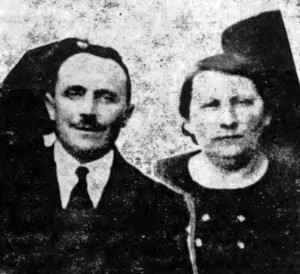
The parents of Gitele Steinberg Chaim and Mala (slaughtered in Ostroh) |
My father decided at the last moment to join the group of the sick people assuming that the Germans would not harm the sick and so, perhaps, he would live, but unfortunately, he was mistaken: they brought all the sick and elderly to the murder place and shot them. Among the slaughtered was also my dear father. That's when I saw him for the last time.
Mourning, we returned to the ghetto without my father. Waiting for disaster, perhaps we are waiting for our end? Now there was no doubt that any hope of remaining alive had run out, all the dreams that the Germans would let us live had disappeared. But life went on and we were hungry and despondent, moving around like shadows between the walls of the ghetto, which closed in on us after the terrible slaughter. Many houses were empty of Jews. Life
[Page 241]
in the ghetto got harder by the day. The Nazis sought to eliminate the Jews of the ghetto not just physically through unceasing terror, but also to strangle any living thought and attempt to awaken opposition from this quarter before they succeeded in executing them.
Day by day, the cordon around the ghetto tightened. No one with common sense was able to accept that, in fact, the Germans were prepared to murder thousands of people. Events happened one after the other and daily we experienced new things. We became apathetic and equally indifferent to the troubles of the whole and of the individual. Tragedies visited us one after the other, one worse than the other, and all together they piled up like a mountain of trouble, a procession of horrors. But in those difficult days, the people in the ghetto took pity on one another, that perhaps despite everything there was hope of life, that perhaps despite everything the Germans would not carry out the murder of masses.
The September 1, 1941 Action
On September 1 at 6 a.m., we again had to present ourselves for forced labor, but through the windows we saw that the Germans, dressed in raincoats and metal helmets, were running around the streets of the ghetto, something that aroused suspicion. Ukrainian policemen followed them, they entered houses and began to force the Jews out of their homes with the deception that they had to present themselves for work. The heart foretold evil. I didn't leave the house so as not to present myself for work.
One could already here incessant automatic fire outside. In the streets, the sounds of great explosions that shocked the entire ghetto could be heard. I sat and looked with trepidation at what was happening outside. I had one prayer in my heart, that the Germans would not start to murder. I see people gripped with fear and trembling gathering outside, and the Germans and the Ukrainian police searching every house, every courtyard, looking for Jews who had not come outside.
At that moment, Roza, the wife of Lova Kornblit who had been executed on August 4, came to us. I told Roza that I had decided not to present myself for work because I worried that the Germans were about to carry out an action in the ghetto today. I suggested to her that we go up into the attic and hide, perhaps the Germans wouldn't find us.
I wasn't wrong. The Germans decided to execute all the young people and, in fact, they chose all the young people from among the group that stood outside and they transported them outside of the ghetto under the pretext of sending them to work. My sister, Chasia, still managed to leave early in the morning for her workplace at the Judenrat offices before the Germans gathered all the young people and she was saved from death on that day.
The two of us sat in the attic the entire day and luckily they didn't search for us and we, too, were saved from death on that day. These were days of death and destruction before the final extermination of the Jews of Ostroh. After the murder of the young people, life in the ghetto somehow went on. We went out daily in groups of Jews for work accompanied by Ukrainian “overseers” equipped with rifles and batons.
The Liquidation of the Ghetto on October 15, 1942
That day, October 25 [typo?], was cold and rainy. A command came to be ready to leave the ghetto. Terror gripped everyone, each person searching for a way to be saved, but to no avail. The ghetto had become a closed cage, surrounded by enlarged forces of Germans and Ukrainian policemen who were equipped with much weaponry. The Germans drove the Jews out of their homes. My mother, terror-stricken, went out of the house to see what was happening outside, my sister, Chasia, went to her workplace at the Judenrat offices seeking there a place of rescue.
I remained at home alone. You could hear shouts, crying, aggressive curses of the murderers outside. The shots grew with great vigor, wailing and shouting filling the airspace, and at that moment, I remembered my Christian friends who had promised to help me at a tight time. This was the only hope that perhaps I could get help from them and stay alive. I saw that the Ukrainian police had surrounded the ghetto on all sides so that we wouldn't be able to escape from it. Among the Ukrainian police was also my friend, Borchakovsky. I decided
[Page 242]
to crawl out of the ghetto and, by chance, I happened upon Borchakovsky who was looking for me in order to save me and, when he saw that I was crawling among the ranks of the policemen, he engaged them in conversation so that they wouldn't pay attention to me, but to no avail: one of the policemen saw me, shot me, and hit me in the ankle. I lay on the ground, wounded, showing no signs of life. At midnight, under cover of darkness, I managed to evade the eyes of the policemen and, crawling, managed to leave the walls of the ghetto. I arrived wounded and hungry at Borchakovsky's house.
|
|
|
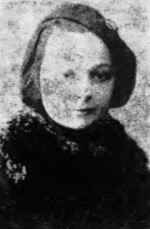
Chasia Steinberg (sister of Gitele Steinberg-Reuveni) killed in Ostroh |
Hidden in the “Aryan Side”
When I arrived at Borchakovsky's, he calmed me, took pity on me, and said to me, there is no reason to be afraid, he and his family would help me, they would share my fate. He was a good-hearted man who revealed willingness to do whatever he could to save me from death. He understood the seriousness of the situation, that he was endangering his own life and those of his family, but he was prepared to help me in this difficult situation.
The next morning, I asked Borchakovsky to go to my house in the ghetto and see whether any of my family were hiding in the attic. And, in fact, he found my mother and my sister in the attic. He promised them that he would come at midnight to bring them to him. Unfortunately, when he returned to the ghetto to get them, there were no longer there. He only found photos scattered over the floor. He collected them and brought them to me instead of my mother and my sister. After a few days, I learned that my sister, Chasia, too, had been caught by the Germans together with her friend and that the two of them had been executed.
The deaths of my mother and sister brought me to depression. I felt as though limbs had been cut off my body. For many days, I mourned them, but with this I reached the conclusion that I had to be strong despite the loss of my mother and sister. I was in a state of shock, but the will to live overcame me.
The Borchakovsky family was poor, but, despite the trouble, they tried to save me from hunger. His wife, a friendly peasant and honest, showed that she, too, was prepared to save me from death. She even influenced her husband not to withdraw in the face of the difficulties. Besides me, they were also hiding a relative of the Trachtman family, Irena was her name, the two of us hid at the Borchakovskys for several months while switching hiding places.
During those days, a Polish woman named Kasia visited the Borchakovskys and said that she, too, was hiding Trachtman at her house and was taking care of him. This was a woman who put her life in danger through her efforts to help Jews in that awful time as much as she could. During those long evenings, we spoke a lot about the situation of the Jews. Irena, too, was full of confidence that the war would end with the defeat of the Germans. It was this confidence that filled us with hope that we would overcome the calamities and remain alive.
Once Kasia told us that a rumor was going around that the Borchakovsky family was hiding two Jewish women while the Ukrainian police, and even the local population, started searching for Jews hidden among the Christians. The danger that they would catch us
[Page 243]
at the Borchakovsky house was felt. It was clear that we had to leave his house before it was too late.
Borchakovsky was very embarrassed because he wanted to save us, but was also afraid of the serious consequences. If Jews were found in his house, it was a death sentence for himself and his family. At this time, the authorities announced that a Christian who hid a Jew in his house was sentenced to death. This threat terrified many good people who had been prepared to help.
I asked Borchakovsky to go to Volodya Polishchuk and tell him to hide us in his house and about the foreseeable danger should the Germans or the police catch me at his house. And he did go to Polishchuk and that one came immediately with a cart full of hay. At my request, he also agreed to take Irena because I didn't want to part from her. He hid us under a pile of hay and we arrived safely at his house in the village of Moshchanytsya [?]. The German guards stopped the cart on the way to the village and began to search in the hay to see if he was bringing forbidden things. But luckily, they didn't find us and we were saved from certain death.
On the third day after we left Borchakovsky's house, the Gestapo surrounded the house. They searched the entire house, but they didn't find us. We remained at Polishchuk's house for 3 months. Once in a while, his brothers, who were part of the infamous Bandera gangs, would visit him. These were gangs who murdered Jews and also Poles. Every time he knew that they would visit, Polishchuk took care to move us to hide in his windmill where we suffered from cold and hunger.
When his brothers' visits became more frequent and the situation became catastrophic, we had to leave Polishchuk's house and return to Borchakovsky. We always knew that in times of mortal danger, the certain address was his. He always understood the severity of the situation, was always ready to help and to come to our aid at every opportunity. And so he received us with open arms. He saw immediately what our condition was. We could tell that he was very moved and he expressed his desire to take care of us during this terrible time. When we heard these words, we didn't know how to evaluate this good heartedness of a non-Jew, who served in the Ukrainian police, despite liable to mortal danger. We hid at Borchakovsky's house until the Red Army liberation on February 5, 1944.
These descriptions that I have put down on paper, they are nothing compared to the bitter reality and nothing that I went through will be erased from my memory and I always see before me my loved ones, my parents, my sisters, who were annihilated by the cursed Nazis and their Ukrainian helpers. I have never forgotten my rescuers, the families of Borchakovsky and Polishchuk to whom I owe my life, who endangered their own in order to save me from death. My ethical responsibility is to express my thanks to those righteous of the nations of the world who never accepted anti-semitism and who put out a supporting hand at the most difficult time of my life, during the terrible Holocaust.
[Page 244]
|
|
|
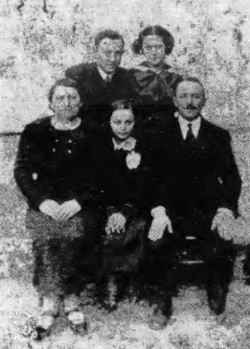
Sitting from right to left: the father, Chaim Steinberg, the daughter, Gitele, the mother, Mala Standing: the daughter, Chasia, and the son, Moshe |
|
|
|
|
|
|
JewishGen, Inc. makes no representations regarding the accuracy of
the translation. The reader may wish to refer to the original material
for verification.
JewishGen is not responsible for inaccuracies or omissions in the original work and cannot rewrite or edit the text to correct inaccuracies and/or omissions.
Our mission is to produce a translation of the original work and we cannot verify the accuracy of statements or alter facts cited.
 Ostroh, Ukraine
 Yizkor Book Project
 JewishGen Home Page
Copyright © 1999-2026 by JewishGen, Inc.
Updated 17 Oct 2026 by JH