 |
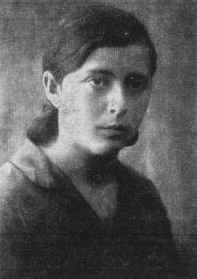
Bluma Sterenberg
|
[Page 245]
Translated by Shalom Bronstein
The following is the letter of Bluma Sterenberg z”l, that she left with her Polish neighbor whose name was Pioterokovska. It was translated from Polish into Hebrew by Nachum (Nyonya) Shochat.
3 September 1941To my Dear one, my husband whom I love above all else.
I write this two months after you have left. A great deal has happened to me during this time and now I have to separate myself from you. It is impossible to describe the Hell of our lives. I will try, only in a few words to tell you the main points.
It began right after you left, on the very same day. On Friday morning the city was already occupied - but the battles continued for six days. It seemed like that no stone would remain on another. We succeeded in getting through all this with a baby, through terrible difficulties and suffering in cellars and in the church.
We knew that life was not going to be sweet, but we had hope, that they would let us live, and in the worst case, we would die of hunger. There were good people who brought us a piece of bread and things began to improve slightly. We began to sell things to get some food. We were therefore satisfied, like we got a ticket to life. It was like this until the 4th of August.
In the morning on that day a horrible state of affairs began, just like in the plays of Dante. No, that is not accurate. Dante could not have imagined situations as frightful as these. Between two rows of soldiers, armed with poles, they led us to the forest; there we stood on the field, machine guns surrounded us, and silently we waited for death.
|
|
|
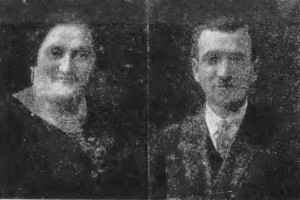
Bluma Sterenberg |
1900 people were murdered there. The rest returned to their homes. We left our father on the field. We didn't mourn very much on his death. Common sense told us that remaining alive was worse than death.The desire to stay alive was very strong so that we were happy even with this kind of life. It is hard to believe that we were to experience a similar event.
[Page 246]
This state of affairs lasted for four weeks during which there were “surprises.” We had to pay a ransom of 100,000 rubles and waited for them to organize a ghetto for us.On August 31 rumors circulated, that tomorrow the horror which we already previously endured would return. I did not believe it but, it was not a rumor - it was true. This time we turned over Rusi, who had been a “father” to us after the death of our father. She had a strong will and physical endurance for everything; she sold things, got us food, ran the house and in addition, every day reported to forced labor that continued from 6 in the morning to 6 in the evening. She ended her life three days ago. Today there is nothing left [to eat] as the last portion was taken.
|
|
|
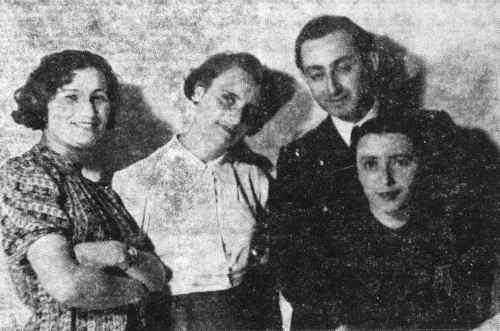
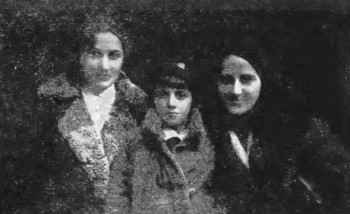
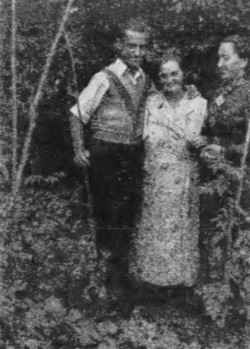
From right to left: Bluma Sterenberg, her brother Samuel Sternberg, sisters Zhnia and Bela Shanfer |
A rumor spread today, that this will take place tomorrow. Lately, all the rumors came true, so I am saying goodbye to you.I only described the dry facts, but I am unable to describe my sometimes-crazy feelings! Especially when I look at my son. My dear one, if you could only know how wonderful a boy he is. My heart is breaking when I think that tomorrow I myself will carry him to his final resting place and he is laughing and laughing “What”...God does not want that I should hear him, “Mahmu” (Mommy). Twice he saved my life, when they turned back mothers with their little children. Now, I wanted to save him, but there is no chance.
I wanted to convert to Christianity (many people wanted to do this). The [Christian] clergy sought permission carry this out, but they have no hope of getting authorization to carry it through. Therefore, we must prepare ourselves to leave life behind.
The mother carries on very bravely, she is deeply pained that she cannot save her son and that you will not see them again.
[Page 247]
I and mother kiss all of you very passionately and hope that after you return, you will not remain here, on our parents' land. Escape from the memories, the place of our suffering, it is like a plague infested place. Cry about our fate and try to put your lives in order.And you, my dear one, however it will be, put your life in order. Life has its own rules. Do not forget me or our firstborn son, of whom you could have been very proud, if only God had not brought this punishment on us.
We kiss you another time and leave you forever
Bluma, Mother and their son
Lord of the universe! I lived another whole month and again hopelessly regained hope. Tomorrow is Yom Kippur, and it is truly the Day of Judgment for me and for your wonderful child, Yoske.
I have absolutely no wish to die!
The boy is so wonderful, and to die so!
|
|
|
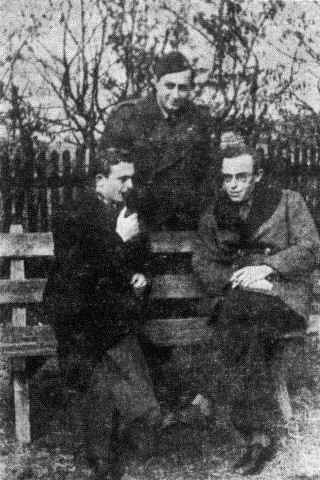
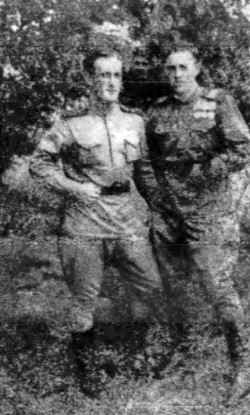
Standing – Samuel Sternberg; seated right of Samuel Mosi Soroka and Mosi Greinimas |
Comments by Shalom Bronstein, the translator into English of this letter:Family name spelled both Sterenberg & Sternberg in article.
My family was very close to the Sternberg (the spelling used in the United States) family. They are mentioned in the ship manifest of my great-grandmother Ruchel Dimmerman who arrived in the US in 1920. After World War II my father and his family sponsored the sole survivor of the family, Sam Sternberg and his wife Barbara whom they brought to Philadelphia where they became successful designers and manufacturers of women's clothing.
by Miriam Kuckel-Lapidus[a]
Translated by Monica Devens
At the end of November 1941, I had the opportunity to travel to Ostroh in a farmer's cart. Of course, we paid the farmer who brought me there in advance. My sister, Lena, who had lived in Ostroh earlier, had left some valuables with her acquaintances. Her hope was that I would get everything that she had left. But I aimed for something different. My goal was, first and foremost, to get documents (forgeries) for the members of my family who were in Rovno [=Rivne], with the help of a Jewish physician who worked at that time for the Ostroh municipality, who had access to documents and also to municipality signatures. Thus, I wrapped myself in a large country kerchief (I didn't look Jewish) and I started on my way in harsh cold. We arrived at Ostroh peacefully.
In Ostroh, I was received by acquaintances, the Korschon family, who helped me with everything. The Korschon family lived in a small house on Tatarsky Street, not far from the commercial center where, before the war, the large businesses and the many small stores of the Jews were concentrated. The Jews who remained in Ostroh after the actions were all imprisoned in the ghetto. They lived in constant fear and did not know what the day would bring. (The community of Ostroh is counted among the ancient communities of Volhynia.)
The population of the city was varied from the perspective of national origin: Jews, Poles, Ukrainians, and Russians. In 1939, there were about 10,500 Jews in the city. Ostroh was conquered by units of the Wehrmacht in the last days of June 1941 and the Germans began persecution of the Jews immediately. On August 4, 1941, about 3,000 Jews were murdered by the Germans and their Ukrainian helpers. This was the first action. The second slaughter was on September 1, 1941, when more than 2,500 Ostroh Jews were murdered. On October 15, 1942, the Germans liquidated the entire ghetto. On that day, about 3,000 people were murdered.
During the few weeks that I remained in Ostroh, I had the opportunity to meet with Jewish youth who had survived the actions in Ostroh. They would meet often. At one of the meetings that took place at the home of Musi (Moshe) Katovitz, I was present. Everyone was worried. They spoke about organization, flight, and opposition, but we were aware, too, of the situation of powerlessness. The ghetto was completely closed and, similar to other places in western Ukraine, most of the local residents treated the Jews with strong hatred and lay in wait for them day and night.
My acquaintance, the physician, fulfilled my request. He acquired documents for the members of my family, but unfortunately, we did not use them in the end.
Original footnote:
[Thou Shalt Not Kill!]
by Aharon Waldman
Translated by Pamela Russ
The more we distance ourselves from the bloody years of the Shoah, the bolder and more descriptive are the memories of those dark times when the Ukrainian murderers and the German murderers killed Jews with unbelievable brutality. And the more that time passes, as fire before my eyes, there arise images of the murder of innocent Jews in our city of Ostroh.
That which I will recount is not simply an episode of a bloody time period, but also a witness of oppression and murder that ruled in the days of the Shoah. We found ourselves in an environment of misery and depression during the time of the last fights of the holocaust survivors of the Ostroh ghetto.
It was in the cold, frosty winter months of the year 1943. In the large death field from one end of Volhyn to the other there were already thousands of murdered Jews in mass graves in various places, and among them many martyrs from our city of Ostroh. The Ukrainian murderers, totally possessed by a psychic hysteria of murdering Jews, did not exclude anyone: not children, not the elderly, and not the sick ones. When the murderers met any lone Jew in the forest or in the field, that is anywhere Jews found hiding places, even in a ditch, they were simply murdered without any compassion, in a bestial manner.
That is how murdered Jews were found lying in the streets of Khorovczyzna, and in other places. Peasants told us that in those days, in Teremno, in the forest, there were some Jewish women wandering around, half dead, starved, and physically depleted.
On one of those nights, a group of us Jews decided to go and find those women and get them some help. We left our camp and went into the forest, and we followed the traces of those women, who, according to the peasants' information given over to us, were not far from our forest. After much searching and following signs and traces, we came to a ditch in the Teremno forest, where there were murdered Jews.
A horrific sight came before our eyes: In the ditch in the forest, from which there was a terrible smell of acetone and a foul smell of death, there lay murdered Jews. But in the dark, we could not see who was in the ditch.
[Page 250]
We immediately made some light, and a horrific picture appeared before our eyes: In the middle of the grave lay Baila Eivenman who had her arms around her little son, Loli Eivenman. Both were dead. On one side there was Polye Treiberman, who already was crazed and was screaming incomprehensible words. Close to her was her daughter Jenia Treiberman, who fortunately, was still fully sane, but completely unaware and apathetic to her tragic fate. She knew exactly what had happened, but she was in no condition to tell us.
We discussed among ourselves what we could do and what kind of major steps we would have to undertake to save the still living Jenia Treiberman from death, and then, bring her to our camp which was about fifteen kilometers from the gravesite. Sadly, we could not take her mother Polye with us to our camp, since she was completely crazed and screamed loudly the entire time, and this would have put us all in danger.
The question became, how were we going to bring Jenia to the camp with us. It would have been too difficult to carry her in our arms, but she was hardly able to walk, and the distance to the camp was too much. We decided that we would get a stretcher and come back for her the following day.
Meanwhile, we left some food and water for Jenia and we promised that we would be back the following morning, at the set time, and we would bring her back with us. But there was a difficult dilemma for us: What should we do with the crazed Polye? We could not bring her with us along with her daughter, but leaving her here in this situation meant leaving a living person totally alone, and she would definitely pass out and go into a slow, horrific death.
We discussed between us what to do. After a short discussion, we came to a terrible decision, that there was no other way but that we would have to give her some poison to facilitate and assure her death. Among us there was a woman who happened to be carrying a dose of poison in case there would be a situation where there would be no way out other than a way of suicide, and not to get into the hands of the murderers.
It was very difficult for us to explain to her that she should give up the poison so that we could give it to the crazed Polye Treiberman, and relieve her from her pains of dying and terrible distress, and that this would be a relief and bring her freedom.
After a long period of processing the idea, the woman finally agreed to give up the poison, and then asked the question: Who would give the poison to the unfortunate Polye? Who would be the one to deliver death to her? It seemed that none of us wanted to transgress the commandment of “thou shalt not kill”! As happens in these types of situations, we had to draw lots, and the one who would be fated to be selected would be the one to carry out the death. We drew lots, and fate had it that one of us had to carry out this horrific act…
The following night, when we reached the ditch, we found Jenia Treiberman with teary eyes. We immediately understood what had happened. Jenia told us that her mother had died from heavy anguish. She was now lying there dead. Her death freed us from transgressing
[Page 251]
one of the Ten Commandments, “thou shalt not kill.” None of us had to be the murderer of the tragic Polye Treiberman…
We closed off the grave with the dead, and one of us recited the kaddish. Around us stood the birch trees as quiet witnesses of the terrible tragedy of a group of murdered Jews, killed by the Ukrainian bestial murderers. It made an impression, as the black and white birch trees symbolized witnesses as each stood wrapped in a talis [prayer shawl], and together with us, the war survivors from our town of Ostroh, recited “Yisgadel ve'yiskadesh shemei rabbah” [the first four words of the kaddish prayer: Exalted and sanctified may His great name be].
Jenia Treiberman was saved from the war's destruction, living through the difficult route of an unsettled life. Today she lives in the Soviet Union, in the city of Odessa. She established a family, her husband is an engineer, holding an important position. She communicates with her aunt Bronia Tsap in America, with whom she has regular postal correspondence.
Jenia Treiberman is the sole witness who was fated to see the death of her mother, and the death of Baila Eivenman and her son Loli, there in the dark ditch, in the Teremno forest.
|
|
|
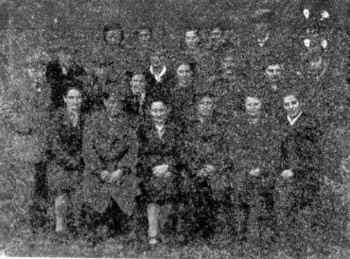
Top row, from the right: Hershel Chutranski, Buni Nitishinsky, Raja Chutranski, Betzalel Landau and his wife Center row from the right: Meyer Rubenstein, Hinde Shkolnik-Rubenstein, Tolpin and his wife Tzila, Liza Kaplan, Malka Vishnivitzki, Moshe Matzutzki Seated, from the right: Bronja Kidar, Mrs. Chutranski (the mother), Dovid Fishman and his wife, Pinchas Ulman, Zlata Shkulnik- Matzutzki |
by Chaim Finkel
Translated by Monica Devens
The few people who managed to escape the Ostroh ghetto during the slaughter and reach the forest were bereaved, broken, and shattered in body and spirit. These were unarmed people and, therefore, defenseless. During their time in the forest, they began to organize into small groups in order to make their existence easier.
The conditions in the forest were harsh, but the people knew how to accommodate to the conditions of the forest and to various situations. They divided the tasks among themselves and organized to fight all the enemy forces, the Germans and their partners, the Ukrainians. All the small groups of Ostroh natives maintained ties and knew what was happening to Ostroh survivors scattered in the forests.
At the time, the Soviet partisan movement was in its infancy and so small groups could fill an important task. At the beginning, the partisan groups were too weak to pull off partisan actions, but over time, they learned how to attack the enemy and to cause heavy losses. The partisans of Ostroh natives joined the partisan framework at this time since they were filled with feelings of hatred and revenge without bounds. They attacked the Nazis at every opportunity, fought the enemy bravely, learned how to construct bombs, sabotaged telephone lines, blew up roads and bridges, and were excellent scouts since they understood every road and path in the forest.
And in this manner, Ostroh natives went out on partisan actions during the nights in the areas of Ostroh, Shepetovka, Pluzhne, Khorovshchizne [=Khoroshiv?], and other places. They fell upon a sugar factory in Shepetovka and blew up bridges on the main road between Lakhovitz [=Bilohirya] and Zaslav [=Izyaslav].
Among the partisan fighters were Jewish women and their children who filled important functions that were placed upon them by the partisan commanders. In particular, women who didn't look Jewish, dressed according to the need, fulfilled important missions. They went from village to village and brought the partisan command important information with valuable intelligence. The Ostroh native partisans earned the mark of excellence from the partisan command. Some of the best fell in battle and some remained alive and they are scattered in various countries and especially in Israel.
Yaakov Kaplan
Yaakov managed to escape the Ostroh ghetto for the forest together with his wife, Batya (Betty) Eisenstein, and her sister, Sarah Eisenstein, and they joined the partisan unit that operated in the Ostroh area. Yaakov was an outstanding partisan and did a lot to strengthen the morale among the partisans whose emotional condition was poor before they went out to dangerous missions.
Yaakov died a hero's death during a surprise attack by the Germans and the nationalist Ukrainian Bandera gangs on the village of Pivneva-Hora in the summer of 1943. After liberation, his partisan friends buried him in the Ostroh cemetery next to his grandfather, R' Berele the judge, zatsa”l [=of blessed memory].
[Page 253]
Moshe Otzar
Born in Ostroh in 1920. In 1941, he was drafted by the Soviet authorities into the Red Army. A few days after the war between Germany and the USSR broke out, he was captured by the Germans. He told them he was Ukrainian. His looks and his complete mastery of the Ukrainian language helped him and thus he was saved from certain death.
In January 1942, they transferred him from Baranavitz [=Baranavichy?] to Minsk. On the way, he and five other Russians managed to escape and get to the forest. For several months, he wandered alone in the forest until April 1942 when he was accepted into the “Zhukov” regiment (the “Chapayev” brigade), which operated at that time in the area of Kapuli (Kupil).
The leaders of the regiment realized his military capabilities immediately and appointed him commander of a unit. He participated in battles in Sturitz (in the area of Kapuli) and Tsutsvich, which is next to Hantsvich (Polesia), and acquired a lot of arms for the regiment.
Due to a personal confrontation with the regiment commander and also due to the antisemitism that began to make its mark felt on the regiment, he was forced to leave his unit in August 1943 and join the Jewish regiment of Gilchik, which had just organized, where he was appointed division commander.
On February 12, 1944, he led his division, along with the entire unit, to ambush the Germans along the Minsk-Slutsk road. The ambush was successful. Twenty-two vehicles with 220 Germans were destroyed. Moshe took two German soldiers prisoner and, for this, was recommended for a medal.
On May 10, 1944, he went out with his division for an ambush along the Staricha-Nieswiez [=Nyasvizh] (Novogrudok region) road. A vehicle with policemen came along and in the battle that broke out between the ambushers and the police, Moshe was mortally wounded and died the next day.
The unit arranged an official funeral for him. All the units participated. Three fire volleys accompanied the burial ceremony.
The Lexicon of Heroism, Volume 1, page 51
Leizer Otzar
Was an outstanding partisan, took part in many battles against the Germans and their Ukrainian helpers. He fell in battle in the forest against the Germans. Another version of the story - he was shot in the back during the battle by an antisemitic partisan.
The Lexicon of Heroism, Volume 2, page 162
Yosef Glitzky
Fled the Ostroh ghetto where his parents and brother were murdered. He got to the forests and joined a regiment of partisans who operated in the forests of Volhynia. For a year and a half, he fought under the command of the Russian commander, Utocha. Was an outstanding partisan and participated in many battles against the Nazi enemy.
After liberation, he was drafted into the Red Army, sent to the front, and got as far as Berlin. He was wounded in one of the battles and released from military service. He came to Israel by way of Cyprus with Aliya Bet [=illegal immigration]. During the War of Independence, he fought with the armed brigade of the IDF. He is counted among the active members of our organization.
Pesach Eisenstein
At the time of the liquidation of the Ostroh ghetto, he fled to the surrounding forests and, after much hardship, joined a regiment of partisans who fought in the forests of Volhynia. He excelled as a guide in the surrounding forests and gave much assistance to partisan fighters to act efficiently against the enemy. He gave body and soul to the battle actions in which his non-Jewish appearance helped him. He took part in campaign actions and acquired a reputation among his partisan friends as a good friend and a courageous partisan.
After liberation, he joined the Red Army, was sent to the front, participated in many battles with his army unit, and fell heroically in one of those battles.
Mendel Treiberman
After his flight from the ghetto, he found his way to the forest and joined a partisan regiment that operated in the Ostroh forests. He participated in many battles and excelled. Among the partisans, he stood out for his concern for others and, in particular, was of great help to the Jews of Ostroh who escaped from the ghetto for the forest and suffered from a lack of everything. He obtained food for them and guarded them. He excelled in his reason, his logic, and his quick grasp of things.
[Page 254]
After liberation, he joined the Red Army, was sent to the front, and fell bravely in one of the battles.
Yitzhak Kedar
He experienced all the abominations of the Ostroh ghetto along with the Jews of the ghetto. At the time of the liquidation of the Ostroh ghetto, he fled to the forest and joined a regiment of Russian partisans and fulfilled many important and positive tasks. He operated with energy in battles and took part in revenge actions against the Ukrainian partners.
After the war, he immigrated to the United States, established a family, and stayed in close contact with the Organization of Ostroh Natives in Israel.
Dvora Zeigersohn
After her escape from the Ostroh ghetto to the forest, she was wounded in the leg and, thanks to her non-Jewish appearance, received medical attention at the hospital in the village of Slavuta. She pretended to be a Christian and, with her husband, Nyusa Greinims, succeeded in getting forged documents as Christians and, thanks to these documents, spent the Holocaust on the Aryan side.
After the war, they immigrated to the United States, where they established their home.
David Muller
Escaped the Ostroh ghetto and hid in the village of Bar for a certain period of time until he came to where the Russian partisans were and joined them. He fought as an outstanding partisan in the forests of Volhynia and participated in many battles along with his partisan company.
After liberation, he worked extensively as the head of “Ha-Bricha” in the city of Łódź. He brought many Jews across the USSR border to Poland and from there to countries in Europe. He helped those who had come out of Ostroh rehabilitate themselves temporarily in Poland until they found their way west.
Sonia Kriboshfaka
Was in the Ostroh ghetto and went through all the abominations. At the time of the liquidation of the ghetto, she succeeded in escaping to the forest and, due to the special conditions in the partisan camp, decided not to join the partisans, but rather took care of herself alone with the help of Jewish partisans, Ostroh natives. One day, she decided to go to Ostroh without consulting any of the city natives. On the road to Ostroh, she was caught by Germans and was brutally murdered.
Bronia Chap
During the horrors in the Ostroh ghetto, her parents, husband, two of her children, and four of her siblings were killed. During the liquidation of the ghetto, she was saved by a miracle along with her 4-year-old daughter, Lina. With her daughter in her arms and dressed as a Ukrainian village farmer, she wandered about in the area from rural place to rural place and, due to her mastery of the Russian and Ukrainian languages, she was not suspected of being Jewish. As she went from place to place, she met a group of Russian partisans and joined them.
The partisan command laid special tasks on her, such as scouting, sleuthing, and gathering intelligence. Bronia fulfilled these tasks with great success. When she was dressed as a villager holding her little daughter in her arms, she didn't arouse any suspicions. She wandered about in the area, listened to what was happening with the German soldiers, collected German newspapers, which were very important to the partisan command, and passed important and militarily valuable information along.
One day while she was with her daughter in the forest along with the partisans of her “Combat Vaslankav” company, they were surrounded by large German forces that shot their many weapons. The partisans were surprised and were unable to defend themselves and so they scattered. When the shooting strengthened, so as not to be hit by enemy fire, she collapsed on the wet ground with her daughter without showing signs of life in order not to draw the attention of the German soldiers who were running all around them.
Suddenly she felt a German soldier kicking her body strongly with his boots, but she didn't respond. When the German soldier was convinced that she and her daughter were not alive, he let slip to a German who stood nearby: “This woman is already dead!” … and they continued on their way. And so Bronia and her daughter were saved from certain death. The partisan command praised
[Page 255]
Bronia Chap for her brave conduct on that day.
After the war, Bronia and her daughter immigrated to the United States, where they still live today.
Dora Band-Soroca
After the Germans murdered her parents during the liquidation of the Ostroh ghetto, she managed to flee to the forest with her daughter, where she endured all the hardships.
After the end of the war, she immigrated to Canada with her daughter. Her daughter, too, was saved from the inferno and they live there until today.
Zindel Chodak
At the time of the German occupation, he was in the Ostroh ghetto and, at the time of the liquidation of the ghetto, he fled to the forest and joined a regiment of partisans that operated in the surrounding forests.
While he was in the forest, he did much to save many Jews from death. He was a courageous partisan and outstanding fighter. He was seriously wounded in one of the battles and underwent many operations until he recovered.
Ostroh native partisans met a hero's death in the forests of Volhynia and they are:
Shmuel Zimmerman, Nyusia Karson, Zelig Vishkerman, and Shlomo Gornstein.
May their memories be for a blessing.
Among the Ostroh native partisans who took an active part and excelled in partisan actions in the forests of Volhynia were also:
Aharon Waldman, Yosef Werbe, Yoel Kassel, Bluma Shorek, Gitele Zimmerman, Pola Treiberman, Feivel Untergweis, and others. They fled from the ghetto to the forest during the liquidation, moved from place to place until they were able to join the ranks of the partisans, and participated in various partisan actions. They successfully completed the tasks given to them by the partisan command and contributed their part in the war against the Nazi enemy and their Ukrainian helpers of Stepan Bandera.
Ostroh natives served in the Red Army also, fought at the front, and contributed to the defeat of the Nazi monster. They fought in battles courageously and with total devotion and revealed military abilities during their war at the front and they earned praise from their commanders. They lifted up the pride of Ostroh natives, both in the world and in Israel.
There were Ostroh natives among the fighters in the ranks of the Red Army during the Second World War and among those who enlisted even before the war or those who came out of the forest after liberation and were drafted into the Red Army and continued their fight at the front, too. Some of the fighters in the Red Army fell in battle and their graves are scattered over various places on foreign soil.
Avraham (Abrasha) Kotel (see his article)
Yosef Meltzer
Participated in battles at the Stalingrad front. In 1944, with the advance of the front westward, he came to Ostroh with his army unit and found the city burned and empty of its Jews. He participated in the liberation battles of the cities of Vitebsk, Warsaw, and other cities and was among the fighters who broke through the lines during the conquest battle of Berlin on May 2, 1945. He was an outstanding fighter and earned many letters of commendation for his fighting at the front and also received a thank you letter from Stalin and from General Rola Żymierski of the Polish Army command. He remained in Poland after the war and established a family there.
Within the ranks of the Red Army, fought and were wounded: Eliezer Perchuk, Boris Lichtenstein, Gonikman, Pretzman, Minsker, they immigrated to Israel together with their families and they are members of the organization of those disabled during the war against the Nazis. Among the fighters in the ranks of the Red Army was also Yeshayahu Sheftal who reached officer rank.
[Page 256]
Among Ostroh natives who fell at the front during their service in the Red Army were:
Lonny Katz - son of Benny and Bella Katz of Ostroh. He fell during the battle against the Germans in the city of Zdolbuniv.
|
|
|
Lonny Katz |
Fedye Katz - Lonny's brother, served as a captain in the Red Army and fell in the battle in Ostroh in 1945.
Yitzhak Magel, Yesha Rozenszturm, Itzik Zilberstein, and Koka-Yisrael Kotel fell also.
May their memories be for a blessing.
With the end of the Second World War, Ostroh natives joined the actions of “Ha-Bricha” in Poland and were active, too, in other countries in Europe and fulfilled important jobs in helping Jews flee from the USSR to Poland and from there to countries where “Ha-Bricha” operated. They took an active part in the organization of illegal immigration to Israel. Among the outstanding activists of “Ha-Bricha” should be cited:
David Muller who was among the organizers of “Ha-Bricha” and contributed much to the immigration of Jews to Israel. His brother, Yosef Muller, was captured by the Russian secret police while carrying out important missions under the auspices of “Ha-Bricha,” was imprisoned, and remained in jail in the USSR for many years before he was freed.
Zalman Sheynerberg, one of the outstanding activists of “Ha-Bricha” in Poland, also did much to bring many Jews to Poland across the USSR border and was captured by the NKVD during an action and remained in Soviet prisons charged with anti-Soviet activities.
Among the Ostroh natives who were activists of “Ha-Bricha” in Poland and in Europe must be cited our members: Aharon Waldman, David Vaynshelboim, Poma Ludomirsky, Noach Sheynerberg, Dov Raichis z”l, Binyamin Zonshine, Yael Zonshine (Katzenblit), Chaim Charbash, Chaim Virkerman, David Boroshak, Binyamin Berenzon, Vilik Biber, Nachum Shochet, Zalman Shochet and others. Most of the Ostroh native activists of “Ha-Bricha” are in Israel.
Bibliography:
The Lexicon of Heroism, Volumes 1-2, Yad va-Shem, 1968.
Michael Grines: “When Life Flourished [in Yiddish],” Buenos Aires, 1954.
Testimony of Ostroh survivors living in Israel and the diaspora.
by Avraham Kotel
Translated by Monica Devens
Summer 1944.
The war became life, life in war. The war machine bursts forward without anything to stop it. The iron chains of the Russian tanks crushing beneath them anything that stands in their way. The Red Army drenched in the ravenous hunger of the victories at the front. The German lines are crumbling and the Red Army chases after the Germans fleeing for their lives. Every day brings newly conquered cities and every day that passes brings the end of the Third Reich closer.
|
|
|
Eliezer and Rivka Kotel - the parents of Avraham Kotel (lost in the Holocaust) |
In those days at the front, you think about the home that was, the family, the city of Ostroh where you were born, friends and acquaintances, where are they now? … Memories of a distant childhood arise in my thoughts, awakening in my heart strong feelings and longings for the distant past, for the warm home, the extended family. Sometimes it seems to you that September 3, 1940, when I went out as a conscript to serve in the Red Army, was just yesterday.
We were seven in my parents' house. My father, Eliezer, z”l, was a forest trader, my mother, Rivka z”l, a housewife, “a Yiddishe Mama” in the full meaning of that term. We were five children and all members of “Ha-Shomer Ha-Leumi,” which later became “Ha-No'ar Ha-Tziyoni.” My oldest brother, Munya (Mordechai), helped my father in his business until he decided, at the beginning of the 1930s, to go to the “Ha-No'ar Ha-Tziyoni” kibbutz and find a way to immigrate to Israel, but he didn't manage
[Page 258]
to get the longed for certificate and remained at home. In 1937, he married Tzvia Berl from the city of Sarny, which is where he established his home and had two children.
My sister, Baba z”l, married Aharon Gorfinkel of Rovno [=Rivne] and lived there. My sister, Tziofa-Shifra z”l, went to the “Ha-No'ar Ha-Tziyoni” kibbutz, but she, too, did not receive the longed for certificate, married Yisrael Goltzhaker from Linov and lived there until her bitter end. I was the fourth age-wise. My little sister, Rachel z”l, was 17 when I saw her for the last time.
|
|
|
Avraham Kotel's sisters: Baba, Rachel, and Shifra (lost in the Holocaust) |
I will never forget the mixed-up feelings during my short leave in Ostroh when I met my beloved family, from whom I parted before my return to my army unit on the Crimean peninsula. This was only four days before the war between the USSR and Germany broke out on June 22, 1941. And who would have been able to imagine that this visit with my loved ones would be my last visit. My heart surely felt and foresaw trouble, but it was so incomprehensible …
During my time at war against the Nazis, I experienced many battles. I met people from many nations in the USSR, among them Jews, brave and courageous fighters of whom many fell in the terrible fields of death.
The famous 51st Army on the southern front was hit hard and only remnants remained. My eyes saw only blood and fire and scorched earth, burnt lumps of steel, destroyed houses, many wounded and death around you. This is cruel war.
I was in the area of Kratz-Yeiny Kala [?]. A bitter and hard battle in every street and house and behind us, the Sea of Azov. We tried to advance while under continuous attacks of heavy fire from German artillery and the raining of bombs from the German Air Force, we tried not to retreat, but to no avail! A shell fell next to me and I was in shock and, when I came to my senses, I found myself in Stantsiya Pashkovskaya next to Krasnodar. That was the first time I was wounded. At that time, I was in the special 3rd battle engineering battalion in the 51st Army.
With our advance westward, a new hope of seeing my loved ones was born. True, the way was still long, but hope lived in the heart …
With the liberation of western Ukraine, I sent letters to municipalities where my family had lived: Ostroh, Sarny, Malinov, and I requested information about the fate of my loved ones.
[Page 259]
Many days passed without a reply … and then on July 20, 1944, I received a “triangle” letter, known to every fighter, but this wasn't a letter from any municipality nor was it from a relative, but from someone I didn't know. The letter was sent at the end of March 1944 and now it was in my hands and I was afraid to open it. I still hoped that my loved ones were still alive and perhaps the letter contained good news and suddenly someone called out my name: “Present yourself immediately to the commander!” One has to obey this order and I ran with the letter in my hand and entirely emotional.
When the commander saw the state I was in, he blurted out: “What's with you?” But I couldn't explain the reason for my emotional state, I just handed him the letter and he began to read out loud so I would hear the contents, but suddenly his voice went quiet. He looked at me, at the letter in his hand, came close to me, hugged me, and said only two words to me: “We will get revenge!” He returned the letter to me and moved away. I felt like this was bad news. It was the end of my hope, the end of my family and my home … I stood as if made of stone.
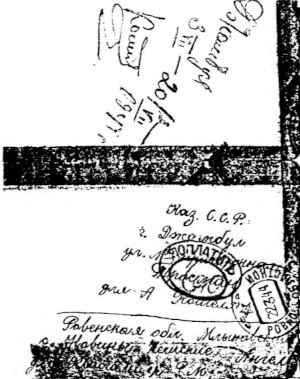
After I came to, I read the letter over and over again, which was in Russian with the stamp on the other side:
|
|
|
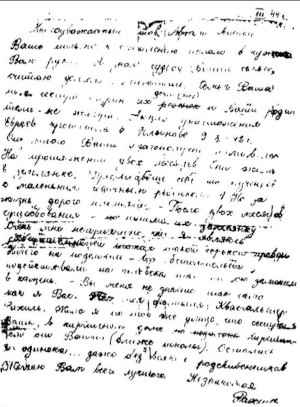
The letter from Rachel, the widow, to Avraham Kotel, written in Russian in the town of Malinov in March 1944, and which came to his comrade-in-arms in the city of Dzhambul [=Jambyl], in which she tells of the bitter fate of his family that was lost in the Holocaust. |
[Page 260]
“Examined by the military censor, March 22, 1944.” And here is the translation of the letter in Hebrew:
“Very honored Comrade Kotel!” March 1944 … your letter, unfortunately, came to someone unknown to you. I am the one who knows the fate of your family, see it as a duty to answer. Your family, meaning your sister, your brother-in-law, and their two children, and your parents - are no longer living. The extermination action against the Jews of Malinov was carried out on October 9, 1942. Your family managed to escape to the forest and, for two months, hid in a bunker. Imagine their suffering with a one-year-old child, but for life, one is willing to pay dearly. After two months in the forest, they found the bunker. I am terribly sorry to have to tell you this bitter truth. There is nothing to do - all the events influence a human like this, that he has turned to stone …
You don't know me, just like I don't know you. My name is Kvashalter Rachel, I lived on the same street as your sister, in a brick house, the third house from your family (next to the school). I remained alone … without relatives.
I wish you the best …
(–-) Rachel the widow
|
|
|
The examination of the letter of Rachel, the widow, by the military censor on March 22, 1944 |
[Page 261]
I was in shock and couldn't recover for a few minutes. How many times did I read the letter and swear in my heart to avenge the spilled blood of my loved ones, my life no longer had any value. The desire for revenge is strong and I participate in heavy battles on Polish soil. Two days after I received the letter from Rachel, I was wounded a second time, this was near the Majdanek death camp. A bullet hit my right leg. These were days when one heard loud shouts on the front: “Onward to Warsaw”! “Onward to Berlin!” …
After recovering in September 1944, I met for the first time Michael Paskhover, a Jewish fighter from Odesa. This was a chance meeting. After being wounded, I was assigned to Reserve Unit 151, which was located in a park called Lubomirsky in the city of Rovno [=Rivne]. For a long time, I kept the content of the terrifying letter from “Rachel the widow” in the pocket of my military shirt as a dear amulet that would protect me.
I am walking around the city market and suddenly I see a sergeant adorned with “Red Star,” “Red Flag,” and other such on his chest. He fixes me with a sharp look and spontaneously spits out: “Amcha?” - Yes, I answered: “Amcha.” - “Are you a Jew? [in Yiddish]” – Yes, I am a Jew.” [in Yiddish] – I answered him. During our conversation, I showed him Rachel, “the widow's,” letter. He read the letter quickly, looked away from me, and was quiet for a long time …
Michael Paskhover served in a special battle unit of the Ministry of the Interior of the USSR (M. V. D.) at the time when the Red Army was rapidly advancing and the Germans were retreating from the front, many Ukrainians, German partners, local residents who had murdered many Jews, went underground. They continued to kill Jews, survivors who had returned from the forests and fought against the Soviet regime. Michael's unit fought against this dangerous enemy, which was conducting a guerilla war, a hidden and very dangerous enemy. In the course of our conversation, he suggested to me that I transfer to his unit. “This is an opportunity for you to avenge the spilled blood of your loved ones. You are a native of the area and would be very useful, I am looking for fighters like you. My unit is located in your city, Ostroh, and there are also senior Jewish commanders in my unit, don't hesitate, they will receive you with open arms. You have fought at the front all the time, hundreds of murderers of our people are swarming in your city: the Ukrainians of Stepan Bandera, with your help we'll take care of them …”
The decision was hard for me. It was hard for me to leave my unit, I had gone a long way with them on the front and I had many, good comrades-in-arms. How could I be in my city where there were no Jews? I have no family, how could I breathe here when all around was only destruction and ruins? On the one hand, I thought, maybe Michael (“Mishka”) is right. I mean, someone has to repay the debt and now I have been given an opportunity that will not come again. I will now have in my hands the possibility and the ability to take revenge against the murderers of my family and the murderers of the Jews of Ostroh.
Logic instructed me to join “Mishka”'s unit and the next day, I already met the captain, Svebel, the Jew (his brother is in Israel). He was the commander of the Special Battalion no. 228 of the Special Infantry no. 21. After a short conversation and short inquiries, he gave me permission to join his unit. My papers were taken from me and I was issued a new military ID attesting to my serving in this special unit in which there was serious military discipline. Not much time passed when I was already commander of an independent unit within this unit, when the commanders gave me complete freedom of action.
The day after I came to Ostroh, I went out to survey the area where once had been a Jewish city. I walked to the center of the city, to my house along Mickiewicz Avenue. - That of the gentiles - unharmed, and the more that I neared the center, the greater the destruction and, on the decline of the avenue, I saw the entire area in which, once, Jewish life bustled. All was destroyed, empty.
On the other side of the city, I could see from afar the remains of the thick and high walls of the Great Maharsha Synagogue, built in the 16th century. There are no Jews here, my heart shrank more, and all of me was emotional as I approached my house. My legs wouldn't take me inside. I was unable to overcome the obstacles within me. I knew that I wouldn't meet my loved ones here. I first entered the large courtyard, the large storeroom was still there, but the large garden
[Page 262]
and the long and decorated fence had disappeared. The trees were uprooted. I hesitated to enter the house.
I am going now to a meeting with the past. I stand before the front door and my heart beats stronger and stronger. A push on the handle and the door opens. I pass through one corridor - it is completely empty. I open a second door, second corridor - completely empty. What terrifying silence exists here! What deathly silence is here! … I open another door and I am already in the large dining room, this room is empty, too, there is no furniture. I approach the fireplace, lean on it, and it's as if the movie of my life passes in front of my eyes … and suddenly someone asks, “Hey, young man, who are you and what are you looking for here?” I turn around and see two young Russian girls before me, looking at this unknown armed soldier. - “Who am I?” - I answered, “I was born in this house, I lived here, I grew up here, and who I search for here, I will never find …” - “My God!” (in Russian) - The Russian girls started to scream, went quickly into the nearby kitchen, and left me alone.
I look around, it's all so familiar to me, look, I was born here and I grew up here. I went into the living room, it's empty. Once the table stood here with chairs around it and here the large clock ticked and here … and here … there is nothing left. What emptiness! And here is my parents' bedroom, also empty, “the children's rooms are empty, too” - I think and I want to go into … my room, but my legs take me outside. I looked at my two-story house and quickly went out. I walked to the next house, the house of the Fyodorov family. This is a noble Russian family, already from the days of the Russian Tsar. Here everything is as it was when I came to say goodbye to them, when I joined the Red Army. Their only daughter, Lusia, was a friend of my sister, Baba. There were excellent relations between the two families. I wanted to hear about the fate of my family and so I found Lusia and her mother at home and I asked them to tell me what they knew about the fate of my loved ones.
The meeting was very emotional and suddenly from behind me, I hear another woman crying. - “Meet Abrasha” - Yelena Pavlovna, the mother, says. - “This is Asya, the wife of Major Schwartz, who are living with us.”
For two hours, the Russian women told me about the fate of my family. After I went into the Red Army, my father was forced, because of his standing as a former forest merchant, to go to live in Malinov where my married sister, Shifra, lived. My mother and young sister, Rachel, who was murdered during the first Ostroh action, remained in Ostroh. My mother left the house and joined my father in Malinov. All the possessions that remained in the house were looted by the Ukrainian guard. Now the house had been turned into a nursery school and kindergarten and, of course, had been nationalized by the Soviet regime.
|
|
|
Munio Kotel with his mother, Rivka, and his wife (lost in the Holocaust) |
I was in Ostroh for about five months and in the city they already knew that the son of Leizer Kotel was serving in the city. I filed a petition with the civil court that they would recognize me as the sole heir of my family. And, indeed, the court ruled that I am, in fact, the sole heir of Leizer and Rivka Kotel. A document that also declared the tragic deaths of my entire family.
During my patrols in the city among the ruins of the ghetto, I met several Jews, natives of my city, and among them were three injured
[Page 263]
in the war against the Nazis, all of whom are in Israel: Gonikman, Pretzman, and Minsker. I also met Yosef M., a classmate from secondary school. He served ten years in prison for the crime of Zionist activities. After I immigrated to Israel, I met him here in Israel.
By virtue of my task, I toured the large square on Sadova Street, where there has always been the weekly market, and it was full of farmers. Not a few enemies of the Soviet regime wandered around here and suddenly I heard someone shout in Ukrainian: “The son of Leizer Kotel is here!” … I recognized him: it was Samko Bolotnyuk who had worked for my father for many years. As he hugged me, he told me about the fate of my family: “When they murdered your sister, Rachel, I got a message from your father from Malinov to bring your mother to him on my cart, I brought her, and when I returned a second time to Ostroh to bring some of the things, I couldn't find hardly anything. I gathered everything that could still be found in the house on the cart, I also wanted to bring your parents to me, but your father didn't agree, he didn't want to leave your sister, Shifra, and didn't agree either to move from there. Why didn't he listen to me?”
I already knew how my mother had gotten to Malinov and also I had a better understanding of the contents of the letter from Rachel “the widow.”
I read Rachel's letter to him and only then did I sense the silence around me. Everyone here knew my father, Leizer, the forest merchant, who had provided hundreds of farmers with a livelihood, who owed their existence to him. I asked myself the question, too: why didn't my father listen to old Samko? Perhaps, perhaps, you would have remained alive? Why didn't you go to Samko, to your village, Chorov, next to Ostroh, where you were born? It was very hard for me in those moments to be with old Samko, hearing the sad and tragic story of the bitter fate of my loved ones. How did I not collapse then hearing the entire bitter truth that breaks my heart and my soul even today? I thanked him from the bottom of my heart for his warm and human attitude toward the members of my family during those difficult days.
When we both calmed down - I directed to him all the property that he had kept for me and I told him that it would be better for the entire village and its residents that I not walk there because my uncle, Pesach Kotel, was murdered there along with his large family the day before the Red Army entered.
|
|
|
Pesach Kotel, father of Sonia Kotel-Eisenstein (lost in the Holocaust) |
The next day, I sat with Horpyna, a native of Chorov, who had been the nanny who raised us and later the children of my sister, Baba. She told me: “Your mother sent me to your sister, Baba, to help her run the household. When the Germans brought all the members of the family out and piled them on the vehicle for their last journey, I got on the vehicle, too. I didn't want to leave them, but a German soldier forcefully threw me off the vehicle and then I hung on the back door of the vehicle with both my hands. The German hit my fingers with the butt of his rifle and broke them all.” She held out her hands, not one finger remained. I was sorry for this faithful old lady. I swore to avenge her, too, she endangered her life and was prepared to die together with my family.
Broken and shattered, I gathered my soldiers and returned to the army base. I wanted to take revenge against the murderers of my family in the town of Malinov. I knew that the blood thirsty Ukrainians had murdered them. Likewise, I wanted to find Rachel “the widow” who, according to my estimation, wasn't far away from here. And when I asked my commanders to carry out revenge actions, they did not agree, I became
[Page 264]
nervous and insufferable and my mood was extremely depressed, but in my unit, they treated me with great patience.
I decided to arrange a visit to our house security guard. I went to his house armed, but it was too dangerous to roam around outside in the city because there were not a few Bandera gangs in the area. And suddenly, I am already in his house. His wife sits amazed when she recognizes me. Where is your husband? - I ask. “He's in the other room,” she answers. - Call him to me immediately. She opens the door and brings him in. It's clear that he has become completely blind. My mother's tablecloth is spread out on the table. On the bed, there is a large pillow with a cover and two large letters - R. K. in Russian. My mother's initials, Rivka Kotel. The blood races to my head from extreme anger and my glance is turned only to the embroidered letters. I took the covers off the pillow, tore the upper part with the initials, and put the fabric in my pocket. My mother embroidered these letters when she married my father in 1908. On the bed, I see a cover in bright green and I immediately recognize it as one of the covers that were on the two beds of my parents in their bedroom.
|
|
|
Avraham Kotel with his brother-in-arms, Michael Paskhover |
I folded the cover and took the two items as a memento … it wasn't fitting for me as a fighter to deal with old people as I had to. I left the house so as not to see the faces of these hated people.
My goal now was only to take revenge against the local Nazi trailers who proved their hatred of Jews through their abominable deeds. I set out on revenge missions and I fulfilled the commandment of “blood vengeance.” The murderers of the Jews in the surrounding villages knew that I was a native of Ostroh, a soldier in the Red Army who had come to carry out “introspection” with the murderers of my family and of the Jews of Ostroh. My avenging hand caught them everywhere and only a few managed to escape my vengeance. My un-“military” activities became quickly known to my supervisors and there were some who sought to bring me to a military court charged with abusing local people and only due to Major Shmuel Schwartz, a Jew from Kyiv, was I transferred to another unit and so saved from military justice.
I continued my service in an army unit that was stationed in eastern Galicia. I continued to participate in battles and actions against a cruel enemy who can't be seen on the horizon. This was a war at the front that wasn't a front. In these series of battles, the enemy was hidden in the earth, in the forest, in the granary, in the ruins, in the basements, where not? He mixed in with the local population that supported him. This was an enemy not in uniform. This was a very dangerous war and not a few of our fighters paid with their lives.
More than once I got in trouble because of my stubbornness about revenge actions. In the village of Bukharav on the Horyn River, not far from Ostroh, there was a large flour mill whose owners were Jews: Zuzik Rubin - my friend, his sister, and his widowed mother. The local miller who worked for them hid them for a certain period of time in a hideout and when their money ran out - so did their lives. He murdered them. The village residents were partners with the Germans. This village with all its residents disappeared from the earth …
I participated in many dangerous missions and I felt lighter-hearted. I continued my service in the army until
[Page 265]
December 13, 1946 and, at the end of April 1947, I was already in Poland where I did not wish to remain. My goal was to immigrate to Israel and, indeed, with the help of my friends from “Ha-No'ar Ha-Tziyoni,” I immigrated to Israel in April 1948 and immediately was drafted into the security forces. I was given the rank of staff sergeant and the privilege of participating in the War of Independence fell to me, in Operation Kadesh, and I did my part, too, in the Six Day War and the Yom Kippur War.
The beautiful years of my life passed with my work as a civilian employee of the Israeli Navy. I was relieved of this honored work for the Navy due to my declining health. I was chosen for the task of regional secretary of the Organization of the Disabled from the War against the Nazis in the Jaffa region, an organization where one meets past anti-Nazi fighters and I am always in the company of comrades-in-arms. I see in my work for this organization a continuation of my service on behalf of fighter friends from the Second World War.
I searched for Rachel “the widow” for 18 years from the day that I received her letter in July 1944 until July 1962. I heard that she was in Israel and I searched for her diligently until I found her at her home in Haifa. The meeting was very emotional and, when I handed her her letter in which she told me the news about the loss of my family, she looked at the letter, at me, and with the tears running from her eyes, she spit out: - “This, indeed, is my handwriting,” and, as she broke out in bitter crying, she asked: - “This is you? I wrote this letter to you?” - Yes, I answered, this is me, I am alive and here I am before you …
Rachel expressed her sadness at the ugly announcement in the letter. I thanked her and added: Know, Rachel, that this letter that you sent me served as a talisman. I took revenge against the murderers of my family, against the murderers of the natives of my city, Ostroh, who slaughtered with cruelty during the Holocaust. And as I stand before you, very emotional, again the “film of my life” passes over me: my parents' house where I was born and grew up, saying good-bye to my parents and family only a few days before the war broke out between the USSR and Germany on June 22, 1941, when I was drafted into the Red Army, the fighting at the front, being wounded, my revenge actions against the murderers of my family and fellow Jews.
I built a family in Israel, but the wounds did not heal and will never heal. I always carry on my back the heavy burden of the terrible Holocaust. This is a deep wound that will remain until the end of my days.
by Chaim Finkel
Translated by Pamela Russ
Moshe Katschka was born in Ostroh in 1914 to parents Menachem and Golda who were lost in the Holocaust along with their entire family.
In his youth, he studied at the Polish government pedagogical seminar in Ostroh and, after completion of his studies, he was licensed as a teacher. Moshe was counted among the outstanding students of the seminar and, in particular, he stood out in the study of mathematics.
|
After the end of the Second World War, he remained alone without any of his widespread family. In 1946, he married Dvora, a native of the city of Shavli [=Šiauliai] (Lithuania), whom he met while working together as educators who prepared Holocaust orphans to immigrate to Israel under the auspices of “The Coordination.”
In 1947, he immigrated to Israel along with his wife, Dvora, and orphan students and, when they reached the shores of Israel, they were exiled to Cyprus by the British. He continued his educational work in the camp in Cyprus, directing youth for a year under the auspices of the institution, “Aliyat Ha-No'ar.”
In January 1948, he immigrated to Israel for a second time with his wife and a group of their student children who were temporarily absorbed in an immigrant camp in Raanana before being settled permanently in various kibbutzim.
Moshe and his wife settled in Moshav Magdiel and established their home there. He did not work in education as a teacher in Israel because he did not have a sufficient command of Hebrew and got along working at “Tnuva” as a cashier and, later, as a bookkeeper in the technical division of “Tnuva.”
He was a modest and kind man, honest and humble. He was involved in the workers' group and respected by the staff and by his many friends. In his workplace, he earned a reputation as one of the workers dedicated to his task, excelled in his exactness in fulfilling the tasks which the management of “Tnuva” laid upon him.
At the end, his health became bad and, despite the warnings of the doctors who took care of him and his family, he continued his work energetically, but his health worsened until he was forced to take to his bed, from which he did not rise.
Moshe passed away in November 1985, leaving as mourners his wife, a married daughter, and his grandchildren.
May his memory be for a blessing.
|
JewishGen, Inc. makes no representations regarding the accuracy of
the translation. The reader may wish to refer to the original material
for verification.
JewishGen is not responsible for inaccuracies or omissions in the original work and cannot rewrite or edit the text to correct inaccuracies and/or omissions.
Our mission is to produce a translation of the original work and we cannot verify the accuracy of statements or alter facts cited.
 Ostroh, Ukraine
 Yizkor Book Project
 JewishGen Home Page
Copyright © 1999-2026 by JewishGen, Inc.
Updated 09 Mar 2026 by JH