To the voice that calls to you from the depths:
Do not remain silent, do not remain silent.
|
[Page 165]
[Page 166]
[Page 167]
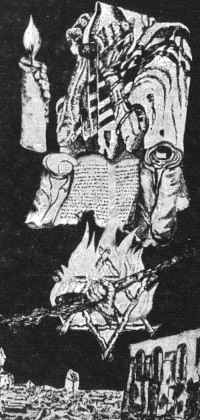
| Remember the Holocaust of Israel | ||
|
|
Listen, Man of Israel, To the voice that calls to you from the depths: Do not remain silent, do not remain silent. |
|
Author - M. Gebirtig
[Hebrew] Translator - Z. Brameir
[English translation courtesy of the Yiddish Book Center]
| It's burning! Brothers, it's burning! Oh, our poor town, alas, is burning! Angry winds with rage are tearing, smashing, blowing higher still the wild flames— all around now burns!
And you stand there looking on with folded arms,
It's burning! Brothers, it's burning!
And you stand there looking on with folded arms,
And you stand there looking on with folded arms,
Don't stand there, brothers, with folded arms! |
by Yitzchak Katzenelson
Translated by Pamela Russ
|
- How can I sing – if my world is so empty? How can I play with broken hands? Where are my dead ones? I am looking for my dead ones, God, in all the trash, In every pile of ashes. Oh, tell me where you are?
Scream out of each grain of sand, from under each rock,
Scream out from the animal organs in the forest, from the fish in the river –
Oh, show me, my people, appear to me, put out your hands
Come, all of you from Treblinka, from Sobibor, from Auschwitz,
Come, you drowned ones, ground up ones, rubbed out, come, spread out
I am that man, I am that man, that watched |
[Page 170]
|
And now? You are wagons, freight trucks, you watch, As silent witness of such a burden, and from such pain, and from that, such distress! You watched this, you quiet ones, you are locked up. Oy wagons, where are You riding, you have this nation, this Jewish nation, and are taking them to their death?
The first to be killed were the children, lost orphans, that means
They were the first ones to be taken to their death, the first on the wagons,
When the sun will rise over a small town in Lithuania
No Jew will ever impress the fairs even at a distance, give no more life to them,
And a Jewish coat will no longer flutter across the markets with sacks
And Jewish children, they will not wake up from their sleep, from dreams |
[Page 171]
|
They are no longer here! Oh, do not ask from across the ocean, not in Krasilovka, Not in Yehupitz… let it go gently… Do not look for anyone, not the Menachem Mendels, the Tuvia dairymen, the Shlomo Hanagids, the Motke Ganves, do not search! They will, as the prophets such as Yeshaya, Yermiyahu, Yechezkel, as Hoshea, Amos, from the eternal Tanach, Cry out from Bialik, speak to you from Sholom Aleichem, And from Sholom Asch's book.
The voice of the Torah will no longer be heard from the yeshivos, |
by Aharon Waldman
Translated by Pamela Russ
|
Forward:
Town: Nowokrajow; region: Rovno
November 4, 1942Today, exactly three weeks ago, I was saved innumerable times from death, since the Hitler onslaught began by us. Therefore, today, I am starting to transcribe these memories of those dark days. I, Aharon Waldman, the son of Beryl and Sarah- Tzivia, a Jew from Ostroh, where I lived all my life, since 1910, the year of my birth, on Walowa Street 8. I will give special details in order to know that all this is a real description; that it is a Jew who is writing this, someone who experienced all of this in all aspects and details. A Jew who, I don't know for yet how long, is still alive, among the few survivors of the Jewish town of Ostroh, which until the tragedy, boasted more than 9,000 Jewish inhabitants and a beautiful Jewish life.
I am writing these memories not for myself, not that I should be able to gain something from them, nor that I become renowned. No! I am writing this so that it should remain as a document of those dark days, written by a simple Jew, who is not pretending to be literary person, or a journalist, a chronicler, or a historian.
Aharon Waldman
|
||||||
[Page 173]
I wish, that if fate would want, and if these lines will one day see the glow of a beautiful tomorrow, we should be able to use them and take out only the best. I am sure that my writing will be deficient in its form, content, or in general, in its craftsmanship. That is why it is as raw as possible, describing just what people lived through.
I want to explain for one moment, that the greatest joy for me will be that if my memories will one day be presented by someone, they should be just as I am writing them now, without any change, or edits, because only if they will be the most basic, will they accomplish their goal. These words will touch the Jewish heart, which will accept them all, learn from them, and teach a life lesson to future generations, in order to avoid such dark times.
Primarily, Jews must always believe in their history, Jewish experiences, and Jewish past, because our greatest tragedy was that we did not believe our own brothers, Jews from Germany, when they tried to warn us against the Germans. And we Jews from the Ukraine just shrugged it off with our hand waves, with the Jewish “really, now…” I am writing all this so that Jews should finally begin to believe this and maybe, for future generations, this will prevent such terrible catastrophes. And maybe, those who read these lines, will believe and learn from this. This will be the greatest joy for me, and my greatest thanks for my superhuman suffering which I feel when I recall, once again in my thoughts, the gruesome scenes that I am retelling from my memories.
I am writing these lines not only with heart and nerves, but actually with the meat of my brain. It will not be difficult to imagine my situation as I am writing, as I will say that I am writing these lines in a barn filled with hay, and any smallest movement can cost me my life. I pray deeply to God, that He should allow me to live long enough that I keep writing and bring to life those days. My wish certainly would be that I could sit with skilled ones and work through my memories.
I will write about memories in small pictures or skits, because, unfortunately, I am not in the mode of creating complete pieces. If I would live long enough to publish these, then maybe I would create something bigger. I am giving attention to the fact that I am responsible for dates and numbers, because it is very difficult for me to remember everything exactly, but I will not make any great errors, because everything is still clear and fresh in my mind. I would just like to explain one more thing, that the details that I will describe were experienced not only by Ostroh Jews, but also by Jews from other Ukrainian cities, with dates being the only difference.
Because of the fact that Ostroh was the last of the cities on the list to be destroyed, there were many refugees here from other cities with whom I had the opportunity to speak, and I realized that the tragedies and experiences were the same everywhere. I have certainly said more in the foreword than should be said, and that is so that the circumstances with which I wrote my memories would become known.
The Beginning
June 22, 1941, was when the German-Soviet war broke out. We in no way expected this to move to Ostroh, and that in a few days this enemy would take to destroy the defense line, a few hundred kilometers from Ostroh.
[Page 174]
The fight for the city was terrible. The least one can say is that the Germans, from June 22 until June 26, tore through the main lines, and broke through the front for hundreds of kilometers, when the fight for Ostroh lasted six days. Why the fight was so difficult, there are various reasons and theories.
During the entire six days, the city lived through attacks from both sides. Almost every hour there was an air attack, both by the Soviets and by the German air force. Each time, there was a horrific outbreak of fire from exploding bombs, that destroyed cellars with tens of shot victims who had been hiding there. And that is how it was, without stopping. You could not know who was the conqueror and who was the conquered. In the final days, the Soviets conducted a major attack. The Soviet tanks were already in the city, and people thought that help was on its way. But then, a fresh German power pushed away the Soviet attack. The Germans threw down the front across the dividing line, and then finally took over the city.
On Wednesday, the second of July, people began to appear and quickly run through the streets – some after water, some after bread. The picture of the city was total disaster: smokey fires, ruins, and dead. The next day, there was a notice that there was a temporary city council that was quickly set up in a familiar style, saying that Jews should put a white band with a blue Star of David [Magen David] on the sleeve of their right arm. All the people could go outside in the streets until nine at night, and Jews only until seven. With this notice, the Hitler ruling began, with the allegiance of the Ukrainians, across the city of Ostroh.
In the first few days, the order for forced labor was put out, that all Jews, men and women alike, ages 16 to 60, were ordered to go to work. For not going, they would be punished according to the war laws. Making sure that all Jews should go to work, the Ukrainian military was quickly set up. They were comprised of well-known pogrom activists, who could not be satisfied with any amount of Jewish blood.
And what type of work was it? First, they had to clean the city from corpses. Yes, everything was called a corpse. Those who hadn't seen such corpses had no idea what war actually is. Charred, burned in horrific positions, the worst that you could imagine, already without any resemblance to anything human. On one level, this type of work included dragging corpses of soldiers out of charred tanks when everything was entangled, heads and bodies, body parts and pieces of ammunition, and so on. The second type of work was to wash the military autos. Washing is washing, but mocking this, to a level of this picture, there was an older greying Jew, with a long, black frock, who was lying on the ground, so unfortunately he was washing a military auto. The German chauffeur handed him a brush to scrub the auto, and he, the unfortunate one, had no idea how to get onto the top of the auto. Then, another German approached and showed the chauffeur how to deal with the Jews. He began to beat the grey-haired Jew mercilessly, and when the victim dropped to the ground in a faint, he took the pump from the auto and sprayed the Jew with water, and when the Jew revived, he beat him again, and on and on. It was terrible to watch how they took revenge
[Page 175]
on the Jewish women who went to wash and scrub the floors for the incoming officials. Who is able to describe all these terrible scenes that the Jews experienced while working. But all this only pales in comparison to what the Jews suffered later, when life became “normal”…
The First Great Tragedy, Popularly Called “The First Monday”
… And that is how the Ostroh Jews began a life of slavery. It was all day at the accursed forced labor, surviving until the nighttime, then secretly gathering together to support each other, hoping that God would help and bring the salvation. And in these moods, the Jews spent three weeks, until, until…it was 11 days in the month of Av, 1941 [August 4], and the Jewish year I do not remember [5701]. Tisha b'Av [the fast day on the 9th of the month of Av] fell on a Shabbath, so the fast was on Sunday [there is no fasting on Shabbath]. Reciting the Kinnos [special prayers for Tisha b'Av mourning the destruction of the Temples] and fasting that year were both very appropriately characteristic. Every Jew, religious and not, went into such an ecstasy, as never before. It was at that time that Jews first thought deeply about “Eicha yashva…” [“How the city (of Jerusalem) sits alone” [opening words of Book of Lamentations, recited on Tisha b'Av], and what that means, when a nation loses its own land, a crowned city … In that atmosphere and with these moods the entire day of that Sunday passed. There was enough time to think because they did not work on Sunday. With those thoughts, everyone fell onto their pillow and sobbed with a broken heart.
The following day, at about 4 AM, they heard a shooting from all types of weapons. People left their beds and went to look through the cracks in the walls. They saw SS soldiers in their colored snaky uniforms running across the city, some on foot, and some on motorcycles or in cars, all fully armed. The first thought was that they were once again setting up a front and the Germans were backing off. But it did not take long to find out what was going on. The soldiers tore into the Jewish homes and chased out young and old, small and big, no one allowed to get dressed, and they were just yelling “Los! Los!” [“Move!”]
Miserable, half-asleep Jews began to fill up the streets. Children's cries were heard, moaning from the elderly and sick who were forcefully dragged from their homes. Anywhere and everywhere, bloody and wounded Jews were being dragged everywhere, even those with grey-white beards, whose colors were already reddened with their own blood. The wildest imagination could never even imagine how to create such horrific masks as the appearance of those uprooted Jews. Just as the wild SS men saw even one Jew with a beard and peyos [sidelocks], they threw themselves onto him as wild animals with a roar: “One typical Jew” …. It was horrible to watch as they threw the sick ones out of the Jewish hospital, and those out of the home for the elderly. Those elderly who could not walk were severely beaten. At these scenes and similar ones, the gruesome train was forming. Everything was set up in rows on the sidewalks in order not to “disturb” the “Aryan” drivers. Groups of Ukrainians began to form as they watched the Jewish rage show. Some watched with commiseration, others with spite and laughter. The spectators were soon rewarded with Jewish possessions, clothing, and money which they freely stole. And that is how the train moved…
When one streetcar went into the center of the city, very soon another mass of unfortunate Jews arrived, and everything was locked into a train
[Page 176]
of Jewish pain and suffering. The entire tragic Ostroh moved in the direction of a new city, where everything was accompanied by beatings and mockery. The murderers took pleasure to throw regular sickly Jewish women off the bridges and into the water, and in front of everyone's eyes, these victims drowned.
At the edge of the city, there was a line of young, wild Ukrainians who beat the Jews mercilessly. When the train arrived to the forest, the majority of the Jews were all bloodied. At the forest, the train took on SS men, who photographed and counted the unfortunate ones, and the head of the group just stood there and enjoyed the scene of robbing lives. There were also soldiers standing there, who were “sorting” the people, separating men from women, women with children were also separate, and the elderly and those unable to work were also separated as a group into another position. All these groups created one square shape, and that is how geometrically the “platz” [place] appeared.
When they arrived at the site, the days were already longer. No one had hats, people had to stand on their feet, and the sun burned brutally. From afar they saw a camp of 150 Ukrainians, townspeople, with shovels in their hands. They stood and waited… At the same time, they were sitting in the city with the field command group: the head of SS, the field commandant, and the city administration, and they hired us and worked out a plan on how to carry out the slaughter, the numbers involved, and in what form this would work.
Here, in the site, it was also very sad. After separating out the workers, according to their professions, they took the rabbis out of the city, among whom was the gray-haired old Trisker Rebbe, of blessed memory, with his son and another ten men, into the middle of the platz, and they began to take revenge on them. One of the SS men, who spoke Polish, called out to the elderly Trisker Rebbe: “Well, well, high priest. Bless your nation, because there is a great danger coming.” The Rebbe did not answer at all, but stood calmly as if nothing was going on, as if they were not referring to him. Then an SS man said to him, “So, old man, sing and dance!” Then the Rebbe began to sing, first quietly, then louder and louder, and he sang a precious Chassidic melody, with enthusiasm and zeal, and indeed with a little dance. Whoever did not see the expression of his eyes, did not really see any godliness. And that is how the old Trisker Rebbe danced and sang until the end. The crowd of Jews stood still and did not know what would be the end of that bloody game, when the head of the SS arrived “with the field commandant.” They conducted an inspection across the rows, asked about what sort of workers were standing there, then took a quick look at the sick and weak in the group. When the head of the SS saw that the group of sick people was too small, he came up with an idea: He went around the workers and said that if someone was sick he should come out of the lineup. Jews allowed themselves to be snatched up on the fishing rod of the murderer, and some came out of the rows, and then the head murderer called out to the field commandant: “And you want to build Ostroh with these lazy Jews?” And he demanded that a separate group be put together for these sick ones. One of the SS soldiers called out in Polish: “This is the group headed for death!”
When the unfortunate Jews heard this, they wanted to flee from the “sick” group, but it was already too late. There was no possible way to get back. After the sick were separated,
[Page 177]
an order was given: Mothers and children were ordered to be sent back to the city. The separation from husbands and fathers is impossible to describe because one rumor circulated, and that was that all the men would be killed. The women and children were set out in rows and the entire train was taken back into the city. Exactly where these unfortunate ones were to be taken was not known to anyone.
The terrible experiences already became indifferent for everyone, but when they got closer to the city, the field gendarmes, who accompanied the train, said to the people: “Don't be afraid, we are taking you home.” And that is how it was. When they let the people go, each person thought: “And what will be with those people who were left in the “platz”?
But it was already too late, because by that same time, the bloody and horrible mass execution of thousands of unfortunate elderly, sick, and weak Jews was carried out on the site!
At 7 o'clock in the evening, on 11 Av 5701, August 4, 1941, the cruel and bloody execution of 3,000 Ostroh Jews began on the site near the forest. After the able-bodied men and women were taken out of the city, an order was given to the several prepared gravediggers, and they dug the first mass grave of 100 meters in length, 2 in depth, and 2 in width, and the bloody orgy began.
Who can describe the scenes that took place among the victims when they saw what was going to be done to them. As soon as the mass grave was completely dug out, they began to attack the victims. Woe to those who experienced horrific scenes which they saw and heard. First, they took care of the men. SS soldiers went out with sticks twisted across their handles, and they used these sticks to attack the throats, and then continued with this until reaching the grave.
Every group of twenty men was dragged to the grave, stood there, right at the very edge of the ditch, with soldiers all around, some with machine guns and some with automatic guns. They shot the victims so perfectly, that they fell directly into the grave. They quickly completed the task with the twenty victims, some dead and some wounded, and very quickly the ones who would do the burying rushed over, peasants with shovels, and some even wounded, but all from above [over the gravesite]. Then they took another twenty, and when the next slaughter was complete, they layered the dead over the bodies already in the grave, and so it went without stopping.
At the same time, the assistants, the Ukrainian militia, did not stand idly by. They walked among the groups of the doomed and took terrible vengeance upon them. They tore off their clothes, took someone's money, someone's jewelry, dragged out soon-to-be victims, who wanted to hide, even for a while, behind another person's back, so as not to see the disaster and the suffering that awaited them. But the Ukrainian hangmen intentionally dragged out those ones and sent these as first ones to the grave. They did not even allow men and women, parents and children, etc., to say goodbye forever. When the first pit was full, a second one was dug out, parallel to the first one, and the slaughter went on and on…
Who can give over, even a small detail of what happened then and there. A mother pleaded with the murderers that she be the one to take her own 20-year-old son to the gravesite, because he was just recovering from pneumonia and could not go on his own,
[Page 178]
so she asked that they not torture and drag him. And it was the mother herself who took him, and the murderers killed him, and the mother was sitting not far from the ditch and watching all of this, and then waited for her own turn.
On the other side, you could see how women, who saw that their husbands were already being taken, stood up themselves, went over to the murderers, and pleaded that they be allowed to die, and the murderers were only in individual cases so “gracious” and permitted this…
You saw how man and wife were being dragged under their arms to the grave to be murdered there. My own mother, whom they wanted to send home together with those who were able to work, because she still looked very young, and when she saw how my father was being led to the grave, she took my father under her arm and they died together.
In such hellish scenes, the executions continued until late in the evening. At 9 o'clock, when there were still 500 women and 100 men left in the camp, the head of the SS arrived and gave an order to kill the men and send the women home.
Among the women there were those who were already naked and lying in the grave and were just waiting for “the shot.” They were also pulled out of the grave… The joy of those “blessed” ones is hard to convey, because it was animal joy and human pleasure. And when these “blessed” ones came from the site to the city, they first found out what had been done to those who had remained in that place, and what a horrific disaster had happened.
A terrible night fell. From all the Jewish houses that were robbed, a cry and a wail were heard, orphans and widows cried, relatives and friends, everyone cried for the 3,000 martyrs.
That same night, Ukrainian militiamen walked around, knocked with their clubs on the darkened Jewish doors and shouted that people were not allowed to cry. Yes, they didn't even allow for crying, even when a horrific pain burned in the hearts of the Jews, when their entire existence burned with helpless rage. On the second day, they were even afraid to speak out loud, because they did not know what could happen if they did.
At dawn, I was at the “place.” …
It was a “place” where there were strewn discarded single shoes, taleisim [plural of “tallis”] with tefillin, documents from close people, a mantel from a Torah scroll… and a little further on, there were three large terrible graves, three graves with something buried there and slightly covered from above with yellow sand, from which there were gobs of women's hair protruding, human-shaped hands, and from the sides of the graves were streams flowing with the warm blood of innocent, Jewish martyrs.
Over 3,000 Jews from Ostroh lay in the graves. These were the nicest and best of the city: rabbis, teachers, intellectuals, and then mostly older people. With these three graves, only the first chapter of the destruction of a Jewish settlement was complete.
Slaughter Money
Nowokrajew,
Tuesday, November 1942.
None other than the devil himself conjured up such a “surprise” for the Ostroh Jews, that exactly two days before the bloody Monday, the order was given that within the next three days, all the Jews had to turn in all their gold, silver, jewels, foreign valuables, etc., to the Wehrmacht [German armed forces].
[Page 179]
Oh! You horrible, vengeful Jewish fate. Right on the morning after the slaughter, when eyes were still swollen from crying and sobbing, at the time when a sanitary commission was standing at the fresh graves and covering the graves of the martyrs with sand and lime, because the innocent blood was seeping right through the ground, at that very same time the remaining Jews had to bring in “slaughter money” for having killed their best and most beautiful, most holy and dearest, children and parents!
Who is in any position to convey what a bloodied Jewish heart felt then, watching how two rows of Jews, mostly women (because men had to be at work) standing there with baskets and with handbags, ready to bring in their possessions, their family treasures, and slaughter money for yesterday's tragedy, when only yesterday women became widows and children orphaned!
At the sides of the rows stood yesterday's hangmen, the SS men, making order, so that people should not push each other, heaven forbid. This was all on the main street for the field commander. Non-Jews were passing by, they stopped for a while and looked… and looked… It's hard to say what the Christians thought about us then. It is difficult to crystallize even thoughts of that time about ourselves, of those who stood in the rows.
Wouldn't it have been much nicer and braver if every Jewish woman had kept a piece of arms in her purse and would have thrown herself to reckon with the murderers for yesterday's innocent spilled blood? Had any of them thought that the commission had spent even a portion of the earnings, which they were now carrying as slaughter money, for the building of our national home, then certainly there would have been on the site yesterday at least a thousand victims less…
Meanwhile, the rows of women moved closer and closer to the entrance, and they were giving up not only valuable things, but family treasures of entire generations, beloved, heartfelt specific Jewish gifts! True, Ostroh was not a rich Jewish city, Ostroh was a fallen wealthy, queen, and that's why you didn't see any modern jewelry or ornaments, but everything was from generations ago, all characteristic Jewish things.
When the things came to the “purchaser” (Dr. Ber, SS leader, Doctor of Philosophy, later regional commissioner of Rovno, who, on his own conscience, had more than 20,000 Rovno Jews killed), he as the chief, along with four other racists of the blonder race, from the beasts with their bloody fingers, felt every object with their bloody fingers and as knowledgeable ones and cultural connoisseurs, they marked up and estimated from which century each item originated…
Ah! Woe to the eyes who watched the women rush to the table, and each one took out from a small purse or from a handkerchief, her jewelry, her candelabrum, obviously an inheritance from a great-grandmother, who used to light the candles and cry at the same time into the fire with her Jewish heart. This very candelabrum brought her grandson slaughter money! There stood many kiddush cups, beautifully engraved, of which how many simchas [happy events] and kiddush recitations they could relate, and here they were being thrown so brutally into the boxes… Here the murderers were reflecting themselves in a Jewish wedding chain, maybe three meters long, while laughing so cynically…
Ah! The dear Jewish golden chain! If you could talk, what would you tell the robbers? It would be enough if you had told them about the wedding, when they gave that to you as a gift
[Page 180]
that went back for generations, then maybe the murderers wouldn't have laughed so hard, and maybe they would have understood that this very chain was able to relate about many, many Jewish experiences, some of suffering and some of joy, and still, Jews remained a nation even after all the calamities and after all the slaughters!
A silver spice bag [used during havdalah, the prayer ending Shabbath] was lying on the table, so ashamed and so lonely. The murderers looked at it wildly and did not know what it was, maybe like a piece of Jewish weaponry. Also, this “small weapon” would relate stories of dear Jewish Shabbath evenings, of holy feasts after Shabbath, when they would relate stories of the holy Baal Shem Tov, good Jews and just simple thoughts of the Torah, certainly more beautiful and cultural than the creation of a foolish, bloody “race theory” that would destroy humanity…
From a distance, there was a silver Passover seder plate with the writings of the entire seder. How many tens of sederim did this seder plate experience, during which time the story of the Exodus from Egypt was told, and it seemed that even now, when the seder plate was lying so humbly in a corner of the chest, it shouted out: “Jews, don't be depressed! The Jewish nation lives on! You will also overcome the bloody horrors! How many rulers there have already been over many centuries who were erased from the world, but Jews were and will always be!”…
That was how, it seems, every fine Jewish person expressed this, and then it came first from the shuls, the Beis Midrash, and smaller places of Torah study. The most expensive and holiest shul's silver also had to be brought to the horrific murder scenes of the Ostroh rabbis, dayanim [religious judges], Hebrew teachers, ritual slaughterers, and just thousands of ordinary, religious Jews.
Everyone saw how the hangmen literally gaped when they saw the “crowns” of the Torah scrolls of the old Ostroh grand synagogue, which were more than 500 years old. They shone with their predatory eyes and did not know what these were… They valued everything as antiques, and it seemed that even their stoney hearts were touched by these items too, when they threw the crowns into the boxes and each crown rang with the many humble, small, golden bells, as if they would have said that these crowns were carrying Jewish angels.
With such a crown, the head of the Jewish King David was adorned. He was the one who was sent to kill Goliath, and it was as if the “crown” would have said: “Don't be proud, foolish thieves, with your temporary victory over my innocent nation, there will come a time when the Jewish people will once again give the world and the whole of humanity great spiritual treasures, and everyone will well remember the unworthy name of you accursed people whose goal it was to destroy the eternally living nation of Israel!”
These fools were now holding the eitz chaims [wooden rollers that hold the sefer Torah], looking in wonder. They could imagine that when the silver was given in a holy place and people used to use it, the Jewish joy was so great, that the excitement of the thieves when they murdered the Jews was absurd.
And like that, all sorts of Jewish and religious objects moved in rows without end. Six large boxes were filled with precious Jewish sacred objects. The boxes were specially ordered for this purpose. They were filled with our precious belongings (except for what the businessmen took for themselves). A very large truck drove in, onto which the six boxes with Jewish and religious objects were loaded… while on the “site,” three large, silent graves of our Ostroh martyrs remained!
That is how we paid our slaughter money!
[Page 181]
Later, we found out that proportionally, Ostroh brought in more than any other city.
The Second “Silent” Slaughter, called “The Second Monday”
Nowokrajew Town, November 18, 1942.
After the Jews had paid for the first pogrom, then early every morning, they had to line up before the field commander, according to their jobs, and the master and ruler of life and death, would count the “heads” of the slaves and then assign them to the hard labor. In those days, people with weak character wanted to be reconciled and console themselves over the past days, as for example, saying that it was a mistake that Ostroh was taken for a Soviet city and that was why there was such a bloodbath going on with the Jews.
Now, in those days, exactly on the thirtieth day after the first massacre, the second silent “massacre” unexpectedly came. Although the Christians, who used to come into contact with soldiers from the field commander, used to murmur among themselves and warn the Jews that there would still be a second Monday, the Jews of Ostroh didn't care about it at all and paid no attention to this.
The first of September, 1941, was a muddy, autumnal Monday. It was six in the morning, when the Jews were already ready to leave to work as they did every day, when they saw soldiers from the S.A. (Sonderabteilung; Special Units) in rubber raincoats with steel helmets walking around the streets quietly. Only, the Ukrainian military was entering the Jewish homes, and sending out all the Jews, except for women and children, to work in the sawmill. Everything went on quietly, without shouting, without shooting or beating. The Jews were not led by someone, but were told to go alone to the sawmill… Soldiers of the S.A. were patrolling the streets, the Jews were already mentally and physically so downtrodden that when they were told to go, they went…
No one even tried to think about what it meant to have a whole city of people go to work at the sawmill! What can so many people do there? So, not thinking, everyone went to the sawmill Only in the later hours did the people realize that something was not so right. The Jews tried to hide and not go along with the others, but then they started shooting, but only into the air. There were no victims.
When they came to the site, they saw that they were not at the sawmill at all, but in a nearby place of a tannery that belonged to the Leibel family. This was a rectangular plot of land, surrounded by a high fence and densely filled with militia, who watched that none of the Jews would escape. They could soon see that not all the Jews were there, but only 3000 Jews, men and women and youths, aged 15 to 20. They were hiding somewhere, because they were not strictly being searched for.
When the crowd of Jews was already gathered on the site, and no one else came, the chief of the S.A. announced that everyone would be sent to work for ten days. The Jews took this to be good news, so at least they would not be killed… One of the Jews called out that they did not bring any food with them, then a soldier called out: “Don't worry, you will get the food there just such as you have never had in your entire life!”
[Page 182]
These words from the soldier became very striking, but sadly, it was already too late because unfortunately they were already in Fyholivka and there was no turning back.
On the site, a ceremony of sorting into larger groups and smaller groups began. These were according to profession and age, married and single, according to how many children, etc. And when everything was already grouped, large black trucks began to enter the site, just like trucks used for burials.
They started packing up to thirty men into each car. Armed soldiers were already standing at the entrance and they did not let anyone get out of the cars. When someone wanted to say goodbye to family or dear ones, the soldiers said that this was just shift work “because everyone would meet at the nearest train station.”… When a convoy of cars left, it didn't take long, and then after forty minutes the cars returned with fresh people. And that is how it went without stopping…
In the city, the Christian directors realized what was happening, that all the Jewish workers and craftsmen from the factories and enterprises were taken, and then everything would remain unchanged, so they went to the city commandant and intervened, that they should leave behind at least the necessary professionals. The intervention worked, although it was already a bit too late, because most of the professional workers had already left. Still, a part of them who were still on the site, were freed and let into the city, and in this way, about 500 Jews were saved. After the lucky ones were sent back to the city, the transferring continued on the site.
The aktzia went very fast so that at two 2 p.m. when the head of the S.A. did the calculation about how many cars had been sent, and then he saw that the required number was there, he told the rest to go home. Those who stayed behind were mainly women and elderly men. About 300 Jews did go home.
When they arrived in the city, they only then considered what kind of new disaster had just happened. It was only then they realized how the murderers had skillfully prepared the “silent massacre,” meaning that the Jews had quietly, without noise and without fear, delivered the people directly into the murderers' own hands. This bloody game was carried out by no more than about twenty-five soldiers of the S.A., with the collaborative help of the municipal militia…
On the second day, the Jews began to follow the tracks of the cars, and questioned the farmers of the surrounding villages, that maybe any of them saw where the Jews were being led? But not all of them wanted to tell the truth, and none of them actually knew the details, but farmers who lived not far from the forest, near the village of Nitishyn [Niecieszyn] twelve kilometers from Ostroh, said that all day they heard shooting in the forest…
Then they sent special messengers who were older peasants, to whom they could obviously have a little trust, who came and told, swearing by their lives and Christian faith, that in the middle of the forest there were two large ditches, where you could see traces of recently murdered victims. How many people were buried there, truthfully, could not be recognized. It cost a fortune to find out something, but it was all for nothing. In this way, Hitler's thieves carried out the second “silent massacre.”
It was a horrible disaster, which was not even mourned. Hushed, quietly, with cold, predatory calculation, for the second time, the Germans
[Page 183]
destroyed a third of the Jewish people in Ostroh. With this second slaughter, Ostroh lost the best and most beautiful youths and adults. A community of young children and women remained, and only 300 men who were capable of work. Just at the 30-day mark of the first slaughter, the second bloody destruction took place, the “silent slaughter.”
Kol Nidrei [prayer recited on Yom Kippur eve]
Thursday, November 1942.
The calendar did its job … Day after day moved forward in terrible suffering and pain, until the Days of Awe set in. One could write a whole piece about these “Days of Awe,” but who has the energy to do this now, when the wounds are still bleeding so freshly… and so, that is why I want to describe only this, the “Kol Nidrei.” As agreed, it was decided to keep Rosh Hashanah quietly, with each person at his own hard labor. Some prayed in the quiet of their own home, and got away with wishing someone “a good year!” The Aseres Yemei Teshuva [Ten Days of Repentance between Rosh Hashana and Yom Kippur] arrived, even though what the Jews actually had to repent for this year only one God in heaven knew. Then the eve of Yom Kippur approached…
Apart from the Jewish generally broken mood of suffering and pain, this Yom Kippur evening was generally felt with an overall depressed mood in the entire city. On that day, a review of the horses and roads of the whole region was decided to be undertaken. Just then, when the city was full of farmers from the surrounding villages, and the noise of horses and wagons was boundless, German airplanes suddenly flew over the city nervously and circled.
Soon a loud explosion was heard. The mood became more tense and full of fear. The farmers started running from the city and there was a panic. When the authorities were questioned, they answered evasively, saying that it was nothing, they were attacking Soviet concrete fortifications. The city did not accept this answer with any extra trust, and everyone interpreted this as they liked. And it really turned out later that Soviet paratroopers were carrying out their sabotage work not far from Ostroh.
In this very mood, the eve of Yom Kippur arrived. Regardless of this, a representative of the Judenrat, H. Zafran, went to the local commandant and asked that the Jews be released from work the next day. The local commandant did not answer this clearly, and said: “Do as you wish!”
The Jews heard the answer, and everyone was amazed. May it not change, but their fate had already been sealed, that whatever they would do, everything was already a closed, fateful decision. But regardless of everything, when evening came, no one could figure it out for himself. That he would recite the Kol Nidrei in the house without a minyan. Anything can be anything, but a Kol Nidrei would always be a Kol Nidrei.
There were many Jews who agreed to allow a minyan to be organized in their homes to appropriately recite the Kol Nidrei. And how much great sacrifice in those days it took to organize a minyan can only be imagined.
I also went to such a minyan for Kol Nidrei. The minyan was in a small house, hidden in a back alley, in the middle of a labyrinth of destroyed war ruins. In a small room, the windows and doors were boarded up and blocked,
[Page 184]
and the rest of the cracks were stuffed with bed linen. So, three minyanim of Jews secretly sneaked in, and some women from the houses nearby. A guard went around outside, watching everything from all angles, so that no one would get killed.
Just as it was getting dark, people lit candles, men put on their taleisim [prayer shawls], the cantor put on his kittel [white robe], and they started to recite the Kol Nidrei prayer. When the cantor began with the Yamim Noraim phrase “Al Daas Hamakom, ve'al daas Hakahal” [“by the authority of the Creator and the authority of the congregation”], the women could not contain themselves and started to cry, but soon they were sharply interrupted: “Quiet! We think we hear people walking around!” …
As they calmed down somewhat, they forgot about the danger that was lurking outside, and as they were praying they gradually entered into a mystical, religious ecstasy and they began to accompany the cantor stronger and more loudly. With so much sincere faith and depth… But from time to time the prayer was interrupted by warnings from the guard outside. And that is how it went until, with God's help, the people completed the Kol Nidrei prayer. Is there anyone out there able to describe how we felt after this Kol Nidrei?
And let the nations of the world think what they want about us, but they will admit that no nation in the world would have gone to offer prayers to their God, when only a few hours ago they saw what was done to their rabbis, Hebrew masters, and holy items! But we Jews were not even broken by this! And perhaps this is our secret and foundation for which we exist. Because the Jewish people's existence is likened to the body of a worm, which, when one side is destroyed, the second side lives on. Regardless of that, that within a few days, only a third of the Ostroh Jewish community remained. Yet, their faith did not break, as the Jews showed with their deep recitation of the holy Kol Nidrei prayer.
Translated by Pamela Russ
Thursday, November 19, 1942
When life after the first two slaughters somehow returned to “normal,” the Judenrat was created by the power of the government.
I will describe only the last Judenrat, because the existence of the earlier ones was so short due to the slaughters, so there is little to say about them.
The Judenrat was the Jewish address for all the ruling powers, for all kinds of matters. The authorities, German and municipal Ukrainians, did not want to have anything to do with Jewish individuals, but with things that couldn't be worked out they immediately went to the Judenrat. The Judenrat was the particular branch office for the authorities, as they took care of all the issues that were put forth for the Jews. And the Jews had to give over everything, from a tin of shoe polish to a lambskin coat. And the Judenrat was held responsible for the smallest thing. If a Jewish shoemaker or tailor did not produce that which was ordered from him, the Judenrat was held responsible, as a “hostage.” Now, the contributions and fixed head tax that the Jews had to pay, was paid by the Judenrat.
When the Jews' suffering was already huge, the suffering for the Judenrat members
[Page 185]
was even greater. When every Jew came away with what he himself had paid as his tax or that he gave away his belongings, only the Judenrat members had to carry it all and stand face-to-face with the murderers…
At the time, when it was “calm,” and every Jew thought about something for himself, then the members of the Judenrat held meetings and thought about how and where to collect all the new demanded items. At this time, when there was a panic in the city, and this was very often, when everyone grabbed his loved ones and ran anywhere just to hide, the Judenrat members ran around to the “authoritative influencers” to inquire about details, and when they found out something, they soon let the Jews know.
Every trip to the regional town of Zdolbuniv was associated with much self-sacrifice. Who could know what a trip outside the city meant, even when you had a special permit? The roads were full of Germans and Ukrainian military, and if they saw a Jew they were frighteningly vicious with him.
And how much the Jews had to adjust their lives as they had to provide non-kosher [illegal] things, such as gold, furs, and so on, as orders from the authority figures, who upon receiving these things, were willing to relate what was going on with the rest of the Ostroh Jews.
Today, how many times did they put their lives at stake because of the jealousy of one “great person” to the other, because he thought that he was receiving less of a “bribe” than the other person. And for these sins, the guilty one was always the Judenrat. And the Judenrat members were the ones who had to deal with these situations from both the authorities and the Jews themselves…
Ostroh Ghetto
When the winter months of the ear 1941-1942 were over, along with the spring arrival, the news came that they were going to force everyone into in the ghetto. Regardless that everyone lived in fear all winter, because “good friends” used to come and say that very soon we would all be locked in the ghetto, and they did that so that they could fool the Jews and get more products.
What that meant, to be chased into the ghetto, every Jew understood. That meant, that Jewish homes would be surrounded and within ten minutes everyone had to be in the ghetto, and we were able to bring along with us in these ten minutes only what we could carry and hold. In just several minutes, we were left with nothing, and no food for the first few days.
Only after much pleading and paying with millions of bribes, the Judenrat managed to arrange that when the Ostroh Jews were forced into the ghetto, it would be done as best as it could. That at least we could have the minimal number of things to bring with us. And so, in the month of June 1942, the Ostroh Jews were given a real ghetto.
It was located in the worst quarter of the city, where there was suffering of war, fire, and destruction, and it was a great distance to the city market, so that Jews should, heaven forbid, not be able to smuggle in any food. The houses were calculated to be able to have ten people in one room. The entire area was enclosed by a barbed wire and from all sides. Warning signs were posted with words in the Ukrainian language:
“Anyone who leaves this area will be punished by death.”
“Special area.”
The Judenrat managed the complete resettlement of the Jews in the ghetto.
[Page 186]
And that is how the Ostroh Jews began to live their lives in the ghetto. It was the first time that they began to suffer with hunger because it was forbidden to bring in any food.
But worse than everything were the moral sufferings. A ghetto in a big city was a large city block surrounded by a very high stone fence. The ghetto people could not see what was happening in the outside world, and the outside world could not see what was happening in the ghetto. Because of that, in Ostroh, it was more than terrible, when through the fence you could see everything that was happening outside. The ghetto was divided into two parts and in the middle ran a highway with a main street, through which everyone drove and walked, and all of them had the chance to watch life in the ghetto.
Ah! How low and miserable you felt when you stood by the ghetto gate, surrounded and separated like animals, and looking out through the cracks onto the other side of the ghetto, watching life flow normally as if nothing was going on. How terrible people felt when they saw a familiar peasant from the village go by, that same peasant for whom it was an honor just days ago to have some words with him, and today he was just driving by and wouldn't even look at you, because you were the damned ghetto Jew and he was the “Aryan” of Hitler's quarter. These very experiences were worse than many other sufferings that people in the ghetto were experiencing.
Jewish Militia
Along with the Jewish autonomy in the form of a ghetto, the Jews were also rewarded with their own Jewish militia. Ostroh had five Jewish military people, even with a special uniform: black hat with a yellow rim, with an inscription in German: Jewish Orderliness Service, and then with a yellow band on the arm. The youth accustomed themselves comfortably to their situation, and whenever it was necessary, they were able to take care of things even for the most important people in the city. First, they made sure that the Jews would not transgress any laws, for example: not walk on the sidewalk, not leave the ghetto, not go to the market except during the designated times, made sure that those people who had the right papers would get to work at the right time, etc. And now, provide the provisions for the Jews, so that they would have the necessary things for the orders. And all this did not happen easily.
However, they often had to resort to violent means in order to snatch a closet, a bed, or the like from a Jewish woman, when, despite everything, the Jews did not want to part with their “possessions.”
Day and night, the militiamen used to run around and be busy, but there was no reason for anyone to be envious of their work. Today, they had to endure curses and insults, but this was still nothing compared to the moral suffering, when they had to bring Jews as “zalozhnikes” [hostages], who were supposed to be placed in the gendarmerie, and no one knew if they would ever return. As it was, they were “heroes,” as they were able to maintain a Jewish community of 3,000 people, in such a terrible time when there was order.
You had to admire them. When you saw a militiaman walking an old, blind 80-year-old Jewish man from the seniors home, as a “hostage,”
[Page 187]
the senior pleaded: “I want to be a sacrifice for the entire city, so that no one else should suffer.” And the one who was guarding him began to cry. Who can figure out what these “Jewish thieves” had to suffer with the Jews as well as from the Germans.
Avraham the Miracle Worker and His Booklet
The first two massacres with the 5,500 victims, when the general mood was so oppressed and depressed, when life was in constant panic, and awaiting death was more than gruesome, a psychological urge for something high and supernatural arose in the people. Everyone became not only religious, but super religious, and people wanted to violently tear down from heaven a miracle that would save them! And then the people began to search for a “prophet,” whoever that might be, as long as he would be able to say something and console with something!…
During those days, people discovered Avraham the shochet [ritual slaughterer] Fishel, the rabbi's son. Maybe it was against his own will, but what could he do. When a congregation of over 3,000 Jews came to him and demanded: “You must become our leader and bring a miracle!” And on his own, he began to float on the surface of his fresh, new occupation as miracle worker. That's how a circle of followers formed around him, who used to reveal all his teachings that indicated that the salvation would soon come. At every opportunity, he used to deliver very good sermons, from which people used to lick their fingers, because everything was interwoven with belief and hope.
One of the “main weapons” of Avraham the shochet was an old Kabbalah booklet, in which there were listed 60 different questions, such as, for example, will I remain alive? What does that other person think about me? Where is my relative? And so on. And according to a certain way, as the book indicated, one could find an answer to the questions. It was worthwhile to see that in the twentieth century, when towers were flying overhead, and when the enemy did not kill us with any “secret name of God” but with real modern automatic weapons and bullets, we Jews went to seek an answer and salvation in a small, ancient Kabbalah booklet …
Who is in any position to convey those scenes that unfolded when they went to “find” themselves. One could see long lines of Jews, old and young, men and women, with a holy and mystical fire in their eyes, as they waited impatiently to be able to enter and receive an answer from the “booklet.” And who was not among those waiting? Starting with those who were still of the remaining intellectuals, like doctors and pharmacists, until the Jewish cemetery of year 90. If the answer was a satisfactory one, the person left the house as happy person, filled with hope that he was already being helped. If the answer was not completely clear, the person was told to come back in about three days.
Today, there were hardly any good answers, so the person came out resigned and totally depressed. No explanation helped, no comforting, with nothing was being held against the booklet!
And people actually asked this book not only about private matters, but also about general Jewish questions. If there was a new ruler, people went right away to Avraham the shochet and they asked him to consult with the booklet, asking what this new evil person thought about the Jews. And if he would treat the Jews well.
[Page 188]
A great panic arose in the city. And if someone said that they were already digging graves for the Jews, then everyone quickly ran to inquire of the booklet, which answered and comforted everyone. That is how the Jews hoped for salvation, from a small Kabbala booklet, which responded to everything. But for the greatest tragedy, that was still to come, for that the booklet was silent…
The Complete End of the Jewish Ostroh
Friday, November 20, 1942
When the winter months of 1941-1942 passed, and the spring sun appeared, the Jews did not celebrate at all. Even though the winter was difficult because of the lack of food, clothing, and heat, the Jews calmed down a little after the disasters, not to mention the very frequent death threats and panics.
The snow and frost hardened everything. Ostroh was cut off from the surrounding world, and that calmed them down. The Jews hoped that maybe the winter would bring some good changes. Perhaps the enemy would be defeated!?… And when the winter passed with nothing and people came out of it only weakened, news soon came of fresh aktzias and liquidations.
In the month of May 1942, the “season” was opened in the town of Hoszow, 30 kilometers from Ostroh, where, for the first time, 1,200 Jews were killed. Ostroh was shaken up, and people soon left to the region of Zdolbuniv to ask how things were moving forward. There, they would answer only in certain terms, such as: “For this month we guarantee…” and always like that.
Later, news came that Rowno had also been slaughtered, and the same was for the Kremenitz region, then same for Lutzk, until Lutzk and Zdolbuniv remained as islands. To all our questions put to our “good friends,” the answer was that Ostroh was not targeted. Then by September, the Dubno region was also destroyed. Zdolbuniv was the only region remaining in the entire Volhyn and Ukraine.
The tragedy was terrible. There was nowhere to run because every place was “Judenrein.” And every day passed for the Jews like slippery lead on the souls of the Jews. People were already resigned to their end, and they prayed that it would happen quickly, because it was impossible to live in constant apprehension.
In the final days before the tragedy, bad omens appeared. The Jewish workers, who worked by loading potatoes at the Ozhenyn station, related that lately the militia was guarding them very closely. Until Monday, October 12, 1942, one of the added inspectors said to the workers: “Know that this week Ostroh will be destroyed.” And that very evening, the regional farmers came in their wagons, with the main gendarme commandant Komarowski, and the Ukrainian commandant Tkachenko.
The summoned the chairman of he Judenrat, Herr Komendant, and they discussed some “current Jewish questions.” They also gave fresh orders for obtaining furniture and ordered everything be read by October 15. They were all in a better mood and the landowner even joked a little bit, and said that he is happy with the Ostroh Jews because they were calm and not nervous.
The visit ended and the Jews became calm because everyone saw and heard that everything was “normal and in the best order.”
[Page 189]
And the crowd left calmly to go to sleep. No one even thought that the entire visit by the entourage was devilishly planned, that they calmed the Jews, and they did not know what was hanging over their tragic heads. The game worked perfectly for the murderers.
The following morning, when the Jews woke up early to go to work as usual, the first ones to go out were the Jewish women who would clean the streets. They immediately saw that the ghetto was surrounded by militiamen who would not allow anyone to leave. There was great panic. There was a major run, speed to hide, but the police stood quietly on the other side of the ghetto fence. It was then clear to everyone what had gone on so “nicely,” the visit and the sweet conversations. But now it was sadly too late to think of anything because everyone was now locked into the ghetto that was surrounded by police.
At eight o'clock, Komorowski went to the Judenrat and told the Herr Komendant that he had received an order that at 12 o'clock all the Jews must be present at the place behind the sawmill, and that everyone should bring food for two days, and if anyone was found hiding, he would be shot on the spot.
After him, the landowner came and asked for a list of all the Jewish workers. After leaving the Judenrat, the “guest” went to look at the “place.” The Jews, without any resistance, went on their own to the “place” of their own funerals. It was terrible to see how the tragic ones went to that “place,” fathers and mothers holding their children's hands as they guided them to their own demise. They went and cried bitterly at the “place.”
At the head of the terrible death train was the Judenrat and the Herr Komendant, and behind them was the Ostroh community of Jews. That is how “voluntarily” the group continued until noon. Some Jews returned to their homes for food, and they were not bothered, and some even went into hiding. But after 12, the Ukrainians took the Aktzia into their own hands. First, the militiamen, who were standing outside of the gate, went into the ghetto and began searching the houses. Whoever they found was shot immediately, or in the best case, that person was taken to the “place” and from there, was never let out. And those who tried to run away were shot immediately. These were the first victims of the bloody incision. This is how the first Tuesday and the first night went, as they waited for their death.
The following morning, everyone thought about and then asked how much longer they had to wait. They had to wait because the main murderers were busy wiping out the Jews in the other towns of the region. According to the plan, when they would be finished there, then these murderers would come to Ostroh, the last stop. They had assembled the Jews of Ostroh three days early because at that point they would hardly know what was going on in other cities and would not flee.
Yes! In the mid 20th century, when people would think about humanitarian feelings, how to make it easier to kill animals, and how to make it easier to kill the worst murderers and criminals; at the same time, they gathered 3,000 Jews, women and children, the old and the sick, for whom there was no secret that they were awaiting their horrific death, three days prior, and they were left to wait, in the worst pain, for their own death.
[Page 190]
For two days and two nights, the Ostroh Jews waited for their bitter end. On Wednesday, October 14, 1942, the murderers arrived. They went to the “place,” the landowner called the chief, Herr Komnedant, and told him that the Jews must hand over whatever goods and possessions that had been hidden away. That was such as suits, Polish leather for shoes, fine furniture, and so on. Then, the SS instructed that everyone write down whatever he was going to give over, and then go and bring it here. When the list was ready, then five of us Jews were escorted into the ghetto to go and retrieve all the things.
We went around all day collecting many things. When we were almost done by evening, the chief commandant went over to the landowner and said that we should be taken to the “place” to our own people, and then all the Jews remained there. The head of the SS ordered all of us to pack up the things, and we loaded up two trucks with the best and most beautiful things, not considering that the murderers had already robbed and tore up the Ukrainians on the spot. When everything was ready to leave, the headman winked at the landowner at our address and slyly said something, we understood that he was giving an order to kill us all right away in this place…!
The murderers took us to the wall of the large MaHarsha shul, and lined us up. We were four Jews: Avraham Komendant, Moshe Moss who was a quilter, Ziame Brandzulies, a road constructor, and me. (A gendarme had called away one of the five when we were just about to be killed.) We were told to turn around, with the face to the wall, and the leader of the team of executioners said: “One, two…” and before he even tried to say “three,” I tore myself away from the wall and ran.
After these events of the day, I was no longer in the “place.” Later, I found out that a Polish woman, who was talking to the engineer Kulyesza, had prepared and dug out the mass graves of the last liquidation of Ostroh Jews. They were in the forest of the new city. The execution took place on Thursday, 4 Cheshvan, 5703, October 14, 1942.
|
|
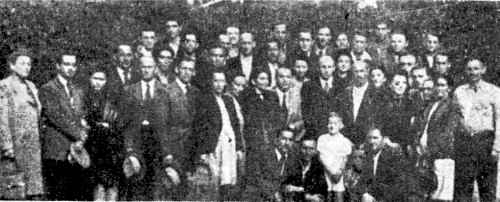
| Conference of survivors of Ostroh on the 4th Remembrance Day of the liquidation of the Ostroh Ghetto |
[Page 191]
|
|
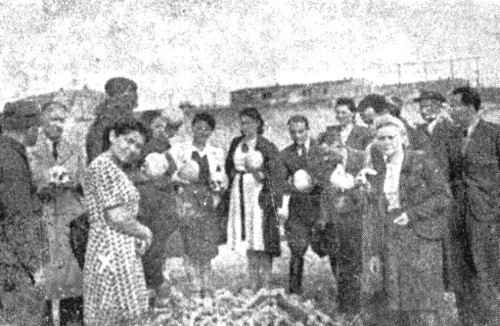
| Group of Holocaust survivors next to the chimneys of the crematorium in the Majdanek Death Camp. Among them are the survivors from Ostroh: Aharon Waldman and Zhenia Eisenberg. |
|
|
Left to right at the front: Zhenia Eisenberg and Aharon Waldman |
by Sima Klipatz
Translated by Pamela Russ
On Sunday, June 22, 1941, rumors were heard that the Germans had started a war against the Russians. These rumors caused a great panic among us, since we still remembered the beginning of the German-Polish war in September 1939. Then many refugees from western and central Poland came to us in Ostroh and they told us what the Germans were doing to the Jews.
On the streets of Ostroh, groups of Jews began to gather and everyone began to comment on the situation. Some said that the Red Army was strong and would quickly push the Germans back, others were more pessimistic and were terrified. And in reality, you could see the worried faces of the Russians who were in Ostroh. They took to pack up their things, preparing to flee from Ostroh.
The following day, Molotov's speech was already heard, as he spoke on the radio to the Russian people, saying that the Germans had succeeded in occupying a large area and that the Red Army was fighting hard against the German aggressors. His last words were that Hitler would have Napoleon's same downfall… but for the Jews this was a small consolation. We knew what could happen to the Jews if, God forbid, they would enter and occupy the city.
Meanwhile, there was great chaos in the city. The Ukrainians and the Poles were looking forward to the moment when the Germans would occupy Ostroh and would settle accounts with the Jews. Meanwhile, black elements of the underworld began to rob the Soviet stores and shops. Many peasants from the villages already arrived in the city with sacks ready to rob the Jewish possessions and goods. It didn't take long and we saw how the first motorized German military units entered Ostroh with a large parade. Lines of tanks and artillery were moving without end. We already understood that such a huge force would not be easily driven back. With great fear we waited for what the next day would bring us.
That's how the days and nights continued until the first aktzia in August 1941. The Germans herded all the Jews out of the city into the forest and ordered them to leave everything behind. Soon, on the spot, they made a selektzia [selection]: They took the old people and they left the young.
In about a month, on the second day after Tisha b'Av, the second aktzia took place. This time, in this aktzia, they took all the young ones. I managed to save myself during this aktzia, since I lived with a cousin who
[Page 193]
had a bicycle, and the Ukrainian militia had to have all the bicycles. So they said they should not take us, and that is how we remained until after the second aktzia.
We lived in a kvartal [enclosed quarter; city block bounded by four streets], where we were locked in. Every day, we were taken to do hard labor in the city, under guard. Every day, Germans would come to the Judenrat and would take workers for all kinds of jobs.
I worked as an official in the Judenrat. The chairman was Avraham Komedant. The situation for the Jews was very difficult. There were no more food supplies, and buying food items from the farmers was strictly forbidden. The Ukrainians were running wildly in town, as they humiliated the Jews and reassured the Jews that they would have a terrible end. We lived in great apprehension, not knowing what tomorrow would bring.
In October 1942, suddenly the ghetto was surrounded by German and Ukrainian militia. This foretold the liquidation of the Jews. On the night of the terrible aktzia, my husband was hiding at a good friend of his in a hideout, and that same night he came to me and said that we were going to a Polish family that we knew, Szczawinski, who lived behind the city and maybe we would be able to hide there. During this aktzia, my mother was killed.
We arrived at the Szczawinski family very distressed. Mrs. Szczawinski looked at us and received us very warmly. She reassured us that we were in safe hands and that she and her family would do everything to save us from death. Her comforting words calmed us down a bit.
The first thing to do was to dig out a bunker for us, where we would be able to stay for a longer time. That same night we all started to dig out a hiding place. After an intensive excavation, the ditch was finished. In the ditch that was now a shelter, a board of my length and my husband's height was put together for sleeping, so that when he lay down he kept his legs together and if he wanted to straighten his legs, he had to get up. As a result of long months of lying and not being able to move, he got a foot disease from which he suffers to this day.
The hideout was not big, and we suffered from a lack of air. The constant lying and not being able to move was very difficult for us. Food used to be brought to us only when our landlords would go and feed the animals. We did not know of any day or night. We could not go out of the hideout to get fresh air, because their servant, who was a Ukrainian woman, was connected with the Banderites [“Banderovtzei”; followers of Stepan Bandera, Ukrainian ultranationalist and Nazi collaborator], and she was not allowed to know that her bosses were hiding Jews. The servant also had small children from whom we had to watch out so they wouldn't notice us.
Every time, when we were secretly brought some food, we were strictly told to lie quietly, not to talk among ourselves, so that the servant with her children wouldn't notice us.
Once, the landlords told us that the Germans were searching all the houses. They were afraid that maybe the Germans would discover us, then the Germans would kill everyone.
[Page 194]
Their son, Tadek, took us secretly that night to a stable in the home of a non-Jewish stranger, and said we should stay there until we would be able to go back to them.
As we stayed in hiding, we always thought about what would happen to us in the end. Would we survive the difficult war time and live until the liberation? This hope that we would be freed whenever that would be, gave us courage and strength to survive the most difficult time of our lives. We knew that there were no more Jews in Ostroh, everything was burned, it was a complete destruction.
We could not want to believe that we were the last Jews of our beloved city.
During the 17 months that we hid with the Polish Szczawinsky family, we enjoyed a very good relationship with them. These were noble people, true followers of the “righteous among the nations,” who risked their lives to save us from destruction, and we will never forget them.
At the beginning of 1944, the landlords told us that the Germans were suffering great losses on the fronts and that the Red Army was advancing. It was not impossible that we would soon be freed from our suffering and pain. And finally, the time arrived.
While lying in the hideout, we heard powerful firing of guns. The shooting became stronger and stronger. On one bright morning, our rescuers came to us and told us that the Germans were running away from the city in great panic. But after the Germans left the city, the Banderites took power into their hands. They mercilessly chased the Poles and then they shot them.
The Banderites took over the prison, and the priest took all the Poles and put them into the prison. Our rescuers came into our hiding place and said to us: “We are leaving because the Banderites will come and shoot us.” We had no choice but to leave the house and go along with the priest.
My husband quietly went out of the ditch, and when he saw that it was quiet, he told me that we had to leave our hiding place, because we were left without our rescuers and we would die of hunger. We came out of the ditch, and quietly went through the city so that no one would notice us. We did not find a single living soul in the streets. Everything had been burned down. We saw that we had nowhere to go, so we went back into our ditch again.
Our house was burned down, the city was passed from hand to hand, until the partisans arrived. Only when the partisans appeared in the city, were we able to get out of our ditch. We met with the partisans and told them about our experiences during the Nazi occupation. My husband and I could not walk, we were already not used to taking steps, since the blood in our legs had hardened.
They took me to the city hospital, and my husband was put on a cart. and they took him to the military, a sick and broken man.
Little by little we regained our energy. I stayed in the hospital. The director of the hospital was a friend of mine, Nina Sakhalashvili, a Georgian. I graduated from middle school together with her. She brought me a dress and left me to work for her in the hospital. After the liberation,
[Page 195]
a small group of Ostroh Jewish survivors gathered together. All of them had lost their family. At that time, the repatriation to Poland took place. Later my husband came from the army and we left for Lemberg. There was my brother Ziame, who came from Russia. He was later arrested on the charge that he had organized a Zionist underground organization at Lemberg University, where he studied, and was sent to a camp in Komi, USSR, where he was held until 1956, when he was released as a result of the amnesty after Stalin's death. That same year he came to Poland, and in September 1956, he arrived in the country. Also, the second brother came from Russia to Poland and later arrived in the country on the ship “Altalena.”
My husband and I escaped from Lemberg to Poland in 1956, because we were threatened that they would arrest us, because a brother of mine was considered a counter-revolutionary person. When we arrived in Poland, we started looking for our rescuers, the family Szczawinski, who also went to Poland, but we did not manage to find their address, and we lost track of them.
I want to note that just after the Russians arrived in Ostroh, they arrested the eldest son of the Szczawinski family on the charge that he belonged to the Polish A.K. [Armia Kroyowa; “Home Army”; Polish underground resistance]. I immediately left for the NKVD and told them that he and his family had saved us from death, putting their own lives in danger. My explanations helped and the NKVD let him go.
This was a great satisfaction for us, that we could do something for our rescuers and thank them for everything they did for us, and thanks to them we stayed alive.
Recently, we found out that one of Szczawinski's sons is in Germany and we are trying to make contact with him, and we are also trying to get the Yad Vashem to recognize the Szczawinski family as “Righteous Among the Nations.”
|
|
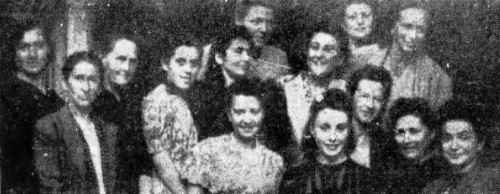
Bottom row: Sonia Waldman, Batia Nissenholtz-Shternberg, Fruma Navkhan-Zeigerson, Devora Zeigerson-Greinems, wife of Syoma Rasztik, Bronia Waldman, Dutzia Roslibker, Feigelman, Mindel Teitelbaum -Kofeiki, Dora Bond-Soroka |
|
JewishGen, Inc. makes no representations regarding the accuracy of
the translation. The reader may wish to refer to the original material
for verification.
JewishGen is not responsible for inaccuracies or omissions in the original work and cannot rewrite or edit the text to correct inaccuracies and/or omissions.
Our mission is to produce a translation of the original work and we cannot verify the accuracy of statements or alter facts cited.
 Ostroh, Ukraine
 Yizkor Book Project
 JewishGen Home Page
Copyright © 1999-2026 by JewishGen, Inc.
Updated 09 Sep 2026 by JH