|
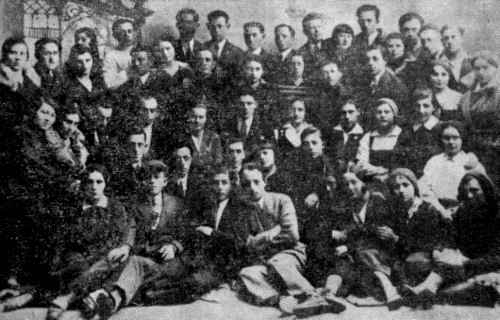
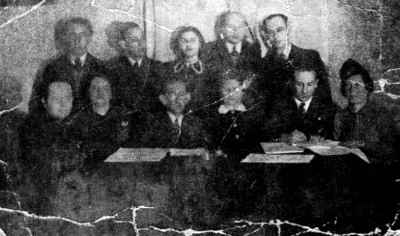
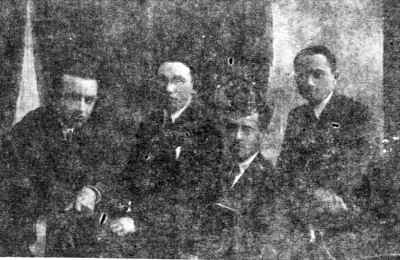
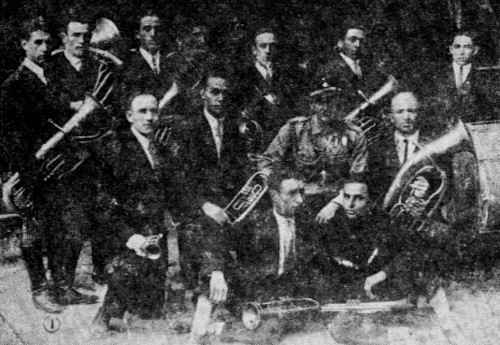
Sitting in the middle: Leib Spielberg, Shlomo Rikman.
Upper row: standing: Abba Nisengoltz, Gavriel Schenker, Eliezer Avrahami, Bezalel Bramnik, Leibush Biber, Yehuda Chorovsky, Moshe Frielich.
|
|
[Page 107]
| Members of “Hit'achdut” in Ostroh in 1925 | |
|
|
| First row below from the right: Yisrael Halprin, Shmuel Landa, Yaakov Zonder, Yaakov Linsky, Shlomo Schwartz. Sitting in the middle: Leib Spielberg, Shlomo Rikman. Upper row: standing: Abba Nisengoltz, Gavriel Schenker, Eliezer Avrahami, Bezalel Bramnik, Leibush Biber, Yehuda Chorovsky, Moshe Frielich. |
“He-Halutz”
The “He-Halutz” movement arose at first due to the efforts of the Zionist federation and its support as a branch spreading the policy of immigration to the Land of Israel. Over time, and following on the work of actualization that it took upon itself, “He-Halutz” evolved and became a special body standing under its own authority and also affiliated with the central “He-Halutz.” From then on, it received instructions and guidance directly from the national center and thus was aided by the support of the local Zionist federation regarding presenting its members for training and for receiving immigration authorization (“sertifikats”).
The “He-Halutz” movement grew and its emissaries spread out throughout Poland. Thousands of pioneers entered training in agriculture, workshops, quarrying, and various types of work. The job of “He-Halutz” was to prepare for hard physical work and also plant in the members a Zionist ideological consciousness. The hard work was as a foundation for their recognition of a life of work in Israel.
The local “He-Halutz” in Ostroh sent its members to training places throughout Poland and also concerned itself with support from foundations towards travel expenses for members lacking means. All of the members were registered with the Work Division of the Israel Office in Warsaw and waited in turn to immigrate according to the certificates that they received.
Thousands of “He-Halutz” members, men and women, prepared for work in Israel, on farms and agricultural settlements, in kibbutzes for handicrafts and industry, out of a belief in the renewal of mass immigration in the future. The training operation in Poland was a period in and of itself. It created values that were the inheritance of all of the pioneering movements in Eastern Europe.
The motivating force of “He-Halutz” in Ostroh was Barka Berger, an energetic activist who worked a lot for the realization of the pioneering idea, lost in the Holocaust. Among the leaders of “He-Halutz” was Syuma Bokimer.
[Page 108]
Dr. Yisrael Pressman, Tzipora Gutman, and Eliyahu Melamed were known as leaders of “He-Halutz Ha-Tza'ir,” they were all educated and enthusiastic Zionists. Dr. Yisrael Pressman and Eliyahu Melamed were lost in the Holocaust and Tziporah Gutman-Lindheimer was able to immigrate to Israel and raise a family. She is involved in teaching and as an educator in the Haifa area.
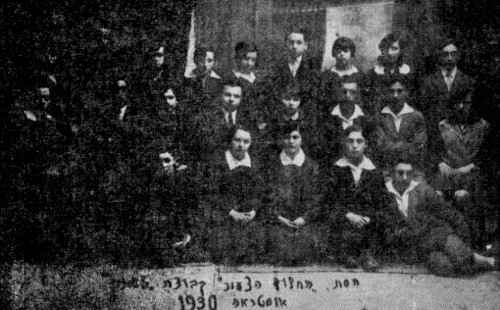
| The “He-Halutz” Branch during the 1930s | |
|
| The “He-Halutz Ha-Tza'ir” Federation in Ostroh under the leadership of Dr. Yisrael Pressman and Dov (Barka) Berger | |
|
|
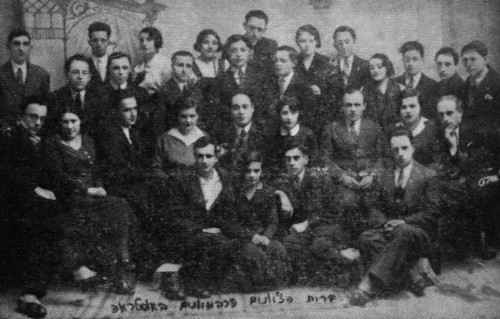
| Upper row, from the right: Michael Mosman, Gornstein, Zisel Perliss-Eisen, Dov Berger, Dutzia Katzler, Rosa Motscher-Darbiansky, Moshe Kortshak, Yisrael Bokimer, Sarah Greenberg. Second row, from the right: Goltsman, Shlomo Weinstein, Popa Schnieder, Tziporah Gutman-Lindheimer, Dr.Yisrael Pressman, Vasler, Chaim Tabatchnik, Drucker. Row below, fourth from the right: Dutzia Varch. |
[Page 109]
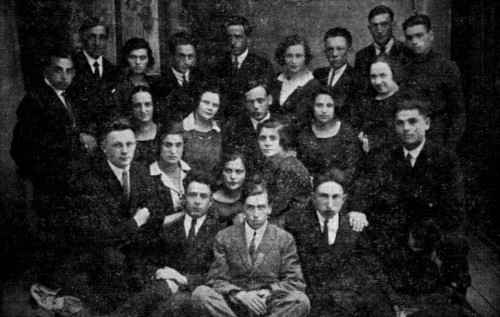
| The “He-Halutz” Branch in Ostroh in 1925 | |
|
|
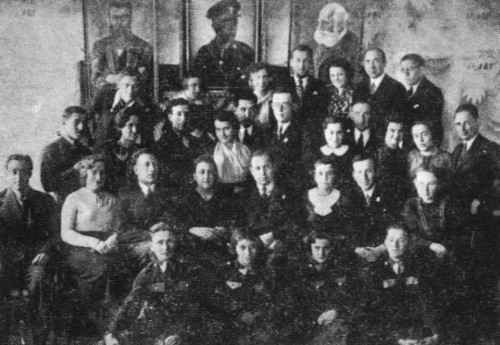
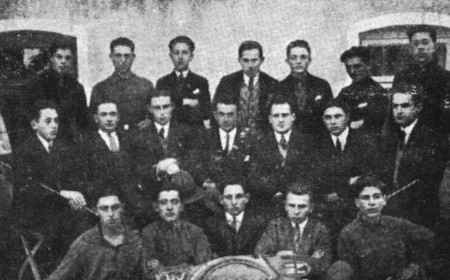
| Upper row, from the right: Michael Schnieder, Zusi Shamban, Aryeh Gulik, Masha Litwin, Aharon Boimblatt, Beiba Lizak, Braindel Wentiora-Marantz, Hershel Bifman. Second row, from the right: Sonia Lizak, Mindel Fishman, Shlomo Rikman, Ida Vaskovoinik, Shlomo (Syuma) Bokimer. Third row, from the right: Sarah Biber-Gulik, Manya Vaskovoinik, Rivka Biber, Shlomo Tolpin. Fourth row, below: from the right: Sintzi Tsitrinel, Ostrovsky, Naftali Schenker. |
| The “He-Halutz” Branch in Ostroh in 1925 | |
|
|
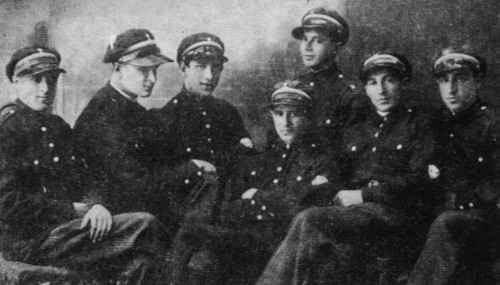
(sitting in the middle) |
[Page 110]
|
|
[Page 111]
The Federation of General Zionists
The period after the Balfour Declaration stood as a sign of revival in the Zionist movement and its penetration into the circles of the Jewish intelligentsia, but the true attack of the Zionist idea and its conquest of the Jewish street occurred in the 1920s and continued with the outbreak of the Second World War.
At the beginning, the Zionist movement was unified because the idea of the building of the Land of Israel unified all its members and supporters. Only in a later period did the political party splits begin to leave their mark. Despite the internal relations between the Zionist parties, which were sometimes also somewhat tense, the general Zionists in Ostroh remained the main active force of the Zionist movement in the city. They were among the main activists on behalf of the Keren Kayemet [=Jewish National Fund], the Keren Ha-Yesod, the Hebrew educational enterprise, and even concerned themselves with influencing the Jewish community in the city council and other communal institutions. Ostroh Zionists were extremely active in the various election campaigns, whether for the Polish “Sejm” or for the city council and the Jewish community. Among the outstanding activists in the Zionist movement were: the brothers Avraham and Mendel (Munya) Bokimer, Grisha Band and others. These were dedicated Zionist activists and, in the work they took upon themselves, the Zionist party operated according to the spirit of the times.
The members of the general Zionist party were very active in the national institutions, they concerned themselves with preparing members for immigration to Israel. The general Zionists were the main source for immigration of the middle class and one must regret that their activity stopped because of the Second World War and only a few fulfilled the dream of immigrating to Israel.
|
|
| Standing, from the right: David Shtulmeister, Attorney Meir Kagan, Chaya'ke Dimmerman, Yosef Lukatsh, Grisha Band. Sitting, from the right: Sonia Gonik-Davidsohn, Gedaliah Gedalivsky, (-), Nyuma Trachtman, (-), (-). |
[Page 112]
The Tzohar Movement and Beitar [=Revisionist Zionists] in Ostroh
The beginning of the path of the Revisionist movement in Ostroh is stuck in those far-off days of the bloody events at the end of 1929 when Arab rioters roamed Israel and murdered Jews in cold blood. During this period, the idea of fighting Zionism first penetrated the Zionist movement, which professed the establishment of an independent Jewish state on both banks of the Jordan River.
After the first foundational meeting through the efforts of the Takser brothers, new members joined, principally from among the students, and attention was mainly dedicated to ideological Zionist instruction and propaganda. Sports activity and physical culture captured an honored place. Sports competitions were held, marches, drills, and all the members were equipped with Beitar uniforms. The members of Beitar and Tzohar were also active in the cultural and spiritual area.
|
|
| Row below from the right: Dr. Musia Katovitz, Yosef Patznik, Bluma Sterenberg, Abrasha Abelman. Second row from the right: Aharon Icht, (-), M. Y. Nordman, Etel Goldstein, Aharon Takser, (-), Basi Soroca, Lyuba Shagam, Naftali Beitler. Third row from the right: Lova Finkel, Leib Simes, Musia Takser, Dora Gamarman, Leib Sterenberg, Avraham Charbash, Moti Simes, Shmuel Lipitz, Neta Chorovsky. Upper row from the right: Avraham Shrovshtik (Sharvit), Kuperstein, Chaim Peltzman, Haichberg, (-), Yosef Marochnik, Hirschel Patznik. |
In the Beitar clubhouse, there were discourses on timely subjects, lectures, exercise, and the headquarters also conducted propaganda activities among the students. The people of Beitar and Tzohar participated energetically in action on behalf of the Zionist funds and campaigns. The headquarters frequently arranged
[Page 113]
parades, question and answer nights, games. They studied Jewish history, Zionist history, knowledge of Israel, exercise, etc. in groups. In addition to the regular social and cultural activities, the Beitar branch organized various courses and led drills and military training. The Ha-Tzohar branch, too, led enthusiastic action. Alongside Tzohar, a circle arose to which former soldiers of the Polish army belonged, which called itself “The Soldier Alliance.”
The daily education in classes, in which the members of Beitar absorbed the history of Zionism and its struggle, strengthened their character, ignited in them feelings of love for Zion that were hidden in their hearts, love of the homeland, which spurred them to immigrate to Israel as soon as possible and to take up the burden of the struggle.
Ugly fate was cruel to this movement, in which precious patriotic youth were assembled. Given the fact that the gates of immigration were locked, they were sentenced to annihilation and destruction, far from the country that captivated them, but that they did not have the privilege to serve. Thus the outstanding leaders of Beitar and Tzohar did not come to Israel, Gedaliah Gedalivsky, Avraham (Abrasha) Abelman, Baruch (Buzi) Chasid. Gedaliah Gedalivsky was murdered by the NKVD in the city of Lviv where he studied and graduated from the university's Faculty of Law. Buzi Chasid and Avraham Abelman were lost in the Holocaust and only the head of the Revisionist movement, the teacher Y. M. Nordman, was able to immigrate to Israel and continued his path in education. He headed up an educational institution in Ramat Gan until the end of his days.
Yosef (Yupa) Katz was the head of the “Zealots' Alliance” federation in Ostroh. Among the other activists of the movement from its founding by Meir Grossman, “The Party of 'The Country of the Jews'” were David Shtulmeister, Avraham Charbash, Fania Finkelstein-Shtulmeister and others.
|
|
| Standing from the right: Abrasha Abelman, Reuven Tochbinder, Moti Simes. Sitting from the right: Musi Soroca, Buzi Chasid, Aharon Icht. |
[Page 114]
|
|
|
| Right to left: L. Simes, Siuni Zeigerson, Leib Sterenberg, the Beitar commander in Ostroh Abrasha Abelman, the head of Ha-Tzohar in Ostroh Gedaliah Gedalivksy, Basik Soroca, Moti Simes. |
[Page 115]
“Ha-Mizrachi”
A branch of “Ha-Mizrachi” and of Young People of Mizrachi existed in Ostroh. The religious Zionists, “Ha-Mizrachi,” succeeded in being a barrier against anti-Zionist propaganda. Their activists were very involved in Keren Kayemet [=Jewish National Fund], Keren Ha-Yesod, and joined in all areas of Zionist work, in addition to the national funds. A generation that was educated in the spirit of Torah and the tradition grew up in a branch of “Ha-Mizrachi.” This generation sought the correct path of physical and spiritual redemption of man in Israel. This generation saw the path in Zionism based on the Torah of Israel. When worlds and values collided, the religious man knew to hold steadfastly to the values of Judaism and Zionism and saw his future in the building of Zion and on religious foundations. The religious member saw in the “Ha-Mizrachi” movement, which had been founded in Israel, the proper framework for the actualization of his ideas and aspirations. Within the “Ha-Mizrachi” branch, an organized and wide-ranging cultural action of Hebrew lessons, knowledge of the Land of Israel, Tanakh, Aggadah, Zionist history, the Torah and Labor movement, etc. were conducted.
Among the leaders of “Ha-Mizrachi” were activists committed to the Zionist idea and the one who stood out among them was R' Moshe Abelman. A well-known figure in the city, a scholar, a scion of a rabbinic family, and he himself was ordained as a rabbi. He was a splendid figure, rooted in the values of traditional Judaism, and distinguished in his many-faceted talents, in his logic and his honesty. He dealt with public needs faithfully. For many years, he was the head of the national bank in the city. He was a representative to the city council and worked much within the Jewish community and in other public institutions. He was one of the founders of the orphanage and worked considerably on behalf of the Jewish hospital. As a wealthy Jew, as the owner of a factory for candles and blankets, he contributed a lot for the good of the poor and for charitable institutions. R' Moshe Abelman was admired and respected by all circles of the residents of the city.
Among the other activists of “Mizrachi” was Mordechai Rabinowitz, brother-in-law of Moshe Abelman. He was elected vice-chairman of the community in Ostroh and in the Jewish view he stood out as one of the learned men and as a devoted community activist. He was active in all kinds of welfare committees and he dedicated his energy and time to these goals. He met a tragic death while in the United States in 1939.
Among the activists of “Ha-Mizrachi” and of the supporting pillars of the community institutions in Ostroh were Pinchas Takser, Aharon Barak, Yitzhak Lizak, Dov Linsky - the legacy of the Keren Kayemet, Moshe Finkel (son-in-law of M. M. Biber), Pinchas Polikoff, Moshe Shulvug, Meir-Zvi Finkel, Mordechai Mishnah (secretary of the Keren Kayemet), Moshe Krichmer and others.
“Dror”
This was a socialist Zionist movement that at the foundation of this party was a Marxist Zionist world view, for liberation of the workers, improvement of their living conditions, and to base the work life of the working class in Israel on normal foundations and reach national-socialist freedom of the Jewish people working in the diaspora and in the land of Israel.
This party was active in all areas of the life of the Jews in Ostroh. The members of “Dror” were educated people and they engaged in educational and cultural activities and their influence on the Jews of the city was very great. The activists of “Dror” were connected through friendship and mutual understanding. Being faithful to ideas of progress and freedom, this desire led them to communal-educational action.
The educated Jewish population, and the youth in particular, derived much benefit from the actions of the members of “Dror.” They frequently held spontaneous gatherings, in which they lectured on current topics. The representatives of “Dror” participated in the general Zionist committee in the city, in the committees of the Keren Kayemet and the Keren Ha-Yesod, and also in other communal institutions.
Already at the beginning of “Dror” in Ostroh, emphasis was placed on propaganda and its members led a strenuous effort in order to instill the idea into the consciousness of the masses that the aspiration for an independent homeland for the Jews was not opposed to the socialist aspiration, but rather the opposite: they completed each other and represented the only solution to the problem of the Jews in the diaspora. Social life in Ostroh was then rising and members of “Dror” would appear at lectures on current topics in different clubs and they contributed greatly to the cultural life of the city.
[Page 116]
Among the outstanding activists of “Dror” were counted the members: Yisrael Fogel, B. Z. Ayalon (Baranik), Roza (Shoshana) Finkelstein, Chaim Davidsohn, Nyonia Tsitrinel, Buzia Takser, Milia Biber, Munya Raichis, Frumke Gairman, and others. Shoshana Finkelstein was for some time the secretary of Kibbutz Ein Harod and passed away in 1981. Frumke Gairman remained in Russia after the end of the Second World War and passed away in 1980.
“The Zionist Worker”
After the Nazis came to power in Germany, they openly announced a war against the Jews in place after place. Hitler, who elevated the Nuremberg Laws to the status of Basic Laws in Nazi Germany, gave a green light to terror against the Jews in Germany. The Nazi press, in particular “Der Stürmer,” came out with slogans like these: “the Jews are our disaster,” “ the Jews are not wanted here,” etc.
Poland, Germany's neighbor, continued to be poisoned by Nazi venom. During the 1930s, particularly after the death of Pilsudski, a difficult period of hard persecution began for the Jews of Poland. The Polish government wanted to solve the Jewish question through the exit of masses of Jews from the country. Constriction of the civil rights of the Jews and constraints on their economic labor, propaganda towards boycotting Jewish commerce, began. The anti-semites dreamed of expelling the Jews from Poland. Riots and pogroms broke out in Polish cities in which there was a strong organizational hand. Attacks on the Jews became daily occurrences and the police did not interfere in carrying out their plan.
The Jews of Poland were terrified because, even before, they did not live in peace and they began to consider their path. Suddenly the idea of immigration to Israel took on a special and deep meaning. Not anymore in the future, rather this is a burning life question and agitation towards immigration to Israel grew in many circles.
At the same time, spurred on by “He-Halutz,” the movement of “The Zionist Worker” was established in Ostroh. Among the founders were: Idel Chelm, Pesach Brachman, Moshe Grinfeld and others. This was a movement of artisans who, because of their age and family situation, could not find a place in the framework of the kibbutz movement. This was a very serious element in the building of Israel, but sadly, the gates of Israel were already half locked and more than that: the limit of certificates was very small for members who were not in training kibbutzes under the auspices of “He-Halutz,” even though immigration to Israel was the soul's desire of tens of thousands of Jews who decided to emigrate to Israel.
Beginning in the 1930s, the Jews could see no chance of assuring their future and only in immigration to Israel did they see the only way to assure their future. The human material that joined “The Zionist Worker” was multi-faceted, principally from the poor and middle classes of the Jews of Ostroh. There were among them people with various professions, such as tailors, cobblers, carpenters, engravers, welders, and other professions who, because of their pressed economic situation hoped that, through “The Zionist Worker,” they had a chance to immigrate to Israel.
The cultural work of “The Zionist Worker” in Ostroh was carried out then in reduced circles. The leadership of “The Zionist Worker” wanted to improve and enrich the knowledge of its members and to obtain for them or to take away from them what their impoverished parents could not, to give them: the study of the Hebrew language, the history of Zionism, and also to plant in them the feeling that they could be useful in Israeli society after they had immigrated.
The Zionist movement was the pride of the city. In it was an important pioneering activity, full of content, alive and vigorous, which enlarged the lives of many and, in particular, the members of “The Zionist Worker.” The life of the city teemed with Zionism whose action was felt in every area: in education, in public access, in daily affairs. In cultural work, and the members attached every fiber of their being to the values of the Zionist movement and were active in the public life in the city. They participated in collecting funds for Keren Kayemet, for Keren Ha-Yesod, and helped the Zionist federation to the best of their ability in all of its activities. The members of “The Zionist Worker” were alive to every public goal and took an active part in social activities, each according to his qualities and personal inclinations. The branch of “The Zionist Worker” in Ostroh excelled in
[Page 117]
the internal consolidation of its members around the idea of immigration to Israel.
Proper cultural work was carried out by the branch of “The Zionist Worker.” On most Friday nights, “Question and Answer” evenings were held. Most of the questions were about how an artisan might sustain himself until the longed for day that he would immigrate to Israel. The yearning for Israel continued to strengthen, but certificates were lacking. The Israel Office was unable to answer the many requests of those wishing to immigrate to Israel. The training kibbutzes in Poland filled up and the best of the pioneering youth stayed there for years waiting for permission to immigrate and the chances that “The Zionist Worker” would receive a number of certificates were few. But the pioneering spirit was strong in them. The members of “The Zionist Worker” would meet in the evenings in the modest clubhouse after a day's back-breaking work, imbued with their deep belief in their path, even though they knew how difficult the chances of immigration were, but they knew that this was the password of their lives and that they would achieve it when the longed for day came.
|
|
| Right to left: Melamed, (-), Bezalel Bramnik, Yosef Bokimer. |
The immigration permission of the member, Pesach Brachman, made a great impression. A representative of the center of “The Zionist Worker,” Ostrovsky, participated in the general gathering and, due to this, new members signed up for “The Zionist Worker” in the hopes that their turn, too, to immigrate to Israel would come. Later on another couple of members signed up: Yasha Zieger and his wife, Mendel Vishkerman and his wife, Avraham Treiber and his wife, Hirschel Piatker and all the members of his family.
Thus it could be said that the dream of Zionism to throw off the chains of the painful, depressing diaspora, of the anti-semitism of the regimes and the inhabitants both, and of the feeling of lowly citizens, bore into the hearts of the Zionist youth and adults their own value and self-esteem, straightened their stature, and lifted them up to a new level. Sadly, further members of “The Zionist Worker” and other Jews were not able to immigrate to Israel. The Second World War broke out and many remained without realizing their dream of immigration to Israel and the Nazi Amalek waved his filthy sword and annihilated them.
[Page 118]
|
|
[Page 119]
The “Bund” Party
The October Revolution in Russia in 1917 brought with it a revival of social life in Ostroh. The political parties and the cultural institutions, which had held their activities in secret before the Revolution, now began to work openly. The “Bund” party was also revived.
Over time, new members - also from the circles of the intelligentsia - joined the party and they contributed greatly to the broadening of its influence. Propaganda work was emphasized and so the “Bund” led an energetic action to instill in the minds of the mass Jewish workers the aspiration of socialism and social justice.
Social life in Ostroh during the 1920s was then marked by ascent. The Jewish workers' movement began a frantic action of creating professional associations, cultural institutions, libraries, evening classes, lectures, etc. Apart from the gatherings and meetings, the parties, the members of the “Bund” came together to exchange ideas about current practical matters. The main activity of the “Bund” in those years was cultural-political-socialist and not revolutionary. Emphasis was on the Yiddish language. This flowed from love of the common language and appreciation of it as a cultural asset and also from striving for personal-proletarian material and the competition in the working street and acclimation to it.
The character of Ostroh, the popular-vivacious Jewish city, and its hold on Yiddish culture, contributed to forming the figure of the working man. The community of the Jewish workers was tightly closed and given to the influence of the “Bund” due to the actions of its talented members who led the activities of the “Bund” in Ostroh. These members were Motl Goren, Yankel Gerstein, Nyonia Brom, the Detinka brothers, Chana Spielberg, Yankel Bronstein, Frieda Goren, and others.
The reaction and the national and social depression in Poland in the 1920s and 1930s, which events which happened in quick succession, tossed the Jews strongly and some fell into the hands of Communism that captivated then with its innovation and its daring by promising the end of national discrimination and social differences. To those who were enthusiastic, the Soviet Union became the center of life and aspirations and they found relief in sticking to her tightly from afar and in working underground with all the magic and heroics of this activity.
The Jewish working public was tightly closed and, if they had been inclined earlier to the influence of the “Bund,” they began now to leave the “Bund” and join the Communist party and the “Bund” party split up and almost disappeared from the area. At the head of the Communist party stood those same members who had been the leaders of the “Bund” in Ostroh, Motl Goren, Frieda Goren, Golda Grachman and others.
The activities of the Jewish communists in Ostroh flowed from their concern for the working man, they were the first to make a real effort to organize the workers, for the improvement of their living conditions and their education and standing on fair days. Radical, freedom-loving thought captured the hearts of the workers and at the same time, the end of the 1920s and 1930s, class slogans appeared, in the eyes of the workers, as a protest against Polish rule, which suppressed each action with an iron fist, pursued the Communists, and prisons were filled with political prisoners, among whom was also a group of Communist activists from Ostroh. Among the prisoners were Motl Goren, Frieda Goren, Esther Stern, Reizel Grachman, and Baila Kuperstein. After serving their sentence, these members were not permitted to return to their city, but the Second World War broke out after a short time, Ostroh was annexed to the Soviet Union, and Motl Goren - the Communist prisoner - was elected mayor and served as mayor until the Soviet-German war broke out on June 22, 1941.
Frieda Goren was able to immigrate to Israel with her family and Motl Goren served as a military judge in Warsaw until he immigrated. He worked for the municipality of Bat Yam and passed away in 1967. Frieda Goren-Kolpanitzki is one of the outstanding activists of the Organization of Ostroh Natives.
“The League for Culture” (“Kultur-Lige”)
After the First World War and the October Revolution in Russia in 1917, life in the city completely changed. An atmosphere of freedom encompassed most of the Jewish public
[Page 120]
and, like in other cities in Volhynia, here, too, strong inclinations towards democratic life began to beat and they found expression in all areas of life. Social activities changed under legal conditions. Despite the fact that the street in Ostroh was engaged by revolutionary slogans, nevertheless a large part of the Jewish population in the city were not captive to cosmopolitan ideals.
In those days, days of spiritual uplift, individual groups from the Jewish intelligentsia organized and took upon themselves the concern to improve the lives of the Jews in the city in the social and cultural areas. These were people with high culture who founded “The League for Culture” or, in Yiddish, “Kultur-Lige.” The task of the “Kultur-Lige” was to enrich the spiritual and educational load of the Jewish youth who lacked an elementary education.
Among the founders of the “Kultur-Lige” are counted: Dr. Yosef Rozenszturm, his wife the educator Henna (daughter of the veteran teacher, R' Moshe Shulvug), Dr. Shimon Tzveiman, Dr. Shmuel Tolpin, Chaim Katz, Leizer Ginker, Dr. Yoka Tolpin, Sarah Abelman, Chana Spielberg, Frieda and Motl Goren and others. Two of the leaders of the “Kultur-Lige” died the most tragic deaths: Dr. Shmuel Tolpin was cruelly murdered by soldiers of the ruler of blood, the Ukrainian Hetman Symon Petliura, and Dr. Yosef Rozenszturm was killed on the train tracks of the city of Rovno [=Rivne] while doing business for the “Kultur-Lige” (Dr. Shimon Tzveiman and Motl Goren died in Israel).
The “Kultur-Lige” counted dozens of members, most of them progressive youth, thirsty for action and knowledge. By the measure of those days, the “Kultur-Lige” opened a widespread and intensive action in the area of culture and education. A suitable framework was created for cultural and social action and it filled an important and large function in the field of culture and education among the Jews of Ostroh.
The “Kultur-Lige” initiated a revolution in the thinking of the Jewish youth in the city. Its principal activities were expressed in literary action. Alongside the “Kultur-Lige” a library was founded with donations of books that were assembled from various houses. In the complex of important actions that the “Kultur-Lige” engaged in were included arranging literary parties, lectures on various subjects, evening classes for those lacking education, various clubs and seminars, a group for Yiddish literature, a kindergarten, an elementary school, a drama club, and other clubs that were greatly successful.
One should note that the beginning of the 1920s were years of depression from an economic viewpoint and Jewish youth went around with nothing to do and susceptible to dangerous influences that were liable to lead to decline and degeneration and so the activities of the “Kultur-Lige” in those days were at the same time both useful and moral.
Jewish youth came to the “Kultur-Lige” clubs from all economic classes. The clubhouse was filled with members thirsty for knowledge and they found their place within the framework of the cultural activities of the “Kultur-Lige.” Yiddish was given special status and thus all activities were conducted in this language. There were pedagogical forces who had gotten their education in teachers' seminars and teachers with a higher education joined them and, over time, the welcome approaches merged and got their desired character in the framework of the “Kultur-Lige.” The rapid broadening of cultural action in Ostroh expressed itself in the institutions that were continually added under the auspices of those at the head of the “Kultur-Lige,” which broadcast their purpose and influenced the masses of the people, and public life in Ostroh was lively and fruitful during that period.
Sports Activities
Sports activities in the city were known to hold an honored place in the colorful life in Ostroh of the period of the two world wars. Jewish youth were full of life and were imbued with ideas and belief and idealism and with this one can explain the fact that a notable percentage of Jewish youth did not content themselves with the conceptual realm alone, but rather also with sports, in keeping with the widely known saying: “A healthy mind in a healthy body.” Jewish youth in Ostroh developed quite a lively sporting life within the framework of the youth movements or outside of them.
“The Sports Division” of “TAZ” (“The Organization for the Maintenance of Health”) worked for the purity of sport and physical development, in keeping with the demands of “TAZ,” which was also called
[Page 121]
“The Blue-White Division S.S.G.” in Polish : “The Sports Division for Gymnastics” and it received the budget for sports activities from the leadership of “TAZ.” The counselors in the “Division” were former soldiers who had served in the Polish army and others joined their ranks as well like: Avraham Waltman, Yoni Klorfein, Musia Soroca and others.
|
|
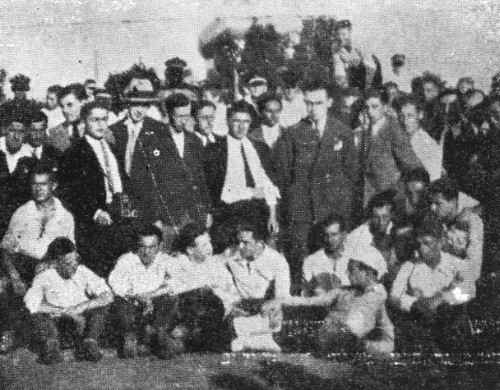
| Upper row, from right to left: Roitenberg, Leib Frelis, Motshan, Yaakov Finkelstein, Mitke Gonik, Avraham Blinder, Beiya Gilbord. Row in the middle, from right to left: Basik Soroca, Lova Darbiansky, Binyamin Grines, Yesha Bokimer, Musi Soroca, Grisha Vidra, Neta Chorovsky. Row below, from right to left: Ephraim Glassman, P. Finkelstein, Yaakov Shmidman, Chaim Zeigerson, Gochman. |
The members of the “Sports Division” worked in various areas of sport such as: soccer, trapeze training, ping pong (table tennis), bicycle races, gymnastics, swimming, high jump and long jump, basketball, etc., but of course, the main attraction was the soccer division. It was a spectacular sight to see the soccer players competing with soccer teams from various cities in the area, like Mizoch, and soccer teams from other cities. The spectators on the sports fields followed the players of Ostroh with joy and pride, breaking through the blocks of their rivals to the shouts of the masses. One should note that, not only soccer, but also the other sports divisions stood at a high level and revealed significant action. The crowning glory of the sports activities was an annual competition that was arranged with great festivity in the presence of the heads of the Polish administration and representatives of the Jewish institutions and heads of the community, in order to mark the achievements in the various sports fields.
Sports activity demanded, of course, much organizational and financial effort and the budget that the leadership of “TAZ” gave to the sports activities was not sufficient for its needs, thus there was a need to seek other financial sources for the proper functioning of the sports branch. Party evenings, sports competitions, and principally soccer competitions that drew a big crowd were organized for this purpose. The uniform of the soccer division was constant: blue-white, and it was no surprise that the soccer division drew young men to this popular sport.
Jewish youth that shook off the oppression in which they had been situated found, in sport, the most clear expression
[Page 122]
of standing tall and spiritual healing and sports activity took an important place among all the other social institutions of the various classes in the city.
The years of the 1930s were fruitful in the area of Jewish sports in Ostroh. In that period, good results were achieved in all the branches of sport, but unfortunately, the sports activity, like those of other areas, were stopped when the flames of the ugly war broke out in the skies of Poland and most of the Jewish athletes, and among them the athletes of Ostroh, were lost and only embers saved from the fire of the terrible Holocaust were able to pass the sites of extermination and join the builders of our country.
|
|
by Avigdor Kamerman
Translated by Shalom Bronstein
When the Province of Volhyn was divided between Poland and Russia in 1920 – the city of Ostrog came under Polish control. The Horyn and Viliya Rivers served as the border.
In keeping with the practice in the border areas of Poland, only a Pole was appointed head of the city without considering the makeup of the population. Most of the aides were also Poles, although I was appointed assistant head of the city of Ostrog, serving in that capacity for three years from 1928-1931.
The administration of the city had two “lavnikim” joined with it who were Ukrainians. In my time I was able to replace one of them with a Jew. The city council at that time consisted of twenty-four representatives that were elected by all the residents. Among them were sixteen Jews out of the general population of 16,000 of whom 75% were Jews.
The Jewish representatives had different viewpoints (5 Zionists, 2 Workers, etc.) but they were united when it came to any question raised in the council concerning the Jews. Jewish officials also had a role in the administration of the city. In my time their number increased to eight and this does not count the Jews who provided various services to the city.
The attitude that prevailed in Poland at this time and in the ruling political party concerning national minorities in general and the Jews in particular, was evident in the next city elections in Ostrog that took place in 1930. Because of government pressure and despite the increase of the Jewish population since the previous elections, the number of Jewish representatives declined to 14.
City affairs were generally carried out confidentially behind the scenes, and so it appeared that internal peace prevailed among the various delegations. But, in reality, at times there were tense relations between the Ukrainians on one side and the Poles on the other.
Funds which came from city income were allotted to support the city's Jewish institutions such as the Jewish Hospital, the Jewish orphanage, the ambultorium of the Jewish health organization “Maoz,” the Talmud Torah, the old-age home and others.
However, the allotments were small and were cut without taking into consideration that the amount of taxes that Jews paid almost covered the entire city budget. This amount was not small – 450,000 Polish gold coins. This was especially so since the Jews became impoverished as the Russian-Polish border was very close to the city causing a heavy tax burden to weigh in on them.
Besides this, there was the burden of the taxes collected by the Jewish community to maintain itself and support the community beneficial organizations. These could not function on the allocations from the city which had no relationship to the real needs. However, it should be pointed out that for the most part an understanding relationship existed between the administrations of both the Jewish community and the city.
Among the important public works projects carried out by the city in 1930, were the construction of the large bridge linking
[Page 124]
the new city and the laying of a new road near the large synagogue, where formerly very thick mud prevented access to the synagogue.
During this time, the Jewish community constructed a sophisticated slaughter house. Many visitors came to Ostrog to see its historic sites that spanned nearly a thousand years. They were especially interested in the large synagogue of the Maharsha (Rabbi Shmuel Eliezer Edeles – 1555-1631), very old ritual items, the old cemetery, the palace of the early rulers of Ostrog where the Poles now organized a city museum, etc. Among the famous recent visitors were Marshal Jozef Pilsudski (former Prime Minister of Poland), the writer Sholem Asch and others.
|
|
Top row from right to left: Michael Oksengorn, Chaim Zeigerson, Shmuel Fisher, and others; Middle row, seated from right to left: Chaim the trombonist, Kastzki (the commanding officer of the firefighters), Noah Feldgoz, Meltzer, Mirotznik and others |
|
|
JewishGen, Inc. makes no representations regarding the accuracy of
the translation. The reader may wish to refer to the original material
for verification.
JewishGen is not responsible for inaccuracies or omissions in the original work and cannot rewrite or edit the text to correct inaccuracies and/or omissions.
Our mission is to produce a translation of the original work and we cannot verify the accuracy of statements or alter facts cited.
 Ostroh, Ukraine
 Yizkor Book Project
 JewishGen Home Page
Copyright © 1999-2026 by JewishGen, Inc.
Updated 12 Jan 2026 by LA