[Page 94]
Parties and Youth Movements
by Chaim Finkel
Translated by Monica Devens
Ostroh, of the glorified tradition and an active and lively Jewish center, was in essence a Jewish city, which distinguished itself in its cultural and spiritual level and, during the entire period of its existence, served as a great spiritual Jewish center and became the cultural and spiritual capital of the entire Volhynia region and many areas outside of Volhynia.
But it was not only the Jewish majority that established the image of Ostroh, rather also the economic and cultural activity made its mark on its character, its ways of life, and its special style. The Jewish public in Ostroh was, during the years between the two world wars, made up largely of people who had a national awareness and encompassed many strata in the city, among which was a substantial segment of the Jewish intelligentsia. Most important, the multi-movement organization among the students and working youth stood out.
A special cultural atmosphere arose in Ostroh, which was necessary for the existence of parties and youth movements, both Zionist and non-Zionist. In this city were found educated people of an intellectual spiritual approach that broadened the horizons on their thinking through different educational institutions and through independent study. These were young, talented, highly ethical activists who mostly came under the wings of the accomplished leaders of the city.
Here, within Jewish Ostroh, branches of all the parties that existed in the Jewish street in independent Poland were active and here, too, the struggle, in all its severity, among the parties and youth movements to conquer the masses for their hopes was manifested: the mass meetings, the publicity activities, the propaganda and education were filled with this struggle.
The substance of the action of every one of the movements was the hope of actualizing its central idea. Thanks to this broad cultural and educational activity, an intelligentsia worthy of the name arose, with the ability to think and the will to work for the good of the public since strong inclinations toward communal, public, and social service existed in the Jewish community in Ostroh.
The years between the two world wars were full of increasing tension over the rise of Nazism and the strengthening of anti-semitism in Poland. Fear of tomorrow cast its shadow over the lives of the Jews in the city, as in all cities in Poland, and despite that, political-communal activities did not lessen, the opposite - public activities were lively and even became valued cultural enterprises. Nevertheless, sadness was carried in the space of the city and, with this, dreams and hopes for a better future.
The private aspirations of the youth in Ostroh merged with the national hopes of the entire community. Principally the youth was carried on the wings of imagination for a better future, for a full and more beautiful life, and “the” method (“the” with the definite article) was in the party framework. The party war in Ostroh took place on a cultural and social level, but the currency of these matters was sharp struggles with an ideological background. The influence of the parties in the street was attached to the personal make-up of the parties and youth movements, at the communal and cultural level of the local activists who stood at the head of their branches.
Every party and youth movement had intellectuals who ran communal-social activities among the Jews of the city and thus two large concentrations were established in the city: the concentration of the Zionist parties and youth movements and that of the leftist parties. The Zionist block supported the building of the Land of Israel and the revival of the Hebrew language, without abandoning the communal activity of daily life in the diaspora. The leftist block worked principally
[Page 95]
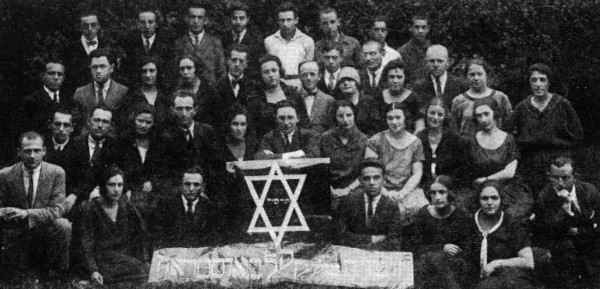
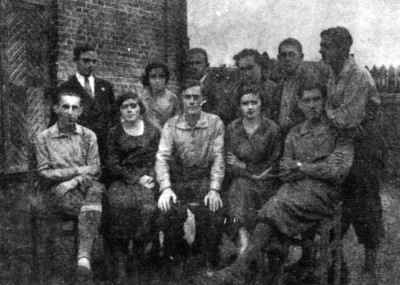
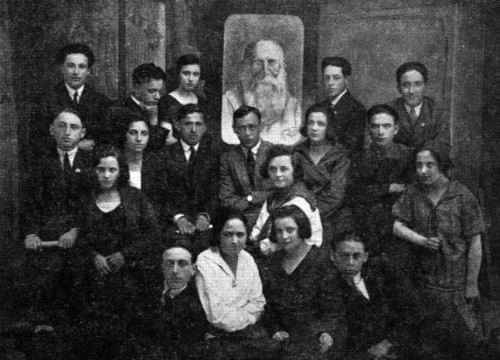
| Activists of the Keren Kayemet in 1928 |
|
|
First row below from the right: Syuma Bokimer, Sarah Goldberg, Vasler, Velka Zeid, Yisrael Halprin, Batya Tsitrinel, Binyamin Grines.
Second row: Chaya Viderman, Sarah Rappaport, Chana Leipel, Esther Iojzips, Bezalel Bramnik, Nyonia Tsitrinel, Yaakov Zunder (-), Akiva Horowitz, David Glatzer.
Third row: Rachel Glantz, Chaya Barak, Moshe Frielich, Sarah Schneider, Ida Vaskovoinik, Yehuda Chorovsky, Buzia Kagan, Gavriel Scheinik, (-), Chuma Spielfoigel, Yaakov Perlmutter, Reuven Gulik.
Upper row: (-), (-), (-), Zvi Perlmutter, (-), (-), Yaakov Linsky, Wolf Brezenblit. |
among the labor stratum and in poor dwellings and the working and student youth. At the head of the workers' movement stood the Detinka brothers, Mordechai Goren and others, who worked in the area of the organization of vocational associations and also in the area of propaganda and spreading education and culture, while the Zionist parties assembled around a general city Zionist committee, at whose head stood popular activists like Yeshaya Feiner, Leib Spielberg, Zalman Gerschfeld, Leibush Biber, Chaim Davidsohn and others. The Jewish community became a political arena of struggles between the Zionist parties and the leftist parties.
The Zionist Movement
The Zionist movement in Ostroh encompassed many layers of the city and among them a sizable portion of the Jewish intelligentsia. In particular, the multi-movement organization among the student and working youth stood out. The aware and active Ostroh Jewry were captivated by the idea of national revival and connected with the Zionist movement, which began to gain for itself an honored place in the life of the society in the city already from the beginning of the 20th century.
The Jewish public in Ostroh was, during the years between the two world wars, comprised largely of people with a national consciousness, and thronged to the Zionist movement in all its forms, which stormed through and included the vast majority of the Jewish public in the city.
The Zionist movement penetrated deeply into all levels of the Jewish population, it was a significant popular movement. With the development of the Zionist movement, its activities in propaganda, Hebrew language and culture instruction, branched out, with the creation of the national funds: Keren Kayemet le-Yisrael [=Jewish National Fund] and Keren Ha-Yesod, concern for the physical welfare of the youth through sport organizations like “Maccabi”
[Page 96]
and “Ha-Po'el,” pioneering education for youth with aspects of training, education of women for communal life and public activity and more, and on all of this, the Zionism in Ostroh was a criterion for awareness and public activity also in areas of local life outside of the circle of its direct involvement, nevertheless they were influenced and activated indirectly by its creative spirit and blessed initiative of its activists.
In the first years of the 1920s, with the end of the First World War, the Zionist movement in Ostroh had already captured the central place in Jewish communal life in the city and its influence continued to grow until there was no corner of public life that Zionism neglected and no Zionist body in the place that did not show social awareness.
The Zionist activists were represented and active in all the institutions of the public, in the community, in the municipality, in the associations, in the organizations, and in the groups. The interest of the masses in political and communal problems dropped drastically, but the results of communal action were noteworthy in every step.
“Ha-No'ar Ha-Tziyoni”
This movement was within the framework of the general Zionist federation and it captured an honored place among the Jewish students. From then on, the students in Ostroh were the spearhead of the Zionist movement and excelled in their activities, principally in the period between the two world wars.
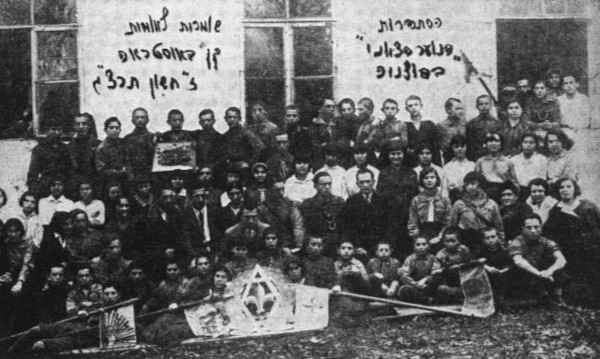
| The “Ha-No'ar Ha-Tziyoni” Core Group in Ostroh in 1932 |
|
|
In the second row above, in the middle: David Muller of the leaders of “Ha-No'ar Ha-Tziyoni” and of the leaders of “Ha-Bricha” in Poland.
Fourth row sitting from the right: Grisha Vidra, Grisha Reznick, Dr. Oderman, Shifra-Tziofa Kotel, Miriam (Miki) Tolpin-Berger, Dutzia Katzler.
Fifth row below, from the left: Nachum Shochet, Zindel Grines, Moshe Steinberg (on the right). Among the others: Yosef Muller, Shifka Biberchuk-Tolpin, Noah Iret, Poli Shamban-Oderberg, Ziameh Sheynerberg, Zalman (Ziameh) Shochet, Dov (Burya) Raichis, Esther Shapira, and others. |
[Page 97]
“Ha-No'ar Ha-Tziyoni” as an educational organization emphasized significant scouting-Zionist education and encompassed most of the youth studying in the Polish secondary school, in which the Jewish students made up a significant percentage. As its activity went on, “Ha-No'ar Ha-Tziyoni” encompassed not only the students, but also other layers of the youth. Among the founders and activists of “Ha-No'ar Ha-Tziyoni” [were] Breshtzivkeh (Pesach Broshi), Zindel Grines, Sasha Gurwitz, Grisha Vidra, David Muller, Yitzhak Zeltzer, Grisha Reznick, and others.
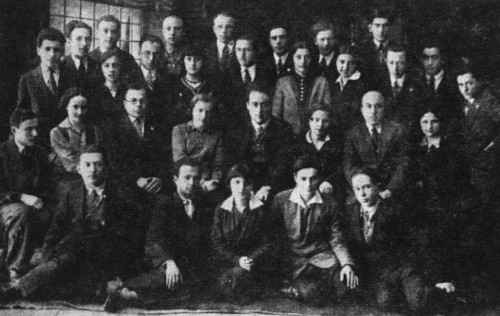
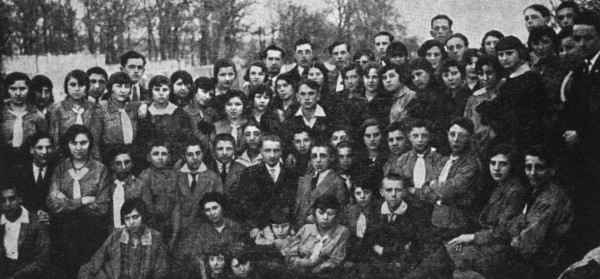
| A group of students in Ostroh in 1933 |
|
|
First row below from the right: Grisha Eisenberg, Lova Saks, Sima Sheynerberg (Klipatz), Nyuma Charolinsky, Buki Berg.
Second row from the right: Rachel Shulvug, Attorney Meir Kagan, Tzfira Gutman, Aharon Takser, Riva Muller, Dr. Yisrael Pressman, Sarah Eisenstein, Yona Leipel.
Third row from the right: Shaul Brendel (Klevan), Moshe Takser, David Muller, Roza Chasid, Mindel Rosenthal, Naftali Beitler, Aniota Galperson.
Top row from the right: Siyoma Chasid, Nachum Shochet, Shimon Margol, Mendel Sirover, Moshe Steinberg, Eliyahu Melamed, Gedaliah Gedalivsky, Yoni Goltsman. |
Every group used to meet regularly as a core group and, under the leadership of the head of the group, they would study Jewish history, the history of the Zionist movement, knowledge of the Land of Israel, Hebrew literature, scouting, and general subjects. “Ha-No'ar Ha-Tziyoni” taught good fellowship, shared life, and responsibility. The movement educated its members to refrain from smoking and from alcohol. The older members went through a period of “training” in stages - training in Poland and some of the members integrated into the life of the Yishuv in Israel after their immigration
[Page 98]
to Israel in kibbutzim and in many responsible positions.
One of the heads of “Ha-No'ar Ha-Tziyoni” in Ostroh and one of those who stood out among the educated youth was Dr. Herzl (Grisha) Oderman. He grew up and was educated in a Zionist household and with a clear Zionist atmosphere. His parents, Moshe and Feiga Oderman - both enthusiastic Zionists, named their son after the prophet of the Jewish state, Dr. Herzl. Dr. Oderman, who was broadly educated and very proficient in Hebrew literature and in Jewish and Zionist history, knew how to lecture at the meetings of the core group with great ability and his lectures were very interesting. He was the driving force of the core group and was also involved in the society and beloved by his fellows. He excelled in rare personal qualities. He was a dear member and honest in his dealings with the members with whom he worked in the movement. He possessed amazing courage in relation to the righteousness of the Zionist-national idea.
During the terrible Holocaust, he was murdered by Bandera's Ukrainian murderous gang, whose hands were disgusting with Jewish blood.
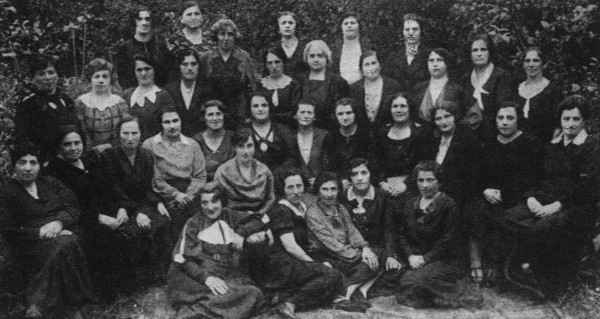
| The Organization of Zionist Women in Ostroh in 1934 |
|
|
First row below: (-), Rachel Glantz, Chaya Viderman, Feiga Barak, Chava Leibel, Roza Karner-Rodman.
Second row: Gittel Aberbuch, Sarah Bard, Miriam Barnik Rosenthal, Chana Ludomirsky, Feiga Vidra, Rachel Girnstein, Mina Shatzogol, Sonia Samik, Chana Biber, Esther Linsky, Leikechmacher, Shatzogol.
Third row: Rachel Finkel, (-), Zelda Treiber, Gamarman, Alta Barak, Godlis, Margol, Weinstein Roitenberg Greinims.
Top row: (-), Berenzon, Sarah Krichmer, Mina Finkelstein, Chasid. |
[Page 99]
“Ha-Shomer Ha-Tza'ir”
After the events of the First World War that silenced the sounds of the cannons, the news of the “Balfour Declaration” was received with great excitement in Ostroh and inspired the imagination of the Jews of Ostroh, in particular the young people. The area in which they were able to give expression to the whispers of their hearts was the first Jewish-Zionist youth movement, “Ha-Shomer Ha-Tza'ir.”
With the founding of this youth movement, the principles of physical and spiritual education, the development of a sense of direction, cultivation of the attributes of help and kindness, faithfulness to the values of Zionism and love of the national values of the people were inculcated.
The Shomer nucleus became a noisy center of life for the Jewish youth in the city and for their national aspirations. The appearance of the nucleus in the public life of the city was marked during holidays and festivals: Hanukkah, Purim, Lag Ba-Omer, and at every other suitable opportunity,
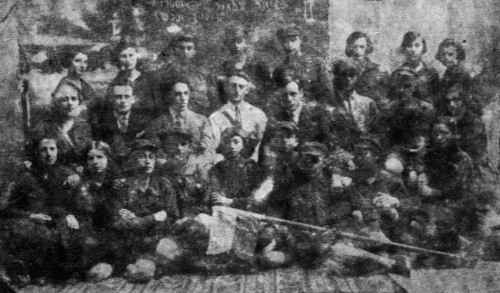
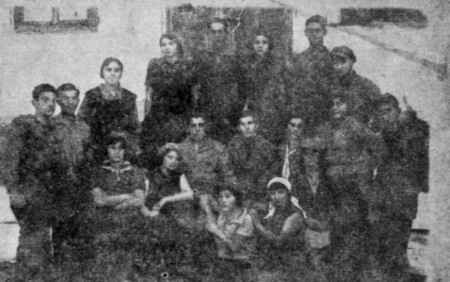
| The Core Group of “Ha-Shomer Ha-Tza'ir” in Ostroh |
|
|
Standing from the right: Sitsha Finkelstein (son of the teacher, Yosef Finkelstein), Siyoma Kristal, Feiga Finkelstein, Binyamin Charolin, Baila Goldenberg, Avraham Chorney.
Sitting from the right: Leib Shmidman, Sarah Goldenberg, Michael Friedman, Doba Vaynshelboim, Yehoshua (Shaike) Katzenblit-Katzir. |
a time when, with the permission of the local authorities, they marched in the streets of the city in their scout uniforms, decked out with their flags, to the rhythm of the Jewish command and Hebrew marching songs.
The longing to know and to learn spurred the leadership of the core group to arrange programs, lessons in Jewish and general history, anthropology, sociology, the world-wide workers' movement, the history of Zionism, etc. The method of a personal continuing education program was a light for education in the Shomer cell. Dozens of young people studied and deepened their knowledge in many areas of study outside of the framework of their daily studies in school. This was all done in order to provide the members of the Shomer fund with the understanding and the knowledge to achieve their missions in the Shomer path.
From the 1930s on, the institutions of learning expanded and deepened and the network of training experiences branched out. In those days
[Page 100]
there were many members of the Shomer movement in the training kibbutzes and, among them, members of the “Ha-Shomer Ha-Tza'ir” nucleus of Ostroh.
Among the leaders of “Ha-Shomer Ha-Tza'ir” in Ostroh were Minya Grainimas and Avraham Chorney. The two of them were educated people and popular in the group. Minya Grainimas was a graduate of the Ostroh secondary school and of the Law Faculty in Warsaw, was an elite of the Ostroh Jewish youth and, over many years, taught and directed and was a guide for youth in Ostroh. For a certain time, he taught in the “Tarbut” secondary school, had a developed character, idealist, saturated with Zionist ideas that were circulating at that time, and he threw himself heart and soul into the action and the struggle to bring the ideas of Zionism to fruition.
During the Second World War, he was drafted into the Red Army and fell in battle on the Stalingrad front in 1942.
Avraham Chorney was one of the spiritual leaders of “Ha-Shomer Ha-Tza'ir” in Ostroh. Having an academic education with broad knowledge of Judaism and general subjects, modesty and simplicity stood out among his outstanding qualities and he was a symbol of public and intellectual integrity, well-meaning and pleasant with people. Avraham Chorney had the privilege of immigrating to Israel, worked in instruction in many different schools, and was also a Lecturer in the Department of Judaism in Haifa until his last days.
| The Core Group of “Ha-Shomer Ha-Tza'ir” in Ostroh in 1926 |
|
|
First row below, from the right: Sonia Haibenman, Abba Shachtenaukas, Reuven Pinkerhut, Yesha Frenkel, David Muller, Mordechai Shkolnik (Oryon), Moshe Tolchin Rosa Borodavky, Sonia Kotel.
Second row in the middle: Fraida Shtrum, Nunek Margol, Minya Grainimas, Shlomo Rikman, Yesha Bokimer, Ben-Zion H. Ayalon, Binyamin Grines, Risia Balin.
Third row, above: Reizel Wexler, Sonia Radoshcher, Lili Bronstein, Basi Soroca, Shmuel Fisher, Zev Wasserman, Pesia Kirschon, Sonia Zilberberg. |
[Page 101]
| The Core Group of “Ha-Shomer Ha-Tza'ir” in Ostroh in 1938 |
|
|
“Gordonia”
The “Gordonia” branch in Ostroh was founded in 1925. Among the first founders were: Shlomo Bokimer, Shlomo Rikman, Yisrael Halprin, Eliyahu Kaplan, Zvi Mandelzweig and others. Young people from different strata belong to “Gordonia,” which educated based on pioneering Zionism, ethics, and love of work and nature, in accordance with the pure doctrine of the distinguished spiritual leader, A. D. Gordon.
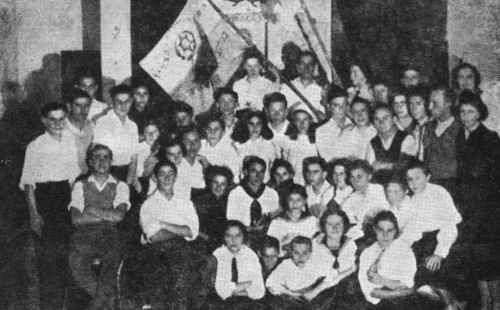
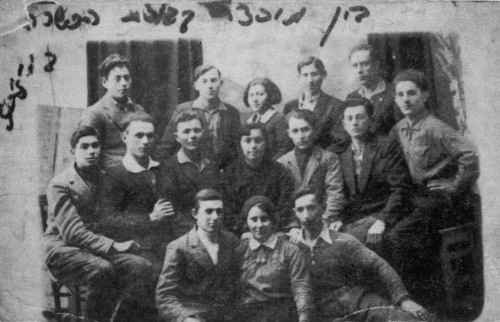
| “Gordonia” in Ostroh according to its levels and groups |
|
|
[Page 102]
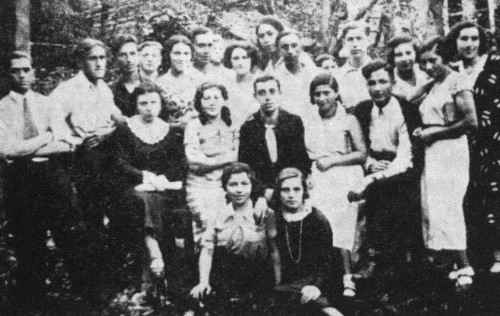
Nightly, the branch was full of young people who dedicated their time to study, song, and dance. The members of the Ostroh core group were exceedingly active. Life in the core group was lively and full of interest and content. In our core group, there was a wide variety of human material from different strata of the students and working youth, but the intimate atmosphere, almost familial, unified everyone. This atmosphere and also the social make-up of the core group gave a taste and desire for action. Coming together as a team, the songs and the dances, the lectures and the discussions, the parties and the celebrations in a cultural atmosphere and with great taste - all these things unified “Gordonia” in Ostroh.
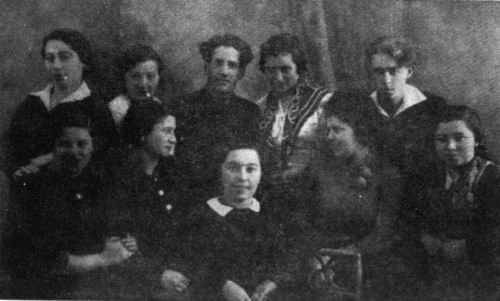
| The Founders of the “Gordonia” Branch in Ostroh |
|
|
Row below from the right: David Shtulmeister, Chana Barr, Manya Goldberg, Chaim Zeigerson.
Second row in the middle: Itka Iojzips-Gilbord.
Upper row, from the right: Yonya Bronfeld, Neta Chorovsky, Manya Lerner, Zelig Lerner, Grisha Perlmutter. |
Every member found his place and his satisfaction in the group and was very strongly attached to it. Hikes in nature in the area were arranged, summer colonies. As a branch that was one of the links in the chain of the national “Gordonia” movement, from time to time emissaries from the main administration and guests from the Zionist and kibbutz movement visited and every visit was a celebration of lifted spirits.
The members of the “Gordonia” branch in Ostroh went for training to training kibbutzes of the movement in various cities in Poland and, after a certain period of time, were granted permission to emigrate and they immigrated to Israel, and there is a portion of them who continued their lives in the kibbutz movement
[Page 103]
in Israel and some who continue their public lives in the country. The leaders of the “Gordonia” movement and the “Hit'achdut” party who contributed to this wide-ranging activity were: the brothers Eliyahu and Yaakov Kaplan, Leibush Biber, Shlomo Bokimer, Zvi Mandelzweig, Aharon Waldman, Chaim Finkel (secretary), Yehoshua Lerner, Charna Kripitzer, Chaim Zeigerson, Chentzia Gorinberg and others. Leibush Biber became known as an excellent speaker. Yaakov Kaplan fought with a partisan unit in the forests of Volhynia and fell in battle against the Nazis. Leibus Biber and his wife, the educator Feiga (Liss), were victims of the Holocaust.
The rise in political tension and the shadow of the coming war left their mark on the Jews of Ostroh. In the “Gordonia” branch, they read the articles in the Jewish press as a group. And the branch continued its intensive activity until the Second World War broke out.
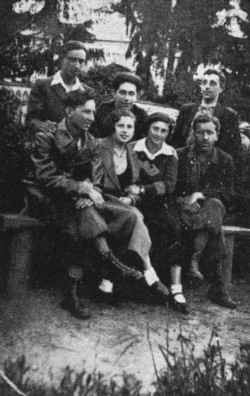
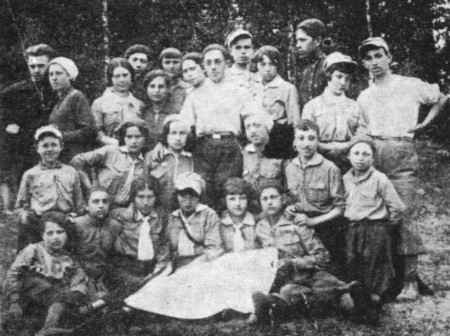
| Parting from Pesach Ashkenazi
before his Immigration to Israel |
|
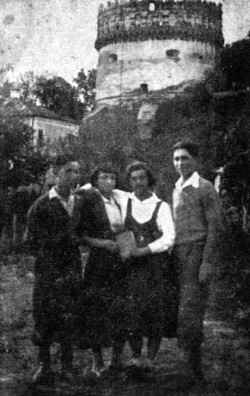
A Group of Members of “Gordonia”
against the Backdrop of One of the Towers in Ostroh |
|
|
|
|
Standing, from the right: Chaim Finkel, Aharon Lerner, M. Frielich
Sitting, from the right: David Klodenitzsky (Kovel), a member of the “Gordonia” center, Lina Vishnivsky, Dvora Mitshnik, Pesach Ashkenazi |
|
From right to left: Aharon Lerner, Ruth Rozenblat-Sapir, (-), Pesach Ashkenazi |
[Page 104]
| “Gordonia” Members from Ostroh at the Training Kibbutz at Mizoch: |
|
|
| Reva Yanover, Hinda Girstein, Lina Vishnivsky, Pesach Ashkenazi, and Fruma Melamed. |
| The students of the “Yehudit” group of “Gordonia” with the teacher Chaim Finkel |
|
|
Above from the right: Pesach Ashkenazi, Sukenick, Aharon Lerner, Goldberg, Yosef Finkelstein, Fruma Melamed, Zlata Shkulnik-Matzutsky, Zelda Icht, Menashe Lichtikman, (-), Blanca Sterngold, Chaim Roichman.
Second row in the middle: second from the right Y. Bark, Goldberg, Chaim Finkel, Shifra Yermolnik, (-), (-).
Below, third from the right: Kotik, Katzler, Toiba Finkel, (-). |
[Page 105]
| “Gordonia” Members from Ostroh at the Training Kibbutz at Mizoch |
|
|
Upper row: third from the right Hinda Girstein.
In the middle: fourth from the right Reva Yanover, first from the left: Zeidel Stern (Kochavi).
Below: first from the right Pesach Ashkenazi. |
| Ostroh Youth from a Training Kibbutz During a Visit Home |
|
|
Standing from the right: Chaim Roichman, Tzipora Goicherman, Asher Kripitzer, Hinda Girstein, Fruma Melamed.
Sitting from the right: Chaya Mushin, Raizel Zokenmacher, Reva Yanover, Lina Vishnivsky, Dvora Mitshnik. |
[Page 106]
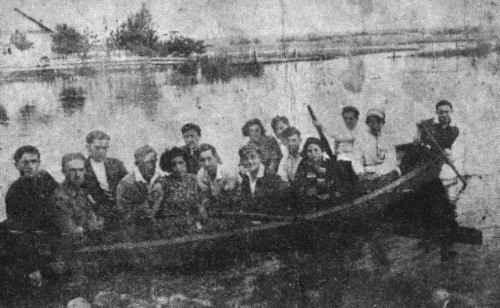
| “Gordonia” Members from Ostroh at the Calm Waters of the Horyn River |
|
|
Upper row from the right: Chana Gochman, Aharon Lerner, Dvora Mitshnik, Chaim Finkel, Pesach Ashkenazi, Raizel Zokenmacher, Moshe Rozenblat, Chaim Roichman, Leib Glizer.
Below from the right: Yaakov Rozenblat, two guests, Chaika Krayzelman, Izzia Lukatsh, Yehoshua Lerner. |
| Young People of the “Gordonia” Movement in Ostroh |
|
|
Upper row, from the right: Batya Militiner, Tzipora Goicherman-Melamed, Gitter (daughter of Yontel Menker), Menashe Lichtikman, Munya Frielich, Aharon Lerner, Manya Waldman, Yehoshua Lerner, Sarah Chimenes, (-), Pesach Ashkenazi, Moshe Rozenblat, Avraham Goz.
Sitting from the right: Izzy Lukatsh, Lina Vishnivsky, Chaim Finkel, Hinda Girstein, Rachel Icht.
Below: (-), Chaya Mushin-Hershman. |
This material is made available by JewishGen, Inc.
and the Yizkor Book Project for the purpose of
fulfilling our
mission of disseminating information about the Holocaust and
destroyed Jewish communities.
This material may not be copied,
sold or bartered without JewishGen, Inc.'s permission. Rights may be
reserved by the copyright holder.
JewishGen, Inc. makes no representations regarding the accuracy of
the translation. The reader may wish to refer to the original material
for verification.
JewishGen is not responsible for inaccuracies or omissions in the original work and cannot rewrite or edit the text to correct inaccuracies and/or omissions.
Our mission is to produce a translation of the original work and we cannot verify the accuracy of statements or alter facts cited.
 Ostroh, Ukraine
 Yizkor Book Project
 JewishGen Home Page
Yizkor Book Director, Lance Ackerfeld
This web page created by Jason Hallgarten
Copyright © 1999-2026 by JewishGen, Inc.
Updated 15 Feb 2026 by LA