 |
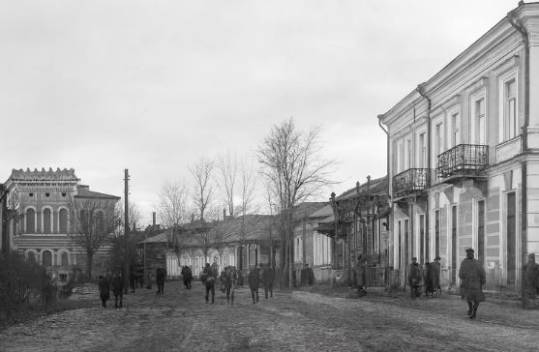
The Main Street Dubinska in Ostroh
|
[Page 75]
[Page 76]
[Page 77]
by Professor Yaakov Tolpin
Translated by Pamela Russ
Without a doubt, the Russian October revolution altered the story of world history. I do not have the knowledge to write an objective judgment of the revolution, but can only relate incidents to which I was witness (also in my place of birth, Ostroh). I also want to honor those people who genuinely believed that the time of freedom, for which everyone had waited for so long, had finally arrived.
On February 17, 1917, the rumors, that had reached Kiev from Petrograd, were already filled with unrest. The rage among the students was tremendous. In the university corridors, they quietly said that the police in Petrograd could not disband the masses of people who were rebelling and shouting, standing in long lines before the food stores. And not only in Petrograd, but also in Kiev, the capital of the food-rich Ukraine, where the earnings of the average person could not meet the prices.
In the Jewish student club, only important news was transmitted: there was a strike in the Putilov Zavod [industrial manufacturing complex], the large weapons factory in Petrograd. The workers went into the streets for a demonstration.
One day later, they already openly announced that a committee had been formed in which almost all of the members of the parliament would become part. This committee would conduct negotiations with the Tzar Nicholai. At the head of the committee would be the president of the parliament, Rodzyanko.
We had weapons, and each of us went around with a revolver and a red armband. I felt very uncomfortable when I went to get a haircut, and I had all these things on me. A few days after I came into the store, and the barber, and his customers moved away from me with respect, or fear. “Sit down, citizens.” Suddenly, the term “citizens” had become a term of respect.
The police and gendarmes remained quiet. Students, male and female, became armed police in the middle of the street.
[Page 78]
I myself saw how a giant gendarme, like a lamb, followed the order of a petite student, and gave her his ammunition.
In Petrograd, they stole the archives of the gendarmerie and secret police on the first day of the revolution. Experienced eyes found proof against the spies and provocateurs; they locked up the sadly famous provocateur Azef, and the leader of the Bolshevik initiative in Rumo, Malinovski, who was arrested and later shot. But we, in the Kiev student-militia, did not have any experienced judges of the archives. Poalei Tziyon was a small party, and we could not even pretend to have higher positions. So, I took the advice to study the gendarmerie archives.
I leafed through the correspondence, and was not sure if I would accomplish anything with that, until I suddenly saw a familiar name: Goldenfeld. I went through the letter-exchange between the Kiev gendarmerie and the director of the university about Vova Goldenfeld from my hometown of Ostroh, in Volhyn. Vova Goldenfeld organized a strike among the tannery workers in Ostroh. Even though his father was the boss of the largest leather factory in town, the strike mainly was against his own father. With time, he was arrested. The gendarmerie wrote to the director of the university saying that Goldenfeld was a socialist in the Jewish party of the socialist Zionists, and urged them to lock him out of the university. The director replied that the university would accept this. A little later, the father, against whom the son had petitioned the strike, sent his son out of the country to study at his own expense.
When I came home in the summer of 1917, to spread propaganda for the revolution and help establish a Poalei Tziyon party in town (with my brother's initiative), I met Vova Goldenfeld and we worked together. In 1977, when I was in Jerusalem, I called his son, a professor in the Jerusalem university – an important scientist in Kiev – who had left the Soviet Union with his family, including his mother. His father was no longer alive.
Contacts with the revolutionary organizations said that our militia would not exist for long. Our staff members knew about positions that they wanted to have for their parties. One time, after a late meeting, I left the university, along with two other university staff members. From their positions, it was known that they were politically connected as well as personal friends. They wanted to get to know me better, so one of them said, that was Dovnorzapolski, the son of a known reactionary, director of the commerce institute in Kiev, but the other? He had a freer, more homey, brotherly manner of behavior. He laughed comfortably, and spoke Russian with a Ukrainian accent: “We know that you are a member of the Poalei Tziyon party, as you said earlier at the meeting, you are a Jew. And what am I? I answered, 'You are a Ukrainian; Gomornik is a Ukrainian name.'”
[Page 79]
A loud laughter was heard on Valdimirskaya Street. “When I will tell you who is my brother-in-law then you will know who I am. My brother-in-law is Chaim Nachman Bialik.” I became still as a rock. His name was Gomornik! Later I thought that maybe the name used to be Gamronik.
The Red Revolution in Ostroh
When I think about the city of my place of birth, Ostroh, Volhyn, in the spring of 1917, I see agitation and enthusiasm on the faces of the people. I also see new hope on Jewish faces. The city had a population of about 20,000, 70% of which was Jewish. In the history of the Ukrainian, Jewish, Russian, and Polish culture, this city played a role. And this, now, a few months after the beginning of the revolution, deepened the hope.
When I returned home from Kiev, I noticed a difference in the connection to the revolution between the majority of young Jews and the older ones, as many of the younger Jews were familiar with the main ideas of the “forbidden” movements. The older Jews now were getting a flood of new ideas and new laws in the daily newspapers. But the names of the new heroes quickly became comfortable, and some of their publications quickly made history. The regulations of the justice minister of the temporary government Alexander Kerenski stated that all the boundaries of the Jewish rights were now removed; that all Jews now were allowed to live everywhere and to work in any area, including government jobs. He made himself a friend to the Jews. Some revolutionaries returned to Ostroh, three brothers, Bundists, from America. The Bundist party was renewed. When I returned, the Poalei Tziyon party was created, and the publications of my older brother were a great help. He was in town only for a short leave, as a newly graduated doctor who would be sent to the war front.
The Tzeirei Tziyon were drawing together as part of the Jewish youth, and they often discussed their Zionist-socialist inclinations. The disagreements between the Jewish parties became stronger. My new party friends, many of the serious youth, sometimes heard from a new Bundist: “We, Bundists, are the only representatives of the Jewish proletariat.”
The disputes between our parties were mirrored in the newly founded Soviet, the council of workers deputies in Ostroh. As everywhere, we were just following the example of Petrograd. There, important leaders of the radical parties were being hired. Their prestige was so huge, that the Soviets assumed the right to pass new laws.
It is very difficult to explain the changes from hope to deep upset that took over the Jews in Ostroh every day in the late summer of 1917 and beginning of 1918. They became very aware of the quick changes of events. Jews read and discussed with satisfaction about the meetings of establishments that would create a democratic constitution for Russia. The work was managed by special committees, supported by the government. Names from the famous Jewish social activists – such as the well-known advocates Vinover, Gruzenberg, the former “Bund” lovers – worked as healers of Jewish troubles.
It also became known that in the
[Page 80]
shared elections, each organized party had a list of candidates, each party with the same number in the entire country. The Poalei Tziyon party was number seven. They also let us know from the Central Committee in Kiev that in our Volhyn district the first candidate would be Sh. Anski, and the second candidate would be my brother Dr. Sh. Tolpin, who was still on the front. Sh. Anski declared his support of our program, and he would be on some of the lists of our candidates. The Jewish parties, through these activities, produced socialist activists in Ostroh, who demonstrated capacity with our challenges during the election campaigns.
My friends had a wonderful surprise for me when I came home for a short time. They designed evening courses for young workers. The courses were being taken with great interest by the youth, and the classes were full. Later, when B. Boruchov died, they named the courses after him. They existed for a few years until the region went under Poland, and the courses became integrated with the other schools. But another surprise, a tragic one, awaited us very soon: The first pogrom after the revolution happened in Ostroh. Surprised, angry soldiers, threw themselves onto stores and robbed from people who never worried about their needs. They did not kill anyone, but the majority of stores were run by Jews. This placed a terrible jolt on everyone's morale. Jews dropped their hands: “Where is our freedom? Our security?”
In the surrounding villages, the peasants, who had returned from the front with guns in hand, took over the grounds of the landowners. This takeover of land occurred more frequently all over Russia, more so than around us. The work of the Bolshevik party was felt everywhere. At the end of October 1917,
|
|
|
The Main Street Dubinska in Ostroh |
[Page 81]
the Bolshevist party felt strong enough to overthrow the government. With the help of its armed members, some were military units, they took over the government over the entire Russia, and evacuated the current leaders. The rupturing of the government across the entire country was huge. But the Jews asked: “Will they be following through with their promise of peace?” They tried. People read about the negotiations with the German head commander in Brisk over many months. And then, across the entire Russia, the calls of Leon Trotsky were heard, the leader of the Soviet peace delegation: “We are signing the peace agreement that you are giving us, without reading it. One year from now, we will agree to a real peace with the German revolutionary workers!” One year later, the agreement was dissolved because the German monarchy was disbanded because of their revolution.
For a moment, people breathed more easily. But now, when Russia formally lost Ukraine, according to the enforced agreement, we felt how false the position was of the young leader of the Ukrainian circle, who demanded the immediate separation from Russia. Germany supported that, but with its own demands.
It was already a few months since the circle in Kiev had established its own order. The plan was to meet the cultural needs of the significant national minorities, create ministries for them who would address their issues. There was actually a Jewish ministry created with Z. Zilberfarben, the leader of the united socialist party, as the minister. Local community elections went on in Jewish cities, also in Ostroh, understandably.
At the same time, the Jews felt a new movement. The awakened nationalist feelings of the Ukrainians brought back historical familiarities and sad ones in Jewish history, Cossack organizations. All of a sudden, familiar Ukrainian youth removed themselves from their Jewish friends. Many of them went around in nationalist Cossack clothing. There was fighting here and there about a random word. There was a sense of a pogrom waiting to happen. The clothing of “Sychoviks” [Ukrainian riflemen military units] and “Haidamakes” [Ukraine Cossack paramilitaries], terrified the Jews. The word Haidamek alone reminded them of the horrors of the Chmielnicki times. And the hatred against Russia, that raped the Ukrainian culture often poured itself out towards the Jews as well, because the Jews spoke Russian and rarely Ukrainian. The German army, right after the Brisk peace agreement, marched into the whole Ukraine.
On May 1, 1918, I was once again in Ostroh and delivered a speech to our friends. The meeting was held near the largest building in the city, where a German military unit had set itself up. When I finished speaking from the balcony and returned, behind me there were some German soldiers standing with machine guns. Later, the newspapers wrote that there had been an uprising in Kiev. They had taken down the Ukrainian government with the help of the German army and put up a ruler with the title of “Hetman” [commander in chief of the Ukrainian State]. This was a Russian general named Skorovatski, from an assimilated Ukrainian family.
Within some time, the pressure on the Jewish town lessened. But, in the town the Germans dealt very differently. There was thievery without limits. A peasant, who did not bring out what he was ordered to do,
[Page 82]
lost his life, and every day, in Ukraine, they shot and hanged peasants. The ground was returned to the former owners. The young peasants, who had returned from the front with weapons in hand, began fighting against the Germans, attacking trains, set fire to whatever they could. Their gangs were filled with hatred against everyone who had suffered less. They also let out all their anger against the city. That is, against the Jews…
The city began to feel a shortage of food. Every move increased the venom in the Germans. At a meeting of the Ostroh Jewish community council, a German military unit marched right in and ordered that the council be arrested, and the chairman was thrown into prison. The head of the community happened not to be there, and it was my brother who conducted the meeting, as the vice-chairman. Not long before this, he had come home on foot from the destroyed Austrian front. After a few days in prison, he was released. But good friends encouraged him to leave.
Suddenly, there was a great event: a revolution in Germany! The German front broke down, and Germans were fleeing from Ukraine. They only wanted to go home, and give back their weapons to Ukrainians who were attacking them. The white armies also broke down. The “Hetman” fled to Germany. Jews were terrified. At the beginning of 1918, the communist party declared: “The entire government, the Soviets!”
In Kiev, we heard that a new Ukrainian ruling was being set up. The Jewish population was now behind the independent Ukrainian rule, which was re-establishing the autonomous institutions of minorities. A. Rewutski, the chairman of the Poalei Tziyon, was the minister of Jewish issues. He immediately received reassurance from the new rule that Jews would be protected. But the person with the most knowledge in the government immediately became Symon Petliura. He called himself the Chief Commander. His assistants were commanders, and his army of peasants, formerly soldiers, definite chauvinists, were angry at everyone. But the Jews felt the rage more than anyone else.
The terrible times of the pogroms brought killings on the Jews without reason. Other than the army, bands of all kinds of “chief commanders” were at the head. They worked in their areas, and the Jews were the victims. Some argued: “You cannot fight in our regions, we do not support you, but Jews have money. You have to give us so much and so much as a “contribution.” If not,” … and then there were pogroms everywhere.
Two youths went to the train station in Ostroh to receive their merchandise. There was an “army” standing there, and the chief said: “They are probably spies.” They were shot right there. A wagon driver was bringing Jews to the station and then returned halfway there. A band had killed his passengers….no one stayed alive… sometimes you don't know who you are dealing with.
Very quickly, a meeting was called together of Ostroh city councilmen. In the room where the meeting was held there stood a military man, and I did not know to which army he belonged. Not him, not his companions, none were Ukrainian, they simply wanted to do good for him. His regiment, he said, needed clothing, boots, food, and more and more… “We will take it all from you tomorrow morning at the right time,” he said. Everyone saw black before their eyes. “I would not want my soldiers to have to take it all by themselves,” he said as he was leaving. And then the terrible news arrived: Three thousand Jews were murdered in cold blood in Proskurov.
[Page 83]
A unit from the “Red Guard” passed through Ostroh a little while earlier, en route to help the Red Army, which was headed towards Kiev. An unfamiliar young boy came into our house, gave me a letter, and left. The letter was from Ben Tzion Melamed's son, my dear student in the Poalei Tziyon party. He wrote:
“I learned about socialism from you. And now I see that you are not yet with us, not yet joined with the real socialist revolution. How is that possible?”
I went back to Ostroh much later, after graduating from university. One authority pushed out the other, pushed it out from our region, and then with time, it also got pushed out. The city was already in the hands of the Red Army, then went over to the Polish army, and now was back in the hands of the Soviet Union… Victims, innocent victims were constantly dying, and there was no major change in security coming any day soon. We lived through an extraordinary picture of war – a meeting with the cavalry army general Semyon Budyonny. Like a tremendous storm, they ripped through the city with raging screams of the fiery Cossacks: “Give up Warsaw!” Horses and Cossack riders, who had been together for years and understood each other very well, were running along horses, who had never yet run in war, maybe luxurious horses, and some working horses, some without saddles, riders with Cossack guns, others with hunting guns – and others went with the Cossacks, some with Tartaric faces – and the pressure on the Polish army, I think, did not stop. But in less than a week – the rush went in reverse, from behind Warsaw…
In Ostroh, the officer of the Soviet division appeared. Our portion of Ukraine was given over into the possession of his hands. With fear, Jews heard that this was the 44th Ukrainian division with the infamous regiments who had created many horrific pogroms in Jewish cities. The second Bogunski, the Tarashchanski, and other regiments in which there were still many Petliura members, who had turned to Bolshevism after a lost battle. It did not matter very much to them in which army they now belonged. They made many pogroms wherever they could. But my fear for the Jewish Ostroh changed during the chaos, when I became familiar with the politics of the division. I encountered a Jewish intellectual, an exhausted young man in his thirties, with two heavy revolvers hanging from his belt, which caused him to bend over. He edited the newspaper of his division and wrote leading articles every day to empower the communist spirit of the soldiers. His name was Dr. Tcheskis. He was a philosopher from Sorbonne and came from Paris to work for the revolution.
I had a mission to gather together our culture league in Ostroh, that was founded before the Soviet army had taken over the city, and negotiate with the education commissioner for the privilege to manage the Jewish schools as before. For the time being, we were given this privilege. The political committee assisted in bringing together all the teachers from the administrative subdivision. So, I had to create the plan with him and then gave him technical information as the local instructor.
[Page 84]
After this gathering, I met him a few times, and then lost him. Years later, in the Boston area, I met his older brother, a professor of French literature, who had come over from Iowa State University to Brandeis University. Each time we met, he asked me to tell him everything that I knew about his brother, things that he knew nothing about. Who knew what kind of fate he had in Stalin's time!…
The education commission gave me permission to go to Zhitomir to see how they had set up the Jewish schools in the province. My real intention was to visit the gravesite of my brother who was killed by the Petluiraniks when he served in their army as a mobilized doctor. His gravesite was in nearby Berditchev. On the way home, on a very hot day, I went on foot from the train station, seven or eight times, with a heavy sack of books and propaganda literature, which they told me strongly that I should bring with me. I was very tired and hungry. From a distance, I saw a dead body in the field, and then another. Who knew what they had fought for. I remembered my childhood friend from Ostroh, Nuske (Nossen) Perlmutter, who died a short time before this in a nearby village. He had “served in the government” after he came home from Austrian imprisonment, and had nowhere to go. He was sent with a Red Army unit to acquire bread from that village for the army. They killed all the peasants, tore them to pieces. The army killed them in the village and burned them all. But Nuske was nowhere. I heard a bird singing over my head. Another bird answered him out in the field. I stopped, put down the heavy sack, and sat down to rest for a bit. I think: “Is there any place on this earth where a person can still enjoy things? Where you can sit with family, with friends, and just chat? Chat about just regular things? And be quietly happy? Has this passed for me and for my family forever?”
My entire life, since that afternoon, was lifted from the mood in that hour.
Original footnote:
by Freida (Gurin) Kolpanitzki
Translated by Pamela Russ
Sadly, I am the only remaining witness who is fit to describe a region, which for certain reasons, was not described appropriately in its full measure: This is the story of the Bundist movement in Ostroh, better said, of the labor movement that was run by the Jewish workers' union in our city.
As a result of the failed revolution in Czarist Russia in the year 1905, a huge cloud of suppression and arrest spread among the worker elements and, understandably, did not leave out the Bundist movement as well. A number of comrades were sent for many years of forced labor to Siberia, some put effort over time into fleeing to America in order to be able to transplant their revolutionary activities there. Understandably, those who remained in Russia continued their activities in illegal ways, and they were harassed with suppression, arrests, and forced eviction to Siberia. These types of devoted and earnest Bundist activists also existed in Ostroh. And even though their activities were strongly contained, it was all felt in the social life in the city. The following comrades were involved with the Bundist activities: Niunye Brum and her husband, Yankel Gurstein, Adele Zussman and her husband Avraham, a stranger and his wife, someone who was left behind as a stranger, Rosenblum. These active people, who existed in a situation of fear, suppression, and persecution from the Czarist authorities, and especially under the watchful eye of the Czarist secret police, did not give up their fight and remained loyal to their ideal of socialism.
After the outbreak of the February revolution in the year 1917, when Russia freed itself from the heavy Czarist regime, Jewish social life in Ostroh was revitalized. Also, the Zionist organization, which was semi illegal, began to run a multi-tasked institution. In the city, there were many demonstrations, manifestations, and people were filled with hope for a better future. It was more than natural that the small activity of the Bundist members also became revitalized, and the members threw themselves into active work with a strong vitality.
The first meeting of the old-new Bund took place in the small house of Niunye Brum with the participation of new, young members who joined up with the Bund.
[Page 90]
This was a worker's element that was hungry for knowledge and thirsty for education, and wanted to find in the aisles of the Bundist organization the right place to gain knowledge and at the same time to fight for attaining better life conditions.
This new stream of young, dedicated youth, brought in lively commitment to the Bundist organization in Ostroh. In particular, were two exceptional brothers, youths Leizer and Berl, who at that time returned from America with a huge pack of knowledge and with an even greater enthusiasm for future activities in the city where they had been pursued earlier.
At that time, Yoske Roitman also returned from consignment. He was a good, devoted friend, and a capable, influential people's tribune member, who, with his fiery speeches, tore through all the masses. The Bund in Ostroh, renewed with fresh, committed energies, stepped up to substantial work. Many different circles were created in various areas of socio-cultural life, such as politics, culture, professionalism, and electioneering.
The young activists, holding their breath, welcomed each meeting, which was attended by a large number of members and sympathizers. Thanks to this devoted work, new talents evolved. The work of the Bund, and the intense devotion of the members, was crowned with success and brought much desired fruits.
This quiet youth, who, other than learning in a cheder and never having attended elementary school, and did not have any real education, participated actively in the discussions at these frequent meetings, and the members demonstrated much knowledge in handling the questions.
On November 10, 1918, Poland declared itself as an independent country and its newly established army ruled over southern and eastern Ukraine. As a result of this move, Ostroh remained under Polish rule. Understandably, the situation changed. The Polish government declared right at the beginning of its existence that the Polish republic was built on democratic foundations, and that the Polish republic was democratic, but in practical terms, the situation was completely different. The Polish Sejm [parliament] passed heavy laws regarding the population in general, and specifically, for the Jewish population.
But disregarding that, was a full, rich life was felt in Poland on the Jewish street, and an extensive, full-blooded life pulsed with an interesting Jewish social life. The Bund existed legally and ran lively activities. The director of the Professional Organization was Mottel Goren; the technical secretary was Esther Stern. The Professional Union was divided into individual sections and was located in a rented locale by Shlomo Piromal on the wide street. Each vocation had its own location. When there was a strike and a fight took place to improve the working payment loans, or for shortening the workday, the strikers used the security of the Polish police, and the active members of the union were taken in for heavy trials in police districts, which were accompanied by verbal abuse, terror tactics, chicanery, and added beatings. But this did not scare off the activists and still,
[Page 91]
they forged ahead with their tasks, hoping for a better future.
Along with the Bund, the “Culture League” was established in Ostroh, whose initiators were a group from the democratic intelligentsia in town, and at the head was Dr. Yosef Rosenstrum, Dr. Shimon Zweiman, Yoke Tolpin, Leizer Ginker, a Jewish teacher, Sarah Abelman, Tzina Rubin, a Jewish teacher, Polye Rubinstein, a midwife, Chaim and Babeta Katz, and others. These were highly intellectual, talented people, who brought a lively mood into the Jewish street (so much so, that their homes became a nest of comfortable, cultural gatherings). From the Bund, the following individuals were represented in the Culture League: Chana Shpielberg, Fani Tzimmerman, Mottel Gurin, Freida Gurin, Izak Averbuch, Yankel Sudgalter.
At that time, with incredible efforts, a Jewish school was founded with the name of Y.L. Peretz, under the direction of two certified pedagogues who were recommended by the Central Warsaw Jewish School Organization, Chaike Teitelbaum and Tzina Rubin. At the same time, a kindergarten was opened under the direction of two talented pre-school teachers, Sima Klepatch and Fani Tzimmerman.
The frequent visits of the representatives of the Central Warsaw School Organization were inspired by the high pedagogic level of the Culture Institutions, but the Polish government agencies looked with a crooked eye at the activities of the Jewish school and did not acknowledge them. They systematically harassed the directors of the school. As a result of these systematic repressions and persecutions against the active members of the Bund and Culture League,
|
|
| The administration of the kindergarten in the 20s | |
|
From right to left: Machla Kuperstein, (–), Chana Spielberg, Chaim Farkas,
kindergarten teacher Dina, Rubin, Fania Klika, Yaakov Sudgalter, Freide Gurin-Kulpnitski |
[Page 92]
the Jewish school was locked up in the year 1921. The kindergarten existed until 1923, supported by the drama circle that had its income by presenting theater performances dedicated to the kindergarten.
The kindergarten was once visited by the writer Peretz Markish, who was inspired by the young children's singing, as they sang Jewish children's songs with great talent. But this kindergarten also irritated the eyes of the Polish authorities, and as a result of the repressions, the kindergarten was shut down in the year 1923.
The Culture League opened a library of collected books. It was open daily, and operated as a full-fledged professional library. The young, new, evolving workers very hungrily swallowed the beautiful, Jewish literature.
Also, the Drama Circle of the union was comprised of very talented members, among whom were Gittel Gibel, Yoel Abrech, Yermiyahu Kuzir, Mottel Gurin, Niunye and Shimon Tzweiman. The Drama Circle was operated by a talented stage manager, Shubinov, a newcomer from the Soviet Union. He prepared interesting performances from a choice repertoire of the best pieces of the time. But the systematic repressions by the Polish government upset the regular activities of the Drama Circle, and locked its development.
At that time, in Ostroh, there was also a new development of a professional Jewish opera theater under the direction of the successful, professional artist Sterngold, who was at a very high musical level, and chose the Jewish people in Ostroh.
When the split of the Bund into the “Kombund,” which had a communist world view, came about, a
|
|
| Freide Gurin-Kulpnitzki, the mother Bluma Gurin, the brother Motel Gurin |
[Page 93]
communist group in Ostroh materialized under the mask of a professional union, that carried out political activities.
As a result of a great provocation in Volhyn, in December 1929, a huge wave of arrests began. More than 1,000 arrests were made, as people were locked up in various prisons in Poland, Volhyn, and other cities. Also, in Ostroh, there were six arrests made, and they were convicted to long-term imprisonment, according to the judge, in the well-known diamond lawsuit. Among those who were imprisoned, were: Freide Gurin for seven years, Mottel Gurin for five years, Esther Stern for four years, a Ukrainian comrade for six years, Raizel Grechman for three years, and Baila Kuperstern for three years.
But in spite of the chicanery and judgement of the Polish authorities, the union continued to exist. It did not diminish its professional and political activities, but understandably, continued on a smaller scale. My brother and I, after getting out of prison, no longer had the opportunity to live in Ostroh because the police chased us out of the city, and first we returned to Ostroh, when the city was taken over by the Red Army, after the collapse of Poland in the year 1939. But tragically, this period of time was short. The wandering had begun with the outbreak of the German-Russian war in June 1941, and ended with my Aliyah to Israel.
|
|
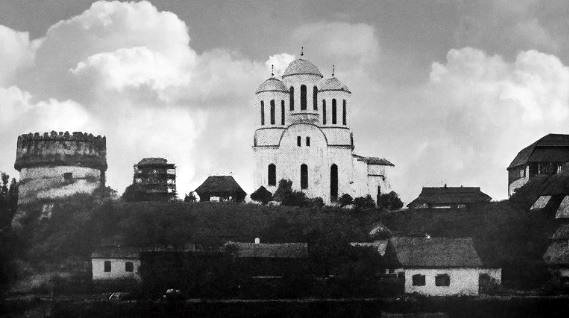
| The remains of the fortified wall, with a fortress on the right and a tower on the left |
|
JewishGen, Inc. makes no representations regarding the accuracy of
the translation. The reader may wish to refer to the original material
for verification.
JewishGen is not responsible for inaccuracies or omissions in the original work and cannot rewrite or edit the text to correct inaccuracies and/or omissions.
Our mission is to produce a translation of the original work and we cannot verify the accuracy of statements or alter facts cited.
 Ostroh, Ukraine
 Yizkor Book Project
 JewishGen Home Page
Copyright © 1999-2026 by JewishGen, Inc.
Updated 03 Aug 2026 by JH