[Page 174]
The Jews of Koło from Overseas
[Page 175]
[Blank]
[Page 176]
Koło Jews in the United States
By Sol Marisan
Translated by Janie Respitz
In New York, the largest city in North America, you can find people from all
continents, countries and cities. Among them you can find people from our
Koło.
The first people from our city to arrive in America came in the second half of
the 19 th century. There are people that actually say it was 1870. If we don't find an
earlier year, we can establish it has been approximately 90 years.
Like all immigrants in those years, they became Americanized in the eastern
part of metropolitan New York, on the “East Side”. They were
predominantly workers, common folk, searching throughout the continent for a
better life. Although they were far from home, through suffering and hardships,
they never forgot the city of their childhood.
In 1875 a group was organized by people from Koło and surrounding towns.
They named the group “The Society of the love of Abraham, Sons of
Koło” and with that, expressed their respect for the rabbi from
Koło at the time whose name was Avrom (Abraham). The main purpose was,
like all other immigrant societies, to provide mutual aid during illness,
deaths and other events. At one of the first meetings, it was decided to open a
prayer house for the members of the society.
They did not have a public premises. The first consultations took place in
private dwellings, most often on Delancey Street, in the heart of Jewish New
York. In order to see each other more often, the members of the Koło
society prayed together on the Sabbath and holidays in the home of one of the
members.
After a short time, the society, with great effort, acquired their own lot, a
piece of terrain in the Washington cemetery. This did not happen easily and
they were excited with this first step.
With the new wave of immigrants, among them Jews from Koło, the number of
members in the society grew. At one meeting it was decided to build their own
synagogue. Said and done. They bought a
[Page 177]
house in New York at 48 D Avenue. The prayer house was situated on the first
floor and the apartments on the second floor were rented out.
A fire which broke out in the building destroyed everything. The members were
extremely distraught about this incident and looked for comfort in renewal.
Within a short time, at the spot where the burned building stood, a new one was
built.
The struggle to exist led the Jews from Koło across the United States,
where they searched for a livelihood. Besides the society in New York, a
Koło society was founded in Chicago.
Jews from Koło in America did not forget about their brothers and parents
in the old home. They supported them however possible: they sent money for the
interest free loan fund, helped the Jewish high school, the “Tree of
Life” school, and on holidays they sent packages for the needy. The help
continued regularly until the outbreak of the Second World War.
Much of the aid activity was organized by the “Koło Ladies
Society”. Unfortunately, this women's society unraveled a few years ago.
With the expansion of New York city, people from our town, like many others,
left the city centre and gravitated toward the suburbs. Hardly anyone remained
in the area near the synagogue. From time to time they came there for meetings,
but not for prayers.
As a result, the society fell into a difficult financial situation. In 1945 it
was decided to sell the synagogue building to the city administration of New
York. The building was demolished and, in its place, a large apartment building
was built.
The activity of our society continued. Meetings took place once a month in a
rented hall in the Statler Hotel on 33rd Street and 7th
Avenue in New York.
From 1935-1939, on the eve of the Second World War, a few young people from
Koło arrived in America and became members of the society. The numbers did
not increase since at the same time, some of the first devoted members had
passed away.
After the war we received news about the few survivors from Koło who were
now spread out in various countries. The younger members
[Page 178]
of our society organized a large aid campaign to help however possible. They
joined the campaign to support various institution such as: United Israel
Appeal, the Histadrut (Labour Union) Campaign, Israel Bonds, hospitals and
others. They also sent packages and support to Jews from Koło around the
world, the Jewish Aid Society in Koło, containing money and clothes.
|
|
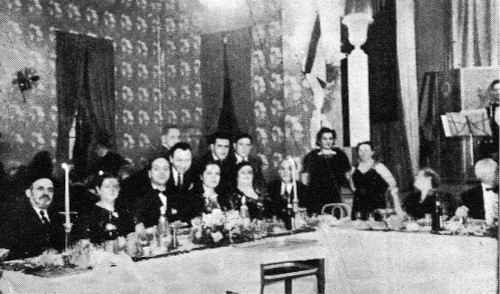
Celebrating 65 years of the “Abraham Society, Sons of Koło” in
New York
From right to left:
Yakov Karlinger of blessed memory, one of the founders of the society and
president for many years; his wife; Peretz Brand of blessed memory; his wife;
Mrs. Elsin Brand, Ruven Brand; Mrs. Natan and Rabbi H. Nata of blessed memory.
Standing: H. Vilams, M. Roykh and S. Marisan.
The celebration took place on December 29th 1940.
|
In 1946, in memory of those from the Koło Jewish community that were
killed, the society organized a memorial gathering. Those who delivered
eulogies were: Rabbi Toybnfligl of blessed memory and the journalist Yakov Pat.
Pat offered his impressions on his visit to the destroyed Koło. From that
day on the memorial day was observed every year for the Koło martyrs.
A few survivors from Koło came to America after the war. Today, the
society of Jews from Koło, “The Society for the Love of Abraham”
numbers over one hundred members. This is the only organized body of Koło
Jews in America.
When the “Society of Descendants from Koło in Israel” decided to
publish “The Book of Koło”, they also sent a summons to our
society
[Page 179]
in America suggesting collaborative work.
The writer of these lines, recognizing the indifference among the leading
members, called a meeting of the Koło society in New York and created a
Memorial Book committee which brought desirable results.
The committee issued an appeal in Yiddish and sent it to Jews from Koło in
America and Canada. The appeal was good. The artist Harry Daniels donated one
of his paintings for the cause and it was sold through a lottery.
Advertising for the “Koło Book” appeared in the Yiddish press in
New York and Chicago. The committee also sent copies of interesting historical
documents about the Jewish past in Koło for the book.
|
|
|
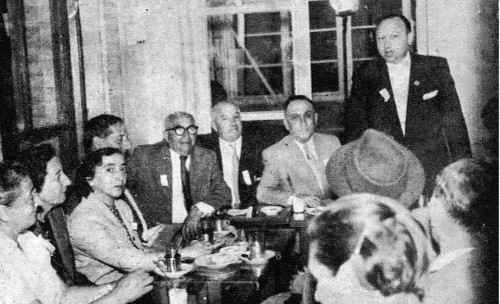
A banquet for our member S. Marisan during his visit to Israel
|
[Page 180]
The Founder of the Koło Society in London
By Sh. R. Volf
Translated by Janie Respitz
|
|
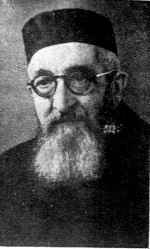
Reb Eliyahu Friedland
of blessed memory
|
It was the beginning of the 1930s when I read a few lines in the London Yiddish
newspaper which grabbed my attention. The content was a complaint against the
Koło Jews in London, asking why they were doing nothing to help their home
town and not following the example of other immigrant societies. The appeal was
signed by: E. Friedland, Manchester.
The author of the appeal was unfamiliar to me at the time and therefore, I did
not believe there would be a response. A short time later I read a second
request from this same E. Friedland. That is when I decided to call upon the
Jews from Koło living in England to do something for their city of birth.
I communicated with some of my friends about activity in the society and they
agreed on the content of a new appeal which was immediately published in the
London Yiddish daily “Di Tzayt” (“The Time”). The first
meeting was called with people from our town, and among the first, of course,
was Reb Eliyahu Friedland,
[Page 181]
who came from Manchester. He was in seventh heaven.
Those gathered were convinced there was a field of interest in this activity
and a lot could be done. The following were on the elected committee: Moishe
Veber (chairman), Morris Kurtz (treasurer), Rotbard (secretary), Daniel
Bernshteyn, Resler, T. Verber, A. Zlotnitsky, E. Brukshteyn and others.
The society ran very good activities, carrying out successful undertakings.
Larger and older societies were envious of our successes. Significant sums of
money were sent to Koło to various welfare institutions.
I would like to mention that the success of our society was largely due to Reb
Eliyah Friedland of blessed memory. He was the pillar of strength that drove us
to act. I also took advantage of my work at the newspaper “Di Tzayt”,
writing weekly notes and appeals calling upon Koło Jews in England to come
together. Our townspeople showed interest in following the program of the
society. It is worthwhile adding that the ads in the newspaper were done for
free.
The meetings where Rabbi Friedland and his wife attended attracted a large
crowd. No one from our town now living in London stayed home when it was
announced there would be a meeting with our guests from Manchester. The hall
and the corridor would overflow. It gave us great pleasure to see Friedland
among so many Koło Jews, and his face shining from joy.
The contact among Jews from Koło became stronger and warmer. Many
Koło Jews living not far from Manchester would visit him. They were
received with friendship and love.
The society continued its activities until the outbreak of the Second World War.
Reb Eliyahu Friedland was known for his generosity and donations to various
welfare institutions. He never refused an appeal and donated large sums to all,
but first and foremost to Jewish institutions in Koło. It gave him great
joy to help Jews from our town. Before the outbreak of the war, he brought the
Kutzer family to England,
[Page 182]
(a son of Gershon Kutzer, who was in Germany). During the war, Ezra Reykhert's
grandson came to London with the Polish army. I wrote to him about this and
received a prompt reply: food packages and money were sent to him. Reykehert's
grandson spent every furlough with Friedland in Manchester. He was treated as
one of the family. He was not the only one to benefit from Reb Eliyahu's
generosity.
As already mentioned, the work of the society was stopped by the outbreak of
the Second World War. As a result, Friedland suffered immensely and many times
turned to me to once again to wake up our townsfolk to act. The harsh air
attacks by the Nazis disrupted all our plans. London suffered greatly from the
hateful bombings. Since the population was spread throughout the country, it
was difficult even to assemble a quorum (ten men to pray). Friedland was not
satisfied with my arguments, he encouraged activity under all conditions.
After the war, Friedland once again raised the question: when will we renew the
work of our society? We tried but without success. A few of our townsfolk
remained in London, and the rest were badly affected by the great Jewish
tragedy. Everyone lost their nearest and dearest from our old town of Koło.
Friedland began to work with his own hands. He wrote to the Koło city hall
to send him a list of Koło Jews who were saved and survived. It was then
that we found around thirty people who returned from the camps or had escaped
to Russia. Packages of food, money and clothing were sent to them. Reb Eliyahu
was not very rich, but he had a good heart and was very generous: he helped
those in need and displayed great self-sacrifice toward Jews from Koło.
His only son, P. Friedland, inherited all these great qualities from his father.
London.
[Page 183]
The Story of a “Ma'apil”
By Michael Nelken
Translated by Mira Eckhaus
One of a thousand
Like many of the citizens of my town who had no chance of arranging their lives
for the future, neither in their hometown nor in other cities across Poland, I
decided to emigrate, to seek a place to live and work. I spent more than twenty
years in Koło, the best years of my childhood and youth, and it became
alienated from me.
The immigration conditions were quite difficult: leaving Poland and entering
another country was a truly fantastic dream. The financial means at my disposal
were limited and the “certificate” allowing permission to enter the
country – was not granted to everyone.
I felt the ground slipping from under my feet, and I decided to leave and come
what may! I went to the city of Gdańsk, which is Danzig, from where you
can reach all the continents of the world. Of all the border cities in Poland,
I chose it because it was a free city state, under the protection of the League
of Nations. The Poles had the right of entry into this city. In addition: in
Danzig and its surroundings lived about eleven thousand Jews, refugees and
immigrants from Russia and Lithuania. Most of them considered this city as only
a transit station. From here they sailed by ship legally, or by circuitous
means.
Peddling, Gdańsk style
On the 17th of May, 1934, I arrived to the old port city, where buildings from
the 16th century remain. On the day of my arrival, I found a place to stay, and
went out to wonder about the lives of our brothers, the Israelites, whose
situation was similar to mine. What do they do and how do they save money for
the expenses of the journey? I will not list all the livelihoods, but I will
mention the main one, which was – peddling. The majority of the
immigrants, who settled here in temporarily, were engaged in selling ready-made
clothes and notions. In this way they supported themselves and also saved a
little, in order to carry out their plan and realize their dream.
I wandered around the villages near the city with a suitcase full of notions.
Every day I worked at this job from morning until noon, and I was not lucky
– I made a little money.
When I returned to the city, I devoted my free time to a “purpose”,
which we did not explicitly state. I will only describe a few of the types I
encountered on my way, who handled hidden matters, they are called
“machers”. Each of them seemed to me like a sphinx. I could not tell
their nature. Some of them seemed very kind, others were rude, as if from the
underworld. The “machers” were engaged in organizing convoys of
illegal immigrants to the Land of Israel. The price was
[Page 184]
2500 Polish zlotys on the boarder. Whoever paid this amount was provided with a
passport and entry visas.
The main action of the “saviors” took place in a hostel at 60
Hondgasse Street. Here gathered all those whose souls were bitter with
anticipation for the ship that would take them to the land of their dreams.
Here, you could also encounter the stiff, irritated faces of people who would
bite their fingernails in public out of tension.
They came to this inn, ostensibly to eat “Haimisheh Mitagen”, but the
main purpose of the meal was to negotiate with the “machers”, who
came here with new offers every now and then, as agents for shipping companies.
After I had figured out the nature of these people, the time had come to put my
plan into action. I contacted a fellow on whom I had pinned my hopes. He
promised to obtain for me a sailor's passport, who is working on one of the
ships anchored in the harbor. The offer greatly appealed to me.
We went to the beach, entered a tavern and met a Norwegian sailor named Knut.
The negotiation was short: for a sum of money my name was changed and I became
a new person, Christian Knut.
The threads of the plan were woven in my mind: I would sail from Danzig to
Germany, from there I would move to Belgium and continue to France and sail to
Lebanon. From Beirut – the main port in this country – I had to
travel 152 kilometers and I should be in the Land of Israel!
This plan was not carried out. One day I went out into the streets of the city
and met I. G. Grossman, who was of Koło (now living in Tel Aviv). We spoke
a little and I saw that he was knowledgeable about the “matters”. He
advised me not to make my way to Germany through the “corridor”, due
to the severe inspections. The Hitlerite police were extremely strict. If, God
forbid, they recognize my Jewish nose on my face, I will not get out alive.
I made some changes to the plan: I would set out in an unconventional way, not
as a sailor but as one of the citizens of Danzig going to Germany for a
weekend. To this purpose, I purchased a suitable suit, stuck a pipe in my
mouth, and in one hand held a German newspaper and in the other a striped
blanket that could be used to sit on the grass.
On Saturday night, I crossed the border successfully and headed for the city of
Königsberg. I breathed a sigh of relief. How good I felt that I managed to
leave Danzig. It had become a burden on me. I witnessed the Nazi terror that
began to give its signs. The German residents of this city were ordered to mark
their houses with flags with a swastika. Threats against Jews were made
publicly. Every Jew whose face testified he was a Jew was beaten in broad
daylight.
From I set out for Berlin. I didn't even stay there for a few hours. When I sat
in the train, I pretended to be indifferent, but fear grew in my heart: I had
now entered the mouth of the predatory beast, would I come out safely? Here I
was interrogated by the supervising inspectors, who demanded to see
[Page 185]
my passport. I pretended to be a Norwegian who doesn't understand German. At
one of the stations, two German policemen stopped me and asked me again:
Passport? I proudly took out Christian Knut's passport and heard one of the
security guards whisper to his friend in German: “I thought it was a
Jew”. They didn't hold me back and allowed me to continue on my way. An
inner feeling called to me: Don't stay overnight on German soil! I obeyed this
feeling like a good boy and continued on to the city of Cologne on the Rhine.
I got off in this city and turned to the Jewish community, to guide me how I
could reach my desired destination. I received from one clerk the address of a
Jew living in Aachen. In the dark of night, I arrived in this city and from
there one step towards the border. I indifferently followed the instructions
and found the man I was looking for. The address did not disappoint.
I don't have the talent to describe the hours of great tension, when I was led
to the crossroads near the border. A dense forest appeared before me, and I
stood by a path that ran through it. Is this my path? As a leisure traveler, I
walked along it and it was very long, as if it had no end. For several hours I
walked without obstacles and suddenly – a burst of gunfire. I lay close to
the ground and did not move from my place until dawn. When the day broke, I
began to advance along it and reached a rural settlement. I infiltrated it, as
if I were a local. Fortunately, I reached a Belgian village – I escaped
the greatest danger.
I entered the village inn to rest a little. I did not stay there but continued
on my way to Brussels.
In Brussels, the capital of Belgium – the second chapter of my travels
began. I must say a few sentences about this city, which restored my peace of
mind and equilibrium after days of unusual tension. I checked into a hotel and
stayed there for a few days. Many Jews lived in this city, but I had no chance
of being assisted by them. In this industrial city, which dealt with the lace,
carpet and weaving industries, I found no sympathetic ear. The lack of money
forced me to wander far away. I had only 50 francs left in my pocket. I had
heard a lot about a large Jewish center in Paris, about the Jewish Quarter,
about “Amcha” and about the Latin Quarter, 7 Rue Fontage – the
place of the Tzahar (Revisionist Zionist Alliance) center.
The greatest experience in Paris was my meeting with Ze'ev Jabotinsky. When I
came to the Tzahar center, he welcomed me warmly and listened to my concerns.
As one of his admirers, I asked him for advice and guidance. After many things,
he said to me, among other things: “my friend, I really envy you for going
to Eretz Israel and the English people there still don't know you…”
He offered me oranges and gave me a sum of money for travel expenses to the
port city of Marseille, from where ships sail to Lebanon, which was under the
French mandate until World War II. From there – one “jump” to
the Land of Israel.
In Marseille, many obstacles accumulated and put my strong will to the test.
[Page 186]
I walked around in this city, which was full of immigrants and residents from
all over the world, and I saw the vast port with nineteen kilometers of piers
and docks, and salvation was far from me. Several thousand Jews lived in this
city, and I could not find a common language with them. An economic crisis was
going through this city, and it was difficult to get any kind of work. In the
old city near the port, in the cafes, I met hundreds of young men from Poland,
who had come here to immigrate to the Land of Israel – and they were
depressed and hungry.
Many ideas sprang to my mind, and all were carried away by the wind; nothing
remained of them that had any hold in reality. There were days when I was
literally starving for bread: my pockets were empty, as was my stomach. I
wandered the streets, gloomy, daydreaming about the immigration to the Land of
Israel and worrying about getting a slice of bread.
I stopped by the window of a store selling children's toys. The spring-loaded
toys caught my eye. They distracted me from the hardships and the bitter
reality. I stood for hours by the window, forgetting my hunger. Suddenly I felt
a great hunger and wanted to go back to my overnight spot, to the bridge, maybe
I'd find a slice of bread there that someone had left in an abandoned backpack.
– What is your request, sir? – A voice surprised me. It was the owner
of the shop who took an interest in me. Fortunately for me, he understood a
little German and we started talking. After some negotiation, he agreed to my
offer, to deliver toys to me on commission. Every morning, he would give me
goods on credit and in the evening, I would pay him for the toys I sold. It
never occurred to me that this business, which I did not believe in, would
allow me to make a decent living and would also allow me to save a large sum,
about seven thousand francs, for travel expenses.
In those days, I was shaken by an unexpected incident that happened to me.
While I was sleeping in a hotel, the police came and took me to prison. What
was the reason for it? After a few days in prison, I was released and learned
that I had been a victim: while they were looking for suspicious people, they
also imprisoned me, despite the fact I did not do anything… After this
ordeal, I decided to leave France and hasten my immigration.
Sailing to Beirut and from there to the Land of Israel
In August 1934, I sailed for Beirut on the French ship “mushroom”. My
companion on this journey was the illegal immigrant Z., whom I had met in
Marseille. A friendship was forged between as we shared a common destiny. The
ship docked at several ports on its way and also stopped at the port of Haifa.
I took advantage of the acquaintance I had made with the captain and asked him
to go down to Haifa for a short time, to enjoy the rights of a sailor and a
tourist. He acceded my request and gave me a special permission.
So, I said to myself: Why should we continue to Lebanon and from there reach
Israel, the land of Israel is ahead of us! We will go down to the beach and
wander the streets and never return to the ship…
So, I asked the captain for a permit for my friend Z. This request angered him
and he realized we were up to something. He immediately revoked my permit and
arrested me as I was very suspicious in his eyes.
[Page 187]
In Beirut I fell victim to a tip-off: they suspected me of espionage. They
searched my suitcase and found two passports, a Polish and a Norwegian. Again,
they put me in a closed car and took me to prison. They believed that this time
they had a big “catch”.
The prison conditions were harsh. My hair was shaved, my fingerprints were
taken, and I was thrown into a dark cell. I was alone. Of the Jews in the city,
who numbered about five thousand, none of them were interested in me. The daily
ration was a dry pita bread and a jug of water. At night they did not let me
rest, they interrogated me endlessly. A week passed like this. In the second
week of my imprisonment, I was transferred to a larger cell containing
prisoners from the Druze community, who were suspected of preparing a rebellion
against the French government.
Finally, they brought me before a judge, and he sentenced me to a month in
prison for possessing two passports. After one month, I was released.
I was only one hundred and fifty-two kilometers away from Haifa, and the
chances of reaching it were very slim. I no longer trust the various smugglers
who had misled me. I sought advice on how to cross into Israel.
When I approached the kiosk to buy me something to drink, I suddenly heard the
“Mame Lashon” (Mother Tongue). The kiosk owner, M. Shlezinger,
received me warmly and also participated in a significant portion of my travel
expenses to Israel. He even introduced me to Salomon, one of the smugglers of
illegal immigrants to Israel.
Salomon, who owned a cafe, was dressed like an Arab and spoke many languages,
including nonstandard Yiddish. I trusted this Salomon – only he would let
me into the Land of Israel! The days did not last long and the negotiations
were over. For a large payment, he joined me to a convoy that would leave one
day from the port of Sidon.
Salomon's assistants brought me to the city of Sidon, and there they joined me
with a large group of Jews from the Eastern communities, large families: women,
men, and children. The illegal immigration officers took pictures and documents
from us and threw them into the sea, lest we be caught and get into trouble. We
were people without citizenship.
We got into a fishing boat and my eyes darkened: the place was narrow, there's
room for thirty people, and we were about a hundred. There was no place to sit
and we were all standing next to each other, not moving either to the right or
to the left.
Before our departure, the guides said that the journey would be short, and
there was no need to stock up on food. Eight hours passed, and another eight,
and the longed-for shore was far away. For six days we were rocked in this
boat, and the hunger and thirst were unbearable. We saw all day long only the
sky and see, and there was no sign of land.
The children suffered greatly, crying non-stop, and the weak women also fainted
from hunger and thirst. During the day we suffered from the heat, and at night
the storms gave us headaches. To the hunger and the thirst was added a new
trouble: water had entered our boat and there was a danger that we would sink.
We pumped the water out with buckets and cups one night, and only then were
they able to plug the hole. The patience of the illegal immigrants ran out and
suspicion arose about the reliability of the guides. They pulled out
[Page 188]
knifes and threatened the sailors and the captain. Only thanks to a few wise
people was a killing on the boat avoided. After everyone has calmed down, the
sailors demanded that the passengers give them the gold they had because taking
the people on board was dangerous. After this appeal, they began a search and
took what they could find.
The boat docked half a kilometer from the shore, and we went down into the
water and managed to reach a sandy area.
After a long walk, we arrived in Netanya at dawn. We met a Jewish guard, a
Yemenite, and he gave us water. In his sukkah, we had our first meal: grape,
bread and watermelon.
The next day each of us received ten Grush, an identity card and short khaki
pants.
We traveled to Tel Aviv in a kibbutz freight car, because Netanya was under
British supervision.
[Page 189]
Migration
Translated by Janie Respitz
We are presenting here excerpts from a pack of letters, sent by members of the
Himmel family to their brother Mikhal HaKohen Himmel in Israel. The letters
were all written in different places in the Soviet Union where they were during
their wandering.
The First Letter
…I will describe a little about the cruel time when we were still at home
(in Koło), before we left for the Soviet Union.
The entire summer of 1939 we sensed war was approaching. As far as earning a
living, there's nothing to discuss. We ate what was prepared. Friday, the first
day of the war, at 11 o'clock in the morning, Hela and Manya were at the
“market” and heard an air raid siren. Police and civic militia
dispersed the crowd.
The next morning, Saturday, there was a notice in the newspaper which confirmed
everything we had been talking about for months. The war was happening. The
same day there were three alarms, however, we did not see any airplanes. At
noon, while eating, we heard the air raid of the bombardment. There was no
siren and as a result, many people said, it was the Poles. We went out to the
street and saw how they came from Kalisz Street and were flying toward the
train station. We clearly saw their numbers: twenty-one bombardiers. When the
first arrived at the train station they dropped a few bombs. That's when the
alarm sounded. There were many escapees at the station and 160 casualties.
Sunday was a day of airplane attacks. Every other hour – an alarm. It was
chaos. Everyone asked: where can we escape? The only response was: to Warsaw!
One could not find a droshky. A trip to Klodova
[Page 190]
cost 260-300 zlotys. The air attacks continued on Monday.
Around midnight, Lola Shubinska came to wake up Hela and Moishe – Mendl.
She told them to get dressed and leave town. The civil administration including
the police already left.
I went out to the street. It was crowded in front of every house. From the
cobblestones of the old marketplace until the Warsaw Bridge it was impossible
to pass. We decided to go to Pshaysht (Pshedetch). It was a small town that did
not have any strategic value.
We woke the children and started packing. We took two suitcases and a few
knapsacks. The expedition was composed of: Hela and Moishe – Mendl and
their children; me, Manya, my mother-in-law and Manya's brother.
We left around five o'clock in the morning. The flow of walkers and wagons was
larger than at night. When we arrived at Gutman's house, in the Warsaw suburb,
we heard an alarm: six bombs fell in the direction of the train station. In
Izik Khaim's dwelling which was in the above-mentioned house, we sorted our
things in our baggage and left some stuff behind to lighten our load on our
journey.
When we arrived at the cross-roads of Klodova – Dambia, there was a new
alarm. Standing there were Polish soldiers ready for battel. The alarm lasted a
long time.
We decided to go through the villages to avoid the highway. We walked toward
Khoyne. As we walked, we heard constant bombing. The villages near the highway,
we were told, were completely eradicated. When the highway was bombed, those
escaping ran to the fields and the pilots pursued them.
At night we slept in a village. The next day at noon we arrived in Pshaysht.
The town was over crowded. With help from Manya's family, we rented a flat for
one month.
After a few days people began to return to Koło. Moishe and I wanted to
know what was doing at home. In the city they already saw the beginning of the
destruction: where Zlate's house once stood,
[Page 191]
there was now a deep hole from a bomb; in front of Hirshbeyn's house, another.
At Reykhert's granary, a third. Half of Hirshbeyn's house fell, Nakhe- Ite's
house remained. At Danilevitch's house, the scaffold of his roof was broken. At
our house, the plaster inside and out fell off. All the widow panes were
shattered. Indoors, not a lot was missing. They removed mainly foodstuffs. I
remained at home for two days and then I left. Moishe-Mendl remained. One day
after Rosh Hashana I returned to Koło with Hela, the children, and Manya.
We took the sewing machines and small objects and returned to Pshaysht and
immediately began to work.
On the way we met German soldiers who were heading to Koło. (Until then
the Nazis had not entered our city). Wednesday morning, we heard what the
soldiers had already done: Tuesday they chased Jews with force from their work.
On that day my uncle Yosef and Shloyme Biezshvinsky were killed. Around 11
o'clock, when everyone was working, the city synagogue was set on fire. They
did not succeed in extinguishing the fire.
In Pshaysht as in Koło, they took the Jews to forced labour. We went every
other day or twice a week. When the commandant was mean the terror was harsh,
when he was in a better mood, it was a bit easier. Here as well the synagogue
was set on fire on the night of Shemini Atzeret.
We lived in a Polish house and the head of the household was the mayor of the
town. I did not go to work, they sent someone else in my place. In total I
worked once, digging out gusset.
Wearing the yellow patch was compulsory in Pshatsht as well. The last week we
lived there we had to wear the yellow patch on our backs. For a few days I did
not go out on the street in order not to wear this humiliating mark. Later we
got used to what we had to do.
The Road to the Soviet Union
We travelled from Pshaysht to Shedletz by train. Then from there until the Bug
River, the border between the Russian and German occupation, by wagon. In the
middle of the night, we crossed the river on a small boat and walked a few
kilometers to a train station.
[Page 192]
We arrived in Bialystok. I wandered and could not find a threshold to step
over. All the synagogues were overflowing and all the private homes were
already lacquered with refugees. Close to ten thousand people arrived in the
city each day. Everyone was looking for acquaintances.
My wallet was too weak to remain in the city. After a week we decide to move
on, to Rovno, where Yakov Klaper lived. In order to get a train ticket, you had
to be an artist or a giant. At 5 o'clock in the morning Manya and I climbed a
fence and with great effort reached the train. We travelled on the next train
to Rovno.
Yakov Klaper's house looked like a hotel. Relatives from his side as well as
his wife's family, and friends from Kalisz found him. There were approximately
15 people.
We also found a place there to sleep. At the time there was a tailor's
cooperative which Yakov belonged to. He gave me the key to the premises and
said I should spend the night there. I slept there for eight nights, until I
found work in a candy factory. I lodged with a family, on a couch in a corner.
The new housing was also brought to a head. When Mikhal-Aron arrived, it
became more difficult. There was nowhere to find shelter.
There was a notice saying that if you wanted to work in a village deep inside
Russia you should sign up. We were among the candidates.
The trip to “Sovkhoz” where we were heading took 17 days. The winter
was very harsh, -40 degrees, however, we arrived in good health.
The Second Letter
March 3, 1940
…We were still getting organized in “Sovkhoz”. Mendl, Manya and
I live in a sunny warm dwelling, which consists of one room and a kitchen.
Mendl and Manya are taking tractor lessons. I am the director of the local club
and the “Sovkhoz” library (which has around 5,000 books). My salary
in 300 rubles a month. Besides that, I am a teacher in a school,
[Page 193]
where I teach two subjects: 4 hours a week I teach German language and 7 hours,
arithmetic. I receive a separate salary for my school work. I still do not know
how much; I estimate around 140 rubles a month. I am learning fluent Russian, I
read a lot, review the school course and do what is necessary. I hope that this
year, after the school vacation, I will begin studying at university. Today I
sent a letter to Moscow to the education commission, asking for information and
permission.
Finally, I got rid of my job as “collector”, measuring the streets in
Łódź, climbing up to the fourth and fifth floors, from early in the morning
until late at night. Here, studying is considered a job, where you receive
payment. Every student, without exception, receives accommodations and a
stipend which can support him.
How Was I Saved?
…on August 30th and 31st in Łódź there was a mobilization.
The Poles who were mobilized left singing: in two weeks' time they would be in Berlin.
Friday, September 1st, in the morning, we heard on the radio that Wielun
and other cities had been bombed and it was hard to believe. I, as usual went
to collect. My boss told me not to buy a monthly tramway ticket, because who in
the last few days gave money. I walked. At 11 o'clock in the morning I was in the
Widzever suburb and the sirens begin with an alarm signal. The streets emptied.
This was not a test alarm. It lasted an hour, this time without victims.
The next day, very early on Saturday, when I was still asleep, new alarms. We
jumped out of bed. Suddenly the earth shook and the house as well, as we later
learned, a bomb fell on a new house on Bandurskyego Street. The house was cut
through like butter, from the fourth floor to the ground. There were many
killed.
My bosses raised my proviso 25 percent. There were fools who gave money in
“hot days” …
[Page 194]
During my work there were many air raids and I had to hide in the shelter of
the houses. At every house stood a civil guard of renters and identified
everyone who entered. It was difficult but we began to get used to this new
situation.
Tuesday, September 5th, at night, I was on duty in the shelter until 2
o'clock in the morning. When I went to sleep, I was awakened by the telephone:
they informed me from the shelter that the street was black with people. I was
to wake up my landlords and go to the shelter.
There was chaos in the street. People were running in all directions, with
packs and bags. We could not find out where they were going. With difficulty,
we learned from them, that the army, police and officials had left Łódź. They
ordered the men to follow them to Bzhezshin and for women and children to
remain. Others were saying that the Germans were close and the fear was great.
More than once the Polish radio told of their brutal attitude toward the
civilian population.
I ran down to the apartment, threw everything out of my valise leaving only two
pairs of underwear and socks. I put on my best suit and went out to the street
with my valise.
Running with all the others running, I arrived at the Bzhezshin highway. Some
headed in the direction of Strikov. All roads were filled with people, wagons
and soldiers. Just as day was breaking I heard the hum of airplanes. The masses
ran toward the fields, distancing themselves from the military, throwing
themselves in the potato patches, and I, together with them.
I did not return to the highway. Through fields and forests, I arrived in
Bzhezshin, hoping there I would find redemption. My plan was to continue. To
walk to Lublin or Warsaw, as far west as possible. I had money, 500 zlotys.
Bzhezshin was crammed with people. You couldn't even insert a pin. I could no
longer drag the valise and threw it away. I put my underwear in a pack which I
bought there. I ate something and continued on my way.
Where do I go? Rawa lies 50 kilometers from Bzhezshin and some are walking
there. We walked through fields, far from the highway.
[Page 195]
We walked about two kilometers and again heard the noise of airplanes. Back to
the potato patches. The ground under our feet continued to tremble. When we
glanced at Bzhezshin a shiver went through our bones: the town was covered in
smoke.
On the way to Rawa, 16 kilometers from Bzhezshin lies to town Yezhov. I decided
to rest there and then continue. The entire time I walked through fields and
roundabout ways. It was difficult in the sand, but safer. On my way I met the
entire staff of the “Łódź Folksblat” (People's newspaper), led by the
poet Moishe Broderzon. Among the contributors was the humorist Oberzhanek, who
made all of Łódź laugh. Now he was exceptionally serious, I did not hear one
joke from him.
The above-mentioned group decided to go from Rawa through Pulov and Demblin to
Lublin, and from there they would decide where to go next. I walked with them
for half and hour and once again we had to lie down in the potato patches. The
bombing continued, with short breaks, for a few hours. On the highway nearby
explosives and incendiary bombs fell. Yezhov was on fire. I saw the great
devastation caused by the Nazis that night and a few days later read the
mourning notices in the streets of Łódź.
In the commotion I lost the editorial personnel. A few minutes later a
neighbour from Narutovitch Street arrived. He was in a group of four men. I
went with them.
On the road we picked carrots, kohlrabi and ate from the vegetable fields until
we were full. Our plan was: to follow the paths through the fields until dark,
and at night continue along the highway. There was no food to be had in the
villages, all the cottages were as if dead. All the inhabitants ran away. Even
finding water was difficult. If we found a well, there was no pail. If there
was a pail, the well was dry or full of mud. The heat during the day was as hot
as the middle of the summer.
On the road we picked carrots in the vegetable fields, kohlrabi and Mendele
Moykher Sforim's[1]
mare.
On the wagon: men, women, children and bundles. All Jews. “Where are you
going?” they asked me. “To Łódź” was my reply. They looked at us
as if we were crazy. “We are running away from
[Page 196]
the city, and they're going there”. We asked them: “Where is the most
direct road to Rawa?” They said: “Rawa is finished! Rawa no longer
exists! We are running from there”.
We continued. The highway was filled with dead horses and, not to be compared,
people. The asphalt is smashed to pieces. Here and there lie turned over field
kitchens, fallen telegraph poles, the wires block the way, tangled under our
feet. Despite the barriers and piles of stones, tanks, military wagons and
trucks roll by, all escaping from Łódź. Then come the waves of civilians, the
majority on foot, and some on rovers and wagons. The wide expressway was
densely crowded. We had to walk one after the other.
It became dark and the movement grew. Every minute we were in danger of being
run over by a vehicle, which for obvious reasons did not turn on its lights, or
from receiving a bump from a wagon shaft, or stumbling over a corpse lying on
the road.
The pitch darkness was from time to time lit up by a hellish fire. As we
walked, we passed burning villages. Everything in the villages was burning: the
houses, the huts and the barns. In order not to get lost, one held onto
another's jacket, at the bottom. No one thought about resting: as soon as one
might sit down for a while, he may not be able to get up quickly. Not a minute
could be wasted. We postponed rest for daytime when we would have to hide in
the potato patches.
We dragged our feet. They did not move from strength but from necessity. Around
11 o'clock at night we arrived in Rawa. The town was covered in fire and smoke.
It was hard to walk through. The smoke hurt our eyes and scratched our throats,
almost suffocating us. There was no living soul around. It was rare to see an
undamaged house. All around, destruction, smashed houses.
When I left the city limits, I met some people. With despair, they said the
highway which goes to Lublin was cut off by the Germans. There was no choice
but to go toward Warsaw. I had no desire to go. What awaits me there? The
capitol is most probably the center of hatred. I went there and thought the
from there it may be easier to head east. I continued
[Page 197]
walking until 4 o'clock in the morning, without stopping. At daybreak, we left
the highway and with a roundabout route we walked through fields. At 6 o'clock
in the morning we arrived in a small forest and lay down for to rest for a
while.
After a half hour rest a soldiers ordered us to leave saying it was a military
position.
We obeyed although our feet protested and refused to walk. With great effort,
we walked like never before. Our closest destination was Amshinov, a town 30
kilometers from Rawa. We were to arrive there at 2 o'clock in the afternoon and
rest there. We were already used to the air raids, like old soldiers at the
front. As soon as we saw an airplane we fell to the ground. Once, during an air
raid I slept, even though it pounded and thundered. My friends had to wake me:
“we can continue on our way!”.
Due to great fatigue, I could not keep up to their marching tempo. My travel
companions distanced themselves from me. I simply lost them and had to continue
on my own.
A lucky find encouraged me a bit: a sack of rye. I filled my pockets and
nibbled, but my feet barely carried me. I was in pain. Around 5 o'clock in the
evening I was not far from Amshinov. Here the pilots welcomed me and once again
and I had to lie in the potato patch.
This time the air attack was not a joke. A whole orchestra: noise from the
bombings, explosions of the bombs, bangs from machine guns. One could go mad
from this devilish music. Right near me lay a Christian and a Jew. One
whispered the prayer: “Hail Mary!”, the other, “The Shema, Hear
O Israel”! I blocked my ears, making myself deaf. I had one wish: if a
bullet finds me, let it kill me as a do not wish to lie here wounded in the
field.
When I stood up, there was no one around. I was alone it the field. After
walking a few dozen steps an airplane came toward me. I looked for shelter in
the area but there was only sand, you could not even see a blade of grass. I
took off my coat and ran toward the closest potato patch. The airplane was
flying so low, I was able to see the pilot.
[Page 198]
I barely managed to jump into the potato patch as the machine guns shot
automatically. My ear drums practically exploded. The airplane flew over me.
When I stood up the hairs on my head were wet, as if someone poured cold water
on me.
Once again to the highway. My feet marched on as if they hadn't walked all the
way from Łódź. I strode like this until 2 o'clock in the morning.
I heard moaning from wounded coming from the ditches along the highway. They
were asking for a drop of water; however, everyone was worried about himself.
On the ground we saw scattered valises, coats, bedding and treasures of money
which refugees threw away.
Suddenly someone said: I hear the noise of an airplane! If it was true or he
just assumed, I don't know. A few people left the highway and looked for a path
in the field, I among them. I don't know how long I lay there. Who looked at a
clock? I fell asleep. Someone gave me a poke and I woke up. I did not have the
strength to stand up but the one who woke me did not abandon me.
The Polish army was driving down the highway. They did not take any civilians
into their wagons. I turned to one and prevailed upon him: take as much money
as you want and permit me to ride with you! He agreed and said: Twenty zlotys!
I climbed onto the wagon. Suddenly I heard a cry. In the darkness I did not
notice that a wounded man lay on the wagon and I stepped on him. It was a
bandaged soldier.
Around 6 o'clock in the morning I arrived in Warsaw. The walk from Łódź took
forty-eight hours.
This is where a new chapter begins. The march, which took two days and two
nights is just the beginning of what would happen next.
In Warsaw I looked for Yisroel Himl, my aunt Hendl's son, who until the war was
the auditor of the Central Cooperative banks. The city was bombed non-stop.
There was resumed running from house to house: perhaps it is safer there, not
compromised?… I wandered around the city for three weeks.
[Page 199]
I mainly ate: herring, cucumbers, pumpkin seeds and candy.
Tuesday morning, October 4th I left for Łódź. It was already “after
the war” …the route was: Warsaw, Bloyna, Sochotchev, Lovitch,
Glavna, Strikov and Łódź. When the pilots finished their work, the weather took
over. It rained and the highway was full of mud.
In Sochotchev, 55 kilometers from Warsaw, I went to my relative Zaltzman. His
house was one of the few not destroyed by fire. There I found Yokheved's
sister. She lost everything: the house, machine and merchandise.
The next day I left for Lovitch and Thursday night I arrived in Łódź. This is
when I learnt that people also ran away from Koło.
I rested a bit in Łódź, came back to myself and decided to return to
collecting. My bosses gave me 50% proviso and made me an equal partner in their
business. One day I received news that the Gestapo was looking for me.
Łódź was emptying of Jews. People were once again leaving: on foot, by train or
with cars. With the latest news I did not wait to liquidate the business with
my bosses. I sent some of my money to Hinde and Rivke and some I sewed into my
clothing and left.
On November 30th I left Łódź and on December 2nd
I was on the other side of the Bug River. I arrived without clothing or
underwear; the Germans took everything from me. However, I did find myself
under a new sky and found another attitude of man to man.
Trnaslator's footnote:
-
Mendele Moykkher Sforim, Mendel the Book Peddler is considered the grandfather
of Yiddish literature. One of his best-known works was called “The
Mare”. Return
[Page 200]
The War Years in Soviet Russia
By Hillel Veyman
Translated by Janie Respitz
Where were the Jews of Koło not flung during the dark and bloody war years?
From December 2nd 1939 until June 22nd
1941 my family and I were in Magnitogorsk. My livelihood came from industrial
work named for “Stalin”. Since I was not a specialist, I was employed
as an unskilled laborer.
On the day the German-Soviet war broke out I left Magnitogorsk with my family
and went to Tashkent. Our first station was Chkalov. We lived in barracks for
three weeks and then they mobilized all the refugees and sent us to a kolkhoz
“Krasnaya Zviezda”. The work was mainly agricultural: in the field
and bringing wood from the forest etc.
The further station was Chelyabinsk. Here they recruited us for the work
legion. The conditions were very difficult, worse than in prison. In principle
we received money, like all workers. The salary was so small, we finished every
month with a deficit, owing money. When I think about the food, I wonder how we
survived those hunger days. Every day we received 500 grams of bread and twice
a day nettle soup. The weakest actually died; people dropped like flies.
We were tormented like this for half a year. A few men, including me realized
that we would not be able to endure this. We decided to escape although we knew
we would be tried as deserters. There was no other way and we decided to carry
out our plan.
We came to a factory where they needed working hands. The director of the
factory greeted us with the following words: “I know you left the work
battalion because you do not have the strength to do difficult physical work.
Given that I now need workers,
[Page 201]
I'm ready to take you”. He also provided us with temporary documents.
Here is where we returned to being ourselves. We went to the bathhouse and
removed the filth of a few weeks. The group, which numbered 10 men, received 5
rooms and enough food to be satisfied. Henekh Hirshbeyn from Koło was with
us. He worked in a factory as a material supplier.
In 1945 I received a letter from my wife and children who had remained in the
kolkhoz. When I got there, I only found one. I took my son, and with the help
of “Zvionzek Polskikh Patriotiv” (The Polish Zionist Patriotic) I
arranged to place him in a children's home. The society was founded by the
Polish writer V. Vashilevska.
The work in the factory was satisfactory. There were many Polish citizens
working there. The collective showed trust in me and elected me chairman of the
“Z.P.P”. My frequent meetings with Hirshbeyn brought us closer to our
far away home town Koło, from which we had been torn away.
In 1946 I returned to Poland and settled in Nidershlezien. I spent almost 10
years there. I worked in many jobs beginning as an official on the Jewish
committee (from 1946-1948), then in a brush making cooperative and the last, a
tailor cooperative (hygiene inspector).
In April 1957 I immigrated to Israel. I came to Kibbutz Afek (United Kibbutz
Movement), where I live together with my family.
[Page 202]
The Jews of Koło in the Warsaw Ghetto
By Esther Nashelska-Bendler
These lines will try to shed some light on the last days of tens of people from
my town who fled to Warsaw during the Holocaust and are missing. I shall start
from the place I lived in- the home of Yitzhak Izhbitzki. He was the concierge
of a large house at 29 Gjibovska street. Many were jealous of him because
concierges were not taken for forced labor. The home was near a metal-bed
factory where non-Jewish Poles worked, and these people helped us by smuggling
food. Each day they brought foodstuffs which we paid for with our gold and
jewelry. Some of the food we ate and some we passed on to grateful friends. The
food was not hygienic but it was better than eating waste scraps.
Yitzhak's home became a center for the Ghetto Jews. There we heard what had
happened in the expulsions from Koło, Izhbitza Lubelska and other places.
I think about 100 Koło Jews took refuge in Warsaw. I can recall Izho
Frankel, his wife and son Kova (who supported them), David Fernikez, his wife,
and daughter Halinka,Moshe-Leib Levin, his wife, their daughter Genia and son
Adjo, Tempelhof and his wife, Israel Czeczinski and family, Yedza Bijzvinska,
Paula Zaitzek, Yehezkel Vahulder and family, Adek Schlechtov and wife, Regina
Schlechtov and husband, Mrs Schmuklerska and family, Binyamin Kuninski and
family from the New Market, Rabbi Shlomo Rotfeld and daughters, Brunek
Silberberg and family, the son of Sinai Brockstein, chankovitch, Itzhe Neumann
and wife Olek Neumann and wife,Ignasz Neumann, wife and son, Gittel Neumann
Nashelska, Ezra Izbitzki, the Futter family, Naomi Kirschbaum, Sala Kirschbaum
and her sons.
The Jews of Koło came with a few belongings and sought work. Ignasz
Neumann and I stitched uniforms for the army, this saved us from deportation.
…our relatives: Itzik Czezinski was a policeman with the Jewish
“militia” Adek Schlectov and his wife were dentists, Ezra Izhbitzki
was a metal worker.
One day Regina Schlectov and her husband visited me. Their knapsacks indicated
a lengthy journey. Regina showed me a German handbill that said: “If you
want bread and work, come to Umschlagplatz and you will be sent to a place of
work”
They complained about their bitter life, they were tired and hungry. At that
time nobody knew of the Nazi deception. The Nazis tricked thousands of Jews,
and so they were in the first “transports” to the crematoria.
The family of David Firnikazh were killed in Warsaw. His wife was killed when
an SS officer entered their room and told them to stand up. She was paralysed
and could not move so she was shot on the spot. David tried to move to the
Aryan side of the city and with him went the families of Szezinski, Wachelder
and Bizhvinski. They were all captured and shot and nobody knows where they are
buried.
In Warsaw also died the wife and three daughters of Arthur Nashelski, Kazik
Yoel and his wife (nee Wartski). Fabian Yoel, his wife and daughter, Abraham
Feldman, his wife and daughters, Aharon Ritschke, his wife and their daughter
Zoshia. His son Shaya Rassler returned from Russia and was killed in Warsaw.
Tempelhof refused to go to Umschlagplatz and commmitted suicide with cooking
gas.
The rest of our fellow townsmen mentioned above were caught in the Selections
and sent to Maidanek and Treblinka.
As the ghetto area was reduced, Yitzhak Izhbitzki was dismissed and found work
as a concierge on Niske street.
He was killed in the final assault on the ghetto as he smuggled weapons through
the sewers into the ghetto for the Jewish fighters.
The years 1941-42 in the Warsaw ghetto were cruel and bitter. Each day we
waited in vain for deliverance. Those who found work became slaves, but we did
not lose hope, we tried our best to hold on.
Nobody who was not in that Hell can imagine the slow death of our community in
Koło.
This material is made available by JewishGen, Inc.
and the Yizkor Book Project for the purpose of
fulfilling our
mission of disseminating information about the Holocaust and
destroyed Jewish communities.
This material may not be copied,
sold or bartered without JewishGen, Inc.'s permission. Rights may be
reserved by the copyright holder.
JewishGen, Inc. makes no representations regarding the accuracy of
the translation. The reader may wish to refer to the original material
for verification.
JewishGen is not responsible for inaccuracies or omissions in the original work and cannot rewrite or edit the text to correct inaccuracies and/or omissions.
Our mission is to produce a translation of the original work and we cannot verify the accuracy of statements or alter facts cited.
 Koło, Poland
 Yizkor Book Project
 JewishGen Home Page
Yizkor Book Director, Lance Ackerfeld
This web page created by Lance Ackerfeld
Copyright © 1999-2026 by JewishGen, Inc.
Updated 25 Feb 2026 by OR