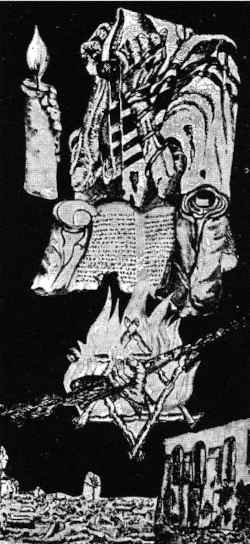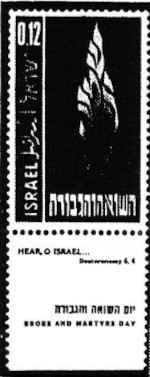
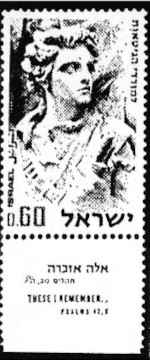
| And I will take you, one from a city and two from a family, and I will bring you to Zion. |
| (Jeremiah 3:14) |
| For these things I weep, my eye sheds tears |
| (Lamentations 1:16) |
|
|
[Page 305]
| … on your high places shall lie the slain, How have the heroes fallen |
| (2 Samuel 1:19) |
| And He established testimony in Jacob… In order that the last generation might know, sons who will be born should tell their sons. |
| (Psalms 78:5-6) |
| O that my head was a spring of water and my eyes a fountain of tears, that I might weep day and night over the slain of the daughter of my people. |
| (Jeremiah 8:23) |
[Page 306]
[Page 307]
|
|
[Page 308]
|
- “God full of Mercy” |
|||
|
by Yitzhak Katznelson
Translated by Judie Ostroff-Goldstein
(Translation appearing in the “Czyzewo Memorial Book”)
| How can I sing – so that the world will know? How can I play with broken hands? Where are my dead? G-d, I am searching for my dead, In every hill of ash: - Oh, tell me, where are they?
Shout out from the sand, from under every stone, |
[Page 310]
| It is your blood and sap, it is the marrow from your bones, It is your body and your life! Shout, Scream, loud!
Shout out from animal entrails in the forest, from fish in the river –
Oh, alas, my people appear. Raise your hands
Everybody come, from Treblinka, from Sobibor, from Ostrolenka, |
| Come, you who are drained, ground down, crushed. Come. Stand up, In a circle, a large circle around me, one large ring – Grandfathers, grandmothers, mothers with babies in their wombs – Come, Jewish babies of powder, of a bit of soap.
I am the man who watched, who saw
And now? You see wagons, trucks now, you watch, |
[Page 311]
| The first killed were the children, forlorn, little orphans. They are called The best of the world, the most beautiful that the dark earth possesses! Oh, from the loneliest little orphans and children's homes should grow our comfort, from the cheerless, mute, little faces, the gloominess will not be allowed to take us!
They were the first to be taken to their deaths, the first ones on the wagon, |
| The sun will rise once more over small villages in Lithuania and Poland never to meet a Jew again A light in the dark, an old man, a man reciting a chapter of Psalms, a man going into the synagogue - After all, the peasants will travel in wagons on all the roads, they will travel to the fair after all, So many gentiles – good gracious! Yet more than before! And the market, the market is dead. The market is full and is not full!
There is no longer a Jew to beautify the fair for great distances around, they are no longer lively, there is no longer any spirit |
[Page 312]
|
And Jewish children – they will not wake up from sleeping, from dreams, every one of them bright in the morning – They will no longer go to school, no longer let their minds wander, no longer play pranks, no longer play in the sand, Oh, you Jewish youngsters, oh, bright eyes! Little angels…where are you from? From here, in this town? And not from here! Oh, beautiful young girl, your brightness, your neatness, everything in order, your little face is not messy.
They are gone already! Oh, on the other side of the ocean, do not ask, do not search in Kasrylewka, nor in Jehupiec…leave it alone! |
|
They will cry out to you from Bialik, speak to you from Scholem Aleichem, from Scholem Ash, from one of their books.
It is that lost voice from the Torah no longer heard from any yeshivas, from any study house and pale yeshiva students, |
In Memory of My Town, Gorzd,
Which was Destroyed in the Holocaust
by Rivka Naveh (Katz)
Translated by Sara Mages
|
My precious home in Gorzd, Lita My little home – how big you were to me! Through the fog of the years and the smoke of your ruin In abundance of light I will see your image. A swamp in the yard - in spring as in autumn An electric light that turns on and off by itself A firefighters' ladder on a sloped roof And a brick chimney like a holiday hat. Your sturdy walls have seen generations. All of them are planks covering beams. |
|
|
[Page 314]
|
Squeezed between your neighbors, ashamed and afraid Not Jews both as one: On your right the school for gentile children On your left – a tavern for drunks. You had an address, a street, also a number Is there nothing left of that either? Oh, my home that on seventy-six Klaipeda Street! How were you consumed by fire? And “Tamoczne,” the “alley” and all market square – Whereas the gentiles' Pelke Street remained standing! And the klompes[a] culture in thatched-roof huts Built hewn stone houses on your ruins! And indeed, only we who were privileged to arrive here Survived to mourn the destruction… Gorzd, my family home, how precious your memory is to me With my childhood years intertwined in your landscape.
Yes, there was a town of Gorzd – and is no more |
[Page 315]
|
Do you remember that when the door opened a bell rang there? And there was Sara Freida – who didn't know her The subject of all jokes - but a pure soul. And there was R' Garsha Feiba, a learned scholar, Affectionately pinching a little boy's cheek: What does that mean? - a serious question To test schoolchildren in the Torah. From Melech's barbershop and the rabbi's house The long Klaipeda Street to the last of its residents. Small gray houses without opulence and splendor Only the Shabbat candles revealed who lived in them. (apart from the policeman – a respected man of power who looked forward to a slice of Shabbat challah from my mother) Simple, innocent and honest people, Carrying the burden, as if they were locked in their own world. |
|
|
[Page 316]
|
And on the path of dreams to a great and rich world A small train to the city of Memel. Here they find their livelihood in every profession Working for wages for the needs of every Shabbat. They are also looking forward to Ludwig the postman Expecting a letter with a dollar from overseas. Ludwig! – for years you have made my family happy with my letters! Did you also commit murder? And Jones and Stasia, the woodcutters and water carriers, were our friends. How did they quickly become the murderers of our children?…
And years have passed, and turned into decades |
|
|
[Page 317]
|
The halutzim of “Mizrachi” and halutzim of Zionist Socialists Carrying lofty ideals to praise! And a vague dream about leaving the Diaspora, That was decided in a daily war on poverty? How on winter nights amidst snow and frost We dreamed of a homeland of sun and light… And to the singing of drunken at the end of market day Who sold geese and sipped from a bottle We suppressed the fear with a different song – About a halutz who somewhere building us a country. And about Jerusalem – a holy word in the Siddur And about Carmel and Kinneret - a kind of vague imagination… And the winding Minija River among the green fields In our hearts the Jordan whispered two banks. Oh! Will the Minija flow by the cemetery they plowed For those who murdered our loved ones? And the sun will rise there for the cruel people And their moon did not turn to blood? Gorzd, my town, you were erased and are no more And so few carry your memory in their hearts, And the pain that floods the heart from time to time And you don't know if it's grief, or anger The echo of “pour out one's wrath” said by all generations And with the oath of the generation: Woe! Forever no more! |
Original footnote:
Who Erased My Town from the Map?
by Eliezer Oronovsky
Translated by Theodore Steinberg
|
Who erased my town from the map? What black devil? What dog's paw?
Did they lead everyone
In sealed train cars
Did they, each one
torture them all:
Where is their grave?
Does the dust soar up
I would bring the dust
My sinful life |
by Rashel Oysher
Translated by Gloria Berkenstat Freund
In 1939, when Hitler Germany occupied Memel, the Gorzd population was left almost without any opportunities for existence. Many young people from Gorzd and even entire families moved from Gorzd to other cities and shtetlekh [towns, shtetl is the singular form of the word] of Lithuania in order to look for a source of livelihood. However, the greater part of the Gorzd population remained in place.
Gorzd, which lay right near the border with Germany, was occupied by the German army even earlier than the official announcement of the outbreak of the war. The Gorzd population remained in place.
As soon as the bloodthirsty Fascists invaded the shtetl they immediately drove the population out of their houses and set fire to the small amount of remaining goods left over after the great fire of the summer of 1939.
Two young Jewish men, Mendl Man and Josef Osherovitz, who helped the small border garrison to resist the incoming German army were later found dead near a machine gun. The Hitlerists used the fact that young Jewish men fought against them; they staged a public trial against the men in the shtetl. They drove all of the Jewish men together on a side of the shtetl and told them to dig a grave for themselves. When the grave was finished, they carried out the sentence: for staging resistance to the German army, all of the men were sentenced to death by shooting…
The death sentence was carried out immediately.
The first heroic death during the execution was my sister Toybe's husband, Motl Meirovitz. He had well mastered the German language and hearing the death sentence, he
[Page 326]
|
called out: “You shoot us because we are Jews; you are tyrants, vile dogs and dirty pigs!”
He tore open his shirt and his last words were; “Shoot, you will pay dearly for our innocent blood!” The first bullet immediately found him and he fell dead.
The Jewish women and children were driven to a stall in Anieliske (a village near Gorzd). There they were held hungry in cold and dirty conditions under the heavy supervision of
[Page 327]
the Lithuanian nationalists. The women were forced to clear the streets and dig potatoes.
When the work ended, everyone, young and old, was shot in a swampy forest. The outrage took place in October 1941. The aktsia [action, often deportation] was carried out by drunken Lithuanian nationalists. They rampaged and shot to the right and to the left during the course of an entire day. In the morning they placed their bloody work in the ground and not finding the grave used the previous day, they dug out a second one.
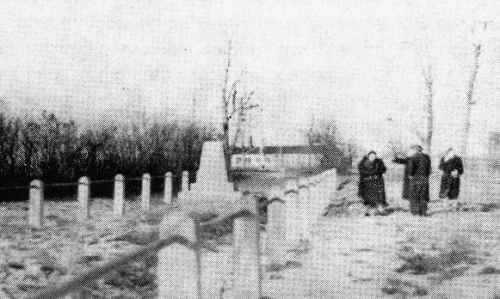
Thus the Jews of the shtetl ended their lives and all that remained of our Gorzd martyrs was one large grave at the side of the shtetl and two graves among the swamps and forests on the road between Vezaiciai and Anderame.
Three mass graves remained of our dearest Jews of the shtetl, who were murdered in a savage manner, brothers and sisters, friends, comrades and innocent
|
|
[Page 328]
children. Three mass graves – this is the fresh cemetery of the Gorzd Jews.
Ruchl Yami-Gritziana, who until the end was with all of the women at the grave and survived by chance, later spoke about the tragedy of our Gorzd Jews.
When the women were shot she jumped into a pit and lay there until it became dark. She crawled out of the pit late at night and left for the village of Vezaiciai. The teacher in the local Lithuanian school hid her for a time and later he took her to a secure place where she survived until the liberation.
Ruchl Yami-Gritziana is the only living witness to the bloody tragedy of the Gorzd Jewish community.
At the outbreak of the war between Germany and the Soviet Union, a small number of the young from Gorzd, who lived in various cities and shtetlekh [towns] in Lithuania, succeeded in escaping to Russia. I was among those escaping.
Our will was strong and we proudly fought against the Hitlerist army and took revenge for the spilled innocent blood of our dear annihilated families.
Heroically perished in the savage fight against the enemy:
Boris Majsachovitz
Leyzer-Ayzyk Karbman,
Gutl Cuker
Jukhl Zilberg and so on.
In innumerable struggles the roads of war were crossed until victory:
[Page 329]
|
|
Avraham Ornshtein near the graves of the murdered women |
Eliyahu Akerman,
Chaim Rubinshtein,
Yitzhak Zilberg,
Leyzer Winik.
I voluntarily mobilized in the Lithuanian division and took part in all battles with the division. During the last year of the war, my fight continued in a partisan headquarters.
Returning after the war, I immediately visited our Gorzd, which had become a ruin, and the graves of our Gorzd martyrs.
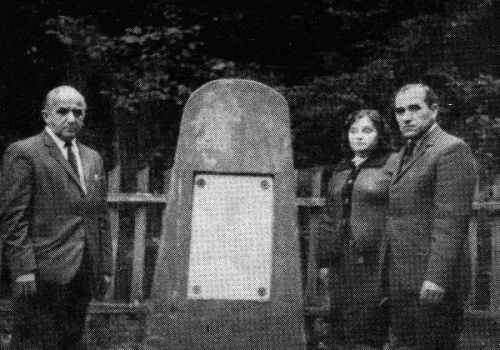
With our extremely limited resources, we erected three headstones on all three mass graves. A great thank you
[Page 330]
|
|
for organizing and placing the headstone belongs to our Gordzer, Avraham Ornshtein and Yitzhak Zilberg.
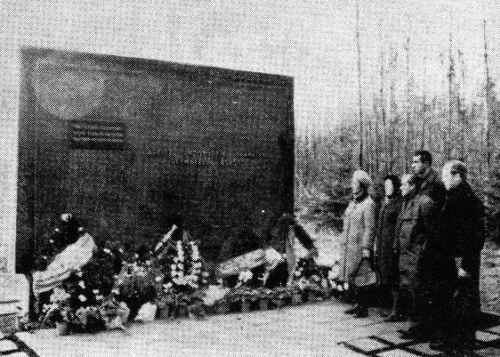
Several years later, the local regime also placed a memorial wall near the grave in the forest and a road to the grave was also paved.
We Gordzer, who still remained in Lithuania, were invited by the local regime to the opening of the meeting at which gathered a large number of the Lithuanian population. We appeared as the representatives of the victims to thank the local regime for the initiative to erect a monument for our murdered Gorzd Jews.
In my short speech, which was translated
[Page 331]
on television, I turned to the local population to ask them to take care of the sacred earth of our murdered brothers and sisters in a respectful manner and to honor their memory. At the same time I branded the traitorous deeds of the murderers and of those who lent a hand to the murder of our closest and dearest families.
Each summer we would travel to visit the graves of our parents in order to be “together” with our closest and dearest even for a short time.
Let their memory be sanctified for eternity.
|
|
Quiet, Quite
by Shmerke Kaczerginsk
Translated by Sara Mages
|
Quiet, quite, my son, let's be silent! Graves are growing here, The haters planted them Here are the paths.
To Ponary the roads will lead,
Quiet, my son, my treasure,
Also the sea has borders and a shore,
Spring has come to your land,
Autumn is already turning treetops golden, |
[Page 333]
|
The mother is left bereaved, Her son is in Ponary.
The bound waters of the Viliya
May the darkness of our days be dispelled,
Quiet, quite, be not stormy,
Please, my son, please don't laugh!
Let the wellspring gently flow
And like the freed Viliya, |
[Page 340 - Yiddish] [Page 339 - Hebrew]
Our Town Is Burning
by Mordkhe Gebirtig
Translated from the Yiddish by Theodore Steinberg
|
It's burning! My brothers, it's burning. Oy, our poor town, poor thing, is burning. Angry winds rip angrily, they tear and blow more strongly at the wild flames, and everything around is burning!
And you stand and watch
It's burning! My brothers, it's burning.
And you stand and watch
It's burning! My brothers, it's burning. |
[Page 341]
|
as after a battle just empty, blackened wells.
And you stand and watch
Don't stand there, brothers, |
|
|
JewishGen, Inc. makes no representations regarding the accuracy of
the translation. The reader may wish to refer to the original material
for verification.
JewishGen is not responsible for inaccuracies or omissions in the original work and cannot rewrite or edit the text to correct inaccuracies and/or omissions.
Our mission is to produce a translation of the original work and we cannot verify the accuracy of statements or alter facts cited.
 Gargzdai, Lithuania
 Yizkor Book Project
 JewishGen Home Page
Copyright © 1999-2026 by JewishGen, Inc.
Updated 02 Oct 2026 by JH