 |
|
|
[Page 342]
Translated by Theodore Steinberg
|
Vilna, 5 February, 1945
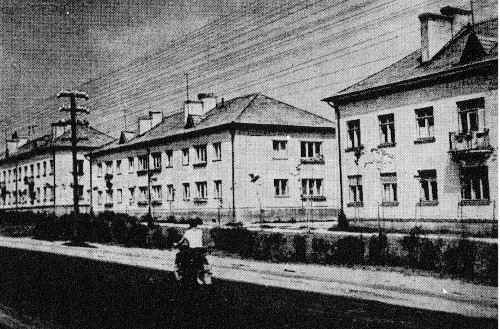
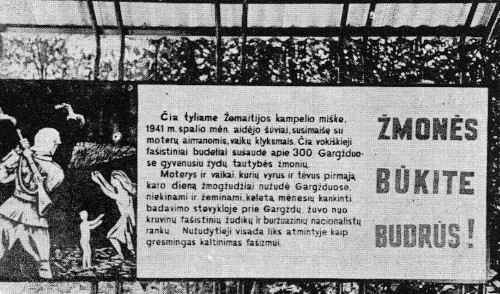
Dear Isaac and Zissel and dear sisters-in -law! I want to write to you today about my tragic experience when I saw the destruction of Gorzd. The destruction of the Gorzd Jewish population was as follows. On the night of 22nd June at 5 past 3 the Nazis invaded Gorzd.It was only the army. No tanks were in the batallion. They immediately burnt the buildings and they forced the population to gather in the market square.The next morning they divided the Lithuanians separately. They encircled the Jews, loaded their guns and were ready to shoot. A messenger came from the direction of Davil and asked them to delay the shooting.They immediately herded the Jews and took them towards the garden without food or water until Tuesday morning. They then took the men to Logallen where the death sentence was carried out. It was 24 June 1941 about 1 o'clock-lunch time.It was carried out near David Wolfowitz's house. Near the turn which takes you to Pelkis Street. The Jews were divided into lots of 25 and then shot. You can see a mound covered in snow.Amongst the hundreds of martyrs lies our Father. My tears seeped through the snow and wet the earth. Years will go by and this mound will always press our hearts and call to us and we will mourn. They sent the women and children to Onerlishke and kept them a couple of months and made slaves of them to work in the shtettle. Nobody knows exactly when they were shot, but I know that in the ghetto of Kovna, in November, a letter was brought by a Litvak and the Gorzde Lithuanians say they were shot in Autumn. The children were cut with bayonets when they were still alive, and the women were shot. All were burried in a mass grave, the mass grave is in a little forest, not far from the road that goes to Koel. There our Mother and Freda met their terrible death. Wandering amonsgt the destruction of the shtetle, you can see the staircase of our house, the cement bricks where we used to jump about as children. There I used to meet our Mother and Father when I used to come home on holiday. There I said goodbye to you, Zissel, when you left for South Africa. There is mothing left except our Father's mass grave not far away, and the grave of our Mother and sister, Fredila towards the little forest. At the back of the house, you can see our well, and I can still see part of the stable, which our Grandfather built from cement. I imagine our Grandfather coming in from the garden, and our Grandmother sitting on the veranda waiting for him. Our mother stands cooking at the stove, and tears are running down her face thinking of her children in Africa. Our father sits at the window and reads a book, and from the veranda you can hear Fredilas laughter – a dream – a terrible dream. here is the reality, destruction and graves. I will end now, as this letter has cost me alot of 'gesund'. Devorah, Ruth and I send you our very best wishes, and lots of health.
Your Leyba
|
[Page 344]
|
|
[Page 345]
|
|
[Page 346]
In 1939, Sheptil moved together with his wife Chana of the Pil family from Memel to Kovno.
In 1941, The Germans issued an order: all Jews in Kovno and the region must leave their homes and move to Slobodka Ghetto. You must complete the order by August fifteenth. Among those entering the ghetto were also Sheptil Bliss and his wife.
One day, Sheptil was walking alone on Kriksciukaici Street in the ghetto. A German guard noticed him, and to his amusement, the German used his rifle and fired a shot at the Jew walking down the street. Sheptil was hit in the back and fell wallowing in his blood.
On 22 October 1941, the Germans issued an order that all the residents of Slobodka Ghetto in Kovno must gather together with their families in Demokratu Square in Slobodka. Everyone gathered in the morning. Lithuanian murderers stood ready around the ghetto. The Gestapo appeared, headed by Obersturmbannführer Ruka, and ordered everyone to turn right or left. Those turning left were taken by the Lithuanians to the death camp at the Ninth Fort. Among them was also Fenny Meiskhovitz the pharmacist's wife. Meiskhovitz remained sitting in his place on the field. When they reached him, they found him dead of a heart attack.
Yizkor[1]
by Yishayah Zandberg
Translated by Theodore Steinberg
|
In the evening hour, when the houses sleep and the streets quietly dream and dream, a pale light shines, a yellow shimmer, a blue fog borders the room.
And when the night wraps itself in shadows,
At night, when the sky is full of stars,
And late at night, when all is still in the homes, |
Translator's footnote:
A Memorial to my Town of Gorzd
by Yudika
Translated by Theodore Steinberg
|
On the desolate ground where your world stood for hundreds of years, generations after generations, with old prayer houses and new, children like flowers and young people like trees, righteous faces, showing their ancestry, the joy and the need–a hushed Havdalah the shone so colorfully.
Where on earth do your sparks not exist?
When a cry cracks the heavens
How can one quell the fire in her heart, |
[Page 349]
|
dared to attack the world in its beauty and erase cities from their eternal life. Will the fire of hate not reach them? Wlll they not poison their own consciences? |
I Light the Candle for You
by Yudika
Translated by Theodore Steinberg
|
I light the candle for you today– our mothers, sisters of our great, bloodied people. For you, martyrs, murdered in all parts of the world. In dark cellars, valleys, woods, and in camps of death, starving, tortured, in your imagination you blessed the candles.
Your hand stretched out in darkness over the candles
I light the candles for you.
The house is tidy, the floors are clean, |
|
|
JewishGen, Inc. makes no representations regarding the accuracy of
the translation. The reader may wish to refer to the original material
for verification.
JewishGen is not responsible for inaccuracies or omissions in the original work and cannot rewrite or edit the text to correct inaccuracies and/or omissions.
Our mission is to produce a translation of the original work and we cannot verify the accuracy of statements or alter facts cited.
 Gargzdai, Lithuania
 Yizkor Book Project
 JewishGen Home Page
Copyright © 1999-2026 by JewishGen, Inc.
Updated 02 Oct 2026 by JH