 |
Gershon Neigwirtz, may God avenge his blood, the instructor
|
|
[Page 95]
With the blessing of God, the day after the conclusion of the Shavuot holiday, 5738 [1978].
By G. Y. A.
Translated by Binny Lewis
In my desire to give a comprehensive survey of the Bnei Akiva organization in Trembowla, I must preface with general outlines the spiritual life in our town and the factors that led to the organization of a religious movement in the town, in the years thirty-three or thirty-four, in a town that was mostly secular, and especially the youth in those years. I must also emphasize that before a Bnei Akiva branch was organized in the town, there was no religious Zionist or even anti-Zionist organization in it. There were a few individuals who, according to their worldview, belonged to the Mizrachi movement or sympathized with Agudah or Poalei Agudah. But an organization in a movement, who would even mention it [man dekhar shmeh – an Aramaic expression meaning “who would even mention its name,” i.e., it was completely nonexistent] – it did not exist at all. The reasons were several: the first, the general and Jewish population of the town. Trembowla was known as a district town, “powiat,” with a small Jewish population relative to the Polish and Ukrainian population; it did not even proportionally reach the population of Buzhanow, which belonged
[Page 96]
to our district. Even before the First World War, in the days of Austrian rule, a government gymnasium was established in it in the year nineteen hundred and four, and it is clear that the urban population, and especially the Jews, who had a significant share in the intelligentsia of the town, aspired with all their might to send their children to secondary education in the town. It is understood that most of those educated in this institution were already far from religion and Jewish life in general.
About the development of the Zionist movement in the town before the First World War, I do not know much. In any case, what is certainly known is that there was not a single family, nor even individuals, who immigrated to the Land of Israel or directed their path to it before the First World War. I remember that at the end of the First World War many emigrated to the United States, before immigration to it was almost completely closed. I know of a large part of our family on my father's side and also on my mother's side, who emigrated to the United States several years before the outbreak of the First World War and also after that, until immigration was closed.
I remember well that with the establishment of Polish rule in Eastern Galicia (for the war against the Bolsheviks ended in late 1920 and early 1921), a large “Shomer” movement arose in our town. The hall, or as they called it the “Lokal Farain” (the branch), was in the courtyard where I lived all the days I lived in Trembowla, in the house of “Zishua Kepl.” But as I remember, this movement had no practical results in our town. The whole movement was a matter of fashion, for not a single member of the Shomer went out to hakhsharah [agricultural training] and none even attempted in any way to immigrate to the Land. And so the movement was not taken seriously at all. As long as they had not entered the yoke of making a living, they were in the movement and won souls for it, but afterward each one turned to his own way. There were those who continued their studies in institutions of higher education in Poland or in another country, there were those who turned to other professions and married. Not a single one of them realized the idea of immigrating to the Land. Nevertheless, it is certainly clear that the seed that was sown at the end of the First World War, which caused the development of a mighty Shomer movement that encompassed all of Poland – it is the one that brought about the establishment and flourishing of all the pioneering movements that were founded in the town in the mid-twenties. All those movements that came into being as a result of this initial movement were not religious. From this movement developed the “HaShomer HaTza'ir” movement, “Gordonia,” “HeChalutz,” “Hitachdut,” the Revisionist youth “Beitar,” and the Zionist Youth.
From the mid-twenties, after the Fourth Aliyah did not succeed in taking root in the Land and many immigrants returned to Poland, the selective aliyah began
[Page 97]
|
|
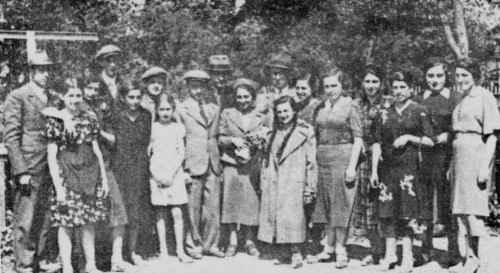
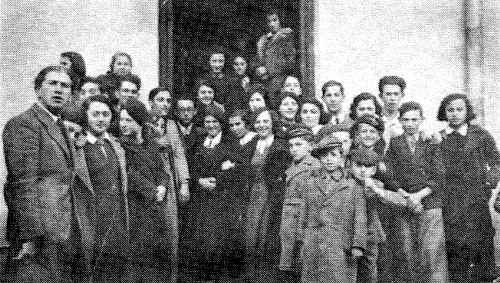
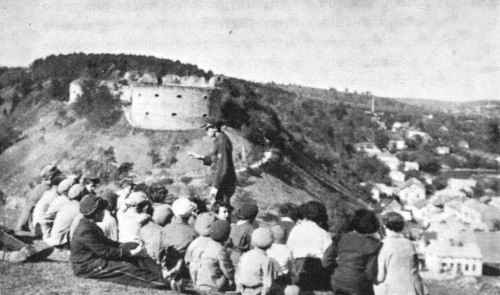
| Bnei Akiva youth at the foot of the fortress Gershon Neigwirtz, may God avenge his blood, the instructor |
|
|
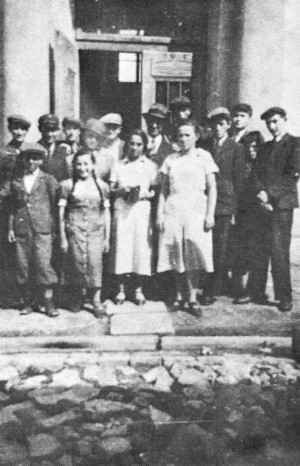
| Bnei Akiva members bidding farewell to Shoshana Goldflis upon her immigration to the Land |
[Page 98]
– meaning, they could not immigrate to the Land except through the movements (of course, the exception was the immigration of the middle class). The Zionist movements were the ones that decided which of their members would receive a certificate – a permit for immigration – after physical training in an organized place by the kibbutzim that were established in various places in Poland, and also spiritual training; the member's standing in the movement was determined. These matters belong more to the history of the Land and immigration, and there is no need to tell about them in our book, even though these matters have a strong connection with the movements in the Diaspora, which were supposed to supply the human material for the building and development of the Land. By the end of the twenties and the beginning of the thirties, a large portion of the Jewish youth that turned to hakhsharah came from the “HaShomer HaTza'ir” movements, which already had organized and flourishing kibbutzim in the Land at that time, or from the “HeChalutz,” “Hitachdut,” “Gordonia,” “Buslia” movements and others.
At this time the Zionist Youth movement was also founded. It began to organize and establish itself in the town with the decline of the “HaShomer HaTza'ir” and “HeChalutz” movements. The reasons were: a) Capable organizers and instructors arose for the new movement, such as Zhoni Tanenbaum, Hasiu (Hasin) Neibuar [הסיו/הסין נייבואר; the name appears in the source in two variant spellings; possibly a Yiddish diminutive], Yitzchak Goldshtein, and others, who succeeded in bringing the growing young people into the new movement; on the other hand, the organizers and instructors of the developed movements, “HaShomer HaTza'ir” and “HeChalutz,” fell into the net of the leftist youth and moved to the underground Communist movement, which was forbidden in Poland, and many of its members, leaders of Communist propaganda in the small town, were caught and sentenced to many years of imprisonment and were even sent to the Bereza Kartuska camp; and in the town it was discovered that those who were considered devoted pioneers had betrayed the Zionist idea.
I will not detail here the reasons that caused this turnabout. I conveyed only in very general outlines the state of the movements in the town at the beginning of the thirties. In that year I left my studies at the yeshiva of the rabbi of Probuzhna. Since I was raised in a Zionist spirit from my childhood years, I decided to join some hakhsharah and immigrate to the Land. Since I was religious and observant of the commandments, I did not want to enter any of the movements that existed in the town, and I searched for a way to connect with the “Mizrachi” movement. I knew by rumor that it had pioneers and training sites, but since I did not have an address for them, I connected with Chaim Horowitz, whom I would pray with at the “Alte Kloyz” every morning on weekdays, and with Yitzchak Friedman, may God avenge his blood, whom I knew had a connection with the “Mizrachi” movement. They provided me with the address: Lvov, Slonechna 3, which was
[Page 99]
the center of the “Mizrachi” movement in Eastern Galicia. Especially, Yitzchak Friedman, may God avenge his blood, supported my ideas. He was a wonderful person; all his days he aspired to immigrate to the Land of Israel, and it was his meditation day and night, and he did not merit it. He supported me not only with advice but also financially; he wanted to support me so that I could realize my ideas, for even the travel expenses to the training site were a problem in Poland at that time.
|
|
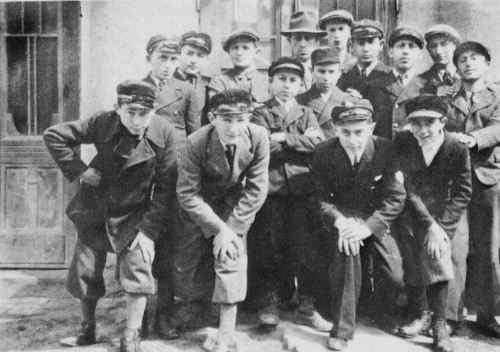
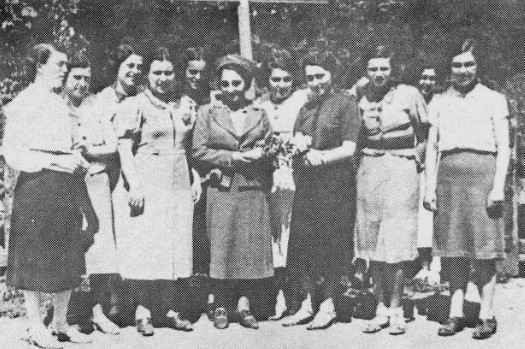
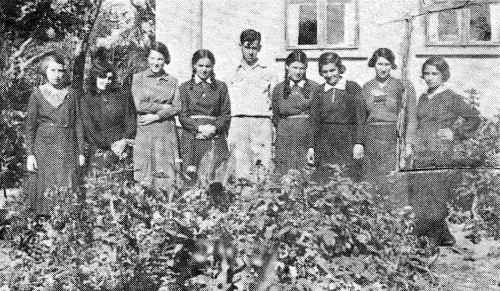
| A group of Bnei Akiva members |
I decided to do this against the wishes of my father, of blessed memory. Despite his belonging, according to his views, to the “Mizrachi” and despite his activity in the Zionist movement, he could not agree that his son, who was among the few who devoted themselves to the study of Judaism and who was destined to become a rabbi and who studied under a famous rabbi like the rabbi of Probuzhna, now wanted to go out to hakhsharah. In the perception of the Jews of Trembowla, I was an anomaly, an exception, at that time; and especially a young man like me suddenly became a pioneer
[Page 100]
and went out to hakhsharah. In Trembowla there were no such people who went into exile to a place of Torah; at most they studied at the “Kloyz,” even before the war. But as I said, since I received the address, I turned to them and they directed me to the “HeChalutz” department, and in the spring, in the year 5690 [1930], after the Passover holiday, I went out to agricultural training at Zarubyntsi near Zbarazh. These were owners of a large estate – religious people who supported the Zionist idea and maintained on their estate during the summer an agricultural training group. But until the year 5690, only pioneers from secular movements were there. Also, the first governor of the Bank of Israel, David Horowitz, of blessed memory, was in training there, as well as Meir Rosenfeld from Trembowla, who is now in the Land, who immigrated before the Second World War, was also there. The training there was only agricultural, and before the High Holy Days – I indeed wanted to continue, but the matter did not come to fruition, since the “Mizrachi” movement did not have a suitable training site at that time. I was therefore forced to return home and began to devote myself to general studies, as my father, of blessed memory, wished.
At the beginning of the thirties, the “Bnei Akiva” movement began to develop throughout Eastern Galicia. Members of HaPoel HaMizrachi contributed to this: Moshe Reich, Lang, Reiber, Feldman, and especially Raphael, who was then called Worfel, and others. Since I had gone out to hakhsharah, I maintained contact with the center and received from them a letter to organize the “Bnei Akiva” movement in our town. The matter was timely and opportune, for after the trials and imprisonment that many of the town's youth received when they were caught, many of the pious and Hasidic parents (especially the young people who prayed at the Husiatyn Kloyz) feared that their sons would be caught up in the secular movements. And since the founding of a pious movement like Tze'irei Agudah, as in many surrounding towns, was unthinkable in our town, which was entirely Zionist, many of the men of the “Kloyz” where I prayed regularly turned to me to organize a religious youth movement. Let it be Bnei Akiva, as long as they would not be caught up in secular movements, the bitter consequences of which the parents had seen with their own eyes.
I then turned to the town's rabbi, Rabbi Eliezer Leitner, who was in his heart a Zionist and a Mizrachi sympathizer, to place at our disposal one of the rooms in the Talmud Torah, which the benefactor Kalman Eliyahu built after the First World War in the year 1923 with his own money, and the rabbi tended to the building. It stood empty for a long time and sometimes its rooms served as a place for a Hebrew school, which did not exist continuously in our town, or for other melamdim [teachers]. The rabbi responded willingly to my request, and thus the Bnei Akiva movement arose and came into being in our town, and I was its founder. Indeed, Yitzchak Friedman (who not only had all
[Page 101]
|
|
(First row) Yeshayahu Goldflos, Yosef Shteinig, Kalman Shtaub, Moshe Altshuler (Second row) Leib Friedman, David Goldflos, Elazar Dlugotsh (Third row) Berl Drudner, Meneleh Milgrom, Yitzchak Shtaub, Eli Zomerfeld, Yisrael Goldflos, Gershon Neigwirtz, David Leiter, Berl Shtrasberg |
[Page 102]
his children as members, but he himself was immersed head and body in the movement and dedicated all his free time to conversations and other activities. This was in the year 1933 or 1934; I do not remember exactly. Over time, I succeeded in bringing closer to the movement the brothers and sisters of my friend David Milgrom, may God avenge his blood, who perished in the Borki Wielkie camp. I succeeded in adding to the movement several more young men and women, students of the gymnasium in Trembowla who were from religious homes, worshippers at the “Husiatyn Kloyz,” and especially Gershon Neigwirtz, who perished in the forest, according to rumor. He tended to the branch after I left the town when I went to teach in Zarubyntsi, and also afterward when I went to study in Lvov, and afterward when I went to teach in the school in Czortkow. I would return home only on holidays; from time to time I would dedicate all my time to the Bnei Akiva branch in the town. Gershon Neigwirtz, may God avenge his blood, dedicated
|
|
all his energy and talents to the development of the “Bnei Akiva” movement in our town, until he finished secondary school and also for two years afterward, when he left the town for the purpose of studies. But when he left the movement, it was already “a living creature carrying itself” [chai nosei et atzmo – an expression meaning it was self-sustaining]. In the last year before the Second World War, it became a large and accepted movement in our town; it numbered more than one hundred members.
In its hands were concentrated most of the fundraising drives for the Keren HaYesod and the Jewish National Fund,
[Page 103]
and in every cultural and educational enterprise it took an active part. Thanks to it, the Hebrew school was re-established under the direction of Shimon Fishbach, a kindergarten, and so on. Its influence was great in every educational and cultural matter. Even in the large “Ivriah” library, its members penetrated, and its influence especially grew in restoring values of tradition and Judaism in all strata of the public in Trembowla. Many children who were organized in “Bnei Akiva” brought into their parents' homes values of tradition that had already been far from their hearts. More than once I thought about the activity of the Bnei Akiva movement in our town and I saw in it – one that returned many to the sources. Since the influence of the government elementary schools, which in our area were Polish (and not “Tarbut” and “Yavne” schools as in the Poland that was before the First World War under Russian rule), in which all the children attended, and the gymnasium that most of the youth attended – was great upon the youth, and the influence of the gentiles distanced the Jewish youth from the sources of our ancient culture. And only the Bnei Akiva movement brought the youth back closer to the values of tradition.
The branch also served as a faithful source for cultural development through conversations and activities that were the daily bread of all the movements. It broadened horizons, aroused interest in the fate of the Jews in the Land and in the Diaspora, and above all, aroused an alert social life. In the summer they would go out to summer camps, meeting friends from other towns at conferences and assemblies that were convened; and they also established locally, over time, a training site for pioneers from the movement. And it is clear that this had a great influence also on the locality and the local movement. All these aroused the national feelings, and the aspiration to immigrate to the Land grew and increased also in our town.
But with the outbreak of the war, all this fell silent. The Russians, who conquered almost all of Eastern Galicia, put an end to the alert and vibrant life of the youth in Poland, who were bound with bonds of love to the Land and to the Yishuv [the Jewish settlement in Palestine].
by Moshe Briller (United States)
Translated by Binny Lewis
There once was a youth – young people of different appearances and different traits; in short, human beings. But they had one thing in common that was destined to distinguish them from the youth of the entire world: they were Jews. They
[Page 104]
were born in an era that was destined to be the cruelest for a people accustomed to trials and suffering.
However, let us not anticipate events. In the period that will be discussed in these lines (before the Second World War), these young people did not know and did not think about death and about extermination camps, even though heavy clouds began to gather above their heads and the raging of the madman in the center of Europe became louder and more venomous from day to day – these young people continued in their day-to-day occupations and lived normal lives. By their nature they were optimists, despite the poverty and the pressures and despite the lack of hope. They were mostly alert and energetic, although there were among them also dreamers and idealists. But all were filled with the desire to live, to succeed in life, and to realize their dreams and hopes.
|
|
Most of them were in their teenage years, most were students of the local schools, some were apprentices to craftsmen. They were aware of the conditions in which they lived and of the hostility of the non-Jewish population among which they lived. They adapted to the reality and did not despair. Most of them belonged to some Zionist youth organization. And Zionist organizations were as numerous as the number of shades of the Jewish national worldviews of the Jews of the place. All of them had one common aspiration: to return to their homeland, to be a nation among the other nations of the world, with a government of their own, and cities and villages and farms and kibbutzim, with schools, culture, theaters, opera, and an orchestra of their own. And above all, their aspiration was to cease being “the Wandering Jew,” misfits among strangers who did not want them.
[Page 105]
One of these groups was “The Zionist Youth.” It was a scouts organization – Jewish Zionist scouts.
From an ideological standpoint, this organization was at the center of the Zionist movement – not too far to the left and not too far to the right. They were called “General Zionists.”
It is worth noting in this context that the word “Zionism” did not have at that time the same meaning that it has in the world today.
Even our most wicked enemies did not see in it a threat to world peace. The slogans of “aggressors,” “servants of imperialism and racists” were not yet in use regarding Zionism. We were not then classified as the international demon, as a scarecrow, and children were not frightened by mentioning the pogroms and horrors we would perpetrate. (At that time, the governments of Europe were interested in getting rid of the Jews, and although students were forbidden to belong to political parties, the Polish government unofficially agreed to our existence.)
I joined the organization at the age of 14 or 15. I was a member of a group; this was the smallest unit of the organization, the nucleus from which the entire organization grew. The groups were organized according to the age of the members. I was a member of a girls' group. In my group were Tsinka Stern, Betka Weiss, Pantzia Horowitz, my sister Klara, and others. My sister Yehudit was in a younger group, and my brother Max was a member of an even younger group.
The head of the group was a young man or woman who was a bit older than the other members, and he or she was chosen for their positions thanks to their knowledge and traits. We were all friends, except that the group leader had more authority and more responsibility. Remembered for good are our young leaders – Yitzchak Goldshtein, of blessed memory, and Chaim Drimer, may God avenge his blood, and other younger members, all serious, devoted, talented, and convinced that they were fulfilling an important role.
I remember the location of the Zionist Youth's quarters – we had to change our location several times. Our financial situation was tight and we were unable to pay rent.
We were young, overflowing with energy and merriment; it was hard to restrain us. Like young birds, we were always ready to jump into the air and fill the surroundings with our chatter, and the neighbors complained, of course.
[Page 106]
Our last quarters were in the house of Mr. Rudolf, at the foot of the “Pokrovka.” The entrance was from around the back, through a back entrance and through a dark little room. Along the walls of the room were tables and along them benches. On the benches we sat during the talks and debates. The center of the room was clear for dancing.
Despite these conditions, the room did not have a sad and neglected appearance. We used our imagination to give it a cheerful and beautiful appearance. Strips of colored paper hung from the ceiling; on the walls were pictures of Herzl and Weizmann and other Zionist leaders. On the front wall were displayed slogans that we wrote in Hebrew. These decorations were not permanent – they were one-time. We would
|
|
replace them and renew them from time to time. Every holiday and every political-national event received a special display, and our imagination supplied us with rich and original material. Because this modest room served us not only as a meeting place but also as a club, we loved it and decorated it with various ornaments.
In order to save on expenses, we did all the work ourselves. We also saved every penny and donated it to our common fund. We asked for donations from the people of the town so that we could sustain ourselves as an organization. Once, on the night of Purim, four boys and I dressed up, knocked on the doors of houses, played and sang, and asked for donations. The result was not bad at all, but what gave me the greatest satisfaction was the feeling that my appearance was changed beyond recognition (so I believed). It was pleasant to enjoy the appearance as a different personality, without being subject
[Page 107]
to the limitations and social obligations, and being permitted to participate in the pranks of children.
Our activities were varied. The gatherings took place once or twice a week and were aimed at arousing the intellectual interest of the members. The group leader would give a short lesson, read a story with Jewish content, or raise a problem for debate.
We learned a great deal. But – looking back – I come to the conclusion that we learned less than we could have learned. What child would not prefer to look through the window and observe people and nature? What young person would not prefer to dream about being in the fields, in the forest, or on the playground, rather than listening to a lesson in history, in knowledge of the soil of the Land of Israel, or in current events? It was only natural, and yet many of us studied and absorbed a considerable amount of knowledge that was destined to serve as a foundation for our continued development.
We also learned literature, and I think that we owe thanks to “The Zionist Youth” for having aroused in us the love of our own literature. For what did we know until then about our literature? In school we learned about Mickiewicz, Slowacki, Sienkiewicz, and Zeromski – and what did we know about the treasures of our culture?
And how much wisdom and beauty could we have learned from our sacred literature and from the Jewish stories of our time, which could have opened new horizons for us. The study of our literature and our history helped us understand ourselves and the world in which we were destined to live. A person does not live in a vacuum. All of us, even the geniuses among us, are the product of the society in which we live. Through studying our history and literature, we acquired a broad perspective on our past.
From this we also learned to better understand our own time and the ideas prevalent in the society of our time. The writings of Herzl, Ahad Ha'am, Pinsker, and others broadened our horizons. Weizmann and Ben-Gurion taught us that we must act in order to acquire independence and a state of our own, that we must work hard and with dedication.
There were among us those who fulfilled what we learned. Hersh Garton joined the “hakhsharah”; Ephraim Meltzer immigrated to the Land and joined the builders of the Yishuv. But these were only a handful, because the Mandate government narrowed our steps and guarded the gates of the Land so that no Jew would infiltrate into it.
[Page 108]
Belonging to “The Zionist Youth” was not limited to work alone. There was also pleasure in it. We played, laughed, danced, and sang.
I still hear the horas that we sang and to whose sounds we danced, arms linked and feet jumping. Everyone danced, even those with “two left feet.” Song had an important role in our lives. We sang between the lessons, before them and after them; we sang as we marched through the streets and as we sat at the edges of the forest. We sang when we were happy and also when sad; we sang in large groups and small. Our songs were an expression of our youth, of our dreams, and of our longings for better days.
Sometimes we held performances. Once I organized a small orchestra and a choir of boys and girls. We rented the Ukrainian Prosvita hall and performed a show for the Trembowla audience. The performance was very successful; we sang songs and danced on the stage. Chapters of poetry were recited in Hebrew and in Polish, and a tableau was performed to the sounds of “The Jordan” and “Perhaps.” Several girls sat on the stage that was made to look like a boat, moved oars, and sang “The Jordan.” Tzvi (Hersh) Grozen was one of the good singers. The melody of “The Jordan” soared upward from a long note in a low register.
The melody rose and descended, as the melodic line moved slowly and full of feeling – and finally the tone expired in a soft pianissimo. Perhaps even more moving was [the melody] rising slowly, sad and touching.
The song “And at Night in the Desert” made the strongest impression on me. This song was sung by two boys from Ternopol. We were at hakhsharah. The night was black and cool, and in the air there was silence, when suddenly we heard the voices of the boys.
They sang like two birds in such perfect harmony and with such feeling that I felt tears streaming down my face. The stars twinkled in the sky, and for a brief moment I had the feeling that it was a night in Israel and that the stars were inviting us to pitch our tents in the desert sands.
At times we went on excursions. Especially on Shabbat afternoons, we would go out to the fields, to the forests at the “Fortress” or at “Pokrovka,” where lessons were interspersed with songs and dances.
Once, on a Shabbat afternoon, several friends – boys and girls – went up the fortress through the forest until we reached Strusov. In my mind's eye, I see the small town with its poor, small houses and the drowsy atmosphere
[Page 109]
in its streets – here and there a solitary Jew in his long Sabbath clothes, a few children playing hide-and-seek, and behind a fence a cow chewing grass and a few hens.
After a short while we met some friends. We spent time with them, chatting and laughing. After we tasted some of the wine and bit into the delicious black bread, we set out on our way home.
It was a bright and beautiful summer day. It was hot; only a light breeze was blowing. We saw no need to hurry, and so we advanced slowly through the forest, singing and chatting and expressing our satisfaction with the pleasant outing and thinking about organizing similar excursions more often.
We were already not far from Trembowla when suddenly we sensed an unexpected change in the weather. All at once, black clouds appeared that quickly covered the entire sky. Storm winds began to shake the branches of the trees in fury. It was pitch dark. A downpour began to fall, and we were defenseless against the raging forces of nature. We were in a situation with no escape. It was hard to see the road ahead of us, and when the thunder began to pound with deafening noise, we started to run without knowing where.
We bumped into each other and into trees. We were soaked to the bone, frightened and crushed, when we reached a place of safety. And then lightning flashed and a mighty thunderclap sounded. This time the lightning struck a shack in the nearby village. Within seconds a fire broke out and the forest looked as if it were all ablaze. The consequences of this excursion? There were no consequences – two weeks later we went on another excursion.
I wish to conclude with the blessing: Be strong and courageous! To the survivors who remain, and to those who perished – may their memory be blessed.
|
|
JewishGen, Inc. makes no representations regarding the accuracy of
the translation. The reader may wish to refer to the original material
for verification.
JewishGen is not responsible for inaccuracies or omissions in the original work and cannot rewrite or edit the text to correct inaccuracies and/or omissions.
Our mission is to produce a translation of the original work and we cannot verify the accuracy of statements or alter facts cited.
 Terebovlya, Ukraine
 Yizkor Book Project
 JewishGen Home Page
Copyright © 1999-2026 by JewishGen, Inc.
Updated 21 Jul 2026 by JH