 |
|
|
[Page 110]
by Yehudit Aryeh (née Briller)
Translated by Binny Lewis
Sometimes I return in my thoughts to my birthplace, Trembowla. It had water, fields and forests. A town that I loved, in which my family, relatives, and friends lived. The town exists, but its Jews are in the grave, and even that no longer remains.
A world that was and is no more. It is impossible to forget the life, the family, the Jews dear to the heart.
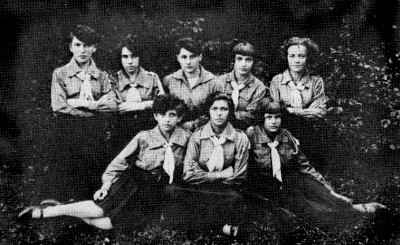
We, the living in Israel – do we not live by the force of the foundation that we received in Trembowla? I remember – in the thirties, the “Zionist Youth” movement arose. The first commander was (Iziu) Zuniu Tanenbaum. He was the instructor of the girls' group “Aviv.” I do not remember all the groups; I was in the group “Shoshana.” The instructor was Ephraim Meltzer. There was also a girls' group of our age called the “Dror” group. The instructor was Hasiu (Hasin) Neibuar [הסיו/הסין נײבואר; the name appears in the source in two variant spellings; possibly a Yiddish diminutive], of blessed memory. We attended a
|
|
| The Zionist Youth – “Aviv” group |
[Page 111]
Polish village school, and our Zionist education we received in the movement. The excursions, the conversations – can one forget? Almost all the Jewish youth belonged to the Zionist Youth movement at that time.
The commanders were – Zuniu Tanenbaum, of blessed memory, then Yitzchak Goldshtein, of blessed memory, and the last was Chaim Lantz, of blessed memory.
In Trembowla there was also a Hebrew school, “Tarbut.” It was difficult to maintain a Hebrew school, but the students also helped in maintaining the Hebrew school. The teachers changed each time. The teacher who dedicated great efforts and possessed extensive knowledge was the teacher Lederan, of blessed memory.
In Trembowla there was a library, “Ivriah.” The library was full of good books and it gave the Jewish youth a great deal. The library existed thanks to a handful of people who worked voluntarily and instilled in the youth the love of books.
Although two-thirds of my years of life have passed outside of Trembowla, it lives within me deep in the heart. The experiences I went through there live in my heart, together with all my dear ones who were and are no more.
The Zionist Youth Movement in Trembowla
At the beginning of the thirties, the Zionist Youth movement was at its full flourishing. The commander of the movement was the attorney Zuniu Tanenbaum, of blessed memory. In the leadership were Yitzchak Goldshtein, of blessed memory, Kuba Rozensztroch, may he live long, Yosef Weisberg, of blessed memory, and others.
The second commander of the movement was Yitzchak Goldshtein, and after him Chaim Lantz.
At that time there were several groups in the movement. I particularly remember the “Nesher” group and the “Aviv” group. The “Aviv” group was a girls' group, and its instructor was Zuniu Tanenbaum, of blessed memory. Afterward a girls' group was founded under the name “Shoshana,” and its instructor was Ephraim Meltzer. When he immigrated to the Land, the group was led by Chaim Lantz, of blessed memory. There was also a parallel boys' group called “Dror,” and its instructor was Hasiu (Hasin) Neibuar, of blessed memory. Hasiu was a very talented young man, with a great power of persuasion, and even then he stood out in the movement. The center employed him in many missions. I remember one mission from which he returned and taught us the song “Akarah” [Barren] by the poetess Rachel.
In addition to the youth group, there was an adults' group that saw
[Page 113]
itself as a guardian of our youth movement. Their leader was Dr. Landau, of blessed memory, who was very active on behalf of the movement.
The activities in the movement were many and varied: conversations, studies about the Land of Israel, Hebrew, history, geography, folk dances, and excursions. All of them bore a Zionist character and caused us to dream about the Land of Israel.
|
|
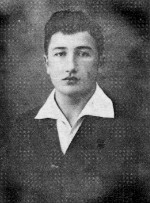
| Yosef Weisberg – one of the instructors of the Zionist Youth |
The branch of the movement was at first at Rudolf's place, and afterward we moved to Aizik Kepl's. Izhu Rudolf was studying at that time in Krakow. When he came home for summer vacation, he would tell us stories about the Land of Israel. Anyone who knew how to retell the stories was “promised” a ticket to the Land of Israel. When we asked him why he himself did not go to the Land of Israel, since he knew all the stories, he said that one sin was preventing him – his being a Jew.
We used to collect donations for the Jewish National Fund. When we would arrive at Zilberg's pharmacy, we would peek inside before entering, because only when Fridek was in the store was it worthwhile to enter. His donation was very generous.
Alongside the serious activities, there were also pranks. Willi Marndorf, of blessed memory, used to bring to the branch entire trays of cookies together with silver spoons without his parents' knowledge. We ate the cookies, and as for the spoons, mother used to return them to Mrs. Marndorf.
When my sister Klara, of blessed memory, was at summer camp, several friends traveled, without their parents' knowledge, to visit on Shabbat. Mother gave them a box full of cookies and sweets for Klara. Since they traveled in secret, they did not take food with them, and when hunger bothered them, they ate everything that was in the box. When Klara opened the box, she found dry challah, which they had put in place of the cookies. This story was told to me years later in Novosibirsk by Moshe Dubiner, who participated in the prank.
Trembowla, with its natural beauty, with the “Zamek” [castle/fortress], with the “Monastyr” [monastery], with its rivers and forests, was an ideal place for the movement's activities. In winter we used to ski down from the Pokrovka, and in summer we went on excursions in the area.
The movement filled our lives with content and interest. Although we studied in a Polish school, our friends were only from the movement, and one shared dream united all of us – the Land of Israel. The end of the movement came with the outbreak of the Second World War. We had to forget everything we loved in order to preserve our lives.
Ein HaMifratz, January 10, 1979
by Moshe Drezner
Translated by Binny Lewis
Many of our dear ones, to whom I dedicate these lines, were annihilated by the cruel Nazi boot without having managed to take their leave from all they loved, and there was no one to eulogize them when the cornerstone of this house was pulled away.
The year of the First World War, 1914, was destructive for all peoples, but the Jewish people were harmed many times more severely. The source of their livelihood was snatched from their hands, and they also lost their cultural foundation. The economic situation was grievously bad. Even the well-to-do among the residents were left stripped bare and lacking everything.
[Page 114]
Several years passed before the community organized itself and began to act. The efforts of the forces that awakened brought good results. Most of the residents found themselves sources of livelihood, and community life also began to develop.
The youth was not satisfied with that; it was effervescent and thirsty for a new form of life. Within it nested an aspiration to breathe spiritual and Zionist content alike. In the early days of the youth movement in the town, there were difficult debates and struggles between us and the community of parents, who could not understand or agree to our activities among the ranks of the youth. The opposition was directed primarily at our movement – “Hashomer Hatzair” – about which they used to say: “Respect him and suspect him.” [A Hebrew idiom meaning one should both honor and be wary of someone.] Why so? Suspect him: because we were too far to the left – therefore suspect him. Respect him: because every action carried out by members of “Hashomer Hatzair” was successful and brought honor both to the Jewish public and to the “Hashomer Hatzair” chapter, who knew how to devote themselves heart and soul to Zionist education.
|
|
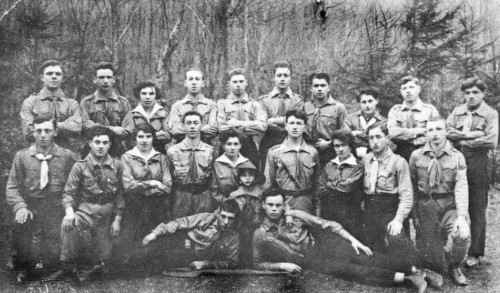
| Members of “Hashomer Hatzair” |
All the youth in our town – without mentioning ideological views – who were engaged within the framework of Zionist education, were good youth, devoted and active. I remember debates in joint committees where the topics were activities on behalf of the national funds – the Jewish National Fund, the fund for immigration to the Land of Israel, and so forth. Among the participants I remember, on behalf of the “general Zionists,” the chairman of the committee Dr. Landau, of blessed memory; David Margaliot, of blessed memory; on behalf of “Hashomer Hatzair”– Hersh Drozner, my brother, of blessed memory; from “HeChalutz” – Dudik Tirkel, of blessed memory, who was devoted and beloved by all of us; Yisrael Rosenfeld, may he be distinguished for long life, currently in Israel.
Among the other topics with which we grappled and wished to resolve were also
[Page 115]
the procurement and retention of Hebrew teachers, and cooperation in acquiring books for the general library “Ivriah,” in which we were the driving spirit.
The “Hashomer Hatzair” chapter was honorably situated in the heart of the city, in a magnificent natural landscape, in the house of the Brik family, of blessed memory, on the bank of the Gniezna River, which bisected the city. Here we managed to develop extensive activity; we invested great efforts in order to establish and maintain the chapter. As I mentioned, the economic situation in the town was poor, and especially among the ranks of the youth, who were still students, and our desire to sustain and increase our membership was fierce.
In order to cover the expenses of the chapter and to expand the chapter's library, we – the older members – founded a commune, whose function was to obtain menial labor, to earn money, and also to adapt to hard physical work and to prepare ourselves for immigration to the Land of Israel.
It was an experiment in communal living; everything was therefore in the realm of a new beginning. Inner doubts and external obstacles were not lacking, but thanks to our stubbornness, the results were desirable.
Here too there was a struggle with the Jewish public. It was not becoming for Jewish youth to work in dirty jobs, to pass through the city in clothes blackened by coal dust or mud (which we hauled up to the ceilings of buildings). We carried out various additional jobs such as painting signs for shops and teaching Hebrew in family homes.
If at first our parents did not agree with our activities and suspected the path by which we would lead their children astray, then over time we succeeded in proving our existence through blessed deeds.
We organized dramatic troupes at the chapter; the primary subjects were from life in the Land of Israel. We arranged reading circles and Hebrew language study, organized outings and games in the bosom of nature, and conducted discussions on various topics under the guidance of the intellectual forces among us.
We forged connections with the movement in the Land of Israel; from the movement's Israeli press we drew and instilled among the youth love of the homeland. We adopted for ourselves an ideological foundation that advocates (to this very day) intellectual collectivism. Already then we realized one of the great ideas, such as mutual responsibility without reservation.
In order to act more efficiently, the members were divided into groups according to
[Page 116]
|
|
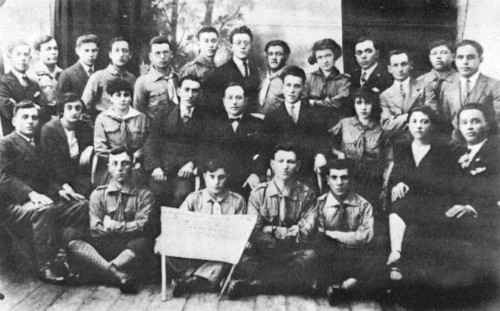
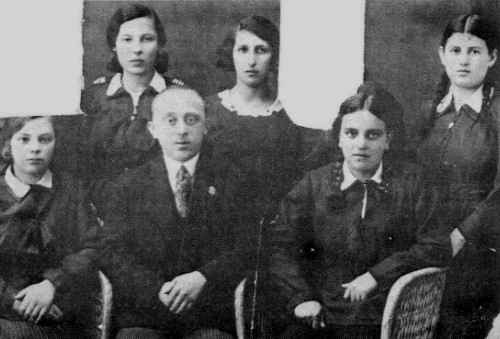
| Members of “Hashomer Hatzair” in Trembowla |
[Page 117]
their age. Among the counselors were Yisrael Rosenfeld, Sarah Milgrom, of blessed memory, Yozek Einleger, Gusta Meltzer, David Margalit, of blessed memory, Izio Greenfeld (currently at Kibbutz Ein HaMifraz). The head of the group to which I belonged was Moshe Weissberg.
It was not long before the movement expanded. Members were added, and likewise counselors such as Volvele Rosenfeld, Binyamin Shapira, Gusta Milgrom, of blessed memory, Sabina Greenfeld (currently at Kibbutz Ma'apil), and the writer of these lines. Alongside the “Hashomer Hatzair” movement, the “HeChalutz” organization was also established. Among the counselors were Natan Vorman (in Tel Aviv), Hersh Drezner, of blessed memory. The cooperation between the two movements was close. The counselors of “Hashomer Hatzair” also rallied to the intellectual work in “HeChalutz.”
Despite all the difficulties, the “Hashomer Hatzair” movement won the trust of the secular and religious public, and was recognized in the city as a movement that could be relied upon. Remembered for good is the city's rabbi, Eliezer Leiter, of blessed memory, who more than once came to our aid and resolved problems for us in the town regarding various permits. Our standing in the Jewish public was well established, and we continued to operate without interference. Even religious Jews such as Leib Rosenfeld, of blessed memory (who passed away in Israel), cooperated with us on the “Hashomer Hatzair” committee – a matter that added honor and success to us.
During the years of the “Hashomer Hatzair” movement's existence in Trembowla, as in all the other cities, there were ups and downs. Beginning in 1933–4, when whispers about the possibility of the outbreak of World War II began in the world, despair took hold of the Jewish public as the Nazi party in Germany made its mark and began to degrade Jews. Among us too, the ranks of the youth began to thin and activity weakened.
We made great efforts; we instilled love of the Land of Israel in the youth. Here they learned the history of the Jewish people and its connection to the Land of Israel, and that this connection was never severed.
[Page 118]
by Yosef Einleger & Natan Vorman
Translated by Binny Lewis
The First World War drove many Jews to the Austrian capital – Vienna – and among them also Jewish youth from Eastern Galicia. Part of this youth had belonged before the war to the “Tzeirei Tzion” (“Young Zionists”) organization, at the head of whose goals was: the study of Jewish history and analysis of the Jewish problem in the Diaspora; or to the “Scouts Organization,” which was then called “Scout,” and which was organized according to the model of the Polish Scouts Organization.
This youth merged, after stormy debates, into one movement and founded the “Hashomer” movement, which was later called “The Viennese Hashomer.” One of the activists of the Viennese Hashomer was Shmuel son of Avraham Einleger, of blessed memory, a native of Trembowla who had arrived during the war with his parents in Vienna and returned in 1917 to Trembowla. He initiated the establishment of “Hashomer” in our city according to the model of the Viennese Hashomer. The meeting place of the members of “Hashomer” was in the apartment of the Manheim family, where the cultural and social activity was conducted, which found expression in the study of the Hebrew language, discussions on current issues and on the Zionist movement; from there burst forth the melodies of the new Zionist songs of that time. It is worth noting that “Hashomer” was the first Zionist organization in Trembowla. “Hashomer” did not last long. After an existence of two years, it ceased its activities. There were several reasons for this: the war between the Poles and the Ukrainians, and the war that broke out between the Poles and the Bolsheviks.
The goal of “Hashomer” at that time was to educate the youth in the spirit of productivization and immigration. According to the concepts of the times in the 1920s, only one who had a trade could be a candidate for immigration – such as: a cobbler, a blacksmith, a farmer, and the like. But at that time there were no such candidates for immigration, and they also hesitated to immigrate. And so the period of “Hashomer's” existence ended in 1920.
At the beginning of 1925, Tosik Amrant arrived in Trembowla from the district city of Ternopol. He connected with several students from the upper classes of the government high school and founded the “Hashomer Hatzair” movement. The goal of this movement
[Page 119]
|
|
| Activists of the JNF – Dr. Stern, the Chairman |
[Page 120]
was to give the youth a national and socialist education and to train them for immigration to the Land of Israel. “Hashomer Hatzair” in Trembowla was based on the principles that had crystallized in the national “Hashomer Hatzair” movement. The chapter of “Hashomer Hatzair” was divided into units (groups) that concentrated the same age groups, in order to adapt for them the organizational and cultural activities.
From time to time, representatives of the movement arrived in Trembowla from Ternopol and Czortków, such as Richter and others, and guided the chapter leadership in the first steps of its existence.
At first we gathered in the home of one of the members, and there we conducted the organizational activities. After the chapter expanded and gained new momentum, we rented a room in the house of Glass on Sobieski Street. After two years of the chapter's existence, we rented a room from Volvele Briller, of blessed memory, near Pokrówka. From 1929 until the outbreak of World War II, the chapter's activities were conducted in the home of Moshe Brik, of blessed memory.
And these were the groups that existed in the Trembowla chapter: “Aryeh,” “Aviv,” “Chavatzellet,” and “Trumpeldor.”
The first head of the chapter was David Margalit, the second – Pinchas Neiman, the third – Yosef Eisenger, and after him – Yisrael Rosenfeld. During that period, the number of members in the “Hashomer Hatzair” chapter reached 150 members. The first youth movement in Trembowla was Hashomer Hatzair. Its members were very active in the national funds, such as: the Jewish National Fund, the Foundation Fund, and in the distribution of shekels. Within the walls of the chapter, extensive cultural and informational activity was conducted. Almost every evening, discussions were held about what was happening in the Land of Israel, about Jewish culture in the Diaspora, about social topics, about Zionist history, and about the socialist movements in the world. The cultural and educational activity that was conducted at the “Hashomer Hatzair” chapter was very intensive and influenced the shaping of the Zionist-socialist ideology of the Trembowla youth. The chapter members organized theatrical productions in the city depicting Jewish life, and masses of the Jewish population of Trembowla would flock to them. The income was dedicated to cultural enterprises. The chapter members participated in regional and national conventions, summer camps, and leadership retreats. All of this opened new horizons before the chapter members, and the “Hashomer Hatzair” chapter became one of the most important in the Ternopol district.
After a certain period of the chapter's existence, the members began to take steps to realize the Shomerian ideal and to travel to training kibbutzim.
[Page 121]
The first to go to a training kibbutz was Yitzchak Goren (Greenfeld), and after him other members went. After 1928, the “Hashomer Hatzair” movement began to contract. Several members who had stood at the head of the chapter left the movement, enrolled as students at universities, and devoted themselves to studies.
After Yisrael Rosenfeld, Moshe Drozner was head of the chapter until his immigration to the Land of Israel. After him, Sabina Greenfeld and Gusta Milgrom led the chapter.
The first from the “Hashomer Hatzair” movement to immigrate to the Land of Israel was Izia Goren (Greenfeld) in 1929; after him – Mordechai Hirschhorn, of blessed memory; after them – Leib Goren (Greenfeld), Moshe Drozner, Sabina Greenfeld, Klara Drozner, Gershon Yunger, of blessed memory, the sister of Mordechai Hirschhorn.
A large portion of the Jews of Trembowla who are in the Land of Israel are graduates of “Hashomer Hatzair”, who absorbed the culture of the movement and remember the effervescent Shomerian life that gave them interest and content in life.
by Yosef Einleger
Translated by Binny Lewis
The First World War, between 1914–1918, was harsh, cruel, and very long. Many Jewish families left Trembowla out of fear of the Russians and fled westward, into Austria. They wanted to distance themselves from the front and went to take shelter under the Kaiser's protection in Vienna, and there they found refuge and aid.
In the first battle near Husiatyn, the Austrian army suffered a crushing defeat. In my memory, as a seven-year-old child, the sight of the retreating army and the wounded on wagons on their way westward, in the direction of Podhajce and Stryj, is etched.
The Russian army advanced without hindrance. They tell that an elderly Jewish woman by the name or nickname “Batalikhe” went out to meet the Russian soldiers advancing forward with two empty buckets – something that according to superstition symbolizes a bad omen for those one encounters.
Trembowla fell into Russian hands for three years, until in 1917 it was liberated by the armies of Germany and Austria.
[Page 122]
In the years 1918–1920, battles were conducted in Eastern Galicia between the Poles and the Ukrainians, and in 1920 there was a war between the Poles and the Bolsheviks. In that year, after the “Miracle on the Vistula,” the Poles succeeded in repelling the Bolsheviks; a peace agreement was made, and the border between Poland and Soviet Russia was established.
In the years 1914–1920, Jewish life was reduced to guarding existence – to live, to subsist, in order to reach better times. After these years, the standard of living began to rise gradually. The elementary and secondary schools were opened, and the youth in the city began to awaken. Shmuel Einleger, of blessed memory, who had then returned from Vienna, organized “Hashomer” according to the model of the Viennese “Hashomer.” This was the first youth organization with a Zionist character. This was after the Balfour Declaration, and the enthusiasm of the Jewish youth was great. The founders and first members were: Shmuel Einleger, Lipa Briller, David Greenberg, Bumba Einleger, Yitzchak Weissberg and his brother Avraham, may he be distinguished for long life, Yitzchak Goldstein, Lonka Fisher, Hela Eisner, Bronia Ginsberg, Zuska Brown, Shlomo Einleger, Chava Alman, Rivka and Hania Zaltzer, Mania Ginsberg, Lonka Greenberg, Esta Rosenberg, Nuska Zlatkes, and many more.
The “Hashomer” organization did not last long. The goal was to create a new Jewish type, productive, who would be suited for life in the Land of Israel rising to renewed life. However, this goal was not achieved. No basic and practical program was laid out, and the organization gradually petered out.
After some time, the former members of “Hashomer” gathered to take counsel on how to arouse and organize the youth in the city, or to establish a cultural institution worthy of its name. They thought and decided: to establish a library. Thus was established the Hebrew library, which developed and became a source of pride. The former members of “Hashomer” established the “Ivriah” library and afterward “Hashomer Hatzair,” which was the first youth organization in the city and which had 150 members.
It should be noted in this context that after the war there was nothing in the city – no organization, no movement, no cultural activity – apart from the Jewish sports association for football. And because of this, no organizational connection could be formed, neither with Ternopol nor with Lemberg. The only cultural pursuit was reading newspapers. They read “HaChvila” by Dr. Reich from Lemberg, “Nowy Dziennik” by Dr. Ton from Cracow, “Nash Przegląd” by Gruenbaum
[Page 123]
from Warsaw – the three newspapers mentioned above in the Polish language – in addition to “Haynt” and “Moment” in Yiddish.
And so, a group of young people gathered – those we know from “Hashomer” that had expired: Shmuel Einleger, David Greenberg, Lipa Briller, Bumba Einleger, and others – and began to discuss the topic: a public library. However, how does one do this? They had neither experience nor money, neither a hall nor furniture, and most importantly, there were no books.
After long debates, the idea arose to collect used books from homes – to go from house to house and request books for the library. They said it and did it. In the Glass house there was an empty room, and there they placed the pile of books on the floor. In another place they managed to obtain a table and another table, two old cabinets, planks for shelves, and thus was born and founded the first Jewish library in Trembowla under the name “Ivriah,” without money and without means, solely through the great enthusiasm of its founders. Initially, monthly subscription fees were set as low as possible, in order to encourage future readers.
There were expenses for lighting, for cleaning, for heating. They began to think about ordering new books; connections were forged with publishing houses in Lemberg and Cracow. The management took upon itself financial obligations, but the money from membership dues was insufficient. The due date for the promissory notes approached and the coffers were empty. The signatories on the notes refused, out of sympathy, to continue. There was a threat of bankruptcy; entire days were spent discussing the situation in order to prevent a crisis. From where would help come?
But Israel is not forsaken! It is a time of trouble for Jacob, and from it he shall be saved. [Paraphrase of Jeremiah 30:7.] And behold, an idea sprang up: to hold a series of amateur theatrical productions and a dance evening after each production. The income – consecrated to the library. They immediately set about preparations; connections were forged with Ternopol, Chorostków, Kopyczynce – settlements in which the youth had some experience in organizational matters. A play was chosen and rehearsals began. Time pressed; rehearsals were held in the actors' homes. The actors were: Pepe Meltzer, Alter Azderbel, Natalia Shmiltzer, Regina Meltzer, Bumba Einleger, Seniu Kotlerski, Yehuda Lizner, Iciu Rubel, Dora Kotlerski, Sharka Bazan, Moshe Brik, Shlomo Feld, Naftali Weinraub, Chaim Ganzer, and others. The production was in Yiddish and was held at the “Prosvita.” According to existing custom, invitations were sent, and several days before the production, pairs from the production committee went to request donations for the buffet – cakes and the like. The goods that were
[Page 124]
donated were collected on the day of the production at the hall; there were also goods that the committee prepared itself and that were sold at a profit. The result was that the next morning the buffet was empty and the coffers were full.
The first play staged was the comedy “Chainke, Pinke.” The director was the dentist Acht. The production was more successful than expected, and a second production was held. In addition to these, other plays were staged, such as the tragedy “Bar Kokhba” (in which Chaim Ganzer played Rabbi Akiva), “Der Vilder Mentsh” (“The Wild Man”), and others. The hall was packed from wall to wall. All the tickets were sold. In these productions, the previously unknown talents of Pepe Meltzer and Alter Idzbel were revealed. The audience burst with laughter. The actors had to come out before the curtain, to the sound of the audience's cheers, multiple times. The second production was a tragedy called “Gott, Mensch und Teufel” (“God, Man, and the Devil”). The lead actor and director this time was Seniu Kotlerski. The third production was again a comedy called “Kaptzenzon un Hungerman.” In the lead roles played Bumba Einleger and Seniu Kotlerski. Afterward, several literary evenings and reading performances were held of the works of Jewish authors and poets, recited by Meir Malman. All these evenings were met with great success, and the tickets for visitors were sold in advance. And so it continued for several years. The revenues made it possible to sustain and develop the library until the day of its closure in 1939.
In the meantime, certain changes occurred in the composition of the activists for the library. The founders for the most part left Trembowla and went to study at universities. However, they did not forget the library. While in the university cities, they became its ambassadors. They maintained the connection with it, followed the new publications, and as soon as books appeared they would acquire them and transfer them to Trembowla even before reviews appeared about them in the press. Books were acquired in the languages: Polish, Yiddish, Hebrew, and German.
At that time, the library entered the most vigorous stage of its development. From time to time new books arrived. The number of subscribers grew beyond expectation. It became possible to raise the subscription fees. Revenues grew and the number of books increased, and the space was insufficient to contain them. A more spacious location had to be sought.
The period between 1926–1939 was the golden age of the “Ivriah” library in Trembowla. During that period, Bumba
[Page 125]
|
|
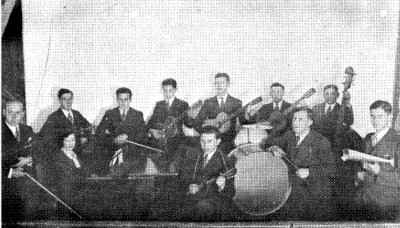
| The Orchestra |
|
|
| Group “Dror” of Hashomer Hatzair – Counselor: Dora Neiman |
[Page 126]
Einleger managed its affairs, and afterward – David Greenberg. When David also left to study in Cracow, Dora Neiman took over the management of the library. Then a successful cooperation developed between her and David Greenberg, who would acquire and transfer to Trembowla the best books as soon as they appeared in Cracow. At that time, translations from the Russian language were in vogue – books of a social, political character. There were also books translated from German, English, and French. Especially worthy of mention are the publications of “The Library of Nobel Prize Laureates,” among them excellent translations from French by the writer Benny Zhelenski.
After the immigration of Dora Neiman to the Land of Israel, her brother Pinchas, David Margalit, and Leopold Glass took over the management, and they were engaged in this until the closure of the library with the Russian conquest. Besides those mentioned above, the library was operated with the help of other volunteers, not a few, all of them without expectation of reward, of course.
In the years 1937–1939, the number of books reached 15,000.
Among the readers of “Ivriah” were not only Jews, but also educated Poles and Ukrainians, also from the more distant vicinity; from the towns of Strusov, Budzanow, and Janov, people came to exchange books at the “Ivriah” library.
In the last years, the library received from the community council two rooms for its purposes; then appropriate cabinets were also acquired. The work in the library was perfected. New catalogs were prepared; the numbering was renewed. The work in the library was reorganized. The lending and returning of books was conducted with professional efficiency.
Following the success of the “Ivriah” library, a Polish library was established in the “Sokól” and a Ukrainian one in the “Prosvita” in Trembowla, which operated according to the model of “Ivriah.” However, they did not reach its level, neither in terms of organization nor in terms of the number and quality of books.
On September 1, 1939, the Nazis attacked Poland, and on the 17th of that month the Red Army entered Trembowla. After several days, “Ivriah” was sealed shut by the NKVD. A similar fate befell the Polish and Ukrainian libraries. By the end of 1939, all the books from the “Ivriah” library and from the Polish library were transferred to the Ukrainian library at the “Prosvita.” A team specially selected by the NKVD worked for several months censoring and arranging the books. The unsuitable books were suppressed (burned?). One general library remained for the entire Trembowla area.
[Page 127]
The “Ivriah” library was a cultural phenomenon that was one of a kind. It influenced to a decisive degree the spiritual, cultural, and political development of an entire generation, from which were composed the various political organizations, legal and illegal, among them the Zionist youth organizations, Hitachdut Poalei Tzion, Bnei Akiva, the Zionist Youth, Beitar, Hashomer Hatzair, and so forth. This Jewish youth took an active part in elections to the Zionist Congress, in work on behalf of the Jewish National Fund, in elections to the Polish “Sejm” on behalf of Zionist List No. 17, and in local municipal elections.
The “Ivriah” library constituted a cultural and educational institution whose stature exceeded the size of the town of Trembowla. It was a cultural institution unique in all of Galicia, which operated for 17 years with the help of volunteer workers.
The war and its consequences brought to oblivion the enterprise that was built by devoted people who invested a very great deal of toil and energy in its development. The “Ivriah” library was not the property of any party, of any private body; it was the property of the Jewry of Trembowla and its glory.
by Israel Goldflus
Translated by Binny Lewis
My teacher and rabbi, Pinchas Arak, guided my first steps in Gemara. He said that after I had studied privately for several years, two hours a day, I no longer needed the help of a teacher and instructor, and from this point on I must study on my own, or travel to a yeshiva.
He was the son-in-law of a melamed [religious teacher] called R' Yeshaya, who died during the First World War. R' Pinchas taught only Gemara; he was a pleasant man, well-versed also in worldly affairs, who loved to read books outside the Jewish studies. During the break between my lessons and those of my brother, of blessed memory (who would learn after me), or during the time he was accustomed to set me to independent work – which was called “alaynen,” perhaps because the student studied alone – “allayn” (alone in Yiddish) –
[Page 128]
R' Pinchas would consult the Brockhaus encyclopedia in German, which was in our home's library, among other encyclopedias and German books.
He taught a group of students for many years in the afternoon, since in the mornings they attended the Polish elementary school. Even many high-school students studied with him; he taught us before noon. I began at exactly 8 o'clock, as in school. For a certain period I studied together with the son of Moshe Einleger, of blessed memory – Yosef, who was called Yuzek. He was older than me and already studied in high school, in a class with few students. Since the students studied as externals [privately], Yosef was free also in the mornings.
I studied with Rabbi Pinchas Arak from the year [19]20 until [19]24. Even after I left the town to study with the rabbi of Probezhna, I used to visit him when I came home, and I was even accustomed sometimes to bring him wine for the four cups at Passover as a gift. It seems to me that he died with the German invasion or still during the Soviet occupation. Together with the younger son of Rabbi Pinchas Arak – Meir (who had worked for Leyb Shartser for many years and afterward opened an independent hardware store) – we hid together during the first aktsia [deportation action]. In the forest there we worked together for a period.
May their memory be blessed!!!
by Y.G.
Translated by Binny Lewis
R' Natan Ashkenazi, of blessed memory, taught me Hebrew, Bible, German, arithmetic, and all the other subjects in Hebrew. I studied with him for the same number of years I had studied Gemara with R' Pinchas Arak. He was accustomed to come to our home at around 11 o'clock, after R' Pinchas Arak had finished teaching me, and at times the two of them would meet at our home.
R' Natan's method was Hebrew through Hebrew. He was not accustomed to use translations into the language familiar to the student; instruction was conducted in the very language one wished to impart to the student – a method by which people strive even today to teach a foreign language. My teacher, R' Natan, taught only the Bible in an exceptional way – Hebrew with a translation into German, rather than into Yiddish.
The students, of course, did not know the German language. He intended,
[Page 129]
therefore, to catch two birds with one stone: to impart Hebrew, and also knowledge of the German language, in which he was exceptionally proficient. Among the students this was received as it is written in the Gemara: “he hangs something known upon something unknown” [tali tanya b'de'la tanya – a Talmudic expression for an invalid logical argument], since both languages together were foreign to them. But it was impossible to convince him on this matter. Apparently, he had taught this way before the First World War, and even in the days of Poland he did not wish to change his teaching method. He was accustomed to pace the room during the lesson and recite his material by heart, accompanied by a German translation. The fact is that the main knowledge I acquired in Hebrew, German, and the other subjects was gained during the three years I studied with him.
R' Natan Ashkenazi was a solitary and poor man. He had separated from his wife and lived with his sister and mother from the twenties until the thirties. His livelihood came from private lessons in Hebrew and German. Afterward his situation worsened and he could no longer earn his bread from teaching. The situation of the Jewish middle class was steadily deteriorating in antisemitic Poland. Parents did not send their children for private lessons and contented themselves with the studies in the government school. At the end of his days his means of support was broken, and even his health deteriorated. R' Natan was then supported by a relative who worked in Geneva at the League of Nations. At that time I was already a grown young man. While staying at home during a vacation I heard that my teacher was ill. I immediately hastened to his sickbed and cared for him during his illness. He was very glad at my coming. He always received me with open affection and great friendship. He emphasized several times that I was his most senior and best student. He died of tuberculosis in the month of Av in the year 1933. At the time of his passing I was, to my regret, not in the place, as I had traveled to the World Conference of Hapoel HaMizrachi [the religious Zionist labor movement], which was held then in Kraków. When I returned, he was already no longer alive.
May his memory be blessed!
by Frida (Kozhe) Atinger, née Antner
Translated by Binny Lewis
My father, of blessed memory, who was known by the affectionate name “Yankele Shaye-Ber's,” was a short man, though he was by no means a small man altogether. His birthplace was in the village of Malaya Luka[?], near the town of Mikulince [Mikulintsy]; his studies were at the yeshiva of R' Mani's in Tarnopol, and his residence in Trembowla, where he married and established a home. Even though
[Page 130]
he was not a native of Trembowla, my father was integrated into the life of the community as one of its veterans.
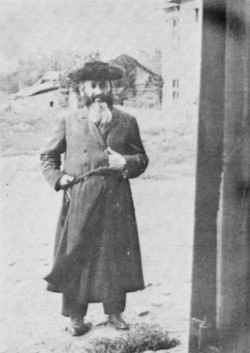
My father, of blessed memory, was a Husiatyn Hasid, devoted with all his soul and might to the affairs of the “Husiatyn Kloyz” [Husiatyn house of prayer]. His admiration for his rebbe, R' Yisrael Friedman, was boundless and immeasurable. His devotion to Hasidism was an inseparable part of his personality and influenced his entire way of life. For a number of years – years during which the “Husiatyn Kloyz” was in the process of construction – my father was accustomed to invite all who came to the synagogue to our home for the Shabbat Kiddush. And do not disdain the “Kiddush” of Hasidim: those Jews, imbued with Hasidic enthusiasm,
|
|
| R' Yaakov Antner of Blessed Memory |
[Page 131]
knew how to turn a “Kiddush” accompanied by half a “kugel,” a liter of vodka, and salted chickpeas into a genuine celebration, when each sip was accompanied by a dozen “l'chaims!” ablaze with joy. After the “warming up” of the body, the conversation turned to spiritual matters, to disputation in Torah matters, the wondrous way of the Rebbe and his miracles – everything permeated with joy and enthusiasm. Those moments of spiritual elevation strengthened and fortified the poverty-stricken Jews to face another weekday with courage, and the livelihood worries that came with it.
The enthusiasm soared especially on Simchat Torah, when in honor of the occasion “holiptses” [stuffed cabbage leaves filled with meat and rice] were added, and the strong drink was distributed with a generous hand. The Hasidim shed the cares of daily life and gave praise and thanks to the Creator of the world in song and dance. Here, a Hasid like “Yiddele Shvebl” went out in a dance with his arms waving, his mouth giving thanks to the Master of the Universe that He had not made him, heaven forbid, a “starosta” or “voyevoda” [a county governor or provincial governor], but had created him a simple Jew, who had merited to serve the Master of the Universe.
Father's home was open to his friends and to the friends of his household alike. A regular guest in our home was the elder Yisrael (“der alter Shtaub”), a quiet man of pleasant manners, and Shalom Friedman, a gifted cantor, refined of spirit, a son of Torah and overflowing with good deeds. The sweet tones of his prayer, as he led the congregation, still echo in my memory and cause the strings of my heart to tremble.
Another regular guest was Leybele Rozenfeld, a wise man with the sound judgment of a lawyer. On Tuesdays, market days, the “yaridnikes” [market-goers] would stop at our home to warm their bodies with a cup of tea or to refresh their hearts with a bowl of soup.
I do not remember a single Shabbat evening when there was no “Shabbat guest” at our table. Those who benefited from our hospitality included wandering “eyni??akh” [“grandchildren” – a term used by people who claimed to a Hasidic rabbinic crown solely by virtue of their ancestry], and simple paupers. And this was not only on Shabbatot but on weekdays as well.
To this very day I do not know where my father drew the strength and the energy to attend to communal needs after the many hours he labored for the livelihood of his home. For many years he served as treasurer of the community (in the days of Professor Franzus and Mr. Podhorzer, who were presidents of the “kultus” [Jewish communal organization]). In addition, he dealt with ritual slaughter, with payment of the salaries of the rabbi and the shochetim [ritual slaughterers], attended to the problems of the bathhouse, the matters of
[Page 132]
burial, the wheat money [maot chitim – Passover charity], and other matters of charity. As a mohel [circumcisor], he never hesitated to spend a Shabbat or holiday in some remote village provided he could fulfill the commandment of bringing a Jewish child into the covenant of Abraham our father. Father had a melodious voice and served as the “ba'al shacharit” [prayer leader for the morning service] and “ba'al koreh” [Torah reader] in the Husiatyn synagogue, “ba'al musaf” [additional service prayer leader] in the Beit Midrash, and “ba'al toke'a” [shofar blower] in both. On Purim he read the Megillat Esther in the synagogue and hastened to earn the honor of an additional reading in the home of Rachel Alman, where the women gathered who had been prevented from hearing the Megillah reading in the synagogue.
Father's day began at five in the morning. The first two hours were devoted to prayer and to practicing the Torah reading. My father dedicated every free moment to these practices. On our table there was always an open book.
A man of a sensitive and warm heart, he respected every person for what he was – Jew as well as Christian. He knew how to ease the sorrow of the bereaved and to bring healing to the sick. Wherever he happened to be, he knew how to bring a spirit of hope and joy of living.
Despite his personal sufferings he maintained a steadfast spirit until he was laid low – stricken by cancer – and agreed to move in with my brother, Meir, of blessed memory, in Zaleshchiki [Zaleszczyki], where he passed away on the 15th of Elul [5]698, two months after my departure for the United States. His faithful friends – Rabbi Leitner, Shalom Friedman, and Yisrael Shtaub – traveled especially to Zaleshchiki to pay him their last respects.
All of my father's life – as I see it now – was consecrated to Torah, service, and acts of loving-kindness.
|
|
JewishGen, Inc. makes no representations regarding the accuracy of
the translation. The reader may wish to refer to the original material
for verification.
JewishGen is not responsible for inaccuracies or omissions in the original work and cannot rewrite or edit the text to correct inaccuracies and/or omissions.
Our mission is to produce a translation of the original work and we cannot verify the accuracy of statements or alter facts cited.
 Terebovlya, Ukraine
 Yizkor Book Project
 JewishGen Home Page
Copyright © 1999-2026 by JewishGen, Inc.
Updated 10 Aug 2026 by JH