 |
|
|
[Page 67]
[Page 68]
[Page 69]
By Rabbi Meir Wander
Translated by Binny Lewis
The first rabbi known to us is the pious Rabbi Isaac, a teacher (Mokich) and head of the rabbinical court (Ab”D) of Trembowla in Podolia. He was the nephew of Rabbi Yechiel Michal, son of Rabbi Eliezer, one of the sacred communities of the year 408 (1648) in the pogroms of Nemirov. Later in the year 448 (1688) he lived in Zolkiew and printed in Lublin the book of his uncle titled “Shevrei Luchos” (Fragments of the Tablets).
1. Rabbi Aaron
Rabbi Aaron was the first official rabbi of Trembowla known to us. He later moved from Trembowla to the rabbinate in Zlotshov.
We know his birth year, approximately the year 430 (1670). His father's name is not mentioned. We only know that he was the son-in-law of the famous Rabbi Mendel of Apta, known as the brother of the renowned wealthy man Rabbi Henekh of Zolkiew.
Rabbi Aaron was considered one of the geniuses of the era. He also authored many important books that were not published in print. He died in the year 499 (1739).
His daughter was the wife of Rabbi Israel, head of the rabbinical court of Zlotshov and Lukatch. He was born in the year 451 (1691) and died in Lukatch at the age of 47. This son-in-law was of great descent, a descendant of great and honorable rabbis. His father was Rabbi Jacob, Ab”D of Husiatyn, and his origin was from Rabbi Meir of blessed memory, head of the rabbinical court of Lvov and Galicia.
The mother of Rabbi Israel was the daughter of Rabbi Gershon the Kohen Rappaport, Ab”D of Belz, brother of Rabbi Simcha the Kohen Rappaport, Ab”D of Lublin.
The novellae (Chidushei) of Rabbi Israel were printed in a book published by his son titled “Halakha Adam Mi-Israel” (A Man of Israel according to Halakha). The book also included some of the novellae of his grandfather Rabbi Aaron. In the introduction that his grandson wrote for his father's book, he mentions with reverence his grandfather Rabbi Aaron and writes about him the following words: “My mother's father, the rabbi, the genius, the pious Rabbi Aaron was head of the rabbinical court of Trembowla and Zlotshov. He made ears for the Torah and composed wonderful commentaries on the Jerusalem Talmud, Midrash Tanhumma and others. It is regrettable that I am unable to publish them, for then they would have shown how much my ancestor was devoted to the truth of the Torah, and certainly they would have enjoyed the novellae of his Torah.”
[Page 70]
2. Rabbi Abraham Yechiel Fischel
Regarding this rabbi we know that he was a rabbi in the community of Salpakowitz and other towns, and from the beginning of the sixth century of the sixth millennium, the year 1700 according to their count, [he was] head of the rabbinical court and head of the yeshiva (Rav Mevin - a teacher) in the community of Adath Yeshurun of Trembowla in the Galician region of Lvov.
Our biographical information about him we derive from the unique book he published titled “Amrei Tzrufa” (Refined Words). From there we also know that his father, Rabbi Zev, immigrated to the Land [of Israel] in his later years and was buried in Safed in the year 515 (1755).
We also know from the book that his life was full of exile and wandering, and all his life was a life of poverty and suffering. Despite these harsh living conditions, his head and most of his being were immersed in studies.
In publishing the book, he was aided by the wealthy man Rabbi Mordechai, son of Rabbi Haim. In his ornate introduction to the book and also on the cover of his book, he also calls the book “Chidushei HaRIF” (Novellae of Rabbi Isaac Alfasi) and emphasizes there that he could not publish all his novellae due to lack of funds.
The book also contains approvals from great rabbis of his time, among them judges of Berlin, Rabbi Naphtali son of Rabbi Benjamin Hertz of Glava, and Rabbi Jacob Segal Landau, head of the rabbinical court of Tarnopol. Finally, an approval from Rabbi Benjamin Hersh, head of the rabbinical court of Berlin.
3. Rabbi Aaron Halperin
He was one of the great Torah scholars of Trembowla, but did not serve in a rabbinic position. He was of great distinction, descended from the family of the author of the “Levushim” (Garments).
His wife was the daughter of the wealthy man from Nierode, and she was a woman of valor who engaged in commerce in order to relieve her husband of the burden of earning a livelihood for the household, so that he could devote himself to studies and the publication of his books.
He authored three valuable and rare books known to us. The first book he published around the year 515 (according to the date of the approvals, 1755). He writes in the introduction to the book that he was orphaned from childhood and grew up on the lap of the elderly Rabbi Liebush, and most of his Torah he learned in Vishnyavitz, under the direction of his brother-in-law Rabbi Elchan the Kohen. And since he did not merit having sons, he established a school [Beit Ulpana] and a Torah library in it. In his book he brings hope that he would merit to reach the Land [of Israel] in the end of his days. In the book there are many approvals, among them the approval of Rabbi Haim the Kohen Rappaport,
[Page 71]
|
|
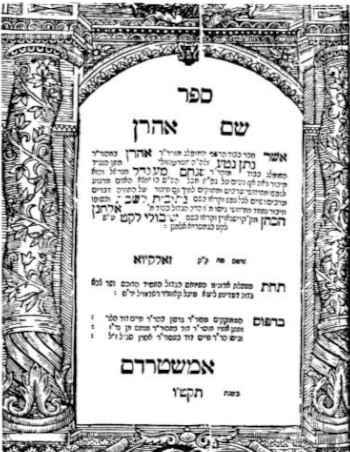
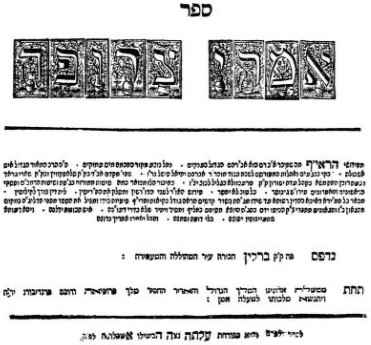
| [Title page of book reproduced in original: “Amrei Bruch” (Words of Baruch) - From the novellae of the Rif that the honored, honored, wise and great rabbi Rabbi Abraham Yechiel Fischel composed. A star doubled from the light of his wisdom, deep waters. In the order of the Talmud in completeness…] |
[Page 72]
|
|
| [Title page of book reproduced in original: “Shem Aaron” (Name of Aaron) - Which was composed by the honored, distinguished rabbi Rabbi Aaron, son of the honored Rabbi Nathan Nata of blessed memory, of Trembowla… As composed by the honored Rabbi Menachem Mendel… A condensed work containing selections from all of the Talmud… commentary on the Torah named “Netivot LaShabbat”… and a composition of his brother-in-law the great rabbi Rabbi Elchan the Kohen from Vishnyavitz, named “Shvilei Leket”…] |
[Page 73]
Ab”D [of various communities, and] Rabbi Yechiel Fischel son of Rabbi Zev Wolf, Ab”D of Trembowla, whom we mentioned. Also the approval of the rabbi of Tarnopol, the Galician region of Podolia, is found there, and another approval of three renowned rabbis, among them the rabbi of Zolkiew.
The name of his first book: “Shem Aaron” (Name of Aaron) was printed in Zolkiew by the printers. Its contents were novellae of Gemara, legal authorities, Tosafot and also included a commentary on the Torah named “Netivot LaShabbat” (Paths for the Sabbath) according to the weekly Torah portions. Attached within was also a work named “Shvilei Leket” (Paths of Gathering), novellae on the tractates of his brother-in-law, Rabbi Elchan the Kohen from Wishnyavitz, under whom he studied, as we mentioned.
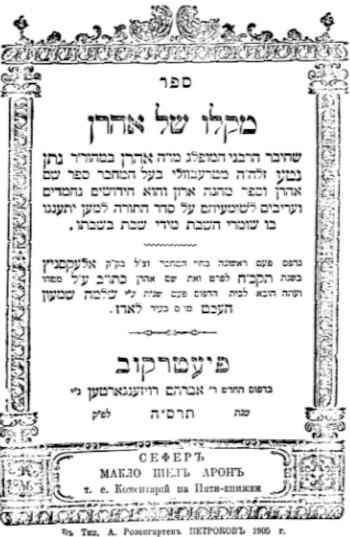
The second book he published around the year 527 (1767), its name “Machane Aharon” (The Camp of Aaron), in which are novellae on the tractate Berachot and Moed, and especially an interpretation on tractate Shekalim, which is rare because there are no other later commentaries on this tractate. The approvals on the book are, aside from Rabbi Meir Margaliyot which appears also in his first book, from Rabbi Jacob son of Rabbi Mordechai Halperin, Ab”D of Trembowla, Rabbi Joseph Shatsky, Ab”D of Brody, Rabbi Solomon Isaac, Ab”D of Tarnopol, the Galician region of Podolia, and Rabbi Mordechai Kohen Rappaport, Ab”D of Alexantz. Later, in that same year, he printed his third book titled “Maklo shel Aharon” (The Staff of Aaron), twenty pages of folio, novellae on the difficult passages of the Talmud and novellae on the Torah according to the weekly Torah portions. Rabbi Halperin from Trembowla emphasizes in his introduction to the book that it is small in quantity but large in quality. The book apparently became beloved to the learners, and Rabbi Solomon Echt, a book merchant in Lodz, reprinted it in Piotrkov by the press of Rabbi Abraham Rosengarten in the year 565 (1905), thirty-nine pages.
Printed in the city of Zolkiew by the printers. [With permissions from various authorities and dated to Amsterdam in the year 515 (1755)]
Printed first in the lifetime of the author of blessed memory in the city of Alexantz in the year 528. Now it has been brought to the printer again by Solomon Simon Echt, in the city of Lodz. Piotrkov - in the new press of Rabbi Abraham Rosengarten.
4. Rabbi Jacob Halperin
We know about his personality only from the approvals he gave to many books. As we mentioned above, he gave his approval to books authored in the year 527 (1767) by his townsman Rabbi Aaron Halperin. In the year 530 (1770) he moved to Lvov, and on his approvals that he gave there, he also signs as Ab”D of the holy community of Trembowla, for now a judge of the rabbinical court (Rav Bet Din) and preacher and officer of judgment of Lvov. On the second day, the twenty-fifth of Nisan, 532 (1772), he approved the book “Pri Megadim” part Yoreh Deah, which was printed that year in Berlin, and he calls the author of “Pri Megadim” his friend and colleague who clung from an enemy.
Ten years after this, in the year 542 (1782), he gave an approval to that same author who published his book Pri Megadim on the Shulchan Aruch part Orach Chayim, which was printed in Padua in 547 (1787).
[Page 74]
|
|
| [Title page of book reproduced in original: “Maklo shel Aharon” (The Staff of Aaron) - Which the rabbinical authority Rabbi Aaron, son of the honored Rabbi Nathan Nata of blessed memory, of Trembowla, author of the book Shem Aaron and the book Machane Aharon composed. Pleasant novellae and sweet for those who hear them, on the order of the Torah, so that those who observe the Sabbath may enjoy it from Sabbath to Sabbath…] [Russian translation of the title: “SEFER MAKLO SHEL AHARON” - i.e. Commentary on the Pentateuch - In the Press of A. Rosengarten, PIOTRKOV, 1905] |
[Page 75]
In the book “Anshei Shem” (Men of Name), pages 110-119, more approvals are listed, upon which he signed second after Rabbi Mordechai Zev Ab”D of Lvov. Also in the years 538-541 (1778-1781) he gave approvals to books, and his last approval is from 548 (1788). On the structured prayer book of Rabbi Asher son of Rabbi Solomon Zalman Margaliyot from Mezbizh, he signed second after Rabbi Abraham Moses of Peshlvotsk.
5. Rabbi Eliezer Lipa Shur
This rabbi, as transmitted in the genealogical scroll at the beginning of the book “Sefatei Tzaddikim” (Lips of the Righteous), folio 3, page 1, moved from Mezbizh to the rabbinate of Trembowla.
Also transmitted in the scroll that his father Rabbi Abraham Mordechai, Ab”D of Zolkiew, was the son of Lipa, a prominent man of Zolkiew, son of Rabbi Jacob Shur from Brest, son of Rabbi Solomon from Brest, who was the son-in-law of the famous Rabbi Saul Wohl, also known from the annals of the communities of Jews of Poland.
His approvals are scattered in various books, starting from the year 475 in which he gave his approval to the book “Shem Yaakov” (Name of Jacob).
6. Rabbi Haim Aryeh Leib Horovitz
He was the rabbi of Trembowla until his death on the twelfth of Iyar, 558 (1798). From the wise men of the Kloyz in Brody, the researcher Galber writes in his book “History of the Jews of Brody” pages 75-77 that he was the son of Rabbi Saul, grandson of Rabbi Zev Wolf, Ab”D of Horowitz, who was also one of the wise men of the Kloyz and died on Monday the ninth of Av, 406 (1746).
His mother Toyba was the daughter of Rabbi Itzikl Horovitz, Ab”D of Brody. The descendants took the name Horovitz after this ancestor of theirs.
In the year 430 (1740), Rabbi Haim Leib had a son Rabbi Isaac, Ab”D of Chishinov and Yaroslav, author of the book “Be'er Isaac” (Well of Isaac) on the commentary of Rashi on the Torah.
7. Rabbi Menachem Mendel
This rabbi was born in Brody and was called to the
[Page 76]
rabbinate of Trembowla. There he gave an approval to the book “Nachal Eshkol” (Brook of Grapes) of his relative Rabbi Haim Ozer Moses the Kohen from Brody in the year 567 (1807). We also find that a question arose with him, a year before the mentioned date, regarding a firstborn animal born to a Jew, and since it was not sold to a non-Jew while there was still time, it grew wild and all suffered from it. He sought a solution and sent his opinion to his relative Rabbi Joshua the Shil, Ab”D Ab”D of Tarnopol, who is the father-in-law of the author of “Nachal Eshkol”. In his response to Rabbi Menachem Mendel from the second day, the seventh of Tammuz, 566 (1806), he writes: “I saw your words and I was glad because of your good health, and how pleasant are your words, which are dear to me…” (Sefer Joshua, pages 40-41).
8. Rabbi Meir Tzvi Hirsch Vitmaier
This rabbi was born in Klush in the year 558 (1798), to his father Rabbi Gabriel, who was merciful and honored rabbis. He was connected to the family of the Maharal, the Baach, and the Taz. He moved to Brody after he married the daughter of Rabbi Levi Frenzus and heard Torah from Rabbi Tzvi Hirsch the Lehr. He also studied under Rabbi Ephraim Zalman Margaliyot and received from him authorization to teach.
In the winter of 584 (1824) he was selected for the rabbinate of Trembowla, and his rabbi traveled with him for his installation. A year and a half he sat on the chair of the rabbinate in that place.
After that, through the efforts of Rabbi Solomon Kluger from Brody, he was accepted in the summer of 585 (1825) to the rabbinate of Sombor. He served as rabbi there for fifty years, and as rabbi of Sombor he remained in the memory of the next generation. He was considered one of the remnants of the old generation, and the geniuses of the generation honored and appreciated him.
Until his last day he did not know any illness and was healthy and did not even need glasses of old age. He died in the cholera epidemic on the eve of Shabbat the twenty-fourth of Av, 633 (1873). He managed to print during his lifetime in Przemysl the first part of his book “Responsa Ramtz” on Orach Chayim and Yoreh Deah. The second part, Eben HaEzer and Choshen Mishpat, was printed in the year 645 (1885). Two years later his book “Derashot Ramtz” (Sermons of Ramtz) was also printed with glosses and additions, the fruits of life, from the publisher for Rabbi Haim Ginzel.
From the questions and answers in his books, the occupations of the Jews of Trembowla are also reflected, as well as the branches of their livelihood, for there are many questions regarding the breaching and infiltration of foxes into chicken coops, what is the status of the other birds that remained, and especially those that were wounded. Because of the trampling of predatory animals, many questions arose regarding the fitness of the birds that remained in the coop.
[Page 77]
9. Rabbi Shmeriah Shmeril Brandeis
Born around the year 440 (1780), to his father Rabbi Jacob who brought him up and educated him with dedication. He learned Torah from Rabbi Ephraim Zalman Margaliyot and was considered one of the mighty men of Torah in his time. He served two years as rabbi of Trembowla, from the summer of 585 (1825) until 587 (1827).
He maintained contact with Rabbi Joshua the Shil, Ab”D, and also traveled to him frequently. Among the subjects of his questions was an interesting question about a woman who slept with a baby in bed and in the morning found him dead, and many other questions regarding halakha.
In the year 588 (1828), Rabbi Shmeriah moved to the rabbinate of Rimlov and is mentioned in rabbinical literature as rabbi of Rimlov. He printed interpretations on the order of prayer and published a book titled “Ayin Tfilah” (Vision of Prayer).
In his last years he immigrated to Jerusalem. He died in Jerusalem on the twenty-second of Tevet, 617 (1857) and was buried on the Mount of Olives there. A copy of his gravestone was also preserved.
All his biography was recorded in abbreviated form in the books “Meore Galicia” part A, pages 619-668.
10. Rabbi Aryeh Leibush Podhoretzer - Podhitzer
He was rabbi in Ozirran, and in the year 588 (1828) came to serve as rabbi of Trembowla until the year 610 (1850) approximately. At the end of his days he left the rabbinate and settled in Tarnopol, where he died and was buried.
11. Rabbi Tzvi Ephraim Taumin
Rabbi of Trembowla in the years 620 (1860). From his period we know the names of the members of the rabbinical court in the city, because of their correspondence with the genius rabbi from Brody, Rabbi Solomon Kluger, who responds in one of his answers to the rabbinical court of Trembowla to the honored Rabbi Isaac son of the honored Rabbi Abraham and the honored Rabbi Tzvi son of the honored Rabbi Nahum, from Maizlesh, and the honored Rabbi Zev Wolf Horovitz. The question discussed was regarding marriage matters concerning a divorced woman who disguised herself as an unmarried virgin and married in another city.
[Page 78]
12. Rabbi David Solomon Drimmer
He was one of the honored men of Trembowla, and apparently from the family of Rabbi Solomon Drimmer, Ab”D of Skala on the river Zbruch, known and famous for his books of Responsa (Sheilot u-Teshubot) in several volumes titled “Beit Solomon” (House of Solomon).
Rabbi David actually fulfilled the duties of rabbi when there was no official rabbi at the beginning of the years of the 630s (1870). His name appears in lists of names of those who signed new responsa books that appeared from that period. We also learn from his questions the names of the slaughterers at that time in Trembowla.
13. Rabbi Simcha, Ab”D
This rabbi was a descendant of the illustrious Ab”D family, relative of the genius author of “Minchat Hanukh”, but we do not have precise details about his family. Apparently he married a woman from Skala (Souchal) and was supported by his father-in-law's table. We find in the responsa of the rabbi from Lvov Rabbi Saul Nathanson a letter to him in Skala.
In the year 632 (1872), he already sat on the chair of the rabbinate in Trembowla, and in that year we find in the Responsa “Beit Solomon” (House of Solomon), which we mentioned, an answer to Rabbi Simcha Ab”D, judge of the holy community of Trembowla, regarding a shepherd, an Israelite, who had in his flock one hundred sheep and eighty cattle, and in the morning they found in the pen three sheep killed and another three wounded, and a question arose regarding the fitness of the remaining ones and also the fitness of the milk, and the responder permitted and allowed everything.
Twenty-three of the Jews of Trembowla signed the book “Brit Abraham” (Covenant of Abraham) of the Preacher Rabbi Joseph Moses of Zlotshov, which was printed in Brody in the year 1875. It is interesting to transcribe their names. The first and foremost: 1) Rabbi Simcha Ab”D. 2) Rabbi Leyb Goldstein. 3) Rabbi Anshel Yager (who was the grandson of the author). 4) Rabbi Samuel Pic. 5) Israel Itzik Polishuk. 6) Rabbi David Axelrod. 7) Rabbi Samuel Orhahn. 8) Rabbi Nathanel Horovitz. 9) Rabbi Joseph Simon. 10-11) The slaughterers (Shochetim) Rabbi Simcha and Rabbi Moses. 12) Rabbi Barish Spira. 13) Rabbi Mordechai Fridman. 14) Rabbi Aba Weiser. 15) Rabbi David Badyan. 16) Rabbi Azriel Gershon Weiss. 17) Rabbi Samuel Wulfenfayt. 18) Rabbi Solomon Zeidelman. 19) Rabbi David Genzer. 20) Rabbi Nehemiah Rosenzweig. 21) Rabbi Yechiel Shechter. 22) Rabbi Moses Tokfeld. 23) Rabbi Abraham Gelir.
[Page 79]
A year later, in the year 636 (1876), thirteen copies of the book “Dvir HaMufutz” (The Dispersed Sanctuary) which was authored by Rabbi Israel Dov Galanter and printed in Przemysl in the year 631, were purchased for the Kloyz (study circle) by the wardens: 1) Rabbi Samuel Pic, 2) Rabbi Baruch Gotlieb, 3) Rabbi David Solomon Drimmer, 4) Rabbi Haim Dov Genzer, 5) Rabbi Haim Moses Yaavetz, 6) Rabbi Joshua Mordechai, the slaughterer (Shochet), 7) Rabbi Isaiah Dov Shokberg, 8) Rabbi Israel Isaac Polishuk, 9) Rabbi Mordechai Moses Yaavetz, 10) Rabbi Moses Leyb Glazner, 11) Rabbi Menachem Halperin, 12) Rabbi Nathanel Horovitz, 13) Rabbi Leyb Badyan.
14. Rabbi Moses Ab”D
In the year 636 (1876), Rabbi Moses Ab”D ascended the chair of the rabbinate in Trembowla, and he was still a young man of eighteen, born in the year 618 (1858), to his father Rabbi Isaac Ab”D of Klush. He married the daughter of Rabbi Abraham Mendel Steinberg (from Brody).
Rabbi Moses Ab”D became famous in his time as a great scholar of Torah, a splendid preacher and beloved of the people. Important communities desired his presence and wanted him to move to them. In the year 664 (1904) he was a candidate for the rabbinate of Reisha, and a year later his candidacy was proposed in Krakow.
In the year 668 (1908) he was elevated to serve as rabbi of Lvov, the inner city, but the name Rabbi of Trembowla clung to him always. He died on the twenty-sixth of Iyar, 676, and left a generation of righteous ones, some of whom are here in the Land [of Israel]. A summary of his biography was published in “Meore Galicia” part A, pages 405-406.
In the year 652 (1892) he signed the book “Ma'aseh Rukach” (Work of Rokach) together with Rabbi Baruch Meir Drimmer and also purchased another book for the society of “Linas HaTzedek” (Shelter of the Righteous). All three were also numbered among those who signed the book “Torat Ram” (Torah of Ram) by Rabbi Alexander Margaliyot of Lvov, in the year 658 (1898). Rabbi Baruch Pluim signed in 673 on volume 6 of the encyclopedia “Otzar Yisrael” (Treasure of Israel).
15. Rabbi Eliezer Leiter
The Rabbi Eliezer Leiter closes the line of rabbis of Trembowla. The last rabbi was born in the year 642 (1882), to his father Rabbi David Dov Ab”D of Zavalev, grandson of Rabbi Shalom Judge and Teacher of Righteousness in Bobrka.
His descent was from a distinguished family of genius rabbis, but more than anything else he had lineage of his own. In his youth his lap was full of Talmud and the codes, and he found favor in the eyes
[Page 80]
of all who saw him. Therefore, he was selected in the year 669 (1909) to serve as rabbi of Trembowla at the age of twenty-seven. He conducted his community with Torah and fear, and was desired by most of his brethren. In the year 674 (1914) he was a member of the Association of Rabbis founded by the Rabbi Kohen from Egypt.
The genius Rabbi Meir Ark, rabbi of Turin, wrote to him in response and addressed him with the title: “To the honor of the rabbi, the genius, the honored Rabbi Eliezer Leiter, may his light shine, Ab”D of Trembowla” (Amrei Yashar, part A, page 192). In the years of the Holocaust, he drank the prescribed cup of destruction together with his community's members. Although he remained the last of all his family and also hid for a few days after Trembowla was declared a Judenrein (free of Jews), but someone betrayed him and the last one of his family perished in various actions.
His cousin, Rabbi Moses Leiter from New York, composed an elegy for his memory and published it in his book “Niv ve-Hagut” (Utterance and Thought), page 313.
The Cup-Bearer
Eliezer poured and gave drink
The wise one, comprehensive |
[Page 81]
Rabbi Eliezer Leiter
This is a section and image from the book about the rabbis of the Leiter family that was printed in New York.
By Rabbi Jacob Leiter
The younger brother of the great Rabbi, the honored Rabbi Nathan Nata Leiter, Rabbi Eliezer Leiter, was the rabbi of Trembowla, a town near Tarnopol, in Eastern Galicia. Rabbi Eliezer Leiter was born in the year 642, in Zavalev, where his father, Rabbi David Dov, served as rabbi of the place. He was the student of his elder brother and excelled like his older brother in remarkable memory and perception, and he also applied himself to his studies with great diligence. His father the rabbi's house was a place of Torah eminence. The sons debated matters of Torah, studied together, examined one another, and discussed the novellae they had created in their studies.
|
|
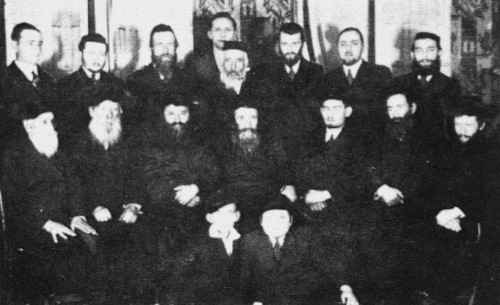
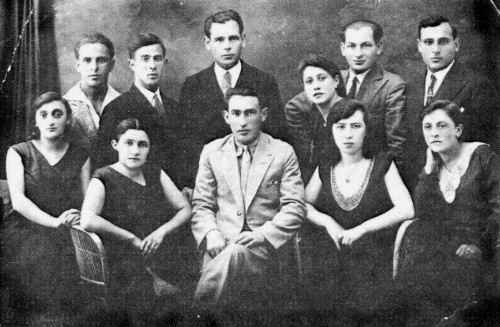
| The third from those standing from right to left is the author Rabbi Jacob Leiter. Among those sitting are also his relatives Nathan Nata Leiter, judge of the rabbinical court (Rav Bet Din) of Legov, Rabbi Eliezer Leiter Ab”D of Trembowla, and Rabbi Nahum Leiter Ab”D of Stettin, may they be remembered for good. |
Beyond that, the rabbi's house was a house of education in the wisdom of administering the rabbinate, which is indeed a wisdom. His father the rabbi was an expert in this discipline. He was greatly honored by his community, and no one dared to do anything in this community without him. Indeed, he was an outstanding community leader, concerned about its welfare and standing as its guardian.
In this atmosphere, the youth Eliezer grew. He absorbed within himself the knowledge that he acquired in Talmud and the codes, and grasped the rabbinic climate of the rabbi's house. Additionally,
[Page 82]
he was thirsty for knowledge and took great interest in everything happening around him in the great world. He learned the language of the state, German, and the language of the land, Polish, and mastered both in speech and in writing. He also knew Hebrew thoroughly according to all the rules of grammar, and his language was polished and precise.
He also excelled in the talent of a preacher and speaker, and his sermons and addresses made an impression. He too, like his elder brother, was ordained by the rabbi, Rabbi Shalom Mordechai of Bezdan, the rabbi of Brznjan, and the license to teach from him was recognized by all the communities.
When Rabbi Moses Ab”D of Trembowla was appointed as head of the rabbinical court in Lvov, and his place as rabbi of the city became vacant, in the year 610 (1850) Rabbi Eliezer Leiter was appointed to this position.
In his proficiency, his sermons, his addresses, his intelligence, and his straightforwardness, he gained the affection of the members of his community, who treated him with great reverence. He conducted the rabbinate with strength and glory, and elevated the honor of his office in the eyes of all the community's members. He was a man of vigor and brave heart, rich in talents and qualities.
At the outbreak of the First World War, he fled to Vienna, for his city fell into the hands of the Russian army. In Vienna, he moved to work on a broader stage, a national stage. He was active in the Agudath Israel movement during its period of flourishing in the capital of Austria, and served for some time as the director of the central office of this organization. In this position, he demonstrated organizational talent. He was beloved by the leaders of the Agudah and by the great Torah scholars who lived in Vienna at that time. At the same time, he was very active in rabbinical matters. He was appointed by the Austrian government as an overseer of shelters for Jewish refugees, and in this position he helped many Jews who suffered from shortages.
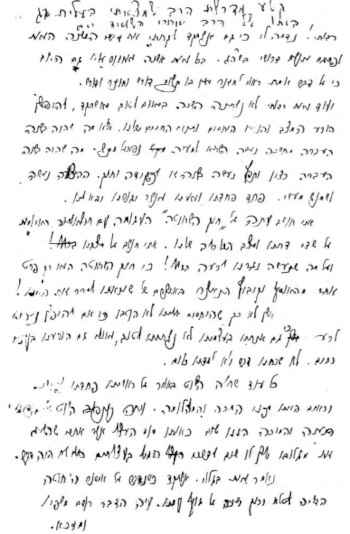
After the war, he returned to his city and renewed his activities in the community. He rebuilt the institutions of the community that were destroyed or became impoverished during the period of Russian occupation, and his community members were grateful to him for this action. He prepared a Torah book for printing, which contained his sermons and addresses and also novellae of Torah–but he did not manage to publish it.
With the occupation of Trembowla by the Russians, in Tishrei 700 (1939), many Jews from other cities arrived or were expelled there, and the rabbi stood by them in their time of trouble and helped them in every possible way. Under the burden of German occupation, Rabbi Leiter suffered with all the community members. During the “expulsions” to destruction, the people of the city hid him, and he perished a few weeks after Trembowla was declared Judenrein by the informer who betrayed him to the Gestapo.
[Page 83]
|
|
| A section from a sermon of the rabbi that I found in the attic of his house after the Holocaust… [The rabbi's house after the Holocaust…] |
[Page 84]
His son-in-law Shimon Eichenbaum, the son of Rabbi Solomon Eichenbaum of Tarnopol, a cultured person and a man of education, a student of Rabbi Menachem Munish Ab”D in Tarnopol, who completed his studies at Warsaw University and at the Institute for Jewish Studies in Warsaw, and was a teacher of religion in secondary schools in Tarnopol. He perished with all his family in the Holocaust in Tarnopol.
by Rabbi Meir Wander
Translated by Binny Lewis
A. Rabbi Isaac Tzvi Halevi Gertler
Rabbi Gertler was born around the year 600 (1840) and at a very young age was accepted as rabbi of Strusov. Apparently, in the year 628 (1868) approximately, he moved to the rabbinate of Podvolotzisk.
We know that in the year 639 (1879) he signed the book “Drash Moses” (Sermon of Moses - Ostroha). He corresponded with Rabbi Jacob Weidenfeld, the genius rabbi of Rimlov.
He died on the first of Adar, 652 (1892).
B. Rabbi Joshua the Shil, Ab”D
Rabbi Joshua the Shil was a refined Torah personality from the illustrious Ab”D family. The author of “Minchat Hanukh” (Gift of Hanukah), rabbi of Tarnopol, was his uncle. His wife was the granddaughter of Rabbi Ephraim Zalman Margaliyot of Brody, author of “Tevuot Shor” (Produce of an Ox), and she was famous for her scholarship and piety.
Rabbi Joshua the Shil was accepted to the rabbinate of Strusov in the year 628 (1868) after Rabbi Gertler moved to Podvolotzisk. He maintained correspondence asking questions with Rabbi Isaac Aharon Itinga, rabbi of Lvov. He too, like his predecessor, was requested by the community of Podvolotzisk. After the death of Rabbi Gertler in the year 652 (1892), he served there for 3 years until his death in the year 658 (1898).
He was blessed with five sons, great Torah scholars and teachers, in the manner of the five books of the Torah. 1) Rabbi David Manush Ab”D, Ab”D of Tarnopol. 2) Rabbi Isaac Ab”D of Tartkiv. 3) Rabbi Judah Leibush Ab”D of Podvolotzisk. 4) Rabbi Joseph Dov Ab”D of Twist. 5) Rabbi Shalom Ab”D of Varish-Worzen.
Rabbi Manish Ab”D was among the great Torah scholars of his generation, and from many lands people turned to him
[Page 85]
to ask for his ruling on matters of halakha. Born in the years 625 (1865). He was ordained to teach by the genius Rabbi Dov Berish Rappaport, Ab”D of Rovaruska. When his father moved to serve in Podvolotzisk in the year 652 (1892), he was accepted as rabbi of Strusov in his place.
His wife was the daughter of Rabbi Joel Moses Landa, Ab”D of Yavorov. And indeed, he served as rabbi of Strusov for only two years, until the year 654 (1894), and after the death of his father-in-law in this year, he was requested by the community of Yavorov to fill his position. In the year 671 (1911), he was elevated to the rabbinate of the city of the county, Tarnopol, where he established a large yeshiva for students, and many ordained teachers and rabbis came from it in the days of Polish rule.
He died on the twenty-first of Sivan, 697 (1937). Details can be found in “Meore Galicia” part A, pages 371-377. Five of his daughters married important rabbis.
C. [Section number C appears to be missing in the original]
D. Rabbi Abraham Ab”D
The father of Rabbi Abraham was Rabbi Samuel, Ab”D of Sundova and Vishny. He married the daughter of his cousin Rabbi Joshua the Shil, who was Ab”D of Strusov.
In the winter of 654 (1894), he was ordained to teach by Rabbi Jacob Weidenfeld, the genius of Rimlov, just before his death, and immediately after that, he was accepted to the rabbinate of Strusov when Rabbi Manish moved to Yavorov. He was rabbi of Strusov until the outbreak of the First World War and also for some time after the war. He died in the year 703 (1943).
E. Rabbi Alexander Lipa Eichenstein
Rabbi Alexander Lipa Eichenstein was the last rabbi of Strusov and perished in the Holocaust. He was the son of Rabbi Alexander Yom Tov Lipa, the firstborn son of Rabbi Isaac Eisik, the Rabbi of Zhiditchov.
He studied in Tarnopol under Rabbi Meir Spira of blessed memory, founder of the yeshiva of the wise of Lublin and rabbi of Lublin, and in his household, also under his father-in-law in the city of Tarnopol. We know with certainty that in the year 687 (1927), they answer him with the title rabbi of Strusov.
These were the five rabbis who served consecutively during the last eighty years of the community of Strusov.
In Strusov, there were some distinguished Torah scholars, and in many Responsa books we find answers to them.
[Page 86]
Such was one named Moses Tzvi Hirsch. He was apparently a scribe, and in a question from this field, he turns to Rabbi Dimmer of Skala (”Beit Solomon”, part B, page 144). In the book “Even Yakara” (Precious Stone) by Rabbi Benjamin Weiss of Chernowitz, we find an answer to Michael Rosenboom from the holy community of Strusov regarding the matter of Halitza (the ceremony releasing a widow from levirate marriage) of a certain woman, whether she is obligated in Halitza or is exempt. Close to before the Holocaust, we find a brief novella sent by Rabbi David Horovitz Ab”D of Stanislavov, in his response book “Imrei David” (Words of David) (page 26) to the distinguished young scholar, sharp and clever, [Rabbi] Isaac Heller.
Some of the Jews of Strusov were book lovers, and they sent payments in advance for printing expenses on books: 1) “Brit Abraham” (Covenant of Abraham) in Brody, 635 (1875), six signers, residents of Strusov. 2) The book “Taami HaMitzvot” (Reasons for the Commandments), Przemysl, 648 (1888), seven resident signers. 3) “Sefer HaTmunah” (Book of Form), Lvov, 652 (1892), seven signers. 4) The book “Torat Ram” (Torah of Ram), Lvov, 658 (1898), nine signers.
Accurate details about the death of the last rabbi of Strusov we heard from the mouths of people from Strusov who survived the Holocaust.
In Strusov, there was an action even before they transferred its residents to the ghetto in Trembowla, where they concentrated all the Jews of the Trembowla district.
On the Holy Sabbath, the Torah portion Tochacha (rebuke), on the fifteenth of Elul, 702 (September 29, 1942), the Gestapo suddenly appeared accompanied by many soldiers and Ukrainians, they surrounded the town and brought out about four hundred people whom they led to Belzec. At the head of these groups was the rabbi of Strusov, Rabbi Eichenstein, who encouraged the spirit of his community members in this time of trouble and hardship, and he perished with them.
by Rabbi Meir Wander
Translated by Binny Lewis
Since in Poland there were many cities named Janow, and the Responsa books did not always make clear in which Janow the matter was discussed, we therefore bring in our list only the rabbis whom we are certain, without doubt, served in the rabbinate of Janow near
[Page 87]
Trembowla, and not in Janow near Lvov or Lublin and other cities. Among these, the first known was:
A. Rabbi Eliezer Lipman
Rabbi Lipman came from the city of Zolkiew to the rabbinate of Janow in the year 515 (1775). He moved to the rabbinate of Chortkiv, and there he died in the year 517 (1777).
B. Rabbi Samuel Horoshevsky
Rabbi Samuel Horoshevsky was from a distinguished and famous family of rabbis. Son of Rabbi Elimelech, the Maggid of Mezritch (Preacher of Divine Word) from Drohovitz, and grandson of the Tori Zahav (Golden Rings) and the Beit Hadash (New House).
C. Rabbi Dov Berish Sagal
Rabbi Dov Sagal was for many decades rabbi of Janow near Trembowla. Answers to him are found in the Responsa “Zichron Moses” (Memory of Moses) (Brimer) Orach Chayim, 9 and 14, in the years 599 (1839) and in the Responsa “Kol Yehudah” (Voice of Judah) (Halperin), 13, before the year 621 (1861). He taught Torah to the young people in the city, and among his students was the rabbi who filled his place after his death.
D. Rabbi Abraham Moses Summerstein
This rabbi was appointed in the year 635 (1875) to the rabbinate of Janow, after the death of his teacher, Rabbi Dov Sagal. Born in the year 597 (1837), and all his days he engaged with diligence in studies.
The members of the community loved him very much. He was of good temperament, pious, and humble, and in general, did not enjoy the pleasures of this world. A sudden illness that lasted eight days struck him down at a young age. He died on the eve of Sabbath, the nineteenth of Adar II, in the year 638 (1878), and Rabbi Jacob Weidenfeld, the genius of Rimlov, came to eulogize him. A record of mourning was published by his students in the newspaper “The Magid” volume 22, page 112.
His grandson was Dr. Emil Summerstein, one of the heads of the Communist government in Poland after liberation from the Nazi yoke. (Note–He was also a delegate to the Polish parliament during the days of Polish rule. Y. G.)
[Page 88]
E. Rabbi Shimon, Ab”D
Rabbi Shimon Ab”D was born in the year 599 (1839), to his father Rabbi Joseph, author of the book “Minchat Hanukh” (Gift of Hanukah), rabbi of Tarnopol. He was accepted to the rabbinate of Janow, as mentioned in one of the sources. After the death of his father in 634 (1874), he ascended the chair of his father in Tarnopol until his death on the fifteenth of Sivan, 669 (1909). Details about his biography can be found in “Meore Galicia” part A, pages 408-409.
F. Rabbi Shimon, Ab”D (Second)
The second Rabbi Simcha Ab”D was born around the year 609 to his father Rabbi Moses Ab”D of Mikulinetz. His wife Leah was the daughter of the genius, the Maharsh”m (Rabbi Samuel Mohilever), rabbi of Berezhany.
He served many years as rabbi of Janow, and in the year 669 (1909), he moved to the neighboring city of Bozhanov. From there, after the death of his father-in-law the Maharsh”m, he moved to serve in the rabbinate of Berezhany.
He was considered one of the great ones in Torah, and a certificate of ordination from him had great importance. He stayed in exile in Marienbad during the First World War, and returned to Berezhany, where he died in the year 695 (1935).
He left a flourishing family of descendants in the United States and in Israel.
G. Rabbi Haim Shechter
Rabbi Haim Shechter was the rabbi of Janow in the last decade before the Holocaust, and he closes, apparently, the rabbinate of Janow.
Note: As a resident of Trembowla and as a living witness, I can supplement this list. According to my knowledge, after the First World War, Rabbi Moshe Mozciski served in Janow. I do not recall his first name precisely. I remember that before this, he served as a rabbi in Kudryntzki on the river Zbruch, which was right on the border, and after the First World War, the Jewish settlement became empty there, and he came to serve as rabbi of Janow. I do not recall exactly when.
In any case, I studied under him when he was rabbi of Janow in the year 686 (1926), for half a year, and this is certainly reliable and trustworthy according to what I heard from residents of Janow, few of whom survived and remember. Rabbi Moshe Mozciski
[Page 89]
died in the year 32 or 33 (1932-1933), and Rabbi Haim Shechter, who was a slaughterer in the place, apparently also filled the position of rabbi.
I met him in the forest after Trembowla was declared “Judenrein” (free of Jews), and according to my estimate, he perished there in one of the camps at the end of summer in the year 703 (1943). May the Lord avenge his blood.
by Natan Warman
Translated by Binny Lewis
The Prague Conference during the intermediate days of Passover in the year 1920, in which participated delegates of the “HaPoel HaTzair” from Eretz Israel and representatives of “Tze'irei Tzion” from the countries of Eastern and Central Europe, laid the foundation for the worldwide merger of HaPoel HaTzair and Tze'irei Tzion. Their aspiration was to solve the Jewish problem by establishing a society of Hebrew workers in Eretz Israel and transferring the masses of Jews in the Diaspora to productive occupations. The program of the Hitachdut was finalized at the Berlin Conference in the year 1922. It was decided to name the movement: the Zionist Labor Party – the Hitachdut.
Its goal was to establish a free Jewish workers' society in Eretz Israel and to renew the life of the nation in the Diaspora on the foundations of productive labor, national autonomy, and Hebrew culture. The Hitachdut dedicated the major part of its efforts to encouraging the pioneering movement in the Diaspora and organizing immigration to Eretz Israel. Similarly, the Hitachdut movement invested great efforts in making productive the youth and in the Jewish cooperative movement in the Diaspora. The Hitachdut championed the idea of reviving the Hebrew language. It was the principal force in the “Hebraization” movement and was most active in spreading the Hebrew language throughout the Diaspora. Most of the activists and teachers in Hebrew schools came from its ranks. The Hitachdut in Eastern Galicia was–the largest territorial branch in the world.
The branch of the Hitachdut movement in Trembowla was founded at the end of the year 1929 by former members of “HaChaluz” and former members of “HaShomer HaTzair” who left their movement because of their advanced age. The beginning of the organization of the “Hitachdut” branch
[Page 90]
in Trembowla–The meeting place of the Hitachdut branch in Trembowla was in the home of Zelig Gottlieb on Volova Street. After this, the branch moved to the home of the Gaels family on Sobeski Street. After a period of about two years, the branch moved to the home of Moshe Brik, and then–to Sophia Chrzanowska Street next to the railroad. After a short period the branch moved back to the home of Moshe Brik, and there the activities of the branch were conducted until the outbreak of World War II.
|
|
| Group of Members of the Hitachdut Movement |
The first chairperson of the “Hitachdut” branch was Avraham Ginsburg of blessed memory, and the first secretary–Tzvi Melner, may he rest in peace. Among the various active members who laid the foundation of the “Hitachdut” movement in Trembowla were: Avraham Greenberg, Tzvi Melner, Yaakov Sheinhaub, Yaakov Krahholtz, Shmuel Herbst, Yaakov Warman, Mordechai Nossbaum, Yitzhak Blumenkrantz, Yaakov Blumenkrantz, Aharon Yitzhak Kreisler, Leib Milgrom, Wolf Oaks, Tzvi Oaks, Yitzhak Goldstein, and others.
However, the branch was open every day and the members spent time there
[Page 91]
from the early afternoons until the late hours of the evening. The hall served as a reading room and also as a place for popular games such as: chess, dominoes, etc. Because of the popular character of the movement, it attracted young and old alike, and within a short period the “Hitachdut” branch in Trembowla became one of the largest branches and surpassed in membership all the other Zionist movements' branches in our city. The members of the branch distinguished themselves in their activities in all areas of cultural, political, and economic life in the city. The branch was represented by its members in the management of the “Tarbut” school, in the JNF, Keren Hayesod, and in the mutual aid fund founded by the “Joint.” The “Hitachdut” was the only movement that had representation on the Jewish Community Council.
Later on, a group of academics and professional intelligentsia joined it. The movement gained great momentum and encompassed almost all layers of the Jewish population in Trembowla. The prominent members of the aforementioned group
|
|
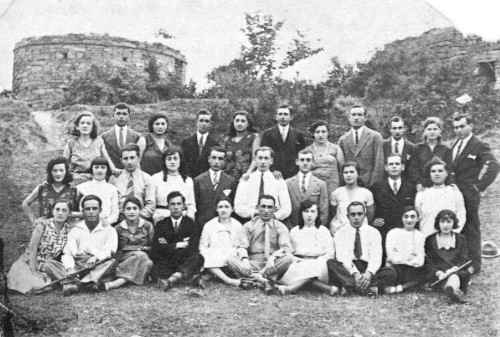
| Hitachdut youth against the backdrop of the fortress |
[Page 92]
were: David Margalit of blessed memory, David Terkel of blessed memory, Yosef Englger, and Pinchas Neiman, may he rest in peace. From 1932–1935, the secretary of the “Hitachdut” in Trembowla was my friend Yaakov Karbholtz of blessed memory. In his youth he studied at a gymnasium in Vienna, a city to which his parents had come during World War I. He had not yet managed to complete his high school studies when his family returned to their city of origin–Trembowla. He specialized in accounting management and was an excellent accountant. Karbholtz contributed greatly to the development of the branch through his talents and his dedication.
Every year in January, elections were held for the branch committee. In 1935, elections for the branch committee were held in the community hall, because the hall of the “Hitachdut” branch was too small to accommodate all the members. Pinchas Neiman was elected as chairperson of the branch and Natan Warman as secretary, who served in this position until the outbreak of World War II–1939. The new committee set for itself the goal to expand and deepen cultural activities. Every Saturday evening, assemblies and lectures were held on current topics. Distinguished speakers were invited from the provincial city–Tarnopol–and from the center–Lvov. During the week, discussions were held on political and organizational topics. The participation of the members was very alert. The “Hitachdut” branch had affiliated with it the youth movement “Buslia” and Gordonia, these two youth movements were founded at the initiative of the “Hitachdut” branch in Trembowla. In organizing these movements, Yaakov Sheinhaub of blessed memory and Natan Warman, may they rest in peace, were especially engaged. These movements strengthened and expanded the ranks of the movement. The relationship between the member and the branch was alert and lively, and sometimes the hall of the branch was too small to accommodate all the members. During the lectures, members were forced to stand in the corridor.
At the initiative of the branch, summer camps of Gordonia were held around Trembowla, and a training kibbutz of “Buslia” was founded. During the two years 1935–1937, the aforementioned kibbutz operated, in which the best forces of “Buslia” from Trembowla and the vicinity gathered. The members of the kibbutz worked in a quarry in a village near Trembowla–Zatsianovtsy. The quarry belonged to the Fogelman brothers. The kibbutz members did not shy away from any physical work, and the very awareness that they were preparing themselves for immigration and for productive lives in Eretz Israel made this training point a guiding and directing force in the “Buslia” movement in the vicinity of our city. The branch endeavored to help this training kibbutz in the search for sources of income and work, so that the kibbutz could sustain itself, and also helped it with guidance, in the study of the Hebrew language, and in instilling the idea of working Zionism.
[Page 93]
In the last years before the outbreak of World War II, the branch reached its peak. In 1933, the branch joined the united movement of “Hitachdut Poalei Tzion” [Hitachdut of Workers of Zion] after the conference in Lvov, and from then on became a branch of “the Zionist Socialist Party–Hitachdut Poalei Tzion” in Eastern Galicia. The branch increased its activity in the public life of the Jews of Trembowla. Its vitality was especially felt in Zionist institutions such as: Keren Kayemet LeIsrael [Jewish National Fund] and Keren Hayesod [Foundation Fund], and in the Jewish Community Council. The branch's representative on the Community Council was attorney David Margalit of blessed memory, a man who knew how to win the trust and affection of all the council members. Through his integrity and wholeheartedness, he worked extensively for the benefit of the reorganization of the community and its ability to function.
|
|
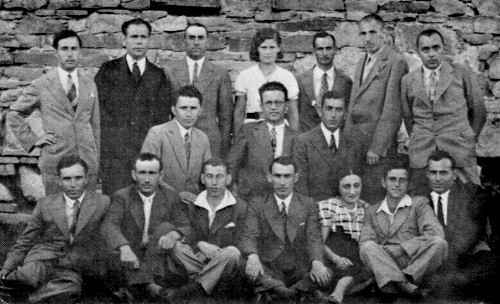
| Members of the “Hitachdut” |
Among the members dedicated to the cause of the branch and to the values of working Zionism, Isidor Schwartz of blessed memory stood out. He was alert and vibrant. He merged with the movement so that he did not know where “he,” the movement activist, ended, and where “he,” as an individual devoted to his family, began. He was the chairperson of the JNF and under his leadership the fund's revenues grew to such an extent that
[Page 94]
Trembowla occupied one of the honored places in the Tarnopol district in its contributions for the benefit of Keren Kayemet LeIsrael. Isidor Schwartz was a member of the branch committee until the outbreak of World War II. He did not miss a single meeting and fulfilled every task assigned to him with dedication. He was in the management of the mutual aid fund, whose function was to help with interest-free loans to small merchants and craftsmen.
In 1934, the branch began to organize craftsmen whose advanced age did not allow them to belong to “HaChaluz.” At first they were called “Olim–workers,” and later “The Worker.” They were few in number, but they were ready to immigrate to Eretz Israel at any cost. According to the decision of the party center, “The Worker” in Trembowla received a certain number of certificates [immigration permits]. They did not manage to use them because war broke out and put an end to the hopes and aspirations of the members of “The Worker” to immigrate to Eretz Israel.
Next to the branch, academic youth and students organized themselves. The writer of these lines initiated their organization and their affiliation with the branch. Among the prominent members of this nucleus was Shmuel (Milo) Greenberg. He joined the training kibbutz of the academic youth “Ichudiah” in the city of Nadvorny, where a wood industry was developed. The work in the aforementioned kibbutz was arduous and demanded great physical effort. Shmuel distinguished himself in his work and was one of the active members of the kibbutz. After a year and a half, he returned to Trembowla and prepared for immigration, but the occupation of Eastern Galicia by the Russians put an end to his aspirations.
In 1936, Avraham Greenberg was elected again as chairperson of the branch and served in this position until the outbreak of World War II. The branch of the party “Hitachdut Poalei Tzion” in Trembowla was numbered among the largest and most important branches in Eastern Galicia both in terms of its quantity and its quality. From 1929–the year of its founding–it distributed the greatest quantity of shekels [Zionist Congress voting tokens] and always won the majority in elections to the Zionist Congresses.
For the 21st Zionist Congress before World War II, all the Zionist parties prepared with intensity and enthusiasm, and the scope of shekel distribution reached dimensions that had never been known before. Despite the fact that the Jewish community in Trembowla was very small, they distributed 600 shekels. In elections for the Congress, 520 voters participated, and the “Hitachdut Poalei Tzion” movement received 280 votes. The branch in Trembowla was among the branches in Eastern Galicia that received an absolute majority for the 21st Zionist Congress.
Many years have passed since the founding of the “Hitachdut” branch in Trembowla.
[Page 95]
The changes that have taken place since then in the life of the Jewish people in the world and in Eretz Israel were so great that sometimes it seems as if the facts and events mentioned in this article took place many generations ago. It is difficult, therefore, to delve into the depths of the past and extract from within them the main things, to attempt a summary of the activities and to give a faithful assessment of the role of the Trembowla branch in the Hitachdut movement of Eastern Galicia. Experiences and memories that evoke emotion and the remembrance of bygone days–“days of storm and eruption”–seek expression to perpetuate them, these members–the men of deed whose aspiration was to immigrate and live lives of labor and creativity, and whose lives were cut short in their prime. These experiences seek to perpetuate themselves and not let them descend into the abyss of forgetfulness.
Many devoted members and noteworthy events were omitted from my recollection, and I contented myself with sketching a few basic lines of the “Hitachdut Poalei Tzion” movement in our city.
|
|
JewishGen, Inc. makes no representations regarding the accuracy of
the translation. The reader may wish to refer to the original material
for verification.
JewishGen is not responsible for inaccuracies or omissions in the original work and cannot rewrite or edit the text to correct inaccuracies and/or omissions.
Our mission is to produce a translation of the original work and we cannot verify the accuracy of statements or alter facts cited.
 Terebovlya, Ukraine
 Yizkor Book Project
 JewishGen Home Page
Copyright © 1999-2026 by JewishGen, Inc.
Updated 13 Jul 2026 by JH