 |
|
|
[Page 26]
By Israel Glikan
Translated by Binny Lewis
“Childhood is a homeland, and there is no difference
Wherever we saw it, whether here or there.
It is the seed of the great expanse
And it is the navel-point of the world.”
(From “Meir the Klezmer Becomes a Commissar,”
“Or Zarua” by Shimshon Meltzer, p. 226)
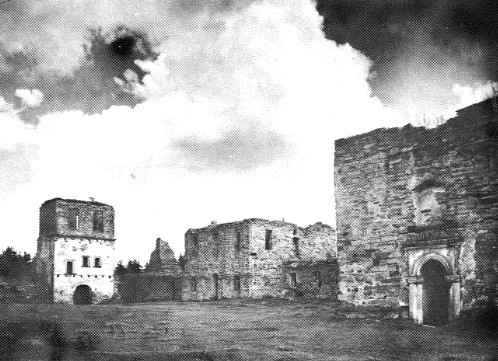
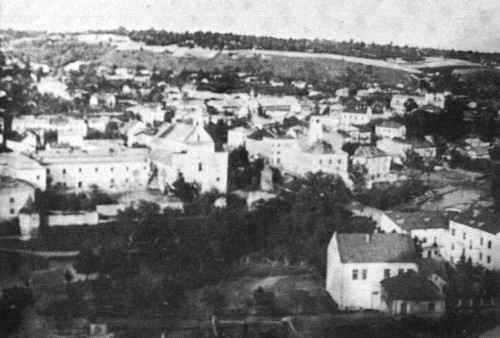
General view of the city of Trembowla from the fortress (Shloss)
More than once, even before I read and saw this poetic fragment, I reflected that the true homeland of every person is the land in which he was born. It is bound up with him all the days of his life, willingly and unwillingly. First it is preserved in memory as landscape, even if other details are not always preserved in it. When I hear the song “My Land, a Land of Mountains and Valleys,” I see in my imagination Trembowla. It too was a valley surrounded by mountains. When I came to the Land of Israel in 1945 and visited Safed a few months later and climbed up to the citadel, I thought I was seeing the Trembowla Shloss. Even today, every time I visit or stay in Safed, I never miss a visit to the citadel, which reminds me, like a living picture, of my hometown with the Shloss.
Allow me to spread the picture before you: I am climbing up to the Shloss. The ascent is not difficult, especially after the road leading up to the fortress was widened and repaired – the road that was destroyed and ruined during the years of the First World War and was later renovated, so that one could easily climb to the summit and stroll around on the stone wall. And so, when I climbed to the summit and turned my face to that side from which the city and the Gniezna River cutting through it are visible – not the forests surrounding the wall on the other sides – I see the city as if in the palm of my hand; I see the ribbon of the Gniezna River cutting through the city and dividing it into the “Alte Shtat” [Old Town] and the “Neue Shtat” [New Town]. I never knew in my childhood which was old and which was new.
[Page 27]
We, who lived across the river, on the bank where the Shloss stands, always said: we are going “auf yener Shtat” [to the other town], where our grandmother Alte, of blessed memory (my mother's mother), lived. From the summit of the Shloss I see the two large bridges spanning the Gniezna: the one close to the foot of the wall, which was destroyed by the Russians in the First World War and rebuilt with the onset of Polish rule. On the other side of that bridge stands the church with the crescent atop its roof, in memory of the Turkish wars there; after a new church was built in the days of Poland, in the center of the other quarter across the Gniezna, this church became the Bernardine monastery. I do not know exactly for what purpose the church served.
|
|
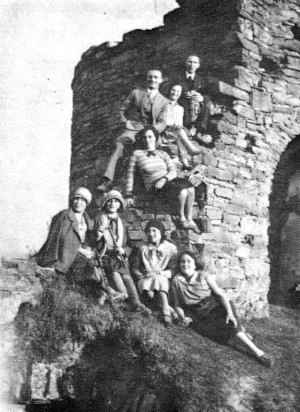
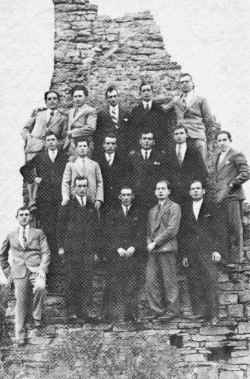
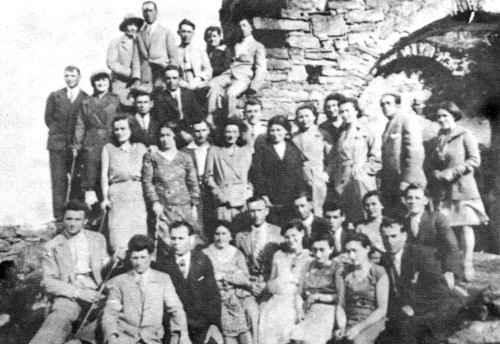
| A group of Trembowla youth at the fortress |
I only recall that it occupied a large area with a walled garden that reached to the river, on the side facing the Shloss, and on the other side up to the houses in the old market. Facing the town hall – the Magistrat, in the foreign tongue. The second, newer bridge was built in the days of Polish rule over the Planti. Some distance from the Planti was the Jewish mikve [ritual bath], which underwent many renovations in the days of Poland, but was not moved
[Page 28]
from there, even after the Planti became a commercial center with a bazaar and shops. There may have been additional crossings and light wooden bridges for crossing the Gniezna called “kladkes” [footbridges], like the one over the Planti before the large new bridge was built, but those were outside the city.
I continue to cast my gaze straight down from the wall to the foot of the hill and see there densely packed houses of one or two stories, the municipal bathhouse close to the river, the flour mill of Zhabski, the synagogues – the Beit Midrash and the “Alte Kloiz,” located in one building – and next to them the Husiatyn Kloiz; to the south, the Kopychyntsi Kloiz, taller than the other synagogues, with two floors, closest to the road leading to the first bridge – the main crossing to the other side of the river. Facing the Kopychyntsi Kloiz, the Talmud Torah building, in partnership with “Yad Charutzim,” the craftsmen's synagogue, which began to build an imposing structure but lacked the means to finish it. Then came Kalman Eli from the United States (I do not remember his surname), who was a relative of Reb Yeshaya Ber Shekberg the teacher, grandfather of Sara and Kuzye Antner. The management of Yad Charutzim made an agreement with Reb Kalman Eli to complete the building and add two more stories, in which the Talmud Torah would be housed – the one that later served, in part, as a Hebrew school at certain times. Some of the town's teachers were also given rooms there for their classes – one or two rooms of the building; at the end of the 1930s, the Bnei Akiva movement received it under the care of the rabbi, who was its guardian.
I continue to gaze and see the whole empty square, called the Planti, in a part of which the market was built in the 1930s. I see meadows and also green fields stretching to the southwest up to the barracks that stood far off on that same bank where the Shloss is.
I remain standing at my post on the summit of the Shloss, turn slightly to the right, and see across the way the Pokrovka. Walking on Sobieski Street it always seemed to me like a high mountain wanting to swallow the city. Many houses are attached to it. They are built on its slope, as if sheltering in its shade. There were the houses of the families Yosi Oksengorn, his daughter Adel Brust, Velveli Briller, Nissenbaum, Gershon Katz, and others.
From the Shloss, the whole Pokrovka appeared as a small hill, but seen from the city it made an impression of a tall, steep mountain. When I climbed the wide path to the peak of the Pokrovka, I could see at its foot a small valley, like a
[Page 29]
large, wide pit, called the “Tul,” which looked like the maw of a large volcano. We used to run there sometimes to play “kitsch kampf” [some sort of game] and football, because at the bottom there was a flat, smooth area, barely sufficient for those games.
After my eyes had their fill of this landscape, I could see from afar, from all sides of the Shloss wall, only forests – a rare occurrence in this part of Eastern Galicia. This plateau, according to its geographical location, is called
|
|
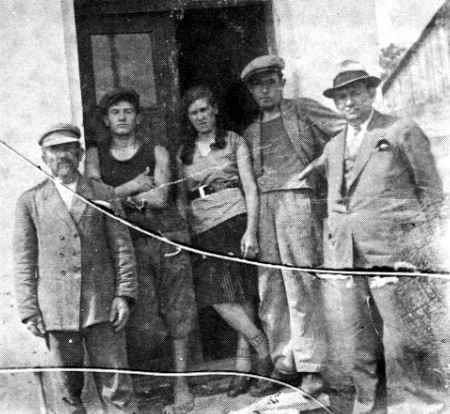
| A group of hikers at the fortress |
Podolia, and fields are more common there than forests; but the Trembowla “Yar” [gorge] (as it is called in Polish geography) – that beautiful and fertile valley – was surrounded by ranges of hills and mountains on which forests grew: the Strusov Forest in the extension of the Shloss and the Krobynka Forest across from it. And on the other side, to the south of the Trembowla “Yar,”
[Page 30]
were the hills of the Monastyr, and the Seret River at their feet, into which the Gniezna flowed as one of its tributaries.
There at the foot of the Monastyr, the Gniezna River emptied into the Seret, which was one of the main tributaries of the Dniester River. The Dniester was the border between Poland and Romania during the existence of Poland, until the Second World War. From the Monastyr, forests spread along the villages of: Slobodka, Zalavye, Zhshtsyinotshke, Guminsk, Semeniv, Malov, and others, up to the Pokrovka hills. Especially wonderful was the view from the Shloss over the city on a moonlit night, when the Gniezna River cutting through the city appeared as a ribbon of captivating silver beauty.
|
|
| The Monastyr |
I remember mainly Sobieski Street, because along it – from the barracks (in which the Ninth Cavalry Regiment was quartered) to the synagogues – it was inhabited almost entirely by Jews, including the alleys adjacent to this main street, although a few Polish and Ukrainian residents also lived on this street. It served in part as a Jewish quarter; when the Germans
[Page 31]
restricted the area of Jewish settlement before the Aktions and progressively reduced their dwelling space after each Aktion, in order to concentrate them in a smaller and smaller area.
The last section was from the house of Itshe Briller to the houses of Zishye Kapel, turning into Zhshtynotshke Street, a street in which, even in Polish times, no Jews lived, and which was sparsely populated. A few farmers lived there, who had gardens and even grain fields close to their homes.
The Zastsianochke Street led by a wide road to the Pokrovka on its other side, and as the street name indicates, it was the road that led through the Pokrovka and the small orchards (kleine Suden) to the village of Zastsianochke and other villages.
|
|
| The “Kultus Kloiz” Synagogue |
Across the Gniezna River there were fewer Jews than in this part. They were not concentrated there as on the side bordering the Shloss. In this part, not far from the Shloss, most of the city's synagogues were concentrated, because in the other part of the city across the Gniezna there were only two synagogues: the “Butshiner Kloiz” and the “Kultus Kloiz.” The origin of the name “Butshiner Kloiz” is not known to me, but the “Kultus Kloiz” was the bequest of a Jew from Russia. The place served after his death as a synagogue and community council, in which the council meetings were held. The number of Jews who prayed in this synagogue barely reached a minyan on weekdays.
[Page 32]
Life across the Gniezna, on the fortress and synagogue side, in the center
For me the motto “childhood is a homeland,” which I inscribed at the head of this chapter, is not just a motto but also a way of life. My surroundings from childhood were entirely Hebrew and Jewish. I had little contact with non-Jews and gentile boys, since I did not attend the state municipal school but studied privately. I had only a few Christian friends from the neighborhood children. I also had very few Jewish friends. Already in my childhood I was a regular subscriber to the “Ivriya” library, which was founded in the 1920s.
Despite its disseminated name “Ivriya” [Hebrew], it contained mainly books in Polish, German, and Yiddish. The Hebrew books constituted the smallest portion. The truth is that readers of Hebrew in our town were very few, and I recall one interesting fact: once the library managers were talking among themselves – when I appeared to change a book – that they were obliged to purchase a new series of Hebrew books, since all the Hebrew books in the library had passed through my hands and they had nothing to offer me to read. All this does not prevent me from noting and emphasizing that the activity of the library was very important, because it spread education among the youth in the city and above all a consciousness of reading, across all strata of the Jewish public in the city. Particularly great was its influence on the youth, who are usually eager for reading.
We must remember that in those days no one dreamed of television, and radio was also not yet widespread in the early years of Polish rule, until the 1930s. The library workers offered readers the best of new Polish literature and a selection of world literature translated into Polish.
My surroundings, as I said, were entirely Hebrew, and since I greatly loved tradition and religion, I did not miss communal prayer even before the age of bar mitzvah. I thus habitually made my way twice daily from my home to the kloyzim [prayer houses], along Sobieski Street. Therefore I was very much involved in the life of that street, on which the rabbi also lived, and in one of the alleys, not far from the rabbi, lived also Reb Boruch Dlogatz the scholar, may God avenge his blood. Of course I was always among the adults and in their company, for on weekdays, in my childhood and youth, many young people no longer came to the synagogue. They were all in secular youth movements in the evenings. During prayer time they were in line [at the synagogue?], or simply strolled the streets in groups, but their paths were already far from the synagogue. In the mornings there were synagogues in which only one minyan took place, and this was in a state of difficulty [barely assembled]
[Page 33]
|
|
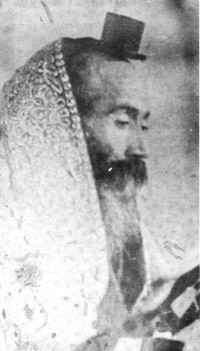
| Reb Hirsch Rotman at prayer |
[Page 34]
and, toward evening, I recall well that in the Kopychyntsi Kloiz, Israel Kleiner the shammes [synagogue beadle], may he rest in peace, would approach the main road, to Reb Mendele Fogelman's “budke” [stall], and grab passers-by, asking them to come to the synagogue because there was one man short for the minyan. And as is usual in such cases, more often than not there was more than one man short; but in this way he managed to organize them one by one to complete the minyan.
The Hasidic Atmosphere of the Husiatyn Kloiz
Between the two world wars, until the 1930s, I could feel warm prayer and observe Hasidic life only in the Husiatyn Kloiz. Most Hasidim in Trembowla (their numbers were not particularly large) were Husiatyn Hasidim; among them were only five Chortkiv Hasidim and perhaps a few more sympathizers. The confirmed Chortkiv Hasidim were: my uncle Leib Goldflus, may God avenge his blood (my mother's uncle), Zishye Kapel from the flour mill, may he rest in peace – he was the brother of my grandfather Israel Avraham Kapel, may he rest in peace – Shmuel Nechemia the teacher (I believe his surname was Rosenzweig), Moti Finkelstein, may he rest in peace, and Iztikl the Torah reader, may he rest in peace, father of Natan Ahrman, long may he live, who is here among us. A doubtful Chortkiv Hasid was Gershon Katz, may he rest in peace, whose origins, I believe, were from Chortkiv. There were also, of course, a few individual Hasidim of other rebbes, such as Boruch Meir Drimer, of blessed memory, a Belz Hasid, and my uncle Shmelki Weisman, a brother of my father's mother, may she rest in peace, who was an Ottynia Hasid of the Vizhnitz dynasty.
I remember clearly that a few years after the end of the First World War, in the days of Polish rule, the Husiatyn Hasidim organized themselves a separate minyan. They prayed for a time at the home of Reb Boruch Meir Drimer, of blessed memory, until they built themselves a new synagogue – which had apparently been destroyed in the First World War or in the great fire of 1910, which also consumed the “Great Shul” that was not rebuilt after the war.
In all the synagogues they prayed in the Sephardic rite [Nusach Sefard], even if the worshippers were not Hasidim at all but simply householders. I also recall the ceremony of the dedication of the new Husiatyn Kloiz. For a long time the building stood unplastered, with the red bricks jutting out from afar, until an order once came from the government to plaster and beautify all the buildings in the city for the celebrations of the third
[Page 35]
of May [Polish Constitution Day], or the eleventh of November [Independence Day], the national holidays of Poland, and then the walls of the Husiatyn Kloiz were plastered on the outside.
The kloiz was distinguished from the other synagogues in that it had a sukkah with a collapsible roof that could be opened and closed when rain fell. The roof opened in clear sunny weather and closed quickly when rain began to fall. Such a sukkah was called a “sukkah with a Schlag.” This was also a sarcastic expression for someone whose wife was shrewish; one would jest and say: he took a wife with a dwelling, and in addition to the dwelling also a “sukkah with a Schlag” – meaning the shrewish wife, since “Schlag” also meant a misfortune. “A vayb a Schlag.” The Husiatyn Kloiz also differed in that the women's gallery was built as a continuation of the building and not above it, as in the Kopychyntsi Kloiz, the Beit Midrash, and the Alte Kloiz.
I recall the ceremony of transferring the Torah scrolls on a Sabbath eve from the home of Reb Boruch Meir, where they had prayed until the building was completed, and also the Kiddush the following Saturday morning. Especially memorable to me are the nights of Shemini Atzeret and Simchat Torah in that kloiz. For the Hakafot [Torah processions] in the Husiatyn Kloiz, people came from all corners of the city, because after Maariv [the evening prayer] they did not begin the Hakafot there as in the other synagogues – instead they went to fixed homes, where they made Kiddush and had a pleasant time [literally: were fragrant a bit]. This was mainly at the home of Kalman the shochet [ritual slaughterer], where they prepared stuffed spleens whose fine taste has remained in my mouth to this day, and all kinds of “holubtsi” [stuffed cabbage leaves] and other delicacies made in his home, or at the home of Shalom London, may he rest in peace, Yankele Antner, may he rest in peace, or at my uncle Leib's home, may God avenge his blood, and in the homes of other congregants of the kloiz. At nine in the evening, and sometimes even later, they returned to the synagogue for the Hakafot, which lasted until midnight.
The living spirit of all the joy and dancing was Shalom London, may he rest in peace, who succeeded in inspiring the people and raising the joy to its peak by pretending to be drunk.
In the Husiatyn Kloiz was the greatest concentration of Torah study circles. During most of the year, especially on the long Sabbath nights, as our poet Bialik said, scholars, worshippers, and learners would congregate in that synagogue. Among them were: Reb Boruch Dlogatz, may God avenge his blood; Reb Boruch Meir Drimer, of blessed memory; Reb Shmelki Weisman; Reb Anshil Plesner, of blessed memory (whose son Tzvi, long may he live, is here with us); and also Shalom Friedman, may God avenge his blood, who was the additional prayer leader [baal musaf]
[Page 36]
on the High Holidays and, besides his Torah knowledge, had a very pleasant voice, and people came from all corners of the city to hear his prayer on the High Holidays. Even today, not infrequently at memorial gatherings in the Land of Israel, people mention to one another Reb Shalom Friedman, may God avenge his blood, and his prayer that captivated all the listeners and remained forever engraved in memory.
Not infrequently on the High Holidays I think to myself: would that I could return to those months of old [literally: "Would that He grant me months of yore"] – if only I had even the smallest measure of those feelings that flooded my heart in those days. Those were experiences of awe and trembling that also brought an inexpressible delight. Of those experiences only memories remain, and these grow ever dimmer. I assume that there are a few among us in whom the melody of Reb Shalom Friedman's prayer, may God avenge his blood, is well preserved in their memory to this day. One such person was my friend and companion Alter Meir Polishuk, may he rest in peace, who passed away here in the Land of Israel in 5737 [1977].
The Husiatyn Kloiz was also attended on weekdays by Alter's father, Reb Pinchas Polishuk, of blessed memory. He too was a Husiatyn Hasid. A learned Jew, pleasant in his manner and beloved; I always loved to converse with him when he came to study in the synagogue in a study partnership [“chavrutah”] with a few other Jews from the kloiz. He was alert to the news occurring in the world.
I remember clearly how he expressed his shock when Hitler, may his name be blotted out, came to power in 1933, and his heart foretold darkness for all of Europe and especially for the Jews. Also Reb Yeshaya Ber, the father-in-law of Yankel Antner, who was a teacher in my childhood, was in my youth among those who participated in the study sessions in the kloiz, or sat and studied there alone, after he had ceased to practice his profession.
There were also those who participated in the studies but were not counted among the great scholars, such as my mother's brother Zisye Kapel, may he rest in peace, Shalom Weinraub, may God avenge his blood, Yudelele Shvebl, may God avenge his blood, Avrahamtzi Tirkel, may God avenge his blood, Avraham Zisye Shinhoyt, may God avenge his blood, Yankelele Antner, may he rest in peace, Reb Aryeh Leib Rosenfeld, of blessed memory, Kalman the shochet, and many others. The Husiatyn Kloiz was also attended for prayer by the son-in-law of Eiyzik Kapel, may God avenge his blood (a cousin of my mother), Akiva Margolyes, of blessed memory, who came to live in our city in the 1930s from the village of Leshchiv. He was accustomed to always saying that he had already gone through the entire Talmud several times. My mother's brother Leybush Weiser would remark about this: “Er hot shoyn gedavent etlikhe mohl gantz Shas” [He has already ‘prayed’ through the entire Talmud several times, as one reads Psalms]. [Note: the use of “davent” (pray) for Torah study is ironic – implying he recited it by rote like prayers, without truly studying it.]
[Page 37]
Yahrzeit Celebrations and Memorial Days in the Husiatyn Kloiz
I recall the Hilula celebrations and the Yahrzeit memorial days of the Rebbes of the Rozhin-Medzibozh dynasty, to which the Rebbes of Chortkiv and Husiatyn belonged. These were the 19th of Kislev – the yahrzeit of the Rebbe Dov Ber of Medzibozh, may his merit protect us, the founder of the Rozhin–Sadagura dynasty, disciple and successor of the Baal Shem Tov; the 3rd of Cheshvan – the yahrzeit of the grandson of Reb Ber, Reb Israel of Rozhin, may his merit protect us; Hoshana Raba night – the yahrzeit of the son of Reb Israel of Rozhin, the first Rebbe of Chortkiv, Reb David Moshe; and Lag Ba'Omer – the yahrzeit of his brother, the first Rebbe of Husiatyn, Reb Mordechai. These yahrzeit days were usually celebrated at the home of one of the Hasidim and sometimes also in the kloiz.
I clearly remember how my grandmother Rivka, may she rest in peace, my father's mother, who in her old age lived with my uncle Leib, may God avenge his blood, would prepare the fish for such a gathering. These gatherings were not rowdy and an atmosphere of elevation prevailed in them. Especially the participants would become elevated with the start of the dancing, which soared to the heights [literally: upward and upward], freed from all the mundane and the profane of daily life.
I recall that one Sabbath night I came home and there in our corridor stood my uncle Leib, may God avenge his blood, and Yudelele Shvebl, may God avenge his blood, intertwined and clinging to each other, dancing with all their soul and strength. That Sabbath night and their rapturous dancing I shall never forget.
The vibrant, effervescent kloiz life from the 1920s until the 1930s gradually diminished, until with the outbreak of the Second World War only a handful of Jews remained to study in the kloiz, and the joyous celebrations on holidays and the dances on New Year's Eve after the prayer, the festivities on Simchat Torah, and the Rebbes' yahrzeit days, almost ceased entirely.
Spiritual Life in the Other Synagogues
Second after the Husiatyn Kloiz, in which Jews sat and studied, was the “Alte Kloiz.” This synagogue was situated in the building that also housed the Beit Midrash, in which the rabbi regularly prayed. Most of the rabbi's sermons on Shabbat Shuva [the Sabbath of Repentance] and Shabbat Hagadol [the Great Sabbath before Passover] were delivered in the Alte Kloiz.
The living spirit of the Alte Kloiz – who always took an interest in it and cared
[Page 38]
for the minyan – were Chaim Horowitz, may God avenge his blood (his son Yaakov is here with us), and Yehoshua Mordechai Herbst, may God avenge his blood, son of Reb Zuzue the teacher, whose daughter is here with us.
Reb Chaim Horowitz devoted fixed times to Torah study. He was an opponent of Hasidism [a Mitnaged]. His family was from Chortkiv, and he was an admirer of Rav Shapira, who was known for his opposition to the Rebbe's court, about which much is written in the Chortkiv book. All Rav Shapira's admirers were called “Shprinzaks.” Chaim Horowitz was counted among them.
Reb Shalom Nissenbaum sat there always and studied on the Sabbaths. Also Gershon Katz, Yitzhak Friedman, may God avenge his blood, and Reb Yitzhak the Torah reader, father of Natan Ahrman, long may he live, sat there and studied. There were certainly other Jews who studied there, but it is impossible to enumerate them all because of the angel of forgetting, who has not passed over me either in recalling these memories. Sometimes Reb Boruch Floyin also found his way to this kloiz – the father of Reb Zalman Floyin, may God avenge his blood, whom they called “der krimer Kopf” [the crooked head]. He always prayed in the Butshiner Kloiz across the Gniezna bridge. He was considered a scholar and always used to come to hear the rabbi's sermons. Sometimes on Sabbath afternoons he would come to the Alte Kloiz to study.
Groups of students also studied there, organized by the rabbi or by Reb Boruch Dlogatz, may God avenge his blood, groups that sprang up and withered after a short time. Also my mother's brother Leybish Weizer, who was a Torah scholar, after he returned from Czechoslovakia, taught there a group that his young man organized in the late 1920s in Trembowla. He organized a group of young men and taught them without pay in the Alte Kloiz. I recall that he taught them tractate Nedarim with the Ran [Rabbi Nissim ben Reuven of Gerona] and clarified every difficult “klomar” [i.e., difficult passage] in the Ran.
I recall that before him too, the rabbi and sometimes Boruch Dlogatz organized groups of students whom they taught early in the morning, even before prayer, before they went to school – whether the elementary or secondary – or to other occupations in which they were engaged. But in truth, these groups never lasted very long.
But beyond the studies of the youth in the local secondary school, there were individuals who went to study in various institutions far from Trembowla: such as Meir Saltzer after secondary school to Breslau; Tzvi Plesner, Gershon Tapt (who are here with us), and Israel Tirkel, of blessed memory, who fell in the War of Independence in the Land of Israel, went to the Poznański Seminary in Warsaw. I myself went to study at the yeshiva of the Rabbi of Probużna, Reb Avraham Yaakov Horowitz. Yaakov Leviter went to the Rabbi of Khorostkov, known here in the Land
[Page 39]
as Rav Rut of Czernowitz. The first of those who went away was Reb Yehuda, called “Yudl Dlogatz,” who began in the groups I mentioned above and afterward continued his studies with the rabbi, Reb Manish Av Bet Din (they called him “der Yaboraber Rav”), because before he sat on the rabbinical seat in Ternopil he served as rabbi in the nearby town of Yavoriv.
Reb Yehuda Dlogatz was a great diligent scholar and made nights equal to days in Torah study. After studying a short time in Ternopil, he received permission to issue rulings [heter hora'ah]. He was a distinguished Torah scholar. After some time he was appointed rabbi in one of the towns of Volhynia, a town near Rivne, and according to the report I received after the war, he perished there with his family in the Holocaust.
To the Higher Institute for Jewish Studies in Warsaw, my friend and companion David Milgrom, may God avenge his blood, turned after completing secondary school in the city. After graduating, he taught at the Jewish secondary school in Chortkiv that was founded there a few years before the outbreak of the Second World War. He perished in the Borki Wielkie labor camp, may God avenge his blood.
There were also a few younger young men who left Trembowla for institutions outside the city and studied there until the outbreak of the Second World War. They were: Leibele Friedman, son of Yitzhak Friedman, may God avenge his blood, and the son of my cousin David Goldflus, may God avenge his blood, who studied together at that same time in the Stanislaviv yeshiva. The brothers of David Milgrom – Israel and Manley, may God avenge their blood – who followed in their brother's footsteps and also studied at the Institute for Jewish Studies.
There were also a few who went to vocational secondary schools that were not in Trembowla at all. Among them I recall: Meir Rosenfeld, who is here with us in the Land of Israel, and the brother of Tzvi Plesner, Shalom Leib, who perished – may God avenge his blood.
There were also those who went abroad to study engineering and medicine after the matriculation exam, since in Poland there was a numerus clausus for these professions and Jews were not accepted to study at institutions of higher education. But I will not enumerate their names, since not all are known to me, and among them were many whom I did not know since they were not of my generation.
All this, in brief, on Torah and spiritual life in the Jewry of Trembowla in the period between the two world wars.
[Page 40]
Events and Episodes from the Spiritual Life That Remain in My Memory
Trembowla was not a large city – up to ten thousand inhabitants, though it was a district town (Powiat, in the foreign tongue). And especially small was the Jewish population in proportion to the local population; the Jews constituted a high percentage of the residents in all the nearby cities.
In many places the population reached 80 percent: in Budzanov nearby, which belonged to the Trembowla district, the number of Jewish residents was greater than in our city. In the district metropolis of Ternopil near us, the Jewish population reached 50 percent.
With us it did not even reach 20 percent. It did not exceed 1,500 souls. Clearly, it was not rich in many events and happenings, but one cannot say that echoes of what was occurring in the world, and especially in the Jewish world, did not reach us. It participated in Zionist life and in other local happenings.
As in other places, all the Zionist movements and organizations were present, but these movements were not as active and effervescent as in other cities. Therefore our city's share in mass and large immigrations to the Land of Israel was not great. In the days of Polish rule, only a trickle went up – some from the pioneering movements and the rest as students who came to study there for higher learning after secondary school, and these formed the nucleus of the immigrants from our community.
There was another reason for this limited immigration from our city: the low economic standing of the Jews in the city. It was expected that all the small commercial and industrial enterprises, insofar as they existed, would be concentrated as usual in the hands of the Jews, as in other cities, and the Jewish population would flourish and prosper. The Jews should have been the “face of the city” [as in Rashi's interpretation – the wealthy] (Genesis 41:56), but in reality it was not so. There were not many wealthy in the city, and the percentage of wealthy in Trembowla was much smaller in comparison to other nearby cities.
An additional contributing factor to this situation was the state secondary education (for which, of course, the tuition fees were not as high as in private schools) that existed in our city even before the First World War. Therefore all
[Page 41]
the youth turned mainly to studies in the gymnasium. The percentage of Jews in the secondary school was above and beyond their proportion in the general city population, and certainly even more so if we add to the urban population the rural population, whose percentage in the secondary school was negligible.
There were times, even in the days of Polish rule, when Jews constituted half the number of students in the secondary school, and only sometimes reached one third. This situation also changed in the 1930s and their relative number decreased and diminished due to the stream of antisemitism that flooded Poland, and due to the impossibility of continuing higher studies upon completing secondary school in any institution. Jewish young people who wanted to continue their studies in higher institutions were forced to enroll in more liberal countries such as Czechoslovakia, France, Italy, and so on, and not everyone could afford this economically.
An important event in the life of the nation whose echoes reached Trembowla is clearly remembered by me: the day of the opening of the Hebrew University in Jerusalem in 1925.
I recall that the rabbi, Reb Eliezer Leiter, may God avenge his blood, stood by the Holy Ark in the Kopychyntsi Kloiz and spoke of how great and important this day was. This event was celebrated specifically in the largest synagogue that existed then in the city, and not in the “Alte Kloiz” where the rabbi usually spoke. The synagogue was packed to capacity. Many speakers addressed the occasion, naturally all the representatives of the Zionist movements and at their head Dr. Landau. But the impression that the rabbi's words left on me and, I assume, on all those present – was tremendous. It was engraved in my memory for a long time, and though today I do not recall its content in detail, it remained alive in my heart as if it had been not long ago, and these memories were renewed in me when we celebrated here in the Land of Israel a few years ago the 50th anniversary of the opening of the University.
I also clearly recall several other celebratory events connected with what was happening in the Land of Israel: elections to Zionist Congresses and the distribution of the Zionist shekel. Memorial gatherings for the 20th of Tammuz for Dr. Herzl, of blessed memory, or other events related to the Land of Israel. In most if not all of them, the rabbi also participated and delivered his speech, although officially I do not suppose he affiliated himself with any Zionist party. I also clearly remember Chanukah parties from my childhood district, even before the bar mitzvah, at which my brother, may God avenge his blood, and I recited poems by Bialik.
I clearly remember the reaction of the Jews in the Diaspora to the events of 5689 [1929]
[Page 42]
in Hebron in the Land of Israel, in the Polish press. In connection with the events, articles and writings appeared in “Nasz Przegląd,” “Chwila” in Polish, and “Haynt” and “Moment” in Yiddish. Of course the news [literally: blood] also reached our city, along with the newspapers that arrived in the city.
I also recall another event that made an impression in the city: the appearance and visit of the “Preacher of Bialystok.” He was a famous Magid [Preacher], in the style of the itinerant preachers of a few generations ago. He traveled through all the cities of Poland and accumulated great wealth from his fire-and-brimstone maggidic sermons about ethics, ancestral legacy, Judaism, and repentance [teshuvah]. Certainly his speeches had something of the Jewish originality and rootedness that was already foreign and distant to many of our contemporaries. Nevertheless, his words captivated and drew hearts, even of people who were already far removed from this worldview.
The manner of his speech and his sweet melody drew them in as if by magic strings, and everyone flocked to hear him in order to be fragrant [refreshed] from his words, without any connection to the subject he addressed. And yet he caused to some degree a disappointment among our townspeople, because the subject he spoke about did not attract their hearts at all, and thus it was understandable that, with all his rhetorical advantages, he left something of an unsatisfying aftertaste. They were also somewhat resentful of the rabbi, thinking that the rabbi's hand was in the matter – that the speaker had been specifically directed to address the points he raised in his speech.
According to my account of the spiritual life, and the youth of whom many went to study outside the city at special institutions where they studied Hebrew, and the youth that remained in the city studied mainly in the city gymnasium, it is understandable that, since the population was small, they could not at all times maintain a Hebrew school, which was supported only by the parents' fees, and hence existed only during certain periods. May the memory of Chaim Herbst and David Tirkel, may God avenge his blood, and their other companions be blessed for their efforts on behalf of the maintenance of the school.
Especially I fondly recall Chaim Herbst, because he devoted much time to this matter and also taught himself at certain times. All of them strove to inculcate among the youth and the Trembowla community a feeling for Hebrew in most of their spare hours. Chaim Herbst managed courses for many years for a negligible salary, merely in order to impart the language to those who wished to improve their knowledge of it.
If a separate chapter will not be written about the school, let my words here be a memorial to their blessed activity.
[Page 43]
I have sketched only a few lines about Jewish and Zionist life in Trembowla – the city in which I was raised and grew up. I have emphasized that mainly from this article will remain an echo of the devout and Hasidic Trembowla, which was decidedly only a part of the population, but it was the part I knew well, and I thought it fitting and proper that it be remembered in a book dedicated to the memory of our holy martyrs who perished in the Holocaust together with European Jewry.
|
|
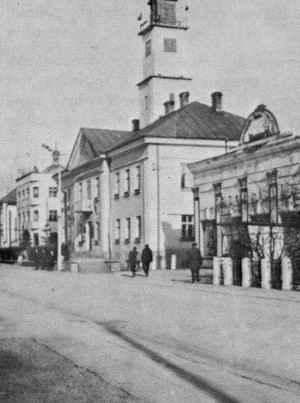
| Trembowla – General View |
by Moshe Briller, USA
Translated by Binny Lewis
Some time ago two photographs came into my hands. One was an old photograph that had been in my possession for a long time. It was a picture of a group of the Zionist youth in Trembowla, in which appeared the figures of my sister Clara, Pentsia Horowitz, and several other girls, some of them good friends of ours.
The second photograph I received not long ago. It is the photograph of my older first cousin, Chanusia Horowitz. What memories these evoke, what sad thoughts! An entire generation that went to its world.
One needs only to look at those faces, in whose eyes one can read the aspiration to self-expression, the will to live and drink the full cup of life. If life is a stage and the people actors upon it, then life is also a dream of shifting intensity and shifting circumstances. It is full of anticipation and tension, disappointments and suffering. It is an oscillation between hope and disillusionment, between joy and despair. But the lives of these young people were cut in the middle; their hopes were not fulfilled, and their disillusionment ended in the most terrible tragedy that has ever been the lot of our “chosen” people.
Trembowla was for us, who were born and raised in it, not merely a city but an entire world and its fullness. It was the place in which every stone spoke to us, in which every house bore within it memories and experiences, in which every street had a story. Beyond that it was a city full of people, young and old, each of whom had his own problems, worries, and worldview.
It was a city, and certainly it is a city to this day. But once the people who lived in it were our brothers and sisters, and they have gone from this world never to return. There are surely some kind of lives there today, but I fear that if I were to visit it now, it would make an impression on me of a ghost city – without its soul, without the life that gave it its special meaning, without the laughter whose echo perhaps still resounds in the nighttime silence of its emptiness.
I remember the city. It lay slumbering among the hills and mountains
[Page 45]
of the Podolian landscape. A small river flows lazily through its center, dividing it into two: the Old Town and the New Town. In spring this river would awaken from its slumber, rising in its turbulent waves, roaring with blocks of ice it carried on its back, frightening the easily frightened and presenting to the curious and the bold a sight of unforgettable beauty.
On hot summer days its banks would fill with a crowd of bathers – people and children – dressed in garments of various colors and cuts. The air would fill with laughter and chatter. They were the eternal idlers who lived from day to day and from month to month, awaiting employment and steady work, dreaming of miracles in a frozen and hopeless world.
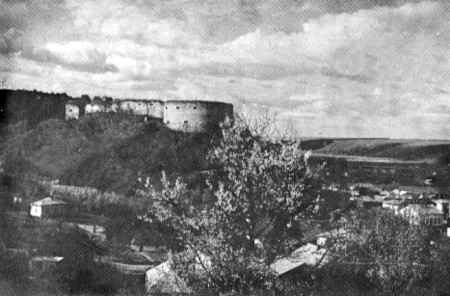
A special charm belonged to the Shloss – the fortress. Rising atop a steep hill, the Shloss seemed to stand guard over the city, over the Falbverg hills
|
|
| The fortress from the south-west |
all around, over the roads leading to it and over the nearby hill, the Pokrovka. Who among the natives of Trembowla does not clearly remember the outline of the Shloss and its approaches, its thick and strong walls and its towers, which in days gone by
[Page 46]
served as a defense post against Turkish attacks? Who does not remember the statue of Zofia Chrzanowska? One hand stretched eastward and the other, holding the dagger, directed at her heart? Legend or historical truth – it was an impressive sight. No wonder that many of the city's residents were eager to be photographed at the foot of the heroine's statue.
The Shloss had other things to offer to hikers and those resting in it: a spacious park and avenues between the trees, benches along the avenues and around the squares, green lawns, resting spots, a wide open area for concerts, dances, and performances, a pine forest stretching for kilometers to the outskirts of Strusov, the town.
On Sabbaths, the Jews of Trembowla would stroll for their pleasure in the Shloss, delighting in the cool, fresh air and the natural beauty of the place. Groups of people would gather in the various spots – family groups and groups of friends. Children ran about playfully, playing tag or hide-and-seek. The sounds of children's laughter filled the air with the tones of play, delight, and happiness. Their mothers and fathers would catch them with a smile to give them a cookie, knish, strudel, or another treat.
In other places young men and women would stroll, the young men trying to impress the girls, while the girls tried to attract the young men with their charms. Laughter and giggling were the sounds emanating from these groups.
I loved to awaken in summer at sunrise, to dress, and to climb to the Shloss with a book in hand. Lying on my belly on the grass I would pick the strawberries and swallow them with appetite. How beautiful it was to dream on such mornings. To what distances one could sail in the imagination!… I saw myself crossing seas and continents, visiting distant lands, listening to wonderful concerts, participating myself in musical creations, and experiencing the wonders and pleasures that my soul yearned for. How wonderful it was to be young and to daydream. Although reality was a nightmare and these dreams were never destined to come true.
Life was hard, but it had its vital sides as well. Without sophisticated means of entertainment, we created our own games, our own amusements. The natural beauty of Trembowla that surrounded us provided us with compensation.
[Page 47]
The truth is that we were surrounded by a sea of hatred, of which at that time we were not sufficiently aware. In our worst dreams we were incapable of imagining what was to come. Only a satanic imagination
|
|
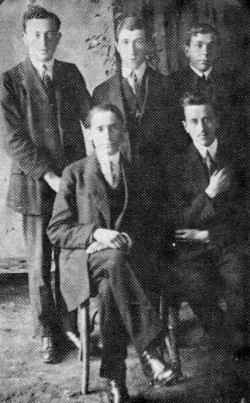
| Youth in Trembowla |
could have conceived of the crematoria, the gas chambers, the Einsatzgruppen, and all the other inventions of the “era of progress.”
The Jews led what could be called a normal life – it cannot be called anything else,
[Page 48]
although in truth it was not normal at all. A people that for long periods had been consistently displaced from its positions, that had always been defined as parasites, that had never been permitted to engage in normal occupations, to which almost all branches of the economy were closed, that was persistently persecuted and always served as a scapegoat – could not see its life as normal. Its life was hard, and especially hard were the lives of the young generation – they were lives without hope. Yet in its innate stubbornness (to succeed, to advance, and never to surrender), they continued to strive for self-improvement. Faced with difficulties that were hard to overcome, they strove to emigrate to other countries, in order to build their lives on new foundations. Some succeeded, but for the overwhelming majority it was a dream that could not be realized. The gates of other countries were locked, and expressing wishes for a better fate did not help us.
Today this belongs to history. We were always alone. The explanation was simple – we served as a scapegoat in international politics. Even if we were not better than our neighbors – we were certainly not worse than them.
Our youth was idealistic, and despite all the troubles, the distress, and the poverty – optimistic. Our eyes were directed to a distant land – our homeland, the homeland of our fathers. We believed in Herzl's vision. In order to be rescued from our bitter fate, we had to become a people again; we had to rebuild our land, settle its soil, turn the desert wastes of sand and rock into fertile earth. It is no wonder that so many Zionist youth organizations flourished in Trembowla.
I myself belonged for many years to “Ha-Noar Ha-Tsiyoni” [The Zionist Youth], and I still remember the serious faces of the young movement members. The speeches of the counselors, the lessons in history, in the history of Zionism and its aims, the lessons in the geography of the Land of Israel, and so forth. The evenings after school and after homework preparation we spent in these organizations. It was serious work, but also a pleasure. An inseparable part of our gatherings were the discussions – “pondekis” [meaning uncertain]. In these discussions we broadened our horizons; in them we learned to live together, to cooperate in the spirit of the “kvutsot” [kibbutz groups]; we sang Hebrew songs and also old songs in Yiddish. These songs expressed our longings for a better and freer life, our desire to return to the land of our fathers. In them was the warmth and simplicity of our family life, and in them also was a note of resistance, of readiness to fight, to continue despite all the difficulties and despite the hostility surrounding us. I remember the songs and I still hear them.
[Page 49]
I hear these songs sometimes in the silence of the night, except that now they sound to me like a mighty symphony expressing the distress of a nation condemned to annihilation, the agonies of fathers and mothers who would soon be forced to hear the despairing voices of their children torn cruelly from their mothers' arms and to witness their tragic deaths. Their own voices too are heard in this tragic symphony, broken and crushed, yielding to the work of the murderers. Their cry of despair certainly reached the gates of Heaven, but in vain. There was no answer to their plea, not even a faint echo. All was lost without end, without remnant.
And the dances – the Horas! Turbulent, inflamed, feet pounding forcefully on the floor, bodies intertwined in powerful rhythmic motion, spinning in tightly-knit circles. Alertness and joy. Expression of youth, hope, faith.
The older generation – God-fearing, diligent, energetic, devoted to their families, faithful to their way of life. All their lives – a struggle for survival. Despite the legend of Jewish wealth, only a handful of families lived above the poverty line. By Western standards they were poor, and only in comparison to the rest of the Jewish population in Trembowla were they considered well-off. The majority lived on the edge of poverty. Life was hard, the struggle for survival was cruel. Employment was not to be found; apart from the few professionals and craftsmen, there was only one occupation for a Jew – retail trade. For most, it was a hopeless pursuit.
Their spiritual support was their religious way of life. Their lives moved from one Sabbath to the next, from one holiday to another. Throughout the week they subsisted on a crust of bread, but on the Sabbath the face of things was different.
The synagogue was the meeting place of one man with his fellow; there they spoke of the events of the day, argued about the future. There the Jew could forget for a short while his daily distress. It was also the place where he could pour out his heart before his Creator, hoping that the Master of the Universe would not abandon him in his hour of danger.
Perhaps this is the place to raise the memory of the young and old, the men and women who walked in their days in the streets of Trembowla and saw it as their city – as every person is entitled by international law to his birthplace. Who [the number] there is “a million” – or more precisely: six million.
[Page 50]
Therefore I will content myself with raising the names of my holy martyred parents, Israel Avraham and Chana Briller, may God avenge their blood, of my sister Clara, and of my brothers Max and Milek, of blessed memory.
Let us all remember – we owe this to our holy martyrs, we owe this to our Trembowla, we owe this to the children whose lives were severed by the cruel Nazis and their helpers, may their name and memory be blotted out. Let us remember – we must not forget. This is our sacred duty.
|
|
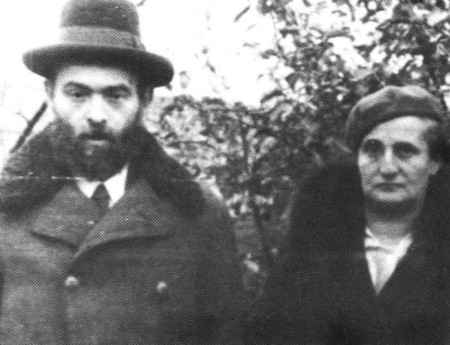
| The family of Asher Katz, of blessed memory |
[Page 51]
by Meir Zaltzer
Translated by Binny Lewis
A) The Economic System of the Jews of Poland
In my search for material on the economic system of the Jews of Poland before World War II, which I needed for the preparation of this article, I found in the Central Archives for the History of the Jewish People in Jerusalem a confidential report by Dr. Seraphin in Koenigsberg, printed in December 1938, in the journal Ost Europa Markt, at a time when the German preparations for the invasion of Poland were already in an advanced stage. This research was undoubtedly intended to serve as a guide for the “Final Solution.”
This report, prepared with great care, reflects the unnatural character of the economic system of Polish Jewry, which on the one hand had “control” over certain branches and on the other hand had no foothold in important fields, such as agriculture, government bureaucracy, and so on. The tendency toward professions in which they found their place, such as commerce, liberal professions, crafts, and so on, was the result of their being pushed out of other fields. The choice of professions by Jews in Poland was not free. The Jews were forced to devote themselves to professions to which they had access, and this caused a one-sided, unnatural, and unhealthy economic system. This also added to the hostility of the non-Jewish population.
And this is the language of the report, translated from the German:
“The economic-social structure of the Jews of Poland differs from that of the Jews in Western Europe. Polish Jewry constitutes a closed society, distinguished in its decisive majority consciously from its surroundings, using its own language, belonging to the Jewish nationality, and whose social structure encompasses more 'prestigious' professions as well as a large number of others, such as: retail merchants, craftsmen, seasonal workers, and proletariat in the full sense of the word.”
[Page 52]
In 1931, the number of Jews in Poland was 3,084,800, constituting 9.7% of the general population. In contrast to the general population, the Jews were concentrated in cities. Out of 100 Jews, 77 lived in cities as opposed to 23 in non-urban settlements. Because of this, the proportion of Jews in cities was high and sometimes they even constituted a majority in them. Out of 425 Polish cities with a population below 20,000, in 188 of them there were more than 45% Jews. In the two largest cities – Warsaw and Lodz – in 1931 there were in Warsaw 350,000 Jews, constituting 31% of the general population, and in Lodz 200,000, constituting 33%. Similarly, the Jews constituted 32% in Lvov, 25% in Krakow, 47.5% in Bedzin, 51% in Stanislawow, 56% in Rivne, 63% in Pinsk of the general population. Due to this concentration in centers of commerce and industry, the Jews determined the character of cities to a great extent, concentrating in closed Jewish quarters, in ghettos, which constituted purely Jewish settlements. And thus the Jews constituted in the third district of Warsaw 89% of the residents, in the Old City of Vilna 66%, in Kazimierz, a suburb of Krakow, 71%, in the Old City of Lodz 77%.
According to authoritative sources, approximately 50% of the Jews of Poland did not pay municipal taxes due to poverty, 23% of the Jewish population received ma'ot chitim [wheat money – charity for Passover provisions] in order to celebrate the Passover holiday. One-third of the Jews of Warsaw needed the support of the welfare committee. It follows that 30%–40% of the Jewish population belonged to the stratum that was completely without status and the most impoverished. And therefore it is a fact that the Jews in all of Poland constitute fertile ground for the ideas of Russian communism. On the other hand, the social tensions and the crowding of the ghettos caused thousands of Jews to be pushed constantly into the host nation.
In addition to this, the Jews exploit every occupation that is suitable and convenient for them, with the help of all means of competition, out of a pursuit of meager profit, which is the result of the impoverishment of a part of Polish Jewry. At the same time, it is impossible to ignore the fact of the Jews' entrenchment in key positions of the economy. That is to say – the effective control of banking, the influence on enterprises, the almost complete domination of foreign trade.
More than two-thirds of the Jews in Poland make their living from commerce. According to a Jewish account, in 1932 there were 202,000 businesses in Jewish hands and 125,000 in non-Jewish hands. If we add to this the businesses in the form of joint-stock companies, then 75%–80% of commerce in Poland was in Jewish hands.
[Page 53]
The domination of retail commerce is complete. There are currently 270 Jewish retail organizations as opposed to 14 non-Jewish ones. In 1933, in 216 cities in Poland (excluding Western Poland), 66% of small shops were in Jewish hands. According to the statistics of the Ministry of Commerce and Industry in Warsaw, covering the districts of Vilna, Novogrudek, Bialystok, and Polesia, the Jews held 64.8% of grocery stores, 67.6% of chemical trade houses, 82.6⅓% of shops for agricultural produce, 84.6% of trade houses for metal products, machines, electrical products and photographic products, 85.8% of trade houses for ready-made clothing and haberdashery, 94.4% for textile products, 95.6⅓% for leather and fur products. Out of 42 textile industry enterprises in Bialystok, 35 belonged to Jews.
The decisive part of Polish cottage industry, such as basket-making, shoemaking, ready-made clothing, spinning, and rope-making – was conducted by Jews.
Also in the liberal professions, the influence of the Jews was very strong. The domination of the Jews in the press, apart from the antisemitic newspapers, is a fact. The Jews have a decisive share in the medical and legal professions. 45⅓% of the physicians in the Warsaw and Lublin districts, 70% in the Lodz, Stanislawow, and Lvov districts, 86% of the dentists of Poland are Jews. In 105 settlements that have a district court, not a single Polish attorney was found. Three-fifths of all cinemas in Poland are in Jewish hands.
Many Jews are employed in the Polish radio stations. The operetta in Poland is almost entirely in Jewish hands. There are 79 Jewish professors and lecturers in the universities.
Despite the primitive antisemitic attitude of broad peasant circles and despite the pronounced though diminishing opposition to the economic sphere from strata of the Polish intelligentsia, the economic position of the Jews remains unshaken. It would not be an exaggeration if, instead of speaking of important economic branches of Poland, one would speak of a “Jewish national economy” in Poland.
Commerce, craftsmanship, contracting, and a large part of the liberal professions – are to a great extent in Jewish hands in Poland.
Thus far the confidential report of the German Seraphin.
[Page 54]
What remained of the “unshaken” economic position of the Jews of Poland? It vanished together with the Jews, regrettably.
B) The Economic Situation in Trembowla
Before we proceed to a survey of the livelihoods of the Jews of Trembowla, let us try to compare their situation in relation to the non-Jewish population.
Let us begin with the liberal professions.
Physicians: There were in Trembowla also non-Jewish physicians, but the number of Jewish physicians exceeded that of the non-Jewish ones.
Attorneys: There were some Ukrainian attorneys. The Polish lawyers had a broad field in the senior bureaucracy. For Jews, the study of law was convenient, because they could study at home and travel for examinations; hence the large number of Jewish attorneys.
Architects, engineers, and technicians were both Polish and Ukrainian.
Officials: Apart from two or three Jewish government officials, the government bureaucracy from the Starosta (district governor) down to the wozny (attendant) was entirely in Polish hands.
In contrast, craftsmanship was represented to a great extent by Jews. There were some non-Jewish tailors, cobblers, and carpenters. By contrast, the tinsmiths were exclusively Jewish, and the roofs of the churches were covered by Jews. Also the watchmakers, glaziers, and painters were mostly Jewish.
Even more so was commerce in Jewish hands in Trembowla. There was sharp antisemitic propaganda in favor of Polish and Ukrainian commerce, but most branches of commerce were and remained in Jewish hands.
The fabric shops, leather shops, ironmongeries, lumber shops, and others were exclusively in Jewish hands.
And one more note before we proceed to the matter: the list of those engaged, or more precisely those who were engaged, in the various professions cannot be complete for two
[Page 55]
reasons: a) Most of the names I recorded from my memory and with the help of members of the editorial committee. It cannot be assumed that we did not unintentionally omit certain names. b) In order to prevent this to some extent, I sent urgent requests to the members of the organization to fill out the questionnaires I enclosed with the letters. But to my regret,
|
|
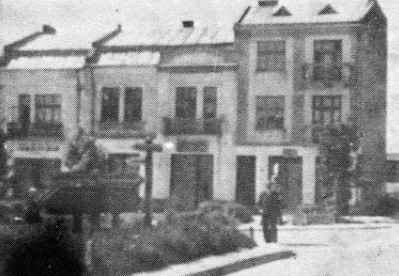
| Magistrat |
fewer than half of the members responded. This also applies to the list of names of the victims. And therefore I must state decisively that all the omissions are not my fault.
C) On the Livelihoods of the Jews of Trembowla
Now let us proceed to the matter.
In terms of livelihood, the profession in which they were engaged and from which they derived
[Page 56]
their sustenance, the Jewish population of Trembowla was composed of six classes:
A) Men of Religion
|
|
| Academic youth |
B) The Professional Intelligentsia
The veterans of the Jewish professional intelligentsia in Trembowla were graduates of gymnasiums outside the town, because the Trembowla gymnasium was founded
[Page 58]
only at the beginning of the 20th century. They were the physicians Dr. Sert, Dr. Deutsch, Dr. Neustein, and the attorneys Dr. Landau, Dr. Sert, Dr. Hahn, Dr. Shmirer, Dr. Blaustein, and Dr. Feuerstein. But in the course of time, a new generation arose from the town's native sons, who acquired their secondary education in Trembowla and received their higher education at the universities of Lvov, Krakow, Vienna, and Czernowitz.
To this new generation belonged the physicians Dr. Stern, Dr. Kolin, Dr. Bumza, and Dr. Sass.
After World War I, the following lawyers were added: Zalman Einleger, Sefrin, Wolf Brandes, Halberg, Avraham (Bomba) Einleger, David Margolis, and the articled clerks: Chaim Deimer, Yosef Einleger son of Moshe, Monsieur Lazarus, and Zigmund Rotman, all of whom perished in the Holocaust, may their blood be avenged. And may they be distinguished for life: the attorneys David Sass of blessed memory, Herman Meltzer, Yulk Einleger, Yitzchak Goldstein (who passed away in the Land of Israel), Yisrael Rosenfeld, Pinchas Neuman, and Yaakov Rosenshtrauch.
Horn was a veteran surveyor. The engineer Fischer was from outside the town.
Of the sons of Trembowla who studied engineering: Karol Guthertz, Filk Shechter, may his blood be avenged, and may they be distinguished for life: Shiku Einleger, Philip Goldenberg, and Tzvi-Hirsh Shertzer of blessed memory.
The veteran pharmacist in Trembowla was Paul Zilberg. His sons Yosef and Fredrick were also pharmacists, as was his nephew Berl Zilberg. Also Yaakov Gottlieb and Yosef Deimer were pharmacists, may their blood be avenged. Our comrade Yosef Einleger, may he be distinguished for life, is a pharmacy owner in Tel Aviv.
Dentists in Trembowla were: Dr. Kleber, Feder, Richer, Riner.
There was a Jewish judge in Trembowla: Judge Engel, and one veterinarian – Engel, his brother.
C) The Officials
Jewish government officials were few in number due to the anti-Jewish discrimination practiced by the authorities.
Yitzchak Halberg was a government official. Chanis was an income tax official. Also Horshubski from Dolina was an income tax official.
[Page 59]
The only Jewish official in the municipality was Selek Steinig-Ashkenazi, who married Gusta Guthertz.
In the framework of government officials, one can count the Jewish teachers who served in state schools, and who were for the most part academic teachers. They were Prof. Goldblatt, Prof. Mildwurm, Prof. Frantzos, Dr. Frenkel, Dr. Toperman, Prof. Lifshitz, Mr. Michael Litman, and Mr. Reisberg, and many more.
Zhenia Kachka-Greenberg taught at the elementary school.
There were also Trembowlans who engaged in teaching outside the town. Among them: David and Lonka Greenberg, who taught at the Jewish gymnasium in Baranovichi; Shmuel Einger of blessed memory, who taught in Vilna; Wolf Rudolf in Gorlice; Meir Zaltzer in Vienna, Warsaw, Sosnowiec, and Katowice; Herman Einger in Lvov; Yitzchak Rudolf. The Zionist activist Avraham Greenberg engaged in private teaching. David Milgrom and Yisrael Goldflis taught in Czortkow.
In bookkeeping were engaged: Zelig Bumza, Meir Breinstein, Abba Briller, Mendel Goldflis, Yitzchak Goldstein, Nota Lantz, Yaakov Kirbholtz, Dunya Goldflis, and others.
Kreisler and Fertig were court officials.
Shefer was in the police.
Mark was the head of the land registry.
Sharfshpitz was the community official.
D) The Craftsmen
And these are the professions in which the craftsmen of Trembowla were engaged:
1. Tailors and seamstresses, 2. Hatters and milliners, 3. Furriers, 4. Cobblers, 5. Barbers, 6. Butchers, 7. Bakers, 8. Carpenters, 9. Tinsmiths, 10. Glaziers, 11. Painters, 12. Rope-makers, 13. Blacksmith, 14. Carter, 15. Wagon drivers, 16. Bathhouse attendants, 17. Stonemason.
[Page 60]
1. Tailors:
1) Shmaryl Gutstein, 2) Avraham Yochanan Hochman, who was the chairman of “Yad Charutzim,” 3) Moshe Weinraub, 4) Zelig Weiss, 5) Yehoshua Weisbrod, 6) Yisrael the Tailor (lived on Ibeshkevich Street), 7) Frak from Gzhymalow, 8) Kut, 9) Kolin, 10) Peretz Shechter.
Seamstresses:
1) Toiba Bumza, 2) Mizia Herbst, 3) Bata Biltchi, 4) Sara Ter, 5) Bela Lampa, 6) Gusta Milgrom, 7) Dvora Manheim.
2. Hatters:
1) Berl Wachtel, 2) Pepper, 3) Misha Shechter.
Milliners (ladies' hats):
1) Mrs. Bluma Dreimer, 2) Mrs. Sass.
3. Furriers:
1) Zalman Yitzchak, 2) Aryeh Shwalbenst.
4. Cobblers:
1) Koppel, son of the melamed from Skalat.
5. Barbers:
1) Glick, 2) Naftali Weinraub, 3) Yisrael Stern, 4) Michael Shmitzer, 5) Lizer Shmitzer, 6) Yosef Shmitzer, 7) Avraham Shmitzer.
6. Butchers:
1) Efraim Yosef Ganz, 2) David Ganz, 3) Yitzchak Meir Hitler, 4) Nisan Wilner,
[Page 61]
5) Fishel Zuckerman, 6) Yehuda Kolin, 7) Azur Pikholtz.
7. Bakers:
1) Mordechai Hirsh Alman, 2) Wolf Lemmel, 3) Leib Paperblit, 4) Getzel Shlak, 5) Avraham Hirsh Shenhaut.
8. Carpenters:
1) Asher Katz, 2) His son Chaim (lives in Kiryat Bialik).
9. Tinsmiths:
1, 2) The Erdman brothers, 3) Shmaryl Buchberg, 4) Yosef Karbholtz, 5) His brother Leib Karbholtz, 6) Bril Shwalbenst.
10. Glaziers:
1) Bezalel Goldberg, 2) Moshe Deligtch, 3, 4) The brothers Mendel and Yaakov Leichtner, 5) Yosef Melner.
11. Painters:
1) Rafael Popik, 2) Shmuel Stern.
12. Rope-makers:
1) Mendel Unger, 2) Yitzchak Unger, his son, 3) Asher Weisbrod.
13. Blacksmith:
1) Moshe the Blacksmith, brother-in-law of A.Y. Hochman.
14. Carter:
1) Noach Lang.
15. Wagon drivers:
1) Baruch Leib, 2) Gedalya, his son, 3) Yitzchak Weiss, 4, 5) The Neugebirts brothers, 6) Aharon Friedman.
[Page 62]
16. Bathhouse attendants:
1, 2) Mendel Unger and his son, 3) Rafael Popik.
17. Stonemason:
1) Yisrael Ganzer.
E) Artisans
1. Watchmakers:
1) Elazar Greenberg, 2) Yitzchak Weinstock, 3) Knobler, 4) Nachum Shechter, 5) Shechter – son-in-law of Feibush Zwikerman the disabled and paralyzed watchmaker.
2. Musicians:
1) Mendel Leib, 2) Ben Zion Lampa, 3, 4) His sons Meir and Eli, 5) Natalia Shmitzler, 6) Shabtai – flute player.
3. Photographer:
1) Schneilichtt.
4. Printers:
1) Shimon Breinstein, 2) Munyo Goldstein, 3) Glass, 4) Yaakov Horowitz, 5) Steinig, 6) Shalit.
F) The Merchants
The merchant class included the largest number of all the classes of the Jews of Trembowla. Among them were wholesalers such as Leib Shertzer and Shalom Shechter, merchants with established shops, owners of small shops, and stallholders.
[Page 63]
And these are the branches of commerce that were represented in Trembowla:
1. Fabrics, 2. Leather, 3. Shoes, 4. Groceries, 5. Grain, 6. Iron, 7. Lumber, 8. Vessels, 9. Haberdashery, 10. Eggs, 11. Beer and spirits, 12. Tobacco, 13. Newspapers, 14. Soft drinks and ice cream, 15. Cattle dealers.
1. Fabrics:
1) Bergman-Leviter, 2) Toiba Ginsberg, 3) David Ginsberg, 4) Shlomo Ganzer, 5) Avraham Greenberg, 6) Shalom Weinraub, 7) The Melner brothers, 8) Yehudit Strasberg and her son Zelig.
2. Leather:
1) Shlomo Zaltzer, 2) Avraham Tirkel, 3) Gershon Katz, 4) Yitzchak Friedman, 5) Bezalel Tzises, 6) Shpeicher.
3. Shoes:
1) Avraham Briller, 2) Dubiner, 3) Aharon Zalzberg, 4) Lazarus.
4. Groceries:
1) Alman, 2) Yaakov Antner, 3) Yitzchak Briller, 4) Yitzchak Hirsh Wilner, 5) Rachel Manheim, 6) Yoel Master, 7) Freind, 8) Miriam Kalman, 9) Shalom Shechter, 10) Leib Shertzer.
5. Grain:
1) Buchholtz, 2) Bin, 3) Wolf Briller,
[Page 64]
4) Leib Goldflis, 5) Diner, 6) Moshe Hendel, 7) Yehoshua Mordechai Herbst, 8) Zaltzman, 9) The Tunis brothers, 10) Teft, 11) Shalom London, 12) Mitelman, 13) The Milgrom brothers, 14) Baruch Ployin, 15) Yitzchak Kleiner, 16) Yaakov Kapel, 17) Moshe Shtaub, 18) Aharon Sass, 19) Anshil Pleshner, 20) Yosef Kreizler, 21) Yosef Buchholtz, 22) Yosef Margalit.
6. Iron:
1) Max Gutfried, 2) Hirsh Weissberg, 3) Yehuda Leisner, 4) Pinchas Polishuk, 5) Mordechai and Aharon Ployin.
7. Lumber:
1) Moshe Brik, 2) Wolf Briller, 3) Zelig and Shmuel Ginsberg with Moshe Zilberg, 4) Binyamin Gelman, 5) Moshe Griya, 6) Yitzchak Warman before WWI, 7) Shalom Nussenbaum, 8) The Rubel brothers.
8. Vessels:
1) Moshe Deligtch (glassware), 2, 3) The shops of the Karbholtz brothers.
9. Haberdashery:
1) Shmuel Brandes, 2) Toiba Ginsberg, 3) Shmuel Yair Rudolf, 4) David Ber Rudolf with groceries.
10. Eggs:
1) Yitzchak Briller, 2) Chaim Horowitz, 3) Shmaryl Melner, 4) Bezalel Kapel.
11. Beer and spirits:
1) Simcha Einleger, 2) Goldstein, 3) Yaakov Neuman, 4) Eizik Podhorzer.
[Page 65]
12. Tobacco:
1) Avraham Einleger (wholesale), 2) Shmuel Hirsh Frenkel.
13. Newspapers:
1) Eliyahu Feld.
14. Soft drinks and ice cream:
1) Azriel Altberg, 2) Mendel Fogelman, 3) Kimel, 4) Avraham Yitzchak Rosenberg, 5) Hirsh Rotman.
15. Cattle dealers:
1) Moshe Budian, 2) Mordechai Brief, 3) Hirsh Luker, 4) Feigenbaum.
G) Miscellaneous
1. Hotel:
Fischer.
2. Flour mills:
1) Marinsdorf, 2) Kapel-Dreimer.
3. Buckwheat mills:
1) Shmuel Dov Adler, 2) Yitzchak Gutstein, 3) R' Yeshayahu Bar Shochberg.
4. Dairyman:
1) Wolf Yitzchak Shechter.
5. Printing presses:
1) Glass, 2) Steinig.
6. Restaurants and taverns:
1) Simcha Einleger, 2) Dreimer's tavern, 3) Michael Zaltzer, 4) Netanel Meltzer, 5) Chuben, 6) Moshe Rudolf, 7) M.F. Rosenberg, 8) Pesia Rosenshtrauch, 9) Sher.
[Page 66]
|
|
| Meir and Sophia (née Goldstein) Brinstein z”l |
|
|
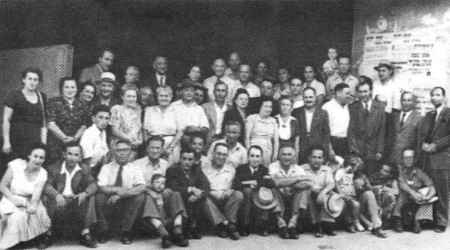
| Sons of Trembowla at a memorial gathering in the Land (of Israel) |
|
|
JewishGen, Inc. makes no representations regarding the accuracy of
the translation. The reader may wish to refer to the original material
for verification.
JewishGen is not responsible for inaccuracies or omissions in the original work and cannot rewrite or edit the text to correct inaccuracies and/or omissions.
Our mission is to produce a translation of the original work and we cannot verify the accuracy of statements or alter facts cited.
 Terebovlya, Ukraine
 Yizkor Book Project
 JewishGen Home Page
Copyright © 1999-2026 by JewishGen, Inc.
Updated 01 Jul 2026 by JH