 |
|
|
[Page 9]
[Page 10]
Trembowla My Town
by Tzvi Pleshner
Translated from Hebrew by Binny Lewis
| Trembowla, my town, Why does my heart stir for you? And your name, when I recall it, My innards within me churn? I knew — you were my native motherland, Even though in a foreign and treacherous land. In you I grew, your air I breathed, In your bosom my dreams I wove. In you my parents and siblings lived, My Jews toiled and created. In you infants suckled their mothers' milk, Children learned from the mouths of their teachers and rabbis. In you boys and girls blossomed And pure loves flowered. In you wedding canopies were raised, Sons and daughters were born, And elders, when their day came, Were gathered unto their people... In you the life of the community Flourished to glory... In you they studied Torah And bent over the Gemara. In you there burned constantly The fire of Hasidism... In you a generation of enlightened ones grew, Thirsting for beauty and for light. In you youth movements seethed In the light of ideals and purity. In you there walked with pride |
[Page 12]
| Dreamers of Zion. In you they sang their burning song, Those yearning to ascend to the homeland. And now?... Is a bridge still stretched over the Gniezna River, And it flows, streaming in tranquility as of old, And does not overflow its banks and rage, And does not flood, destroying and demolishing all around? And the waters are clear and not red as blood, And the skies spread above are bright, And are not black as pitch? And the sun sends forth rays of light, And the stars still shine at night And in tranquility wink their eyes in secret? And the verdant earth, broad of expanse, Does it not tremble beneath one's feet? And people walk about with laughter on their lips, And she does not open her mouth to cry out? And she does not spew forth brimstone and fire, And does not swallow them in her seething maw? And the “Monastyr” — do its walls still stand? Have its foundations not been shaken? And it caresses with an affectionate gaze Those who frolic all around, And does not hurl its stones At those who pass before it? And the “Zamek” — does it still stand upon its mound? Has it not sunk? Has it not collapsed? And Chrzanowska is watching, Her eye is still watching? Standing upright, Poised, courageous of heart, Her gaze piercing, calling, sounding the alarm, And in her hand the blade of a knife will flash? Will shame not cover her face |
[Page 13]
| For not having dipped it in her blood, After she saw with her own eyes The disgraceful silence of her sons! And the Jewish houses stand there, Gleaming, radiant in their whiteness, And their walls will not stream with tears For those who were within them and are no more? And above the rooftops Doves coo And sing their songs, as usual? Is it truly so? Can it be? But one thing I know And a shudder seizes me: That you are empty and wretched, my town, That only Ivan and Vasil walk in you... Therefore my heart stirs for you, Trembowla, my town, And your name, when I recall it, My innards within me churn... Even though decades have passed, You continue to live within me, The blood of your Jews surges in my blood And their memory burns in me like fire — Engraved upon my dripping heart, And my soul within me is enshrouded... Until my last day I shall see them in my dreams... And from my heart the sorrow shall not depart Until my final day... |
By Meir Saltzer
Translated from Hebrew by Binny Lewis
Trembowla is situated on the Podolian plateau; its western part belonged to Poland until the Second World War. This plateau rises to an elevation of 400 meters above sea level. Trembowla is distinguished by its natural beauty, and its surroundings are called the Podolian Switzerland.
Trembowla lies on the Ternopil–Chortkiv railway line. Its distance to Ternopil in the northwest is about 30 km. To its south, at a similar distance, lies Kopychyntsi.
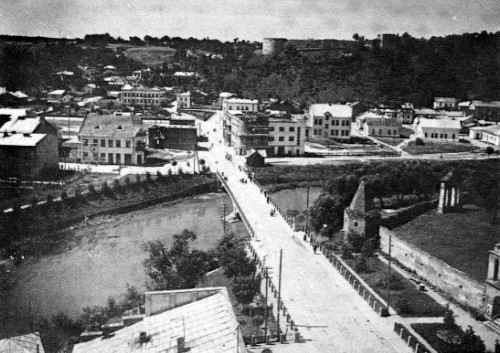
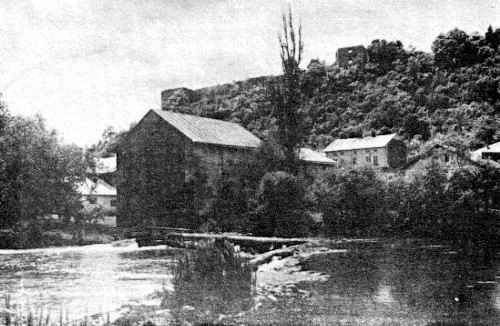
The city of Trembowla is situated in the valley of the Gniezna River, at the foot of the ruins of the fortress. It is divided into the Old Town, at the foot of the fortress to the west of the Gniezna, and the New Town, to the east of it.
|
|
| View of the “Fortress” from the east |
[Page 15]
The fortress hill and its ruins are the pride of Trembowla. The stroll up the slopes of the hill, through the cool and fragrant pine groves, the fresh air, the breathtaking views of the landscape stretching into the distance – these were an important part of the Sabbath pleasure [oneg Shabbat] for the Jews. Young and old, women and children, would walk there in tranquility, breathing the refreshing air and enjoying the peace and beauty of the place. The fortress hill cast a special mood upon the walkers, a mood of uplift and purification. On the fortress hill no shouting or noise was heard. Its atmosphere was gentle and calming.
|
|
| The fortress and the Gniezna River |
After the two pine groves, a deciduous forest stretched all the way to Strusov in the northwest.
Down the slope of the fortress hill, on the west side, flowed the Dmokhletz stream, and in the 1930s a modern and beautiful swimming pool was built there.
At the foot of the hill, on the south side, there is a spring of fresh water called the Tarnowski Well, and on Sabbaths Jews would come from afar to drink its cool waters.
[Page 16]
Across the way, to the south, lies the Pokrovka hill, and next to it the electric power station.
In the middle of the city the Gniezna flows gently. Along its banks stand three flour mills, and over it stretch three bridges – two for pedestrians and vehicles and one railway bridge. Due to the many wars fought in the area during the first half of the century, these bridges were blown up and rebuilt. Along the Gniezna are several bathing spots, enjoyed by most of the city's residents in the summer months. And when it is covered with a coat of ice in winter, the young people skate upon it.
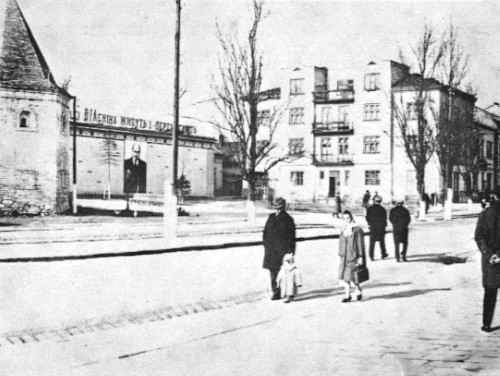
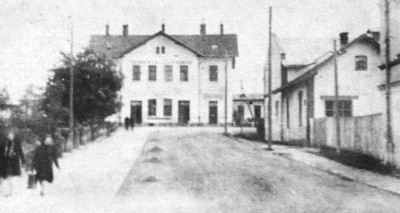
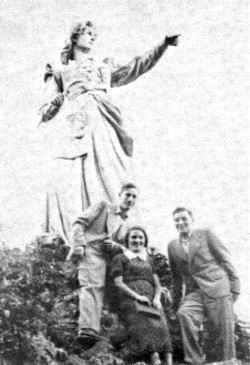
The main street runs along both sides of the Ternopil–Kopychyntsi road, and it was called, until the war, Chrzanowska Street, in memory and honor of the local heroine of the 17th century, Zofia Chrzanowska, whose sculpture stands on the fortress hill. The main part of the street extends from the town square in the direction of Falbovanka. There stand the Tserkva [Greek Catholic church], the Dom Narodny [People's House], the Sokol – which was the Polish cultural and sports center – the new Catholic church, the Fischer Hotel, the Deutsch building, the Drimer-Kapel building, and other fine houses. In an alley next to the hotel is the railway station.
In the center of the city stand the Municipal Hall – the Magistrat – the Bernardine monastery [Minzir Bernardini], and beyond these, only Jewish houses: the house of Mordechai Floyin, in which his family lived and in which was also his hardware store; the fabric shop of his daughter Taube Ginsberg and of his daughter Rivka Rudolf. Next to it was the house of his brother, Chaim Floyin.
Across from it was the Jewish Community building, in which were, downstairs, the pharmacy of Zilberg, the fabric shop of the Milner family, and the hardware shop of Hirsch Weisberg. Upstairs was the “Kultus Kloiz” synagogue and the office of the community council. To its right stood the two-story house of Yehuda Kollin, with a butcher shop on the ground floor. To the left of the community council building stood the house of Yitzhak Hirsch Willner, with his large grocery store; the last building before the monastery was the house of Rossia Zomfeld, in which lived, among other tenants, Dr. Chaim Kollin, who also had his office there.
The alley running along the monastery garden was entirely inhabited by Jews. There stood the “Butshiner” [Bochynia?] synagogue, which during the First World War, when the “Kultus Kloiz” synagogue was in ruins, was the only synagogue in the New Town. There lived Yosef Kirveholtz, who had a tinsmith's shop and workshop. There also lived Asher Weisbrod, the rope-braider.
The old part of the city lay across the central bridge, to the right of
[Page 17]
the street that ran in the direction of the fortress hill was the area entirely inhabited by Jews. There stood the majority of the city's synagogues: the Beit Midrash and the Old Synagogue (di alte Kloiz), both in one building; the Husiatyn Kloiz; the Kopychyntsi Kloiz; and Yad Charutzim (the craftsmen's synagogue). There also stood, before it burned down around 1910 or 1911, the Great Synagogue (“di Shul”), which was not rebuilt after the fire. Close to the river was the bathhouse, which was operated on Sabbath eves and used mainly by our Jewish brethren.
|
|
| The house of Rossia Zomfeld |
To the left, going southward, ran the main artery of the Old Town – Sobieski Street. This street led to the Monastyr [Monastery], an ancient ruined fortress within a dense forest. At the foot of the hill on which the ruin stands, toward the south and west, the Gniezna flows into the Seret, a tributary of the Dniester.
Trembowla the city is surrounded by suburbs and villages. To the east – the Sady [Sadin in Yiddish], so called for the many fine orchards within them. Growing there are tasty cherry and gooseberry trees, good apple trees – from the Papiruvka (named for their thin skin like paper [papir]), which ripen early, to the Rennet apples, with their leather-like skin, very hard, which reveal their full flavor in winter months. The pears of all kinds –
[Page 18]
from the large “kosha” pears, whose insides look like buckwheat porridge and surpass it in taste, to the small pears called “Kol Nidrei pearlets” [sweet ones that ripen by Yom Kippur season], reine-claude plums from which jam – powidla – is made. Also abundant are redcurrant bushes (Weinferlikh) and gooseberries (Agrest). The peasant women bring the fruits, vegetables, chickens, ducks, and so forth every morning, and especially on Tuesdays – market days – to the market, and the housewives purchase them and carry their haul home.
The Sady are located up the hill, past the Christian cemetery. In winter one sledges there on the track coming from Lushnyov.
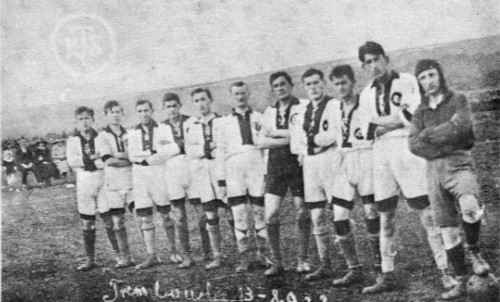
To the northeast, on a hillside, lie the Shchianky. One reaches them by passing the [former] Jewish cemetery. In that direction, across the Gniezna River, the main road leads to Ternopil. There, after the railway bridge, on the right side of the road, was the Trembowla football field. In the 1920s, football matches were held there between the local “Fortuna” team and visiting teams from other towns. Members of “Fortuna,” aside from one or two non-Jews, were exclusively Jews. Its president was Salek Steinig–
|
|
| The “Fortuna” football team |
[Page 19]
Ashkenazi, and its players were: Dudek Sas, the outstanding right winger; Hertz, the center forward; Yulak Eisenger; Filk Shechter; Izik Kapel; Bomba Eisenger; goalkeeper Alexander Kotlerski; and others. This was the first team. There were in it – in the “Fortuna” football association – five teams. The third was the youth team, in which Yaakov Shpikher, the mute, played as center forward. In time, in the 1930s, the football field was moved southward to the Planti. In those days Monyo Papirblyt was the outstanding footballer.
The road to Ternopil passed through the suburb of Krobynka, in whose orchards a delicacy for the palate grew wild.
In the opposite direction, to the southeast, the main road passed through the suburb of Falbovanka, in which several Jewish families lived and which was destined to become the killing ground for the Jews of Trembowla.
The other villages in the surrounding area were: Lushniv, Borychivka, Dolha, Ostrivchyk, Zastsianochka, Semeniv, Pidhaichyky, Mohylnytsia, Darabiv, and others.
|
|
| The Trembowla railway station |
The towns belonging to the Trembowla district were: Strusov, Yaniv, Budzanov.
A very important institution in the city is the railway. It constitutes the link connecting to the outside world, and its arrival and departure determine the time with greater precision than a watch. Three passenger trains daily in both directions connected the residents of Trembowla with the world, apart from the freight trains. The track ran meters from our house. A few minutes before a train passed, the crossing-gate would descend and the wagons would stop.
[Page 20]
In wartime, railway traffic was very intensive. The trains carried soldiers and war materiel; from the direction of traffic we could estimate the situation at the front.
After the railway bridge was blown up at the approach of the front, there would be for a time a stillness on the tracks, and weeds began to grow on them.
In the late 1930s, the “torpedo” was introduced into service – two express cars on the Lviv–Chortkiv line – which shortened the travel time considerably.
A very important institution of a different kind was the gymnasium [secondary school]. It was founded in the first decade of the century as a state secondary school and served as a cultural force of the first order. The gymnasium provided a general education and was a gateway to higher education. It also served as a factor in assimilation into Polish culture, despite the Zionist spirit that prevailed in the Jewish street, and it competed with traditional education. Polish speech was dominant, and Polonization advanced rapidly.
Trembowla, being a very ancient city, was a district town – Starostvo under Polish rule. At its head stood the Starosta.
Trembowla had been from ancient times a free city. That is to say, it was not the property of a single person – a count or duke – but rather a dwelling place of free citizens. Like Przemysl, it had been the seat of a Ruthenian prince. In a certain period, Prince Danylo ruled over it.
The fortress served as a defense against the attacks of the Turks and Tatars, who apparently at times gained control of the entire region.
Especially famous is the battle against the Turks in the seventeenth century, in the days of [King] Sobieski.
At that time, the commander of the region was Count Chrzanowski. During his tenure the Turks launched a fierce attack on the fortress, and the commander-count was inclined to surrender. Then, as he sat with his officers in council on the eve of the surrender, the Countess suddenly appeared in the council chamber with a drawn dagger in her hand. She directed the dagger toward her own heart and declared that she would strike herself if the commander carried out his plan.
Her brave appearance breathed courage into those present, and they resolved not to surrender but to fight. And in the end King Sobieski came to their aid, and they were saved from subjugation and shame.
[Page 21]
In memory of this event, a statue of the Countess stood in the middle of the fortress square, with a dagger in her hand in a very dramatic pose.
With the Third Partition of Poland in 1795, Trembowla and the entire region fell into the hands of the Emperor of Austria-Hungary, and the entire area was called Galicia. Trembowla was now in Eastern Galicia, whose capital was Lviv – Lemberg.
|
|
| Zofia Chrzanowska, heroine of Trembowla |
At the head of the city council – the Magistrat – stood the Burmistrz [Mayor]. There were also Jewish members on the city council. My great-grandfather, Naftali Saltzer, of blessed memory, was a member of the city council, and they called him Naftali Radnik [approximately in the mid-19th century].
The Jewish community had a measure of self-governance. At its head stood the head of the community – the Kultus-Präsident. After the First World War, those who served in this role were: Yitzhak Hirsch Willner, Professor Goldblatt, Izik Podhorzer, Prof. Frantsos, Dr. Stern.
From 1914, with the outbreak of the First World War in August of that year, until 1920, Trembowla was an arena of battles fought during that period.
[Page 22]
In August 1914, after the outbreak of the war and with the advance of the Austrian army into Russia, Jews were brought from Kamianets-Podilskyi and other Russian cities as prisoners to Trembowla. I remember the shock of Trembowla's Jews upon seeing their fellow Jews of Israel being led as prisoners. They received them warmly and offered them food and assistance.
The Austrian advance into the depths of Russia did not last long. Soon the wheel turned and the Austrians were forced to retreat; then the fear of the Russians fell upon the Jews, and the vast majority packed small or large bundles and left the city. I know of no Polish or Ukrainian residents who fled from the Russians. Among the Jewish refugees, some reached Vienna in their flight and remained there until after the war.
The period of Russian occupation began, lasting three years. Upon their entry, the Russians burned many buildings in the city center – a very strange thing. They repeated this act when they were forced to retreat in 1917, which is more understandable.
In 1915 the Austrians launched a counter-offensive and reached Buchach. The echoes of the artillery bombardment reached Trembowla from the battlefields, but the offensive was repulsed and the Russians remained for another two years.
In 1916 we heard of the death of the Emperor, and this news saddened us greatly, for the Emperor Franz Joseph had been a moderate ruler, revered by the Jews.
In the summer of 1917 came a joint Austrian–German offensive. With our eyes straining, we awaited the arrival of “our” Germans. There were aerial bombardments that frightened us greatly. This time the Russians retreated, and the retreat lasted many days.
One day we noticed great commotion in the gymnasium near our house, which served as a hospital. The hospital was evacuated and the furniture was brought out to the courtyard and piled in the middle. Toward evening the building was set on fire. The fire was very large, and we feared it would spread and reach us. We stood all night at the gate of the house, ready for anything. The fire did not spread, although Russian soldiers did not permit the neighbors to extinguish it. The following evening the railway bridge was blown up, and in the morning the Germans were in the city.
The Germans advanced into Russia and the Austrians followed in their wake.
[Page 23]
Valerian Hak arrived – the director of the gymnasium from before the war – and the gymnasium opened (in the two single-story buildings that remained from the fire). There were entrance examinations, and I was accepted as a student of the gymnasium.
At the end of the school year in the summer of 1918, the Austro-Hungarian Empire collapsed and the war ended in the West. But not in the East. By a special arrangement, Eastern Galicia was transferred by the Austrians to the Ukrainians, who founded a Ukrainian state with their own army and their own currency (hryvnias and karbovantsi). Studies in the schools ceased, and in their place private courses were founded, owned by Pranchuk and Mazur, for a fee. The studies in them lasted half a year and then ceased.
The war between the Poles and the Ukrainians raged at that time in the region, and in the summer of 1919 the Poles entered Trembowla. The gymnasium opened again, this time under the directorship of Kurts. In 1920, Pilsudski led the Polish army, the Legions, as far as Kyiv. The Bolsheviks launched a counter-offensive and in its course invaded Trembowla.
The Communist rule was strange by its very nature. There were “contributions” [forced requisitions], until the Polish army, in cooperation with Petliura, repelled the Bolsheviks and peace was concluded.
The border at the Zbruch, which had formerly been the boundary between Austria-Hungary and Russia, again became the border between Poland and Russia. From 1920 to 1939 the Poles ruled Trembowla. There was no war, but there was oppression of the Jews and Ukrainians – the Pacification. There was an economic war, there was a boycott, there was the “walka gospodarcza owszem” [economic struggle, to be sure] of Slawoj-Skladkowski, and there was the numerus clausus in the universities. The Jewish youth – gymnasium graduates – studied law and philosophy (mostly at home and traveling to Lviv and Kraków for examinations), and those who had the means studied abroad and afterwards had to undergo nostrification [foreign-degree validation].
In the years following the death of Pilsudski in 1935, antisemitism intensified at a tremendous pace, mainly under Hitler's influence. There were pogroms – in Grodno in June 1935, in Przytyk in March 1936, in Minsk Mazowiecki in June 1936, in Odrzywół, and elsewhere. (Y. Davidowitz: “Di Pogromen,” Paris, 1936.)
The Poles thought to profit from Hitler's incitement against Czechoslovakia and staged a campaign over the issue of Teschen [Czechín] and Zaolzie. In their foolishness and brazenness
[Page 24]
they strengthened Hitler's hand and weakened Czechoslovakia, which could have been an effective ally against the common enemy.
In August 1939, after the Ribbentrop–Molotov Pact was signed, the eyes of the Poles were opened – but it was already too late. The Germans were already sitting in Slovakia, from which came the first bombers that bombed Trembowla on the 12th of September, in a bombing in which Chaim Drimer, of blessed memory, was killed.
On the 1st of September 1939 the war broke out and the Germans set out to conquer and destroy Poland, and afterward the whole world. The Russians entered on the 17th of September 1939 into the eastern part of Poland and, without effort and almost without losses, annexed half of Poland. From that point, Trembowla became part of Western Ukraine.
In Trembowla, which according to estimates had about 10,000 inhabitants, there lived approximately 1,500 Jews. Trembowla was in Galicia, and naturally its Jews were of the Galician type: admirers of German culture, educated and semi-educated, whose speech was laced with German expressions absorbed from the language of Goethe, Schiller, Heine, and Lessing. However, in the days of Polish independence, the Polish language and its social refinements penetrated more and more into the Jewish street, and the parents increased their habit of speaking with their children in the language of Mickiewicz and Slowacki. Adaptation to Polish culture advanced in general at a tremendous pace, as noted above. The youth spoke Polish and only Polish, and read Polish – original Polish literature and translations of world literature into Polish. In this sphere the “Ivriya” library played a great role, under the dedicated management of the holy martyrs: David Grinberg, Bomba Einleger, David Margolies, of blessed memory, and – may they be distinguished unto life – Dora and Pinchas Neuman. The “Ivriya” library served for youth and adults alike in Trembowla as a window to the wide spiritual world and contributed greatly to the cultural level of Trembowla's Jewish residents.
The Zionist movement in all its varieties and factions was the accepted and dominant force in the lives of Trembowla's Jews. Dr. Landau was the uncontested Zionist leader, until he went to live in Lviv. Trembowla's Jews read the Zionist press – “Havile” in Polish (perhaps also the Warsaw “Nasz Przegląd” and the Kraków “Nowy Dziennik”) and “Haynt” in Yiddish. In every home was the blue Keren Kayemeth [Jewish National Fund] box, to which pennies were donated on every occasion.
[Page 25]
Sion [Sionek?] Neubauer, may God avenge his blood – the gracious and talented young man of Trembowla – was the leader of the Zionist youth in Trembowla before he moved to Katowice, and Naftali Weinraub, of blessed memory, was already after the Second World War in the leadership of “Herut” in Tel Aviv.
An educational factor of the first order was the state gymnasium, already mentioned. It was only natural that graduates of elementary school enrolled in the local secondary school, with the aim of acquiring knowledge and a matriculation certificate, which certainly did not guarantee a secure academic career. Jewish students in the gymnasium were a minority, albeit above their proportional representation in the general population.
The attitude of the Christian majority toward the Jewish students was fairly decent. The Christian students did not refrain from helping their Jewish classmates in their studies – not only in German.
Religious lessons for Jewish students were given by Mr. Reisberg, of blessed memory, and they were limited to studying history according to the books of Dr. Meir Balaban and Dr. Shiffer.
Lessons in the classrooms began with the “Pachierz” prayer [Lord's Prayer], recited standing, and while the Christian students crossed themselves, the Jews stood with hands folded on their chests.
There were students who studied Jewish subjects in the afternoons (Bible and Talmud), but they constituted a minority.
Several Jewish teachers taught in the gymnasium. The history teacher was Prof. Mildborm, who taught before the First World War and returned to teach afterward. Like him, Prof. Goldblatt, the German teacher; Prof. Frantsos taught mathematics for many years. German was later taught by Dr. Toperman. There was one Jewish teacher of Polish: Dr. Frankel, who tried to be more Polish than the Poles. The young teacher Litman taught mathematics; he was later dismissed because of his views and became a Zionist activist.
In the elementary school taught Zhenia Kachka, née Grinberg.
|
|
JewishGen, Inc. makes no representations regarding the accuracy of
the translation. The reader may wish to refer to the original material
for verification.
JewishGen is not responsible for inaccuracies or omissions in the original work and cannot rewrite or edit the text to correct inaccuracies and/or omissions.
Our mission is to produce a translation of the original work and we cannot verify the accuracy of statements or alter facts cited.
 Terebovlya, Ukraine
 Yizkor Book Project
 JewishGen Home Page
Copyright © 1999-2026 by JewishGen, Inc.
Updated 19 Jun 2026 by LA